Aurora informally approves draft oil and gas ordinance

anadarkohydraulicfracturingapril2011

From the Aurora Sentinel (Sara Castellanos):

Council members at the meeting informally approved a draft ordinance regulating oil and gas development amidst growing tensions from the community about the environmental impacts of fracking. City staff members in the coming weeks are slated to meet with major oil and gas developers to discuss the proposed draft, and council members will have to formally vote on the draft at a later date. The draft ordinance puts stricter regulations on oil and gas developers than the city’s current ordinance, but concerned residents still say council should have done more…

Aurora’s proposed regulations include requiring oil and gas companies to obtain a conditional use permit if they are considering drilling within 1,000 feet from a residential subdivision. Aurora’s current ordinance allows drilling in all zone districts. “This is a recognition that as you get closer to residential (areas) there may be impacts,” said Jim Sayre, manager of zoning and development review for the city. “There may be light, glare, traffic, vibration, noise and things we do look at with industrial activity.”[…]

The city’s draft also requires the use of best industry practices for water quality monitoring, “green” fracturing fluids and closed-loop systems. Another tenet of the draft requires traffic impact studies and haul routes…

The draft regulations would also require an emergency response plan to deal with any hazardous spills, which current ordinances do not require.

Meanwhile, Commerce City has delayed their ordinance again. Here’s a report from Bruce Finley writing for The Denver Post. From the article:

The City Council on Monday temporarily shelved a six-month moratorium on all oil and gas drilling in the city — including the controversial practice of hydraulic fracturing, or “fracking” — to allow for more talks with oil and gas interests. The council unanimously voted Monday night to hold off on a moratorium for at least 60 days while city officials continued work on an agreement that could lead to fracking regulation. Council members say the negotiations could reap broader and more effective standards than a simple ban.

More oil and gas coverage here and here.

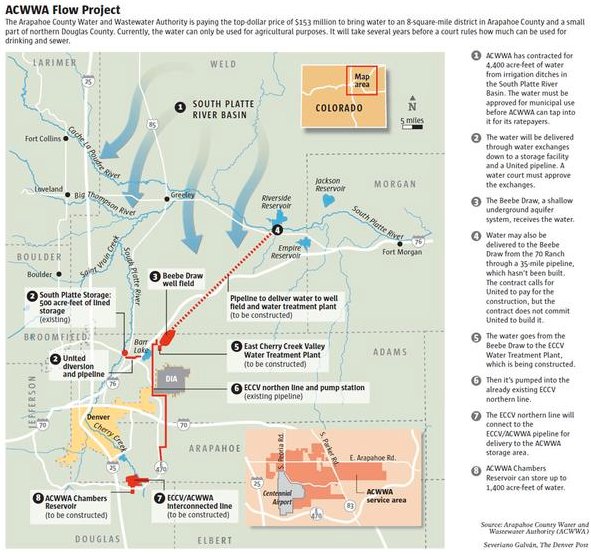
The Arapahoe County Water and Wastewater Authority scores 4,400 acre-feet of ag water from United Water and Sanitation, next up water court for a change of use

acwwaeccvdeal.jpg

From The Greeley Tribune (Eric Brown) via Windsor Now!:

Arapahoes’s purchases, negotiated over the past couple of years and finalized in September, still leave a couple of major questions yet to be answered. The county must win approval from water courts to use the water for municipal purposes and it must figure out a way to get the water from here to there. According to documents, Steve Witter, water resources manager for the Arapahoe County Water and Wastewater Authority, said during a presentation at an authority board meeting in September that 43 percent of the 4,400 acre-feet of water purchased by United Water and Sanitation District — on behalf of the authority — came from the Poudre River, while the other 57 percent came from the South Platte River. In an interview Monday, Witter noted that this marks the first time Arapahoe County — the third-most populous county in the state with nearly 600,000 people and whose municipalities include suburbs of Denver — has purchased water rights from farmers in northern Colorado. Witter said all of the agricultural water rights purchased on behalf of the water authority came from the Poudre and South Platte rivers. The transactions were made between United and individual shareholders of irrigation, ditch and reservoir companies — including 12 companies in Weld County, according to documents obtained by The Tribune…

Front Range municipalities, because of their rapid growth, have been buying agricultural water rights from farmers to secure the future water needs for decades. But because of the ongoing “buy and dry” trend, the 2010 Statewide Water Supply Initiative, compiled by the Colorado Water Conservation Board, estimates that 500,000 to 700,000 acres of irrigated farmland could be dried up by 2050 — a year by which Colorado farmers will also be expected to help feed a state population that will have doubled to about 10 million people, according to some estimates.

More Arapahoe County Water and Wastewater Authority coverage here and here.

Southeast Metro Stormwater Authority celebrates fifth anniversary

cherrycreekflood08031933castlewooddamfailure.jpg

Here’s the release from the SEMSWA via the Englewood Herald. From the release:

The Southeast Metro Stormwater Authority has celebrated its fifth anniversary of operations in the southeast Metro Denver area. SEMSWA, formed by a five-party intergovernmental agreement signed in September 2006, is responsible for stormwater management in the City of Centennial and the urbanized unincorporated portion of Arapahoe County. The authority was formed to provide a funding mechanism for the planning, construction and maintenance of drainage and flood control facilities, and to comply with federal environmental regulation to protect and enhance water quality in neighborhood greenways, flowing creeks and Cherry Creek Reservoir.

More stormwater coverage here.

Lamar pipeline: The Lower Ark Board listened politely (and critically) to GP Resources’ project preview yesterday

denverbasinwellsandpumping.jpg

From The Pueblo Chieftain (Chris Woodka):

The board had questions about the projected yield of the project, the problem of brine disposal from a proposed treatment plant and the idea of moving water out of the Arkansas Valley — which goes against the mission adopted by the district after voters formed it in 2002. “I compliment your approach, opposed as I am to any water leaving the valley,” said Reeves Brown, a Beulah rancher who sits on the Lower Ark board. “There’s a limit to what we think agriculture can give up in order to support growth in Colorado.”[…]

Upon questioning from the Lower Ark board, Nyquist said the only definite use for the water is in Elbert County. The Cherokee Metro District in Colorado Springs and Castle Rock in Douglas County have been approached, but decided on other options, at least in the short term, Nyquist said. “Right now, the pipeline ends at Falcon,” Nyquist said.

“It’s only a short distance to Reuter-Hess Reservoir (in Parker), which has 60,000 acre-feet of empty storage space,” said Jay Winner, general manager of the Lower Ark district…

GP is looking at either deep injection of brine or a solar heating system that would evaporate the water [ed. by-product of the proposed reverse osmosis water treatment plant]. The heating system, which could also generate steam to power turbines, has not been tested on a large scale, Nyquist said. It would also generate 16 truckloads of salt per week. “It could be used as sidewalk deicer,” Nyquist said. “As a private business, we will figure out another manufacturing opportunity for something that would just be waste.”[…]

[Karl Nyquist] said the assessed valuation of the ground on which the treatment plant is built would be greater than the value of the ground dried up. The combined wages from jobs at the treatment plant, reservoir and continued farm operations would more than make up for the temporary farm jobs that would be lost as a result of the dry-up, Nyquist said.

More Lamar pipeline coverage here.

Douglas County Conservation District presents Rural Water Authority of Douglas County

douglascounty.jpg

Here’s the release from the Douglas County Conservation District via the Castle Rock News Press:

The Douglas County Conservation District invites you attend the celebration of over 50 years of service to the Douglas County residence at our Annual Meeting of Landowners. This year our meeting will be held on Oct. 12 at 6:30 p.m. at The Lowell Ranch south of Castle Rock located at 2330 E. Frontage Road.

The presentation will be given by the Rural Water Authority of Douglas County. The Rural Water Authority of Douglas County was created to serve the rural water users of Douglas County in providing an adequate, sustainable and reliable water supply. A brief business meeting will be conducted before the presentation.

The District will also be awarding a $500 college scholarship to Patrick Taggart to use toward his tuition to assist in pursuing a degree in Agriculture. Pine Cliff Ranch will also be recognized as the District’s Conservationists of the year for 2011.

Please join us for an enjoyable evening with complimentary finger foods, desserts, coffee, and apple cider, along with great information, awards recognitions and door prizes. It will begin at 6:30 p.m. at The Lowell Ranch located at 2330 E. Frontage Road south of Castle Rock. Please RSVP by October 11th at 303-688-3042 ext. 100 or by email at pam.brewster@co.nacdnet.net.

More Denver Basin aquifer system coverage here.

The Parker Water and Sanitation District may lower their mil levy 31%

rueter-hessplans.jpg

From the Parker Chronicle:

Said Mary Spencer, President of the [Parker Water and Sanitation District] Board, “The tap fee income PWSD has received from new development allows us to pay debt and reduce property taxes from 14.925 mills to 10.172 mills in 2012. This translates to a savings on property taxes. The reduction in the mil levy also includes a onetime reduction in the operating portion of the mill levy by 0.925 mills to payback property taxes plus interest that were collected in excess of limits allowed under TABOR. In addition, the Board is presenting to their customers, at the October 17, 2011 budget hearing, that there be no increase in the 2012 wastewater rates and only a 4% increase in water rates. The 4% increase for the average in house use of 6,000 gallons is $1.59 per month…

The Board will consider the proposed budget for approval at the October 17, 2011 Board meeting to be held at 7 PM at the District’s North Water Reclamation Plant located at 18100 E. Woodman Dr., Parker , CO 80134.

More Parker coverage here.

Castle Rock: Three water providers show up at public meeting to pitch solutions to the city’s long-term supply needs

denveraquifer.jpg

From the Castle Rock News Press (Rhonda Moore):

Years after launching an effort to plan for a long-term source of renewable water, Castle Rock put out an invitation to hear from water providers that might be able to compete with the Water, Infrastructure and Supply Efficiency program, long touted as the solution to meet the needs of Castle Rock and several south-metro area municipalities.

Among the water providers that submitted bids were Renew Strategies, headed by former Gov. Bill Owens; Stillwater Resources, which acts as a broker to match providers with municipalities like Castle Rock; and United Water, which serves public water districts such as the East Cherry Creek Valley Water and Sanitation District and the South Adams County Water District.

WISE, a project from the South Metro Water Supply Authority, was not among the providers that responded to the request for proposal. WISE has long aimed to buy its water from Aurora and Denver and store it in the Rueter-Hess reservoir. The Army Core of Engineers earlier this year notified Rueter-Hess officials that the plan violates a provision of the reservoir’s federal permit, and town councils from Aurora and Denver have yet to approve a proposal for the WISE project.

The responses included a proposal from Renew Strategies to acquire underground water from the Lost Creek Basin for between $23,000 and $24,000 per acre foot, plus infrastructure costs of up to $75 million; Stillwater’s option to purchase 4,000 acre feet of Boxelder farm water rights for about $21,000 per acre foot; and United Water’s proposal to sell South Platte surface water to Castle Rock for $23,850 per acre foot, which includes about $9 million in infrastructure costs.

More Denver Basin aquifer system coverage here.

Castle Rock: Wednesday the Town Council and the Town Utilities Commission will hear from water providers who want to supply the long-term needs for the town

denveraquifer.jpg

From the Town of Castle Rock via the Castle Rock News Press:

Members of the public, along with Town Council and the Town Utilities Commission, will hear from the groups that wish to provide the Town with long-term water at a special meeting Sept. 14.

The meeting will begin at 6 p.m. in Council Chambers at Town Hall, 100 N. Wilcox St.

Three of the four groups that have been short-listed in the search for the Town’s long-term water provider – Renew Strategies, Stillwater Resources and United Water – will each make a half-hour presentation, followed by questions from Town officials and the public.

The fourth proposal – the WISE agreement between South Metro Water Supply Authority, Aurora Water and Denver Water – is being reviewed by the Aurora City Council prior to being released to the public.

All four proposals will be evaluated against the same criteria, which include the opportunity to succeed, cost, local partnership opportunities, existing infrastructure, experience and water rights.

Seven proposals in all were received in response to the Town’s June request for water supply proposals. All of those proposals were reviewed against the same criteria in placing the four remaining proposals on the short list. At [this] week’s special meeting, the three groups will introduce their projects and provide information on their concept, water supply characteristics and costs.

This effort to secure a long-term water source is just one component of the Town’s Legacy Water Projects – the goal of which is to transition the Town to 75 percent renewable water by the time it is built out. (All of the Town’s water currently comes from nonrenewable wells.)
There are two other major components to Legacy Waters:

• The purchase of water storage space in Rueter-Hess Reservoir, which will open next year near Parker
• The construction of a water purification facility in Castle Rock, which will provide for 35 percent of the Town’s renewable water needs by 2013

Additional funding will be needed to secure the water that is needed for the Town’s future. The Town may hold a property tax election in 2012 or 2013 in order to fund the Legacy Water Projects.

More Denver Basin aquifer system coverage here.

Flaming Gorge pipeline: Frank Jaeger (Parker Water and Sanitation District) and others are urging the state to continue looking at the proposed project

flaminggorgepipelinemillion.jpg

From The Pueblo Chieftain (Chris Woodka):

“While we are encouraged that the Flaming Gorge discussion sponsored by the roundtables and state of Colorado will attempt to foster agreement on key issues and take a fair look at the project, we are concerned that many groups are engaging in a political attempt to intimidate the participants and bias or terminate the process,” Parker Water and Sanitation Manager Frank Jaeger wrote in a recent letter to key state officials.

Environmental groups last month announced opposition to the study of the project by roundtables…

The [Colorado-Wyoming Cooperative Supply Project] is awaiting U.S. Bureau of Reclamation modeling of the Colorado River basin, expected to be complete later this year, before it wraps up its feasibility study launched in 2010. Since then, the group has further defined its needs: 105,000 acre-feet annually from the project to meet growth estimates to the year 2070…

The Colorado-Wyoming Coalition’s proposed project helps meet several positions taken on water by Gov. John Hickenlooper, Jaeger said. Those include:

– Protecting agricultural water.

– Providing an adequate supply of water to promote a strong economy.

– Helping to fill the municipal water gap identified in the 2010 Statewide Water Supply Initiative.

– Supporting the portfolio of strategies identified by the Interbasin Compact Committee: reuse, conservation, alternative agriculture-municipal transfers, completing identified projects and developing new projects.

More Colorado Wyoming Cooperative Supply Project coverage here.

Federal funding may become available for the south Metro suburbs, Aurora and Denver to use for the WISE project

prairiewaterstreatment.jpg

From The Denver Post (Bruce Finley):

Suburban water authorities said the project [Water Infrastructure Supply Efficiency or WISE], designed to reduce reliance on dwindling underground water, will cost about $558 million.

U.S. Bureau of Reclamation officials said “rural water supply” funds may be available for the project, if it survives a detailed feasibility review. Congress would need to authorize the federal funding, which could decrease the bill passed on to water customers. “What we’re looking at: Is this project capable of being completed? Is the cost-benefit going to work out? Is it going to be beneficial?” Bureau of Reclamation spokesman Peter Soeth said.

Meanwhile, a crucial wastewater purchase deal with Denver and Aurora has yet to be done. How much wastewater could be diverted, and how often, remains under negotiation. The suburbs told federal officials the WISE project would deliver 5,000 to 11,000 acre-feet a year for the first five years, then as much as 37,000 acre-feet a year…

The federal rural water-supply funds could be used because suburbs with populations under 50,000 are deemed “rural,” said Mark Shively, executive director of the Douglas County Water Resource Authority. “We have very aggressively pursued this opportunity,” Shively said. “We’re now about 20 percent into the feasibility study.”[…]

Beyond pipeline construction, the proposed project involves new storage of treated wastewater in surface reservoirs and by injecting it into depleted aquifers. “We have a couple reservoirs we’re looking at,” Shively said. “Between the Chatfield and Rueter Hess (reservoirs) we have a good amount of storage.”

Here’s the report from Reclamation.

More WISE project coverage here.

The Parker Water and Sanitation District snags the ‘Outstanding Water Laboratory’ award from AWWA — Rocky Mountain Section

chemistryglassware.jpg

From the Parker Chronicle:

In addition to receiving highest marks in a broad spectrum of water-quality tests and analysis processes, the award was also given to the district for its fieldwork performed beyond its customer service area of about 16,000 customers. The district’s lab technicians have been called to assist other districts in Arapahoe, Douglas and Elbert counties with water-quality testing and analysis due to inadequate on-site lab capabilities or under-trained personnel. Water district winners in all categories will be recognized at the Joint Annual Conference of the American Water Works Association on Sept. 18-21 in Loveland.

More Parker coverage here.

Parker Water and Sanitation and Stonegate are in merger discussions

denverbasinwellsandpumping.jpg

From The Denver Post (Bruce Finley):

…utility managers propose to merge water systems to spread debt and increase efficiency. It’s the sort of consolidation that industry leaders anticipate, in Colorado and nationwide, as problems with water supply and aging pipes intensify. But the Parker-Stonegate deal has set off a political storm. On Wednesday night, more than 170 Stonegate residents attended the latest informational meeting, and a majority indicated in an informal vote that they opposed the merger. “Nobody in our neighborhood understands what is going on,” said Stonegate resident Lisa Nejedlow, whose residential water pressure recently decreased sharply. “I don’t want to go with Parker. I don’t trust them. I think they have too much debt ($214 million) and they are trying to go into other people’s pockets.”[…]

If Parker (population 45,000) and Stonegate (11,000) were to merge their water systems, it would be the first signficant consolidation in the south metro area. There are more than 25 water utilities on the Front Range. Suburban developers created most of these special-use districts. Some serve as few as 25 people…

Stonegate and Parker residents would face property-tax hikes as well as rising water bills whatever they do. But hooking up with Parker’s system could solve Stonegate’s problem of having to upgrade its sewage-treatment system — estimated to cost at least $10 million. That expense would add to Stonegate’s $30 million debt from sinking 13 super-deep municipal wells, building a pool and community center and other spending, said Stonegate metro district manager Mitch Chambers…

Stonegate board members are divided. “We need to explore other options,” said Mike Sjobakken, one of two board members who are opposed, noting that a former Parker utility-board member who resigned amid controversy has been hired to help Parker project who would pay what if the utilities merged. “It would make sense to consolidate,” but maybe with multiple entities, not just Parker, he said.

More South Platte River basin coverage here.

Arapahoe County Water and Wastewater Authority deals are the subject of a Denver Post investigation

A picture named acwwaeccvdeal.jpg

From The Denver Post (Karen Crummy):

Arapahoe County Water and Wastewater Authority, known as ACWWA, proposes delivering its excess water to Castle Rock, even though the water isn’t yet approved for residential use. Castle Rock officials are wary. “We’re comparing projects. We’re not rushing into anything,” said Ron Redd, the town’s utilities director. “We need to make sure we partner up in a secure, long-term water deal. We can’t afford to make a mistake.”[…]

“Given ACWWA’s current surplus of treated and untreated water capacity and Castle Rock’s future water demands, a joint solution involving Castle Rock, ACWWA and United could be advantageous for all parties,” wrote Jim Dyer, ACWWA’s government-relations director, in a Feb. 11 letter to Redd…

Ten days ago, Redd gave the Town Council a memo that outlined the proposed project: South Platte River Basin water would be treated near Barr Lake and conveyed south through a pipeline to a delivery point near E-470 and Smoky Hill Road. Castle Rock would then have to build infrastructure to get the water to the Rueter-Hess Reservoir in Parker and then to the town service area. Redd’s memo points out his initial concerns, which include the town’s reliance on water that must be changed from agricultural use to municipal use…

Redd and his staff are analyzing the ACWWA/United proposal and another one from WISE — Water, Infrastructure and Supply Efficiency. WISE is a joint collaboration among Denver Water, Aurora Water and the South Metro Water Supply Authority (of which Castle Rock is a member and Redd is board president).

More South Platte River basin coverage here.

Cherry Creek Reservoir winter boating closure starts December 1

A picture named cherrycreekreservoir.jpg

From the World Fishing Network:

Cherry Creek State Park will close to boating on Wednesday, Dec. 1 due to the onset of winter and the seasonal closure of the aquatic nuisance species vessel inspection stations. All waters in the park will be closed to both motorized and non-motorized watercraft. Cherry Creek Reservoir will reopen to boating on March 1, as weather allows.

More Cherry Creek watershed coverage here.

More South Platte River basin coverage here.

Denver Water’s proposed rate increases attract the focus of councillor Jeanne Faatz

From The Denver Daily News (Peter Marcus):

The Board of Water Commissioners will hold a public hearing on Wednesday, as well as again next Wednesday, before voting on the proposal. The plan calls for an average increase for next year of $41 per year for Denver customers, or an increase of about $3.40 per month. The increase would be more than 10 percent for next year and comes as Denver Water officials warn that consumers may see an increase of 31 percent over the next three years. If approved, the increased water rates would take effect in March 2011.

Suburban residential customers would see an average increase of about $2.66 per month, or about $32 per year.

The proposal has already made a splash with Denver City Council members – but not the kind of splash that Denver Water would have liked. In addition to raising concerns over the impact a rate increase could have on constituents, Councilwoman Jeanne Faatz took the opportunity last month to raise questions over the organization of the Denver Water board itself.

Currently, the Board of Water Commissioners is a five-member board that is appointed by the mayor of Denver. Faatz questioned whether it wouldn’t be a better idea to switch to a board that is elected by the people, to perhaps better represent the interests of voters.

“Our same people are paying these rates and they have definitely let us know that they are not interested in increased taxes and we have tried to listen to that and be responsive, and they’re not interested in higher fees, and yet you all just pretty much as an enterprise get to set what you set and charge them,” Faatz told Denver Water officials at a City Council briefing last month.

More Denver Water coverage here.

CWCB: New transmountain pipeline concepts update

A picture named dnrpipelineconcepts309

From The Pueblo Chieftain (Chris Woodka):

The Colorado Water Conservation Board is looking at three new transmountain possibilities and two pumpback plans in the Arkansas and South Platte river basins in an analysis of supply options that could provide between 100,000 and 250,000 acre-feet per year of new water to the Front Range.

Only one of the projects, a 540-mile pipeline from Flaming Gorge Reservoir in Wyoming to Colorado’s Front Range, is actively being pursued. Entrepreneur Aaron Million and the South Metro Water Supply Authority both looking are at it. The “Big Straw” plan, or Colorado River Reconnaissance Project, was not evaluated in the latest study because of its high initial cost to build. It would bring water from the Colorado River near Grand Junction to the Front Range. Other projects studied were from Blue Mesa Reservoir and the Yampa River. The Green Mountain pumpback plan also was included in the study, although it would provide about 68,000 acre-feet annually — less than the other 100,000 or 250,000 acre-feet plans.

The Arkansas Valley plans would move water from either La Junta or Avondale to Rueter-Hess Reservoir near Parker. From either place, the cost would be nearly $100,000 per acre-foot over the 50-year life of the project and supply 100,000 or 250,000 acre-feet, according to a report by CDM engineering. All of the other options come in around $80,000 per acre-foot or less over 50 years. One of the South Platte options would cost around $70,000, while the Green Mountain option is about $40,000 over the life of the project. The reason for the discrepancy would be the need for reverse-osmosis, coupled with unproven methods of zero liquid discharge, to bring Arkansas Valley water up to drinking quality…

The new report, now in draft form, will be part of a Colorado Water Conservation Board’s water needs assessment expected to be complete in January.

More CWCB coverage here.

Castlewood Dam failure and flood — August 3, 1933

Castlewood Canyon Dam ruins

Here’s a look back at the catastrophic failure of the Castlewood Dam on Cherry Creek, from Jeffrey Wolf writing for 9News.com. From the article:

Heavy rain put too much pressure on the Castlewood Dam, located in what is now the Castlewood Canyon State Park near Franktown. The 300 feet of rock and concrete gave out and a wall of water rushed through Cherry Creek. It flooded farmland, swept away buildings, and tore down bridges 30 miles away in downtown Denver. It was the worst flood ever in Denver and the damage was extensive.

Rueter-Hess Reservoir: Castle Rock residents can get up close and personal with the project August 7

A picture named rueter-hessplans

From The Douglas County News Press:

The Rueter-Hess Reservoir, presently under construction in Parker, is an important part of Castle Rock’s sustainable water strategy. The town is offering residents this chance to tour the reservoir before it’s filled with water. Castle Rock residents are invited to take a self-guided driving tour from 9 a.m. to 1 p.m., Aug. 7.

Rueter-Hess is key to Castle Rock’s long-term water supply. The town has partnered with Parker Water and Sanitation District, Castle Pines North Metro District and Stonegate Valley Metro District on the project, scheduled for completion in 2012. This is one of the biggest water supply reservoirs to be constructed, in Colorado and along the Front Range, in decades.

Residents can stop by to see exhibits and water experts, to answer questions about this and other water projects. Please note the tour will be cancelled in the event of rain.

The reservoir is at 9343 Newlin Gulch Road in Parker. For directions and a map, go to CRgov.com/rhtour.com.

Questions? Contact Carolyn Richards, crichards@CRgov.com or 720-733-6002.

More Rueter-Hess Reservoir coverage here and here.

Centennial: New $30 million Joint Water Purification Plant completed

A picture named watertreatment

From the Centennial Citizen (Peter Jones):

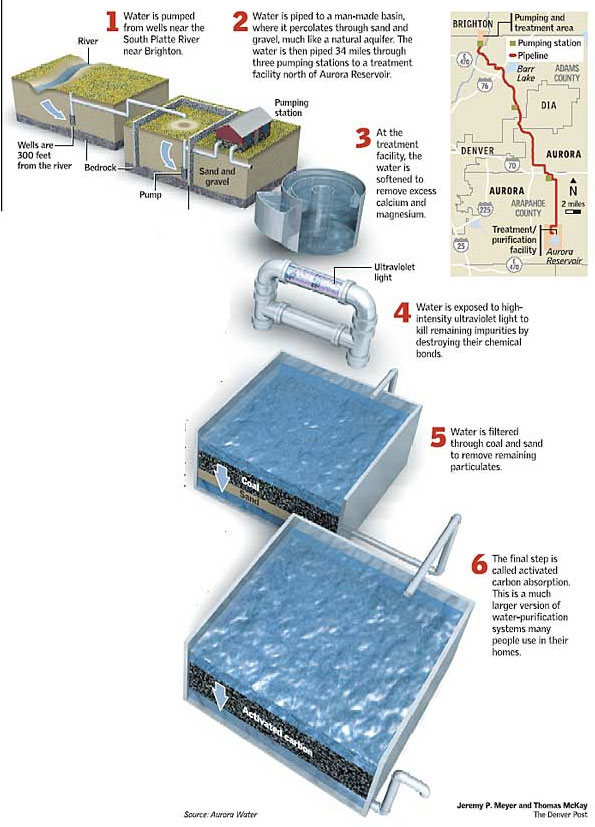
The facility on Jordan Road, a few miles south of Arapahoe Road, will provide up to 12 million gallons a day of potable water from Cherry Creek to about 12,000 residents and 30,000 employees in the area. [Arapahoe County Water and Wastewater Authority and Cottonwood Water and Sanitation District] say they entered into the cooperative venture to meet customers’ increasing potable water demands and to reduce reliance on nonrenewing deep-ground water supplies. “This plant is a major step in being able to supply our customers with the growing demand of water,” Authority general manager Gary Atkin said. “The new plant will also increase the quality of the water we provide.”

Unlike other reverse-osmosis plants in the state, the Joint Water Purification Plant is incorporating a process for disinfection called “advanced oxidation” that eliminates pharmaceuticals and other industrial chemicals that can show up in a water supply. “Microfiltration” will be used to clean up the portion of the water that is returned to Cherry Creek.

More water treatment coverage here.

Parker Water and Sanitation District board election recap

A picture named rueter-hessplans.jpg

From the Parker Chronicle (Ashley Dieterle):

Two positions are now filled on the Parker Water and Sanitation District board of directors after an all mail-in ballot election. Current board president Mary Spencer earned the most votes, with a total of 1,327 followed by candidate Darcy Beard earning 1,166 votes. Both women earned four-year terms.

More Parker coverage here and here.

Parker: Rueter-Hess Reservoir ready to store water

A picture named rueter-hessplans.jpg

From The Denver Post:

Parker Water & Sanitation District officials announced that construction of the Rueter-Hess Reservoir — which is 180 feet deep and spans 1,400 acres — has reached a stage where water can be received. State officials have approved a request to allow water in nearby Newlin Gulch to be stored in the reservoir.

More Rueter-Hess Reservoir coverage here and here.

CWCB: Is there a transmountain pipeline in Colorado’s future?

A picture named coloradopipelineconcepts.jpg

From The Pueblo Chieftain (Chris Woodka):

The state is pondering proposed pipelines to move water from most areas of the state to the Front Range in an attempt to meet future water demands. Not all will be built, and none has been officially endorsed…

Strategies in the report that move water from one basin to another include:

Flaming Gorge Pipeline: Proposed by Aaron Million, it would bring water from Flaming Gorge Reservoir in Wyoming to reservoirs near Fort Collins and Colorado Springs. Yampa Pumpback: A pipeline would look at bringing water from Maybell to the Brighton area.

Green Mountain Pumpback: Water from Green Mountain Reservoir would be pumped back to Dillon Reservoir and moved to the Denver area.

Big Straw: A pipeline would take water from the Colorado River at the state line near Grand Junction and bring it to the Front Range.

At the request of Front Range roundtables, another project, the Blue Mesa Pumpback in the Gunnison River basin, also is being studied…

There are also alignments of pipelines in both the Arkansas and South Platte basins that would bring water to the Front Range, possibly storing it in Rueter-Hess Reservoir, a 72,000 acre-foot reservoir constructed near Parker that currently lacks water to fill it.

Here’s some background on solving Colorado’s water supply problems, from Chris Woodka writing for The Pueblo Chieftain. From the article:

The newest project, proposed by entrepreneur Aaron Million, would build a pipeline from Flaming Gorge Reservoir that would go around Colorado’s Rockies rather than through them. Another, the Yampa River pumpback plan, was suggested by the Northern Colorado Water Conservancy District. Those still face the pressure of a skeptical audience. The concept behind each of the projects – building a large-volume project to bring more water across the Continental Divide – is under renewed study by the Colorado Water Conservation Board, but a long way from becoming reality. Taking water from the Rio Grande basin is for the moment off the table, but all of the Colorado River basins are part of the CWCB study. Other plans look at moving water from farmlands in the Arkansas and South Platte valleys to serve population growth…

For the next decade, the major cities began developing alternatives to the big projects of the past, leading to major changes in how water was developed. There was more talk of recycling, drying up more farmland and more long-range planning. There was more speculation by private developers to buy ag water rights from struggling farmers to hold until the cities were willing to pay. That happened during two very wet decades in the 1980s and ’90s.

When the drought of 2002 came, the state mobilized in new ways. The CWCB launched its Statewide Water Supply Initiative, which in 2004 identified more agricultural dry-ups as the easiest way to meet future urban demands. State voters turned down Referendum A in 2003 that would have created a $2 billion state fund to develop projects. When the top-down approach didn’t work, the state Legislature created the grass-roots Interbasin Compact Committee and basin roundtables to help tackle the gnawing question: Could another transmountain project be developed?[…]

The state studies of water projects looked at the relative feasibility of each and found that it could be expensive to develop more than one. Each project could bring about 250,000 acre-feet and would cost between $7.5 billion and $10 billion to build. “Projects have a better chance of success if they evaluate and mitigate impacts and produce benefits in both the basin of use and the basin of origin,” [Jennifer Gimbel, CWCB executive director] said.

Even if agreements are reached, more water would be needed. Conservative estimates of growth and water needs call for 830,000 acre-feet of new supplies in 50 years, when the state’s population is expected to double to 10 million people. Could the carrying capacity of existing diversions be increased? “The state hasn’t looked at this comprehensively,” Gimbel said. “However, most of the transmountain projects are being used to full capacity, depending on the demand pattern on the East Slope. In other words most projects use as much transmountain water as is physically and legally available.” The IBCC’s model for balancing water portfolios between strategies – conservation, more diversions, ag dry-ups – is a useful tool, but has not produced the answer so far. Groups looking at the problem focused on general proportions, not a specific project at the most recent meeting.

More CWCB coverage here.

Parker: Recall of Parker Water and Sanitation board fails

A picture named denveraquifer.jpg

From The Denver Post (Bruce Finley):

A proposed water-rate hike last year prompted the campaign to oust four members as irresponsible. Board members backtracked, but campaigners pushed on. The results — board president Mary Spencer survived by 30 votes, Root by 7, Mike Casey by 58 — won’t be final until Dec. 30, Douglas County Clerk and Recorder Jack Arrowsmith said. At least one race requires a recount.

Parker’s 12-month tussle reflects rising tension over water in Front Range suburbs, where water managers are struggling to obtain and divert renewable water from mountain rivers as local groundwater supplies dwindle. “This is the kind of battle we’ll see played out with greater frequency as the demands on these finite water resources intensify,” said water expert David Getches, dean of the University of Colorado law school and former state director of natural resources. “We’ve allowed, in Colorado, whole subdivisions and whole communities to be built on nonrenewable water supplies.” Parker’s five-member board oversees the water supply for more than 22,000 people southeast of Denver who rely on 30 wells, from 51 to 2,745 feet deep, that draw fewer and fewer gallons per minute. State data show water tables falling 30 feet a year…

Frank Jaeger, the water-district manager, is leading a drive to divert upper Colorado River Basin water to Denver suburbs from western Wyoming. The $230 million Rueter-Hess reservoir under construction near Parker — one of Colorado’s biggest water- storage projects in decades — would hold that water, along with creek runoff and reused water treated at a new high-tech chemical plant. Jaeger’s district, established in 1962, is one of dozens created after developers built subdivisions across semi- arid terrain and left decisionmaking to the residents. Now, boards face difficult decisions as economic doldrums limit residents’ abilities to pay higher water rates…

“What we learned is, we weren’t doing a very good job of educating the public,” [accountant Darcy Beard] said. “The cost of water in Colorado is never going to go down. We live in a high-desert environment.”

More Parker coverage here.

Parker: Recall of Parker Water and Sanitation Board failing according to early results

A picture named rueter-hessplans

From The Douglas County News Press (Ashley Dieterle):

Board president Mary Spencer had 1,976 votes to retain her in office, edging out the 1,946 votes to recall her by only 30. Mike Casey earned 1,983 votes to keep him in office versus the 1,925 votes to recall him. Sheppard Root had the narrowest lead Tuesday night with the 1,962 votes to retain his seat beating the recall tally of 1,955 by only seven votes. The one vacant position will be filled by Randall Huls wining 1,415 votes over Darcy Beard (1,217) and Tracy Hutchins (753).

More Parker coverage here.

Parker: Rueter-Hess Reservoir update

A picture named hessplans.jpg

So far Parker and its partners in Rueter-Hess Reservoir — currently under construction southwest of the city — do not have enough surface water to fill the 77,000 acre-foot reservoir. Here’s a report from Bruce Finley writing for The Denver Post. From the article:

The prospect of what critics call an empty bathtub is generating anxiety around Colorado as water managers clash over the last unclaimed mountain river flows. Most water to fill the Rueter-Hess reservoir “will have to be imported,” said Frank Jaeger, manager of the Parker Water and Sanitation District, who for 25 years has led the effort to supply 450,000 suburban residents. Importing water would require multibillion-dollar pumping and piping from rivers running down the western side of the Continental Divide, such as the Colorado, back across mountains to Front Range residents, Jaeger said. Though huge, the costs likely would be less than for alternatives such as trapping and treating contaminated water from the South Platte or Arkansas rivers, he said. The option Jaeger and a Colorado-Wyoming coalition of municipal suppliers favor — one of four being considered by state natural resources officials — would divert water from the Flaming Gorge Reservoir in western Wyoming along Interstate 80 to Colorado…

Yet Colorado Western Slope leaders see the $230 million Rueter-Hess reservoir as folly — and bristle at talk of diverting more water across the mountains to fill it. The reservoir “is 20 times more expensive, and 10 times as big as they need. It’s going to be a little bit of water in a big bathtub,” said Eric Kuhn, manager of the Colorado River Water Conservation District, based in Glenwood Springs. The financing, based on tap fees from anticipated housing construction, “is the water equivalent of a Ponzi scheme,” Kuhn said…”There’s a very good chance that, in the long run, there’s not going to be any more water available on the Western Slope. And, if they’re having trouble now paying for Rueter-Hess, how are they going to pay for moving water from the Western Slope? That’s why I say this is a fairy tale,” Kuhn said…

This month, more construction vehicles are rolling into action to build up the 7,700-foot-wide Frank Jaeger Dam at the reservoir. Critics “can make their claims,” but the reservoir will be crucial to sustain population growth, Jaeger said. Paying off the debt for the construction now underway all depends on tax revenues from future growth, he said. “To say, ‘We’ll just shut off growth’ will only exacerbate problems,” he said. “If you don’t pay off debt, what do you do? What does that do to the economy of the whole state? We need steady, controlled growth. All our needs for a reasonable lifestyle are tied into this.”

More Rueter-Hess coverage here and here.

Parker: Searching for dough to complete Rueter-Hess

A picture named rueter-hessplans.jpg

The collapse in real estate in Parker has had a negative impact on funds for Parker Water and Sanitation’s Rueter-Hess Reservoir. Here’s a report from Chris Michlewicz writing for the Parker Chronicle. From the article:

When the housing market began its long slide into the abyss in 2006, district officials immediately began to notice the impact. The number of tap fees collected went from 1,700 in 2005 to suddenly 600 the following year. Last year, just more than 300 taps were connected. This year, as of June 4, only 18 taps have been sold. “All of our planning was based on a worst-case scenario of 600 taps per year,” [Frank Jaeger Parker Water and Sanitation District’s longtime manager] said during an interview in late April. “This thing has escalated on us.”[…]

Unfortunately for the district — and for its customers, it turns out — the end came into sight much quicker than ever thought possible. Between 2005 and 2008, Parker water collected $65.9 million in taps fees. The money funded capital projects, built up reserve funds, and was also used to pay debt service on the $105 million in revenue bonds issued in 2004. (Money for the expansion was paid up front by Castle Rock, Castle Pines North and Stonegate, who entered into a partnership to buy water storage in Rueter-Hess, which is still under construction just southwest of Parker’s town boundary). Counting the 5.118 percent interest rate on the bonds, Parker water is responsible for paying $12 million per year on its debt. To date, according to its finance director, the Parker Water and Sanitation District has paid only $4.1 million of the loan principal. That means the outstanding principal for Rueter-Hess alone stands at $101.3 million. And there is little in the way of revenue coming in right now. Enter last December’s proposed rate and fee increase of 28 percent on the water district’s 12,900 customers…

Conversely, prospective residents have a new quandary to consider. They, along with the existing population, will be responsible for covering the remaining costs for Rueter-Hess Reservoir, plus another $80 million in outstanding district debt, unless development picks up soon. Those who eventually move into The Canyons, a massive planned residential development just north of Castle Rock that will also be served by the Parker water district, will pay the high cost of water and eat the tap fee expense that is passed on from the developer. “People moving into Parker who haven’t got their homes built right now are in for that same surprise,” Jaeger said. “There’s no getting away from the cost of developing water.” One study conducted by a district consultant showed that the Parker area will need roughly 31,000 acre-feet of water as an indefinite supply. Jaeger is still exploring options — some very promising — for obtaining water for the future. “I’m looking 100 years down the road,” he said. “This community is not going to go away, and it’s going to need a water supply.”

More Coyote Gulch coverage here and here.

Parker: Group seeking to remove Parker Water and Sanitation board members appeals decision to throw out recall petition

A picture named rueter-hessplans.jpg

Here’s an update on the recall petition for Parker Water and Sanitation board members, from Chris Michlewicz writing for the Parker Chronicle. From the article:

Transparency Advocates for Parker Water and Sanitation filed an appeal earlier this month to have a Douglas County District Court judge review whether there was a legal basis for throwing out the petition, which contained more than 500 signatures. Douglas County Clerk and Recorder Jack Arrowsmith ruled that false or misleading information was used when the group was circulating the petition. Now the Transparency Advocates are challenging the grounds for the dismissal because they say county officials misinterpreted the scope of their duties. “It pains me to point the finger at Jack Arrowsmith because I think he relied on faulty legal advice,” said Merlin Klotz, a member of the recall group.

In one claim, TAPWS did not accuse the water board members of legal wrongdoing, but rather suggested that they violated the public trust by circumventing Colorado’s open meetings law. The law requires public notice when three or more board members meet to discuss business. Some board members have admitted to speaking individually with one another about rescinding a water rate increase that was approved in December. The group says Arrowsmith should not have reviewed the allegation and dismissed the petition because his ruling stated that the evidence was insufficient to prove that the law was broken.

Arrowsmith could have scheduled a recall election that enables the public to decide whether four out of the five Parker Water and Sanitation District board members should be unseated…

The petitioners said Arrowsmith also failed to notify the recall petition targets on the day the petition was approved. The letters to the board members about the approval were dated March 11, four weeks later than required by law.

In its appeal to Douglas County District Court Judge Vincent White, TAPWS outlined several other examples of what it calls improper interpretations of the law when deciding to throw out the petition, which was submitted in February. Klotz said the clerk and county attorneys might have used the dismissal to cover up possible legal errors. County officials declined to address any specific allegations in the pending case. Arrowsmith dismissed the petition April 23 after finding that information on the opposition group’s Web site could have unfairly swayed the opinions of those who signed it. TAPWS maintains that the information was accurate.

More Coyote Gulch coverage here.

Newlin Gulch and the Clean Water Restoration Act

A picture named effluent.jpg

The Bush administration weakened protections for streams and wetlands with rules issued by the EPA. Several attempts at restoring jurisdiction failed during the last few years. Here’s a report about Newlin Gulch which empties into Rueter-Hess Reservoir from Make Jaffe writing for the Denver Post. From the article:

More than 76,000 miles of Colorado streams — 73 percent of the state’s waterways — are, like the Newlin Gulch creek, at risk of losing federal wetlands and pollution protections. The reason: U.S. Supreme Court decisions and Bush administration interpretations of those rulings that limit the scope of the Clean Water Act…

Also at risk are water pollution safeguards because a quarter of the sewage treatment and industrial outfall pipes are on Colorado waterways that don’t meet the “waters of the United States” definition, a Trout Unlimited study found. Nationwide, 20 million acres of wetlands and 2 million miles of waterways could be affected, according to federal estimates…

Which waterways get Clean Water Act protection was redefined by the U.S. Supreme Court in two rulings. The first, in 2001, found that some isolated intrastate ponds weren’t protected by the act because the law refers to “navigable waters” and the ponds were not. The justices equated “water of the United States” with navigability. The second, in 2006, limited wetlands protections to only “relatively permanent waters” connected to navigable waterways. The Bush administration followed up both cases with guidance to the Army Corps of Engineers and the Environmental Protection Agency that used the decisions to remove many wetlands and streams from the regulation. The guidance also said decisions on what water is protected would be made on a case-by-case basis…

Which waterways get Clean Water Act protection was redefined by the U.S. Supreme Court in two rulings. The first, in 2001, found that some isolated intrastate ponds weren’t protected by the act because the law refers to “navigable waters” and the ponds were not. The justices equated “water of the United States” with navigability. The second, in 2006, limited wetlands protections to only “relatively permanent waters” connected to navigable waterways. The Bush administration followed up both cases with guidance to the Army Corps of Engineers and the Environmental Protection Agency that used the decisions to remove many wetlands and streams from the regulation. The guidance also said decisions on what water is protected would be made on a case-by-case basis.

More Coyote Gulch coverage here and here.

CWQCC: No to increased sewage in Cherry Creek watershed

A picture named cherrycreekreservoir.jpg

From the Denver Post: “The Colorado Water Quality Control Commission voted March 10 to reject a proposal that would have reduced water quality in Cherry Creek Reservoir, one of the state’s most active fisheries and site of a popular state park. The Cherry Creek Basin Authority and Parker Water and Sanitation District had sought to increase algae levels in the lake and the amount of sewage discharged in the basin. Fifteen citizens testified against the proposal at the hearing, as did the Colorado Division of Wildlife and the U.S. Environmental Protection Agency.”