Swim class on the San Juan River. Photo: Brent Gardner-Smith/Aspen Journalism
Click here to read the January, 2019 Western Rivers Newsletter (Abby Burk). Here’s an excerpt:
Colorado’s legislative session is off to a caffeinated start. The session began on January 4 and runs through May 3, 2019. Governor Polis—along with his new administration and new Democratic leadership in both the State House and Senate—are setting the scene for a busy legislative session.
There are two main dynamics charting the work of Colorado’s lawmakers in water: the ongoing 19-year Colorado River Basin drought and funding for Colorado’s Water Plan.
Due to plummeting water levels in the Colorado River’s two main reservoirs (Lake Powell and Lake Mead) the Colorado Water Conservation Board voted in November, 2018, to support a Colorado River Drought Contingency Plan (DCP). Colorado joined neighboring Upper Basin states of Wyoming, Utah, and New Mexico in support of the DCP in December. Now, all eyes are on the Lower Basin states of California, Nevada, and Arizona as they also evaluate support for a DCP by the looming January 31, 2019, deadline imposed by the Bureau of Reclamation. If the DCP and the necessary water sharing practices are to be successful, Colorado and other states will need improved water policies and funding to protect rivers and compact water deliveries.
In light of climate change, drought planning, and population growth, birds and people need the objectives and actions for increased water security contained in Colorado’s Water Plan more than ever. However, funding for Plan implementation has fallen short. The Water Plan calls for funding needs of $100 million annually from 2020-2050. That’s roughly $3 billion to sustainably fund increased water conservation and efficiency for cities and towns, methods to keep agriculture thriving, and stream and watershed health improvements.
With the DCP and drought top of mind, there has been some positive movement for Water Plan funding. Governor Polis’s budget contains the $30 million investment initially proposed by Governor Hickenlooper to fund the Colorado Water Plan and help mitigate drought, particularly for relief in rural communities. Also, the Colorado Water Conservation Board has proposed $20 million for Water Plan implementation in the 2019 “Projects Bill” that will be submitted later in the session for legislature approval. That’s $9 million more than in 2018.
Water legislation in 2019 is already off and running with much more to come. As we make decisions about water, there is a lot at stake for birds, other wildlife, agriculture, and communities. Audubon is at pace with and fully engaged on conservation and water legislation every step of the way. We will be calling on you to engage in action alerts and education events in 2019. Register for Getting Green Laws, an event that will include legislation training on the evening of February 19th in Denver and a rivers action day at the State Capitol on February 20th.
For Colorado’s rivers and streams, we thank you for your engagement.
Early-session Colorado water legislation that Audubon is engaged with:
SJM19-001 Memorial For Arkansas Valley Conduit – Memorializing the United States Congress to fulfill the commitment of the federal government to provide funding for the Arkansas Valley Conduit project. From the Water Resources Review Committee
SJM19-002 Corps Of Engineers To Dredge Lower Arkansas River – Concerning memorializing the United States Congress to enact legislation directing the United States Army Corps of Engineers, in conjunction and cooperation with the Lower Arkansas Valley Water Conservancy District, to dredge a portion of the Arkansas River
The Office of the State Engineer has filed the proposed Republican River Compact Water Use Rules with Water Court Division 1 in Greeley.
The filing was made last Friday, January 11.
The process for developing the rules included several public meetings with a special advisory committee. It was comprised of volunteers representing users and interests throughout the Republican River Basin. The meetings took place within the basin, and the last one was last August.
As drafted, the rules allow the state to administer surface water and groundwater wells for compliance with the 1942 Republican River Compact.
It includes the state engineer’s ability to curtail wells, which means issuing a cease and desist.
However, Deb Daniel, the general manager for the Republican River Water Conservation District, noted that wells that are within the Republican River Domain and have an augmentation plan are protected from curtailment.
That means all wells located with the Republican River Water Conservation District are protected, due to the district’s augmentation efforts such as the compact compliance pipeline, purchasing surface water rights, and providing financial incentives for well owners to voluntarily retire their wells, such as through CREP and EQIP conservation programs.
However, the Republican River Domain boundary is different than the RRWCD boundary, so there are some wells that currently are not protected from the potential curtailment. There is legislation currently before the Colorado State Legislature that will expand the RRWCD’s boundary to including all of the Republican River Domain.
Division 1 Water Court will have to rule on the proposed rules before they go into effect.
Well owners can make filings for or against the proposed rules with the water court. The case number is 2019CW 3002.
One can learn more about the rules at the Colorado Division of Water Resources website, http://water.state.co.us.
Newly inaugurated Governor Jared Polis had a low-key and positive start on water. His natural resource transition included Hickenlooper’s in-house water expert, John Stulp. Water policy in his State of the State address was only one paragraph, but it succinctly supported the State Water Plan and advocated getting it funded. He linked Colorado’s water to its agricultural needs, which is one of the key principles of the plan. That is, preserving agriculture in Colorado requires intelligent and prudent water management.
State of the State on Water
“The lifeblood of our agriculture industry is water – which is why we must commit to a bipartisan and sustainable funding source for the Colorado Water Plan. Governor Hickenlooper, along with the leadership of John Stulp, did extraordinary work bringing together a coalition of Coloradans from all corners of our state to create the Water Plan. Now we’re going to do our part by implementing it.” State of the State address, Jan. 10, 2019
Dealing with the water gap that is well identified in the State Plan is essential to protect irrigated agriculture and support the state’s quality of life and economy. The largest number of residential, business and agricultural water users are in the Arkansas and Platte basins. Their needs must be balanced with other users and uses, including recreation, wildlife and aesthetics.
Tuesday, Gov. Jared Polis took the oath of office, in a ceremony that included poets and blessings from a variety of faith leaders. Thursday, the state’s 43rd governor presented his first state of the state address under a theme of “A Colorado for All.”
“The state of our state is solid. It is strong. It is successful. It is daring. And it is bold,” one of Polis’ favorite watchwords and one that he repeated eight times during the speech….
On agriculture, Polis pointed out that “volatile commodities markets, a damaging trade war from Washington” and an increasingly serious water shortage are making life harder for those in the ag industry. He said his pick for ag commissioner — Kate Greenberg, formerly of the National Young Farmers Coalition — will focus on the future of farming.
Polis also pledged to a “bipartisan and sustainable funding source” for the state water plan, and to partner with groups like the Rocky Mountain Farmers’ Union to “reduce barriers to employee ownerships and to grow wages in the ag sector,” as well as expanding access to capital for the next generation of farmers.
Polis emphasized his commitment to renewable energy and addressing climate change, both which will require less dependence on fossil fuels. But he also pledged to find ways to take care of those who work in the energy industry. “Some of the hardest-working people in Colorado today work in the coal and oil-and-gas industries and we will not leave them behind,” he pledged. That means transitioning to good-paying jobs that take advantage of the skills and experience of those workers…
Polis later told reporters he would favor a 3 to 5 percent reduction in the income tax rate, a proposal contained in a bill introduced in the state Senate on Thursday.
Senate Bill 55 is sponsored by northeastern Colorado lawmakers Sen. Jerry Sonnenberg of Sterling and Rep. Rod Pelton of Cheyenne Wells. Polis said he had not yet seen the bill as of Thursday, but it appears to match his proposal from the speech.
SB 55 would reduce the individual and the corporate state income tax rate from 4.63 percent to 4.49 percent; and reduces the state alternative minimum tax by 0.14 percent. It has been assigned to the Senate Finance Committee; no hearing date has yet been set…
“While it is important to look towards the future of agriculture, it’s vital not to forget the lessons the past has taught us,” said Colorado Farm Bureau president Don Shawcroft. “Support of all farmers and ranchers across the state is key, whether they are big or small, organic or conventional, young or old.”
As to the water plan, Shawcroft added that agriculture “is most profitable and most productive when farmers and ranchers have access to the water resources they need. Those resources can’t be tied up on the Front Range.”
[…]
On Monday, that committee is scheduled to review House Bill 1029, which would redraw the boundaries of the Republican River District. Democratic Rep. Jeni Arndt of Fort Collins is sponsoring the bill on behalf of the interim Water Resources Review Committee, and told this reporter that new boundaries will pull in well owners whose groundwater pumping is depleting the flow of the Republican as well as interfering with compact compliance. The district was drawn by the legislature in 2004 along a geographic ridge and now must be modified to include these additional well owners. Arndt said that those in the district pay $14.85 per irrigated acre for compact compliance; the well owners brought in under HB 1029 will also pay that fee.
The largest group of well owners to be brought into the district are located in Kit Carson and Cheyenne counties. The redrawn boundaries also would bring in a small portion of Washington County.
Karley Robinson with newborn son Quill on their back proch in Windsor, CO. A multi-well oil and gas site sits less than 100 feet from their back door, with holding tanks and combustor towers that burn off excess gases. Quill was born 4 weeks premature. Pictured here at 6 weeks old.
Polis’ uber-reasonable tone had a disarming effect. Who would profess to be against early childhood education or lower health-care costs? The new governor artfully framed long-contentious issues as solvable so long as lawmakers have the state’s best interests at heart…
Other items that resonated with rural communities: supporting the outdoor recreation economy, but “doubling down” on supporting the state’s agricultural producers. That means protecting the industry’s lifeblood — water. “We must commit to a bipartisan and sustainable funding source for the Colorado Water Plan,” Polis said…
Infastructure — broadband, roads, public transit — all need investment and funding sources. Polis’ framed his call for 100 percent renewable energy as “not just about climate change,” but saving money for consumers withe cheaper energy and “making sure the good-paying green jobs of the future are created right here in Colorado.”
The governor’s speech hit on all the points meaningful for his supporters without causing undue fear for the rest of the state — with the possible exception of oil and gas companies and “influential” corporations. Polis indicated he wants to let communities have more say about industrial activities withing their borders and he wants to make the tax code more fair. That means closing loopholes that benefit corporations.
In his first major policy speech in office, Colorado Gov. Jared Polis outlined an optimistic and ambitious plan for his first year in office and promised to work to make law his lofty goals regarding education, climate change, health care, infrastructure and energy and to work to keep Colorado “the best state in the nation.”
[…]
He won applause early in his speech when he acknowledged the “record-setting number of women” now serving in the General Assembly – second in the U.S. to Utah. And he received another standing ovation for a thinly-veiled dig at the Trump administration.
“Here in Colorado, we treat each other with respect. We reject efforts to intimidate immigrant families, or tear children from their parents’ arms,” Polis said. “We don’t tolerate bigotry or discrimination of any kind. And we don’t accept hostage-taking as a form of governance. … So, in the spirit of putting problem-solving over partisanship, let’s work together.”
[…]
Regarding energy, Polis reiterated his commitment to Colorado using 100 percent renewable energy by 2040 and said there would be no more doubting the effects of climate change.
“Climate change is a scientific reality. It’s real. There’s no pretending otherwise for farmers and ranchers wo are facing historic water shortages. There’s no pretending otherwise for the 46,000 men and women who work in Colorado’s ski industry and see their jobs threatened by decreased snowpack,” Polis said. “And there will be no pretending otherwise in this administration.”
He said that his administration would also “do right by all the men and women in today’s energy workforce” and acknowledge the state’s coal and oil and gas workers, saying, “We will not leave them behind.”
“We will embrace the skills and experience these Coloradans bring to the table. Their help will be needed and rewarded at every single step of this transition,” Polis said. “And we will support the communities these jobs have sustained, to ensure they can continue to thrive in the renewable-energy economy.”
But at the same time, Polis hinted that he would allow for local control over some industries, like oil and gas, which several Front Range communities have called for in the face of new fracking development.
“Just as we stand up for workers and good jobs, so too must we stand up for our communities and their right to have a voice when it comes to industrial activities within their borders,” he said. “It’s time for us to take meaningful action to address the conflicts between oil-and-gas drilling operations and the neighborhoods they impact, and to make sure that all of our communities have clean air and water.”
Colorado River drought planning as well as the funding dilemma behind the state’s ambitious water plan, are among the water issues likely to win stage time at the Colorado State Capitol this year.
When the session opens Friday, Democrats will control both chambers, having retained the majority in the House of Representatives and taken control of the Senate as a result of the November elections.
The two committees where most water bills originate have new leadership as a result of the political shift. Sen. Kerry Donovan (D-Vail) is now chair of the Senate Agriculture and Natural Resources Committee, and Rep. Dylan Thomas (D-Avon) is now chair of the House Rural Affairs Committee.
800-Pound Gorilla in the Room
There is one major issue that will loom over this session even without legislation—the Colorado River drought. In November, the Colorado Water Conservation Board, the state’s lead water policy and planning agency, adopted a critical policy statement supporting a Colorado River Drought Contingency Plan (DCP). Once the plan is finalized, a process that could take months, it may require lawmakers to act.
The policy comes in response to a 19-year drought in the Colorado River Basin that has seen storage in its two largest reservoirs—Lake Powell and Lake Mead—drop below 50 percent of capacity. Continued drought could lead to water cutbacks in the Upper and Lower Colorado River Basins in order to comply with the 1922 Colorado River Compact and related agreements. The Upper Basin comprises Colorado, New Mexico, Utah and Wyoming, while the Lower Basin states include Arizona, California and Nevada.
Included in the DCP is discussion of a far-reaching conservation effort in Colorado and the other Upper Basin states that would free more water for storage in a protected pool in Lake Powell to ensure Lower Basin states receive their legal allotment.
Under the new policy adopted by all four Upper Basin states and the Upper Colorado River Commission, any demand management program would emphasize voluntary, temporary and compensated reductions in water use, and would not be implemented without an extensive public review process.
If it comes to actual cutbacks, water users across the state would share the pain, including Front Range communities, under the new policy.
Despite these assurances, there is a great deal of legislative concern, especially over the potential role of the federal government in deciding if and when to release water from Upper Basin reservoirs to replenish Lake Powell. Sen. Don Coram (R-Montrose) likened it to “depositing money into a bank account [Lake Powell] and authorizing someone else [the Bureau of Reclamation] to make withdrawals.”
The crisis on the Colorado River is likely to serve as context for several water policy discussions this session, though Rep. Roberts said, “There won’t be any rush to legislation.”
Donovan said lawmakers would be fully briefed on the drought plan, “and then we will be able to proceed to consider appropriate actions to put the state in the best position to comply with the Colorado River Compact.”
Colorado Water Plan website screen shot November 1, 2013
Colorado’s Water Plan
Another high priority will be examining ways to fund Colorado’s Water Plan (CWP). The CWP was prepared by the Colorado Water Conservation Board (CWCB) at the direction of Governor John Hickenlooper and adopted in 2015. It contains eight measurable objectives—including new water storage, maintaining agricultural productivity, and improving watershed health. It also includes critical actions to achieve them.
The plan cites a need to raise $100 million annually over 30 years—or $3 billion from 2020-2050—to sustainably fund its implementation. It suggests a loan repayment guarantee fund and “green” bonds for environment, recreation, conservation, agriculture and education activities. Not all funding would come from the state; storage projects often rely on ratepayers to cover the costs of water development and delivery.
Legislators are expected to explore funding options for structural and nonstructural projects. The CWCB has included $20 million for CWP implementation in the 2019 “Projects Bill” that will be submitted to the legislature for approval. That is $9 million more than in 2018.
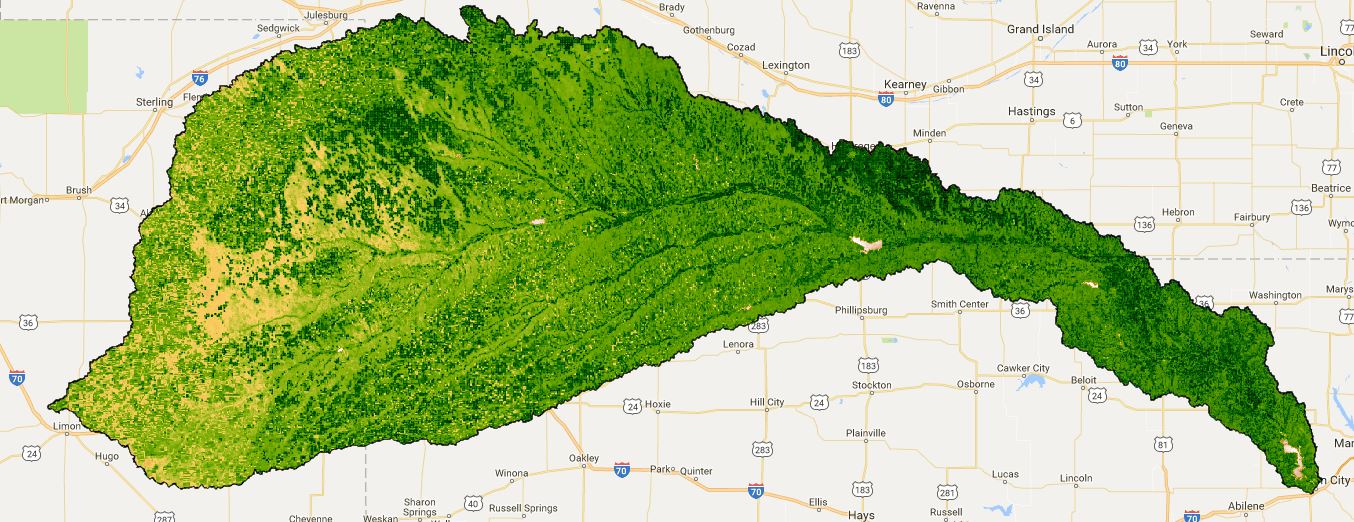
North Fork Republican River via the National Science Foundation.
Republican River Compact
Another bill that has been forwarded to lawmakers from the 2018 interim Water Resources Review Committee would redraw the boundary of the Republican River Water Conservation District in eastern Colorado to include more wells that reduce the flow of the Republican in violation of a compact with Kansas and Nebraska. The bill would allow the district to assess the same fee on those well owners that it does on all irrigators in the district to pay for a pipeline that transports water to the river to ensure compact compliance. The district borrowed $62 million to buy water rights and build the pipeline, and has assessed farmers $14.50 per acre to repay the loan.
Oil and gas development on the Roan via Airphotona
Severance Taxes
Lawmakers will also consider a bill that would change the timing of severance tax allocations for several CWCB water programs, to allow for better planning. The state collects severance taxes from oil and gas producers and other extractive industries, some of which is used to support water-related activities.
Currently the state’s severance tax revenue is transferred three times a year to the CWCB based on revenue forecasts; if the actual tax collections are below forecasts (which is often the case), funds are “clawed” back. This bill would base allocations on the amount collected in the previous fiscal year and consolidate three payments into one for the following year. Because tax collections in fiscal year 2018 exceeded forecasts, “it gives us a moment in time to do this,” Donovan said, avoiding any gap in funding.
Photo credit: AgriExpo.com.
Deficit Irrigation
Still another issue likely to surface is how to encourage more deficit irrigation, a strategy that applies less water than optimally needed by a crop in order to free up water for other uses. One proposal that did not make it out of the summer interim water committee would have added deficit irrigation to land fallowing as a type of pilot project the CWCB could approve, with the conserved water being available for short-term lease. Although the bill received support from a majority of committee members, it did not garner the two-thirds necessary to advance as a committee-sponsored bill. It may be considered again this year. (A similar bill—HB 1151—passed the House in 2018 but was withdrawn by its senate sponsor for additional study.)
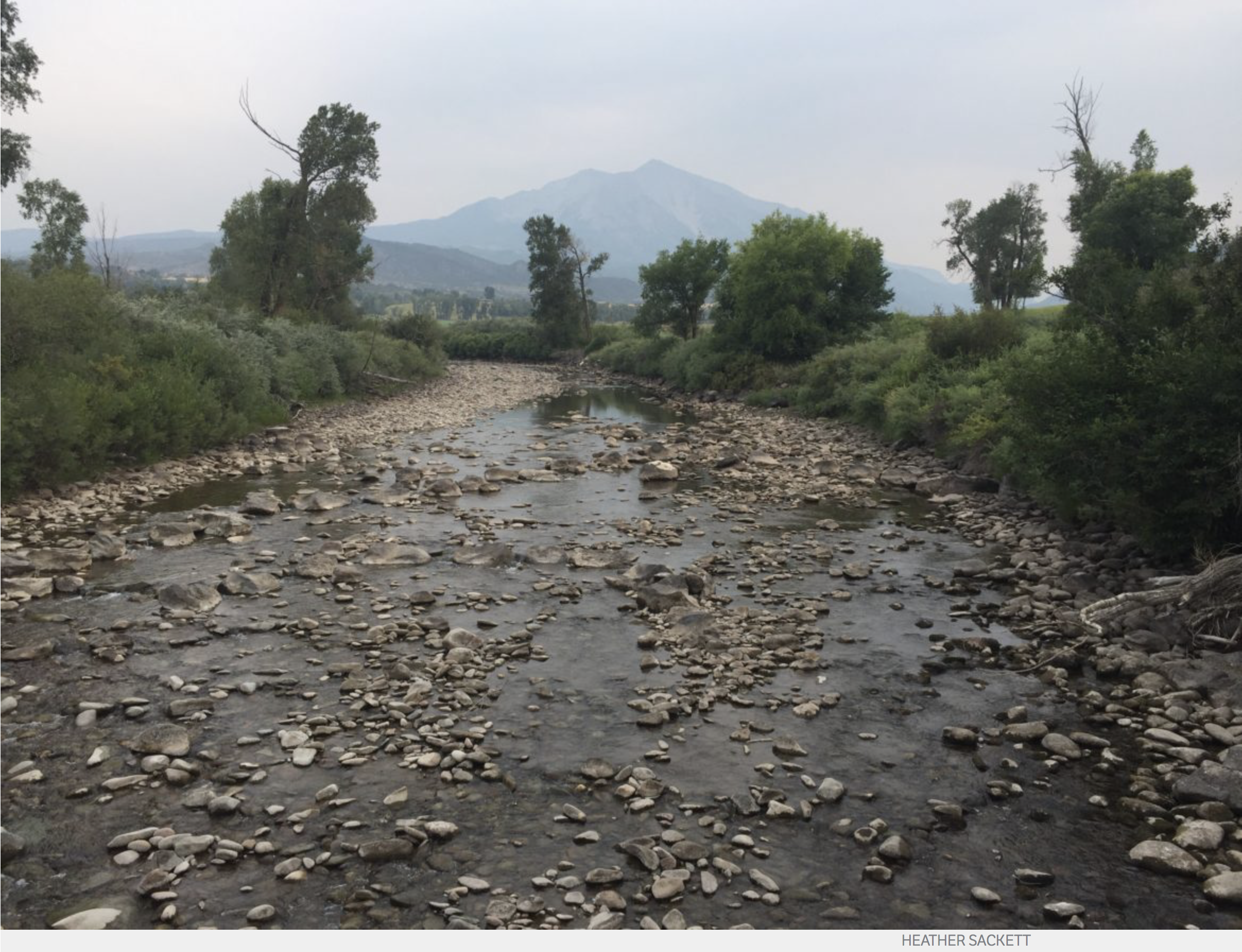
The lower Crystal River was running at 8 cfs near the state fish hatchery on Aug. 1, 2018. Lows flows on the Crystal have spurred action from the state, including curtailment and a call for instream flows. Photo credit: Heather Sackett via Aspen Journalism
Instream Flows
There is also interest in legislation that could expand the state’s instream flow pilot program, where water right holders forego diversions, instead leaving their water in the stream on a short-term basis for fish and habitat protection without jeopardizing their water right. The program is voluntary, temporary, and can provide financial compensation. It may involve “split-season” use, where a farmer irrigates his or her crops early in the season and then leases the water to a nonprofit (in partnership with CWCB) to maintain instream flows later in the year. Although the committee did not report out a bill on this issue, there is reportedly interest in legislation that would encourage additional voluntary leasing while protecting agricultural water use.
Bonita Mine acid mine drainage. Photo via the Animas River Stakeholders Group.
Water Quality and Hard-rock Mining
And last but not least, the General Assembly is expected to renew consideration of a measure it rejected in 2018. Lawmakers considered HB 1301, which would have required reclamation plans for new or amended hard-rock mining permits to demonstrate an “end date” for water quality treatment to ensure compliance with water quality standards. The bill also would have eliminated the option of “self-bonding”—an audited financial statement that the mine operator has sufficient assets to meet reclamation responsibilities—and required a bond or other financial assurance to guarantee adequate funds to protect water quality, including treatment and monitoring costs. It passed the House but was defeated in a Senate committee. Rep. Roberts, the primary sponsor last year, expects a bill on the same topic this session.
Larry Morandi was formerly director of State Policy Research with the National Conference of State Legislatures in Denver, and is a frequent contributor to Fresh Water News. He can be reached at larrymorandi@comcast.net
Fresh Water News is an independent, non-partisan news initiative of Water Education Colorado. WEco is funded by multiple donors. Our editorial policy and donor list can be viewed here.
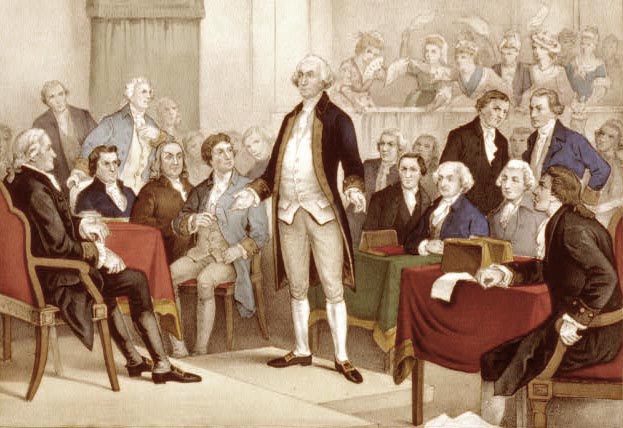
George Washington addresses the Continental Congress via Son of the South
FromThe Grand Junction Daily Sentinel (Charles Ashby):
Sen. Don Coram, R-Montrose, along with others, are looking for ways to fund the Colorado Water Plan, the product of a collaborative effort during Gov. John Hickenlooper’s term in office designed to assess and meet the state’s water needs for years to come.
That plan calls for doing many things over the years, not the least of which is to create about 400,000 acre-feet of additional water storage, and save another 400,000 acre-feet through conservation efforts. Estimates to achieve all of its goals, however, have been as high as $20 billion.
As a result, Coram says there’s no time like the present to find long-term funding sources to pay for it, and he doesn’t believe that it can come from severance taxes, which are collected by companies that extract natural resources, such as oil and gas drilling.
Not only are severance taxes subject to huge swings in how much the state can collect because of market forces, but Front Range legislators are always quick to dip into that money when the economy goes sour, he said.
To date, they’ve done that to the tune of more than $400 million in recent years, money the Legislature has yet to pay back.
“The fact is, if we are going to meet our needs, the Colorado River is certainly overallocated and everybody’s got their eye on it,” Coram said. “We’ve got to come up with a sustainable funding source and not rely on severance taxes, which the General Assembly goes in and robs when it feels like it.”
Estimates project that about $100 million a year would be needed to implement the water plan.
Though Coram said he’s not yet sure what funding source to turn to, he’s heard talk of special taxes to pay for it all, such as a surcharge on all water users and a special bottle fee. He predicted that there is no single source that could raise the money needed to implement the plan.
If a new tax is to be a source, it will have to be placed before the voters as required by the Taxpayer’s Bill of Rights.
“We’ve got to create a designated funding mechanism for water infrastructure, conservation and storage, and every piece to the puzzle has to be a part of it,” Coram said.
“My concern is the Front Range wants us to change our life so they don’t have to change theirs. We’ve got to move slowly, but we’ve got to put some cash in the till to do these things.”
Meanwhile, Rep. Don Catlin, R-Montrose, expects to be working on a water-related measure of his own.
Catlin plans to introduce a bill to strengthen easements for irrigation ditches. He says a problem is reoccurring all around Colorado as various areas of the state become more urbanized.
He said an increasing number of city dwellers are buying property in rural areas that include easements for irrigation ditches, but they don’t fully understand why those easements exist.
As a result, some of those new property owners are treating the ditches as their own private streams, even placing cobblestones in them as part of their landscaping, Catlin said.
When ditch riders try to access their systems, they’re running into conflicts with these homeowners, including being sued.
“It’s an urban versus rural issue, but I think one of the big problems is a lot of people don’t understand water needs,” Catlin said. “This would be a way of sharpening up that right. A lot of these urban people move in, they don’t want you to walk up the easement to check your ditch. That can’t be right.”
[…]
Rep.-elect Matt Soper, R-Delta, who also is looking for ways to fund the water plan, is considering a bill to expand the state’s grant program for school construction and infrastructure. He’s also working on measures to crack down on sexually explicit electronic messages that are sent to juveniles, and a measure to require all local governments to post meeting notices online.
FromColorado Politics (Marianne Goodland) via The Durango Herald:
Becker…reorganized a few committees, eliminating the Agriculture, Livestock and Natural Resources Committee in favor of a “Rural Affairs Committee.”
[…]
In a Sunday statement, Becker said the Rural Affairs Committee “will oversee issues of particular importance to rural Colorado such as agriculture, water, rural broadband and rural economic development.”
[…]
And there’s one new committee: Energy and Environment…
Rural Affairs (formerly Agriculture, Livestock and Natural Resources) will be chaired by Rep. Dylan Roberts of Avon and vice-chairwoman Rep. Donald Valdez of La Jara.
Energy and Environment will be chaired by Rep. Dominique Jackson of Aurora; vice-chairwoman will be Rep. Edie Hooton of Boulder…
The Energy and Environment committee, and the Finance committee, will be led by African Americans; five of the 11 committees are led by women.
Early next year Colorado lawmakers will consider a bill that expands the Republican River Water Conservation District, helping the district pay for a program that ensures the state delivers enough water to Kansas and Nebraska to meet its legal obligations.
Colorado has spent millions of dollars battling lawsuits over the problem and earlier this year agreed to pay Kansas and Nebraska another $4 million in damages.
Last week, the Colorado General Assembly’s Water Resources Review Committee recommended a bill that would redraw the boundary of the Republican River district to include several hundred additional wells whose pumping is reducing the flow of the river.
The bill would allow the district to assess the same fee on those well owners that it does on all irrigators in the district in order to pay for a pipeline that transports additional water to the river.