

Click the link to read the release on the University of Colorado website (Susan Glairon):
June 25, 2024
The University of Colorado Boulder has earned a major grant to boost drought monitoring and prediction on the Colorado River.
The $750,000 award from the National Oceanic and Atmospheric Administration (NOAA) to the Cooperative Institute for Research in Environmental Sciences (CIRES) on campus and the Department of Civil, Environmental and Architectural Engineering (CEAE) is part of $4.9 million in funding being distributed nationally by the Biden-Harris Administration to help western communities better prepare for droughts.
The project, “Improving Hydroclimate Forecasts by Multi-Model Combination Approaches for Enhanced Reservoir Operations on the Colorado River,” aims to develop models that will help water managers and stakeholders enhance the reliability of water supply in the Colorado River Basin. CEAE Professor Rajagopalan Balaji, who is also a CIRES fellow, serves as the principal investigator of the project.
Balaji said the Colorado River’s water supply, the “lifeblood of the southwestern U.S. socio-economy,” has been under severe stress since 2000 due to streamflow reduction from the Millennium Drought and increasing demand.
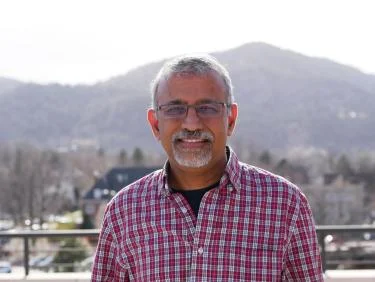
“The lack of skillful streamflow forecasts beyond a season has likely contributed to suboptimal water management during this prolonged dry period, exacerbating the water supply stress,” he said. “Developing a skillful streamflow forecasting system is crucial for enabling efficient water resource management and ensuring a sustainable and reliable water supply in the river basin.”
The CEAE-led project will develop new Colorado River Basin streamflow forecast models at 0-24 months lead time. The project will use NOAA’s advanced seasonal prediction systems and new machine learning techniques to improve lead predictions key to water management in the Basin. In addition, the forecasts will be used in the Colorado River Basin Operational Prediction Testbed and with stakeholder engagement to enable efficient water resources decisions.
Additional collaborators on the project include the CU Boulder Center for Advanced Decision Support for Water and Environmental Systems, NOAA Climate Prediction Center, NOAA Colorado Basin River Forecast Center, the US Bureau of Reclamation and the Southern Nevada Water Authority.