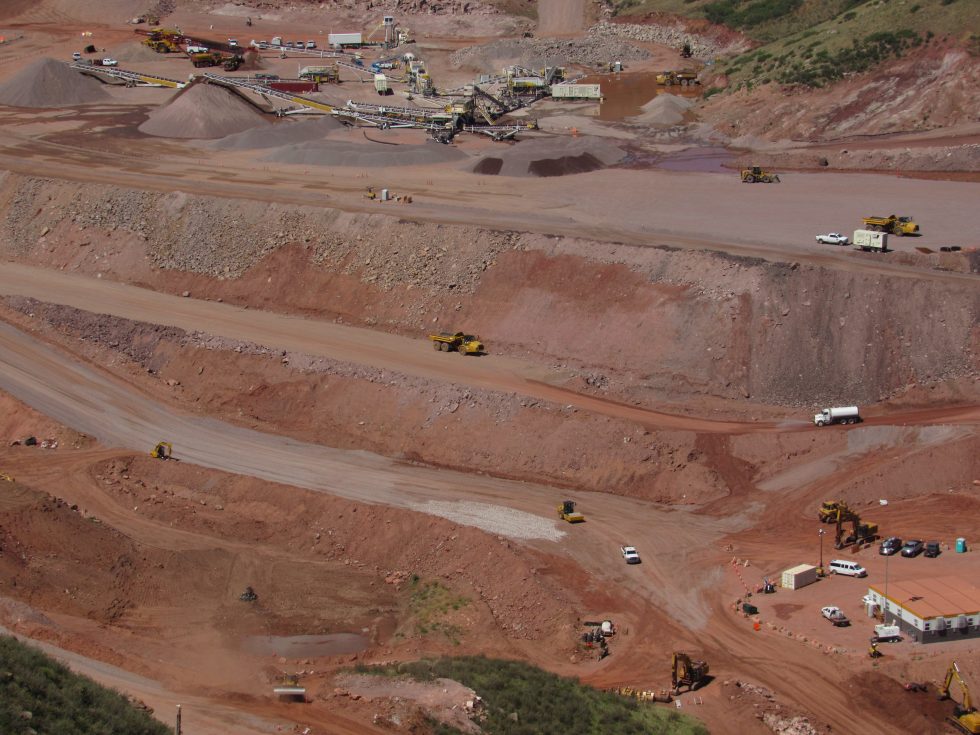
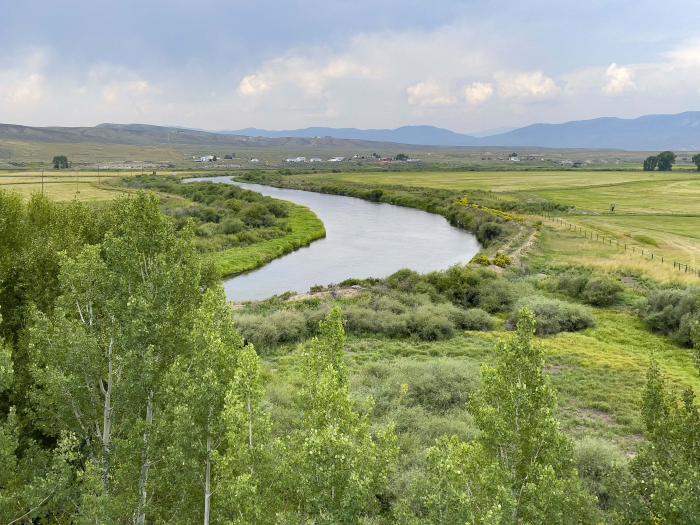
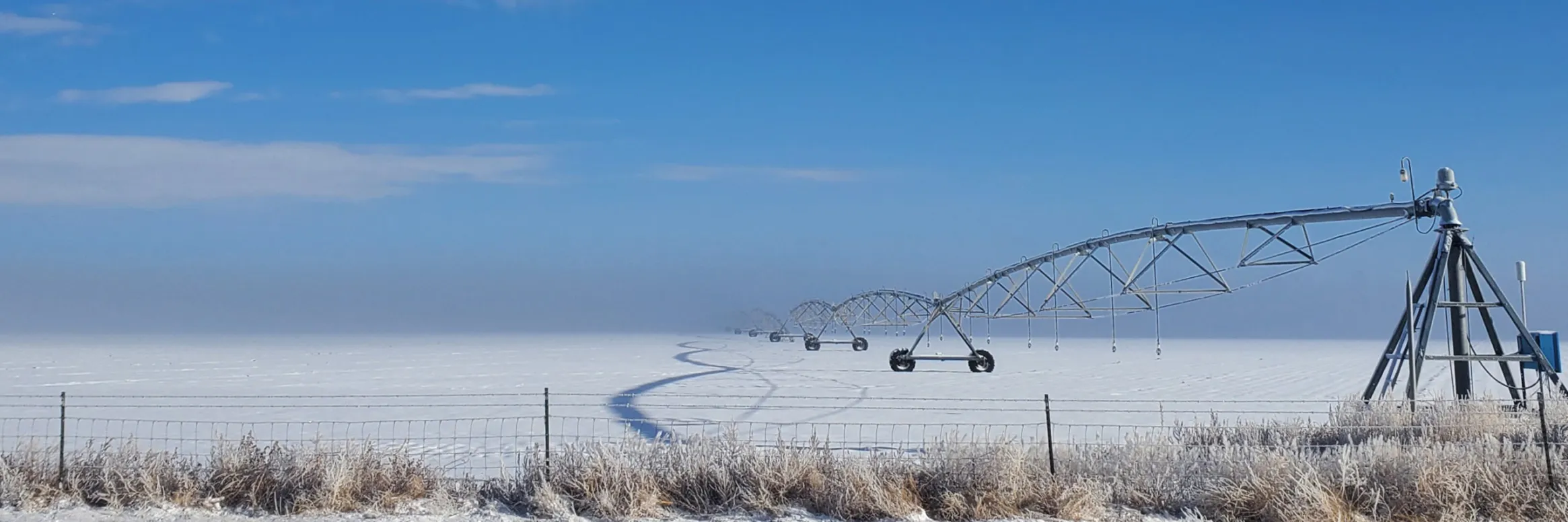
Erie is among 15 Northern Colorado entities participating in the Northern Integrated Supply Project. Water to supply new growth is a key driver of the project. Construction underway in Erie. Dec. 4, 2022. Credit: Jerd Smith, Fresh Water News
Fifteen towns, cities and water districts in northern Colorado hope to begin building two dams and other infrastructure in 2025 to deliver enough water to meet needs for a quarter-million people, many of them along the fast-growing Interstate 25 corridor.
Northern Water, the agency overseeing what’s known as the Northern Integrated Supply Project (NISP), hailed federal approval of a critical permit last month as a milestone. “This action is the culmination of nearly 20 years of study, project design and refinement to develop water resources well into the 21st century,” said Brad Wind, general manager of Northern Water. Wind said that NISP will enable the 15 project members, including Windsor, Erie and Fort Morgan, to grow without buying farmland, then drying it up and using its water for growth.
The environmental group, Save the Poudre, hopes to dash those plans. The nonprofit says it will file a lawsuit in an attempt to block the $2 billion NISP. To succeed, the group will have to overcome precedent. It failed to block Chimney Hollow, the dam that Northern Water is constructing as part of a separate project, in the foothills west of Berthoud whose construction began in 2022 after a three-year court case.
“We have a much stronger case against NISP because the project would drain a dramatic amount of water out of the Poudre River, which would negatively impact the river’s ecology, its habitat, and its jurisdictional wetlands — protected by the Clean Water Act — all the way through Fort Collins and downstream,” said Gary Wockner, director of Save The Poudre.
This new court challenge was set up by a U.S. Army Corps of Engineers announcement Dec. 9 that it was issuing a crucial permit under the Clean Water Act. Directors of Northern Water, the overarching agency for the participating jurisdictions, are scheduled on Thursday, Jan. 5, to take up whether to accept the terms of the permit. Staff members have advised them to do so.
Northern Integrated Supply Project (NISP) map July 27, 2016 via Northern Water.
The impetus for NISP can be traced to the early 1980s when Northern Water began drawing up plans to dam the Poudre River in the foothills near Fort Collins. Federal agencies balked at Denver’s plans for a similar project on the South Platte River at Two Forks, in the foothills southwest of Denver. Northern shelved its initial plan. But after the scorching drought that began in 2002, Northern developed plans for NISP, which it submitted to federal agencies in 2004.
Two reservoirs are central to NISP. Glade Park, an off-channel reservoir, would be built north of La Porte, bounded by the Dakota hogbacks and a dam that would cross today’s Highway 287. It would have a capacity of 170,000 acre-feet, slightly larger than the 157,000 acre-feet of Horsetooth Reservoir. Northern’s water rights are relatively junior, dating from the 1980s and would only generate water in spring months during high runoff years.
The project promises delivery via pipeline of 40,000 acre-feet of high-quality water annually to the 11 mostly smaller towns and cities and the 4 water districts. Erie is buying the largest amount of water from the new project, claiming 6,500 acre-feet. An acre-foot equals 326,000 gallons.
The second storage pool, Galeton Reservoir, at 45,000 acre-feet, would impound water northeast of Greeley. Unlike the water from Glade, which is to be strictly dedicated to domestic use, Galeton would hold water that will be delivered to farms in Weld County that otherwise would have received water from the Poudre River. This will be done via a water-rights swap with two ditches north of Greeley. Those agreements have not been finalized.
Preservation of agricultural land, costs of water, and water quality figure prominently in the talking points both for — and, in some cases, against — the project.
Northern and its project participants argue that NISP will allow them to grow without drying up farms. It can do so, they say, by delivering the water at a lower cost.
The federal environmental impact statement’s no-action alternative found that population growth would occur regardless of whether a federal permit was issued, said Jeff Stahla, the public information officer for Northern Water. That analysis found that in the absence of NISP, the 15 cities and water districts would look to buy water rights currently devoted to agriculture, ultimately taking 64,000 acres — or 100 square miles — out of production.
The 15 utilities will be able to get NISP’s new water at $40,000 per acre-foot, substantially below current market rates for other regional water sources such as the Colorado-Big Thompson Project shares. Those shares, which constitute seven-tenths of an acre-foot, have been selling for about $75,000.
In some cases, expanding cities will take farmland out of production — and presumably gain access to the water, but not always.
“We do not want to dry up northern Colorado,” says John Thornhill, Windsor’s director of community development.
Thornhill said that Windsor, a town of 42,000 with its 20th Century sugar beet factory still standing, is participating in NISP to improve the resiliency of its water portfolio as it prepares for another 10,000 to 15,000 residents in the next 10 to 15 years.
“The town of Windsor has just as much interest in having a clean, healthy river as anybody else does,” he says. “[The Poudre River] goes right through our town.”
Fort Collins is not participating in the project. In a 2020 resolution, it said it would oppose the proposal or any variant that failed to “address the City’s fundamental concerns about the quality of its water supply and the effects on the Cache la Poudre River through the city.”
Water quality will be at the heart of Save the Poudre’s lawsuit against the Army Corps of Engineers’ 404 permit. The group’s Wockner says the diversion to Glade Reservoir will reduce peak flows in the Poudre, a river already suffering from E. coli and other pollutants, by up to 40%. “The water quality in the river will worsen because as you take out the peak flows what is left is dirty water,” he says.
Also at issue, says Wockner, will be the impacts to Fort Collins’ wastewater treatment. With reduced flows downstream from its two treatment plants, those plants would have to be upgraded.
On the flip side, Fort Morgan got involved partly because of Glade Reservoir’s higher water quality, according to City Manager Brent Nation.
The city of 12,000 historically relied upon aquifer water heavily laden with minerals for its domestic supply. As the aquifer became increasingly tainted by chemicals used in agricultural production, the city, in the late 1990s, began importing water through an 80-mile pipeline from Carter Lake, a reservoir that stores imported Colorado River water southwest of Loveland.
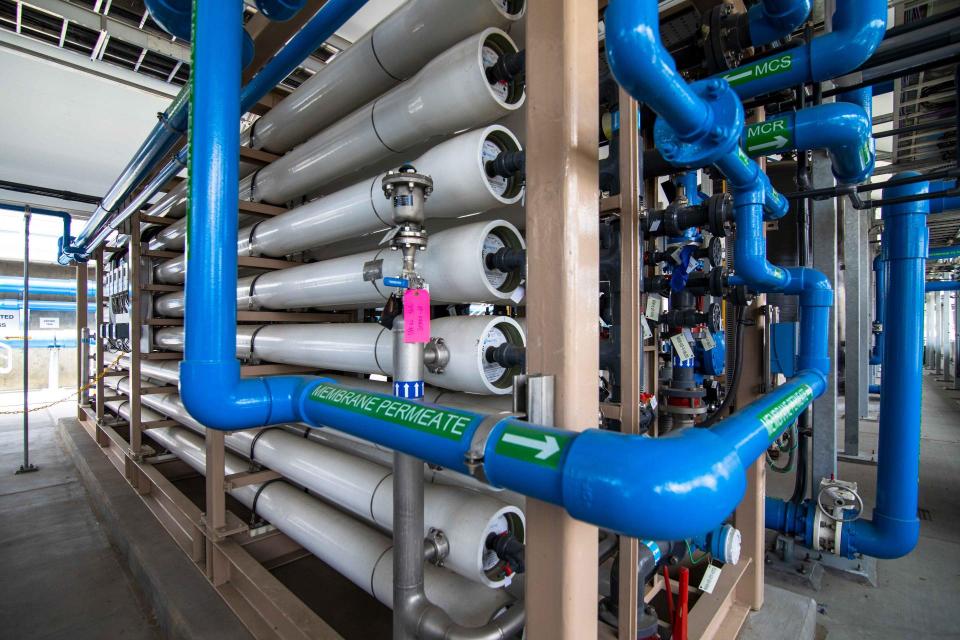
To use aquifer water for its new population growth Fort Morgan would need to upgrade its water treatment system to use reverse osmosis. That’s a more expensive treatment that also produces a problem of brine disposal.
Both Fort Morgan and Windsor have started working on land-use regulations that will restrict high-quality water for domestic use, at least in some subdivisions, leaving lower-quality water for landscaping.
If NISP as proposed survives Save the Poudre’s legal challenge, it may still need a 1041 permit from Fort Collins. Those regulations have not yet been adopted, however.
Allen Best grew up in eastern Colorado, where both sets of grandparents were farmers. Best writes about the energy transition in Colorado and beyond at BigPivots.com.
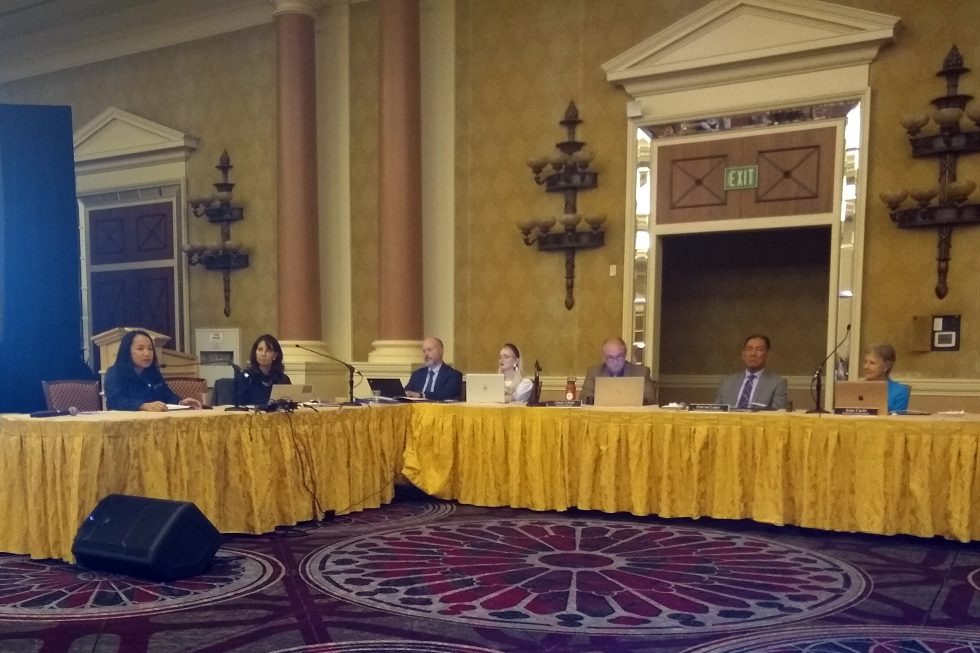
U.S. Bureau of Reclamation Commissioner Camille Touton (left) alongside members of the Upper Colorado River Commission at the 2022 Colorado River Water Users Association Conference on December 14, 2022 in Las Vegas, Nevada. Photo by Jerd Smith
As the Colorado River crisis deepens, a new federal analysis of flows into Lake Powell shows that they will continue to plummet through 2025, before beginning to recover.
James Prairie, a hydrologic engineer for the U.S. Bureau of Reclamation, said flows are likely to be just 24% of average this year, making it unlikely under various planning scenarios that Powell will have enough water for the Upper Basin states of Colorado, New Mexico, Utah and Wyoming to meet their legal commitment to deliver a minimum of 7 million acre-feet of water to the Lower Basin. That amount is already reduced from the historical delivery obligation due to low flows on the river.
The news comes as more than 1,300 of the river’s most powerful water users gather this week in Las Vegas for the Colorado River Water Users Association Conference, the largest annual confab on the river.
This year it has sold out for the first time in its history, according to Crystal Thompson, communications manager at the Central Arizona Project, a major user of Colorado River water and a conference organizer.
In the water world, stream and reservoir measurements are based on what’s known as the water year, which begins Oct. 1. Prairie said Upper Basin flows in water year 2023 are expected to be just 24% of average. In 2024 they are likely to improve, reaching 58% of average, before rising to 61% of average in 2025.
But because Lake Powell is so low — it’s just 23% full with roughly 5.5 million acre-feet of water stored right now — it won’t be able to recover enough water to keep those releases going, Prairie said. And that means that users across the seven-state Colorado River Basin will see more dramatic cutbacks in their water supplies to try to protect remaining supplies in both Lake Powell and Lake Mead, farther downstream.
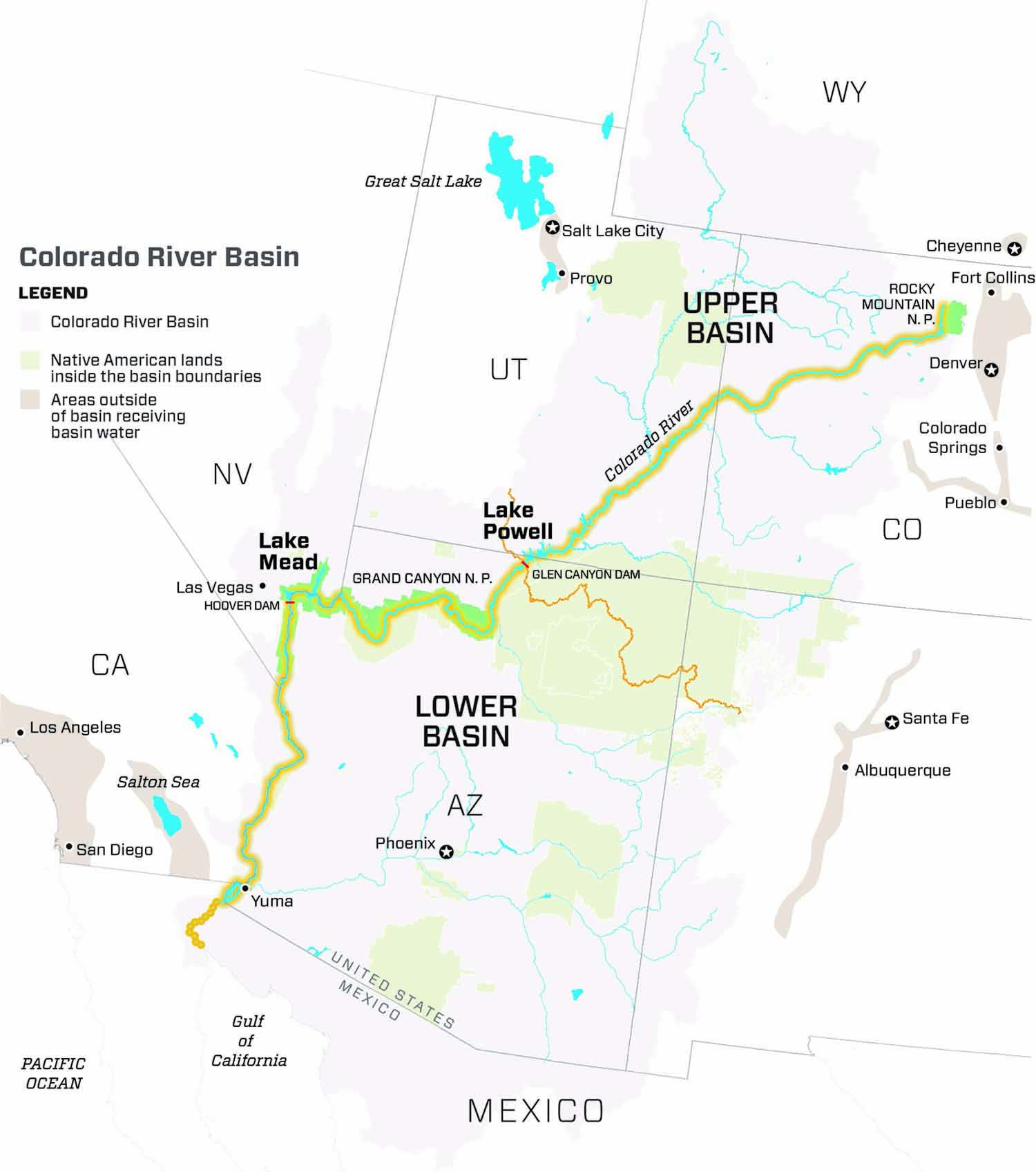
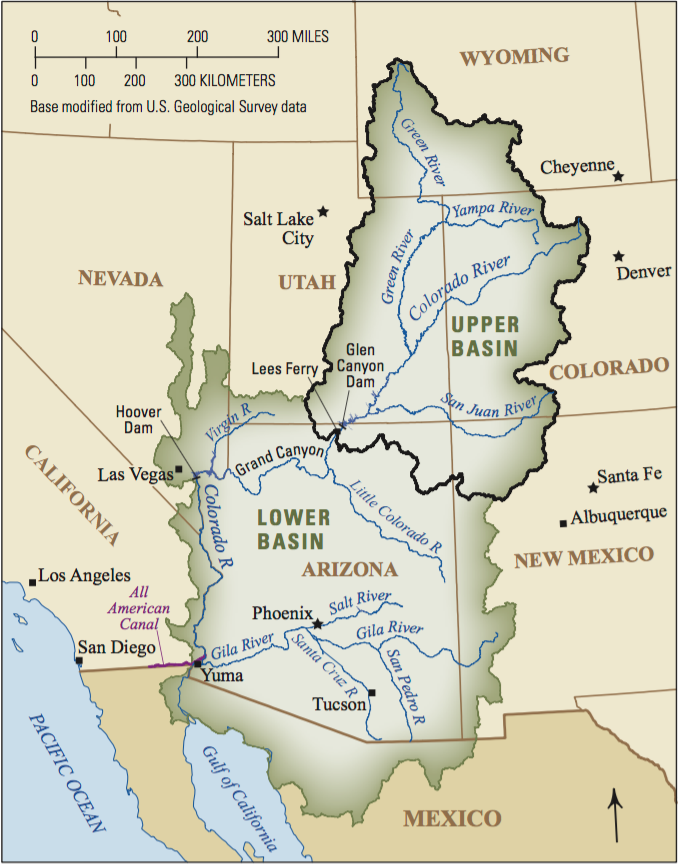
The basin, mired in a drought believed to be the worst in 1,200 years, is divided into two regions. The Upper Basin includes Colorado, New Mexico, Utah and Wyoming, while the Lower Basin covers Arizona, California and Nevada.
Colorado River Basin. Credit: Chas Chamberlin
During a meeting of the Upper Colorado River Commission held Wednesday during the confab, hundreds packed a conference room to hear the reports. The commission works to ensure the Upper Basin states receive their allocation of Colorado River Water and that they meet their obligations to send water to the Lower Basin.
“We all know that we are gathering here today in a time of unprecedented crisis in the basin,” said Anne Castle, a Colorado water attorney who President Biden appointed to serve as federal chair of the commission in September 2022.
“We all know we have a huge imbalance between supply and demand and we also know we don’t have much time to correct it,” Castle said.
Last summer U.S. Bureau of Reclamation Commissioner Camille Touton ordered the states to figure out how to reduce water use by 2 million to 4 million acre-feet, but no agreements have been reached, leaving the possibility that the federal government will decide how to make the cuts.
Touton urged water users to continue working together to find a solution to the crisis.
As lakes Powell and Mead have dwindled, all seven states have had to get by with less water and federal forecasts indicate that is likely to be the case for several more years.
In Colorado, major cutbacks have already occurred.
Becky Mitchell, director of the Colorado Water Conservation Board who also represents Colorado on the Upper Colorado River Commission, said the state has already had to temporarily dry up thousands of acres of irrigated farmland because of the crisis.
Mitchell said the state used 25% less Colorado River water in 2021 than it did in 2020 because of the drought.
Critical negotiations among the states are underway to reach a consensus on how to slash water use enough to keep Lake Powell full enough to continue producing power.
“The gap is big enough that no one basin, no one state, no one sector of the economy can solve it alone,” Castle said.
“The real enemy here is not another basin, or another state or alfalfa or golf courses. It is climate-change-induced lower flows. It’s not an enemy that we can defeat. It is one that we have to learn to live with,” she said.
Jerd Smith is editor of Fresh Water News. She can be reached at 720-398-6474, via email at jerd@wateredco.org or @jerd_smith.
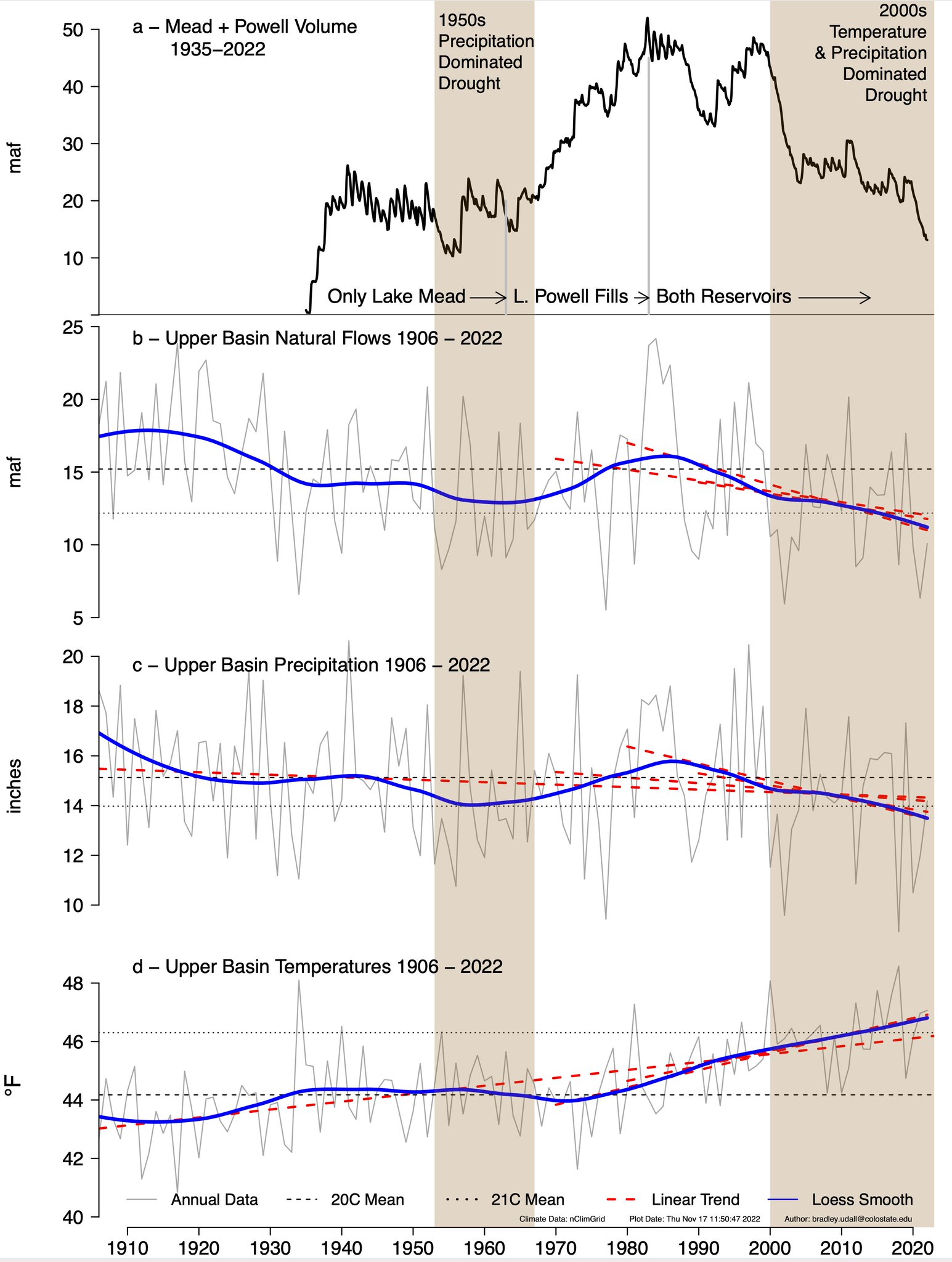
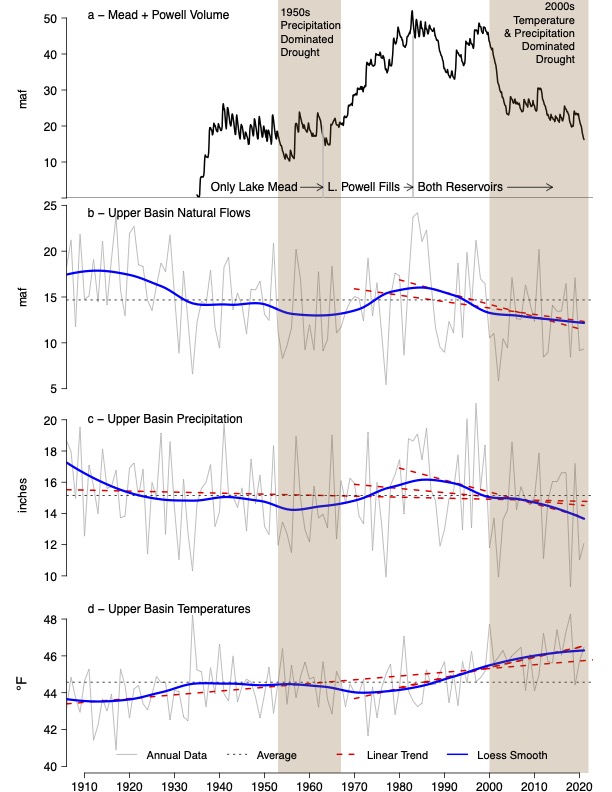
Updated Colorado River 4-Panel plot thru Water Year 2022 showing reservoirs, flows, temperatures and precipitation. All trends are in the wrong direction. Since original 2017 plot, conditions have deteriorated significantly. Brad Udall via Twitter: https://twitter.com/bradudall/status/1593316262041436160
This User Guide is designed to help planners, policymakers, and communities navigate this often confusing information landscape and acquire information most suitable for their needs. While focused on the U.S. Mountain West, much of the information in the User Guide is transferable to other regions too.
Please share this User Guide with your networks and others who might benefit from this free resource…
This User Guide was made possible through NOAA Sectoral Applications Research program funding. We gratefully acknowledge the tremendous work that went into the climate resources this Guide addresses, and appreciate the valuable feedback we received from so many in the research and management communities.
A reminder of the choices that global society has to make about the climate:
Delaying action on reducing emissions commits the world to live with severe consequences.
Rapid action now means a more habitable world for all.
There is no going back. Choose wisely. Credit: Ed Hawkins via via his Twitter feed
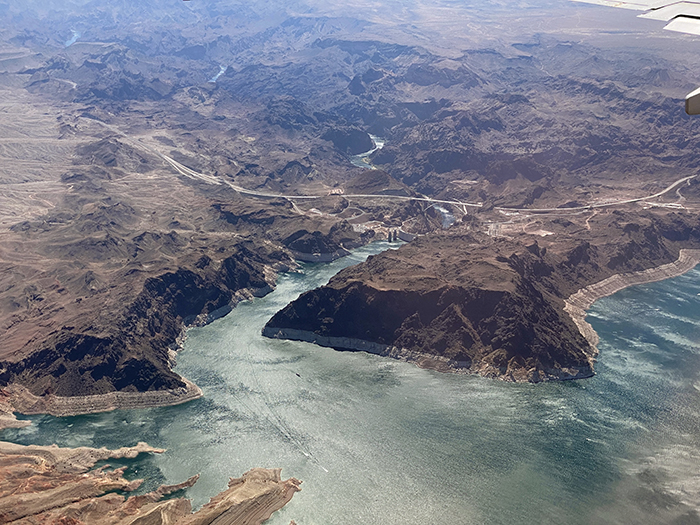
Hoover Dam’s intake towers protrude from the surface of Lake Mead near Las Vegas, where water levels have dropped to record lows amid a 22-year drought. (Source: Bureau of Reclamation)
Chorus of experts warn climate change has rendered old assumptions outdated about what the Colorado River can provide, leaving painful water cuts as the only way forward
When the Colorado River Compact was signed 100 years ago, the negotiators for seven Western states bet that the river they were dividing would have ample water to meet everyone’s needs – even those not seated around the table.
A century later, it’s clear the water they bet on is not there. More than two decades of drought, lake evaporation and overuse of water have nearly drained the river’s two anchor reservoirs, Lake Powell on the Arizona-Utah border and Lake Mead near Las Vegas. Climate change is rendering the basin drier, shrinking spring runoff that’s vital for river flows, farms, tribes and cities across the basin – and essential for refilling reservoirs.
The states that endorsed the Colorado River Compact in 1922 – and the tribes and nation of Mexico that were excluded from the table – are now straining to find, and perhaps more importantly accept, solutions on a river that may offer just half of the water that the Compact assumed would be available. And not only are solutions not coming easily, the relationships essential for compromise are getting more frayed.
With the Compact’s shortcomings and the effects of climate change and aridification becoming as clear as the bathtub ring around Lake Mead, previous assumptions of how much water the river can provide and the rules governing how it gets divvyed up must be revised to reflect the West’s new hydrology. One thing is certain among experts and Colorado River veterans: Water cuts are in the short-term and long-term forecast for major cities such as Los Angeles, Las Vegas and Phoenix, as well as farmers from Colorado’s West Slope to growers in California’s Imperial Valley near the Mexican border.
“You don’t have any other arrow in your quiver right now except to reduce use,” Pat Mulroy, former general manager of the Southern Nevada Water Authority, told a gathering of Colorado River water interests this fall. “There are no other arrows.”
Updated Colorado River 4-Panel plot thru Water Year 2022 showing reservoirs, flows, temperatures and precipitation. All trends are in the wrong direction. Since original 2017 plot, conditions have deteriorated significantly. Brad Udall via Twitter: https://twitter.com/bradudall/status/1593316262041436160
The River’s Changing Math
Predicting the amount of water the Colorado River can provide in a given year has always been a challenge. The river’s flow is famously erratic, dictated by the size of the often-fickle Rocky Mountain snowpack and other variables such as soil moisture and changes in temperature.
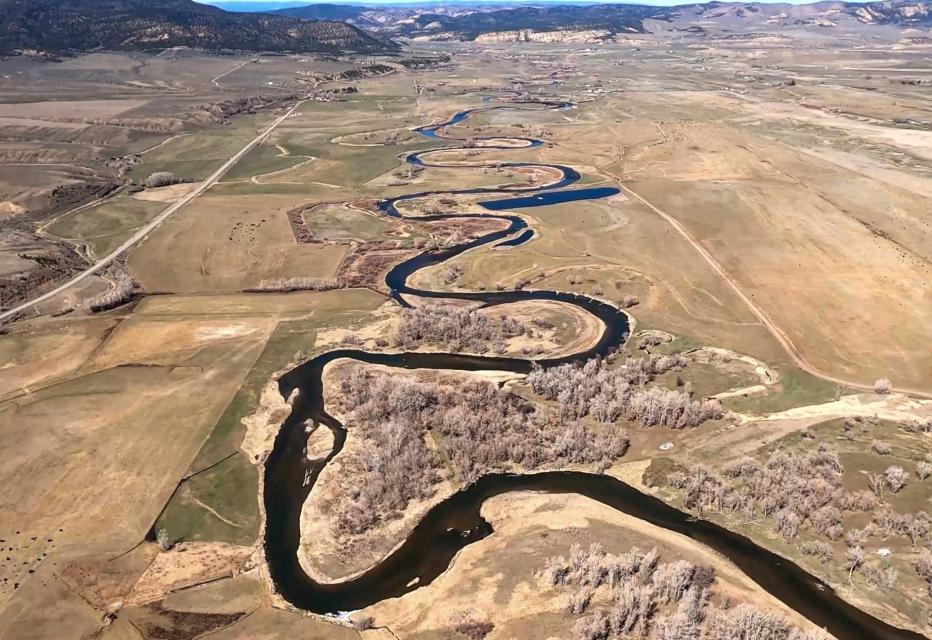
Flows in the White River (pictured above) and other Upper Basin tributaries have declined dramatically over the last 20 years, a trend experts warn will worsen as the West becomes hotter and drier. (Source: The Water Desk)
The old expectations of the Compact signers is giving way to a new reality on the river. Over the last century, the river’s flows in the Upper Basin have dropped by 20 percent. Scientists have pinned warming temperatures as the main cause of the disappearing flows and predict the trend will worsen as the Upper Basin, source of most of the river’s water, becomes even hotter and drier.
Water users have been able to counter previous dry spells by relying on the river’s main reservoirs. But after more than two decades of drought, both Lake Mead and Lake Powell are only about one-quarter full. The reservoirs’ rapid declines have forced the Bureau of Reclamation to order unprecedented water cuts to Arizona and Nevada. Mexico is taking similar cuts under binational agreements. And Reclamation has warned more severe actions are needed to prevent the collapse of the Colorado River system.
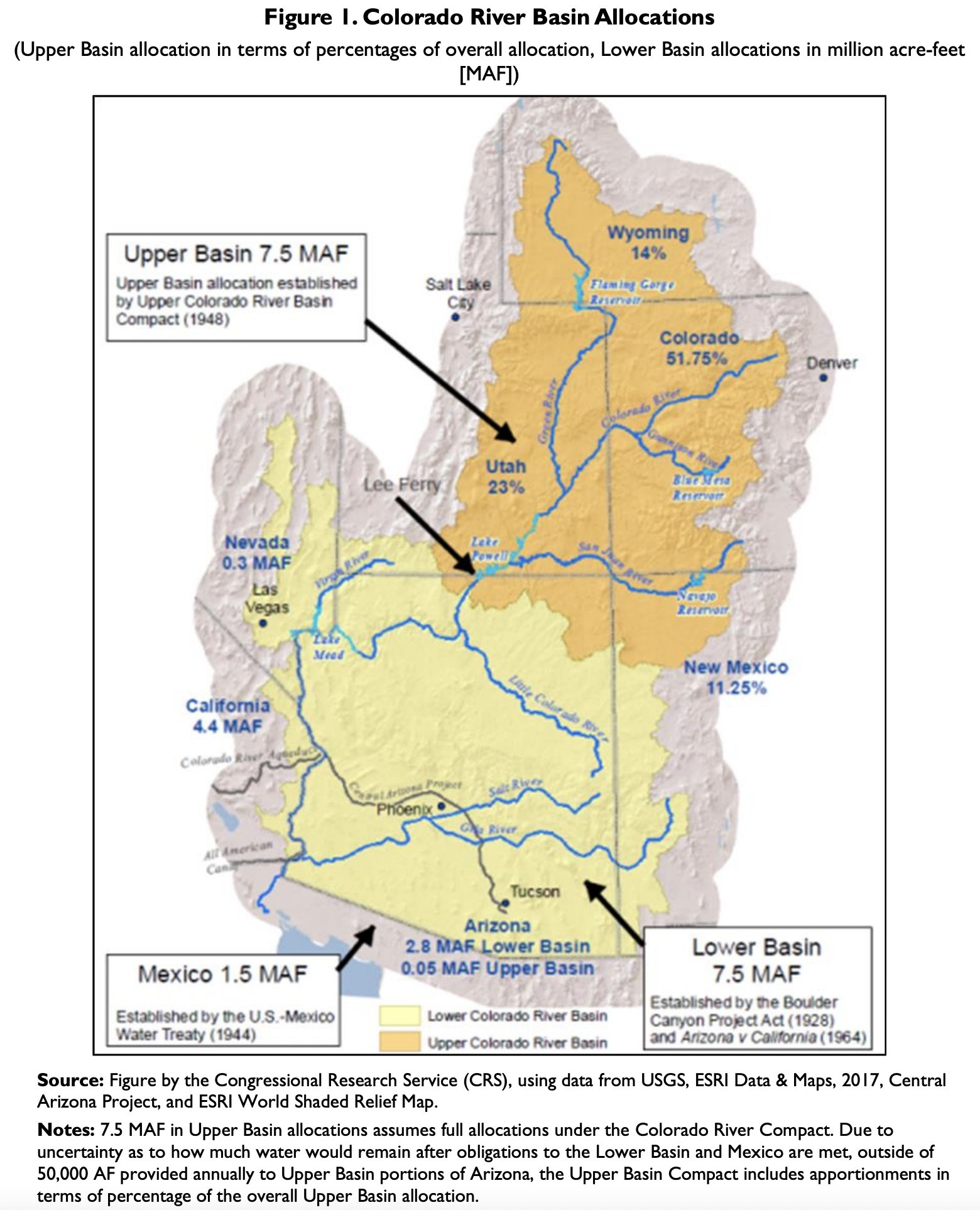
The Compact signatories, relying on data from a small but abnormally wet time period, estimated the river’s annual average natural flow in the Upper Basin to be about 18 million acre-feet. The figure, they asserted, was enough to cover 7.5 million acre-feet of water in perpetuity for the Upper Basin states of Colorado, New Mexico, Utah and Wyoming, and 7.5 million acre-feet for the Lower Basin states of Arizona, Nevada and California. They also agreed that any water committed to Mexico would be supplied equally by the two Basins. Native American tribes, who now legally hold substantial rights to the river’s water, were barely mentioned.
Brad Udall, Colorado State University climate researcher, said it’s becoming harder and harder for the river to meet the promises outlined in the Compact and the accompanying set of agreements, laws and court cases referred to as the Law of the River. He warned dozens of water managers and policy experts at a recent Water Education Foundation Symposium that climate change caused by greenhouse gas emissions is rapidly and permanently shifting precipitation trends in the Basin.
“It’s not a drought, it’s not temporary, it’s aridification,” said Udall. “Additional 1 degree Celsius or more warming by 2050, Lee Ferry flows in 9 million acre-feet are possible. Every important trend line [is] heading in the wrong direction, notably our reservoirs, but all the science trends as well.” [ed. emphasis mine]
Data from recent decades shows it’s becoming uncommon for the river to meet the benchmark used to craft the Compact. Estimated annual flows at Lee Ferry, a key dividing point between the Colorado River’s Upper and Lower Basins, have surpassed 18 million acre-feet just four times since 1991, while the river’s average flow since 2000 has been 12.3 million acre-feet.
“If we’re taking out more than comes in, it is really simple math that the reservoirs are going to continue to decline,” said Rebecca Mitchell, director of the Colorado Water Conservation Board, the state’s water management agency.
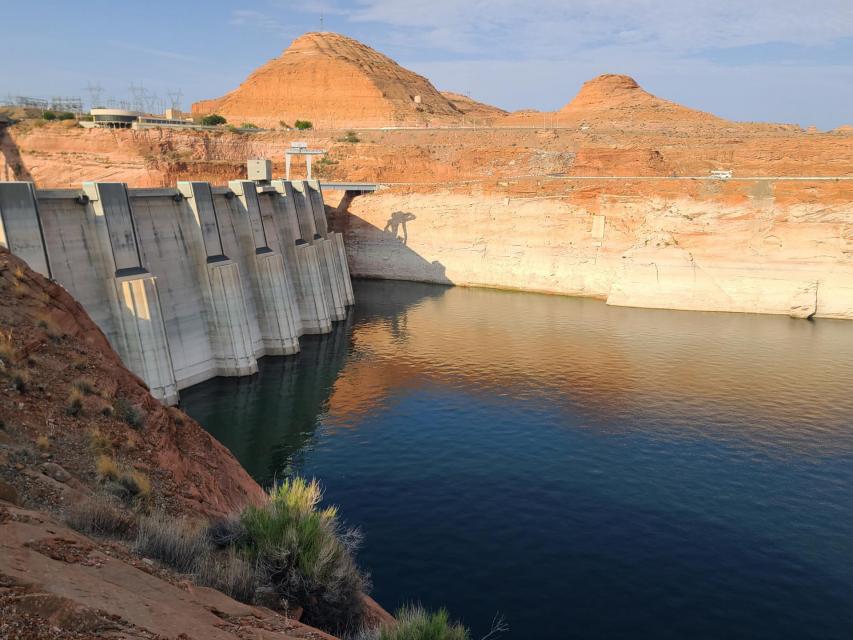
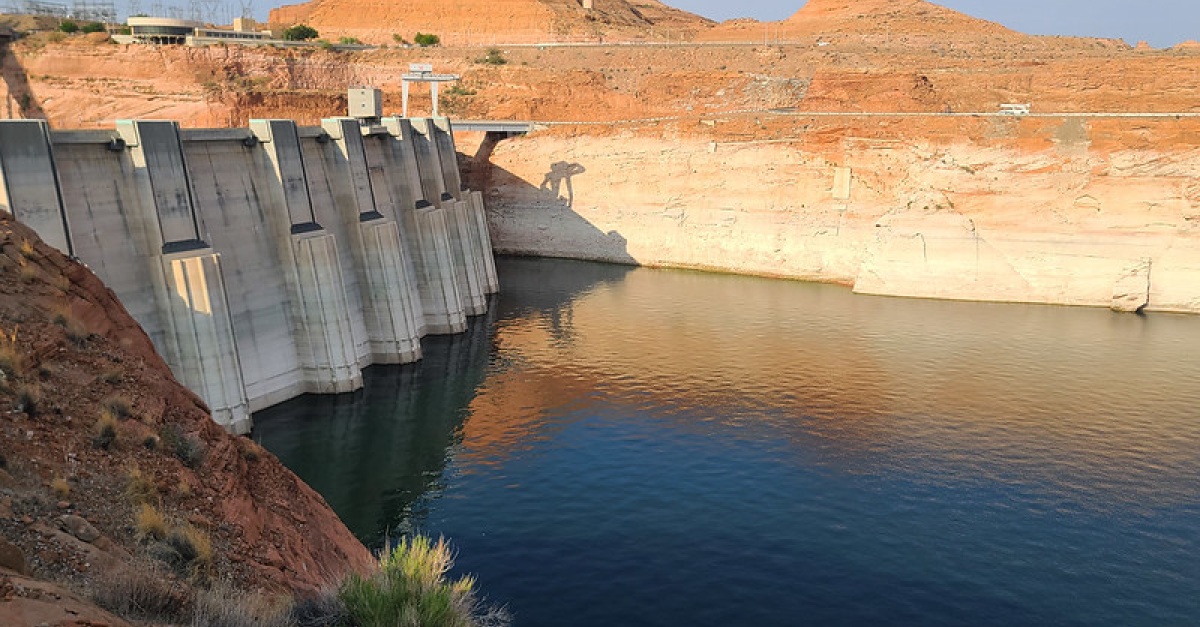
The federal government may reduce releases from Glen Canyon Dam (pictured above) in 2023 by an unprecedented 2-3 million acre-feet, a move that would trigger severe cuts in the Lower Basin. (Source: Bureau of Reclamation)
Mitchell was among nearly 200 state and regional water managers, farmers, tribal leaders and other water interests from the seven Basin states, along with key federal and Mexican officials, who attended the Foundation’s biennial Colorado River Symposium in late September to mark the Compact’s 100th anniversary and to discuss the risks and challenges ahead for the iconic Southwestern river.
Discussions were sometimes sobering and sometimes tense, underscoring the growing risks to a river depended upon for drinking water by 40 million people and for irrigation of more than 4 million farmland acres across the Basin. An undercurrent of the discussions was whether Basin interests can avoid taking their differences to court – a prime motivation behind creating the 1922 Compact. Despite the occasional sharply worded airing of differences between Upper and Lower Basin interests, there was broad acknowledgement that action is needed to keep the river system functioning.
Reclamation Commissioner Camille Calimlim Touton was among those urging water interests throughout the Basin to continue working collaboratively toward solutions and she provided a broad outline of actions that federal officials are preparing to take in 2023 – including reducing water releases from Lake Powell and Lake Mead – to keep the river from crashing.
“The actions we choose to take over the next two years,” Touton told participants, “will define the fate of the Colorado River for the next century.”
Living Within New Means
Though the Colorado River’s annual yield has shrunk in the 21st century, demand for its diminishing supply hasn’t, creating a glaring math problem for Basin water managers. In a system where every drop of water is already allocated, the specter of an 11 million acre-foot river — or worse — is forcing users to prepare for a drier future.
The Colorado River Compact divided the basin into an upper and lower half, with each having the right to develop and use 7.5 million acre-feet of river water annually. (Source: U.S. Geological Survey via The Water Education Foundation)
One agency that has been actively finding ways to stretch its river supply is Southern Nevada Water Authority, which serves more than 2 million people in the Las Vegas area. The agency has updated its modeling and long-range planning to reflect the river’s changing hydrology.
John Entsminger, the authority’s general manager, said computer models are sending a direct warning that the Lower Basin will end up with only a slice of the 7.5 million acre-feet per year outlined in the Compact. After accounting for evaporation and system losses, he said, it’s probable the Lower Basin and Mexico will have much less water to split.
“It is incumbent upon the Lower Basin to come up with a plan to live within its 7 million acre-feet release from Lake Powell probably forever going forward and hope it’s not less than that,” said Entsminger.
Like Nevada, Arizona is already feeling the pinch from the latest round of federal water cuts. So far, the two states and Mexico have shouldered most of the pain.
In 2022, Arizona is using approximately 2 million of its 2.8 million acre-feet Colorado River allocation, according to state officials The state’s agricultural industry is taking the hardest hit, including one rural county that fallowed more than 50 percent of its farmland for lack of irrigation water.
“We’re already seeing huge pain, and with an 11 million acre-feet [river] that pain’s just going to continue to grow,” said Tom Buschatzke, Arizona Department of Water Resources director.
Lees Ferry, located 15 miles downstream of Glen Canyon Dam is the dividing line between the upper and lower Colorado River basins. Photo/Allen Best
The widening gap between supply and demand is also having an impact above Lee Ferry, where inflows into Lake Powell continue to fall below historical average. Water from Powell is critical for helping the Upper Basin meet its commitment under the 1922 Compact to deliver water to the Lower Basin.
Representatives from the Upper Basin states say they have collectively cut their annual consumptive river use from 4.5 million acre-feet to approximately 3.5 million acre-feet over the last three years. Over the same period, they argue, the Lower Basin has done little to reduce its own consumptive use. Similar to Arizona, Upper Basin farmers also have been on the receiving end of water cuts.
The Ute Mountain Ute Tribe has fallowed the majority of its farmland in southwestern Colorado while in Wyoming, more than 100,000 acres of farmland were cut off from surface water for most of August because of low stream flows in the Upper Basin.
“That equates to about 100,000 acre-feet of [diverted Colorado River water] a month…that’s a third of our average irrigated use,” said Brandon Gebhart, Wyoming State Engineer.
The Upper Basin states have proposed a five-point plan built around paying farmers to reduce water consumption. Though it doesn’t require mandatory cuts for water users, proponents say the success of the plan hinges on whether the Lower Basin agrees to leave more water in Lake Mead.
“I think we need to recognize that the uses are far outweighing what Mother Nature is providing and that is primarily not in the Upper Basin,” said Mitchell with the Colorado Water Conservation Board.
California In the Spotlight
California’s use of the river has been a sore point among others in the Colorado River Basin. California, the largest user of Colorado River water, has been spared from water cuts so far due to its senior priority rights and has been using its full 4.4 million acre-feet entitlement in 2022. Groups in both the Upper and Lower Basins say the state must significantly reduce its use to prevent the river system’s collapse.
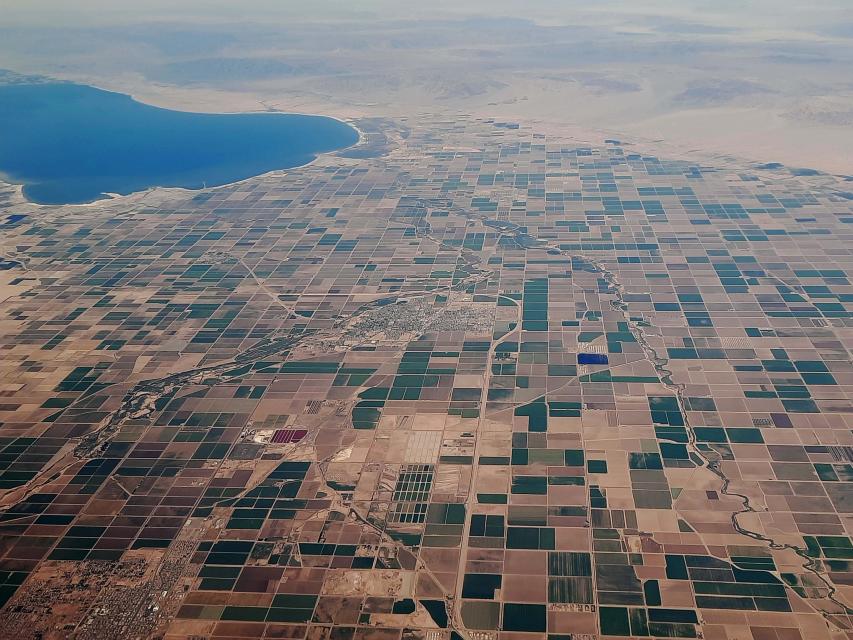
The Salton Sea (pictured above ) straddles the Imperial and Coachella valleys and has long been a sticking point in Colorado River deals. But the federal government recently committed up to $250 million for restoration efforts at the sea. (Source: Water Education Foundation)
California water agencies and state officials have pushed back on criticism that they aren’t doing enough to help buoy the shrinking reservoirs.
Peter Nelson, chairman of the Colorado River Board of California, argued California delayed the current crisis by enacting voluntary deals that pay farmers not to plant their fields, transfer water to urban users or make their systems more water efficient.
“In the Lower Basin, since the last seven years or so, we’ve stored 1.5 million acre-feet of water in Lake Mead as Intentionally Created Surplus water,” said Nelson, who farms in the Coachella Valley. “That has enabled the lake levels at Lake Mead to stay high enough to stay out of shortages and benefit other states in the Basin.”
Though the state is using its full share amid another bitterly dry year on the Colorado River, California water managers say they are not dismissing the fact that the river is overprescribed and that future cuts are needed. But they warn that the state’s farmers shouldn’t be made the scapegoat for all the Basin’s water problems.
For example, cutting off water to farmers in the Imperial Valley may help solve one crisis but simultaneously cause another, said Henry Martinez, general manager of the Imperial Irrigation District. Agriculture overwhelmingly drives Imperial County’s economy, he said, so fallowing would lead to major job losses in a region already prone to high poverty and unemployment rates.
“You can devastate the whole industry by making the wrong cutbacks at the wrong time. There has to be consideration also as to how to prop up or maintain the economy of the region, otherwise you go from a very poor area to devastating even furthermore the economy,” said Martinez.
In response to Reclamation’s call this summer for river users to voluntarily conserve 2 million to 4 million acre-feet of water in 2023 to protect Lake Mead and Lake Powell, Imperial Irrigation District and other California agencies on Oct. 5 proposed a plan that would save 400,000 acre-feet — 9 percent of California’s river allocation — each year between 2023 and 2026.
Earlier this month, the Department of the Interior approved the deal, committing $250 million from the Inflation Reduction Act to kickstart the conservation plan and support Salton Sea restoration efforts. As a result of water conservation efforts and a long-term transfer of farm water from the Imperial Valley to urban San Diego, the sea has been shrinking, exposing more lakeshore to winds that blow hazardous, lung-choking dust into the region.
California’s offer has received mixed reviews throughout the Basin: Some have applauded the proposal and called it an encouraging first step from the river’s biggest user, but others have cast it as an underwhelming opening gambit.
Wade Crowfoot, California Natural Resources Agency Secretary, said the Basin must continue negotiating and taking advantage of federal aid earmarked for Western drought relief to spur water conservation.
“As challenging and as tense as this is, I think that there’s a real opportunity and that failure is not an option,” said Crowfoot. “Everybody understands we have to figure this out and we have some resources at our disposal.”
“We can’t be caught flat-footed.”
In June, Reclamation Commissioner Touton told a U.S. Senate panel that unless an emergency conservation deal was reached by river users in 60 days, the federal government would have to take unilateral action to prevent the system’s demise.
In response to Reclamation’s call this summer for river users to voluntarily conserve 2 million to 4 million acre-feet of water in 2023 to protect Lake Mead and Lake Powell, Imperial Irrigation District and other California agencies on Oct. 5 proposed a plan that would save 400,000 acre-feet — 9 percent of California’s river allocation — each year between 2023 and 2026.
Earlier this month, the Department of the Interior approved the deal, committing $250 million from the Inflation Reduction Act to kickstart the conservation plan and support Salton Sea restoration efforts. As a result of water conservation efforts and a long-term transfer of farm water from the Imperial Valley to urban San Diego, the sea has been shrinking, exposing more lakeshore to winds that blow hazardous, lung-choking dust into the region.
California’s offer has received mixed reviews throughout the Basin: Some have applauded the proposal and called it an encouraging first step from the river’s biggest user, but others have cast it as an underwhelming opening gambit.
Wade Crowfoot, California Natural Resources Agency Secretary, said the Basin must continue negotiating and taking advantage of federal aid earmarked for Western drought relief to spur water conservation.
“As challenging and as tense as this is, I think that there’s a real opportunity and that failure is not an option,” said Crowfoot. “Everybody understands we have to figure this out and we have some resources at our disposal.”
“We can’t be caught flat-footed.”
In June, Reclamation Commissioner Touton told a U.S. Senate panel that unless an emergency conservation deal was reached by river users in 60 days, the federal government would have to take unilateral action to prevent the system’s demise.
Bruce Babbitt, former Interior secretary and Arizona governor. (Source: Water Education Foundation)
But the deadline passed without a deal and there was no immediate federal response, causing water users to wonder whether repercussions were coming. With little progress on a watershed-wide conservation plan, some Colorado River veterans contend the federal government should take a direct role in facilitating negotiations.
“I think Reclamation is going to have to get some key players in the room, probably including Mexico, and really get down to the brass tacks of leveraging and what needs to be done,” said Tom Davis, general manager of the Yuma County Water Users’ Association. “We need to save this patient’s life in the next 24-36 months.”
Touton’s demand that the Basin states cut 2 million to 4 million acre-feet caught them off guard, said Bruce Babbitt, former Interior secretary and Arizona governor. Since the announcement, Babbitt said, the states have essentially been “stumbling around” in the absence of a well-defined negotiation framework.
Babbitt likened the current situation to the one 100 years ago, when the states’ negotiations on how to split the Colorado River had also stalled before President Warren Harding tapped Herbert Hoover to guide the talks. Babbitt told the September symposium there are important lessons to be taken from the structured discussions at Bishop’s Lodge, just outside of Santa Fe, N.M., that ultimately led to the formulation of the 1922 Compact.
“What finally emerged out of that in terms of process at Bishop’s Lodge is something that I think we need to reflect on because we’re going to have to put together a workable framework,” Babbitt added.
Federal officials contend there isn’t a leadership void.
David Palumbo, Reclamation’s deputy commissioner of operations, said Reclamation is preparing a suite of actions — including reducing releases from Lake Powell in 2023 — to prevent a scenario where water can’t flow out of the system’s main dams.
“If we need to release less than 7 million acre-feet [from Glen Canyon Dam] … if that hydrology is not there, we’re going to have to do something to avoid the crash and we’re going to be prepared to do that,” said Palumbo. “We can’t be caught flat-footed.”
Water users are urgently trying to keep Lake Powell on the Utah-Arizona border from dropping to a point where Glen Canyon Dam can no longer generate electricity. (Source: Bureau of Reclamation)
With talks between the states and tribes at a standstill, Interior Secretary Deb Haaland on Oct. 28 announced the federal government is considering deviating from operating rules established in 2007 and 2019 to handle water shortages on the river.
During recent public briefings, federal officials have indicated that Lake Powell releases may be slashed by 2 to 3 million acre-feet annually to keep the reservoir from reaching a point where it could no longer generate electricity or deliver water downstream.
Meanwhile, Reclamation is now offering Lower Basin water users up to $400 per acre-foot of conserved water over the next three years, part of the $4 billion in drought relief funding secured through the Inflation Reduction Act. In addition, at least $500 million will be reserved for water conservation and efficiency projects in the Upper Basin.
Some Colorado River veterans, including Colby Pellegrino, deputy general manager of resources for the Southern Nevada Water Authority, are urging Reclamation to focus the federal drought relief on actions that will not just temporarily halt Lake Mead’s decline, but permanently change water use habits.
“We should be using that money to fundamentally change the way we do everything in this Basin to use the least amount of water possible,” she said.
Considering the scope of the damaging economic, social and ecosystem impacts that would flood the Basin if Lake Mead or Lake Powell were to reach dead pool, others argue Congress should get more involved. One idea, outlined in a policy paper presented at the Symposium by the Foundation’s 2022 Colorado River Water Leaders class, is a biennial program that would provide federal funding for programs that would reduce system demand and encourage more frequent discussions between the states, tribes and other water users in the Basin.
Congress has enacted similar regional programs in recent decades, including in the Florida Everglades, the Chesapeake Bay and the Great Lakes. A stable source of federal funding can create permanent, multi-benefit solutions, said Brenda Burman, former Reclamation commissioner who will take over as general manager of the Central Arizona Project in 2023.
“Whether it’s biennial or yearly, I think we need to be looking at a Colorado River Basin program,” she said.
Tribes Gain a Say
Unlike previous deals, the federal government and states say they are committed to figuring out how to share Colorado River water while acknowledging the sovereignty and water needs of Native American tribes.
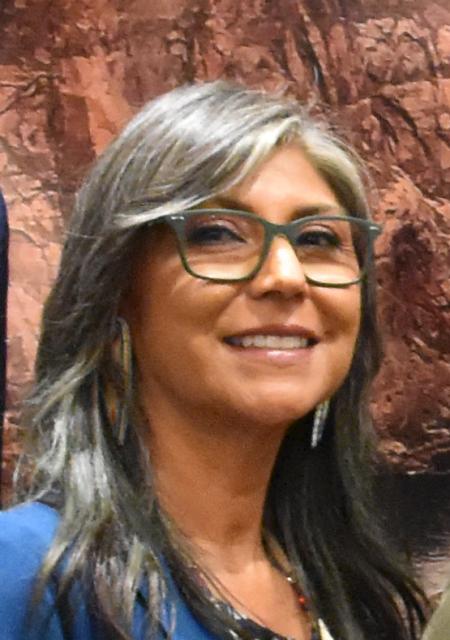
Lorelei Cloud, member of the Southern Ute Indian Tribe’s tribal council. (Source: Water Education Foundation)
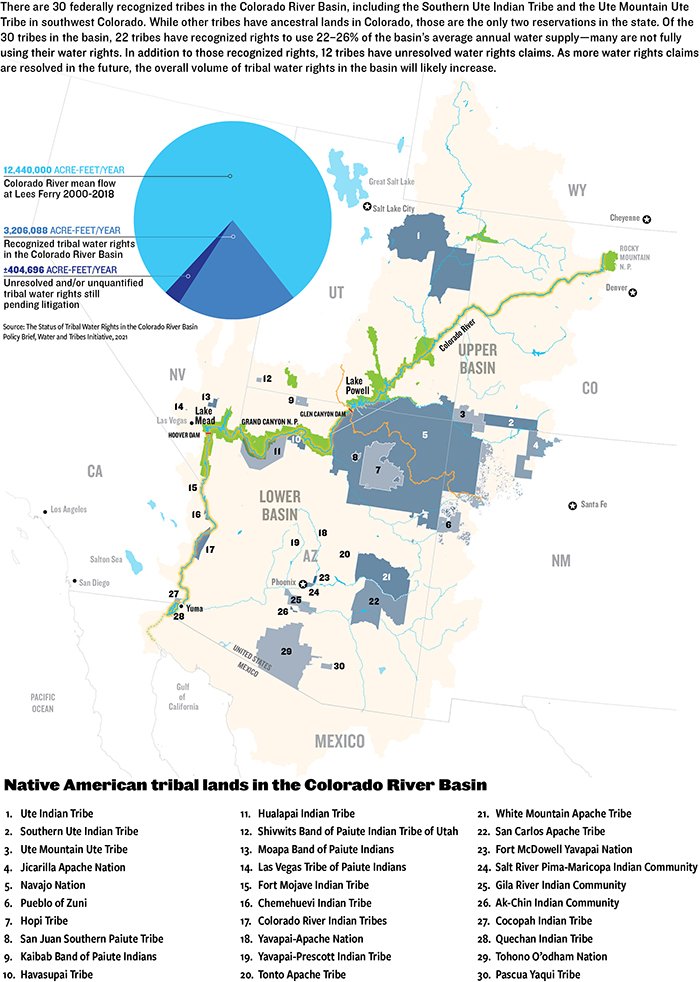
Many Basin tribes, which hold legal rights to about a quarter of the river’s water, are hoping to upgrade their infrastructure and fully develop their water rights. As the tribes assert their water rights, the amount of water available to states with junior rights like Arizona or Nevada may shrink. After fighting legal battles to secure their rights to the river — 12 Basin tribes still have unresolved water rights claims — tribes aren’t eager to halt the progress they’ve made in bringing water to their communities and farms.
Lorelei Cloud, a member of the Southern Ute Indian Tribe’s tribal council, said the tribe’s unused river water simply flows by its Colorado reservation to be used by others downstream. She reiterated that unused tribal water, which gets treated as “surplus water”, is a vanishing luxury the rest of the Basin won’t soon be able to bank on.
“Tribes don’t get compensated and have never been compensated for our unused tribal water, especially the water that’s sitting in Lake Powell and Lake Mead,” said Cloud.
Decrepit water infrastructure among other issues prevents the Southern Ute from being able to use its full river allocation as it is, so Cloud added that the tribe is unlikely to cut back its water use even if the river continues to shrink.
“When tribes start to develop their water, what are you all going to do?” Cloud asked the Symposium crowd. “Because that water is ours. We’re in Colorado, so we’re going to get our water first.”
While the tribes have been historically excluded from and considered an afterthought in Colorado River negotiations, there are signs that the balance of decision-making power is shifting. Congress is providing billions of dollars in funding in the Bipartisan Infrastructure Law and the Inflation Reduction Act to help tribes across the country improve their drinking water and water delivery systems.
At the September Symposium, both federal and state officials echoed the need for tribes to be included at the bargaining table.
“Tribes across the Basin will also continue to play a vital role,” said Interior Secretary Haaland, the first Native American to serve as a cabinet secretary. “Indian tribes have water rights, and not only are they deeply affected by the drought, but they have been and will be invaluable partners in finding solutions.”
Other Challenges
Before considering any major changes to the river’s guiding principles, water managers will have to ensure that the country of Mexico is included in the process.
Mexico, already dealing with water shortages in several of its northern cities, is taking cuts to its river supply in 2022 and 2023 under binational agreements. Tensions over sharing the Colorado River have traditionally waxed and waned but the neighboring countries have been able to reach a series of water management agreements in recent decades.
Members of the International Boundary and Water Commission (IBWC), which oversees boundary and water issues between the U.S. and Mexico, said they are confident the two countries can continue communicating and building on previous partnerships.
“I feel that we’re going to go very far and be able to identify what we need to solve the issues along the U.S.-Mexico border,” said Maria-Elena Giner, the U.S. commissioner to the IBWC.
Thus far, talks regarding the river’s future have focused on limiting impacts to cities, farms and tribes. But reserving enough water to ensure the Basin’s fish and wildlife survive the drought is another thorny task water managers are wrangling with.
Environmental groups and other nongovernment organizations argue they are key river partners that can bring myriad resources and ideas to the brainstorming process.
“When the system is not sustainable, it’s not resilient and the environment loses. It’s the one that gets sacrificed first,” said Taylor Hawes, The Nature Conservancy’s Colorado River program director. “Finding solutions that do not sacrifice the environment, that do not look at the environment as a sacrificial lamb, need to be part of our collective path forward.”
Meanwhile, new rules that would require Lower Basin users to account for water lost in large reservoirs to evaporation or leaky water delivery infrastructure are in the works. Currently, Upper Basin states are charged for evaporation losses but the Lower Basin is not.
Federal officials estimate as much as 10 percent of the river’s flow evaporates annually, including more than 1 million acre-feet from the Lower Basin. The federal government has announced it may change the evaporation accounting practices by the end of 2024, meaning the Lower Basin could take a significant cut to its share.
“In these serious times, we need to take the overdue step of assessing how to account for those losses throughout the Basin. This is another tough reality that we must work together to address,” Haaland said.
As water managers attempt to navigate the river’s mounting crises, they can turn to a variety of recent success stories for inspiration.
Pat Mulroy, a senior fellow at the University of Nevada, Las Vegas’ Boyd School of Law and the former longtime general manager of the Southern Nevada Water Authority, is an advocate for extensively rethinking how the Colorado River is managed. (Image: University of Nevada, Las Vegas’ Boyd School of Law)
Cities such as Phoenix, Los Angeles and Las Vegas have shown the ability to decouple water demand from population growth. Restoration efforts at the long-neglected Salton Sea are producing positive results. An innovative water sharing deal is providing economic benefits to the Jicarilla Apache Nation as well as water security for New Mexico and increased river flows for endangered species of fish.
These beneficial programs and decisions — in a refreshing twist from a river history dominated by men — are being crafted with the input of women in high-ranking positions, creating hope on a river in dire straits.
Instead of court battles that could lead to a federal judge taking over management of the Colorado River, water users need to negotiate with open minds as they chart a path for the lifeline that means so much to so many, said Mulroy, former head of the Southern Nevada Water Authority. To cut through the paralysis that has bogged down negotiations, everyone will have to show the courage to deviate from old agreements and assumptions and prepare for cuts.
“We’re talking about a body of law and a structure we’ve lived with predicated on 17 to 18 million acre-feet,” Mulroy said, “and a reality that has 9 to 11 million acre-feet in the river – the two don’t mesh.”
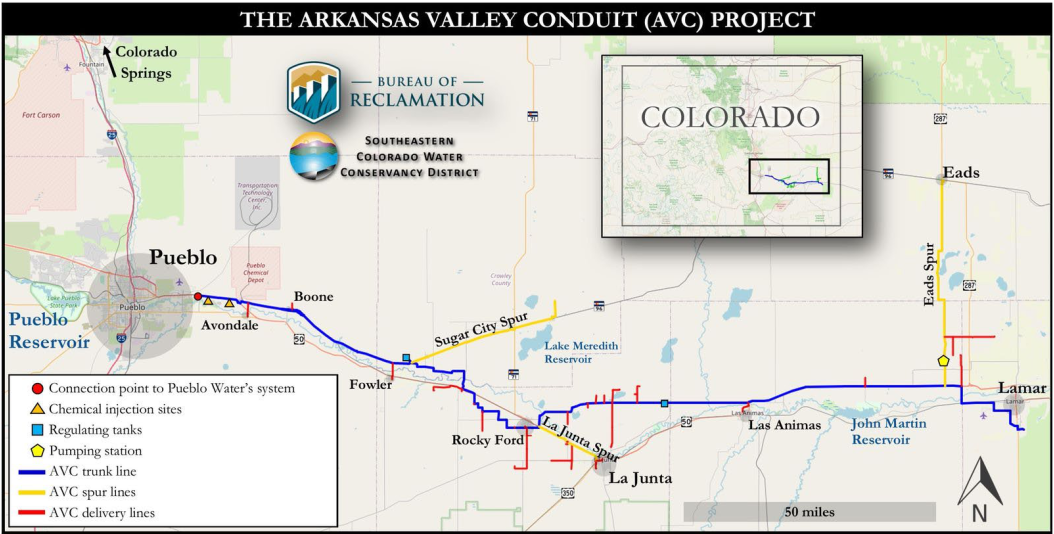
Since 1962, people in Colorado’s Lower Arkansas Valley have heard talks of a pipeline that would bring them clean drinking water from Pueblo Reservoir upstream.
The 103-mile Arkansas Valley Conduit promises to be a long-term source of clean water for the region, where many people rely on poor-tasting and contaminated well water. The project was planned as part of the Fryingpan-Arkansas Project, but for decades, the pipeline was too expensive for the small towns to afford, $600 million by today’s estimates.
If the project stays on schedule, the pipeline will reach its easternmost destination, the town of Lamar, Colorado, in 2035.
But with $60 million in new funding from the Bipartisan Infrastructure Law, officials are hoping to cut the project’s remaining 13-year timeline in half — and ensure steady access to clean water for more than 50,000 people living east of Pueblo along the Arkansas River.
“People have waited 60 years to build this,” says Chris Woodka, a spokesperson for the Southeastern Colorado Water Conservancy District. “The Bipartisan Infrastructure Law has made it entirely feasible that we could do this in a much shorter time.”
Also known as the Infrastructure, Investment and Jobs Act, the 2021 law authorizes more than $550 billion in new investment that will be spread across the nation, including more than $50 billion for clean water programs and another $8.5 billion for Western water needs. The historic federal investment comes as Colorado and other Western states face growing pressures from climate change, drought and a regional crisis along the Colorado River.
Colorado windfall?
Colorado could receive between $800 million and $1.2 billion for water projects alone, according to an early estimate from Gov. Jared Polis’ budget office. A companion bill that passed in August 2022, the Inflation Reduction Act, dedicates another $4 billion for drought resiliency in Western states.
The funding won’t resolve the drought. But the law is an opportunity to fund critical repairs on neglected water systems, many of which were built at the turn of the century.
Amy Moyer, director of strategic partnerships at the Colorado River District, hopes it will inspire water managers and public servants, who are used to engineering workarounds and funding projects piecemeal, to be more ambitious.
“It’s really giving [people] the license to think big,” Moyer says. The river district is giving grants to entities in its 15-county area to conduct studies and develop competitive applications for the federal money. “Projects that were previously unachievable because of a huge financial cost might be back on the table.”
How much money Colorado ultimately gets, however, will depend on efforts by state agencies, regional boards and advocacy groups to help communities, especially small and rural areas, navigate funding programs and pull together competitive applications. Entities eligible for funds include cities and towns, special districts, tribes, water suppliers, and nonprofit cooperative associations like mutual ditch companies.
“We have so many small water users and water providers that are maxed out by just trying to keep their systems running,” says Moyer, whose team has been helping people wade through federal programs to match their projects to the right opportunity.
Largest investment ever
The $1.2 trillion Bipartisan Infrastructure Law is the largest single federal investment in the nation’s water infrastructure ever, with billions available for programs aimed at improving clean water access, fixing century-old facilities and dams, and investing in the health of watersheds and forests.
Most of the one-time dollars will flow through longstanding programs. The U.S. Bureau of Reclamation’s WaterSMART program, which invests in projects that improve water efficiency, will get $400 million through the BIL. Another Reclamation program for Water Storage, Groundwater Storage and Conveyance Projects will get $1.15 billion, almost twice the total that the program received between 2016 and 2021.
The U.S. Environmental Protection Agency, meanwhile, will receive $50.4 billion for drinking water, wastewater and stormwater infrastructure improvements, including $15 billion to replace lead service lines. States will receive those dollars through their state revolving funds, programs that provide low-interest loans and use the money that borrowers pay back, through interest and principal, to provide additional future funding.
Colorado’s revolving funds — administered jointly by the Colorado Department of Public Health and Environment, the Colorado Department of Local Affairs, and the Colorado Water Resources and Power Development Authority — will get $680 million over the next five years, or nearly three times usual annual funding levels.
The money won’t make up for decades of neglect of the country’s water infrastructure; a 2020 report by the American Society of Civil Engineers, for example, estimated that the U.S. needs to invest $109 billion each year over the next two decades to catch up. The EPA’s own estimate calls for more than $744 billion in capital investments over that time period to bring communities into compliance with federal water quality and safety standards.
It’s still a “tremendous opportunity” for utilities to make a serious dent in their deferred infrastructure needs, says Tommy Holmes, legislative director for the American Water Works Association.
“We’ve got to use this money effectively if we want to see any future federal investments on a big scale,” says Holmes.
Finally, cash
Other programs are getting funded for the very first time. Reclamation’s aging infrastructure account, created in 2009 to help fund operations and maintenance work at Reclamation facilities, has until now never received any money. Most of the agency’s facilities are between 60 and 100 years old. BIL allocates $3.2 billion to that account, or 39% of Reclamation’s total funding under the law.
The law also sets aside $1 billion for water initiatives in rural communities nationwide.
Tribal communities will receive $3.5 billion through the Indian Health Service, a recognition of the historical dearth of funding for tribal water infrastructure. Nearly 48% of tribal homes do not have access to clean drinking water or basic sanitation, according to a 2021 report from the Water and Tribes Initiative, with Native American families 19 times more likely than white households to lack indoor plumbing.
The Southern Ute Indian Tribe has been awarded more than $1.1 million in BIL dollars for two wastewater projects, including a project to repair damaged sewage pipes and improve service to more than 1,000 homes. Another $1 million will help improve drinking water service and water pressure to more than 152 homes in Towaoc, the headquarters of the Ute Mountain Ute Tribe in southern Colorado.
The $3.5 billion represents the entire construction funding gap identified by IHS to bring tribal communities to federal standards and tackle a backlog of critical clean water projects.
“This is the first time in history that gap has been filled with funding,” says water policy expert Anne Castle, who is co-leader of Universal Access to Clean Water for Tribal Communities, a project of the Water and Tribes Initiative. “I don’t want to suggest it is a complete eradication of the problem of lack of access to water and sanitation in Indian country, but it is a huge forward step.”
Pressure to act
Groups will need to act relatively quickly to pull together applications for the federal funding opportunity, which can take months to years to prepare.
At the Uncompahgre Valley Water Users Association, general manager Steve Pope is used to navigating federal requirements. The association manages a federally owned system that diverts water from the Gunnison Basin to over 76,000 acres of land in Montrose and Delta counties.
The association hired a consultant to write a grant for a $6 million project to line a one-mile section of canal. Planning on any of its bigger pursuits, which range from $25 to $30 million, are still eight or nine months away from the grant-writing stage, a process that can cost tens of thousands of dollars, Pope says.
“We’re probably going to get one crack at it,” says Pope. “You really have to have your ducks in a row.”
Small organizations with limited capacity may decide it’s not worth the work, says Sonja Chavez, general manager of the Upper Gunnison River Water Conservancy District. Many projects need engineering work or a feasibility study to make their application competitive. To go after federal dollars, groups also need to secure state and local matching funds.
“For me to put in the effort to go after federal funds, I probably wouldn’t do it unless I had a significant project to go after,” says Chavez.
The advantage will go to “shovel-ready” projects that have already been studied and planned. Colorado’s revolving funds, for example, have so far awarded BIL-funded loans to four projects, all of which have been in development for years.
“There’s a lot of pressure to get this money out the door as quickly as possible,” says Alex Funk, director of water and senior counsel for the Theodore Roosevelt Conservation Partnership, which is convening policy groups to strategize and support environmentally sustainable projects funded by the law.
A slow roll-out
Although the legislation was passed in November 2021, the money has been slow to roll out. Reclamation and state revolving funds will award funding on a rolling basis over the next five years, meaning organizations that aren’t yet ready to apply can try for a later round. Many programs have not released any funds, while some new programs have yet to release the criteria for applications.
Unlike the 2021 American Rescue Plan Act, which requires public agencies to spend all of their dollars by the end of 2026, there’s no uniform deadline for when organizations must spend their BIL funds.
The state revolving funds have one year to obligate the BIL dollars they receive each year and another two years to spend them, says Keith McLaughlin, executive director of the Colorado Water Resources and Power Development Authority (CWRPDA), which serves as the banker for Colorado’s revolving funds.
In Northwest Colorado, the 126-year-old Maybell Ditch still delivers water from the Yampa River to 18 agricultural producers. Adjusting the headgates – which were built in the 1960s and are now broken – requires a one-mile hike into the canyon and the effort of a few people, says Mike Camblin, a rancher and volunteer manager of the Maybell Irrigation District.
Now with a $1.92 million BIL grant, the district hopes to begin construction next year on a project to build an access road, replace the headgates with an automated system, and to reconstruct portions of the ditch to address low-flow areas and large debris that make it impassable for boaters and too shallow and warm for fish.
The district and its partners worked for nearly five years to raise money for the project, get support in the community and from the Moffatt County Board of County Commissioners, and secure a grant from the Colorado Water Conservation Board.
All that helped the project’s application to Reclamation’s WaterSMART Grants program, says Diana Lane, sustainable food and water program director at The Nature Conservancy, the project’s fiscal partner. The application criteria awards points for projects that build on state or local planning efforts.
Finding workers
Amid a nationwide labor shortage, finding the skilled workers and planners to move projects forward expediently will be challenging.
Many state and local governments are still trying to fill positions that opened up months ago. And while a large water utility or municipality has staff dedicated to grant writing or to support project development, smaller organizations often need to hire a consultant to write a grant, conduct a study, or do engineering work.
That kind of expertise can be hard to come by, especially in rural Colorado communities.
At the Colorado Agricultural Water Alliance, executive director Greg Peterson is focused on a watershed program under the Natural Resources Conservation Service, which received $918 million in BIL funding, that could help irrigators and agricultural users address issues like soil erosion and flood mitigation. Local entities only have to put up a quarter of the costs of a project and can receive up to $25 million.
Peterson is working with eight different communities on applications for the program. He struggled to find a Colorado expert with experience applying to the fund and ended up reaching out to a group in Oregon for help.
“If we didn’t have them, we wouldn’t go after [the money] at all, probably,” he says.
State, regional groups step up
Early rounds of BIL grants went to states like Arizona and California that had more “shovel-ready” projects to put forward, says Moyer.
This year, officials are hoping money set aside by state lawmakers will give Colorado a competitive edge and help communities that don’t have the capacity to go after grants on their own.
“We’ve been really impressed with Colorado leadership in terms of recognizing that you have to work for these funds,” says Funk. “I think Colorado is actually a big competitor for this funding and could be a model for other states.”
The governor’s office estimates that Colorado needs $1 billion in local or state matching funds to successfully secure $4.1 to $7.1 billion in federal infrastructure dollars. Most federal programs require a local funding contribution, with some as high as 75%.
In addition to the $80 million in state matching funds set aside by state lawmakers, the state legislature also set aside $5 million for the Colorado Water Conservation Board (CWCB) to provide technical assistance for groups going after the dollars. Half of that will be available as direct grants for agencies to hire their own contractors, while the other half will pay for in-house contractors at CWCB who will provide assistance.
State agencies are also staffing up to conduct outreach about opportunities under the BIL. The Department of Local Affairs and Office of Recovery are hosting roundtables and webinars to answer questions from prospective applicants. Each of the state’s regional councils of government will receive funding to hire a coordinator to help local groups navigate federal and state programs.
“We want to make sure communities have the opportunity to say yes or no to these funding opportunities – we don’t want a community to say, ‘I wasn’t aware,’” says Meredith Marshall, infrastructure coordinator at the Colorado Office of Economic Development and International Trade.
This article first appeared in Water Education Colorado’s Fall 2022 issue of Headwaters Magazine.
Fresh Water News is an independent, nonpartisan news initiative of Water Education Colorado. WEco is funded by multiple donors. Our editorial policy and donor list can be viewed at wateredco.org.
Thy Anh Vo is a freelance journalist based in Colorado. She’s passionate about journalism that shows people how government works and how to hold it accountable. Thy has reported for The Colorado Sun, ProPublica, The Mercury News in San Jose, and Voice of OC.
Cover of the NBS report, released at COP27. Credit: White House
Click the link to read the article on the NOAA website (Genie Bey):
At COP27 in Egypt, the Biden-Harris Administration released the Nature-Based Solutions Roadmap, an outline of strategic recommendations to put America on a path that will unlock the full potential of nature-based solutions to address climate change, nature loss, and inequity. This marks the first time the U.S. has developed a strategy to scale up nature-based solutions. The report was developed in response to President Biden’s Executive Order 14072, which recognizes the importance of forests and other nature-based solutions to tackle the climate crisis and strengthen communities and local economies. Led by the Council on Environmental Quality, the Office of Science and Technology Policy, and the National Climate Advisor, the report was developed in consultation with numerous agencies, and identifies key opportunities for greater deployment of nature-based solutions across the Federal government.
The Roadmap calls on expanding the use of nature-based solutions and outlines five strategic areas of focus for the federal government: (1) updating policies, (2) unlocking funding, (3) leading with federal facilities and assets, (4) training the nature-based solutions workforce, and (5) prioritizing research, innovation, knowledge, and adaptive learning that will advance nature-based solutions. Genie Bey, Zac Cannizzo, Chelsea Combest-Friedman, Bhaskar Submaranian, and Lisa Vaughan represented NOAA’s Climate Program Office as contributors to this report and the accompanying resource guide.
What we need now is your help; I invite you to join us for the West Slope Water Summit on Nov. 10 at the Montrose County Event Center. Even though we are a small community on the western slope, arming our community members with knowledge, encouraging conservation, and researching potential solutions is a role that we all play in the Colorado River system. In its fourth year, the West Slope Water Summit’s theme is “troubled waters” featuring an impressive number of prominent water and conservation experts.
The program begins with Andy Mueller, Executive Director of the Colorado River District, who will address adapting the 1922 Compact to today’s reality. Next, Don Day, Meteorologist Day Weather Inc., is presenting on the State of the Weather: the good, the bad, and the ugly.
Before the free lunch, our local Uncompahgre Valley Water Users Association Manager Steve Pope will provide an update to the Colorado River Basin Drought Response as part of a panel of water user board members.
Spots are still available — we recently moved from the conference room to the arena to accommodate a larger crowd. Register at westslopewatersummit.com
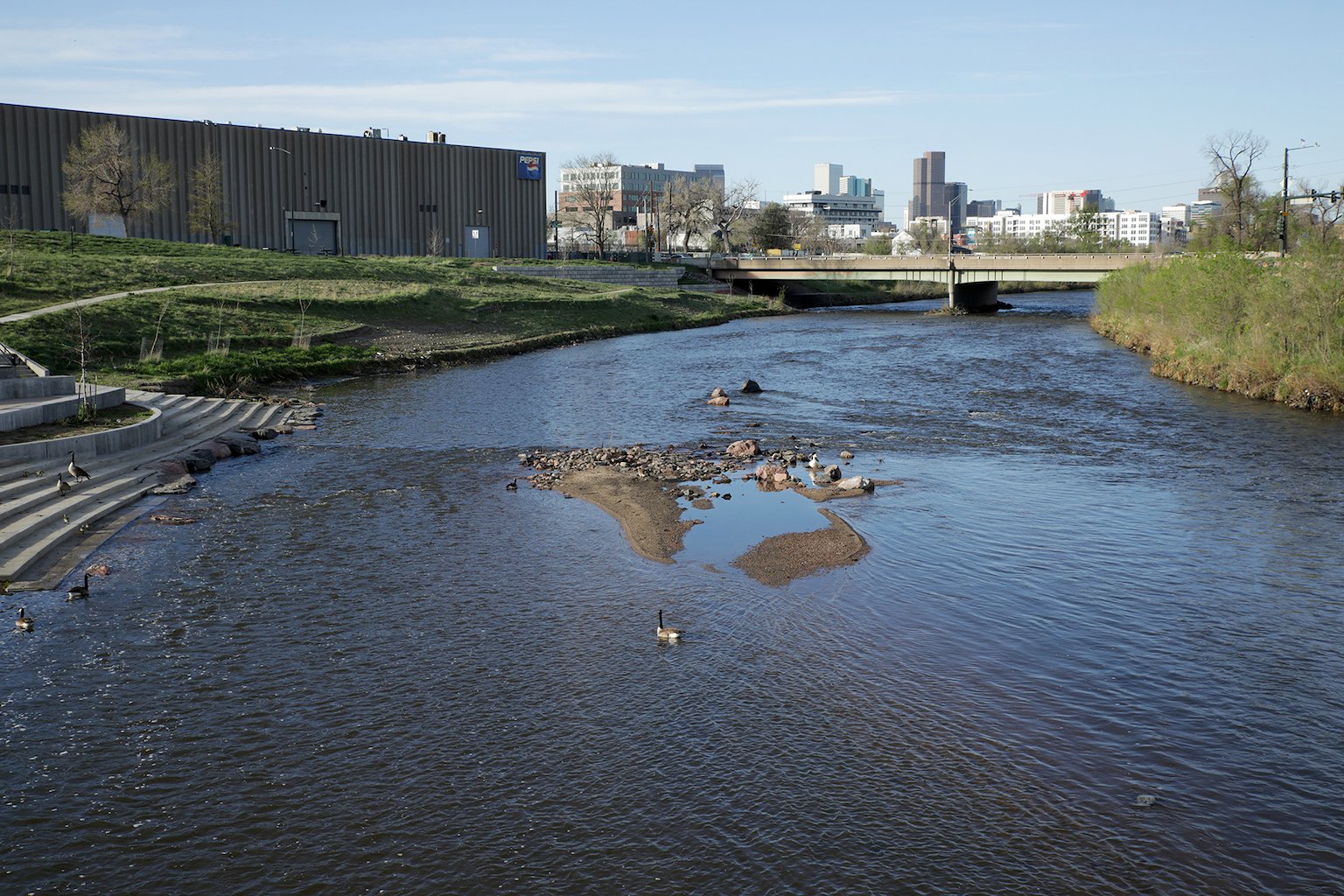
River Bottom Park Uncompahgre River. Photo credit: PhilipScheetzPhoto via the City of Montrose
South Platte River near CSU Spur. Photo credit: Colorado State University
Register here. Click the link to read the release on the Colorado State University website (Anthony Lane):
This year’s CSU Spur Water in the West Symposium, to be held Nov. 2-3 in downtown Denver, will bring together policymakers, researchers, and experts from the business, nonprofit, and agriculture sectors to look globally for lessons and strategies with the potential to inform how Colorado and other western states respond to the region’s water challenges.
The event’s theme, “Global Water: Successes and Solutions,” underlies a program that includes panel discussions and keynote speeches aimed at starting conversations about how communities and the entire region can respond and adapt to the pressures created by a growing population within a changing environment.
“Water in the West, now in its fifth year, has always focused on creating opportunities for speakers and audience members to connect while exploring solutions from unexpected places and sectors,” said Jocelyn Hittle, the CSU System’s associate vice chancellor for CSU Spur and special projects. “This year, we are bringing speakers with wide-ranging expertise — from ag to business to investing — together from across the world to present solutions that might be useful here in the American West. We hope the CSU community and others from across the West will join us for a stellar speaker line-up, a solutions-oriented approach, and a chance to build new, and perhaps unexpected, connections.”
Speakers and panel discussions
Among the speakers at the 2022 Symposium is Jay Famiglietti, a water researcher who leads the Global Institute for Water Security at the University of Saskatchewan. Panel discussions on cities, agriculture, and innovation opportunities will seek to inform western water discussions by drawing on the experiences of experts from government agencies, private industry, and municipalities as far away as Portugal and Cape Town, South Africa.
Two additional panel discussions will examine lessons and opportunities related to international water agreements. One will focus on the Columbia River Treaty, which the United States and Canada signed in 1961 and governs the construction and operation of dams on a river that begins in the mountains of British Columbia, flows south through eastern Washington, and then turns west, defining the border between Oregon and Washington on its way to the Pacific. The other will explore solutions involving the United States and Mexico, both of which rely on water from two rivers, the Colorado and Rio Grande, that have their headwaters in Colorado.
In the future, the Water in the West Symposium will be held at the CSU Spur Hydro building, which opens in January 2023.
The Symposium switched to a virtual format in 2020 and 2021 because of COVID precautions. This year, attendees have the option of attending in-person sessions at the Seawell Ballroom or participating virtually. A combined reception at CSU Spur the evening of Wednesday, Nov. 2, will bring Symposium participants together with the ranchers, farmers, conservationists, land managers, scientists, and others attending Regenerate 2022, an annual conference focused on sharing knowledge and building a culture of resilience.
The event will take place just weeks before the Spur campus’s third building, Hydro, opens in January. In coming years, Hydro will house the Water in the West Symposium and a range of programs and initiatives focused on water research, conservation, and education. Among these will be Denver Water’s new water quality lab, which will serve to inform the public while providing capacity for more than 200,000 tests each year to monitor the quality of water before treatment and after it is prepared for distribution to customers across the metropolitan area.
Program details and registration information for the 2022 Water in the West Symposium are available at csuspur.org/witw/.
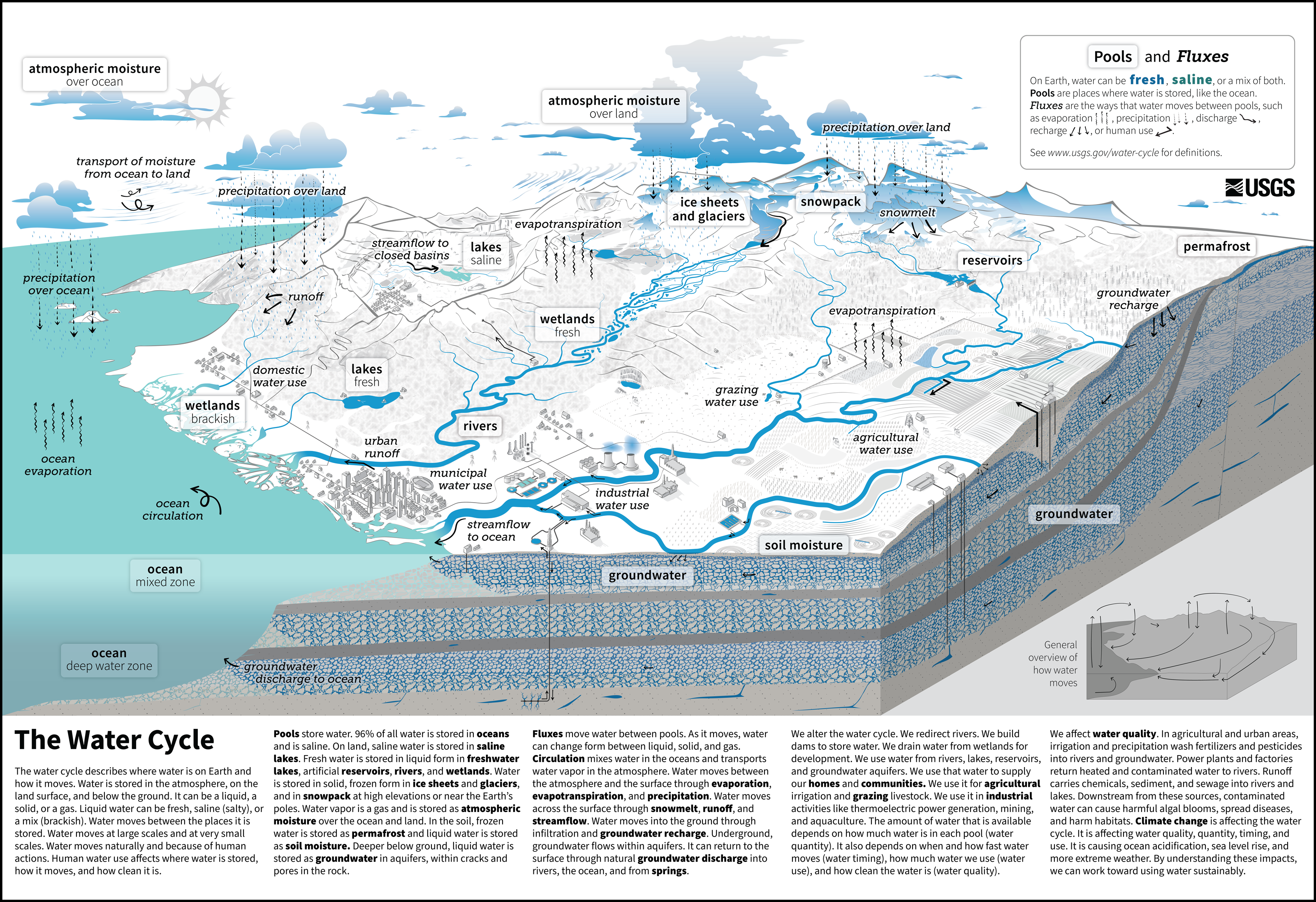
Click the link to read about the water cycle on the USGS website:
The water cycle describes where water is on Earth and how it moves. Human water use, land use, and climate change all impact the water cycle. By understanding these impacts, we can work toward using water sustainably.
What is the water cycle?
The water cycle describes where water is on Earth and how it moves. Water is stored in the atmosphere, on the land surface, and below the ground. It can be a liquid, a solid, or a gas. Liquid water can be fresh or saline (salty). Water moves between the places it is stored. Water moves at large scales, through watersheds, the atmosphere, and below the Earth’s surface. Water moves at very small scales too. It is in us, plants, and other organisms. Human activities impact the water cycle, affecting where water is stored, how it moves, and how clean it is.
Pools store water
Oceans store 96% of all water on Earth. Ocean water is saline, meaning it’s salty. On land, saline water is stored in saline lakes. The rest of the water on Earth is fresh water. Fresh water is stored in liquid form in freshwater lakes, artificial reservoirs, rivers, and wetlands. Water is stored in solid, frozen form in ice sheets and glaciers, and in snowpack at high elevations or near Earth’s poles. Water vapor is a gas and is stored as atmospheric moisture over the ocean and land. In the soil, frozen water is stored as permafrost and liquid water is stored as soil moisture. Deeper below ground, liquid water is stored as groundwater in aquifers. Water in groundwater aquifers is found within cracks and pores in the rock.
Fluxes move water between pools
As it moves, water can change form between liquid, solid, and gas. Circulation mixes water in the oceans and transports water vapor in the atmosphere. Water moves between the atmosphere and the surface through evaporation, evapotranspiration, and precipitation. Water moves across the surface through snowmelt, runoff, and streamflow. Water moves into the ground through infiltration and groundwater recharge. Underground, groundwater flows within aquifers. Groundwater can return to the surface through natural discharge into rivers, the ocean, and from springs.
A high desert thunderstorm lights up the sky behind Glen Canyon Dam — Photo USBR
What drives the water cycle?
Water moves naturally and because of human actions. Energy from the sun and the force of gravity drive the continual movement of water between pools. The sun’s energy causes liquid water to evaporate into water vapor. Evapotranspiration is the main way water moves into the atmosphere from the land surface and oceans. Gravity causes water to flow downward on land. It causes rain, snow, and hail to fall from clouds.
Greeley Irrigation Ditch No. 3 construction via Greeley Water
Humans alter the water cycle
In addition to natural processes, human water use affects where water is stored and how water moves. We redirect rivers. We build dams to store water. We drain water from wetlands for development. We use water from rivers, lakes, reservoirs, and groundwater aquifers. We use that water to supply our homes and communities. We use it for agricultural irrigation and grazing livestock. We use it in industrial activities like thermoelectric power generation, mining, and aquaculture.
We also affect water quality. In agricultural and urban areas, irrigation and precipitation wash fertilizers and pesticides into rivers and groundwater. Power plants and factories return heated and contaminated water to rivers. Runoff carries chemicals, sediment, and sewage into rivers and lakes. Downstream from these sources, contaminated water can cause harmful algal blooms, spread diseases, and harm habitats for wildlife.
The water cycle and climate change
Climate change is actively affecting the water cycle. It is impacting water quantity and timing. Precipitation patterns are changing. The frequency, intensity, and length of extreme weather events, like floods or droughts, are also changing. Ocean sea levels are rising, leading to coastal flooding. Climate change is also impacting water quality. It is causing ocean acidification which damages the shells and skeletons of many marine organisms. Climate change increases the likelihood and intensity of wildfires, which introduces unwanted pollutants from soot and ash into nearby lakes and streams.
What determines water availability?
Humans and other organisms rely on water for life. The amount of water that is available depends on how much water there is in each pool (water quantity). Water availability also depends on when and how fast water moves (water timing) through the water cycle. Finally, water availability depends on how clean the water is (water quality). By understanding human impacts on the water cycle, we can work toward using water sustainably.
Read more about the components of the water cycle in more detail:
Filtration pipes at Metropolitan Water District of Southern California’s wastewater recycling demonstration plant. (Source: Metropolitan Water District of Southern California)
Colorado regulators, after years of study, negotiations and testing, approved a new rule that clears the way for drinking treated wastewater this week, one of only a handful of states in the country to do so.
The action came in a unanimous vote of the Colorado Water Quality Control Commission Oct. 11.
Direct potable reuse (DPR) involves sophisticated filtering and disinfection of sewage water for drinking water purposes, with no environmental buffer, such as a wetland or river, between the wastewater treatment plant and drinking water treatment plant. That water is then sent out through the city’s drinking water system.
Colorado joins Ohio, South Carolina and New Mexico in setting up a regulated DPR system, with California, Florida and Arizona working to develop a similar regulatory scheme, according to Laura Belanger, a water reuse specialist and policy advisor at Western Resource Advocates.
Ron Falco, safe drinking water program manager for the Colorado Department of Public Health and Environment (CDPHE), said the new regulation would provide communities across the state important access to a new, safe source of drinking water, a critical factor in a water-short state.
“This is going to be a need in Colorado and we want to be prepared,” he said. “Can DPR be done safely? Our answer to that is yes.”
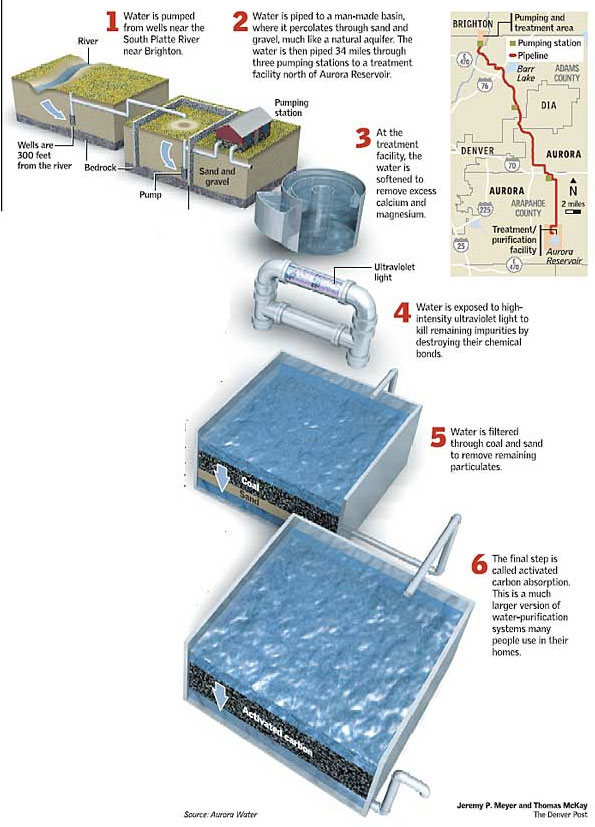
Aurora has had a reuse system in place for more than a decade that also uses treated wastewater. But Aurora’s water is treated and released from the wastewater treatment plant into the South Platte River, where it flows through the river’s alluvial aquifer, before Aurora pumps it out through groundwater wells. Aurora then mixes it with raw mountain water before treating it and distributing it to customers. That practice is known as indirect potable reuse — there’s an environmental buffer between the wastewater plant and the drinking water plant, in Aurora’s case, that’s the river. Indirect potable reuse is used by several big cities nationwide, including San Diego.
Graphic by Chas Chamberlin, Source: Western Resource Advocates
Under Colorado’s new regulation, water providers will be required to show they have the technical, managerial and financial resources needed to successfully treat wastewater.
Communities will also be required to show how they will remove contaminants in their watersheds before the water reaches rivers and streams.
Wastewater intended for drinking will require extensive disinfection and filtration, among other techniques, all of which are intended to eliminate pathogens like viruses and bacteria, and remove drugs and chemicals to safe and/or non-detectable levels, according to CDPHE.
And any community that seeks to add treated wastewater to its drinking water system will have to set up extensive public communication programs to show the public its process and to help educate residents about this new water source.
Communities will also have to collect a year’s worth of wastewater samples and prove that they can be successfully treated to meet the new standards.
Western Resource Advocates’ Belanger, who has long advocated for the use of DPR, said the approval has been a long time coming and is cause for celebration.
“We believe DPR is a very important water supply for our communities now and into the future. We feel [this new regulation] is robust and protective of public health.”
But key to tapping the new water source will be helping the public get over the “ick factor,” officials said.
Jason Rogers, vice chair of the Water Quality Control Commission who is also Commerce City’s director of community development, said public outreach should be carefully monitored to ensure it is actually reaching people in all communities and that it is being well-received.
“When thinking about that public meeting, where does it occur? People in some of these communities may have a high reliance on multi-modal transportation, it may not allow for that meaningful engagement,” Rogers said. “And if it isn’t being well received, we need to have them go out and do more public engagement.”
With a mega drought continuing to grip the Colorado River Basin and other Western regions, Colorado’s multi-year process to develop a sturdy new drinking water regulation drew widespread attention, said Tyson Ingels, the head drinking water engineer at the state’s Water Quality Control Division.
Ingels said Utah and Arizona participated in Colorado’s work sessions, demonstrating the interest in what could become an important new water source in the West. Arizona is just now kicking off its own rulemaking process, Ingels said, and Utah, while not yet regulating DPR, has seen a handful of communities proposing to use DPR.
Colorado’s rulemaking process, which dates back to 2015, was at times fractious, with water providers and wastewater operators concerned that the proposed regulation would interfere with what they’re doing already and could add burdensome costs to efforts to develop new water sources.
Ingels said the addition of a third-party facilitator was essential to resolving everyone’s concerns.
Jeni Arndt, a former lawmaker who also serves on the water quality commission, said finalizing the groundbreaking new regulation signaled an important step forward in navigating difficult public policy issues. [Editor’s note: Arndt is a former board member of Water Education Colorado, which sponsors Fresh Water News.]
“Gone are the days when we were struggling to come to agreement,” Arndt said. “I’m very excited to move forward into a new era.”
On Tuesday, several water utilities spoke in favor of the new regulation, including the Cherokee Metropolitan District, Castle Rock, and the City of Aurora.
Matt Benak, Castle Rock’s water resources manager, said the regulation will give his town the certainty it needs to move forward developing new water supplies. “DPR is a critical tool for sustainable water resources. Creating this regulation will allow water providers like us to plan and to potentially implement DPR,” he said.
Tuesday’s approval was contingent on fixing minor clerical errors in the regulation. Commissioners will give final formal approval of the regulation at its November meeting.
Jerd Smith is editor of Fresh Water News. She can be reached at 720-398-6474, via email at jerd@wateredco.org or @jerd_smith.
Water Education Foundation Inaugural ColoradoRiver Water Leaders class with their suggested 2026 operating guidelines for the river basin. Photo credit: The Water Education Foundation
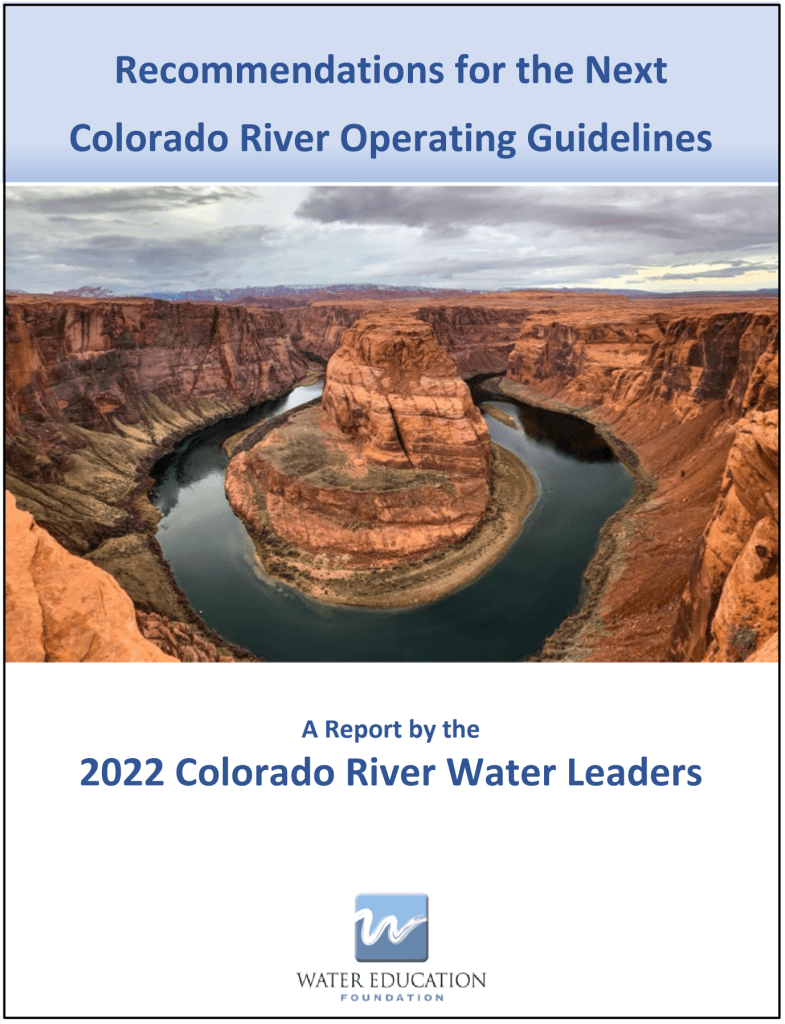
Our inaugural 2022 Colorado River Water Leaders class completed its six-month program with a report outlining key policy recommendations for managing the Colorado River after existing operating guidelines expire in 2026.
The class of 13 up-and-coming leaders included engineers, lawyers, resource specialists, scientists and others working for public, private and nongovernmental organizations from across the river’s basin. The class had full editorial control to choose its recommendations.
Class members presented their recommendations at the Foundation’s biennial Colorado River Symposium, an invitation-only event in Santa Fe, N.M., whose audience included key water managers, state and federal officials, tribal leaders and other interested groups from throughout the Colorado River Basin.
The biennial Colorado River Water Leaders program is modeled after our California Water Leaders program, which allows participants to deepen their knowledge on water, enhance individual leadership skills and prepare participants to take an active, cooperative approach to decision-making about water resource issues. Leading experts and top policymakers served as mentors to class members. Our next Colorado River Water Leaders class will be in 2024.
Among the Colorado River Water Leaders’ key recommendations:
– Improve the planning process through increased frequency, communication and engagement with water interests
Brad Udall: Here’s the latest version of my 4-Panel plot thru Water Year (Oct-Sep) of 2021 of the Colorado River big reservoirs, natural flows, precipitation, and temperature. Data (PRISM) goes back or 1906 (or 1935 for reservoirs.) This updates previous work with @GreatLakesPeck. Credit: Brad Udall via Twitter
– Establish a more holistic approach to systems management that balances water use with available supply and inflows that provides flexibility and allows the system to recover and build resilience.
Colorado River Allocations: Credit: The Congressional Research Service
– Leverage the political power of the Colorado River Basin to push Congress for large-scale, predictable federal investment.
Colorado River “Beginnings”. Photo: Brent Gardner-Smith/Aspen Journalism
– Incorporate the environment in the next round of Colorado River operating guidelines.
The Colorado General Assembly’s Interim Water Resources and Agriculture Review Committee recommended two bills for consideration next session, which will begin in January 2023, at its third and final meeting on Sept. 22. One would change the committee from an interim to a year-round committee, and the other would create a task force to explore the use of snowmaking by ski areas as an alternative form of water storage.
Joint Water Committee
George Washington addresses the Continental Congress via Son of the South
The committee unanimously recommended a bill that would change its status from an interim committee — limited to meeting after the legislature adjourns each session — to a year-round committee that would meet at least four times each year. Its purposes would remain the same: “contributing to and monitoring the conservation, use, development, and financing of the water resources of Colorado for the general welfare of its inhabitants; identifying, monitoring, and addressing Colorado agriculture issues; and reviewing and proposing water resources and agriculture legislation.” And its make-up would not change: 10 members, with five appointed by the president of the Senate and two by the minority leader; and five appointed by the speaker of the House of Representatives after consultation with the minority leader.
In proposing the bill, Sen. Cleave Simpson, R-Alamosa, said he was responding to a “sense of urgency, and really approaching almost emergency status in the state about water issues.” He pointed to “challenges from Nebraska on the South Platte, [and] declining reservoirs in the Colorado River system” that would benefit from giving the committee “the ability to meet as needed throughout the course of the year.”
High-Altitude Storage
The committee also unanimously recommended a bill that would create a seven-member task force to study and report back on the feasibility of using high-altitude snowmaking to serve as water storage. Task force members would include the state engineer, two state legislators, a representative of the ski industry and one from the whitewater rafting industry, an engineer with experience in high-altitude hydrology, and staff from the U.S. Forest Service. If the bill passes, the task force would meet no later than Nov. 1, 2023, and report its findings and any recommendations to the committee by June 1, 2024.
Snowmaking. Photo credit: Allen Best
At an earlier committee meeting in August, Rep. Hugh McKean, R-Loveland, said he had been mulling the concept of an alternative water storage system and this approach “would allow ski resorts to blow other people’s water as snow up into the high woods to extend the snowmelt by 30-45 days and literally allow them to create storage up high as snow.” He thought this could be a “transformative way of storing water in the state of Colorado that does some things for an industry we depend on, and does some things to delay water coming down, in some cases, until we really need it.”
In introducing the bill, Rep. McKean acknowledged that “this is intended to be a conversation” to explore whether the idea makes sense. He was looking for the task force to help determine if “there is a financial and logistical way of increasing storage at high altitude.”
Other Issues
The committee had seven other bills before it but all were withdrawn by their sponsors, citing the need for additional work. Among those receiving testimony was a bill that would restrict a homeowners association from unreasonably requiring the use of either rock or turf grass on more than a certain percentage of a homeowner’s landscape and providing an option for drought-tolerant plantings on the rest of the property. Another bill would provide legal protections and financial incentives to treat nontributary water that is “developed,” or brought to the surface, as a byproduct of oil and gas operations for other beneficial uses.
Larry Morandi was formerly director of State Policy Research with the National Conference of State Legislatures in Denver, and is a frequent contributor to Fresh Water News. He can be reached at larrymorandi@comcast.net.
Colorado and three other Upper Colorado River Basin states have, for the first time in history, embarked on a series of formal meetings to find a way to negotiate jointly with some of the largest owners of Colorado River water rights: tribal communities.
The states, which include New Mexico, Utah, Wyoming and Colorado, began meeting with six tribes several weeks ago, according to Rebecca Mitchell, director of the Colorado Water Conservation Board who also represents Colorado on the Upper Colorado River Basin Commission.
The tribes are the Jicarilla Apache Nation in New Mexico, the Navajo Nation in New Mexico and Utah, the Ute Indian Tribe of the Uintah and Ouray Reservation, and the Paiute Tribe in Utah, as well as Colorado’s Ute Mountain Ute Tribe, based in Towaoc, and Southern Ute Indian Tribe, whose lands lie in and around Ignacio.
“We have four Upper Basin states and the six Upper Basin tribes, 10 sovereigns, in the room together saying that the table that is set is not the table that works for all, and we are going to create our own table. They are really focused on solutions and being part of the burden and part of the success,” Mitchell said.
The six tribes are among 30 tribal communities in the seven-state Colorado River Basin, which, combined, have paper water rights to roughly 25% to 30% of the river’s flows, more than 3.2 million acre-feet of water.
The news came Sept. 16 at the Colorado River District’s Annual Seminar in Grand Junction. The river district represents 15 counties on Colorado’s West Slope and is responsible for policy and managing the river within those boundaries.
For more than 100 years, modern water management in the American West has been conducted by the federal and state governments, without formal tribal leaders.
Under Western water law, water has to be measured, its historical use rates certified, and it has to be diverted so that it can be put to beneficial use. Tribal water rights are treated differently. Tribes’ water rights date back to the time when the reservations were created, based on a law that was applied retroactively – many reservations were established before the law existed and so the amount of water they received was never quantified or adjudicated. For this reason, many tribes have had to settle their water rights within the state or states where their reservation lies— some of those negotiations remain unsettled. Many tribes have never measured their water use and, even among those tribes with quantified water rights, many have never had the money to build the dams, pipelines and reservoirs that allow them to put the resource to use.
Roughly 60% of the water the tribes legally possess has never been developed or integrated into the region’s hierarchy of water rights, though they are often some of the oldest, according to tribal estimates.
Daryl Vigil, Jicarilla Apache Nation Water Administrator, said tribal leaders want the federal government to create a new framework to right past wrongs and establish a process for tribes to participate in critical river negotiations.
For too long, he said, “The policy-making process has been left up to the seven basin states and the federal government. We want to speak on behalf of our own water. We’ve heard a whole lot about scarcity and pain,” he told the Grand Junction audience of roughly 400 people. “And we know a whole lot about that. We’re asking, we’re demanding participation because it is a basic human right.”
During the past five years, as the Colorado River has sunk deeper into crisis, the tribes have begun working together and asserting their right to negotiate with federal, state and local water agencies to determine how their water will be used, how badly needed tribal water systems can be built, and how tribes can be fairly compensated for the water that has long been used by others.
Despite increased public pressure to recognize the tribes’ water rights and to include them in critical negotiations and decision-making processes, they continue to be shut out, including in the most recent talks over how to achieve the 2 million to 4 million acre-feet of cuts that U.S. Bureau of Reclamation Commissioner Camille Touton ordered back in June in order to keep lakes Mead and Powell operating.
Another set of critical talks set to begin in the near future still has no mechanism for including the tribes. These are talks that will determine how to operate the river well into the future, after the current framework for river operations, known as the 2007 Interim Guidelines, expires at the end of 2026. Tribes were not included in the talks leading up to the 2007 agreement either.
Lorelei Cloud, a member of the Southern Ute Tribal Council, said traditional water users in the Colorado River Basin won’t survive unless tribal waters are legally recognized, developed and put to use by tribes and other users in the basin.
“We are a sovereign government. We should be considered just as a state would be. If you think that we shouldn’t be involved, then don’t include our 30% allocation for anyone else’s use … We need to be included in every one of these conversations. My reservation was established in 1868. We are first in time first in line. You cannot discount us,” she said.
Jerd Smith is editor of Fresh Water News. She can be reached at 720-398-6474, via email at jerd@wateredco.org or @jerd_smith.
Native land loss 1776 to 1930. Credit: Alvin Chang/Ranjani Chakraborty
Cattle of the Bow & Arrow herd, graze in a frosted corn field on the 7,770 acre Ute Mountain Ute Farm & Ranch Enterprise near Towoac, Colorado. About 700 head of cattle, graze on the farm and ranch lands during the winter. During the summer the herd is moved to mountain pastures. (Dean Krakel photo, special to EWC)
At Spring Born, a greenhouse in western Colorado near Silt, you see few, if any, dirty fingernails. Why would you? Hands never touch soil in this 113,400-square-foot greenhouse.
You do see automation, long trays filled with peat sliding on conveyors under computer-programmed seeding devices. Once impregnated, the trays roll into the greenhouse.
Thirty days after sprouting, trays of green and red lettuce, kale, arugula, and mustard greens slide from the greenhouse to be shorn, weighed and sealed in plastic clamshell packages. Hands never touch the produce.
Spring Born says it needs 95% less water compared to leafy greens grown using Colorado River water a thousand miles downstream in Arizona and California. That region supplies more than 90% of the nation’s lettuce. At Silt, the water comes from two shallow wells that plumb the riverine aquifer of the Colorado River, delivering about 20 gallons per minute. The water is then treated before it is piped into the greenhouse. This is agriculture like nowhere else.
he all-mechanized operations at Spring Born’s large greenhouse near Silt, Colo., produce leafy greens by maximizing the use of water. Spring Born says it needs 95% less water compared to greens grown using Colorado River water 1,000 miles downstream in Arizona and California. From the Hip Photo courtesy of Spring Born
Great precautions are taken to avoid contamination and prevent the spread of pathogens. Those entering the greenhouse must don protective equipment.
There’s no opportunity for passing birds or critters to leave droppings. As such, there is no need for chlorine washes, which most operations use to disinfect. Those washes also dry out the greenery, shortening the shelf life and making it less tasty. The Spring Born packages have an advertised shelf life of 23 days.
Spring Born likely constitutes the most capital-intensive agricultural enterprise in Colorado. Total investment in the 250-acre operation, which also includes traditional hay farming and cattle production, has been $30 million. The technology and engineering come from Europe, which has 30 such greenhouses. The United States has a handful.
Agribusiness in Colorado generates $47 billion in economic activity but it ties to one reality: The future is one of less water. So how exactly can agriculture use water more judiciously?
The Thirsty Future
A Desert Research Institute study published in April 2022 concluded that the warming atmosphere is a thirstier one. Modeling in the study suggests that crops in some parts of Colorado already need 8% to 15% more water than 40 years ago. Agricultural adaptations to use less water are happening out of necessity.
Grahic credit: Colorado Climate Center
Colorado has warmed about 2.5 degrees Fahrenheit in the last 120 years. Warming has accelerated, with the five hottest summers on record occurring since 2000.
Higher temperatures impact the amount of snowfall and amount of snowpack converted to water runoff. “As the climate warms, crops and forested ecosystems alike use water more rapidly,” says Peter Goble, a research associate at the Colorado Climate Center. “As a result, a higher fraction of our precipitation goes into feeding thirsty soils and a lower fraction into filling our lakes, streams and reservoirs. Essentially, a warmer future is a drier future.”
This year was a good example of the drying trend.
Dolores River watershed
Snowpack was around average in the San Juan Mountains, but spring arrived hot and windy. Snow was all but gone by late May, surpassed in its hurried departure only in 2018 and 2002. Farmers dependent on water from the Dolores River, still reeling from last year’s meager supplies, were required to accept lesser supplies yet again as the growing season began this year.
The Ute Mountain Ute Farm and Ranch Enterprise, the most southwesterly agriculture operation in Colorado, expected less than 30% of its regular water delivery from McPhee Reservoir. This was on top of a marginal year in 2021, too. Simon Martinez, general manager of the operation, said just 15 of the 110 center pivots had crops under cultivation in early June. Employment was cut in half, and the 650-head cow-calf operation had been slimmed to 570.
Pressured by compacts
The warming climate is not alone in spurring adaptations. In many river basins, irrigators must also worry about delivery of water to downstream states specified by interstate compacts.
Water conservation districts formed in the last 20 years are paying farmers to decrease pumping and planting to save the water that remains in the aquifers, comply with compacts, and transition to less water use.
Directors of the Republican River Water Conservation District, in northeastern Colorado were successful in voluntarily retiring 4,000 acres by June 2020. They are confident about retiring 10,000 acres in the area between Wray and Burlington before 2025. They’re less sure of achieving the 25,000 acres that compact compliance will require by 2029.
Rio Grande Water Conservation District directors in south-central Colorado have an even greater lift. They must figure out how to retire 40,000 irrigated acres by 2029. They’re at 13,000.
High commodity prices have discouraged farmer participation. The pot of local, state and federal money hasn’t been sufficient to fund high enough incentives to compete with commodity pricing. A bill, SB22-028, Groundwater Compact Compliance Fund, which passed in the Colorado Legislature in May, will allocate $60 million to both the Republican and Rio Grande basins to help them comply with interstate river compacts by reducing the acreage outlined above. The law says that if voluntary reductions cannot be attained, Colorado may resort to mandatory reductions in groundwater extraction.
From Sprinklers to New Crops
Even as center-pivot sprinklers are removed in the Republican River Basin and San Luis Valley, they are going up in the Grand Valley of western Colorado. There, instead of drafting groundwater, they are distributing Colorado River water, because they are reducing labor costs and reducing water use.
The geography of the valley from Palisade to Fruita and Loma does not immediately favor center pivots. They work best as a pie within a square, a full 40 or 160 acres. Parcels in the Grand Valley tend to be more rectangular. That means a pivot can arc maybe three-quarters of a circle. That slows the payoff on investment.
Why the pivot, so to speak, on pivots? Perry Cabot, a water resource specialist with Colorado State University’s Western Colorado Research Center near Fruita, sees two, sometimes overlapping, motivations. (Cabot also serves on the Water Education Colorado Board of Trustees.)
The greater motivation is the desire to save labor. That itself is good, he says, because the investment reflects an intention to continue farming. “People are obviously doing it for the long haul,” he says.
The other motivation appears to be water related. “The feedback I get is, to paraphrase the farmers, at some point in the future we are going to have less water to farm with and so we must prepare for that,” Cabot says.
Incremental improvements have improved efficiency. Experiments at the CSU research center in Walsh have shown conclusively the advantage of long-drop nozzles that spray the water just a couple feet off the ground, reducing evaporation.
Jason Lorenz with Agro Engineering talks about irrigation, soil moisture and chemistry during a soil workshop for students in Colorado’s San Luis Valley.Courtesy of AgroEngineering
Technology can help perfect a producer’s irrigation set up. Consider work in the San Luis Valley by Agro Engineering, crop consultants who seek to assist growers in producing maximum value with minimum water application. Potatoes, the valley’s largest cash crop, thrive in warm, but not hot, days and cool nights. They need 16 to 18 inches of water per year, of which 13 to 15 inches comes from irrigation. This includes two inches applied during planting, to moisten soils sufficiently for germination. They do not do well with too much water, explains Jason Lorenz, an agricultural engineer who is a partner in the firm. That, and the need to align use with legal requirements, gives growers compelling reason to closely monitor water.
The company uses aerial surveys conducted from airplanes to analyze whether the desired uniformity is being achieved. The latest advancement, multispectral aerial photography, enables the detection of green, red and near-infrared light levels. These images indicate the amount of vegetative biomass, vegetative vigor, and the greenness of the leaves. Variations show where crops are healthier and where there are problems, including insects and diseases, water quality, or soil chemistry problems.
Any discussion of water and agriculture in Colorado must include a focus on corn. In 2021, according to the U.S. Department of Agriculture, almost 1.4 million acres in the state were devoted to corn, with well more than half of that irrigated.
Corn is also thirsty. So far, efforts to produce corn with less water have come up short, says Colorado State University water resources specialist Joel Schneekloth. But if corn still needs the same amount of water, researchers have succeeded in producing greater yields.
How about alternatives to corn? Sunflowers, used to make cooking oil but also for confections, came on strong, but acreage shrank from 132,000 acres to 59,000 acres statewide between 2010 and 2019. For farmers, corn pays far better.
Quinoa may be possible. It consumes less water. But no evidence has emerged that it’s viable in eastern Colorado. The demand is small. Demand also remains small for black-eyed peas, which a bean processing facility in Sterling accepts along with pinto, navy and other beans.
“We can find low-water crops, but they just don’t have huge markets,” explains Schneekloth who conducts studies for the Republican and South Platte basins at a research station in Akron. There has to be enough production to justify processing facilities, he said. One such processing facility proximate to the Ogallala aquifer in Colorado—it was in Goodland, Kansas—closed because it didn’t have enough business.
Nearly all of the corn in Colorado is grown to feed livestock. What if, instead of eating beef or pork, we ate plant-based substitutes? The shift, says Schneekloth, would save water. It takes seven pounds of forage and grain to produce one pound of meat. For a meat substitute, it’s closer to one for one. But that tradeoff isn’t that simple in most places. Much of the cattle raised in Colorado start on rangeland, feeding off of unirrigated forage, which is not suitable for crop production.
Besides, Schneekloth says he has a hard time imagining a mass migration to meat substitutes in the near future. Plant-based substitutes cost far more and the product, to many people, remains unsatisfactory. “Mass migration will be a hard one to sell,” he says. “Maybe eventually, but it won’t happen for a long time, I don’t think.”
Healthier Soils
Soil health has emerged as a lively new frontier of research and practice and the integration of livestock and crop production is one of its tenets—manure adds nutrients to the soil and builds organic matter, improving soil health.
Soil, unlike dirt, is alive. It’s full of organisms, necessary for growing plants. Wiggling worms demonstrate fecund soil, but most networking occurs on the microscopic level. This organic matter is rich with fungi and bacteria. Iowa’s rich soils have organic content of up to 9%. The native soils of Colorado’s Eastern Plains might have originally had 5%. The farms of southeastern Colorado now have 1% to 3%.
Derek Heckman is on a quest to boost the organic matter of his soil to 5% or even higher. It matters because water matters entirely on the 500 acres he farms in southeastern Colorado, just west of Lamar.
Derek Heckman, who farms near Lamar in eastern Colorado, is implementing various soil health practices to build the organic matter of his soil, improve water retention, and stretch limited water supplies farther.Allen Best
“Water is the limiting factor for our farms a majority of the time,” he explains. “We are never able to put on enough water.”
Heckman’s water comes from the Fort Lyon Canal, which takes out from the Arkansas River near La Junta. In a good year, he says, his land can get 25 to 30 runs from the ditch. Last year he got 16 runs. This year? As of early May, Heckman was expecting no more than 10 runs.
“The more organic matter there is, the more the moisture-holding capacity of the soil,” he explains. This is particularly important as water supplies dwindle during the hot days of summer.
“Let’s say we have 105 degrees every day for two weeks,” says Heckman. “Organic content of your soil of 3% might allow you to go four additional days without irrigation and without having potential yield loss or, even worse, crops loss.”
Heckman, 31, practices regenerative agriculture.
In explaining this, Heckman shies away from the word sustainable. It’s too limiting, he says. “I don’t want to just sustain what I’m doing. Regenerative is bringing the soil back to life.”
Growing corn in the traditional way involved plowing fields before planting. The working of the field might involve five passes by a tractor, compacting the soil and reducing its porosity. The plows disrupt microbial life.
For several decades, farmers and scientists have been exploring the benefits of less intrusive tilling of the soil. Beginning about 20 years ago, Heckman’s father was one of them. The scientific literature is becoming robust on the benefits of what is generically called “conservation tillage.”
Irrigated corn fields of eastern Colorado can require 10% less irrigation water depending upon tillage and residue management practices, according to a 2020 paper published by Schneekloth and others.
Heckman experiments continuously, trying to find the best balance of cover crops, minimal tilling, and the right mix of chemicals.
“A lot of guys are comfortable with what grandpa did and what dad did, and that’s what they do,” he says. “I want to see changes in our operation.”
On the Western Slope, soil health restoration is being tested in an experiment on sagebrush-dominated rangelands south of Montrose. Ken Holsinger, an ecologist with the U.S. Bureau of Land Management, says the intent is to restore diversity to the lands and improve the water-holding capacity of the soil.
Holsinger says the federal land was likely harmed by improper livestock grazing, particularly prior to adoption of the Taylor Grazing Act in 1934, but may well have continued until the 1970s prior to implementing modern grazing practices.
This experiment consists of a pair of one-acre plots that have lost their topsoil and have become dominated by sagebrush and invasive vegetation. Such lands produce 200 to 300 pounds of forage per acre but should be producing 800 to 1,000 pounds per acre of native grasses. The soil will be amended with nutrients to restart the carbon cycle. Afterward, 50% of the sagebrush will be removed.
“We are looking at restarting the carbon cycle and ultimately holding more water in the soil profile,” says Holsinger.
One way these enhanced, restored soils help is by preventing the monsoonal rains that western Colorado typically gets in summer from washing soil into creeks and rivers, muddying the water. If the experiment proves successful, then the task will be to cost-effectively scale it up, ideally to the watershed level.
Back in Silt, at the site of Spring Born, Charles Barr, the company’s owner, speaks to the need for innovation. “That will be the model going forward for all of these agricultural areas,” he says. “They have to find new sources of revenue, they have to find new ways of doing business, and they have to find new ways to conserve water.”
An earlier version of this article appeared in the Summer 2022 edition of Headwaters magazine.
Allen Best grew up in eastern Colorado, where both sets of grandparents were farmers. Best writes about the energy transition in Colorado and beyond at BigPivots.com.
The Colorado River bridge on the Utah State Route 95 at Hite, Utah. Panorama stitched from 7 portrait format images. Photo credit: Christian Mehlführer via Wikimedia Commons
The Biden administration has given Western states a deadline to tackle the escalating emergency.
The Colorado River’s literal race to the bottom hit another low last month.
As the waterline dropped farther and shortages hit dire new levels, the Biden administration announced unprecedented cuts, giving Colorado and six other Western states 60 days to reach an agreement on how to radically reduce their water use.
There is good reason for such urgency. Last month, the U.S. Bureau of Reclamation imposed the first-ever Tier 2 water restrictions — a “break glass” emergency measure that was unthinkable even a few years ago.
The latest stark cuts mean that Arizona, Nevada and Mexico next year will see their shares of Colorado River water drop by 21%, 8% and 7%, respectively. And there are likely even more grueling restrictions ahead.
“People need to understand how important the Colorado River is for all of us,” said Elizabeth McVicker, Ph.D., J.D., a Management professor at Metropolitan State University of Denver who was instrumental in creating the One World One Water Center (OWOW). “It provides drinking water for 40 million people across seven states, fuels many major cities and generates electricity for 5 million households. If it fails, we all fail.”
The Colorado River meanders through ranch land near Kremmling on Aug. 17, 2021. Choked by chronic overuse, a 22-year drought and the effects of climate change, the Colorado River’s flow has declined by nearly 20% this century. Photo credit: Denver Water.
Standoff among states
The crux of the current problem? Neither Upper Basin states (Colorado, Wyoming, Utah and New Mexico) nor Lower Basin states (California, Nevada and Arizona) want to make further water cuts — they each think the other side should make more sacrifices.
In essence, they are like seven people arguing over who gets the biggest bite of an ice-cream sandwich as it melts away before them.
However, McVicker sees glimmers of light. “Personally, I’m optimistic that the states will ultimately make progress because there’s a growing awareness that without serious action, we’ll all lose,” she said.
(Left to right) John McClow, Rebecca Mitchell, Gene Shawcroft, Tom Bucshatzke at the Colorado Water Congress 2022 Annual Summer Conference. Photo credit: Heather Sackett/Aspen Journalism
Unsurprisingly, she points out, state politicians are rattling their sabres and fighting their respective corners. “But we are seeing more meaningful collaboration between on-the-ground water agencies,” she added, “and that’s what counts.”
Climate consequences
It’s no mystery how we got here. The U.S. is caught up in a historic 23-year megadrought. Our mountain snowpack is rapidly diminishing. Extreme heat is evaporating more water off the top of the great reservoirs. And unprecedented signs of depletion are seemingly everywhere.
Around the Lake Powell reservoir, a white “bathtub ring” outlines the recent steep water loss.
At Lake Mead, once-sunken boats have risen from the depths like ghoulish tombstones. Last month, receding waters in Texas revealed 113 million-year-old dinosaur tracks.
“We reached this point much more quickly than anyone thought,” McVicker conceded. “Most people thought it would be several more years before we reached Tier 2 status, but then it came along all at once.”
Students with answers
The urgency of the U.S. water shortage has long been recognized at MSU Denver, which runs a range of pioneering water-studies courses, including via the OWOW Center and a noncredit option via Innovative and Lifelong Learning. And many MSU Denver students are rolling up their sleeves to tackle an issue that will likely be around for their entire adult lives.
MSU Denver Computer Science major Victor Lemus Gomez presented a policy to lawmakers that proposed water loss audits as a way to plan for the future. Photo by Alyson McClaran
This summer, Victor Lemus Gomez took part in a Colorado fellowship program designed to give policymaking experience to STEM students. He created a proposal urging water providers to conduct water-loss audits, which would help state leaders plan better for the future. And the best part? He got to deliver it personally.
“It was such a privilege to present my policy proposal directly to lawmakers,” he said. “It gave me a firsthand look at the hard work and urgency that our state elected officials bring to this fight.”
Also in the fellowship program was fellow student Claire Sanford, who focused her efforts on water-wise landscaping. “It’s so important for water conservation,” she said. “Using native plants empowers people to tackle climate change while simultaneously lowering their water bills and encouraging biodiversity.”
Equally important, she said, it gives Coloradans a chance to connect with beautiful native landscapes that flourished in these same spaces centuries ago. “It’s always exciting to see people interacting with regionally appropriate plant life,” she said, “and it makes me feel hopeful for the future.”
Water waste
Tackling this imminent crisis will necessarily mean improving the efficiency of U.S. agriculture, which accounts for 80% of the Colorado River’s water use. But that’s a tall order, given that there is so much waste, leakage and, sometimes, plain poor judgment.
“Right now, our desert-based farmers are using billions of gallons of American water to grow crops such as cotton and hay for export to competitor countries like Saudi Arabia and China,” McVicker said. “Where is the sense in that?” The whole agricultural industry, she argues, needs to take a strong look at itself.
MSU Denver Environmental Science major, Claire Stanford, observes native plants and water wise landscaping at Botanical Gardens in Denver. Photo by Alyson McClaran
For a better example of how to do things, McVicker points to Aurora, where a new city proposal seeks to eliminate “nonfunctional turf” in almost all new developments, including residential lawns, medians and commercial properties. “They are taking real, concrete action and standing up for the simple idea that we have to preserve to thrive,” she said.
Persuading Coloradans to adopt a more responsible approach is also at the core of Sanford’s fellowship work. “People are awestruck when I show them how our native plants have complex root systems up to 5 feet deep, as opposed to the shallow Kentucky bluegrass,” she said. “These plants are literally rooted in our tradition, so we should be using them much more.”
One positive side effect of the ongoing crisis has been that the water industry is growing fast and increasingly becoming a realistic career choice for students. Smitten by the water bug himself, Gomez is encouraging others to explore potential opportunities in this fascinating field.
“Water is one of those critical elements that encompasses every aspect of our lives,” he said. “And the great courses at MSU Denver offer a pathway into a field of study that isn’t just fascinating and rewarding — it can also bring about real social change.”
John Tracy is the current director of the Colorado Water Center, and has previously served as the director of the Texas Water Resources Institute.
The U.S. Bureau of Reclamation announced Tuesday that two states plus Mexico will have a reduced supply of water for 2023 as the Colorado River basin enters a Tier 2 shortage for the first time in its recorded history.
The effort to conserve water comes as water levels in two of the river’s largest reservoirs – Lake Mead and Lake Powell – reach historic lows, stoking concerns about their respective dams’ ability to provide power. Meanwhile, roughly 40 million people in seven states rely on the Colorado River for water.
The latest federal restrictions come after the states that use the Colorado River failed to reach an agreement about how to reduce consumption in the long-term. Those conversations will continue – and could lead to changes to the 100-year-old Colorado River Compact.
“We’re almost to the breaking point where someone will have to suggest that the compact needs to be looked at, or all the states involved will have to decide, ‘we need to adjust our water usage every year because there’s no more water coming down the basin,’” said John Tracy, the director of the Colorado Water Center. “That’s the reality.”
He spoke to SOURCE about what the latest restrictions mean, what will happen next and Colorado State University’s role in researching water in the West. Read the full Q&A below:
What’s the significance of the Bureau of Reclamation declaring the current situation on the Colorado River a Tier 2 shortage, and why should we care?
There are a lot of different economies on the Colorado River that have been predicated on diverting water and carrying it long distances to cities, industries and agricultural production facilities. That’s been going on for 100 years.
If all of a sudden that water were shut off, it would be bad news for the region’s water supply. The most obvious city in that basin that would be impacted is Las Vegas, but there are other communities that would also have problems.
Being able to have certainty about how much water is available allows a wide range of communities and economic centers to prepare and work to allocate water resources between cities and for industries.
On top of that, the Colorado River is a huge power producer, so making sure the hydroelectric turbines keep flowing in the basin is a big deal. If the water levels drop below a certain point and are unable to produce power, there are cities like Las Vegas that simply can’t operate.
The U.S. government is reducing the water supply for Nevada, Arizona and Mexico. What does the crisis mean for the state of Colorado?
This gets into an interesting question, because in the U.S., the Constitution leaves decisions on water management up to individual states. The Colorado River Compact set the rules for who gets water when.
Where the federal government became involved is with the dams, and the two really big ones on the Colorado River are the Hoover Dam and the Glen Canyon Dam. Both are downstream from Colorado, so the decisions about reductions in releases there won’t have much of an impact here.
The only thing that might have some impact are instances where individual diverters enter into voluntary agreements to let water go downstream.
What can the federal government do to fix the situation?
Reclamation only has the authority to manage the facilities that they own, and that’s the Colorado River reservoirs. They can’t tell a state or irrigation district what to do. They can enter into agreements with water users, or can reduce releases from their facilities, but they have no regulatory authority on individual water users.
That’s why it’s up to the states to negotiate, and the document the Bureau of Reclamation released on Tuesday essentially says, “we’re going to punt this to next year and hope for a wet winter.”
It’s not the major cutback that’s needed. Instead, it’s trying to bring the lower states back into the allocations that were originally agreed upon by the Colorado River Compact 100 years ago. The federal government is hoping to get people to live by the agreement, and is hoping for a wet winter that will make the situation less urgent.
With climate change and the record drought, is there time to wait for a wet winter?
It’s one of those situations where you look at it via basic numbers. In essence, the Colorado River Compact from 100 years ago was predicated on a whole lot more water being available in the river than what really exists.
Climate change has made this worse and the timing worse, and it’s something we’ll have to live with in the future. So, you either do something really big, dealing with multiple states and the politics and interest groups involved, or you do year-to-year adjustments and see what happens.
What happens if no action is taken?
The solution will put itself into place. Reclamation has an obligation to keep the hydropower going for the electric grid, and if we don’t have a good winter and the water levels continue to drop, they’ll be in a position where they’ll have to reduce flows to the lower states.
It will be up to the U.S. Bureau of Reclamation to choose to either reduce hydropower production or the allocations to the lower states, because there will be no water to allocate.
This year, the Bureau said, “we can manage, but we’re right on the cusp.” But if the situation worsens, no action will not be a possibility and decisions will have to be made.
How is the Colorado Water Center furthering the scientific understanding of what’s happening in the Colorado River Basin?
There are various elements to it. You have Senior Water and Climate Scientist Brad Udall researching the climate change impacts on the Colorado River and beyond, and he has been providing very insightful basic science to inform policy makers about what they’ll have to deal with.
He’s been very important in moving this discussion forward to the point that it’s clear a crisis is coming.
Senior Water Policy Scholar Jennifer Gimbel is working to educate people on the Colorado River, and not just the physical nature, but how it impacts the seven states that utilize it. She’s teaching a graduate-level seminar course (GRAD 592) this semester focusing on the Colorado River Basin.
Research Scientist and Extension Specialist Perry Cabot is calculating water usage, and specifically helping policy makers understand how much water is utilized by crops and how much returns to rivers. He’s been collaborating with a wide variety of scientists across the West.
The Colorado Water Center is also doing lots of work to help policy makers understand the physical situation of the Colorado River, the history of the Compact, the water use in the basin and the science behind the drought’s impact.
What we don’t do is get into the discussion of where any agreement should go. We’re at the point where something’s got to give, and it will be interesting to see what happens, but that’s up to the policy makers and federal agencies responsible for the river.
To put it succinctly, our role is understanding the science and making sure everybody’s educated on the science.
Colorado and San Juan River Endangered Species Program: Julie Stahli, U.S. Fish and Wildlife Service
This map shows the snowpack depth of Castle and Maroon valleys in spring 2019. The map was created with information from NASA’s Airborne Snow Observatory, which will help water managers make more accurate streamflow predictions. Jeffrey Deems/ASO, National Snow and Ice Data Center
Colorado Airborne Snow Measurement Group: Taylor Winchell, Denver Water
Water ‘22: Jayla Poppleton, Water Education Colorado
Denver Water crews dug up old lead service lines from customers’ homes for years of study that led to the utility’s Lead Reduction Program. Photo credit: Denver Water.
Eliminating Lead in School Drinking Water Facilities: Mike Beck, CO Water Quality Control Division
Winchell told the attendees that, “ASO is an extremely powerful #climate adaption tool.”
He’s right, stationarity is dead so Colorado needs to incorporate new strategies for measurement of snowpack and that is exactly what the ASO technology provides.
Colorado needs more reservoir storage and ways to manage urban growth in order protect its water supplies, prominent politicians said Tuesday at a major gathering of water officials in Steamboat Springs.
“Water is central to our livelihoods and its increasing scarcity is a challenge of the first order for everyone who calls the American West home,” said Joe O’Dea, a Republican challenging incumbent Democratic Sen. Michael Bennet for one of Colorado’s U.S. Senate seats.
O’Dea spoke, along with Bennet, Gov. Jared Polis, and republican gubernatorial candidate Heidi Ganahl at the Colorado Water Congress’s summer convention. The Colorado Water Congress is a statewide association that represents water districts, utilities, environmental groups and tribal communities.
“You can’t solve our problem without talking about storage. We know this region is getting drier and large-scale weather events are coming at unpredictable times,” O’Dea said. “That makes it all that more important to store water resources whenever they do appear.
“But we need a more rational process to approving them. Chatfield took the better part of 23 years to permit a single common sense project. Environmental review and public comment are central to good decision making, but they shouldn’t take decades,” O’Dea said.
O’Dea was referring to the successful effort to convert some of the space in the federally owned Chatfield Reservoir southwest of Denver for storage rather than simply flood control, which was its mission when it was built in the 1960s.
Gov. Jared Polis, too, pointed at climate change as a key driver that will shape how Colorado and other states manage their water supplies in the coming decades.
“Over the past two decades we have faced forces that threaten our access to water. The chronic, extreme drought, the changing nature of precipitation across the West. These pressures threaten water security, not just of our farms, cities and rivers, but the entire region,” Polis said.
“As a headwaters state, our resources flow to 18 states and Mexico. The entire region relies on Colorado to be a good steward. We’re proud of that responsibility and we take that responsibility very seriously,” he said.
To fulfill that responsibility within and outside the state’s borders, Polis called for more major investments in water sustainability, citing as an example the $60 million that Colorado lawmakers approved this year to fallow land in the Rio Grande and Republican River basins to improve aquifer health and ensure the state can meet its obligations to deliver water to New Mexico and Texas, which also rely on the Rio Grande, and Kansas, which relies on the Republican River.
“As we look to the future of our state, we need to understand the connectedness of water to the many challenges we face,” Polis said. “We are facing consistent growth in Colorado. But we can’t afford the water profile of exurban sprawl. We need to grow in a sustainable way,” he said, citing the need to develop more housing that reduces Coloradans’ per capita water use.
Republican gubernatorial candidate Heidi Ganahl also called for more water storage and promised to limit federal intervention in Colorado’s water affairs, including negotiations over how to reduce water use among the seven states that rely on the Colorado River. These include the Upper Basin states of Colorado, New Mexico, Utah and Wyoming, and the Lower Basin states of Arizona, California and Nevada.
“The Upper Basin states have done just fine working through water issues. But expanding water storage is a must … and we must go in a different direction [regarding federal permitting requirements],” Ganahl said, adding that she would push the federal government to streamline water project approval processes.
She also criticized the Colorado Water Plan, a multi-million dollar collaborative effort by the Colorado Water Conservation Board to ensure the states’ major river basins are able to plan for and secure the water they need. Ganahl said it was too expensive and bureaucratic and that the current work to update the plan, first approved in 2015, “misses the mark. As governor I would simply work to develop more water.”
Bennet urged the conference attendees to look ahead and continue the hard work that has already been done.
“The conditions are as dire as we’ve seen, and we have a very difficult negotiation in front of us,” he said. “The people in this room have stepped up and made sacrifices,” he said. “But we know temporary Band-Aids are not going to cut it. All parties have to live with what the Colorado River can provide. This is an opportunity to make decisions that will strengthen the West for the next 100 years and fulfill our responsibility to the next generation.”
Political pollster Floyd Ciruli said that so many candidates spoke at the water conference was an indicator of the national attention that Western water shortages are generating, and he gave the politicos credit for providing on-point suggestions for what could be done.
“All four of these candidates were ready for today,” Ciruli said. “All of them talked about water.”
Jerd Smith is editor of Fresh Water News. She can be reached at 720-398-6474, via email at jerd@wateredco.org or @jerd_smith.
Coyote Gulch on the Yampa River Core Trail August 24, 2022.
Day 1 included an introduction to the The Headwaters of the Colorado Project from Pat O’Toole, a rancher on the Little Snake River near the Colorado/Wyoming border. An interesting note: He irrigates from ditches that divert in both states.
East Troublesome Fire. Photo credit: Northern Water
The Pre-conference workshop on forest and watershed health was killer. So much good work is being done across Colorado but of course due to decades of neglect the watersheds are in terrible shape and prone to the massive wildfires we have witnessed since 2000.
It was cool to hear about efforts at mitigation and restoration. There was a palpable excitement about the funding bills passed by Congress and signed by President Biden (with nearly universal non-support by Republicans) in the last 14 months including the recent $4 billion that the USBR scored for aridification relief in the Colorado River Basin. Molly Pitts drove home the need for a thriving forest products industry as part of the solution but she pointed out the need for trained workers, saying that you don’t put an inexperienced worker into a million dollar piece of equipment and turn them loose on the forest.
Much of the afternoon was a chance for the politicians running in the November election. Michael Bennet, Jared Polis, Joe O’Dea, and Heidi Ganahl all spoke. The final act was an election analysis by Floyd Ciruli.
Here’s the link to the conference web page and the agenda. Here’s the link to the Twitter fest. Note that the conference tag I’m using, #cwc2022, is shared by others.
Click on the image to enlarge. Credit: The Nature Conservancy
The Yampa River Core Trail runs right through downtown Steamboat. Photo credit City of Steamboat Springs.
I’m at the Steamboat Grand gearing up for the conference. Click th link to go to the conference website. Here’s the agenda.
I wonder if we’ll be chatting about the Colorado River?
I rode the Yampa River Core Trail from my campsite W. of town. It is a delight and a great way to get going in the morning.
Brad Udall: Here’s the latest version of my 4-Panel plot thru Water Year (Oct-Sep) of 2021 of the Colorado River big reservoirs, natural flows, precipitation, and temperature. Data (PRISM) goes back or 1906 (or 1935 for reservoirs.) This updates previous work with @GreatLakesPeck.
Carbondale rancher Bill Fales says that in 47 years of ranching in the Roaring Fork Valley, he’s never sees hay production as dismal as in 2020. “I used to think that one of the advantages of ranching here is we had a really stable climate,” he says. Photo credit: Laurine Lasalle/Aspen Journalism
In July, Cold Mountain Ranch and the Colorado Water Trust penned an agreement they hope will improve the Crystal River’s streamflow in dry years. The contract compensates the Ranch owners, Bill Fales and Marj Perry, for adjusting the timing of their water diversions when late summer flows dip.
The Crystal River has its headwaters in the Maroon Bells-Snowmass Wilderness, but as the river descends through the wide pastures above the Town of Carbondale, more than 30 agricultural diversions, representing around 300 cubic feet per second (cfs) of water rights, pull water from the Crystal and its tributaries to irrigate around 4,800 acres of land. In drought years, which are becoming more frequent, sections of the Crystal River run dry.
Created by Imgur user Fejetlenfej , a geographer and GIS analyst with a ‘lifelong passion for beautiful maps,’ it highlights the massive expanse of river basins across the country – in particular, those which feed the Mississippi River, in pink.
“A river is like a circulatory system,” says Alyson Meyer Gould, staff attorney & policy director for the water trust, “if you have a point where the circulatory system doesn’t work, it can have negative effects both upstream and downstream.”
A 2016 report on the Crystal River found there are specific stretches of the lower Crystal River that are most impaired, primarily after major ditches divert water from the river and before their return flows rejoin the Crystal downstream. This change to the river’s hydrology can impact water temperature, habitat quality and habitat availability, diminishing the ecosystem.
Cold Mountain Ranch is right next to one such beleaguered section of the Crystal River. The property has been in Marj Perry’s family since 1924. A cow-calf operation, the ranch irrigates several hundred acres for pasture and hay, utilizes grazing permits on nearby public lands and leases pasture nearby. In a typical year, Fales flood irrigates from early May through early October, moving water via ditches around his property in a three-week cycle. Fales gets two cuttings of hay, and spring and fall pasture with their water rights.
Under the new six-year agreement with the Colorado Water Trust, when river flows dip to 40 cfs or below, Cold Mountain Ranch will decide whether to enact the diversion coordination agreement. The ranch will be paid a $5,000 signing bonus for entering the updated agreement, an acknowledgment of the time and effort required to negotiate such a contract.
In addition to the bonus, for each cfs per day — up to 20 days total per year in up to five years — that they don’t divert during the contract period, they will be paid $250. The agreement will lift when flows hit 55 cfs. If the ranch is able to enact the agreement for their maximum decreed flow rate for the 100 potential days in the agreement, they could be paid $150,000 over five years.
Says Fales, “It’s the right thing to do. I’m not sure it’s a perfect thing to do, but I try not to let perfect be the enemy of the good. We’ll try it, we’ll see if it works and see what we learn from it.”
This is the second time that Cold Mountain Ranch and the Colorado Water Trust have entered such an agreement. The first ran from 2018 to 2020 but was never implemented. In 2018, flows in the Crystal were so low that “there was not enough water available to result in significant benefits instream,” according to the water trust. In 2019, flows were high enough that the threshold was never met. In 2020, heat and drought meant the ranch couldn’t afford to give up any water and still grow the hay and pasture they needed to feed their cows.
Helms Ditch irrigated acreage. Credit: Colorado Water Trust via Aspen Journalism
The water for this agreement will come from the Helms Ditch, which can divert up to around 6 cfs. In late summer this can be about 30% of the ranch’s available water. About half those rights were adjudicated in 1903 and the other half in 1936, making the diversion significantly more senior than the environmental instream flows on the river, which date to the 1970s. Cold Mountain Ranch uses water from three ditches, but the Helms Ditch is not shared with any neighbors, which makes it an easier candidate for an agreement with the water trust.
Crystal River rancher Bill Fales stands at the headgate for the Helms Ditch, with Mount Sopris in the background. As part of an agreement with the Colorado Water Trust, Fales could be paid to reduce his diversions from the ditch when the river is low. CREDIT: HEATHER SACKETT/ASPEN JOURNALISM
One barrier to in-stream water conservation is the fact that water voluntarily left in the river can simply be diverted by another user downstream. In this case, the agreement is designed to alleviate drought stress on a concise stretch of stream, an area that in the dry year of 2012 was completely dewatered. If the water stays in the river for as little as a mile or two, it can make a big difference. As Heather Tattersall Lewin, director of science and policy at the Roaring Fork Conservancy explains, “As little as 6 cfs can make a difference in temperature resiliency, the existence of a cool pool versus a shallow riffle, or the ability for a fish to move from pool to pool or not.”
This agreement with Cold Mountain Ranch is not the only one of its kind for the Colorado Water Trust. In 2012, when much of the state was in a severe drought, there were insufficient laws in place to protect water users who wanted to conserve. In 2013, the Colorado Legislature passed Senate Bill 13-19, allowing some water users to temporarily reduce their water use without jeopardizing their legal rights. Without that protection, a water user who conserved could legally be considered to be abandoning their valuable rights to water, a rule often referred to as “use it or lose it.”
Willow Creek via the USGS
Senate Bill 13-019 was first used by the Colorado Water Trust and a rancher on Willow Creek in 2016. Willow Creek is a tributary of the Colorado River southwest of Rocky Mountain National Park. The rancher had noticed Willow Creek sometimes ran dry during the late summer months and reached out to the water trust. That agreement has been used to restore flows in 2016, 2021 and 2022. According to the water trust, “The project restores a fairly small amount of water to the stream, but because there are no other diverters immediately downstream, that additional water helps to keep Willow Creek connected to the Colorado River.” This style of agreement has since been drawn up by the water trust for four other projects, including Cold Mountain Ranch.
Climate change is impacting both the supply and timing of flows in streams like the Crystal River. Average peak runoff is moving to earlier in the season, extending the amount of time in late summer when streams run low. Warmer temperatures make the soil thirstier, so more snowmelt gets absorbed by the land instead of turning into runoff, even when snowpacks are typical, increasing the frequency of low-flow years.
“The Colorado Water Trust sees diversion agreements as one of many tools in the toolbox to improve flows in Colorado Rivers in the face of climate change,” says Blake Mamich, water transactions coordinator for the water trust.
For some water users, dry years will make changing their diversions more challenging — many agricultural water users on the Crystal River and its tributaries already experience water shortages in dry years. But, continues Mamich, “these agreements may be advantageous to agricultural producers in sub-optimal production years, as a way to diversify income while supporting the health of the river.”
Agriculture represents the majority of water use in Colorado, so ranchers and farmers will need to be part of any major water conservation strategy. But it’s not as simple as just buying agricultural water rights. Farms and ranches around the state are a significant part of the state’s economy and lifestyle — permanently drying them up can have profound negative effects on local communities.
That’s why the water trust is trying these voluntary and temporary agreements, hoping to find a solution that benefits both the environment and agriculture. But, in the quest to improve flows around the state, the water trust uses many statutory tools to get more water in rivers, including purchasing and leasing water rights, creating agreements around the timing of reservoir releases, and more.
The Crystal River widens and becomes shallower just before it passes under the southern bridge into River Valley Ranch. A group of local organizations is working to restore both the stream and the banks. CREDIT: WILL GRANDBOIS / ASPEN JOURNALISM
For the Crystal River, water from Cold Mountain Ranch is just a start. The Crystal River Management Plan cites a need for 25 cfs during severe drought to meet goals for maintaining the ecosystem. The agreement between the water trust and the ranch will, at most, contribute 6 cfs for just 20 days of the year. To continue to build the river’s resilience in the face of climate change, Mamich says it will likely take a combination of various tools, from new infrastructure to additional diversion agreements with more water rights holders in the watershed.
Olivia Emmer is a freelance journalist based in Carbondale, Colorado. She can be reached at olivia@soprissun.com.
Back in the spring, we spoke with Nicholas Colglazier, a member of the Water Education Colorado Board of Trustees and executive director of the Colorado Corn Administrative Committee (CCAC), for the Summer 2022 issue of Headwaters magazine “How Are Colorado Farms and Ranches Managing Water For Tomorrow?” about the challenges facing corn growers and the organization’s work to promote water efficiency improvement measures.
CCAC is the state check-off for corn producers in Colorado, established back in 1987 through a market order to collect a 1.8 cents per bushel assessment on all grain corn grown in Colorado. CCAC uses that funding to conduct research, market development, promotion, outreach and education. That work includes sharing opportunities related to water efficiency soil health and more.
What does your water-related research and work look like?
We’re really looking at how do we help our producers be more efficient? How do we help producers operate with better management practices or best management practices?
And so a lot of that has actually been focused on water in the past. A lot of it has focused on variable rate irrigation or variable rate sprinklers. We’re also looking at, if you’re short on water, when should you irrigate to get the best yield for your crop? So we put some research dollars into that.
We’re really very much invested in how we use this scarce and very important resource efficiently and for the betterment of our industry and environment.
The latest thing we’re doing is we have really dove into soil health because what we see in terms of agriculture is a need for resilience especially as we see the climate changing, whether it’s getting hotter or drier or just hotter will be borne out in the future. But regardless, to be successful you have to be able to manage water and one of those ways is through soil health.
This monitoring station is part of a research project by Colorado State University to track soil and plant conditions in irrigated pastures. The study aims to learn more about how using less water affects high-elevation fields. CREDIT: HEATHER SACKETT/ASPEN JOURNALISM
What does soil health mean for producers?
If you can improve your soil health, whether it be through soil structure, organic matter, minimizing erosion from water as well as wind, you build a healthy foundation that you have as an agriculturalist to really be able to make it through harder times.
If you’re able to store more water in your soil, that means that you’ll have a better chance of making a crop in a hotter, dryer year.
If you have better soil structure that means that you have a higher infiltration rate. So when we get a hard rain, which we are notorious for here in Colorado—you know, getting 4 inches of rain in a couple of hours—your field has a better chance of actually absorbing and taking that water into the soil rather than letting it run off and provide no benefit for the future crops.
So we’re really investing heavily with the Colorado Department of Agriculture. We’re part of their soil health initiative and we’re trying to help farmers adopt those conservation practices that will lead to healthier soil and lead to better water retention. And a lot people recognize that this is really what we’re after water retention and healthier soil, so that we can better manage that water here and for future crops.
How are you communicating the importance of soil health out to corn growers?
What we’re trying to do is enroll about seven producers in the STAR+ program. STAR stands for Saving Tomorrow’s Agricultural Resources and it basically awards producers a star level depending upon their practices. So if you are minimizing soil disturbance, if you are building soil armor, if you’re incorporating livestock, if you have plant diversity, if you have a continual live root, these are all things we look for to increase soil health and the microbiome within it. If you’re doing this, you get awarded points.
It’s not like a test where you get answers wrong and they take points away, it is literally an accumulation of points where they look at, “OK, what are you doing? Are you doing your best management practices? Are you adopting good conservation methods? Are you looking out for ways to lessen soil erosion? Are you looking out for ways to lessen your trips across the field and while you’re doing it, lessen the disturbance of that soil so that you can build that soil health?”
And that goes into everything, like soil structure, water infiltration rates, and managing that soil so it can better take in that water resource.
So we’ve been trying to get out there and get a few people to bite.
We have some monetary incentives because these things aren’t cost-free, it takes money to change these practices and buy new equipment, to buy new cover crop seed, you name it. It takes capital investment from our producers and if we can help offset that from the very beginning so that we can learn how things work on farms and get actual practical knowledge and practice on somebody’s farm, it helps flatten that learning curve for the future so that more and more people will be willing to adopt.
So we’re really trying to incentivize producers into this program so that we can get that data and help communicate further to producers to say, you know, doing this is not only beneficial to the environment but it’s beneficial for your bottom line and that sustainability tripod of economics, environment, and social benefits are all there. Without one of them, that whole sustainability table topples right over so were really big believers in that and moving that forward.
Farmers Highline Canal Arvada.
What are the biggest challenges that Colorado Corn growers are up against today?
I’d say first and foremost is water availability.
We look at what’s going on, not only just soil health but also in terms of what water’s available and who’s out there buying it. We’ve seen a lot of agricultural operations dry up in the past and we’ve seen a lot of municipalities and people buy farms specifically for the water for later use. So the farm may be using that water now but what is it going to be like in 10, or 15 or 20 years? Are they going to keep that water on the farm or are they going to pull that off for municipal reasons? Keeping water available to farmers is definitely an issue that we see farmers facing down.
Making sure that people who have water have access to it is a big issue, but also making sure the resource is there for the longevity of the industry and community it supports.
Another one is profitability. That is always something that has been an issue within agriculture. It’s a pretty interesting time to talk about it because we’re seeing $8 corn on the board and I just looked at it today in Yuma you can contract, October and November, corn for $7.81 that’s a very, very high price for corn. But we’re also facing questions on the availability of fertilizers and pesticides that are needed to successfully grow a crop. And if you don’t have access to those tools, are you going to be able to grow a crop? Even with $7 corn.
Micha Ide of Bright Ide Acres farm, Washington, practices rotational grazing on her farm. Animals are moved frequently around the pasture to increase soil fertility and enhance the sustainability of the farm. Photo credit: Audra Mulkern
Another issue that we’re constantly trying to figure out is the sustainability of corn. We entered into the soil health arena with the department because we realized sustainability really is a big deal but it’s becoming a much bigger deal outside of our industry. Our customers are the ethanol plants and feed yards, they’re the ones who are selling, ultimately, to the consumer and the consumers are demanding more environmentally conscious sustainability in their products and their buying.
So, how can corn make sure we are on that path? That we’re providing a sustainable product to our consumers so to feed lots, to the ethanol plants, to the hog farms, to the chicken farms. How do we make sure that corn is sustainable?
It’s finding that message and delivering the fact that throughout the years we’ve been ahead of our time. Take 1980-2015, you know, we reduced erosion immensely, we’ve become much more efficient with our land use, we’ve become much more efficient with our water use, we reduced our gas footprint, but we’ve got to keep doing more.
We’re seeing companies like Mcdonald’s and Walmart come out with sustainability statements on row crops, so you know that at some point, those are going to take hold and it’s going to impact what we can and can’t do on our farms. Those producers who are able to adopt practices so they can meet those sustainability metrics are going to be successful. It’s going to impact the entire industry and how we do things.
So, making sure we keep that up, we are at the table when it comes to these sustainability discussions so we can look at a Walmart or a Mcdonald’s and, as they set their goals, we can say ‘Yeah, we can do that” or “you’re asking too much, that’s just not a feasibility.” There are limitations on what we can do and still allow profitability in the system. Because if you don’t have profitability in the system, you’re not going to have anybody there to do it.
Are most producers feeling the same pressure and push toward sustainability?
I don’t know if they are feeling it at the farm level just yet. A lot of them are probably looking at just figuring out “how do we make it through this year, how do we make it through next year?”
But a lot of them are looking at how do we become more sustainable in our operations? Maybe not because of what Walmart or Mcdonald’s are doing but because we need to become more sustainable. We realize that sustainability, the traditional definition of social, economic, environmental benefit, they’re trying to find a balance between all of those knowing that’s what they need to do for their own success in their operation. If they can find ways to impact the environment less, if they can find ways that build that soil, build that foundation, they’re going to be ultimately more successful. So I think a lot of them are looking in that direction versus what are customers’ customers demanding of them. And sometimes that’s coming from the top down.
Agriculture in Colorado is the state’s largest water diverter and user. But knowing that, ultimately, we’re doing that for consumers and we’re trying to do that in the most environmental and sustainable way possible. Being efficient, trying to conserve where we can, and doing this because ultimately, the food we grow whether it be corn for livestock or fruit and vegetables is consumed by consumers, who, most of them live in the Denver metro area. So, that relationship that everybody has to water and agriculture is there because every day, whether it’s a direct consumption of water through your faucet or consumption of water through the foods that they eat ultimately it comes back to us as a consumer when it comes to agriculture diverting water.
That’s why it’s so important to find ways to keep water in agriculture because that allows that food that we consume each and every day, for a lot of it to come from their backdoor, from their state, to not have to bring it across state lines or transport it thousands of miles, it allows them to support their farmers who are just in their backyard, out on the Eastern Plains or the Western Slope and it’s incredibly important that people realize that we’re all part of this water cycle and we’re all using that water.
Read about other ways in which Colorado’s farmers and ranchers are managing water with an eye toward efficiency and water quality improvements in the summer 2022 issue of Headwaters magazine “How Are Colorado Farms And Ranches Managing Water For Tomorrow?”
Here’s to weekends on wild rivers! And to cool boats that make a statement. There is no ride like a classic dory – and the Glen Canyon is a special boat. You must give this a try sometime if you haven’t already. So cool! @AmericanRivers
My family has been raising cattle in the Southwest for almost 50 years, and last year we experienced a first – producers in our valley did not receive any supplemental irrigation water from the reservoir. Agricultural producers in the river valleys and winding canyons of the Southwest are feeling the impacts of climate change. Temperatures are rising, snowpack is decreasing, runoff is occurring earlier in the year, and it’s becoming drier. As climate change continues to impact the Southwest, understanding how these environmental changes impact us will help farmers and ranchers like myself adjust our land management practices to remain resilient to drought and climate change.
Ecosystems Adapt & So Can We!
Areas that receive low amounts of rainfall are especially susceptible to changes in the environment. The plants and animals that live in dry areas are specialized to this unique landscape, and as the world around them changes, they must adapt or face extinction. Fortunately, healthy ecosystems respond to change, and so can we. The key to responding is diversity. Biodiversity is what gives species the genetic advantage they need to adapt to changing environments. The environment is changing, and just as genetic diversity allows for change, farmers and ranchers can proactively use innovative, versatile strategies to respond and help their enterprises survive.
Healthy Livestock Make Happy, Profitable Ranchers
Ensuring livestock remain healthy is the top priority for those who raise animals. Managed grazing that supports healthy soils and robust forage is a must. Lack of water affects the nutritional content and digestibility of forage. This leads to animals – and ranchers – becoming stressed. Adjusting stocking rates and pasture rotation are a few strategies recommended by the USDA Southwest Climate Hub that can help support the health of your pastures, which in turn supports the health of your animals.
Increased temperatures aren’t just uncomfortable; livestock consume more water when it is hot, making stock water especially important when water is scarce. Warmer temperatures also directly impact the health of our livestock, which in turn reduces profits. Providing access to pastures with trees or shade structures where livestock can get out of the sun is just as important as providing access to water.
It’s No Surprise That Plants Need Water
Photo courtesy of Sensa Wolcott
When water is limited, our fields produce less hay, forage and produce, making it challenging to grow what we need to be successful. Changing temperature will affect which crops thrive in particular areas. The Colorado State University Extension office provides many helpful strategies for how we can tackle these challenges. Prepare to make adjustments to the specific plants that you cultivate. Try planting crop varieties that require less water to thrive and research how specific crops use water. Rotate crops in a way that better promotes growth and productivity during drought and incorporate strategies that slow down water and increase infiltration, such as installing contour swales in fields.
Changes in temperature and precipitation patterns will impact the harvest timing of hay and produce and increase the likelihood of weeds popping up. Be prepared for changes in when you typically harvest and focus on increasing biodiversity by planting a mixture of different types of plants in a hayfield or pasture. Variety provides resilience as well as defense against invasive species, which are less likely to move into healthy, drought-resilient pastures and hayfields.
Healthy Watersheds Support Us All
Wetland. Photo courtesy of Sensa Wolcott
Water is critical to life in Colorado because it supports the biodiversity and health of the entire watershed, including the animals and plants so important to farmers and ranchers. Improving irrigation efficiency and upgrading diversion structures can help us adapt to rising temperatures that cause snow to melt and runoff earlier in the year. Early runoff means there is less water later in the season, when animals, plants, and irrigators all need water. Practicing irrigation strategies that encourage keeping rivers wet and implementing practices that increase groundwater storage support healthy waterways and support the needs of farmers and ranchers.
Riparian area management techniques like those mentioned in this article from Agri-Food Canada can benefit producers and the ecosystem. Try fencing livestock out of parts of the riparian corridor to support healthy riparian ecosystems. Livestock can cause erosion and water quality concerns – but well-planned access points that provide livestock with access to crucial drinking water can support both a healthy herd and a thriving waterway.
Farmers and ranchers want to see water in the river – the longer the better – which also supports the health and well-being of the aquatic ecosystem. Protecting our riparian areas is imperative; when our riparian corridors are healthy and thriving, so are we.
We Have a Choice
The future of agriculture is tied tightly to the future of our waters. Healthy ecosystems that have a variety of plants and animals are vital. Choosing innovative management strategies enables us to be good stewards of the natural world while also improving our farms and ranches so that we all can remain resilient in the face of drought and a changing climate.
Sensa Wolcottt.
Sensa Wolcott works as the Watershed Coordinator for the Mancos Conservation District. She is pursuing her Masters in Biology through Miami University’s Project Dragonfly, where her work focuses on community-based conservation and connecting people with the land through dialogue and collaboration. Sensa and her family live on their family owned and operated cattle ranch and enjoys hiking, camping, mountain biking, and photography.
Mancos and the Mesa Verde area from the La Plata Mountains.
They’re seeking opportunity, fairness, and a voice in decision making after a century of exclusion
Mid-morning in early September 2020, leaders from eight tribal nations met with Arizona state legislators, water engineers and policy experts via Zoom. One by one, each recounted their tribe’s history and efforts to secure water for their citizens. Half of the tribes in Arizona have unresolved claims to water. Of the 30 federally recognized sovereign tribal nations in the U.S. segment of Colorado River Basin, the vast majority, 22, are in Arizona.
Meeting that day was the Arizona Governor’s Water Augmentation, Innovation and Conservation Council, a committee of state legislators and water policy experts convened to plan for Arizona’s share of diminishing resources in the Colorado River Basin.
Not quite a year later, in August 2021, federal officials issued the first-ever shortage declaration on the river, resulting in substantial cuts to Arizona’s share of Colorado River water. The state has been working with some of the tribes with resolved, adjudicated water rights to help make up for low water levels.
On that September morning in 2020, two things had become clear: First, tribes like the Navajo Nation, Pascua Yaqui Tribe, and Yavapai-Apache Nation have found a couple of conditions in Arizona’s policy toward negotiating Indian water settlements unacceptable, thus their water rights remain unsettled. And second, tribal nations had been collaborative partners to surrounding communities and were, and continue to be, positioned to play an increasingly pivotal role throughout the basin as more tribal water rights are settled and basin-wide water supplies continue to decline.
Tribes have played a pivotal role in leasing water to support other water users and states as they cope with water shortage, for example. But with so many tribes who still have unsettled water rights and Colorado River flows declining, big questions remain for the 40 million people spread throughout the basin in seven U.S. States and Mexico—many of those questions center around the tribes.
Ticking Clock
Everyone in the basin can hear the clock, ominously dripping time like a leaky faucet. Drip: There is less water than ever before with the basin ensnared in a 22-year megadrought, the worst in the past 1,200 years, according to a recent study published in the journal Nature Climate Change. Drop: Without swift action to conserve water under the growing pressure of demand, the basin may be hurtling toward a water crisis. Drip: The basin’s existing water shortage management framework is set to expire in 2026 so negotiations to craft the next framework are underway; will tribal nations be included in those negotiations? Drop: How will water shortages affect the tribal nations in the Colorado River Basin and what role will those tribes play as all water users cope with shortage?
Generally, the Colorado River Basin’s tribes have some of the senior-most water rights on the river, based on federally “reserved” water rights with priority dates aligned with the dates reservations were established, some as early as 1865.
But even today, 12 of the basin’s tribes (most in Arizona) have unresolved water rights claims, and eight of those 12 have unquantified rights—meaning the amount of water they have a right to is not yet determined. Simply securing those water rights remains a time-consuming and arduous endeavor, in costly settlement negotiations amidst a scrum of other water users staking claims.
The water held by the basin tribes who have legally quantified water rights amounts to no small sum: 22 tribal nations retain 3.2 million acre-feet of water, or an estimated 22% to 26% of all annual water supplies in the basin, according to a 2021 brief from the Water and Tribes Initiative. This amount will likely increase over the years once more tribal water claims are resolved.
Even for tribes with settled or adjudicated water rights, some can’t access the full extent of that water because of lack of infrastructure or funding, or both. In total, just under half, or 1.5 million-acre-feet, of settled or adjudicated tribal rights have not yet been put to use by the tribes.
When adding together that unused water and unquantified water, and considering that tribes plan to fully develop and use their water, other water users in the basin wonder how it will look to integrate expanded tribal water use with existing water uses as water supplies continue to dwindle.
Lack of Representation
In one blinding instant, a flashbulb floods the adobe-walled room, illuminating a row of stoic men: seven state water commissioners standing behind then-Secretary of Commerce Herbert Hoover who sat at a desk. In front of them lies the 1922 Colorado River Compact, the formative agreement to carve up flows of the Colorado River. Within the Palace of the Governors in Santa Fe, N.M., these men divided the river into an upper and lower basin, apportioning the rights to consume 15 million acre-feet of water—their estimation of average annual river flow at the time—between the seven U.S. basin states: Colorado, New Mexico, Utah and Wyoming of the upper basin, and Arizona, California and Nevada of the lower basin, with the opportunity for lower basin states to develop an additional 1 million acre-feet from tributaries below Lee Ferry, Ariz.
The compact ushered in a new era of water management for the Colorado River Basin. But now, 100 years later, when facilitator of the Water and Tribes Initiative, Daryl Vigil, peers at this photograph of Hoover and the state water commissioners, he sees an “all monochromatic photo of older white gentlemen” who made no plan for apportioning any share of water to Native American tribes.
Herbert Hoover presides over the signing of the Colorado River Compact in November 1922. Members of the Colorado River Commission stood together at the signing of the Colorado River Compact on November 24, 1922. The signing took place at the Palace of the Governors in Santa Fe, New Mexico, with Secretary of Commerce Herbert Hoover presiding (seated). (Courtesy U.S. Department of Interior, Bureau of Reclamation)
Since the beginning of U.S. tribal water law, sovereign tribal nations in the basin have been excluded from cornerstone water management decisions despite having senior title to water. Native American water rights were first officially recognized in 1908, over a decade before the Colorado River Compact was signed, with the U.S. Supreme Court’s Winters v. United States decision. The court found that when the federal government “reserved” territories known as reservations, it too had “reserved” sufficient water to fulfill the purposes of the reservations—these water rights are considered established at the date when the reservation was created, making them senior to all uses that came later. But having the right to reserved water didn’t mean that the tribes had access to actual “wet” water or the legal representation to quantify their water rights.
When the 1922 compact was signed, tribes were surviving a multitude of disastrous living conditions and forced assimilation produced by federal Indian policy, established after U.S. violent colonial expansion. Indigenous peoples weren’t recognized as U.S. citizens until 1924, tribal governance wasn’t federally recognized until 1934, and Native Americans couldn’t vote in every state until the 1960s. “We were surviving here on government rations in 1922 when the Law of the River was created,” says Vigil.
A 1928 survey entitled “The Problem of Indian Administration” found that 26 Western Native American reservations and their economic bases were crumbling under management of the U.S. Department of the Interior (DOI), asserting that colonialism largely destroyed their ability to hunt, gather and fish.
The report recommended educating tribes to effectively use their land and water rights, saying that administrators “should be given the duty of seeing that the Indians secure their rightful share of water.” This recommendation was not enough. Assigning concrete legal title to tribal water succumbed to federal delay—a defining feature of water rights disputes for all tribal nations.
Tribes gained some ground when, in 1963, tribal water policy and Colorado River policy intersected in the U.S. Supreme Court’s Arizona v. California decision. Lengthy litigation led up to the decision, with Arizona filing suit in the U.S. Supreme Court to determine how much Colorado River water it could use. To answer that question, the U.S. found it had to assess what reserved water rights were needed for some of the tribes in the lower basin. A special master for the case determined the future needs of each reservation by assessing the amount of practicably irrigable acres and reserving water to irrigate that land rather than considering the reservations’ populations. In his proposed decree, which was upheld by the Supreme Court, the special master entered a quantified water right for five reservations on the mainstem of the Colorado River, granting 905,496 acre-feet of water for 135,636 irrigable acres.
After the case established the standard of quantifying the tribal reserved water right as looking at the amount of water required to irrigate the irrigable acreage on the tribal land, the push to quantify more tribal water rights ensued. But Supreme Court rulings “grew more negative,” according to a presentation from DOI. In 1989, DOI adopted the policy to resolve Indian water disputes through settlement rather than litigation, creating the Secretary’s Indian Water Rights Office. To reach agreement, Indigenous nations must negotiate their rights within a massive tangle of other users staking claims to water within the state where their reservation is located, which can take decades. Once all parties concur, Congress must approve the agreement by passing legislation to fund any tribal water infrastructure projects.
As federal tribal water policy evolved, so too did Colorado River policy. After the 1922 compact, a series of layered agreements—including Arizona v. California and other court decisions, congressional acts, legal settlements, treaties and compacts—known collectively as the “Law of the River” have come to govern the way water is managed and divided throughout the basin.
The latest layers of the Law of the River have been implemented since 2000, in response to years of drought. In 2007, the U.S. Secretary of the Interior adopted the Interim Guidelines for Lower Basin Shortages and Coordinated Operations for Lake Powell and Lake Mead. The Interim Guidelines outline a method to balance the amount of water available between the upper and lower basins. In 2019, upper and lower basin Drought Contingency Plans (DCPs) were developed as additional frameworks to address water shortages and water-saving rules.
The upper basin continues to “equalize” the contents of Lake Powell and Lake Mead per the 2007 guidelines, and continues to pursue water augmentation activities such as cloud seeding. It is also exploring the possibility of developing a demand management program in which water saved or not used in the upper basin could be stored in Powell as a 500,000 acre-foot drought pool, though the Colorado Water Conservation Board put a “hard pause” on Colorado’s demand management investigation in March 2022. For the lower basin, the DCP, a Binational Water Scarcity Contingency Plan with Mexico, and the 2007 guidelines lay out cuts in water deliveries from the Colorado River, triggered by projections of Lake Mead storage elevations. The interim guidelines already outlined cuts but the DCP added additional delivery reductions for the lower basin states and Mexico to absorb. The greatest cuts to lower basin water use will come from Arizona and California but the entire lower basin, including Mexico, will share in scarcity.
When these guidelines and plans were crafted, all but the Lower Basin DCP received little to no tribal input. These plans will expire in 2026, and negotiations for the next phase of shortage-sharing agreements are just beginning.
Native American Timeline. Credit: Water Education Colorado
Vigil, who is also water administrator for the Jicarilla Apache Nation from New Mexico, joined the Water and Tribes Initiative in 2017 to facilitate tribal discussions, protect water rights, and unify tribal interests within the Colorado River Basin. Their tribal leader forums helped spur a coalition of the tribes in the basin to call for inclusion in water framework negotiations.
When new guidelines are developed to govern river management beyond 2026, how will they affect existing tribal water rights or unresolved water claims? “Those are questions that are not yet clear to the Ute Mountain Ute Tribe and probably other tribes,” says Leland Begay, water attorney for the Ute Mountain Ute Tribe, which has adjudicated water rights in Colorado but has not yet resolved its water rights in New Mexico and Utah.
Settled Water Rights for the Colorado Ute Tribes
During the hot summers of his childhood, Lyndreth Wall of the Ute Mountain Ute Tribe would take refuge on Ute Mountain in southwestern Colorado, herding livestock at his grandparents’ sheep camp. They spoke only Ute to him, which he picked up fast, at least conversationally. In those days, the 1970s, the water on Ute Mountain was delicious. “The tribe took care of the water there,” Wall says. But his home tap water in Towaoc tasted like metal. It was “disgusting,” he says, and could make you sick. In White Mesa, their western tribal community in Utah, the water was worse—contaminated by radioactive waste.
For young Wall, his neighbors, family and livestock, the journey to procure drinkable water would be a 30- to 120-mile round trip excursion from Towaoc to Cortez or Mancos, even Durango, Colo. Wall remembers his parents packing buckets in their family pickup—the Wall’s buckets mixed with those of neighbors. This supply would last a few days before they would need more.
Today, more Ute Mountain Ute tribal members have water for drinking and irrigation thanks to the 1986 Colorado Ute Indian Water Rights Final Settlement Agreement, followed two years later by a federal settlement act, and by amendments in 2000, all of which they share with the Southern Ute Indian Tribe. The settlement places the Colorado Ute tribes among the four tribes in the upper Colorado River Basin that have completed water rights settlements, which also means that the State of Colorado is no longer negotiating any tribal settlement agreements.
For the Ute Mountain Ute Tribe, the settlement meant access to Dolores Project water, an entitlement to Animas-La Plata Project water, and rights to over 27,000 acre-feet of water from rivers that flow near or through their reservation. Most years, the Ute Mountain Ute Tribe can access their 25,100 acre-foot water storage allocation from the Dolores Project’s McPhee Reservoir in southwestern Colorado. Water from McPhee began to flow to the Ute Mountain Ute Tribe in 1994 delivering clean drinking water to the tribe for the first time in their history and supporting the development of a hotel, travel center and casino, which provide vital tribal employment and income. The tribe’s new irrigation water from the Dolores Project, up to 23,300 acre-feet per year, supported the development of the highly productive 7,700-acre Ute Mountain Ute Farm and Ranch Enterprise and Bow and Arrow corn mill.
For the Southern Ute Indian Tribe, the settlement wasn’t quite as momentous. “We have seven sources of water, seven rivers, that run to the tribe, so the tribe had been accessing those waters pre-settlement,” says Kathy Rall, head of the water resources division for the Southern Ute Indian Tribe. Before the settlement, the tribe didn’t have quantified rights to that water, Rall says. “Those rights were hammered out and solidified through the settlement,” she says. The Southern Ute Indian Tribe also received an allocation of Animas-La Plata Project water—but the infrastructure was never built for either tribe to access that water.
“Ever since [the Animas-La Plata Project] was constructed, we’ve never used a drop of it, yet we have a certain percentage, not only to us, but also our sister tribe, the Southern Ute,” says Wall, who is now a tribal councilman for the Ute Mountain Ute Tribe. The project allocated more than 60,000 acre-feet per year of municipal and industrial water to the Ute Mountain Ute Tribe and the Southern Ute Indian Tribe, but a series of obstacles has made this water inaccessible.
Lake Nighthorse and Durango March 2016 photo via Greg Hobbs.
The settlement authorized the construction of Lake Nighthorse, just south of Durango, to store Animas-La Plata water for tribal water uses. The project was envisioned to bring water for irrigation, municipal and industrial uses to the tribes and non-tribal water users. But environmental and fiscal concerns resulted in the project being downsized.
A lawsuit halted the construction of Lake Nighthorse’s Ridges Basin Dam in 1992. Groups including the Environmental Defense Fund, Sierra Club, and the Taxpayers for the Animas River argued the dam’s cost was an undue burden for taxpayers and that its construction would threaten the Colorado pikeminnow fish population, which was federally listed as endangered at the time. Christine Arbogast, lobbyist for the Ute Mountain Ute Tribe, Southern Ute Indian Tribe, and neighboring water districts and municipalities, remembers a meeting where an environmental advocate said that with the amount of funding required to build the reservoir project, they could supply the tribe with bottled water for life. “That was the kind of mentality on the side of the environmental community,” says Arbogast.
As project proponents tried to advance Lake Nighthorse, part of the permitting requirement was to propose alternatives to the project. To address the endangered fish issues, the U.S. Fish and Wildlife Service approved an alternative that would allow for reservoir construction but with certain requirements, including a new San Juan River Basin Recovery Implementation Program. The recovery program would go on to manage the river to recover the endangered Colorado pikeminnow and the razorback sucker while allowing water development to continue.
To carry out the Animas-La Plata Project, a 2000 settlement amendment restricted the water in Lake Nighthorse to municipal and industrial use, excluding irrigation. Now referred to as “Animas-La Plata Lite” there was no longer any plan to construct the irrigation canals that would have connected Lake Nighthorse to the tribes and even neighboring water districts and municipalities that were counting on these water supplies throughout the negotiations. The tribes scrapped their plans to expand farmlands as a result. “It was heartbreaking to every single one of them, including the tribes, when we had to make the decision to shelve the irrigation component in order to get this settlement,” Arbogast says.
Some positive outcomes resulted from the settlement, including quantified and adjudicated water rights for the Southern Ute Indian Tribe, access to Dolores Project water for the Ute Mountain Ute Tribe, and funding for both tribes, Rall says. But ongoing lack of access to water stored in Lake Nighthorse and the inability to use that water, if accessed, for irrigation, was “disastrous” she says.
When the project was downsized to the “lite” version “we just kind of said, ‘OK, we’re going to get what we get,’” Rall says. “The tribe went, ‘If we don’t settle now, who knows what we’ll end up with.’”
The settlement means that the tribes’ water allocations are protected, which “does offer the tribes a measure of security in their water rights,” says Amy Ostdiek, head of the Colorado Water Conservation Board’s Interstate and Federal Section. “But there are still critical needs in terms of infrastructure and access to clean drinking water.”
As the settlement stipulates, the moment the tribes begin to use water from Lake Nighthorse, they will each inherit an annual bill of around $800,000 in operations and maintenance costs for the dam and pumping facilities that the federal government is currently footing. At the moment, there is still no infrastructure to deliver the water to the tribes, and the tribes are not prepared to take on those costs, so they haven’t used any of their water. This may change due to the $2.5 billion earmarked in the 2021 Infrastructure Investment and Jobs Act for completion of authorized Indian water rights settlements. Both Colorado Ute tribes are pursuing that funding, with full support from the State of Colorado, according to the Colorado Water Conservation Board (CWCB), but whether they will receive it remains to be seen. Information sessions on the bill between tribal nations and DOI are ongoing.
“We’re trying to find alternatives and ways that we can utilize our water in [Lake] Nighthorse. We want it and it seems like we’re having a water war,” says Wall. “What’s rightfully ours is ours by God. We need to continue to save it for the future of our tribe.”
Water or Land, Not Both
Settling and quantifying tribal water rights claims isn’t just beneficial to tribal nations. The state in which a reservation is located and other water users there benefit from the certainty of knowing how much water is allocated to the tribes so they can make plans to live within and stretch their own share or to work together to send water where it’s most needed.
But Arizona is home, at least partially, to 11 of the 12 tribal nations in the basin who still have unresolved claims to Colorado River water—resulting in uncertainty for the state and the tribes. Many tribal leaders are frustrated by the state’s unprecedented condition for tribes to secure their water rights: In exchange, tribal nations must surrender their right to freely enter fee lands into trust, an essential administrative program of the Bureau of Indian Affairs that lets tribes recover their ancestral homelands. Instead, tribes would need congressional approval to have the Interior Secretary take lands into trust.
“We just believe that the congressional process is a more equitable forum for the discussion of those lands into trust,” says Tom Buschatzke, director of the Arizona Department of Water Resources. He cites the importance of hearing from local communities that could be impacted when the tribes bring additional ancestral homelands into trust and ensuring “politically elected leaders get to make the decision.”
That stipulation is a nonstarter for many tribes, and puts them in a precarious position, weighing their right to re-acquire their ancestral homelands against securing water for their people.
“That’s something we will never agree to,” Yavapai-Apache Nation Chairman Jon Huey told the Governor’s Water Augmentation Innovation and Conservation Council during that September 2020 meeting. The Yavapai-Apache Nation plans to bring land into trust, re-acquiring its homeland to build housing for the growing tribal population.
Already, leaders from the Navajo Nation, Tonto Apache Tribe, Yavapai-Apache Nation, and Pascua Yaqui Tribe in southern Arizona have worked for decades with the state and other water districts to reach a settlement. For example, the Navajo Nation has been in recurring negotiations since 1993.
Tribes also object to a condition proposed by Arizona officials that they waive their right to object to future off-reservation groundwater pumping.
Despite hearing from leaders like Huey, the state has not changed its position. Buschatzke says these conditions are just part of the “give and take” nature of settlements. “Some things you give more of, some things you give less of,” he says. “And the whole package has to fit together for both sides at the end of the day in a way that they can live with it and in a way that they believe, hopefully, that they’re better off with the package than they are without the package.”
DOI remains dedicated to facilitating settlement discussions and is aware of the tribal concerns toward Arizona’s anti-fee-to-trust policy. “We are working from the federal perspective closely with tribal partners and with non-federal entities like the State of Arizona to bring these issues to conclusion and resolution,” says Tanya Trujillo, assistant secretary for water and science at DOI, who has been part of these tribal settlement discussions.
Working Together in Shortage
Water levels in Lake Mead have dropped to historic lows over the past year, triggering a shortage declaration on the Colorado River. Some of the frameworks that govern how the river is managed are set to expire in 2026. As states and stakeholders negotiate the next management framework, tribal nations want to make sure they have a seat at the table. Photo by Jeffrey Hayes / Flickr
Despite some of the barriers to settlement, Buschatzke concedes that settlements provide certainty for tribes and other water users, as well as a way to work collaboratively. And now more than ever, the need to collaborate with tribes has hit harder than in the past.
September 21, 1923, 9:00 a.m. — Colorado River at Lees Ferry. From right bank on line with Klohr’s house and gage house. Old “Dugway” or inclined gage shows to left of gage house. Gage height 11.05′, discharge 27,000 cfs. Lens 16, time =1/25, camera supported. Photo by G.C. Stevens of the USGS. Source: 1921-1937 Surface Water Records File, Colorado R. @ Lees Ferry, Laguna Niguel Federal Records Center, Accession No. 57-78-0006, Box 2 of 2 , Location No. MB053635.
The upper basin states are subject to fluctuations in hydrology, which determine the amount of Colorado River water available for their use. While the 1922 compact allocated the consumptive use of 7.5 million acre-feet of water per year to each the upper and lower basins, the upper basin regularly uses less Colorado River water than agreed to—about 4 million acre-feet per year since 1990. That’s, in part, because the upper basin hasn’t fully developed reservoirs to store extra water in times of plenty and to use its full allocation. Per the compact, upper basin states cannot deplete the river at Lee Ferry, the dividing point between the upper and lower basins, below a certain amount. That non-depletion requirement means the upper basin will likely shoulder the burden of declining flows into the future, and may have to continue to use less water.
Lower basin states rely on supplies stored in Lake Mead, the basin’s largest reservoir, which reached a historic low of just 35% of capacity in August 2021. As Mead’s water level has receded, the lower basin has begun to take cuts to the amount of water it’s drawing from the reservoir, as outlined in the 2019 Drought Contingency Plans. The first big cuts are coming from Arizona—this year it will take 18% less Colorado River water, coming almost entirely from the Central Arizona Project (CAP), slashing its CAP water use by about 30%. The CAP pipes Colorado River water to Phoenix and Tucson, and to irrigators and tribal nations in central and southern Arizona. Agricultural water users will be the first to feel these water reductions, with CAP agricultural water deliveries, mostly in Pinal County, reduced by 65%.
If Lake Mead levels continue to fall, deliveries to lower basin states will continue to be reduced, eventually affecting all lower basin states and Mexico. In February 2022 the U.S. Bureau of Reclamation projected that the reservoir level could likely drop by another 30 feet or so over the next two years, reaching new shortage tiers and triggering more cuts to lower basin states.
Tribes play a critical role in all of this: As Colorado River water supply diminishes, and as more tribes settle their water rights, those tribal water rights could comprise a larger percentage of available senior Colorado River water resources. Take the Colorado River Indian Tribes, consisting of four tribes, the Mohave, Chemehuevi, Hopi and Navajo, with a reservation along the Colorado River at the border between Arizona and California. These tribes hold rights to more than 700,000 acre-feet of mainstem Colorado River water, with more than 660,000 acre-feet of that water in Arizona. These are the most senior water rights in the lower basin, making them the most secure in times of shortage.
Starting in 2016, the Colorado River Indian Tribes entered a short-term pilot project with Reclamation, in which they were compensated for fallowing more than 1,500 acres of farmland so that water could be left in Lake Mead. Those pilot project numbers were upped in 2018. The following year, in 2019, the tribes worked with the State of Arizona on a much larger agreement, as part of the Drought Contingency Plan, committing to fallow farmland and forego water deliveries to the tune of 150,000 acre-feet over three years to help maintain levels in Lake Mead. In exchange for this contribution of water, the tribes are paid $38 million. Now, the tribes are looking to be able to lease their water—something that wasn’t authorized in the Arizona v. California opinion that established their water rights. A bill introduced to the U.S. Senate in December 2021 could allow the tribes to lease part of their water allocation to individuals, businesses, municipalities, governments and others for off-reservation uses to provide additional drought relief and protect natural habitats in Arizona.
Colorado River Indian Tribes Chairwoman Amelia Flores greets Tanya Trujillo, the Interior Department’s assistant secretary for water and science, at the Colorado River Water Users Association December 2021 conference. Photo courtesy U.S. Bureau of Reclamation / Flickr
A January 2022 agreement on the Colorado River in New Mexico does just that. The Jicarilla Apache Nation, New Mexico Interstate Stream Commission and The Nature Conservancy announced a new deal to lease up to 20,000 acre-feet of water per year from the Jicarilla Apache Nation to the stream commission to support threatened, endangered and vulnerable fish and to increase water security for New Mexico. The tribal nation subcontracts some of its other water to users outside the reservation, providing a valuable source of income.
The Colorado Ute tribes and the State of Colorado are wondering whether a similar agreement or lease deal could put their unused Animas-La Plata Project water to work, says Peter Ortego, general counsel for the Ute Mountain Ute Tribe. (Ortego also serves on the Water Education Colorado Board of Trustees.) “The tribes have been eager to see solutions to these problems and the state has been helpful in working with us to find a consumptive use for that water,” says Ortego.
Talks are preliminary and confidential, and the tribes’ settlement legislation is somewhat narrow, Ortego says, specifying that the tribes water can be leased but must be used for municipal or industrial needs within Colorado. Because Lake Nighthorse is in the southwest corner of the state, so close to the border with New Mexico, that doesn’t leave room for a lot of Colorado users to step in and lease water. However, some nearby communities are running short on water and could benefit from the supplies stored in Lake Nighthorse, if an agreement is reached. “I think we’re starting to understand now that if we can all work together to utilize that water, it will be best for the entire region,” Ortego says. “The ultimate goal is to basically keep water in Colorado to help Colorado meet its other obligations.”
More of this water sharing and leasing work could be coming. “We are very open to more discussions with tribes about what additional opportunities may exist,” says Trujillo, who has met with tribes on their ability to contribute water and receive compensation. “I think there is a lot of interest from several different angles to try to do more of that.”
Tribes Unifying in Negotiations
When he became water administrator for the Jicarilla Apache Nation, Vigil began to see how excluded tribal nations were from river management decisions.
From the 2018 Tribal Water Study, this graphic shows the location of the 29 federally-recognized tribes in the Colorado River Basin. Map credit: USBR
No tribes were invited to provide input to the 2007 Interim Guidelines, which dictate reservoir operations in the event of water shortages. The guidelines were negotiated by representatives from each basin state, federal agencies, and with Mexico through the International Boundary and Water Commission—tribal water use was the responsibility of the state that the tribe resided in, so the tribes were treated as stakeholders within the states, not as sovereigns themselves. In 2012, when Reclamation completed the basin-wide Colorado River Basin Water Supply and Demand Study, tribes called attention to the fact that there was no meaningful inquiry into tribal water. It was only after pressure on Reclamation that the agency funded the Colorado River Basin Ten Tribes Partnership Tribal Water Study, which, in 2018 assessed water supplies for a coalition of 10 tribal nations in the upper and lower basins that had previously come together in 1992 to push for more tribal voices in basin water management. The study was not comprehensive of all basin tribes but gave a stronger sense of tribal water supplies. In developing the 2019 DCP, which outlined water-saving plans between the seven U.S. basin states and Mexico, Reclamation consulted with only a few lower basin tribes.
At this Ten Tribes Partnership Meeting in 2018, Southern Ute Indian Tribe councilwoman Lorelei Cloud approved publication of the Tribal Water Study. Photo courtesy of the Southern Ute Indian Tribe
This neglect from state and federal agencies prompted the creation of the Water and Tribes Initiative in 2017. Aiming to support tribes and give them a stronger voice in water management discussions in the region, various leaders formed the initiative, including tribal representatives, policy experts, researchers, conservation groups, state and federal officials and others, co-convened by Vigil and Matt McKinney, co-chair of the University of Montana’s Natural Resources Conflict Resolution Program. “Why wouldn’t you include 30 [tribal] sovereigns who own 25% of the volume of the Colorado River?” says Vigil. “Why wouldn’t you include 30 tribal sovereigns who have been here for millennia?”
As water managers begin to plan, negotiate and draft the next river management framework that will be implemented as the Interim Guidelines and DCP expire in 2026, many tribes are actively trying to gain a seat at the negotiating table. Twenty of the basin tribes have formed an ad hoc group for all 30 of the tribes in the basin called the Colorado River Basin Tribal Coalition. As the most substantive negotiations in developing the next river management framework are likely to unfold over the next two years, the coalition is calling to work together with federal agencies and states as soon as possible. While the next set of guidelines will not affect the status of settled tribal water entitlements, many tribes are concerned that they could affect unresolved water claims, which could still take decades to settle, and their ability to plan for their future.
Rebecca Mitchell, director of the CWCB, has been meeting with the Ute Mountain Ute and Southern Ute Indian Tribes to develop a sovereign-to-sovereign framework, a process for tribes and the State of Colorado to engage on equal ground throughout water management negotiations.
“The scope of the interim guidelines will be limited to operations of the major reservoirs, so it is important to recognize that we cannot resolve all of the issues in the basin throughout that negotiation process,” Mitchell wrote in a statement via email. “Still, it will be imperative to include tribal nations in the process.”
That relationship between the Colorado Ute tribes and state has been great, says Rall with the Southern Ute Indian Tribe. “[Mitchell] is trying to lead the way for other states to do the same, hoping that other states will enter into sovereign-to-sovereign agreements with their tribes to have a seat at the table.”
For Leland Begay with the Ute Mountain Ute Tribe, early involvement in Reclamation’s next framework for managing water shortage is going to be critical for tribes to determine their future—to participate in decisions they were excluded from in years past. “In the past, there’s been a lot of shortcomings on behalf of the Bureau of Reclamation in engaging with tribes at an early stage,” says Begay. “This is an opportunity for Reclamation to meaningfully engage with tribes on how the interim guidelines impact tribes and their water rights and their land.”
It’s difficult not to view the Colorado River Compact in a global colonial context. When the compact was signed in 1922, European colonial powers were still carving up African territories, exploiting resources like copper or rubber. The U.S. empire carved up the Colorado River, splitting it among seven states, dispossessing tribes from their natural relationship with the river, with no plan to deliver them water. While the historical Law of the River can’t be removed from this context, its next era could be one where federal, state and local agencies work collaboratively with tribal nations.
Vigil has a gentle, impassioned cadence when he speaks. The river, he says, has given him a calling, a voice. Tribal nations in the basin are in a much better position today to advocate for their water interests, but it took years—a whole century really—to reach this point. It’s left him wondering: Where are we headed if we don’t start to build a collaborative framework that includes tribes?
While he talked, Vigil would occasionally chuckle or laugh in disbelief, especially about the history of tribal water rights. “I think [the laughter] is a, you know, it’s a Native thing. It’s like a way to deal with the absurdity and like the massive amount of grief that comes with having to acknowledge this and where we’re at. Like every single time.”
Kalen Goodluck is a Diné, Mandan, Hidatsa and Tsimshian journalist and photographer based in Albuquerque, N.M. His work has appeared in High Country News, The New York Times, Popular Science, National Geographic – Travel, NBC News and more.
North American Indian regional losses 1850 thru 1890.
Brad Udall: Here’s the latest version of my 4-Panel plot thru Water Year (Oct-Sep) of 2021 of the Colorado River big reservoirs, natural flows, precipitation, and temperature. Data (PRISM) goes back or 1906 (or 1935 for reservoirs.) This updates previous work with @GreatLakesPeck.
From email from the Getches-Wilkinson Center:
This year marked the 42nd Annual Conference on Natural Resources at Colorado Law. Over its rich history, the conference has addressed many different natural resource issues. In more recent years, the Center’s summer conference has explored the major issues in water law and policy in the West.
There is no debate – demands for water across the Colorado River Basin exceed the shrinking supply. Chronic drought, record heat, increasing winds and aridity, as well as rampant wildfires are diminishing the Basin’s overall health and resilience.The historically low levels in Lake Mead and Lake Powell have invited unprecedented federal action and raise the specter of a looming energy crisis. To ensure a sustainable future, these harsh realities will require inclusive collaborations and innovative actions. The return of the GWC Summer Conference brought together a broad array of expertise and diverse perspectives from across the region to candidly discuss these complex challenges. Throughout this conference we examined potential options to advance sustainable water management, expand basin-wide conservation in every sector, and strengthen watershed resilience.
Conference Sessions:
Thursday, June 16: Where We Currently Stand in the Colorado River Basin
The Science: What Does the Climate Science Suggest for the Short- and Long-Term?
The Status, Scope and Timeline of Ongoing Negotiations for the 2026 Guidelines.
Institutional Uncertainty: 100 Years Later, What We Still Don’t Know About the Compact.
The Good (13 MAF/year), the Bad (11 MAF/year), and the Ugly (9 MAF/year). How does the Law of the River work (or not) along this continuum?
Friday, June 17: Building Pathways to a Sustainable Future for All
Crafting a Rural-Tribal-Urban Social Compact in a Warming World.
Water Resiliency Across the System.
Next Generation Voices.
42nd Annual Colorado Law Conference on Natural Resources
Thursday, June 16 and Friday, June 17, 2022
Wolf Law Building, Wittemyer Courtroom
Western Water Q&A: CRIT chair Amelia Flores says allowing tribe to lease or store water off reservation could aid broader Colorado River drought response and fund irrigation repairs
Amelia Flores, chairwoman of the Colorado River Indian Tribes. (Source: CRIT)
As water interests in the Colorado River Basin prepare to negotiate a new set of operating guidelines for the drought-stressed river, Amelia Flores wants her Colorado River Indian Tribes (CRIT) to be involved in the discussion. And she wants CRIT seated at the negotiating table with something invaluable to offer on a river facing steep cuts in use: its surplus water.
Wheat fields along the Colorado River at the Colorado River Indian Tribes Reservation. Wheat, alfalfa and melons are among the most important crops here. By Maunus at English Wikipedia, CC BY-SA 3.0, https://commons.wikimedia.org/w/index.php?curid=47854613
CRIT, whose reservation lands in California and Arizona are bisected by the Colorado River, has some of the most senior water rights on the river. But a federal law enacted in the late 1700s, decades before any southwestern state was established, prevents most tribes from sending any of its water off its reservation. The restrictions mean CRIT, which holds the rights to nearly a quarter of the entire state of Arizona’s yearly allotment of river water, is missing out on financial gain and the chance to help its river partners.
Flores, as CRIT’s tribal chair and the first woman to hold that post, is leading her tribe’s effort to persuade Congress to allow the tribe to lease or store its water off reservation lands like tribes in Arizona and other Colorado River Basin states with congressionally approved deals already can. If Congress grants the request by CRIT, Flores said, the tribe would offer water to aid struggling Arizona farmers and cities as well as wildlife restoration sites throughout the Lower Basin. The bill is pending in a U.S. Senate committee.
CRIT is comprised of members from four distinct ethnic groups, the Mohave, Chemehuevi, Hopi and Navajo tribes, and has set its sights on having a voice in renegotiation of operating guidelines for the Colorado River, which must be renewed by 2026. Flores contends the tribe has proven itself as a valuable partner by recently leaving water in Lake Mead to alleviate shortages. She hopes CRIT will finally have a voice in determining the river’s future, unlike previous negotiations that were crafted without tribal input.
In an interview with Western Water, Flores explains CRIT’s cultural ties to the Colorado River, the proposed legislation and the need for tribes to play larger roles in the upcoming renegotiations.
WESTERN WATER: You refer to the tribes as Aha Makhav, or people of the river. Can you talk briefly about the tribe’s historical relationship with and its cultural ties to the Colorado River?
AMELIA FLORES: Our creator Mataviily created first the stars and the planets and then after he created the animals, he created the people. To go along with that, he created the river and laid aside the lands for us to live off of. This is in our clan songs. The clan songs followed the river from Avii Kwa’ame north of Laughlin, and the Newberry Mountain Range. That is our sacred mountain to the Mohave people. And not only to the Mohave, but to the other tribes along the river. I can’t leave out the mountains. The mountains are very sacred to the Mohave people and they all have names. As stewards of the land and of the river, our identity is in the land and the water. We are the river.
WW: In December of 2020, you were elected by a wide margin to become the first female chair of the Colorado River Indian Tribes. What inspired you to run for the position and, as you said after the election, break the glass ceiling?
FLORES: It goes back to me serving the tribal membership for 29 years as the library archivist. And during that time I was mentored by the Mohave elders, and these were male elders, about the history and the culture of our tribe. The knowledge they passed on was inspiring and I think that is part of me wanting to serve on the tribal council level. And so, it was just moving on to the next level (to become CRIT chair). Also, the passion that I have to serve and help my people is another part that inspired me to continue working for my people.
With the trust and the support of the people, I was elected. It was their support and their vote that broke the glass ceiling, not me. I can provide a woman’s voice to the decisions and to the government.
WW: Under your leadership CRIT is pursuing federal legislation that would allow it to lease or store some of its Colorado River water off the reservation. How would the bill benefit the tribe and how does it fit into broader efforts to share water across the entire Lower Colorado River Basin?
FLORES: The CRIT Resiliency Act didn’t happen overnight. Our past tribal councils had been looking at how we could get more benefit out of, and authority over, our water. Over at least the last 20 years other tribes in Arizona started getting their settlements. With their settlements, they’re able to lease their water that they use from the Colorado River.
Agriculture is the main economic venture on CRIT’s reservation, where a range of crops like alfalfa, cotton and sorghum thrive in the rich soil along the banks of the Colorado River. (Source: CRIT)
WW: Looking ahead, what sort of role might CRIT and other tribal groups play in the discussions about the next set of river operating guidelines, which must be finalized by the year 2026? What are some of CRIT’s main priorities heading into these renegotiations?
FLORES: I can only speak for CRIT, not for the other tribes. But we all should play equal roles to the states in these discussions. Each tribe is vital and for so long we’ve been left out of the discussions, we’ve been left out of when plans are developed. With the drought and given the conditions [on the river], we are now being invited to the table, which has been a wake-up call for the Bureau of Reclamation and the United States. We’re all sovereign, we all have our own water rights. But ultimately the United States has its obligations to protect our resources and that’s not only water but other resources, like land for the individual tribes.
I think we need to remain vigilant. We need to hold the Bureau of Indian Affairs and the federal government to their policies. And I believe through negotiation and being at the table, we have a better chance of holding them accountable. We don’t ever want to go back to 10 years, even five years ago when we weren’t consulted.
WW: What is your greatest concern with the Colorado River, especially given the drought?
FLORES: My concern is that there’s a risk the Colorado River could stop flowing if the megadrought continues. Although we would be the last to be cut, it would greatly impact our tribal government and our services to the people. It would impact our environment and the habitat preservation we have going on at the Ahakhav Preserve. I’m hanging on to hope that we have a change in our climate, but there’s a possibility that no water could be flowing along the banks of the river.
WW: CRIT in recent years has participated in the 2019 Drought Contingency Plan and done things like fallow farmland in order to help avoid shortages elsewhere in the Lower Colorado River Basin. Do you think the federal government and the other river users will recognize and credit CRIT’s cooperation and actions during the renegotiation process?
FLORES: Oh yes. With the 200,000 acre-feet of water that we’ve already left in Lake Mead, I don’t think they could overlook us anymore and what we have contributed. And we are now in a relationship with the Arizona Department of Water Resources and also CAP. So in developing those relationships over the years they see us as a vital part of saving the river.
This webinar looks at the past, present and desired water future of the Colorado Ute Tribes.
With speakers:
Chairman Manuel Heart, Ute Mountain Ute Tribe
Council Member Lorelei Cloud, Southern Ute Indian Tribe
Amy Ostdiek, Colorado Water Conservation Board
Mike Preston, Weenuch-u’ Development Corporation President
Scott McElroy, Retired – McElroy, Walker, Meyer and Condon, P.C.
Steve Wolff, Southwestern Water Conservation District (moderator)
Low snowpack and soaring temperatures made 2020 the third-driest year on record in Colorado. When similar conditions repeated in 2021, tribal farmers in southwest Colorado had to scramble, fallowing thousands of acres of land and laying off workers at the Ute Mountain Ute Tribe’s farm and ranch outside of Cortez.
“It made me very aware that our farm is in the desert. We have to look at it that way,” says Simon Martinez, general manager for the Ute Mountain Ute Tribe Farm and Ranch Enterprise and the Bow and Arrow Brand non-GMO cornmeal business. The 7,700-acre farm is located on the tribe’s 553,008-acre reservation in southwest Colorado, less than 20 miles from the Four Corners.
When Dolores River flows below McPhee Reservoir were reduced to just 10% of normal in 2021, the tribe was able to operate only eight center pivot sprinklers, compared to its usual capacity of 110 sprinklers. A single center pivot sprinkler system irrigates circles of crops ranging from 32 to 141 acres in area. Lack of water meant fallowed acres, leaving the tribe to use only 500 acres in 2021, compared to 4,500 acres of alfalfa alone grown in 2020.
Without irrigation water, the farm’s ability to grow its mainstay crops of alfalfa and corn was majorly reduced, and without crops to harvest, employment, too, was cut to 50%. Twenty farm workers lost their jobs.
This year the tribe is expecting slightly more water, 20% to 25% of its normal allocation, or roughly 6,000 acre-feet of water, according to Mike Preston, president of the Weenuch-u’ Development Corporation, which oversees the farm’s operations. But some 6,000 acres of its 7,700-acre farm remain fallowed, a situation that requires the tribe to spend millions of dollars to keep weeds in check.
There is also hope in rising wheat prices, which are expected to reach $11.16 a bushel by December, according to Wall Street Journal crop pricing data. Preston said the tribe hopes to plant a late wheat crop this year to capitalize on the world-wide wheat shortages triggered by the war in Ukraine.
Overall, the tribe’s farm and ranch enterprises operate for economic empowerment and employment. And operations are largely successful—before the drought, the farm had been productive and profitable since it began operating in the late 1980s.
For Bow and Arrow Brand, operations didn’t slow, even last year. The cornmeal operation was launched years ago in order to stretch the shelf life of the tribe’s corn. Fresh sweet corn can last about two weeks, but by creating cornmeal, the produce remains profitable for around 18 months. Even during the drought and pandemic, sales continue. Full staff employment has been maintained.
Sustaining everything has been a challenge, but Martinez is up for the challenge, as he must be, he says. “We’re going to do our best to keep employment.”
Some help and funding is available to make up for losses, such as drought impact funding. And Martinez is working to help the farm adapt. He’s spreading the limited amount of water as far as possible through work with the Natural Resources Conservation Service to upgrade sprinkler nozzle packages and continued consultations with agronomists on crop selection for increased drought tolerance. But those efforts can only go so far.
Martinez is hopeful that McPhee, the third-largest reservoir in Colorado, which serves the tribe, will see its water levels restored to meet tribal needs.
“We’re kind of teetering on the brink,” says Preston. The Dolores River watershed relies entirely on snowpack. But conditions aren’t looking great—100% of Montezuma county remains in severe or extreme drought, according to the National Drought Mitigation Center. Forecasts for the Dolores River Basin, as of June 1, project 45% to 60% of water supply availability this year, according to the Colorado River Basin Forecast Center.
What seems clear to many in the region is that desert-like conditions are likely to continue and that means the Ute Mountain Utes must shift their operating plans to accommodate drier conditions.
“We’ve got to adapt,” Martinez says.
An earlier version of this article appeared in the Spring 2022 edition of Headwaters magazine. Additional reporting was contributed by Fresh Water News Editor Jerd Smith.
Rachelle Todea is Diné and a citizen of the Navajo Nation. She is a freelance reporter based in Westminster, Colo., who reports on climate change and Indigenous peoples.
Read the label on your lawn fertilizer bag and help save your favorite lake or reservoir from those smelly, pea-green algae blooms that shut down summer watering spots for weeks at a time.
That’s the message from water quality officials and city water utilities this year as the summer lawn and recreation season gears up.
Algae blooms, long common in the Eastern United States, are becoming more frequent in Colorado lakes and reservoirs as a 20-year mega-drought reduces water levels, 90-plus degree days occur more often, raising water temperatures, and growing numbers of homeowners add phosphorous-laced lawn fertilizers to their grass.
Blue-green algae produces toxins that can harm people and pets, and can also create odors and tastes that degrade water quality.
The problem surfaced at Aurora’s Quincy Reservoir in 2020. Since then the city has taken the lead on trying new treatment methods, such as installing aeration devices that inject oxygen into the water. It has also spent millions on other treatments such as hydrogen peroxide and alum, which kill certain types of toxin-producing algae and, with alum, weigh the phosphorous down so that it falls to the bottom of the lake and becomes encased in silt and mud.
But the biggest issue, by far, says Sherry Scaggiari, an environmental services manager at Aurora Water, is the increasing amount of phosphorous that finds its way from lawns into stormwater, and then into streams and lakes.
“We are trying to get people to use less phosphorous on the grass. You need nitrates, but you don’t need phosphorous,” Scaggiari said.
At Barr Lake State Park near Brighton the problem has triggered several efforts to clean up Barr and Milton Reservoir, which are owned by a private irrigation company. Steve Lundt, a scientist who sits on the board of the Barr-Milton Watershed Association, has been monitoring the watershed for some 20 years.
Beach at Barr Lake, where agencies are working to remove toxic algae. May 31, 2022. Credit: Jerd Smith, Fresh Water News
“People always ask, ‘Why is there so much phosphorous in these reservoirs?’ Well, there are 2.5 million people living in the watershed. That is half the population of the state.”
Fixing Barr and Milton is a major undertaking. Treatments such as alum work best in water bodies, such as natural lakes, where water supplies aren’t released annually for irrigation. Much of the Barr-Milton system is used to irrigate farm lands on the Eastern Plains as well as to supply municipal drinking water. It drains and fills every eight months, roughly.
“We would be adding alum almost continuously,” Lundt said, an expensive process that also expands the park’s carbon footprint because the alum has to be mined.
Aurora, however, hopes it only needs to treat Quincy once every 10 years or so, according to Greg Baker, spokesperson for Aurora Water. But if phosphorous levels continue to rise, it may have to be done more frequently.
Lundt is also using a method known as bio-remediation to remove some 8,700 carp, or roughly half of the local carp population, from Barr Lake since 2014. The invasive species is known for stirring up the sediment, releasing phosphorous into the water and creating a situation ripe for algae growth.
This month the association plans to hold a fishing competition with a $2,000 prize for the angler who removes the most carp.
And Aurora and Barr-Milton are looking at extensive planting programs along waterways leading to their reservoirs that will use plants, such as cattails, that are effective at removing phosphorous from water.
Still, water officials say, the best tool, and perhaps most cost-effective, is to begin slashing the use of phosphorous-based lawn fertilizers.
The Barr-Milton Watershed Association has been leading a campaign, called the P-Free Lawn Fertilizer campaign, to encourage consumers to omit phosphorous from lawn care for several years. And Water ’22, a year-long campaign to educate Coloradans on water issues, is also highlighting the issue. [Water ’22 is being led by Water Education Colorado, which sponsors Fresh Water News].
Lundt said some 12 states have already outlawed phosphorous-enriched fertilizers’ use by homeowners unless they can prove their soils are short of phosphorous.
Major fertilizer makers, such as Scott, have removed phosphorous altogether.
“Fertilizer companies are on board, it’s a matter of just changing the culture of how we fertilize our lawns,” Lundt said.
Jerd Smith is editor of Fresh Water News. She can be reached at 720-398-6474, via email at jerd@wateredco.org or @jerd_smith.
Metropolitan Water District’s advanced water treatment demonstration plant in Carson. (Source: Metropolitan Water District of Southern California)
Metropolitan Water District’s wastewater recycling project draws support from Arizona and Nevada, which hope to gain a share of metropolitan’s river supply
Momentum is building for a unique interstate deal that aims to transform wastewater from Southern California homes and business into relief for the stressed Colorado River. The collaborative effort to add resiliency to a river suffering from overuse, drought and climate change is being shaped across state lines by some of the West’s largest water agencies.
Southern California’s giant wholesaler, Metropolitan Water District, claims a multi-billion-dollar water recycling proposal will not only create a new local source for its 19 million customers, but allow it to share part of its Colorado River supply with other parched river partners already facing their own cutbacks. To advance what would become the nation’s largest wastewater recycling facility, Metropolitan is securing financial aid from other major Colorado River users in Nevada and Arizona in return for giving them portions of its river supply. Amid critically low reservoir levels and the first-ever shortage declaration on the Colorado River, water managers and experts are touting the interstate deal as a prime example of the team effort required to safeguard the future of this iconic Southwestern river and the people who rely on it.
“It’s a really interesting and innovative approach around partnerships,” said Heather Cooley, research director with the Pacific Institute, an Oakland-based water policy center. “Something we haven’t yet seen.”
Thus far the project appears long on support, but there are some potential impediments, such as whether the next set of river operating guidelines due in place by 2026 will allow the partners’ proposed long-term interstate water exchanges. Additionally, California regulators must clear the way for Metropolitan and others in the state to put the recycled supply directly into the drinking water system.
Drought in the Colorado River Basin has pushed the water level in Lake Mead, Southern Nevada’s main water source, to a historic low. (Source: Southern Nevada Water Authority)
Aid for the Struggling Colorado
Metropolitan pitched the ambitious wastewater recycling proposal more than a decade ago, but the project gained steam recently amid increasingly dry conditions across two of its key water sources in California’s Sierra Nevada and Colorado River Basin. Water interests along the lower Colorado River Basin have for several years discussed how they might augment the river’s shrinking flows. As it turned out, the Lower Basin’s next potential augmentation project is being hatched more than 200 miles away near the coast of California.
Southern Nevada Water Authority, the Central Arizona Project and the Arizona Department of Water Resources have agreed to spend up to a combined $12 million to assist Metropolitan with environmental review, almost half of the total planning cost. If the project isn’t built, or if operating agreements aren’t finalized, Metropolitan would refund the agencies’ contributions. However, if the Nevada and Arizona agencies stay on to help build the final project, they will gain to-be-determined slices of Metropolitan’s annual share of Colorado River water.
The partnering agencies are currently grappling with major cuts to their own Colorado River supply, and more are on the horizon.
Last summer, the Bureau of Reclamation declared a first-ever shortage in the Lower Colorado Basin, requiring Arizona to slash its annual take of the river by 18 percent and Nevada by 7 percent in 2022. But the mandated cuts have done little to protect water levels at the river’s two main reservoirs, Lake Mead and Lake Powell, and now federal officials are on the verge of implementing a fresh round of unprecedented reductions that stand to affect supply for the Lower Basin states.
Metropolitan’s assistant general manager calls the deal a win-win for Southern California and the Southwest.
“The idea of the program is that in return for their co-investment to make this facility a reality, we would back off some of our Colorado supply,” Deven Upadhyay said. “It becomes one component of potential augmentation on the river to help others out.”
Boosting Water Security
At full capacity, Metropolitan’s wastewater recycling plant could produce up to 168,000 acre-feet a year. However, Upadhyay said Metropolitan doesn’t plan to make a corresponding amount of its river share available to the out-of-state investors.
But gaining even a sliver of Metropolitan’s Colorado River supply could boost water security for arid Arizona and Nevada.
“We’re at a point in this Basin where we can’t afford to not look at reasonable ideas,” said Colby Pellegrino, deputy general manager of resources for the Southern Nevada Water Authority.
Contract details haven’t been finalized but Pellegrino estimates SNWA could secure between 25,000-35,000 additional acre-feet annually, or around 10 percent of its yearly river apportionment. In Las Vegas, one acre-foot of water is enough to serve two households for more than a year, though officials are continually striving to reduce per capita water use.
Meanwhile SNWA, which relies heavily on Lake Mead to serve its more than 2 million customers in the fast-growing Las Vegas area, appears wholly interested in seeing the project through. It has already earmarked up to $750 million for Metropolitan’s proposal or other recycling projects. Such a major investment would require a long-term operating contract potentially in the 20- to 30-year range, Pellegrino said.
The partnership also figures to afford some long-term water security for Arizona, which takes the biggest hit of any state when shortages are declared on the Colorado River. Currently Arizona is grappling with how to cut 512,000 acre-feet and it faces further reductions if Lake Mead’s elevation drops below 1,045 feet and a Tier 2 shortage is triggered, a scenario the Bureau of Reclamation projects could happen by May 2023.
Gaining reliable access to Metropolitan’s river allotment could help Arizona address growing demand from municipal and industrial users, said Sarah Porter, director of the Kyl Center for Water Policy at Arizona State University. Porter applauded the multi-state collaboration, saying the recycling project and other augmentation ideas, like a proposed binational desalination plant along the Sea of Cortez in Mexico, could add flexibility to a system that serves 40 million people from Denver to San Diego and irrigates more than 4 million acres of farmland.
“It’s a huge amount of water,” Porter said of the potential yield of Metropolitan’s project for urban Southern California. “That’s one more community that relies on the Colorado River that has another degree of resilience.”
Graphic showing how purified wastewater is expected to flow to various locations in urban Southern California. Water from Metropolitan Water District’s Advanced Water Treatment Plant would flow to various sites for use in replenishing groundwater or delivery to water treatment plants for distribution to ultimate users. (Source: Metropolitan Water District of Southern California)
A Promising Leap in Reuse
California already has a rich legacy of turning wastewater into high-quality water suitable for a variety of uses including agricultural, groundwater recharge and outdoor irrigation. In 2020 the state used more than 700,000 acre-feet in recycled water, much of it going to golf courses, farms and some indirect potable uses. But experts say California can greatly expand the output through a recycling technology Metropolitan is currently ginning up support for.
Filtration pipes at Metropolitan Water District of Southern California’s wastewater recycling demonstration plant. (Source: Metropolitan Water District of Southern California)
Direct potable reuse, however, is not currently permitted in California, but the State Water Resources Control Board is expected to finalize regulations by December 2023. To prove to regulators and the public that the process is safe and viable, Metropolitan has been compiling water quality data from a demonstration facility in Carson since 2019.
The technology is a great match with a county like Los Angeles where most of the treated wastewater currently goes into the ocean, said Cooley, with the Pacific Institute. With imported water becoming increasingly unreliable, she said it was critical for Southern California to pursue new recycling projects, noting the region currently reuses only 29 percent of its effluent.
“There are lots of opportunities if we start thinking outside the box more and really look beyond individual agency service areas,” Cooley said. “We’re going to have to do more of that to address the challenges that we now face.”
Once California gives the green light, Metropolitan says it will build a facility near the demonstration facility in Carson that could produce up to 150 million gallons a day of potable water or enough to serve more than 500,000 households, using wastewater from a nearby plant operated by the Los Angeles County Sanitation Districts. Purified water from the new recycling plant would be delivered to four of the region’s groundwater basins for later use and two of Metropolitan’s existing treatment plants via approximately 60 miles of new pipelines for further distribution in its service area.
Metropolitan Water District’s advanced water treatment demonstration plant in Carson. (Source: Metropolitan Water District of Southern California)
Overcoming Sticker Shock
Neither construction nor the new water will be cheap.
In 2018 Metropolitan pegged construction costs at $3.4 billion, but inflation could spike the final price tag to $4 billion by the 2032 projected completion date. As for water prices, Metropolitan currently charges its member agencies around $1,100 per acre-foot of treated water; the new supply will likely run more than $1,800 per acre-foot.
Upadhyay, the Metropolitan official, downplayed the difference by saying cost concerns are relatively minor compared to the damaging effects climate change is having on the Colorado River and Sierra Nevada watersheds it relies on for imported water. He added the agency is hoping to reduce the impact on member agencies with contributions from the out-of-state partners. In addition, it has asked the California Legislature to contribute $500 million. Metropolitan also is exploring the possibility of similar partnerships with users of California’s State Water Project, but no contracts have been signed, Upadhyay said.
“It’s not like we can go out and acquire more imported supply,” Upadhyay said. “Going forward, we really need to be looking here at home.”
That sentiment is shared among some agricultural interests in the basin, including Bart Fisher, vice president of the Palo Verde Irrigation District Board of Trustees. Fisher, who farms on the west side of the Colorado River near Blythe, Calif., called urban water recycling efforts the “wave of the future” and noted Palo Verde farmers have been utilizing water reuse techniques for decades.
“These urban projects have major implications for the Lower Basin,” he said. “It will alleviate some of the pressure we are feeling.”
Finding Ways to Work Together
It’s unclear whether current operating guidelines for the river allow the sort of interstate exchange being proposed. But the partners say the concept shares ties with the intent of previously enacted conservation programs like the 2007 Intentionally Created Surplus, a water banking program intended to boost storage in Lake Mead. They hope guidance for interstate exchanges will be explicitly included in the next set of river operating guidelines that have to be finalized by 2026.
“It would behoove all of us to have a candid conversation in the renegotiations about that, make sure we have the rules spelled out,” said Pellegrino, SNWA deputy general manager.
The 20-plus year megadrought is forcing all users in the Lower Basin to get creative in developing ways to stretch their shares of the Colorado River. And the clock is ticking.
Last month water levels at Lake Powell fell to a historic low and are still hovering near the minimum elevation level at which Glen Canyon Dam can generate electricity for more than 5 million homes and businesses across the West. The Bureau of Reclamation expects the combined storage at Lake Powell and Lake Mead to drop below 30 percent by late 2022 due to declining inflows of runoff.
Metropolitan’s wastewater recycling plant won’t cure all the Lower Basin’s myriad water troubles. But Colorado River veterans say the proposal is a welcome sign of progress, nonetheless.
“It’s good to see this multi-state collaboration and that’s what we do need,” said Porter, with Arizona State’s Kyl Center. “It’s better for everyone if we can find these ways to work together.”
Reach Writer Nick Cahill at ncahill@watereducation.org, and Editor Doug Beeman at dbeeman@watereducation.org.
A series of hot, dry years in the Upper Colorado River Basin has led to increasing concern about the security of water supplies at region-wide and local scales for the following purposes and sectors:
• Maintaining compact compliance and preventing Lake Powell’s water level from dropping too low to generate power.
• Maintaining agricultural production and the vitality of rural communities.
• Maintaining municipal and industrial water security.
• Maintaining river ecosystems.
Without a strategic, collaborative approach to addressing these issues, there is a risk that individual entities will act independently to secure their water supplies against climate and legal uncertainties. This could lead to more permanent transfers from agriculture, with detrimental impacts on rural communities and unpredictable impacts on river ecosystems.
Over the past several years, there have been numerous explorations into new approaches to meeting community and environmental needs in the Upper Basin, including deliberate, temporary, and compensated reductions in water use in order to help balance supply and demand in the Colorado River system, share water supplies between agriculture and cities, and aid troubled streams.
This report distills insights from these explorations that can help illuminate how such deliberate, temporary reductions in water use could play a role in:
• Enhancing long-term water security for farms, municipalities, industries and rivers in the Upper Basin (upstream objectives).
• Compact compliance and protection of power generation capacity in Lake Powell (downstream objectives).
In this report, the term “strategic conservation” will be used to describe these deliberate reductions in water use to meet specific goals.
The insights covered in this report focus on the following topics:
• Water user interest
• Agronomic impacts of reducing water use
• Monitoring and verification of saved water
• Shepherding and conveyance of conserved water
• Pricing considerations
• Environmental considerations
• Additional considerations
For each topic, key insights and remaining uncertainties are highlighted and illustrative research, experiences and resources are described. Links to documentation are provided wherever possible.
Tattered Cover and Water Education Colorado are pleased to present this virtual event with Paolo Bacigalupi on May 11th at 6pm. This will be live streamed via YouTube Live. A link to view the stream will be emailed to you upon registration…
PAOLO BACIGALUPI is a Hugo, Nebula, and Michael L. Printz Award winner, as well as a National Book Award finalist. He is also a winner of the Theodore Sturgeon Memorial Award, the John W. Campbell Award, and a three-time winner of the Locus Award. His short fiction has appeared in The Magazine of Fantasy & Science Fiction, Asimov’s Science Fiction Magazine, and High Country News. He lives with his wife and son in western Colorado, where he is working on a new novel.
As warm spring winds whip the Eastern Plains, sapping soils of moisture, and the state’s reservoirs sit at below-average levels, water managers got more bad news Tuesday: this two-year drought cycle could continue through the summer and into the fall leading the state into its third year of below-average snowpack and streamflows and high wildfire danger.
Looking ahead the weather pattern known as La Niña, which has created the intense drought of the past two years, is likely to continue, according to Peter Goble, a climate specialist with Colorado State University’s Colorado Climate Center.
“La Niña is not letting go,” Goble said Tuesday at a meeting of the state’s Water Availability Task Force, a group charged with monitoring the state’s water supplies. “It may stick around for a third year and this will reduce our chances of any meaningful drought recovery this spring and summer.”
In Colorado, and other Western states, mountain snow levels are closely watched because when they melt in late spring, they supply the majority of water for cities and farms.
Now, statewide snowpack is at [86%] of average, according to the NRCS, an improvement over last year’s 79% of average mark at this time. But ultra-windy conditions and warm temperatures continue to rob the soils statewide of critical moisture, meaning a significant amount of the water from melting snow will be absorbed before it reaches streams.
Colorado snowpack basin-filled map April 20, 2022 via the NRCS.
At the same time the state’s stored water supplies are at just 76% of normal, according to Karl Wetlaufer, a hydrologist and assistant snow survey supervisor with the NRCS.
“We’re seeing some of the lowest storage levels in more than 30 years,” Wetlaufer said.
Blue Mesa Reservoir is Colorado’s largest reservoir, able to store some 800,000 acre-feet of water. But due to the drought, and an emergency release of 36,000 acre-feet last summer to aid Lake Powell, Blue Mesa is just over 40% full.
More releases to Lake Powell from the reservoir, a recreational hot spot, may be necessary this summer. And because runoff isn’t expected to be that high, Blue Mesa isn’t expected to recover much, if at all this year, officials said.
The boat ramp at the Lake Fork Marina closed for the season on Sept. 2 due to declining reservoir levels. The Bureau of Reclamation is making emergency releases out of Blue Mesa Reservoir to prop up levels in Lake Powell and preserve the ability to make hydropower. CREDIT: HEATHER SACKETT/ASPEN JOURNALISM
“Blue Mesa is not expected to fill, and by the end of this year it will be right back to where it is now … it’s not looking good for this area,” said Beverly Richards, a water resources specialist with the Upper Gunnison River Water Conservancy District, which helps shape policy and management strategies for the river.
More releases to Lake Powell from the reservoir, a recreational hot spot, may be necessary this summer. And because runoff isn’t expected to be that high, Blue Mesa isn’t expected to recover much, if at all this year, officials said.
“Blue Mesa is not expected to fill, and by the end of this year it will be right back to where it is now … it’s not looking good for this area,” said Beverly Richards, a water resources specialist with the Upper Gunnison River Water Conservancy District, which helps shape policy and management strategies for the river.
On the Front Range, some cities, such as Thornton, expect their reservoirs to fill. The South Platte Basin is near normal for its snowpack and streamflow forecasts are healthier than others across the state.
But Swithin Dick, water resources manager for Centennial Water and Sanitation District in Highlands Ranch, said the outlook is worrisome.
“My gut meter is moving from cautious to concerned,” Dick said.
Denver Water, Colorado’s largest city water supplier, derives its supplies from the Upper Colorado River Basin on the West Slope, as well as the South Platte River. Its storage system is at 79% full, while snowpack in its mountain watersheds is measuring 79% to 80% full.
Some relief from the dry, windy weather could come in May if forecasts prove to be off track, Goble said.
“You want some million dollar rains on the Eastern Plains,“ Goble said. “But the deck is stacked against us.”
Jerd Smith is editor of Fresh Water News. She can be reached at 720-398-6474, via email at jerd@wateredco.org or @jerd_smith.
A half day virtual educational seminar explaining the complicated and often confusing issues surrounding water in SW Colorado.
About this event
Water Law in a Nutshell Workshop
Led by Mr. Aaron Clay, Attorney at Law and former 26-year Water Referee for the Colorado Water Court, Division 4
Friday, April 22, 2022
9:00 AM to 1:00 PM Virtual Live On-Line Course
**Details and link access will be sent directly to you after you register and a couple days prior to the start of the course.
Continuing Education Credits Available:
Realtors: 4 hours CE
Attorneys: 4 hours CLE
Once again we are pleased to present the Water Law in a Nutshell course. A great opportunity to learn with Aaron Clay in an online setting about all aspects of the law related to water rights and ditch rights as applied in Colorado. Subject matter includes the appropriation, perfection, use, limitations, attributes, abandonment and enforcement of various types of water rights. Additional subject matter will include special rules for groundwater, public rights in appropriated water, interstate compacts and more.
From his 26 years as a water referee at the Colorado Water Court, Clay brings his wealth of knowledge that earned him a reputation as one of the top experts in water law to this “Water in a Nutshell” course.
Even if you have done this course before, it is a great refresher as there is so much information to absorb!
We welcome EVERYONE, from anywhere in Colorado, including landowners, realtors, lawyers, water district employees, and anyone else interested in water law.
Construction workers build a single family home in Castle Rock. The community needs new surface water supplies to reduce its reliance on non-renewable groundwater. Credit: Jerd Smith
Castle Rock’s building boom has barely slowed over the past 20 years and its appetite for growth and need for water hasn’t slowed much either.
The city, which ranks No. 1 in the state for water conservation, will still need to at least double its water supplies in the next 40 years to cope with that growth. It uses roughly 9,800 acre-feet of water now and may need as much as 24,000 acre-feet when it reaches buildout.
With an eye on that growth and the ongoing need for more water, Douglas County commissioners are debating whether to spend $10 million in federal American Rescue Plan Act funding to help finance a controversial San Luis Valley farm water export proposal.
Thirteen Douglas County and South Metro regional water suppliers say they have no need or desire for that farm water, according to Lisa Darling, executive director of the South Metro Water Supply Authority. [Editor’s note: Lisa Darling is president of the board of Water Education Colorado, which is a sponsor of Fresh Water News]
“It is not part of our plan and it is not something we are interested in,” said Mark Marlowe, director of Castle Rock Water. “We have invested hundreds of millions of dollars in our long-term plan and we are pursuing the projects that are in that plan. The San Luis Valley is not in the plan.”
Renewable Water Resources, a development firm backed by former Colorado Gov. Bill Owens and Sean Tonner, has spent years acquiring agricultural water rights in the San Luis Valley. It hopes to sell that water to users in the south metro area, delivering it via a new pipeline. In December, RWR asked the Douglas County commissioners for $10 million to help finance the $400 million plus project.
Tonner did not respond to a request for comment for this article, but he has said previously that the water demands in south metro Denver will be so intense in the coming decades, that the San Luis Valley export proposal makes sense.
Opposition to the export plan stems in part from concern in the drought-strapped San Luis Valley about losing even a small amount of its water to the Front Range. But RWR has said the impact to local water supplies could be mitigated, and that the proposed pipeline could help fund new economic development initiatives in the valley.
Stakes for new water in Douglas County and the south metro area are high. In addition to demand fueled by growth, the region’s reliance on shrinking, non-renewable aquifers is putting additional pressure on the drive to develop new water sources.
Denver Basin Aquifer System graphic credit USGS.
Marlowe and other water utility directors in the region have been working for 20 years to wean themselves from the deep aquifers that once provided clean water, cheaply, to any developer who could drill a well. But once growth took off, and Douglas County communities super-charged their pumping, the aquifers began declining. Because these underground reservoirs are so deep, and because of the rock formations that lie over them, they don’t recharge from rain and snowfall, as some aquifers do.
At one point in the early 2000s the aquifers were declining at roughly 30 feet a year. Cities responded by drilling more, deeper wells and using costly electricity to pull water up from the deep rock formations.
Since then, thanks to a comprehensive effort to build recycled water plants and develop renewable supplies in nearby creeks and rivers, they’ve been able to take pressure off the aquifers, which are now declining at roughly 5 feet per year, according to the South Metro Water Supply Authority.
The goal among Douglas County communities is to wean themselves from the aquifers, using them only in times of severe drought.
Ron Redd is director of Parker Water and Sanitation District, which serves Parker and several other communities as well as some unincorporated parts of Douglas County.
Like Castle Rock, Parker needs to nearly double its water supplies in the coming decades. It now uses about 10,000 acre-feet annually and will likely need 20,000 acre-feet at buildout to keep up with growth.
Parker is developing a large-scale pipeline project that will bring renewable South Platte River water from the northeastern corner of the state and pipe it down to the south metro area. Castle Rock is also a partner in that project along with the Lower South Platte Water Conservancy District in Sterling.
Redd said the San Luis Valley export plan isn’t needed because of water projects, such as the South Platte Water Partnership, that are already in the works.
“For me to walk away from a project in which we already have water, and hope a third party can deliver the water, just doesn’t make sense,” Redd said.
The costs of building two major pipelines would also likely be prohibitive for Douglas County residents, Redd said.
“We would have to choose one. We could not do both.”
Steve Koster is Douglas County’s assistant planning director and oversees new developments, which must demonstrate an adequate supply of water to enter the county’s planning approval process.
Koster said small communities in unincorporated parts of the county reach out to his department routinely, looking for help in establishing sustainable water supplies.
He said the county provides grants for engineering and cost studies to small developments hoping to partner with an established water provider.
“All of them are working to diversify and strengthen their water systems so they are sustainable. Having a system that encourages those partnerships is what we’re looking at,” Koster said.
Potential Water Delivery Routes. Since this water will be exported from the San Luis Valley, the water will be fully reusable. In addition to being a renewable water supply, this is an important component of the RWR water supply and delivery plan. Reuse allows first-use water to be used to extinction, which means that this water, after first use, can be reused multiple times. Graphic credit: Renewable Water Resources
Whether an RWR pipeline will play a role in the water future of Douglas County and the south metro area isn’t clear yet.
Douglas County spokeswoman Wendy Holmes said commissioners are evaluating more than a dozen proposals from water districts, including RWR, and that the commission has not set a deadline for when it will decide who to fund.
Jerd Smith is editor of Fresh Water News. She can be reached at 720-398-6474, via email at jerd@wateredco.org or @jerd_smith.
The Hutchins Water Center recently completed two reports: Insights Gained on Agricultural Water Conservation for Water Security in the Upper Colorado River Basin distills insights from recent studies and experiences related to using strategic agricultural water conservation in order to help balance supply and demand in the Colorado River system, share water supplies, and aid troubled streams. The other report, Grand Valley Water Workforce Needs & Related Opportunities at Colorado Mesa University, summarizes local water workforce skill and knowledge needs and outlines how current CMU offerings respond, as well as opportunities for improvement.
Thousands of people in the Lower Arkansas Valley who’ve struggled to deal with contaminated water for more than 20 years will have access to clean water by 2024 under a new agreement signed by the federal government and two Colorado water agencies last week.
The Arkansas Valley Conduit (AVC), as the clean water delivery project is known, will bring water from Pueblo Reservoir through the city of Pueblo and out to communities on the Eastern Plains, such as Avondale and Boone, by 2024, and other communities, such as La Junta, as soon as 2027.
Arkansas Valley Conduit map via the Southeastern Colorado Water Conservancy District (Chris Woodka) June 2021.
Water officials said the entire pipeline should be completed by 2035 if not sooner. The project will ultimately serve 50,000 people, officials said.
Under the agreements, signed by the U.S. Bureau of Reclamation, the Pueblo Water Board, and the Southeastern Colorado Water Conservancy District March 18, some $40 million in federal and local funding will be available to launch construction, with subsequent funding for the $600 million project anticipated to come from Congress and local water agencies.
In addition, the agreement allows Reclamation and Southeastern to pipe the water through the city of Pueblo’s water system, rather than building a separate system to move the water out to the Eastern Plains. Officials said this new agreement will shave costs and several years off the project.
“This contract signing marks one of the most significant milestones to date towards making the AVC a reality and bringing clean water to communities that desperately need it. It advances the project over 14 miles east from Pueblo Reservoir which puts us much closer to our first participants in Avondale and Boone,” said Brent Esplin, regional director of the Missouri Basin and Arkansas-Rio Grande-Texas Gulf regions for Reclamation, in a statement.
Naturally occurring selenium and lead, as well as radionuclides, have dogged the region’s water systems since the 1960s. Many of the communities face enforcement actions from the state health department because they don’t have the financial resources to treat the water for drinking and then to treat it again for discharge into the wastewater systems that discharge to the Lower Arkansas River and its tributaries, according to Chris Woodka, senior policy manager with the Southeastern Colorado Water Conservancy District. Southeastern operates the federal Fryingpan-Arkansas Project’s Pueblo Reservoir.
“This project will relieve some of the pressures that they face. They will get better quality drinking water and they will see improvements to their discharged water,” Woodka said.
Pueblo Reservoir
The idea is to deliver clean water from Pueblo Reservoir directly to the communities via the 34-mile pipeline, reducing and sometimes eliminating the contaminants that the water now picks up when it travels through streams and irrigation ditches.
The conduit has been on planning boards for more than 50 years but it wasn’t until a new federal law was approved in 2009 stipulating that the federal government would pick up 65% of the costs that the plan began to advance, Woodka said.
Since then the region has wrestled with getting federal cash to start work and convincing local water agencies and the communities who need the water to cooperate on design issues and costs, Woodka said.
“People are convinced it will get built,” Woodka said. “Now the questions are about affordability.”
And for small towns, those are big questions.
Tom Seaba is La Junta’s director of utilities. His city has comparatively clean water, with no radionuclides and a selenium issue that it is treating via reverse osmosis.
“It could be the silver bullet that everyone would like to take care of the contaminants that are in the water. The flip side is the cost,” Seaba said.
La Junta charges customer $2.50 per thousand gallons for water now, which includes treatment costs. The new water will cost $2.19 per thousand gallons, untreated, and La Junta will still have to find a way to recoup the cost to disinfect and treat the water.
“Now that we’re getting down to brass tacks, we need to see if the underlying reality will do for us what everyone hopes it will. If we can connect and that takes care of the problems we have, sign us up. But if it doesn’t, we will have to do something else,” Seaba said.
Jerd Smith is editor of Fresh Water News. She can be reached at 720-398-6474, via email at jerd@wateredco.org or @jerd_smith.
Colorado and othehr Western states are hoping to increase the use of Aerial Snowborne Observatories to better measure the water content in moutain snowpacks. Credit: NASA Hydrological Services
Colorado has approved a $1.9 million snow measuring initiative based on NASA technology that will help communities across the state better measure and forecast how much water each winter’s mountain snowpack is likely to generate, using planes equipped with sophisticated measuring devices.
The Colorado Water Conservation Board (CWCB) has been testing the accuracy of the flight-based data measuring work since 2015, according to Erik Skeie, who oversees the program for the CWCB. The board approved funding for the new $1.9 million initiative at its March 16 board meeting.
The new collective, known as Colorado Airborne Snow Measurement group, includes utilities, irrigation districts and environmental groups, including Northern Water, Denver Water and the Dolores Water Conservancy District, among others. In all, 37 water-related groups wrote letters in support of the grant and the measuring program, Skeie said.
Northern Water, which supplies more than 1 million residential, commercial and farm customers on the Northern Front Range, is hopeful the grant will help create an annual monitoring and measurement effort.
”I think it’s a really good program if we can make it sustainable into the future,” said Emily Carbone, water resources specialist at Northern Water.
This map shows the snowpack depth of the Maroon Bells in spring 2019. The map was created with information from NASA’s Airborne Snow Observatory, which will help water managers make more accurate streamflow predictions. Jeffrey Deems/ASO, National Snow and Ice Data Center
Airborne Snow Observatory technology uses planes equipped with LiDAR, a pulsing radar, to develop a grid that contains a deeply detailed picture of the ground when it isn’t covered by snow. Then, during the winter months, those planes fly the same terrain once or more each month when it is covered with snow. In this way, the instruments are able to measure snow depth and snow reflectivity. These data, combined with computer-based models, allow the ASO to generate precise readings on when the snow will actually melt and how much water the snowpack in different regions actually contains.
Traditional forecasts can be off by as much as 40%, and sometimes more. But ASO forecasts have been shown to have accuracy rates of 98%.
As the megadrought in the Colorado River Basin has intensified, and climate change has altered snowfall and traditional patterns of snowmelt, finding better ways to measure the water content of snow has become critical, said Taylor Winchell, a climate adaptation specialist at Denver Water who is overseeing the utility’s flight data program.
A flight from NASA’s Airborne Snow Observatory gathers data about the snowpack above Dillon Reservoir on a flight. Information gathered from the flight helped Denver Water manage reservoir operations. Photo courtesy of Quantum Spatial
Denver Water began using the technology in 2019.
“As the snowpack is changing, the more accurate measurements that we can have help us adapt our operations to a new water future and it helps us make the most of every drop in the system,” Winchell said.
Since the early 1930s, snowpacks have been measured manually and via remote ground-sensing by the federal Natural Resources Conservation Service. Colorado and other Western states use a network of dozens of snotel sites to collect on-the-ground data, but forecasts can change dramatically if the weather becomes volatile, as has been the case more often in recent years.
That volatility and the ongoing drought have made water forecasting even more critical for water agencies. If water supplies come in lower than forecasts indicated, cities and irrigation districts can come up short of water, causing disruptions in deliveries, among other problems.
But ASO technology is expensive. Denver Water spends about $145,000 for two flights, a cost that includes subsequent modeling as well. But the forecasts have proved to be so accurate that the utility is committed to its ongoing use.
California is spending roughly $7 million annually and that cost could grow to more than $20 million if the golden state opts to expand the geographic reach of its ASO program, according to Tom Painter, a former NASA scientist who helped develop the ASO technology and who is now the CEO of Airborne Snow Observatories Inc., the NASA spinoff that is commercializing the technology.
A similar program in Colorado, one expansive enough to cover all the critical mountain watersheds, could cost as much as $15 million annually, Painter said.
The work would include flying some 10 flights per year per river basin during January, February, March and April, with additional flights in late spring as the snow begins to melt. Then flight data would be incorporated into forecast models.
Predicting snowmelt and its water content as warm weather arrives has been a tricky issue for researchers and water utilities because it becomes highly variable.
“That’s when traditional models start to fall apart,” Painter said. “They can’t hold onto the snowpack well enough. So having the data from ASO is nice to keep the forecast accurate. It’s like looking at your checking account balance a couple of times a month.”
Skeie, of the CWCB, said the new approach to measuring what’s known as snow water equivalent, or the amount of water contained in the snow, will take much of the guess work out of annual water forecasts.
And he’s hopeful that the multi-million price tag can be covered by an array of agencies, including the water utilities, the U.S. Bureau of Reclamation and state governments, among others.
“It’s going to take all of that to make it sustainable,” Skeie said. And with the backing of the Colorado Airborne Snow Measurement group, it’s more likely to occur than it has been before.
Using ASO, in combination with snotel data, “is the difference between having someone describe a picture to you, and being able to see it in 4D,” he said. “It’s incredibly useful.”
Jerd Smith is editor of Fresh Water News. She can be reached at 720-398-6474, via email at jerd@wateredco.org or @jerd_smith.
The East Troublesome Fire in Grand County burned down to the shore of Willow Creek Reservoir, one of the lakes in Northern Water’s collection system in Grand County. Dec. 13, 2020. Credit: Jerd Smith
As forecasters call for a warm summer ahead in Colorado, threatening to further weaken the state’s water supplies, water and fire officials plan a major two-day confab later this month in Grand Junction, in hopes of bringing more people together to understand and plan how best to protect the state’s vital mountain watersheds.
Like other Western states, Colorado derives the majority of its water for cities, farms and industry from mountain snowmelt, a resource that is coming under increasing pressure due to drought and climate change.
“Before the Fire: Protecting the Water Towers of the West,” is designed “to frame the issue around challenges, and demonstrate the impacts of unhealthy watersheds and inaction,” said Christian Reece, executive director of Grand Junction-based Club 20, an economic development group that is sponsoring the conference.
Representatives of the U.S. Forest Service, the Colorado State Forest Service, and other experts will be presenting at the conference, slated for March 24 and 25.
The summit comes as Colorado and other Western states prepare for what may become another rough wildfire season.
Colorado snowpack basin-filled map March 2, 2022 via the NRCS.
Colorado’s snowpack is resting at average for this time of year, and whether traditional spring snows will materialize to boost it above average remains unclear.
Peter Goble, a climate specialist with the Colorado Climate Center at Colorado State University, said the weather outlook for the spring could go either way, but warm summer temperatures could leave the state under fire threat again.
“There is not as clear a picture as we would like,” Goble said. And though the near-term forecasts for March indicate the state could receive good snow, the runoff forecasts for the spring and summer are likely to be lower than average.
“The way temperatures are trending, we’re more likely to have a warmer summer and we need to factor that in,” he said.
Colorado River Basin Drought Monitor snowpack basin-filled map March 1, 2022.
The seven-state Colorado River Basin, suffering under what is considered to be the worst drought in 1,200 years, will need several back-to-back years of mega snowpacks in order to recover, according to the Colorado Climate Center.
“The 1,200-year drought is not good news,” Reece said. “But it helps make the case for why watershed work is so critical.”
After the catastrophic Marshall Fire burned 25 miles north of Denver on Dec. 30, the state has been on edge, unnerved by the emergence of urban wildfires and a winter fire season.
“Here in Colorado, after our 2020 fire season and now the Marshall Fire, I truly believe we have to change how we tackle wildfires,” said Dan Gibbs, executive director of the Colorado Department of Natural Resources, via email. Gibbs will be presenting at the conference.
Among the topics on tap is how to utilize tens of millions of dollars in federal and state funding that is being set aside to reduce fuel loads in mountain watersheds and to help restore the water systems that lie within the burn areas.
“We’ll try to break down the silos and elevate the importance of watersheds,” Reece said. “We hope we inspire people so much that they leave the summit and decide that they want to take on watershed protection work when they get home.”
Jerd Smith is editor of Fresh Water News. She can be reached at 720-398-6474, via email at jerd@wateredco.org or @jerd_smith.
Douglas County Commissioners should not move forward with Renewable Water Resources’ (RWR) request to utilize American Rescue Plan Act (ARPA) stimulus funds to export water from the northern San Luis Valley (SLV). The RWR proposal would significantly impact the economy, environment, and culture of the San Luis Valley, a unique region home to Great Sand Dunes National Park and Preserve and three national wildlife refuges, which collectively attract more than 600,000 visitors annually to the SLV. The SLV cities, farmers, and residents universally oppose the RWR proposal. The project would result in the “buy and dry” of agriculture, which has led to the devastation of other rural communities in Colorado.
As conservation organizations, we represent thousands of hunters and anglers in Colorado. Healthy wildlife habitats are necessary to sustain wildlife populations, and wetlands, riparian corridors, and mesic areas are critical in our arid state. The proposed RWR project would impact fish and wildlife habitats on multiple fronts. Groundwater and surface water resources in the SLV are connected, with aquifers sustaining streamflow, which supports habitat for cold-water fisheries. Therefore, removing water from the aquifers could negatively affect aquatic ecosystems important to the region. For example, the proposed wellfields of 22 to 25 groundwater pumping wells for the RWR project would neighbor the Baca National Wildlife Refuge, potentially impacting the wetland and aquatic ecosystems that support breeding and feeding grounds of migratory birds and waterfowl. Baca is also home to the state’s most viable population of Rio Grande Chub, a state species of concern. Other potentially affected species include the Rio Grande Cutthroat Trout and Gunnison Sage Grouse. The RWR proposal would also require the dry-up of 20,000 irrigated acres in the valley. Impacts to irrigated agriculture in the SLV resulting from the RWR project would also negatively affect fish and wildlife since most of the SLV’s wetlands occur on private property and are sustained through irrigation and water delivery.
Potential Water Delivery Routes. Since this water will be exported from the San Luis Valley, the water will be fully reusable. In addition to being a renewable water supply, this is an important component of the RWR water supply and delivery plan. Reuse allows first-use water to be used to extinction, which means that this water, after first use, can be reused multiple times. Graphic credit: Renewable Water Resources
The RWR plan runs contrary to the Colorado Water Plan. The plan, which guides state water planning and policy, establishes a conceptual framework for guiding negotiations around new transbasin diversion projects, including developing adequate measures to reduce socio-economic and environmental impacts on the basin of origin, which the RWR fails to accomplish meaningfully. The Colorado Water Plan also strongly condemns the practice of “buy and dry,” which has led to significant socio-economic and environmental impacts in rural communities and instead supports alternative approaches such as investments in conservation and smart land-use planning.
More cost-effective strategies exist, including investments in water conservation and water recycling/reuse. And there is no surplus water in the SLV to export. The SLV aquifers are over-appropriated and climatic trends point to less available water. Therefore, the RWR proposal presents a likely expensive, unpopular, and risky approach to meeting the growing water needs of Douglas County.
Denver Basin Aquifer System graphic credit USGS.
Our organizations recognize that Douglas County is growing and reliant on an unsustainable groundwater resource. We encourage Douglas County to use the federal funds to make needed investments to address water supply needs in a way that prioritizes local water supplies, promotes conservation, and creates jobs for the community rather than siphoning these funds to a speculative and costly water export proposal that will have significant impacts on rural Coloradans and the unique environment of the San Luis Valley.
Theodore Roosevelt Conservation Partnership
Trout Unlimited
National Wild Turkey Federation
Colorado Backcountry Hunters and Anglers
Colorado Wildlife Federation
Alexander Funk is the director of water resources and senior counsel at the Theodore Roosevelt Conservation Partnership.
Water sustains the San Luis Valley’s working farms and ranches and is vital to the environment, economy and livelihoods, but we face many critical issues and uncertainties for our future water supply. (Photo by Rio de la Vista.)
Here’s release from Adams State University (Linda Relyea, Rio de la Vista):
“In Scarcity, Opportunity for Community” is the theme for the Salazar Rio Grande del Norte Center hosted Rio Grande State of the Basin Symposium this year. These words, from the pen of the late Justice Greg Hobbs, are as timely as ever, as the San Luis Valley faces water scarcity from several directions. In the past, whenever we’ve faced risks, this community comes together to protect our water future. This is the opportunity ahead, if we are able to rise to it.
What is the status of our water supply, current threats and opportunities? We’ll provide updates, information and future forecasts for 2022 at the fourth annual “Rio Grande State of the Basin Symposium.” It will be held virtually, Saturday, February 26th, from 9 am to 1 pm. Co-hosted by the Salazar Rio Grande del Norte Center at Adams State University and the Rio Grande Water Conservation District, the event is free and open to the public. The Symposium is also a featured program of the Adams100 series, celebrating the first 100 years of Adams State University. Register on-line here to receive a Zoom link to the event.
Keynote Speaker for the 2022 Rio Grande State of the Basin Symposium: Dr. Maria E. Montoya. Photo credit: Adams State University
Dr. Maria E. Montoya to be Keynote Speaker
“We’re looking forward to hearing a new voice and a global perspective on water scarcity and communities from our keynote speaker this year, historian Dr. Maria E. Montoya in her presentation, ‘A Look at Water Scarcity Globally: From the American West to China’,” said Salazar Center Director Rio de la Vista. With family roots in the San Luis Valley and the southwest, Maria E. Montoya is a Global Network Associate Professor of History at New York University and the Dean of Arts and Sciences at NYU Shanghai. She earned her BA, MA and PhD degrees at Yale University. Her research explores how workers and families in the nineteenth and early twentieth centuries have used natural resources to make a living and make their homes in particular places in the American West, with numerous books and articles published on these topics. Dr. Montoya is currently working on another book project about the scarcity of water in the American Southwest and the Rio Grande.
Symposium Agenda Overview
“We’re very pleased to have long time Adams State business professor and newly appointed State Director for the USDA’s Colorado Office of Rural Affairs, Armando Valdez as our Master of Ceremonies,” said de la Vista, “As a multigenerational farmer/rancher from the Capulin area, a water leader, educator and now statewide leader, he brings his valuable perspective to the whole event.”
The morning will begin with a report on the current “State of the Basin,” including the latest data on snowpack measurements and flow forecasts by Division Engineer, Craig Cotten with the Colorado Division of Water Resources. He will also provide information about the state of our groundwater and related challenges. Given the various aspects of community and water scarcity facing our community now and in the time ahead, the Symposium agenda will address three key causes of water scarcity and the community’s response to them: the state of the Valley’s aquifers and subdistricts, the current threat of water exportation, and the changes being experienced due to climate change.
The session on “What’s up with the aquifers?” will include a panel addressing the status of the aquifers and the work of the Groundwater Management Subdistricts to achieve ground water sustainability. Amber Pacheco from the Rio Grande Water Conservation District, George Whitten, rancher and water leader in Saguache County, and Charlie Goodson of Colorado Open Lands will answer questions on these issues.
For the session on “What’s up with the water exportation threat?”, Heather Dutton, Manager of the San Luis Valley Water Conservancy District will give an update on the latest developments with the proposal to move SLV water to Douglas County. Michael Carson of the Rio Grande Water Conservation District will let participants know how they can learn and engage in the collective effort to prevent exportation and the collaborative protectsanluisvalley.com information source.
“What’s happening with climate change?” will be addressed by well known journalist and author Laura Paskus, drawing from here recent book, “At the Precipice: New Mexico’s Changing Climate,” which was published in September 2020 by the University of New Mexico Press. Based in Albuquerque, New Mexico, Paskus is the environment reporter for New Mexico PBS, and produces the monthly series, “Our Land: New Mexico’s Environmental Past, Present and Future.”
The program will also include information about the Rio Grande Basin Roundtable’s newly completed Rio Grande Basin Implementation Plan from Emma Reesor of the Rio Grande Headwaters Restoration Project. Becky Mitchell, Director of the Colorado Water Conservation Board will update on the new version overall Colorado Water Plan. State Senator Cleave Simpson will share the latest on water bills at the Colorado State Legislature. The program will also provide information about the Salazar Rio Grande del Norte Center’s upcoming water education programs for Adams State and the community.
Hosts and Sponsors
The Salazar Center and the Rio Grande Water Conservation District are co-hosts of the annual Rio Grande State of the Basin Symposium, with generous support from the Colorado Water Conservation Board. Symposium sponsorships from the SLV Chapter of Trout Unlimited, the Conejos Water Conservancy District, the SLV Irrigation District, the SLV Water Conservancy District, Colorado Open Lands, Headwaters Alliance and generous individual donors all help make this event possible and free to the community.
To register and for more information about the 2022 Rio Grande State of the Basin Symposium, click here. Interested citizens can also follow the Salazar Rio Grande del Norte Center on Facebook for regular updates on water issues and get information about Water Education program at Adams State University at http://www.adams.edu/about/salazar-center/ or contact them directly at salazarriograndecenter@adams.edu.
To learn even more about water issues in the Rio Grande, videos of previous year’s presentations from the 2019, 2020, and 2021 Rio Grande State of the Basin Symposiums and other past water talks are all available online at: https://www.youtube.com/playlist?list=PLM1XIDdQr4T5uncIUerKvQUhESIzAcfoO. The 2022 Symposium recordings will be posted there as well, as part of the Salazar Center’s on-going work to develop a Rio Grande Library of water information and resources.
San Luis People’s Ditch March 17, 2018. Photo credit: Greg Hobbs
State officials on [January 26, 2022] announced an education campaign aimed at water conservation that emphasizes the role of individual consumers in their everyday, in-home water use.
At the bi-annual meeting of the Colorado Water Congress, Governor Jared Polis unveiled the Water ’22 campaign, a year-long, statewide initiative that aims to educate Coloradans about one of the state’s most important resources. The program encourages conservation in the face of climate change-fueled drought by asking people to take a pledge to conserve water and protect water quality in their daily lives by taking part in 22 small actions.
Polis proclaimed 2022 the “Year of Water” in Colorado, marking the 100th anniversary of the Colorado River Compact and an upcoming update to the state’s 2015 Water Plan.
“We have a shared responsibility to steward this incredible natural resource and make sure it’s there for our people, our places, our ecosystems, our industries that need it to thrive because it all starts here in Colorado with us,” he said.
Water ’22, which is being spearheaded by Water Education Colorado, lays out 22 simple things individuals can do to save 22 gallons of water a day. They include things like turning off the water while brushing your teeth, fixing leaky fixtures, watering outdoor lawns and landscaping at dawn or dusk and using phosphorus-free fertilizer. The initiative is an effort at education and engagement and is not designed to result in measurable water savings or improvements to water quality.
The campaign focuses on the voluntary actions of individual municipal water customers instead of policy changes to conserve water. And although the agriculture industry represents 86% of the state’s water use, according to numbers provided by Water Education Colorado, Water ’22 does not include ways for agriculture to conserve water.
“The main thrust of the campaign is targeting consumers at the domestic-use level,” said Jayla Poppleton, executive director of Water Education Colorado. “Our message to Coloradans is that they have a role to play. It’s up to all of us to do our part.”
According to its website, Water Education Colorado is a nonprofit organization charged with ensuring a sustainable water future by educating and engaging citizens around water. It also publishes the Fresh Water News website…
Jayla Poppleton, executive director of Water Education Colorado speaks at Colorado Water Congress at the announcement of the state’s new campaign Water ’22. The initiative is focused on individual actions and is not designed to result in measurable water savings. CREDIT: HEATHER SACKETT/ASPEN JOURNALISM
Sponsors and supporters
Water ’22 promotional materials highlight the connection between climate change, drought, wildfires and water shortages.
“The Water ’22 campaign was created to educate Coloradans about how the state’s water is one of its most important resources and to encourage conservation and protection in order to mitigate the impacts of climate change, which has led to persistent drought conditions,” reads a press release.
There is no doubt climate change is robbing the Colorado River of water and driving shortages.
Brad Udall: Here’s the latest version of my 4-Panel plot thru Water Year (Oct-Sep) of 2021 of the Colorado River big reservoirs, natural flows, precipitation, and temperature. Data (PRISM) goes back or 1906 (or 1935 for reservoirs.) This updates previous work with @GreatLakesPeck.
Scientists Brad Udall and Jonathan Overpeck showed in a 2017 paper that rising temperatures are responsible for roughly one-third of declining flows. Hot temperatures and dry soils have contributed to record-low spring runoff in recent years and the basin’s two largest reservoirs — lakes Powell and Mead — stand at less than one-third full, their lowest levels ever. In 2021, federal officials declared the first-ever shortage in the lower basin and began emergency releases from upper basin reservoirs to prop up Lake Powell and maintain the ability to make hydroelectric power…
…presenting sponsors who have contributed $10,000 to the campaign include Molson Coors Beverage Company and Boulder-based cannabis edibles company Wana Brands. It is also being funded with $35,000 of state grant money from the Colorado Water Conservation Board…
Several environmental organizations prominent in the water sector are also participating in Water ’22. Water for Colorado, which represents a coalition of groups, including The Nature Conservancy, Western Resource Advocates, Audubon Rockies and American Rivers, is supporting it as well.
Water for Colorado Communications Coordinator Ayla Besemer said things in the Colorado River basin are dire and it’s important for Coloradans to know where their water comes from and do all they can to conserve on a personal level.
“Between the destructive wildfires, the first-ever basin shortage declaration, emergency reservoir releases, and ongoing megadrought, the need to support Colorado’s fragile water resources is so urgent as to rise above one, specific donor,” she said, referring to funding from Chevron. “We trust this campaign will have a positive effect on water and Coloradans’ understanding of the current situation, aiding in collaborative efforts to confront climate change.”
Aspen Journalism covers water and rivers in collaboration with The Aspen Times. This story appeared in the Jan. 28 edition of The Aspen Times and the Craig Press, and the Jan. 29 edition of the Vail Daily and Sky-Hi News.
Some of the snowmelt flowing in the Blue River as it joins the Colorado River near Kremmling, Colo., will reach the Lower Basin states. Dec. 3, 2019. Credit: Mitch Tobin, the Water Desk
Fifteen years ago, deeply worried that a continued drought on the Colorado River would cause a crisis sooner rather than later, the seven U.S. states that share the river’s flows made a historic agreement to jointly manage reservoirs and share shortages that might arise.
The agreement, known in shorthand as the 2007 interim guidelines, is set to be renegotiated beginning this year, ahead of its expiration in 2026.
Another critical set of agreements, known as the 2019 drought contingency plans, are also being re-examined this year as the crisis on the river deepens.
“We’re about to engage in some very difficult discussions,” said Rebecca Mitchell, director of the Colorado Water Conservation Board and the state’s representative on the Upper Colorado River Commission.
Mitchell’s comments came Jan. 26 at the annual convention of the Colorado Water Congress, which represents hundreds of Colorado water users and utilities, in Aurora.
The Colorado River Basin includes the Upper Basin states of Colorado, New Mexico, Utah and Wyoming, and the Lower Basin states of Arizona, California and Nevada. It also includes 30 tribal nations and Mexico.
“One of the keys to our success is going to be that we are in line with the other basin states and the U.S. Department of the Interior, but that we are also working with other sovereigns and stakeholders to find solutions,” Mitchell said.
Mitchell and others credit the two agreements with keeping the system operational for much of the past 15 years.
“They were successful in that they slowed down the decline of the reservoirs and bought some time to see if hydrology improved,” she said. “News flash: It did not.”
Climate change, the 20-year megadrought affecting the basin, and population growth have super-charged the crisis, causing the river’s flows to decline faster than anyone anticipated, and lakes Mead and Powell to record their lowest levels since they were built, respectively, in the 1930s and 1960s.
The river system has deteriorated so quickly that last July the U.S. Bureau of Reclamation moved, within a matter of days, to begin emergency releases of water from Utah’s Flaming Gorge, Colorado’s Blue Mesa, and New Mexico’s Navajo reservoirs.
These turbines at Lake Powell’s Glen Canyon Dam are at risk of becoming inoperable should levels at Powell fall below what’s known as minimum power pool due to declining flows in the Colorado River. Photo courtesy U.S. Bureau of Reclamation.
The goal was to protect Lake Powell’s ability to produce hydropower, a green source of electricity that supplies more than 50 cities and electric companies in Colorado alone.
In addition, Lower Basin states have committed to reducing outflows from Lake Mead, a move that reduces some of the pressure on Lake Powell to the north. But few believe these actions will be enough to protect the river system as the weather forecast continues to deteriorate.
The majority of the mountain snows that feed the Colorado River fall in the Upper Basin. Although recent conditions have improved slightly, with snowpack reaching average or above average levels in the western half of Colorado, climate scientists say the runoff forecast is not matching up and attribute lower forecasts to the impact of badly depleted soil moisture caused by prolonged drought.
That has left Upper Basin state water officials wondering how much more water they will have to sacrifice to protect Lake Powell.
“The Secretary of Interior took action to release 150,000 acre-feet of water from Upper Basin reservoirs to protect Lake Powell levels. 36,000 acre-feet of that came from Blue Mesa. It left that unit at 27% full. We saw the harm that caused,” Mitchell said. “It’s difficult to think how much more we can provide.”
Lain Leoniak, an attorney and negotiator from the Colorado Attorney General’s office, said officials are hopeful that the new interim guidelines will contain a road map that hinges less on operating rules and more on weather forecasts.
Brad Udall: Here’s the latest version of my 4-Panel plot thru Water Year (Oct-Sep) of 2021 of the Colorado River big reservoirs, natural flows, precipitation, and temperature. Data (PRISM) goes back or 1906 (or 1935 for reservoirs.) This updates previous work with @GreatLakesPeck.
“We’re going to have to find a way to be responsive to extreme variability in hydrology,” Leoniak said. “We need flexibility built into any post-2026 guidelines, but we don’t want to be engaging in renegotiations every two to three years. That doesn’t work either.”
As teams from across the basin prepare to begin negotiating, Mitchell said Colorado and other Upper Basin states would push to ensure that no one state has to take on more of the burden than another, that all states, and such sovereign nations as the tribal nations and Mexico, as well as other parties, such as environmental groups, would be full participants in the negotiations.
Mitchell also said her negotiating team would push to ensure the Upper Basin states weren’t forced to give up more water than the downstream users on the system.
Under the terms of the 1922 Colorado River Compact, the Upper Basin and Lower Basin states are each entitled to 7.5 million acre-feet of water annually. But any excess water received, or left unused, in the Upper Basin flows to the Lower Basin because much of it cannot be stored here. That situation has given Lower Basin states access to surplus water over the years that they have become reliant on, a fact that Mitchell and others say has to change if the river is going to be brought into balance in this drier world.
“The compact’s intention was that we all had that equal footing. The fact that there have been states that have been able to overuse while we are using less than our apportionment … we don’t want them to get used to that overuse. We have to be focused on making sure that they adjust to what is available to them,” Mitchell said.
As the 1922 compact approaches its 100th anniversary in November, Mitchell said she was hopeful that agreements will be reached in the coming months that will help balance the river and allow it to function well for the next century.
“Hopefully people will be sitting here in 100 years saying [of the negotiators], ‘They did a good job.’”
Jerd Smith is editor of Fresh Water News. She can be reached at 720-398-6474, via email at jerd@wateredco.org or @jerd_smith.
Colorado securities regulators have filed a $19 million fraud suit against a troubled Colorado water company, charging that it misled investors and sold shares in subsidiaries illegally.
The lawsuit, filed Dec. 10 in Denver District Court, alleges that Denver-based Two Rivers Water & Farming LLC, failed to properly register its stock sales as required by law and misappropriated money.
The Two Rivers subsidiaries, including GrowCO, Inc. and TR Capital Partners, among others, were described to investors as cannabis businesses that planned to build high-tech greenhouses for growing hemp.
In court filings, however, the state securities commission alleges that only one $5 million greenhouse in southern Colorado was ever built, and that other funds raised were misappropriated.
In a Jan. 18 response to the state’s suit, former Two Rivers officers denied the state’s allegations, saying that in several instances cited by the state, the securities weren’t required to be registered and that during certain periods between 2014 and 2019, the defendants weren’t responsible for Two Rivers’ actions because they were not officers at the time.
The defendants, including John McKowen, Jan McCaffrey, George McCafffrey, Wayne Harding, Edward Wallick, Richard WiWi and Kirsty Cameron, asked that the state’s suit be dismissed.
Neither Colorado Securities Commissioner Tung Chan, or Martin Berliner, the attorney representing the Two Rivers’ defendants, responded to requests for comment.
A message left at Two River’s Denver office for current CEO Greg Harrington was not returned.
Two Rivers Farming and Water is listed under the symbol TURV on the Over The Counter (OTC) index. Unlike major stock exchanges, such as the New York Stock Exchange, OTC stocks aren’t closely regulated, nor are they required to provide as much financial information to investors.
TURV stock is listed as an OTC security on the website OTC Markets, but is flagged with warnings, in part because it has failed to file the required financial reports for several years.
In 2020, the Colorado Water Conservation Board (CWCB), moved to foreclose on land and water rights in the Arkansas Valley owned by Two Rivers, to satisfy $1.4 million in delinquent loan payments and dam repair bills.
Last August, however, Two Rivers paid the state $161,000 to cover the late payments, causing the state to stop foreclosure proceedings, according to Kirk Russell, who oversees the CWCB’s loan program.
“When they came to us (in 2012) and desired to get ag land back into production, we thought it was a great idea,” Russell said. “But the organization was just a bad one to start with.”
How many people still own shares in the company isn’t clear. Its stock has traded for as little as 12 cents a share to more than 70 cents a share. In various debt offerings since 2012, the company has issued millions of shares of stock, often using them as collateral for loans from investors.
Chris Scott is a tax attorney and a Two Rivers shareholder. He, along with 55 other investors, is suing Two Rivers in a separate suit. He said it’s not clear what will happen as a result of the Colorado Securities Commission’s action. But he said he would like to see a new management team installed at the company.
“The only reason I invested was because people I formerly trusted told me what a great deal this was going to be,” he said.
Two Rivers’ next payment to the state is due March 1, Russell said. If that payment is missed, the CWCB has said it will resume legal proceedings against the company.
Jerd Smith is editor of Fresh Water News. She can be reached at 720-398-6474, via email at jerd@wateredco.org or @jerd_smith.