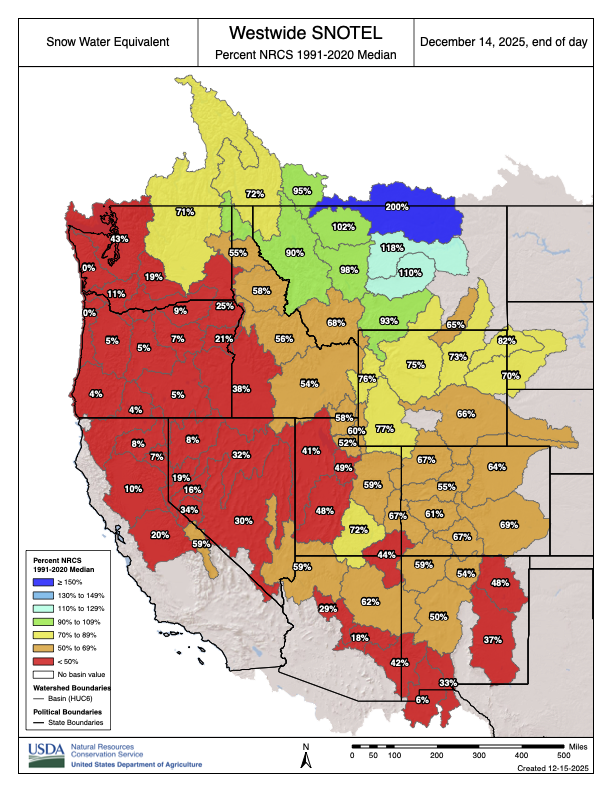
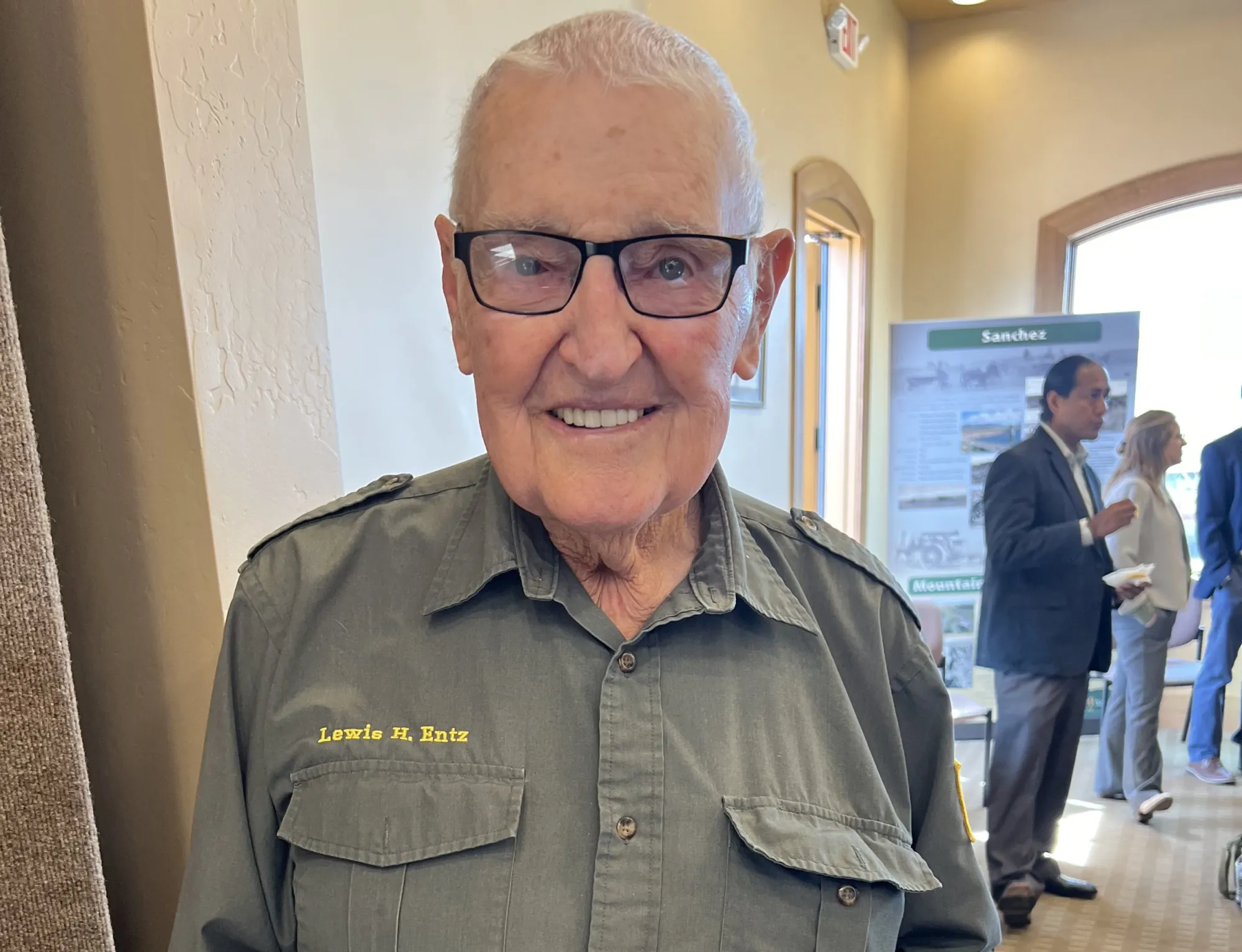
Left to right: Becky Mitchell, Tom Buschatzke, Brandon Gebhart, John Entsminger, Keith Burron, Gene Shawcroft, JB Hamby, Estevan López. Photo credit: Yes To Tap via X (Twitter)
The single most important gathering of Colorado River Basin officials came and went — with no significant announcements regarding the often frustrating yet crucial seven-state negotiations for how to divvy up the river over the next 20 years…Here are three takeaways as the states wrestle with basinwide overuse of water, declining river flows due to a warming world and how to meet the federal government’s Valentine’s Day deadline for a consensus-based deal.
States far from deal — with less than 60 days left
Unlike last year’s conference, the seven states agreed to sit on a panel that was added to the agenda for the last day. The ballroom was still packed for the early morning session. That’s because the stakes are high for states to meet Burgum’s Feb. 14 deadline for a seven-state agreement. Should they not deliver one, Burgum could intervene and states are likely to sue. The Lower Basin states have agreed to shoulder the brunt of a massive deficit the system faces that totals 1.5 million acre-feet, or almost 489 billion gallons. However, the Upper Basin states of Colorado, Utah, New Mexico and Wyoming say they don’t have more water to give should cuts in their jurisdictions become necessary. Conflicts exist with state laws, too…
Temporary deal could be on the table to avoid courtroom
Nevada’s governor-appointed negotiator, John Entsminger, spoke last on the panel and called out the other six states for failing to cede any ground on further conservation in their remarks. Without some compromise from each state on these long-standing arguments, the negotiations are “going nowhere,” he said. While the states have been expected up until this point to deliver a 20-year deal, Entsminger suggested on the panel that a temporary, five-year deal could be on the table to comply with the Feb. 14 deadline.
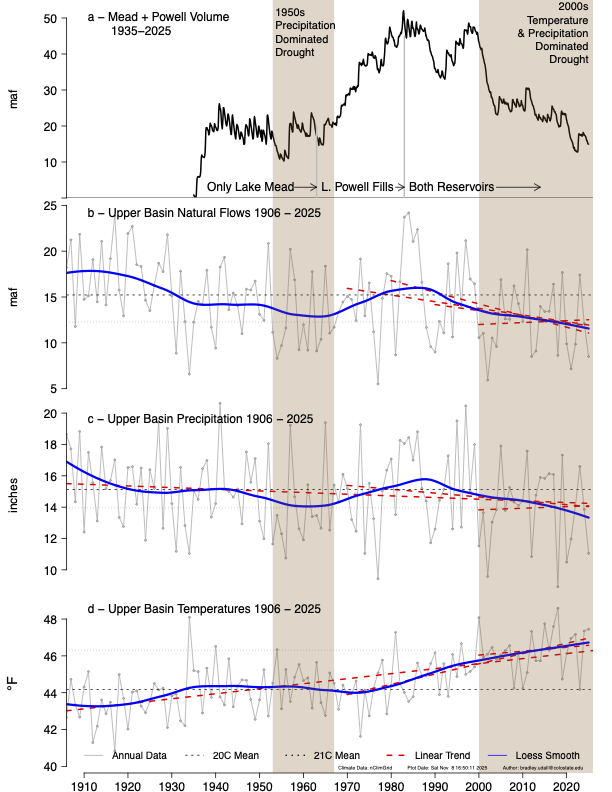
Udall/Overpeck 4-panel Figure Colorado River temperature/precipitation/natural flows with trend. Lake Mead and Lake Powell storage. Updated through Water Year 2025. Note the tiny points on the annual data so that you can flyspeck the individual years. Credit: Brad Udall
Poor outlook sending shockwaves throughout basin
The underlying issues of the Colorado River are making this moment much more precarious. Several experts presented a dismal picture for the system at large. Carly Jerla, senior water resource program manager at the Bureau of Reclamation, said the agency’s most recent projections place flows into Lake Powell anywhere between 44 percent to 73 percent of average this upcoming year. And since 2006, that replenishment of the reservoir has declined about 15 percent because of poor snow years, evaporative losses and more…
The back of Glen Canyon Dam circa 1964, not long after the reservoir had begun filling up. Here the water level is above dead pool, meaning water can be released via the river outlets, but it is below minimum power pool, so water cannot yet enter the penstocks to generate electricity. Bureau of Reclamation photo. Annotations: Jonathan P. Thompson
Jack Schmidt, who leads the Center for Colorado River Studies at Utah State University, has published several papers this year alongside a group of experts throughout the basin. By his estimation, should snowpack in the Rocky Mountains fail to impress again this winter, water managers may be blowing through a crucial buffer that ensures water can be released from Lake Powell into Lake Mead — and that hydropower generation can continue.
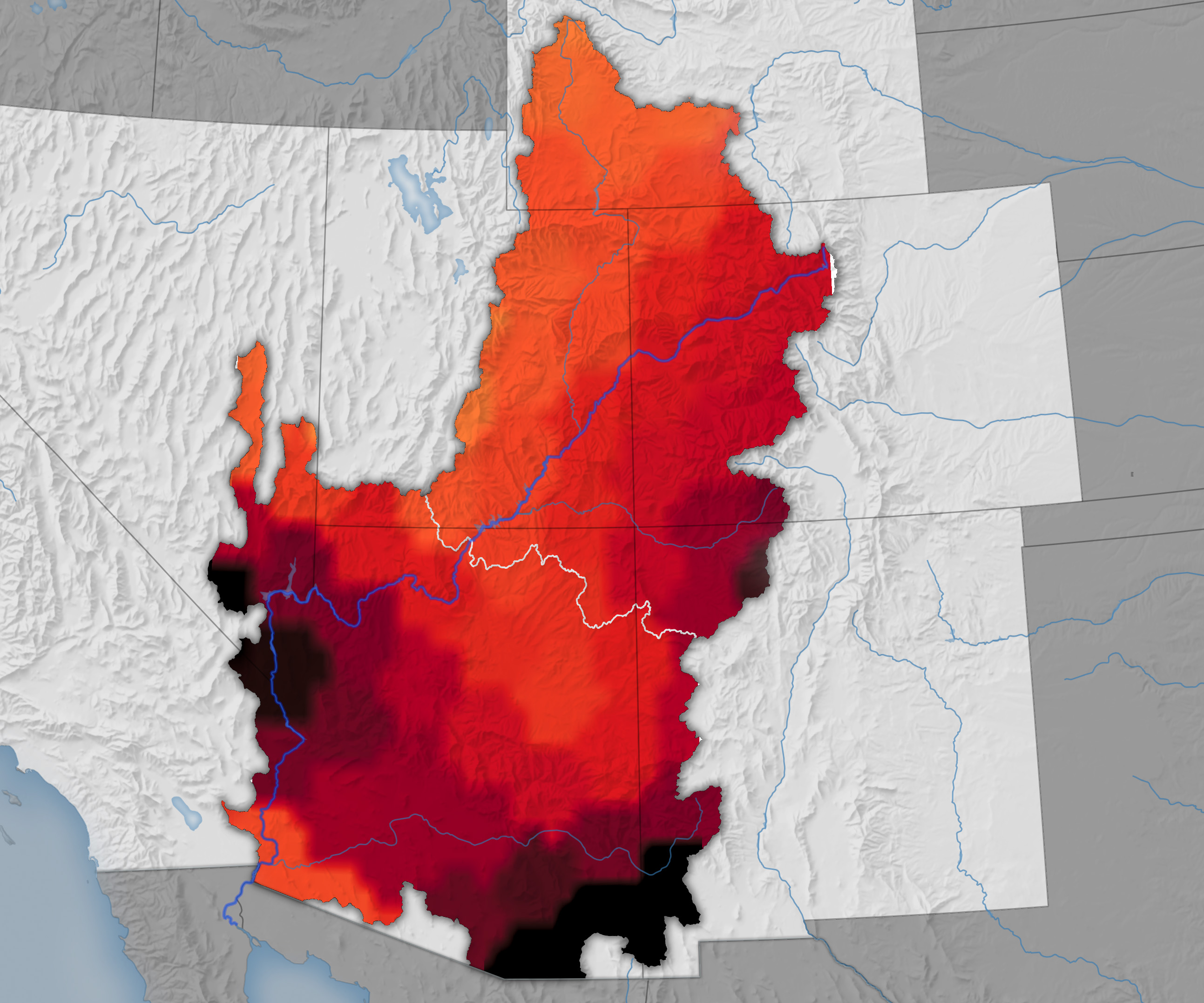
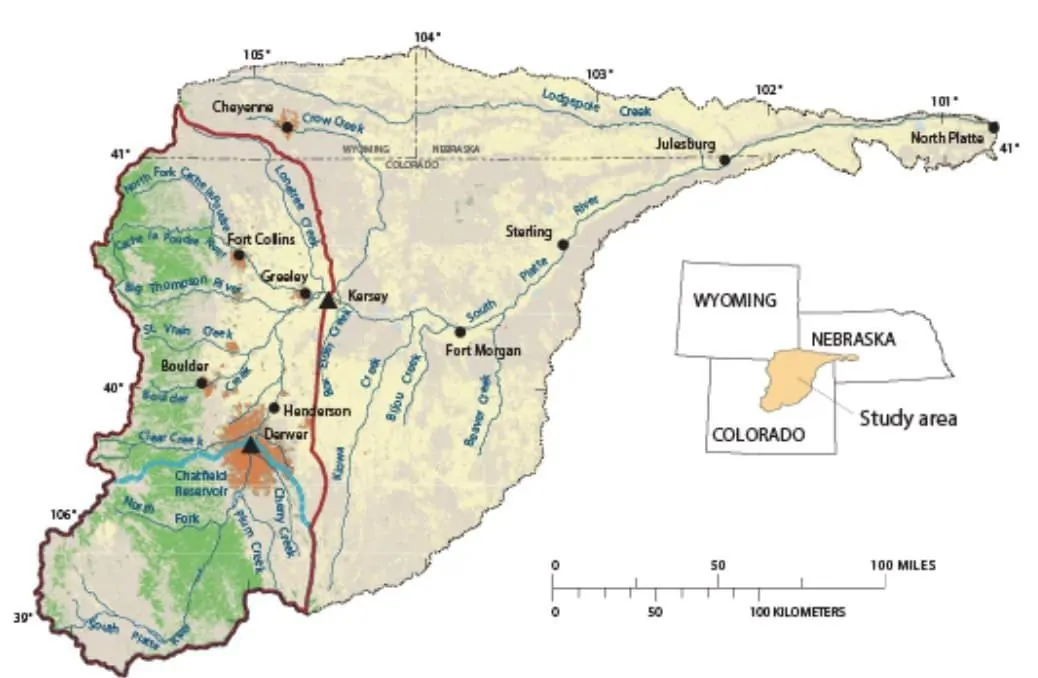
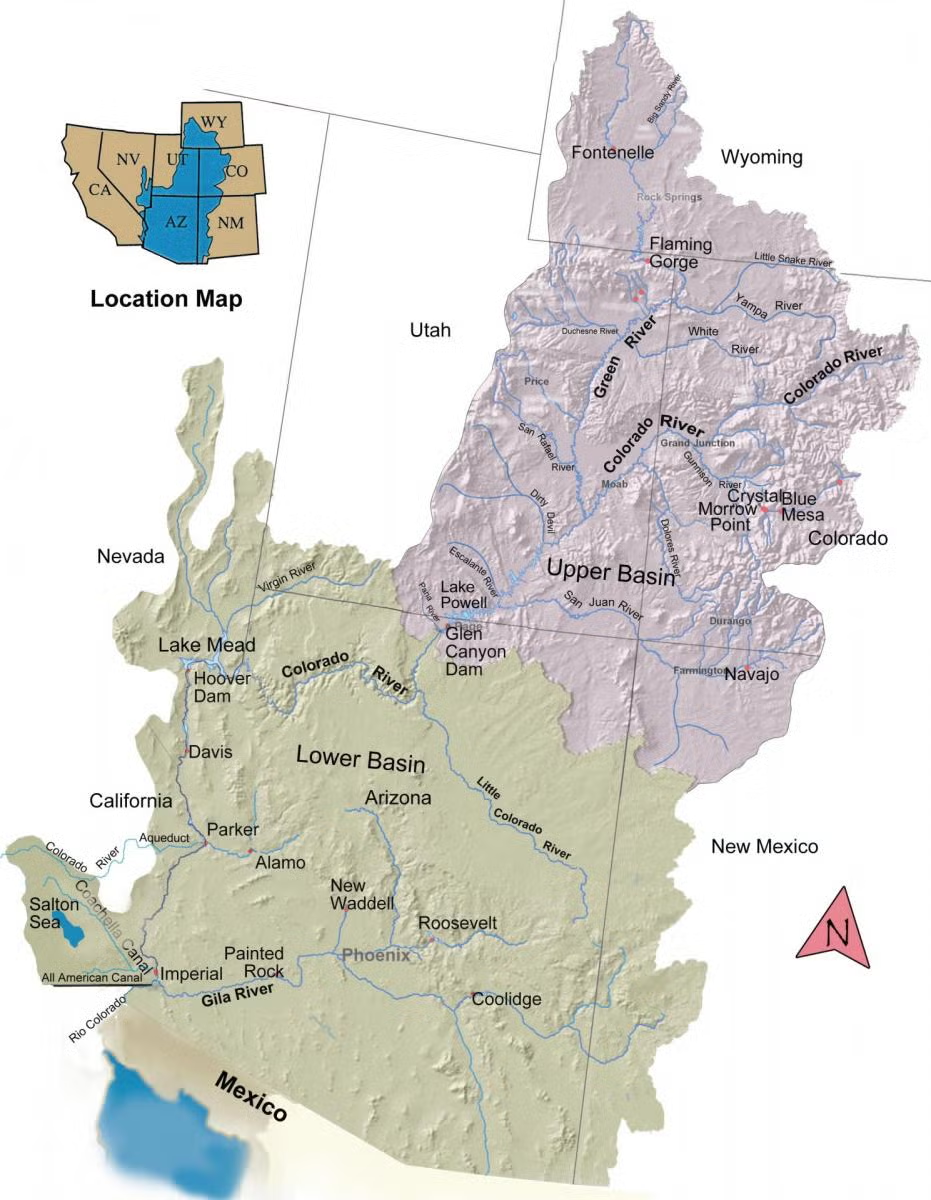
Map of the Colorado River drainage basin, created using USGS data. By Shannon1 Creative Commons Attribution-Share Alike 4.0
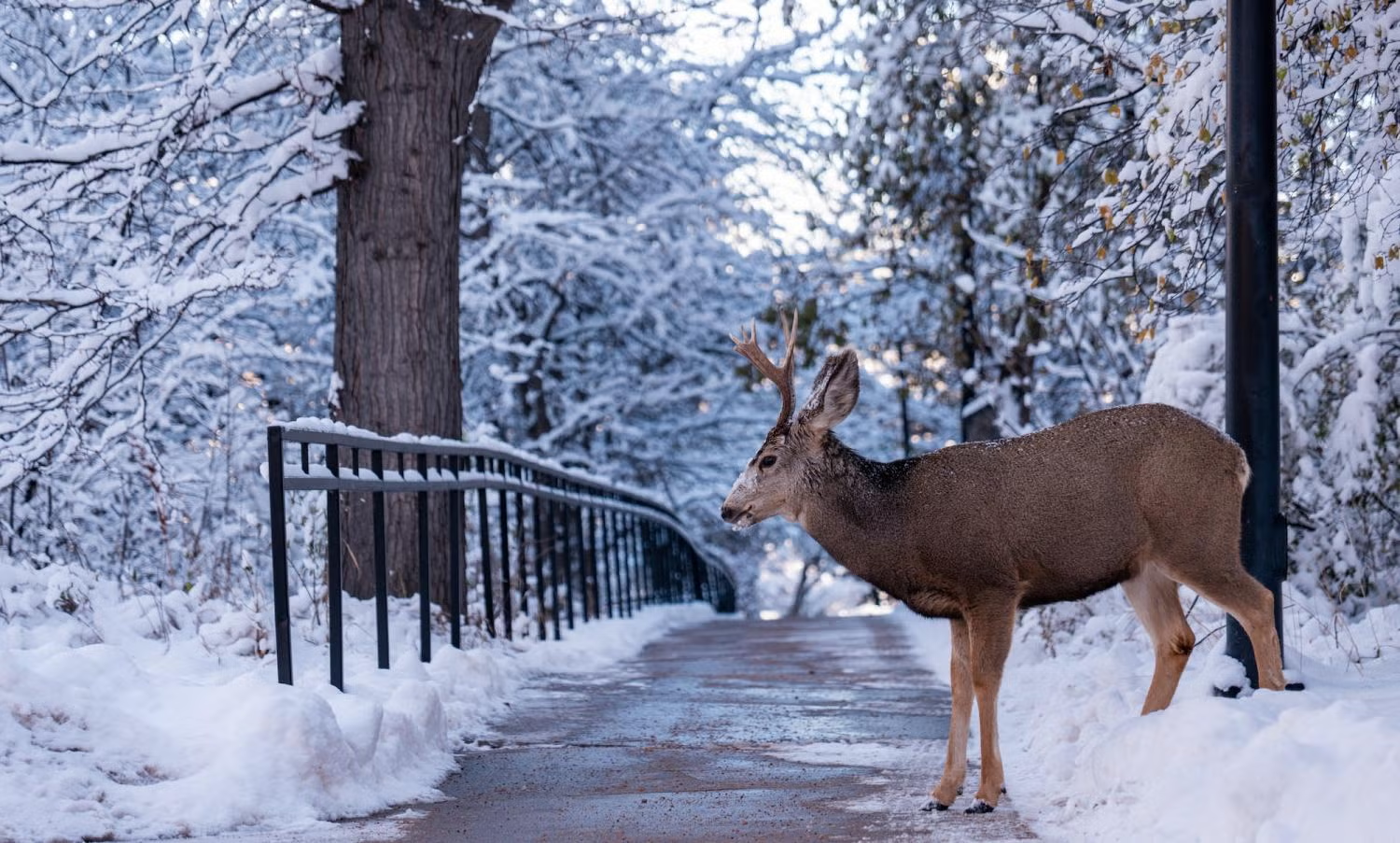
Jennifer Kay has a message for the skies above Colorado: “Let it snow.”
Kay is an atmospheric scientist who, in her free time, likes to go cross-country skiing in the Rocky Mountains.
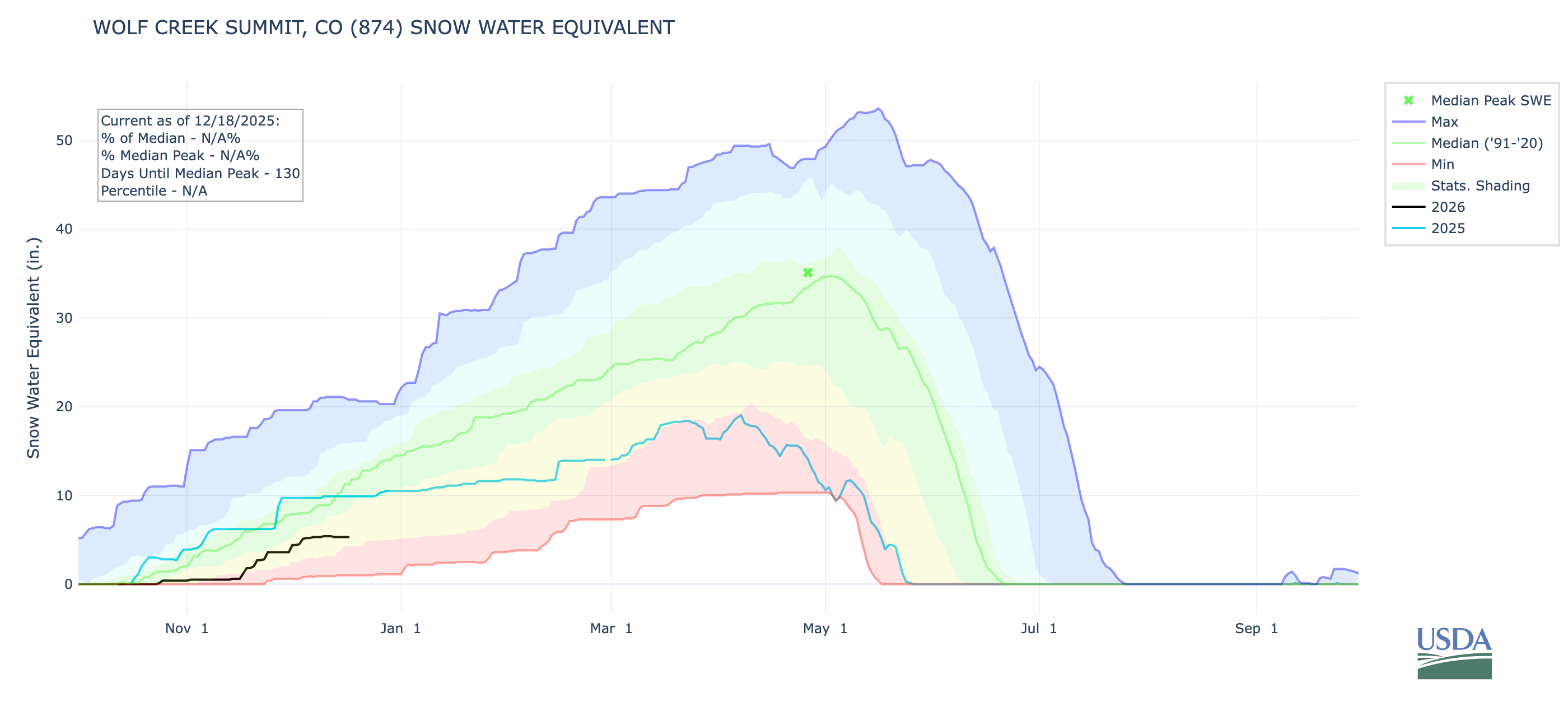
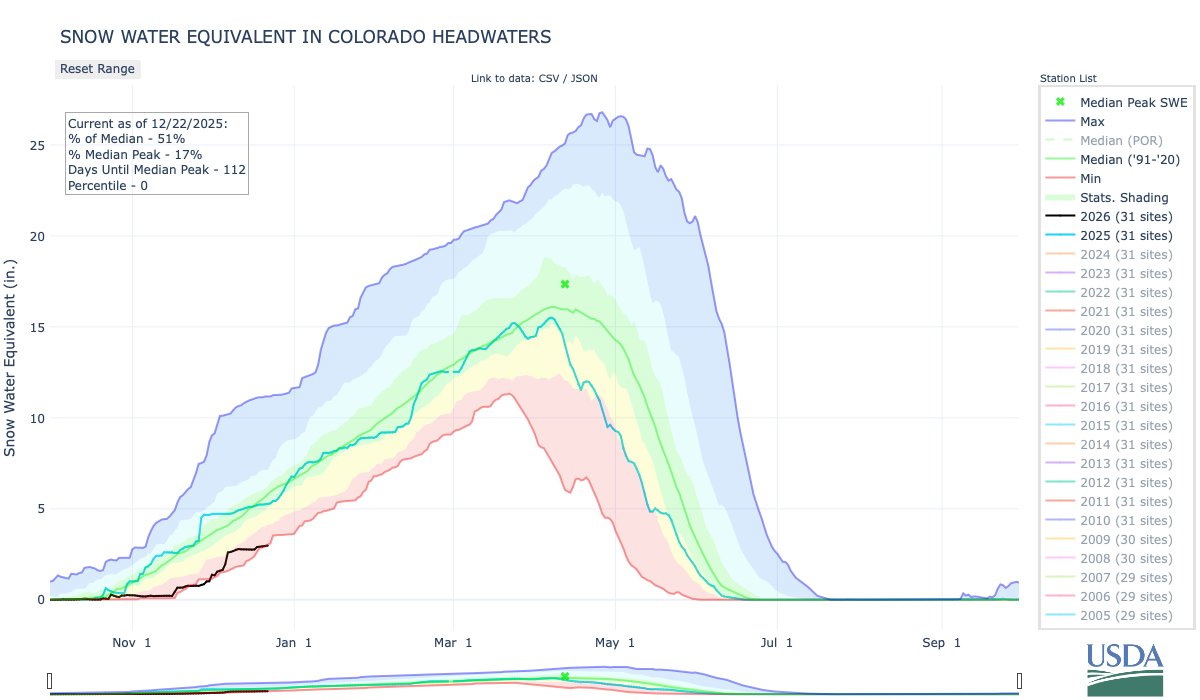
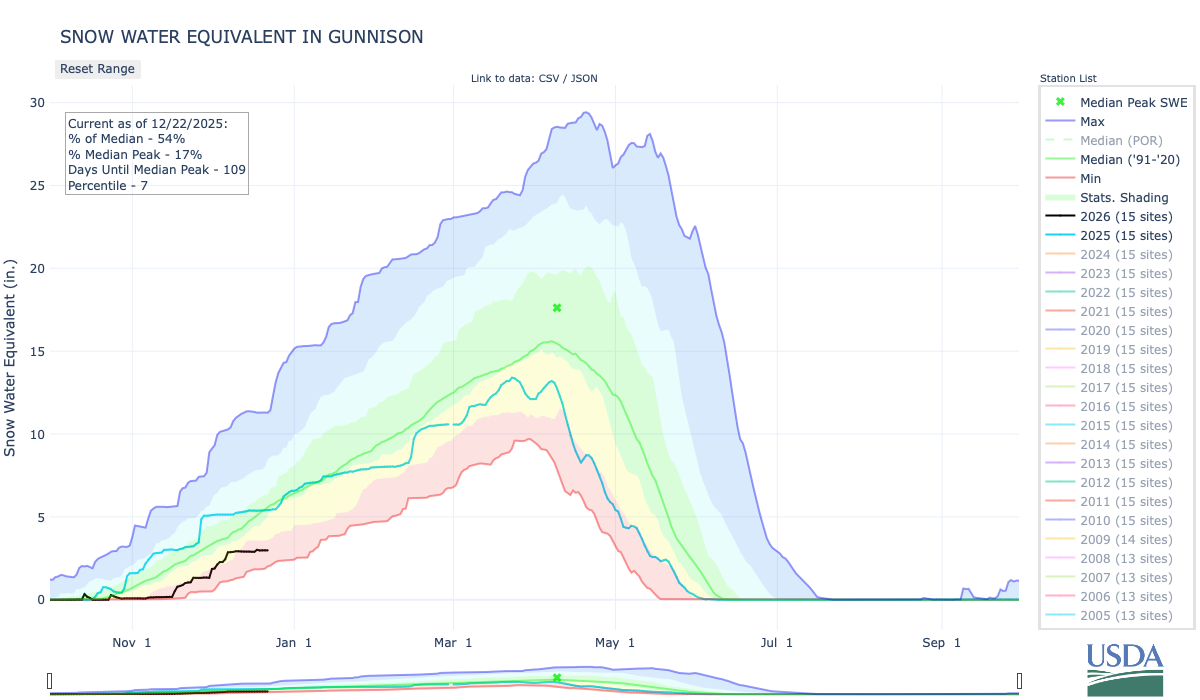
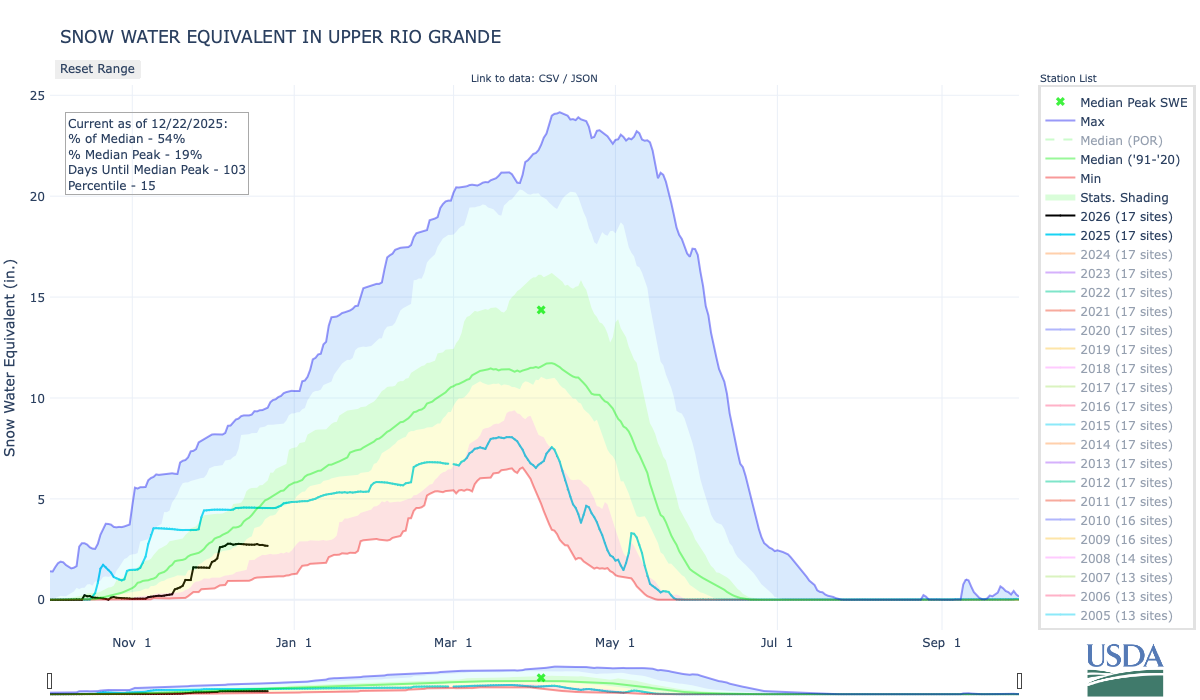
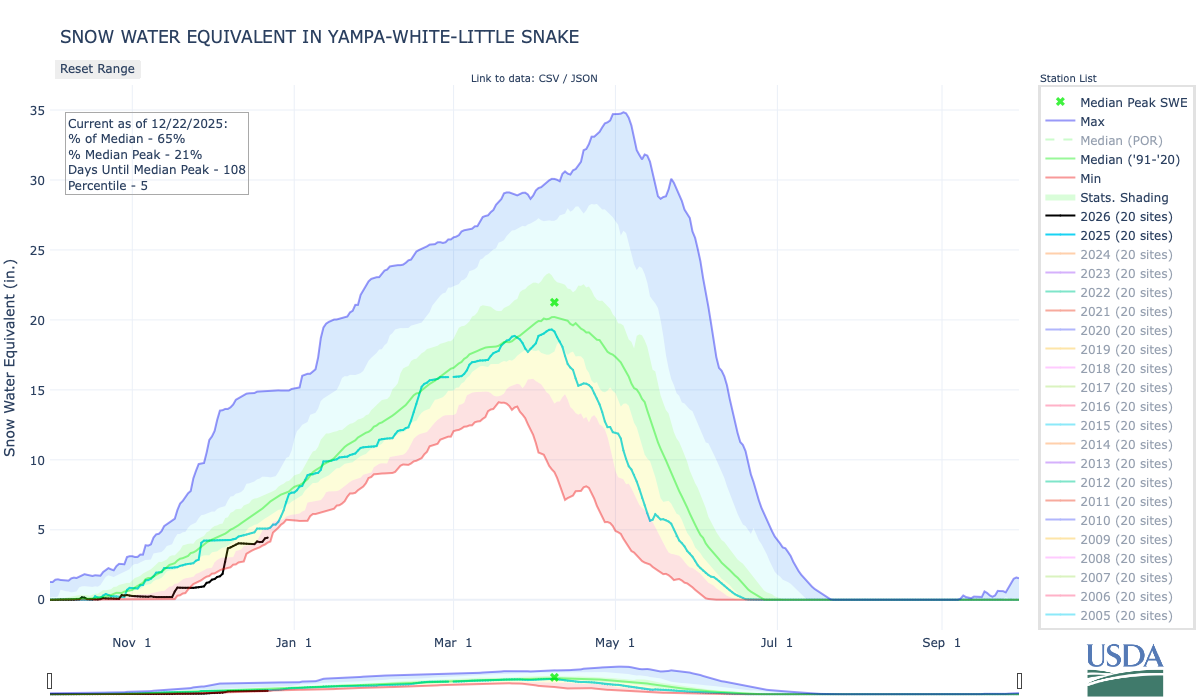
But this year, the season’s typical white-out blizzards haven’t arrived.
Denver didn’t get its first snow—a wimpy dusting of just 0.2 inches—until Nov. 29, the second latest first snow on record. Temperatures around the Front Range have also been downright balmy, drawing close to or even setting record highs.
Could the late start to the winter be a bad omen for Colorado’s ski industry and its future water supplies?
Kay weighs in on the question from CU Boulder’s East Campus with a view of the Flatiron Mountains behind her. They’re almost completely dry, with almost none of the sprinkling of white that usually marks them this time of year.
She says it’s not time to panic—yet.
“It’s also really early in the season still, so people shouldn’t be too worried about what’s going to happen with the ski season or water,” says Kay, a fellow at the Cooperative Institute for Research in Environmental Sciences (CIRES) at CU Boulder. “There are still a lot of different ways this season could unfold.”
In 2021, for example, Denver didn’t see its first snow until Dec. 10 (the latest on record). But snowfall totals inched closer to normal in the months that followed.
Kays says it’s not possible to predict how much snow will come to Colorado in an individual winter season months ahead of time.
A lot of that stems from a phenomenon known as the jet stream. That’s the name for a narrow band in the atmosphere above North America where winds reach tremendous speeds, sometimes over 250 miles per hour. When this band hovers above Colorado, it tends to bring big, rumbling storms to the state.
“When the jet stream brings storms to us, we get…a lot of wet, snowy days,” Kay said. “If the jet stream goes another direction, maybe to the north or south of us, we don’t get as many snowstorms.”
But, she adds, any number of complex factors can make the jet stream wiggle from month to month—although meteorologists can often predict what the jet stream will do several days in advance.
Recently, the jet stream has stuck mostly to the north of Colorado, crossing over states like Montana and the Dakotas.
This year’s less-than-snowy winter has Kay thinking about what the future may hold.
With warming, she says, many storms that might normally produce snow may instead bring rain. That could have a wide range of consequences for the state.
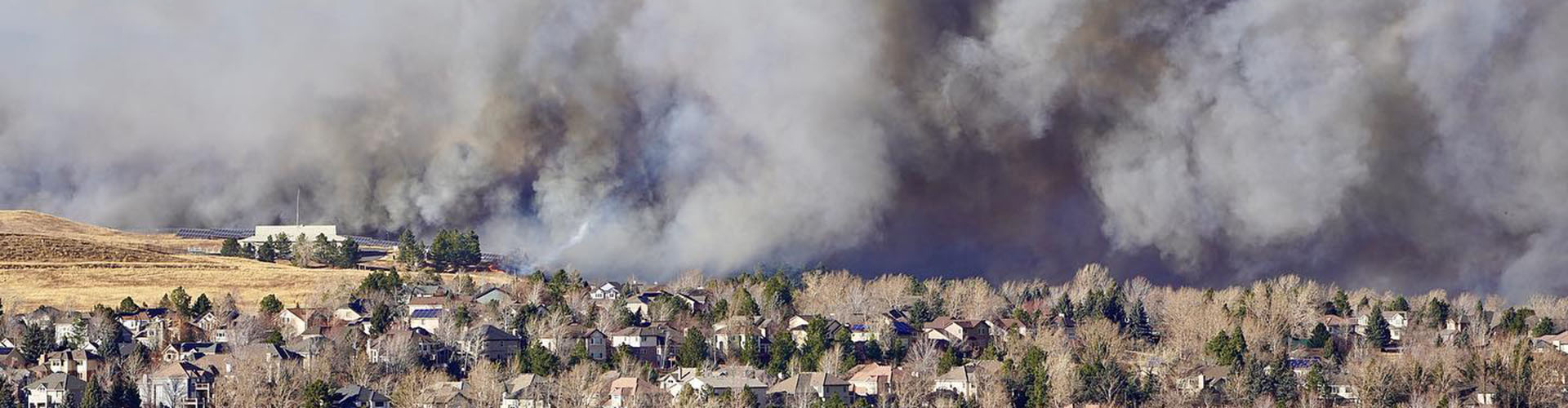
Marshall Fire December 30, 2021. Photo credit: Boulder County
A thick blanket of snow on the ground, for example, can keep wildfires from starting and spreading. The Marshall Fire, which devastated parts of Boulder County in December 2021, erupted at a time when the ground was relatively dry, and winds were especially fierce.
Kay believes it’s important for Coloradans to prepare themselves for hotter and dryer weather.
She lives in Boulder and keeps a go-bag packed at all times, even during the winter months. It includes a change of clothes, important documents, chargers for electronic devices and contact information for her neighbors.
“I have already adapted to the reality of more fires as we get hotter and drier in Colorado,” she says. “Understanding what’s happening around you and having a plan for extreme events like the strong wind events we have along the Front Range is important.”
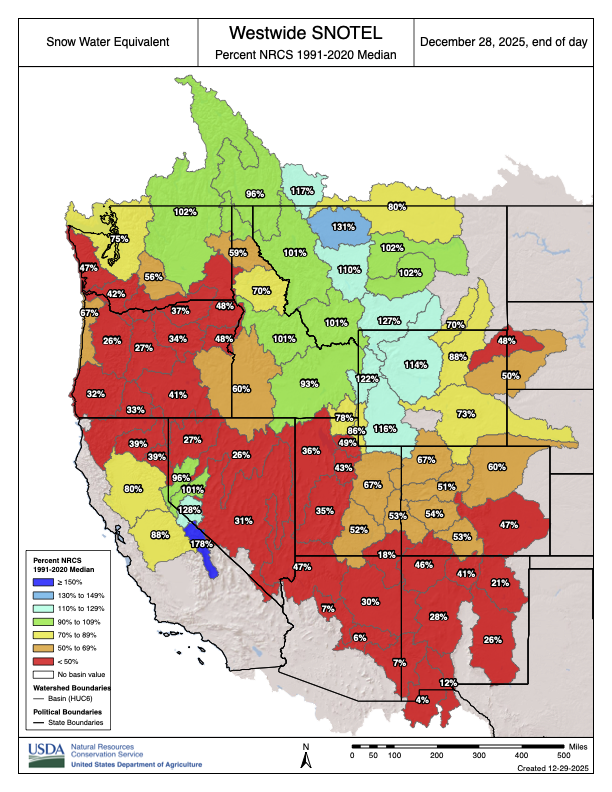
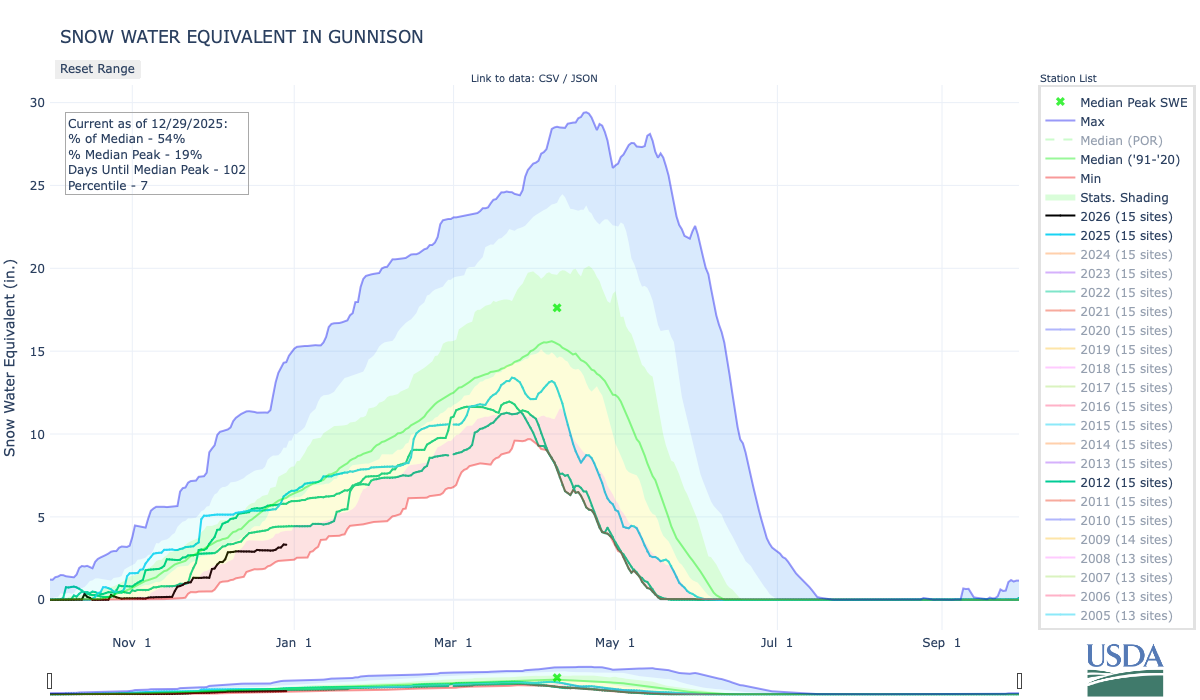
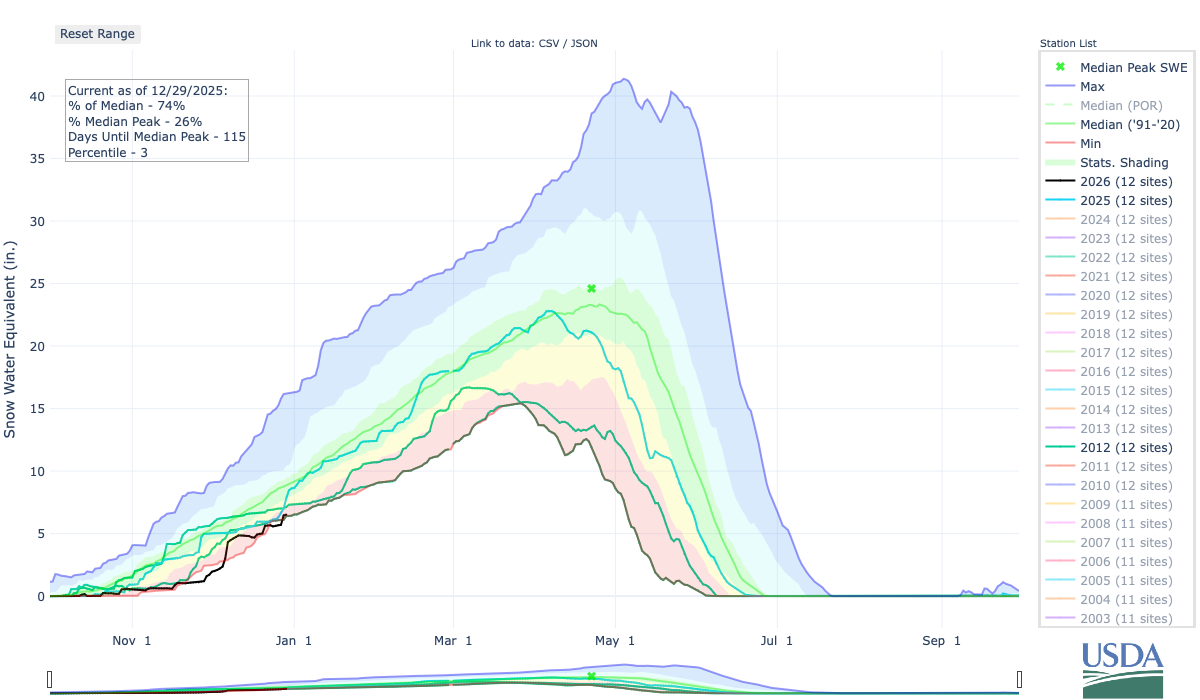
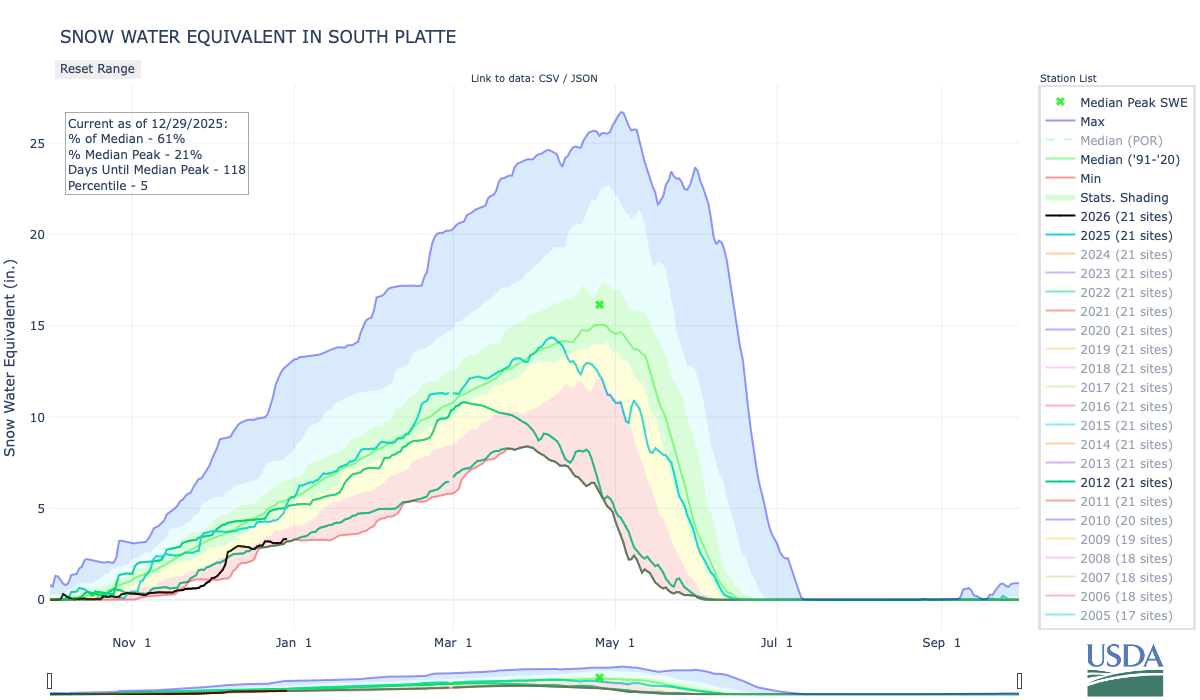
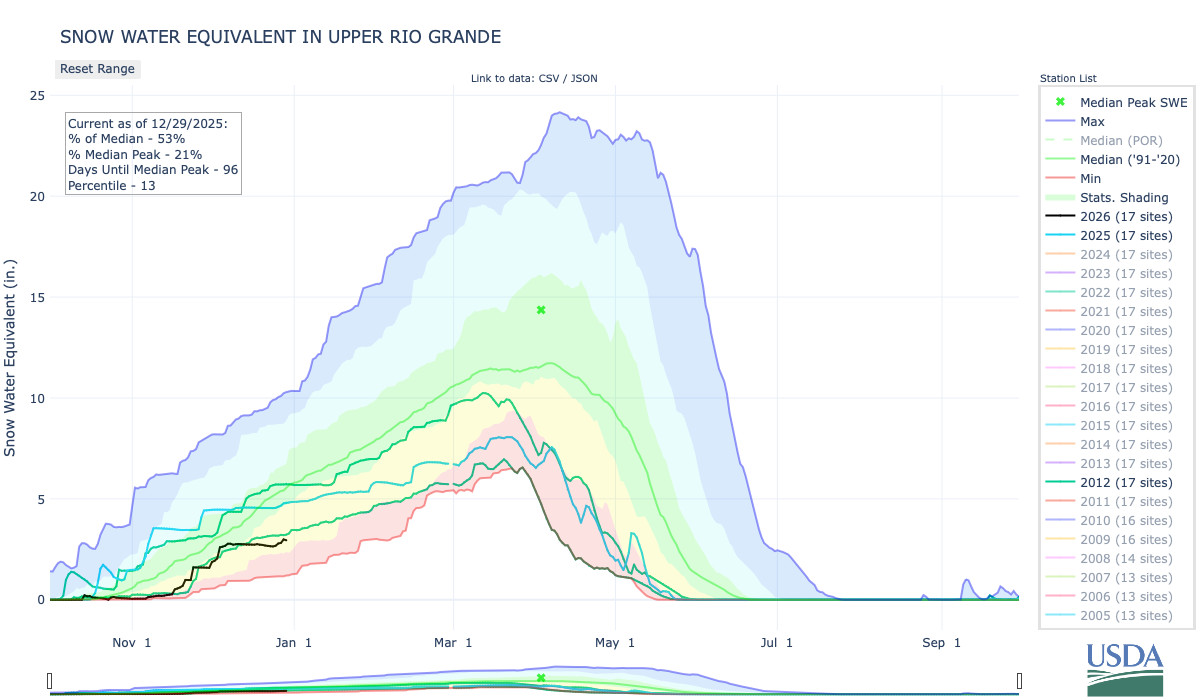
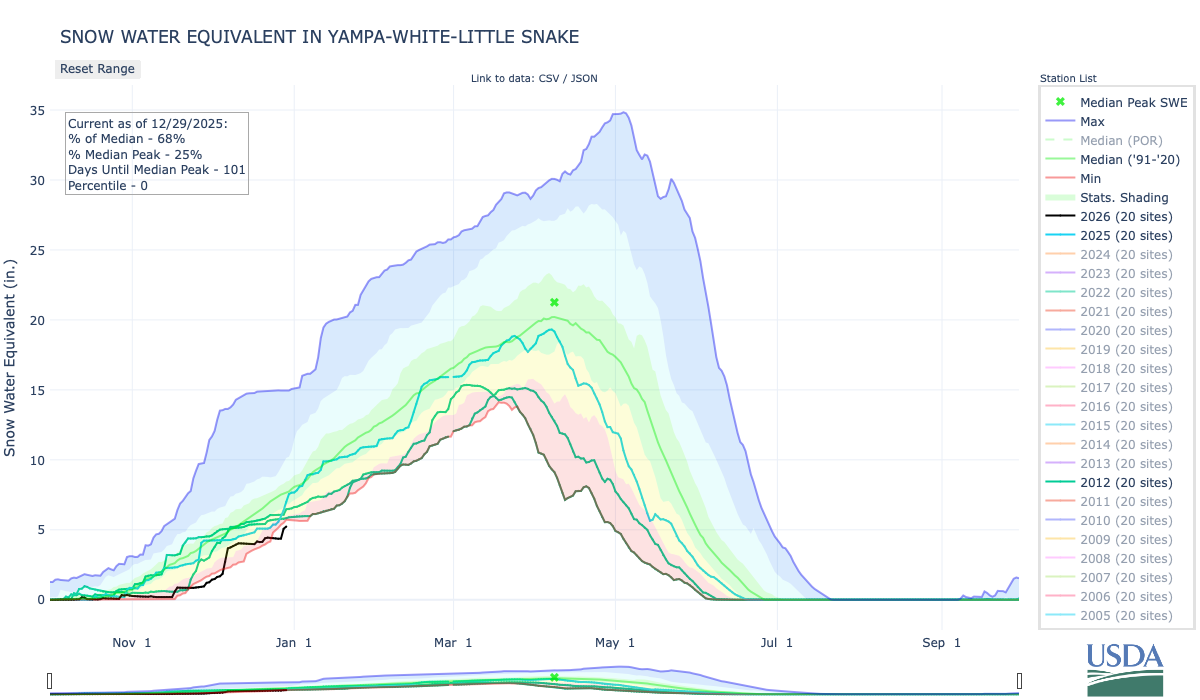
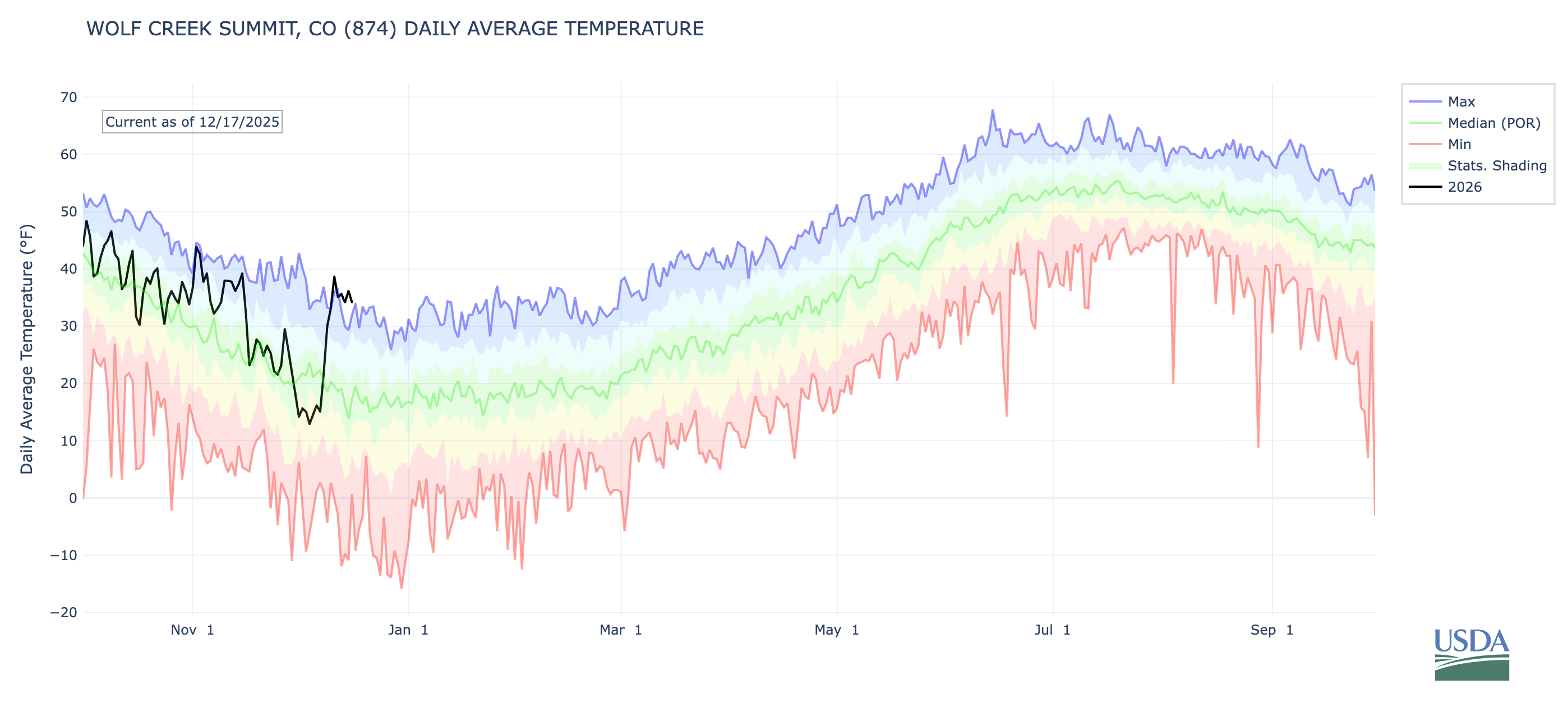
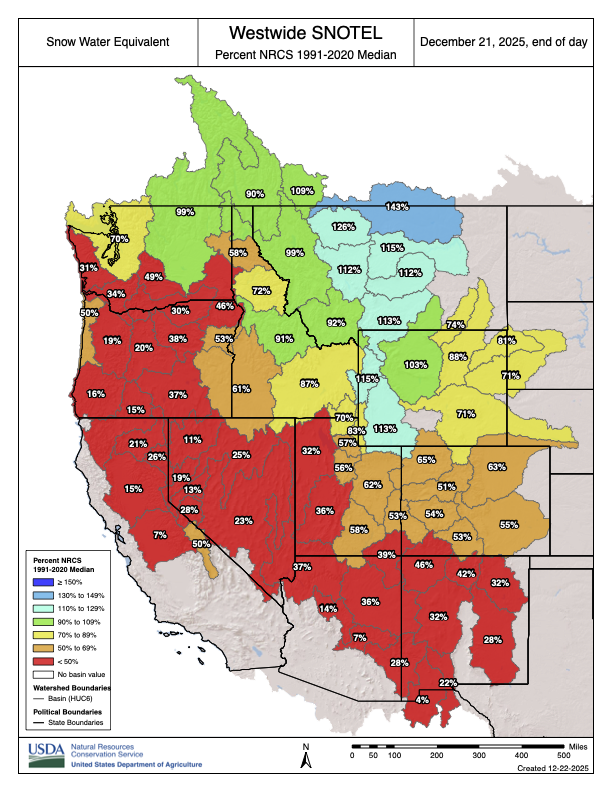
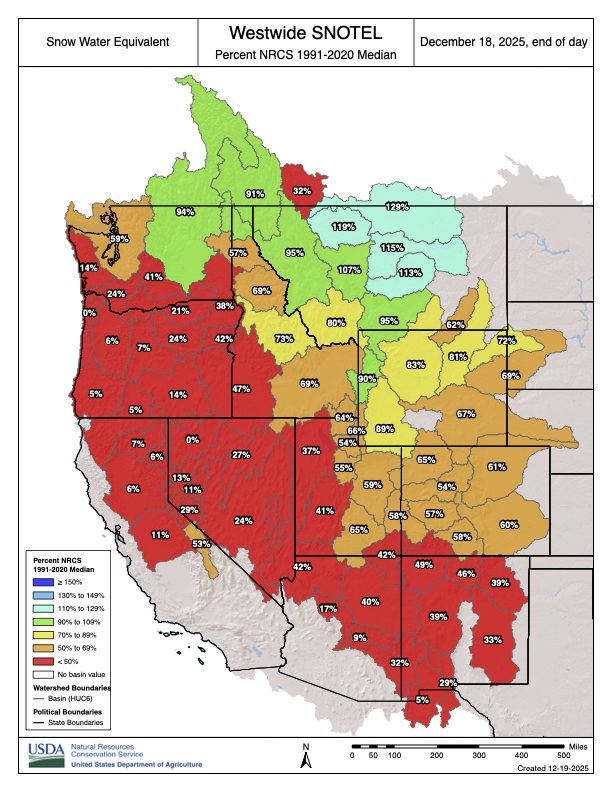
Westwide SNOTEL basin-filled map December 28, 2025.
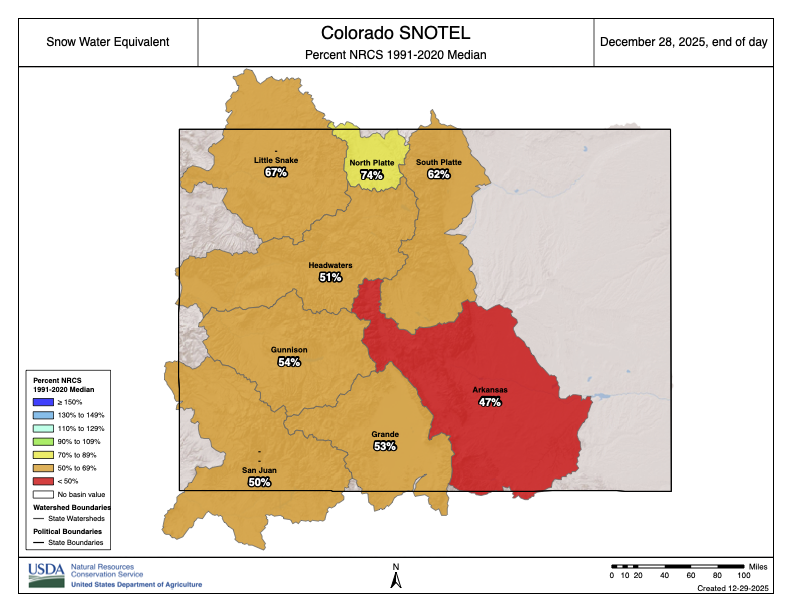
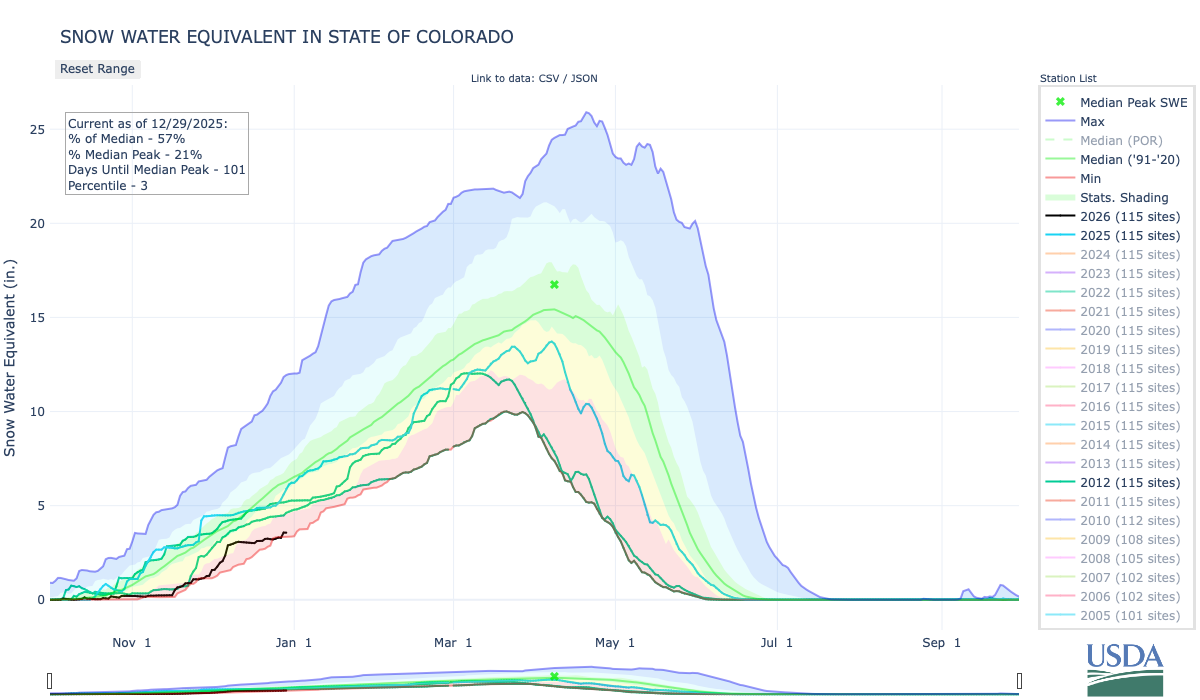
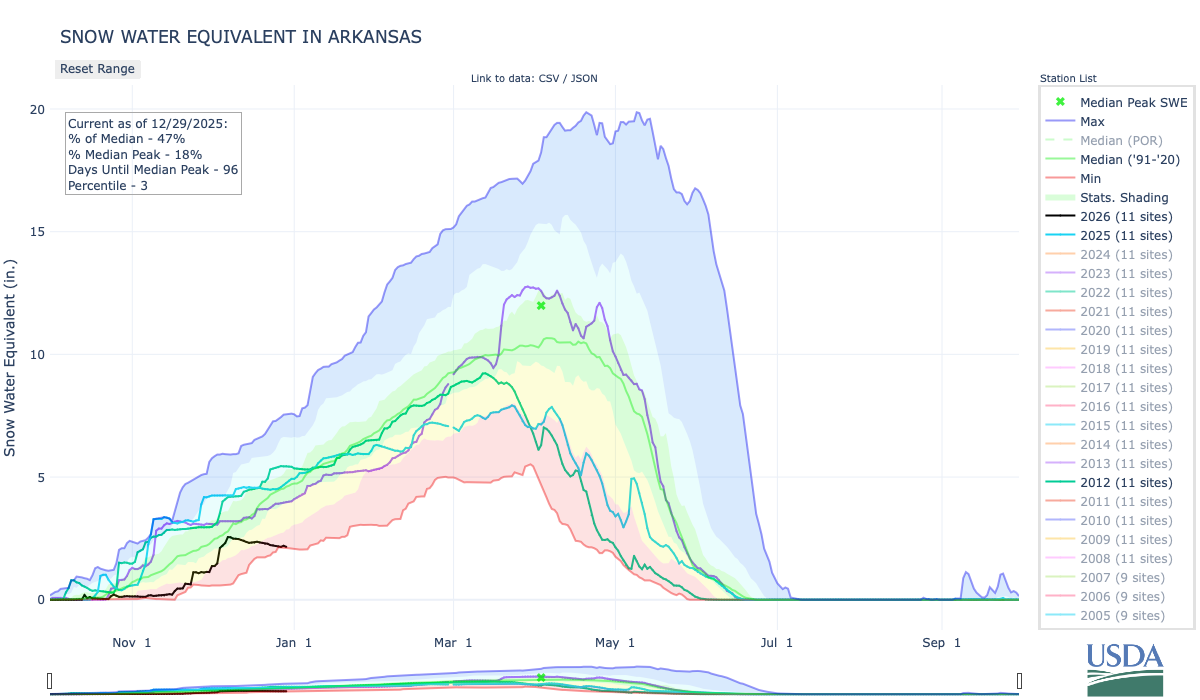
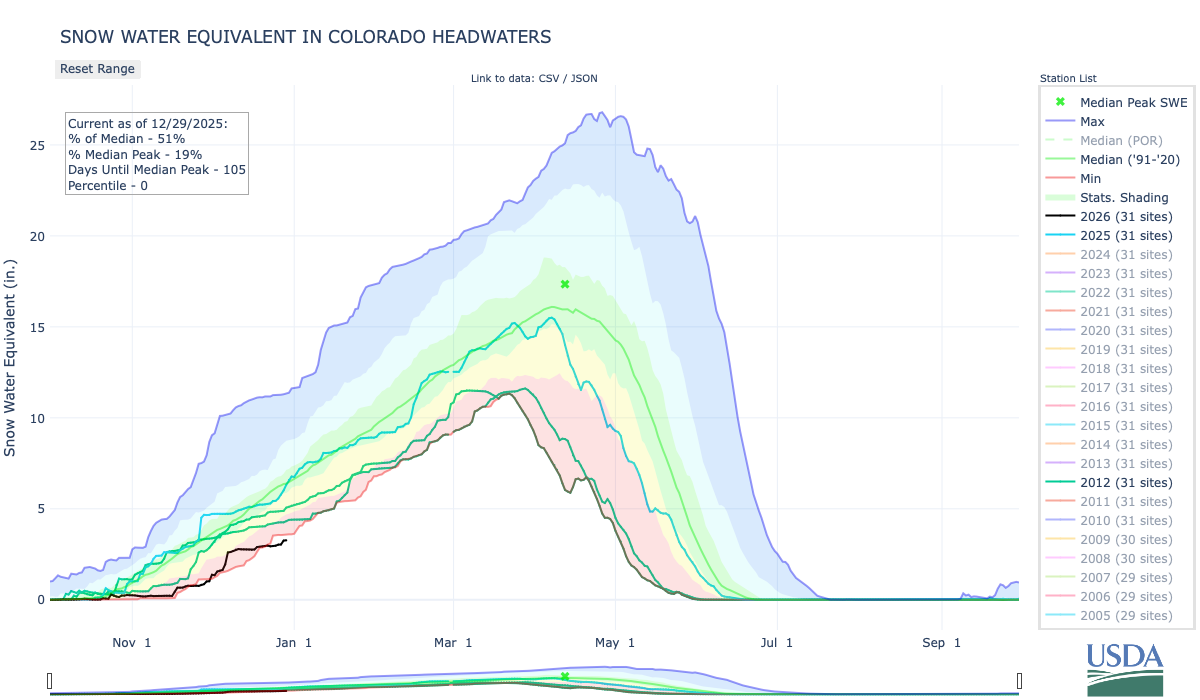
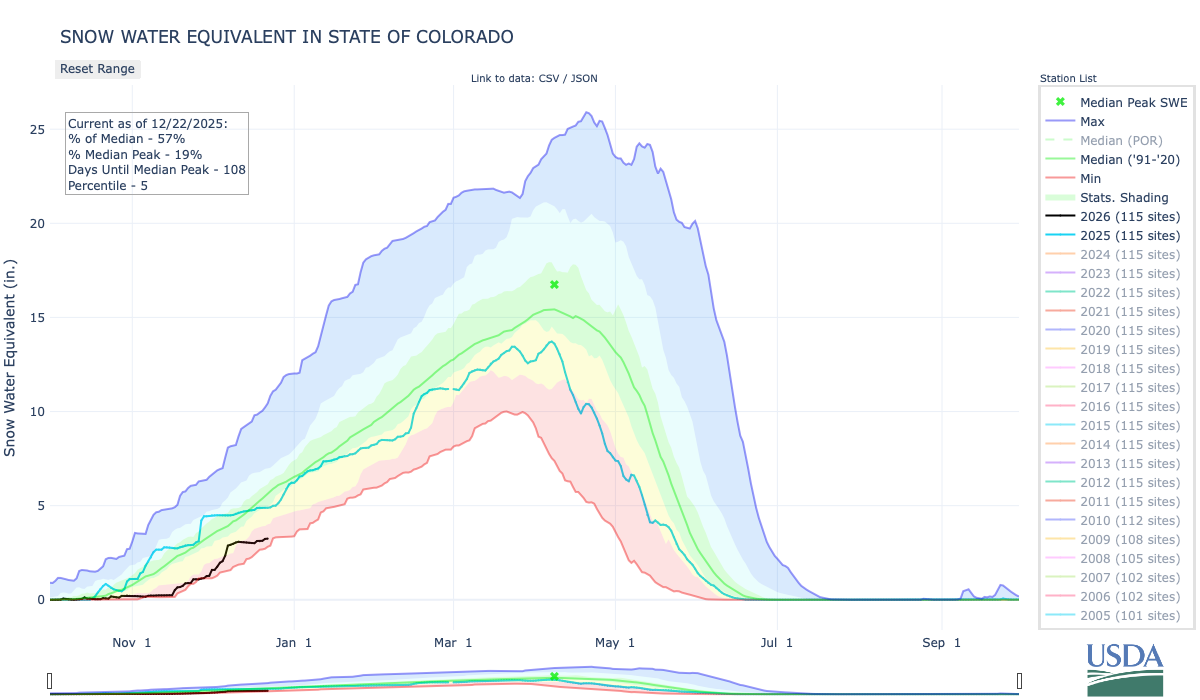
Colorado snowpack basin-filled map December 28, 2025.
A private development company is investing $150 million in an ambitious plan to harvest groundwater lying beneath sprawling northern Colorado ranches to serve fast-growing towns along the Interstate 25 corridor.
FrontRange H2O, backed by a Texas oil and real estate company, is behind the venture. The firm has been operating in Colorado for more than 20 years, treating and delivering wastewater from oil wells for oil industry reuse on the West Slope, and overseeing extensive real estate holdings in Denver and elsewhere, according to Brent Waller, who is president of the Loveland-based company.
“We were recycling produced water before it was cool,” Waller said. Produced water describes wastewater that is generated through oil production.
Experts say the large-scale, private urban water development is the first of its kind in Colorado and could help thirsty towns like Fort Collins and Loveland shore up their water systems.
But others worry that the privatization of water in the state could lead to price hikes and might also, because of its reliance on nonrenewable groundwater, undermine the state’s future water security.
Still, Front Range H20 believes its system will deliver water at less cost and sooner than other government-backed projects.
Until now, Colorado communities have relied on water that is captured, stored and treated by public, nonprofit water utilities, such as Denver Water. The agency is an independent entity governed by commissioners who are appointed by the Denver mayor. In other cases, cities operate their own water systems. Public entities such as these are required by law to regulate water rates, to issue bonds to finance their work, and they are subject to oversight by elected or appointed bodies.
But FrontRange H2O is a private company that is using millions of dollars in private financing to secure the water rights, obtain state permission to drill the groundwater wells, and to build a water treatment system and pipeline to carry the water. Although it must obtain state permission to drill the wells and build the water treatment plant, it is not subject to the same public oversight as a public government system would be.
“This kind of thing is common in Texas and Arizona, particularly with groundwater, but it is unique in Colorado,” said Adam Jokerst, Rocky Mountain regional director for WestWater Research, based in Fort Collins. Jokerst is a groundwater expert who has consulted with Front Range H2O on its northern Colorado plans.
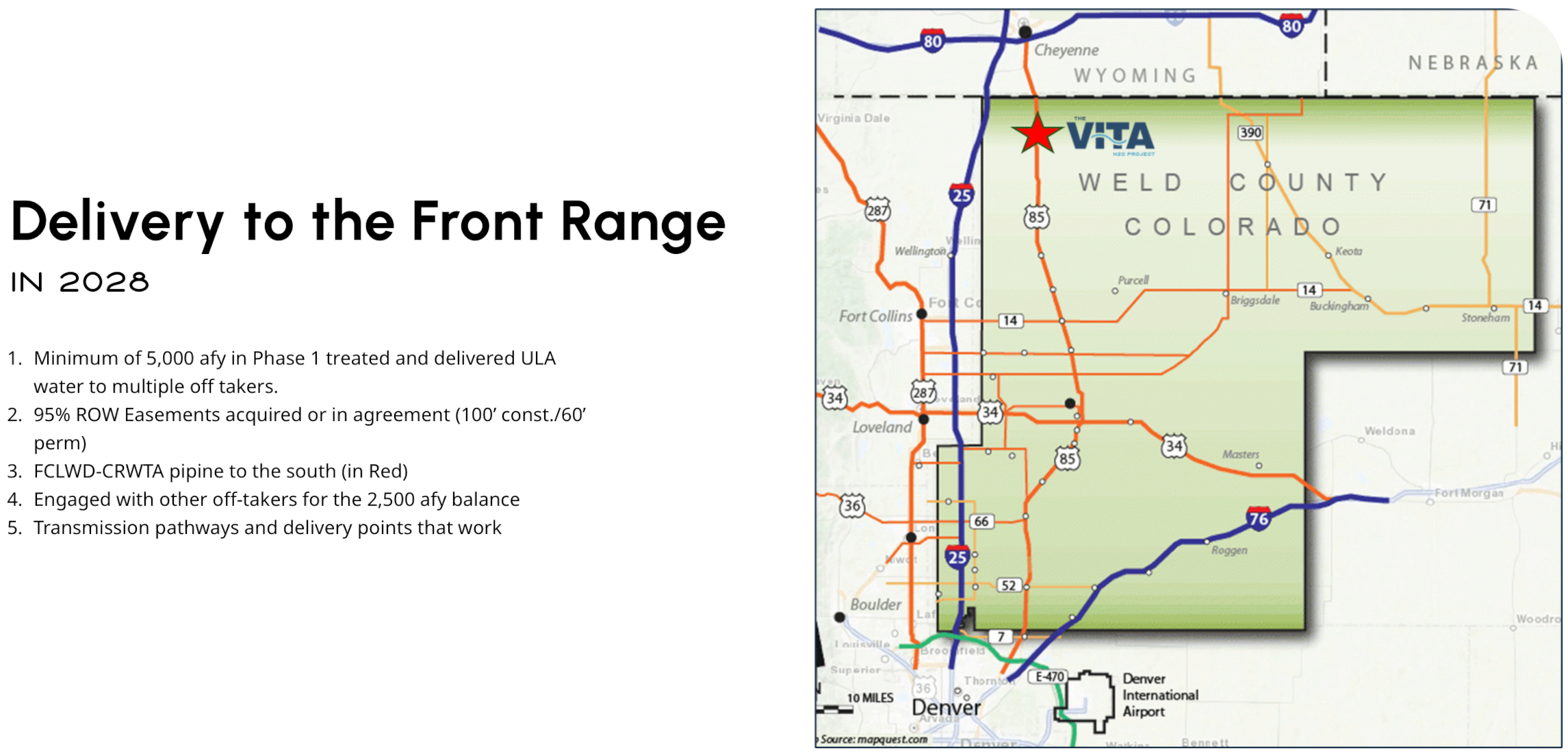
FrontRange H2O refers to its current project as VitaH2O. Nine wells drilled into the aquifer are expected to generate up to 5,000 acre-feet of water initially, Waller said. An acre foot equals nearly 326,000 gallons of water and is eough to serve to two to four urban households for one year. The water will be treated at a new plant north of Nunn and then delivered down to Cobb Lake, a reservoir owned by the Fort Collins-Loveland Water District, or FCLWD.
The district was in the news earlier this year when it opted out of a large-scale water and reservoir project run by Northern Water known as NISP, the Northern Integrated Supply Project. It will instead partner with VitaH2O.
Typical water well
As the project moves forward, Waller said FCLWD will contribute an additional $150 million to help complete the new water supply project. Chris Pletcher, general manager of FCLWD, declined an interview request. The water district was NISP’s largest customer and was on track to pay $400 million to help build the giant system.
Colorado derives most of its water supplies from melting snows that fill its streams and rivers, but large swaths of the state, including Douglas County, rely heavily on wells drilled deep into aquifers, many of which are not recharged through rain and snow.
As the state grows, the pressure to tap these nonrenewable waters is growing as well.
According to the Colorado Division of Water Resources, interest in drilling high producing groundwater wells in northern Colorado is growing.
“There has been more activity in this area in the last 10 years,” said Tracy Kosloff, deputy state engineer at Colorado’s Division of Water Resources.
Major players in the area include Front Range H2O and the city of Greeley, among others.
The interest in nonrenewable groundwater worries people like Steve Boand, a former Douglas County commissioner and water consultant who has watched his region’s nonrenewable groundwater supplies shrink as they are used by fast-growing towns like Parker and Castle Rock.
Any project that relies on nonrenewable groundwater is problematic, Boand said.
“In general, sustainable water supplies are the preferred source,” Boand said, noting that Douglas County water providers are spending hundreds of millions of dollars to recycle water and tap rivers and streams to wean themselves off nonrenewable groundwater. Their hope is, eventually, to use their aquifers only in drought years when surface supplies are scarce.
And that is part of the plan with VitaH2O, Waller said. The project will use surface supplies that the Fort Collins-Loveland district already owns to recharge the aquifers they plan to withdraw water from, in hopes that the treated water being pumped back into the ground in wet years will extend the life of the nonrenewable aquifers.
Under Colorado water law, groundwater can be drilled by whomever owns the land above the aquifer, but they must demonstrate that they are extracting water gradually and must prove it will last at least 100 years.
Waller said he believes the surface supplies that VitaH2O will inject back into the aquifers in wet years will extend the life of the system beyond 100 years, to 300 years or more.
The location of the wellfield as seen in a PDF provided by the Vita H20 Project.
East of Waller’s development, the city of Greeley has already invested $85 million in developing an aquifer system under the Terry Ranch that will supply water in drought years and will also store treated water, according to Sean Chambers, Greeley’s director of water and sewer utilities.
“What you are seeing now is a new approach to diversifying surface water supplies with this deep aquifer, nonrenewable groundwater … and there is a rush on that,” Chambers said.
Looming in the background is Northern Water’s NISP project. It was originally designed to serve 15 entities, but three have already pulled out, including the largest, the Fort Collins-Loveland district. Waller said he is in talks with several other communities, including Wellington and Eaton, who are looking for an alternative to the costly $2.7 billion NISP, which will rely on renewable water supplies from the Poudre and South Platte rivers.
Brad Wind, general manager of Northern Water, said NISP’s growing cost is prompting long-time supporters to rethink their participation and that some will inevitably go with other providers, such as VitaH2O.
“People have some hard choices to make,” Wind said.
How much water is available to be mined from these aquifers isn’t clear yet, though developers such as Waller and Greeley have invested heavily in doing the hydrological analysis that gives them an estimate of what is available.
But overuse is a major concern and Chambers says that is a key issue the city is addressing as it develops its system.
“Collectively we will have to find ways over time to make sure that northern Colorado and other communities that rely on this water don’t just mine it to extinction … Greeley goes into this effort with our eyes very wide open about that,” Chambers said.
“This is a resource that should last for 10 generations or longer and provide a runway for public officials to figure out how to build resilience into all of our sources of supply,” he said.
Boand isn’t convinced that the recharge technologies and state rules designed to make the water last longer are going to be enough to protect the aquifers.
“Recharge has been somewhat successful but everybody has talked about it as if it is the great salvation, even though it is very much in the testing phase,” Boand said. “And it takes the same attention to detail that running a nuclear power plant takes … lots of engineers and lots of scientists.”
Another concern with having a private company develop a major public water supply is the stability of the company and the water system if the company should fail.
Waller says his company’s contracts provide protection for that possibility.
“If we go belly up, five years or 10 years down the road, the water districts and participants have the right to step in and take over the system. There are controls in place,” Waller said. They expect to deliver water in the first quarter of 2029.
As with most new water projects, developers go through a special court review where they must prove their water estimates are accurate and that their water use won’t harm others. Waller said his company’s water court application was filed in October.
And it is being closely watched.
Chambers, with the city of Greeley, is concerned that the VitaH2O project may impact the Terry Ranch project, which lies nearby. He said he expects to fight to defend Greeley’s rights and will object to anything he sees as threatening.
“We intend to be an objector in the water court process to protect our decree and our investments,” he said.
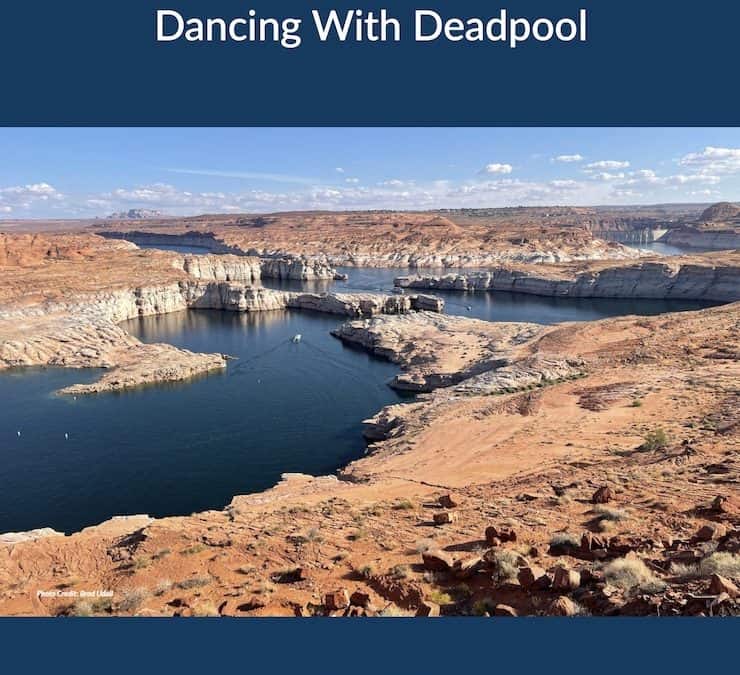
A new report from Colorado Law’s Colorado River Research Group warns the Colorado River Basin is “out of time,” describing conditions so severe they threaten the region’s water supply, economy and governance. Called “Colorado River Insights 2025: Dancing with Deadpool,” the report details a dire assessment of the basin’s worsening crisis and offers options for reform. According to the report, reservoirs that once stored four years of river flows are now more than two-thirds empty. The authors note a single dry year or two could push Lake Powell and Lake Mead below critical thresholds, jeopardizing hydropower, water deliveries, and even physical conveyance downstream. The report concludes that current operating rules through 2026 are unlikely to prevent this scenario.
“This report underscores that the basin is out of time, the crisis is no longer theoretical,” said Douglas Kenney, director of the Western Water Policy Program of the Getches-Wilkinson Center at the University of Colorado Law School and chair of the Colorado River Research Group.
“Post-2026 negotiations must produce durable, equitable, climate-realistic solutions — and they must do so urgently. The message is stark: the Colorado River system is now dancing with Deadpool.”
Among the key challenges:
Severe shortage risk: The authors warn that if the next two winters are dry, combined usable storage in Powell and Mead could fall below 4 million acre-feet — far short of what’s needed for water supply and compact obligations.
Climate-driven decline: Rising temperatures, shrinking snowpack efficiency and ocean-atmosphere interactions are reducing runoff and precipitation.
Safety nets collapsing: Groundwater reserves are rapidly depleting, while federal capacity — funding, staffing and science programs — are eroding. Interstate cooperation is fraying, and litigation may be on the table.
Authors stress that many challenges are self-inflicted and, in their view, solvable with technical, legal and financial tools already available.
Colorado River Basin Plumbing. Credit: Lester Doré/Mary Moran via Dustin Mulvaney and Twitter
The year is ending with the Colorado River at a critical juncture.
Figure 4. Graph showing active storage in Lake Powell, Lake Mead, and in Powell+Mead between January 1, 2023, and November 30, 2025. Credit: Jack Schmidt/Center for Colorado River Studies
The big reservoirs Mead and Powell remain perilously low and the seven states that share the basin have been unable to agree on cuts that would reduce their reliance on the shrinking river.
Reservoir operating rules expire at the end of 2026. If no agreement is reached the federal government could step in, or the states could take their chances in court. It’s a risky move that no one in principle seems to want. Yet brinkmanship and entrenched positions have stymied compromise.
Native America in the Colorado River Basin. Credit: USBR
The basin’s Indian tribes, which collectively have rights to more than a quarter of its recent average annual flow, are adamant that their interests – and more broadly, the river itself – be protected. “Any progress made in the negotiations to date is merely rationing a reduced supply, not actively managing and augmenting it as a shared resource with strategies and tools that can benefit the entire basin,” the leaders of the Gila River Indian Community wrote on November 12.
Dozens of semi-trucks have blown over in high December winds, the Wyoming Department of Transportation reports. (WYDOT/Facebook)
Click through to read the article on the WyoFile website and to view the rainbow photo (Katie Klingsporn):
December 26, 2025
December ushered an array of weird meteorological conditions to Wyoming — from record-high temperatures to hurricane-strength winds and the rare winter rainbow.
The prismatic arch appeared over central Wyoming on Dec. 17, a rare spot of beauty amid raging wind gusts that wreaked havoc across the state.
In nearby Lander, the wind knocked down trash cans and fences. It blew Christmas decorations halfway to Colorado, peeled shingles off of roofs, closed the highway to South Pass and felled trees.
Elsewhere, high winds have knocked out the power to traffic signals in Casper and forced city officials to close the landfill. December gusts also toppled dozens of semi-trucks on highways like Interstate 80, the Wyoming Department of Transportation reported.
Balmy temperatures have attended the winds, breaking records in places ranging from Riverton to Worland and Rock Springs — where a high of 59 was the warmest temperature on record in December, according to the National Weather Service.
Residents accustomed to bundling up for single-digit temperatures, snowfall and ice skating during the holidays may instead reach for a windbreaker and umbrella this year.
At Lake Mead National Recreation Area in Nevada, “the National Park Service’s focus remains on sustaining boating access and visitor services across the park, including operations at Hemenway Harbor, Callville Bay Marina, Echo Bay, Temple Bar Marina, and South Cove to the extent feasible,” the National Parks Traveler was told.
“As part of that effort, construction began at Hemenway Harbor last summer to extend the launch ramp and help maintain access as conditions change. Lake levels are closely monitored, and NPS operations continue to be adjusted as needed to support safe recreation while protecting park resources,” the Park Service said.
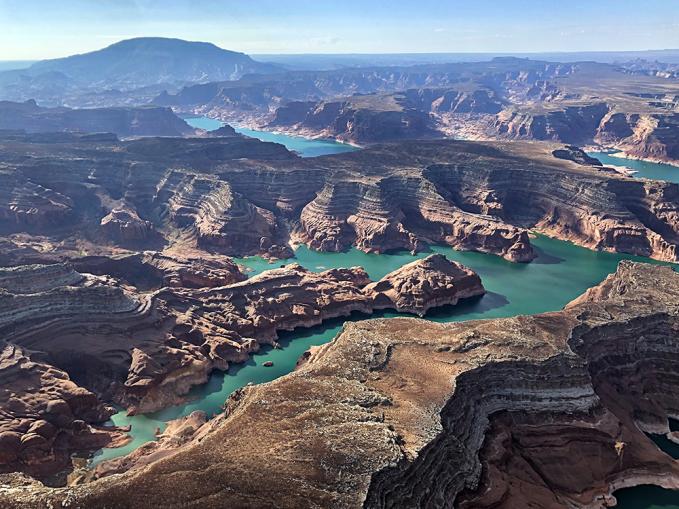
Two years ago Lake Mead officials adopted a plan to “maintain recreational motorboat access in the event water declines to 950 feet.” As of Tuesday, the elevation was 1061.76 feet, according to the U.S. Bureau of Reclamation. At Glen Canyon National Recreation Area, which straddles the Utah-Arizona border, the Park Service has spent more than $100 million in recent years to extend boat ramps and relocate a takeout for river runners coming down the Colorado River through Canyonlands National Park.
Colorado River negotiators are seen, from left to right: Becky Mitchell (Colorado), Tom Buschatzke (Arizona), Brandon Gebhart (Wyoming), and John Entsminger (Nevada). (Photo by Jeniffer Solis/Nevada Current)
Western states that rely on the Colorado River have less than two months to agree on how to manage the troubled river – and pressure is mounting as the federal government pushes for a compromise and a troubling forecast for the river’s two biggest reservoirs looms.
Top water officials for the seven Colorado River Basin states — Arizona, California, Nevada, Colorado, New Mexico, Utah, and Wyoming — gathered for the three-day Colorado River Water Users Association conference at Caesars Palace in Las Vegas last week.
Colorado River states have until Feb. 14 to reach a new water sharing agreement before current operating rules expire at the end of 2026 —or the federal government will step in with their own plan.
Despite the fast-approaching deadline, states reiterated many of the same issues they did during previous years at the conference, namely, which water users will need to sacrifice more water to keep the Colorado River stable as overallocation, climate change, and rising demand sucks the river dry.
Nevada’s chief river negotiator and general manager of the Southern Nevada Water Authority John Entsminger offered a succinct but sharp assessment of the negotiations during a panel discussion Thursday.
“If you distill down what my six partners just said, I believe there’s three common things: Here’s all the great things my state has done. Here’s how hard/impossible it is to do any more. And here are all the reasons why other people should have to do more,” Entsminger said.
“As long as we keep polishing those arguments and repeating them to each other, we are going nowhere,” he continued.
The seven states that share the river’s flows have been deadlocked for nearly two years over how to govern the waterway through the coming decades — even as water levels at Lake Mead and Lake Powell are forecasted to reach record lows after two straight years of disappointing snowpack across the West.
The Colorado River’s headwaters saw a weak snowpack last winter, contributing to one of the worst spring runoff seasons on record. Water flow into the river this year was only 56% of average, leading to significant reductions in Lake Powell, according to the Interior Department’s Bureau of Reclamation.
Federal officials also released a troubling forecast of expected flows for the river in 2026, which were significantly lower than previous predictions. Projections from the Bureau of Reclamation found the Colorado River’s inflow next year would likely be 27% lower than normal, with worst-case scenarios predicting even lower flows.
Without a strong winter snow season, it’s possible Lake Powell’s levels could drop low enough to cease hydropower production by next October — a scenario that would also limit the department’s ability to send water downstream to Arizona, California and Nevada.
The federal government has refrained from imposing its own plan for the river, preferring the seven basin states reach consensus themselves. But the Interior Department has ramped up pressure on states to reach a deal.
The Bureau of Reclamation’s Acting Commissioner Scott Cameron said he and other federal officials have intensified efforts to bring states to a consensus, flying out West every other week since early April to meet with the seven states’ river negotiators.
“The expiration of the current agreements is not a distant horizon. It’s less than a year away. The time to act is now,” said Cameron.
Within the next few weeks, the Bureau of Reclamation will release a range of proposals to replace the river’s current operating rules, but said they would not identify which set of operating guidelines the federal government would prefer
During the conference, negotiators for the seven states repeated that they are still committed to finding a consensus despite missing previous deadlines. California’s biggest water districts said they were willing to “set aside many of their legal positions” in order to reach a seven-state agreement.
However, a long-term multidecade strategy for managing low river flows is likely out of reach.
“I went into this process…advocating strenuously for a 20- to 30-year deal,” said Entsminger. “I no longer believe that’s possible with the time we have left and with the hydrology that we’re facing.”
Entsminger said the “best possible outcome at this juncture” is a short-term five-year deal that sets new rules around water releases and storage at Lakes Powell and Mead.
During a panel of state negotiators, states highlighted water conservation efforts they have undertaken to reduce water use and protect the river, but all explained why their state can’t take on more cuts.
Figure 4. Graph showing active storage in Lake Powell, Lake Mead, and in Powell+Mead between January 1, 2023, and November 30, 2025. Credit: Jack Schmidt/Center for Colorado River Studies
“Our savings accounts are totally depleted,” said Utah’s’s river negotiator, Gene Shawcroft. “Reserviours were full when we started this process. They’re empty now.”
One of the biggest disagreements between the Upper and Lower Basin states is over which faction should have to cut back on their water use during dry years.
The Lower Basin – Nevada, Arizona, and California – have agreed to take the first 1.5 million acre-feet in water cuts needed to address deficits and evaporation that are reducing flows in the river, but say any additional cuts during dry years must be shared with upstream states. Under the current agreement, Lower Basin states must take mandetory cuts when water levels in Lakes Powell and Mead are low.
The Upper Basin, which is not subject to mandatory cuts under the current guidelines, say they already use much less water than downstream states and should not face additional cuts during shortages.
Any more cuts to water users in downstream states during dry years will be politically perilous, explained Arizona’s top negotiator, Tom Buschatzke. Arizona requires the state legislature to approve any changes to Colorado River management rules impacting the state.
Buschatzke called for the Upper Basin – Colorado, Wyoming, New Mexico, and Utah – to split any additional water cuts with the Lower Basin states 50-50.
“We need conservation in the Upper Basin that is verifiable and mandatory,” Buschatzke said, during the panel.
“I have to go to my legislature and get that approval,” he continued. “And I will say right now, I do not think there is anything on the table from the Upper Basin that would compel me to do that today.”
New Mexico’s river negotiator, Estevan López, responded, “I think we’ve been pretty clear. We are unwilling to require additional mandatory reductions on our water users.”
This story was originally produced by Nevada Current, which is part of States Newsroom, a nonprofit news network which includes Stateline, and is supported by grants and a coalition of donors as a 501c(3) public charity.
Map of the Colorado River drainage basin, created using USGS data. By Shannon1 Creative Commons Attribution-Share Alike 4.0
Click the link to read the report from “Dancing with Dead Poll” on the Getches-Wilkinson website (Jack Schmidt1, Anne Castle2, John Fleck3, Eric Kuhn4, Kathryn Sorensen5, Katherine Tara6) Here’s Chapter 1:
In Brief
The rains of mid-October caused significant flooding in the San Juan River basin and increased reservoir storage throughout that basin and in Lake Powell.7 However, basinwide reservoir storage remains low, and the October rainfall offerings were insufficient to alleviate the peril of declining overall water supply.
While the attention of the Basin’s water management community remains focused on the thus far unsuccessful effort to forge a seven-state agreement on future long-term operating rules, the Basin continues to face the risk of short-term crisis. If winter 2025-2026 is relatively dry and inflow to Lake Powell and other Upper Basin reservoirs is similar to that of 2024-2025, low reservoir levels in summer 2026 will challenge water supply management, hydropower production, and environmental river management. Under such a scenario, it is likely that less than 4 million acre feet in Lake Powell and Lake Mead would be realistically available for use during the nine months between late summer 2026 and the onset of snowmelt runoff in 2027. If winter 2026-2027 is also dry, water supply would be further constrained. The present reservoir operating rules that remain in place through 2026 are insufficient to avert this potential water supply crisis. Action to further reduce consumptive water use across the basin is needed now.
How did we get here?
The Basin’s reservoirs were nearly full in late summer 1999,8 acting as a buffer against dry years and serving their fundamental purpose. At that time, the 46 Colorado River Basin reservoirs tracked by the Bureau of Reclamation in its Hydro database held 59.5 million acre feet (maf) in active storage,9 more than four times the Basin’s average consumptive uses and losses in the 1990s (Fig. 1).10 Beginning in 2000, five years of below average runoff11 resulted in a 46% reduction in storage in the Basin’s reservoirs.12 During that time, the reduction in storage in Lake Powell and Lake Mead accounted for 90% of the Basin’s total loss in storage, because most of the Basin’s water was stored in those two reservoirs.
Figure 1. Graph showing active storage in Colorado River basin reservoirs between January 1, 2021, and November 30, 2025. Credit: Jack Schmidt/Center for Colorado River Studies
During the next fourteen and a half years, the amount of storage in the Basin’s reservoirs changed little, despite four years of large runoff (2005, 2011, 2017, and 2019). The increase in storage during the few wet years was nearly completely consumed during the more frequent dry years, and active storage in Powell and Mead was only 5% greater in late July 2019 than it had been at the beginning of 2005.13 When dry years of low runoff returned between 2020 and 2022,14 the Basin’s water users had little of the buffer that they had at the beginning of the 21st century. Combined active storage of Powell and Mead was halved again between mid-July 2019 and mid-March 2023,15 reducing the combined contents of these two reservoirs to only 27% of what it had been in late summer 1999.16 If next winter’s runoff is as low as it was in 2025 17 and consumptive use is not significantly reduced, Powell and Mead will drop below the previous unprecedented low stand of mid-March 2023.
How much of active storage is realistically available?
One of the challenges of the current water supply crisis is uncertainty over how much water is actually available in the reservoirs for use. Although Reclamation regularly reports the amount of water in active storage, our analysis identifies realistically accessible storage as the more appropriate metric of the amount of water that is available for use without challenging the integrity of the dam structures, efficient production of hydroelectricity, or implementation of environmental river management protocols, especially in Grand Canyon.
The back of Glen Canyon Dam circa 1964, not long after the reservoir had begun filling up. Here the water level is above dead pool, meaning water can be released via the river outlets, but it is below minimum power pool, so water cannot yet enter the penstocks to generate electricity. Bureau of Reclamation photo. Annotations: Jonathan P. Thompson
Reservoir water that can be physically released from a dam is termed active storage. In virtually all reservoirs, there is a small amount of water below the elevation of the lowest outlets–the infamously named dead pool. Active storage is everything above dead pool–water that can be physically released through the reservoir’s lowest outlets.
We know, however, that not all the water above dead pool is readily usable. Engineering assessments have indicated that infrastructure constraints at Hoover and Glen Canyon Dams require that higher reservoir elevations be maintained, thereby constraining utilization of the lowest part of the active storage. We defined realistically accessible storage as the volume of water whose release does not impact previously identified engineering or hydropower-production constraints.
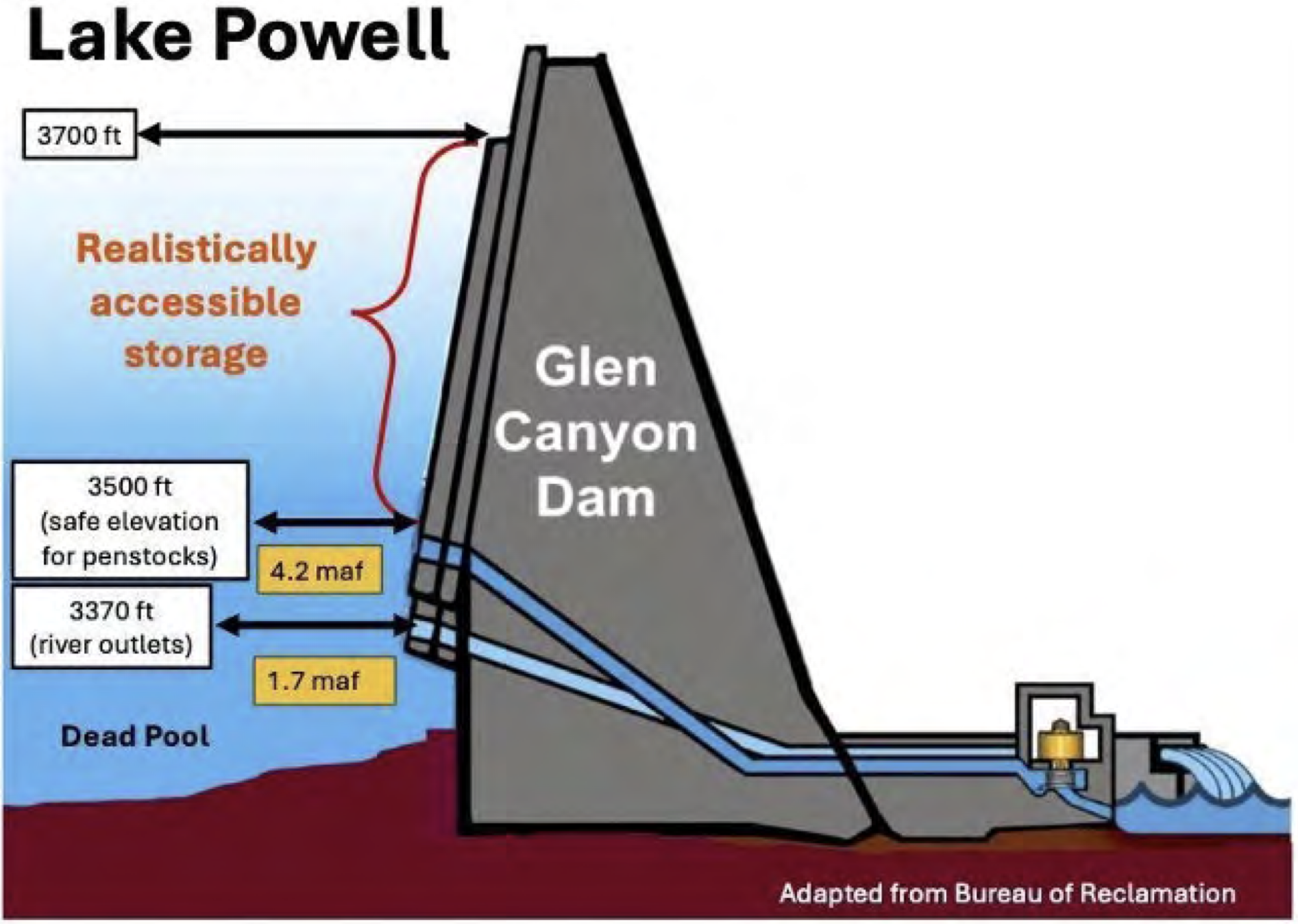
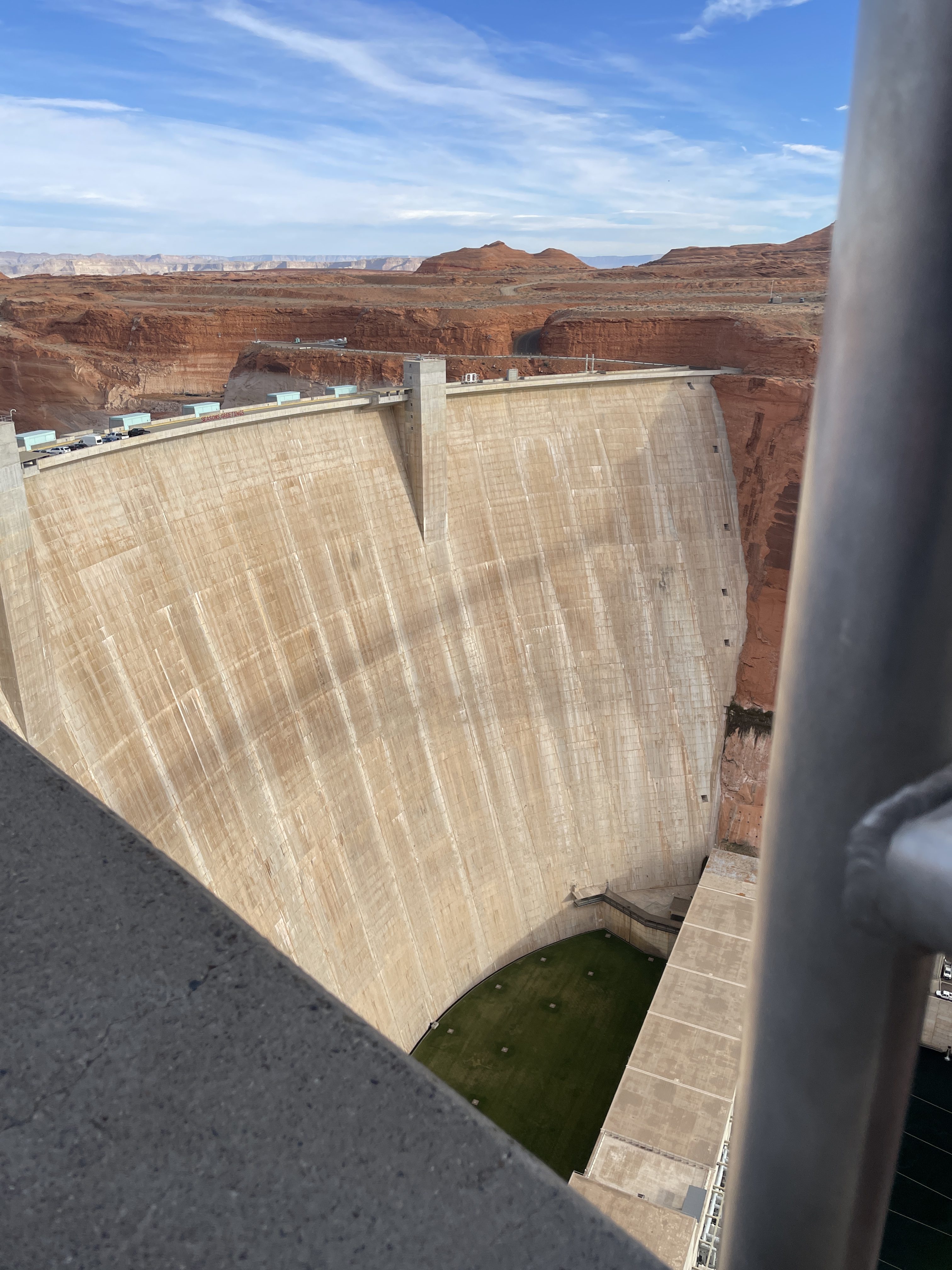
At Glen Canyon Dam, for example, the lowest release tubes, called the “river outlets,” are at elevation 3370 ft. Reservoir water below that elevation cannot be released and constitutes the dead pool. Above the river outlets, at elevation 3490 ft, are the intakes for the power generating turbines, known as the penstocks. The penstocks are the conduits that withdraw water from the reservoir into the powerplant to generate electricity, and thereafter discharge the water to the Colorado River downstream from the dam. When the reservoir falls below the elevation of the penstocks, the river outlets are the only means of discharging water through the dam (Fig. 2). The river outlets are not routinely used to release water; virtually all normal releases go through the penstocks.
Experience has shown that the river outlets were not designed for continuous release at the discharge rates required to meet downstream obligations. If the river outlets were to be used continuously, there is significant concern that structural damage to those outlets could occur.18
Accordingly, Reclamation has determined that it will take steps to avoid Lake Powell elevation declining below 3500 ft, considered a safe elevation for continuous withdrawal of water through the penstocks without risk of harm caused by cavitation to the turbines that produce electricity.19 Similarly at Lake Mead, Reclamation has indicated its intent to protect the reservoir from going below elevation 1000 ft.20
Figure 2. Diagram showing schematic of Glen Canyon Dam elevations at which Lake Powell’s waters can be released downstream, and the volumes of water defined by these elevations. Active storage between 3370 and 3500 ft is not realistically accessible for continuous downstream release without risk to engineering infrastructure at the dam and powerplant. Hydroelectricity cannot be produced below 3490 ft, and 3500 ft has been established as a minimum safe level for intake through the penstocks.
The total volume of active storage in Lake Powell above dead pool but below elevation 3500 ft is 4.2 maf. Release of this stored water is constrained, because it cannot be safely withdrawn through the penstocks, and continuous use of the river outlets is considered unwise. At Hoover Dam, there is 4.5 maf of active storage below elevation 1000 ft, also not realistically accessible. In these two largest reservoirs of the Colorado River Basin, there is a total of 8.7 maf of active storage below the elevations required for safe and efficient operation of the infrastructure (Fig. 3). Thus, of the 14.9 maf of active storage at Lake Powell and Lake Mead on November 15, 2025, only 42% of that active storage, 6.2 maf, was realistically accessible.
Figure 4. Graph showing active storage in Lake Powell, Lake Mead, and in Powell+Mead between January 1, 2023, and November 30, 2025. Credit: Jack Schmidt/Center for Colorado River Studies
Implementation of environmental river management protocols at Glen Canyon Dam are constrained when the elevation of Lake Powell is low. Since 1996, controlled floods, administratively termed High Flow Experiments (HFEs), have been conducted at Glen Canyon Dam to rebuild eddy sandbars along the river’s margin and conserve sediment. HFEs are now an essential component of the Long Term Experimental and Management Plan for Glen Canyon Dam.21 Reclamation did not, however, release an HFE in 2021 or 2022 when sediment conditions were sufficient to trigger implementation of the HFE Protocol because Lake Powell was low. In early October of those years, when decisions about implementing HFEs were made, active storage in Lake Powell was 7.3 maf (elevation 3545.3 ft) and 5.8 maf (elevation 3529.4) in 2021 and 2022, respectively. Reclamation cited low storage as the reason not to release those controlled floods.22 Although administrative decisions change with time, it is doubtful that any HFEs would be released if Lake Powell fell below elevation 3500 ft.
Low reservoir levels also impact Reclamation’s ability to control the invasion into Grand Canyon of smallmouth bass, and other warm water reservoir fish species, that dominate the recreational fish community of Lake Powell. These nonnatives are significant predators and competitors of endangered or threatened native fish species and live near the surface of Lake Powell. At moderate and low reservoir elevations, water withdrawn through the penstocks (termed fish entrainment) includes some fish that survive passage through the powerplant turbines and are delivered into the Colorado River downstream from the dam. These fish have the potential to successfully spawn downstream from the dam if river temperatures are relatively warm, such as occurs when Lake Powell is low and water is only released through the penstocks.
This infographic shows how as Lake Powell water levels decline, warm water containing smallmouth bass gets closer to intakes delivering water through the Glen Canyon Dam to the Grand Canyon downstream. Credit: U.S. Geological Survey
Reclamation has implemented a protocol to eliminate the potential of smallmouth bass population establishment in Grand Canyon by releasing some cooler water through the river outlets when the water released through the penstocks is warm. The objective of these Cool Mix releases is to disrupt smallmouth bass spawning downstream from the dam. Water released through the river outlets bypasses the powerplant and does not produce electricity, and Western Area Power Administration (WAPA) must purchase electricity on the open market to replace electricity that the agency contractually committed to provide. WAPA estimated that the cost of replacing contracted electricity was $18.9 million23 and $6.5 million24 during the Cool Mix releases of 2024 and 2025, respectively. The risk of fish entrainment from Lake Powell increases significantly as Lake Powell’s elevation drops, and the need to implement the Cool Mix protocol therefore increases. The risk is minimized if Lake Powell is higher than 3590 ft (10.8 maf active storage) and significantly increases when Lake
Powell is below 3530 ft (5.8 maf active storage).25 When water is no longer withdrawn through the penstocks, the risk of entrainment decreases, because all water passes through the lower elevation river outlets.
What would happen if the coming winter and spring snowmelt is similar to 2024-2025?
In an analysis released in September 2025, we reviewed what might happen in the coming year if runoff is the same as it was last year and Basin consumptive uses and losses are the average of the past four years. We used a simple mass balance approach and estimated the available water supply and consumptive uses and losses, and calculated the difference between the two. The available water supply is the sum of the natural flow of the Colorado River at Lees Ferry plus inflows that occur in the Lower Basin, primarily in Grand Canyon. Consumptive uses and losses are those associated with diversions that support irrigated agriculture, municipal and industrial use, water exported from the Basin by trans-basin diversions, and reservoir evaporation. The difference between supply and use is the net effect on reservoir storage. We then estimated the effect of the Basinwide imbalance between supply and use on the combined realistically accessible storage in Powell and Mead, i.e., above elevations 3500 and 1000 ft in Lake Powell and Lake Mead, respectively.
In the scenario that we considered, we assumed that natural flow at Lees Ferry in the coming year will be 8.5 maf, the same as in Water Year 2025,26 and inflow in the Grand Canyon is 0.8 maf. Thus, we assumed a total supply in the coming water year of 9.3 maf. We analyzed a scenario wherein consumptive uses and losses in the United States portion of the Colorado River would be the average of the most recent four years (2021-2024), namely 11.5 maf,27 and we assumed that 1.4 maf would be delivered to Mexico.
The gap between supply and use under this scenario is 3.6 maf, which would have to be met by additional withdrawals from reservoir storage. Assuming that 75% of this deficit would be withdrawn from Lake Powell and Lake Mead (2.7 maf), then the realistically accessible storage in these two reservoirs would be reduced to 3.5 maf, slightly less than the 21st century low that occurred in mid-March 2023 (Fig. 3). Our analysis of this one realistically low inflow scenario–the coming year’s supply is just like last year’s and consumptive uses and losses are the average of the past four years–is consistent with, but less dire than, Reclamation’s most recent 24-Month Study minimum probable forecast28 for the coming year. That study projects that total storage in Lake Powell and Lake Mead will be drawn down by 3.8 maf during the next year, 2.9 maf from Lake Powell alone. Under Reclamation’s minimum probable projection, the elevation of Lake Powell would drop below 3500 ft in August 2026. All of the remaining realistically accessible storage, 2.5 maf in the scenario modeled by Reclamation, would be in Lake Mead. Under the assumption that the current operating rules remain in effect in 2027, Reclamation’s projection is that the elevation of Lake Powell would stay below elevation 3500 ft through at least July 2027.
Further complicating the situation is that the status and ownership of water in Lake Mead at very low storage levels is unclear. Lake Mead holds (a) water available for allocation in the Lower Division under the prior appropriation system, (b) at least some amount of the water due to Mexico under treaty obligations, and (c) assigned water. Assigned water, commonly known as Intentionally Created Surplus or ICS, is water that can be delivered independent of the Lower Basin’s prior appropriation water allocation system and that is held in Lake Mead by the Secretary of the Interior for the benefit of a specific entity. Assigned water also includes delayed water deliveries held for the benefit of the Republic of Mexico that can be delivered subsequently in amounts in excess of the U.S. treaty obligation to Mexico of 1.5 maf/year. Owners of assigned water have the right to withdraw that water when Lake Mead water levels are above 1025 ft, but entitlement holders in the priority system also have a right to water deliveries, as does Mexico via treaty.
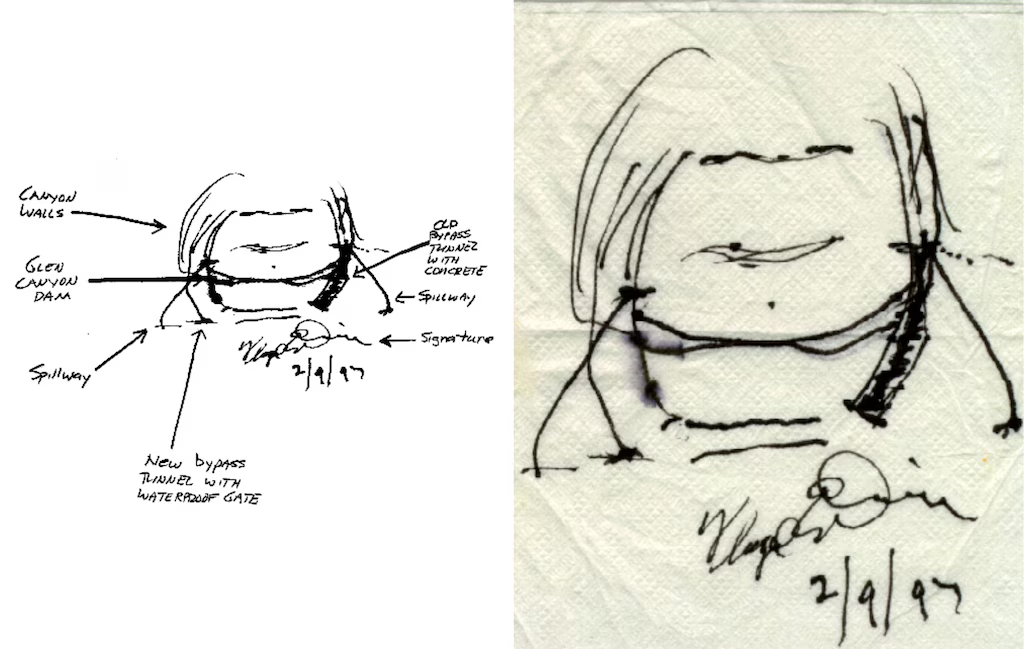
Sketches by Floyd Dominy show the way he’d end the Glen Canyon Dam. From the article “Floyd Dominy built the Glen Canyon Dam, then he sketched its end on a napkin” on the Salt Lake Tribune website.
So long as there is water in Lake Mead adequate to fulfill all required and requested deliveries, no conflict arises. However, as the amount of water in Lake Mead decreases, the potential for a clash increases. International treaty obligations take precedence over deliveries pursuant to the priority system within the U.S., but it is unclear how competing priorities and entitlements will be resolved within the U.S. Holders of higher-priority entitlements would likely contest the Secretary’s authority to reduce their deliveries while withholding assigned water from the priority system. As of the end of 2024, there was approximately 3.5 maf of assigned water in Lake Mead, almost the same as the amount of realistically accessible water in storage above elevation 1000 ft. If Lake Powell ever became a “run of the river” facility, the potential for conflict over access to water in Lake Mead would also increase.
Implications
We are not weather forecasters and have no crystal ball that reveals the coming winter snowpack. We are not predicting that our assumptions about the gap between supply and use/losses and the resulting drawdown of Lake Powell and Lake Mead will inevitably occur. Our scenario is merely one of many possibilities, but our assumptions are sufficiently realistic to serve as a warning of how close the Basin is to a true water crisis. Our results should serve as a call to action. We need to adopt additional and immediate measures across the Basin to reduce water consumption even further during the next year, well before any new guidelines are in place.
Taking steps now to decrease consumptive uses across the Basin will reduce the need to implement draconian measures next summer or in the following years. Every acre foot saved now is an acre foot available for our future selves, slowing the rate of reservoir decline and creating more room for creative Colorado River management solutions. If, on the other hand, we delay reducing water usage and addressing reservoir drawdown, we may find ourselves in more significant distress at the beginning of the Post-2026 guidelines. As we wrote in October, continued reduction in Lake Powell releases also brings the Basin perilously close to the Colorado River Compact “tripwire,” the point at which the ten-year rolling total of water delivered from the Upper Basin to the Lower Basin might trigger litigation asking the U.S. Supreme Court to interpret long avoided ambiguities in rules written a century ago by the drafters of the Colorado River Compact.
We do not presume to make specific recommendations about the steps that should be taken immediately to reduce consumptive use in the Basin. There are many smart and experienced individuals in the Colorado River community whose sole focus is on the mechanics of operating the Colorado River water system and the impacts of operations on their particular constituencies.
We can, however, highlight the available mechanisms for reduction of consumptive use that should be explored for their immediate utility in diminishing the looming jeopardy to the overall system. Such mechanisms include:
Releases from federal reservoirs upstream of Lake Powell to stabilize storage in Lake Powell.
Such releases would be made pursuant to the Drought Response Operations Agreement or similar successor agreement or pursuant to the Secretary of the Interior’s inherent authority to operate federal water projects. Obviously, such releases do nothing to solve the imbalance between supply and demand and will create additional depletions in the system when these reservoirs are refilled. Such releases can, however, provide a temporary bulwark against exceptionally low levels in Lake Powell.
Additional reductions in deliveries from Lake Mead under the Secretary’s Section 5 delivery contracts in the Lower Basin, as authorized by Section II.B.3 of the decree in Arizona v. California, 376 U.S. 340 (1964).
By reducing deliveries from Lake Mead, releases from Lake Powell could also be reduced without the risk of causing exceptionally low storage in Lake Mead.
Extension of system conservation programs in the Lower Basin, and facilitation of an Upper Basin water conservation program, both funded through compensation from federal or state governments or other water users in the Basin, and requiring specific quantities of saved water.
Relying on compensated annual forbearance alone is unsustainable, however, because it is not feasible to pay water users in the long term to forgo the use of water that nature no longer supplies. Permanent reductions in consumptive use are both necessary and also the most productive use of limited funding. In addition, to be effective, changes to state law in some Upper Basin states may be necessary, including recognition of water conservation as a beneficial use for the purpose of avoiding litigation concerning the Colorado River Compact. Finally, authorization for shepherding of saved water to the intended place of storage is essential, including across state borders.
Reductions in deliveries to Mexico through negotiation of a new minute.
Reductions in consumptive use by federal water projects in the Upper Basin, if allowable pursuant to the Secretary’s authority.
It should be noted, however, that in order to benefit the Colorado River system, any such reductions must be recognized at the point of diversion and shepherded to the intended place of storage.
It is obvious that any long-term agreement for future Colorado River operations among the Basin States should be evaluated based on its immediate ability to reverse the storage declines experienced in recent years and anticipated in the future under similar hydrology. An agreement that does not reliably balance supply with uses and losses is not sustainable. Similarly, any operational alternative proffered by the Department of the Interior must achieve the same objectives. When our reservoir storage is as low as it is now, we have very little buffer to rely on–we simply cannot use more water than nature provides.
The focus within the Basin and among its principal water users and state negotiators has been on the formulation of the Post-2026 guidelines for operation of the river. But action is necessary now to avoid creating conditions that will doom the next set of operating principles by initiating their implementation when the Basin is in full crisis mode. No governmental administration, state or federal, wants to see the Colorado River system fail on its watch. Negotiators have worked tirelessly to reach agreement, yet have come up short. The hour is late. The Secretary must take decisive action.
Photo Credit: John Weishei via the Colorado River Research Group
Footnotes
1 Director, Center for Colorado River Studies, Utah State University, former Chief, Grand Canyon Monitoring and Research Center.
2 Senior Fellow, Getches-Wilkinson Center, University of Colorado Law School, former US Commissioner, Upper Colorado River Commission, former Assistant Secretary for Water and Science, US Dept. of the Interior.
3 Writer in Residence, Utton Transboundary Resources Center, University of New Mexico.
4 Retired General Manager, Colorado River Water Conservation District.
5 Kyl Center for Water Policy, Arizona State University, former Director, Phoenix Water Services.
6 Staff Attorney, Utton Transboundary Resources Center, University of New Mexico.
7 Between 9 October and 8 November, five reservoirs in the San Juan River basin gained 204,000 af in total storage, especially in Navajo and Vallecito Reservoirs. Between 9 October and 20 October, Lake Powell gained 105,000 af in active storage, and the total contents of Lake Powell and Lake Mead increased by 108,000 af between September 25 and October 27.
8 Schmidt, J.C., Yackulic, C.B., and Kuhn, E. 2023. The Colorado River water crisis: its origin and the future. WIREs Water 2023;e1672.
9 Total active storage in the Basin’s 46 reservoirs was at its maximum on 24 August 1999.
10 Total Basin consumptive uses and losses, including deliveries to Mexico, averaged 14.2 maf/yr between 1990 and 1999.
11 Average natural flow of the Colorado River at Lees Ferry, estimated by Reclamation, was 9.5 (Water Year, WY) and 9.6 (Calendar Year, CY) maf/ yr between 2000 and 2004. Average natural flow for the preceding ten years (1990-1999) was 15.0 maf/yr (WY, CY). Average natural flow for the entire 21st century between 2000 and 2025 was 12.3 maf/yr (WY, CY).
12 Total active storage of the Basin’s reservoirs was 32.0 maf on 19 October 2004.
13 Total active storage in Lake Powell and Lake Mead was 23.0 maf on 1 January 2005 and was 24.2 maf on 28 July 2019, a 5% increase.
14 Average natural flow at Lees Ferry averaged 9.0 (WY) and 9.2 (CY) maf/yr between 2020 and 2022.
15 Total active storage in Lake Powell and Lake Mead was 12.7 maf on 14 March 2023, 48% less than it had been on 28 July 2019.
16 Total active storage in Lake Powell and Lake Mead was 47.7 maf on 19 September 1999.
17 Reclamation estimates that natural flow at Lees Ferry was 8.5 (WY, CY) maf in 2025.
18 Bureau of Reclamation, Establishment of Interim Operating Guidance for Glen Canyon Dam during Low Reservoir Levels at Lake Powell (2024).18
19 Bureau of Reclamation, Supplement to 2007 Colorado River Interim Guidelines for Lower Basin Shortages and the Coordinated Operations of Lake Powell and Lake Mead, Record of Decision (2024) (SEIS ROD).
20 Id.
21 U.S. Department of the Interior, Record of Decision for the Glen Canyon Dam Long-Term Experimental and Management Plan, Final Environmental Impact Statement, December 2016.
22 Salter, G. and 7 co-authors, 2025, Reservoir operational strategies for sustainable sand management in the Colorado River. Water Resources Research 61, e2024WR038315.
23 Ploussard, Q., Pavičević, M., and Yu, A. 2025. Financial analysis of the smallmouth bass flows implemented at the Glen Canyon Dam during Water Year 2024. Argonne National Laboratory report ANL 25/44, 17 pp.
24 C. Ellsworth, Western Area Power Administration, pers. commun.
25 Eppenhimer, D. E., Yackulic, C. B., Bruckerhoff, L. A., Wang, J., Young, K. L., Bestgen, K. R., Mihalevich, B. A., and Schmidt, J. C. 2025. Declining reservoir elevations following a two-decade drought increase water temperatures and non-native fish passage facilitating a downstream invasion. Canadian Journal of Fisheries and Aquatic Sciences 82:1-19.
26 During the 21st century, natural flow at Lees Ferry was lower than this amount in 2002, 2012, 2018, and 2021, meaning that this is not a worst case scenario.
27 In 2024, consumptive uses and losses in the Upper and Lower Basins totaled 11.4 maf.
28 October 2025 24-Month Study Minimum Probable Forecast. For a discussion of why the Minimum Probable forecast has become a more reliable indicator of the future than the Most Probable 24-Month Study, see Awaiting the Colorado River 24-Month Study, Aug. 14, 2025.
Map of the Colorado River drainage basin, created using USGS data. By Shannon1 Creative Commons Attribution-Share Alike 4.0
‘Dancing with Deadpool’ – Doesn’t that sound like something a romantic like me would concoct? I was intending for this post to be a follow-up on the last post, laying out my rationale for believing that we have all been ‘romancing the Colorado River’ for a century and a half, with three distinct epochs.
But then ‘Dancing with Deadpool’ came along. ‘Dancing with Deadpool’ is actually the title of a report recently released by a Colorado River Research Group, a group of natural and social scientists presenting under the auspices of the Getches-Wilkinson Law Center at the University of Colorado. They are ‘all academics with long, well-established involvement in Colorado River scholarship,’ and you’ve heard about the work of a number of them in these posts before – Brad Udall, Eric Kuhn, Jack Schmidt, Ann Castle, Doug Kenney, among others. In ‘Dancing with Deadpool’ they were invited ‘to present their thoughts on the future of the Colorado River as individuals rather than as representatives of their institutions.’
Back for a moment to my thesis that, as a Bureau of Reclamation engineer said in 1918, ‘a vein of romance runs through every form of human endeavor,’ but mediated with desert poet Mary Austin’s caution to those who drink the waters of the romanced river, and who then ‘can no more see fact as naked fact, but all radiant with the color of romance’: I will say of most of the contributors to ‘Dancing with Deadpool,’ that they are trying to reconcile the naked facts too long ignored with the ongoing Romance of Controlling and Conquering the River that they are too polite to suggest just ending, as it were.
Their thoughts have received a bigger play in the news than they might have, had there been any real news from the closed rooms where the seven state negotiators, with 30 First People nations and Mexico looking over their shoulders, are trying to work out a new post-2026 management plan for the river. Since we’ve been in the 2026 water year since October 1, a new plan can’t come any too soon at this point – especially given the projections that this winter may be as anemic as last winter in terms of runoff this coming summer.
The 60-page report can be found at Colorado River Insights: Dancing with Deadpool, and is mostly good reading; the Executive Summary of the eight essays can be found here, and most newspapers of record have done a big story on the report.
I am not going to go into separate analyses of all eight essays making up this report. What I want to do instead is to pick up and run with some points in several of the essays that seem to me to point toward a potentially romantic vision of our future in the Colorado River region that starts with some often downplayed ‘naked facts’ that can’t be ignored or denied forever….
Udall/Overpeck 4-panel Figure Colorado River temperature/precipitation/natural flows with trend. Lake Mead and Lake Powell storage. Updated through Water Year 2025. Note the tiny points on the annual data so that you can flyspeck the individual years. Credit: Brad Udall
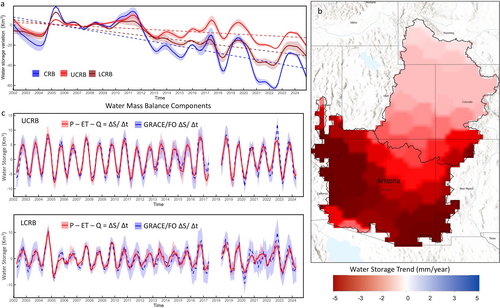
When we talk about ‘our problems with the Colorado River,’ we need to be more clear when we are talking about a ‘river problem’ and when we are talking about ‘the river system’ that we have imposed on the river to enable our use of the river’s water. In ‘Dancing with Deadpool’ Brad Udall and Jonathan Overpeck, take a second look at a big river problem. A decade or more ago, they added an enlightening distinction about ‘drought’ to our vocabulary: they acknowledged that part of the 21st century drought was a ‘dry drought,’ meaning caused by diminished precipitation; but then said that at least half of the drought was a ‘hot drought,’ caused by rising temperatures that increased evaporation and transpiration of the precipitation that managed to fall. And the rising temperatures they accrued to anthropogenic greenhouse gases in the atmosphere. Now they they have amended their analysis based on studies of what has been happening in the Pacific Ocean; they say in this essay that the ‘dry drought’ is also probably at least partially a consequence of our anthropogenic sins, due to the impact of rising temperatures on the Pacific Ocean from whence the western climate emerges.
About half of the CRRG scientists collaborate on a ‘Dancing’ essay about ariver system problem, analyzing where we stand on Colorado River Reservoir Storage – showing that we are indeed dancing with deadpool, the stage at which a reservoir level drops below its lowest portals through the dam, meaning no flow in the river below the dam. We wish this were a river problem that we could blame on the gods of nature, but it is mostly a river system problem. The river system is most visibly a set of big physicl structures for storing water and releasing it on a need basis into a vast desert distribution system. This system is overlaid on the natural river (which has dealt with worse obstacles in its five million years), but overlaid on the physical system is a thick but rickety layer of compacts, laws, treaties, regulations, court decisions, et cetera that dictate the operation of the physical system. Right now, the river managers – another layer, generating an operating system fraught with tensions between politics, economics and traditions – are working kind of desperately on ever-larger bandaids patched on operating systems that were clearly on track for deadpool in the first decade of the century. Jack Schmidt et al lay out this unfolding story.
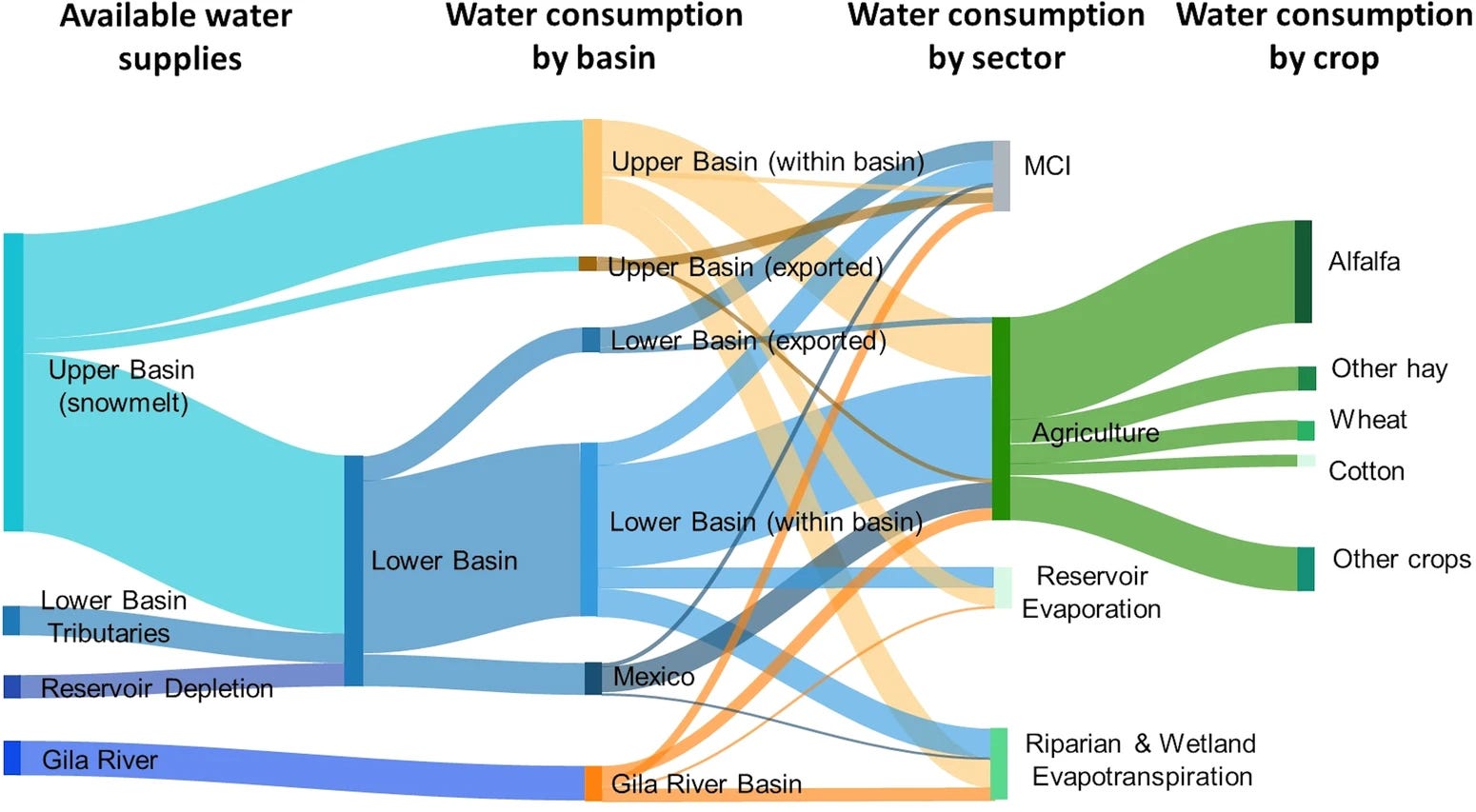
Graphic via Holly McClelland/High Country News.
About half of the CRRG scientists collaborate on a ‘Dancing’ essay about ariver system problem, analyzing where we stand on Colorado River Reservoir Storage – showing that we are indeed dancing with deadpool, the stage at which a reservoir level drops below its lowest portals through the dam, meaning no flow in the river below the dam. We wish this were a river problem that we could blame on the gods of nature, but it is mostly a river system problem. The river system is most visibly a set of big physicl structures for storing water and releasing it on a need basis into a vast desert distribution system. This system is overlaid on the natural river (which has dealt with worse obstacles in its five million years), but overlaid on the physical system is a thick but rickety layer of compacts, laws, treaties, regulations, court decisions, et cetera that dictate the operation of the physical system. Right now, the river managers – another layer, generating an operating system fraught with tensions between politics, economics and traditions – are working kind of desperately on ever-larger bandaids patched on operating systems that were clearly on track for deadpool in the first decade of the century. Jack Schmidt et al lay out this unfolding story.
But those essays reflect the ‘first we scare’em, then we ask them to think’ strategy of most legitimate public information (public propaganda never gets to the second step). Some of the essays in ‘Dancing with Deadpool’ gave some nudges toward alternative ways of looking at both the river and the river system that might be rabbit holes out of the current stalemate.
By measuring the gravitational pull of water for more than two decades, NASA satellites have peered beneath the surface and measured changes in the groundwater supplies of the Colorado River Basin for years 2015 to 2024. Credit: NASA
Doug Kenney, chair of the CRRG and director of the Getches-Wilkinson Center’s Western Water Policy Program, set me to thinking about that with an essay that was actually part of the ‘first we scare’em’ section of the pamphlet, about the ‘alarming erosion’ of the Colorado River ‘Safety Nets.’
Typical water well
A focus on surface water prior to the early 20th century is understandable; until the advent of powerful fossil-fueled pumps, all land-based animal life including us had to access the water we needed from the surface water that makes up less than one percent of all the water on the planet. We could also dig wells into the upper groundwater zone, fitted with handpumps, and the farm culture generated the windmill driven pump for filling stocktanks as well as home use, but other than that, it was all surface water – especially when it came to irrigated agriculture.
But now we can access that groundwater – and obviously do; when we say the Colorado River provides domestic water for 40 million people and irrigation water for five million acres of farmland, it should be obvious that allthat water is not coming from a river running on average 12 million acre-feet a year. It is, in fact, hard to tell in some places in the Lower Colorado River Basin, and in many urban areas, which resource, ground or surface water, is the ‘safety net’ for the other. We do know that we’ve been pumping enough ‘supplemental’ groundwater to cause serious subsiding of the land as emptied underground aquifers collapse irreversibly.
But nevertheless, at the heart (not in the head but the romantic heart) of the negotiations is how to build up the storage again in two big open reservoirs under an increasingly brutal desert sun. How to Make Mead and Powell Great Again! – and who should sacrifice to do it. Have they not read Udall and Overpeck?
If we were intelligently approaching the post-2026 era, we might consider setting a 20-year ‘interim’ schedule for phasing out Mead and Powell entirely as the world warms, and getting as much of the river’s surface water as possible underground where it is safer from the drying sun. Before we have emptied and collapsed all the underground storage areas. There’ll be a full post on that one of these days.
Well, that’s the kind of thinking “Dancing with Deadpool’ wakens in my admittedly iconoclastic mind. I do not suggest that as a simplistic trumpish solution. Allocation of invisible underground water is not as straightforward as the allocation of surface water; nothing will be simplified by trying to combine ground and surface water into a single system – although it is working out fairly well in Colorado where integrating groundwater and surface water use has been the practice since 1969. Not a new idea, in other words, although California – where the Central Valley has massive subsidence from aquifer loss – continues to believe it is not that big a deal.
Why are our negotiators not working on that kind of integrative 21st century thinking? Why haven’t they been working on it since the ‘interim’ began in 2007? The water mavens are quibbling over bits and pieces of the overdeveloped surface water, while most of the states pump huge quantities of groundwater with no regulation for their diminishing future. The faded but still somewhat radiant colors of the Romance of Conquest still hover over the basin, where we continue to tinker with the divine compact carved in stone by God’s lightning and carried off of a sacred mountain by Herbert Hoover and Delph Carpenter.
Members of the Colorado River Commission, in Santa Fe in 1922, after signing the Colorado River Compact. From left, W. S. Norviel (Arizona), Delph E. Carpenter (Colorado), Herbert Hoover (Secretary of Commerce and Chairman of Commission), R. E. Caldwell (Utah), Clarence C. Stetson (Executive Secretary of Commission), Stephen B. Davis, Jr. (New Mexico), Frank C. Emerson (Wyoming), W. F. McClure (California), and James G. Scrugham (Nevada) CREDIT: COLORADO STATE UNIVERSITY WATER RESOURCES ARCHIVE via Aspen Journalism
John and Mrs. Gulch in Coyote Gulch May 2000. Note the socks drying on the backpack, that old Jansport.
Mrs. Gulch (Early 1973): Since we’re taking the summer off for a honeymoon let’s go backpacking.
Me: No thanks, I backpacked during my time in the Boy Scouts before being asked to find another outlet for my Junior High attitude.
Mrs. Gulch: What didn’t you like about backpacking.
Me: At the top of the list — I don’t like cooking over a campfire.
Mrs. Gulch: We can get a backpacking stove.
Me: A what?
Mrs. Gulch: A backpacking stove, they use white gas that you carry in a Sigg bottle. Let’s go to the backpacking store, things have changed since you were a Boy Scout.
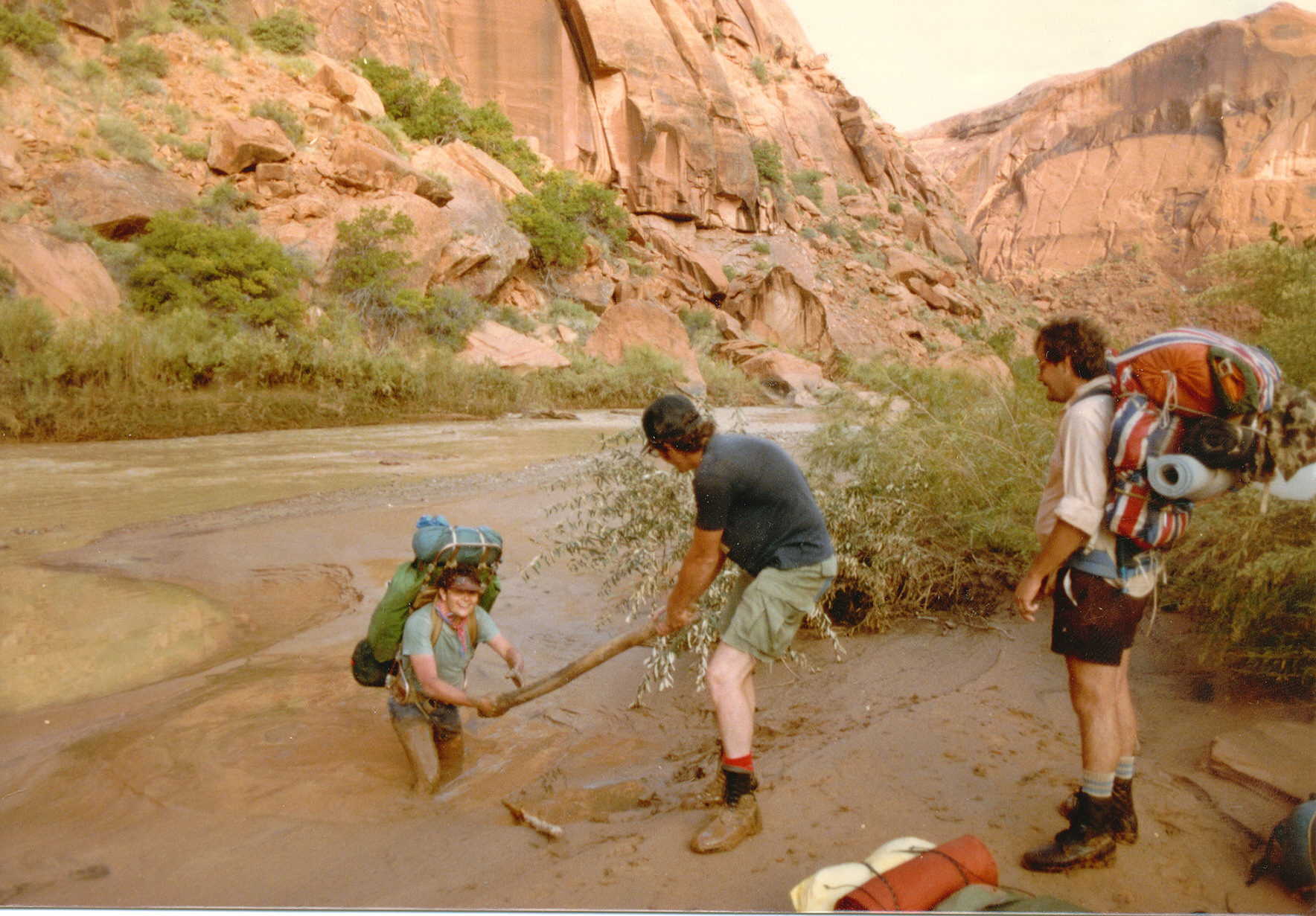
Joe Ruffert helping Coyote Gulch out of the mud along the Escalante River sometime in the early 1980s. We were on our way to meet Mrs. Gulch at Coyote Gulch. Photo credit: Mike Orr
That was my introduction to Mrs. Gulch’s knowledge of backpacking. Of course she was way more experienced than I was but didn’t gloat. She wanted to be on the trail and she wanted to take me along. That opened up a world for me and I became obsessed with backpacking — mountains and desert — it didn’t matter, and much of my time during winter, from then on, was spent looking over USGS topo maps, trying to find a cool route to follow. Subsequent years you could find us on the trail in Colorado, Utah, Montana, Washington, and New Mexico most often with my good friend Joe. We took many folks on their first backcountry trek over the years and alternated mountains then desert, year after year.
There is a standout trek for me. Four of us started in Harris Wash, a trib of the Escalante River and walked to Coyote Gulch, another trib of the river. Mrs. Gulch and another friend met us there with a food drop so that she and I could go back upriver to our VW bus parked at the Harris Wash trailhead.
During the hike to Coyote Gulch we met up with hoards of biting flies until below 20 Mile Wash. It was miserable at times but we learned to get in the shade, kill a few, slather up with DEET, cool off and hydrate.
When Mrs. Gulch and I left the group in Coyote Gulch my friend Don asked, “You’re going back through the flies?”
When she and I hit the fly space upstream we ended up hiking from early morning until nighttime to get done as quickly as possible. The last day I was pretty agitated and tired from the trek and I missed the exit to Harris Wash. I was worried and anxious also and a little (maybe a lot) of panic set in. I’ve mentioned before how much I depended on Mrs. Gulch’s wise counsel during our 50 years of marriage and that day it showed up again.
Mrs. Gulch (calmly): Let’s get in the shade, kill a few flies. You can get your compass and the topo sheet out of your pack and figure out where we are.
Me: These flies! We missed Harris Wash? We need to get back to the bus and back to Denver! Blah, blah, blah!
Mrs. Gulch (repeating herself calmly): Look there’s a shady alcove over there, let’s go there, kill a few flies, and you can get your compass and the topo sheet out of your pack and figure out where we are.
My Christmas present — messing with maps, see if you can find Harris Wash and Silver Falls Creek. Map: Escalante, Utah. USGS Historical Topographic Map Collection
After orienting the map and taking a good look at the terrain I saw a side canyon (Silver Falls Creek) coming into the Escalante River canyon just upstream and found it on the map. As it turns out we just needed to go back downstream a bit (just around the bend) and we would be at the confluence with Harris Wash. We didn’t miss it by much.
Wise counsel indeed.
Happy 71st birth anniversary Mrs. Gulch and thank you for your humor and wise counsel over the years.
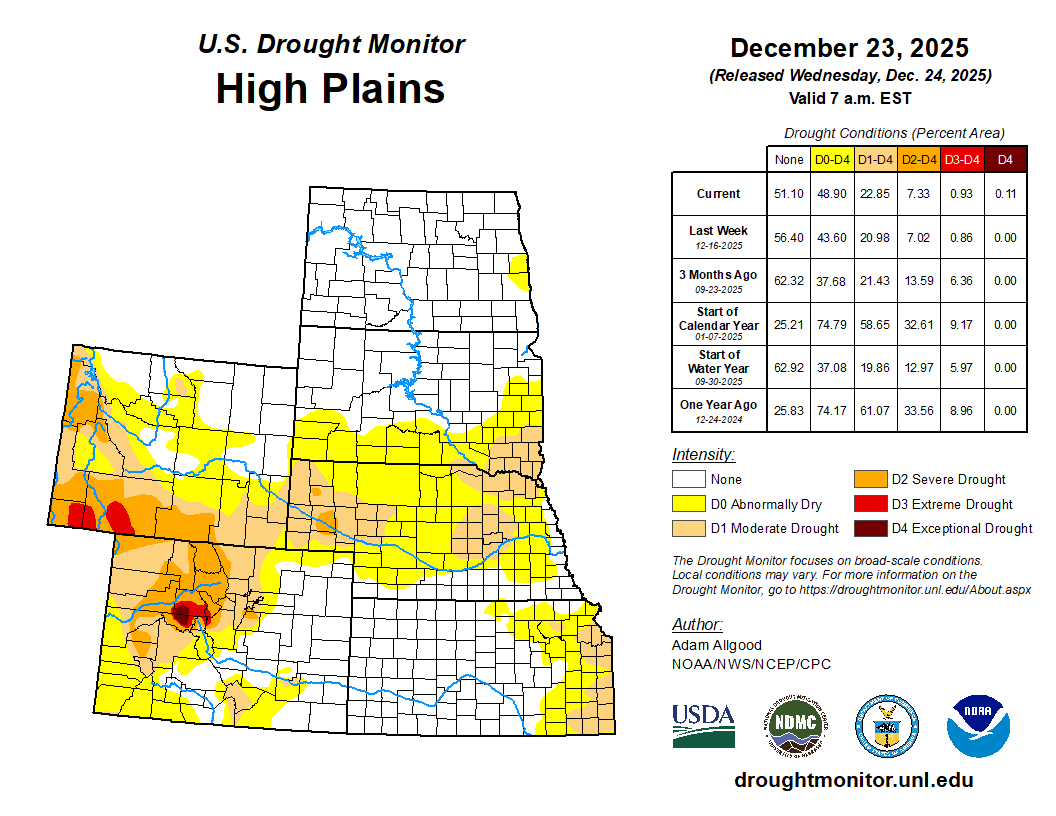
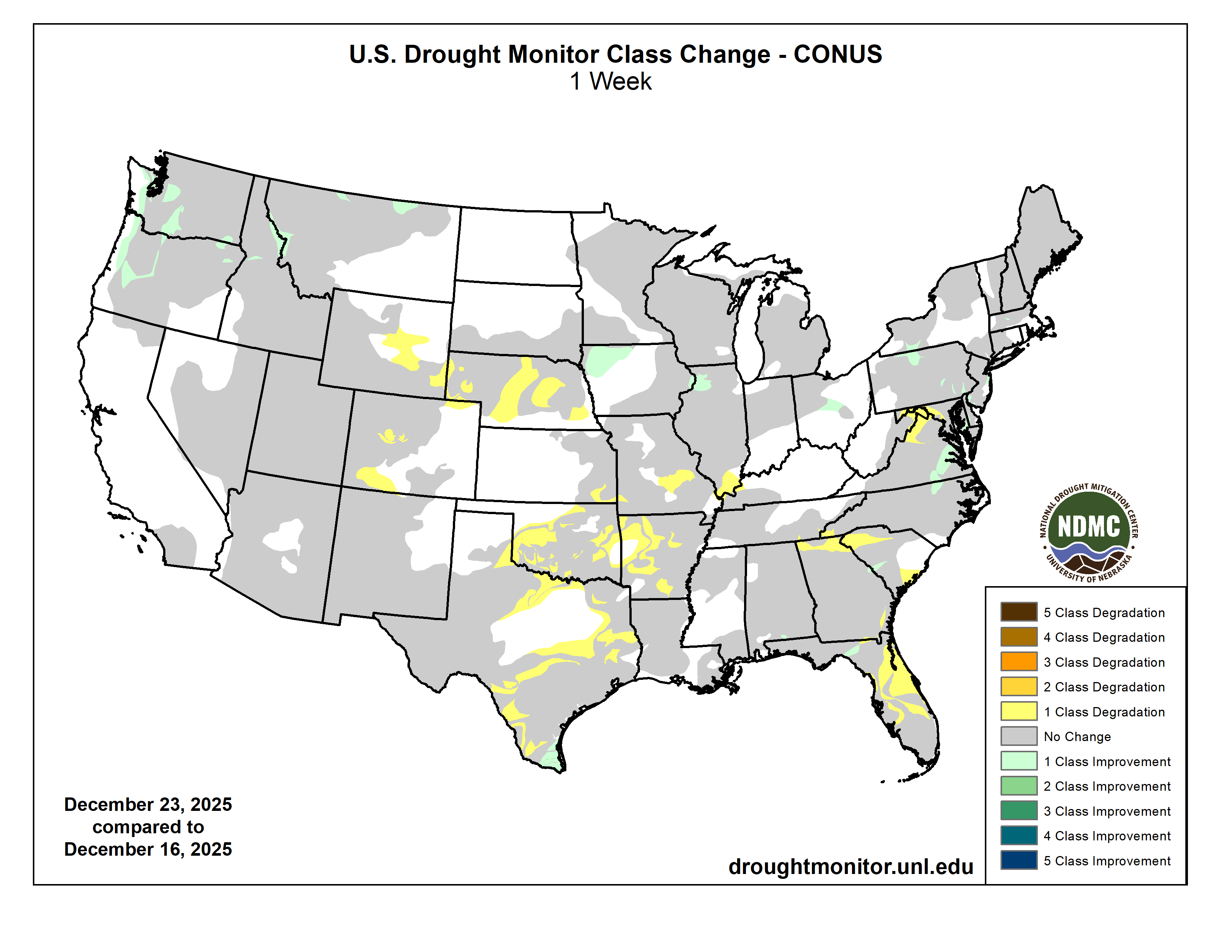
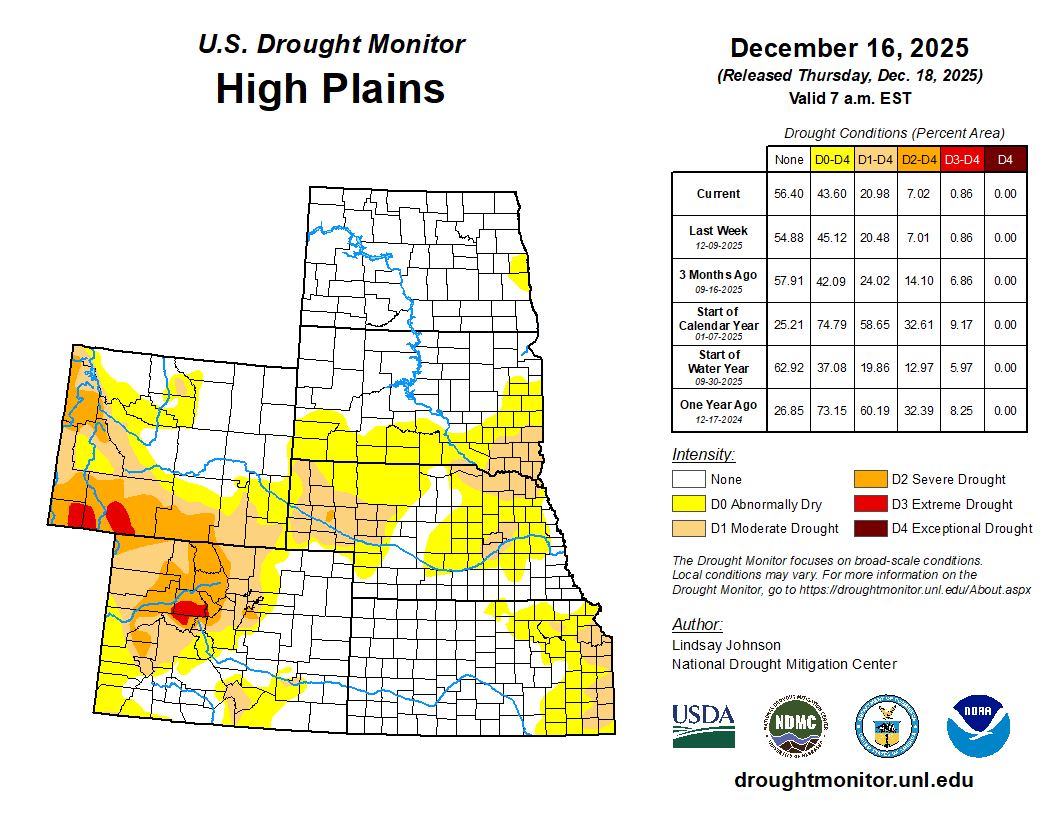
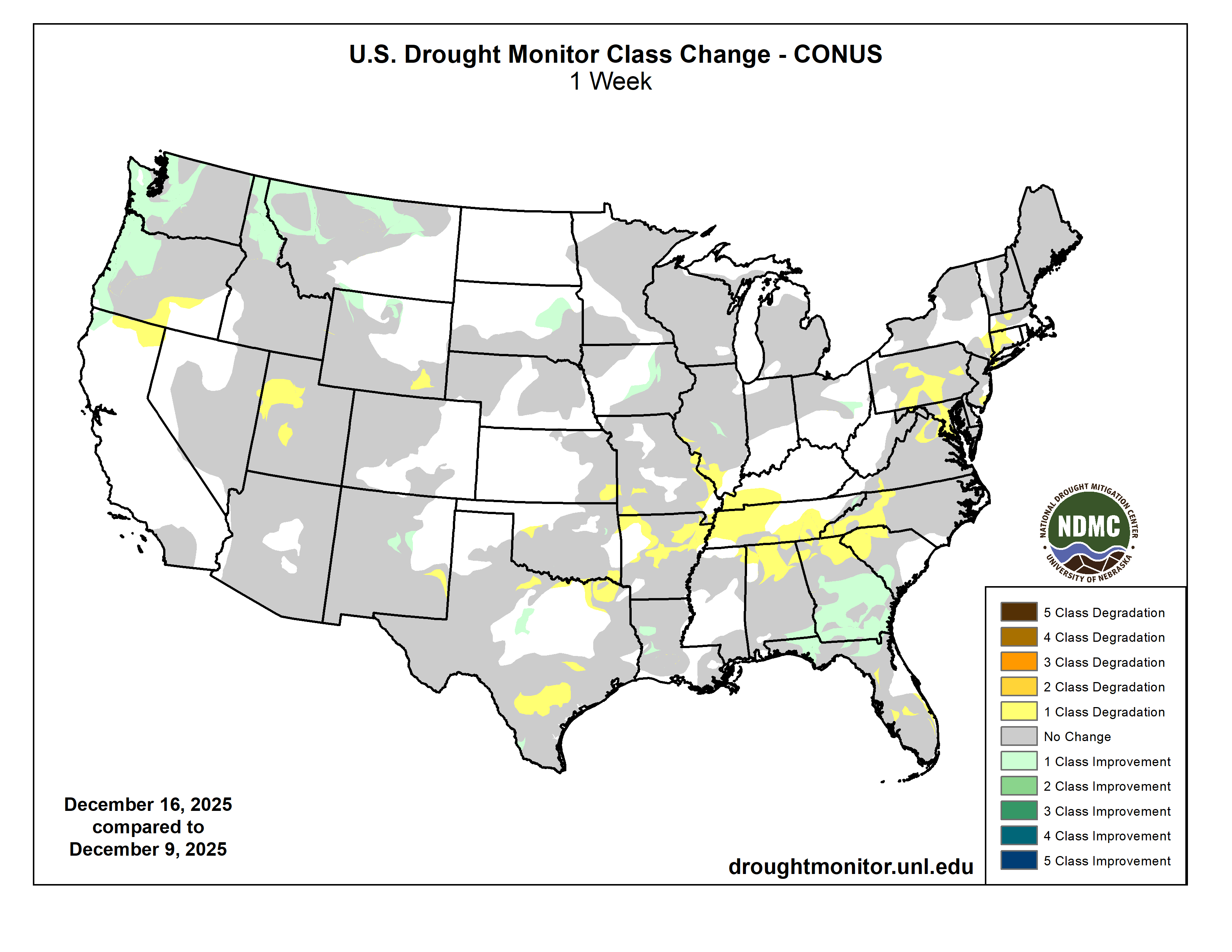
During the last 7-days, strong anomalous ridging over the Aleutians and troughing over the Gulf of Alaska promoted northerly flow across Alaska, leading to below-normal temperatures and little snowfall. Downstream, an unusually strong ridge dominated the flow across the contiguous United States. Between the northeastern Pacific trough and this ridge, strong onshore flow and atmospheric river activity promoted copious amounts of precipitation across the Pacific Northwest, though above-normal temperatures kept snow elevations higher than normal and limited the ability of this precipitation to substantially build early season snowpack across the Cascades, northern Sierras, and northern Rockies. Little to no precipitation was observed across the Southwest through the Plains under the anomalous ridge, and much above-normal temperatures promoted degradations of drought depictions for portions of the Rockies, Great Plains, and the lower to mid-Mississippi Valley. Across the East, an active northern stream saw the development of several storm systems which brought widespread precipitation across portions of the South, the Tennessee and Ohio Valleys, and the Northeast. Warming temperatures across the region caused much of this precipitation to fall as rain, melting much of the snowpack built during the previous week in the process. This precipitation led to some modest improvements to drought and abnormal dryness, though more widespread drought reductions were limited due to frozen soils and streams across New England, and groundwater conditions that are slower to respond to precipitation across the mid-Atlantic region. Dry conditions and above-normal temperatures led to degradations across much of Florida…
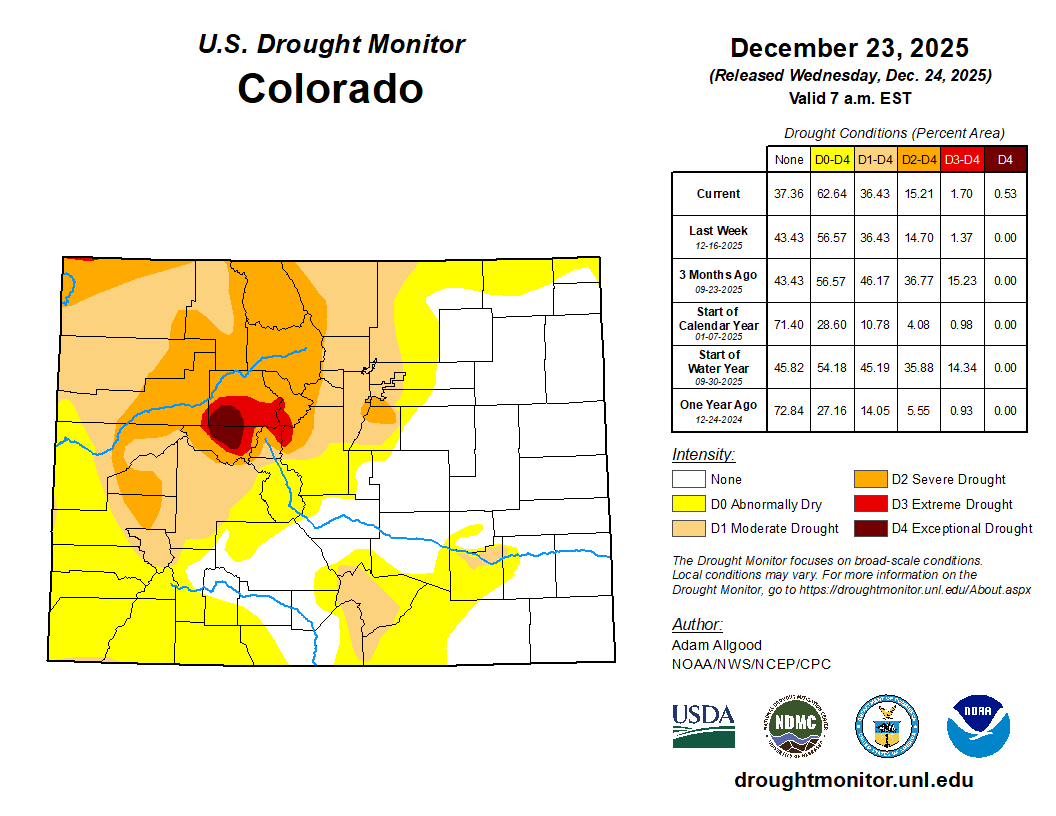
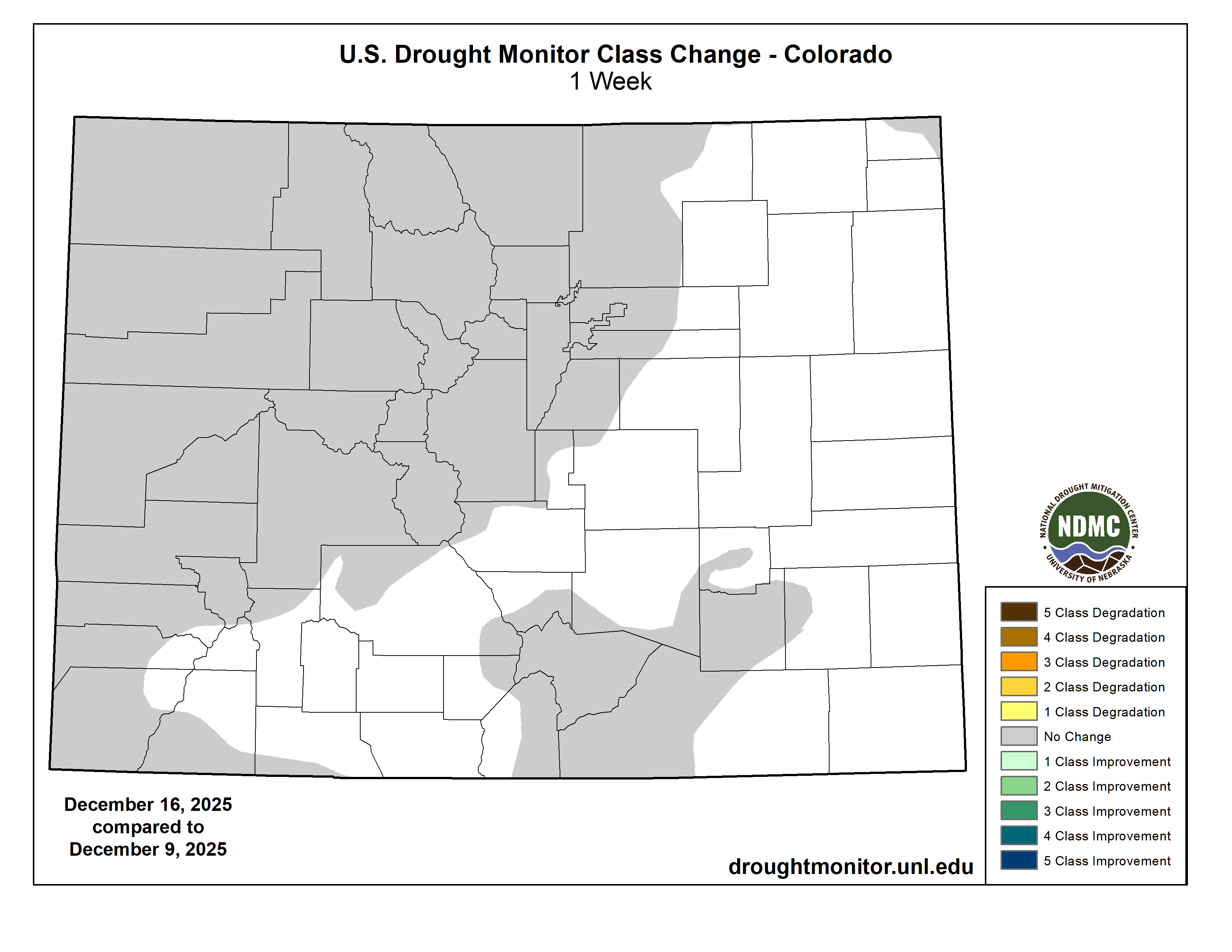
A lack of snow cover, much above-normal temperatures, and periods of strong winds led to an unusual amount of winter degradation across the High Plains region.D2 expanded across western Nebraska, with expansions of both D1 and D0 occurring across central and eastern parts of the state, where precipitation was generally less than 0.2 inch equivalent, and high temperatures soared as high as the 70s. A small area of D1 expanded across southeastern Kansas, and across Colorado, D4 was introduced to Eagle and Pitkin Counties. D0 expanded across the Plains of Wyoming, where warm temperatures, strong winds, and a record lack of snow cover promoted worsening impacts. Drought depictions remained unchanged across the Dakotas, where soils and streams have largely frozen for the winter…
Colorado Drought Monitor one week change map ending December 23, 2025.
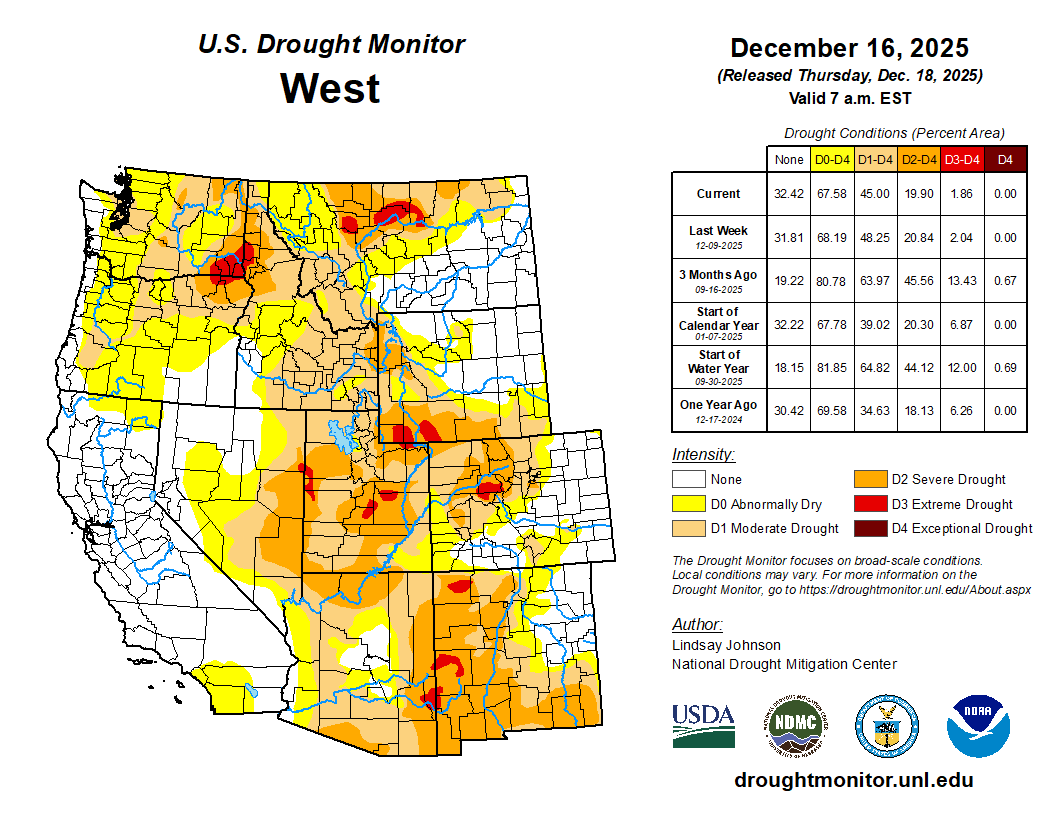
Across the West, a series of atmospheric river events brought copious amounts of precipitation to the Pacific Northwest, with Washington and the northern Rockies continuing to be pounded, and precipitation extending further south later in the period to blanket western Oregon and northern California, which had missed out on heavy precipitation during AR events earlier in the month. While the repeated bouts of heavy precipitation continue to ease lingering drought conditions west of the Cascades, the picture is a bit more mixed at higher elevations. Temperatures during the period ranged above-normal, keeping snow elevations higher than average, which prevented the much above-average precipitation from building up substantial snowpacks in the Cascades and northern Sierras. In fact, SWE values remain below 50-percent of average across the Cascades, northern Sierras, Blue Mountains, and the Bitterroot Range, though conditions have started to improve across the remainder of the Northern Rockies. While not an immediate drought concern during the winter months, a lack of snow cover could present problems during the Spring and Summer melting season, and additional precipitation along with colder temperatures are needed to recover the snowpack conditions during this wet season. Based on these considerations, D1 and D0 were reduced along the western front of the Cascades and across small portions of the Intermountain West, but drought conditions were maintained across the higher elevations. A small area of D0 reduction was made across northern Montana, where recent storminess brought improvements to 30- and 60-day SPI values…
Following another week of subnormal precipitation, and with temperatures ranging above-normal, the South saw further drought degradations. A small area of heavier precipitation fell across far South Texas, resulting in reductions of D1 and D0, but drought expanded or intensified across the southern Texas plains, Hill Country, and the Piney Woods. Drought also intensified along the Red River Valley, and degradations were more widespread across the eastern two thirds of Oklahoma and Arkansas. In Arkansas, local observers continue to report drying lakes and ponds, while in Oklahoma, record warmth, strong winds, and persistently below-normal precipitation promoted expansion of D2 and D3 conditions. Across Tennessee, precipitation was more generous, and a swath of 1 inch or more fell across the central portion of the state where D0 conditions are currently in place. Despite this rainfall, 60- to 90-day precipitation levels remain below-normal, and SPI values continue to indicate dry conditions. Therefore, no improvements were made across Tennessee…
Looking Ahead
During the next few days, atmospheric river activity will continue to bring copious moisture to the West, with the focus of heavy coastal rainfall and mountain snows shifting to California. Heavy precipitation is forecast to push inland to the Great Basin and portions of the Rockies. Later in the week, as the Pacific trough moves onshore and ridging builds over the northeastern Pacific, a break in AR activity is favored through the end of Week-1. Further east, persistent ridging is forecast for the central US, leading to mostly dry conditions and much above-normal temperatures for the Plains. Across the East, a blocking ridge retrograding towards Greenland from Europe will promote backdoor front activity and cold air damming, as well as providing a focus for additional precipitation and winter storm activity. The WPC 7-day QPF forecast shows precipitation amounts exceeding an inch across most of the Northeast Region, much of which may fall as snow or a wintery mix across the mid-Atlantic. Mostly dry conditions are favored for the Southeast during Week-1, with light rain possible across the lower Mississippi Valley. During Week-2, CPC forecast indicate enhanced chances for above-normal precipitation for the western third of the CONUS, with the highest probabilities across the Southwest. A slight tilt towards above-normal precipitation extends along the northern tier to the Great Lakes region, while below-average precipitation is favored for much of the eastern seaboard. Strong anomalous ridging favors above-normal temperatures for most of the CONUS, with blocking potentially leading to below-average temperatures across the Northeast. Above-normal precipitation is favored for Hawaii, while below-normal temperatures are favored for Alaska, with drier than normal conditions expected along the southern tier of the state.
Drought Monitor one week change map ending December 23, 2025.
The winter solstice teaches us that we must descend into the darkness before we can return to the light. This solstice season we find ourselves in especially dark times —figuratively speaking.
We can be fairly certain that the earth’s northern hemisphere will begin tilting back towards the light next week. Yet we can only hope that America will find similar relief from the metaphorical shroud of darkness under which it has fallen.
As I monitor the news each day, I find myself spiraling past frustration, disdain, and outrage and sinking into a mire of disbelief and despair. That our government is rife with corruption, short-sightedness, greed, and incompetence is outrageous, but neither new nor surprising. What is new is that those traits are now combined with blatant cruelty, wretchedness, moral vacuity, outright bigotry and racism, and a pathological dearth of empathy and compassion. It’s a toxic stew that emanates from the president, is lapped up by his sycophantic and unqualified cabinet — not to mention the tech broligarchs who debase themselves in hopes of holding onto a few more million of their billions of dollars at tax time, or ease the regulatory burden on their hyperscale AI-powering data centers.
Perhaps most distressing is that the safeguards that once protected the nation from the lunatics or incompetents in power — i.e. the courts, the rule of law, Congress — have themselves been broken down or infected with the same malady of wretchedness.
If you think I’m exaggerating, just consider the current situation: The U.S. military is blowing up Venezuelan boats — and then striking the wreckage again to kill any survivors — and is threatening to go to war with the country and send American soldiers into harm’s way, simply to distract the nation from Trump’s disastrous policies and his close association with known pedophile, sex-trafficker, and scam artist Jeffrey Epstein. And when Democratic members of Congress — and decorated veterans — tell soldiers they will support them if they refuse to break the law, Trump threatens to court-martial them.
That’s outrageous and despicable. That Congress and the courts and the American people aren’t rising up en masse in revolt is depressing. And that’s just one example of so, so many like it. Which explains the extra despair during this dark season.
I’m saying a little pagan prayer that the light will return next year.
But for now, I’m afraid I have some more darkness to report from the Land Desk beat:
Back in 2024, former Mesa County clerk and right-wing conspiracy theorist Tina Peters was convicted by a jury of breaching the security of her office’s own election system in 2021 in a futile attempt to prove election fraud. Trump pardoned her, but it didn’t count because it is a state, not federal, crime, and Gov. Jared Polis wasn’t going to play Trump’s game. That made Trump mad, so, in his usual fashion, he governed by spite and is now planning to dismantle the National Center for Atmospheric Research in Boulder.
This will not only hurt Colorado, but also science and all the people who are affected by climate and weather and the like, which is to say: everybody, this harms us all. Here’s a couple Blue Sky takes from prominent scientists:
The U.S. House of Representatives voted yesterday to pass Rep. Lauren Boebert-sponsored legislation that would remove Endangered Species Act protections for gray wolves in the lower 48 states. The bill now goes to the Senate. Congress delisted wolves in the Northern Rockies in 2011, turning management over the states; hunting wolves is no allowed in Montana, Wyoming, and Idaho. This bill could potentially do the same for wolves in California, Colorado, Oregon, Washington, New Mexico, Nevada, and most of Utah.
The Bureau of Land Management is going on a bit of a tear when it comes to auctioning off public land leases to oil and gas companies. Just a couple of examples of future sales (June 2026) you can weigh in on:
In Utah, the administration is planning on offering 39 parcels covering about 54,000 acres. A bulk of the parcels are located south of the town of Green River, east of the river itself, and adjacent to Tenmile Canyon.
And it’s looking to sell 174 oil and gas leases covering more than 160,000 acres in Colorado. They don’t have the maps up for these ones yet, but judging by the descriptions it seems they are scattered across much of the state (but not in southwestern Colorado).
⛈️ Wacky Weather Watch⚡️
Weather is wacky and probably always has been. But this month has got to be one of the weirdest, weather-wise, the West has seen in a while. It’s like the new abnormal on steroids, and it’s hard to deny that much of it has the oily fingerprints of human caused climate change smeared all over it.
This week, alone, the West has experienced:
A succession of atmospheric rivers pounded the Northwest, dropping more than 10 inches of rain in places over a few days and bringing several rivers up to record-high flows and causing widespread flooding. The Skagit River near Mt. Vernon, Washington, jumped from about 13,500 cubic feet per-second on Dec. 4 to 133,000 cfs a week and a day later. The Snohomish River saw even more dramatic increases in flow. The flooding and landslides severely damaged U.S. Hwy 2 through the Cascade Mountains, and it could be closed for months. And anywhere between 200,000 and 500,000 homes and businesses were left without power after the floods, rains, and severe winds toppled utility lines, reminding us once again that extreme weather is a far greater danger to the power grid than shuttering coal plants. Atmospheric rivers and big storms aren’t abnormal. But because warm air can hold more moisture, these ones may have been intensified by global heating.
The storms came on the heels of the warmest meteorological autumn on record in the Northwest (based on 130 years of record-keeping). The result: Huge dumps, even in the mountains, falls mostly as rain, not snow, meaning the snowpack remains relatively sparse across much of the region.
The soggy soil of the Northwest coincided with smoky skies in eastern Colorado.I had thought that I could close out my Watch Duty wildfire-monitoring tab for the season, but I had to bring it back up on Wednesday night as wicked winds combined with dry conditions and warm temperatures to whip up a trio of grass fires in Yuma County, Colorado, with another one flaring up along the Colorado-Wyoming line. All fires were contained, but they brought back memories of the 2021 Marshall Fire, which broke out in similar conditions at the end of December.
The fires followed a nine-day warm streak on the Front Range, when the mercury in Denver topped out at 60° F or above, including reaching a daily record high of 71° on Dec. 17. The rest of the state was also abnormally warm (after a seasonably chilly beginning to the month).
Expect the same to continue into the New Year. While Utah and western Colorado may get some precipitation, it’s likely to be either rain or sloppy snow — i.e. Schneeregen — due to unseasonably high predicted temperatures.
Most ski areas in the Interior West are open now, but that doesn’t mean the conditions are good. To the contrary, they’re generally lousy almost everywhere, with snowpack levels hovering around 50% of “normal” everywhere from Utah’s Wasatch Range to Vail to Wolf Creek in southwestern Colorado. In most of those places the story of the season is the same: It started off with heavy rainfall, followed by a succession of decent snow storms that offered false hope, only to be dashed by a run of warm snow-melting temperatures. So far the story’s even more extreme in the Sierra Nevada, where the mountains are utterly devoid of snow, despite massive, flood-inducing rains this fall. The following graphics from the Wolf Creek Pass SNOTEL station tell the story of most of the region:
The water year started with a deluge and flooding on the San Juan River through Pagosa. While precipitation leveled off after that, accumulations remain above normal and significantly higher than on this date last year.
The problem: All of that water fell as, well, water, not snow, thanks mostly to high temperatures. Note how average daily temperatures have been above the median, sometimes way above it, all water year so far.
The result: way below “normal” snowpack levels. They are also significantly lower than at this time last year, and last year sucked, to put it bluntly. While all of the rain eased drought conditions and restored some moisture to the soil, the lack of snow does not bode well for spring runoff — or the reservoirs and water users that depend on it.
🤖 Data Center Watch 👾
The backlash to the Big Data Center Buildup is gaining steam, and the resistance to the energy- and water-guzzling server farms is scoring a few victories and suffering defeats.
Earlier this month, Chandler, Arizona’s city council voted to reject Active Infrastructure’s proposed rezoning request that would have cleared the way for the developer to raze an existing building and replace it with an AI data center complex. The denial followed widespread opposition from residents, and in spite of lobbying by former Sen. Kyrsten Sinema in favor of the facility and the developer’s pledge to use closed-loop cooling, which consumes less water (but more energy) than conventional cooling systems.
Opposition to a proposed data center in Page, Arizona, was dealt a blow when a referendum to block a land sale for the facility was rejected because the petition didn’t meet legal requirements. Beth Henshaw has more on the Page proposal over at the Corner Post, a cool nonprofit covering the Colorado Plateau.
Pima County, Arizona’s supervisors approved an agreement with Beale Infrastructure advancing its proposed Project Blue data center. The developer is pledging to match 100% of its energy consumption with renewable sources and to use a less water-intensive closed-loop cooling system. Opposition to the facility has been fierce.
🌞 Good News! 😎
These days we hear a lot about how utility-scale wind and solar developments harm the flora and fauna of the desert. But one solar installation near Phoenix is providing sanctuary for wildlife, as reported by Carrie Klein in Audubon recently. Wild at Heart, a raptor rehabilitation center, rescued a bunch of burrowing owls from a housing development construction site. But instead of returning them to the wild (which is becoming more and more scarce in Arizona), they set them up in plastic tunnels they built amid a 10,000-acre solar installation. The owls are not only surviving, but are thriving and successfully reproducing. Finally, a bit of light!
📸 Parting Shot 🎞️
Moon and tree, Bryce Canyon National Park. Jonathan P. Thompson photo.
Glen Canyon Dam from the visitor center December 19, 2025.
Update: I found a more complete rendering of Seldom Seen’s Prayer in the Coyote Gulch archives. Scroll to the bottom.
I’m on the road back to Denver. I decided to take a southerly route east from St. George through southern Utah and Northern Arizona to travel through country I had not seen before. A short drive from Kanab on Friday put me at Glen Canyon Dam. Although I am not religious I wanted to stop there and recite Seldom Seen’s Prayer from Edward Abbey’s “Monkey Wrench Gang” which I first read while walking down the Escalante River. My sisters and brothers that walk the tribs off Glen Canyon understand.
“Dear old God, you know and I know what it was like here, before them bastards from Washington moved in and ruined it all. You remember the river, how fat and golden it was in June, when the big runoff come down from the Rockies?… Listen, are you listenin’ to me? There’s somethin’ you can do for me, God. How about a little old pre-cision-type earthquake right under this dam? Okay? Any time. Right now for instance would suit me fine.” -Seldom Seen Smith (H/T Fisher Brewing Company)
My rented Model Y at Glen Canyon Dam December 19, 2025.
What a joy it is to drive the Model Y with self-driving. Self-driving was particularly useful in Las Vegas with all the traffic and unfamiliar (to me) roads. The integration of the Navigation system and the Tesla Charging Network takes quite a load off cross-country road trips. For the leg between St. George and Pagosa Springs I charged at St. George, Page, Kayenta, and Durango.
Glen Canyon downstream of the dam December 19, 2025.
I found a more complete rendering of Seldom Seen’s prayer in the Coyote Gulch archives.
Seldom Seen’s prayer at about Glen Canyon Dam from The Monkey Wrench Gang — Edward Abbey
Anne Castle, Jeff Kightlinger, Jim Lochhead at the 2025 CRWUA Conference. Photo credit: Water Mark (@OtayMark)
Click the link to read the article on the Aspen Daily News website (Austin Corona). Here’s an excerpt:
December 17, 2025
Federal officials have released a “sobering” forecast of 2026 water levels in the Colorado River, with expected flows plummeting from previous predictions. Precipitation later in the winter could turn those dire forecasts around, officials say, but the current outlook is grim for a river already flirting with crisis. Officials published the new forecast on Monday, only a day before negotiators and stakeholders from the river’s basin states gathered in Las Vegas for a three-day conference. The federal government has given states until February to agree on a longer-term strategy for managing low river flows. The Colorado River’s flow in 2026 (specifically, the unregulated inflow to Lake Powell) could be 27% lower than normal, according to the most probable scenario in the December forecast, with worst-case scenarios predicting even lower flows. The projection has worsened estimates released in November (16% lower than normal in most probable scenarios).
“We all know Mother Nature is a trickster and can often confound our expectations. We certainly hope she intends to do that this year,” said Wayne Pullan, the Bureau of Reclamation’s regional director for the Upper Colorado River Basin, on Tuesday. “But December’s outlook is troubling.”
The bureau, which manages federal dams, will delay water releases at Lake Powell to conserve supplies in the reservoir during the dry winter months in 2026, Pullan said. Even with those efforts, however, the lake’s water levels could fall to critical levels in 2027 as another disappointing year hits the basin. A bad water year in 2026 would compound already poor conditions from 2025, when river flows have been less than half of normal. The new forecast increases the possibility that water levels in Lake Powell could drop below the intakes for hydropower turbines and that releases from the lake could fall below the annual average required to meet the requirements of the 1922 Colorado River Compact, which governs water allocation between the seven states that use the river. Without above-average flows in future years to bring averages back up, or an interstate deal on how to manage drought, those low releases could set the stage for a legal battle on the river.
The back of Glen Canyon Dam circa 1964, not long after the reservoir had begun filling up. Here the water level is above dead pool, meaning water can be released via the river outlets, but it is below minimum power pool, so water cannot yet enter the penstocks to generate electricity. Bureau of Reclamation photo. Annotations: Jonathan P. Thompson
Colorado Senate Bill 24-005 (SB5) seeks to reduce unnecessary outdoor water use by limiting high-water landscaping in commercial areas to conserve water amid mounting drought concerns. Beginning Jan. 1, 2026, the legislation will restrict non-functional turf (irrigated grass areas used for decoration), artificial turf and invasive plant species in non-residential settings.
Implementing SB5
SB5 requires changes to land-use code to specify these restrictions for the following applications:
Commercial, institutional and industrial properties
Homeowner association common-interest community areas
Public spaces such as street right-of-way, medians, parking lots and transportation corridors
Restrictions and Applications
Due to the value and appropriateness of higher water use and activity they support, SB5 does not apply to areas considered functional or recreational, including turf for athletic fields, parks and golf courses.
The bill does not impact existing development; it applies only to new developments and certain redevelopment projects that require building or landscaping permits and disturb at least 50 percent of a site’s landscape. It excludes single-family residential properties, focusing instead on public and commercial areas where landscaping serves primarily for aesthetic purposes.
New Landscape Rules Matter for Colorado’s Future
Landscapes play a vital role to communities, but historical turf-heavy designs consume significant resources to meet social expectations. Today, more sustainable solutions exist that use less water while still delivering functionality. Allocating water budgets to landscape formats that provide the highest social value for the water invested is a sensible application to managing this scarce resource.
Areas that are primarily ornamental can be designed to use less water than traditional turf grass while still providing important non-recreational functionality. For spaces that require turf-like groundcover, multiple alternatives exist that use less water than cool season Kentucky Bluegrass, including Tahoma31 warm season grass, Dog Tuff grass and a variety of native grass combinations that thrive in this climate with minimal supplemental needs. These alternatives support stormwater management, provide cooling and pollution mitigation, while also delivering enhanced benefits of habitat for Colorado’s native flora and fauna. Non-turf areas such as gardens and groves have plentiful options for perennials, groundcovers, shrubs and trees that use less water than turf while providing essential livability features to our region.
Northern Water’s Role
To support SB5 implementation, Northern Water has been providing training to regional municipalities, including the Growing Water Smart program from the Sonoran Institute. These workshops introduce new sustainable landscape options that meet municipal needs while also providing flexibility for cities to determine a unique sense of place for their regions. Northern Water and its partners also provide tools such as landscape designs and demonstrations at our Berthoud Conservation Campus so city planners and consultants can experience ColoradoScapes and understand their resource uses as they update land use codes. Many cities are excited to modernize the message their landscapes convey and have begun showcasing these features on their own properties.
Lower Water, Higher Value Landscapes
SB5 ensures that water resources are dedicated to areas with the highest essential and recreational use, while maintaining high quality, aesthetically pleasing commercial, industrial and transportation areas that require less water. These changes will create communities that show our region’s natural beauty and restore ecosystem services to our pollinators, birds and other animals, while offering an authentic Colorado experience. Learn more about all of our water efficiency services that support this water-wise future.
Happy #DecemberSolstice! 🌞Understanding seasons – a look at the hourly incoming solar radiation during the two solstices (23.5°N/S). I've added a red marker for ease of viewing. Dashed line shows the equatorThis graphic can be found at zacklabe.com/arctic-clima…
North Weld County Water District Service Area. Graphic via NWCWD.
Here’s the release from the North Weld county Water District:
December 10, 2025
North Weld County Water District implements modest 4% rate increase for 2026 – still among lowest in region
WELD COUNTY, COLORADO (Dec. 10, 2026) –North Weld County Water District (NWCWD) announced a comparatively modest 4 percent rate increase for 2026 – which is less than the previous year and significantly lower than the surrounding region.
“Maintaining our water service infrastructure continues to be a priority for the district and one that we balance with our fiduciary responsibility to our rate payers,” said Eric Reckentine, General Manager, North Weld County Water District.
A diligent infrastructure improvement plan is highlighted in these key District projects designed to ensure a clean, robust, and affordable water supply:
Weld County West Transmission Line: The District will start construction of the Weld County west 42-inch transmission line and new 6 million gallon treated water tank in 2026 with a project cost of $20 million dollars.
Eastern Zone Distribution Line: The District will continue construction of the eastern zone 30-inch distribution line with the project’s third phase starting in 2026 and to be completed in 2027.
Soldier Canyon Water Treatment Plant Expansion: The SCWTP treatment plant capacity was expanded from 60 million gallons per day to 68 million gallons in 2025. In collaboration with the Soldier Canyon Water Treatment Authority and nearby District partners (such as Fort Collins-Loveland Water District and East Larimer County Water District), NWCWD is finalizing the Soldier Canyon Filter Plant Master Plan, and will begin design on a plant expansion for additional treatment capacity for the District to begin in 2029.
With these improvements, the district says it can meet growth needs well into the future.
“Upgrades to our aging water delivery system allow the District to meet new treatment standards and accommodate the record-breaking growth in Northern Colorado,” Reckentine said. “A stable revenue stream from water rates enables us to accomplish that.”
About North Weld County Water District:
Weld County is the fastest growing in the state. North Weld County Water District’s cities, residents, and businesses rely on the safe, reliable, and affordable water we have been delivering for over 64 years. The District constantly plans for growing communities, which now span from agricultural to rural to urban, ensuring that all future water needs are met and we can continue to deliver the highest quality water in the growing region for decades to come. To learn more, visit NWCWD.org.
The South Platte River originates in South Park and then wanders northeast, entering Nebraska just a few miles west of Colorado’s northeast corner. The red line here distinguishes the upper South Platte Basin in Colorado from the lower basin. Image: U.S. Geologic Survey.
Colorado River states have been given less than two months to agree on how to share water cuts from the shrinking river.
Homeland Security waives environmental laws to speed the construction of a border wall in parts of New Mexico.
A federal judge proclaims federal authority over the contentious Line 5 oil pipeline that crosses the Great Lakes.
U.S., Mexican governments sign Tijuana River sewage cleanup agreement.
The House passes a bill to change environmental reviews for infrastructure permitting.
USGS study finds lower water levels in Colorado’s Blue Mesa reservoir the cause of increased toxic algal blooms.
And lastly, a draft EIS for post-2026 Colorado River reservoir operations, when current rules expire, will be published in the coming weeks.
“Let me be clear, cooperation is better than litigation. Litigation consumes time, resources, and relationships. It also increases uncertainty and delays progress. The only certainty around litigation in the Colorado River basin is a bunch of water lawyers are going to be able to put their children and grandchildren through graduate school. There are much better ways to spend several hundred million dollars.” – Scott Cameron, acting commissioner of the Bureau of Reclamation, speaking at the Colorado River Water Users Association conference on December 17, 2025. Cameron encouraged the states to reach an agreement on water cuts and reservoir operating rules instead of suing each other.
By the Numbers
February 14: New Interior Department deadline for the seven Colorado River states to reach an agreement on water cuts and reservoir operations. If the states fail at that, Interior could assert its own authority. There could also be lawsuits. A short-term agreement might be necessary.
The deadline, according to Interior’s Andrea Travnicek, is for several reasons. It gives states time to pass legislation, if necessary. It provides time for consultation with Mexico and the basin’s tribes. And it allows for reservoir operating decisions in 2027 to be set this fall.
“Time is of the essence, and it is time to be able to adjust those stakes, to arrange so compromises can be made,” Travnicek said.
News Briefs
Line 5 Oil Pipeline Court Case A U.S. district judge ruled that the federal government, not the state of Michigan, has authority over the contentious Line 5 oil pipeline that crosses the Great Lakes at the Straits of Mackinac.
Michigan’s top officials have attempted to shut down Enbridge Energy’s Line 5 since 2020 when Gov. Gretchen Witmer revoked the company’s easement.
In his ruling, Judge Robert Jonker determined that the federal Pipeline Safety Act gives the U.S. government the sole authority over Line 5’s continued operation, the Associated Press reports.
Tijuana River Sewage Pollution Cleanup U.S. and Mexican representatives signed an agreement that will facilitate the cleanup of chronic sewage pollution in the Tijuana River, a shared waterway.
Line 5 Oil Pipeline Court Case A U.S. district judge ruled that the federal government, not the state of Michigan, has authority over the contentious Line 5 oil pipeline that crosses the Great Lakes at the Straits of Mackinac.
Michigan’s top officials have attempted to shut down Enbridge Energy’s Line 5 since 2020 when Gov. Gretchen Witmer revoked the company’s easement.
In his ruling, Judge Robert Jonker determined that the federal Pipeline Safety Act gives the U.S. government the sole authority over Line 5’s continued operation, the Associated Press reports.
Tijuana River Sewage Pollution Cleanup U.S. and Mexican representatives signed an agreement that will facilitate the cleanup of chronic sewage pollution in the Tijuana River, a shared waterway.
Called Minute 333, the agreement outlines actions and sets timelines. A joint work group will assess project engineering and feasibility studies. Mexico will build a wastewater treatment plant by December 2028 and a sediment control basin by winter 2026-27. The agreement also addresses monitoring, planning, and data sharing.
Permitting and Land Use Bills House Republicans used the week before the holiday break to pass a bill that changes infrastructure permitting processes.
The SPEED Act, which passed with support from 11 Democrats, changes the National Environmental Policy Act and the environmental reviews it requires for major federal projects. It restricts reviews to immediate project impacts, sets timelines, and limits lawsuits.
“On net, these reforms are likely to make it easier to build energy infrastructure in the United States,” asserts the Bipartisan Policy Center.
Border Wall Kristi Noem, the secretary of the Department of Homeland Security, is waiving environmental laws in order to speed the construction of a border wall in parts of New Mexico near El Paso, Texas.
The affected laws include the Clean Water Act, National Environmental Policy Act, Safe Drinking Water Act, Migratory Bird Conservation Act, and others.
Studies and Reports
Mississippi River Recap The U.S. Army Corps of Engineers published a December state of the Mississippi River report, noting how drought conditions this year have influenced operations on the country’s largest river system.
The Corps authorized construction of an underwater dam that was completed in October in order to impede the upstream movement of salty water from the Gulf of Mexico.
Harmful Algal Blooms in Colorado Reservoir Blue Mesa is the largest reservoir in Colorado and is part of the Colorado River basin water storage system.
The U.S. Geological Survey investigated why Blue Mesa has been experiencing toxic algal blooms in recent years. Its report concluded that warmer water temperatures enabled by lower water levels are the likely cause.
The affected laws include the Clean Water Act, National Environmental Policy Act, Safe Drinking Water Act, Migratory Bird Conservation Act, and others.
Studies and Reports
Mississippi River Recap The U.S. Army Corps of Engineers published a December state of the Mississippi River report, noting how drought conditions this year have influenced operations on the country’s largest river system.
The Corps authorized construction of an underwater dam that was completed in October in order to impede the upstream movement of salty water from the Gulf of Mexico.
Harmful Algal Blooms in Colorado Reservoir Blue Mesa is the largest reservoir in Colorado and is part of the Colorado River basin water storage system.
The U.S. Geological Survey investigated why Blue Mesa has been experiencing toxic algal blooms in recent years. Its report concluded that warmer water temperatures enabled by lower water levels are the likely cause.
Reducing nutrient inflows is unlikely to help, the researchers said. There are naturally occurring phosphorus inputs and the algae can fix nitrogen from the air.
The best solution might be keeping the reservoir high enough, the report says. That will not be easy in a drying and warming region with competing water demands.
On the Radar
Colorado River Draft EIS Coming Soon In the coming weeks – in early January if not by the end of the year – the Bureau of Reclamation will publish a draft environmental impact statement for changes to how the big Colorado River reservoirs will be managed.
Reclamation began its environmental review about two and a half years ago. The agency had hoped to slot a seven-state consensus agreement into the document. But since there is no agreement, the document will instead describe a “broad range” of options, said Carly Jerla of Reclamation, who spoke at the Colorado River Water Users Association conference.
The draft will not select a preferred option, Jerla said. Instead that will come in the final version.
“We’ve set up a draft EIS that reflects a range of carefully crafted alternatives to enable the further innovation and the ability of the basin to come to a consensus agreement to be able to adopt in time for the 2027 operations,” Jerla said.
Federal Water Tap is a weekly digest spotting trends in U.S. government water policy. To get more water news, follow Circle of Blue on Twitter and sign up for our newsletter.
The Colorado River Basin spans seven U.S. states and part of Mexico. Lake Powell, upstream from the Grand Canyon, and Lake Mead, near Las Vegas, are the two principal reservoirs in the Colorado River water-supply system. (Bureau of Reclamation)
Last night, I woke up to percussion on the roof. In late November at 7,000 feet in the Rockies, you’d normally look for snow. But yet another predicted storm had petered out and come in as rain instead.
This storm was going to be big, the local weatherman promised, with some places getting up to 6 feet. But then he downgraded the forecast — and downgraded it again. By the time the system moved off to the east, no more than a few inches had fallen in a couple of high places. We’d seen no significant snow, and we were getting closer to the solstice.
Anticipation is a fickle feeling, a jittery mix of adrenaline and hope. Early winter used to make me excited, no matter where I lived in the West. I’d track storms coming in from the Pacific, waiting for Colorado’s high alpine ski resorts to battle to be the first to open or watching the snowline creep lower in the Pacific Northwest.
But lately that anticipation has been subsumed by dread. Now, the forecast hits me with the wrong kind of adrenaline. I get a cramp in my stomach when storms don’t come. Skiing has made me a barometer for winter, and the recent seasons have gone awry as they become increasingly warm and dry. In the past, I was purely excited about winter storms because I envisioned storm-day skiing and soft turns. Now I worry what the lack of snow means for the future.
As a skier, my happiness is tied to weather systems beyond my control. It might be a sick fascination to keep fixating on snowfall, but it keeps my barometer tuned and makes me look for the bigger patterns.
Skiers can be obsessive, ritualistic and superstitious, prone to worrying about upsetting the cosmic order. We joke about praying for snow, even though we know that’s not how nature works. But I still go to pre-season ski-burning bonfires and wash my car in hopes of encouraging snowstorms. What is that but praying?
There are two reasons to wish for snow: the selfish and the sustainable.
I want snowy winters partly so I can ski — so I can enjoy something I’ve done every winter since I was a tiny kid, the thing that makes me feel weightless and fast and connects me to the world around me. But when I compulsively check SNOTEL sites or ski area base depths, I’m also seeing something bigger and watching the patterns evolve.
Skiing might seem superficial, but winter clearly shows that the climate is changing. It’s made tangible through movement, or the lack of it. The things we love show us where our pain points are, and how much we stand to lose, and how little control we have.
My local ski hill pushed back its opening date this year, as did every mountain in Utah — Deer Valley for the first time in its history. Not only was there scant natural snow, it wasn’t even cold enough to make snow. That lack of snow has cascading impacts, especially on workers and communities that depend on winter tourism. But we don’t just profit from snow; it’s also our most solid water supply.
Westwide SNOTEL basin-filled map December 21, 2025.
Nearly every part of the Western U.S. is in drought conditions today. As of December, the National Water and Climate Center’s map of snow-water equivalentis colored red, and most places are less than 50% of average. Snow is our most significant water supply.
Across the West, this slow winter comes after a hot dry summer, when fires crept ever closer to town. Last winter was also dry and skimpy, exacerbating the long-term drought. Ski mountains are haggling over water rights for snowmaking. Lack of snow means increased fire risk and food insecurity, along with entrenched and at times bitter fights over rivers.
We live in a system, and skiing is a specific marker for how that system is changing.
A friend who is a ski guide stopped by the other day, and when I asked him if he was getting anxious about work, he looked north up the valley toward the mountains and grimaced. “I’m not quite worried yet,” he said. Maybe that’s rational, but my worry has already kicked in.
Figure 1. Graph showing active storage in Colorado River basin reservoirs between January 1, 2021, and November 30, 2025. Credit: Jack Schmidt/Center for Colorado River Studies
I look at the shrinking reservoirs and the spreading drought predictions. I remember last winter’s scratchy, icy ski turns and the summer’s lack of monsoons, with fire lurking in the background. I know what it’s like to wait for snow without it ever coming.
I also know that it’s still early in the season. Things could change, storms could stack up and keep coming, even though the National Weather Service is predicting a weak and wavering La Niña. There’s a lot of flexibility in the system. I can look at the sky and still feel some hope. I can’t predict what will happen, I just know what the past has shown me.
So, yes, I am still praying for snow, but for many more reasons and with even more fervor than I did before.
Colorado Snowpack basin-filled map December 21, 2025.
Click the link to explore the interactive graphs on the NRCS website.
The seven states that rely on the Colorado River to supply farms and cities across the U.S. West appear no closer to reaching a consensus on a long-term plan for sharing the dwindling resource. The river’s future was the center of discussions this week at the annual Colorado River Water Users Association conference in Las Vegas, where water leaders from California, Nevada, Arizona, Colorado, New Mexico, Utah and Wyoming gathered alongside federal and tribal officials. It comes after the states blew past a November deadline for a new plan to deal with drought and water shortages after 2026, when current guidelines expire. The U.S. Bureau of Reclamation has set a new deadline of Feb. 14. Nevada’s lead negotiator said it is unlikely the states will reach agreement that quickly.
“As we sit here mid-December with a looming February deadline, I don’t see any clear path to a long-term deal, but I do see a path to the possibility of a shorter-term deal to keep us out of court,” John Entsminger of the Southern Nevada Water Authority told The Associated Press.
The Colorado River Basin spans seven U.S. states and part of Mexico. Lake Powell, upstream from the Grand Canyon, and Lake Mead, near Las Vegas, are the two principal reservoirs in the Colorado River water-supply system. (Bureau of Reclamation)
The federal government continues to refrain from coming up with its own solution — preferring the seven basin states reach consensus themselves. If they don’t, a federally imposed plan could leave parties unhappy and result in costly, lengthy litigation. Not only is this water fight between the upper and lower basins, individual municipalities, tribal nations and water agencies have their own stakes in this battle. California, which has the largest share of Colorado River water, has over 200 water agencies alone, each with their own customers.
“It’s a rabbit hole you can dive down in, and it is incredibly complex,” said Noah Garrison, a water researcher at the University of California, Los Angeles.
Lower Basin states pitched a reduction of 1.5 million acre-feet per year to cover a structural deficit that occurs when water evaporates or is absorbed into the ground as it flows downstream. An acre-foot is enough water to supply two to three households a year. But they want to see a similar contribution from the Upper Basin. The Upper Basin states, however, don’t think they should have to make additional cuts because they already don’t use their full share of the water and are legally obligated to send a certain amount of water downstream.
“Our water users feel that pain,” said Estevan López, New Mexico’s representative for the Upper Colorado River Commission.
Udall/Overpeck 4-panel Figure Colorado River temperature/precipitation/natural flows with trend. Lake Mead and Lake Powell storage. Updated through Water Year 2025. Note the tiny points on the annual data so that you can flyspeck the individual years. Credit: Brad Udall
Lake Powell is seen from the air in October 2022. The December 24-month study from the U.S. Bureau of Reclamation projects Powell could drop below the threshold needed to make hydropower in 2026. CREDIT: ALEXANDER HEILNER/THE WATER DESK
Federal water officials addressed the increasingly grim river conditions and laid out their options for dealing with plummeting reservoir levels over the first two days of the largest annual gathering of water managers in the Colorado River Basin.
On Monday, the U.S. Bureau of Reclamation released its monthly report, which projects a two-year hydrology outlook for the operation of the nation’s two largest reservoirs: Lake Powell and Lake Mead. The report provided a sobering backdrop to the Colorado River Water Users Association conference at Caesar’s Palace in Las Vegas.
Westwide SNOTEL basin-filled map December 18, 2025. via the NRCS.
With the slow start to winter in the Upper Basin (Colorado, New Mexico, Utah and Wyoming), the report showed a drop in Lake Powell’s projected 2026 inflow of 1 million acre-feet since the November forecast. Under the “minimum” possible inflow, Lake Powell would fall below the surface-elevation level of 3,490 feet needed to generate hydropower by October 2026 and stay there until spring runoff briefly bumps up reservoir levels in summer 2027; but the water level would again dip below 3,490 in the fall of 2027.
Under the “most probable” forecast, the reservoir’s level stays above minimum power pool, but falls below the target elevation of 3,525 until the 2027 runoff. (Reservoir levels below the target elevation trigger more drastic emergency actions.) The reservoir is currently about 28% full, down from 37% at this time last year.
Wayne Pullan, regional director for the bureau’s Upper Basin, called the December projections troubling.
“That outlook is sobering for all of us,” Pullan said at Tuesday’s meeting of the Upper Colorado River Commission.
Snowpack, which is lagging across the Upper Basin, hovered at around 61% of median Wednesday. Snowpack in the headwaters of the Colorado River was 53% of median.
The Colorado River basin has been locked in the grip of a megadrought since the turn of the century. Climate change and relentless demand have fueled shortages, pushed reservoirs to all-time lows and sent water managers scrambling.
Pullan laid out four tools that the Bureau of Reclamation can use to respond to the projected low water levels to prevent the surface of Lake Powell at the Glen Canyon Dam from falling below 3,500 feet in elevation.
This 2023 diagram shows the tubes through which Lake Powell’s fish can pass through to the section of the Colorado River that flows through the Grand Canyon. Credit: USGS and Reclamation 2023
The first tool is shifting some winter releases to the summer months when runoff into the reservoir will compensate for those releases. The second is releasing water from upstream reservoirs to boost Lake Powell. The third is reducing releases when water levels hit a certain trigger elevation.
Representatives from the Upper Basin and Lower Basin (Arizona, California and Nevada), which share the river, have been in talks for two years — with long periods of being deadlocked in disagreement — about how to manage the river after the current guidelines expire at the end of 2026. The 2007 guidelines set annual Lake Powell and Lake Mead releases based on reservoir levels and did not go far enough to prevent them from being drawn down during consecutive dry years.
“We have learned that if we failed at all in these last 25 years, it might have been that our vision wasn’t sufficiently pessimistic,” Pullan said.
States’ representatives have said they are still committed to finding a consensus after they blew past a Nov. 11 deadline to come up with an outline of a plan. Federal officials have set a second deadline of Feb. 14 for the states to submit a detailed plan.
While water managers across the basin wait for an agreement from the states, federal officials are moving ahead with the National Environmental Protection Act review process and crafting an environmental impact statement for future reservoir operations. Reclamation officials said that they plan to release a draft EIS around the end of the year and that the alternatives analyzed in the EIS will be broad enough that they would capture any seven-state agreement. The draft EIS will not choose a preferred alternative.
“Probably all of you have heard us say, ad nauseum, this emphasis on creating a broad range of alternatives,” Carly Jerla, a senior water resource program manager at the Bureau of Reclamation, said Wednesday. “We really went about this by taking input over the last almost two years from you all … to craft a broad range that really reflects the ideas on how to operate the system.”
Wayne Pullan, Reclamation’s Upper Colorado Basin Regional Director, speaks at the meeting of the Upper Colorado River Commission at the Colorado River Water Users Association Conference on Tuesday in Las Vegas. CREDIT: HEATHER SACKETT/ASPEN JOURNALISM
Not a routine water source
This isn’t the first time the basin has experienced dire straits. In 2021, as Lake Powell flirted with falling below minimum power pool, the Bureau of Reclamation made 181,000 acre-feet in emergency releases from three Upper Basin reservoirs — Flaming Gorge, Navajo and Blue Mesa — to protect critical Lake Powell elevations.
These reservoirs are part of the Colorado River Storage Project, and their primary purpose is to control the flows of the Colorado River. But the unilateral action by the feds rubbed Upper Basin water managers the wrong way. The 36,000 acre-feet released from Blue Mesa cut short the boating season on Colorado’s largest reservoir, which is on the Gunnison River.
On Tuesday, Colorado’s representative, Becky Mitchell, said Upper Basin reservoirs are not a routine water source for the Lower Basin.
“I appreciate as we’re in critical and dire situations how we use our resources to protect our infrastructure, but we have to shift,” Mitchell said. “Our biggest resource is post-2026 and figuring out how do we do this in a way that doesn’t create those to be routine water sources.”
Udall/Overpeck 4-panel Figure Colorado River temperature/precipitation/natural flows with trend. Lake Mead and Lake Powell storage. Updated through Water Year 2025. Note the tiny points on the annual data so that you can flyspeck the individual years. Credit: Brad Udall
So far, the basin has avoided the worst outcomes by getting last-minute reprieves in the form of wet years in 2019 and 2023. But overall, Jerla said, the Colorado River can expect to see persistent dry years and challenging conditions in the future, and water managers will need more adaptive, flexible solutions.
“(This is) really our last year together operating under the existing agreements, kind of stretching the flexibilities and the bounds and stability which those agreements provide,” she said.
The Colorado River Basin spans seven U.S. states and part of Mexico. Lake Powell, upstream from the Grand Canyon, and Lake Mead, near Las Vegas, are the two principal reservoirs in the Colorado River water-supply system. (Bureau of Reclamation)
The Colorado River fills Glen Canyon, forming Lake Powell, the nation’s second-largest reservoir. The reservoir could drop to a new record low in 2026 if conditions remain dry in the Southwestern watershed. (Alexander Heilner/The Water Desk with aerial support from LightHawk)
Click the link to read the article on the Inside Climate News website (Wyatt Myskow, Blanca Begert, Jake Bolster):
December 19, 2025
At the Colorado River Water Users Association annual conference in Las Vegas, Colorado River Basin states remain at an impasse over how to cut their water use as Lake Mead and Lake Powell verge on record lows.
The Colorado River Basin is, quite literally, 50 feet away from collapse, and an agreement to save it is nowhere in sight.
Water titans clashed at Caesars Palace in Las Vegas this week, where negotiators from each of the seven Colorado River Basin states outlined what they have done to protect the river—and pointed fingers at each other, demanding more.
Udall/Overpeck 4-panel Figure Colorado River temperature/precipitation/natural flows with trend. Lake Mead and Lake Powell storage. Updated through Water Year 2025. Note the tiny points on the annual data so that you can flyspeck the individual years. Credit: Brad Udall
Talks over how to manage the river after 2026, when current drought mitigation guidelines expire, began two years ago. Federal deadlines have come and gone, and the stakes are higher than ever as climate change and overuse continue to push the river that 40 million people rely on to the edge. Still, the states are refusing to budge.
“It’s now 2025, we’re here in a different hotel a couple years later and the same problems are on the table. In the last two years, we’ve been spinning our wheels,” said JB Hamby, California’s lead negotiator, at the annual Colorado River Water Users Association conference.“Time has been wasted, and like water, that’s a very precious resource.”
The back of Glen Canyon Dam circa 1964, not long after the reservoir had begun filling up. Here the water level is above dead pool, meaning water can be released via the river outlets, but it is below minimum power pool, so water cannot yet enter the penstocks to generate electricity. Bureau of Reclamation photo. Annotations: Jonathan P. Thompson
The Colorado River flows from Wyoming to Mexico, supplying water to seven U.S. states, two Mexican states and 30 tribes. But the bedrock law guiding its management, the 1922 Colorado River Compact, overestimated how much water the river could provide, leading to state allocations that promised more than was ultimately available. The nation’s two largest reservoirs, lakes Mead and Powell, which for decades have met the excess demand driven by overly optimistic allocations, are at the brink. Lake Mead is 33 percent full; Powell is just 28 percent full. If the latter’s water levels drop by an additional 50 feet, the water behind Glen Canyon Dam would be trapped, limiting deliveries to California, Arizona and Nevada, and preventing the dam from generating hydropower.
The federal government’s data indicate that Lake Powell could drop to that level, known as “deadpool,” by the summer of 2027 if significant cuts aren’t made.
Yet, the states remain stuck on the same points that, for years, have prevented any of them from agreeing to reduce their long-term use enough to prevent the collapse of the Colorado River system.
The structural deficit refers to the consumption by Lower Basin states of more water than enters Lake Mead each year. The deficit, which includes losses from evaporation, is estimated at 1.2 million acre-feet a year. (Image: Central Arizona Project circa 2019)
In a proposal to the federal government from March 2024, Arizona, California and Nevada, the three states that make up the Lower Basin, which uses the greatest amount of the river’s water and has historically over-consumed its allotments, put annual cuts of 1.5 million acre feet of water on the table for a post-2026 agreement. [ed. This includes 1.2 MAF for the “Structural Deficit”. The Lower Basin has never been charged for shrink in Lake Mead and in the Colorado River mainstream. USBR said earlier in the Post-2026 guideline negotiations that the LB would have to be charged for shrink going forward.] They want to see any necessary reductions after that, which experts estimate could range from another 2 to 4 million acre-feet per year, divided among all seven states. One acre-foot of water is enough to supply somewhere between two and four households for a year.
The Upper Basin states of Colorado, New Mexico, Utah and Wyoming have proposed taking voluntary reductions. They argue they should not face mandatory cuts because the Upper Basin has never used the full amount of water it was allocated under the 1922 compact, which apportions 7.5 million acre-feet to each basin. Due to climate change and a lack of storage infrastructure, they say they’re already living with cuts while delivering the required water to the Lower Basin.
— Colorado River Water Users Association (@CRWUA_water) December 18, 2025
In closing comments on Thursday, which provided a rare opportunity for the public to hear what have otherwise been behind-closed-doors conversations, negotiators expressed frustration, rehashing the same talking points they have used for years.
“As long as we keep polishing those arguments and repeating them to each other, we are going nowhere,” said John Entsminger, Southern Nevada Water Authority’s general manager, and that state’s negotiator. He added that at this point, the best he could envision was an interim five-year operating plan agreement, not the multi-decadal deal that would be necessary to bring certainty to the region. Even a short-term deal still requires resolving debates about what each state can commit to.
The impasse heightens the risk that the federal government will have to step in to implement a plan to protect its infrastructure. Many fear that a failure to reach state consensus could lead to exorbitantly expensive litigation, delay needed action for years and cause uncertainty throughout the region.
The federal Bureau of Reclamation has told the basins to develop a plan by Feb. 14, 2026, after the states blew past a previous Nov. 11 deadline, so it can include their agreement in the federal government’s environmental analysis of a post-2026 plan to operate Lakes Mead and Powell and oversee their dam releases.
Lorelei Cloud, Vice-chair of the Southern Ute Tribal Council, and Southwest Colorado’s representative of the Colorado Water Conservation Board, which addresses most water issues in Colorado. Photo via Sibley’s Rivers
Lorelei Cloud, chair of the Colorado Water Conservation Board and co-founder of the Indigenous Women’s Leadership Network, cautioned against federal intervention. The federal government has fallen short of its trust responsibility to the tribes by failing to provide water, she said.
”All the people on the ground really need to step up and provide a solution,” she said.
Bill Hasencamp, manager of Colorado River Resources for the Metropolitan Water District of Southern California, said that federal intervention would mean reverting to pre-2007 operating guidelines under which water allocations are determined annually. That would make it harder for Metropolitan, which serves 19 million people across Southern California, to plan for the future.
“We might invest in sources that we don’t need, but also we may have to restrict water deliveries from time to time, as we’ve done in the past,” said Hasencamp. “For us, that’s a fail.”
But Tom Buschatzke, the director of the Arizona Department of Water Resources and the state’s lead negotiator, told Inside Climate News that federal leadership could break the deadlock between the states, a move that Arizona Gov. Katie Hobbs has called for recently.
Buschatzke feels that nothing the Upper Basin has proposed would withstand scrutiny from Arizona legislators, who would have to approve it. Visibly upset, he said the Upper Basin’s claim that they can’t take more cuts is “absurd” and is based on them not getting their “paper” water—a term used to refer to water that exists legally but has never been put to use or proven to currently be available.
“They need mandatory conservation that results in more water being in Lake Powell that can be moved to Lake Mead,” he said.
From left, J.B. Hamby, chair of the Colorado River Board of California, Tom Buschatzke, Arizona Department of Water Resources; Becky Mitchell, Colorado representative to the Upper Colorado River Commission at #CRWUA2023. Hamby and Buschatzke acknowledged during this panel at the Colorado River Water Users Association annual conference that the lower basin must own the structural deficit, something the upper basin has been pushing for for years. CREDIT: TOM YULSMAN/WATER DESK, UNIVERSITY OF COLORADO, BOULDER
Upper Basin negotiators counter that it is not their responsibility to cut their use to accommodate Lower Basin users who have long overdrawn the system. “We cannot subsidize overuse,” said Becky Mitchell, Colorado’s negotiator.
Lower Basin water use since 1964. 2025 data provisional, based on USBR projections Oct. 29, 2015.
At one point, the Lower Basin used several million acre-feet more water per year than it was allocated, but it has since reduced its consumption and now uses less than it is legally entitled to. California, the river’s biggest user, touted drastic conservation measures that have reduced water use to its lowest levels since the 1940s, despite booming growth in the state. Lower Basin leaders argue, too, that the region’s biggest cities, farms and economic outputs from the river are within the three states.
Upper Basin officials argue they have the right to grow as the Lower Basin has, and it’s unfair for those four states to sacrifice their future.
— Colorado River Water Users Association (@CRWUA_water) December 17, 2025
Earlier this week, leaders in both basins saw a preview of the federal government’s draft environmental review, which included a range of options for managing Lake Powell and Lake Mead. Some in the Lower Basin expressed concern that the options relied too heavily on them making future cuts. Hamby, California’s negotiator, emphasized that if the basin states eventually reach an agreement, it will determine how the federal government manages the river.
“Ultimately, none of it should matter if we get to a seven-state consensus,” said Hamby, who is also a board member of Southern California’s Imperial Irrigation District, the river’s single-largest water user. “But as part of the [environmental review] process, what we look forward to seeing from California is an equally balanced risk across the basin that motivates people to develop a seven-state consensus.”
Brandon Gebhart, Wyoming’s state engineer and Colorado River negotiator, called the analysis “broad enough to accommodate any seven-state consensus agreement” in an email.
Andrea Travnicek, assistant secretary for water and science at the Interior Department, said the government expects to publish the environmental impact statement in the last week of December or first week of January.
Despite the urgency, conference attendees weren’t surprised that negotiations remain stalled and no deal appeared imminent.
Cynthia Campbell, the director of policy innovation for the Arizona Water Innovation Institute at Arizona State University, said she expects one of two outcomes in the next 18 months, and perhaps both: the system will collapse or there will be litigation.
The public, she said, will then ask what happened, and leaders will have no good answers.
“I came with very low expectations, and they were met,” she said.
The Colorado River Basin spans seven U.S. states and part of Mexico. Lake Powell, upstream from the Grand Canyon, and Lake Mead, near Las Vegas, are the two principal reservoirs in the Colorado River water-supply system. (Bureau of Reclamation)
Bureau of Reclamation’s Acting Commissioner Scott Cameron speaks at the annual Colorado River Water Users Association’s conference. (Photo: Jeniffer Solis/Nevada Current)
In the next few weeks, the public will get their first look at a critical document two and a half years in the making that will define how the Colorado River is managed for the next decade.
The Bureau of Reclamation – which manages water in the West under the Interior Department – is on track to release a draft environmental review by early January with a range of options to replace the river’s operating rules, which are set to expire at the end of 2026.
Several elements of the draft were shared during the annual Colorado River Water Users Association’s conference in Las Vegas at Caesars Palace Wednesday.
Negotiations between federal officials and the seven western states that rely on the Colorado River have largely remained behind closed doors since 2023, but any new operating rules will be required to go through a public environmental review process before a final decision can be made.
Interior Department Assistant Secretary for Water and Science, Andrea Travnicek, said the agency is committed to meeting the self-imposed January deadline in order to finalize new rules before the current ones expire.
“The Department of the Interior recognizes a shrinking timeline is in front of us in order to operate under a new potential agreement,” Travnicek said.
In an unusual move, federal water officials said the draft will not identify which set of operating guidelines the federal government would prefer, which is typically included in environmental reviews.
“We will not be identifying a preferred alternative, but we anticipate the identification of that between the draft and the final,” said Bureau of Reclamation’s senior water resource program manager, Carly Jerla.
Instead, the draft environmental review will list a broad range of possible alternatives designed to enable states to continue working towards a seven-state consensus agreement on how to share the river’s shrinking water supply.
“We want to continue to facilitate, but not dictate these operations. The goal here is to inform decision makers and encourage parties to adopt agreements that put consultation and negotiation first,” Jerla continued.
The Colorado River Basin spans seven U.S. states and part of Mexico. Lake Powell, upstream from the Grand Canyon, and Lake Mead, near Las Vegas, are the two principal reservoirs in the Colorado River water-supply system. (Bureau of Reclamation)
Lower Basin states — California, Arizona, and Nevada — and Upper Basin states — Colorado, Wyoming, Utah and New Mexico — have been at an impasse for months over how to manage the Colorado River’s shrinking water supplies.
Last month, the states missed a federally-imposed deadline to submit a preliminary seven-state consensus plan that could replace the river’s operating guidelines after days of intense closed-door negotiations.
States’ last chance to share a final consensus-based plan will be mid-February 2026 in order to reach a final agreement in the summer with implementation of the new guidelines beginning in October 2026.
The Bureau of Reclamation’s Acting Commissioner Scott Cameron said he and other federal officials have intensified efforts to bring states to a consensus, flying out West every other week since early April to meet with the seven states’ river negotiators.
“There are a number of issues from decades past that some people are having some difficulty getting past,” Cameron said, adding that states must “be willing to set aside previous perceived inequities and unfairness.”
One of the biggest disagreements between the Upper and Lower Basin states is over which faction should have to cut back on their water use, and by how much.
Lower Basin states want all seven Colorado River states to share mandatory water cuts during dry years under the new guidelines. The Upper Basin, which is not subject to mandatory cuts under current guidelines, say they already use much less water than downstream states and should not face additional cuts. [ed. Also, the UB states face cuts every year from Mother Nature with the variability, but generally lower, snowpack each season.]
Despite states missing past deadlines, Cameron said he was “cautiously optimistic” states will reach a consensus deal by the February deadline.
“It’s not unusual in the negotiating process that tougher decisions get made the closer you get to the deadline. And frankly, there are tough decisions that have to be made,” Cameron said.
On Tuesday, California’s biggest water districts said they were willing to “set aside many of their legal positions” in order to reach a seven-state agreement.
The Bureau of Reclamation provided a broad overview of the components that will be included in draft’s range of options, including guidelines to reduce water deliveries from Lake Mead during shortages, coordinated reservoir operations for Lake Mead and Lake Powell, and storage and delivery mechanisms for conserved water.
Jerla, Reclamation’s senior water resource program manager, said the draft alternatives will include some components previously proposed by states.
She said the agency has adopted a number of temporary operational agreements since 2008 to address changing conditions on the river. Those agreements have served as test runs for a long term agreement and emphasized the need for more flexibility when managing the river from year-to-year.
“We want to preserve ourselves the flexibility to come back to the table, to do reviews, to make consensus adjustments if needed,” Jerla said.
That flexibility to operations will likely be needed again this year due to a less-than-average upcoming snow season, that combined with a dry spring or early summer in 2026, could create conditions for another low runoff year.
“We’re monitoring the forecast, and we’re seeing not a great start to water year 2026. It’s still early in the year, but the way things are setting up it isn’t looking good,” Jerla said.
Figure 1. Graph showing active storage in Colorado River basin reservoirs between January 1, 2021, and November 30, 2025. Credit: Jack Schmidt/Center for Colorado River Studies
The two biggest reservoirs in the country, Lake Powell and Lake Mead, are currently at a fraction of their full capacity. Lake Mead is at 32% capacity, while Lake Powell is at 28%.
Additionally, water inflow into the reservoirs in 2026 are projected to most likely be 75% of the average, according to the federal agency. The minimum probable inflow forecast for 2026 is 44% of average, indicating a potentially very dry year.
As the 80th annual Colorado River Water Users Association (CRWUA) conference wraps up, SNWA General Manager John Entsminger reflects on the shared responsibility of everyone on the river, emphasizing collaboration while continuing to protect Southern Nevada’s water future. pic.twitter.com/JjuvUrHwuR
This week, temperature and precipitation patterns varied sharply across the country. Temperatures were generally warmer in the West and colder in the east, with much of the Cascades and Rocky Mountains running well above normal while the Midwest experienced much colder-than-normal conditions. Multiple Pacific storm systems brought widespread precipitation to the Pacific Northwest and northern Rockies, falling as rain at lower elevations and snow in the mountains; however, despite recent snowfall, snowpack remains below normal for mid-December. East of the Rockies, precipitation was more limited and uneven, and where it did occur across the northern Plains and Midwest, it often fell as snow. As a result, drought conditions improved mainly across parts of the Pacific Northwest and northern Rockies. Additional localized improvements occurred in parts of the Southeast, where lingering benefits from rainfall in prior weeks continued to support soil moisture and streamflows. In contrast, areas farther south and east that missed meaningful precipitation saw conditions persist or worsen. Across portions of the southern Plains, lower Mississippi Valley, Ohio Valley, Mid-Atlantic, and Northeast, continued precipitation deficits and declining streamflows led to degradations. In the Midwest, colder temperatures limited precipitation to fall as snow, slowing hydrologic response and resulting in mostly localized changes…
The High Plains remained largely unchanged this week. Areas of less than one inch of precipitation fell across some areas of the Dakotas and northeastern Wyoming. In east-central South Dakota, this precipitation led to minor improvements with the removal of some abnormal dryness (D0). Nebraska, Colorado, and most of Kansas remained unchanged. In southeastern Kansas along the Kansas-Missouri border, hydrologic deficits led to further deterioration and the expansion of moderate drought (D1). In southeastern Wyoming, frequent strong winds and above-normal temperatures combined with continued lack of precipitation contributed to further degradation and the expansion of moderate drought (D1)…
Colorado Drought Monitor one week change map ending December 16, 2025.
Across the West, drought changes were mainly determined by precipitation. In Washington and northern Oregon, multiple Pacific storm systems, associated with atmospheric river moisture, brought widespread precipitation to the Pacific Northwest. Precipitation fell mainly as rain at lower elevations and snow in the mountains, contributing to ongoing flooding in parts of western Washington and supporting widespread one-class improvements along the coast and nearby interior areas. Since the end of November, snowpack in the Cascades has slightly improved, though snow water equivalent (SWE) values remain below normal for this time of year, particularly where warmer temperatures limited snow accumulation. Across central and southern Oregon and into northern California, conditions show rapid short-term drying. [I spoke with Jeff Deem (Airborne Snow Observatories Inc.) at the Colorado River Water Users Association conference last week and he said that he flew over Lake Tahoe recently and there was NO SNOW.] However, last-minute (Dec. 15-16) rainfall of 1 to 2 inches along Oregon’s coast was enough to bring improvements where it fell while the areas that missed out on the precipitation saw abnormal dryness (D0) expanded.
In the Northern Rockies, repeated precipitation supported one-class improvements across northern Idaho and northwestern Montana. Lower elevations experienced rain or mixed precipitation, while higher elevations received snow, leading to SWE improvements in northern and central Idaho and western Montana. Despite this week’s precipitation, much of Idaho’s snowpack remains below normal with SWE at 70 percent of normal, while snowpack across western and central Montana showed the greatest improvement, with SWE near or above 90 percent of normal for this time of year. Farther east and south across central and western Montana, more widespread precipitation supported a swath of one-class improvements.
Westwide SNOTEL basin-filled map December 18, 2025. via the NRCS.
Across the central Rocky Mountains of Wyoming and Colorado, conditions were more mixed. Portions of the north-central Rockies received enough snowfall to lead to localized improvements, with SWE in some headwater areas approaching near-normal early-season levels. Elsewhere, c. Across much of western and central Utah, SWE remains below 50 percent of normal, supporting one-class degradations in north-central and central Utah. In the Southwest, localized changes were made in New Mexico, with improvements in central New Mexico where longer-term precipitation from earlier periods continued show hydrologic improvement, while precipitation deficits led to the expansion of moderate drought (D1) in the southeast part of the state…
Drought conditions across the South generally worsened this week, as limited precipitation did little to improve the growing moisture deficits. Louisiana and some areas of Mississippi saw some improvements due to precipitation, including the removal of severe drought (D2) in west-central Louisiana. In Texas and Oklahoma, ongoing precipitation deficits led to further expansion of abnormally dry (D0) and moderate drought (D1) conditions. In south-central Texas, longer-term hydrologic stress continued and intensified with the expansion of severe (D2) and extreme drought (D3). Across Arkansas and Tennessee, despite cooler than normal temperatures, dry conditions continued to worsen with growing precipitation deficits, drying soils, and decreasing streamflows leading to the expansion of abnormal dryness (D0) and moderate drought (D1)…
Looking Ahead
According to the National Weather Service’s 5-day (Dec. 18-23) quantitative precipitation forecast, the heaviest precipitation is forecast across the West, particularly along the Pacific Northwest coast and into northern California, where widespread totals may exceed 5 inches in some areas. Additional moderate to heavy precipitation is expected across the Cascades and into parts of the northern Rockies, with totals generally ranging from 1 to 4 inches. Lighter but still notable precipitation is forecast to extend eastward into portions of the central Rockies and the northern Plains. Across the central and eastern U.S., precipitation is expected to be more scattered and generally lighter. Portions of the Midwest, Ohio Valley, Southeast, and Gulf Coast may receive light to moderate precipitation, generally ranging from 0.5 to 2 inches. Farther east, a band of precipitation is indicated along parts of the East Coast, with locally higher amounts possible from the Southeast into the Mid-Atlantic and portions of the Northeast. Overall, the forecast highlights a wetter pattern in the West and more limited, variable precipitation across much of the central and eastern U.S.
The Climate Predictions Center’s 6 to 10 day temperature outlook (Dec. 22–26) shows an increased likelihood of above-normal temperatures across much of the central and southern U.S., extending from the West Coast through the Plains and into the Southeast. The highest probabilities for above-normal temperatures are centered over the southern Plains and Southwest, with much of the interior West, Rockies, and central Plains also favored to be warmer than normal. Near-normal temperatures are indicated across parts of the Pacific Northwest and the Great Lakes. Below-normal temperatures are most likely across portions of the Northeast, particularly northern New England, while Alaska shows a strong signal for below-normal temperatures across much of the state. Hawaii is favored to see above-normal temperatures during the period. In terms of precipitation, the 6 to 10 day outlook indicates an increased likelihood of above-normal precipitation across much of the West, including California, the Pacific Northwest, and parts of the Great Basin and northern Rockies. Near- to above-normal precipitation probabilities also extend into parts of the interior West. In contrast, below-normal precipitation is favored across much of the central Plains, lower Mississippi Valley, Southeast, and Florida, with the strongest signal centered over the southern Plains and Gulf Coast region. Near-normal precipitation probabilities are indicated across parts of the Great Lakes and Northeast, while Alaska shows mixed signals, with below-normal precipitation favored in southern portions and near-normal conditions elsewhere.
US Drought Monitor one week change map ending December 16, 2025.
I apologize, I missed the first Session Friday, “Near-term analysis of Colorado River Basin Storage” with Eric Kuhn, Sarah Porter, and Jack Schmidt. Here’s the link to “Colorado River Insights 2025: Dancing with Deadpool“. Their contribution is in Chapter 1, “Colorado River Reservoir Storage – Where We Stand”.
LAS VEGAS — About [1,700] people from every corner of the Colorado River Basin flocked to the palm tree-lined Caesars Palace casino in Las Vegas this week thirsty for insights into the stalled negotiations over the future management of the river.
New insights, however, were sparse as of Tuesday morning.
The highly anticipated Colorado River Water Users Association conference is the largest river gathering of the year. It’s a meet up where federal and state officials like to make big announcements about the water supply for 40 million people, and when farmers, tribal nations, city water managers, industrial representatives and environmental groups can swap strategies in hallway chats.
The meetings started Tuesday morning before the conference officially kicked off. Officials from basin states, including Colorado, set the tone by digging into their oft-repeated rhetoric about the worrisome conditions in the basin, impacts in their own states and conservation efforts. Conference-goers pushed state leaders for more transparency and progress in the discussions over the river’s future.
The basin’s main reservoirs, lakes Mead and Powell, have fallen to historic lows despite pouring state and federal dollars into broad conservation efforts, said Commissioner Becky Mitchell, Colorado’s governor-appointed negotiator on Colorado River issues.
“We’re in a precarious time because none of that is enough,” Mitchell told hundreds of audience members during an Upper Colorado River Commission meeting Tuesday. “It has not been enough.”
Natural flows — which is a calculation of how much water would pass Lees Ferry without upstream human intervention — has trended downward since the mid-1980s. Even before that, however, the river rarely carried as much water as the drafters of the 1922 Colorado River Compact presumed it did. They based the Compact on a median flow of 20 million acre-feet. The 1906-2025 median flow has actually been just 14.3 MAF, while the most recent six-year average has been just over 10 MAF. Data source: Bureau of Reclamation via The Land Desk.
As the river’s water supply is strained by a 26-year drought and human demands, officials are trying to replace an expiring agreement from 2007, which manages how Mead and Powell capture water from upstream states and release it downstream for water users in Arizona, California, Nevada and Mexico.
The Department of the Interior is managing the effort, dubbed the post-2026 process, but deciding new rules is simpler said than done: Basin officials will have to address a changing climate and decide on painful water cuts going forward.
The Interior Department has given the seven basin states until Feb. 14 to reach a consensus. If they can agree, the feds will use the states’ proposal to manage the basin’s reservoirs. If not, the federal officials will decide what to do.
Udall/Overpeck 4-panel Figure Colorado River temperature/precipitation/natural flows with trend. Lake Mead and Lake Powell storage. Updated through Water Year 2025. Note the tiny points on the annual data so that you can flyspeck the individual years. Credit: Brad Udall
Officials from the Upper Basin states — Colorado, New Mexico, Utah and Wyoming — did not share examples of progress in the post-2026 negotiations. They said the basin’s water cycle, not its legal issues, are the main problem.
“It’s not political positions. It’s not legal interpretations,” Brandon Gebhart, Wyoming’s top negotiator, said. “It’s the hydrology of the entire basin.”
Native America in the Colorado River Basin. Credit: USBR
Others, including some of the 30 tribes in the basin, saw it differently. Some tribal representatives called for more transparency. Others said they couldn’t support a plan that is geared toward sending water to downstream states.
“Despite those that think hydrology is the problem, it’s not, and it can’t always be the scapegoat,” said Kirin Vicenti, water commissioner for the Jicarilla Apache Nation, located within New Mexico just south of the Colorado state line. “Our planning and policies must allow flexibility, and innovative and dynamic solutions.”
Portion of a Roman aqueduct Barcelona, Spain, May 2025.
A basin divided by a Rome-inspired wall
Relationships between upstream states and Lower Basin states — Arizona, California and Nevada — have been strained since the post-2026 effort kicked into gear in 2022 and 2023.
On the other side of the casino wall from the Upper Basin meeting, the Colorado River Board of California met Tuesday morning. Each audience could hear muffled clapping from the other room as the officials spoke to their constituents.
“We know one thing for sure, which is that we have a smaller river and that requires less use,” JB Hamby, chairman of the Colorado River board and California’s top negotiator, told the gathering.
He lauded California’s “massive” and expensive efforts to address the river’s shrinking supply while still growing the state’s economy and agriculture industry.
Lower Basin water use since 1964. 2025 data provisional, based on USBR projections Oct. 29, 2015.
California has cut its water use to 3.76 million acre-feet, the lowest it has been since 1949, state officials said. It has a proposed plan to conserve 440,000 acre-feet of river water per year.
One acre-foot roughly equals the annual water use of two to three households.
“We hear lots of applause lines from our friends next door, and we encourage them to take some examples from what California has been able to put together,” Hamby said. “We must all live with the resources we have, not the ones that we wish for.”
Crossing basin lines
While the states might be divided in water politics, conference attendees like Ken Curtis of Colorado moved between the rooms to hear each group’s discussion.
“We appear to be talking past each other,” said Curtis, the general manager of the Dolores Water Conservancy District in southwestern Colorado.
Some water managers from central Utah said they were already looking beyond the current negotiations to the next few decades. The basin’s challenges don’t end next fall — this is just a speed bump in a long future ahead, they said.
Others were waiting for updates from federal officials, scheduled for Wednesday. The Department of the Interior is set to release a highly anticipated look at different options for how to manage the basin around the end of the year.
Curtis said he is at the conference mainly to learn how other states were grappling with the tough water conditions and to get more insight into the negotiations beyond what’s in the media, he said.
“Squeezing it (water) out of the Upper Basin isn’t going to make enough water for the Lower Basin demands,” Curtis said. “And that may be a biased view, obviously, so I’m trying to get a little bit beyond my own biases.”
September 21, 1923, 9:00 a.m. — Colorado River at Lees Ferry. From right bank on line with Klohr’s house and gage house. Old “Dugway” or inclined gage shows to left of gage house. Gage height 11.05′, discharge 27,000 cfs. Lens 16, time =1/25, camera supported. Photo by G.C. Stevens of the USGS. Source: 1921-1937 Surface Water Records File, Colorado R. @ Lees Ferry, Laguna Niguel Federal Records Center, Accession No. 57-78-0006, Box 2 of 2 , Location No. MB053635.
The Colorado River Basin spans seven U.S. states and part of Mexico. Lake Powell, upstream from the Grand Canyon, and Lake Mead, near Las Vegas, are the two principal reservoirs in the Colorado River water-supply system. (Bureau of Reclamation)
Click the link to read the discussion on the NOAA website:
December 11, 2025
ENSO Alert System Status: La Niña Advisory
Synopsis: La Niña is favored to continue for the next month or two, with a transition to ENSO-neutral most likely in January-March 2026 (68% chance).
La Niña persisted in November, as indicated by the continuation of below-average sea surface temperatures (SSTs) across the central and eastern equatorial Pacific Ocean. The latest weekly Niño-3.4 index value was -0.5°C, with the other Niño index values between -0.2°C and -0.4°C. Recent negative subsurface temperature anomalies weakened slightly (averaged from 180°-100°W; but below-average temperatures continued from the surface to 200m depth in the eastern half of the equatorial Pacific. The tropical atmosphere reflected La Niña, with low-level easterly wind anomalies evident in the central Pacific and upper-level westerly wind anomalies observed across most of the equatorial Pacific Ocean. Enhanced convection persisted over Indonesia and suppressed convection was near the Date Line. The traditional and equatorial Southern Oscillation indices were positive. Collectively, the coupled ocean-atmosphere system remains consistent with La Niña.
The IRI multi-model predictions indicate La Niña will continue in the December-February (DJF) 2025-26 season, but then ENSO-neutral is favored for January-March (JFM) 2026. Together with the North American Multi-Model Ensemble, the team continues to slightly support a weak La Niña through DJF (54% chance), before transitioning to ENSO-neutral in JFM. Even after equatorial Pacific SSTs transition to ENSO-neutral, La Niña may still have some lingering influence through the early Northern Hemisphere spring 2026 (e.g., CPC’s seasonal outlooks). In summary, La Niña is favored to continue for the next month or two, with a transition to ENSO-neutral most likely in January-March 2026 (68% chance).
This discussion is a consolidated effort of the National Oceanic and Atmospheric Administration (NOAA), NOAA’s National Weather Service, and their funded institutions. Oceanic and atmospheric conditions are updated weekly on the Climate Prediction Center web site (El Niño/La Niña Current Conditions and Expert Discussions). A probabilistic strength forecast is available here. The next ENSO Diagnostics Discussion is scheduled for 8 January 2026.
To receive an e-mail notification when the monthly ENSO Diagnostic Discussions are released, please send an e-mail message to: ncep.list.enso-update@noaa.gov.
The idea began in California’s Sierra Nevada, a towering spine of rock and ice where rising temperatures and the decline of snowpack are transforming ecosystems, sometimes with catastrophic consequences for wildlife.
The prairie-doglike Belding’s ground squirrel (Urocitellus beldingi) had been struggling there as the mountain meadows it relies on dry out in years with less snowmelt and more unpredictable weather. At lower elevations, the foothill yellow-legged frog (Rana boylii) was also being hit hard by rising temperatures, because it needs cool, shaded streams to breed and survive.
A Belding’s ground squirrel in the Sierra Nevada. Toni Lyn Morelli
As we studied these and other species in the Sierra Nevada, we discovered a ray of hope: The effects of warming weren’t uniform.
We were able to locate meadows that are less vulnerable to climate change, where the squirrels would have a better chance of thriving. We also identified streams that would stay cool for the frogs even as the climate heats up. Some are shaded by tree canopy. Others are in valleys with cool air or near deep lakes or springs.
These special areas are what we call climate change refugia.
Identifying these pockets of resilient habitat – a field of research that was inspired by our work with natural resource managers in the Sierra Nevada – is now helping national parks and other public and private land managers to take action to protect these refugia from other threats, including fighting invasive species and pollution and connecting landscapes, giving threatened species their best chance for survival in a changing climate.
In New England, managers at national parks and other protected areas were worried about how species are being affected by changes in climate and habitat. For example, the grasshopper sparrow (Ammodramus savannarum), a little grassland songbird that nests in the open fields in the eastern U.S. and southern Canada, appears to be in trouble.
We have been actively mapping refugia in British Columbia, looking for shadier, wetter or more sheltered places that naturally resist the worst effects of climate change.
Forests and wetlands used by moose and other wildlife are becoming more vulnerable to climate change as temperatures rise. Alexej Sirén, Northeast Wildlife Monitoring Network
The mapping project will help to identify important habitat for wildlife such as moose and caribou. Knowing where these climate change refugia are allows land-use planners and Indigenous communities to protect the most promising habitats from development, resource extraction and other stressors.
On the sweeping vistas of East Africa, dozens of species interact in hot spots of global biodiversity. Unfortunately, rising temperatures, prolonged drought and shifting seasons are threatening their very existence.
In Tanzania, working with government agencies and conservation groups through past USAID funding, we mapped potential refugia for iconic savanna species including lions, giraffes and elephants. These areas include places that will hold water in drought and remain cooler during heat waves. The iconic Serengeti National Park, home to some of the world’s most famous wildlife, emerged as a key location for climate change refugia.
In East Africa, climate change refugia remain cooler and hold water during droughts. Protecting them can help protect the region’s iconic wildlife. Toni Lyn Morelli
Combining local knowledge with spatial analysis is helping prioritize areas where big cats, antelope, elephants and the other great beasts of the Serengeti ecosystem can continue to thrive – provided other, nonclimate threats such as habitat loss and overharvesting are kept at bay.
The Tanzanian government has already been working with U.S.-funded partners to identify corridors that can help connect biodiversity hot spots.
Hope for the future
By identifying and protecting the places where species can survive the longest, we can buy crucial decades for ecosystems while conservation efforts are underway and the world takes steps to slow climate change.
Across continents and climates, the message is the same: Amid our rapidly warming world, pockets of resilience remain for now. With careful science and strong partnerships, we can find climate change refugia, protect them and help the wild things continue to thrive.
Palm trees in the Imperial Valley 2017. Photo credit: Allen Best/Big Pivots
Click the link to read the article on the Big Pivots website (Brian McNeece):
December 15, 2025
Where Colorado and other Upper-Basin states need to retreat from trying to develop full compact allocation. But Lower Basin states need to acknowledge Mother Nature.
This was published on Dec. 13, 2025, in the Calexico Chronicle, a publication in California’s Imperial Valley. It is reposted here with permission, and we asked for that permission because we thought it was an interesting explanation from a close observer who was reared in an area that uses by far the most amount of water in the Colorado River Basin.
This week is the annual gathering of “water buffaloes” in Las Vegas. It’s the Colorado River Water Users Association convention. About 1,700 people will attend, but probably around 100 of them are the key people — the government regulators, tribal leaders, and the directors and managers of the contracting agencies that receive Colorado River water.
Anyone who is paying attention knows that we are in critical times on the river. Temporary agreements on how to distribute water during times of shortage are expiring. Negotiators have been talking for several years but haven’t been able to agree on anything concrete.
I’m just an observer, but I’ve been observing fairly closely. Within the limits on how much information I can get as an outsider, I’d like to propose some principles or guidelines that I think are important for the negotiation process.
A. When Hoover Dam was proposed, the main debate was over whether the federal government or private concerns would operate it. Because the federal option prevailed, water is delivered free to contractors. Colorado River water contractors do not pay the actual cost of water being delivered to them. It is subsidized by the U.S. government. As a public resource, Colorado River water should not be seen as a commodity.
B. The Lower Basin states of Arizona, California, and Nevada should accept that the Upper Basin states of Colorado, New Mexico, Utah, and Wyoming are at the mercy of Mother Nature for much of their annual water supply. While the 1922 Colorado River Compact allocates them 7.5 million acre-feet annually, in wet years, they have been able to use a maximum of 4.7 maf. During the long, ongoing drought, their annual use has been 3.5 maf. They shouldn’t have to make more cuts.
C. However, neither should the Upper Basin states be able to develop their full allocation. It should be capped at a feasible number, perhaps 4.2 maf. As compensation, Upper Basin agencies and farmers can invest available federal funds in projects to use water more efficiently and to reuse it so that they can develop more water.
D. Despite the drought, we know there will be some wet years. To compensate the Lower Basin states for taking all the cuts in dry years, the Upper Basin should release more water beyond the Compact commitments during wet years. This means that Lake Mead and Lower Basin reservoirs would benefit from wet years and Lake Powell would not. In short, the Lower Basin takes cuts in dry years; the Upper Basin takes cuts in wet years.
E. Evaporation losses (water for the angels) can be better managed by keeping more of the Lower Basin’s water in Upper Basin reservoirs instead of in Lake Mead, where the warmer weather means higher evaporation losses. New agreements should include provisions to move that water in the Lower Basin account down to Lake Mead quickly. Timing is of the essence.
H. In the Lower Basin states, shortages should be shared along the same lines as specified in the 2007 Interim Guidelines, with California being last to take cuts as Lake Mead water level drops.
I. On the home front, Imperial Irrigation District policy makers should make a long-term plan to re-set water rates in accord with original water district policy. Because the district is a public, non-profit utility, water rates were set so that farmers paid only the cost to deliver water. Farmers currently pay $20 per acre foot, but the actual cost of delivering water is $60 per acre foot. That subsidy of $60 million comes from the water transfer revenues.
J. The San Diego County Water Authority transfer revenues now pay farmers $430 per acre-foot of conserved water, mostly for drip or sprinkler systems. Akin to a grant program, this very successful program generated almost 200,000 acre-feet of conserved water last year. Like any grant program, it should be regularly audited for effectiveness.
K. Some of those transfer revenues should be invested in innovative cropping patterns, advanced technologies, and marketing to help the farming community adapt to a changing world. The Imperial Irrigation District should use its resources to help all farmers be more successful, not just a select group.
L. Currently, federal subsidies pay farmers not to use water via the Deficit Irrigation Program. We can lobby for those subsidies to continue, but we should plan for when they dry up. Any arrangement that rewards farmers but penalizes farm services such as seed, fertilizer, pesticide, land leveling, equipment, and other work should be avoided.
M. Though the Imperial Irrigation District has considerable funding from the district’s QSA water transfers, it may need to consider issuing general obligation bonds as it did in its foundational days for larger water efficiency projects such as more local storage or a water treatment plant to re-use ag drain water.
Much progress has been made in using water more efficiently, especially in the Lower Basin states, but there’s a lot more water to be saved, and I believe collectively that we can do it.
The Colorado River Basin spans seven U.S. states and part of Mexico. Lake Powell, upstream from the Grand Canyon, and Lake Mead, near Las Vegas, are the two principal reservoirs in the Colorado River water-supply system. (Bureau of Reclamation)
Native America in the Colorado River Basin. Credit: USBR
State leaders seek durable post-2026 plan and make significant contributions
December 16, 2025
Las Vegas – California’s water, tribal, and agricultural leaders today presented a comprehensive framework for a durable, basin-wide operating agreement for the Colorado River and highlighted the state’s proposal for conserving 440,000 acre-feet of river water per year.
At the annual Colorado River Water Users Association conference, California underscored the state’s leadership in conservation, collaboration, and long-term stewardship of shared water resources that inform its approach to post-2026 negotiations.
California takes a balanced approach, relying on contributions from the upper and lower basins to maintain a shared resource. California supports hydrology-based flexibility for river users, with all states contributing real water savings. Any viable framework would need to include transparent and verifiable accounting for conserved water, along with several other elements outlined in the California framework.
State leaders also noted that they are willing to set aside many of their legal positions to reach a deal, including releases from Lake Powell under the Colorado River Compact, distribution of Lower Basin shortages, and other provisions of the Law of the River, provided that there are equitable and sufficient water contributions from every state in the Basin and the country of Mexico.
Constructive California
“California is leading with constructive action,” said JB Hamby, chairman of the Colorado River Board of California. “We have reduced our water use to the lowest levels since the 1940s, invested billions to modernize our water systems and develop new supplies, partnered with tribes and agricultural communities, and committed to real water-use reductions that will stabilize the river. We are doing our part – and we invite every state to join us in this shared responsibility.”
Despite being home to 20 million Colorado River-reliant residents and a farming region that produces the majority of America’s winter vegetables, California’s use of Colorado River water is projected at 3.76 million acre-feet in 2025 – the lowest since 1949.
That achievement comes on top of historic reductions in water use over the past 20 years, led by collaborative conservation efforts. Urban Southern California cut imported water demand in half while adding almost 4 million residents. And farms reduced water use by more than 20% while sustaining more than $3 billion in annual output. Tribes also have made critical contributions, including nearly 40,000 acre-feet of conserved water by the Quechan Indian Tribe to directly support river system stability.
Going forward, California is prepared to reduce water use by 440,000 acre-feet per year – in addition to existing long-standing conservation efforts – as part of the Lower Basin’s proposal to conserve up to 1.5 million acre-feet per year, which would include participation by Mexico. When conditions warrant, California is also committed to making additional reductions to address future shortages as part of a comprehensive basin-state plan.
The state’s history of conservation illustrates what can be accomplished through collaboration, and all Colorado River water users in California are preparing to contribute to these reductions – agricultural agencies, urban agencies, and tribes.
Framework for a Post-2026 Agreement
In addition to conservation contributions, California provided a framework of principles for the post-2026 river operating guidelines to advance a shared solution for the seven Basin States, the tribes and Mexico. More specifically, California outlined the following key components for a new framework:
Lake Powell releases – California supports a policy of hydrology-based, flexible water releases that protects both Lake Powell and Lake Mead. Flexibility must be paired with appropriate risk-sharing across basins, avoiding disproportionate impacts to any one region.
Upper Initial Units (Colorado River Storage Project Act) – Releases should be made when needed to reduce water supply and power risks to both basins.
Shared contributions – The Lower Basin’s proposed 1.5 million acre-feet per year contribution to address the structural deficit, including an equitable share from Mexico (subject to binational negotiations), is the first enforceable offer on the table. When hydrology demands more, participation by all seven Basin States is essential.
Interstate exchanges – Interstate exchanges need to be part of any long-term solution to encourage interstate investments in new water supply projects that may not be economically viable for just one state or agency.
Operational flexibility – Continued ability to store water in Lake Mead is vital to maintain operational flexibility. California supports continuation and expansion of water storage in Lake Mead as a long-term feature of river management and to encourage conservation. We also support Upper Basin pools for conservation, allowing similar benefits.
Phasing of a long-term agreement – California supports a long-term operating agreement with adaptive phases. Tools like water storage in Lake Mead and Lake Powell need to extend beyond any initial period due to significant investments required to store conserved water in the reservoirs.
Protections and federal support: Any agreement should be supported with federal funding and any necessary federal authorities, allow agriculture and urban areas to continue to thrive, protect tribal rights, and address the environment, including the environmentally sensitive Salton Sea.
“There are no easy choices left, but California has always done what is required to protect the river,” said Jessica Neuwerth, executive director of the Colorado River Board of California. “We have proven that conservation and growth can coexist. We have shown that reductions can be real, measurable, and durable. And we have demonstrated how states, tribes, cities, and farms can work together to build a sustainable future for the Colorado River.”
What California agencies are saying:
“The future of the Colorado River is vital to California – and our nation. As the fourth largest economy in the world, we rely on the Colorado River to support the water needs of millions of Californians and our agricultural community which feeds the rest of the nation. California is doing more with less, maintaining our economic growth while using less water in our urban and agricultural communities. We have cut our water use to its lowest levels in decades and are investing in diverse water supply infrastructure throughout California, doing our part to protect the Colorado River for generations to come. We look forward to continued discussions with our partners across the West to find the best path forward to keep the Colorado River healthy for all those who rely on it.” – Wade Crowfoot, Secretary, California Natural Resources
“Metropolitan’s story is one of collaboration, of finding common ground. We have forged partnerships across California and the Basin – with agriculture, urban agencies and tribes. And through that experience, we know that we can build a comprehensive Colorado River Agreement that includes all seven states and the country of Mexico. We must reach a consensus. That is the only option.” – Adán Ortega, Jr., Chair, Metropolitan Water District Board of Directors
“California’s leadership is grounded in results, and the Imperial Valley is proud to contribute to that record. Our growers have created one of the most efficient agricultural regions in the Basin—cutting use by over 20% while supporting a $3 billion farm economy that feeds America. Since 2003, IID has conserved more than nine million acre-feet, and with the Colorado River as our sole water supply, we remain firmly committed to constructive, collaborative solutions that protect America’s hardest-working river.” – Gina Dockstader, Chairwoman, Imperial Irrigation District
“The path to resiliency requires innovation, cooperation, and every Basin state’s commitment to conservation. The San Diego County Water Authority supports an approach that provides flexibility to adapt to changing climate conditions. That means developing a new framework that allows for interstate water transfers to move water where it’s most needed and incentivizes the development of new supplies for augmentation.” – CRB Vice Chair Jim Madaffer, San Diego County Water Authority
“Palo Verde Irrigation District is committed to maintaining a healthy, viable river system into the future. We at PVID have always gone above and beyond in supporting the river in times of need. Since 2023 our 95,000-acre valley, in collaboration with Metropolitan and the U.S. Bureau of Reclamation have committed over 351,000 acre-feet of verifiable wet water to support the river system and Lake Mead. It is important to our stakeholders in the Palo Verde Valley and all of California that Colorado River water continues to meet the needs of both rural and urban areas. We must find workable solutions that keep food on people’s plates and water running thru the faucets of homes.” – Brad Robinson, Board President, Palo Verde Irrigation District
“California continues to lead in conservation and collaboration, setting the standard for innovation and sustainability. Together, we strive to ensure reliability for millions of people, tribes, and acres of farmland. For decades, CVWD has invested in conservation efficiency, alongside investments from growers. Additionally, we have saved more than 118,000 acre-feet of Colorado River water since 2022 — underscoring our shared commitment to long-term sustainability. CVWD remains dedicated to finding collaborative solutions to protect the river’s health and stability.” – Peter Nelson, Board Director, Coachella Valley Water District
“As stewards of the Colorado River since time immemorial, our Tribe is committed to protecting the river for the benefit of our people and all of the communities and ecosystems that rely on it. We believe partnerships and collaboration, such as our agreement with Metropolitan Water District and the Bureau of Reclamation to conserve over 50,000 acre-feet of our water in Lake Mead between 2023 and 2026, are essential to ensure that we have a truly living river.” – President Jonathan Koteen, Fort Yuma Quechan Indian Tribe
“Bard Water District remains committed to continued system conservation and responsible water management. While small in size, the District continues to make meaningful contributions to regional sustainability efforts on the Colorado River.” – Ray Face, Board President, Bard Water District
“LADWP is dedicated to delivering and managing a water supply that prioritizes resilience, high quality, and cost-effectiveness. These investments illustrate that achieving urban water resiliency is indeed feasible.” – Dave Pettijohn, Water Resources Director, Los Angeles Department of Water & Power
Water shooting out of Glen Canyon Dam’s river outlets — as opposed to the penstocks and hydroelectric turbines — in autumn 2025. The releases were part of the Cool Flow project that is intended to lower the temperature of the river downstream of the dam to protect native fish by disrupting non-native smallmouth bass spawning. The releases diminished hydroelectric output, forcing the Western Area Power Administration to spend over $25 million over two years to purchase replacement electricity on the open market. Jonathan P. Thompson photo.
A new report from the Colorado River Research Group, aptly named “Dancing with Deadpool,” paints a grim picture of the critical artery of the Southwest. Reservoir and groundwater levels are perilously low, the 25-year megadrought is likely to persist — perhaps for decades, and the collective users of the river have yet to develop a workable plan for cutting consumption and balancing demand with the river’s dwindling supply.
Amid all the darkness however, the report also delivers a few glimmers of hope, noting that mechanisms do exist to avert a full-blown crisis, and that humans do have the power to slow or halt human-cased global heating, which is one of the main drivers of reduced flows in the river.
Udall/Overpeck 4-panel Figure Colorado River temperature/precipitation/natural flows with trend. Lake Mead and Lake Powell storage. Updated through Water Year 2025. Note the tiny points on the annual data so that you can flyspeck the individual years. Credit: Brad Udall
Those reduced flows seem like a good place to start, since the Colorado River Basin is experiencing the very phenomenon that Jonathan Overpeck and Brad Udall write about in the second chapter, “Think Natural Flows Will Rebound in the Colorado River Basin? Think Again.”
Natural flows — which is a calculation of how much water would pass Lees Ferry without upstream human intervention — has trended downward since the mid-1980s. Even before that, however, the river rarely carried as much water as the drafters of the 1922 Colorado River Compact presumed it did. They based the Compact on a median flow of 20 million acre-feet. The 1906-2025 median flow has actually been just 14.3 MAF, while the most recent six-year average has been just over 10 MAF. Data source: Bureau of Reclamation.
The authors call the Southwest “megadrought country,” since tree rings and other sources show that severe, multi-decadal dry spells — like the one gripping the region currently — have occurred somewhat regularly over the last 2,000 years. The current drought, then, is likely a part of this natural climate variability.
But there’s a catch: The previous megadroughts most likely resulted from, primarily, a lack of precipitation. The current dry-spell is also due to lack of precipitation, but it is intensified by warming temperatures, which are the clear and direct result of climate change. They also find evidence that climate change may also be exacerbating the current climate deficit.
The takeaway is that even when we move through the current dry part of the cycle, the increasingly higher temperatures will offset some of the added precipitation and continue to diminish Colorado River flows. And, when the natural cycle comes back around to the drought side, it’s going to be even worse thanks to climate change.
Westwide SNOTEL basin-filled map December 16, 2025.
Water year 2026 is so far looking like an example of the former, with normal to above-normal precipitation accumulating, but as rain, not as snow, leaving much of the West with far below normal snowpack levels.
If the trend continues, it will not bode well for the Colorado River, according to the chapter written by Jack Schmidt, Anne Castle, John Fleck, Eric Kuhn, Kathryn Sorensen, and Katherine Tara. In an updated version of a paper they put out in September, they find that if water year 2026 (which we’re about 2.5 months into) is anything like water year 2025, Lake Powell is in trouble, and “low reservoir levels in summer 2026 will challenge water supply management, hydropower production, and environmental river management.”
The top water users on the Lower Colorado River Basin. Imperial Irrigation District in southern California once again tops the list. But it’s notable how much consumption they’ve cut since 2003; the IID is expected to use even less water in 2025. Nevada is broken out as a state here because of the way the accounting works. Nearly all of Nevada’s Colorado River allocation goes to Southern Nevada and the Las Vegas metro area. Data source: Bureau of Reclamation.
In order to avoid a full-blown crisis in the near-term, Colorado River users must significantly and quickly cut water consumption — independent of whatever agreement the states come up with for dividing the river’s dwindling waters after 2026.
While there is a long-running debate over whether the Upper Basin or the Lower Basin will have to bear the brunt of those cuts, the math makes it indisputable that the agricultural sector in both basins will have to pare down its collective consumption. That’s because irrigated agriculture accounts for about 74% of all direct human consumptive use on the River, or about three times more than municipal, commercial, and industrial uses.
Chart showing how water from the Colorado River is used. Source: “New accounting reveals why the Colorado River no longer reaches the sea,” by Brian Richter et al.
That’s why, in recent years, the feds and states have paid farmers to stop irrigating some crops and fallow their fields. While this method has achieved meaningful cuts in overall water use in those areas, it is in most cases not sustainable because the deals are temporary, and because they rely on iffy federal funding. So, in another of the report’s chapters, Kathryn Sorensen and Sarah Porter offer a different proposal: The federal government should simply purchase land from willing sellers and stop irrigating it (or at least compensate landowners for agreeing to stop or curtail irrigation permanently).
They emphasize that this is not a “buy-and-dry” proposition, where a city buys out the water rights of farms to serve more development. That doesn’t actually save any water, since the city is still using it, and it wrecks farms and communities. Instead, this proposal would actually convert the farmland into public land, and put the water back into the river. This proposed program would target high-water-use, low economic-water-productivity land in situations where the water savings would benefit the environment and the land transfer would help local communities.
Even then, this would be disruptive, in that it would take land out of agriculture and potentially remove farms — and the farmers — from the community. There would also be the question of how to manage the freshly fallowed fields so that they don’t become weed-infested wastelands or sources of airborne, snow-melting dust.
In the following chapter, a quartet of authors suggests a slightly softer approach, in which farmers adapt to dwindling water amounts by shifting crops or to reduce cattle herd sizes or approaches.
The report concludes with a call for a basin-wide approach to managing the Colorado River, and the creation of an entity that would address Colorado River issues in a more comprehensive, transparent, and inclusive way. The current approach, which arbitrarily cuts the watershed in half along an imaginary line, pitting one set of states against another while excluding sovereign tribal nations, and trying to operate within an outdated framework known as the Law of the River, is an opaque mess that has thus far resulted only in gridlock.
The authors propose, instead:
And, finally, a little smidgeon of hope from the report’s second chapter, although it’s hard to be hopeful about reversing climate change in times like these and with a presidential administration intent on burning more and more fossil fuels …
Remote camera image of a wolf pup taken during the summer of 2025. Source: Colorado Parks & Wildlife.
🦫 Wildlife Watch 🦅
The News:Colorado Parks and Wildlife last week thanked New Mexico wildlife officials for successfully capturing gray wolf 2403, a member of Colorado’s Copper Creek pack that had roamed over the state line. The wolf was re-released in Grand County, Colorado, where officials hope it will find a mate.
The Context: WTF!? Are these folks trying to bring an extirpated species back to a state similar to the one that existed before it was systematically slaughtered — i.e. the “natural” state — or are they running a zoo?
The CPW said that the wolf’s capture was in compliance with an agreement with bordering states that is purportedly intended to “protect the genetic integrity of the Mexican wolf recovery program, while also establishing a gray wolf population in Colorado.”
I’m no wildlife biologist, but it sure does seem to me that if a gray wolf from Colorado heads to New Mexico in search of a mate, as is their instinctual tendency, then that’s a good thing. And trying to confine the wolves to artificial and arbitrary political boundaries is counterproductive.
“Historically, gray wolf populations in western North America were contiguously distributed from northern arctic regions well into Mesoamerica as far south as present day Mexico City” explained David Parsons, former Mexican Wolf Recovery Coordinator for the US Fish and Wildlife Service in a written statement. “The exchange of genes kept gray wolf populations both genetically and physically healthy, enhancing their ability to adapt and evolve to environmental changes.” He added that 2403’s walkabout, along with that of “Taylor,” the Mexican gray wolf that has defied attempts to constrain him to southern New Mexico by traveling into the Mt. Taylor region, were “simply retracing ancient pathways of wolf movements. Rather than being viewed as a problem, these movements should be encouraged and celebrated as successful milestones toward west-wide gray wolf recovery efforts.”
Amen to that.
It’s clearly very tough to run a predator reintroduction program in the rural West, fraught as it is with political and cultural complications. And I respect and admire the folks that are running the project, and understand they are working within serious constraints. Still, there has to be a better way to let nature run its course.
Screenshot from Kestrel Kunz’s presentation at the CRWUA 2023 Annual Conference.
I’m in Las Vegas for the 2025 Colorado River Water Users Association annual conference! Follow along on the CRWUA Twitter (X) feed: https://x.com/CRWUA_water. Take a look back at our LinkedIn, blog, and Instagram posts from this year.
Colorado River “Beginnings”. Photo: Brent Gardner-Smith/Aspen Journalism
December 15, 2025
The effort to permanently protect the historic Shoshone water rights gained additional momentum as two more west slope communities committed funding in their 2026 budgets toward the Colorado River District’s $99 million purchase agreement with Xcel Energy. The Town of Breckenridge has pledged $100,000, and the Town of Gypsum has committed $15,000, underscoring the importance of reliable Colorado River flows for communities from the headwaters to the state line and beyond.
By committing financial support for the Shoshone Water Rights Preservation Project, Breckenridge and Gypsum join a large and growing coalition of Western Slope partners working to safeguard flows that support local economies, healthy rivers, and long-term water security for Colorado.
Breckenridge circa 1913 via Breckenridge Resort
“The Shoshone water rights are a cornerstone of the Colorado River system and a critical part of protecting our quality of life in the high country,” said Breckenridge Mayor Kelly Owens. “Breckenridge is proud to stand with partners across the West Slope and headwaters region to keep water in the river, support our outdoor recreation economy, and protect this vital resource for generations to come.”
Town of Gypsum via Vail.net
“Look, in Gypsum we see it every single day, our local ranches, our jobs, our families all depend on the Eagle and the Colorado running strong and flowing,” said Gypsum Mayor Steve Carver. “Backing Shoshone just makes sense. It gives us some certainty when water gets tight. We’re happy to jump in with everybody else and keep that water right here on the Western Slope.”
The Shoshone Water Rights Preservation Coalition, led by the Colorado River District, now includes 35 local governments, water entities, and regional partners across the Western Slope, as well as support from across the state. Together, these partners have committed over $37.3 million toward the $99 million purchase price, in addition to state and federal investments to protect a critical piece of Colorado’s water security.
“Communities across the West Slope continue to step up together in a powerful way,” said Andy Mueller, general manager of the Colorado River District. “Support from Breckenridge and Gypsum reflects a shared understanding that Shoshone is about more than one community or region. It’s about working together to keep the Colorado River and its tributaries flowing for the environment, agriculture, recreation and local communities across Colorado that rely on this water.”
Shoshone Hydroelectric Plant back in the days before I-70 via Aspen Journalism
The Shoshone hydroelectric plant, located in Glenwood Canyon, holds nonconsumptive senior water rights that date back to 1902. These rights are essential for supporting flows in the Colorado River, benefiting agriculture, recreation, rural economies, and water users across the West Slope and beyond.
In December 2023, the Colorado River District entered a purchase and sale agreement with Xcel Energy to acquire and permanently protect the water rights, with plans to negotiate an instream flow agreement with the Colorado Water Conservation Board. This agreement would safeguard future flows, regardless of the Shoshone plant’s operational status.
In January 2025, the Bureau of Reclamation awarded $40 million in federal funding through a program authorized by the Inflation Reduction Act. The River District continues to work with the Bureau and remains optimistic that the project’s broad support and clear public benefit will secure the necessary federal funds to complete this once-in-a-generation investment.
Learn more about the Shoshone Water Rights Preservation Project & Coalition at KeepShoshoneFlowing.org.
The Colorado River Water Conservation District spans 15 Western Slope counties. Colorado River District/Courtesy image
Aldo Leopold, Colorado River delta, Baja California, Mexico Credit: Courtesy Aldo Leopold Foundation and the University of Wisconsin-Madison Archives
Click the link to read the article on the AZCentral.com website (Brandon Loomis). Here’s an excerpt:
December 15, 2025
Key Points
Seven states and 30 tribes that depend on the Colorado River are looking for ways to share a shrinking resource, but environmental groups fear little will be left for the river itself.
A wetlands at the end of the river and a fishery at its midpoint show what can happen when water is managed to preserve nature’s needs.
Growing demand on the river and competing interests, including electric power providers, could force negotiators for the states to confront difficult decisions.
CIÉNEGA DE SANTA CLARA, Mexico — The rusty observation tower at the edge of this wastewater-fed marsh offers an osprey-eye view of two possible futures for the parched and overworked Colorado River. To one side, the marsh spreads across more than 20 square miles of pools and islands choked with cattails and phragmites, convoys of pelicans descending and splashing down for a rest on their journey south from the Great Salt Lake or other western waters. Dragonflies hover below, while a fish hawk circles above, scanning the open water between the reeds. This is a vision of a future in which partners across the Western United States and Mexico save enough water that they can spare some for nature, even if it means irrigating it with the salty dregs. On the tower’s other side, boundless flats of sand and cracked mud spread to the horizon across what was, prior to the river’s damming a century ago, one of Earth’s great green estuaries.
Colorado River Dry Delta, terminus of the Colorado River in the Sonoran Desert of Baja California and Sonora, Mexico, ending about 5 miles north of the Sea of Cortez (Gulf of California). Date: 12 January 2009. Source http://gallery.usgs.gov/photos/10_15_2010_rvm8Pdc55J_10_15_2010_0#.Ur0mcvfTnrd. Photographer: Pete McBride, U.S. Geological Survey
Jennifer Pitt leaned against a rail atop the tower and scanned that dusty horizon. A century ago, she said, the river had meandered so widely and soaked so much verdant ground there that the naturalist Aldo Leopold had written in “A Sand County Almanac” that “the river was nowhere and everywhere,” unable to “decide which of a hundred green lagoons offered the most pleasant and least speedy path to the Gulf (of California).”
Now the Grand River’s delta supports just a handful of green lagoons, all fed either by wastewater or by targeted environmental irrigation. Pitt leads the Audubon Society’s Colorado River program. She has toiled for decades alongside American and Mexican conservationists to rebuild slivers of living delta from what’s left of the water after dams, farm ditches and growing cities divert most of the great river along its 1,450-mile route from the Rocky Mountains toward its dry mouth on the Sea of Cortez near here. A century ago, the river would have wandered a soaked delta teeming with birds, jaguars and legendary biodiversity. Now, a wastewater marsh must do the ecological heavy lifting.
Jennifer Pitt and Brad Udall at the Getches-Wilkinson Center/Water and Tribes Initiative conference June 5, 2025. Photo credit: Allen Best/Big Pivots
“If we can’t prioritize taking care of a place like this, I fear for our ability to take care of ourselves,” Pitt said.
Udall/Overpeck 4-panel Figure Colorado River temperature/precipitation/natural flows with trend. Lake Mead and Lake Powell storage. Updated through Water Year 2025. Note the tiny points on the annual data so that you can flyspeck the individual years. Credit: Brad Udall
The next few months will be a turning point in efforts to preserve a measure of nature here and across the river’s length, as the seven U.S. states that split the bulk of the water struggle to reach a new deal among themselves that could also determine how much water is available to nurse a remnant of the river’s own environment. Federal officials have said Interior Secretary Doug Burgum is prepared to impose his own cuts if the states can’t reach their own deal, and have said they need a negotiated plan by late winter to avoid that outcome. More than two decades of “megadrought,” unprecedented in U.S. history, have left little wiggle room for year-to-year operations. Reservoirs that were near their 58.48 million-acre-foot capacity in 2000 began the 2026 water year on Oct. 1, with just 21.8 million acre-feet behind the dams. Each acre-foot contains about 326,000 gallons and is roughly enough to support three households for a year, though the bulk of the water flows to the region’s farms.
Jennifer Pitt, the National Audubon Society’s Colorado River program director, paddles a kayak through a restoration site. (Source: Jesus Salazar, Raise the River)
Both scenarios were unusual – and they were largely directed by the polar jet stream.
What is a jet stream?
Jet streams are narrow bands of high-speed winds in the upper troposphere, around four to eight miles (seven to 13 kilometers) above the surface of the Earth, flowing west to east around the entire planet. They form where strong temperature contrasts exist.
Each hemisphere hosts two primary jet streams:
The polar and subtropical jet streams in positions similar to much of summer 2025. NOAA
The polar jet stream is typically found near 50 to 60 degrees latitude, across Canada in the Northern Hemisphere, where cold polar air meets warmer midlatitude air. It plays a major role in modulating weather systems in the midlatitudes, including the continental U.S. With winds up to 200 mph, it’s also the usual steering force that brings those bitter cold storms down from Canada.
The subtropical jet stream is typically closer to 30 degrees latitude, which in the Northern Hemisphere crosses Florida. It follows the boundary between tropical air masses and subtropical air masses. It’s generally the weaker and steadier of the two jet streams.
A cross section of atmospheric circulations shows where the jet streams exist between large cells of rising and falling air, movements largely driven by solar heating in the tropics. NOAA
Stronger (faster) jet streams can intensify storm systems, whereas weaker (slower) jet streams can stall storm systems, leading to prolonged rainfall and flooding.
2025’s intense summer of flooding
Most summers, the polar jet stream retreats northward into Canada and weakens considerably, leaving the continental U.S. with calmer weather. When rainstorms pop up, they’re typically caused by localized convection due to uneven heating of the land – picture afternoon pop-up thunderstorms.
During the summer of 2025, however, the polar jet stream shifted unusually far south and steered larger storm systems into the midlatitudes of the U.S. At the same time, the jet stream weakened, with two critical consequences.
First, instead of moving storms quickly eastward, the sluggish jet stream stalled storm systems in place, causing prolonged downpours and flash flooding.
Second, a weak jet stream tends to meander more dramatically. Its broad north-south swings in summer 2025 funneled humid air from the Gulf of Mexico deep into the interior, supplying storm systems with abundant moisture and intensifying rainfall.
Search-and-rescue crews look for survivors in Texas Hill Country after a devastating July 4, 2025, flash flood on the Guadalupe River swept through a girls’ camp, tearing walls off buildings. Ronaldo Schemidt/AFP via Getty Images
This moisture surge was amplified by unusually warm conditions over the Atlantic and Gulf regions. A warmer ocean evaporates more water, and warmer air holds a greater amount of moisture. As a result, extraordinary levels of atmospheric moisture were directed into storm systems, fueling stronger convection and heavier precipitation.
Finally, the wavy jet stream became locked in place by persistent high-pressure systems, anchoring storm tracks over the same regions. This led to repeated episodes of heavy rainfall and catastrophic flooding across much of the continental U.S. The same behavior can leave other regions facing days of unrelenting heat waves.
The jet stream buffered US in hurricane season
The jet stream also played a role in the 2025 hurricane season.
Given its west-to-east wind direction, the southward dip of the jet stream – along with a weak high pressure system over the Atlantic – helped steer all five hurricanes away from the U.S. mainland.
The 2025 Atlantic hurricane season’s storm tracks show how most of the storms steered clear of the U.S. mainland and veered off into the Atlantic. Sandy14156/Wikimedia Commons
Most of the year’s 13 tropical storms and hurricanes veered off into the Atlantic before even reaching the Caribbean.
A higher temperature contrast leads to stronger jet streams. As the planet warms, the Arctic is heating up at more than twice the global average rate, and that is reducing the equator-to-pole temperature difference. As that temperature gradient weakens, jet streams lose their strength and become more prone to stalling.
This increases the risk of persistent extreme rainfall events.
Weaker jet streams also meander more, producing larger waves and more erratic behavior. This increases the likelihood of unusual shifts, such as the southward swing of the jet stream in the summer of 2025.
A recent study found that amplified planetary waves in the jet streams, which can cause weather systems to stay in place for days or weeks, are occurring three times more frequently than in the 1950s.
What’s ahead?
As the global climate continues to warm, extreme weather events driven by erratic behavior of jet streams are expected to become more common. Combined with additional moisture that warmer oceans and air masses supply, these events will intensify, producing storms that are more frequent and more destructive to societies and ecosystems.
In the short term, the polar jet stream will be shaping the winter ahead. It is most powerful in winter, when it dips southward into the central and even southern U.S., driving frequent storm systems, blizzards and cold air outbreaks.
Westwide SNOTEL basin-filled map December 14, 2025.
Click the link to read the article on The Denver Post website (Elise Schmelzer). Here’s an excerpt:
December 11, 2025
Following an abnormally warm and dry year, Colorado’s snow season is off to an abnormally warm and dry start — and not much is expected to change in the near future. Colorado’s statewide snowpack on [December 12, 2025] sat at 70% of the median recorded between 1991 and 2020, according to data collected by the U.S. Department of Agriculture’s National Water and Climate Center. Storms in the first week of December boosted the amount of snow in the mountains from near-record lows, helping struggling ski resorts, but forecasts with little chance of flurries in the near future could counteract those gains.
“It’s early, but man, we could use some snow soon,” said Zach Hiris, a meteorologist with the National Weather Service in Boulder.
The dryness is distributed relatively evenly across the state. The Upper Arkansas River Basin’s snowpack level is the strongest in the state, at 77% of median, and the Colorado River Headwaters area is the driest, at 61% of median.
Colorado snowpack basin-filled map December 14, 2025.
The rest of the Intermountain West is not faring much better, according to a report released this week by the Cooperative Institute for Research in Environmental Sciences at the University of Colorado Boulder. All of Colorado and nearly the entire Western U.S. experienced temperatures several degrees above normal in October and November, according to the Western Water Assessment. Colorado’s Western Slope measured temperatures more than 6 degrees above normal in November. November was the third-warmest November on record, dating back to 1895, according to a report released Thursday by the Colorado Climate Center. Sections of the Western Slope experienced their warmest fall on record.
I’m heading to Las Vegas this morning for the 2025 Colorado River Water Users Association annual conference. Follow along on the CRWUA Twitter Feed.
I am using Turo for my EV rental this trip. I was able to snag a Tesla Model Y. The combination of the Model Y, the Tesla charging network, and the integration with the Tesla navigation system can’t be beat for these EV road trips.
The rhetoric of the so-called sagebrush rebels, members of the Wise-Use movement, the anti-federal land management crowd, public lands ranchers, and the like gives a certain impression: They are salt-of-the-earth folks who are just trying to eke out a meagre living and feed the nation from the hostile land of the Western U.S., and they are doing battle with the coastal elites and moneyed environmentalists who have the federal bureaucrats in their pockets.
There are certainly instances in which this holds true, when a rancher can’t afford pasture of their own, so they rely on the public lands, the public forage, and the taxpayer-subsidized fees to stay afloat. But just as often, these “cowboys” are actually millionaires — sometimes even billionaires — who are accumulating even more cash with the help of the American taxpayers. (And sometimes the public land ranchers and the moneyed environmentalists are one and the same).
Two recent pieces from the folks over at Public Domain — which is run by long-time public lands reporters Jimmy Tobias and Chris D’Angelo — shed more light on this phenomenon. Tobias and ProPublica’s Mark Olalde looked into how ultra-wealthy ranch-owners were benefitting from absurdly low federal grazing fees for High Country News. When you get a chance, check it out.
And it turns out one of those millionaires is high-ranking Interior Department official Karen Budd-Falen. Public Domain managed to pry her financial disclosure from the Trump administration and they posted it online. The Land Desk dove into it and followed a few segues to find not only that Budd-Falen and her husband Frank have done quite well for themselves, amassing large amounts of acreage in the process, but that their ranches have also benefitted from federal subsidies — even as they battled the federal government.
As Land Desk readers are likely aware, Wyoming attorney Budd-Falen built a career fighting federal and state land management agencies on behalf of sagebrush rebels and members of the Wise-Use movement. She and her husband, Frank Falen, once argued that a public lands grazing permit actually conveyed a “private property right” protected by the Constitution. She described land-management agencies as part of “a dictatorship” and in the 1990s helped draft a New Mexico county’s resolution declaring that federal and state land-management officials “threaten the life, liberty, and happiness of the people of Catron County … and present danger to the land and livelihood of every man, woman, and child.”
But Budd-Falen has also been a part of the federal land-management bureaucracy. She worked in Ronald Reagan’s Interior Department under James Watt, and then signed on as deputy Interior solicitor for wildlife and parks under the first Trump administration. Now she is the department’s associate deputy secretary, which gives her plenty of power and influence without the need to be confirmed by the Senate. Notably, she headed up a closed-door meeting early this month aimed at giving Utah more sway over national park management.
The financial disclosure, which is missing the usual signature from an Interior ethics official to verify it is in compliance with the law, shows that Budd-Falen’s firm — which is now owned entirely by her husband — continues to represent clients that her department may regulate. She holds stock in oil and gas companies that operate on public land. And she and her husband own millions of dollars worth of land in Nevada and Wyoming.
Here’s a rundown of their land-holdings, per the disclosure:
A ranch in Big Piney, Wyoming, valued between $1 million and $5 million, leased out to a 3rd party for between $50,000 and $100,000 annually. Karen Budd-Falen owns this several-thousand-acre spread with her siblings and says they reinvest the proceeds back into the property
Home Ranch LLC in Orovada and UC Cattle Company LLC in McDermitt, Nevada, each valued at over $1 million, and each with a livestock operation that brings in over $1 million in income annually. Together, Home Ranch and UC Cattle Company cover about 11,740 acres in northwestern Nevada.
The ranches were previously owned by Frank’s parents, John and Sharon Falen. The late John Falen, who once leased nearly 300,000 acres of public land for grazing, was featured in a 1991 Newsweek story titled “The War for the West” due to his conflict with the BLM for requiring him to fence off streams that provided habitat for imperiled Lahontan cutthroat trout. “I never figured I’d be fighting my own government to defend my way of life,” he told the reporter.
But they also relied pretty heavily on the feds for their livelihood. Not only did they pay well below-market rates for grazing on public land, but the elder Falens’ livestock operation received over $1.3 million in USDA subsidies between 1995 and 2015, according to the EWG Farm Subsidy Database.
Home Ranch LLC in Nevada received an additional $580,000 in federal farm subsidies between 2016 and 2024, while Home Ranch LLC and UC Cattle Company — both registered by Frank Falen at the Budd-Falen law office’s address in Cheyenne — received yet another $871,000 from 2022-2024.
Both Home Ranch and UC Cattle are listed as grazing permittees under the BLM’s Humboldt River Field Office. And in 2020, Home Ranch applied for a grazing permit renewal on the 106,000-acre Jordan Meadows allotment, but after a rangeland health analysis found that several categories did not meet standards, the process was canceled. Currently the allotment is listed as active and permitted for 11,720 animal unit-months, with 8,939 suspended AUMS.
L-F Enterprises LLC, a cattle operation and rentals, in Cheyenne, Wyoming, valued at $1 million to $5 million that brings in between $100,000 and $1 million annually. A note on the disclosure says Budd-Falen is a “passive” owner of this entity.
Divide Ranch, a cattle operation covering about 2,800 acres in Wheatland, Wyoming, valued at $1 million to $5 million. There is a lot of loopy stuff in this disclosure: This one has a footnote that says L-F Enterprises grazes cattle on land owned by Divide Ranch, meaning the Budd-Falens are leasing land from themselves.
Five residential properties in Cheyenne and Laramie, Wyoming, each valued between $250,000 and $500,000 that together bring in a rental income of between $50,000 and $165,000 annually.
Two commercial properties in Cheyenne, each valued between $500,000 and $1 million, that together bring in between $115,000 and $1.1 million annually.
And then there are the stocks:
Budd-Falen has held between $15,000 and $50,000 worth of shares in Enterprise Products Partners L.P. That’s the midstream oil and gas company that owns and operates the pipeline that spilled about 97,000 gallons of gasoline near Durango, Colorado, last December. The spill contaminated groundwater, forced people to move out of their homes, and is still being cleaned up — recently the EPA joined the effort.
And she held between $15,000 and $50,000 shares in Exxon Mobil Corp., the oil and gas giant that drills on the same public lands Budd-Falen oversees.
I know it’s cliche, but I can’t help but think that this is yet another example of the foxes guarding the henhouse, something that the Trump administration seems to specialize in.
🤖 Data Center Watch 👾
The Big Data Center Buildup continues, with larger and larger projects put on the table every day, many in places that one wouldn’t expect. This has sparked a backlash of growing intensity, both among those worried about the centers’ electricity and water consumption, and those who see AI — which is driving much of the growth — as a threat.
This week, a group of more than 200 environmental, social justice, and consumer organizations sent a letter to Congress calling for a nationwide ban on new data centers. It says, in part:
Given the Trump administration’s fondness for AI, and donations from Big Tech, I don’t see the GOP-dominated Congress acting on this.
More news tidbits:
As if to verify the opposition groups’ concerns, the developers of the massive proposed Project Jupiter data center complex near Santa Teresa, New Mexico, recentlyy asked state regulators for permission to generate more power than the state’s largest utility and emit more greenhouse gases than both Albuquerque and Las Cruces combined, according to a Source NMreport. The latter figure was so high that many observers assumed it was a typo. But then, given its purported size — developers say the complex will cost $165 billion — and ginormous energy consumption, fueled by methane, it surely will emit a lot of carbon, typo or not.
Then there’s Beale Infrastructure’s Project Blue, the hyperscale data center planned for 290 acres outside of Tucson that was originally slated to be occupied and operated by Amazon Web Services. From the outset, it has run into stiff local opposition, nixing plans to annex it into Tucson so it could use recycled wastewater for cooling. The developers shifted gears, saying they would use air-cooling instead to save water in the very water-constrained area. But that was a no-go for Amazon, which pulled out of the deal last week. Beale says other tenants have lined up in the tech giant’s stead. Meanwhile, the Arizona Corporation Commission approved the data center’s power purchase deal with Tucson Electric Power.
And in the places-you-wouldn’t-expect-a-data-center beat: An obscure UK-based developer has proposed building a $10-billion, 1-gigawatt data center on 500 acres of land it plans to purchase from the city of Page, Arizona.
The purple dot in the green grid marks the approximate location of the proposed data center in Page, Arizona. Local opposition is growing, based on power use, water use, noise, and proximity to Horseshoe Bend.
Details remain sketchy: It’s not clear who, exactly, the developer is; a land-purchase agreement indicates the data center might generate its own power, but no fuel source is listed — and 1 GW is the capacity of a big coal or natural gas plant; they plan to “acquire, develop, construct, and use water in a sufficient quantity and quality to continuously serve the Data Center and Energy Project,” yet don’t say where they would get this water; and the developer said the project would create 500 permanent jobs, which is a rather large staff to oversee a bunch of computer processing units. A majority of the city council has supported the $7 million land sale, which is contingent on a successful feasibility study, and the attendant tax revenues and jobs. That is not a surprise given the economic blow dealt by Navajo Generating Station’s 2019 closure and lower visitor numbers at Lake Powell and Glen Canyon National Recreation Area. But local opposition is growing and may derail the plans — if the lack of water doesn’t.
A shuttered uranium mine and its waste dump just below the burn scar left by the July 2025 Deer Creek Fire near old La Sal, Utah. Jonathan P. Thompson photo.
Another uranium project is coming to the Lisbon Valley in southeastern Utah, though this one is a bit unconventional. Last month, Mandrake Resources signed onwith Disa technologies to use its “high-pressure slurry ablation,” or HPSA, technology to “recover saleable uranium and other critical minerals” from old mining waste piles on Mandrake’s 94,000 project area south of La Sal.
The Nuclear Regulatory Commission’s environmental review of the Disa’s proposal to remediate abandoned mine dumps with HPSA describes the technology as involving …
Because the process is separating uranium and thorium fines from ore, it is considered a form of milling, not mining. And that’s an important distinction, because when you mill uranium ore, you leave behind mill tailings, which must be disposed of according to NRC and Environmental Protection Agency standards. Instead, the “coarse material,” as the waste is described, would be reintegrated into the mine site — even though it may contain radioactive and other harmful materials.
Nevertheless, the NRC granted Disa a license to use HPSA to remediate waste rock at abandoned uranium mines. “The NRC failed to define and regulate the wastes that would be produced by the HPSA process at former uranium mine sites in accordance with the Atomic Energy Act and NRC and EPA regulations applicable to the wastes from the processing of any ore for its uranium content,” said Sarah Fields, of Uranium Watch.
Also of concern is water use: Disa says it would obtain water from offsite, trucking it in at volumes between 10,000 and 40,000 gallons daily. Most likely this would come from a nearby municipal water supply, but it’s not clear which municipality that would be for the Mandrake/Lisbon Valley project.
Mandrake originally acquired and staked hundreds of mining claims on federal and state lands in the Lisbon Valley to extract lithium. But when its drilling samples showed high levels of uranium — and when lithium prices crashed — the Australian company switched gears, or perhaps just broadened their scope. The firm’s website still refers to the land-holdings as its “Utah Lithium Project.”
🗺️ Messing with Maps 🧭
This is a pretty cool tool released by the U.S. Census Bureau a little while back. It shows how many housing units were added (or lost), along with the percent change, from each state, county, town, and even census tract between 2020 and 2025. Assuming it’s accurate, it could really help inform discussions about housing supply and demand, about the drivers of the housing affordability crisis, and whether land-use regulations and NIMBYism are really shutting down housing construction.
Check it out here and play around with it a little. Here are some screenshots of more detailed views of Phoenix and Durango.
Longtime public servant and former state senator died December 10, 2025 at 94
Lewis H. Entz was one of those public servants who never stopped serving. The former state legislator was revered up until his death, which came Wednesday evening, December 10, 2025. He was 94.
Entz was Mr. San Luis Valley. Born in Monte Vista and a farmer from Hooper, he represented the Valley in the Colorado House of Representatives for 16 years from 1982-98, and then in 2001 became state senator when he succeeded then-State Sen. Gigi Dennis following her resignation.
He served in the state senate until 2006, and before any of that served for 14 years as an Alamosa County Commissioner.
“Five young Republicans talked me into running,” he told the Monte Vista Journal of how he got his start in politics.
Even out of office, Entz maintained his public service. Every year he was part of the annual Alamosa Veterans Day Parade as a former U.S. Marine who fought in the Korean War, and was a regular in the Ski-Hi Stampede Parade and all the parades and gatherings across the Valley.
He was part of the Early Iron Club, which afforded him the opportunity to display his passion of restoring and maintaining vehicles. His baby was his 1943 Ford jeep, which he drove in all the parades year after year.
One of his final meetings was at breakfast in November with state Sen. Cleave Simpson of Alamosa, and former state senators Gigi Dennis and Larry Crowther. It was an occasion to gather together all the former Republican state senators who have represented the San Luis Valley to mingle and enjoy each other’s company.
“So glad we had breakfast together a few weeks ago. Such an honorable public servant, I am so proud to have known him and work with him on important Valley issues,” Simpson said.’
The tributes to Entz on Alamosa Citizen Facebook, which first reported the news of his death, are extensive. “Lew was a great fellow and solid friend of the Upper Arkansas Water Conservancy District. He will be missed,” wrote Ralph Scanga. Wrote Ronald W. Jablonski Jr., “Enjoyed working with Mr. Entz during my time at Rio Grande NF. He was a fair and honest champion for his SLV constituents.”
The lasting question of his legacy is the H in his name, which he always used in life and on the extensive number of legislative bills he authored.
“When my twin sister and I were brought home from the hospital, we went by Homelake. It’s been in my mind ever since,” he told a magazine writer in 2004.
Lewis H. Entz is preceded in death by his wife, Lorie Entz, who passed away Sept. 7, 2014. They married on Nov. 24, 1952.
He is survived by his wife, Kathryn “Kitty” Bigley-Entz. Funeral arrangements and obituary are pending through Rogers Family Mortuary.
Travis Smith and past Aspinall Award Recipients at the 2017 Aspinall Award Luncheon. L to R: David Robbins; Harold Miskel, Eric wilkinson; Ray Kogovsek; Gale Norton; Lewis Entz; Don Ament, Travis Smith; Hank Brown. Photo credit: Greg Hobbs.
Indigenous climate activists marched on Friday through the conference hall at COP30 in Belem, Brazil, to protest continued fossil fuel exploitation on Indigenous lands. Credit: Bob Berwyn/Inside Climate News
Click the link to read the article on the Grist website (Naveena Sadasivam):
December 12, 2025
While the U.S. sits in self-imposed isolation, the rest of the world, led by China, raced ahead to invest in renewables and commit to climate action
As the year comes to a close, 2025 looks like a turning point in the world’s fight against climate change. Most conspicuously, it was the year the U.S. abandoned the effort. The Trump administration pulled out of the 2015 Paris Agreement, which unites virtually all the world’s countries in a voluntary commitment to halt climate change. And for the first time in the 30-year history of the U.N.’s international climate talks, the U.S. did not send a delegation to the annual conference, COP30, which took place in Belém, Brazil.
The Trump administration’s assault on climate action has been far from symbolic. Over the summer, the president pressed his Republican majority in Congress to gut a Biden-era law that was projected to cut U.S. emissions by roughly a third compared to their peak, putting the country within reach of its Paris Agreement commitments. In the fall, Trump officials used hardball negotiating tactics to stall, if not outright derail, a relatively uncontroversial international plan to decarbonize the heavily polluting global shipping industry. And even though no other country has played a larger role in causing climate change, the U.S. under Trump has cut the vast majority of global climate aid funding, which is intended to help countries that are in the crosshairs of climate change despite doing virtually nothing to cause it.
It may come as no surprise, then, that other world leaders took barely veiled swipes at Trump at the COP30 climate talks last month. Christiana Figueres, a key architect of the 2015 Paris Agreement and a longtime Costa Rican diplomat, summed up a common sentiment.
“Ciao, bambino! You want to leave, leave,” she said before a crowd of reporters, using an Italian phrase that translates “bye-bye, little boy.”
These stark shifts in the U.S. position on climate change, which President Donald Trump has called a “hoax” and “con job,” are only the latest and most visible signs of a deeper shift underway. Historically, the U.S. and other wealthy, high-emitting nations have been cast as the primary drivers of climate action, both because of their outsize responsibility for the crisis and because of the greater resources at their disposal. Over the past decade, however, the hopes that developed countries will prioritize financing both the global energy transition and adaptation measures to protect the world’s most vulnerable countries have been dashed — in part by rightward lurches in domestic politics, external crises like Russia’s invasion of Ukraine, and revolts by wealthy-country voters over cost-of-living concerns.
The resulting message to developing countries has been unmistakable: Help is not on the way.
In the vacuum left behind, a different engine of global climate action has emerged, one not political or diplomatic but industrial. A growing marketplace of green technologies — primarily solar, wind, and batteries — has made the adoption of renewable energy far faster and more cost-effective than almost anyone predicted. The world has dramatically exceeded expectations for solar power generation in particular, producing roughly 8 times more last yearthan in 2015, when the Paris Agreement was signed.
China is largely responsible for the breakneck pace of clean energy growth. It now produces about 60 percent of the world’s wind turbines and 80 percent of solar panels. In the first half of 2025, the country added more than twice as much new solar capacity as the rest of the world combined. As a result of these Chinese-led global energy market changes and other countries’ Paris Agreement pledges, the world is now on a path to see 2.3 to 2.5 degrees Celsius (4.1 to 4.5 degrees Fahrenheit) of warming by 2100, compared to preindustrial temperatures, far lower than the roughly 5 degrees C (9 degrees F) projections expected just 10 years ago.
These policies can be viewed as a symbol of global cooperation on climate change, but for Chinese leadership, the motivation is primarily economic. That, experts say, may be why they’re working. China’s policies are driving much of the rest of the world’s renewable energy growth. As the cost of solar panels and wind turbines drops year over year, it is enabling other countries, especially in the Global South, to choose cleaner sources of electricity over fossil fuels — and also to purchase some of the world’s cheapest mass-produced electric vehicles. Pakistan, Indonesia, Vietnam, Saudi Arabia, and Malaysia are all expected to see massive increases in solar deployment in the next few years, thanks to their partnerships with Chinese firms.
“China is going to, over time, create a new narrative and be a much more important driver for global climate action,” said Li Shuo, director of the China climate hub at the Asia Society Policy Institute. Shuo said that the politics-and-rhetoric-driven approach to solving climate change favored by wealthy countries has proved unreliable and largely failed. In its place, a Chinese-style approach that aligns countries’ economic agendas with decarbonizationwill prove to be more successful, he predicted.
Meanwhile, many countries have begun reorganizing their diplomatic and economic relationships in ways that no longer assume American leadership. That shift accelerated this year in part due to Trump’s decisions to withdraw from the Paris Agreement, to impose tariffs on U.S. allies, and more broadly, to slink away into self-imposed isolation. European countries facing punishing tariffs have looked to deepen trade relationships with China, Japan, and otherAsian countries. The EU’s new carbon border tax, which applies levies to imports from outside the bloc, will take effect in January. The move was once expected to trigger conflict between the EU and U.S., but is now proceeding without outright support — or strong opposition — from the Trump administration.
African countries, too, are asserting leadership. The continent hosted its own climate summit earlier this year, pledging to raise $50 billion to promote at least 1,000 locally led solutions in energy, agriculture, water, transport, and resilience by 2030. “The continent has moved the conversation from crisis to opportunity, from aid to investment, and from external prescription to African-led,” said Mahamoud Ali Youssouf, chairperson of the African Union Commission. “We have embraced the powerful truth [that] Africa is not a passive recipient of climate solutions, but the actor and architect of these solutions.”
The U.S. void has also allowed China to throw more weight around in international climate negotiations. Although Chinese leadership remained cautious and reserved in the negotiation halls in Belém, the country pushed its agenda on one issue in particular: trade. Since China has invested heavily in renewable energy technology, tariffs on its products could hinder not only its own economic growth but also the world’s energy transition. As a result the final agreement at COP30, which like all other United Nations climate agreements is ultimately non-binding, included language stipulating that unilateral trade measures like tariffs “should not constitute a means of arbitrary or unjustifiable discrimination or a disguised restriction on international trade.”
Calling out tariffs on the first page of the final decision at COP30 would not have been possible if negotiators for the United States had been present, according to Shuo. “China was able to force this issue on the agenda,” he said.
But Shuo added that other countries are still feeling the gravitational pull of U.S. policies, even as the Trump administration sat out climate talks this year. In Belém last month, the United States’ opposition to the International Maritime Organization’s carbon framework influenced conversations about structuring rules for decarbonizing the shipping industry. And knowing that the U.S. wouldn’t contribute to aid funds shaped climate finance agreements.
In the years to come, though, those pressures may very well fade. As the world pivots in response to a U.S. absence, it may find it has more to gain than expected.
Click the link to read the article on the Big Pivots website (Allen Best):
December 12, 2025
New ‘book’ explores the evolving thoughts about an increasingly dire situation
To put that into perspective, the Colorado River Compact assumed an average 16.5 million acre-feet at that site, Lees Ferry. The river this century has produced far less. Since 2020, the river flows have declined even more, to an average of 10.8.
September 21, 1923, 9:00 a.m. — Colorado River at Lees Ferry. From right bank on line with Klohr’s house and gage house. Old “Dugway” or inclined gage shows to left of gage house. Gage height 11.05′, discharge 27,000 cfs. Lens 16, time =1/25, camera supported. Photo by G.C. Stevens of the USGS. Source: 1921-1937 Surface Water Records File, Colorado R. @ Lees Ferry, Laguna Niguel Federal Records Center, Accession No. 57-78-0006, Box 2 of 2 , Location No. MB053635.
Might it get worse?
“Dancing With Deadpool,” a new product from the Colorado River Research Group, delivers the short answer.
“Another year or two of low inflows and we will completely blow through the cushions provided by reservoir storage,” says the document’s executive summary. The word “crisis” litters the 64-page production. It has eight chapters written by 22 authors from Colorado and three other Colorado River Basin states.
The Colorado River has fascinated journalists since at least the 1980s. Then, the river was still delivering water to Mexico’s Sea of Cortez but troubles were evident on the horizon. The river now, except for specially engineered releases from upstream dams, disappears entirely after crossing into Mexico.
Since 2022, the Colorado River had become a national story. Empty seats at the annual Colorado River Water Users Association conference in Las Vegas have disappeared, press credentials harder to secure.
The tension even in the last year has grown. The river runoff this year was only 55% of long-term average. The seven basin states remain at an impasse about solutions proportionate to the problem.
“We have now entered a new era: Dancing with Deadpool,” says the report.
Deadpool is the point at which reservoirs can release no water. In 2022, that moment seemed imminent as sandstone walls of Glen Canyon were exposed directly to sunlight after being submerged since shortly after Lake Powell began filling. Then a miracle winter arrived, water levels in the two big reservoirs, Powell and Mead, rose once again, the emergency receded.
Now the crisis is back — and looming larger.
You can scare yourself to death with what-ifs, but we may need something akin to a miracle to avoid full-blown crisis. We cannot have another winter and then runoff like 2002-2003. Or, as several authors point out, runoff like we had in 2025.
As it is, we need another miracle winter, something akin to what diehard Denver Broncos fans remember as “the drive” in a 1987 playoff game. John Elway led his football team 98 yards down the field in Cleveland to tie the game with 37 seconds left. They won in OT.
Brad Udall and Jonathan Overpeck warn against too much optimism. Mother Nature can be stingy. She has been in the past, with one drought period as long as 80 years during the last 2,000 years. Now, the evidence grows that our monkeying with Mother Nature has produced this drought.
Udall/Overpeck 4-panel Figure Colorado River temperature/precipitation/natural flows with trend. Lake Mead and Lake Powell storage. Updated through Water Year 2025. Note the tiny points on the annual data so that you can flyspeck the individual years. Credit: Brad Udall
In 2017, Udall and Overpeck issued the results of their study that showed that warming alone was responsible for roughly half of the reduced natural flows of the Colorado River, at that point 17%. They delivered a new phrase: “hot drought” as distinguished from “dry drought.” The warmer temperatures were robbing the Colorado River Basin of water.
Precipitation in the basin has also declined 7% in the 21st century, as compared to the 20th century. In their chapter, Udall from Colorado State and Overpeck now at the University of Michigan (but with a summer cabin in San Miguel County), cite two new studies that together provide evidence “suggesting” complicity of humans. Greenhouse gases explain the declined precipitation, too.
As science is never 100%, Udall and Overpeck use cautious language. The studies, they say, “strongly suggest we are in for extended dry periods in the Colorado headwaters in the decades ahead.”
If there is less water, then isn’t the solution simple? Use less!
Easy to say. And for the last 20 years, efforts have been made to nibble away at uses. Cities have been working to make less water-intensive urban landscapes popular. But the far larger story lies in agriculture.
In Colorado and the three upper basin states, for example, about 70% of all the Colorado River water (after trans-basin diversions for irrigation are accounted for) goes to agriculture. How can ag use less water?
Two of the chapters work on this. A trio of academics from Wyoming and one from Colorado take aim specifically at the upper basin states. “The relevant questions are not whether or when cuts will happen, but how deep will they go, how will they be distributed, and how well can the consequences be mitigated?” they ask.
The four upper-basin researchers argue that evidence already exists for success. With creativity and collaboration, they say, farmers and ranchers can sustain crop and livestock production even as water becomes scarce. They get into the details, talking about adjustments of cow-calf operation, for example, to reduce water-dependent needs. They call for more research into limited irrigation, crop switching and other practices.
Two other academics, both from Arizona State, take a somewhat broader view, acknowledging the challenge.
“In a landscape of poor choices, in a failing river system in which all solutions are deeply unpopular to some or other powerful constituency, potentially harmful to one community or another or inordinately expensive and founded on unreliable funding, it is at least worth considering another option,” write Kathryn Sorensen and Sarah Porter.
They see cuts of up to 4 million acre-feet in the basin annually being necessary. Again, that’s about 25% of what those who created the Colorado River Compact expected would be annual flows for the seven basin states.
How to get there? They introduce a new concept, “economic water productivity,” a measure of the value of water. Instead of buy and dry programs, they see need for a federally financed effort to pivot uses through incentives to reduce water use on those agricultural lands.
Similar buy-down of high-volume irrigated agriculture is underway in two groundwater depletion areas in Colorado, the San Luis Valley and the Republican River Basin. Some federal money is providing help in the latter basin. They contend federal money will be needed, and lots of it, to pay for this big pivot in the Colorado River Basin. That, they say, would be fitting, because it was federal money that financed the infrastructure for this hydraulic empire.
GRACE TWS trend map. (a) The time series of nonseasonal GRACE/FO TWS (km3/year) over UCRB and LCRB for the period (4/2002–10/2024). (b) Spatial variation in TWS trends for the Colorado River Basin for the investigated period (mm/year) (c) Time series comparison of the change in storage ΔS/Δt derived from the water balance equation (Equation 1) and GRACE/FO. ΔS/Δt calculated from GRACE/FO TWS anomalies in km3. The light shading represents uncertainties.
As for groundwater, that part of the Colorado River story has been generally overlooked. A study released several months ago found that nearly two-thirds of storage — both surface and groundwater — lost from 2002 to 2024 in the Colorado River actually came from groundwater depletion, mostly in Arizona.
Whoa!
“Simply shifting unsustainable surface water uses to unsustainable groundwater uses does nothing to address the core mismatch of supplies and demands,” observes Doug Kenney, who directs the Western Water Policy Program at University of Colorado Law School.
Other contributors dissect the complexities of what would seem to be simple, common sense solutions. For example, Eric Kuhn, the former general manager of the Colorado River District, works through the concept of water sharing among the states based on a percentage basis. The Colorado River Compact divides water between the upper and lower basins, a mistake in retrospect although even in 1922, when it was adopted, there had been an argument for using a percentage.
Later, when the upper-basin sates adopted a compact among themselves, they did use a percentage basis.
Kuhn goes deep into the history, as he has done with book-writing (“Science be Dammed,” 2019, with John Fleck) to sort through the thinking of this idea over the last century. It came up again earlier this year as the seven basin states tried to figure out how to share the river given the changed realities. The states, however, could not agree on what percentages should be used for sharing. It may have been just too much of a transformational change for some states to accept, he says.
However, the idea may come back if the stalemate between the upper and lower basins of the Colorado River ends up in the federal courts. Or failing that, what exactly would federal intervention look like? That’s an impolite question, but one of those what-ifs that must be wondered about. (For the record, the water people I know seem to have high regard for people in the Department of Interior in charge of looking after the Colorado River).
The large story here is that the states, with enormous aid from the federal treasury, created the infrastructure and expectations of water that no longer exists and, as per the studies of scientists, will almost certainly not return within the lifetimes of any of us. What, then, should be the federal role in defining the future balance? Once again, might the dismantling of Glen Canyon Dam be such a wild idea after all?
Thoughts in this book will likely be part of the conversations next week in Las Vegas when representatives of the seven basin states gather, as they always do, at the Colorado River Water Uses Association conference. Might a hallway conversation lead to a breakthrough?
Like huge snowstorms in the Rockies and then cool temperatures during runoff, there might be miracles, but I wouldn’t count on it. This deadpool dance might end sooner than anybody actually likes.
Map of the Colorado River drainage basin, created using USGS data. By Shannon1 Creative Commons Attribution-Share Alike 4.0
Graphic credit: Colorado River Research Group from the report “Dancing with Deadpool”
Click the link to access the report Dancing with Deadpool on the Getches-Wilkinson Center website (Doug Kenney1):
The rapid loss of storage in Lakes Mead and Powell is certainly deserving of the attention and angst it has generated and continues to generate, but it is the tip of larger trends altering the landscape of risk in the basin. The dismantling of many other “safety nets,” defined broadly, is happening at a pace far surpassing the already unprecedented declines in reservoir storage. Presumably that’s not an immediate problem if new post-2026 rules are able to recover and protect storage in Mead and Powell (and some of the other upstream facilities), but does anyone have that much faith in the power of new reservoir operating rules to combat the forces that have brought us to this point? What about when we have a 10 million acre-feet/year river?
GRACE TWS trend map. (a) The time series of nonseasonal GRACE/FO TWS (km3/year) over UCRB and LCRB for the period (4/2002–10/2024). (b) Spatial variation in TWS trends for the Colorado River Basin for the investigated period (mm/year) (c) Time series comparison of the change in storage ΔS/Δt derived from the water balance equation (Equation 1) and GRACE/FO. ΔS/Δt calculated from GRACE/FO TWS anomalies in km3. The light shading represents uncertainties.
From Groundwater to Governance
Perhaps the most obvious of those other diminishing safety nets is groundwater. Data on groundwater reserves throughout the basin is spotty at best. One approximation of a truly regional assessment comes from a creative use of satellite-based tools—namely NASA’s GRACE (Gravity Recovery and Climate Experiment) system that can detect tiny changes in gravitational forces associated with the fluctuating mass of aquifers losing (or gaining) storage. Those findings paint a truly disturbing picture. Despite the familiar (and troubling) images of bathtub rings emerging at Mead and Powell, researchers using GRACE data now estimate that, from 2002 to 2024, nearly two-thirds of storage—both surface and groundwater—lost in the Colorado River Basin actually came from groundwater depletions.2 Significant groundwater losses have occurred throughout the basin, but the problem is particularly acute in Arizona and is likely to accelerate as shortages in Central Arizona Project (CAP) deliveries are likely offset by groundwater pumping—an ironic outcome given that CAP was originally proposed as the solution to groundwater mining in the region. Simply shifting unsustainable surface water uses to unsustainable groundwater uses does nothing to address the core mismatch of supplies and demands.
A very different and multi-faceted trend undercutting the regional safety nets is happening within the federal government, where federal agencies, programs and science programs are being systematically dismantled under the guise of “efficiency.” It’s hard to understate the significance of these actions, as it is the federal government that, presumably, has the scope, mandate and resources to oversee the entirety of the River and the full diversity of its roles and values. Interior Department agencies in 2025, like much of the overall federal bureaucracy, have been tasked to achieve significant staffing reductions, and to eliminate (or significantly scale back) spending on key water conservation programs—including programs under the Inflation Reduction Act (IRA) and WaterSMART.3
Additionally, agencies across the federal landscape have mobilized to coerce and shut down climate-related science and scientists, despite the nearly universal acknowledgment among water managers of the central role of climate change in the unfolding crisis.4 Collectively these efforts constitute a systematic effort to discredit and hide the primary cause of the broken water budget, while sabotaging the most effective coping mechanisms available. As members of the research community, the Colorado River Research Group (CRRG)unfortunately has a front-row seat to this culling of the people and programs essential to long-term data collection and analysis. It defies logic, and is dangerous.
Unfortunately, hostility toward the people and programs essential to responding to the Colorado River crisis is not the full extent of federal obstruction. One largely unappreciated threat to the water budget resulting from federal policy shifts comes from efforts to “re-carbonize” (and accelerate) water-intensive energy generation, in part to meet the demands of AI, a particularly troubling trend given that the previous emphasis on renewable energy generation and enhanced energy conservation was one of the few positive trends working to repair the regional water budget.5 Attempts to weaken or dismantle bedrock environmental laws, such as NEPA and the Endangered Species Act, are an additional wildcard likely to inflict irreparable harm on already strained species and ecosystems.6
Given the turmoil at the federal level, it’s tempting to absolve the States for stubbornly clinging to a policy making system reliant on 7-state dealmaking, but that would ignore the reality that the governance of the river has been a problem for decades. A seemingly never-ending series of crisis-inspired negotiations, held in largely secretive forums without direct tribal involvement or tools for meaningful public or scientific engagement, is an uninspired way to manage and protect the economic, cultural and environmental heart of the American Southwest. The river is too big and too important to govern in such an ad hoc and primitive manner. [ed. emphasis mine]
That this approach mostly ”worked” to keep deliveries flowing for so long—except, of course, for the tribes and the environment—rested, in part, on the accepted norm that decisions would emerge collaboratively from the States and would not spill over to the federal courts. But even that governance safety net is eroding, as the States seem to be increasingly resigned—and almost “comfortable”—with the notion that the resolution of existing conflicts may not emerge from a negotiated 7-state agreement. For those parties and viewpoints that have historically been left out of the state-dominated processes and the resulting agreements, then maybe this prospect is welcome. But all would concede that would be a stunning outcome with ramifications that are difficult to predict.
Ever since the Arizona v. California experience, the use of litigation to resolve interstate (and/or interbasin) conflicts in the basin has been a third rail issue, and for very good reasons. As shown by the basin’s earlier foray into Supreme Court action, the process would undoubtedly be lengthy, expensive, and likely to create as many issues and questions as it resolves. It certainly wouldn’t reduce risk, as the states, and the water management community more broadly, would lose control over the process of managing the shared resource. In fact, judicial intervention might be the impetus to trigger yet another traditionally feared decision pathway to be invoked—a Congressional rewrite of river allocation and management—either before or after the litigation concludes. In this setting, the extreme disparity in political influence—as measured by the number of Congressional representatives—between the Upper and Lower Basin is an obvious concern, as is the realization that congressional involvement means the future of the Colorado now becomes a national issue and, potentially, a bargaining chip to be used in the political logrolling necessary to enact legislation in dozens of otherwise unrelated areas.
Screenshot from Kestrel Kunz’s presentation at the CRWUA 2023 Annual Conference.
Rowing in the Wrong Direction
Managing water in the arid and semi-arid West is often more about risk than water. From the seniority concept in prior appropriation to the sizing of infrastructure based on low probability events, the goal of water management is often to clearly define and then minimize the risks of running out. Given that, you’d think that the communities dependent upon Colorado River water would be more committed to protecting (and enhancing) the safety nets that are increasingly critical as storage in Lakes Mead and Powell—the basin’s primary risk management tools—increasingly flirt with deadpool. But at the basin scale, that’s typically not what I see. Sure, individual water managers serving major cities or districts have their own risk management plans focusing on everything from new infrastructure to market solutions, but that’s far from a comprehensive or integrated approach, and safety nets designed by and for the “established players” only deepen the inequities that increasingly divide the Colorado River community.
There’s a lot of work left to do in this basin, both prior and after the 2026 deadline. Viewing the problems through the lens of risk management is not a bad place to start. But if doing so, it’s also not a bad idea to remember that poor risk management often comes at expense of diminished equity—an indispensable element of an equitable apportionment. Numerous examples around the world remind us that water scarcity can be the impetus for joint problem-solving in a spirit of camaraderie and mutual support, or it can sharpen and refine alliances that further distance the powerful from the weak. In this regard, I’m inclined to think we are rowing in the wrong direction. ●
Footnotes
1 Director, Western Water Policy Program, Getches-Wilkinson Center, University of Colorado Law School; and Chair, Colorado River Research Group.
2 Abdelmohsen, K., Famiglietti, J. S., Ao, Y. Z., Mohajer, B., & Chandanpurkar, H. A. (2025). Declining freshwater availability in the Colorado River basin threatens sustainability of its critical groundwater supplies. Geophysical Research Letters, 52, e2025GL115593. https://doi.org/10.1029/2025GL115593.
3 Finding accurate data on federal workforce reductions is challenging; see Competing numbers emerge on federal workforce reductions. Between “incentivized retirements,” RIF (reduction in force) layoffs, recently resumed terminations of employees losing court-ordered protections, remaining planned cuts, and the ongoing hiring freeze, the total workforce of the Department of Interior could drop by over a third in 2025. The Interior Department is taking steps to implement layoffs – Government Executive. Similarly, data on efforts to reduce agency budgets is difficult to compile, particularly given the complex back and forth between the administration, Congress, and, increasingly, the courts. The President’s 2026 budget request cuts Reclamation’s budget approximately by a third (Fiscal-Year-2026-Discretionary-Budget-Request.pdf (see page 28 and Table 2); Briefly: Budget proposal defunds Western water conservation grants – Water Education Colorado). Overall, proposed cuts to the Department of Interior total over $5 billion, or 30.5% of the 2025 enacted budget (Table 2). To this point, that request has not been embraced by Congress.
4 For example, within NOAA, the administration’s 2026 budget request “terminates a variety of climate-dominated research, data, and grant programs,” and “cancels contracts for instruments designed for unnecessary climate measurements,” while also cutting National Science Foundation support of research “with dubious public value, like speculative impacts from extreme climate scenarios” (Fiscal-Year-2026-Discretionary-Budget-Request.pdf; see pages 24-25, and 38).
5 Data Center Energy and Water Use Trends Explained – Circle of Blue
6 Regulatory Tracker – Environmental and Energy Law Program
Colorado River “Beginnings”. Photo: Brent Gardner-Smith/Aspen Journalism
On the evening of November 19, a packed conference room in the Denver West Marriott erupted in cheers when the Colorado Water Conservation Board approved one of the largest ever dedications of water for the environment in Colorado’s history. This new deal, if completed, will ensure that water currently running through the aging Shoshone Hydropower Plant on the Colorado River, deep in the heart of Glenwood Canyon, will keep flowing through the canyon when the plant eventually goes off-line. It’s not a sure thing yet – water court wrangling over the details and financial hurdles remain. But the Board’s action was a crucial step forward.
Currently, when the plant is running full steam, 1,400 cubic feet/ second (think 1,400 basketballs full of water passing by every second) is diverted out of the river into a tunnel and then into massive pipes visible against the canyon walls, where the power of falling water spins turbines to generate electricity. The water is then returned back to the river. Under the new deal, when the plant stops operating (it is over 100 years old and vulnerable to rockfall), the water would instead stay in the river, vastly improving conditions for fish and the bugs they eat in the 2.4-mile reach between the diversion and the powerplant’s return flows. The dedication of the plant’s water rights to that stretch of river would bring benefits that ripple hundreds of miles up and downstream because of the crucial role these water rights play in controlling the river’s flow through Western Colorado.
Shoshone Power Plant, Colorado | Hannah Holm
In Colorado, as in most of the West, older water rights take priority over newer ones when there’s not enough water to satisfy everyone’s claims. On the Colorado River, the Shoshone Hydropower rights limit the amount of water that can be taken out of the river upstream by junior rights that divert water from the river’s headwaters through tunnels under the Continental Divide to cities and farms on the eastern side of the Rocky Mountains. The new deal to enable the Shoshone rights to be used for environmental flows would preserve those limitations on transmountain diversions in perpetuity.
Upstream from the power plant, near the ranching town of Kremmling, Colorado, the river carries less than half the water it would without the existing transmountain diversions. This stresses fish populations and the iconic cottonwood groves that line the river. The Shoshone rights downstream prevent these diversions from being even larger. Because the power plant returns all the water it uses to the river without consuming it, the water continues to provide benefits downstream from the plant to rafters, farms, cities and four species of endangered fish that exist only in the Colorado River Basin. Securing these flows for the future is particularly important as climate change continues to reduce the river’s flow, which has already declined by roughly 20% over the past two decades.
The people cheering in the hearing room represented cities, towns, counties and irrigation districts from up and down the Colorado River. Their entities had pledged ratepayer and taxpayer dollars to help secure the rights in the complex transaction spearheaded by the Colorado River Water Conservation District. Environmental organizations, including American Rivers, Audubon, Trout Unlimited and Western Resource Advocates, were also parties to the hearing and supportive of the deal, but were vastly outnumbered.
The Coloradans cheering in that room were there because their constituents’ livelihoods, clean drinking water and quality of life depend on a living Colorado River. American Rivers is proud to stand with them and will continue advocating for the completion of this historic water transaction.
He also directed federal agencies to “identify coal resources on Federal lands” and ease the process for leasing and mining coal on those lands. In addition, he issued orders to exclude coal-related projects from environmental reviews, promote coal exports and potentially subsidize the production of coal as a national security resource.
But there remain limits to the president’s power to slow the declining use of coal in the U.S. And while efforts continue to overcome these limits and prop up coal, mining coal remains an ongoing danger to workers: In 2025, there have been five coal-mining deaths in West Virginia and at least two others elsewhere in the U.S.
Until 2015, coal-fired power plants generated more electricity than any other type of fuel in the U.S. But with the rapid expansion of a new type of hydraulic fracturing, natural gas became a cheap and stable source for power generation. The prices of solar and wind power also dropped steadily. These alternatives ultimately overcame coal in the U.S. power supply.
Before this change, coal mining defined the economy and culture of many U.S. towns – and some states and regions, such as Wyoming and Appalachia – for decades. And in many small towns, coal-related businesses, including power plants, were key employers.
Coal has both benefits and drawbacks. It provides a reliable fuel source for electricity that can be piled up on-site at power plants without needing a tank or underground facility for storage.
But it’s dirty: Thousands of coal miners developed a disease called black lung. The federal government pays for medical care for some sick miners and makes monthly payments to family members of miners who die prematurely. Burning coal also emits multiple air pollutants, prematurely killing half a million people in the United States from 1999 through 2020.
Coal is dangerous for workers, too. Some coal-mining companies have had abysmal safety records, leading to miner deaths, such as the recent drowning of a miner in a sudden flood in a West Virginia mine. Safety reforms have been implemented since the Big Branch Mine explosion in 2010, and coal miner deaths in the U.S. have since declined. But coal mining remains a hazardous job.
In both of his terms, Trump has championed the revival of coal. In 2017, for example, Trump’s Department of Energy asked the Federal Energy Regulatory Commission to pay coal and nuclear plants higher rates than the competitive market would pay, saying they were key to keeping the U.S. electricity grid running. The commission declined.
So many data centers, desperate for 24/7 electricity, are relying on old coal-fired power plants – buying electricity from plants that otherwise would be shutting down.
Despite the Trump adminstration’s efforts to rapidly expand data centers and coal to power them, coal is more expensive than most other fuels for power generation, with costs still rising.
The U.S. Department of the Interior’s recent effort to follow Trump’s orders and lease more coal on federal lands received only one bid – at a historically low price of less than a penny per ton. But in fact, even if the government gave its coal away for free, it would still make more economic sense for utilities to build power plants that use other fuels. This is due to the high cost of running old coal plants as compared to new natural gas and renewable infrastructure.
Natural gas is cheaper – and, in some places, so are renewable energy and battery storage. Government efforts to prevent the retirement of coal-fired power plants and boost the demand for coal may slow coal’s decline in the short term. In the long term, however, coal faces a very uncertain future as a part of the U.S. electricity mix.