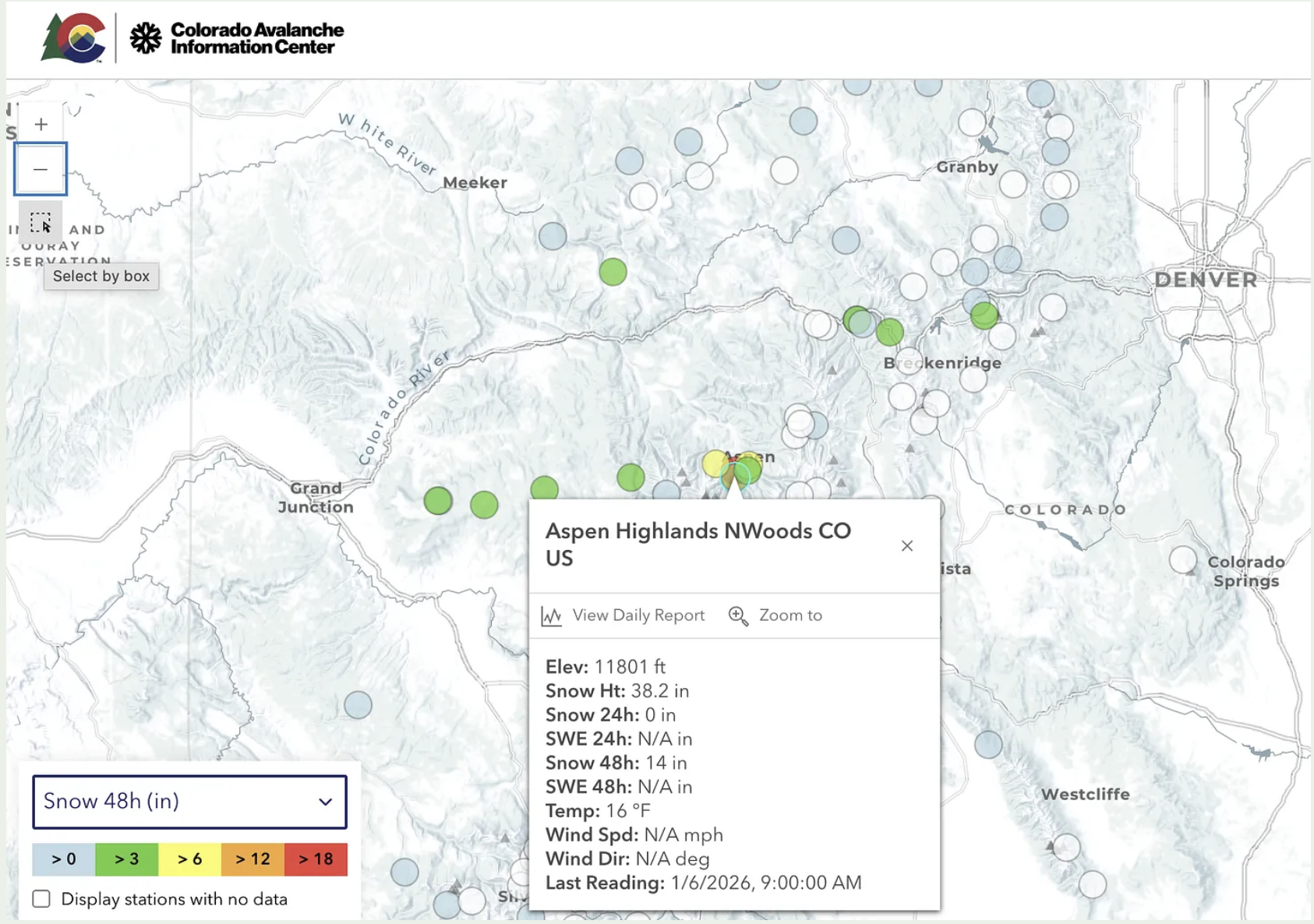
The distribution of woodland in the USA, 1873 pic.twitter.com/Jrsk74ks73
— Vintage Maps (@vintagemapstore) January 22, 2026
Driving a system to crisis — Andy Mueller (#Colorado River District) #ColoradoRiver #COriver #aridification

From email from the Colorado River Water Conservation District (Andy Mueller):
January 17. 2026
The Colorado River system is on the brink of collapse, drained by decades of overuse in the lower basin states and accelerated by the impacts of climate change. While this is not the first time that we have stared down a crisis at Lake Powell, in the past, we have gotten lucky, saved by big snows and cold winters.
This year, however, it does not appear that Mother Nature is going to bail us out.
On the Western Slope, we spent our holidays staring at snowless, brown hillsides and dry, rocky riverbeds as water year 2026 began setting records — all in the wrong direction. At the Colorado River District, our job is to protect the water security of the Western Slope, regardless of the condition of the snowpack. We can’t make it snow, but we can hold decision-makers accountable for their choices, and as we near the deadline of the post-2026 river operation guideline negotiations, we can demand that they do not continue to make the same mistakes which have driven us to this crisis.
In recent months, as pressure and public scrutiny have grown around the negotiations between the seven Colorado River Basin states, it has become clear that the Lower Basin states of Arizona, California, and Nevada are looking for a scapegoat. They have begun loudly accusing the Upper Basin states of Colorado, Utah, Wyoming, and New Mexico of being inflexible and unwilling to compromise on a solution to balance the system. They believe that their political might and economic clout entitles them to continue to use more than their share and absolves them of responsibility for their part in the collapse of the system.
But that is not reality.
Over 100 years ago, the Colorado River Compact was designed with exactly this moment in mind. It was created to allow Upper and Lower Basin states to develop their water separately, to meet the needs of their unique communities on their own timeline, and to steward their resources responsibly.
In eight pages, the Compact makes it clear that the communities of suburban Phoenix are not more important than those of western Colorado.
Think about it like this: in 1922, the Upper and the Lower Basin each bought a brand-new truck. Both came with contracts and manuals explaining proper use and maintenance, limits and legal obligations.
For years, their engines hummed.
During this time, the Lower Basin chose to modify their purchase contract to upgrade. They signed on the dotted line to accept the feds as their water master when they wanted to build Hoover Dam, and Arizona agreed to take junior water rights on the system to develop the Central Arizona Project.
But as things heated up in the early 2000s, the warning lights began to come on.
The Upper Basin quickly adapted to changing conditions, slowing down, or driving carefully around uncertain terrain. Without large reservoirs upstream and guaranteed water deliveries, water managers and agricultural producers in these states had to make tough decisions every month based on how much water was actually in the river.
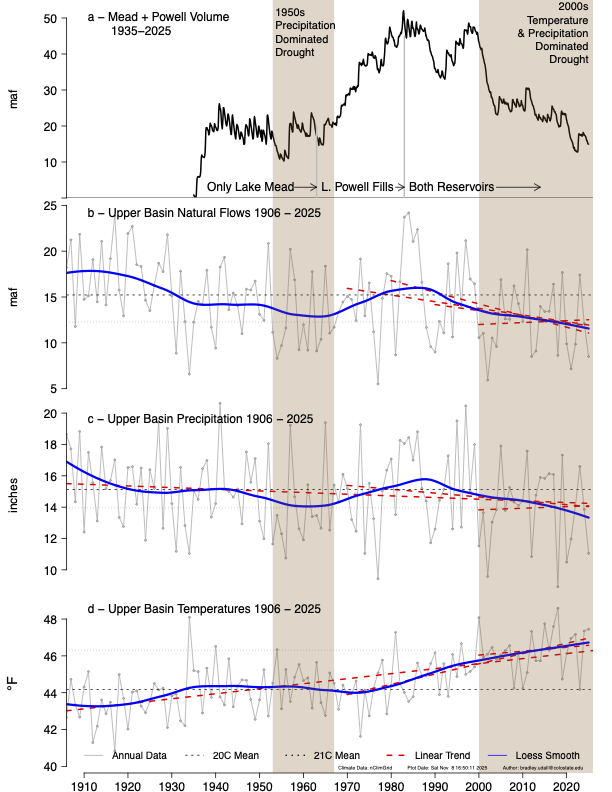
The Lower Basin, however, chose to ignore the warning lights on their dashboard. Despite being told by multiple mechanics that they couldn’t continue to drive full speed anymore, they kept their foot on the gas.
Regardless of worsening hydrology, they overused their allotment by as much as 2.5 million acre-feet per year by not accounting for evaporative and transit loss or their full tributary use. In addition to this, Arizona hoarded over 300,000 acre-feet annually of Colorado River water by dumping it into the ground.
Left unaddressed, the problems compounded. Now their truck is seizing up, and the driver is trying to explain to everyone onboard why their broken vehicle is someone else’s fault.
In western Colorado, we have never had the luxury of looking away from the wear and tear caused by prolonged drought. Every year, we adjust our use to meet our obligations downstream and protect the health of our communities.
The 1922 Compact is not being renegotiated, but the interim rules governing water apportionment on the river are.
Any new agreements must recognize the hydrologic reality that water is a finite and shrinking resource and be consistent with our existing legal framework. New agreements must end the fiction that growth can continue without considering hydrology and reject any deal that forces western Colorado to subsidize decades of overuse elsewhere.
Andy Mueller is the general manager of the Colorado River Water Conservation District based in Glenwood Springs.
Originally published by The Grand Junction Daily Sentinel January 17, 2026.

#Colorado ranchers and consumers can team up to make beef supply chains more sustainable — TheConversation.com
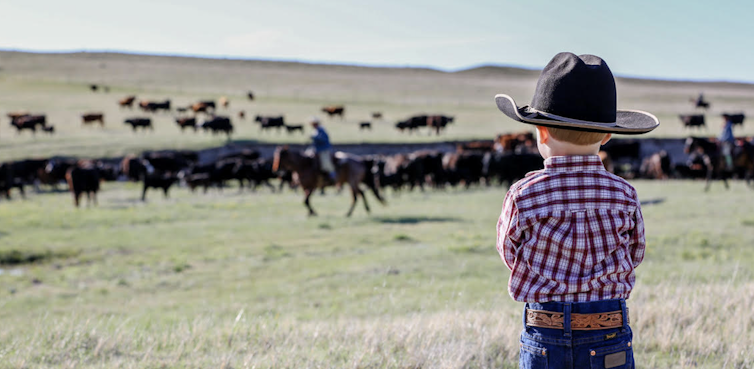
Jordan Kraft Lambert, Colorado State University; Jennifer Martin, Colorado State University; Kim Stackhouse-Lawson, Colorado State University, and Sara Place, Colorado State University
Cowboys guided a herd of longhorn cattle through downtown Denver to celebrate the opening of the annual National Western Stock Show on Jan. 8, 2026. As ranchers bring their best cattle to compete for blue ribbons over the course of this month, it’s a good time to consider whether beef production can be part of a circular economy.
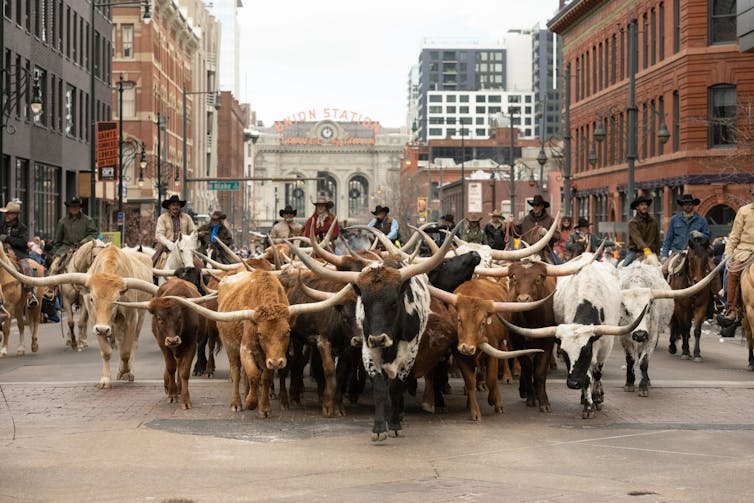
Circularity is an economic model where raw materials are responsibly sourced, waste products are put to best use and the system maximizes ecosystem functioning and human well-being.
As with most human activities, beef production provides a valuable contribution to human health while also impacting the natural environment, sometimes in negative ways.
We are innovators and researchers who live in Colorado and study the beef supply chain. Our work broadly focuses on investigating ways to make beef production more circular and sustainable.
Kim Stackhouse-Lawson and Sara Place are experts in cow burps and technologies to mitigate the methane associated with them. Jennifer Martin is an expert in meat processing and supply chains for byproducts like organ meats. Jordan Kraft Lambert is an expert in commercializing technologies that help farmers and ranchers steward the environment while feeding the world.
Beef is a source of complete protein. It has the full complement of amino acids humans need to build muscle and is a rich source of vitamin B12, which is necessary to ensure nervous system function and red blood cell formation. Beef produced in the U.S. each year meets the total protein needs of 40 million people and provides enough B12 to meet the needs of 137 million people, according to research.
In 2019, U.S. beef cattle production comprised about 3.7% of the country’s greenhouse gas emissions. Beef cattle production is also responsible for approximately 5% of U.S. water withdrawn from surface or groundwater, and 0.7% of the nation’s fossil fuel energy use.
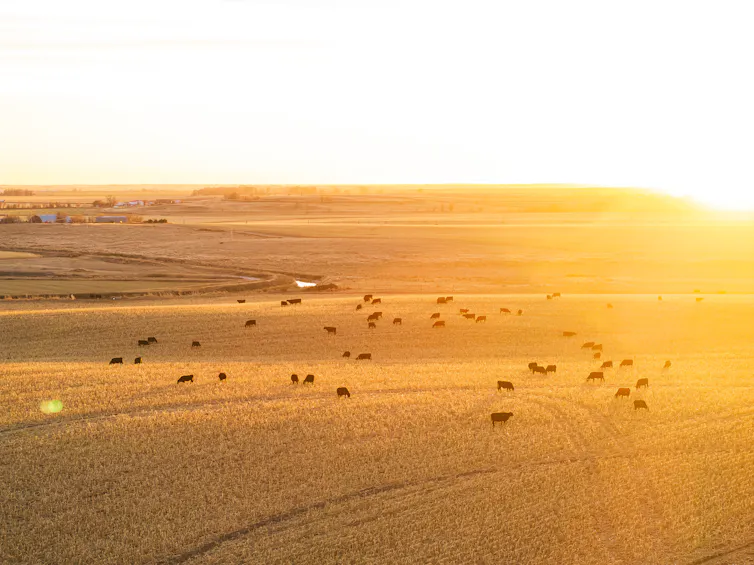
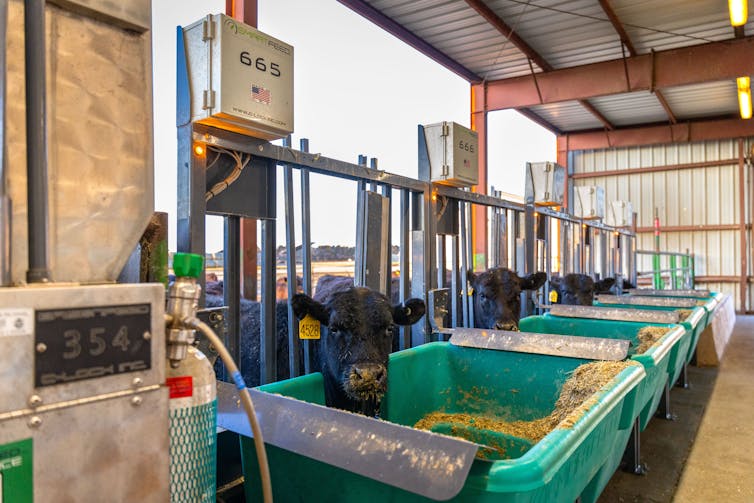
New tech to reduce environmental impact
Cows are able to digest tough, fibrous plant material that humans, pigs and chickens can’t. This makes them an important part of a circular economy because they can digest what would otherwise be considered waste from other industries, like the grain left over from making beer and almond hulls from almond milk. By using these ingredients to feed cattle instead of letting it rot in landfills, U.S. feedlots decreased the amount of human-edible feeds required to produce more beef protein.
When cattle are being fed waste products like almond hulls and spent grain, it’s easy for producers to include feed additives, like herbs and custom-made molecules. These additions may reduce the cows’ methane production by changing how the microbes in their stomachs process carbohydrates.
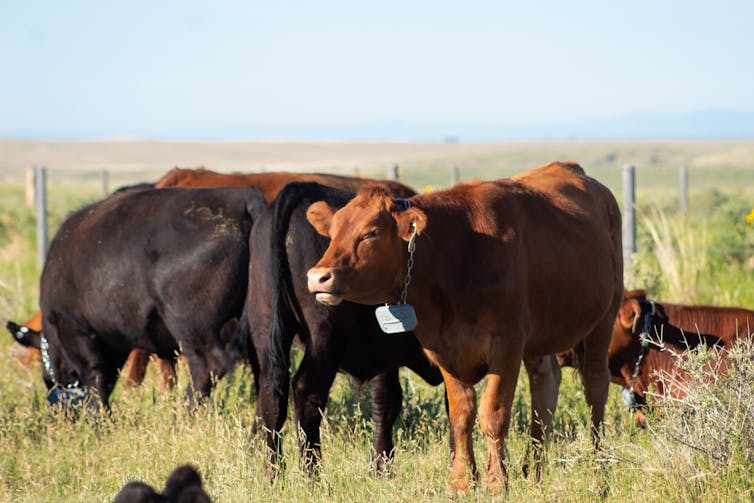
For the same reason that cows can digest what would otherwise be considered waste, cows are able to eat grass. Grazing is important in dry regions like the mountains and high plains of Colorado. If the grass isn’t removed via grazing, it dries and becomes tinder for wildfire. In addition, many of these mountainous areas are too cold, rocky and steep to grow crops. Grazing can turn land that would otherwise be difficult to farm into food-producing land.
Until now, grazing required physical fences, which are costly to maintain and limit wildlife movement. But new technologies like virtual fencing allow Western Slope ranchers to use their smartphones to set digital boundaries. A collar on the cow beeps and buzzes to tell the cows where to go. Virtual boundaries are easy to change and visible only to the cow; thus, they support more environmentally-friendly grazing practices, protect streams and wildlife habitat and reduce wildfire fuel in dry seasons. While our recent research shows that this technology needs more development, it could be an important tool for beef’s role in a circular economy.
Beyond steak: Organ meats, pet treats and leather
In our experience, many U.S. consumers rarely eat cuts beyond steaks and ground beef — often due to a bad first experience with organ meats, like liver, or unfamiliarity with how to cook lesser-known cuts, like heart.
When customers won’t buy these cuts, Colorado’s beef producers who sell online or at farmers markets have to send them to the landfill. That costs the producer money and wastes the water, land and feed used to make these cuts.
Studies show that these cuts are among the most nutrient-dense parts of the animal, providing high levels of iron, B vitamins, choline and and other micronutrients. Making use of these lesser-known cuts can reduce emissions by using more of the animal and keep edible meat out of landfills, where it would otherwise rot, releasing greenhouse gases.
This does not mean anyone has to suffer through a meal of rubbery liver to save the planet. Many cultures globally value organ dishes, and U.S. tastes are expanding to include foods like lengua tacos made from beef tongue. Meanwhile, cooking tools such as sous vide can improve tenderness and juiciness by holding meat at precise temperatures for longer times.
Pets also benefit from eating organ meats, so these cuts are a key ingredient in pet foods and treats.
Consumer fashion choices matter too. About 270 million bovine hides are produced globally each year, and about 70% are turned into leather. Due to insufficient demand, remaining hides are burned or sent to the landfill, both of which release greenhouse gases.
Rather than letting these hides rot, they can be turned into leather, a durable, breathable and biodegradable high-performance material. When consumers choose to buy genuine leather boots, belts and car seats, they’re engaging in the circular economy.
For these reasons, Colorado State University is hosting Future Cowboy on Jan. 25, 2026, at the National Western Stock Show. It’s an event that lets Colorado foodies, fashionistas and cattle producers come together to explore circularity firsthand. The event will feature a leather fashion show, a ranch technology showcase and an opportunity try chef-prepared bison tongue and beef heart.
Jordan Kraft Lambert, Director of Ag Innovation and Partnerships, College of Business, Colorado State University; Jennifer Martin, Associate Professor of Animal Sciences, Colorado State University; Kim Stackhouse-Lawson, Professor of Animal Science, Colorado State University, and Sara Place, Associate Professor of Feedlot Systems, Colorado State University
This article is republished from The Conversation under a Creative Commons license. Read the original article.
#Colorado author, Eugene Buchanan, hopes his ode to one of the West’s last wild rivers sparks new generation of stewards — KUNC #YampaRiver
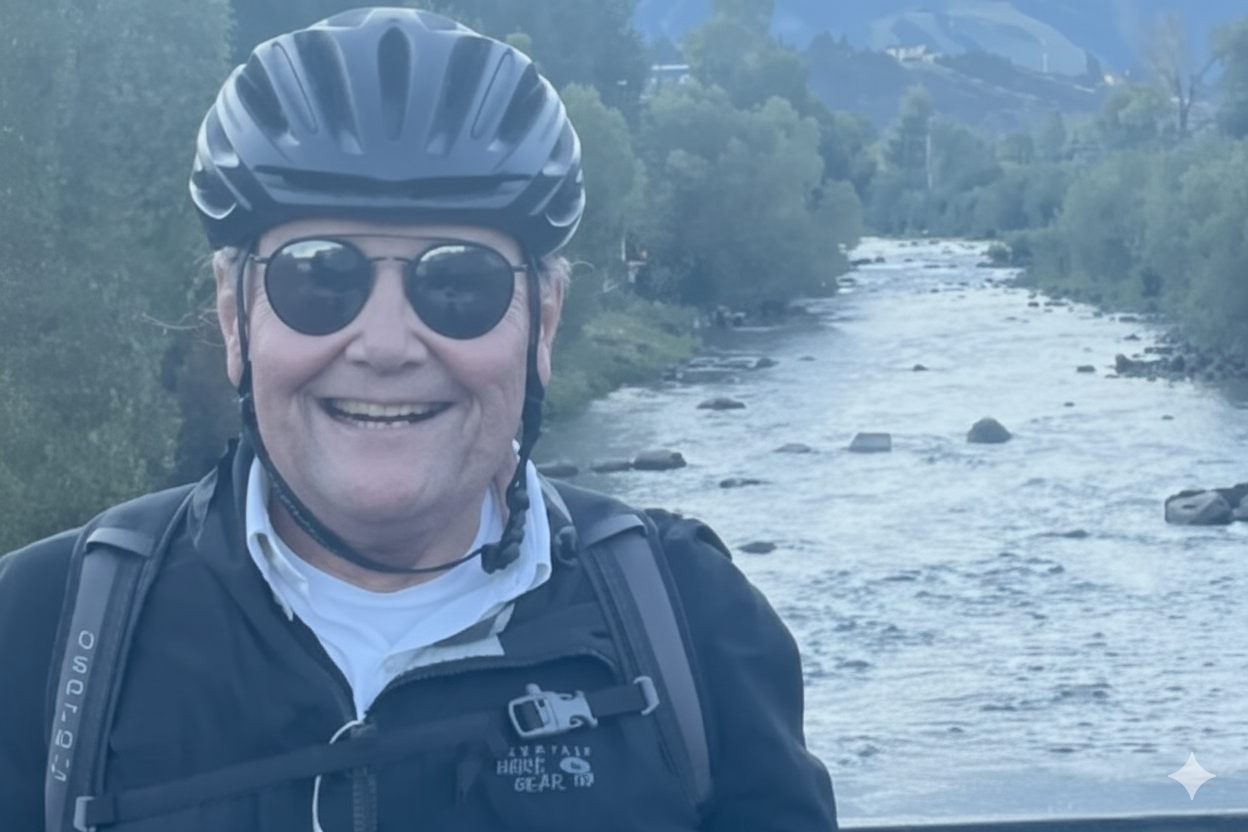
Click the link to read the article on the KUNC website (Scott Franz). Here’s an excerpt:
January 20, 2026
Steamboat Springs author and adventurer Eugene Buchanan has lived near the banks of the Yampa River long enough to notice its rhythms and moods are often mirrored by the residents in his northwest Colorado ski town.
“The river’s pulse kind of matches your own,” he said Thursday. “You know, come springtime, you’re jazzed up, and the rivers crankin’ and flooding, and the surf waves are in and people are rafting it and (stand up paddleboarding). Then it slows down to a trickle later in the summer and people are inner-tubing it. Fly fishing it. That’s a little more of a tranquil time.”

But as Buchanann warns in the first chapter of his new book, Yampa Yearnings, “not all is hunky dory in Yampaland.” Last summer marked the fourth time in history that there was a call on the Yampa due to drought conditions and upstream users were forced to cut back their intake. And like other rivers across the West, Buchanan said the waterway faces growing threats from climate change and increased demands from water users. Buchanan’s book is not all about hard times and drought on the river. In between his history lessons about the Yampa and the challenges it has faced, readers will also learn about the fate of Buchanan’s efforts to help a rancher get his lost cattle back across the raging waterway. There’s also a tale of his friend’s paddling adventure from Colorado to Utah to prove the waterway can facilitate ‘interstate commerce.’ KUNC water and environment reporter Scott Franz interviewed Buchanan about his book and the state of the Yampa. Answers have been lightly edited for length and clarity.
Franz: What impact do you hope this book has for the Yampa River and its future?
Buchanan: It’s hard to say how much impact a book like this will have. It’s my hope that those who are familiar with the Yampa learn to appreciate it a little more. Maybe look at it with a different eye next time they see it. If people aren’t familiar with the Yampa and they live somewhere else, maybe they’ll look outside and see their backyard creek flowing through their town and just think about it a little more. Maybe they’ll donate to a local nonprofit that’s trying to help preserve it, or they’ll pick up some trash or get involved. Or they’ll vote appropriately, how they want to, perhaps preserve it.

A #ColoradoRiver glossary and primer — Jonathan P. Thompson (LandDesk.org) #COriver #aridification
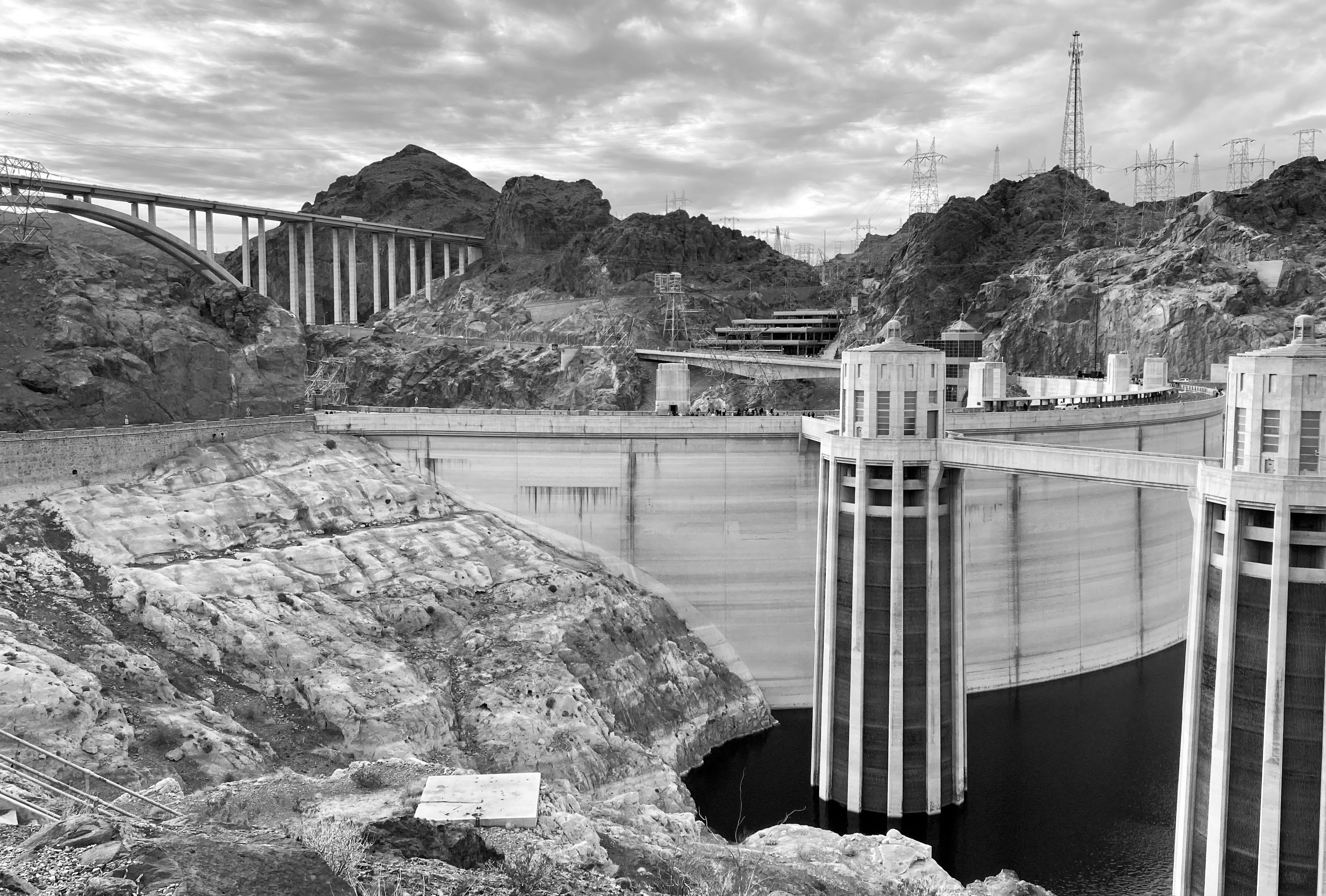
Click the link to read the article on The Land Desk website (Jonathan P. Thompson):
January 20, 2026
After last week’s somewhat wonky dispatch on the Colorado River, a couple of readers asked about some of the terminology used. That, along with the fact that the deadline for an agreement on how to operate the river’s plumbing is fast approaching, prompted me to put together a bit of a glossary/primer on the Colorado River to give a little more context to related news, which is likely to come fast and furious over the next several weeks.
If I miss anything, or if you have other questions, please let me know and I’ll try to answer them soon. Also, I’ll be doing a host of data-driven, Colorado River-related dispatches in coming weeks to go over some of last year’s statistics on water consumption, water pricing, alfalfa production and exports, and so forth.

Colorado River Basin: A 250,000 square-mile watershed that includes southwestern Wyoming, western Colorado, southern and eastern Utah, southern Nevada, western New Mexico, Arizona, and eastern California. For administrative purposes, it has been split into the Lower Basin (CA, AZ, NV) and the Upper Basin (CO, WY, UT, NM), with the dividing line at Lees Ferry.
Law of the River: This isn’t an actual law, but rather a collection of agreements, compacts, treaties, laws, and Supreme Court decisions that serve as a framework for governing the Colorado River.
Doctrine of Prior Appropriation, aka First In Time, First in Right: This is the basis for most Western water law, which says that the first entity to put a set amount of water on a stream to beneficial use at a specific place has the highest or most senior priority of water rights. If a senior rights holder is not receiving their full appropriation due to drought or overuse, they can make a “call” on the river, forcing upstream, junior rights holders to stop diverting water from the stream or its tributaries.
Acre-foot (AF): Amount of water that would cover one acre one foot deep. 1 acre-foot = 325,851 gallons. MAF = million acre-feet.
Consumptive Use: The amount of water diverted from a stream minus the amount returned to it. For example, last year Nevada pulled about 443,000 acre-feet of water from the Colorado River, mostly via pumping plants in Lake Mead. But it returned about 244,000 acre-feet of treated wastewater to the reservoir via Las Vegas Wash, leaving it with a total consumptive use of about 198,000 acre-feet for the year. Evaporation and transpiration (or uptake by and evaporation from plants) are considered consumptive uses. Agriculture is the largest consumptive user in both the Upper and Lower basins.

Colorado River Compact: In 1922, representatives from the seven Colorado River states entered into a compact aimed at ending interstate conflict and litigation to clear the way for developing dams and diversions on the river. The compact gives each basin exclusive beneficial consumptive use of 7.5 million acre-feet of water per year, but also mandates that the Upper Basin “not cause the flow of the river at Lee Ferry to be depleted below an aggregate of 75 million acre-feet” for any 10-year period. A 1944 treaty reserved an additional 1.5 million acre-feet to Mexico, which would be covered by surplus or borne equally by the two basins.

- The Upper Basin divided its 7.5 MAF by percentage: 51.75% to Colorado; 11.25%to New Mexico; 23% to Utah; 14% to Wyoming (plus an additional 50,000 acre-feet for the portion of Arizona in the Upper Basin).
- The Lower Basin allotted 4.4 MAF to California; 2.8 MAF to Arizona; .3 MAF to Nevada.
- 20 million acre-feet: Presumed total annual natural flow of the river upon which the compact was based and which was considered “more than sufficient to water all lands now being irrigated and all lands which can be economically developed for forty years to come.”
- 17.3 million acre-feet: The actual annual flow recorded by the he U.S. Geological Survey during the nine years leading up to the compact’s ratification, with yearly flows ranging from 9.9 million acre-feet to 26.1 million acre-feet. That was during an unusually wet period.
- 14.3 million acre-feet: Median annual natural flows at Lees Ferry from 1907 to 2025.
- 8.5 million acre-feet: Estimated natural flow at Lees Ferry in 2025.
- 2 million to 4 million acre-feet: Estimated amount of consumptive use that must be reduced to bring the Colorado River supply and demand into balance.

Natural Flow at Lees Ferry: This is a calculated estimate of the amount of water that would flow past Lees Ferry if there were no upstream dams, diversions, or human consumptive use. This estimate would guide the supply driven option for dividing up the river. The USBR describes the method for determining it as such:
- Provisional Natural Flow at Lees Ferry = observed annual flow at Lees Ferry + average Upper Basin consumptive use for the last 5 published years +/- net change in mainstream storage +/- net change in off-mainstem storage +/- net change bank storage + mainstem reservoir evaporation.

Winters v. the United States: 1908 Supreme Court ruling establishing that when the federal government “reserved” land for a tribal nation, it also reserved rights to water. And the appropriation date for those water rights would be the date the reservation was established, whether or not the tribe put the water to “beneficial use” at that time. Winters did not quantify the amount of water tribes were entitled to, except that it should be “sufficient … for irrigation purposes.”
- By rights, this would give the 30 tribal nations within the watershed the most senior rights to most if not all of the water in the Colorado River. Five lower Colorado River tribes currently have quantified and settled rights to about 900,000 acre-feet, while Upper Basin tribes have settled and quantified about 1.1 million acre-feet. But other tribes have yet to settle or quantify their rights, so they remain in a sort of limbo.
- In many cases, the tribal nations lack the infrastructure for putting their water rights to use, meaning they end up relying on federal infrastructure — and on the respective appropriation dates for the infrastructure. An example: The Ute Mountain Ute tribe has 1868 water rights on the Dolores River in southwestern Colorado. But they actually receive their water via the Dolores Project, which only has 1968 rights — which are junior to most of the white farmers on the river. That means during very low water years, the tribe can lose most of its water.
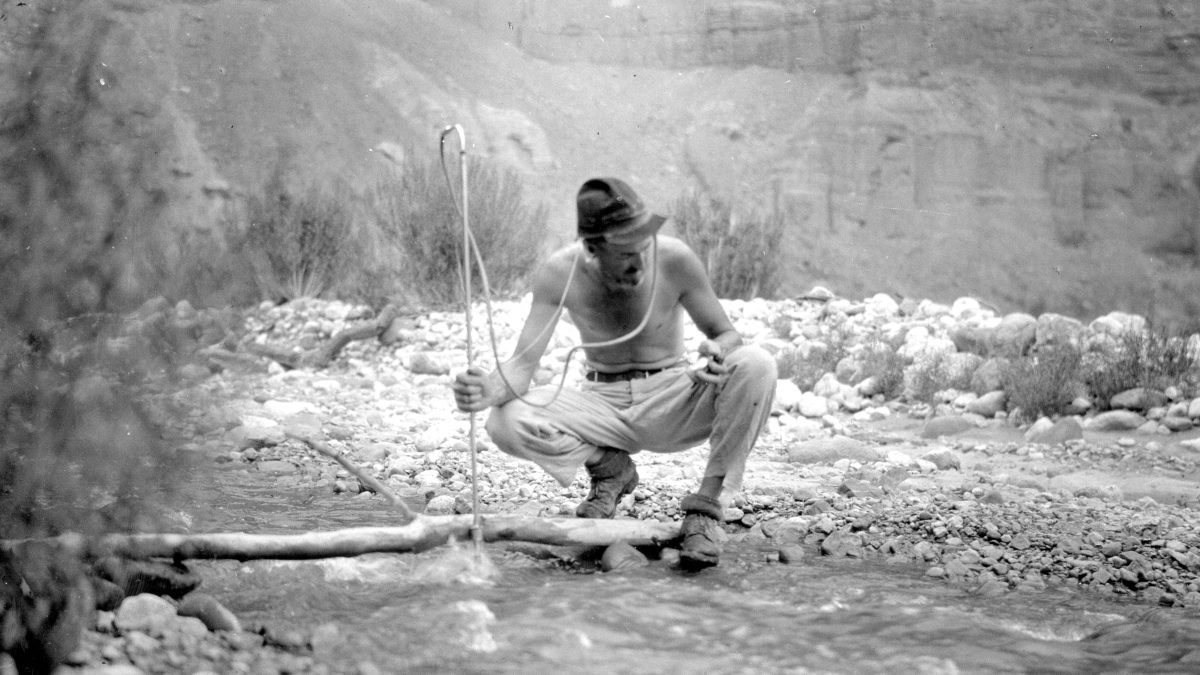
Eugene C. LaRue: One of the early 20th century’s foremost authorities on the Colorado River, who warned the Colorado Compact signatories that their negotiations were based on overestimates of the river’s supply. In 1916, he wrote: “Evidently, the flow of the Colorado River and its tributaries is not sufficient to irrigate all the irrigable lands lying within the basin.” LaRue also warned against building Hoover Dam because evaporation would further deplete water supplies and suggested banning trans-basin diversions, or exporting water from the Colorado River watershed to other parts of the seven basin states. The signatories heard LaRue but clearly didn’t heed his warning, even though he repeated it many times prior to the compact’s signing. (He eventually resigned in protest.)
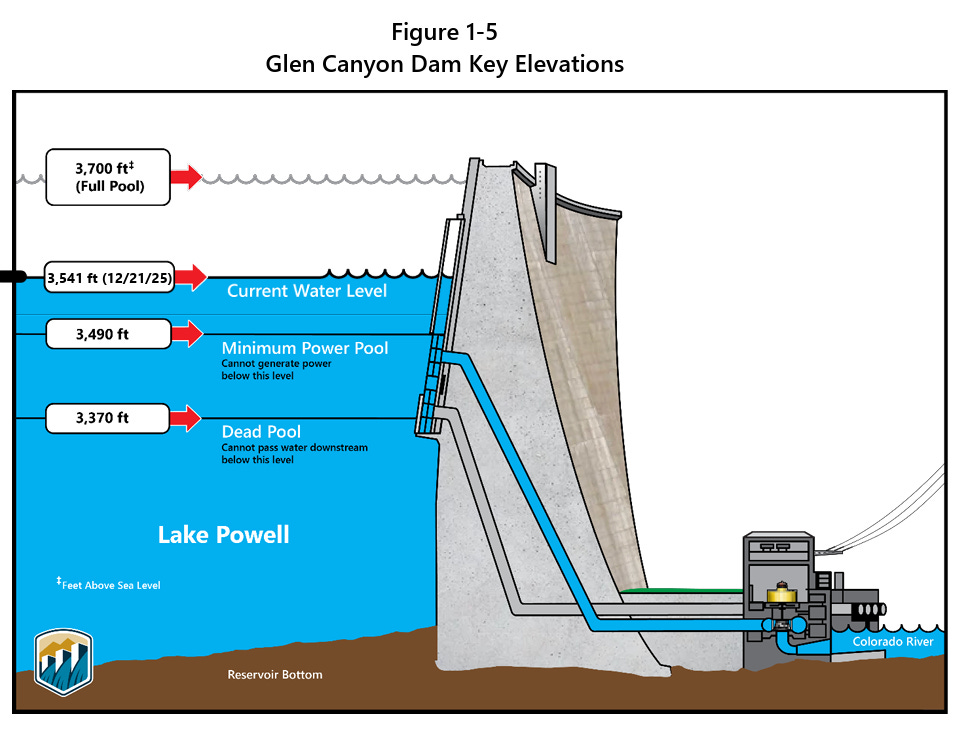
Minimum Power Pool: Surface elevation of Lake Powell or Lake Mead below which hydroelectric production is no longer possible because it is lower than the dam’s penstocks. This is especially critical at Lake Powell because if water can’t be released through the penstocks and turbines, it must go through lower river outlets, which are not equipped for long-term releases and could be damaged by constant use. Also, the electricity from the dam is critical to Southwestern power grids, and sales of it raise revenue for endangered native fish recovery programs.
Deadpool: Surface elevation of Lake Powell or Lake Mead below which no water can be released from the dam. So in Lake Powell, this means the water would drop below the river outlets, which could happen if the reservoir is drawn down to the river outlet level, and then reservoir seepage and evaporation exceeds inflows (which could happen late in a hot, dry summer).
Run of the River: This is the term for when releases from a dam are equal to reservoir inflows minus evaporation and seepage at any given time. In other words, if inflows were 20,000 cfs, releases would be slightly lower, and the dam wouldn’t hold any water back (or release any storage). Glen Canyon dam operators could use this method to keep Lake Powell from dropping below minimum power pool.
Transbasin Diversion: Moving water from one watershed to another, within the same state, e.g. from the Colorado River’s headwaters to the state’s populous Front Range, or from the Navajo River (a tributary of the San Juan, which is a tributary of the Colorado) to the Chama River (a tributary of the Rio Grande).
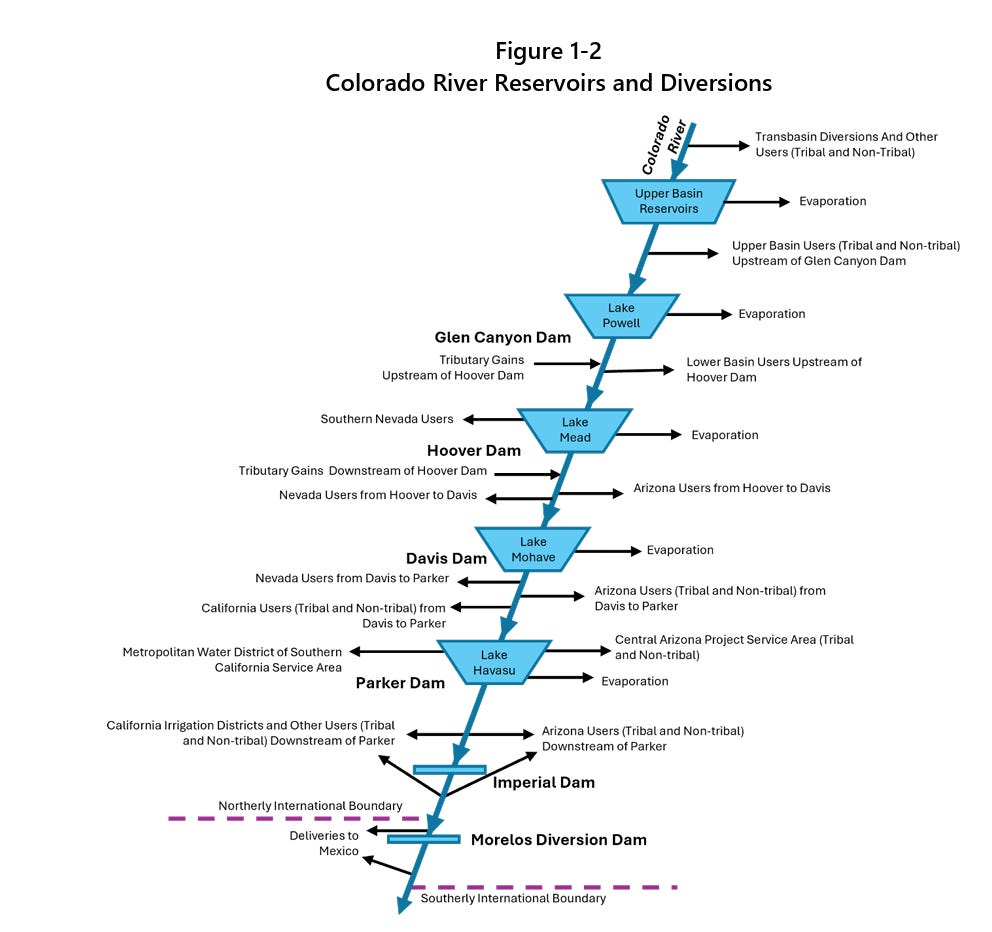
Central Arizona Project: The 366-mile canal and pumping system that delivers Colorado River water to the Phoenix and Tucson areas. The project’s water rights have a 1968 appropriation date, making them junior to California users such as the Imperial Irrigation District. That has meant that Arizona must reduce consumption prior to California.
Imperial Irrigation District: A major agricultural area in southern California and the Colorado River’s largest single water user.
Western water: Where values, math, and the “Law of the River” collide, Part I — Jonathan P. Thompson
Western water: Where values, math, and the “Law of the River” collide, Part II — Jonathan P. Thompson

The Latest in Low Technology
By Robert Marcos, photojournalist
Grand Junction, Colorado
While filming for the Nature Conservancy I learned this: Climate change has made three-quarters of our planet drier, yet at the same time the frequency of extreme downpours has increased. Raindrops that fall during these downpours hit the soil with more energy than they used to. This results with more erosion as dislodged soil is swept downstream by runoff that our increasingly dry soil is unable to absorb.
Forgive me if I left anything out of that overly-simplified explanation, but I wanted to define the problem first before describing solutions that are underway in Northwestern Colorado. The Nature Conservancy and their partners are heavily invested in a project whose goal is to improve the water quality in the Yampa River, and I was fortunate to have been invited to film work being done at three remote sites.
Joseph Leonhard – a Riparian Restoration Project Manager at the Nature Conservancy told me that his crews – which consisted primarily of AmericaCorps workers plus a few hardy scientists from the BLM and USGS, utilized Low-Tech Process-Based Restoration, (LTPBR), methods to slow the water in streams that led into the Yampa River.
LTPBR is a low cost restoration method that uses simple, hand-built structures composed of natural materials obtained locally – like branches, boulders, and sod, which mimic actual beaver dams. By restricting water these small dams encourage regenerative processes that can, over time, repair degraded landscapes, improve water retention, create habitat, and even build resilience against drought and fire.
What really impressed me was that the members of these crews – some of whom were 19-year olds while others were PhD’s, shoveled mud and waded through knee-deep water together. They displayed “group cohesiveness”- which is defined as coordinated effort toward shared objectives. During his interview Joseph Leonhard said that he and his people were “activated”, which I interpreted as meaning that instead of sitting in front of a computer, (like I am right now), they were engaged in productive physical activity that would directly benefit the environment.
For more information about the Yampa River Fund please visit: https://www.nature.org/en-us/about-us/where-we-work/united-states/colorado/stories-in-colorado/yampa-river-fund/
Adams County water district sues #Denver over contamination from fire training facility: Since the South Adams Water & Sanitation district first discovered problem in 2018, it has spent tens of millions on mitigation — The #Denver Post
Click the link to read the article on The Denver Post website (Elliot Wenzler). Here’s an excerpt:
January 21, 2026
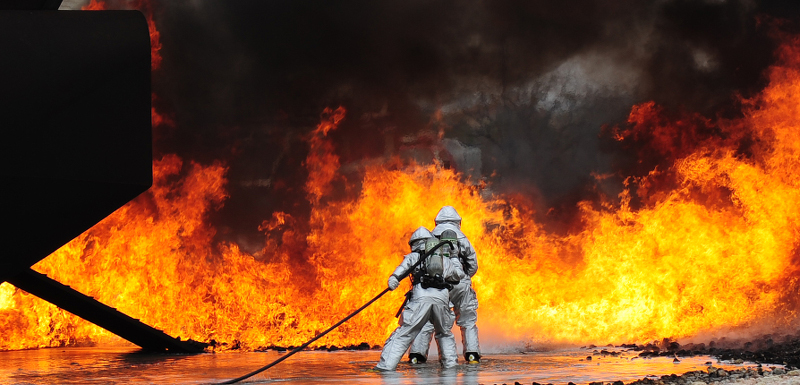
An Adams County water district filed a lawsuit against Denver on Tuesday [January 20, 2026], alleging that foam from the city’s fire training facility has contaminated its water for decades. The South Adams County Water and Sanitation District says the city’s Roslyn Fire Training Facility, near the Rocky Mountain Arsenal National Wildlife Refuge, has used firefighting foam containing a group of chemicals known as PFAS, also known as “forever chemicals,” since at least 1991…
“Denver has failed to eliminate or control releases of (the chemicals) at and from the fire training facility and those releases have contaminated and continue to contaminate the District’s drinking water supplies,” the lawsuit alleges.
The district serves about 75,000 residents in Commerce City and unincorporated Adams County. It first discovered the contamination in 2018. Since then, the district has spent tens of millions of dollars to mitigate the issue, according to the lawsuit. Officials there built another water treatment facility specifically to treat PFAS, and it purchased water from Denver Water to dilute the contaminated water…Even with state and federal funding, the lawsuit says, “there remains a huge deficit” from the costs associated with the firefighting foam. The district asks a U.S. District Court judge to rule that Denver is liable for the response costs and for the ongoing costs the district will incur. It notes that water district officials notified Denver city officials of this claim back in 2019. The amount that the city of Denver would have to pay, if found liable, would be determined in a trial.
#Drought in 2025 in 14 Graphics — NOAA
Click the link to read the article on the NOAA website. Here’s an excerpt:
January 15, 2026
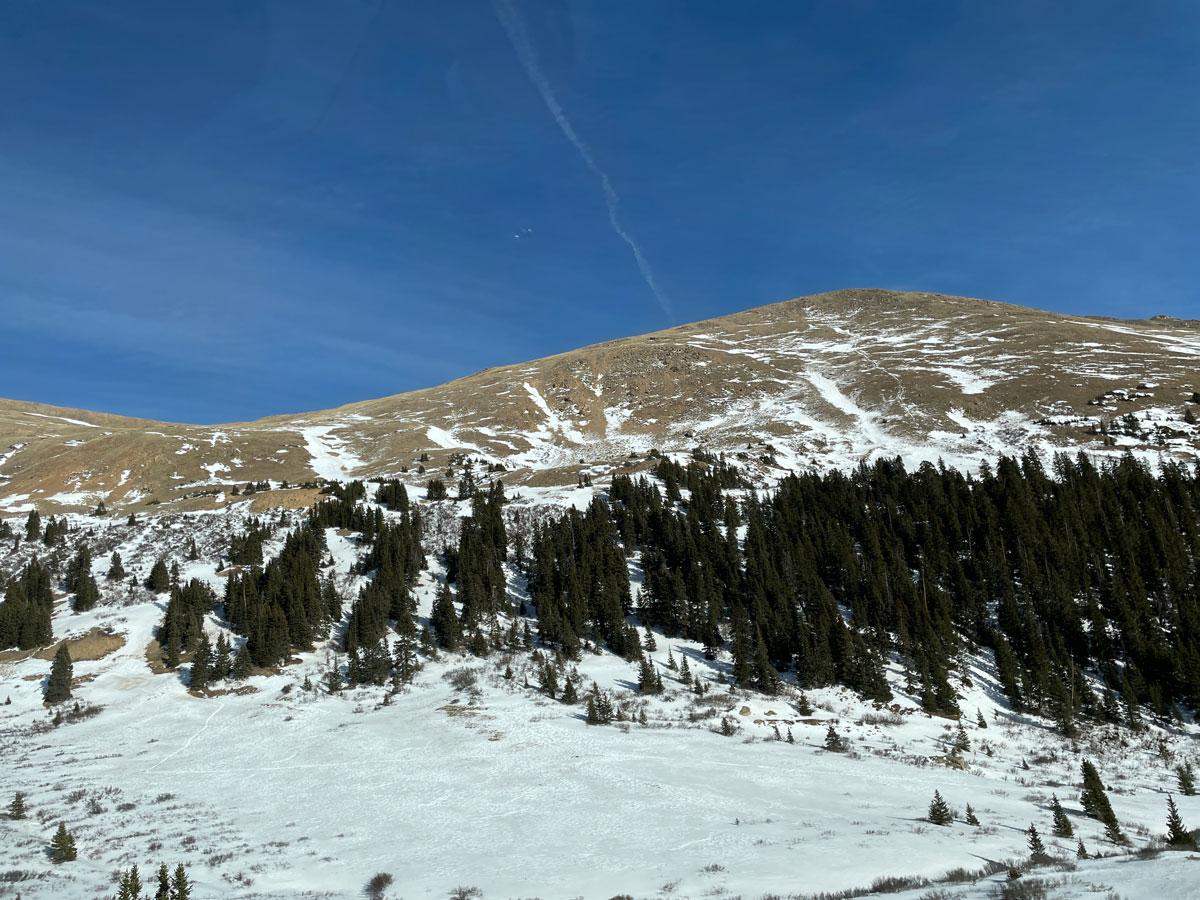
From the catastrophic wildfires in Southern California to historic low-water levels on the Mississippi River and record-low streamflow in the Northeast, drought and its impacts touched nearly every corner of the country. The year saw the unusual return of two La Niña events and devastating weather whiplash that brought historic floods to drought-stricken Texas. 2025 showed us that drought is even more devastating when compounded with other climate hazards, such as wildfire and flood. This list breaks down some significant drought-related events of 2025 that made 2025 a year of water extremes across the United States.
Our thoughts are with those who lost loved ones, homes, and livelihoods in the Texas flooding and California wildfires. We hope for healing and comfort for those dealing with significant losses from these events.
Most of the U.S. Experienced Some Drought Last Year
Much of the West started and ended 2025 in drought, according to the U.S. Drought Monitor. Drought impacted the Upper Missouri River Basin and Northeastern U.S. as winter turned into spring, just as Extreme and Exceptional Drought (D3-D4) emerged in Florida and the Southwest. By late summer, drought largely improved in the East, only to emerge again in force in the Northeast U.S. In fall, drought developed in the Midwest and Southeast, and expanded in the Southern Plains and West. New Year’s Eve found drought covering 35.8% of the Nation.
Below is a slideshow of US Drought Monitor maps for 2025.
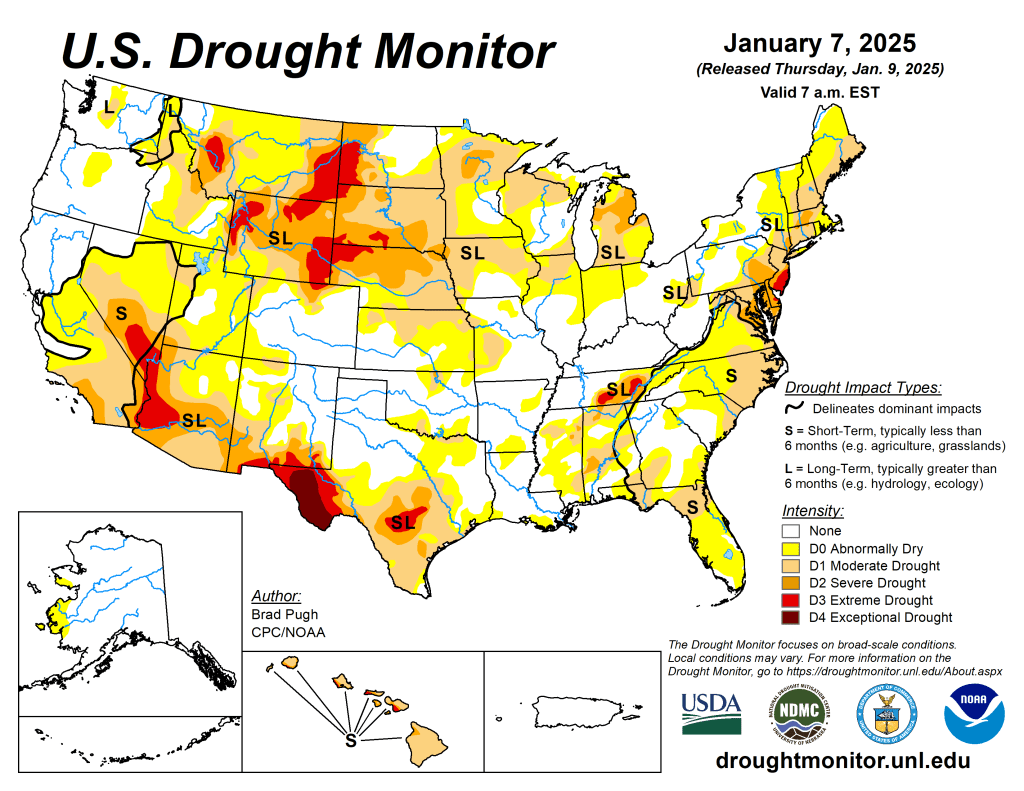
US Drought Monitor map January 7, 2025. 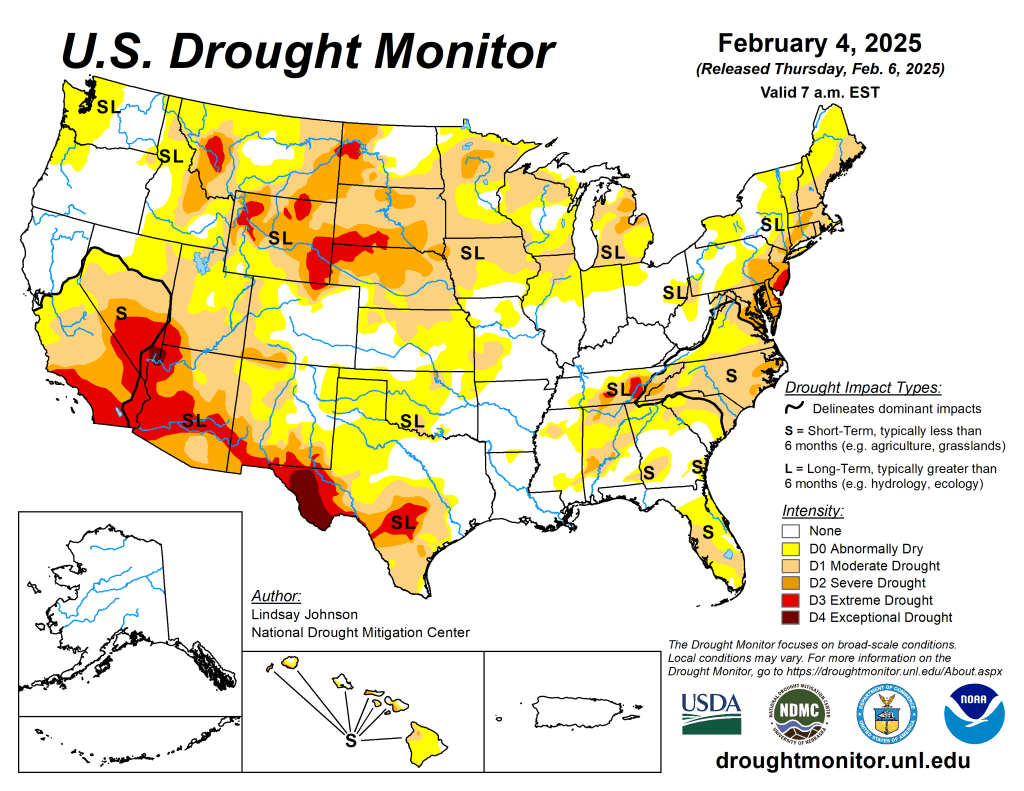
US Drought Monitor map February 4, 2025. 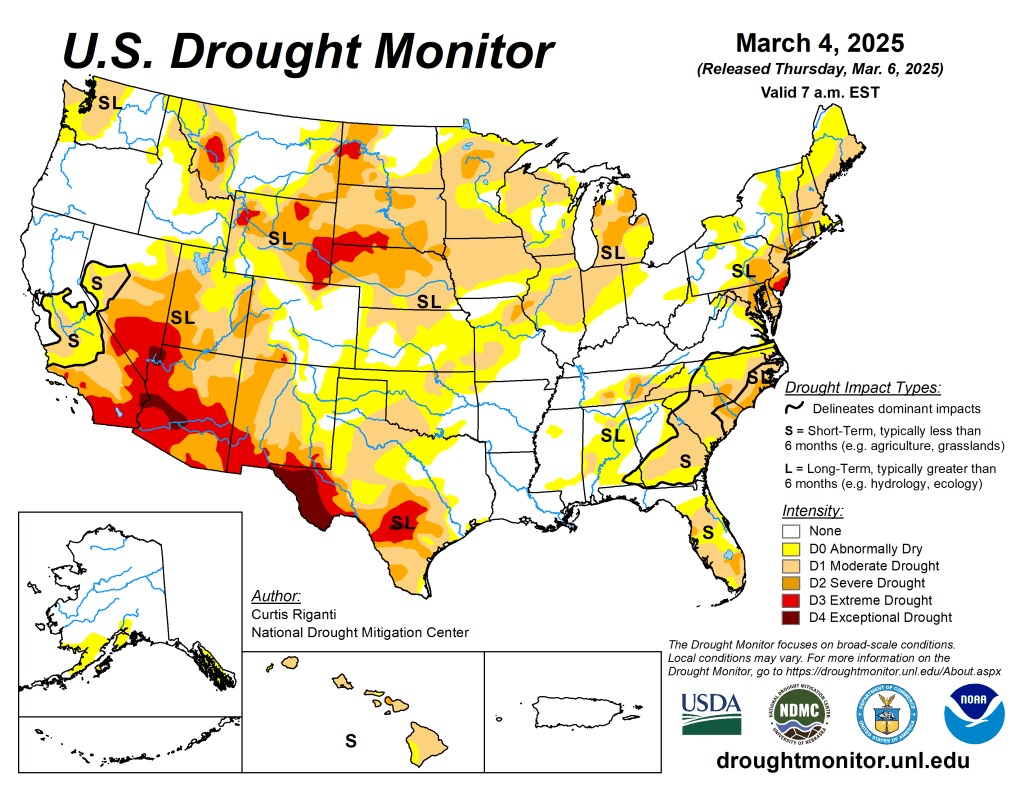
US Drought Monitor map March 4, 2025. 
US Drought Monitor map April 1, 2025. 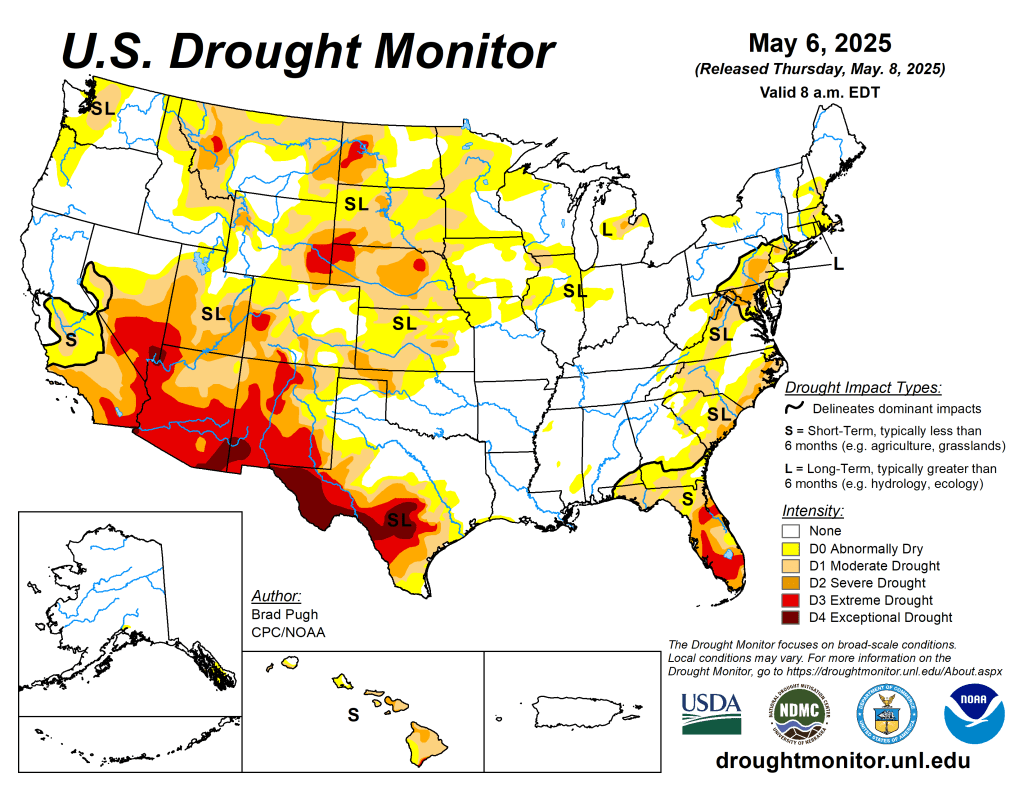
US Drought Monitor map May 6, 2025. 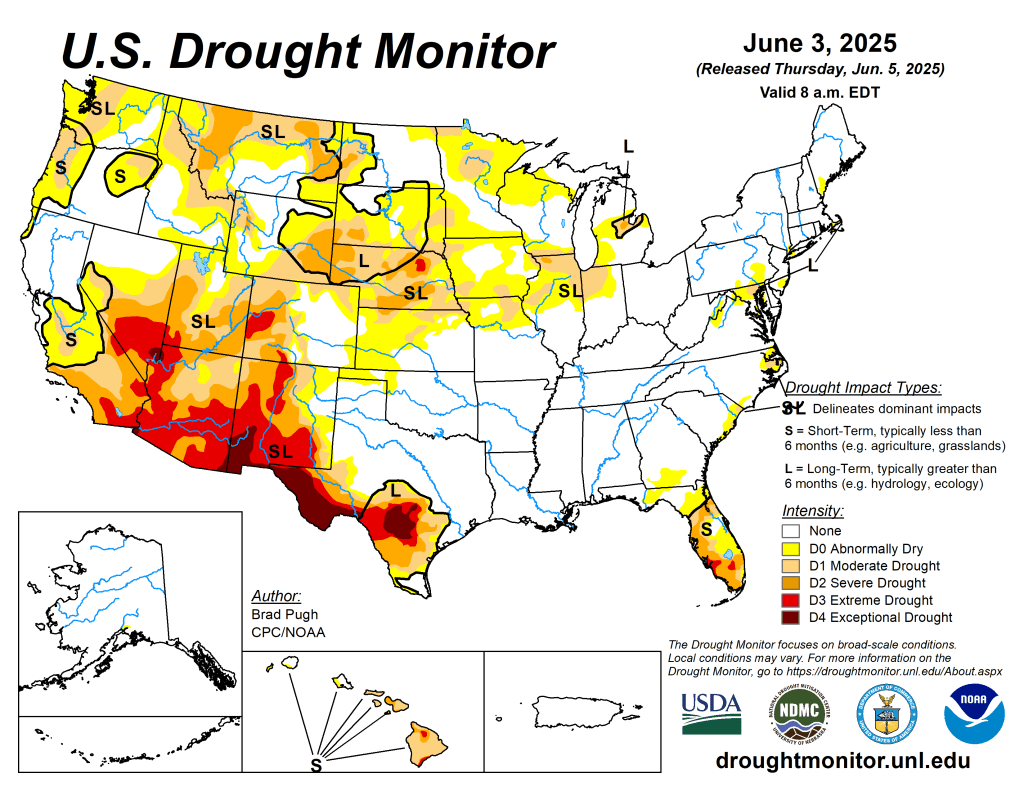
US Drought Monitor map June 3, 2025. 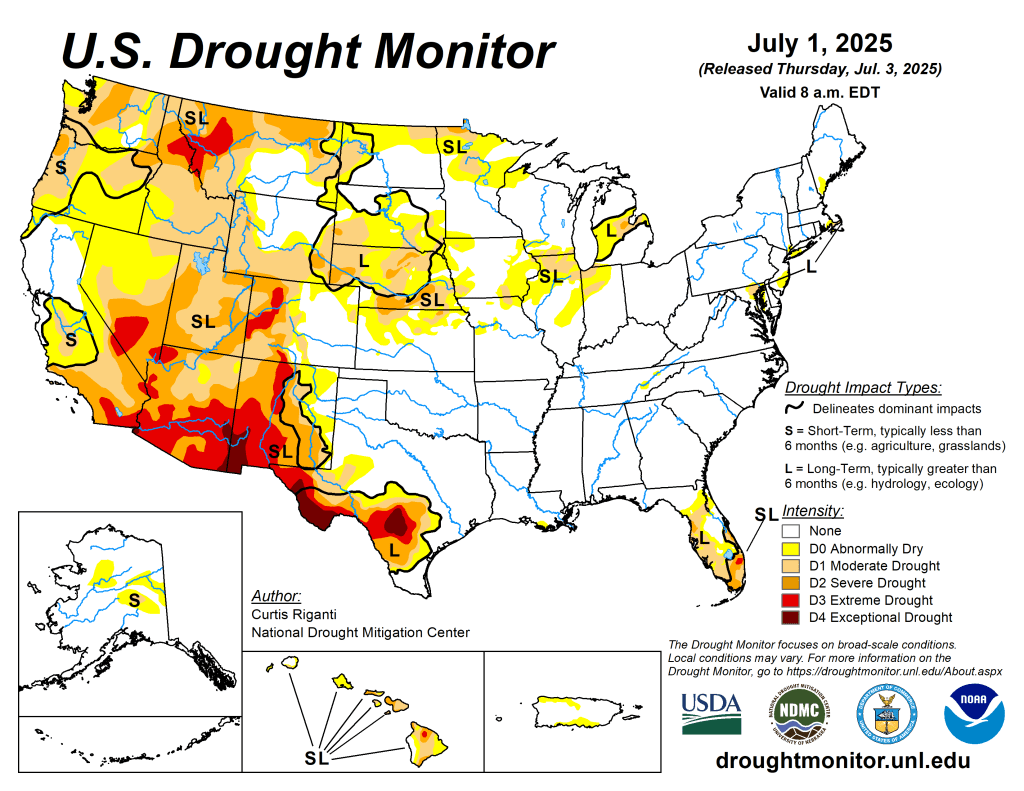
US Drought Monitor map July 1, 2025. 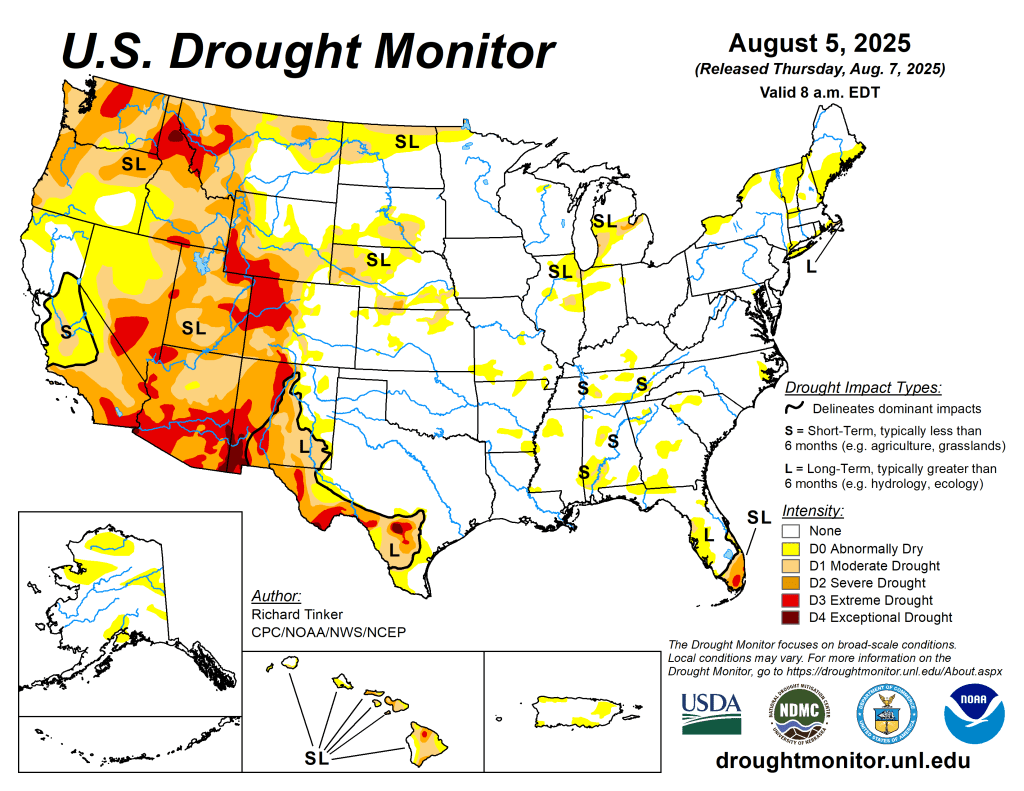
US Drought Monitor map August 5, 2025. 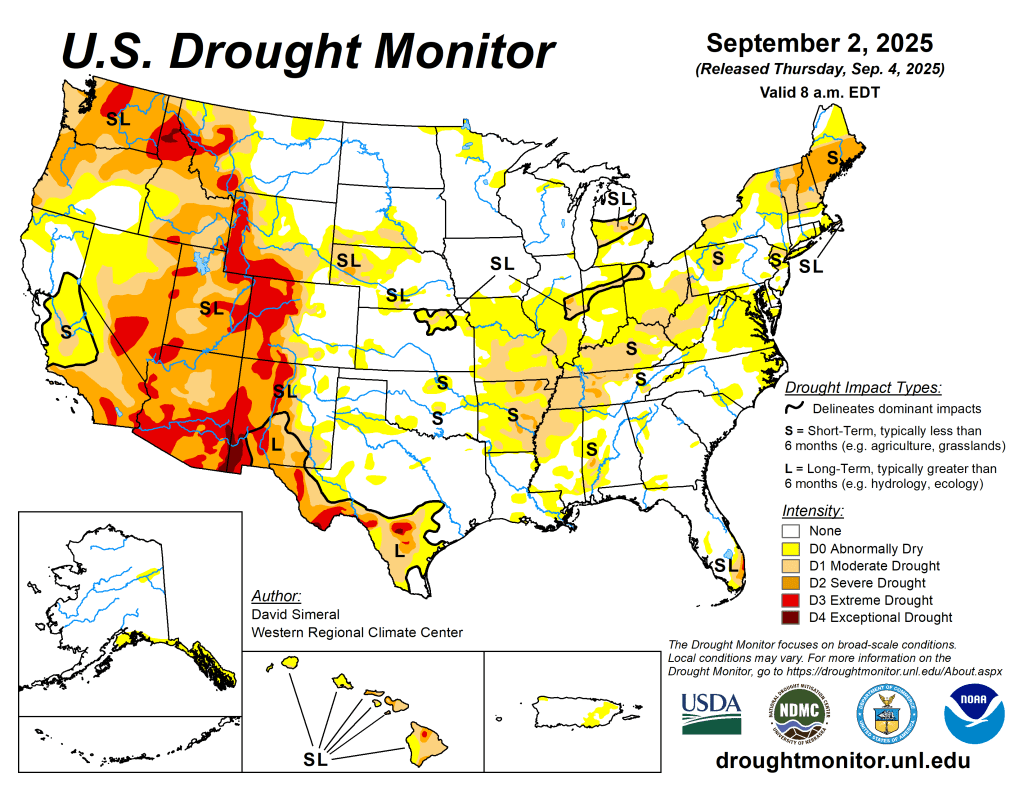
US Drought Monitor map September 2, 2025. 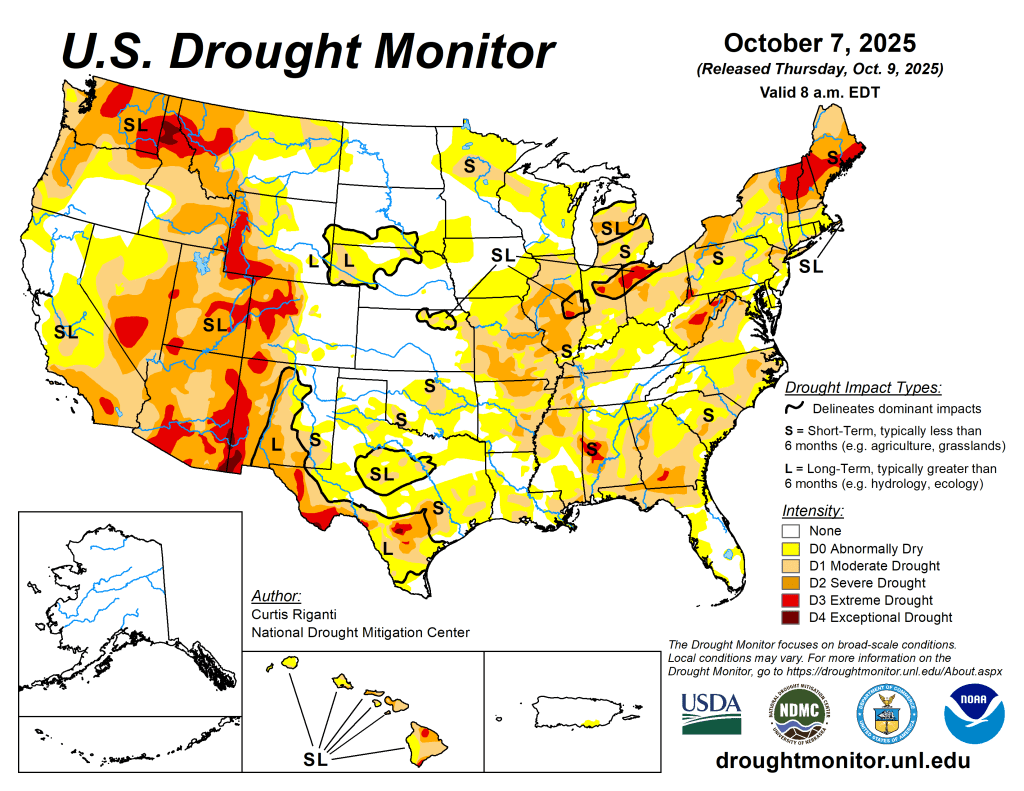
US Drought Monitor map October 7, 2025. 
US Drought Monitor map November 4, 2025. 
US Drought Monitor map December 2, 2025.
2025: A Warm Year Overall
Across much of the U.S., 2025 was a warm year, with annual temperature averages of up to 5° Fahrenheit (F) above normal in most areas. The greatest departures were in the Great Basin, Northern Rockies, and along the southern border. A few spotty areas around the Nation were slightly cooler than normal in 2025, particularly east of the Mississippi River.
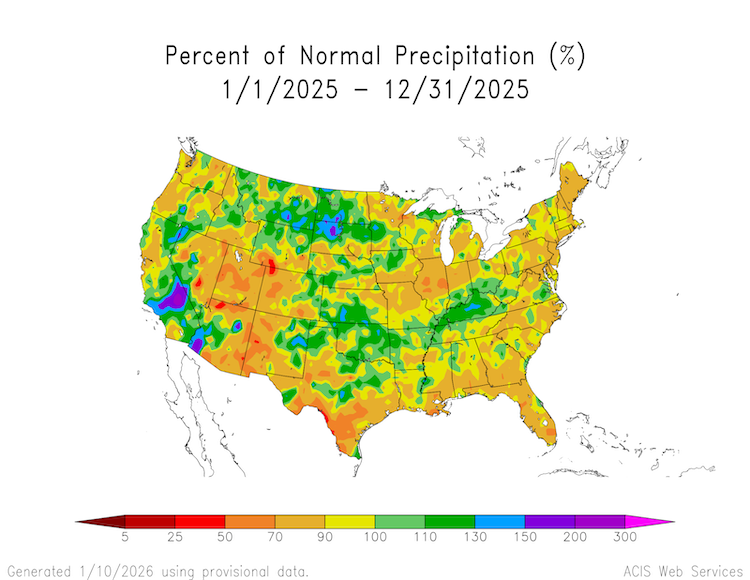
2025 brought a mix of precipitation to the U.S. The Pacific Northwest, Mountain West, Midwest, South, and Northeast were drier than normal. Conditions were particularly poor in the Mountain West and South Texas, where annual precipitation was 50-90% of normal. Southern California, the Dakotas, and southeastern Arizona were wetter than normal.

Heatwave Leads to Early Snowmelt, Runoff in Western U.S.
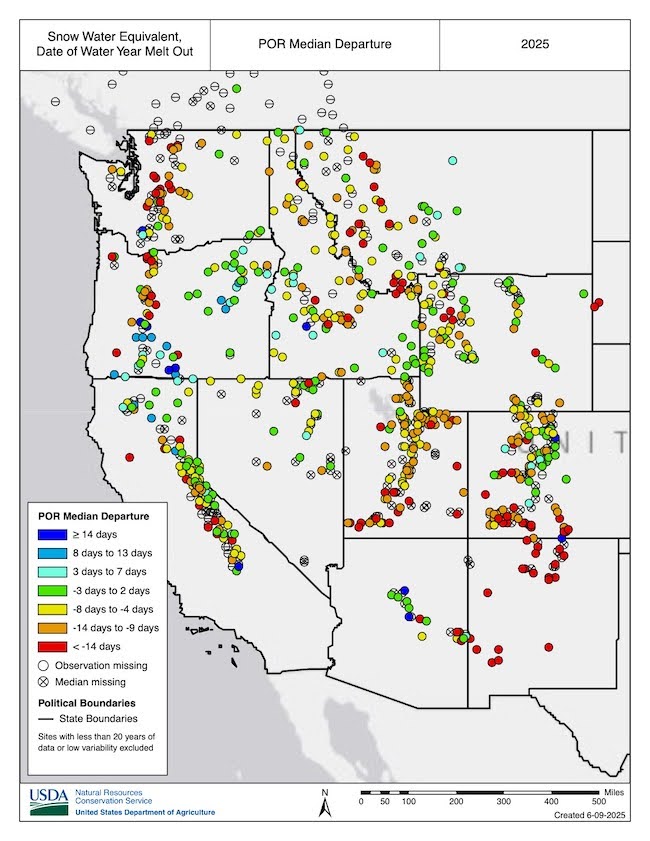
In the West, about 70% of the water supply comes from snow stored in the mountains. Across the West, snow water equivalent on April 1, 2025 was near-normal in most northern watersheds and below normal in watersheds south of the Central Rockies. But April and May brought heatwaves to the mountains, melting snow out much earlier than normal. Rapid melt out occurred across Utah, Colorado, and New Mexico, pushing some basins from above-average snowpack to snow drought conditions in under a month, with snow disappearing 1-4 weeks early.
La Niña Double Dips
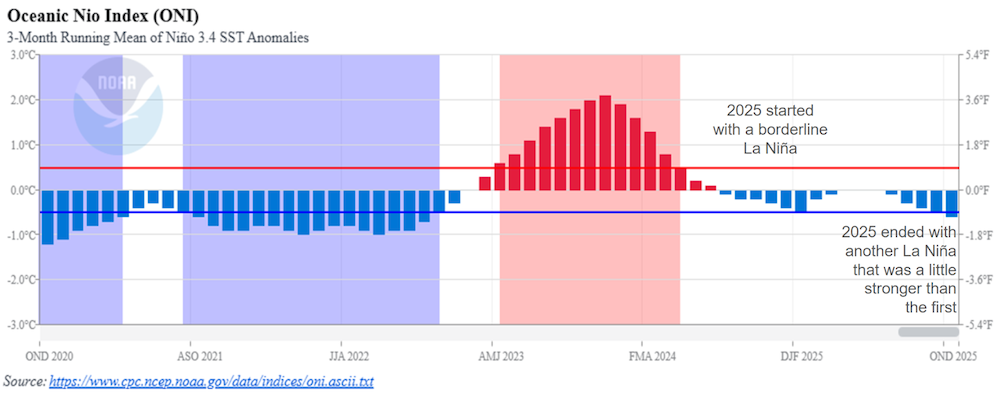
2025 was shaped by two La Niña events. La Niña is one of two phases of the El Niño-Southern Oscillation. La Niña typically brings cool, wet winter conditions to the Northwest U.S., and warm, dry winter conditions to the Southern U.S. The first La Niña was a borderline event, which peaked around January 2025, and then waned by the end of spring. The second was a little stronger, but still considered weak compared to most historical La Niña events. It began developing around August and continues through winter 2025-26.
Low Water Levels on the Mighty Mississippi
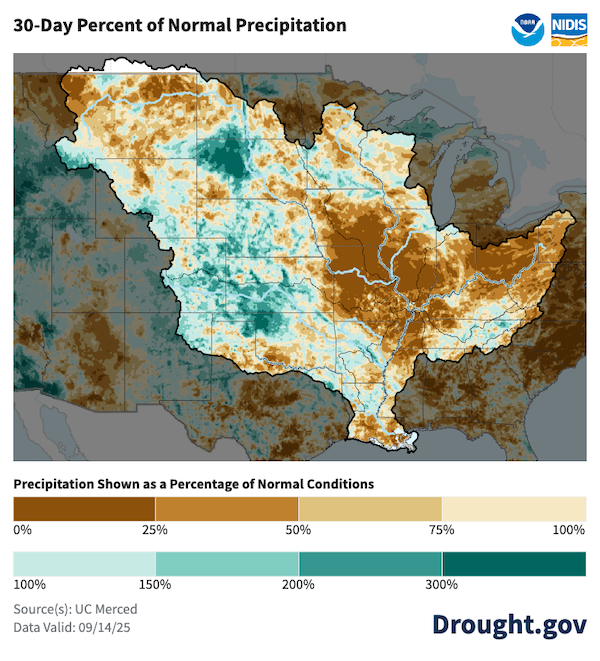
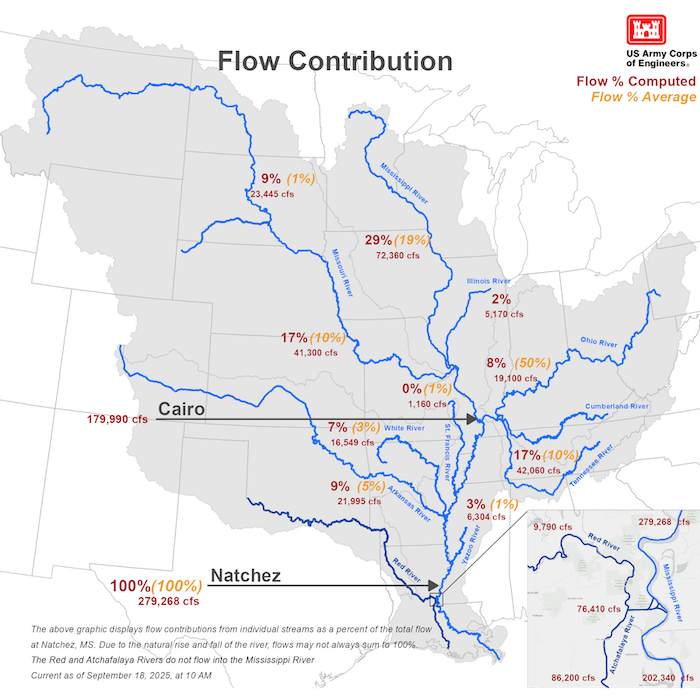
Extremely dry conditions across the Ohio River Basin and southern portions of the Midwest in August and September led to the rapid expansion of drought and decreased flows on the Ohio River and portions of the Lower Mississippi River. In Mid-September, the Ohio River was contributing only 8% of the overall water flow in the Lower Mississippi River, compared to its typical 50% contribution. The Ohio River at Cairo, Illinois (where the Ohio meets the Mississippi River) fell below 10 feet.
Drought Peaked in November at 36%
In late November, the 2025 drought reached its national peak, with 36.65% of the U.S. in drought (D1-D4) according to the U.S. Drought Monitor. November 2025 temperatures were above to much above average throughout most of the Western and Central U.S. Idaho, Nevada, Oregon, Texas, and Utah set new statewide records for November average temperatures. Portions of the northern Great Basin, Northwest, and Rockies and much of the country east of the Mississippi River saw below-average precipitation.

.
Winter Brings Rain Instead of Snow to the West
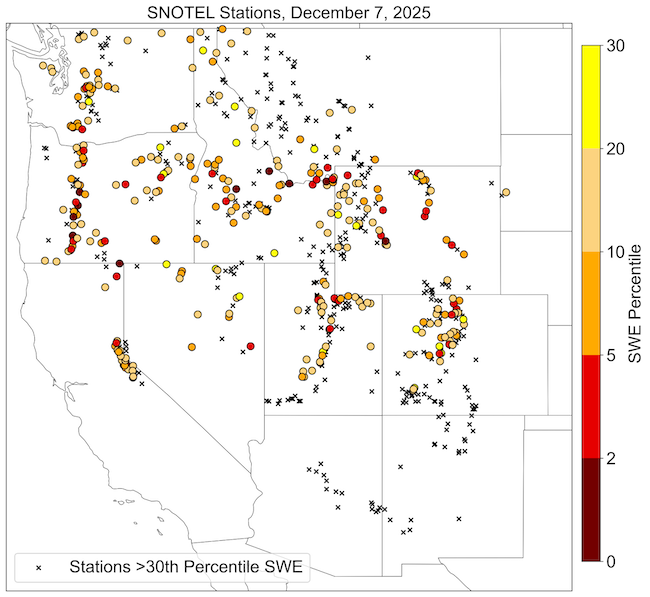
Winter 2025-2026 kicked off with warm weather and rain instead of snow. Nearly every major river basin in the West experienced a November among the top 5 warmest on record. On December 7, 2025, snow cover across the West was the lowest amount for that date in the MODIS satellite record (since 2001), at 90,646 square miles. Water Year 2026 (October 1, 2025–September 30, 2026) precipitation to date was near or above median for many parts of the West in late December. However, much warmer-than-normal temperatures caused precipitation to fall as rain instead of snow in many basins, leading to snow drought despite wetter-than-normal conditions across most of the West. At the end of 2025, snow drought was most severe across much of the Sierra Nevada in California, the Cascade Range in Washington and Oregon, the Blue Mountains of Oregon, and the Great Basin in Nevada.
Keep Up With the Latest Conditions and Outlooks
Find maps, publicly accessible data, and recent research about drought and wildfire on drought.gov. You can also subscribe to NIDIS emails for the latest regional drought updates, webinars, and news in our drought early warning system regions. To stay up to date on the latest drought conditions, sign up to receive drought alerts for your city/zip code when the National Weather Service updates their U.S. Drought Outlooks.
As major #drought looms, #Colorado’s reservoirs are 85% full — Jerd Smith (Fresh Water News) #snowpack
Click the link to read the article on the Water Education Colorado website (Jerd Smith):
January 22, 2026
Colorado’s water storage reservoirs are about 85% full as the state faces a drought year that could be the worst in nearly a quarter century.
State officials are comparing this year with 2002, a year that would deliver one of the worst droughts on record. Whether this year will beat that mark isn’t clear yet.
Having water in storage is how Western states help offset the impacts of crippling droughts. This reservoir storage number, though below average, doesn’t worry water watchers too much right now, according to Nathan Elder, manager of water supply for Denver Water, the state’s largest water utility serving about 1.5 million people.
Denver’s storage system mirrors the statewide average at 82% full. But what worries Elder and others is what lies ahead. Snowpack and streamflow forecasts are so low that the utility is unlikely to be able to fill the reservoirs back up when snows melt this spring.
And that’s unusual. “We always fill,” he said.
In the American West, winter snows melt in the spring, filling reservoirs. Those storage pools help deliver water consistently through long summers and dry falls. Elder said Denver has enough water stored now to last roughly three years.
Northern Water’s storage reservoirs are similarly full, but that’s not causing much cheer. Northern provides water to hundreds of farms and nearly 1 million residents on the Front Range north of Denver.
“We’re in pretty good shape,” said Luke Shawcross, Northern’s water resources manager. “But the forecast is just dismal.”
At a meeting of the state’s Water Conditions Monitoring Committee meeting Thursday, Allie Mazurek, a climatologist with the Colorado Climate Center at CSU, reiterated what has dominated the headlines in recent weeks: December was the warmest on record.
There is little optimism that the state can shake off this record-breaking dry spell, according to Brian Domonkos, snow survey supervisor for the Natural Resources Conservation Services. The agency tracks snowpack in Colorado and other Western states.
Statewide snowpack sits at 57% of normal, Domonkos said. “It’s a record low.”
To get back to some level of normalcy the state would need to receive a series of snowstorms that would drop 145% of the state’s average amount of white flakes.
“And that is not likely,” he said.
Looking ahead, Denver Water and others have begun weekly “water shortage” meetings, with a decision likely in March about whether and what kind of new drought restrictions to impose, Elder said in an interview earlier this week.
“It’s not a good situation,” he said. “We’ve survived years like this in the past and made it through. But it’s a reminder that we live in an arid environment and we need to be conserving all the time.”
This weekend, more snow is expected, but it won’t be a drought-buster, said CSU’s Mazurek.
Still, she said, “at this point, I’ll take anything.”
#Drought news January 22, 2026: Storage in the sprawling, multi-state #ColoradoRiver Basin stood at just under 17.3 million acre-feet (53% of average), reflecting long-term issues in part related to chronically elevated temperatures and a multi-decadal Southwestern drought and #aridification
Click on a thumbnail graphic to view a gallery of drought data from the US Drought Monitor website.

Click the link to go to the US Drought Monitor website. Here’s an excerpt:
This Week’s Drought Summary
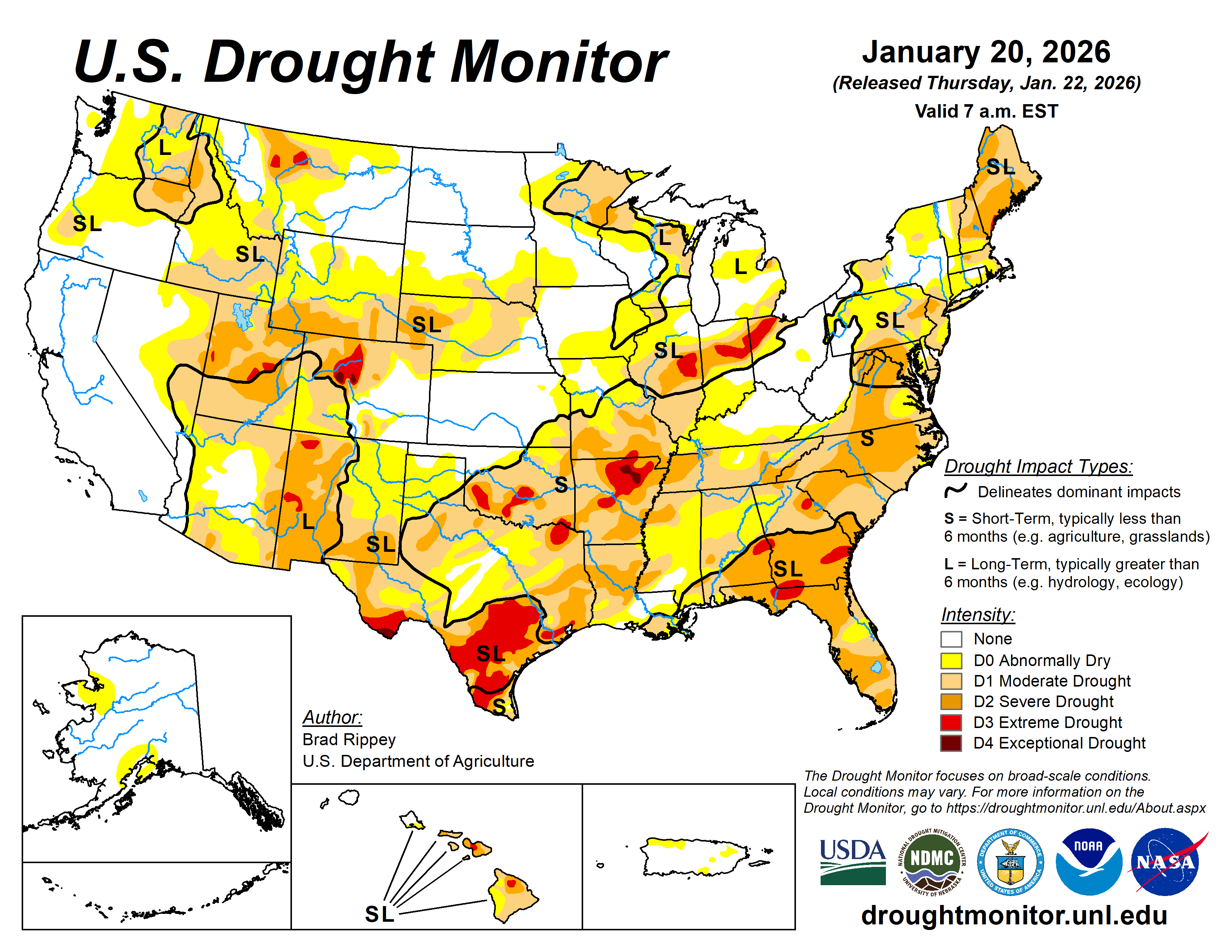
The Lower 48 States finally settled into a more tranquil weather pattern, as a ridge of high pressure settled across the West and a deep trough developed over the East. With many parts of the western U.S. reporting below-average snowpack for this time of year, the pattern change led to increasing concerns regarding Western water supply for next summer and beyond, despite robust precipitation in many areas during the first half of the winter wet season. Still, hydrologic signals were mixed, with California’s 154 primary intrastate reservoirs containing 25.9 million acre-feet of water (123% of the historic average) as 2026 began. Meanwhile, storage in the sprawling, multi-state Colorado River Basin stood at just under 17.3 million acre-feet (53% of average), reflecting long-term issues in part related to chronically elevated temperatures and a multi-decadal Southwestern drought. Farther east, the Plains served as the transition zone between mild, dry weather in the West and increasingly cold conditions in the East. The Plains’ experienced dry weather, aside from wind-driven snow showers on the northern Plains, as well as an occasionally elevated wildfire threat. Elsewhere, areas from the Mississippi Valley eastward noted cold weather, accompanied by occasional rain and snow showers. Some of the heaviest snow fell the Great Lakes States, especially in squall-prone locations. Snow also fell along and near the Atlantic Seaboard, mainly on January 17-18. As colder air became more entrenched in the Midwest and East, drought changes that had been occurring quickly in recent weeks, either due to flash drought or active winter storms, became more muted, with drought effectively “frozen in place” by chilly, mostly dry conditions. During the second half of the drought-monitoring period, sub-0°F temperatures were commonly observed across the upper Midwest and neighboring regions…
High Plains
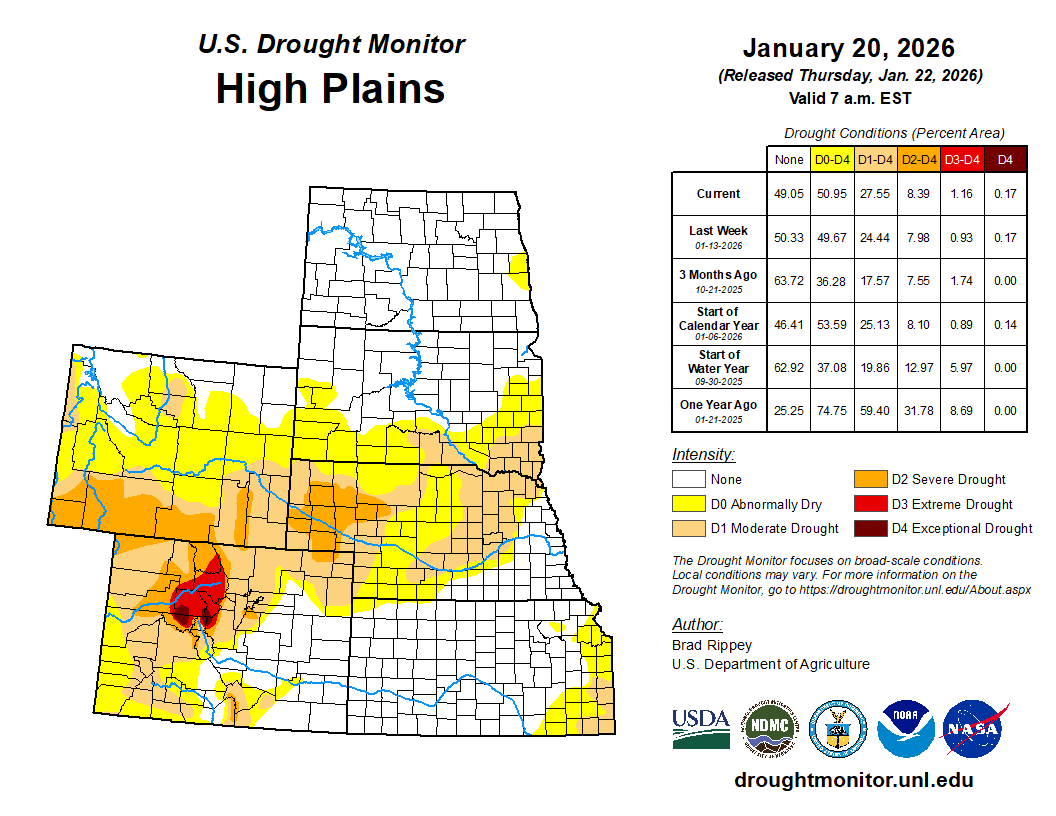
Patchy expansion of dryness and drought was noted, mainly across Nebraska, Wyoming, and southern South Dakota. Due to periods of warm, windy weather, Nebraska reported that statewide topsoil moisture was rated 68% very short to short in early January, according to the U.S. Department of Agriculture. Similarly, Wyoming’s topsoil moisture was rated 55% very short to short…

West
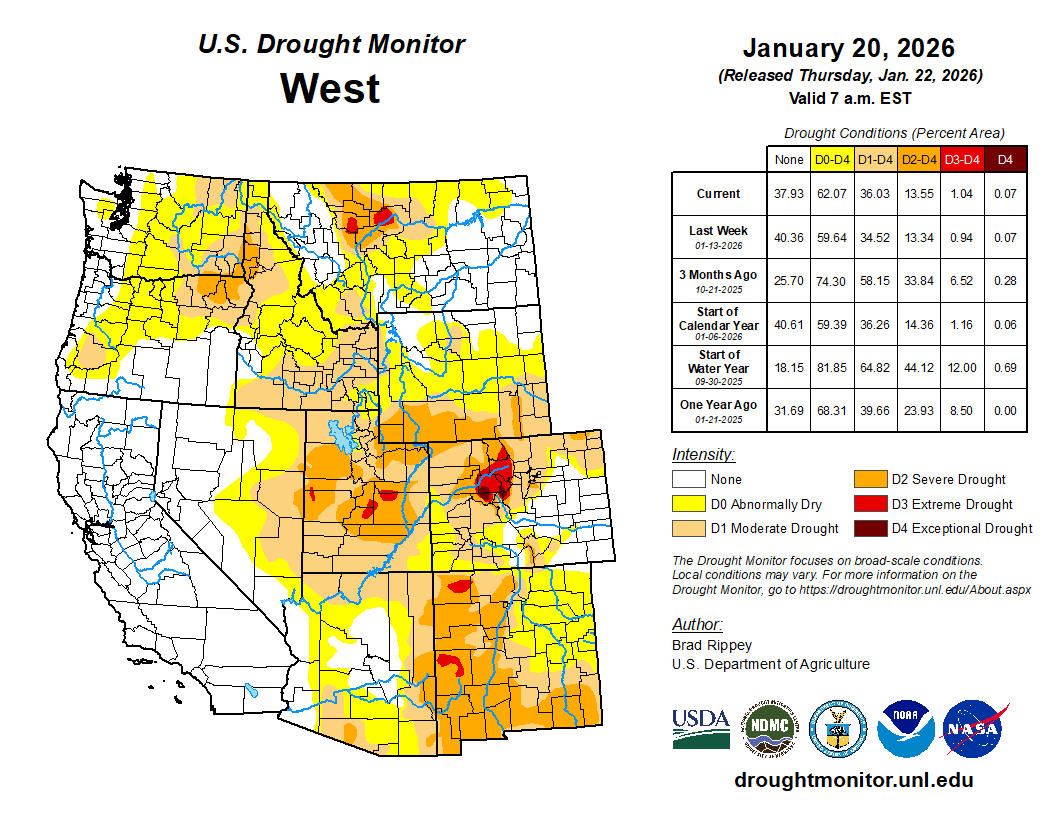
Over the last couple of weeks, an uncomfortable silence has settled across the West. With snowpack already below average in many Western watersheds due to this winter’s preponderance of “warm” storm systems, the mid-point of the region’s snow-accumulation season has arrived with snow-water equivalencies falling farther behind normal each day. Among Western basins, only those located in the northern Rockies and neighboring areas are reporting widespread near-normal snowpack. By January 20, snow-water equivalencies were broadly less than 50% of average in Oregon (and portions of adjacent states) and the Southwest. Although many areas of the West are reporting above-average season-to-date precipitation, the anomalous winter warmth and corresponding lack of snow could have serious future implications for wildfire activity and summer water supplies. For now, however, more than half of the 11-state Western region—including all of California—is free of drought…
South
Worsening drought was a common theme, especially from eastern Texas into Arkansas. A small area of exceptional drought (D4) was introduced in northern Arkansas, amid a punishing period of drought that has left pastures in extremely poor condition and has left many individuals with limited surface water supplies from ponds and streams. Several weeks ago, in early January, the U.S. Department of Agriculture categorized Arkansas’ topsoil moisture as 46% very short to short—and mostly dry weather has prevailed since that report was compiled. From northern Arkansas, a continuous area of severe to extreme drought (D2 to D3) extended southwestward into northeastern Texas. Patchy D2 stretched into neighboring states, including Louisiana, Mississippi, and Tennessee. Much of southern Texas, as well as southern, central, and eastern Oklahoma is experiencing moderate to extreme drought (D1 to D3)…
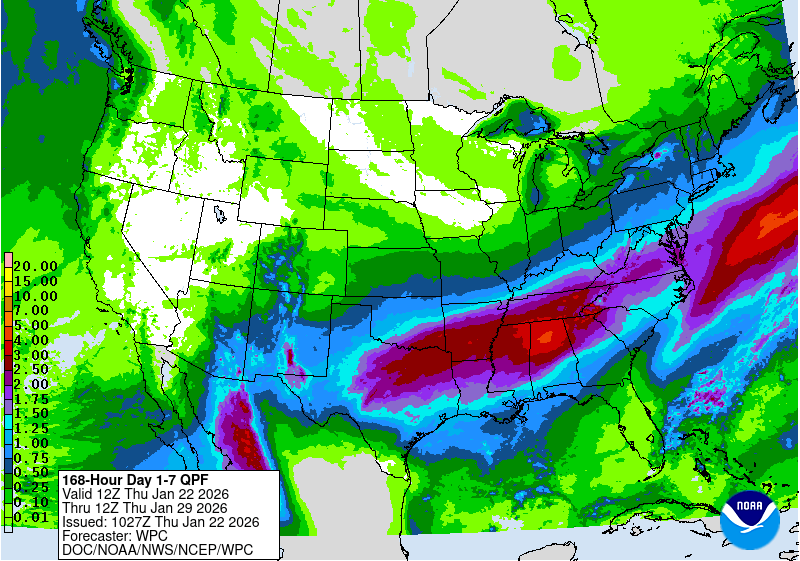
Looking Ahead
From January 23-26, an expansive and potentially dangerous winter storm will unfold from southern sections of the Rockies and Plains to the middle and southern Atlantic States, excluding areas along and near the Gulf Coast. Much of the South will face multiple weather hazards, including wintry precipitation (snow, sleet, or freezing rain), gusty winds, and unusually low temperatures. Wintry weather may extend at least as far south as central Texas and northern sections of Louisiana, Mississippi, Alabama, and Georgia. Post-storm temperatures should fall to 10°F or below along and north of a line from central Texas to northern Georgia, with particular concern for areas that lose electricity due to downed power lines from accumulations of ice and snow. Farther north, sub-0°F readings will be common as far south as the central Plains and the Ohio Valley. The storm is likely to have serious agricultural impacts, including significant stress on livestock due to exposure to cold, wind, wintry precipitation, or a combination of weather extremes. Temperatures could briefly plunge to -30°F or below from North Dakota into the upper Great Lakes region.
The NWS 6- to 10-day outlook for January 27 – 31 calls for the likelihood of below-normal temperatures throughout the eastern half of the U.S., while warmer-than-normal weather will prevail in the West. Meanwhile, near- or below-normal precipitation nearly nationwide should contrast with wetter-than-normal conditions in a few areas, including southern Florida and southern and coastal Texas.

Romancing the River: The Romantic Scientist — George Sibley (SibleysRivers.com) #ColoradoRiver #COriver #aridification

Click the link to read the article on the Sibley’s Rivers website (George Sibley):
January 20, 2026
There continues to be no new information from the ongoing negotiations among the protagonists for the seven states trying to work out a new two-basin management plan for the Colorado River. The Bureau of Reclamation, however, is pressing ahead; it recently went public with its ‘Draft Environmental Impact Statement’ (DEIS) for ‘Post-2026 Operational Guidelines and Strategies for Lake Powell and Lake Mead.’
The five alternative ‘operational guidelines and strategies’ analyzed in this DEIS were announced back in the fall of 2024; the Bureau has spent the past year-plus examining their environmental impacts. I’m not going to go into their analyses right now; I’m still working on skimming, skipping, sprinting and plowing my way through enough of the 1600 pages or so of the report to feel reasonably informed on its contents.
But I will note that the first action analyzed (skipping past the mandatory ‘No Action’ alternative) is for the Bureau to go ahead and run the river system as it sees fit, without input from the seven states/two basins – not something they want to do, but would have to do since the system will not wait while the states stare at their chessboard stalemate. That action would of course precipitate lawsuits from some of the states since the Bureau would have to go ahead with some of the things that are part of non-debate behind the stalemate.
Anyone wishing to submit themselves to the torture of an EIS can find the home page and Table of Contents for the report by clicking here.
And in the meantime, I’ll go off again on what I hope might be at least a more interesting tangent, and maybe more creative – fully believing that the only way out of our ever-unfolding river mismanagement is some centrifugal push to get beyond the tight centripetal pull of the Colorado River Compact and its two-basin expedient that has become gospel.
Two posts ago here, I acknowledged a need to explain why I titled all these posts ‘Romancing the River’ – ‘romance’ being a degraded term these days for many people, most commonly referring to formulaic fiction about chaotic and improbable couple-love relationships. This is a sad degradation of a word that, in more imaginative times, referred to a much larger quality or feeling of adventure, mystery, something beyond or larger than everyday life – ‘your mission should you choose to accept it,’ as it was expressed in Mission Impossible and The Hobbit.
‘Romance’ has been used to describe our relationship with the Colorado River for more than a century. C. J. Blanchard, a spokesperson for the Bureau of Reclamation in 1918, spoke of the ‘romance of reclamation,’ observing that ‘a vein of romance runs through every form of human endeavor.’ The first book compiling the history of the Euro-American exploration of the Colorado River was titled The Romance of the Colorado River. Written by Frederick Dellenbaugh, something of an explorer himself, he first encountered the Colorado River in the company of one of the river’s greatest romantics, John Wesley Powell, on Powell’s second adventure into the canyon region of the river.
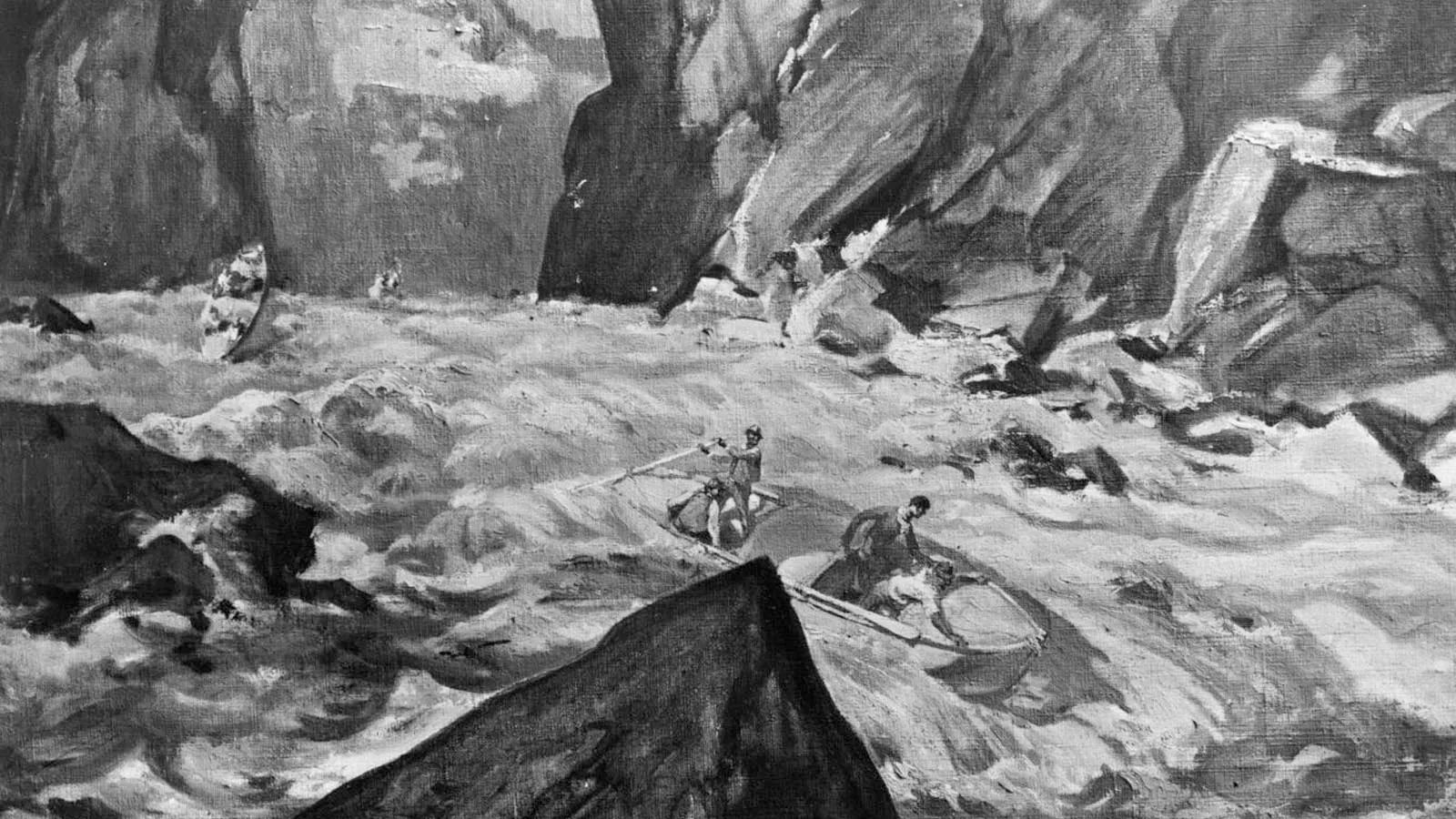
Now wait a minute, you may say: John Wesley Powell a romantic? Everyone knows he was a scientist! Well, yes, that too. A romantic scientist. Let me try to explain.
Science is a discipline, perhaps summarized in the caution: Look before you leap. Science is the discipline of looking, studying, analyzing for causes in some studies, for effects in others, basically trying to map out what is demonstrably going on in the system or structure being studied. But most scientists will acknowledge being also moved by feelings, convictions, beliefs that lie outside of or beyond the linear relationships of cause and effect explorations. The extreme example might be scientists who believe in a god or gods that oversaw the creation they are studying. More subtly, the very desire to pursue a life in science reflects a belief beyond evidence that the work is important as well as interesting. This is the ‘romance’ underlying science and those who pursue it.
The same year Dellenbaugh published his Romance, 1903, another southwestern writer, Mary Hunter Austin, came out with her Land of Little Rain, a poetic collection of her explorations in the deserts of the lower Colorado River region. In that book she offered what might be a cautionary note about ‘romancing the river.’ In an observation about a small central Arizona tributary of the Colorado River, ‘the fabled Hassayampa,’ she reports an unattributed legend: ‘If any drink [of its waters], they can no more see fact as naked fact, but all radiant with the color of romance.’
That could be construed into a kind of spectrum, the ‘naked facts’ of any situation at one end, the ‘radiant colors of romance’ dressing up the naked facts at the other end. The discipline of science is to stay as close to the ‘naked facts’ as possible. But is it a bad thing to allow feelings or beliefs to dress up the naked facts with the radiant color of romance?
Hold that question for a bit, and back to Major John Wesley Powell. Powell was a scientist by nature – meaning born a curious fellow who collected information about things that made him curious. He studied science in a couple of colleges, but never completed a degree – partially, probably, because college science was a little too tame. One of his early ‘field trips’ was a solo trip the length of the Mississippi River in a rowboat. Another was a four-month walk across the ‘Old Northwest Territory’ state of Wisconsin. Both of those trips pretty unquestionably fall more into the category of ‘romantic adventures’ than ‘scientific expeditions.’
As a son of an itinerant farmer/preacher immigrant, growing up on farms in rural New York, Ohio and Illinois, he also shared, to some extent, the romantic Jeffersonian vision of ‘another America,’ a nation of small decentralized and mostly locally-sufficient communities of farm families – now just a nostalgic fantasy-vision of nation building that still haunts the imperial urban-industrial mass society that America has become. But trips to the west had convinced Powell that the mostly arid lands of the West were largely unsuitable for the spread of that agrarian vision, without the development of an appropriate system for settlement and land management specifically for the arid lands.
He had ideas about that, things to say, but he was basically just a high-school teacher who spent his summers adventuring west; how could he get a hearing for his concerns and ideas? He needed some way to gain public attention. So he turned his destiny over to his romantic adventurer side: he would do a scientific investigation into one of the remaining blank spots on the continental map, the region beginning where the rivers draining the west slopes of the Southern Rockies disappeared into a maze of canyons, and ending where a river emerged from the canyons – a river thick with silt and sand, indicating a pretty rough passage through canyons still in the creation stage.

Wallace Stegner, in his great book about Powell and the development of the arid lands, Beyond the Hundredth Meridian, credited Powell’s scientific grounding with getting him through his 1869 expedition into the canyons: ‘Though some river rats will disagree with me, I have been able to conclude only that Powell’s party in 1869 survived by the exercise of observation, caution, intelligence, skill, planning – in a word, Science.’
I’m one of those who disagree with Stegner on that point. The advance planning for the trip sank in the first set of Green River rapids, with the wreckage of one of the boats containing a large portion of both their food supply and scientific instruments. They gradually acquired some skill at negotiating rapids (and knowing when to portage instead), but they started with no skill and paid the price. Observation was limited to the stretch of river before the next bend. Dellenbaugh asked Powell, on the second trip in 1871-72, what he would have done had he come to a Niagara-scale waterfall with sheer walls, no room for portage and no way back upriver. Powell answered, ‘I don’t know.’ Scientific caution was not a factor in this trip; they leapt before looking because there was no way to look first.
Stegner to the contrary, I would argue they survived the way adventurers survive (and sometimes don’t): a kind of adaptive intelligence, for sure, figuring out how to make rotten bacon and moldy flour edible, how to fabricate replacement oars, how to deal with the unexpected quickly and decisively. But mostly, just gutting it out, keeping spirits from crashing completely with morbid humor and routines – Powell getting out the remaining instruments to take their bearing rain or shine, getting back in the boats every morning and turning their lives over to the will of the river again.
And it worked out. Ninety-one days after starting, they made national headlines when they floated half-starved into a town near the confluence with the Virgin River. And Powell, a national hero after that, procured a government job doing a ‘survey’ of the Utah territory.
Then Powell the scientist took over – but the romantic side of his nature shaped his scientific work. The unstated purpose of the western surveys by the 1870s was to map out potential resources for the fast-growing industrial empire ‘back in the states’; Powell covered those bases, but the heart of his 1879 ‘Report on the Lands of the Arid Region…’ was analysis of the potential of the arid lands for fulfilling Jefferson’s romantic agrarian vision for America. All agricultural activity, he argued, would require irrigation, and there was only enough water to irrigate many three percent of the land.
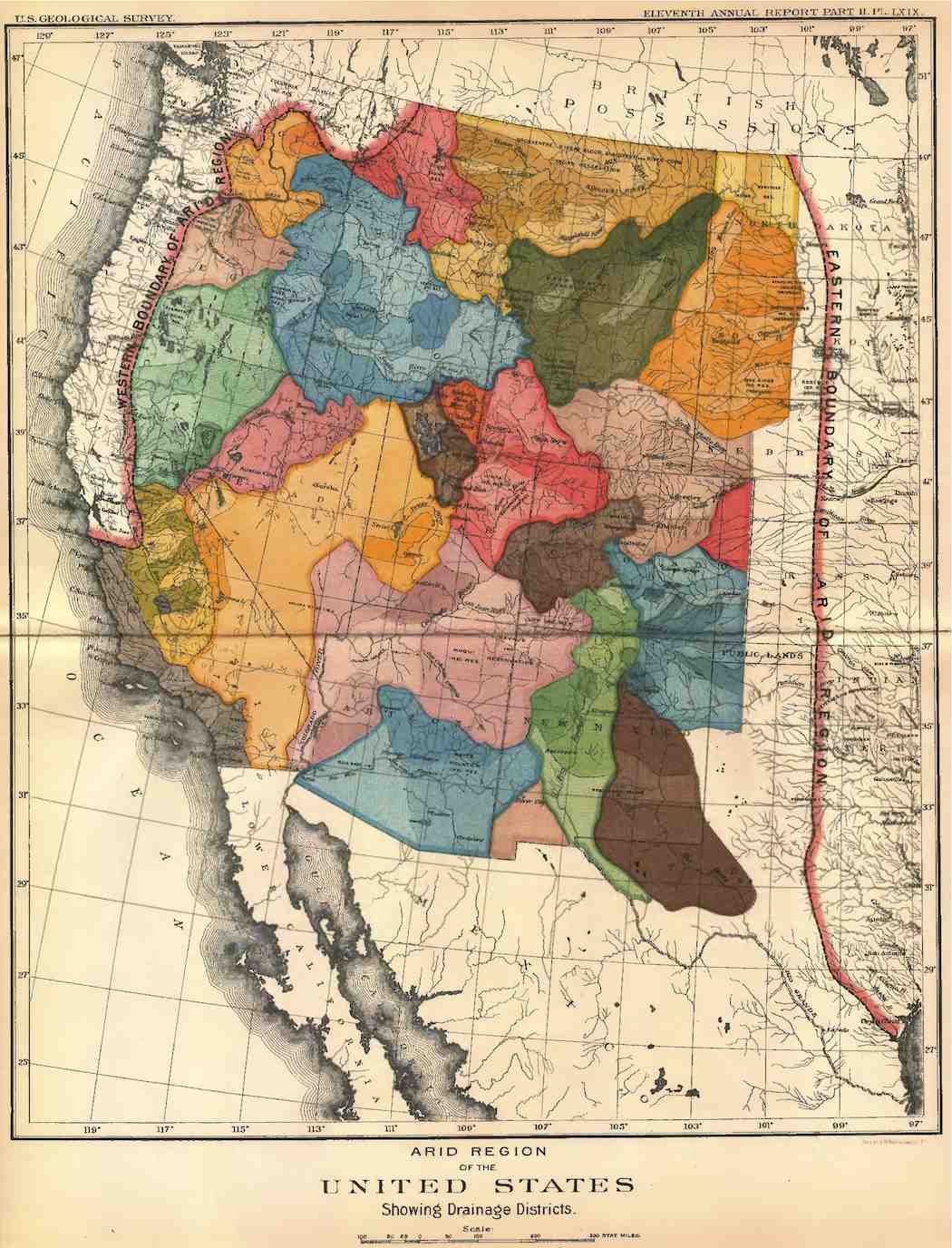
He made a strong case for replacing the Homestead Act’s one-size-fits-all 160-acre homestead allotments with two alternatives for the arid lands: 1) 80-acre allotments for intensive irrigated farming, that being as much as a pre-tractor farm family could successfully tend; or 2) ‘pasturage’ allotments on unirrigable land of 2,560 acres, four full sections, for stockgrowers, with up to 20 irrigable acres for growing some winter hay and the ubiquitous kitchen garden. He went even further than that: settlement should not be done on a willy-nilly ‘first-come-first-served basis’; instead each watershed should be developed by an organized ditch company working from a plan assuring that every member got a fair allotment of water and that the water was most efficiently distributed. And the right to use that water should be bound to the land, he said. No selling your water right to some distant city!
Powell did not just recommend this in his report; he included model bills for state and federal legislation. He was of course thoroughly ignored because everything that he suggested was contrary to the romantic mythology of the Winning of the West – Jefferson’s legendary ‘yeoman’ conquering the wilderness, the rugged American individualist going forth with rifle, ax and Bible.
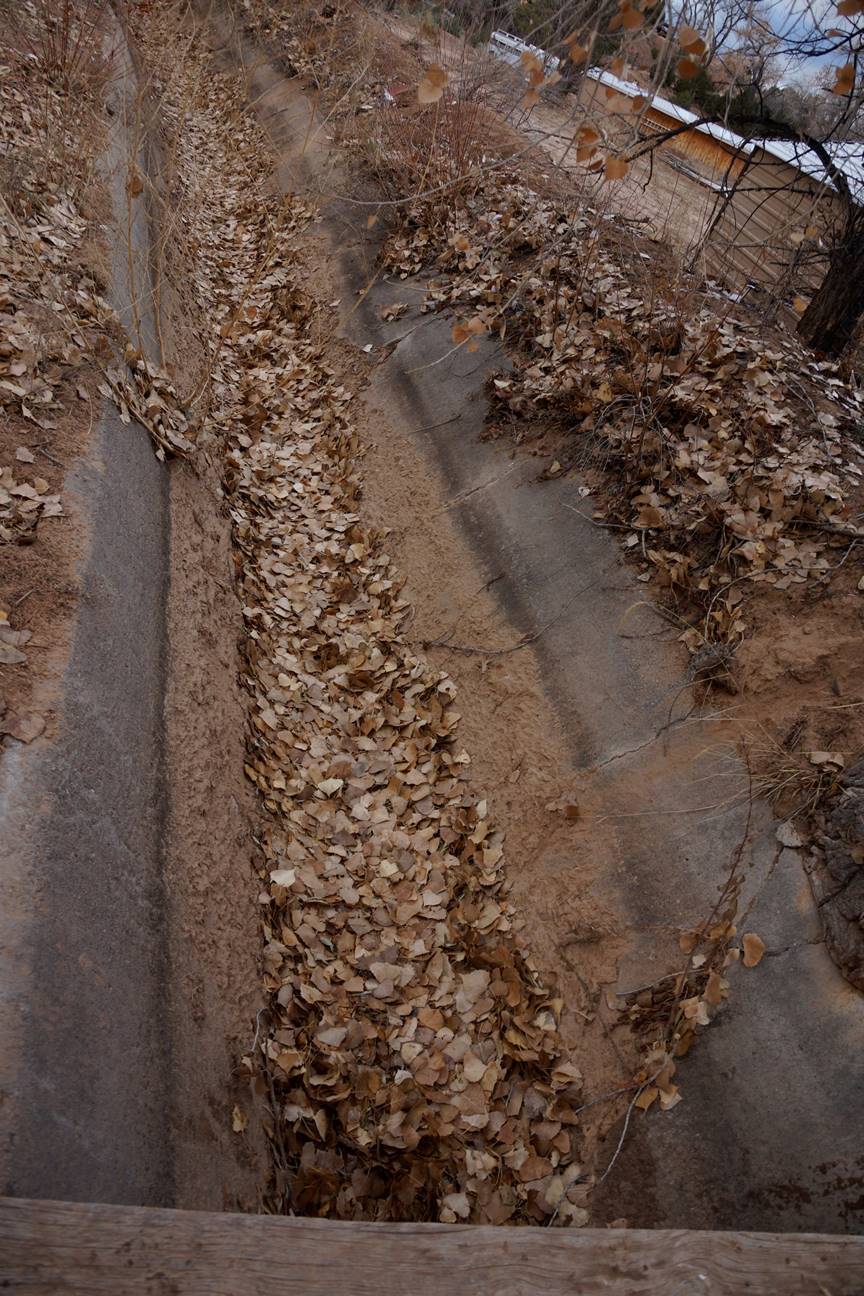
That American mythology from the start was always ‘all radiant with the color of romance,’ with very little attention to ‘the naked facts’ – which is the main reason why two out of three homesteads failed as settlement moved into the semi-arid High Plains and the arid interior West. ‘The naked facts’ of aridity, on the other hand, had been foundational to the communal land-grant system imported from Spain to Mexico, and it was already known to many of the native peoples already in the Americas: it takes a village and a stream to raise good crops in the arid lands. Powell observed it in the Utah Territory, where the Mormons had borrowed it from the natives and Mexicans.
Powell was philosophical about being ignored – and kept on pushing. He was ‘present at the creation’ of the United States Geological Survey (USGS) in 1879, the same year he presented his ‘Report on the Lands of the Arid Region.’ And two years later he became director of the USGS, where he tried to keep both the Agrarian Romance and ‘the naked facts’ of aridity front and center. He tried to sell the idea of doing a complete survey of the interior West to map its water resources and the adjacent areas of possible successful settlement, and he was actually a vote or two from achieving that, and actually shutting down the homesteading process until the study was done. But once some of the senators fronting for the industrialists realized what he was doing, they shut him down with a vengeance – he quickly realized that to save the USGS, he had to resign from it, and did so in 1894. Western extractive industries depended to some extent on failed homesteaders for their labor supply.

Powell was not out of work, however. From his pre-canyon days he had been interested in the First Peoples of the West. While most Euro-Americans saw them, at best, as raw material for conversion to Christianity and industrial labor, and at worse, as vermin to be wiped off the land, Powell saw them as people who had survived and even thrived in the region with Stone Age technology, some still semi-nomadic, some settled in agrarian communities, and therefore people from whom something might be learned. His efforts to communicate with those he encountered in his Utah survey led to the 1877 publication of a book, Introduction to Indian Languages – which led, two years later to the creation of the U.S. Bureau of Ethnology in the Smithsonian Institute with Powell as director – a position he held until his death in 1902, finally producing the first comprehensive linguistic survey of indigenous tongues, Indian Linguistic Families of America, North of Mexico(1891).
In both ethnology and the geology survey Major Powell established a high standard for government science – attention to the naked facts while still trying to carry forward what Bruce Springsteen called ‘the country we carry in our hearts’ – the ever evolving, devolving, careening, diverted, perverted, and currently severely damaged Romance of the American Dream. Next post, we’ll take a look at what happens when that standard gets out of balance.
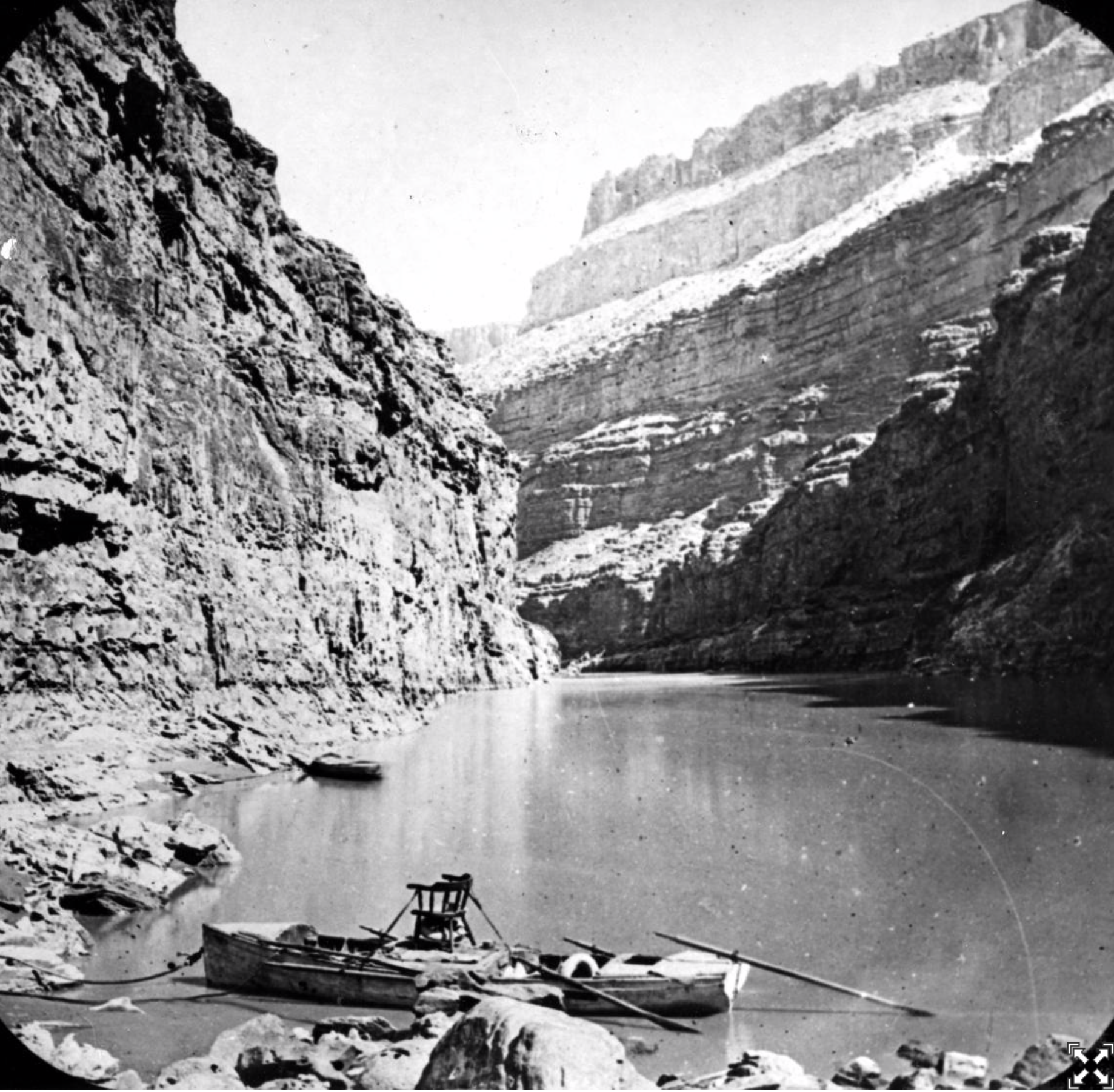
But I want to leave you with a Colorado River image of Powell, related in Dellenbaugh’s Romance of the Colorado River: there were afternoons in that second voyage in the canyons, in the placid stretches between rapids, when the men would rope the boats together, and Major Powell would sit in his chair on the deck of the Emma Dean and read to them from the romantic adventure stories of Sir Walter Scott. Romancing the River.
#ColoradoRiver talks: States are still at odds but working toward a 5-year plan: Time is running short, with less than a month to submit a plan to the federal government — Annie Knox (UtahNewsDispatch.com) #COriver #aridification
Click the link to read the article on the Utah News Dispatch website (Annie Knox):
January 30, 2026
With just weeks to decide how to share the Colorado River’s shrinking water supply, negotiators from seven states hunkered down in a Salt Lake City conference room.
Outside was busy traffic on State Street and South Temple. Inside was gridlock that eased up for a time, only to return, Utah’s chief negotiator, Gene Shawcroft said Tuesday of last week’s meetings.
The states moved forward on a deal for two-and-a-half days, then went back by almost as far as they’d come, Shawcroft said.
“I would just tell you that four days is too long. We got tired of each other,” he said.
Shawcroft reiterated Tuesday what he and his counterparts from the other Colorado River states have said in recent months: They don’t have a deal, but they do have a commitment to keep talking and meet their upcoming February deadline.
The earlier goal was to reach a 20-year deal, but Shawcroft told Utah News Dispatch the states are now working on an agreement for a shorter time frame.
“I think it’ll be fairly simple, but I think it’ll allow us to operate for the next five years,” Shawcroft said.

The river provides water to 40 million people across the U.S. and Mexico, contributing 27% of Utah’s water supply. It is shrinking because of drought, [ed. and aridification]overuse and hotter temperatures tied to climate change.
Time for negotiators is also drying up as a Feb. 14 deadline set by the federal government approaches. The current agreement runs through late 2026.
The four Upper Basin states — Utah, Colorado, New Mexico and Wyoming — are at odds with the Lower Basin states of Nevada, Arizona and California.
The upstream states don’t want to make mandatory cuts in dry years, saying they typically use much less than they’re allocated. The downstream states say all seven need to absorb cuts in difficult years.
Conservation groups have criticized the states for not reaching a deal yet, saying “escalating risks” — including declining storage in lakes Powell and Mead — are piling up every month they fail to agree on a plan.
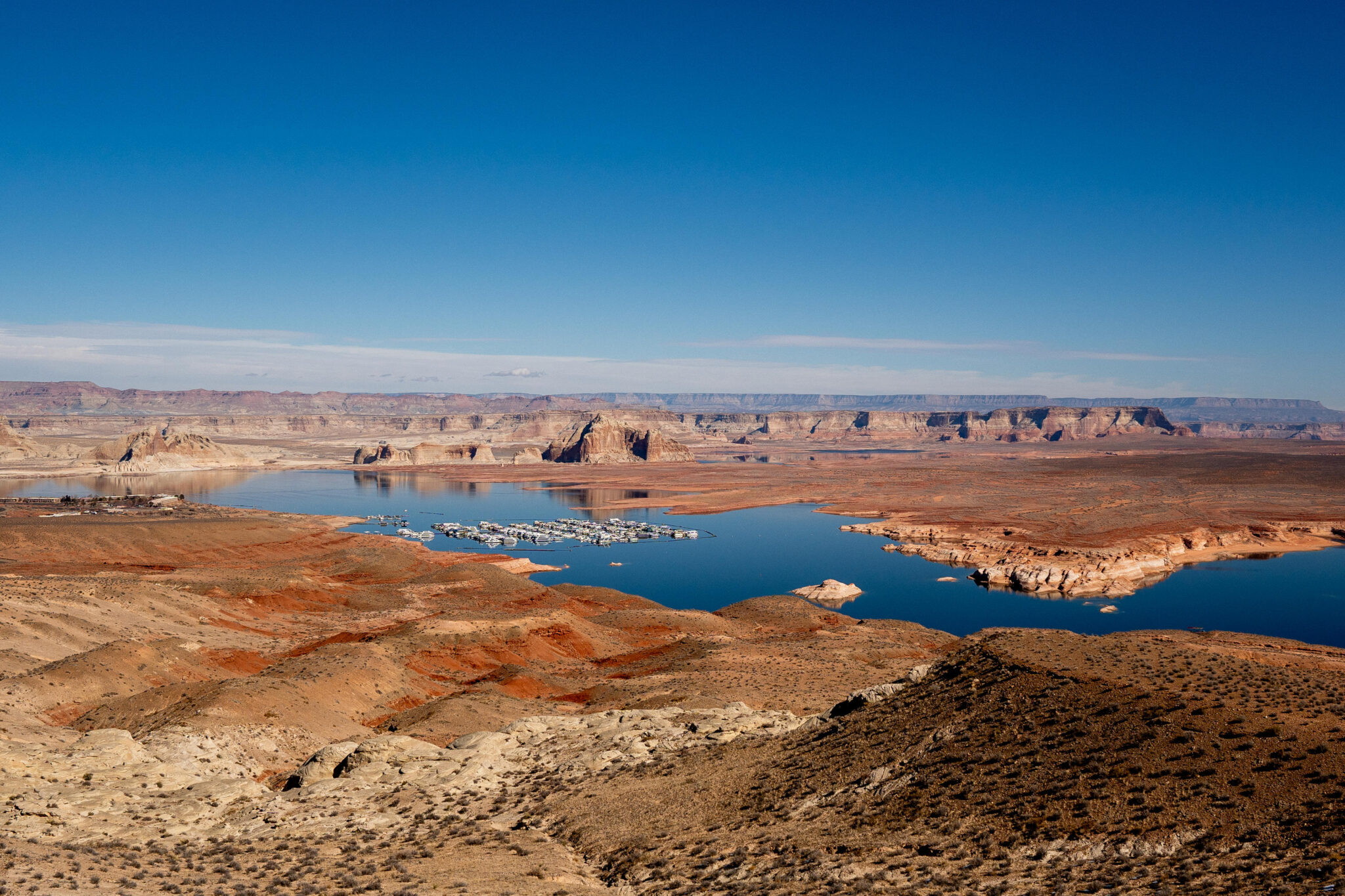
The debate centers in part on upstream reservoirs like Flaming Gorge on the Utah-Wyoming border and whether they’ll be managed under the new plan.
“Lower Basin believes those reservoirs ought to be used at the beck and call of the lower basin to reduce their reductions,” Shawcroft said at the meeting. “Obviously, we think differently.”
Arizona Gov. Katie Hobbs, for her part, has criticized the upstream states’ “extreme negotiating posture,” saying they refuse to participate in any sharing in managing water shortages.

Demand for water is outpacing the river’s supply, and extended dry periods aren’t helping. At the meeting, board members viewed a map covered in yellow, orange and red, noting the entire Colorado River watershed is experiencing some level of drought.
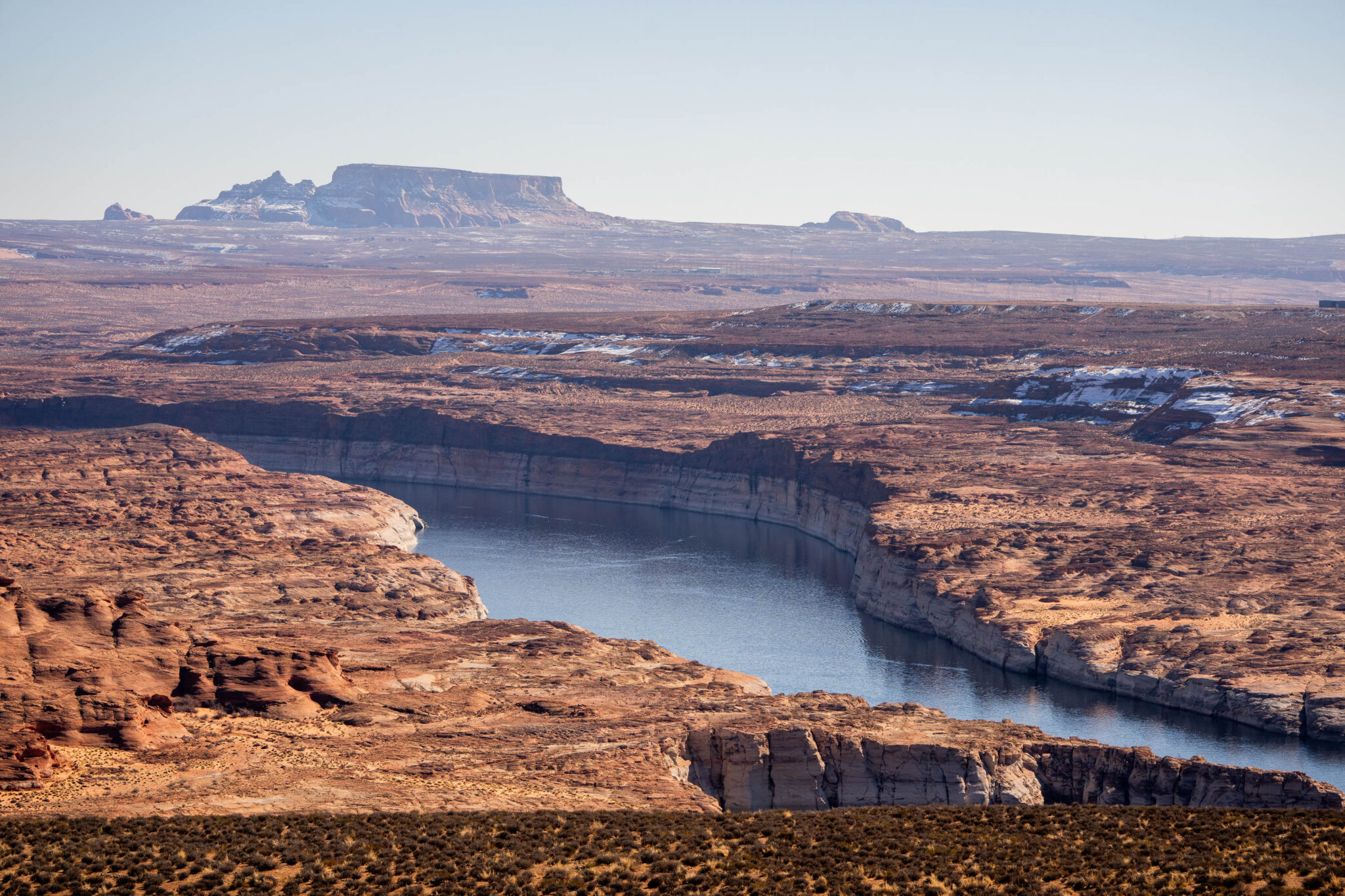
Earlier this month, the U.S. Bureau of Reclamation, the federal agency that oversees water in the West,released five options for a framework on managing the river’s biggest reservoirs, Lake Mead in Nevada and Lake Powell on the Utah-Arizona line.
Amy Haas, executive director of the Colorado River Authority of Utah, said she and her colleagues were still reviewing the 1,600-page document but one thing is clear.
“None of the five can provide what for Utah is really the central consideration for the deal, and that is a waiver of compact litigation,” Haas said.
States can sacrifice more than just time and money in lawsuits over water use. In Texas, similar litigationgave the federal government more leverage in negotiations.
One of the Bureau of Reclamation’s plans would have Nevada, Arizona and California face potential water shortages. It could go into effect next year if the seven states don’t reach a deal.
“The river and the 40 million people who depend on it cannot wait,” Andrea Travnicek, assistant interior secretary for water and science, said in a Jan. 9 statement announcing the five alternatives. “In the face of an ongoing severe drought, inaction is not an option.”
The world is in water bankruptcy, UN scientists report – here’s what that means — Kaveh Madani (TheConversation.org)
Kaveh Madani, United Nations University
January 20, 2026
The world is now using so much fresh water amid the consequences of climate change that it has entered an era of water bankruptcy, with many regions no longer able to bounce back from frequent water shortages.
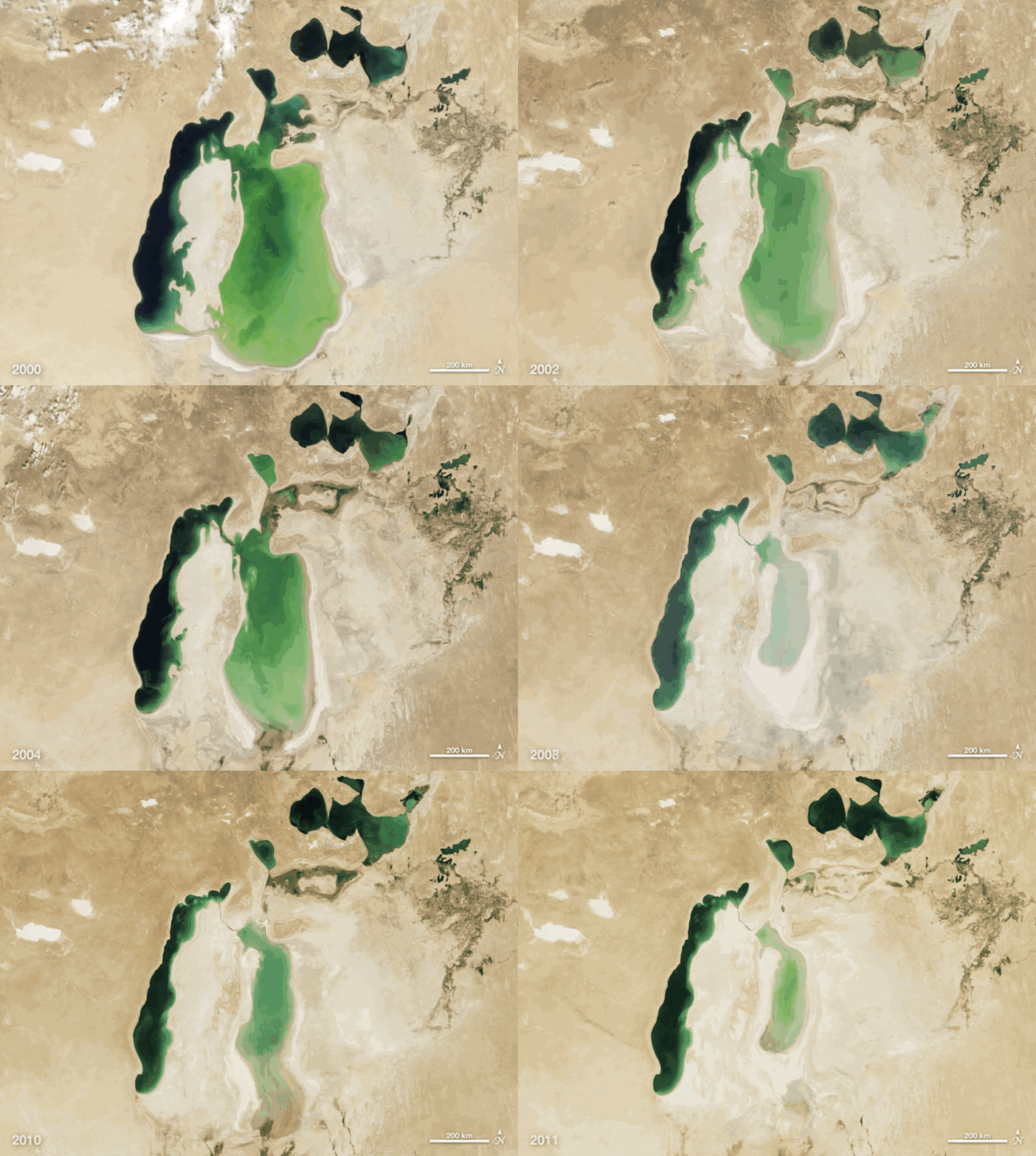
About 4 billion people – nearly half the global population – live with severe water scarcity for at least one month a year, without access to sufficient water to meet all of their needs. Many more people are seeing the consequences of water deficit: dry reservoirs, sinking cities, crop failures, water rationing and more frequent wildfires and dust storms in drying regions.
Water bankruptcy signs are everywhere, from Tehran, where droughts and unsustainable water use have depleted reservoirs the Iranian capital relies on, adding fuel to political tensions, to the U.S., where water demand has outstripped the supply in the Colorado River, a crucial source of drinking water and irrigation for seven states.
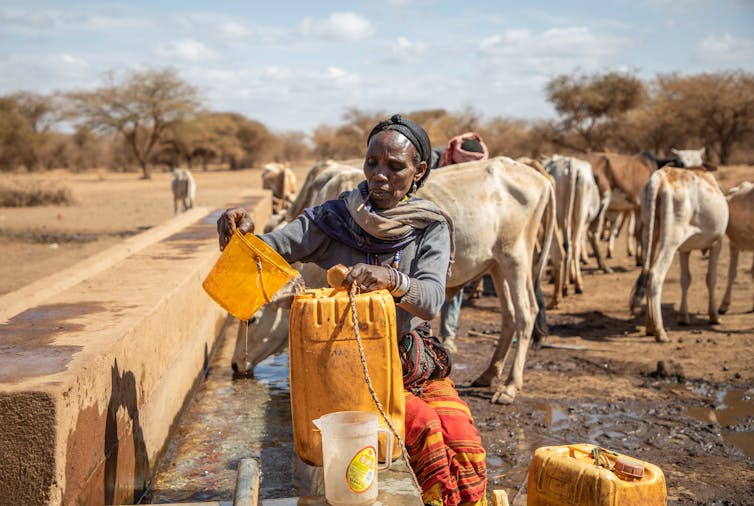
Water bankruptcy is not just a metaphor for water deficit. It is a chronic condition that develops when a place uses more water than nature can reliably replace, and when the damage to the natural assets that store and filter that water, such as aquifers and wetlands, becomes hard to reverse.
A new study I led with the United Nations University Institute for Water, Environment and Health concludes that the world has now gone beyond temporary water crises. Many natural water systems are no longer able to return to their historical conditions. These systems are in a state of failure – water bankruptcy. https://www.youtube.com/embed/rnMDoX_2vR8?wmode=transparent&start=0 Kaveh Madani, director of the United Nations University Institute for Water, Environment and Health, explains the concept of “water bankruptcy.” TVRI World.
What water bankruptcy looks like in real life
In financial bankruptcy, the first warning signs often feel manageable: late payments, borrowed money and selling things you hoped to keep. Then the spiral tightens.
Water bankruptcy has similar stages.
At first, we pull a little more groundwater during dry years. We use bigger pumps and deeper wells. We transfer water from one basin to another. We drain wetlands and straighten rivers to make space for farms and cities.
Then the hidden costs show up. Lakes shrink year after year. Wells need to go deeper. Rivers that once flowed year-round turn seasonal. Salty water creeps into aquifers near the coast. The ground itself starts to sink.
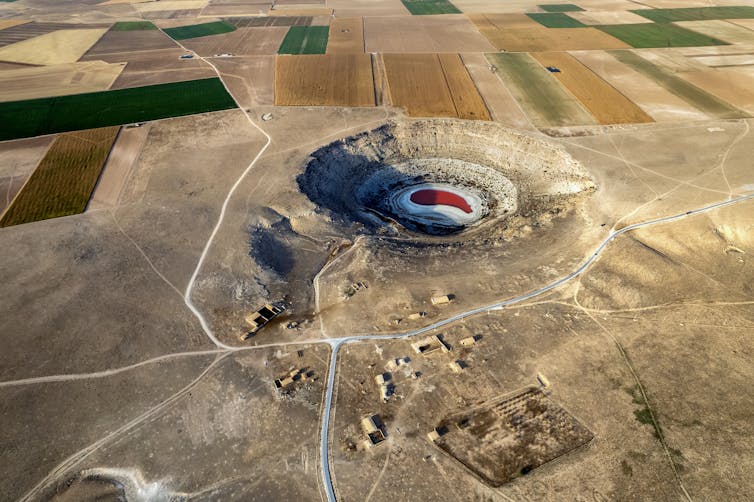
That last one, subsidence, often surprises people. But it’s a signature of water bankruptcy. When groundwater is overpumped, the underground structure, which holds water almost like a sponge, can collapse. In Mexico City, land is sinking by about 10 inches (25 centimeters) per year. Once the pores become compacted, they can’t simply be refilled.
The Global Water Bankruptcy report, published on Jan. 20, 2026, documents how widespread this is becoming. Groundwater extraction has contributed to significant land subsidence over more than 2.3 million square miles (6 million square kilometers), including urban areas where close to 2 billion people live. Jakarta, Bangkok and Ho Chi Minh City are among the well-known examples in Asia.
Agriculture is the world’s biggest water user, responsible for about 70% of the global freshwater withdrawals. When a region goes water bankrupt, farming becomes more difficult and more expensive. Farmers lose jobs, tensions rise and national security can be threatened.
About 3 billion people and more than half of global food production are concentrated in areas where water storage is already declining or unstable. More than 650,000 square miles (1.7 million square kilometers) of irrigated cropland are under high or very high water stress. That threatens the stability of food supplies around the world.

Droughts are also increasing in duration, frequency and intensity as global temperatures rise. Over 1.8 billion people – nearly 1 in 4 humans – dealt with drought conditions at various times from 2022 to 2023.
These numbers translate into real problems: higher food prices, hydroelectricity shortages, health risks, unemployment, migration pressures, unrest and conflicts. https://www.youtube.com/embed/pWDoe7PVNrw?wmode=transparent&start=0 Is the world ready to cope with water-related national security risks? CNN.
How did we get here?
Every year, nature gives each region a water income, depositing rain and snow. Think of this like a checking account. This is how much water we receive each year to spend and share with nature.
When demand rises, we might borrow from our savings account. We take out more groundwater than will be replaced. We steal the share of water needed by nature and drain wetlands in the process. That can work for a while, just as debt can finance a wasteful lifestyle for a while.

Those long-term water sources are now disappearing. The world has lost more than 1.5 million square miles (4.1 million square kilometers) of natural wetlands over five decades. Wetlands don’t just hold water. They also clean it, buffer floods and support plants and wildlife.
Water quality is also declining. Pollution, saltwater intrusion and soil salinization can result in water that is too dirty and too salty to use, contributing to water bankruptcy.

Climate change is exacerbating the situation by reducing precipitation in many areas of the world. Warming increases the water demand of crops and the need for electricity to pump more water. It also melts glaciers that store fresh water.
Despite these problems, nations continue to increase water withdrawals to support the expansion of cities, farmland, industries and now data centers.
Not all water basins and nations are water bankrupt, but basins are interconnected through trade, migration, climate and other key elements of nature. Water bankruptcy in one area will put more pressure on others and can increase local and international tensions.
What can be done?
Financial bankruptcy ends by transforming spending. Water bankruptcy needs the same approach:
- Stop the bleeding: The first step is admitting the balance sheet is broken. That means setting water use limits that reflect how much water is actually available, rather than just drilling deeper and shifting the burden to the future.
- Protect natural capital – not just the water: Protecting wetlands, restoring rivers, rebuilding soil health and managing groundwater recharge are not just nice-to-haves. They are essential to maintaining healthy water supplies, as is a stable climate.
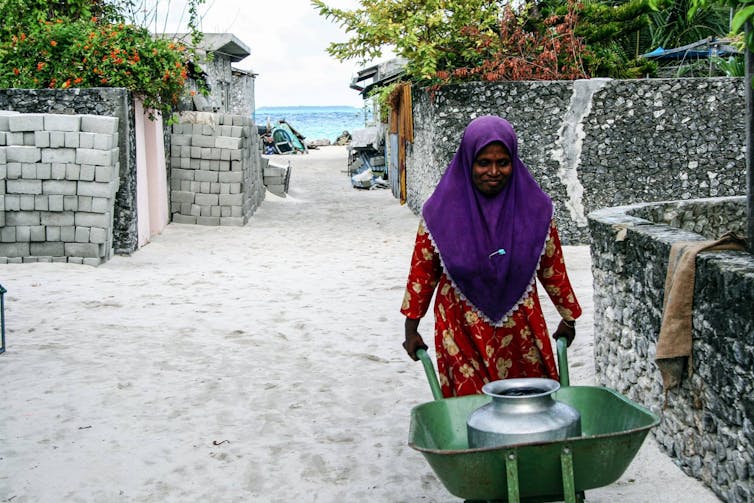
- Use less, but do it fairly: Managing water demand has become unavoidable in many places, but water bankruptcy plans that cut supplies to the poor while protecting the powerful will fail. Serious approaches include social protections, support for farmers to transition to less water-intensive crops and systems, and investment in water efficiency.
- Measure what matters: Many countries still manage water with partial information. Satellite remote sensing can monitor water supplies and trends, and provide early warnings about groundwater depletion, land subsidence, wetland loss, glacier retreat and water quality decline.
- Plan for less water: The hardest part of bankruptcy is psychological. It forces us to let go of old baselines. Water bankruptcy requires redesigning cities, food systems and economies to live within new limits before those limits tighten further.
With water, as with finance, bankruptcy can be a turning point. Humanity can keep spending as if nature offers unlimited credit, or it can learn to live within its hydrological means.
Kaveh Madani, Director of the Institute for Water, Environment and Health, United Nations University
This article is republished from The Conversation under a Creative Commons license. Read the original article.
The Tale of Two Sumps: The Salton Sea and Ciénega de Santa Clara
By Robert Marcos, photojournalist
Grand Junction, Colorado
Most of you have heard that California’s Salton Sea would not currently exist were it not for the nearly 1 million acre feet of agricultural runoff that’s drained into it every year. Paradoxically – the sea is both being kept alive by this salty runoff and being killed by it, in part because the Sea’s evaporation rate of six feet per year is continually concentrating its chemical-laden waters. 1
As you might expect the Salton Sea’s water is dominated by high salinity from salts, which increases dramatically as the lake shrinks. Selenium ranks next as a major metalloid of concern, often reaching ecologically harmful concentrations from runoff. Other notable contaminants include heavy metals like cadmium, copper, zinc, and nutrients driving algal blooms.2
Meanwhile 132 miles south in Sonora another body of water has formed from American-made runoff, and it’s also a paradox. Ciénega de Santa Clara is technically a brackish water wetland consisting of marshlands and lagoons, and its classification as “anthropogenic” stems from the fact that it was inadvertently created by, and entirely sustained by human engineering.3
This “human engineering” began in 1965 after the U.S.Bureau of Reclamation rerouted approximately 100,000 acre feet of salty runoff from the Wellton-Mohawk Irrigation District away from the Colorado River and 13 miles into Mexico – as a temporary way to reduce the excessively salty Colorado river water that had been killing crops in Mexico. By 1973 a permanent bypass canal was built which carried that salty runoff 50 miles further, to the Ciénega de Santa Clara in Sonora.4
But to everyone’s shock and surprise the salty runoff that was dumped at Cienega de Santa Clara resulted in the rebirth of an amazing ecosystem. The sprawling 40,000-acre wetland, now a UNESCO-recognized biosphere reserve, transformed a desolate salt flat into a lush expanse of emergent marshes dominated by dense stands of southern cattail interspersed with bulrushes and submerged aquatics. The nutrient-rich, albeit salty, waters fostered rapid plant growth, creating tangled corridors of green that ripple across the landscape, their feathery seed heads swaying in desert breezes amid shallow, mirrored pools teeming with microbial life.5
But the oasis’s vitality depends upon consistent inflows. Disruptions, like the one in 1993 that occurred during canal repairs caused a dramatic loss of vegetation, confining green regrowth to low-lying faults until the runoff flows resumed. But today “La Cienaga” endures as a testament to ecological opportunism, though looming desalination plans at Yuma threaten its future by potentially diverting the life-sustaining drainage. 6
- The Salton Sea. Physical and Chemical Characteristics
https://aslopubs.onlinelibrary.wiley.com/doi/pdf/10.4319/lo.1958.3.4.0373 - NIH: National Library of Medicine
https://pmc.ncbi.nlm.nih.gov/articles/PMC7232737/ - From accident to management: The Cienega de Santa Clara ecosystem
https://www.sciencedirect.com/science/article/abs/pii/S0925857413001079#:~:text=rights%20and%20content-,Abstract,that%20flows%20to%20the%20Cienega. - Colorado River Basin Salinity Control Project
https://www.usbr.gov/projects/pdf.php?id=96#:~:text=In%201961%2C%20two%20major%20problems,Project%2C%20Delivery%20of%20Water%20to - Audubon: “Water Flows in Colorado River Delta Again”
https://www.audubon.org/news/water-flow-colorado-river-delta-again - Sonoran Institute
https://sonoraninstitute.org/files/pdf/colorado-river-delta-research-la-cienega-de-santa-clara-06152011.pdf
Global Water Bankruptcy: Living beyond our hydrological means in the post-crisis era — United Nations University Institute for Water, Environment and Health
January 2026
Click the link to access the report on the United Nations University Institute for Water, Environment and Health website (Madani K., Mir Matin, Aria Farsi, Luying Wang, Amir AghaKouchak, Mohammed Azhar, Jenna Elshurafa, Sogol Jafarzadeh, Tafadzwanashe Mabhaudhi, Ali Mirchi, Abraham Nunbogu, Mojtaba Sadegh, Robert Sandford, Manoochehr Shirzaei, William Smyth, Hossein Tabari, MJ Tourian, Farshid Vahedifard).
Global water bankruptcy in brief
- The planet has entered the Global Water Bankruptcy era. In many basins and aquifers, long-term water use has exceeded renewable inflows and safe depletion limits, and parts of the water and natural capital—rivers, lakes, aquifers, wetlands, soils, and glaciers—have been damaged beyond realistic prospects of full recovery.
- Billions remain water insecure. Nearly three-quarters of the world’s population lives in countries classified as water-insecure or critically water-insecure. Around 2.2 billion people still lack safely managed drinking water, 3.5 billion lack safely managed sanitation, and about 4 billion experience severe water scarcity for at least one month a year.
- Surface waters are shrinking at scale. A growing number of major rivers now fail to reach the sea or fall below environmental flow needs for significant parts of the year. More than half of the world’s large lakes have lost water since the early 1990s, affecting around one-quarter of the global population that depends directly on them for water security.
- Wetlands have been liquidated on a continental scale. Over the past five decades, the world has lost roughly 410 million hectares of natural wetlands—almost the land area of the European Union—including an estimated 177 million hectares of inland marshes and swamps, roughly the size of Libya or seven times the area of the United Kingdom. The loss of ecosystem services from these wetlands is valued at over US$5.1 trillion, roughly equivalent to the combined annual GDP of about 135 of the world’s poorest countries.
- Groundwater depletion and land subsidence are widespread and often irreversible. Groundwater now provides about 50% of global domestic water use and over 40% of irrigation water, tying both drinking water security and food production directly to rapidly depleting aquifers. Around 70% of the world’s major aquifers show long-term declining trends.
- Excessive groundwater extraction has already contributed to significant land subsidence over more than 6 million square kilometers—almost 5% of the global land area—including over 200,000 square kilometers of urban and densely populated zones where close to 2 billion people live. In some locations, land is sinking by up to 25 centimeters per year, permanently reducing storage capacity and increasing flood risk.
- Cryosphere loss is liquidating critical “water savings”. The world, in multiple locations, has already lost more than 30% of its glacier mass since 1970. Several low- and mid-latitude mountain ranges risk losing functional glaciers within decades, undermining the long-term security of hundreds of millions of people who rely on glacier- and snowmelt-fed rivers for drinking water, irrigation, and hydropower.
- Agricultural heartlands are running down their water capital. Roughly 70% of global freshwater withdrawals are used for agriculture. Around 3 billion people and more than half of the world’s food production are located.
- in areas where total water storage—including surface water, soil moisture, snow, ice, and groundwater—is already declining or unstable. More than 170 million hectares of irrigated cropland—roughly the combined land area of France, Spain, Germany and Italy—are under high or very high water stress.
- Land and soil degradation are amplifying water-related risks. More than half of global agricultural land is now moderately or severely degraded, reducing soil moisture retention and pushing drylands toward desertification. Salinization alone has degraded roughly 82 million hectares of rainfed cropland and 24 million hectares of irrigated cropland—together more than 100 million hectares of cropland—eroding yields in some of the world’s key breadbaskets.
- Drought is increasingly anthropogenic and extremely costly. Over 1.8 billion people were living under drought conditions in 2022–2023. Drought-related damages, intensified by land degradation, groundwater depletion and climate change rather than rainfall deficits alone, already amount to about US$307 billion per year worldwide—larger than the annual GDP of almost three-quarters of UN Member States.
- Water quality degradation is shrinking the truly usable resource base. In many basins, pollution from untreated or inadequately treated wastewater, agricultural runoff, industrial and mining effluents, and salinization means that a growing share of water is no longer safe or economically viable for drinking, food production or ecosystems—even where nominal volumes have not yet declined dramatically.
- The planetary freshwater boundary has been transgressed. Global evidence shows that two important elements of the freshwater cycle—“blue water” (surface and groundwater) and “green water” (soil moisture)—have been pushed beyond a safe operating space, alongside planetary boundaries for climate, biosphere integrity, and land systems.
- Existing governance and agendas are no longer fit for purpose. In many basins, the sum of legal water rights, informal expectations and development promises far exceeds degraded hydrological carrying capacity in the absence of effective governance institutions to address water bankruptcy. The current global agenda focused primarily on WASH (Water, Sanitation, and Hygiene), incremental efficiency gains and generic IWRM (Integrated Water Resources Management) prescriptions is insufficient to address structural overshoot, irreversibility and the rising risks of social instability and conflict associated with water bankruptcy.
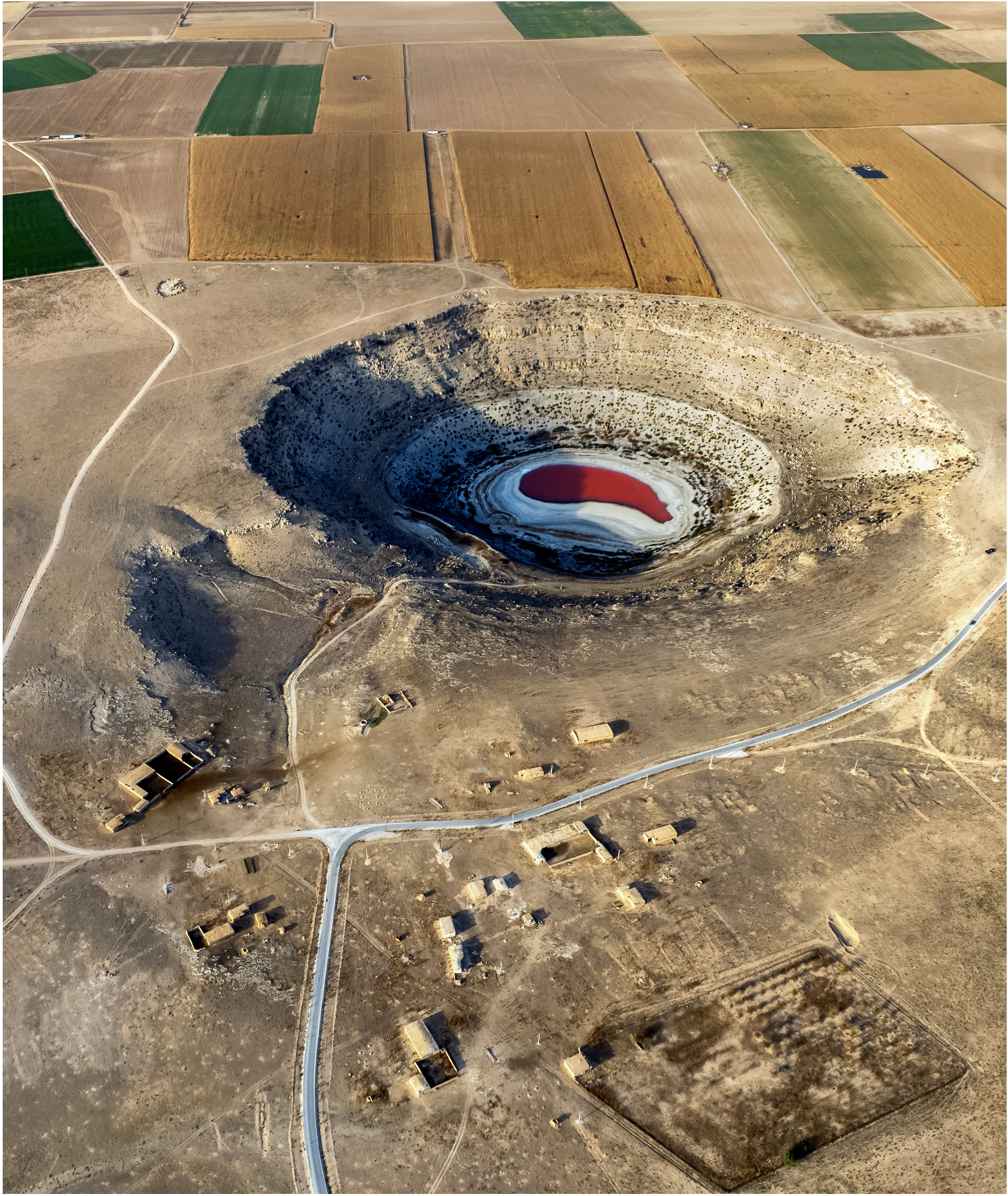
Executive Summary
Water is the quiet infrastructure of everything the United Nations cares about: human security and prosperity, food and energy security, biodiversity, environmental resilience, public health, climate stability, and peace. The UN Sustainable
Development Goal 6 (SDG 6) captures this centrality by committing the world to ensuring the availability and sustainable management of water and sanitation for all. Yet, the world is still very far from meeting SDG 6. About 2.2 billion people still lack safely managed drinking water, 3.5 billion lack safely managed sanitation, and about 4 billion people experience severe water scarcity for at least one month per year. Nearly 75% of the world’s population lives in countries classified as water-insecure or critically water-insecure with progress toward SDG 6 is far off track for 2030. These figures indicate that water-related risks are now systemic rather than marginal.
For decades, the global policy and science communities have warned of an escalating “water crisis” and called for accelerated action to avert it. Those warnings were not wrong, but they are now incomplete. The language of crisis—suggesting a temporary emergency followed by a return to normal through mitigation efforts—no longer captures what is happening in many parts of the world. This report by the United Nations University Institute for Water, Environment and Health (UNU-INWEH) on the 30th anniversary of its inception responds to this gap by offering a new, more precise diagnosis and recommendations for a new governance agenda fitting the water realities of the Anthropocene in the 21st century. The report is a wake-up call and an open invitation to the policy community to use water as a powerful bridge to promote cooperation to address some of the most critical security, peace, justice, development, and sustainability challenges of our time.
The central message of this report is direct: the world has entered the era of Global Water Bankruptcy. In many regions, human–water systems are already in a post-crisis state of failure. Over decades, societies have withdrawn more water than climate and hydrology can reliably provide, drawing down not only the annual “income” of renewable flows but also the “savings” stored in aquifers, glaciers, soils, wetlands, and river ecosystems. At the same time, pollution, salinization, and other forms of water quality degradation have reduced the fraction of water that is safely usable.
The consequences of water bankruptcy are now visible on every continent: rivers that no longer reach the sea; lakes, wetlands, and glaciers that have shrunk or disappeared; aquifers pumped down until land subsides and salt intrudes; forests and peatlands drying and burning; deserts and dust storms expanding, and cities repeatedly brought to the brink of “Day Zero.” These are not simply signs of stress or episodes of crisis. They are symptoms of systems that have overspent their hydrological budget and eroded the natural capital that once made recovery possible, with knock-on effects for food prices, employment, migration and geopolitical stability.
The report calls for the recognition of the state of ‘Water bankruptcy’ as a persistent post-crisis condition of a human–water system in which long-term water use has exceeded renewable inflows and safe depletion limits, causing irreversible or effectively irreversible degradation such that previous levels of water supply and ecosystem functions cannot realistically be restored. In a bankruptcy state, some damages are physically irreparable on human time scales: compacted aquifers do not rebound, subsided deltas do not rise, extinct species do not return, and lost lakes cannot be restored within planning horizons. Others are technically reversible only at costs so high, or over periods so long, that they are effectively irreversible for policy and planning purposes. This is what distinguishes water bankruptcy from two better-known states: water stress, where high pressure still allows recovery, and water crisis, where an acute, time-bound shock can in principle be overcome.
Water bankruptcy is not only about the ‘insolvency’ of the system but also about its ‘irreversibility’. The shift from crisis to bankruptcy has profound implications for how the world approaches both mitigation and adaptation. Crisis management is essentially restorative: it aims to survive a shock and get back to the previous normal, often through mitigation efforts, short-term emergency measures, and supply-side fixes. Bankruptcy management is different. In finance, declaring bankruptcy is the precondition for a fresh, more sustainable start: debts are recognized, claims are written down, and a new balance sheet is constructed to prevent further collapse. In the same way, managing water bankruptcy calls for a transformational fresh start in human–water relations. It demands a deliberate combination of efforts for mitigation plus adaptation to new hydrological and environmental normals.
Bankruptcy management acknowledges the failure of the current development system and water management model and irreversibility of some damages, while recognizing the urgency of preventing additional damages through transformative reforms. Mitigation attempts seek not only to restore the lost past but also to avoid pushing more basins into bankruptcy and to slow the erosion of remaining water-related natural capital. In the meantime, adaptation efforts are focused on functioning more efficiently within tighter hydrologic incremental efficiency gains and generic IWRM limits through reconfigured economics, governance prescriptions—is no longer fit for purpose in the institutions, and development models, while Anthropocene or for an era of growing geopolitical recognizing non-stationary climatic and changed tensions and stalled multilateral processes. It environmental conditions.
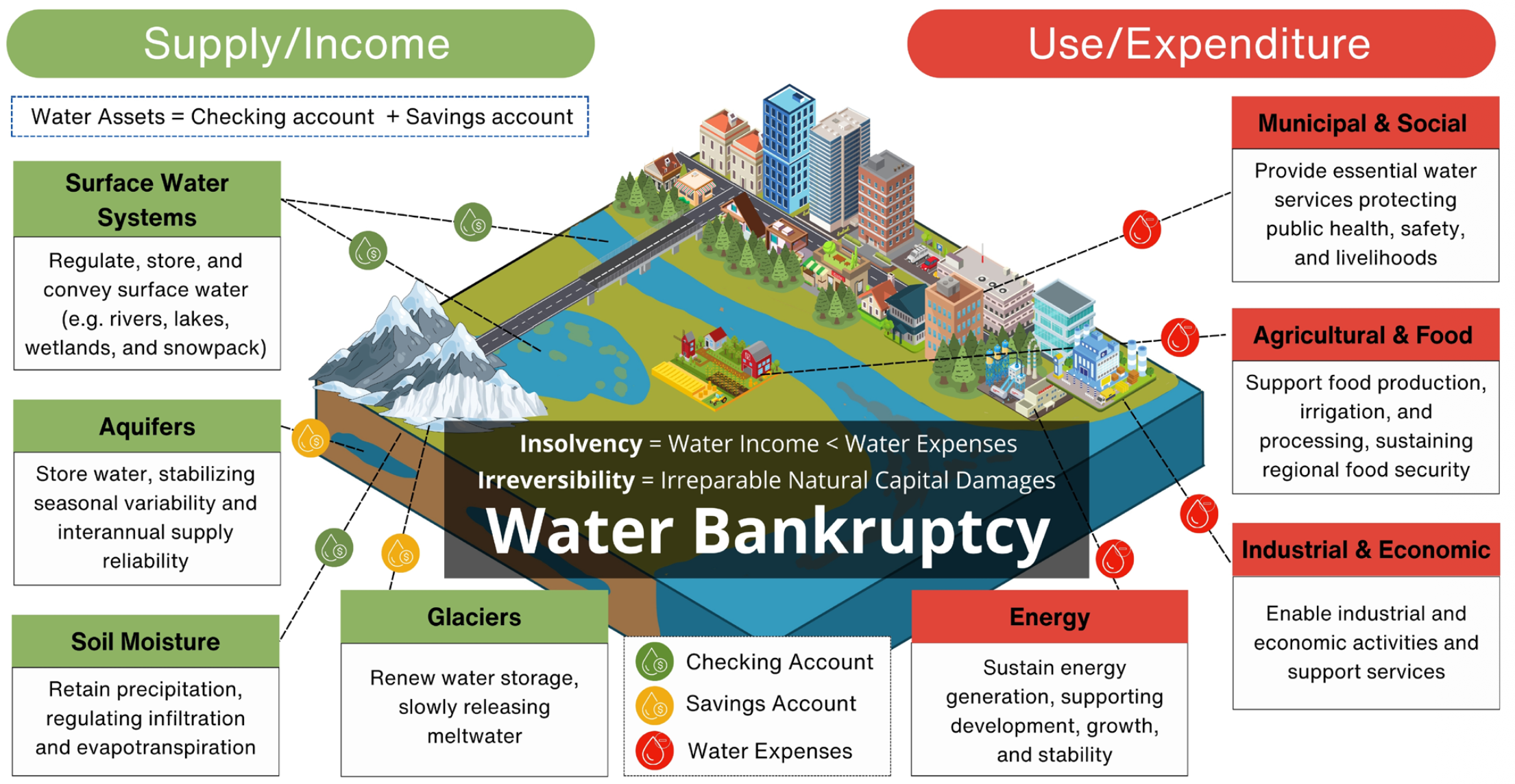
The report reframes the water governance for achieving the goals of the Rio Conventions challenge for a post-crisis era. Rather than asking and the 2030 Agenda, aligning local and national only how to avoid a future water crisis, it asks what it priorities with global climate, biodiversity and means to govern human–water systems on a water-land commitments, and offering common ground bankrupt planet: how to admit insolvency where it between the Global North and Global South as exists; how to manage irreversibility honestly; how well as between rural and urban, left and right to share unavoidable losses fairly; and how to design constituencies. It proposes that water be used as institutions, development pathways, and financial a bridge between fragmented policy arenas and frameworks that prevent further overspending of a divided world, helping to re-energize stalled hydrological capital and damage to the underlying negotiations on the triple planetary crisis. The natural capital.
The report emphasizes that water bankruptcy is also “Water for Sustainable Development” in 2028, a justice, security and political economy challenge. and the 2030 deadline for SDG 6 are identified as Water bankruptcy management must therefore critical milestones for embedding water-bankruptcy be explicitly equity-oriented: securing basic diagnostics, monitoring frameworks and just-human needs and critical services; safeguarding transition support into global governance. environmental flows; providing compensation and social protection where livelihoods must change; and strengthening grievance and conflict resolution mechanisms at local, national, and transboundary levels. Without this justice lens, necessary reforms risk fueling social unrest and undermining the political viability of transitions.
Finally, the report situates Global Water Bankruptcy within the wider multilateral landscape and the realities of a fragmented world. It argues that the current global water agenda—focused primarily on safe drinking water, sanitation and hygiene (WASH), incremental efficiency gains and generic IWRM limits through reconfigured economics, governance prescriptions—is no longer fit for purpose in the institutions, and development models, while Anthropocene or for an era of growing geopolitical recognizing non-stationary climatic and changed tensions and stalled multilateral processes. It environmental conditions. calls for a new water agenda that recognizes water as both a constraint and an opportunity sector The report reframes the water governance for achieving the goals of the Rio Conventions challenge for a post-crisis era. Rather than asking and the 2030 Agenda, aligning local and national only how to avoid a future water crisis, it asks what it priorities with global climate, biodiversity and means to govern human–water systems on a water-land commitments, and offering common ground bankrupt planet: how to admit insolvency where it between the Global North and Global South as exists; how to manage irreversibility honestly; how well as between rural and urban, left and right to share unavoidable losses fairly; and how to design constituencies. It proposes that water be used as institutions, development pathways, and financial a bridge between fragmented policy arenas and frameworks that prevent further overspending of a divided world, helping to re-energize stalled hydrological capital and damage to the underlying negotiations on the triple planetary crisis. The natural capital. upcoming UN Water Conferences in 2026 and 2028, the conclusion of the International Decade for Action The report emphasizes that water bankruptcy is also “Water for Sustainable Development” in 2028, a justice, security and political economy challenge. and the 2030 deadline for SDG 6 are identified as Water bankruptcy management must therefore critical milestones for embedding water-bankruptcy be explicitly equity-oriented: securing basic diagnostics, monitoring frameworks and just-transition support into global governance.
This UNU-INWEH report is not another warning about a crisis that might arrive in the future. It is a declaration that the world is already living beyond its hydrological means and that many human–water systems are operating in a state of water bankruptcy. Recognizing this post-crisis reality is not an act of resignation; it is the starting point for a more honest, science-based and justice-oriented agenda that uses mitigation and adaptation to build a fresh, more sustainable balance between societies and the water on which they depend—before the remaining natural capital is lost.
Key Policy Messages
- The world is already in the state of “water bankruptcy”. In many basins and aquifers, long-term overuse and degradation mean that past hydrological and ecological baselines cannot realistically be restored. While not every basin or country is water-bankrupt, enough critical systems around the world have crossed these thresholds—and are interconnected through trade, migration, climate feedbacks, and geopolitical dependencies—that the global risk landscape is now fundamentally altered.
- The familiar language of “water stress” and “water crisis” is no longer adequate. Stress describes high pressure that is still reversible; crisis describes acute, time-bound shocks. Water bankruptcy must be recognized as a distinct post-crisis state, where accumulated damage and overshoot have undermined the system’s capacity to recover.
- Water bankruptcy management must address insolvency and irreversibility. Unlike financial bankruptcy management, which deals only with insolvency, managing water bankruptcy is concerned with rebalancing demand and supply under conditions where returning to baseline conditions is no longer possible.
- Anthropogenic drought is central to the world’s new water reality. Drought and water shortage are increasingly driven by human activities—over-allocation, groundwater depletion, land and soil degradation, deforestation, pollution, and climate change—rather than natural variability alone. Water bankruptcy is the outcome of long-term anthropogenic drought, not just bad luck with hydrological anomalies. Water bankruptcy is about both quantity and quality. Declining stocks, polluted rivers, and degrading aquifers, and salinized soils mean that the truly usable fraction of available water is shrinking, even where total volumes may appear stable.
- Managing water bankruptcy requires a shift from crisis management to bankruptcy management. The priority is no longer to “get back to normal”, but to prevent further irreversible damage, rebalance rights and claims within degraded carrying capacities, transform water-intensive sectors and development models, and support just transitions for those most affected.
- Governance institutions must protect both water and its underlying natural capital. The existing institutions focus on protecting water as a good or service disregarding the natural capital that makes water available in the first place. Efforts to protect a product are ineffective when the processes that produce it are disrupted. Recognizing water bankruptcy calls for developing legal and governance institutions that can effectively protect not only water but also the hydrological cycle and natural capital that make its production possible.
- Water bankruptcy is a justice and security issue. The costs of overshoot and irreversibility fall disproportionately on smallholder farmers, rural and Indigenous communities, informal urban residents, women, youth, and downstream users, while benefits have often accrued to more powerful actors. How societies manage water bankruptcy will shape social cohesion, political stability, and peace.
- Water bankruptcy management combines mitigation with adaptation. While water crisis management paradigms seek to return the system to normal conditions through mitigation efforts only, water bankruptcy management focuses on restoring what is possible and preventing further damages through mitigation combined with adaptation to new normals and constraints.
- The world has an untapped, strategic opportunity to capitalize on water as a powerful bridge in a fragmented world. Water can align national priorities with international priorities and improve cooperation between and within nations. Roughly 70% of global freshwater withdrawals are used for agriculture, much of it by farmers in the Global South. Elevating water in global policy debates can help rebuild trust not only between the Global South and Global North, but also within countries—bridging rural and urban communities and easing polarization across left and right constituencies.
- Water must be recognized as an upstream sector. Most national and international policy agendas treat water as a downstream impact sector where investments are focused on mitigating the imposed problems and externalities. The world must recognize water as an upstream opportunity sector where investments have long-term benefits for peace, stability, security, equity, economy, health, and the environment.
- Water is an effective medium to fulfill the global environmental agenda. Investments in addressing water bankruptcy deliver major co-benefits for the global efforts to address its environmental problems while addressing the national security (e.g., employment, national stability, and food security) concerns of the UN member states. Elevating water in the global policy agenda can renew international cooperation, increase the efficiency of environmental investments, and reaccelerate the halted progress of the three Rio Conventions to address climate change, biodiversity loss, and desertification.
- A new global water agenda is urgently needed. Existing agendas and conventional water policies—focused mainly on WASH, incremental efficiency gains and generic IWRM guidelines—are not sufficient for the world’s current water reality. A fresh water agenda must be developed that takes Global Water Bankruptcy as a starting point and uses the 2026 and 2028 UN Water Conferences, the conclusion of the Water Action Decade (2028), and the 2030 SDG 6 timeline as milestones for resetting how the world understands and governs water.
#Earth Enters Era of ‘Global Water Bankruptcy,’ UN Report Says: New approaches needed to adapt to an altered environment — Brett Walton (circleofblue.org)
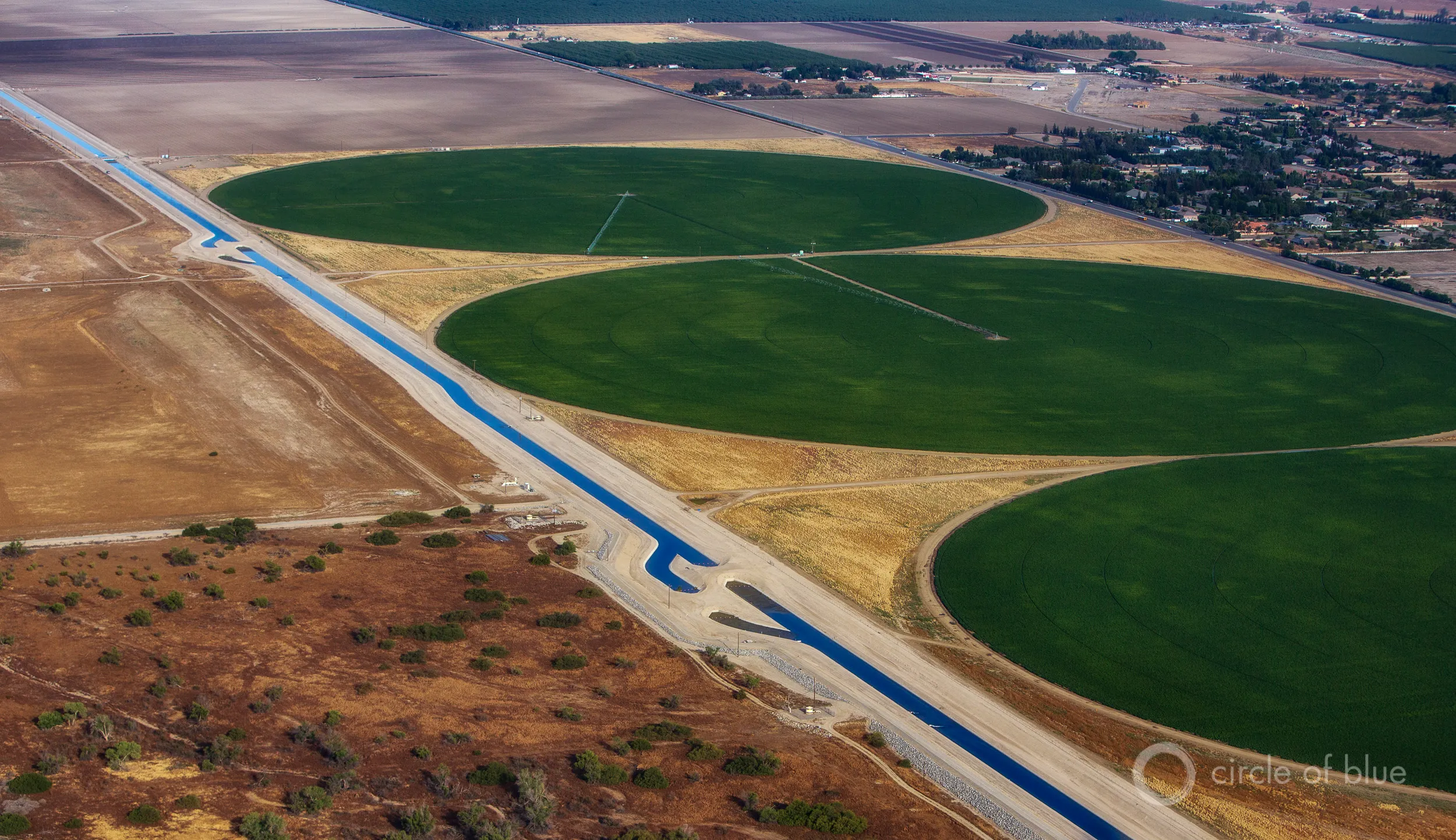
Click the link to read the article on the Circle of Blue website (Brett Walton):
January 20, 2026
The planet’s water reserves are overstretched and polluted, pushing the warming world into a dangerous condition of “water bankruptcy,” argues a new UN University report.
This is not an alarm bell for the future, the report states. Bankruptcy is present today. For water, the world is living beyond its means, draining its underground savings accounts, degrading its ecological foundations, and watching its rain and snow become less reliable and evaporate as the planet warms.
“Bankruptcy tells us that we already have passed this stage of a crisis and are already in a failure mode,” said Kaveh Madani, the report’s lead author. [ed. emphasis mine]
The report favors monetary metaphors – savings accounts, cash flows, insolvency – to explain the state of the world’s water. A business files for bankruptcy when its liabilities are greater than its assets and it needs to restructure. The owners, in other words, admit that their business model has failed and current practices cannot continue.
The planet requires a similar reckoning for water, Madani argued. It is not enough to acknowledge that the planet’s water accounts – its aquifers, lakes, rivers, wetlands, and glaciers – are being drained. Leaders must recognize that new operating rules and ecological guardrails are necessary for life on a hotter planet in which water extraction has been the governing principle for decades.
“When we see insolvency combined with irreversibility, that defines the concept of water bankruptcy,” said Madani, who is also director of the United Nations University Institute for Water, Environment, and Health.
Madani calls this a “post-crisis” mindset – not attempting to resurrect a failed system but instead developing a relationship to water that prioritizes adaptability to an unstable environment while also ensuring justice for the world’s vulnerable people. Admitting failure and changing course, he said, is a way “to protect the future.”
The report details a planet that has veered off the rails. Thirty percent of global glacier mass has melted since the 1970s. In the same period, the world has plowed or drained more than a billion acres of wetlands, an area equal to the European Union. Seventy percent of the world’s major aquifers are in long-term decline. Water extraction from aquifers and rivers accelerated after the Second World War, and 70 percent of the supply goes into irrigated agriculture.
The loss of water in those savings accounts, when paired with other risks, presents a more worrisome picture, Madani said. Pollutants from industry, agriculture, and untreated human waste reduce the amount of high-quality water. Soils are degraded and accumulating salts. The number of water conflicts is rising. Rural water shortages have prompted an exodus toward cities. Meanwhile, inadequate infrastructure investment means that 2.1 billion people do not have clean water at home and 3.4 billion do not have safe sanitation.
It is perhaps not surprising that the Eurasia Group named water conflict as one of its top political risks of 2026.
Madani, who was deputy head of Iran’s environment department in 2017-18, has been using the bankruptcy language since at least 2021 to describe his home country’s dire water situation. Tehran, whose reservoirs are frightfully low, is the latest city to face the prospect of a Day Zero scenario of dry taps.
To reduce the risk of conflict and shortages, the report recommends a wholesale restructuring. Governments could trim water rights and water claims to more align demand with supply and rebuild institutions that allow for continuous adjustment in an unstable environment. Madani acknowledged that reforms at such scale will not be easy, but they ought to be embraced widely because all areas face risks.
“What matters is how you manage your budget, not how rich you are,” he said. “So you can be poor and not get bankrupt and you can be very rich and get bankrupt if you don’t adjust your lifestyle according to your budget.”
All of these changes need to be rooted in justice, argued Madani, who sees a world cleaved in two. Richer areas with diversified economies are better positioned to withstand water shocks. California, for example, which weathered a deep drought in 2014-15. On the other side are poorer societies whose livelihoods are inseparable from farming. Water shortages hit these areas hard. Madani said economic transformation toward less water-intensive jobs is essential for social, political, and ecological durability.
Despite the daunting outlook, Madani views bankruptcy as a fresh start and a way to position water as a bridge-building issue that crosses political chasms.
“We are not naive about the problems of the international world or the diplomatic world,” Madani said. “But at the same time, we think that it is possible to think about water differently, to tell stories that are different, to tell stories that are less dividing, if they are more inclusive and are reflective of the concerns of the Global South, and if we do so, then we can earn their trust and bring them to the negotiations table and do a better job together.”
Feds summon 7 #ColoradoRiver governors for last-ditch drought talks — AZCentral.com #COriver #aridification

Click the link to read the article on the AZCentral.com website (Brandon Loomis). Here’s an excerpt:
January 17, 2026
Key Points
- After negotiators for the seven Colorado River states failed to reach a water-sharing agreement, federal officials have invited governors to continue talks.
- The feds may impose their own plan if states cannot agree, potentially leading to major cuts for Arizona, with its junior water rights.
- The states face a mid-February timeline to present a “deal in principle” to replace guidelines expiring in September.
Interior Secretary Doug Burgum has invited all seven governors and their negotiators to meet in Washington in late January, [Tom] Buschatzke said. Perhaps getting the governors face-to-face could lead to a breakthrough, he added..The seven states have tried unsuccessfully for more than a year to reach a voluntary agreement to replace dam-operating guidelines that will expire with the end of the water year in September. The U.S. Bureau of Reclamation has asked states to submit an agreement by Feb. 14. That date falls on a weekend and likely isn’t a hard deadline for every detail in the plan, Buschatzke said, but a “deal in principle” probably needs to take shape by then if the states want to control their own destinies.
Reclamation offers future #ColoradoRiver management options as states pursue a long-sought consensus — Summit Daily News #COriver #aridification
Click the link to read the article on the Summit Daily News website (Ali Longwell). Here’s an excerpt:
January 17, 2026
While the four Upper Basin states in the compact — Colorado, New Mexico, Utah, and Wyoming — rely predominantly on snowpack for water supply, the Lower Basin states — Arizona, California, and Nevada — rely on releases from Lake Powell and Lake Mead..It’s not the compact, but the 2007 operational guidelines for Lake Powell and Lake Mead that are being renegotiated as they are set to expire this year. A decision must be made prior to Oct. 1, 2026, according to the Bureau…The federal government, seven states and 30 tribal nations all agree the best path forward is for a consensus between the upper and lower basins. However, with the looming deadline and unresolved disagreements about the future of the river, the Department of the Interior and its subagency, the Bureau of Reclamation, are forging ahead.
”The Department of the Interior is moving forward with this process to ensure environmental compliance is in place so operations can continue without interruption when the current guidelines expire,” said Andrea Travnicek, the assistant secretary of water and science for the Bureau of Reclamation, in a news release announcing the agency’s latest draft options. “In the face of an ongoing severe drought, inaction is not an option.”
One of the main disagreements throughout negotiations has been who should be making cuts to water use. The Lower Basin states have advocated for basin-wide water use reductions. The Upper Basin states, however, have pushed back on the idea, claiming they already face natural water shortages driven primarily by the ups and downs of snowpack…The draft Environmental Impact Statement released by the Bureau of Reclamation last week offers five options — including a required “no action” alternative and four others — that represent a broad range of operating strategies. The draft’s publication initiates a 45-day public comment period ending on March 2, 2026. In a statement, Scott Cameron, acting lead of the Bureau of Reclamation, said that the federal agency has purposefully not identified a preferred alternative, “given the importance of a consensus-based approach to operations for the stability of the system.” The expectation is that whatever agreement is reached incorporates elements of all five options offered by the Bureau of Reclamation, Cameron added.
The five options identified are:
- No Action
- Basic Coordination
- Enhanced Coordination
- Maximum Operational Flexibility
- Supply Driven
Each option offers differing methods for how the Bureau of Reclamation will operate Lake Powell and Lake Mead, particularly under low reservoir conditions; allocate, reduce or increase annual allocations for consumptive use of water from Lake Mead to the lower basin states; store and deliver water that has been saved through conservation efforts; manage and deliver surplus water; manage activities above Lake Powell; and more.
#Colorado’s #snowpack hits record-lows for three days straight as ‘bummer’ winter drags on: #Drought conditions continue to spread across the state, with parts of Summit, Eagle and Pitkin counties experiencing the highest levels — The Sky-Hi News

Click the link to read the article on the Sky-Hi News website (Ryan Spencer). Here’s an excerpt:
January 17, 2026
Colorado’s statewide snowpack has again hit record-lows, and could remain there for several days as the state is expected to enter a dry spell until the last week of January. Colorado Assistant State Climatologist Peter Goble described the snow season as “a bummer so far.” With each passing day that this low-snow trend continues, Goble said the less likely it becomes that the state will see enough snow to dig itself out of its snowpack deficit.
“It’s likely to get worse before it gets better,” he said. “We’re starting to look at the rest of the snow season and see a limited runway for improvements. It’s not impossible, but it’s not probable either.” [ed. emphasis mine]
The snowpack statewide has sat at the zeroth percentile, meaning it’s the worst on record, since Wednesday, and remained there as of Friday, according to the U.S. Department of Agriculture’s Snow Telemetry or SNOTEL program. It’s at least the third time the statewide snowpack has hit record-lows so far this season. The snowpack also hit record-lows in late November and late December. Midway into January, Colorado is “rapidly approaching the halfway point of a normal snow season,” Goble said. With most forecasts calling for little-to-no snow for at least the next seven days, he said it is likely the state will enter February at or near record lows…As of Friday, Colorado’s snowpack sat at 4.8 inches of snow-water equivalent, more than 3 inches below the median of 7.1 inches that is more typical of this time of year, according to SNOTEL data. Statewide, the median peak snowpack has occurred on April 8, with a snow-water equivalent of 16.7 inches. While it is too early to call this winter the worst in Colorado’s history, the state is “not keeping good company at this point in the season,” Goble said. The snow-water equivalent so far this season is about an inch below where it was during the 2011-12 season, which was one of the worst winters in the 21st century. The season so far is more comparable to the winters of 1980-81 and 1976-77, which is often considered the worst winter in Colorado history. Since Colorado’s SNOTEL system wasn’t fully built out in those years, it is hard to make direct comparisons to those historically poor snow years, Goble said. Notably, the winter of 1980-81 saw a significant amount of snow later in the year, and ended the season far better than it started. While he said he is hopeful this season will see significant late-season snow, it is far from certain.

Happy Martin Luther King Jr. Day

#Colorado #Snowpack news January 19, 2026

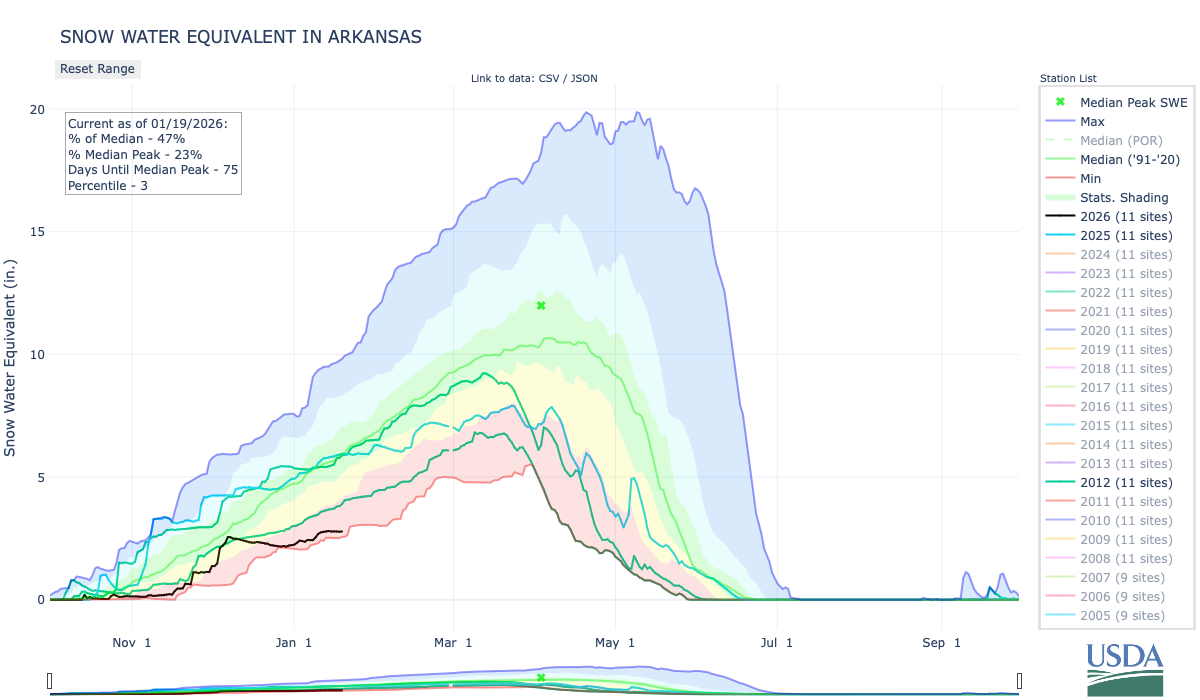


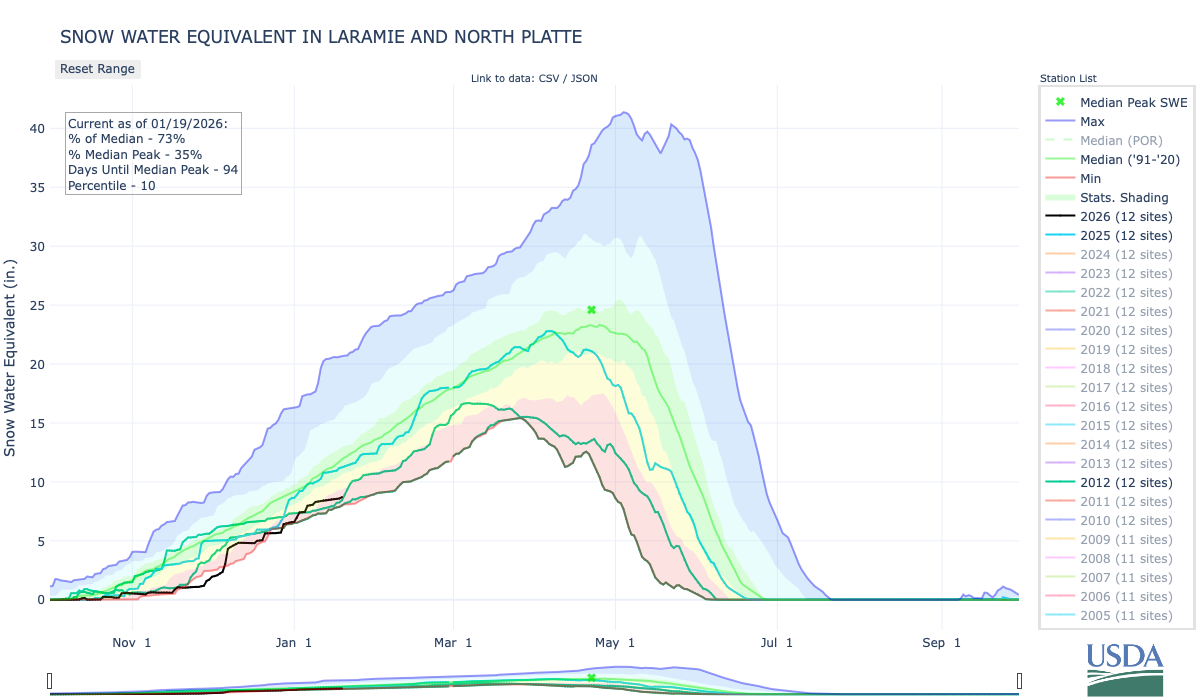
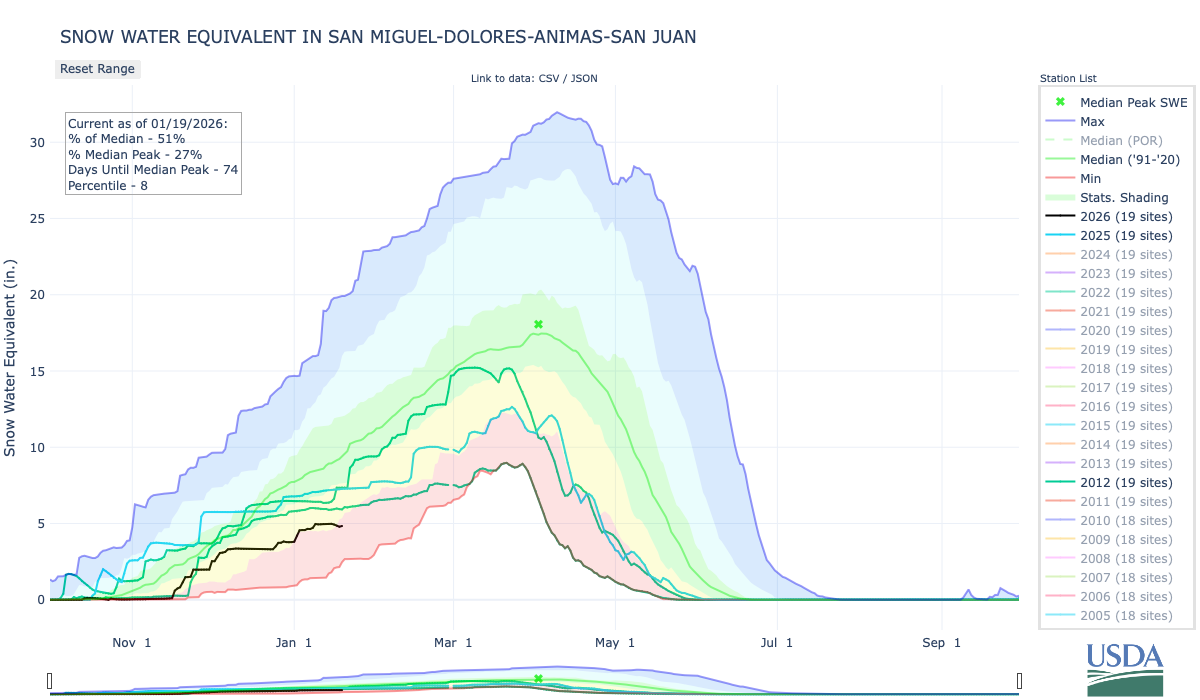
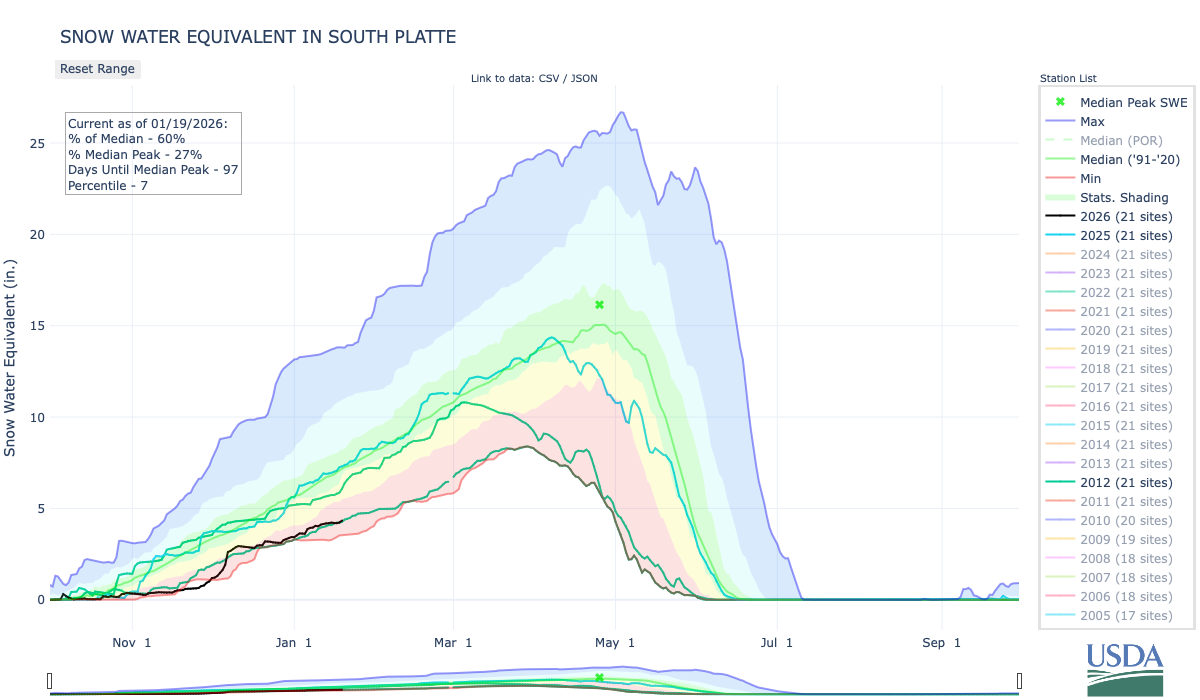

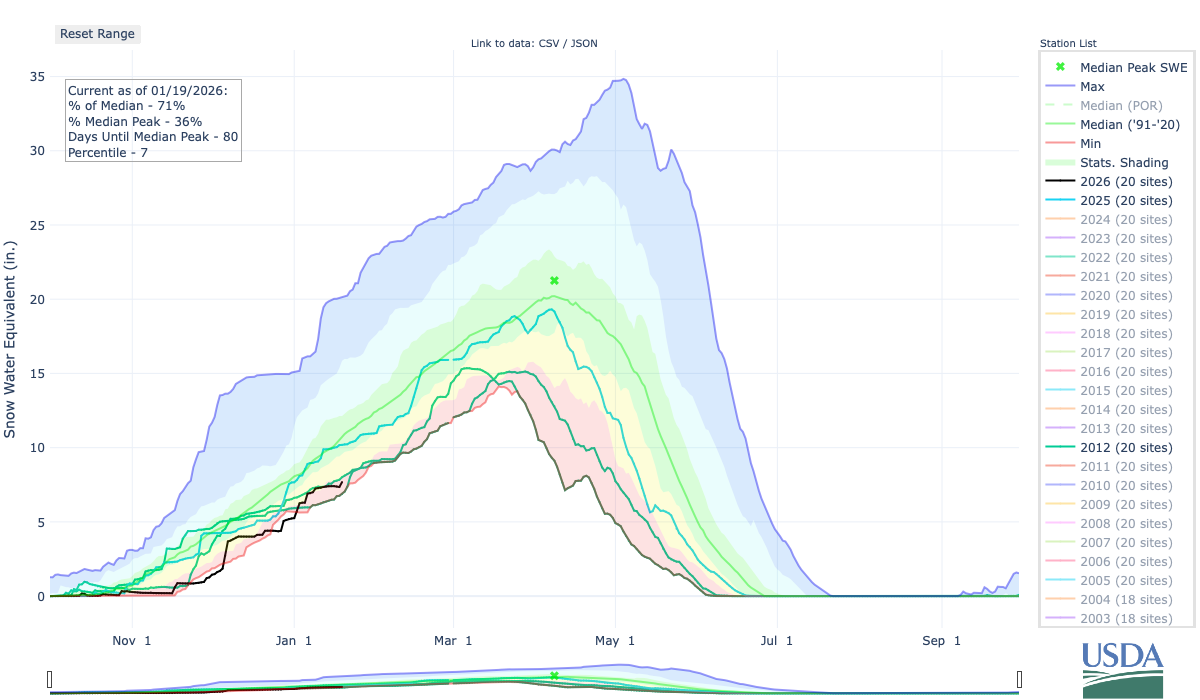
The Colorado River’s Salinity Problem
By Robert Marcos, photojournalist
Grand Junction, Colorado
A political brouhaha erupted in the early 1960s after the Wellton‑Mohawk irrigation project in Arizona discharged very saline return flows into the Colorado River, which raised salinity at the border from 800 ppm to about 2,700 ppm. In Mexicali Valley farmers said the water was virtually “useless for irrigation purposes,” and led to widespread crop failure in one of Mexico’s largest and most fertile regions.
It took the United States 12 years to find a definitive, long-term solution: from the initial crisis in 1961 to the signing of a permanent agreement, known as “Minute 242” in 1973. This agreement led with the Bureau of Reclamation investing $250 million in the development of the Yuma Desalting Plant, which would use a reverse-osmosis system to filter a percentage of salts from the river before it entered Mexico.
The expensive plant was completed in 1992 but was used for only a few months. Because in 1977 a temporary measure enacted by the BOR diverted (the salty) Wellton-Mohawk runoff to Mexico’s Ciénega de Santa Clara. This action brought the river water back into compliance while the Yuma Desalting Plant was still being built. But this “temporary measure” worked so well that it obviated the need for the expensive desalting plant.
The Bureau of Reclamation had known since the 1970’s that the Dolores River had, (for millions of years), been a significant source of the Colorado River’s salinity and in 1996 they took action. The Paradox Valley Unit removes between 50,000 to 180,000 tons of salt annually from a facility west of Montrose, Colorado. In a nutshell the operation works by intercepting saline-rich groundwater before it enters the Dolores River by the use of nine extraction wells. These wells pump out this naturally occurring brine -which is eight times saltier than seawater, before it can seep into the Dolores River.
The brine is piped to a facility where it’s injected under high pressure 3 miles down into the earth – underneath a natural salt layer that prevents it from rising back to the surface. Unfortunately, as is often seen with other types of deep fluid injections, a 4.5 magnitude earthquake was triggered and the unit had to be shut down for two years. When operations resumed it was at a reduced rate of 67% in an attempt to mitigate the seismic risks. Even so, in 2024 the unit still managed to remove 62,913 tons of salt …salt which used to show up in Mexicali Valley.
The very different types of operations that have succeeded in lowering Grand Valley’s once-massive salt load will be addressed in a future post. Thank you.
Sources:
https://www.usbr.gov/history/ProjectHistories/Yuman-AZ-Desalting-Plant.pdf
The latest seasonal outlooks through April 30, 2026 are hot off the presses from the #Climate Prediction Center

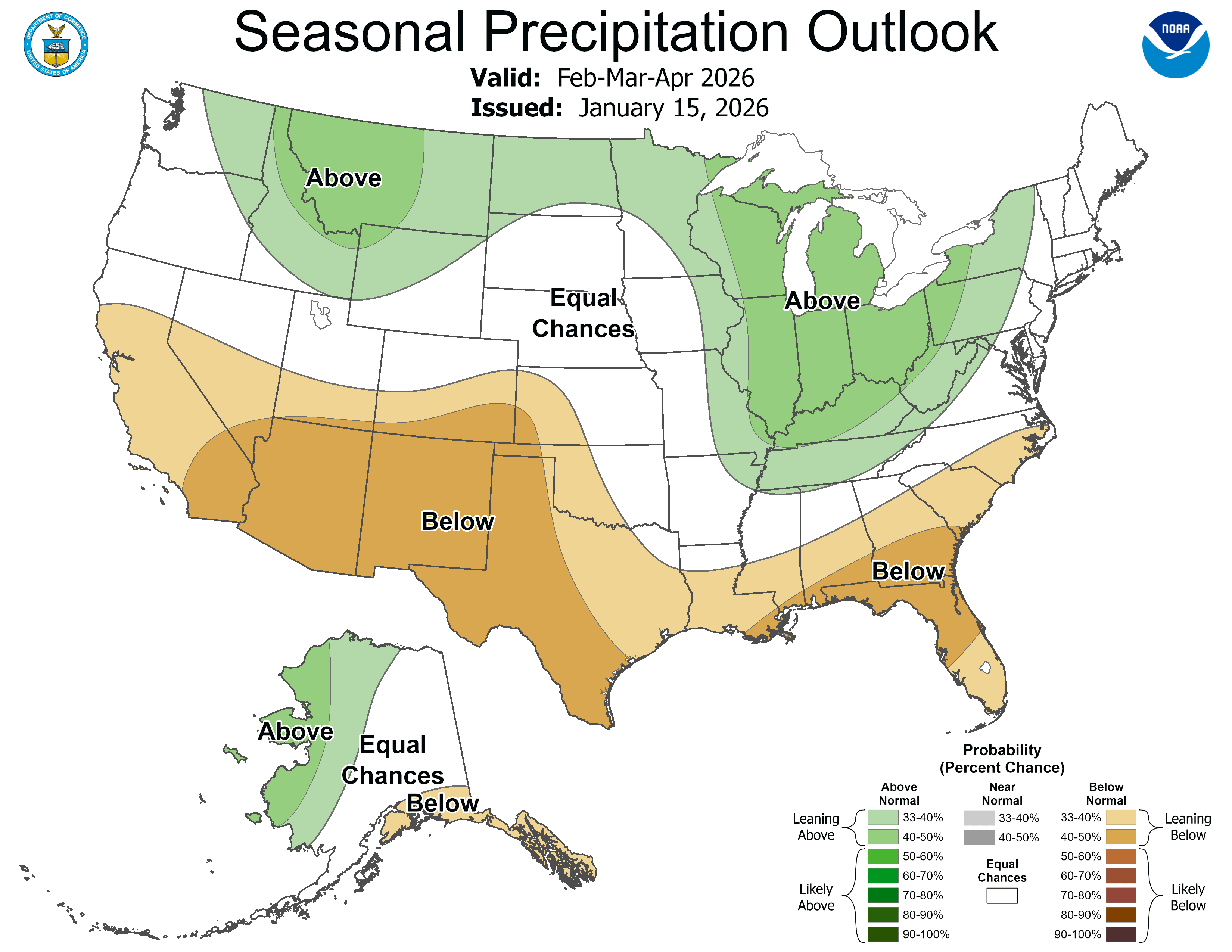
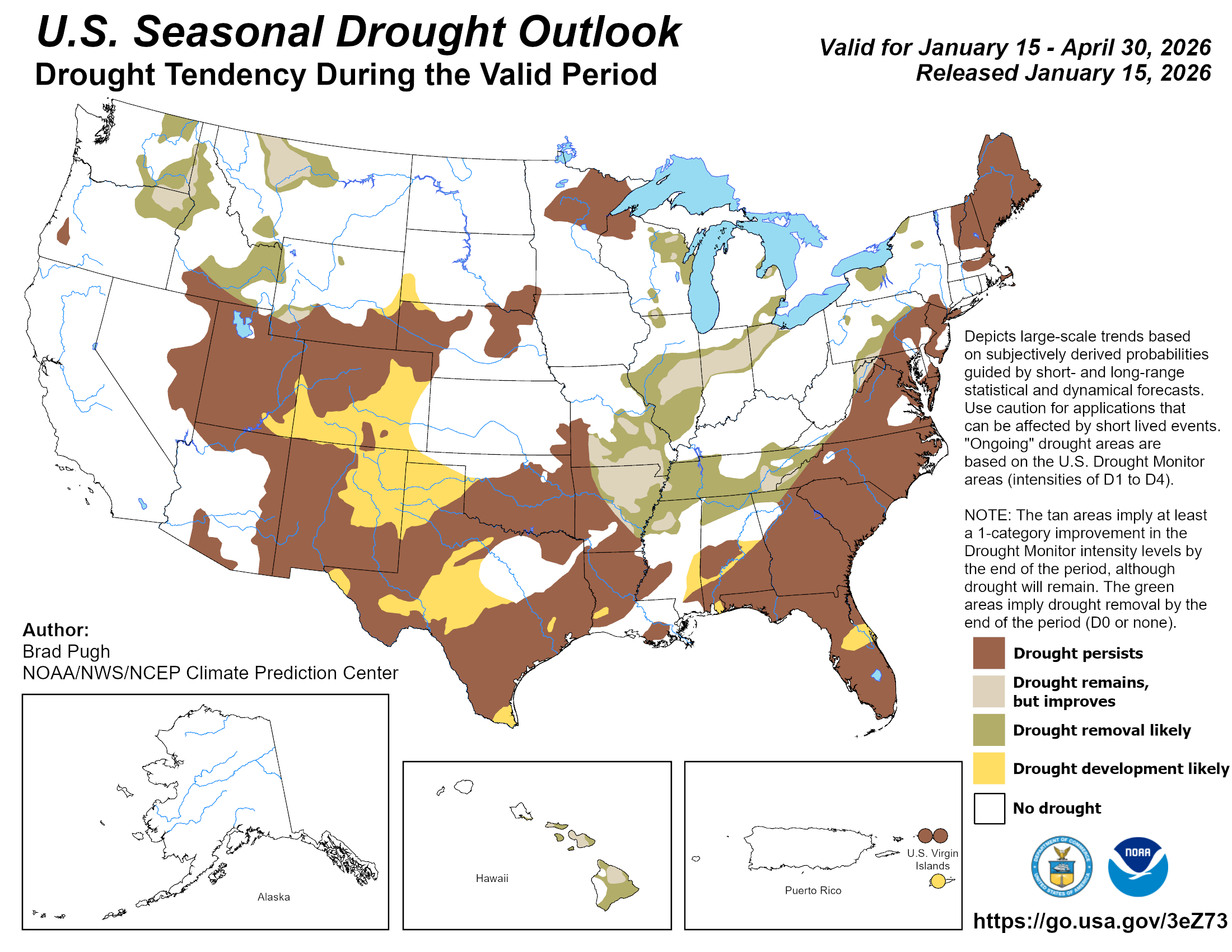
Bureau of Reclamation Aspinall Unit Coordination Meeting February 11, 2026 #GunnisonRiver

From email from Reclamation Reece K. Carpenter:
January 14, 2026
In order to avoid conflict with Colorado Water Congress the first Aspinall Coordination Meeting of 2026 is being rescheduled.
The next coordination meeting for the operation of the Aspinall Unit is rescheduled for Wednesday, February 11th 2026, at 1:30 pm.
This meeting will be held at the Western Colorado Area Office in Grand Junction, CO. There will also be an option for virtual attendance via Microsoft Teams. A link to the Teams meeting is below.
The meeting agenda will include updates on current snowpack, forecasts for spring runoff conditions and spring peak operations, and the weather outlook.
Kick the (#coal) can down the road to 2040?: #ColoradoSprings Utilities wants legislation to let it delay retirement of its last coal-burning unit. It will face a fight among environmental groups — Allen Best (BigPivots.com)
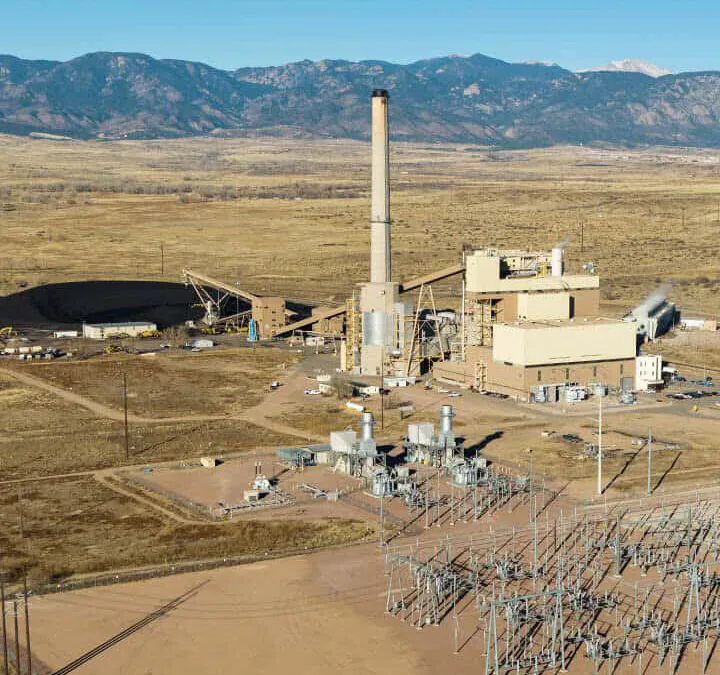
Click the link to read the article on the Big Pivots website (Allen Best):
January 13, 2026
Colorado Springs Utilities stands alone among the electrical utilities in Colorado in saying that it cannot meet its 2030 greenhouse gas reduction targets.
CSU wants to keep the coal-burning unit at the Ray Nixon Plant operating beyond its 2029 scheduled retirement. Four state legislators, two of them Democrats, say they will introduce a bill in the legislative session that begins on Wednesday to do just that.
This proposed bill, according to the draft dated Jan. 5, would require CSU, other municipal utilities and electrical cooperatives to potentially delay meeting the target until 2040, a decade later. They must currently reduce emissions 80% by 2030 as compared to 2005 levels. See 2030 Emission Reduction Goal Challenges (Draft 1-6)
The existing state deadlines would have all but one coal-burning unit in Colorado retired by the end of 2029, leaving only Comanche 3 in Pueblo to operate until the end of 2030. That unit is operated by Xcel Energy and owned by Xcel with two electrical cooperatives as minority owners. It is currently down for repairs.
Colorado Springs began saying almost a year ago that it could not secure enough renewable generation at acceptable prices to meet the carbon-reduction goal. Bids on renewable projects had come in 30% to 50% higher than expected.
Travas Deal, the chief executive of CSU, reiterated his argument at a press conference on Monday. Achieving the deadline of 80% greenhouse gas reductions by 2030 without risking reliability and affordability for the homes, businesses, hospitals and military installations that rely upon electricity from CSU has become increasingly challenging.
He called for a “measured approach.”
A major theme is that renewables cost more money, and the cost is being borne by people who cannot afford rising electricity bills. The draft bill hammers this point from several directions.
The bill being readied for introduction would allow CSU to notify the state’s Air Pollution Control Division by the end of May that it expects to be unable to hit the 2030 goal and why. It would then have until the end of 2026 to come up with a new plan for achieving the goal no later than 2040.
This timeline, said Deal, would “us more time to secure reliable and affordable replacement power for the coal-powered unit at the Nixon power plant currently mandated to retire in 2029.”
But why is Colorado Springs alone among Colorado utilities in wanting a legislative extension? Deal was asked that question twice during a press conference on Monday afternoon, once by this correspondent. After all, United Power left Tri-State less than two years ago and has managed to add both renewable generation and a gas-fired power plant. United has robust growth in electrical demand. And, if not as large as Colorado Springs, United has113,000 members — many of them industrial users with healthy electrical appetites.
Deal answered that United has the capacity to get electricity from Tri-State Generation and Transmission Association, of which it was formerly a member.
That was not a satisfying answer, although it’s possible that transmission constraints might preclude CSU from buying power from Tri-State as United is now doing.
Might Tri-State or other electrical cooperatives quietly be supporting this move to soften the deadlines for closing coal plants? Big Pivots did reach out to Tri-State to request an interview, but did not get a response on Monday.
As for Xcel, this bill would not apply to it or to Black Hills Energy, Colorado’s other privately owned electrical utility.
Standing out in this proposal is the bipartisan support, two Republicans and two Democrats. All but one of them are from El Paso County. One of the two Republicans, Sen. Cleave Simpson, of Alamosa, is the Senate minority leader.
Most striking was a statement made by Sen. Marc Snyder, a Democrat from Manitou Springs. He pointed out that in a “lifetime ago,” when he was mayor of Manitou, the city — which is supplied by CSU — was able to achieve 100% renewables. He said it was Colorado’s first home-rule municipality to do so.
(Aspen, which is also home rule, did so in 2015; when Manitou Springs did it Snyder did not say. In both cases, they presumably did so with the artifice of renewable energy credits.)
Rep. Amy Paschall, also a Democrat, proclaimed her environmental actions. “I recycle, I drive an electric vehicle and I have solar panels on my roof,” she said. She added that she suffers from asthma and has a child who has asthma. As such, she said, attaining ozone reduction “isn’t just an abstract policy discussion. It directly affects our health and our quality of life.”
So why is she adding her name to this bill?
“Because it aims to strike the delicate balance between affordability, reliability and clean energy in Colorado Springs,” she answered. This bill will seek to achieve the “right balance.”
State Rep. Jarvis Caldwell, a Republican (and House minority leader), did not disown the need for an energy transition from fuels that produce emissions, but did characterize current goals as unrealistic.
“What you are seeing now is a growing gap between intention and reality,” said Caldwell. “Over the last several years, the Legislature has set aggressive energy mandates without fully grappling with what those mandates mean for the people who are expected to pay the bill.”
For many households, he said, energy costs are not an abstract policy debate. They are a monthly decision between paying the power bill or cutting back somewhere else.
The energy transition, he said, is “being rushed” and called the timelines “unrealistic.” And Caldwell further charged that reliability is treated as an afterthought.
“The result is higher prices and a more fragile system. That is not responsible governance.”
Caldwell said that both he and Paschal had meet with the Democratic majority leadership. “We didn’t get any commitments necessarily from them, but they heard our concerns and they heard our reasoning, and they were receptive to it,” he said. He also said there had been discussions with Gov. Jared Polis.
Sounds like a compelling argument. Does the rhetoric overlook subtleties?
All or nearly all utilities have or propose to raise their electric rates, and for a complicated stew of reasons. In some cases, they need to reinvest in delivery infrastructure. It’s not all investment in renewable energy to replace fossil fuel generation. In fact, in most cases, renewables reduce costs to consumers, because the fuel in renewables is free. But yes, rates are rising.
Renewables do need transmission — and more of it. And transmission is difficult and expensive.
Colorado Springs has high-voltage transmission lines for its fossil fuel plants. Deal said the best wind lies in Wyoming and hence CSU would be best served by transmission lines along the Front Range — a challenge, as is witnessed by the problems Xcel Energy is having in getting electricity from El Paso County to Aurora. As always, though, that is a more complicated story than this simple sentence. See “Highways of Electricity,” Big Pivots, Jan. 4, 2026).
And Deal’s answer overlooks the fact that Colorado’s best wind resources lie in southeastern Colorado.
Big Pivots asked Deal if CSU would be struggling less if it had better transmission. “Transmission may not have alleviated everything on day one, but it would give us a lot more options,” he replied.
He added that joining the Southwest Power Pool, an organization formed to facilitate energy sharing within a region, will provide a “big tool” for CSU to connect to renewable resources. But again, that will require transmission, although the precise needs remain uncertain.
As for data centers, what part are they of this Colorado Springs story? Is CSU expecting to miss its greenhouse gas reduction deadline because it doesn’t want to miss out on the economic development potential in artificial intelligence centers.
Hard to say, although perhaps tellingly, the video event in Colorado Springs included Johnna Reeder Kleymeyer, from the Colorado Springs Chamber and Economic Development Commission. “This proposed legislation recognizes one simple truth,” she said. “Economic growth and sustainability have to work in concert, not in conflict.”
A reporter from Colorado Public Radio, however, did ask a decent question: Would CSU consider requiring agreements with large-load users, including data centers, to be on hold until the utility could get closer to the current clean energy goal?
“We would never want to close the door on any opportunity there, but I think that’s something that the legislation has to look at, as for us to continue to support growth in our communities, have jobs, and look at those revenue streams come in,” Deal answer.
As for data centers, they do require a lot of electricity without generating a large number of jobs, he added, as compared to another large-level manufacturer. “So we try not to get into what the (electric) load is as much as what the community benefit is and how we can best serve them.”
Colorado Springs, perhaps not incidentally, in December announced that it would become home to a Coca-Cola bottling plant that will require $475 million in capital investment and generate 170 new jobs.
Snyder, the legislator from Manitou Springs, said the bill was being drawn up after consultation with stakeholders. The Sierra Club said it was not among those consulted.
“CSU is the only utility in Colorado to ask for a special exemption from Colorado’s environmental standards that protect public health and our climate,” said Margaret Kran-Annexstein, director of the Colorado Chapter of the Sierra Club.
Conservation Colorado, in a statement, said CSU should not be rewarded for “broken promises and poor planning.”
“After years of failing to plan for replacement resources, Colorado Springs Utilities (CSU) wants to break its promise and remain one of Colorado’s largest polluters,” said Paul Sherman, the organization’s climate campaign manager.
Unlike the Sierra Club, Conservation Colorado had participated in discussions with CSU. Sherman said his organization had communicated its concerns. “None of the substantive concerns we raised were addressed in the draft that CSU and bill sponsors released this afternoon,” Sherman said. “As currently drafted, Conservation Colorado will be opposing this legislation.”
Season’s #snowpack remains meager (January 18, 2026) with little moisture in sight — The #GrandJunction Daily Sentinel #Colorado
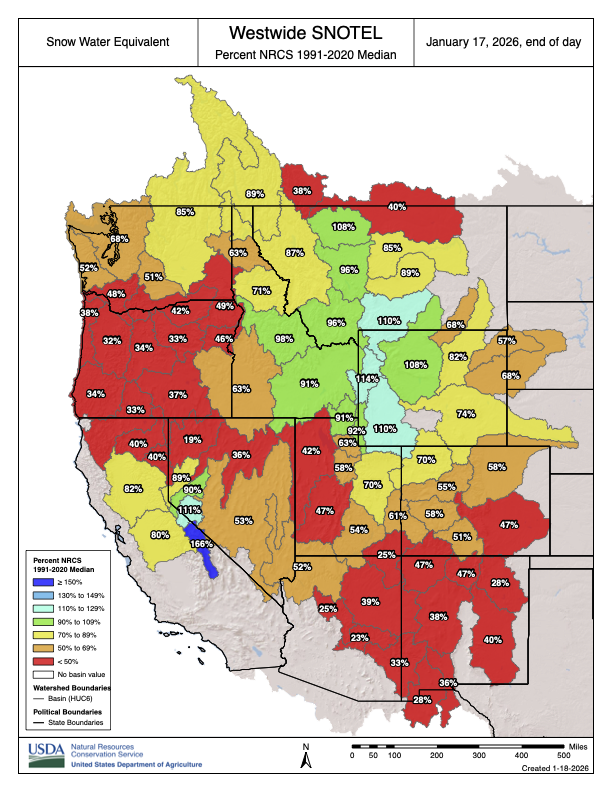
Click the link to read the article on The Grand Junction Daily Sentinel website (Dennis Webbs). Here’s an excerpt:
January 14 2026
Colorado’s snowpack levels remain meager so far this winter season, with little moisture in the near-term local forecast in a year when water managers can scarcely afford a poor spring runoff season due to low storage levels downstream in Lake Powell. The state’s snowpack stood at 63% of median as of Tuesday, according to the federal Natural Resources Conservation Service. Levels range from 76-77% in some basins in far-northern Colorado to 58% in the Colorado River headwaters and just 50% in the Arkansas River basin. The Gunnison River Basin is at 63% of median.
The NRCS said in a news release that warm and dry conditions have led to the below-normal snowpack conditions. Climatologist Allie Mazurek with The Colorado Climate Center said in a December blog post that September-November was the fourth-warmest on record for that period for Colorado, with November in specific being third-warmest on record. Some Western Slope locations had their warmest fall on record, Mazurek wrote. The conditions have challenged ski resorts that have opened later, and with limited terrain. But Powderhorn Mountain Resort announced Saturday that it would be boosting its operations through the opening of its West End Lift the following day, following a 15-inch storm and cooler temperatures that allowed around-the-clock snowmaking.
The Arkansas Valley Conduit project has about three years of cash left to keep building, despite President Trump’s veto — Jerd Smith (Fresh Water News) #ArkansasRiver #ColoradoRiver #COriver #aridification
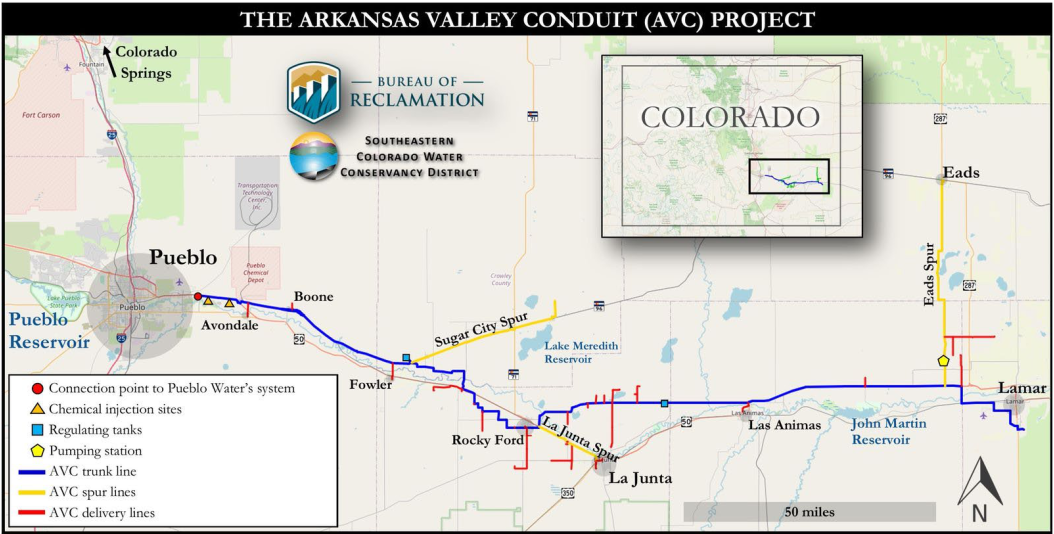
Click the link to read the article on the Water Education Colorado website (Jerd Smith):
January 15, 2026
Water officials and Colorado’s congressional reps are scrambling to find an affordable path forward for communities in the Lower Arkansas Valley who had hoped the federal government would help them lower their costs for a critical clean water pipeline.
President Trump vetoed the bipartisan Finish the Arkansas Valley Conduit Act on New Year’s Eve, and despite Colorado’s efforts, Congress failed to override the veto last week.
Construction on the $1.39 billion pipeline began in 2023. There’s enough money left from the $500 million appropriated by Congress to continue building for another three to five years, according to Bill Long, president of the board for the Pueblo-based Southeastern Water Conservancy District. The district operates the federal Fryingpan-Arkansas Project and is overseeing pipeline construction for the U.S. Bureau of Reclamation.
That means the pipeline should eventually reach Rocky Ford, a point roughly halfway between its start east of Pueblo Reservoir and its endpoint farther east, near Lamar. “It’s when we get to the second half of the project where it will be challenging to build and repay our portion of the debt,” Long said. “Without this legislation, there will be a point where we will have to stop.”
What comes next isn’t clear yet, though members of Colorado’s congressional delegation and water officials in the Lower Arkansas Valley said they are evaluating their options for taking another run at the issue in Congress.
“Obviously things are up in the air,” Long said.
“Sooner rather than later we may be looking at a new piece of legislation, but the question is, would this administration be amenable to a new piece of legislation. If we can’t find something, we may have to wait this administration out,” he said.

Waiting for clean water in the Lower Arkansas Valley is nothing new.
First envisioned as part of the U.S. Bureau of Reclamation’s Fryingpan-Arkansas Project in 1962, the pipeline languished on paper for decades because of high costs. The 130-mile pipeline serves 39 communities.
The need for clean water in the Lower Arkansas Valley became apparent in the 1950s and earlier, by some accounts, when wells drilled near the Arkansas River were showing a range of toxic elements, including naturally occurring radium and selenium. Both can cause severe health problems, including bone cancer and lung issues if high amounts are consumed.
Without safe drinking water, towns in the region have either had to haul water or install expensive reverse osmosis plants to purify their contaminated well water.
Things changed on the stalled project in 2023, when Congress directed some $500 million toward the pipeline.
The legislation would have gone further, allowing the repayment terms on the loans from the federal government to be extended to 75 years, up from 50 years, and to cut interest rates in half, from 3.046% to 1.523%. The legislation also would have allowed the project to be classified as one of hardship, a move that may have allowed the U.S. Bureau of Reclamation to forgive some loan payments if a case for economic hardship could have been made.
The conduit project is also partially funded with grants and loans from state agencies, including the Colorado Water Resources and Power Development Authority.
“The act was an important step in making this project affordable,” said Keith McLaughlin, executive director of the Colorado Water Resources and Power Development Authority, one of the agencies helping fund the work.
“Obviously we’re disappointed,” he said.
Colorado politicos say they’re still working to push legislation through. The bipartisan act was sponsored by Colorado Republican U.S. Reps. Lauren Boebert and Jeff Hurd in the U.S. House and Democratic U.S. Sens. John Hickenlooper and Michael Bennet in the U.S. Senate.
Trump’s veto of the measure is widely seen as being the result of ongoing conflicts between his administration and Colorado Gov. Jared Polis, a Democrat, including a request to pardon former Mesa County Clerk Tina Peters, who is serving a nine-year prison term for orchestrating a data breach of the county’s elections equipment violating state elections. Polis so far has declined to intervene in that case, although he did describe the sentence as “harsh,” leading some to speculate that he might commute it. In a statement, Polis said he was hopeful that Congress would ultimately succeed in approving some form of aid to help complete the conduit.
Neither Boebert nor Hurd responded to a request for comment. But Hickenlooper said that all the congressional reps continue to work on a new path forward.
“The people of southeastern Colorado have waited 60 years for clean, safe drinking water. We’re continuing to work with our partners in the delegation to complete the Arkansas Valley Conduit and deliver on the federal government’s promise,” Hickenlooper said via email.
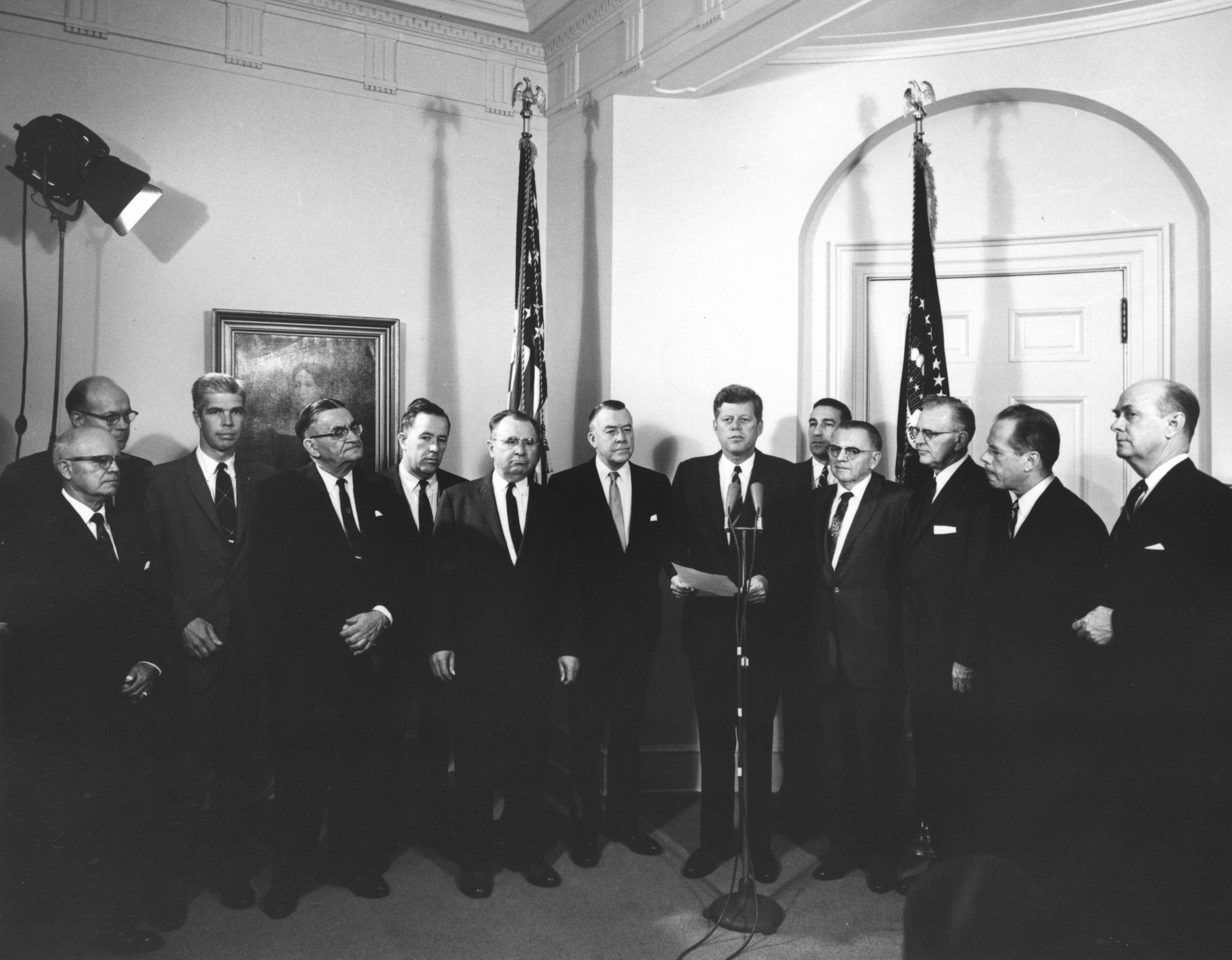
#Colorado Mesa University tabs Shannon Wadas as Ruth Powell Hutchins Water Center director — The #GrandeJunction Daily Sentinel
Click the link to read the article on The Grand Junction Daily Sentinel website. Here’s an excerpt:
January 13, 2026

Shannon Wadas has been hired as the executive director of the Ruth Powell Hutchins Water Center (RPHWC), Colorado Mesa University announced Monday. Wadas was chosen for her experience in natural resource and organizational management in the public and non-profit sectors. CMU cited experiences including her support of watershed planning efforts in the region, coordinating and facilitating a water education course for professionals, and helping form a community navigator network in the Upper Rio Grande Basin to accelerate aquatic restoration. Most recently, Wadas worked as a private consultant focused on organizational strategy, partnership collaboration, engagement and capacity building.
“I am excited and honored to join Colorado Mesa University and lead the Ruth Powell Hutchins Water Center,” Wadas said in CMU’s announcement. “There is no greater unifying force than water. I am thrilled to have the opportunity to catalyze and strengthen the collaborative efforts of CMU and local and regional partners to support important water issues through educational opportunities, research initiatives and thoughtful conversations.”
“Shannon brings a wealth of experience and collaborative leadership to CMU that will strengthen the Ruth Powell Hutchins Water Center’s role in bringing people together, fostering innovation in water resource management and cultivating the next generation of water leaders,” added CMU President John Marshall.
The RPHWC serves as a Western Slope hub for water policy, academic education and applied research. The center also supports student programming and interdisciplinary learning opportunities, including water-focused coursework and research, seminars, continuing education classes and a Water Fellows program.
The latest U.S. Seasonal #Drought Outlook through April 30, 2026 is hot off the presses from the #Climate Prediction Center
#ColoradoRiver experts say some management options in the draft EIS don’t go far enough to address scarcity, #ClimateChange — Heather Sackett (AspenJournalism.org) #COriver #aridification
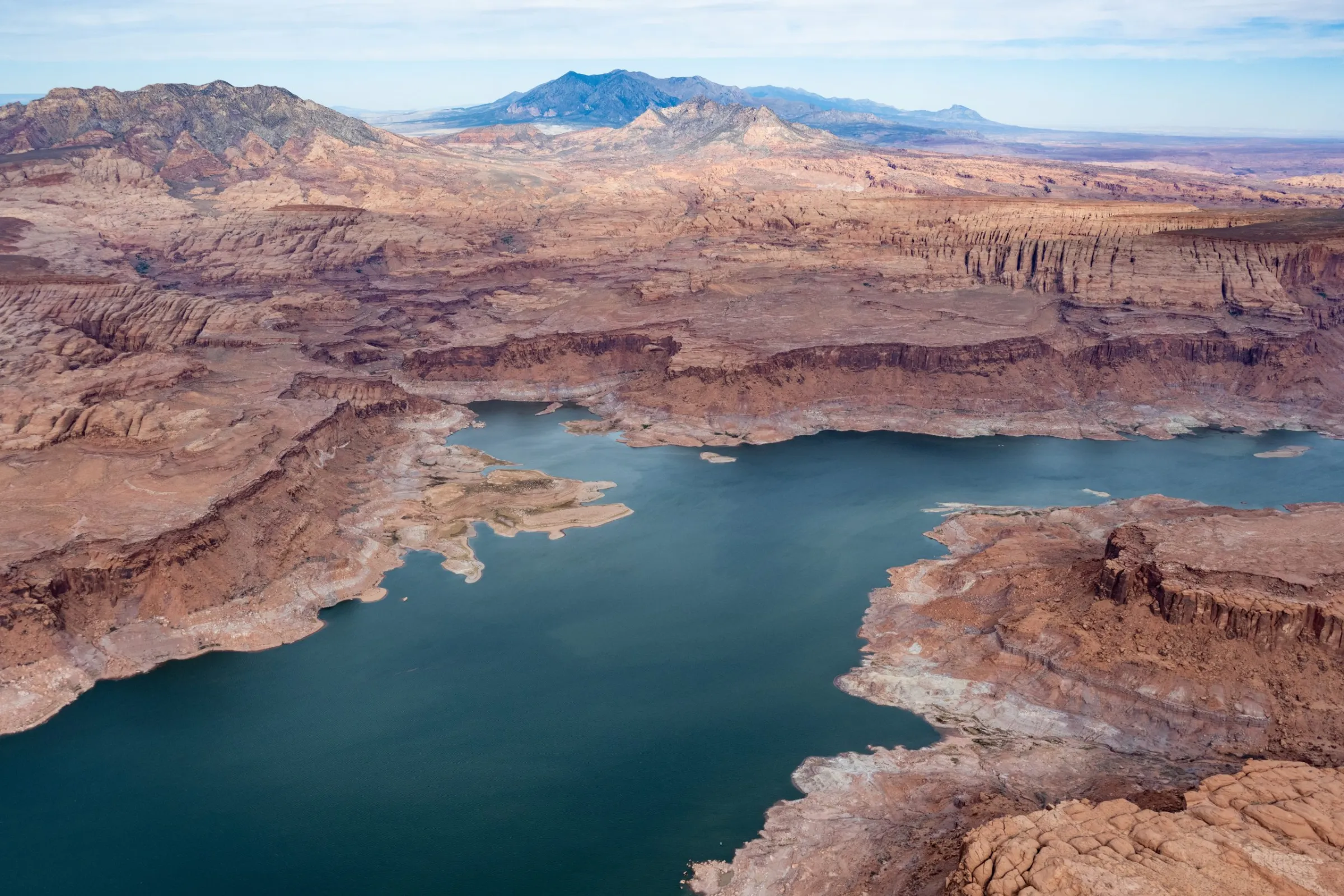
Click the link to read the article on the Aspen Journalism website (Heather Sackett):
January 15, 2026
Federal officials have released detailed options for how the Colorado River could be managed in the future, pushing forward the planning process in the absence of a seven-state deal. But some Colorado River experts and water managers say cuts don’t go deep enough under some scenarios and flow estimates don’t accommodate future water scarcity driven by climate change.
On Jan. 9, the U.S. Bureau of Reclamation released a draft of its environmental impact statement, a document required by the National Environmental Policy Act, which lays out five alternatives for how to manage the river after the current guidelines expire at the end of the year. This move by the feds pushes the process forward even as the seven states that share the river continue negotiating how cuts would be shared and reservoirs operated in the future. If the states do make a deal, it would become the “preferred alternative” and plugged into the NEPA process.
“Given the importance of a consensus-based approach to operations for the stability of the system, Reclamation has not yet identified a preferred alternative,” Scott Cameron, the acting Reclamation commissioner, said in a press release. “However, Reclamation anticipates that when an agreement is reached, it will incorporate elements or variations of these five alternatives and will be fully analyzed in the final EIS, enabling the sustainable and effective management of the Colorado River.”
For more than two years, the Upper Basin (Colorado, New Mexico, Utah and Wyoming) and the Lower Basin (California, Arizona and Nevada) have been negotiating, with little progress, how to manage a dwindling resource in the face of an increasingly dry future. The 2007 guidelines that set annual Lake Powell and Lake Mead releases based on reservoir levels do not go far enough to prevent them from being drawn down during consecutive dry years, putting the water supply for 40 million people in the Southwest at risk.
The crisis has deepened in recent years, and in 2022, Lake Powell flirted with falling below a critical elevation to make hydropower. Recent projections from the U.S. Bureau of Reclamation show that it could be headed there again this year and in 2027.
John Berggren, regional policy manager with Western Resource Advocates, helped craft elements of one of the alternatives, Maximum Operational Flexibility, formerly called Cooperative Conservation.
“My initial takeaway is there’s a lot of good stuff in there,” Berggren said of the 1,600-page document, which includes 33 supporting and technical appendices. “Their goal was to have a wide range of alternatives to make sure they had EIS coverage for whatever decision they ended up with, and I think that there are a lot of innovative tools and policies and programs in some of them.”

Alternatives
The first alternative is “no action,” meaning river operations would revert to pre-2007 guidance; officials have said this option must be included as a requirement of NEPA, but doesn’t meet the current needs.
The second alternative, Basic Coordination, can be implemented without an agreement from the states and represents what the feds can do under their existing authority. It would include Lower Basin cuts of up to 1.48 million acre-feet based on Lake Mead elevations; Lake Powell releases would be primarily 8.23 million acre-feet and could go as low as 7 million acre-feet. It would also include releases from upstream reservoirs Flaming Gorge, Blue Mesa and Navajo to feed Powell. But experts say this alternative does not go far enough to keep the system from crashing.
“It was pretty well known that the existing authorities that Reclamation has are probably not enough to protect the system,” Berggren said. “Especially given some of the hydrologies we expect to see, the Basic Coordination does not go far enough.”
The Enhanced Coordination Alternative would impose Lower Basin cuts of between 1.3 million and 3 million acre-feet that would be distributed pro-rata, based on each state’s existing water allocation. It would also include an Upper Basin conservation pool in Lake Powell that starts at up to 200,000 acre-feet a year and could increase up to 350,000 acre-feet after the first decade.
Under the Maximum Operational Flexibility Alternative, Lake Powell releases range from 5 million acre-feet to 11 million acre-feet, based on total system storage and recent hydrology, with Lower Basin cuts of up to 4 million acre-feet. It would also include an Upper Basin conservation pool of an average of 200,000 acre-feet a year.
These two alternatives perform the best at keeping Lake Powell above critical elevations in dry years, according to an analysis contained in the draft EIS.
“There are really only two of these scenarios that I think meet the definition of dealing with a very dry future: Enhanced Coordination and the Max Flexibility,” said Brad Udall, a senior water and climate research scientist at Colorado State University. “Those two kind of jump out at me as being different than the other ones in that they actually seem to have the least harmful outcomes, but the price for that are these really big shortages.”
The final scenario is the Supply Driven Alternative, which calls for maximum shortages of 2.1 million acre-feet and Lake Powell releases based on 65% of three-year natural flows at Lees Ferry. It also includes an Upper Basin conservation pool of up to 200,000 acre-feet a year. This option offers two different approaches to Lower Basin cuts: one based on priority where the oldest water rights get first use of the river, putting Arizona’s junior users on the chopping block, and one where cuts are distributed proportionally according to existing water allocations, meaning California could take the biggest hit.
This alternative is based on proposals submitted by each basin and discussions among the states and federal officials last spring. Udall said the cuts are not deep enough in this option.
“You can take the supply-driven one and change the max shortages from 2.1 million acre-feet up to 3 or 4 and it’s going to perform a lot like those other two,” he said. “I think what hinders it is just the fact that the shortages are not big enough to keep the basin in balance when push comes to shove.”
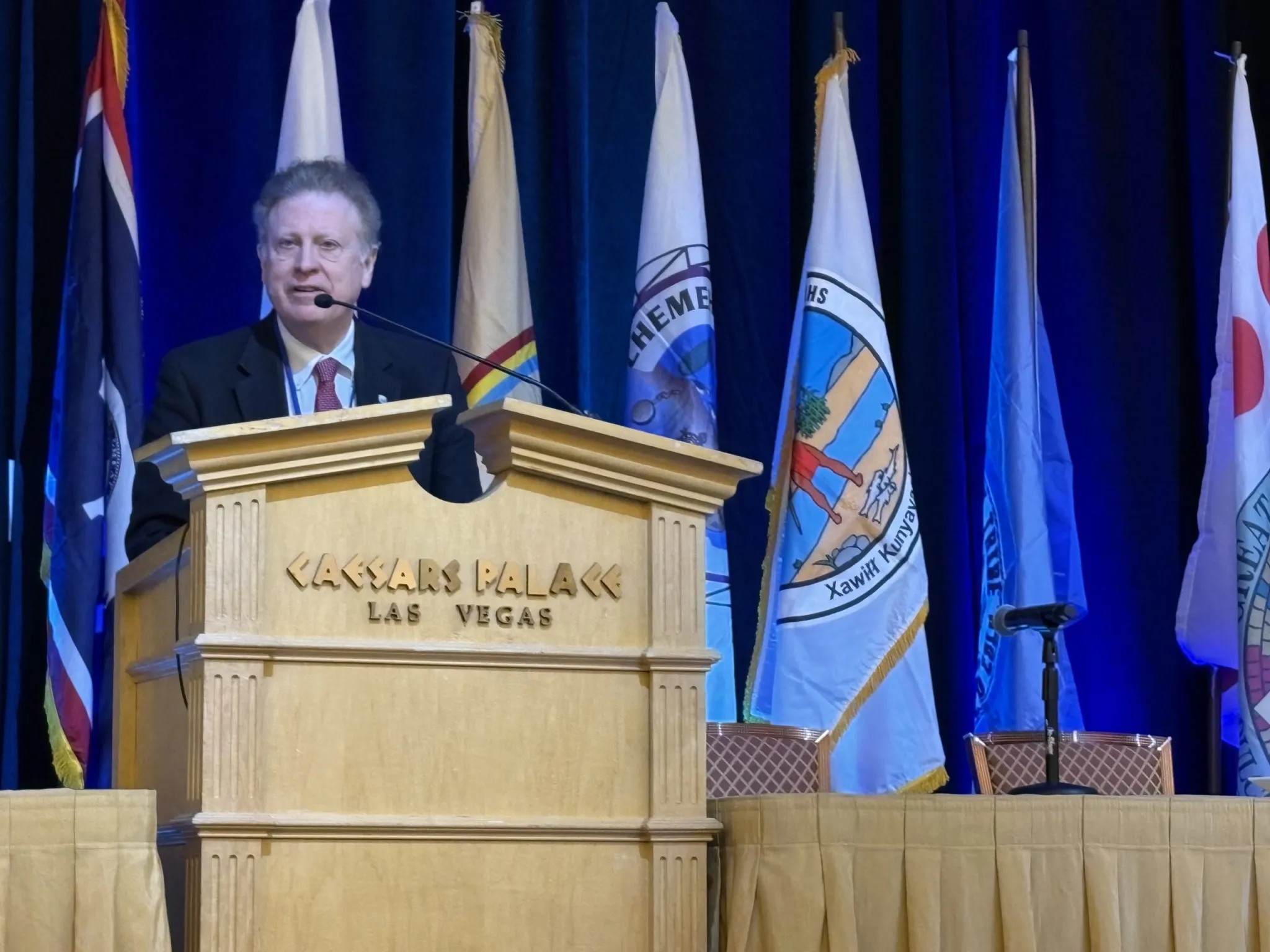
Pivotal moment
In a prepared statement, Glenwood Springs-based Colorado River Water Conservation District officials expressed concern that the projected future river flows are too optimistic.
“We are concerned that the proposed alternatives do not accommodate the probable hydrological future identified by reliable climate science, which anticipates a river flowing at an average of 9-10 [million acre feet] a year,” the statement reads. “The Colorado River Basin has a history of ignoring likely hydrology, our policymakers should not carry this mistake forward in the next set of guidelines.”
The River District was also skeptical of the Upper Basin conservation pool in Lake Powell, which is included in three of the alternatives. Despite dabbling in experimental programs that pay farmers and ranchers to voluntarily cut back on their water use in recent years, conservation remains a contentious issue in the Upper Basin. Upper Basin water managers have said their states can’t conserve large volumes of water and that any program must be voluntary.
Over the course of 2023 and 2024, the System Conservation Pilot Program, which paid water users in the Upper Basin to cut back, saved about 101,000 acre-feet at a cost of $45 million.
The likeliest place to find water savings in Colorado is the 15-county Western Slope area represented by the River District. But if conservation programs are focused solely on this region, they could have negative impacts on rural agricultural communities, River District officials have said.
“Additionally, several alternatives include annual conservation contributions from the Upper Basin between [200,000 acre-feet] and [350,000 acre feet],” the River District’s statement reads. “We do not see how that is a realistic alternative given the natural availability of water in the Upper Basin, especially in dry years.”
In a prepared statement, Colorado officials said they were looking forward to reviewing the draft EIS.
“Colorado is committed to protecting our state’s significant rights and interests in the Colorado River and continues to work towards a consensus-based, supply-driven solution for the post-2026 operations of Lake Powell and Mead,” Colorado’s commissioner, Becky Mitchell, said in the statement.
The release of the draft EIS comes at a pivotal moment for the Colorado River Basin. The seven state representatives are under the gun to come up with a deal and have less than a month to present details of a plan by the feds’ Feb. 14 deadline. Federal officials have said they need a new plan in place by Oct. 1, the start of the next water year. This winter’s dismal snowpack and dire projections about spring runoff underscore the urgency for the states to come up with an agreement for a new management paradigm.
Over a string of recent dry years, periodic wet winters in 2019 and 2023 have bailed out the basin and offered a last-minute reprieve from the worst consequences of drought and climate change. But this year is different, Udall said.
“We’re now at the point where we’ve removed basically all resiliency from the system,” he said. “Between the EIS and this awful winter, some really tough decisions are going to be made. … Once we finally get to a consensus agreement, the river is going to look very, very different than it ever has.”
The draft EIS will be published in the Federal Register on Jan.16, initiating a 45-day comment period that will end March 2.
The Federal Government releases their #ColoradoRiver plan for a warming #climate: Also — Are Hovenweep and Aztec Ruins national monuments really in danger of shrinkage? — Jonathan P. Thompson #COriver #aridification
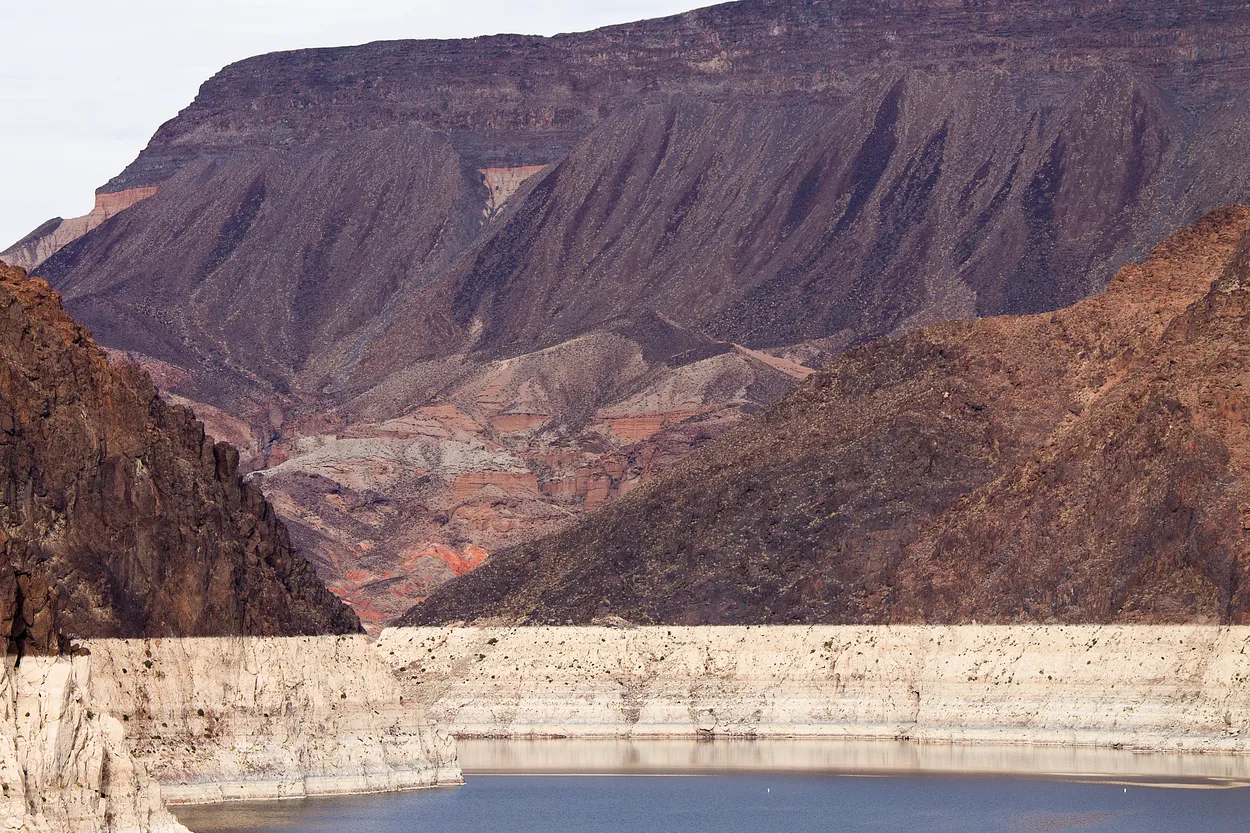
Click the link to read the article on The Land Desk website (Jonathan P. Thompson):
January 14, 2026
🥵 Aridification Watch 🐫
Just over a month before the deadline for the Colorado River states to agree on a plan for sharing the river’s diminishing waters, the feds released their options, one of which could be implemented if the states don’t reach a deal. The Bureau of Reclamation’s “Post-2026 Operational Guidelines and Strategies for Lake Powell and Lake Mead” offers five alternative scenarios for how to run the river, all of which are aimed at keeping the two reservoirs viable through different methods of divvying up the burden of inevitable shortages in supply.
The document, and the need to deal with present and future shortages, is necessary because human-caused climate change-exacerbated aridification has diminished the Colorado River’s flow, throwing the supply-demand equation out of balance. So it is somewhat surreal to peruse the voluminous report that was published by an administration whose leader has called climate change a “hoax” and a “con job.”
My cursory search of the document turned up only one occurrence of the term “climate change.”1 Yet the authors do acknowledge, if obliquely, that global warming is shrinking the river. “The Basin is experiencing increased aridity due to climate variability,” they write, “and long-term drought and low runoff conditions are expected in the future.” This tidbit also evaded the censors: “Since 2000, the Basin has experienced persistent drought conditions, exacerbated by a warming climate, resulting in increased evapotranspiration, reduced soil moisture, and ultimately reduced runoff.”
All of the alternatives put most of the burden of cutting consumptive use on the Lower Basin states, while directing the Upper Basin to take unspecified conservation measures. I’ll summarize the alternatives below, but first, it seems telling to see which which proposed alternatives the Bureau considered, but ultimately eliminated from detailed analysis.
Colorado River crisis continues — Jonathan P. Thompson
The alternatives do not include:
- The “boating alternative,” which would prioritize maintaining Lake Powell’s surface level at or above 3,588 feet to serve recreational boating needs. This proposal was put forward in the “Path to 3,588” plan by motorized recreation lobbying group BlueRibbon Coalition. It was dismissed because, basically, it would sacrifice downstream farms and cities for the sake of boating.
- The ecosystem alternative, which would prioritize the Colorado River’s ecosystem health by focusing management and reducing consumptive human use to protect wildlife, vegetation, habitats, and wetlands.
- One-dam alternative, a.k.a. Fill Mead First. This proposal would entail either bypassing or decommissioning Glen Canyon Dam with the aim of filling Lake Mead. The Bureau said they rejected the plan because it would be inconsistent with the Law of the River and might be unacceptable to stakeholders (even though some Lower Basin farmers got a little Hayduke-fever a couple of years back, suggesting that ridding Glen Canyon of the dam might be the best way to manage the river).
Okay, so that’s what’s NOT going to happen. So what might happen if the feds feel the need to intervene? Here’s a very short summary of each alternative:
- No Action: This is always offered in these things, and it just means that they would revert back to the pre-2007 interim guidelines era, when releases from Lake Powell were fixed at an average of 8.23 million acre-feet per year and shortages were determined based on Lake Mead levels and would be distributed based on priority.
- Basic Coordination Alternative: Lake Powell releases would range from 7 to 9.5 maf annually, based on the reservoir’s surface level, and releases from upper basin reservoirs would be implemented to protect Glen Canyon Dam’s infrastructure. Lower Basin shortages (and cuts) would be based on Lake Mead elevations and would be distributed based on water right priority (meaning Arizona gets cut before California).
- Enhanced Coordination Alternative: Lake Powell annual releases would range from 4.7 maf to 10.8 maf, based on: a combination of Powell and Mead elevations; the 1-year running average hydrology; and Lower Basin deliveries. The Upper Basin would implement conservation measures to bolster Lake Powell levels if needed, and the Lower Basin shortages would range from 1.3 maf (when Mead and Powell, combined, are 60% full) to 3.0 maf (when Mead and Powell are 30% full or lower) annually. The Lower Basin shortages would be distributed proportionally, meaning that California — which has the largest allocation — would take 49% of the cuts, Arizona 31%, Nevada 3.3%, and Mexico 17%.
- Maximum Operational Flexibility Alternative: Lake Powell annual releases would range from 5 maf to 11 maf, based on total Upper Basin system storage and recent hydrology. But when Lake Powell’s surface level drops to 3,510 feet, Glen Canyon Dam would be operated as a “run of the river” facility, meaning that it would release only as much as what it running into the reservoir minus evaporation and seepage to keep the elevation from dropping further. Lower Basin shortages would be on a sliding scale, starting when Powell and Mead drop below 80% full, reaching 1 maf when the two reservoirs are 60% full. When the reservoirs drop below 60%, then shortages would be determined by the previous 3-year flows at Lee Ferry, topping out at a maximum shortage of 4 maf. Shortages would be distributed according to priority and proportionally.
- Supply Driven Alternative: This one is based on the amount of water that is actually in the river (go figure!). Lake Powell releases would range from 4.7 maf annually to 12 maf, or about 65% of the 3-year natural flows at Lees Ferry. Lower Basin shortages would kick in when Lake Mead’s surface elevation drops below 1,145 feet, reaching a maximum of 2.1 maf at 1,000 feet and lower. (As of Jan. 12, Mead’s level was 1,063 feet). Shortages would be distributed according to priority and proportionally.
The Lower Basin states reportedly aren’t too happy about any of the alternatives, because they put most of the onus for cutting consumption on the Lower Basin. Under the Maximum Flexibility option, for example, Lower Basin shortages could go as high as 4 million acre-feet, or about half of those states’ total annual consumptive use. And under another, California alone could have to cut up to 1.5 million acre-feet of water use, which could trigger litigation, since California users have some of the most senior rights on the river. Some of the alternatives would potentially nullify the Colorado Compact’s clause ordering the Upper Basin to “not cause the flow of the river at Lee Ferry to be depleted below an aggregate of 75 maf for any period of ten consecutive years.”
The Bureau does not pick a “preferred” alternative, like federal agencies typically do with environmental impact statements, leaving readers guessing about which option or combination of options might be chosen should the need arise. But it also gives more room for the states to reach some sort of agreement to pick an option from the provided list.
* It is found in the Hydrologic Resources section: “While the flows in the Colorado River would not affect groundwater in the region, changes to the groundwater systems in the Grand Canyon due to climate change may be an additional environmental factor that affects flows in the Colorado River.”
The snowpack remains dismal in most of the West, and it’s not just because of lack of precipitation. In fact, it’s probably more due to the crazy-warm temperatures. The average temperatures across the Interior were way above normal in November and December, as the map below shows. And January’s similarly unseasonably balmy so far. Yikes.
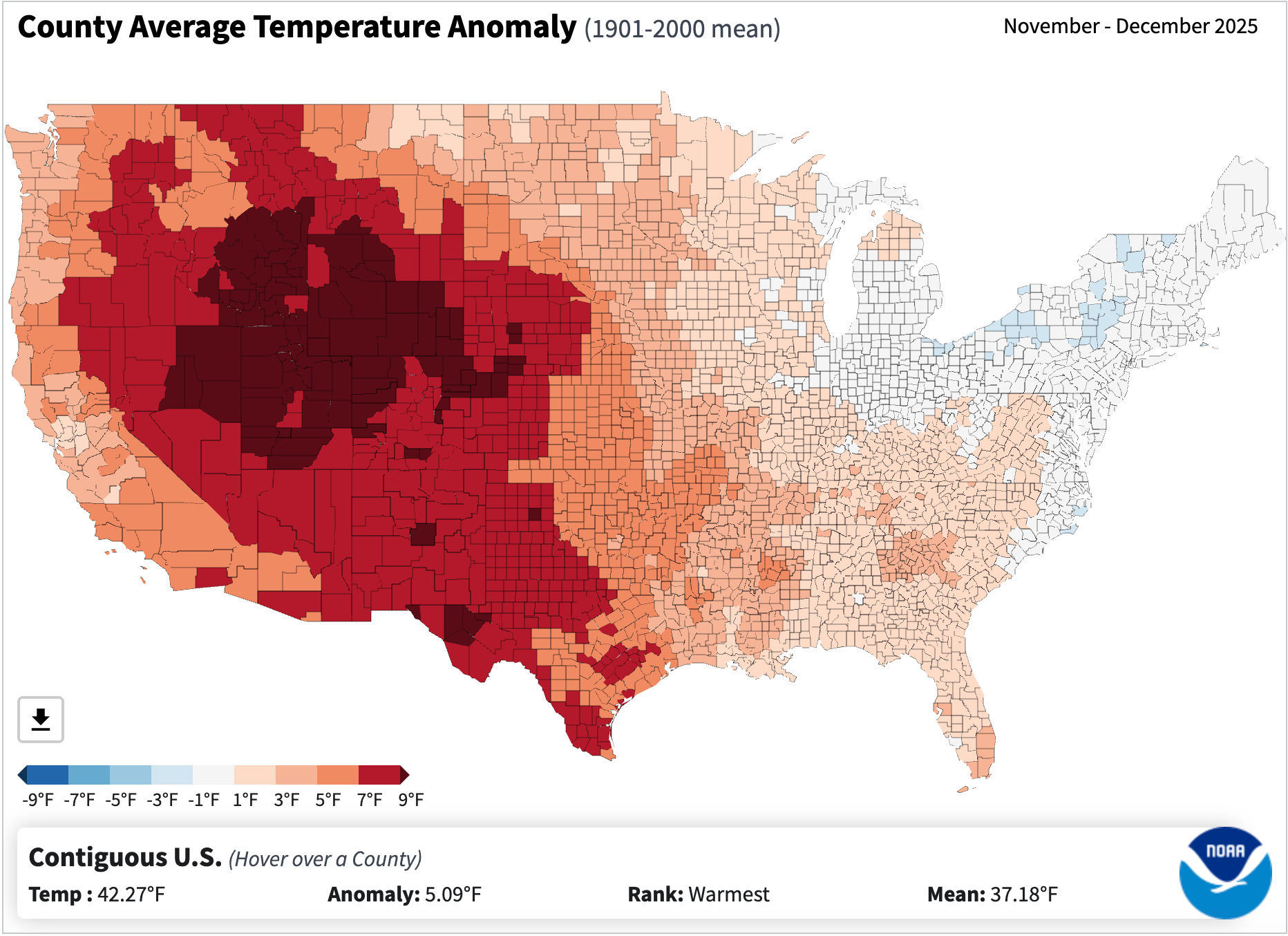
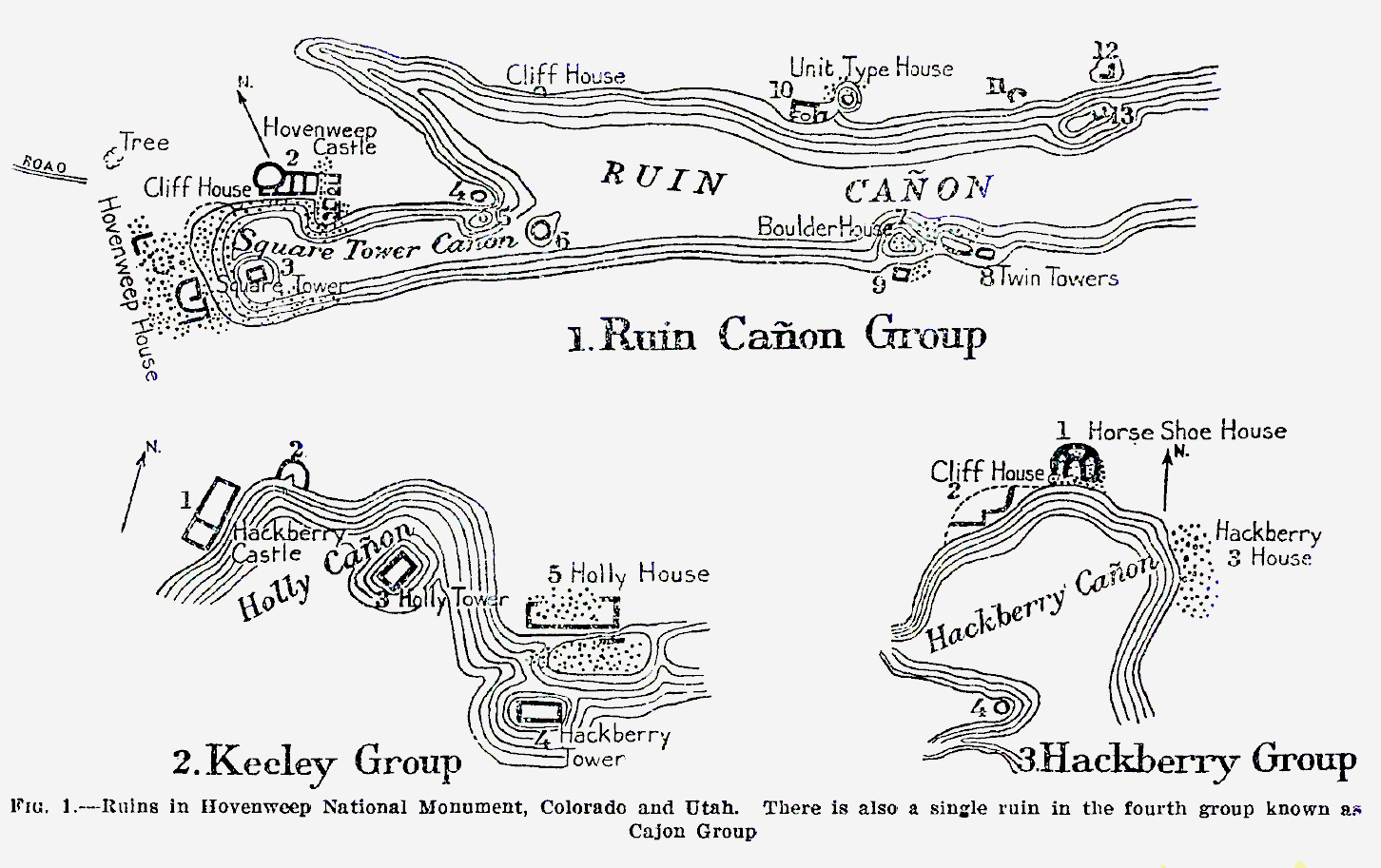
🌵 Public Lands 🌲
Last week the new public lands media outlet, RE:PUBLIC, warned readers of “major shrinkage” this year. They meant, of course, that the Trump administration will probably get around to eliminating or eviscerating at least one national monument in the next twelve months. It’s probably a pretty safe bet, given that in Trump’s first term he shrank Bears Ears and Grand Staircase-Escalante national monuments, and Project 2025, which the administration has hewn closely to, calls for even more reductions.
Indeed, I’m surprised they haven’t already moved to eliminate some of these protected areas, especially the more recently designated ones like Bears Ears, Baaj Nwaavjo I’tah Kukveni-Ancestral Footprints of the Grand Canyon National Monument, or Chuckwalla National Monument in California. An optimist might hope that the Trump administration has realized how deeply unpopular this would be, or has come to terms with the fact that the Antiquities Act only allows presidents to establish national monuments, not eliminate them. But I think it’s more likely they were simply too busy dismantling other environmental safeguards — and, for that matter, democracy — to get around to diminishing national monuments.
I was a little surprised by RE:PUBLIC’s list of vulnerable national monuments, however. It included Bears Ears et al, which makes sense, but then also speculates about other “likely targets, due to their proximity to energy and mining interests,” including: Aztec Ruins, Dinosaur, Hovenweep, and Natural Bridges national monuments.
I hate trying to predict what the Trump administration will do in the future, but I’m going to go out on a limb here and say that these particular national monuments are not in the administration’s crosshairs. While these protected areas are close to energy-producing areas, and probably have some oil and gas, uranium, lithium, and/or potash producing potential, they simply offer too little to the extractive industries to make it worth the political blowback from eviscerating them.
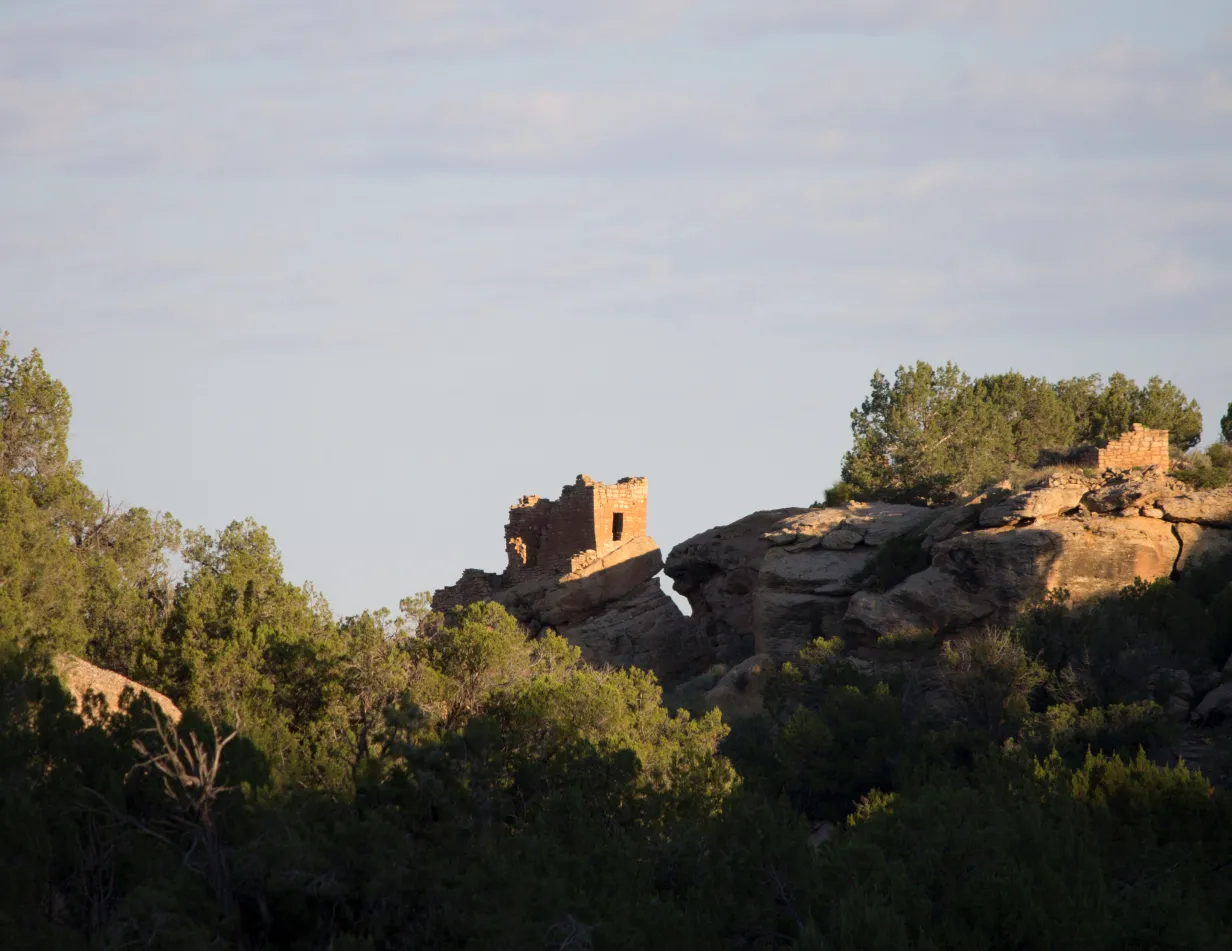
For those who may be unfamiliar with these places, I’ll take each one individually:
- Aztec Ruins: First off, this tiny national monument adjacent to the residential neighborhoods of Aztec, New Mexico, is an amazing place and well worth the visit. The Puebloan structures here are built in the style of Chacoan great houses, and the community — which was established at the end of Chaco’s heyday — may have been become succeeded Chaco as a regional cultural and political center. It is in the San Juan Basin coalbed methane fields and is surrounded by gas wells. In fact, there are a few existing, active wells within the monument boundaries. But no one is champing at the bit to drill any new wells in this region, and they certainly don’t need to do so in this tiny monument.
- Dinosaur National Monument, in northwestern Colorado, is probably somewhat vulnerable, given its size and proximity to oil and gas fields. But again, there’s not a whole lot of new drilling going on in the area. It was established in 1915 to protect dinosaur quarries — clearly in tune with the Antiquities Act — so shrinking it would be met with serious bipartisan political pushback.
- When Warren G. Harding designated Hovenweep National Monument in 1923 to protect six clusters of Puebloan structures in southeastern Utah from development and pothunters, he strictly followed the Antiquities Act’s mandate to confine its boundaries to “the smallest area compatible with proper care and management of the objects to be protected.” As such, the boundaries of each “unit” is basically drawn right around the pueblo and a small area of surroundings, leaving little room for shrinkage. Though it lies on the edge of the historically productive Aneth Oil Field, oil and gas drillers have no need to get inside the boundaries to get at the hydrocarbons. Besides, Trump and Harding have a lot in common, so Trump’s not likely to want to erase his predecessor’s legacy.
- Natural Bridges: It’s odd to me that this one, which is currently surrounded by Bears Ears National Monument, is included on this list. Yes, there are historic uranium mines nearby, and yes, White Canyon, where the monument’s namesake formations are located, was once considered for tar sands and oil shale development. But the small monument itself — which was designated by Teddy Roosevelt in 1908 — is not getting in the way of any of this sort of development. It’s much more likely that Trump would remove the White Canyon area from Bears Ears National Monument, as he did during his first term, potentially opening the area around Natural Bridges back up to new uranium mining claims, while leaving the national monument’s current boundaries intact.
So, in summary: Don’t fret too much about these national monuments getting eliminated or shrunk anytime soon. And for now, maybe we shouldn’t worry about any national monument shrinkage. It is possible that Trump won’t go there this term. Trump shrunk Bears Ears and Grand Staircase-Escalante during his first term in part out of spite toward Obama and Clinton, but also to get then-Sen. Orrin Hatch’s legislative support. That the shrinkage also re-opened some public lands to new mining claims and drilling was a secondary motivation.
This time around, Trump has come up with far more generous gifts for the mining and drilling companies, and much more sinister ways to attack his political adversaries. Besides, he’s got his eyes on much bigger prizes — like Greenland.
1 * The single use of the term “climate change” is found in the Hydrologic Resources section: “While the flows in the Colorado River would not affect groundwater in the region, changes to the groundwater systems in the Grand Canyon due to climate change may be an additional environmental factor that affects flows in the Colorado River.”
Federal officials pursue own #ColoradoRiver management plans as states try to overcome impasse: Bureau of Reclamation’s massive document ‘highlights need for states to reach an agreement ASAP’ — The #Denver Post
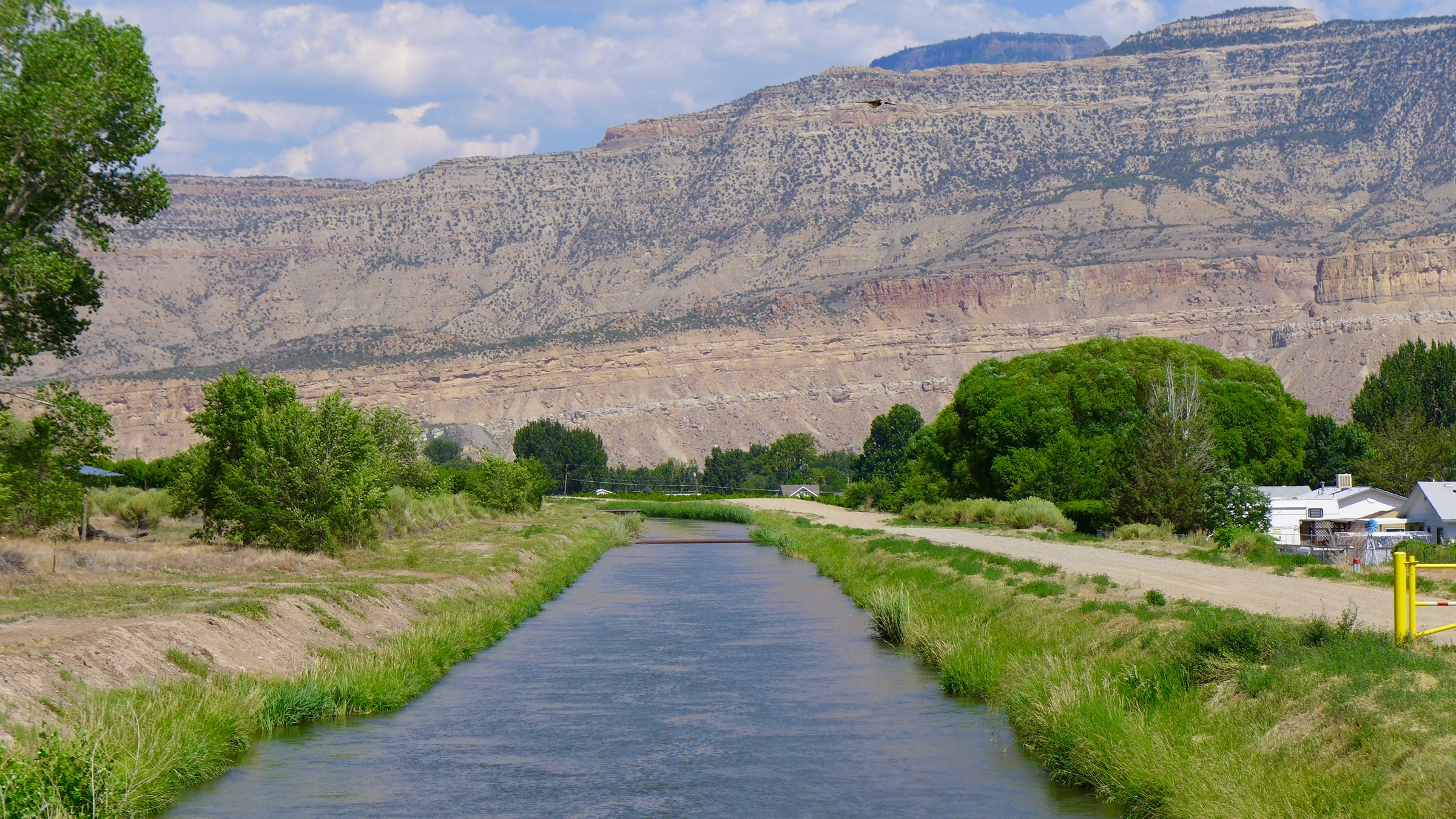
Click the link to read the article on The Denver Post website (Elise Schmelzer). Here’s an excerpt:
January 15, 2026
Absent a crucial but elusive consensus among the seven Colorado River states, federal authorities are forging ahead with their own ideas on how to divvy up painful water cuts as climate change diminishes flows in the critical river. The Bureau of Reclamation last week made public a 1,600-page behemoth of a document outlining five potential plans for managing the river after current regulations expire at the end of this year. The agency did not identify which proposal it favors, in hopes that the seven states in the river basin will soon come to a consensus that incorporates parts of the five plans. But time is running out. The states — Colorado, Wyoming, Utah, New Mexico, California, Arizona and Nevada — already blew past a Nov. 11 deadline set by federal authorities to announce the concepts of such a plan. They now have until Feb. 14 to present a detailed proposal for the future of the river that makes modern life possible for 40 million people across the Southwest. They were set to meet this week in Salt Lake City to continue negotiations. Federal authorities must finalize a plan by Oct. 1…
“The Department of the Interior is moving forward with this process to ensure environmental compliance is in place so operations can continue without interruption when the current guidelines expire,” Andrea Travnicek, the assistant secretary for water and science at the Department of the Interior, said in a news release announcing the document. “The river and the 40 million people who depend on it cannot wait. In the face of an ongoing severe drought, inaction is not an option.”
A 45-day public comment period opens Friday on the proposed plans for managing the river system, contained in a document called a draft environmental impact statement. The current operating guidelines expire at the end of 2026, but authorities need a replacement plan in place prior to the Oct. 1 start to the 2027 water year. The water year follows the water cycle, beginning as winter snowpack starts to accumulate and ending Sept. 30, as irrigation seasons end and water supplies typically reach their lowest levels…
Already, Lake Mead — on the Arizona-Nevada border — and Lake Powell are only 33% and 26% full, respectively. Projections from the Bureau of Reclamation show that, in a worst-case scenario, Powell’s waters could fall below the level required to run the dam’s power turbines by October and remain below the minimum power pool until June 2027. Experts monitoring the yearslong effort to draft new operating guidelines said any plan implemented by Reclamation must consider the reality of a river with far less water than assumed when the original river management agreements were signed more than a century ago.

#Drought news January 15, 2026: Extreme and exceptional drought expanded in central #Colorado
Click on a thumbnail graphic to view a gallery of drought data from the US Drought Monitor website.

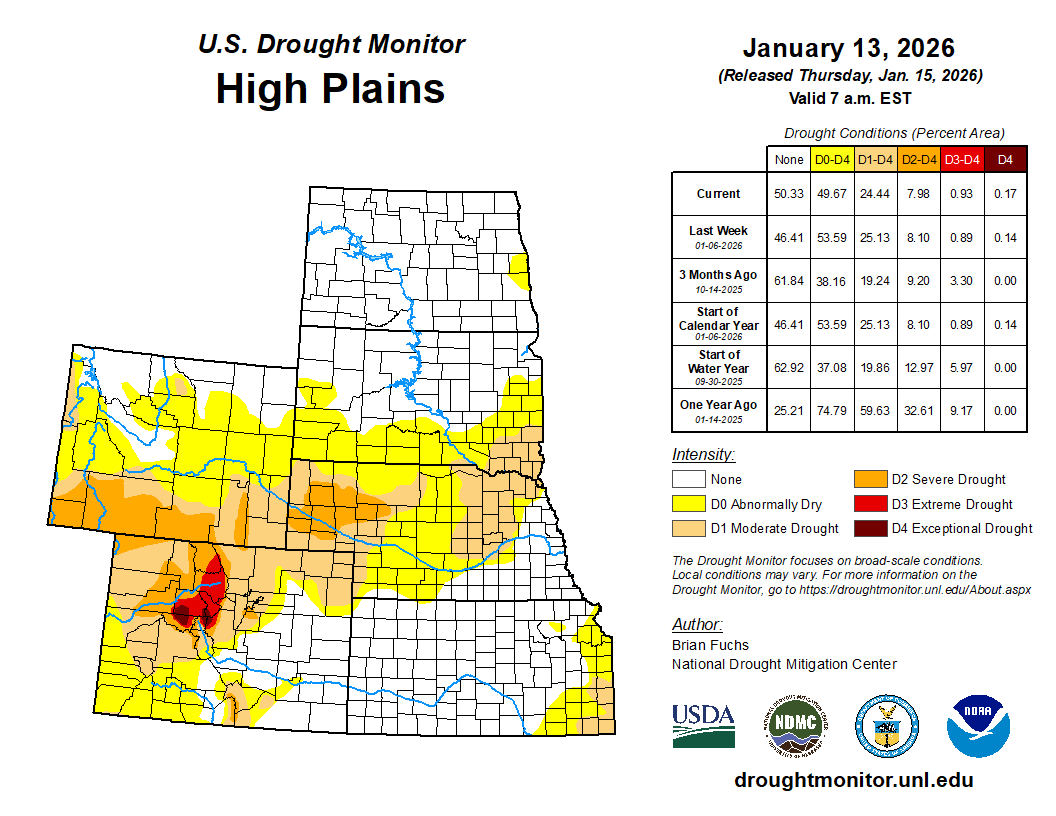
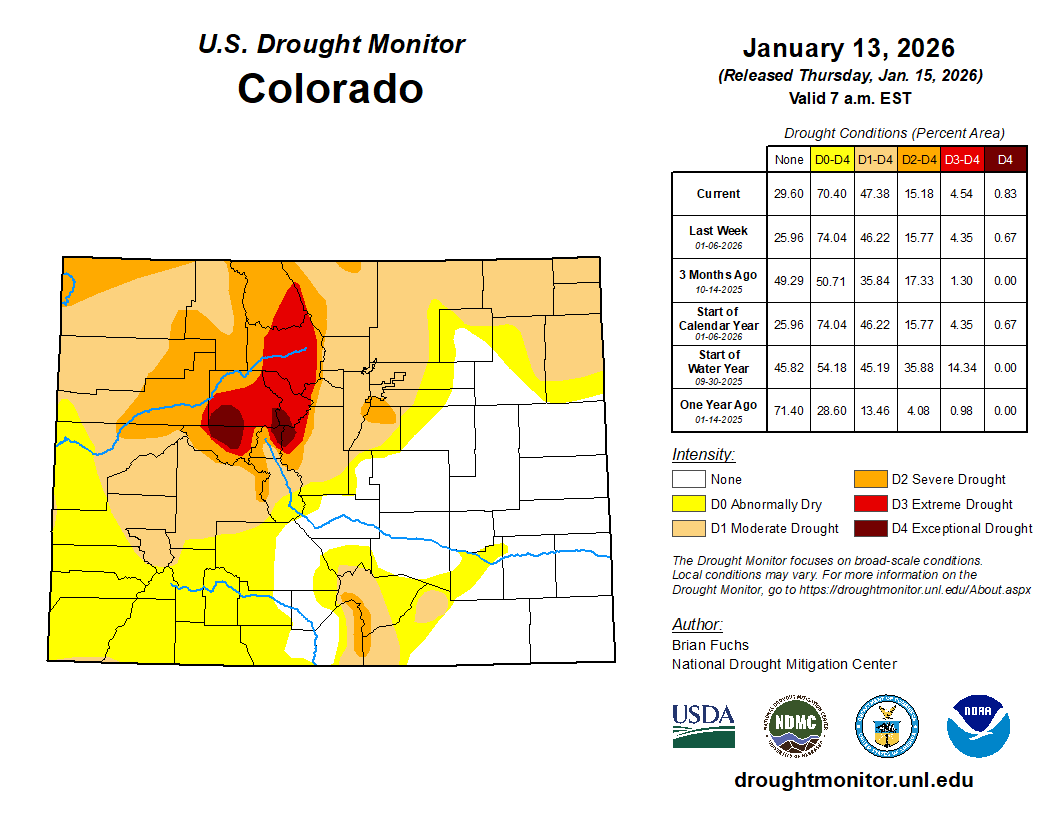
Click the link to go to the US Drought Monitor website. Here’s an excerpt:
This Week’s Drought Summary
It was a more active week nationwide, with significant precipitation across the central Plains, Midwest, and Southeast. Parts of Mississippi and Alabama received more than 5 inches of rain. In the Plains and Midwest, much of the precipitation fell as rain rather than snow due to unseasonably warm temperatures. Portions of the Southwest and central Rocky Mountains also received beneficial rain and snow, slowing drought intensification and leading to localized improvements. Temperatures were warmer than normal across most of the country, with near- to slightly below-normal temperatures limited to the West and Southwest. The largest departures occurred in the upper Midwest and northern Plains, where temperatures were 15–20°F above normal…
High Plains
Above-normal precipitation occurred across eastern Colorado, Kansas, and southeast Nebraska, falling primarily as rain and infiltrating soils due to warm temperatures. Much of the rest of the region remained dry. Temperatures were 10–15°F above normal across most areas, with parts of the Dakotas and eastern Montana 15–20°F above normal. Southeast Colorado was the only area near to below normal. Abnormally dry and moderate drought conditions improved in southeast Nebraska, eastern Kansas, and parts of south-central Colorado. Drought expanded across eastern Wyoming, west-central South Dakota, and northeast Colorado…
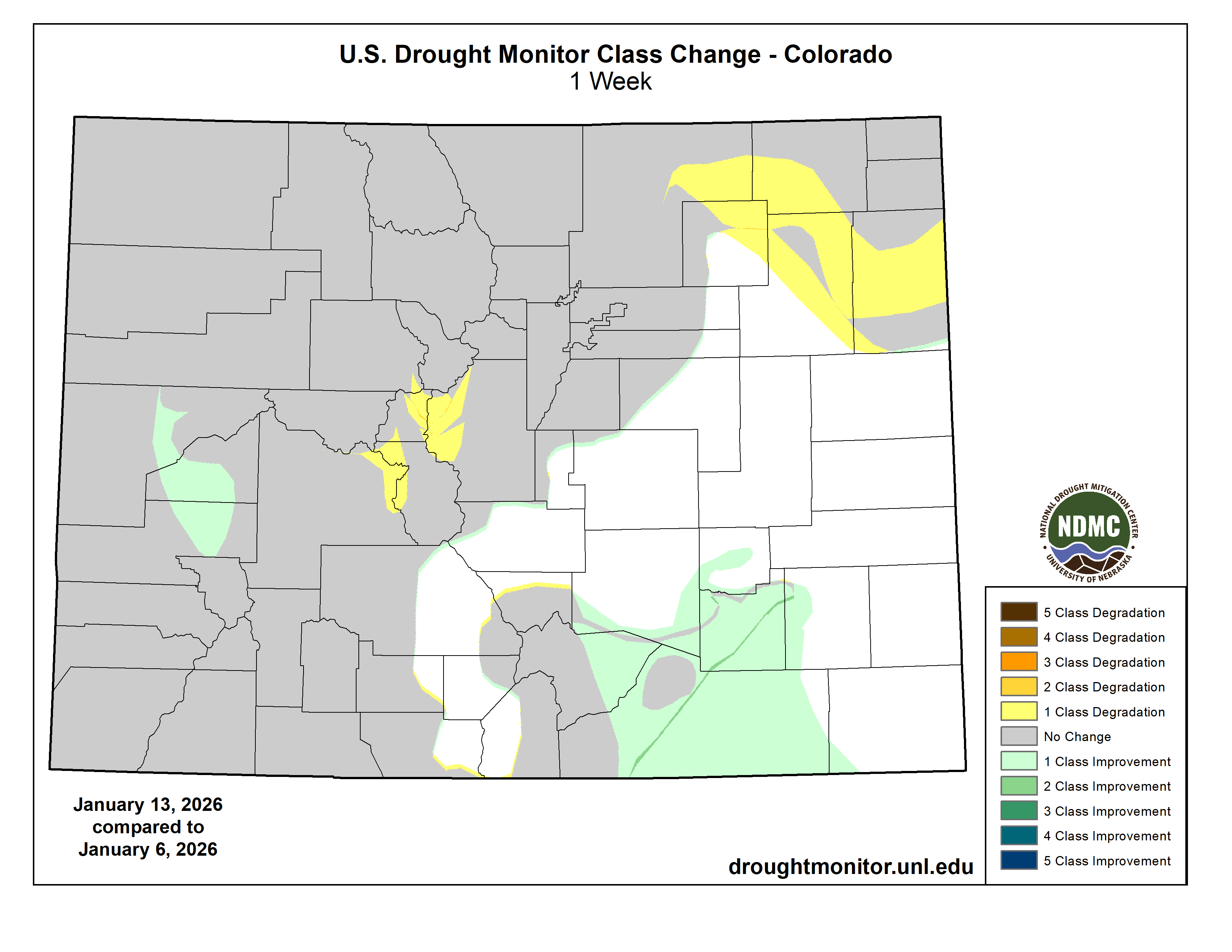
West
Above-normal precipitation occurred across southeast Arizona, western and central New Mexico, parts of Colorado, and western Washington. Temperatures were mixed, with California, Nevada, Utah, Arizona, and New Mexico up to 5°F below normal, while northern areas were 5–10°F above normal and parts of central Montana 15–20°F above normal. Most drought changes reflected improvement, including moderate drought and abnormally dry conditions in western Montana and central Idaho, severe drought in western Colorado, and severe to extreme drought in eastern Arizona, western New Mexico, eastern Nevada, and western Utah. However, drought expanded in southwest Idaho and northern Nevada, extreme and exceptional drought expanded in central Colorado, and abnormally dry and moderate drought conditions expanded across much of eastern Wyoming…
South
Temperatures were above normal across nearly the entire region, with departures of 9–12°F above normal in the east and 6–9°F above normal across Texas and Oklahoma. Northern Louisiana, Mississippi, central and eastern Tennessee, and southeast Arkansas received well above-normal precipitation, with southern Mississippi recording 200–400% of normal. Central and southern Texas, eastern Oklahoma, and Arkansas remained largely dry. Drought improvements occurred across Mississippi, southern Louisiana, and eastern Tennessee, including improvements to severe drought in northwest Mississippi and northern Louisiana. In contrast, drought expanded across much of Arkansas and eastern and southern Texas. Extreme drought expanded across south Texas, with a new area in northeast Texas. Moderate and severe drought also expanded across east Texas into Arkansas, while abnormally dry conditions increased in central Texas and western Oklahoma. Severe drought expanded from eastern Arkansas into western Tennessee…
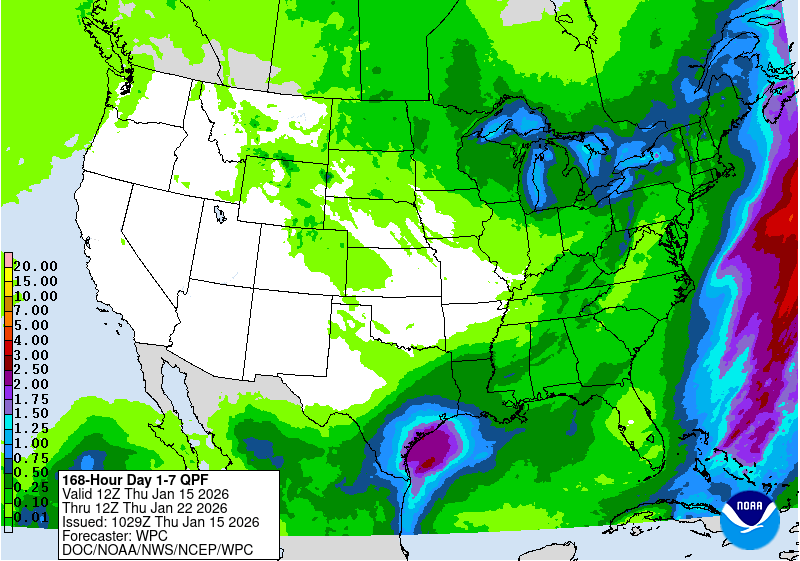
Looking Ahead
Over the next five to seven days, much of the western half of the U.S. is anticipated to be dry from the West into the Plains. The wettest areas are anticipated to be over the Great Lakes region and into the Northeast. At the end of the period, there could be some coastal precipitation in portions of south and east Texas as well as Louisiana. Temperatures during this time are anticipated to well above normal over the West, with departures of 10-13°F above normal from Nevada into Utah and Wyoming. Cooler-than-normal temperatures will be commonplace over the eastern half of the country, with the greatest departures over the upper Midwest and Great Lakes with departures of 10-13°F normal. The below-normal temperatures will migrate all the way into the South, with portions of the Southeast and Florida 6-9°F below normal.
The 6-10 day outlooks show that the likelihood of above-normal temperatures over much of the Southwest and southern Plains. The best chances of below-normal temperatures will be over the upper Midwest and into the Northeast. From the northern Plains into the Southeast and Florida and areas east of here have the best chances of below normal temperatures. Precipitation is expected to be below normal over Florida and the coastal areas of the Pacific Northwest. The best chances of above-normal precipitation are anticipated over the Tennessee Valley as well as over the Rocky Mountains and into the Southwest.
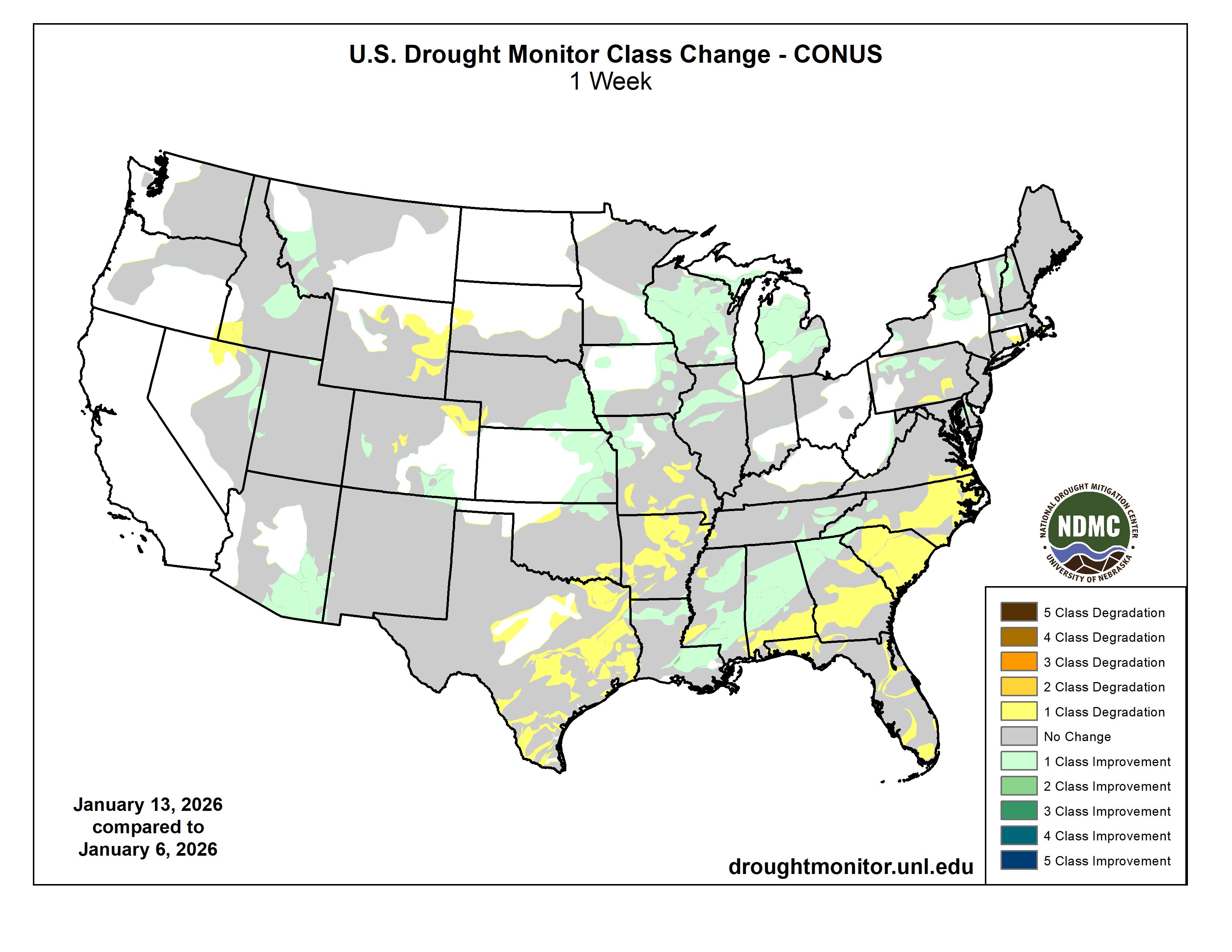
Just for grins here’s a slideshow of early January US Drought Monitor maps for the past few years.
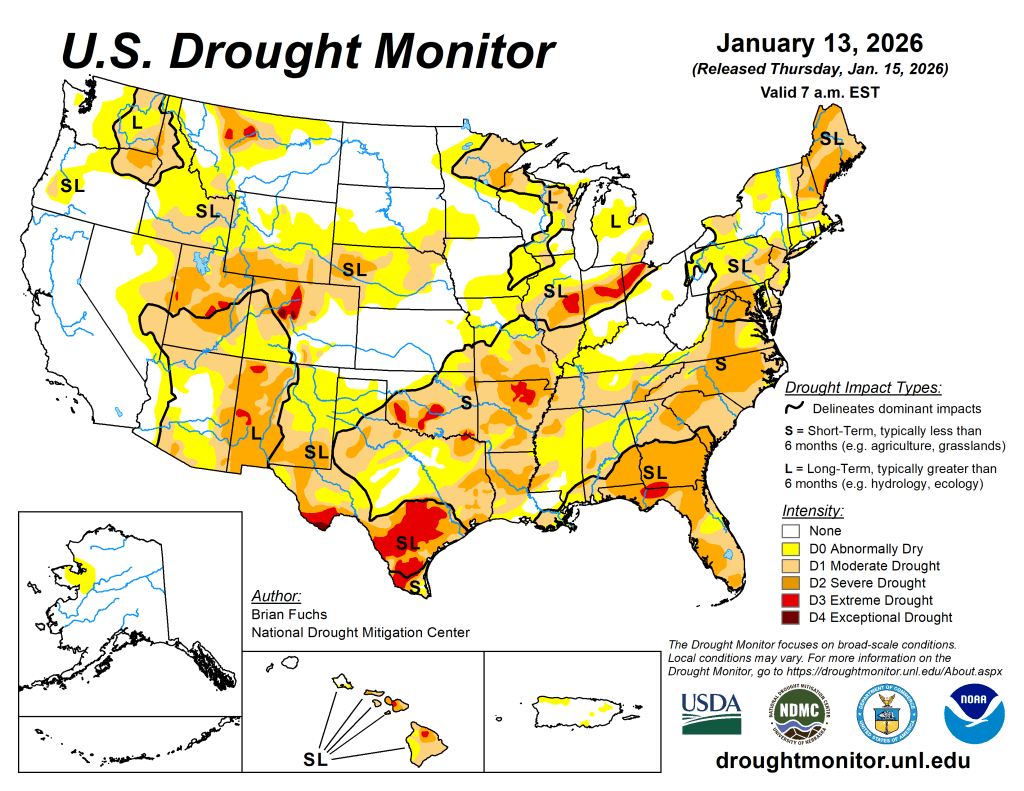
US Drought Monitor map January 13, 2026. US Drought Monitor map January 7, 2025. 
US Drought Monitor map January 2, 2024. 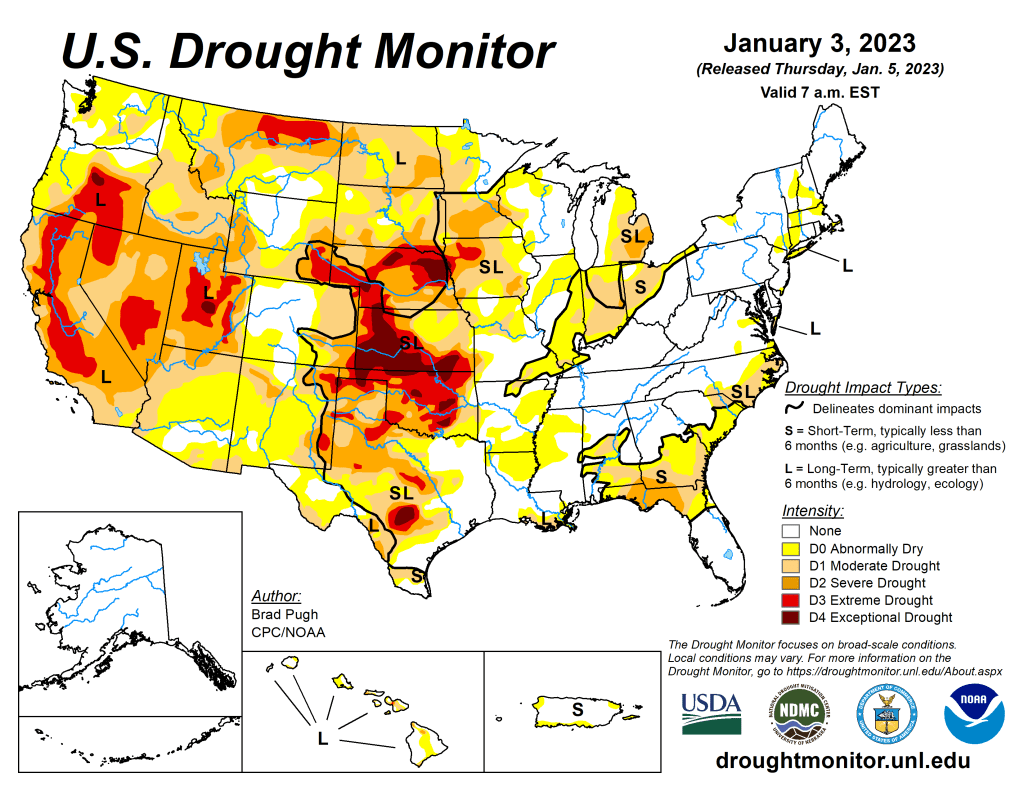
US Drought Monitor map January 3, 2023. 
US Drought Monitor map January 4, 2022. 
US Drought Monitor January 5, 2021. 
US Drought Monitor January 7, 2020. 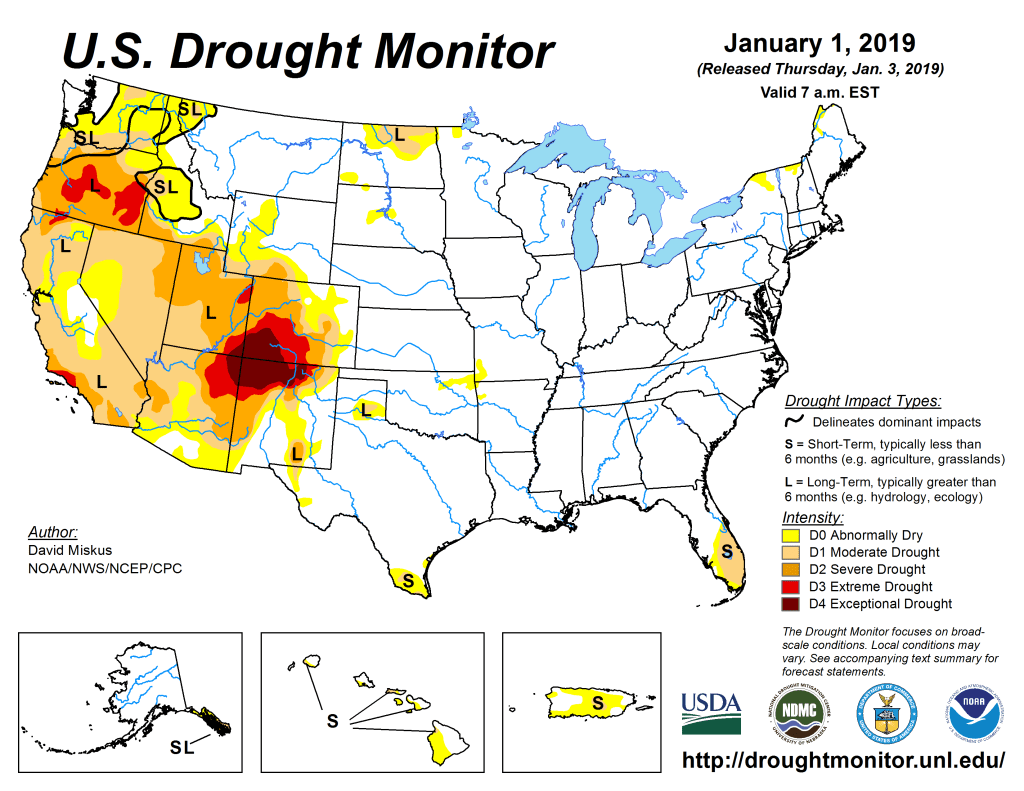
US Drought Monitor January 1, 2019. 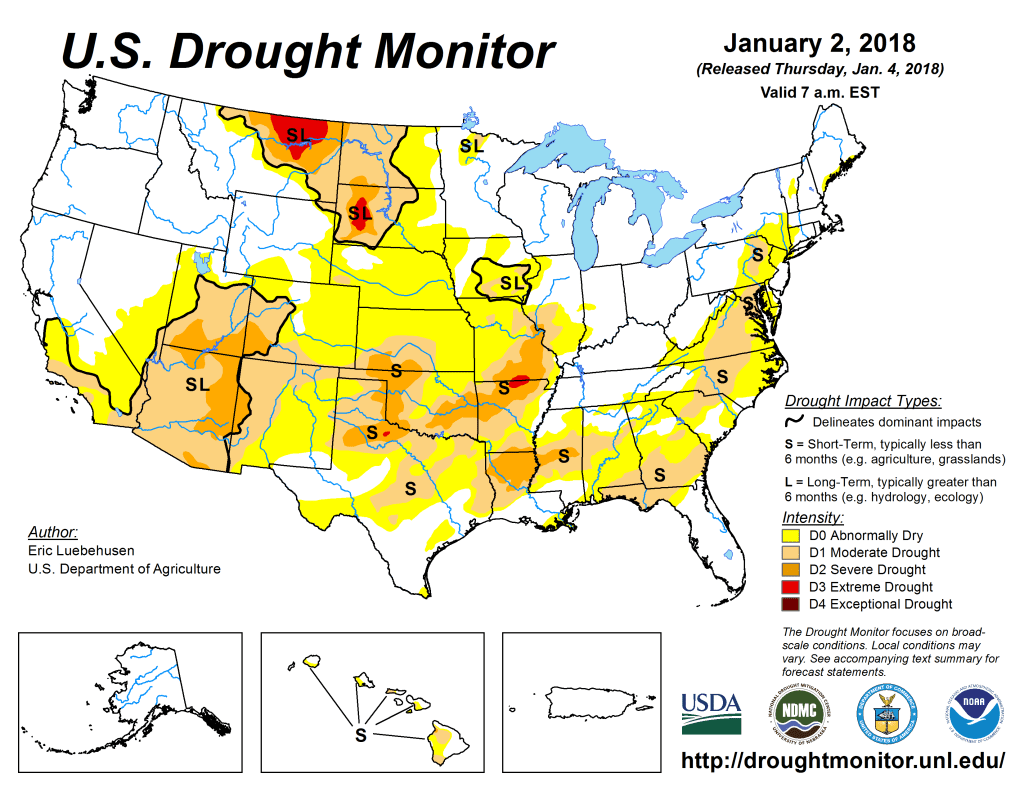
US Drought Monitor January 2, 2018. 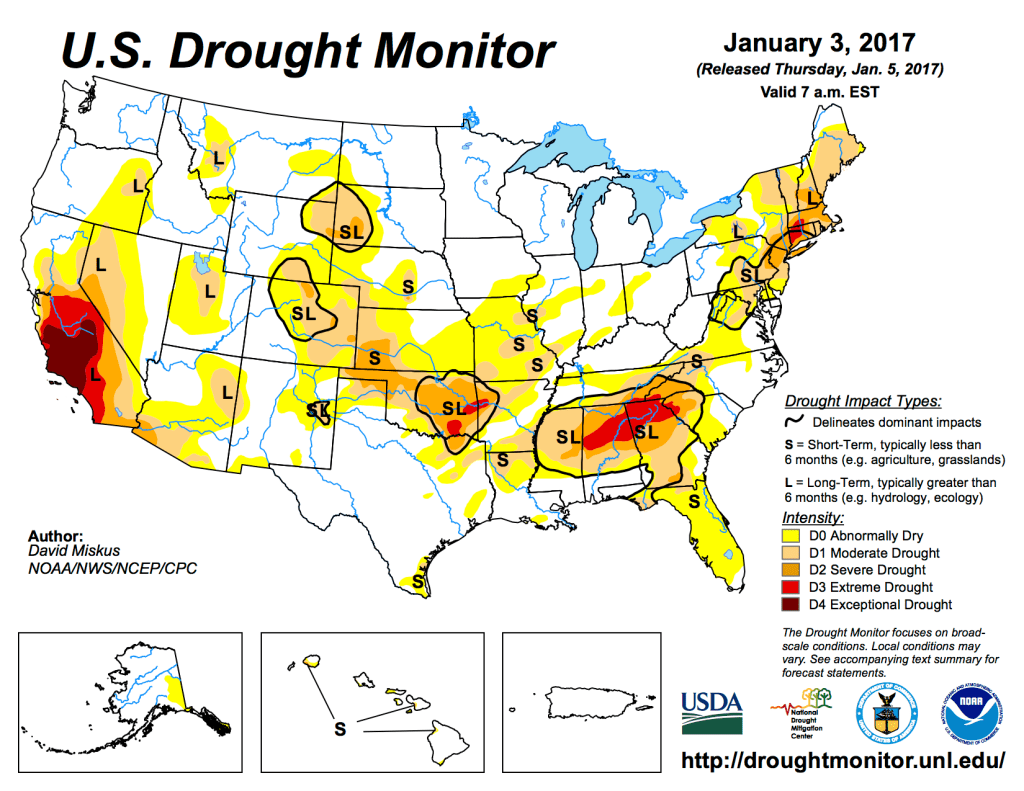
US Drought Monitor January 3, 2017. 
US Drought Monitor January 5, 2016 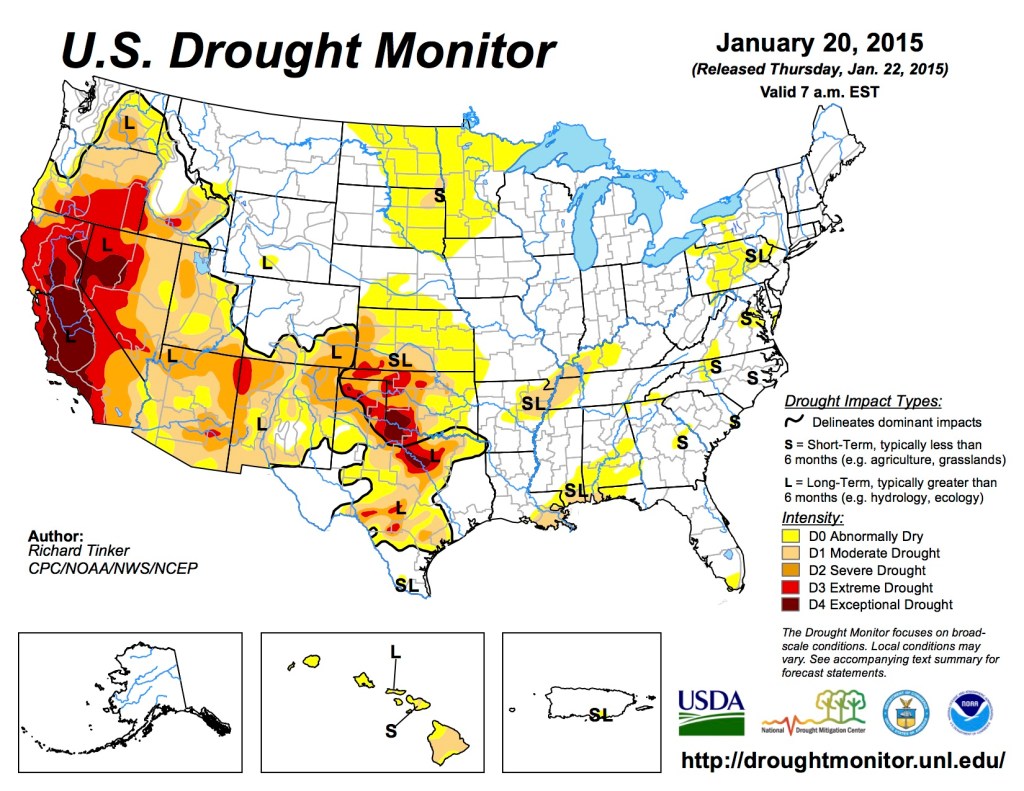
US Drought Monitor January 20, 2015 
US Drought Monitor January 7, 2014 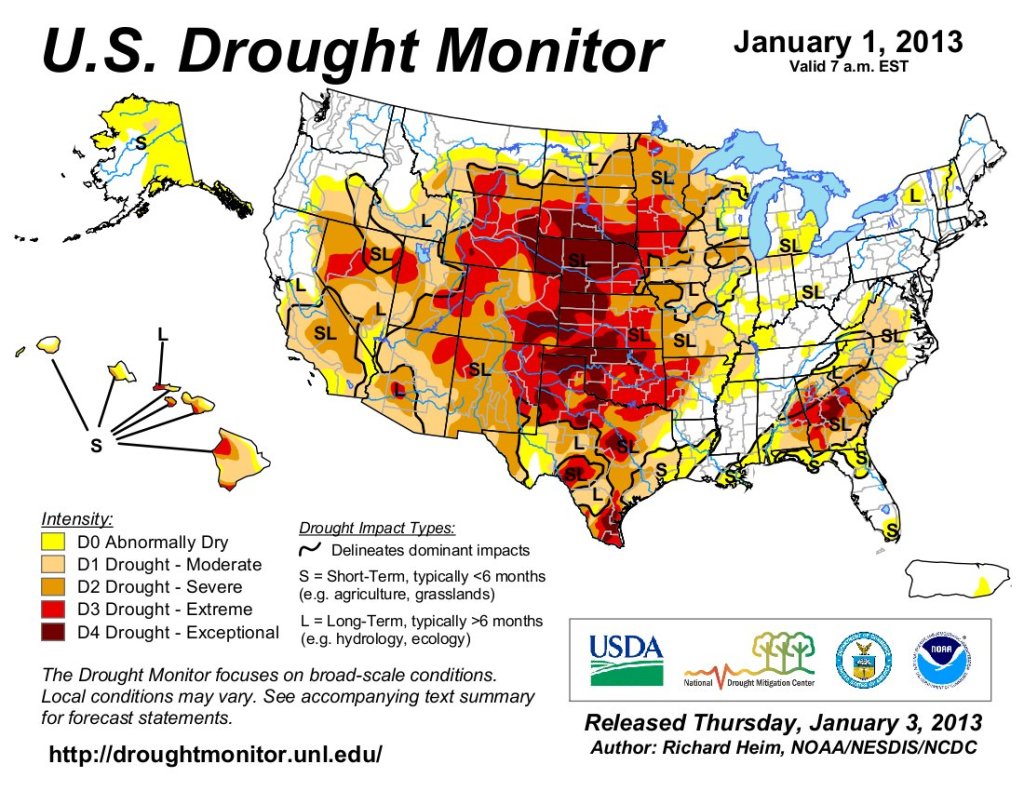
US Drought Monitor January 1, 2013. 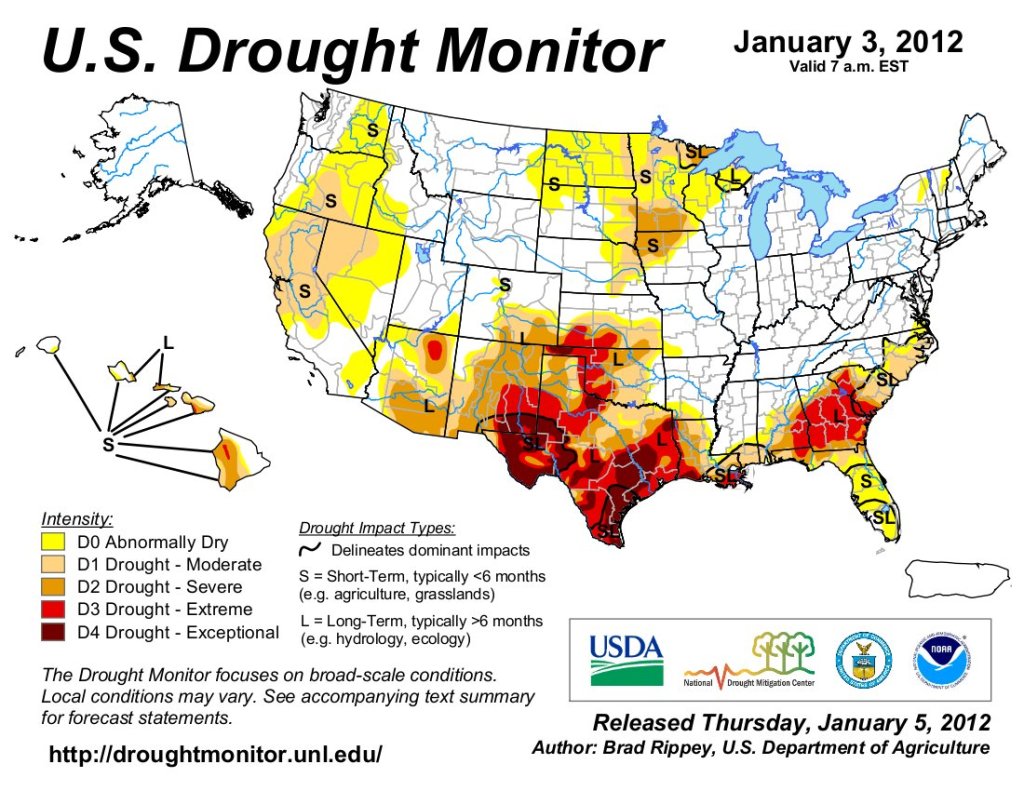
US Drought Monitor January 3, 2012. 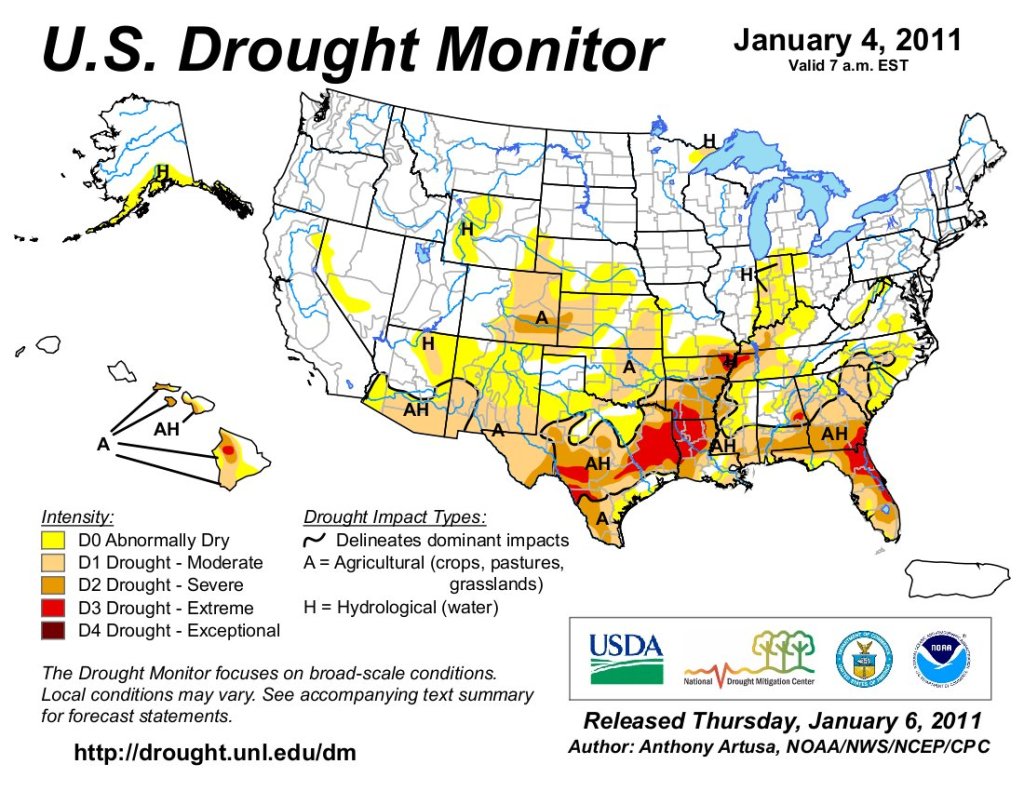
US Drought Monitor January 4, 2011.
Exceptional. Record-smashing. Disturbingly warm. December 2025 was one for the record books in #Colorado — Colorado #Climate Center #drought #aridification
New #Climate Reports Show ‘Unprecedented Run of Global Heat’: Data from multiple international agencies shows the reality of a rapidly warming world — Bob Berwyn (InsideClimateNews.org)

Click the link to read the article on the Inside Climate News website (Bob Berwyn):
January 13, 2026
Several annual international climate reports released Tuesday indicate that relentless human-caused warming continued in 2025, especially in the oceans and at the poles.
For the third year in a row, Earth’s average temperature ran close to 1.5 degrees Celsius hotter than the climate that sustained human civilizations as the 20th century began, before fossil-fuel pollution started damaging the atmosphere.
Avoiding more than that level of warming is also the key long-term temperature goal of the 2015 Paris Agreement. Research shows that warming by more than 1.5 degrees Celsius above the baseline will spell the end of nearly all global glaciers and coral reefs and mark a dangerous red zone for damage and destruction of ecosystems, food supplies, human health and infrastructure.
The European Union’s Copernicus Climate Change Service report released Tuesday ranked 2025 as the third-warmest year on record, just a hair cooler than 2023 and within striking distance of 2024, the hottest year on record. Together, the past three years averaged more than 1.5 degrees Celsius above pre-industrial temperatures, the first time any three-year stretch has crossed that threshold.
“Exceeding a three-year average of 1.5 degrees Celsius above pre-industrial levels is a milestone none of us wished to reach,” said Mauro Facchini, head of earth observation at the European Commission’s directorate general for defense industry and space.
The report reinforces the importance of Europe’s leadership in climate monitoring to inform both mitigation and adaptation, he added. The U.S. is rapidly pulling back amid Trump administration attacks on climate science.
Global temperatures from 2023 to 2025 suggest that the past warming rate is no longer a reliable predictor of the future, said Kristen Sissener, executive director of Berkeley Earth, an nonprofit climate research organization that also released a global report Tuesday.
“The warming spike of the past three years underscores how quickly the climate system can change, and how essential sustained monitoring is to understanding those changes in real time,” she said. “Continued investment in high-quality, resilient and robust open climate data is critical to ensuring that governments, industry and local communities can respond based on evidence, not assumptions.”
At today’s pace of emissions, Copernicus scientists said, the world is on track to hit the Paris Agreement’s 1.5-degree Celsius limit permanently by the end of this decade, sooner than expected when the deal was signed.
“Emissions simply haven’t come down as fast as people believed they would,” Samantha Burgess, deputy director of Copernicus, said when asked about crossing the Paris Agreement limit so soon. “That’s the big difference between where we thought the world would be in 2015, and where we are now.”
And the extreme temperatures of 2023, 2024 and 2025 will be seen as cooler than average in just a few years, Burgess said, warning that continued fossil-fuel emissions are rapidly resetting what the world considers normal.
Faster Warming Likely Ahead
The Copernicus report was foreshadowed by a Dec. 18 analysis of recent temperature trends by noted climate scientist James Hansen and colleagues. They found that 2025 stayed near or above the 1.5-degree Celsius threshold even after the strong planet-warming El Niño weather pattern of 2023–2024 eased.
And they projected that a new El Niño could push global warming to about 1.7 degrees Celsius in 2027. El Niño is a Pacific Ocean temperature cycle that alternately warms or cools the entire planet by 0.1 to 0.2 degrees.

“These three years stand apart from those that came before,” Samantha Burgess told reporters at a media briefing Monday, noting that record-high ocean temperatures are now persisting even without a strong El Niño influence.
“By far and away, the high global temperatures of the last three years have been due to the record amount of greenhouse gas concentrations in the atmosphere,” Burgess said. Other factors can have regional impacts, such as reductions in industrial and shipping pollution that reflect heat away from Earth, especially over oceans, and can also nudge the global average by about 0.1 degrees Celsius.
Major climate monitoring centers around the world are releasing their annual assessments in coordinated fashion Tuesday and into early Wednesday, including the World Meteorological Organization, NASA and the United Kingdom’s Met Office.
The reports’ exact global temperature figures differ by a few tenths of a degree, reflecting slightly different datasets and analytical methods, but they all point in the same direction: Global warming is accelerating, driven overwhelmingly by human emissions.
“We’re all very consistent in the near term, because our planet is better observed than it has ever been,” said Burgess.
Their synchronized release demonstrates that science and data speak for themselves. Even at a time when scientific institutions face extraordinary ideological attacks, the world’s leading climate agencies are allowing the measurements to define the reality of a rapidly warming planet.
A separate analysis released last week by Climate Central quantifies the damage caused by climate extremes in the United States. The group found that the country experienced 23 weather and climate disasters in 2025, from destructive storms and floods to heat-driven wildfires, that each caused at least $1 billion in damage, totaling about $115 billion in losses.
Climate Central is a nonprofit organization of scientists and journalists that researches and communicates climate science and impacts. After the Trump administration cut NOAA’s billion-dollar disaster database, the group revived it to keep long-term loss tracking publicly available using the same scientific methods.
In addition to the disaster database, the Trump administration last year reduced weather balloon launches, said it would shut down the National Center for Atmospheric Research and cut thousands of positions at science-focused agencies. Experts warn that weakening or sidelining science leaves communities more vulnerable.
Several groups of former federal scientists are working outside the government to ensure critical information continues to flow. The American Meteorological Society and the American Geophysical Union are teaming up to publish a series of peer-reviewed papers to help fill the gap left by the discontinuation of the National Climate Assessment. Other former federal officials are building Climate.us as a replacement for a federal website that the Trump administration shut down last year.
Asked about the potential impact of cuts to U.S. climate science programs, Carlo Buontempo, director of the Copernicus Climate Change Service, emphasized that the global climate record does not belong to any single nation, and that the greatest risk lies not in past data, but in future gaps. The international observation system goes far beyond data gathered by the United States, he added. [ed. emphasis mine]
“Global data observations are essential to efforts to confront climate change and air quality challenges,” said Florian Pappenberger, who leads the forecast and services department as deputy director-general of the European Centre for Medium-Range Weather Forecasts.
“These challenges don’t know any borders,” he said. “They don’t know what language is spoken underneath them, and therefore, it’s, of course, concerning that we have an issue in terms of data.”
Polar regions played an outsized role in driving global temperatures higher last year. Antarctica experienced its warmest year on record, while the Arctic had its second-warmest year, a pattern scientists attribute to feedback loops associated with sea-ice loss and, in Antarctica’s case, a rare atmospheric disruption that spiked surface temperatures.
In February, the combined sea-ice cover of both poles fell to the lowest level observed in the satellite era, underscoring how quickly the planet’s reflective ice shield is shrinking.
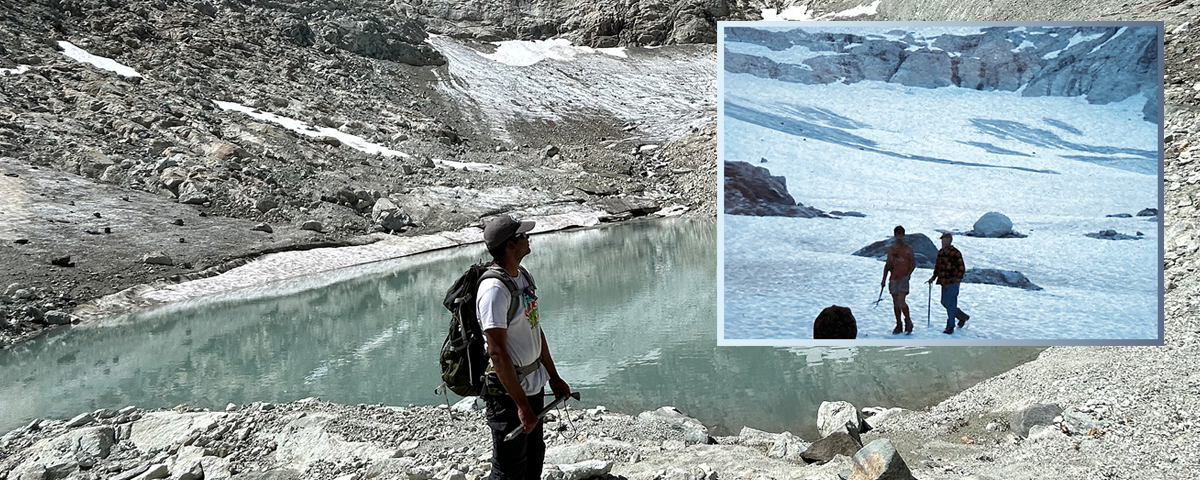
Extreme heat is increasingly how people experience that global warming signal. Copernicus reported that about half of the world’s land surface experienced more days than usual with dangerous heat stress in 2025, conditions that strain the human body. Scientists warned that while no single heat wave or wildfire can be attributed solely to climate change, the background warming is making such extremes more intense, more frequent and more disruptive in a preview of what will become more common as the planet moves deeper into Paris Agreement overshoot territory.
For the contiguous U.S., 2025 was the fourth-warmest year on record, according to the annual State of the Climate report from the National Oceanic and Atmospheric Administration, also published Tuesday. The NOAA report highlights that heat was concentrated in the West, with Nevada and Utah recording their warmest years in the 134-year record. As part of that report, the U.S. Climate Extremes Index ranked 2025 as the 12th-highest on record, particularly for maximum and minimum temperatures and for dry conditions.
Climate Extremes Affect Energy
In a separate report Tuesday, the World Meteorological Organization warned that rising temperatures and climate extremes are reshaping electricity demand and energy-system risks worldwide, as hotter summers drive surging cooling demand while drought, heat waves and wildfires threaten power generation, transmission lines and fuel supply chains.
The report, produced with the International Renewable Energy Agency, found that climate extremes are increasingly disrupting both renewable and conventional energy systems, including drought-stressed hydropower plants and strained grids during hot spells.
Together, the findings underscore that climate change is no longer just an emissions problem but an operational risk for energy systems, which will increasingly shape how power grids are designed, protected and modernized as the world warms even further.
Copernicus’ Buontempo said that, with the inevitability of passing the 1.5-degree mark of the Paris Agreement, “it’s up to us to decide how we want to deal with the higher risks that we’ll face as a consequence.”
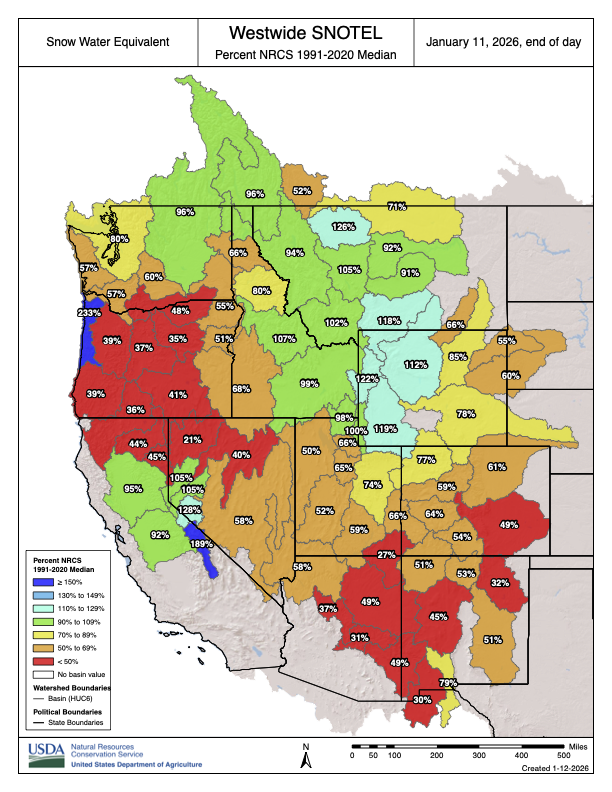
Assessing the U.S. Temperature and Precipitation Analysis in 2025 — NOAA #Climate
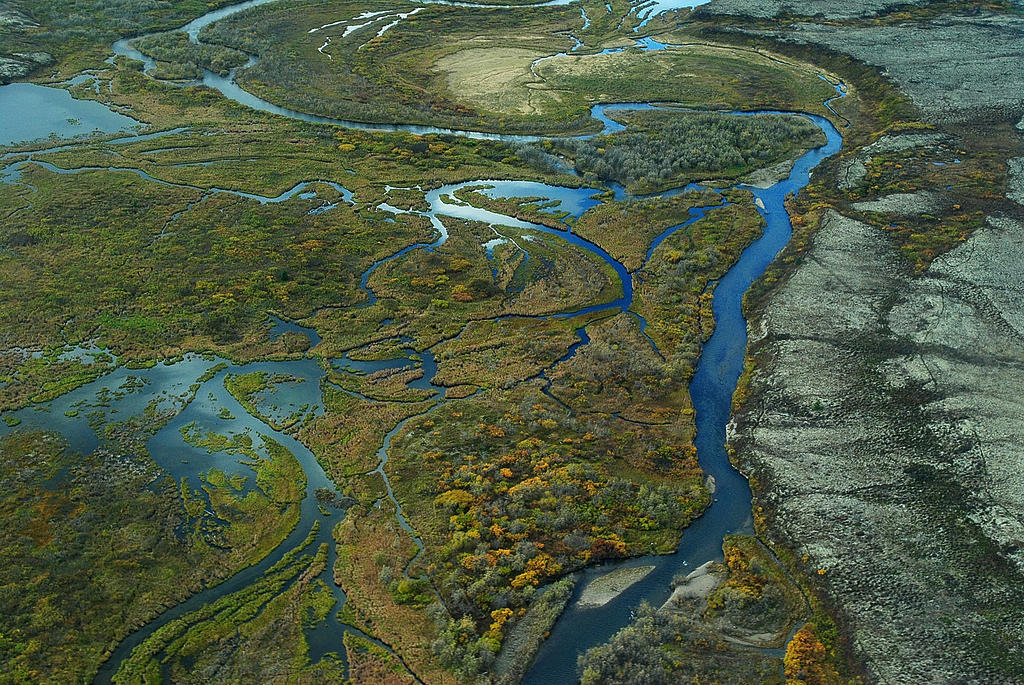
Click the link to read the article on the NOAA website:
January 13, 2026
Annual Key Points:
- For the first time since 2015, no hurricanes made landfall in the U.S. or its territories during 2025.
- The tornado in Enderlin, North Dakota, was the first verified EF-5 since 2013.
- The Eaton and Palisades Fires were the second- and third-most destructive California wildfires on record, respectively.
- The Texas Hill Country experienced a 1-in-100- to 1-in-1,000-year flood event that killed at least 135 people after nearly two feet of rain fell in just a few days.
- Utah and Nevada set new annual temperature records, with Utah eclipsing its previous record that had stood since 1934.

Other Highlights:
Temperature
Annual temperatures across the contiguous U.S. (CONUS) averaged 54.6°F in 2025, which was 2.6°F above the 20th-century average and ranked as the fourth-warmest year in the 131-year record. Temperatures were above average nationwide, with the most pronounced warmth across the western third of the country. Averaged across the entire region from the West Coast through the Rocky Mountains, this area recorded its warmest annual temperature on record.
Based on average annual temperatures across NOAA climate regions, the Southwest saw its warmest year on record; the West and Northwest both ranked third warmest, and the South tied for its fourth-warmest year. Statewide, Utah and Nevada recorded their warmest years on record at 4.3°F and 3.7°F above their 20th-century averages, respectively. In total, a dozen states experienced one of their four warmest years. At the county level, 62 counties across 10 states—more than eight million people—recorded their warmest year on record.
Annual temperatures in Alaska averaged 29.5°F, 3.5°F above the 1925–2000 average, ranking as the ninth warmest in the 101-year record. Much-above-average temperatures persisted through most of the year, producing the third-warmest January–November statewide, though a notably cold December lowered the annual ranking.
Hawaiʻi recorded an average annual temperature of 67.0°F, 0.7°F above the 1991–2020 average, placing the year within the warmest third of the 35-year record.
Precipitation
The CONUS received an average of 29.19 inches of precipitation in 2025, 0.73 inch below the 20th-century average, placing the year in the driest third of the 131-year record. The annual average does not fully reflect some of the pronounced regional wet and dry patterns seen throughout the year: the western U.S. experienced drier-than-average conditions in the first half of the year, followed by wetter-than-average conditions late in the year, while central and eastern regions generally saw above-average precipitation in spring and early summer, then below-average totals in the fall.

Much of the Southwest and Southeast ended the year below average, with deficits exceeding one foot in parts of the Southeast, while the central and northern Plains, along with the western Ohio Valley, were wetter than average. Kentucky had its 10th-wettest year on record, with over a third of its counties receiving more than a foot above their average annual rainfall.
Alaska received 39.72 inches of precipitation in 2025, 3.02 inches above average, placing the year within the wettest third of the 101-year record. Hawaiʻi recorded a total of 41.96 inches, 19.77 inches below average for the state, or about 68 percent of normal (1991–2020), marking its third-driest year in the 35-year record.
Tropical Cyclones
Despite the lack of U.S. landfalls in 2025, the North Atlantic hurricane season was active, producing 13 named storms, including five hurricanes and four major hurricanes; this amount was near the long-term average. The season was particularly notable for three Category 5 hurricanes—Erin, Humberto and Melissa—the second-most to form in a single year. While Erin and Humberto remained offshore, Hurricane Melissa made landfall on Jamaica at peak intensity with maximum sustained winds of 185 mph—tying with the 1935 Labor Day Hurricane as the strongest landfall on record in the Atlantic Basin and ranking as the strongest tropical cyclone worldwide in 2025. Although no direct landfalls occurred, remnants of tropical systems—including Super Typhoon Halong (Alaska) and Hurricane Priscilla (Southwest)—brought flooding impacts to the U.S. late in the year.
Floods
2025 was characterized by widespread and significant flooding, driven by a combination of atmospheric rivers, slow-moving convective systems and tropical moisture. Significant flood events were observed in every season and region; July alone recorded 1,434 flash flood warnings from the National Weather Service—the second-highest July total in 40 years. Several historic precipitation events overwhelmed infrastructure, producing 1-in-1,000-year rainfall recurrence intervals in parts of Kentucky, Tennessee, North Carolina and Texas. These events resulted in significant loss of life; catastrophic flooding in the Texas Hill Country in July resulted in at least 135 fatalities, while recurring storms in the Ohio Valley and severe weather across the South contributed to dozens of additional fatalities throughout the year.
The year featured stark regional extremes, beginning and ending with strong atmospheric rivers that impacted the West Coast; notable events in February, November and December caused widespread damage and fatalities in California and the Pacific Northwest. In the interior, stalled spring fronts produced historic rainfall across the Lower Ohio Valley, while summer saw a shift to the Northeast, where record-breaking rainfall rates inundated the New York City metro area. Unique hydrological extremes also marked the year, including a record-breaking glacial outburst flood in Alaska, tsunami-induced flooding in Hawaiʻi and deadly flash floods over wildfire burn scars in New Mexico.
Tornadoes
The preliminary U.S. tornado count for 2025 was 1,559, ranking as the fifth-highest on record and 127 percent of the 30-year (1991–2020) average. The year was marked by several notable extremes, including 300 preliminary tornado reports in March—a new March record—more than three times average. In addition to the Enderlin EF-5 tornado, five EF-4 tornadoes occurred in Arkansas, Louisiana, Illinois and Kentucky. At the state level, North Dakota shattered its previous annual tornado record of 61 (set in 2010), with 72 tornado reports in 2025.
Wildfires
The number of wildfires in 2025 was approximately 105 percent of the 20-year (2001–20) average, with more than 72,000 wildfires reported. The total number of acres burned from these wildfires—5.0 million acres—was 72 percent of the 20-year average of nearly seven million acres.
Southern California experienced some of the year’s most destructive fires. Fueled by Santa Ana winds gusting up to 90 miles per hour and dry conditions, the Eaton Fire burned 14,000 acres, while the Palisades Fire burned more than 23,000 acres and was the most destructive wildfire on record for Los Angeles. Together, these fires damaged or destroyed over 18,000 structures during January and were responsible for 31 fatalities. Later in the year, the Gifford Fire became the largest wildfire for California in 2025, burning over 131,000 acres across San Luis Obispo and Santa Barbara counties in August.
In Arizona, the Dragon Bravo Fire burned more than 145,000 acres between July and September, making it the largest wildfire of the year in the U.S. and the 10th-largest in Arizona history.
Alaska had a below-average 2025 wildfire season, with approximately one million acres burned—about two-thirds of the state’s 20-year (2001–20) average.
Drought
The drought footprint across the CONUS experienced marked fluctuations during 2025, following a distinct pattern of spring expansion, early summer contraction and autumn resurgence. The year began with 38.1 percent of the lower 48 states in moderate to exceptional drought (D1–D4). Coverage expanded steadily through March, reaching a spring peak of 44.7 percent on March 25. Widespread precipitation then drove a substantial decline, with drought coverage falling to its annual minimum of 29.6 percent by June 3. However, this improvement was short-lived. Drought conditions intensified during late summer and autumn, with coverage increasing rapidly to a yearly maximum of 46.1 percent on October 21 and again on November 18. By the final week of the year (December 30), drought coverage had eased slightly but remained elevated at 42.8 percent, leaving a larger portion of the country in drought than at the start of 2025.
Snowfall
The 2024–25 snow season featured above-average snowfall across parts of the mountainous West, central Plains, Gulf Coast, Southeast and Ohio Valley, while below-average snowfall occurred across much of the Great Basin, southern Rockies, northern Plains, Upper Midwest and portions of the Northeast.
The 2025–26 snowfall season to date (October 1–December 31, 2025) saw above-average snowfall across much of the Midwest and Great Lakes region, with lake-effect areas receiving more than a foot above average for this period. In contrast, much of the Mountain West and High Plains received lower-than-average snowfall, particularly the Cascades, Wasatch and Uinta and the northern and southern Rockies, with the exception of the Sierra Nevada and parts of the northern Cascades, Bitterroots and middle Rockies.
Climate Extremes Index
The U.S. Climate Extremes Index (USCEI) for 2025 was 58 percent above average, ranking 12th-highest in the 116-year record. Warm extremes in both maximum and minimum temperatures were above average across the CONUS, as was the extent of exceptionally dry conditions (very low Palmer Drought Severity Index); each of these indicators ranked among the top 10 on record. Several regions had an annual CEI that was much above average, with the Southwest recording its third highest on record.
Warm temperature extremes were widespread in 2025. Extremes in overnight minimums affected more than 85 percent of the West, Northwest and Southwest regions and over half of the CONUS as a whole, while extremes in daytime maximums covered more than three-quarters of those same western regions. The Southwest also recorded its fourth-largest extent of extremely dry conditions on record, with all regions ranking in the driest third historically.
Check out the comprehensive 2025 Annual U.S. Climate Report. For additional information on the statistics provided here, visit the Climate at a Glance and National Maps webpages.
Forces aligning against healthy snowpack and a ‘normal’ water supply for #ColoradoRiver states — 8NewsNow.com #COriver #aridification
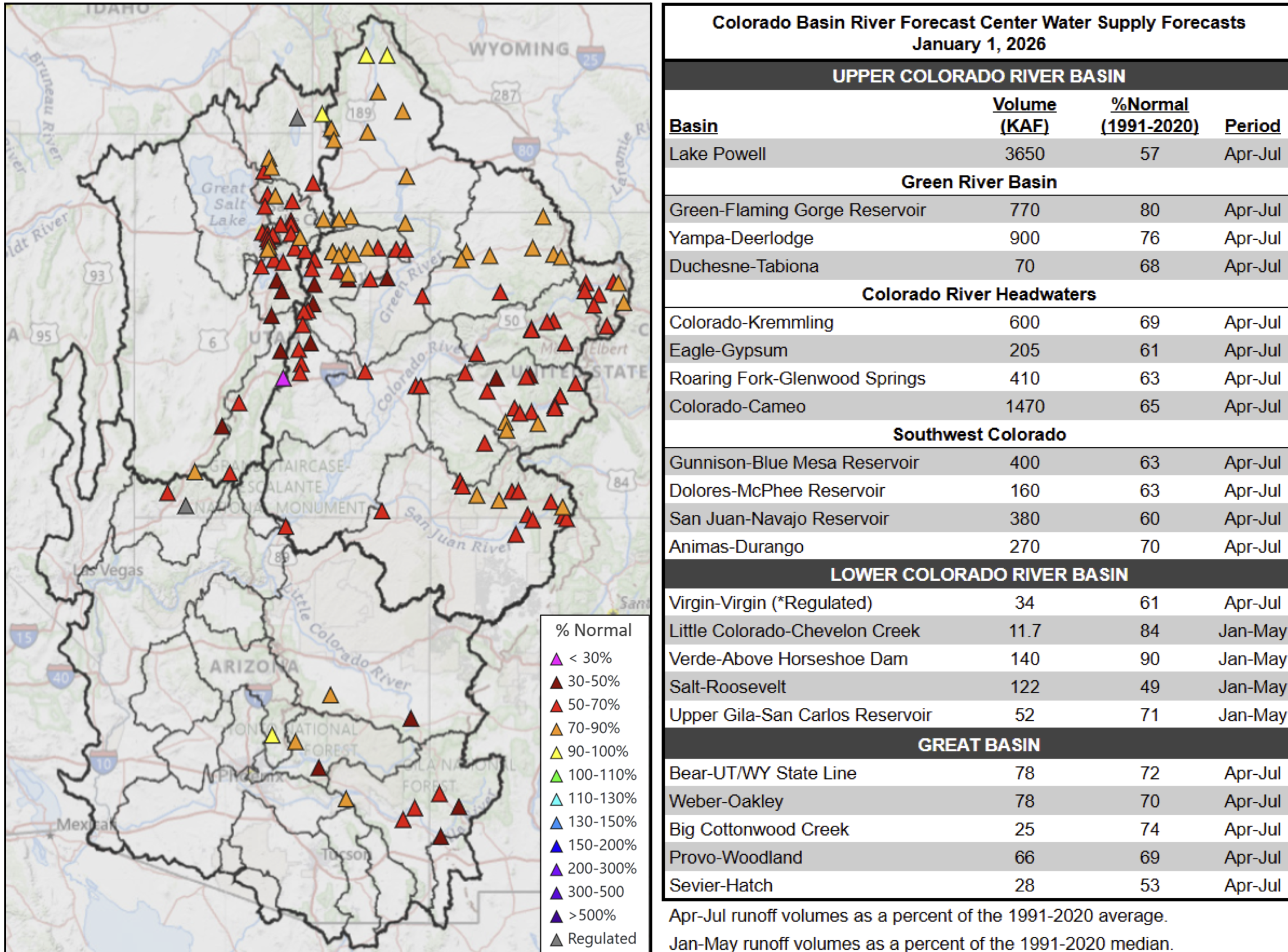
Click the link to read the article on the 8NewsNow website (Greg Haas). Here’s an excerpt:
Water forecasts for the Colorado River are grim going into 2026 as several bad trends are converging. The Colorado Basin River Forecast Center (CBRFC) cited snowpack levels that are lagging badly, dry ground conditions that will soak up moisture that falls, and snow cover statistics that are the lowest on record since satellite monitoring started in 2001. CBRFC water scientist Cody Moser said conditions are “extremely poor” right now. He spoke during a webinar on Thursday morning. The two biggest factors in the CBRFC’s forecasts are snowpack levels and soil conditions. Storms that soaked California in November and December didn’t continue on to the Colorado Rockies, and that meant a slow start on building the foundation for a good snowpack to feed the river before it flows to Lake Powell and down the Grand Canyon to Lake Mead…Water flowing into Lake Powell this year is expected to be 57% of normal levels, and those “normal” levels are based on 30-year averages that include a 25-year megadrought.

Right: CBRFC hydrologic model SWE condition summary.
The January 1, 2026 #Colorado Water Supply Outlook Report is hot off the presses from the NRCS
Click the link to go to the NRCS website to read the report and to drill down to your favorite watershed.
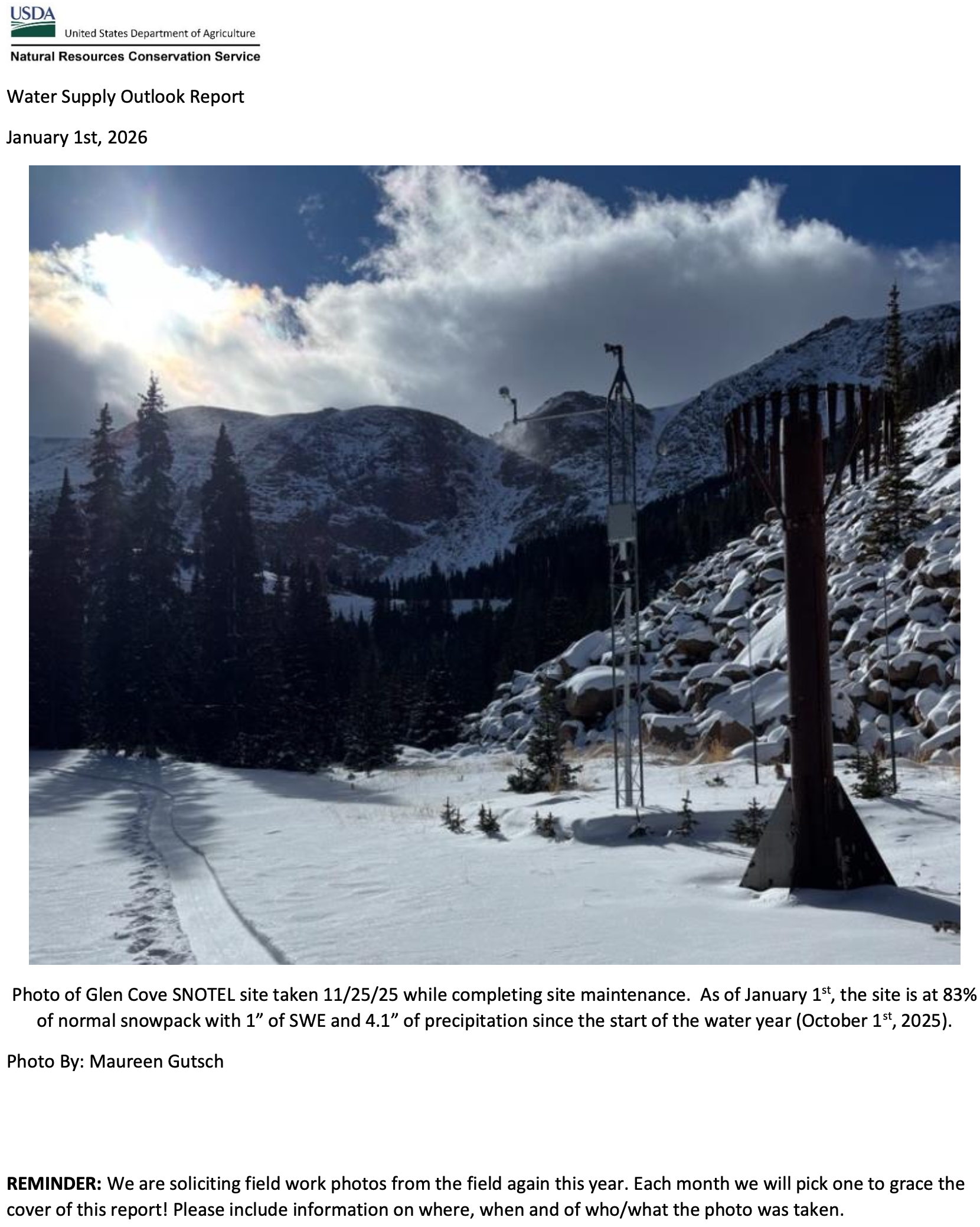
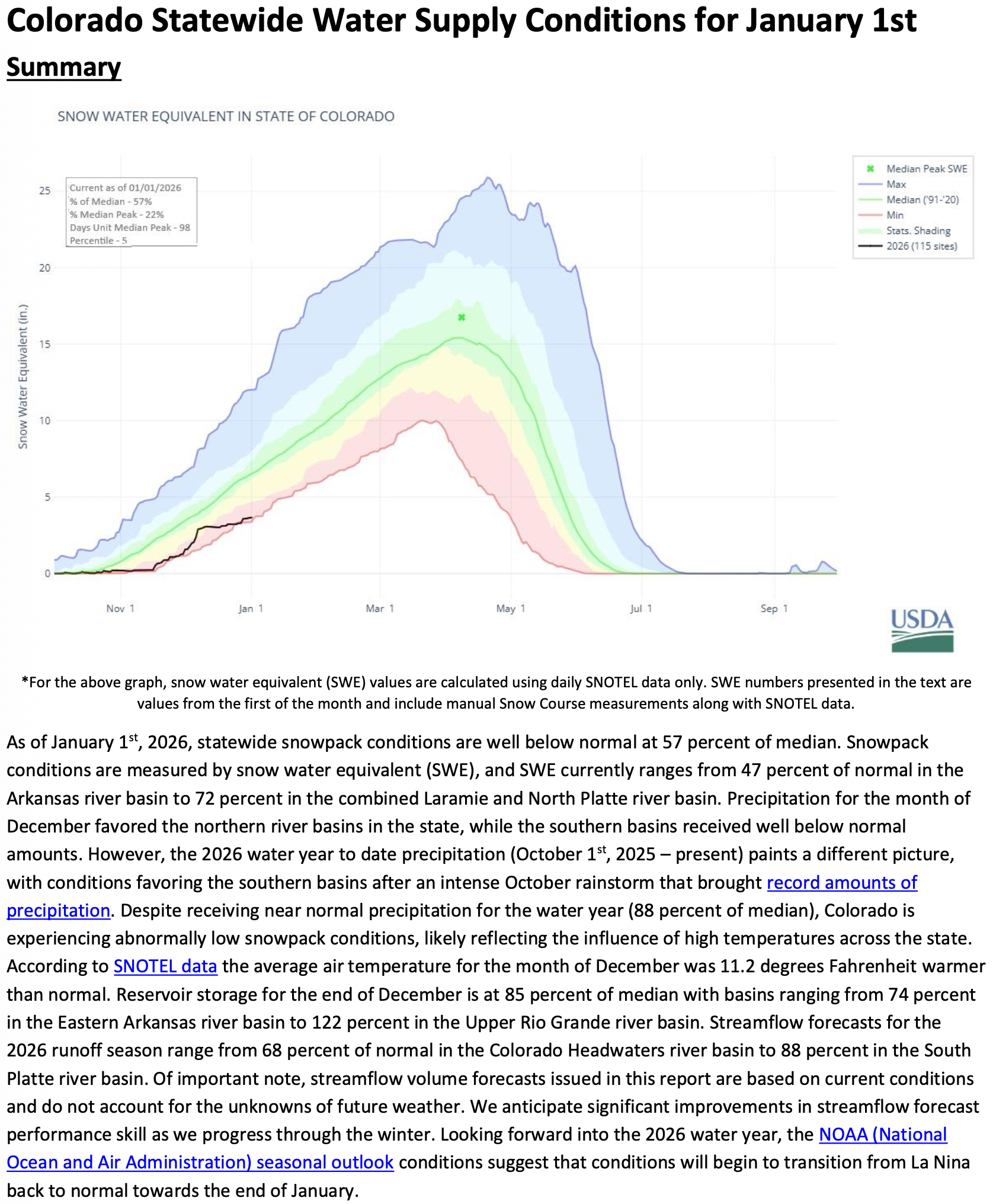
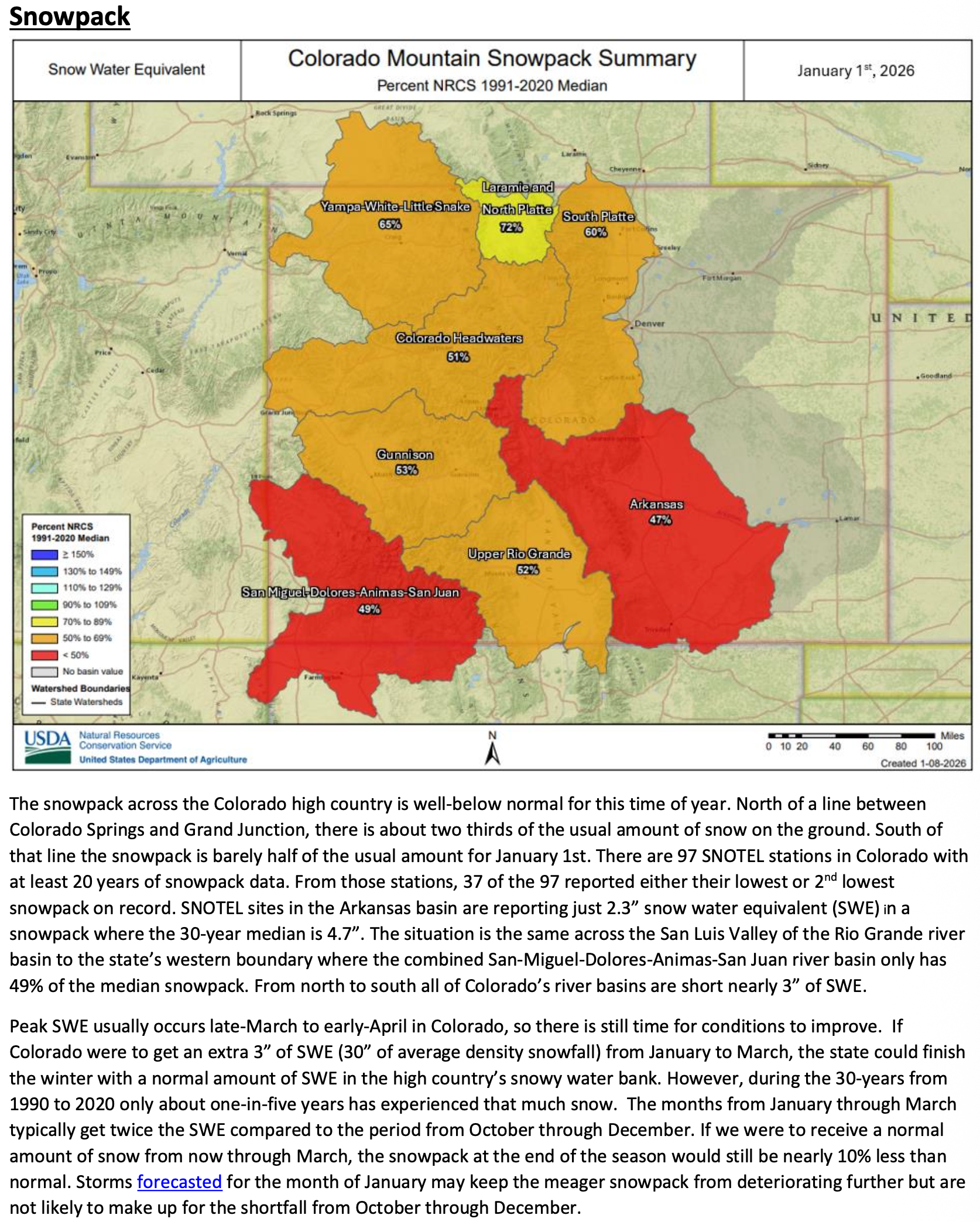

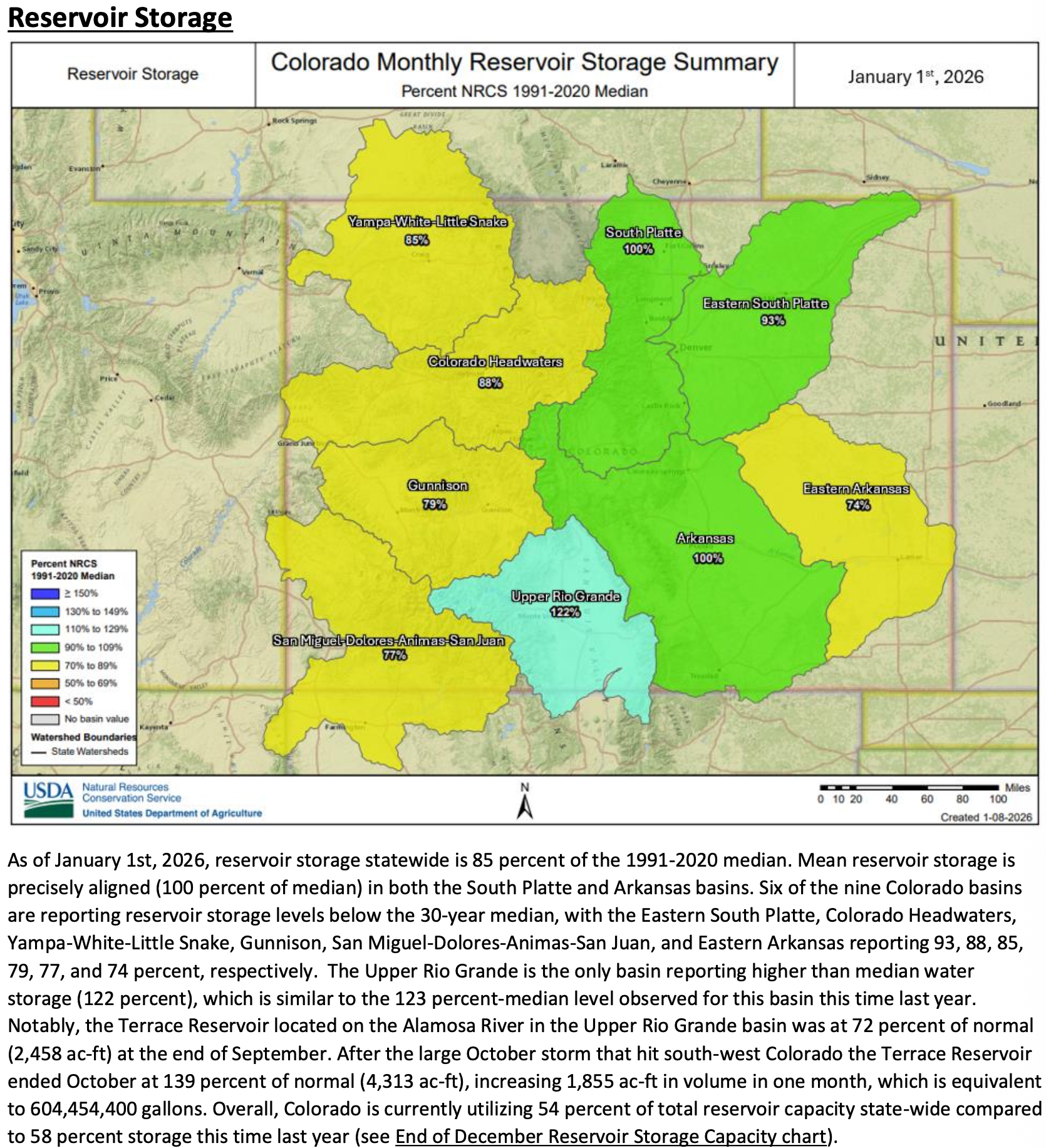

The Colorado River’s Reaches
Post by Robert Marcos (Robert Marcos Studio):
By now everybody’s sick and tired of the term “Dead Pool”. But what about reaches? Last summer as I was driving from Denver to Grand Junction I was horrified to see that the Mighty Colorado that had been flowing outside my left window had suddenly dried up, completely. This was nine miles east of Glenwood Springs. The view of the dessicated riverbed reminded me of a scene from a post-apocalyptic movie.
The culprit of course was the Shoshone Hydroelectric Generating Station which diverts 1250 cfs from a diversion at Hanging Lake, then returns that water 2-1/2 miles downstream after it’s been used to drive the plant’s hydroelectric turbines.
As the name implies Grand Junction’s “15 mile reach” is much longer. In the late summer a full 15-miles of dry river bottom can be seen along the I-70 beginning at the Cameo Diversion Dam and ending 15 miles downstream at the confluence of the Gunnison River. The Cameo Diversion Dam supplies 1.2 million acre feet of river water annually to irrigate Grand Valley farms, then returns about half of that water to the Colorado river at a variety of points downstream.
Not surprising these dry patches are hell for native fish, at least four of which are on the verge of extinction. The Bonytail – which has no wild populations left, the Colorado Pikeminnow, the Razorback Sucker, and the Humpback Chub, are all critically imperiled due to habitat loss from dams and competition from non- native species.
Gratefully one organization has ponied up to keep the water flowing. The Colorado Water Trust uses donations from people like me to buy water from sources that are upstream of these reaches in order to maintain a limited amount of water flow, year round. It may not be much but they’re hoping it’s enough to keep these fish, and many other aquatic species alive through the summer.
I can’t help but wonder whether those who are responsible for managing the river couldn’t do more to balance its many uses in order to ensure that the river’s ecological health isn’t left hanging by such a fragile thread.
Please visit: https://coloradowatertrust.org
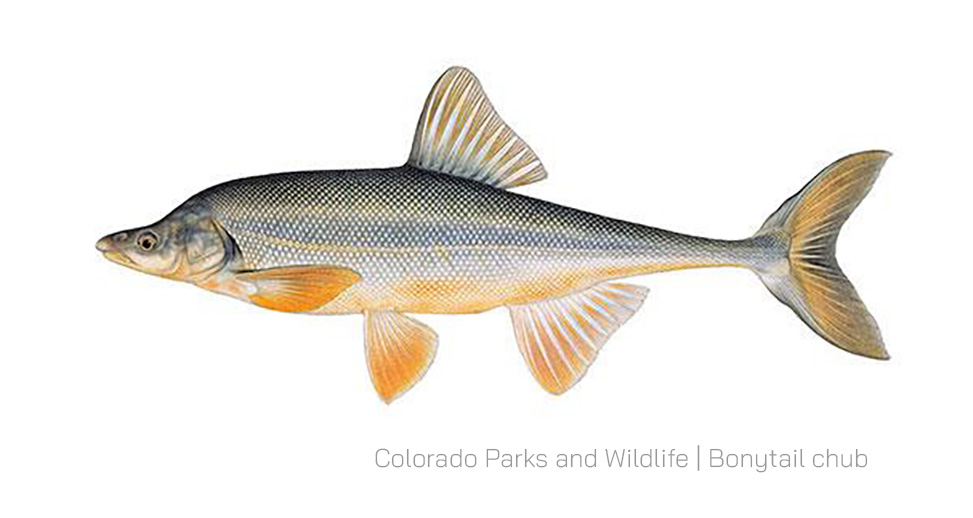
Aqueducts Move Water in the Past and Today — USGS
Click the link to read the article on the USGS website:
Aqueducts move water
June 5, 2018
If you live in an area where ample rain falls all year, you won’t see many aqueducts like the ones pictured here. But there are many areas of the world, such as the western United States, where much less rainfall occurs and it may only occur during certain times of the year. Large cities and communities in the dry areas need lots of water, and nature doesn’t always supply it to them.

Some parts of the western U.S. do have ample water supplies, though. So, some states have developed ways of moving water from the place of ample supply to the thirsty areas. Engineers have built aqueducts, or canals, to move water, sometimes many hundreds of miles. Actually, aqueducts aren’t a high-tech modern invention—the ancient Romans had aqueducts to bring water from the mountains above Rome, Italy to the city.
Can you see something about the aqueduct picture above that causes some water to be lost in transit? In all environments, but especially In places where the climate is hot and dry, a certain portion of the water flowing in the aqueduct is bound to evaporate. It would be more efficient to cover the aqueduct to stop loss by evaporation, but the cost of covering it must be weighed against the value of the evaporated water.
Aqueducts were popular in ancient Rome
Below is a picture of the Roman aqueduct at Pont du Gard, crossing the Gard River in southern France. The aqueduct was used to supply water to the town on Nimes, which is about 30 miles from the Mediterranean Sea. Although the water ended up in the baths and homes in Nîmes, it originated about 12 miles away in higher elevations to the north. The total length of the aqueduct was about 31 miles, though, considering its winding journey.
There is even a Roman aqueduct that is still functioning and bringing water to some of Rome’s fountains. The Acqua Vergine, built in 19 B.C., has been restored several time, but lives on as a functioning aqueduct.
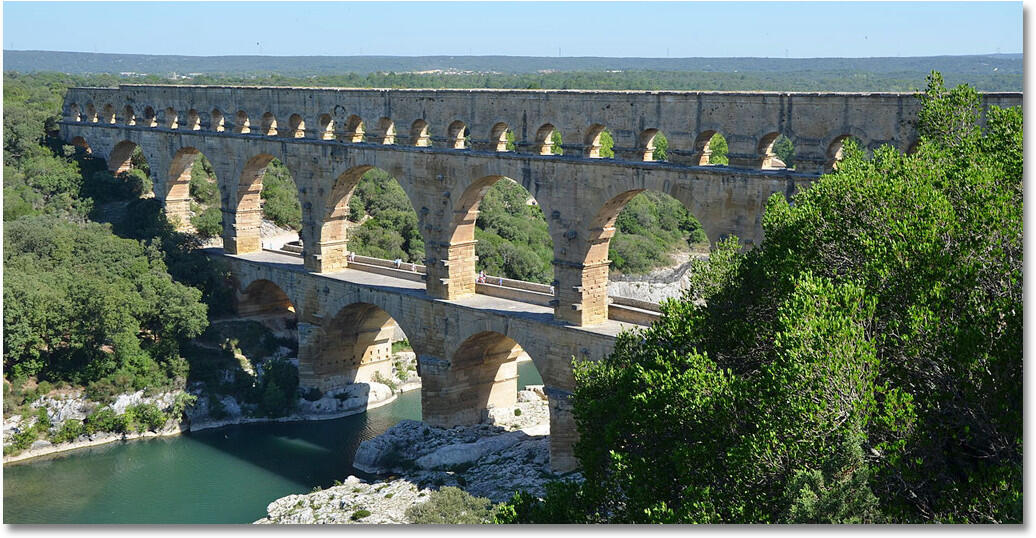
Aqueducts were not the Roman’s choice for water-delivery systems, as they would use buried pipes when possible (much easier to bury a pipe than build an above-ground system). Although aqueducts use gravity to move water, the engineering feats of the Romans are shown in that the vertical drop from the highlands source to Nîmes is only 56 feet. Yet, that was enough to move water over 30 miles. And, if you think you can see the aqueduct in this picture “leaning” to one side, it is a illusion, as the vertical drop is only 1 inch for the 1,500 foot length. It is estimated that the aqueduct supplied the city with around 200,000,000 liters (44,000,000 imperial gallons) of water a day, and water took nearly 27 hours to flow from the source to the city. (Source: Wikipedia)
#Snowpack news January 12, 2026

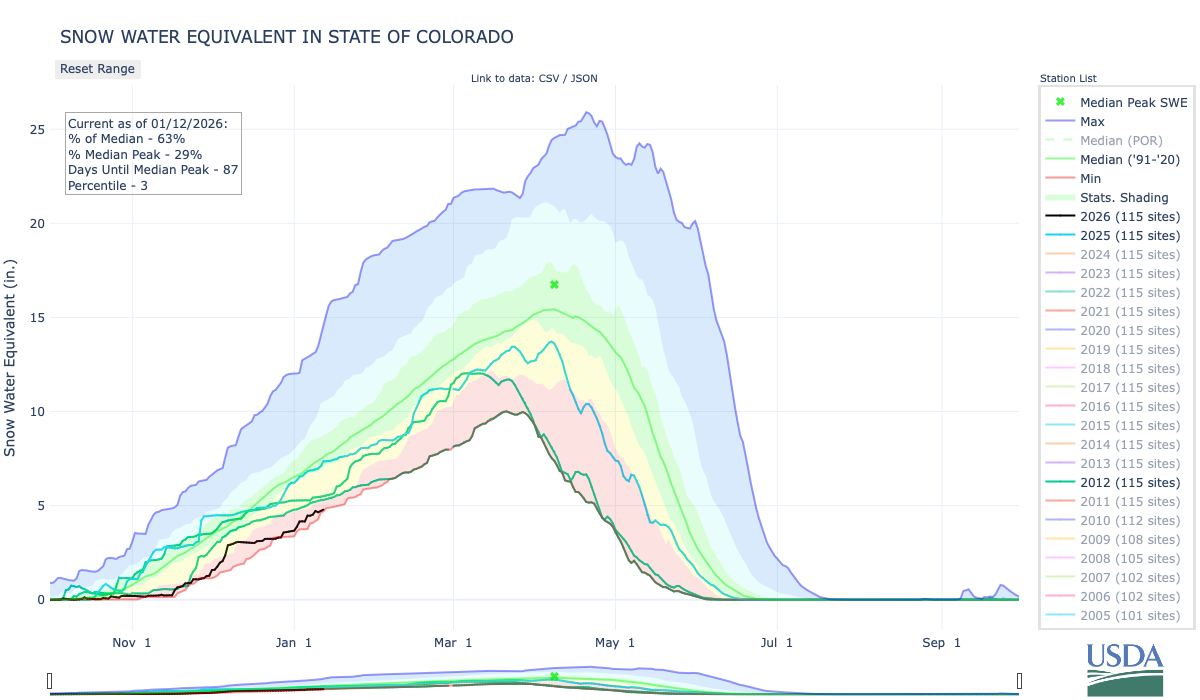
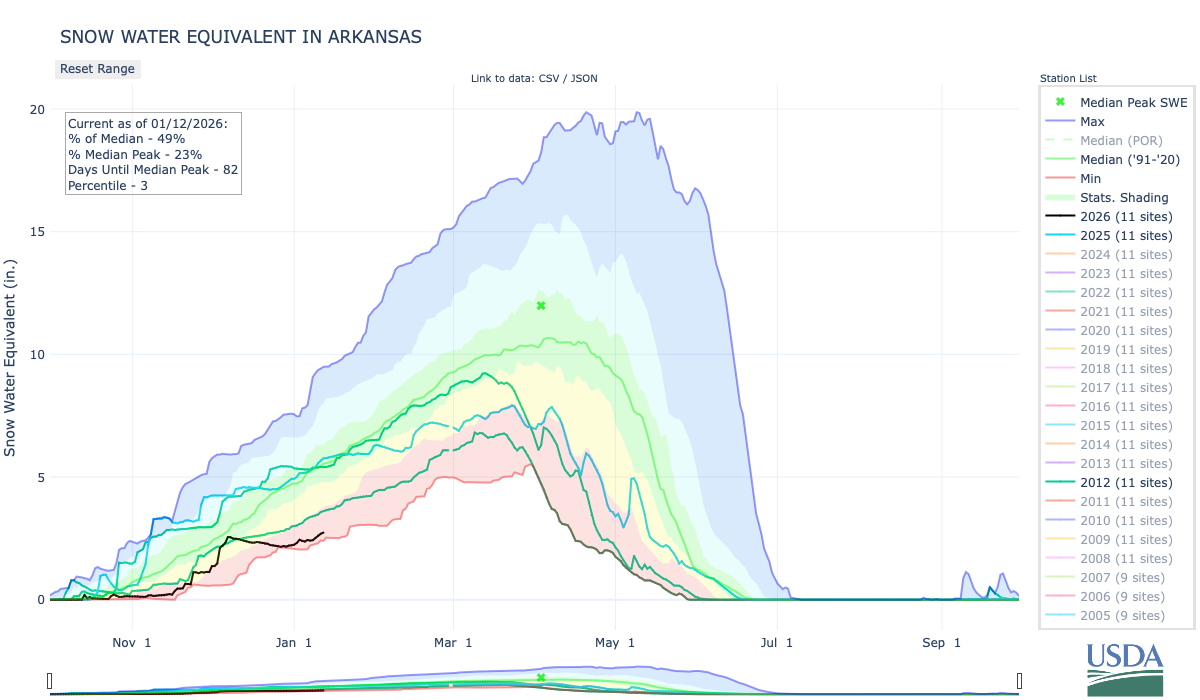

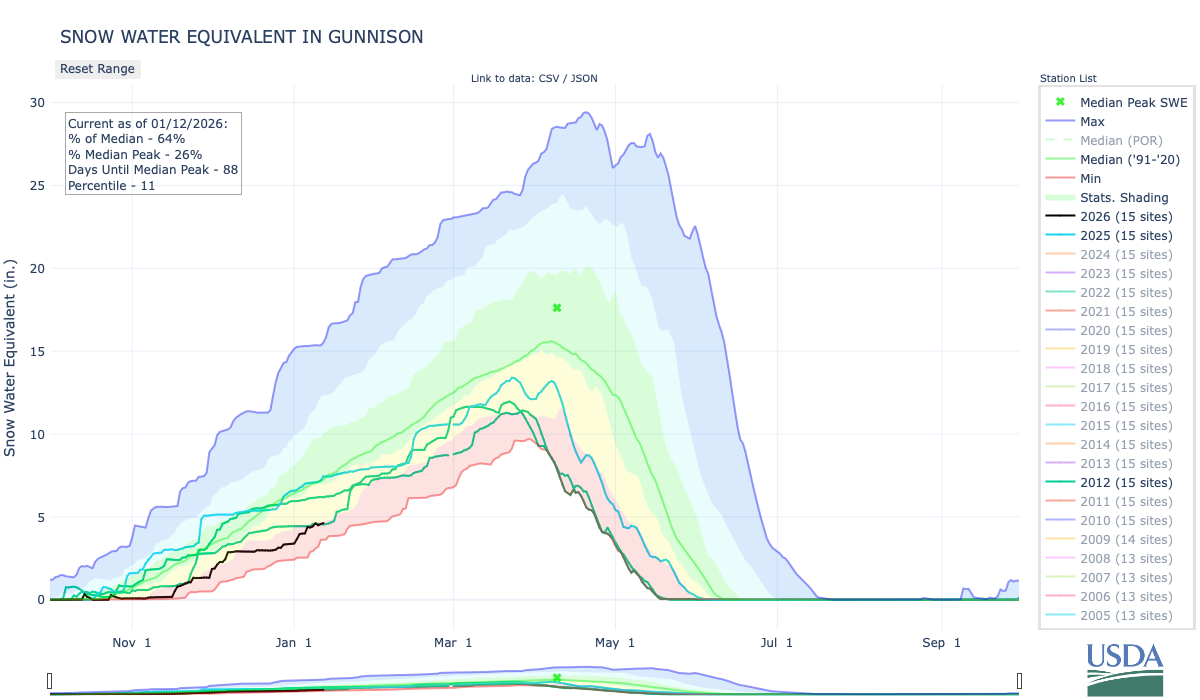

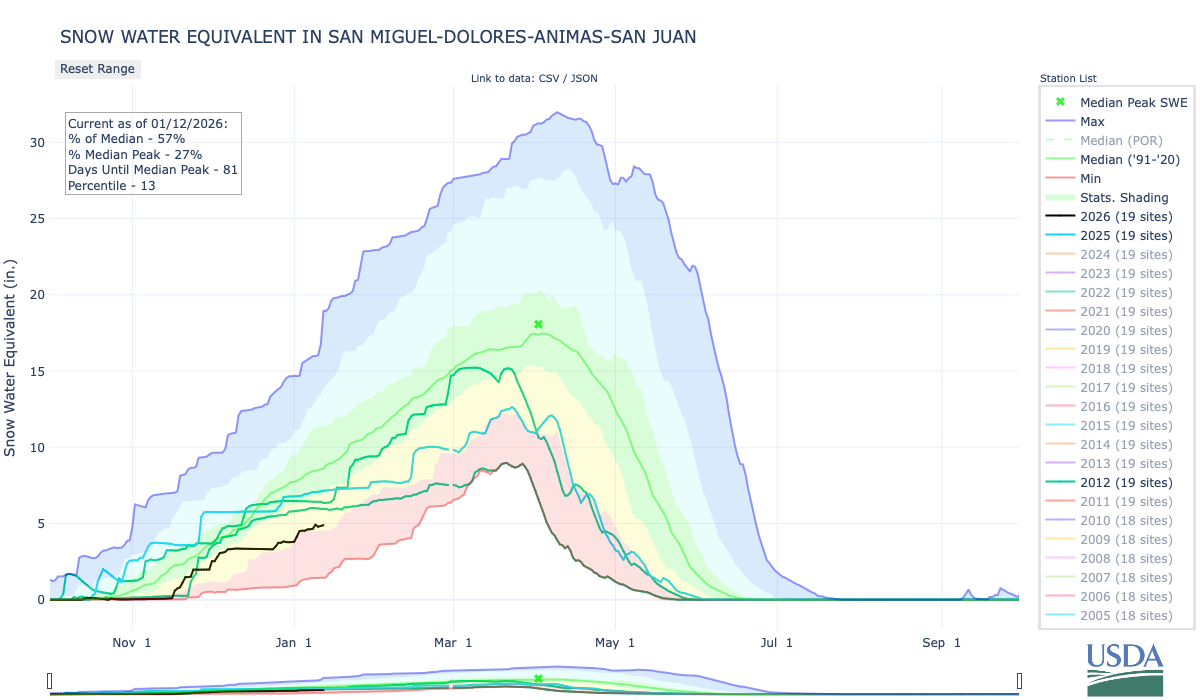


Salt Lake and several other Utah cities saw their warmest year on record in 2025 — KUER

Click the link to read the article on the KUER website (David Condos). Here’s an excerpt:
January 7, 2026
For the second straight time, Salt Lake City set a new record for its warmest year. That’s according to National Oceanic and Atmospheric Administration data that goes back to 1875. The city’s average temperature across 2025 was 57.7 degrees. That’s a full three degrees warmer than its historical average from the previous three decades. And it’s the culmination of several years of increasing warmth in Salt Lake City that has begun to top the record book.
“It looks like the past several years were in the top 15 or so,” National Weather Service Meteorologist Julie Cunningham said. “Kind of crazy to see that trend.”

Provo, Kanab, Bountiful and Boulder also set records for their warmest year in 2025. Several others, including Cedar City, St. George, Spanish Fork and Logan, saw temperatures that landed in their top 10…The summer of 2025 may not have had as many headline-grabbing heat waves as 2024 or 2023, Cunningham said, but it was consistently toastier than usual across the year as a whole. The fall was Utah’s warmest on record. The week of Christmas, cities from Kanab to Tooele broke daily records. On Dec. 22, the overnight low temperature in Salt Lake City was so warm, Cunningham said, it even surpassed that date’s record for a daytime high…Scientists say the record-breaking temperature events are another example of how global climate change — driven by fossil fuel emissions — is affecting life in places like Utah. That’s especially evident with the state’s precious water, said the University of Utah’s Paul Brooks.
“It’s really a dual threat,” the professor of hydrology and water management said. “One is just reducing the amount of water we have, and two is changing its timing, so it’s not as predictable as it once was.”
Higher temperatures fuel more evaporation. When temperatures increase across the year, it lengthens the season when evaporation occurs — essentially extending summer into parts of spring and fall. Warming also messes with the foundation of Utah’s water supply: snow. Snowpack provides 95% of the water used by Utahns. And Brooks said the state’s water management system is based on a predictable cycle of water becoming available when snow melts and flows downstream in the spring and early summer — just as demand for water starts to go up.

R.I.P. Bob Weir: “A breeze in the pines in the summer night moonlight”

Click the link to read the article on The New York Times website (Ben Sisario and Mark Walker). Here’s an excerpt:
January 10, 2026
Bob Weir, a guitarist and songwriter who was a founding member of the Grateful Dead, which rose from jug band origins to become the kings of psychedelic rock, selling millions of records and inspiring a small nation of loyal fans, has died. He was 78…The band, which was founded in the San Francisco Bay Area in 1965, blended rock, folk, blues and country, with mellow ease and a gift for improvisation that became its trademark. In a rock milieu that was still based on short songs and catchy hooks, the Grateful Dead created a niche for meandering, exploratory performances that each seemed to have their own personalities…The band became the pied pipers of the wider hippie movement, providing the soundtrack for 1960s dropouts and LSD dabblers…Even after hippie culture faded, the band retained a gigantic fan base — called Deadheads, a term worn with pride and later adapted for numerous other fandoms — which followed the group wherever it played, traded recordings of its concerts and set up mini-encampments, complete with craft bazaars, oceans of tie-dye and no small amount of drugs.
It was one of rock’s original subcultures. “Our audience is like people who like licorice,” the band’s lead guitarist and singer, Jerry Garcia, once said. “Not everybody likes licorice, but the people who like licorice really like licorice.”
In the band, Mr. Weir — who, like Mr. Garcia, had an early fascination with folk music — stood alongside strong musical personalities. Mr. Garcia was a wizard of improvisation, and gave the group its aesthetic and conceptual direction. Phil Lesh, its bassist, had training as a composer. Mickey Hart, a percussionist, had eclectic tastes and played a major part in introducing Western audiences to world music…But Mr. Weir also developed a reputation for inventive timing on the rhythm guitar, his chords alternately grounding and contending with the melodic chaos of Mr. Lesh and Mr. Garcia’s instruments. Although Mr. Garcia and Robert Hunter, the group’s lyricist, were the Dead’s primary composers, Mr. Weir was also a contributor to the writing of key songs like “Playing in the Band” and “Sugar Magnolia.”
Data Dump: One year into the “energy emergency”: President Trump has helped oil and gas companies, but “drill, baby, drill” remains elusive — Jonathan P. Thompson (LandDesk.org)

Click the link to read the article on The Land Desk website (Jonathan P. Thompson):
January 9, 2026
🛢️ Hydrocarbon Hoedown 📈 Data Dump
Donald Trump made a lot of promises on the campaign trail: If elected, he would bring down the cost of groceries (a word that seemed new to him), he would secure the borders, he would end all of the wars on day one, and he would unleash the oil companies so they could “drill, baby, drill” and secure “energy dominance.”
Groceries are still expensive, “border security” is now MAGA-speak for federal agents gunning down innocent bystanders, and not only are the wars still raging, but the administration’s newly named “Department of War” has bombed Iran, Nigeria, and Venezuela, and is now threatening to invade Greenland and even Mexico.
In fact, the only war that Trump can take credit for ending was Biden’s “war” on energy. And that’s only because the “war” didn’t exist in the first place! It was and remains a figment of the GOP’s imagination.
On Biden’s Energy Dominance — Jonathan P. Thompson
Still, the administration did live up to at least one promise: It used a fabricated “energy emergency” to help increase extractive corporations’ profit margins by rolling back environmental protections, handing out drilling permits like candy at a parade, fast-tracking various mine and oil and gas infrastructure permits, and offering oodles of public land to energy companies.
But has it really achieve the stated goal, to establish “energy dominance” — i.e. boost production, bring down prices, and end oil imports?
Maybe the data will help us figure that one out …
Leasing
As I think we’ve established, the Biden administration did not wage a war on energy or even oil and gas. In fact, under Biden, the nation became the world’s largest oil producer, the largest exporter of liquefied natural gas, and so on, while also fast-tracking solar, wind, and transmission projects on federal lands.
Biden’s Interior Department did, however, put up some guardrails aimed at protecting some public lands. While it leased out parcels in the Permian Basin without restraint, it also refrained from putting some more sensitive parcels up for auction in more sensitive areas with limited oil and gas production.
The Trump administration has been far more friendly to oil and gas companies looking to bolster their land-holding portfolios, not only offering up hundreds of thousands of acres, but then putting them up for auction a second time if the first round didn’t attract enough bids.
- 328,000 acres: Amount of public land and minerals the BLM leased to oil and gas companies between Jan. 20 and Dec. 31, 2025. This brought in about $356 million in revenue.
- $327 million: Amount a single oil and gas lease sale for 31 parcels, mostly in New Mexico’s Permian Basin, brought in this January, a record per-acre high average bid amount.
- 0: Number of bids received for 23 offered oil and gas lease parcels in Colorado in January. The sale was a “replacement” sale held after the initial auction failed to attract enough bids.
Drilling Permits

Environmentalists often attacked Biden for issuing more drilling permits for public lands than Trump did during his first administration. The comparison was dumb, but whatever. Trump apparently didn’t like Biden’s apparent energy dominance, so he struck back by issuing more than 5,000 drilling permits last year, far exceeding the Biden administration’s monthly and yearly averages.
- 1,124: Number of drilling permits the BLM issued to EOG Resources in 2025, mostly in the Permian Basin. That compares to 755 for XTO Permian and XTO Energy; 293 for Anschutz Exploration; 503 to Devon Energy; 338 to OXY USA; 241 to Matador Production; 119 to Chevron; 106 to Middle Fork Energy Uinta; and 80 to ConocoPhillips.
- 95: Number of drilling permits the BLM’s Farmington Field Office issued in 2025, to Hilcorp, Logos, SIMCOE, DJR Operating, and other companies. While this pales in comparison to the Permian Basin, it is a marked increase from recent years.
- 8: Number of drilling permits the BLM’s Moab Field Office issued in 2025.
- 100: Approximate number of drill rigs operating in all of New Mexico during any given week of 2025.
- 8,949: Number of approved federal drilling permits held by oil and gas companies that were available to drill as of Jan. 2, 2026. That is to say, they have the permits, but haven’t yet used them.
Production
During the past year, domestic crude oil production continued to increase month-to-month, but at a slower rate than it had previously. Oil production on federal lands was down about 2% from fiscal year 2024. This is mostly due to industry’s lack of enthusiasm for more drilling, thanks to a combination of low oil prices and higher expenses due to inflation and tariffs on steel and other equipment. So much for drill, baby, drill.

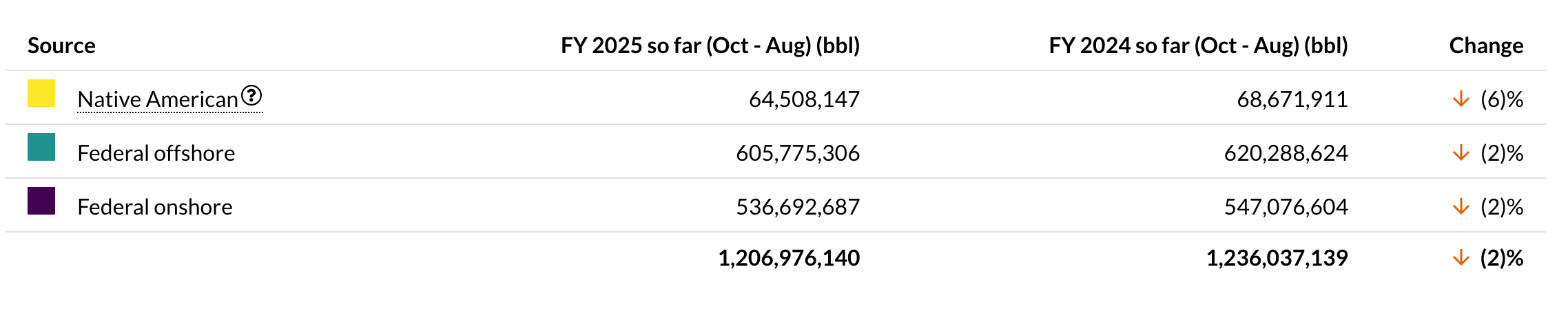
7.9 million: Barrels of crude oil per day the U.S. was importing from other countries in December 2025. That’s marginally less than a year earlier.
2.1 million barrels/day: Net crude oil imports (imports minus exports) to the U.S. in December 2025.
Idle Wells

I find this to be, perhaps, the most telling chart of all. It shows the number of idle wells on federal mineral leases (which includes public lands and split-estate private lands) by Western state. A lot of the wells have just been wrung dry and have been abandoned and need to be plugged and reclaimed, probably at the taxpayer’s expense.
Still others, the ones in the GSI (non-producing gas completion) and OSI (non-producing oil completion) columns, are officially capable of producing oil and gas, it’s just that for one reason or another they aren’t producing currently. Dozens of the GSI/OSI wells in Wyoming, for example, are owned by bankrupt companies that were unable to offload them to someone else.
This brings up a question: If we are indeed in an “energy emergency,” as the Trump administration has declared, shouldn’t we be pumping all of the oil and gas from existing wells that we possibly can before issuing thousands of new drilling permits, most of which aren’t even being used?
Let me answer that one: We’re not in an energy emergency.
🗺️ Messing with Maps 🧭
I came across this cool old map of the Sangre de Cristo land grant while perusing the Green Fire Times’ tribute to Malcolm Ebright, who was a land grant community advocate and historian. In order to get a high-res version I had to, um, copy this from an online auction site (thus the watermarks). I don’t have much to say about it, except it’s a pretty cool map of a very cool area.
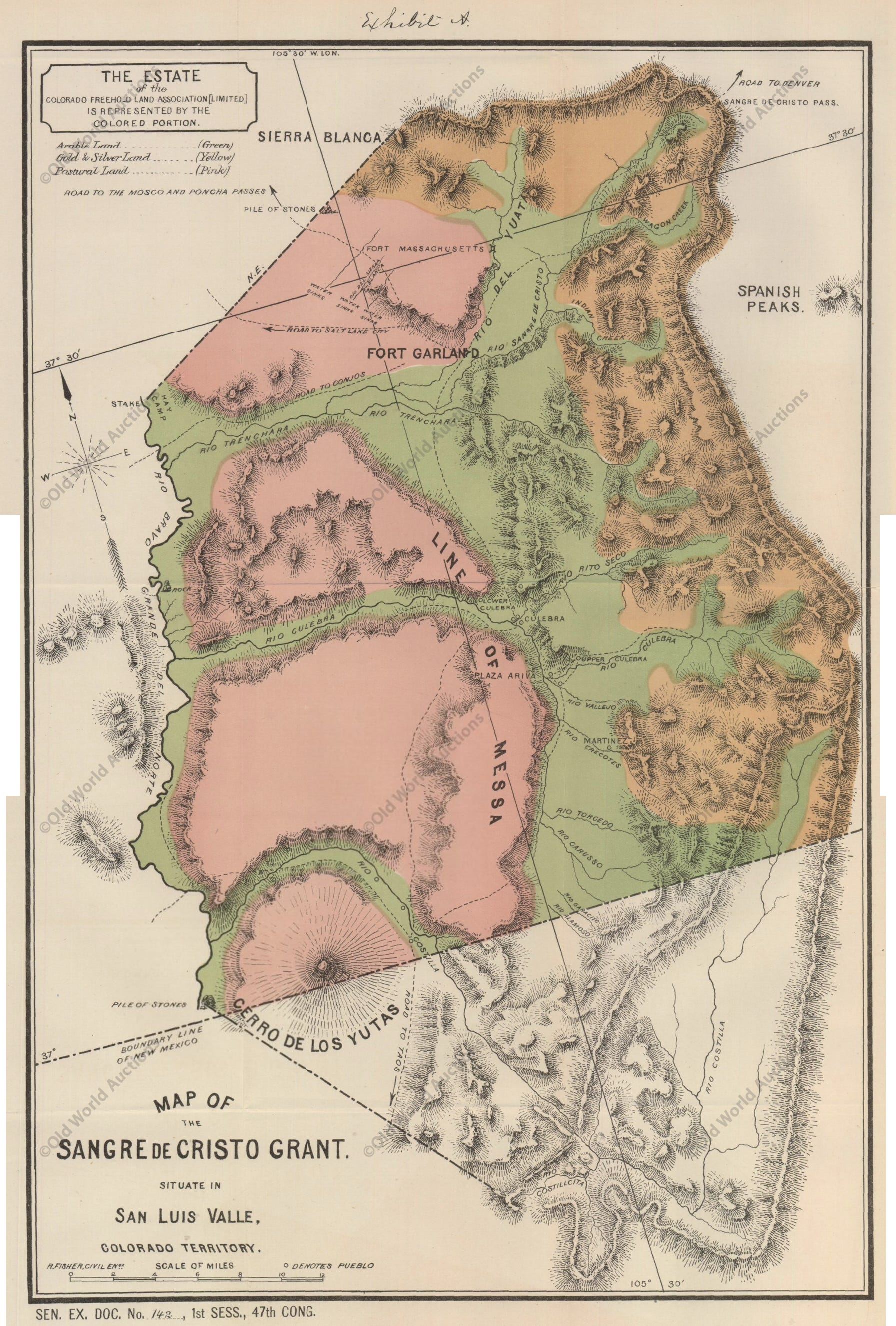
The battle over a global energy transition is on between petro-states and electro-states – here’s what to watch for in 2026 — Jennifer Morgan (TheConversation.org)
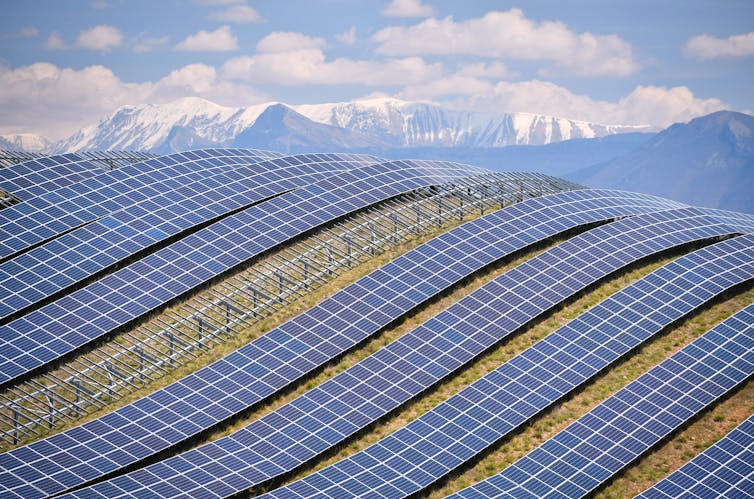
Jennifer Morgan, Tufts University
January 6, 2026
Two years ago, countries around the world set a goal of “transitioning away from fossil fuels in energy systems in a just, orderly and equitable manner.” The plan included tripling renewable energy capacity and doubling energy efficiency gains by 2030 – important steps for slowing climate change since the energy sector makes up about 75% of the global carbon dioxide emissions that are heating up the planet.
The world is making progress: More than 90% of new power capacity added in 2024 came from renewable energy sources, and 2025 saw similar growth.
However, fossil fuel production is also still expanding. And the United States, the world’s leading producer of both oil and natural gas, is now aggressively pressuring countries to keep buying and burning fossil fuels.
The energy transition was not meant to be a main topic when world leaders and negotiators met at the 2025 United Nations climate summit, COP30, in November in Belém, Brazil. But it took center stage from the start to the very end, bringing attention to the real-world geopolitical energy debate underway and the stakes at hand.
Brazilian President Luiz Inácio Lula da Silva began the conference by calling for the creation of a formal road map, essentially a strategic process in which countries could participate to “overcome dependence on fossil fuels.” It would take the global decision to transition away from fossil fuels from words to action.

More than 80 countries said they supported the idea, ranging from vulnerable small island nations like Vanuatu that are losing land and lives from sea level rise and more intense storms, to countries like Kenya that see business opportunities in clean energy, to Australia, a large fossil-fuel-producing country.
Opposition, led by the Arab Group’s oil- and gas-producing countries, kept any mention of a “road map” energy transition plan out of the final agreement from the climate conference, but supporters are pushing ahead.
I was in Belém for COP30, and I follow developments closely as former special climate envoy and head of delegation for Germany and senior fellow at the Fletcher School at Tufts University. The fight over whether there should even be a road map shows how much countries that depend on fossil fuels are working to slow down the transition, and how others are positioning themselves to benefit from the growth of renewables. And it is a key area to watch in 2026.
The battle between electro-states and petro-states
Brazilian diplomat and COP30 President André Aranha Corrêa do Lago has committed to lead an effort in 2026 to create two road maps: one on halting and reversing deforestation and another on transitioning away from fossil fuels in energy systems in a just, orderly and equitable manner.
What those road maps will look like is still unclear. They are likely to be centered on a process for countries to discuss and debate how to reverse deforestation and phase out fossil fuels.
Over the coming months, Corrêa plans to convene high-level meetings among global leaders, including fossil fuel producers and consumers, international organizations, industries, workers, scholars and advocacy groups.
For the road map to both be accepted and be useful, the process will need to address the global market issues of supply and demand, as well as equity. For example, in some fossil fuel-producing countries, oil, gas or coal revenues are the main source of income. What can the road ahead look like for those countries that will need to diversify their economies?

Nigeria is an interesting case study for weighing that question.
Oil exports consistently provide the bulk of Nigeria’s revenue, accounting for around 80% to over 90% of total government revenue and foreign exchange earnings. At the same time, roughly 39% of Nigeria’s population has no access to electricity, which is the highest proportion of people without electricity of any nation. And Nigeria possesses abundant renewable energy resources across the country, which are largely untapped: solar, hydro, geothermal and wind, providing new opportunities.
What a road map might look like
In Belém, representatives talked about creating a road map that would be science-based and aligned with the Paris climate agreement, and would include various pathways to achieve a just transition for fossil-fuel-dependent regions.
Some inspiration for helping fossil-fuel-producing countries transition to cleaner energy could come from Brazil and Norway.
In Brazil, Lula asked his ministries to prepare guidelines for developing a road map for gradually reducing Brazil’s dependency on fossil fuels and find a way to financially support the changes.
His decree specifically mentions creating an energy transition fund, which could be supported by government revenues from oil and gas exploration. While Brazil supports moving away from fossil fuels, it is also still a large oil producer and recently approved new exploratory drilling near the mouth of the Amazon River.
Norway, a major oil and gas producer, is establishing a formal transition commission to study and plan its economy’s shift away from fossil fuels, particularly focusing on how the workforce and the natural resources of Norway can be used more effectively to create new and different jobs.
Both countries are just getting started, but their work could help point the way for other countries and inform a global road map process.
The European Union has implemented a series of policies and laws aimed at reducing fossil fuel demand. It has a target for 42.5% of its energy to come from renewable sources by 2030. And its EU Emissions Trading System, which steadily reduces the emissions that companies can emit, will soon be expanded to cover housing and transportation. The Emissions Trading System already includes power generation, energy-intensive industry and civil aviation.
Fossil fuel and renewable energy growth ahead
In the U.S., the Trump administration has made clear through its policymaking and diplomacy that it is pursuing the opposite approach: to keep fossil fuels as the main energy source for decades to come.
The International Energy Agency still expects to see renewable energy grow faster than any other major energy source in all scenarios going forward, as renewable energy’s lower costs make it an attractive option in many countries. Globally, the agency expects investment in renewable energy in 2025 to be twice that of fossil fuels.
At the same time, however, fossil fuel investments are also rising with fast-growing energy demand.
The IEA’s World Energy Outlook described a surge in new funding for liquefied natural gas, or LNG, projects in 2025. It now expects a 50% increase in global LNG supply by 2030, about half of that from the U.S. However, the World Energy Outlook notes that “questions still linger about where all the new LNG will go” once it’s produced.
What to watch for
The Belém road map dialogue and how it balances countries’ needs will reflect on the world’s ability to handle climate change.
Corrêa plans to report on its progress at the next annual U.N. climate conference, COP31, in late 2026. The conference will be hosted by Turkey, but Australia, which supported the call for a road map, will be leading the negotiations.
With more time to discuss and prepare, COP31 may just bring a transition away from fossil fuels back into the global negotiations.
Jennifer Morgan, Senior Fellow, Center for International Environment and Resource Policy and Climate Policy Lab, Tufts University
This article is republished from The Conversation under a Creative Commons license. Read the original article.
Municipal Partnerships for Instream Flow on #Colorado’s Front Range — Jessica Pault-Atiase (Colorado Lawyer)
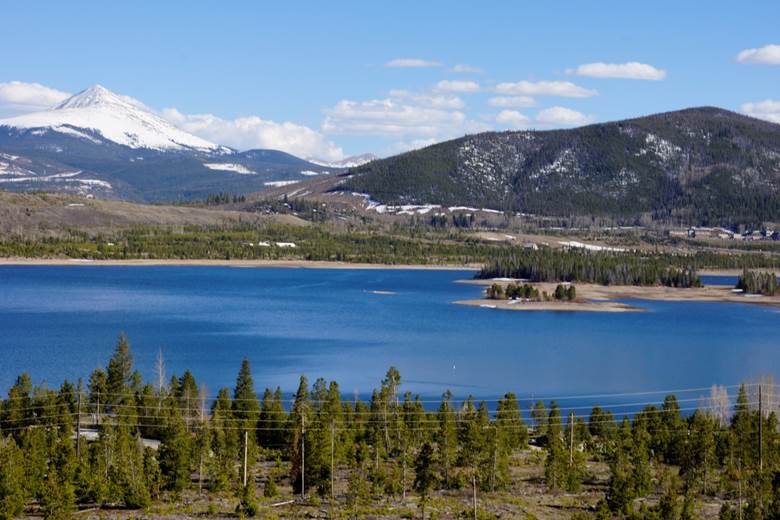
Click the link to read the article on the Colorado Bar Association website (Jessica Pault-Atiase):
January/February 2026
Incorporating instream flow uses into municipal water supply planning efforts can provide numerous public benefits. This article discusses the framework and opportunity for collaborative instream flow protection in municipal water supply operations.
Colorado’s instream flow program is a dynamic approach to protecting the natural environment that encourages practical and creative solutions to evolving environmental concerns. While water rights typically involve diverting water from the stream, the instream flow program protects water in the stream. Environmental values associated with instream flow uses can work synergistically with municipal water supply operations to realize several public benefits, such as improved water quality, riparian health, urban cooling, resiliency, recreational opportunities, and aesthetic value. As illustrated by the examples discussed later in this article, the instream flow program can facilitate cooperative agreements with municipal water providers for shared beneficial use of our state’s most precious resource.
Water Rights and the Prior Appropriation Doctrine in Colorado
The prior appropriation doctrine governs the ownership and use of water and water rights in Colorado. In simple terms, the prior appropriation system is described as “first in time, first in right.” A water user that has demonstrated an intent to put water to beneficial use first has a vested and prior right to use water in that amount against subsequent water users. This system developed out of necessity during the colonial expansion westward and was influenced by Spanish settlers and early miners to allocate water in the arid environment of Colorado, as an alternative to the more common riparian system of water rights based on land ownership abutting water ways.1
The prior appropriation doctrine has been enshrined in the Colorado Constitution. Article XVI, § 5 dedicates water in Colorado as public property for use by the people, subject to appropriation, and § 6 gives the right to appropriate water for beneficial use in priority.2 The 1969 Water Rights Determination and Administration Act (1969 Act) provides the legal framework for surface and tributary ground water distribution and use under the prior appropriation doctrine.3
An appropriation of a water right under the 1969 Act, as originally codified, meant “the diversion of a certain portion of the waters of the state and the application of the same to a beneficial use.”4 Similarly, beneficial uses were limited to diversions of water from the stream system for extractive uses such as domestic or municipal, irrigation, and manufacturing or industrial activities.5 Environmental uses of water, including instream flows, were not initially addressed in the 1969 Act but were later incorporated through amendments.6
Colorado Instream Flow Program
The Colorado Water Conservation Board (CWCB) was first established by the Colorado legislature in 1937 to protect and develop Colorado’s water resources for the benefit of present and future generations.7 It was not until the national environmental movement in the late 1960s, however, that discussions regarding the value of instream flows and role of the CWCB in the protection of such flows began to garner serious attention and focus.8 In 1973, those discussions culminated in the passage of SB 97 to create the Colorado Instream Flow and Natural Lake Level Program.9 SB 97 was unprecedented at the time and amended the 1969 Act to define beneficial use of a water right to include use by the CWCB for protection of stream flows within a specified reach without a diversion of water from the stream.10
Under the instream flow program, the CWCB has exclusive authority to hold a water right for instream flow uses in Colorado and may appropriate water rights or acquire existing water rights for instream flow, provided that it determines that such water rights are necessary to preserve or improve the natural environment to a reasonable degree.11 Since the program’s inception, the CWCB has appropriated nearly 1,700 instream flow rights across 9,700 miles of stream and completed over 35 water acquisition transactions.12
The General Assembly has reinforced and expanded the CWCB’s ability to acquire water rights for instream flow purposes on several occasions.13 Acquiring and changing senior water rights for instream flows in over-appropriated systems can add great value by preserving the priority date, and therefore the availability, of the water for greater instream flow protection.14 Acquisitions can be donated to or purchased by the CWCB, and the statutory language specifically anticipates potential acquisitions from governmental entities, like municipalities.15 Other free-market developments to the Colorado instream flow program enacted by the state legislature over the years include streamlined processes for loans of water rights for instream flow use, instream flow protection for mitigation releases, and stream flow augmentation plans.16 These developments provide additional opportunities for water users, including municipalities, to participate in the program in support of instream flows.
In addition to implementing the instream flow program, the CWCB is tasked with creating the Colorado Water Plan, which addresses the state’s water challenges through collaborative water planning, including expanded opportunities for instream flow protection.17
Case Studies Along the Front Range
The instream flow program provides reasonable protection of the environment for benefit of the public and is emphasized in the Colorado Water Plan as a balanced approach to addressing environmental needs in the face of climate change.18 Similarly, municipal water service providers, acting in the interest of their respective jurisdictions, must often balance water supply with other public interests. Municipal water projects and water supply planning efforts can be designed to address multiple needs and related uncertainties across a jurisdiction, informed by integrated planning efforts. The various public interests typically considered by municipalities may align with instream flow protection in many respects. The Colorado Water Plan includes several policy considerations that highlight this potential overlap between municipal water interests and instream flows.19
Fundamentally, the Colorado Water Plan encourages a holistic, collaborative approach to water management that balances multiple uses and benefits to meet water shortages throughout the state.20 As competition for water resources in Colorado becomes more pronounced with increased demands and costs, the benefits of water sharing and collaboration will also likely increase.21 The Colorado Water Plan focuses on thriving watersheds as an action area to support stream health, recreational uses, resiliency, erosion control, and water quality, all of which provide tangible benefits to municipal water service providers.22 Accordingly, more water in the stream system for instream flows can be a natural complement to a municipality seeking to balance growing water demands with related public interests. The following examples demonstrate how instream flow uses can benefit municipal water supply, and vice versa, to realize this balance in a meaningful way.
Boulder Creek Instream Flow Project
The Boulder Creek instream flow project is a long-standing cooperative project that has been operating in Boulder County for almost 35 years. This project has operated successfully due in large part to the partnership between the City of Boulder and the CWCB and their collaboration with neighboring water users in Boulder County to support environmental stream flows and other uses in the creek.
In the early 1990s, Boulder donated a suite of valuable senior water rights to the CWCB to establish a year-round instream flow program on North Boulder and Boulder Creeks.23 The acquisition was memorialized in a series of donation agreements between Boulder and the CWCB pursuant to CRS § 37-92-102(3), following certain legislative amendments throughout the 1980s that clarified and enhanced the CWCB’s acquisition authority for instream flows.24 Boulder and the CWCB, as co-applicants, also received a water court decree to change the use of the donated rights to include instream flow uses for the project.25
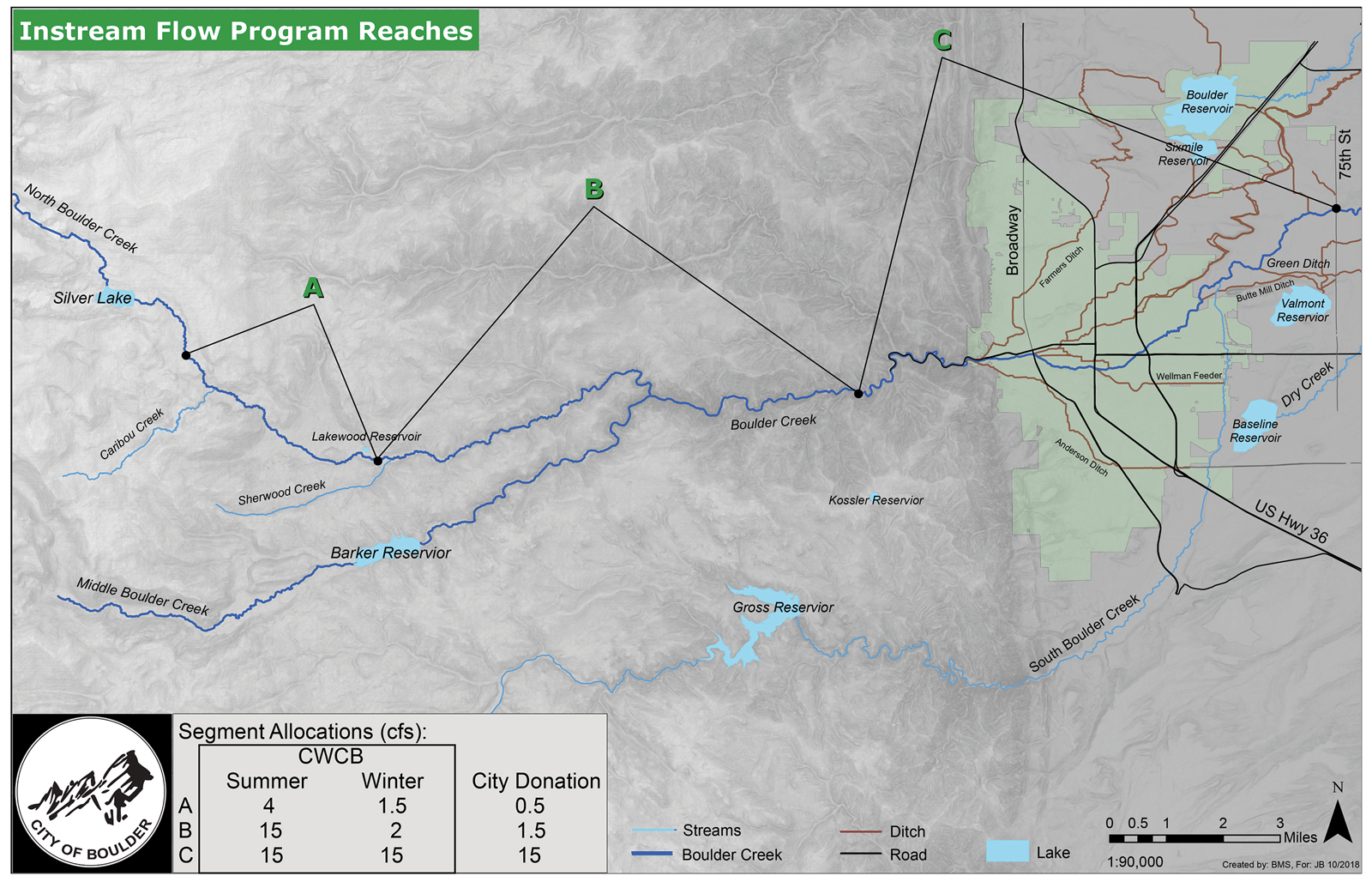
The Boulder Creek instream flow project protects three segments from below the Silver Lake Reservoir near the headwaters of North Boulder Creek down to 75th Street in Boulder County (see fig. 1). The donated rights include reservoir releases, bypassed diversions, and changed irrigation ditch shares to support instream flows throughout the year. As part of its donation to the CWCB, Boulder retained the right to use water available under the donated rights (1) for municipal purposes under certain conditions, including drought and emergency conditions in its municipal water supply operations; (2) for municipal purposes anytime they are not needed to meet instream flow amounts; and (3) for beneficial reuse downstream of the protected reaches.26 This provides operational flexibility for the city’s municipal water supply while also supporting instream flow uses by the CWCB in most years. Its participation in the Boulder Creek instream flow program has also helped the city address US Forest Service regulatory requirements for bypasses related to its diversions from North Boulder Creek as part of federal permitting for one of its raw water pipelines.27
The City of Boulder has a long-standing environmental ethos that incorporates instream flows into its water supply planning and operations. Boulder’s water supply planning documents from the 1980s identified the goal of supporting instream flows in Boulder Creek to enhance aquatic and riparian ecosystems, reflecting city planners’ prediction that dry-up periods in the creek would become more severe and frequent with increased water demands.28 Subsequent Boulder water supply and land use planning documents have included similar goals focused on balancing instream flows and environmental preservation with municipal water demands and operations, and emphasizing the connection between stream health and reliable drinking water supplies.29
Because the protected stream segments run through the Boulder city limits, and extend both above and below the city, the project benefits water quality, riparian health, and resiliency in the Boulder municipal watershed and water system operations and provides additional environmental benefits to the larger Boulder County community.
Gross Reservoir Environmental Pool Project
The cities of Boulder and Lafayette entered into an intergovernmental agreement in 2010 with Denver Water to establish a 5,000 acre-foot environmental pool in an enlarged Gross Reservoir to augment stream flows in South Boulder Creek.30 Boulder recognized the need to address low flows on South Boulder Creek as a key goal in its planning documents and identified Denver Water’s planned expansion of Gross Reservoir as an opportunity to use upstream storage to establish a robust instream flow program. Lafayette similarly identified Gross Reservoir for potential water storage in its water rights decrees, providing both a water supply and environmental benefit to its operations. The parties proactively agreed to cooperate to mitigate the reservoir expansion’s impacts to aquatic resources in the South Boulder Creek basin by creating and operating the environmental pool.31
Coordinated with municipal water system operations, releases from the environmental pool will allow Boulder and Lafayette to store their decreed water rights for later release to meet specific target flows below Gross Reservoir in South Boulder Creek throughout the year. The segments identified for the target flows include Gross Reservoir to South Boulder Road (Upper Segment, depicted as segments 1 and 2 in fig. 2) and South Boulder Road to the confluence with Boulder Creek (Lower Segment, depicted as segment 3 in fig. 2).32 The agreement also includes provisions to address emergencies such as extended drought or an unexpected problem with water storage, conveyance, or treatment infrastructure to allow for flexibility in operations to meet both target flows and municipal needs.
Boulder’s releases from the environmental pool are protected as instream flows according to a Water Delivery Agreement with the CWCB dated September 9, 2019, and a water court decree entered for Boulder, Lafayette, and the CWCB.33 Water released by Boulder to meet the target flows will be protected for instream flow uses to the extent that such flows do not exceed the amounts that CWCB has determined to be appropriate to preserve the natural environment to a reasonable degree in South Boulder Creek. Boulder’s target flow releases will support CWCB’s existing appropriated instream flow rights up to the specified amounts (see fig. 2). Boulder may then redivert the water downstream of the protected reaches for its municipal uses.
The environmental pool will provide permanent, dedicated storage for water rights owned by Boulder and Lafayette to be released to enhance stream flows in South Boulder Creek prior to downstream uses for municipal purposes by the parties. These operations provide added flexibility, resiliency, and redundancy to the cities’ respective water supply systems. In turn, the enhanced stream flows will benefit 17.3 miles of South Boulder Creek, including Eldorado Canyon State Park, South Boulder Creek Natural Area, and City of Boulder open space lands, and will support native fish populations and riparian and wetland habitats.

Poudre Flows Project
The Poudre Flows Project is the first stream flow augmentation plan developed pursuant to CRS § 37-92-102(4.5).34 It is a partnership amongst the CWCB; municipalities of Fort Collins, Thornton, and Greeley; Colorado Water Trust; Northern Colorado Water Conservancy District; Cache la Poudre Water Users Association; and Colorado Parks and Wildlife. The project will augment stream flows through a 52-mile reach of the Cache la Poudre River, with an overarching goal to improve river health (see fig. 3).35 The concept was first envisioned as part of the Poudre Runs Through It working group, a collaborative group of diverse partners and stakeholders in the Poudre River.36 The City of Fort Collins planning priorities incorporate similar goals, including to “[p]rotect community water systems in an integrated way to ensure resilient water resources and healthy watersheds.”37
The project anticipates that the CWCB, through agreements with water right owners, including Fort Collins and Greeley, will use previously changed and quantified water rights owned by these municipalities and potentially others to augment stream flows in six segments of the Poudre River spanning from Canyon Gage to the confluence with the South Platte River.38 Besides the instream flow protection of the environment to a reasonable degree, project partners have identified numerous additional benefits such as connectivity for fish passage and decreased temperatures and nutrient concentrations, all while avoiding impacts to existing water rights and operations.39
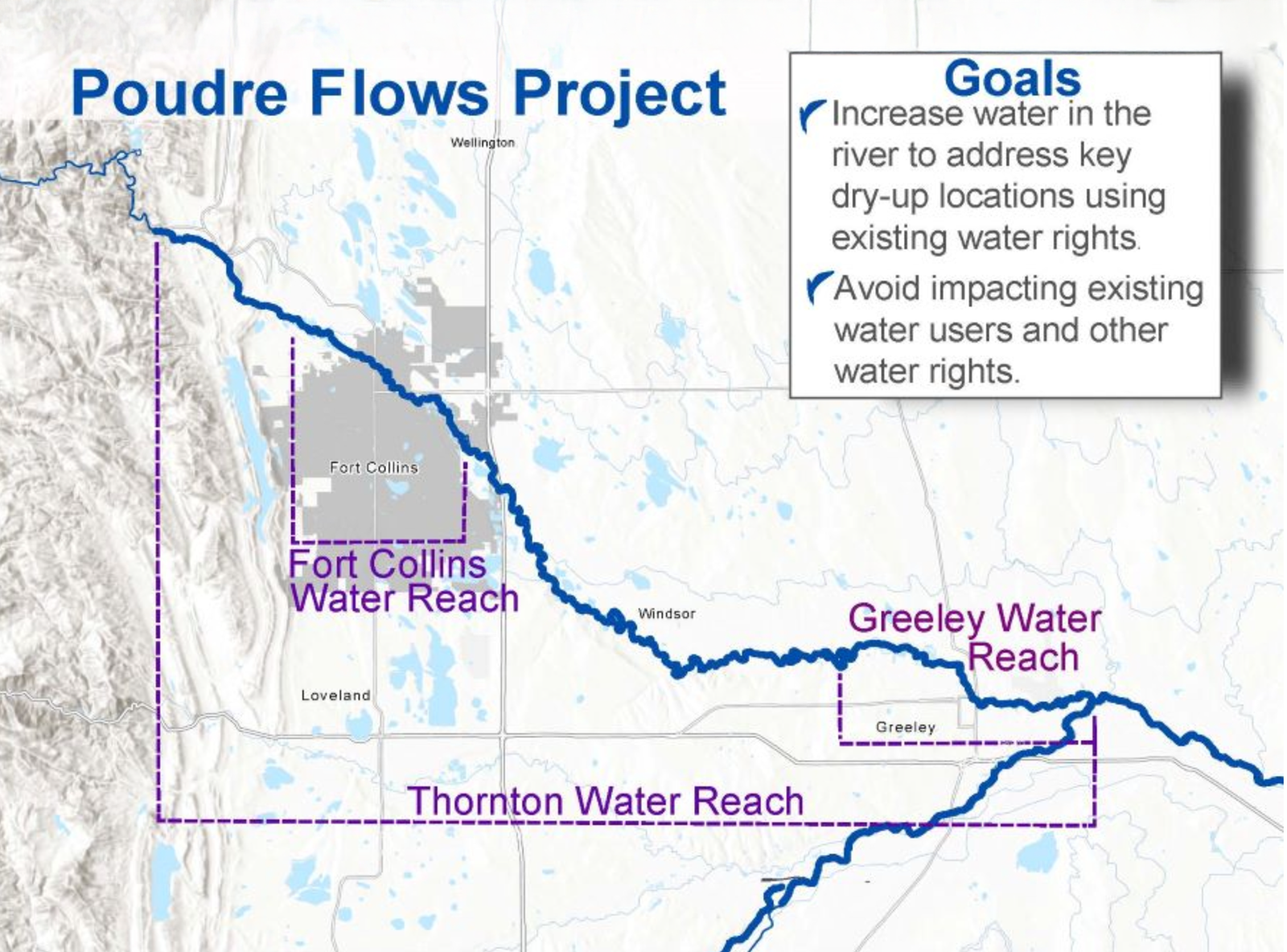
Conclusion
By integrating water supply planning with a holistic approach to water development and management that provides multiple public benefits, municipalities can become strong partners with the CWCB. Together, they can help protect instream flows and balance growing water demands and future uncertainties with the environmental values that make Colorado a beautiful place to live.
NOTES
citation Pault-Atiase, “Municipal Partnerships for Instream Flow on Colorado’s Front Range,” 55 Colo. Law. 48 (Jan./Feb. 2026), https://cl.cobar.org/features/municipal-partnerships-for-instream-flow-on-colorados-front-range.
1. See generally Coffin v. Left Hand Ditch Co., 6 Colo. 443, 447 (Colo. 1882).
2. Colo. Const. Art. XVI, §§ 5–6. See also Colo. River Water Conservation Dist. v. CWCB, 594 P.2d 570, 573 (Colo. 1979) (“The reason and thrust for this provision was to negate any thought that Colorado would follow the riparian doctrine in the acquisition and use of water.”).
3. CRS §§ 37-92-101 et seq.
4. CRS § 148-21-3 (1969) (emphasis added). See also Colo. River Water Conservation Dist., 594 P.2d at 574.
5. Id.
6. See Bassi et al., “ISF Law—Stories About the Origin and Evolution of Colorado’s Instream Flow Law in This Prior Appropriation State,” 22(2) U. Denv. Water L. Rev. 395 (2019), https://dnrweblink.state.co.us/cwcbsearch/ElectronicFile.aspx?docid=211090&dbid=0.
7. See Colorado Department of Natural Resources, Colorado Water Conservation Board, https://cwcb.colorado.gov/about-us.
8. Bassi, supra note 6 at 396–97.
9. SB 97, 49th Gen. Assemb., Reg. Sess. (Colo. 1973). See CRS § 37-92-102(3).
10. Bassi, supra note 6 at 398. See also Colo. River Water Conservation Dist., 594 P.2d at 576. SB 97 was carefully drafted to provide environmental protection through the CWCB, as a fiduciary to the public, without inviting riparian rights for adjacent landowners. Id. The Colorado Supreme Court reiterated this important distinction in St. Jude Co. v. Roaring Fork Club, LLC, 351 P. 3d 442 (Colo. 2015), ruling that a diversion from a steam for private instream flows is a “forbidden right” contrary to the prior appropriation doctrine; only the CWCB, with strict limitations identified by the general assembly, can hold an instream flow right for the benefit of the public. Id. at 451.
11. CRS § 37-92-102(3) (The CWCB is “vested with exclusive authority, on behalf of the people of the state of Colorado, to appropriate . . . such waters of natural streams . . . as the board determines may be required for minimum streamflows . . . to preserve the natural environment to a reasonable degree.” The board also may acquire water rights “in such amount as the board determines is appropriate for streamflows . . . to preserve or improve the natural environment to a reasonable degree.”). Legislation enacted in 2002 expanded the Colorado instream flow program to provide that water rights may also be used by the CWCB to improve the natural environment (and not just for preservation purposes). Bassi, supra note 6 at 391.
12. Colorado Department of Natural Resources, Colorado Water Conservation Board, “Instream Flow Program,” https://cwcb.colorado.gov/focus-areas/ecosystem-health/instream-flow-program.
13. See Bassi, supra note 6 at 405–06, 417–18.
14. Id. at 406. The Colorado Water Trust was formed in 2001 to support Colorado’s instream flow program by promoting voluntary, market-based efforts to restore stream flows in Colorado’s rivers. The Water Trust has been instrumental in facilitating and streamlining the acquisition of water rights from willing partners for use by the CWCB. See https://coloradowatertrust.org.
15. CRS § 37-92-102(3).
16. See generally CRS §§ 37-83-105, 37-92-102(8), 37-92-102(4.5).
17. The Colorado Water Plan was adopted by the CWCB in 2023 as a framework for decision-making to address water challenges and build resiliency in the state. The 2023 Water Plan is an update to the first iteration of the plan released in 2015. See https://cwcb.colorado.gov/colorado-water-plan.
18. See St. Jude Co., 351 P. 3d at 449 (in its use of water for instream flows, the CWCB has a “‘statutory fiduciary duty’ to the people . . . to both protect the environment and appropriate only the minimum amount of water necessary to do so . . . .”).
19. Colorado Department of Natural Resources, Colorado Water Conservation Board, Colorado Water Plan (2023), https://dnrweblink.state.co.us/CWCB/0/edoc/219188/Colorado_WaterPlan_2023_Digital.pdf.
20. See id. at 217–19, 231, 233 (“All areas of the Water Plan are interconnected, and projects need to consider multi-purpose, multi-benefit solutions.”).
21. See id. at 217 (“Multi-purpose projects better address water supply challenges across municipal, agricultural, environmental, and recreation sectors as they occur.”).
22. See id. at 181, 204–07 (stream health and related environmental benefits can enhance municipal supply or improve the quality of life in urban areas).
23. See Decree, In re Application for Water Rts. of the Colo. Water Conservation Bd. on Behalf of the State of Colo. and Water Rts. of the City of Boulder, No. 90CW193 (Colo. Water Div. 1, Dec. 20, 1993).
24. Id. See Bassi, supra note 6 at 405–07.
25. Decree, supra note 23.
26. See id.
27. Bassi, supra note 6 at 408–09.
28. City of Boulder Source Water Master Plan: Vol. 2—Detailed Plan 2-1, 2-3, 3-77, 5-20 (Apr. 2009) (discussing previous planning efforts and priorities regarding instream flows), https://bouldercolorado.gov/media/7670/download?inline.
29. Id. at 3.71, 5-21 to 5-33, 7-3. See also Boulder Valley Comprehensive Plan: 2020 Mid-Term Update 31, 62 (adopted 2021), https://bouldercolorado.gov/media/3350/download?inline.
30. See Decree, In re Application for Water Rts. of City of Lafayette, City of Boulder, and Colo. Water Conservation Bd. in Boulder Cnty., No. 17CW3212 (Colo. Water Div. 1, Feb. 11, 2021). The author represented the City of Boulder in Case No. 17CW3212 and was involved in prosecuting the case and negotiating the underlying agreement with CWCB.
31. Denver Water’s enlargement of Gross Reservoir is the subject of pending litigation.
32. The target flows and target reaches are based on previously collected data and analysis by Colorado Parks and Wildlife using the R2Cross method, which supported CWCB’s previous instream flow appropriations.
33. See id. CRS §§ 37-92-102(3), 37-87-102(4).
34. The cities of Fort Collins and Greeley were instrumental in getting HB 20-1037 passed to authorize the CWBC to use water rights previously decreed for augmentation uses for instream flows. Castle, “To Boost Poudre River Flows, Cities, Conservationists Craft New Plan From Old Playbook,” Water Education Colorado (Jul. 3, 2019), https://watereducationcolorado.org/fresh-water-news/to-boost-poudre-river-flows-cities-conservationists-craft-new-plan-from-old-playbook. See also HB 1037, 75th Gen. Assemb., Reg. Sess. (Colo. 2020), https://leg.colorado.gov/bills/hb20-1037.
35. See Boissevain, “Poudre Flows: Collaboration to Protect the Cache la Poudre River,” Colorado Water Trust (Oct. 29, 2024), https://coloradowatertrust.org/collaboration-to-protect-the-cache-la-poudre-river.
36. City of Fort Collins, “Poudre Flows,” https://www.fcgov.com/poudreflows.
37. Id.
38. See Application, In re Application for Water Rts. of Cache La Poudre Water Users Ass’n, City of Fort Collins, City of Greeley, Colo. Water Tr., N. Colo. Water Conservancy Dist., City of Thornton and Colo. Water Conservation Bd. in Larimer and Weld Cntys., No. 21CW3056 (Colo. Water Div. 1 Apr. 29, 2021).
39. See “Poudre Flows,” supra note 36.

U.S. Representatives Lauren Boebert and Jeff Hurd’s veto override attempt on water pipeline bill fails — The #GrandJunction Daily Sentinel #ArkansasRiver #ColoradoRiver
Click the link to read the article on the Grand Junction Daily Sentinel website (Nathan Deal). Here’s an excerpt:
January 9, 2026
After Coloradan U.S. House Reps. Lauren Boebert and Jeff Hurd saw their Finish the Arkansas Valley Conduit Act approved unanimously by Congress in December, they were stunned when President Donald Trump — once a proponent of the project — vetoed it…After the rejection of the legislation sponsored by Boebert, the former 3rd Congressional District representative and co-sponsored by Hurd, the district’s current representative, they sought a rare move for Congressional Republicans in the Trump era: a veto override that could have defied the president. A vote on the veto override was held in the House on Thursday, needing two-thirds of voters to vote “yes” to pass. It ultimately failed with 249 “yes” votes and 176 “no” votes, with one “present” vote, around 8% short of the threshold for passage. All 213 Democrats voted to back the override, while 36 Republicans backed the override but 176 did not. Five Republicans did not vote…
Boebert’s bill, H.R. 131, would have provided communities in the region more time and flexibility to repay the federal government by extending repayment periods and lowering interest rates. In his veto decision, Trump cited financial concerns, but on the House floor, both Boebert and Hurd emphasized that the bill would not expand the project, authorize new construction or increase federal share. Per Boebert, the U.S. Bureau of Reclamation found that Arkansas Valley drinking water has such high levels of radium, uranium and other pollutant contamination that people in the area could see the cost of drinking water triple without this legislation.
“Contrary to what the veto message states, my bill does not authorize any additional federal funding. It simply modifies the repayment terms for small rural communities in my district so they’re able to afford their 35% cost share of the project that they are statutorily obligated to repay,” Boebert said…
Hurd said that rural Colorado and rural America voted “overwhelmingly” for Trump because they didn’t want to be forgotten by the government, adding, “They expected Washington to keep its word, not abandon them midway.” He also expressed concern about the precedent a failed veto override would set, not just for the rest of Trump’s term but moving forward on Capitol Hill. This was a similar, though less alarmingly phrased, point as Neguse earlier stating, “No state is safe from political retaliation.”
#SanJuanRiver sees record flows amidst #drought conditions — The #PagosaSpringsSun #ColoradoRiver #COriver #aridification
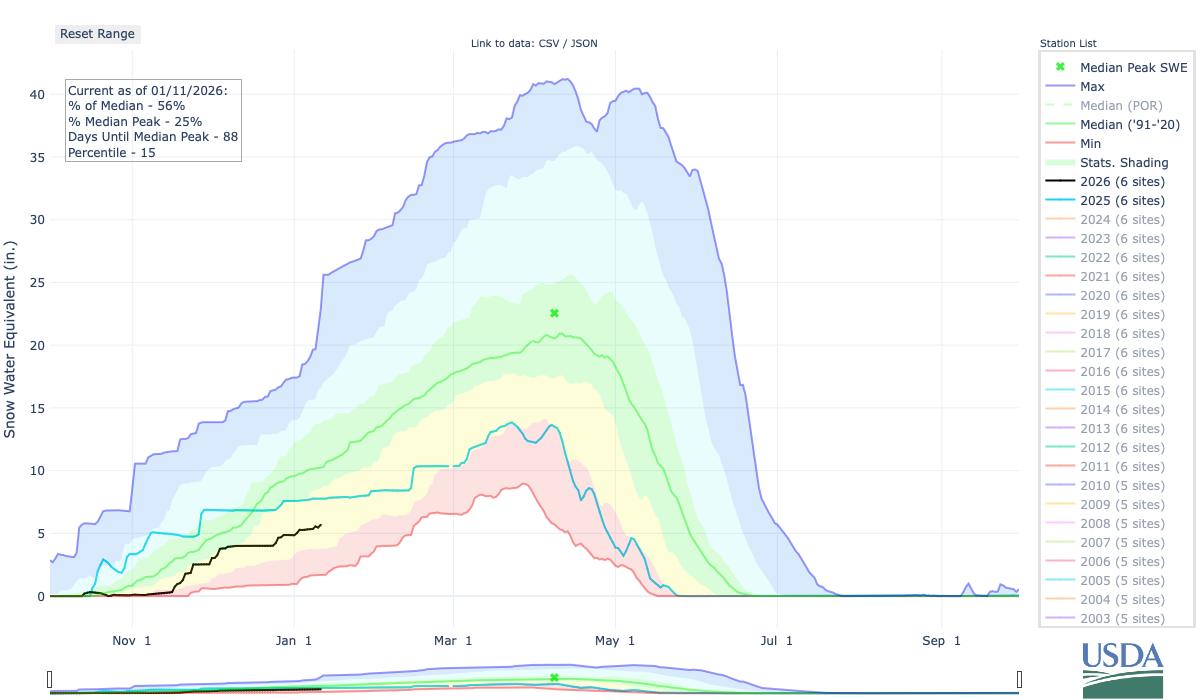
Click the link to read the article on the Pagosa Springs Sun website (Clayton Chaney and Randi Pierce). Here’s an excerpt:
January 7, 2026
Snowpack and stream flow
According to data from the Natural Resource Conservation Services (NRCS), as of 1 p.m. on Wednesday, Jan. 7, the Wolf Creek Pass site at 10,930 feet had a snow water equivalent of 7.6 inches, compared to that date’s median of 15.5 inches. This is up from the Dec. 31, 2025, report of 7 inches. The current amount is 49 percent of that date’s median snow water equivalent…The San Miguel, Dolores, Animas and San Juan River basins were measured to be at 49 percent of its 30-year median snowpack as of December 31, 2025, and at 56 percent on January 7, 2026…
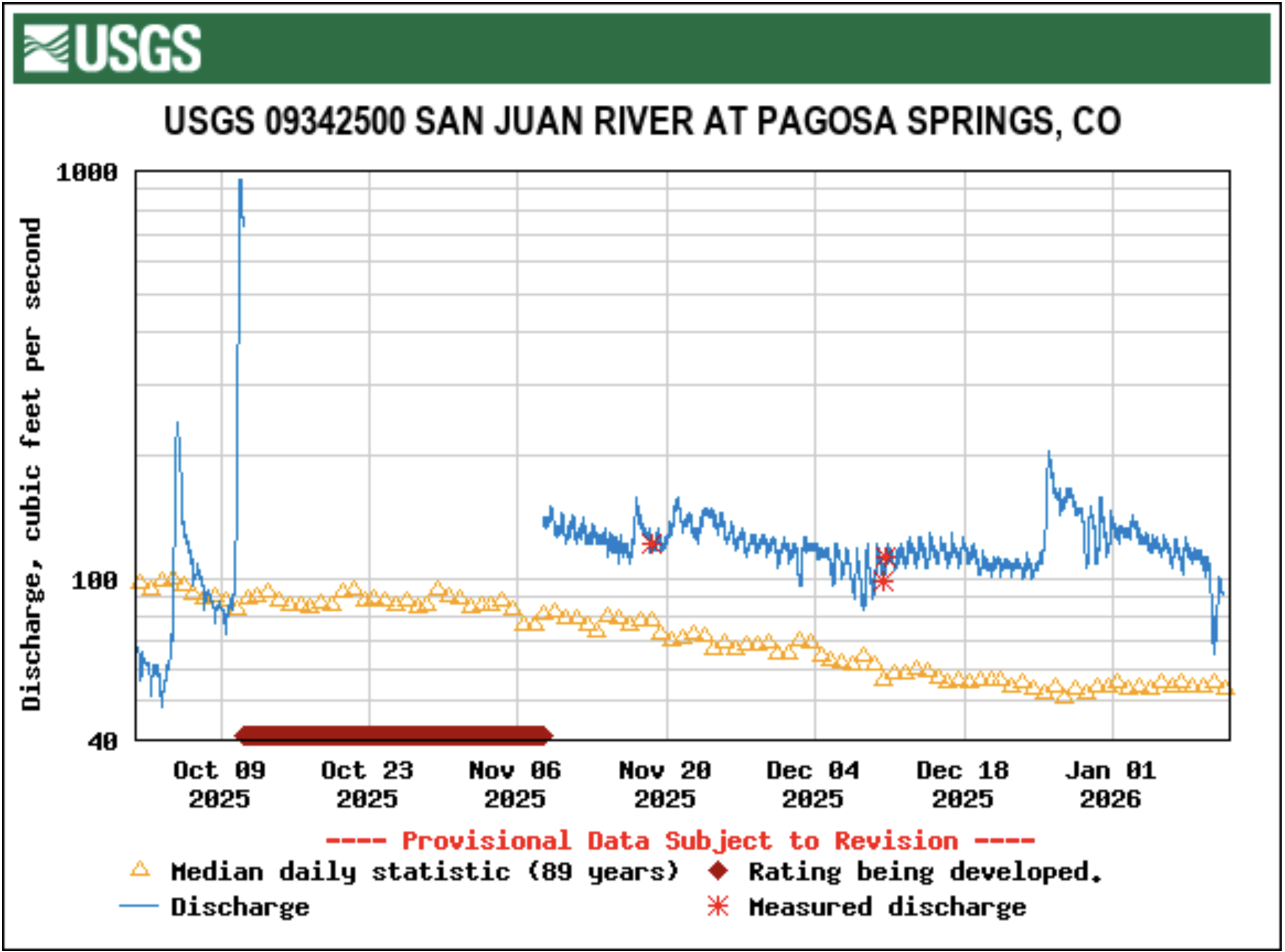
In Pagosa Springs, U.S. Geological Survey for the San Juan River at Pagosa Springs has showed record flows multiple times since the start of the year. For example, at 9 a.m. on Jan. 2, the river was running at 128 cubic feet per second (cfs), which compares to a median of 53 cfs and a previous high of 118 in 1986. At 11 a.m. on Jan. 5, the river was running at 119 cfs, which compares to a median for that date of 54.5 cfs and a previous max value of 116 in 1987. By 11 a.m. on Wednesday, Jan. 7, the river was flowing at 111 cfs. The Jan. 7 median is 55, and the record high is 116 cfs, which was recorded in 1987. According to the U.S. Drought Monitor’s most recent map released on Dec. 31, 2025, 100 percent of Archuleta County is in an “abnormally dry” drought stage.

Town council presented with flood recovery funding scenarios after FEMA denies funds — The #PagosaSprings Sun #SanJuanRiver
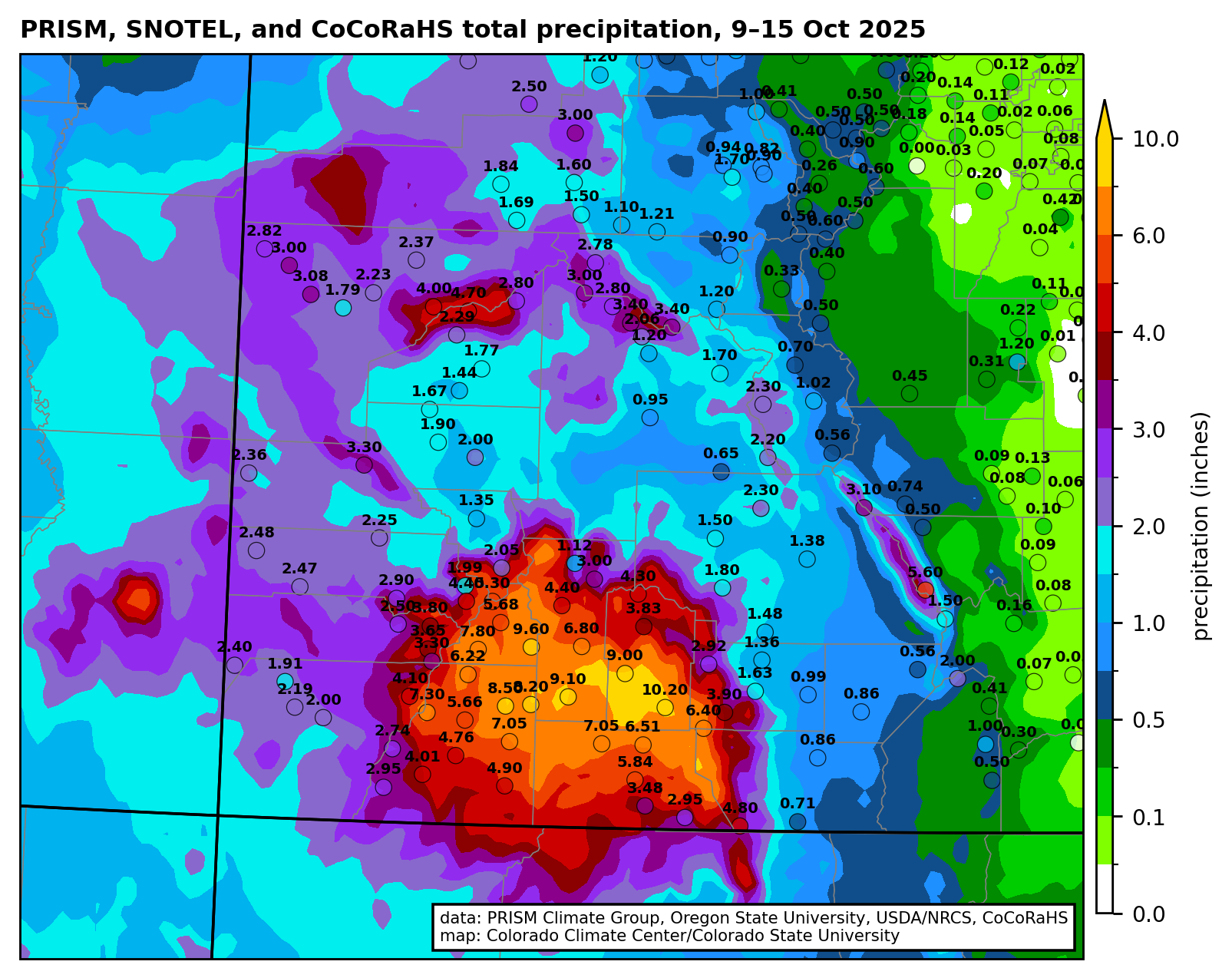
Click the link to read the article on the Pagosa Springs Sun website (Derek Kutzer). Here’s an excerpt:
January 7, 2026
On January 6, 2026 Town of Pagosa Springs staff informed the Pagosa Springs Town Council about the town’s ongoing flood recovery funding efforts in the wake of the Federal Emergency Management Agency’s (FEMA’s) denial of the town’s request for $5.7 million to aid cleanup efforts. Development Director James Dickhoff and Projects Manager Kyle Rickert were both on hand to walk the council through various other funding opportunities, with Dickhoff stating, “We are not counting on FEMA money to come through to us” after the denial on Dec. 21, 2025. Dickhoff stated that staff just wanted to inform the council “on where we are at” regarding the town’s relief funding efforts from the October 2025 flooding…
The total project cost of river cleanup and restoration following the October flood event is estimated to be just shy of $6 million, stated Town Manager David Harris in correspondence. Rickert explained that, with the FEMA funding off the table, the town is pursuing several state grants, and possibly a state loan, as well as two other federal funding programs. Dickhoff added that if the town wanted to pursue “the loan opportunity through the Colorado Water Conservation Board (CWCB),” the council would need to put it before the voters in an upcoming spring election to be legally eligible to take out the loan…
Rickert explained that the federal Emergency Watershed Protection had awarded the town about $3.3 million and the Colorado Office of Emergency Management awarded $463,504 in funds. These funds will go toward embankment stabilizations near the Pagosa Springs History Museum and near 6th Street, pedestrian bridge abutment stabilization at Centennial Park, restoring the River Center ponds, as well as Apache Street bridge repairs and log jam removals, all coming with a total project price tag of $4,178,038, the slideshow states…
He added, “The river is an important part of our tourism portfolio and we need to get it cleaned up” and make it safe for those recreating in the river before summer hits. Rickert then informed the council about a Colorado Parks and Wildlife (CPW) Fishing is Fun grant that the town has requested in the amount of $328,603. This grant would go toward dredging the River Center ponds, a headgate replacement at Pond #1 (the east pond), ditch restoration, debris and sediment removal upstream of town limits to the future 1st Street pedestrian bridge, as well as rebuilding rock structures in the same area. Rickert noted that the town was also awarded $15,000 from History Colorado Emergency Grant for its ongoing efforts to stabilize the river bank near the museum…One or possibly two water gauge stations would give the town an estimated two hours of warning time as water levels rise during another flood event, providing historic data as part of the U.S. Geological Survey monitoring system, she noted. This grant application would be due by Jan. 31, so she asked the council to pass a resolution supporting the CWCB river gauge grant, which the council passed unanimously.
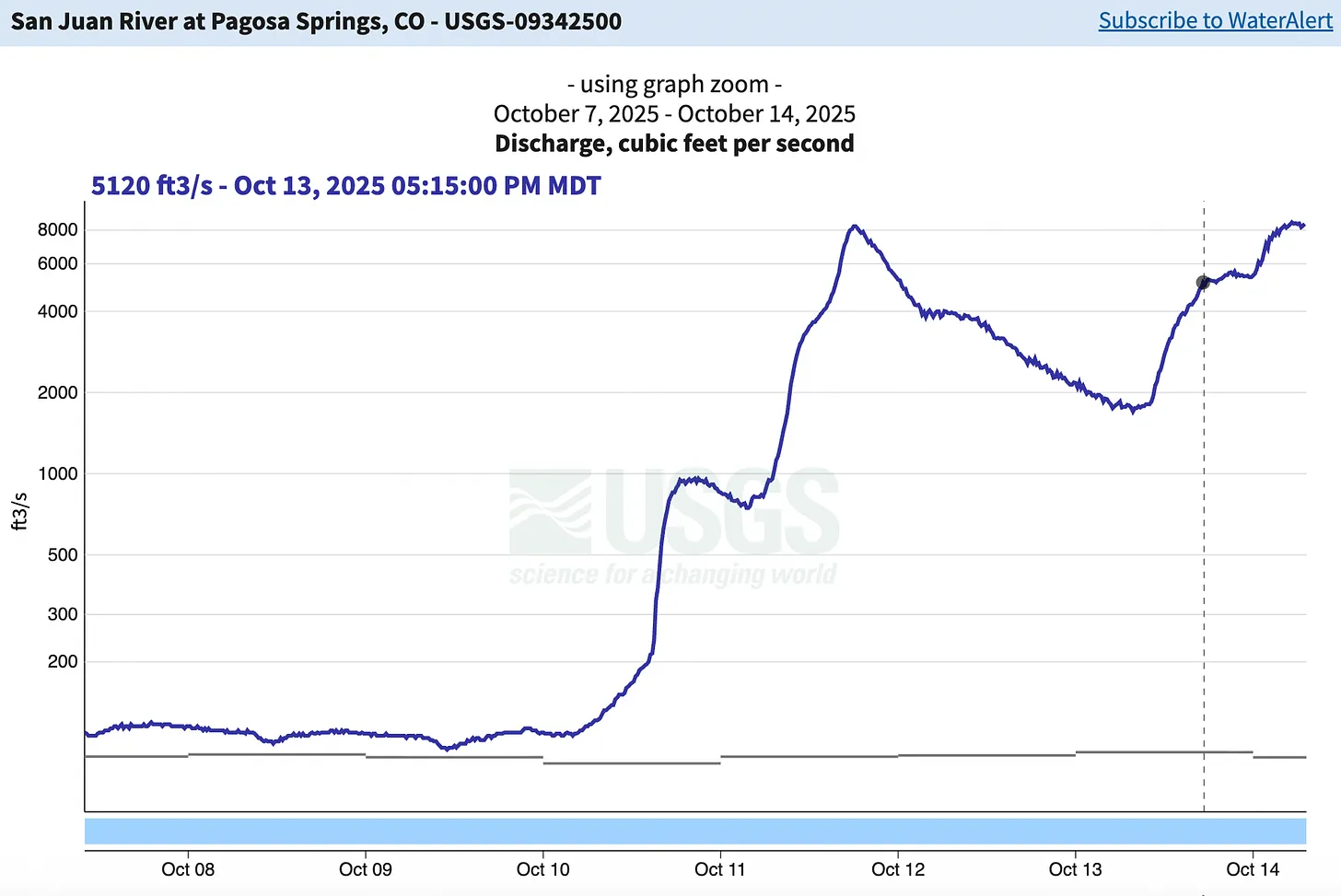
#Oil, Ego, and Venezuela: On President Trump’s dangerous “Donroe Doctrine” shenanigans — Jonathan P. Thompson (LandDesk.org)
Click the link to read the article on The Land Desk website (Jonathan P. Thompson):
January 6, 2026
🤯 Trump Ticker 😱
Five years ago today, President Donald Trump incited an angry mob of his followers to attack the nation’s Capitol building in an attempt to overturn the presidential election that he had just lost. He was trying to launch a coup to overthrow America’s democracy. At the time, many of us expected him to be impeached, and maybe even go to jail for this deplorable act. Little could we have guessed that just half a decade later he’d not only be President once again, but would actually be succeeding in his bid to dismantle democracy, and would be doing it with the tacit and explicit support of Congress, the Supreme Court, and his many supporters who don’t seem to be bothered by his cognitive decline, authoritarianism, broken promises, lies, close association with a convicted sex trafficker and pedophile, disregard for the Constitution, and reckless tinkering with the U.S. economy, international affairs, and his constituents’ well-being.
The administration’s invasion of Venezuela is simply the latest, most egregious example. The military went in, lit up Caracas with explosives and gunfire, killed civilians, kidnapped the nation’s leader (who, admittedly, was a nasty authoritarian), and sowed chaos, all without authorization from Congress. The reason? Trump himself says it was to turn the country’s vast oil reserves over to American corporations, which donated generously to Trump’s campaign. But Trump and his minions were equally motivated by the need to stroke Trump’s fragile ego — which has taken a beating thanks to other failures and low approval ratings, and to distract from his ubiquity in the Epstein files (which the DOJ has yet to release as Congress ordered it to do). Don’t be surprised if they invade Greenland or Cuba or even Mexico, next, as stupid as such a scenario might be.
But let’s focus on the oil factor, since that’s the one that’s most likely to trickle down into the Land Desk beat.
Venezuela has a lot of oil, reportedly the largest proved reserves in the world, and it’s mostly made up of heavy, sour crude (more on this in a minute). It’s currently not extracting very much of that oil, for various reasons (the U.S. produces about 20 times more per day than Venezuela). Trump is encouraging American oil companies to go to Venezuela and develop the oil fields and upgrade the infrastructure. This will take time and money, and it’s not clear that petroleum corporations will be interested in this kind of investment while oil prices are low (as they are, currently). Prices are low because demand and supply are more or less balanced, meaning the world doesn’t really need Venezuelan’s oil — at least not now.
Like fine wine, oil is imbued with terroir. That is, its composition varies depending on where it’s from. Most U.S.-produced oil is tight (from tight shales), light (low density), sweet (low sulfur content) crude that requires less processing than heavy (dense), sour (high sulfur) crude. Thing is, many Gulf Coast refineries were constructed before the shale revolution and are equipped to process heavy, sour crude, like the kind that comes from Venezuela. So there is a domestic demand for the stuff.

If and when Venezuelan production increases, it will add supply to both the global and domestic markets, which could bring prices down even further. That will lower the cost of driving American gas guzzlers around, and increase greenhouse gas emissions and other pollutants, but it will also reduce incentives to drill new wells, which could ease industry pressure on public lands in the U.S. In the meantime, the Trump administration continues to issue drilling permits at a blistering rate, even though companies aren’t all that interested in using them.
Wise Use Echoes — Jonathan P. Thompson
🥵 Aridification Watch 🐫
Last week, the Durango Herald quoted a National Weather Service meteorologist as saying that the snowpack in the southwestern part of the state was “not too bad.” I guess that depends on your definition of “not too bad.” Because it sure as heck isn’t looking good!

The San Juan Mountain snowpack levels are currently at about 50% of normal for the first week of January, and they are tied for third lowest snowpack level on record for this date. That’s not “too bad,” it’s downright dismal. And snow cover is even more meagre in other parts of the state: The Colorado River’s headwaters SNOTEL station is experiencing the lowest snowpack since it started recording in 1986.
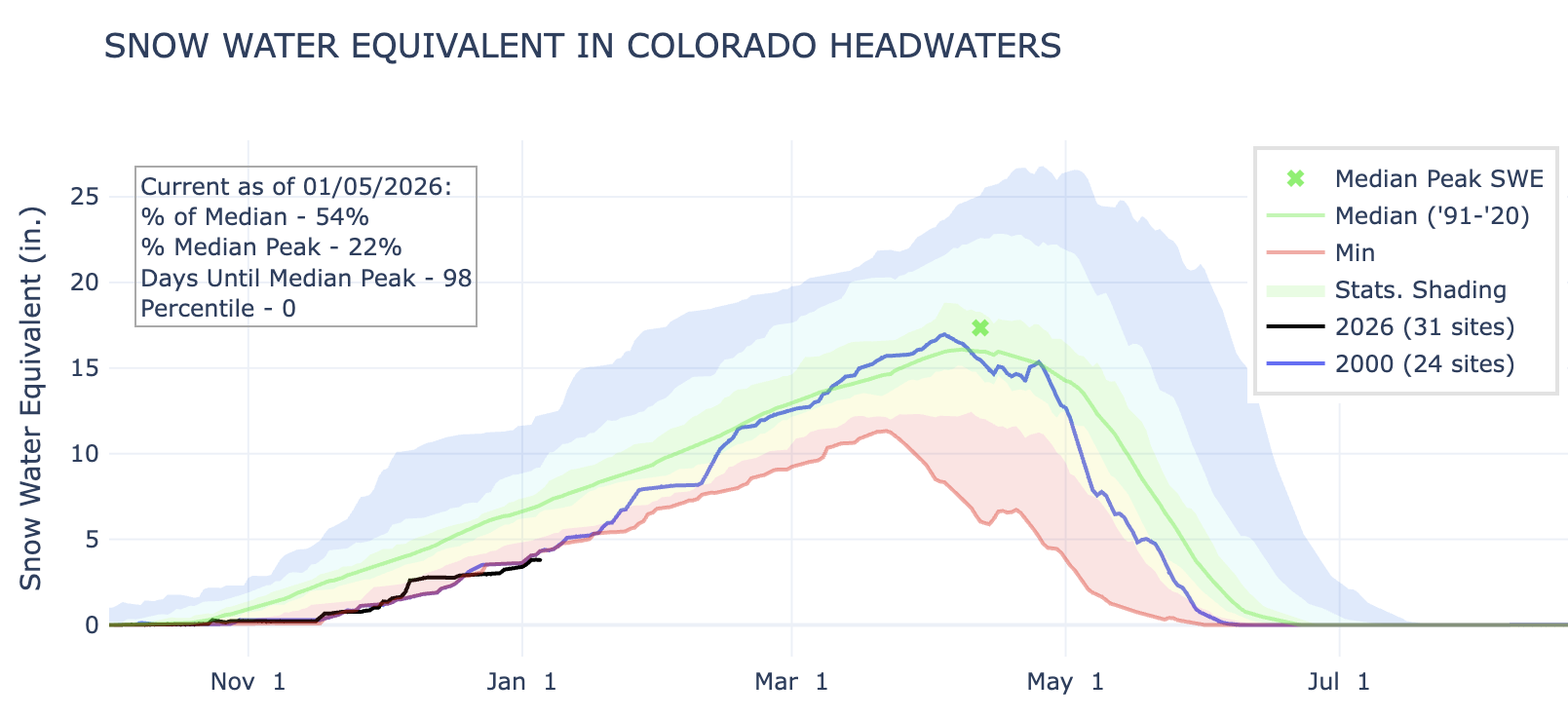
Still, it may be too early for snow lovers to abandon hope altogether, since a full recovery would not be unprecedented. Take the winter of 1989-90, when the early January snowpack was even worse than it is now. It was my first year in college, and when I came home for Christmas we played volleyball and went hiking in the mostly bare La Plata Mountains instead of going sledding or skiing. (At the time it seemed downright apocalyptic, since it followed the unusually wet 1980s, when snow would pile up in Durango and halt car traffic and turn the streets into nordic ski tracks.) But that March the snows finally came and continued into May, leading to some nice spring skiing and a decent spring runoff. The snowpack of 95-96 followed a similar pattern, as did 1999-2000.
During those years, however, the lack of snow was caused by a lack of precipitation. This year, it’s the result of a combination of light winter precipitation and unusually warm temperatures throughout December and early January. A recovery will require not only more snowfall, but also cooler temperatures, making the outlook a little grimmer.
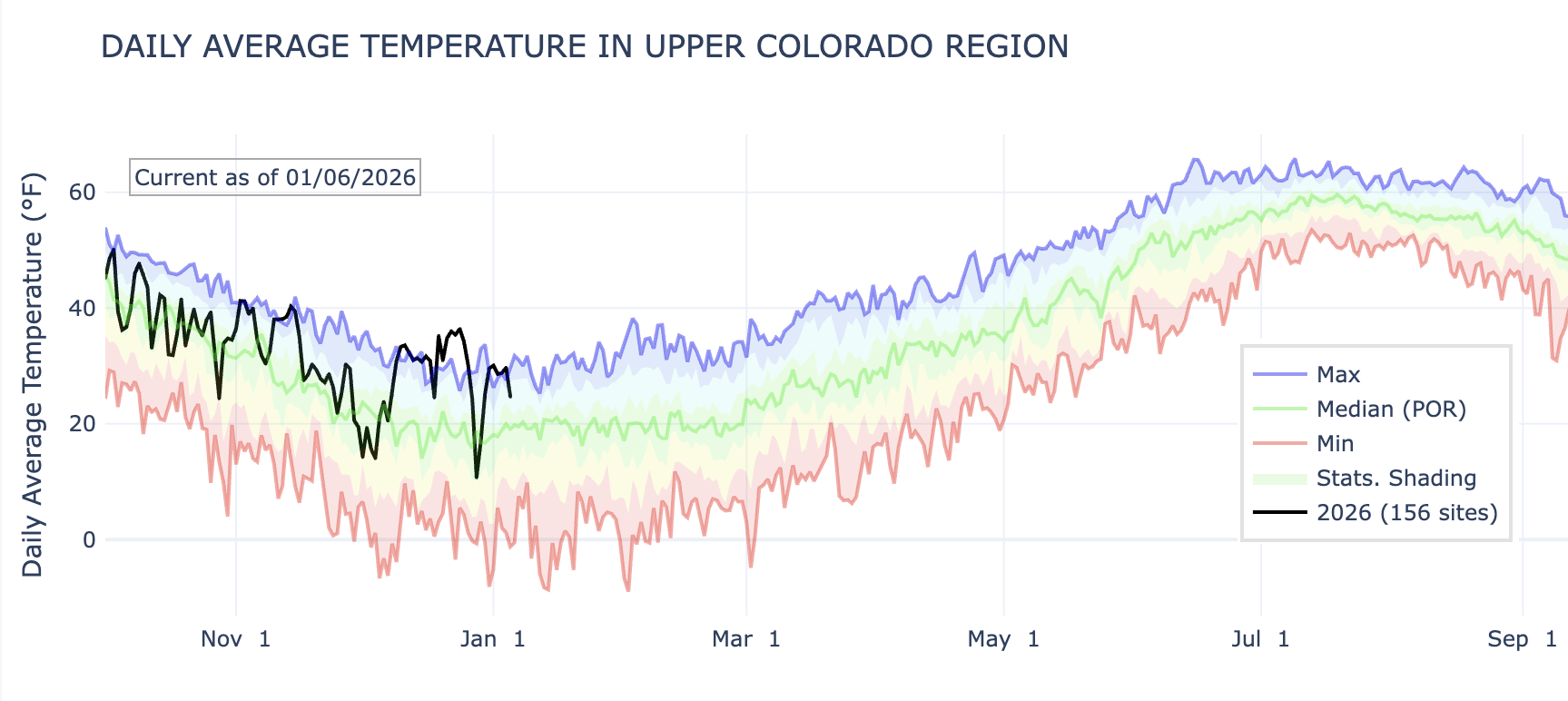
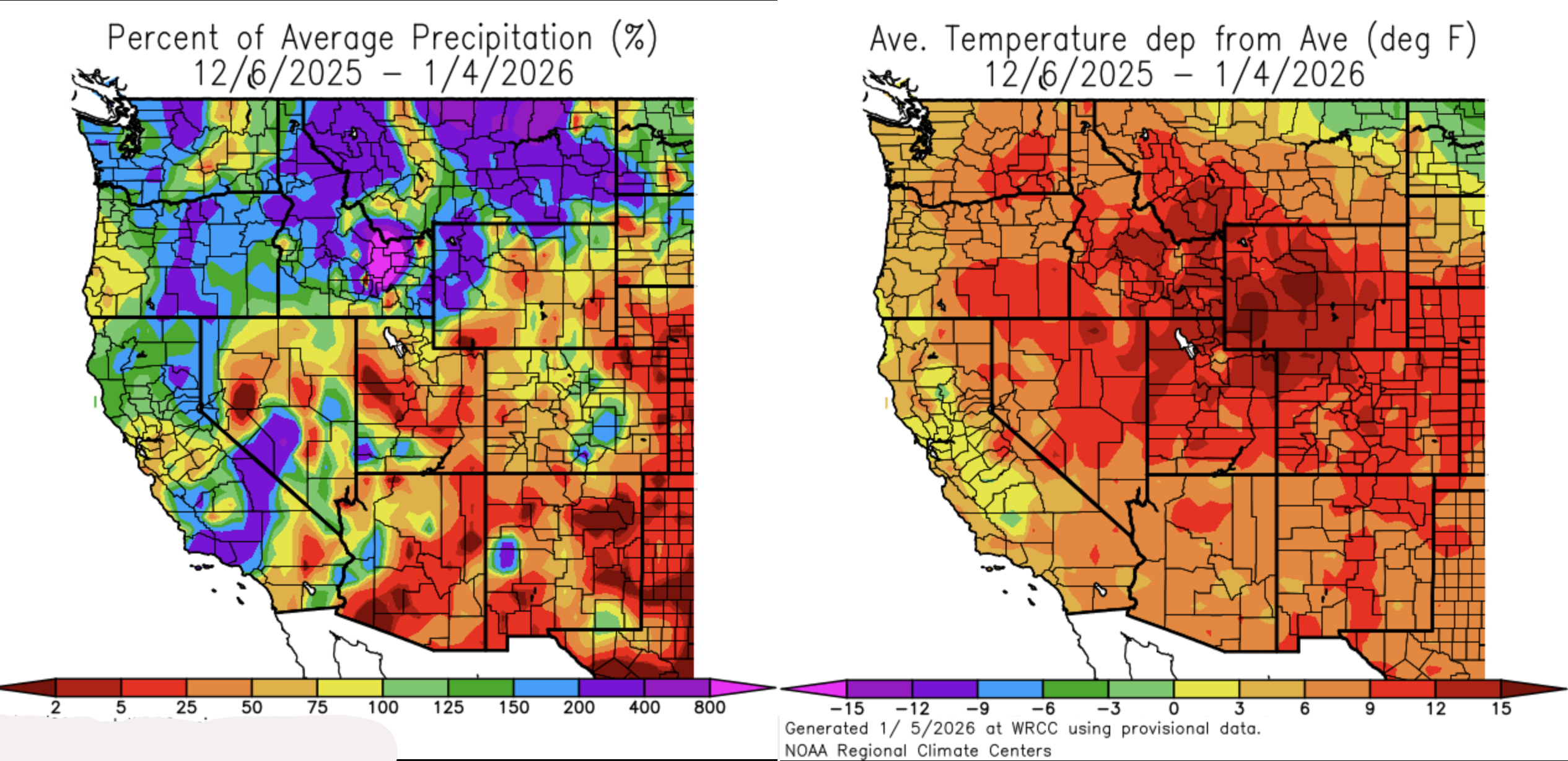

As of mid-December, the snow drought covered most of the West, but a series of atmospheric rivers pounded the West Coast and the Northern Rockies, bringing snow to higher elevations and more northern latitudes (and big rain and flooding to California). Heavy, wet snow piled up on Teton Pass near Jackson, Wyoming, bringing snow water equivalent levels from far below average to above normal for this date. Road crews triggered a huge avalanche that covered the highway in about 30 feet of snow. And, after the skies cleared, a couple of backcountry skiers triggered a slide near Teton Pass; one of the skiers was caught, buried, and killed. It was the nation’s second avalanche-related fatality this season. A few days later, two Mammoth Mountain ski patrollers were caught in a slide while doing avalanche mitigation work and one of them died.
🗺️ Messing with Maps 🧭
Now for a little New Year’s treat for all of you weather/map nerds: The Colorado Avalanche Information Center has launched an interactive map that shows 24-hour and 48-hour snowfall and snow water equivalents at various locations across the state’s mountains, letting you see at a click where the good powder is and isn’t. You can click on each station and get all the details, including current temperature and snow depth.