
Click the link to read the article on the University of Arizona website (Daniel Stolte):
June 18, 2026
Today’s Colorado River Delta is a far cry from the lush waterway that thrived before the river was forced behind dams that diverted much of its flow for half a century. Now, with just small amounts of water and funding, stretches of the parched riverbed have been transformed into healthy riparian habitats.
A new report from a University of Arizona-led team of researchers has evaluated the effects of the 2014-2025 controlled water releases along the lower Colorado River in Mexico to restore natural habitat. The report also lays out a roadmap for continuing the current binational restoration efforts. The report was published today by the Center for Colorado River Studies at Utah State University.
“It’s hard to find some good news about the Colorado River, but we believe we have some to share,” said first author Karl Flessa, professor emeritus in the U of A Department of Geosciences. “The lessons learned from more than a decade of work show that a small amount of water can do big things.”
The controlled water deliveries to the Colorado River streambed from 2014-2025 were mandated by two addenda of the U.S.-Mexico Water Treaty of 1944, which governs the allocation of Colorado River water between the two countries. The current addendum expires at the end of 2026.
To ensure the restoration sites continue to thrive, Flessa said sustaining this binational success will require a renewed commitment of water and funding by the United States, Mexico and non-governmental organizations.
The report reveals that bird numbers and diversity have increased since restoration began in 2014. The delta is an important rest stop for birds migrating along the Pacific Flyway. Beavers and other wildlife have also increased.

The restoration of the Colorado River Delta began in 2014, in the form of a so-called pulse flow, a one-time water release from Morelos Dam that lasted 57 days. Before that, the riverbed below Morelos Dam was dry. The pulse flow was conducted to allow researchers to assess the effects on the ecosystem once water returned.
The pulse flow of 2014 kickstarted a concerted, binational effort to systematically restore riparian habitat along certain stretches of the formerly dry river delta. Environmental NGOs, both in the U.S. and in Mexico, developed three designated restoration sites by terrain-shaping and planting of native riparian vegetation, including cottonwood trees, mesquite trees and willows – species that once dominated the landscape when the Colorado flowed through a healthy delta.
In 2019, AZPM produced a story on revitalizing the Colorado River delta five years after the 2014 pulse flow.
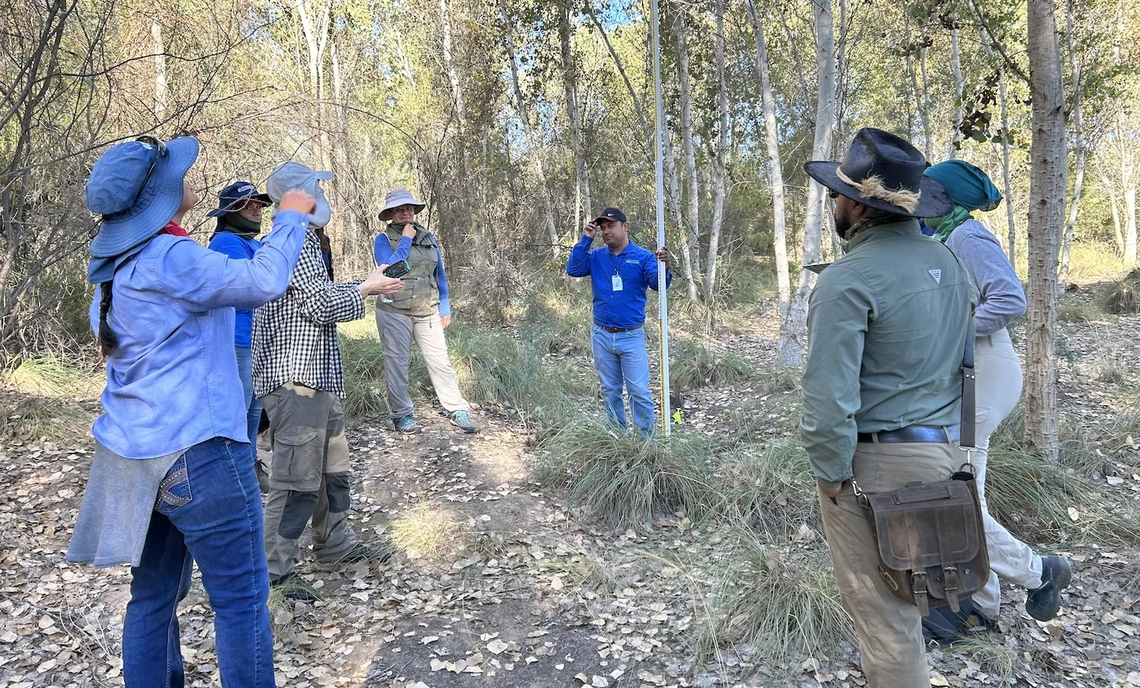
“These NGOs actually have nurseries on site, in which they germinate an array of Sonoran Desert riparian plants. Those seedlings are then planted and carefully irrigated according to the habitat needs,” said Martha Gomez-Sapiens, a U of A research scientist and co-author on the study. “In some cases you will see irrigation drip lines that go to each individual tree – a system designed to maximize water efficiency in this desert environment.”
Subsequent creation, irrigation and maintenance of 1,381 acres of riparian vegetation attracted birds and other wildlife. Deliveries to the river channel raised water tables, supported existing vegetation and increased the length of the flowing river.
In addition, local communities have benefited from recreational, educational and job opportunities. All three restoration sites have visitor programs that cater to local communities and schools, and one – the Laguna Grande complex, managed by the Tucson-based Sonoran Institute – even boasts a visitor center. All offer recreational opportunities in a region dominated by water scarcity.
While the pulse flow of 2014 demonstrated the feasibility of revitalizing former habitats with controlled and planned water releases, the authors conclude that releasing large amounts of water during a limited timeframe has limited benefits for a long-term revitalization of the delta.
“Most of the pulse flow water infiltrated into the groundwater before it could be used by new vegetation,” Flessa said. “Since then, we have learned how to use the water more efficiently for restoration of riparian habitat.”
Importantly, the report points out that restoration sites are not self-sustaining. Revitalizing degraded river habitat will require continuing maintenance, occasional water allocations and monitoring.
According to the authors, just 6,890 acre-feet per year, which represents approximately 0.05% of the Colorado’s total annual average flow, would suffice to preserve the existing restoration sites. With a little more water and a little more funding, the number or size of the sites could be increased even more, according to the report.
“Effective and sustainable habitat restoration can be done with a little bit of water, a small amount of funding and a lot of hard work.” Flessa said.
Other co-authors on the report are Eduardo González-Sargas in the Department of Biology at Colorado State University and Roberto Real Rangel, of The Nature Conservancy in Mexicali, Mexico.
