
Click the link to access the report on the PNAS website (Adrienne M. Marshall, Marianne Cowherd, Stefan Rahimi, and Yuhong Ye). Here’s the abstract:
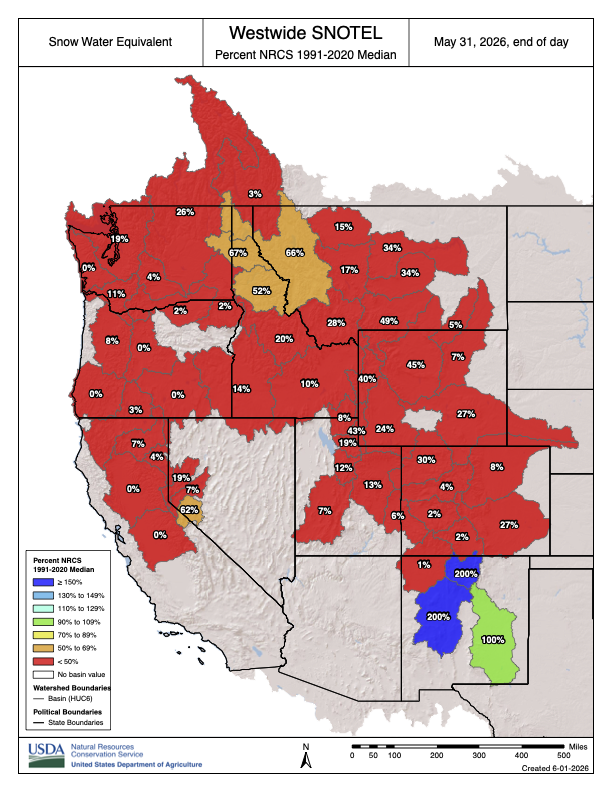
In the spring of 2026, anomalously low snow conditions in the western United States threatened winter recreation and water supplies. Here, we investigate: to what extent was this snow drought attributable to the climate change that has occurred since the pre-industrial period? We find that a snow drought this severe across the western United States was approximately 4.4 [95% CI: 2.6, 9.4] times more likely in the current climate than in the preindustrial period. In the Upper Colorado River Basin, the snow drought was approximately 14 times more likely [0.09, 4,300]. Given a projected increase in the frequency of snow droughts at least this severe in a moderately high emissions warming scenario, the lived experience of this event may help scientists, resource managers, and the public consider what western US snow might look like if greenhouse gas emissions are not aggressively reduced.
In the winter and spring of 2026, a snow drought gripped the American West; “record-low” conditions were widely reported. The snow drought was associated with anomalously high temperatures, with moderately dry to average precipitation. While it is still too early to know how the consequences of this snow drought will materialize, the US Bureau of Reclamation projected for the first time in spring 2026 that Lake Powell would fall below its minimum power pool threshold by the following winter in median climatological conditions. The snow drought is also likely to increase fire risk and reduce water availability for energy, agriculture, and municipalities.
As the snow drought progressed, scientists, the recreation industry, and the press asked whether the low snow anomaly was attributable to climate change. The frequency, severity, and temperature of snow droughts increase in climate models but formal climate attribution has only rarely been applied to snow drought [see Mote et al. for one exception]. Since then, the science and data available for climate attribution studies have advanced substantially. Here, we ask: to what extent is the 2026 western US snow drought attributable to climatic changes that have occurred since the preindustrial period?