
Click the link to read the article on the Alamosa Citizen website (Chris Lopez):
July 24, 2026
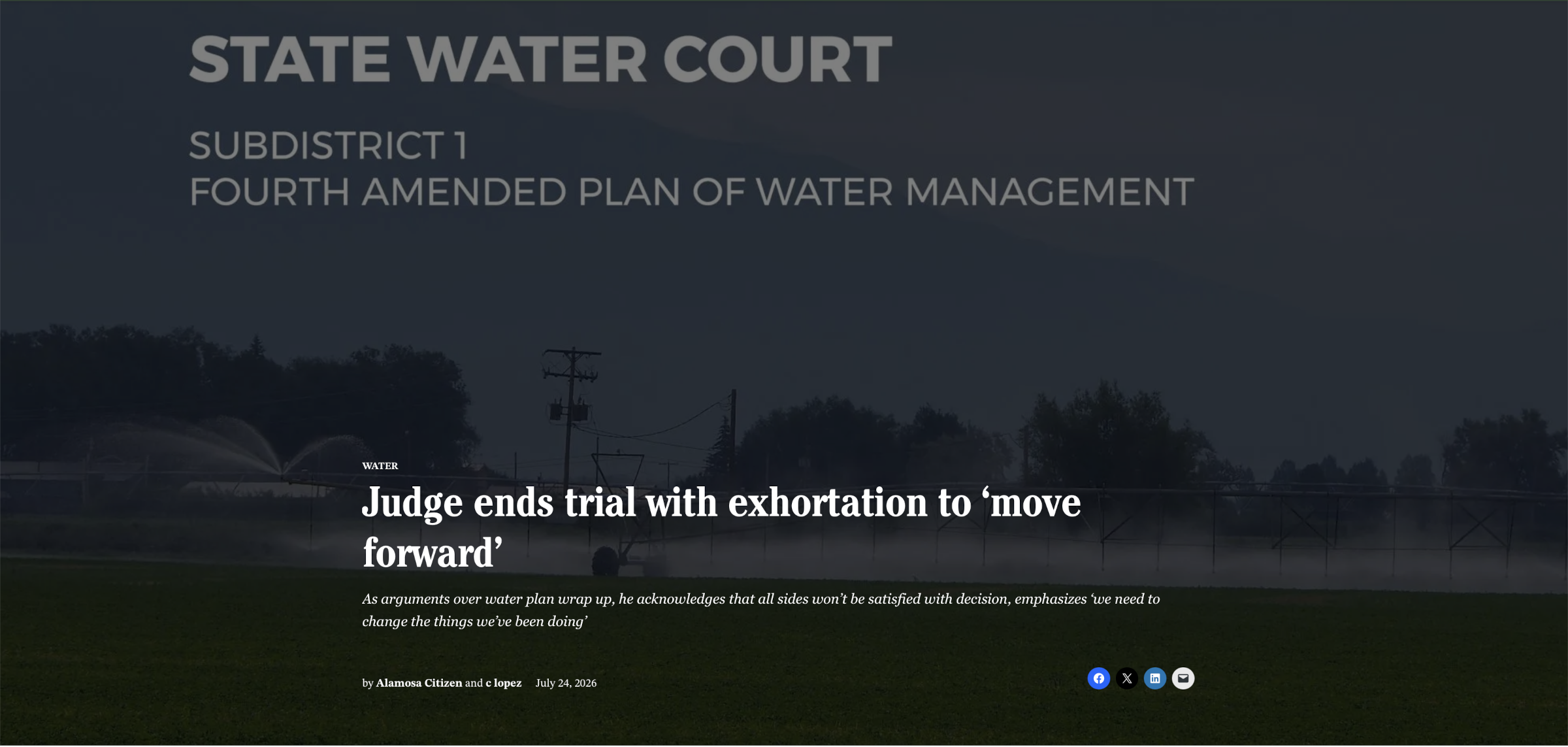
The different sides each presented closing arguments, but it was the reflections of Division 3 Water Court Judge Michael Gonzales that had the courtroom thinking as he brought to a close the water trial dealing with the Subdistrict 1 Fourth Amended Plan of Water Management.
At times it was a bruising trial Gonzales noted Thursday in his closing remarks, as he encouraged all the parties to move on and to not let the four-week trial wear on them and their own personal relationships.
“We all know that there’s no way this court can fashion an order or an opinion that’s going to satisfy everybody. It’s just not going to happen,” the judge said. “I mean, it can’t because we know that we have mutually exclusive and competing interests. We know that this petition when it was created recognized that, but we still said ‘cooperation’ and all those nice things. And in reality, I think we all knew at some point that was going to come to a head. And I think we’re there, but that doesn’t mean we still don’t move forward.”

This was the big water trial because it dealt with a plan to recover the unconfined aquifer of the Upper Rio Grande Basin, Gonzales noted. He pointed to testimony of Mosca-area farmer Lyle Nissen as one he enjoyed the most.
“I just loved his testimony. Someone who’s made some recognition, someone who’s made some changes, someone who didn’t come in here and complain and just said, ‘This is how it is. I recognize it and I move forward.’ And that was great to hear,” Gonzales said.
He also referenced a term he learned during the course of the trial, “deep percolation,” and used it to provide further insight into his thinking.
“I sat in my back yard and I watched the rain come down,” he said of the week’s weather. “I watched puddles form and I thought about my second favorite term from this trial, ‘deep percolation’ and I said, ‘Aha.’ And then I came back 10 minutes later and that puddle was completely gone. I said, ‘Wow.’
“I also sat there and I thought about the testimony I think was from this current state engineer when he said that we need rainstorms of biblical proportion to get us where we need to be, and that hit home. And no matter how wonderful that rain was, there needs to be things that happen.”
The state Division of Water Resources and the Rio Grande Water Conservation District are asking Gonzales to reject the protestors’ arguments and approve the plan. Without it, they argued, the unconfined aquifer won’t recover and broad groundwater well curtailment in the subdistrict becomes inevitable.
The cornerstone of the new plan is the “one-for-one” feature, which limits groundwater pumping to the amount of natural surface water that flows into the subdistrict over a five-year running average. The intent is to put more water into the unconfined aquifer system than is taken out and one-for-one pumping guarantees that, according to the state and subdistrict.
Gonzales noted “the monstrosity of an equation” within the Fourth Amended Plan when he was quizzing Rio Grande Water Conservation District attorney Pete Ampe during his closing remarks.
The one-for-one pumping feature, the equation to determine success, and a new “depletion fee” that sets the value of water in the subdistrict at $500 per acre-foot were all argued over, discussed and debated throughout the month-long trial.
Attorney Mirko Kruse, representing his family’s farming interest, and attorney Andy Jones, representing L Cross Ranch, want Gonzales to refer the plan back to the subdistrict for adjustments they’re requesting but are otherwise good with the plan.
Two other protesting groups, Northeast Water Users Association and Sustainable Water Augmentation Group, want the plan tossed entirely on grounds it isn’t legal; they asked Gonzales to order the subdistrict to only make changes to the existing third plan of water management.
Gonzales told all the attorneys to address Rule 8.7 of the state groundwater rules governing the Upper Rio Grande Basin. That rule determines how “proportional responsibility for maintaining a sustainable water supply is divided among all the well users within the Response Area.”
It gets to one of the key arguments made by SWAG and its belief that groundwater irrigators like their clients are being illegally targeted and asked to share a disproportionate share of the burden in the unconfined aquifer recovery efforts.
Gonzales provided a timeline that leads to this Thanksgiving for when all the case documents and filings will be completed and he can begin his deliberations.
“I guess if there’s one message that we all need to take to heart is that we need to change the things we’ve been doing,” Gonzales said in completing his comments. “We can’t continue down the path we’ve been because if we think that’s the only way we can go, we’re dooming our children, our children’s children. And I don’t want to be a part of that time.”
