
Click the link access the report on the New Phytologist website (Henri M. Braunmiller, Michael Bitterlich, Nicolai Koebernick, Eva Jacob, Anna S. Heck, Andrea Schnepf, Johanna Pausch, Jussi-Petteri Suuronen, Bernhard Hesse, Sylvain Delzon, Jonathan Perrin, Andrew King, Jan Jansa, Mutez A. Ahmed). Here’s the summary:
Summary
- Arbuscular mycorrhizal fungi (AMF) contribute to plant nutrient and water uptake via their extraradical hyphal networks. However, in situ methodologies to quantify architectural and morphological traits of these networks in soil are largely lacking, limiting our understanding of AMF-mediated resource transport.
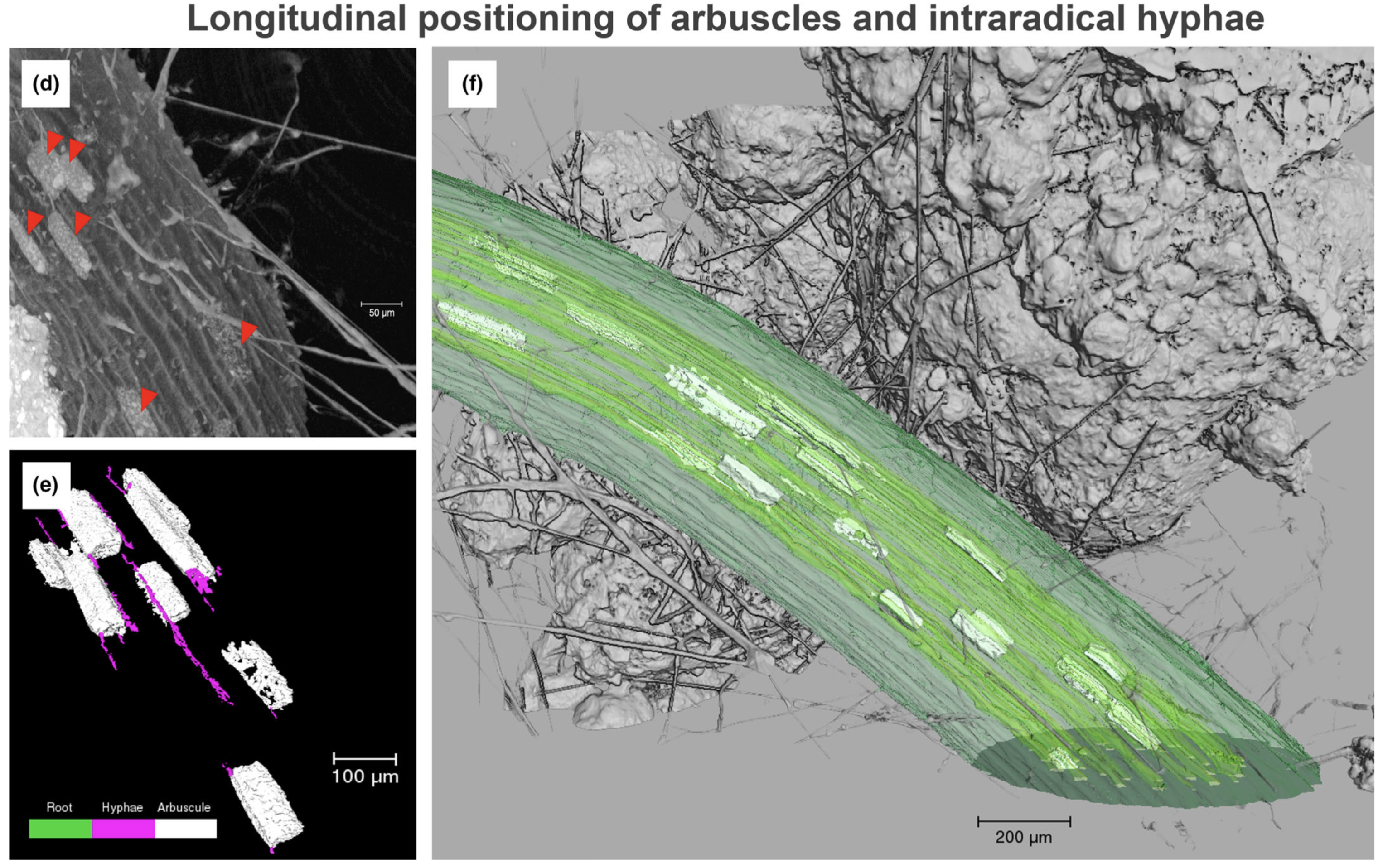
- Using synchrotron-based X-ray computed microtomography (micro-CT), we established a workflow to cultivate, noninvasively image, and quantitatively analyze AMF hyphosphere and rhizosphere structures in the interaggregate space across two soil textures and biological contexts.
- We developed a pipeline for quantitative three-dimensional (3D) assessment of key architectural and morphological traits including structure counts, hyphal length, branching frequency, volume, and surface area. Our method further permits (1) measurement of AMF–soil and AMF–root interface areas and (2) microscale quantification of pore space occupancy by AMF.
- Micro-CT offers a tool for noninvasively visualizing AMF in air-filled soil pore space. We outline how such quantitative 3D information can be incorporated into image-based and functional-structural soil–plant models, thereby supporting a better mechanistic understanding of AMF-mediated processes in soils and plants
Arbuscular mycorrhizal fungi (AMF) may enhance host plant access to soil nutrients and hence contribute to global food security and nutrition (Antunes et al., 2012; Rodriguez & Sanders, 2015; Thirkell et al., 2020). These fungi can supply noticeable proportions of essential plant nutrients, including phosphorus, nitrogen, zinc, and copper (Marschner & Dell, 1994). In addition, numerous studies showed that AMF improve plant water uptake, particularly under dry soil conditions (e.g. Bitterlich et al., 2018; Kakouridis et al., 2022; Abdalla et al., 2023), suggesting a potentially increasing contribution to plant performance under future climate scenarios. A proposed mechanism for AMF-mediated enhancement of water and nutrient acquisition involves the formation of extensive extraradical hyphal networks (Kokkoris, 2026). These networks increase the absorptive surface area and enlarge the effective root radius (Abdalla & Ahmed, 2021), growing beyond depletion zones and thus facilitating access to yet undepleted soil (Schnepf et al., 2008). The degree to which AMF improve plant water and nutrient uptake likely depends on the architecture and morphology of their hyphal network, including hyphal length, diameter, and connectivity among individual hyphae, roots, and soil particles (Abdalla & Ahmed, 2021; Kakouridis et al., 2022). Thus, for a better mechanistic understanding of the role of AMF on water and nutrient transport, characterization of hyphal network structure in soil is indispensable.

Click the link to read Fungi Are Holding the Food Web Together. New Research Images This Underground Network on the EOS website (Emily Gardner). Here’s an excerpt:
September 29, 2026
More than 80% of plants on Earth partner with mycorrhizal fungi to extract nutrients from soil. Underground, in a zone of soil known as the rhizosphere, these fungi grow into vast networks of tubular cells called mycelium (individual cells are called hyphae). These tiny hyphae—about one tenth to one hundredth the width of a human hair—can gather nutrients in the soil and send them into plants. If plants don’t get enough nutrients, neither do the animals that depend on them or the animals that depend on those animals. Furthermore, some research has suggested that mycorrhizal fungi absorb the equivalent of 13 billion tons of carbon dioxide annually. All of this makes the rhizosphere essential to the health of our planet and its inhabitants.
“Basically everyone on Earth is dependent on this really, really tiny zone around roots, in a way,” said Henri Braunmiller, a soil ecologist and graduate student at the Technical University of Munich.