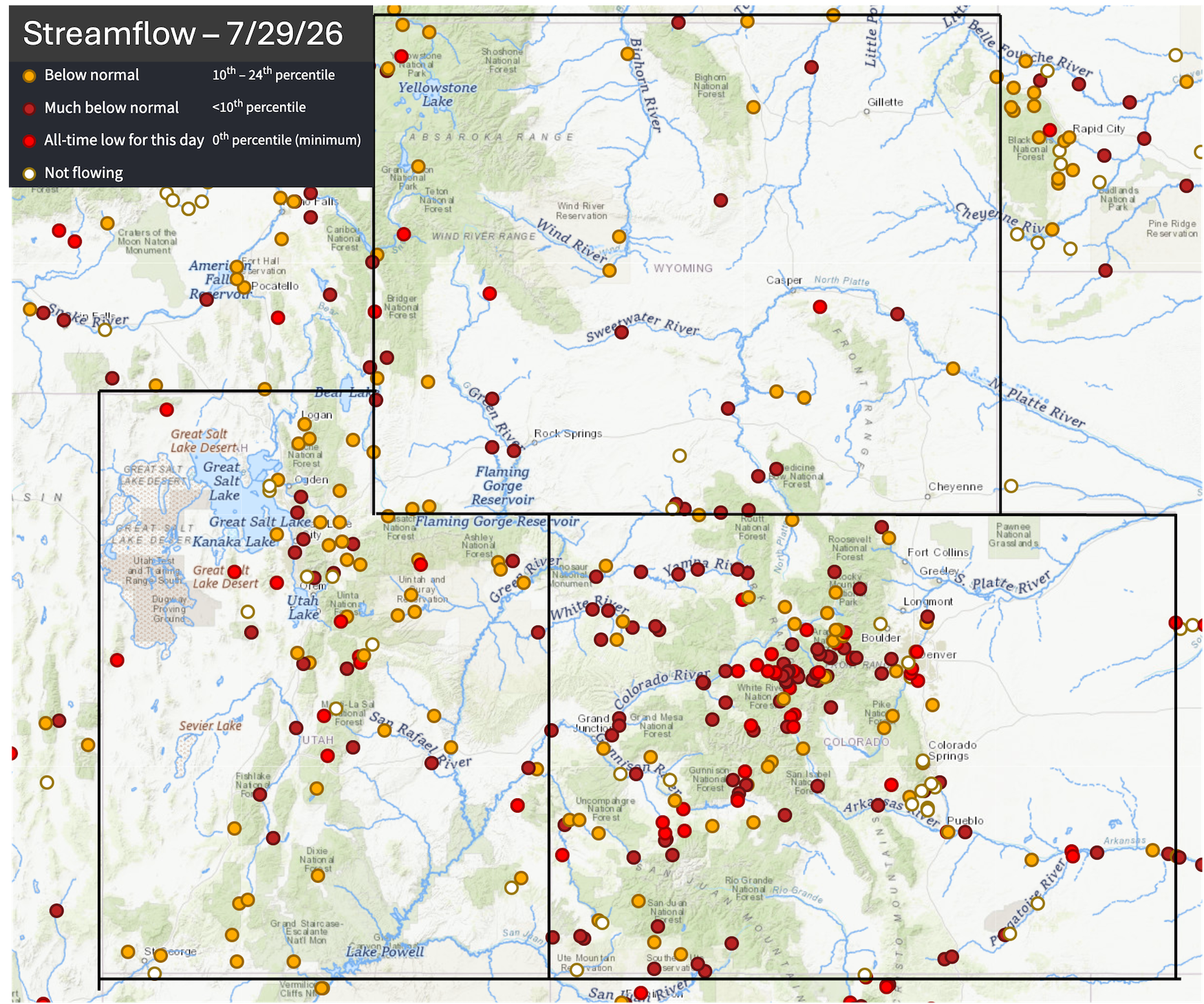
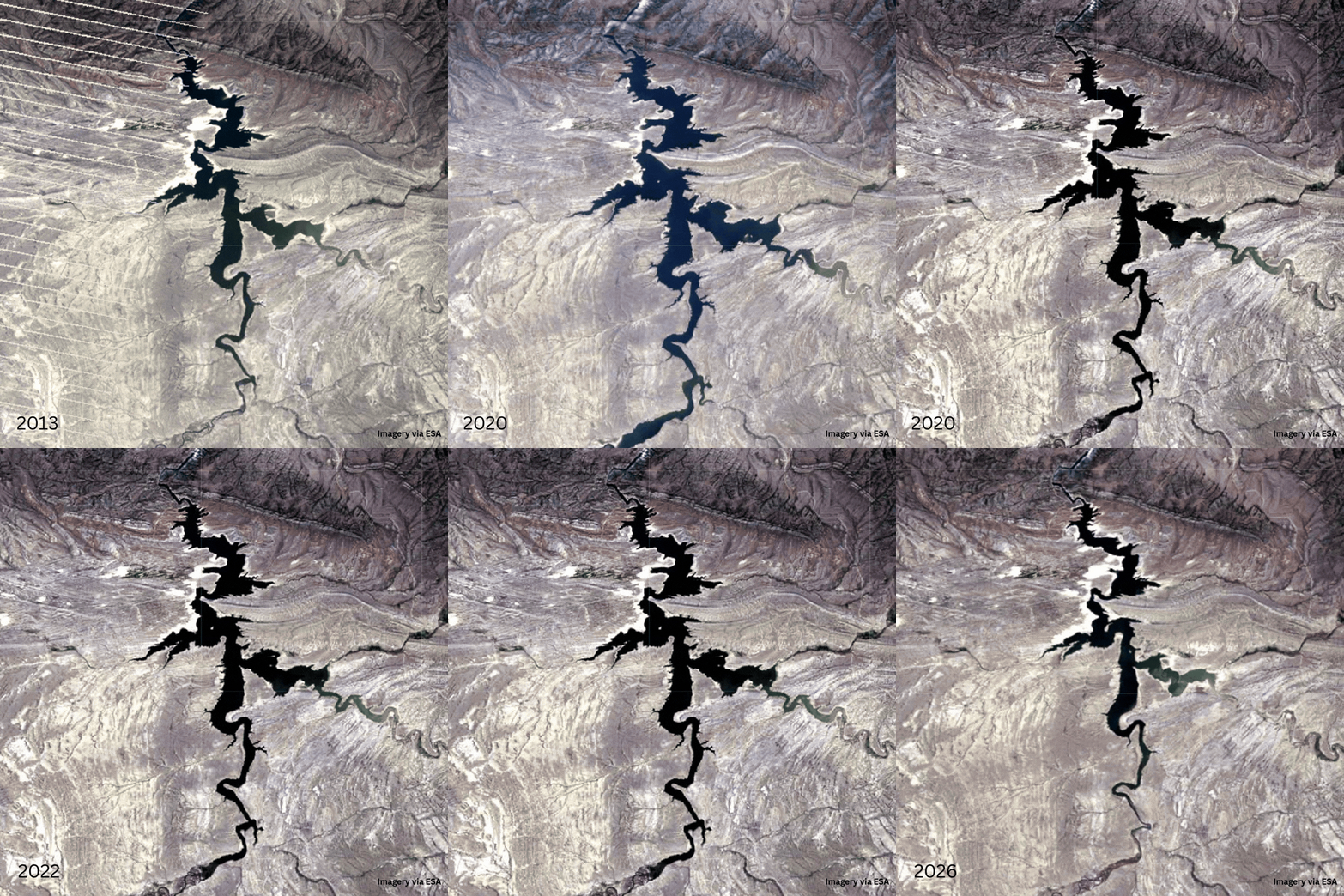
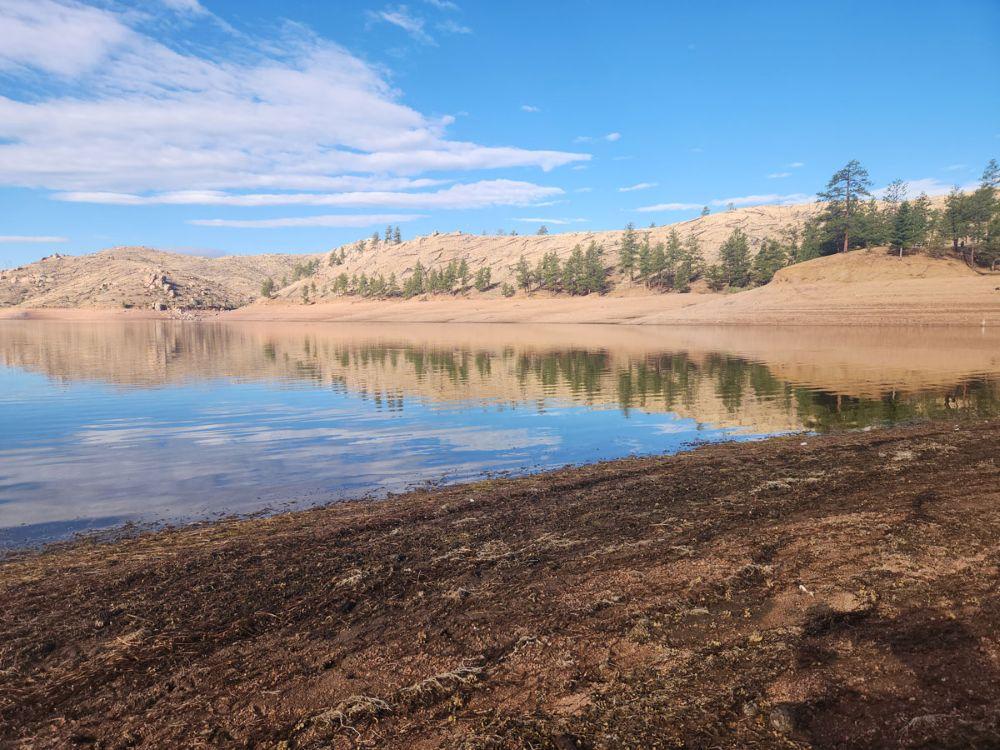
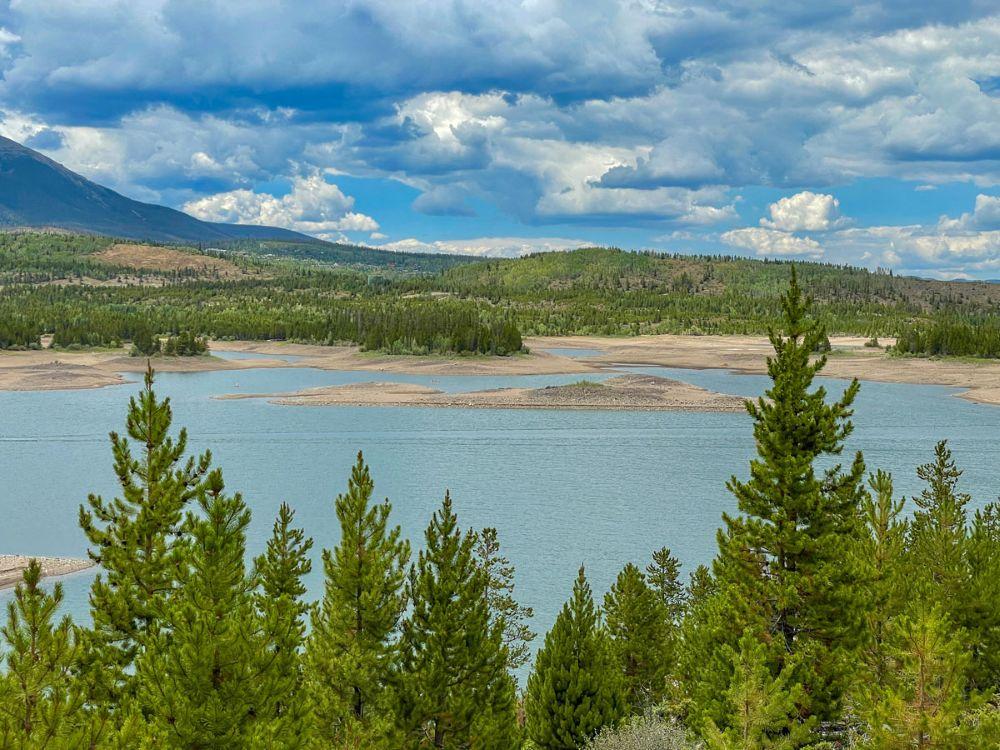
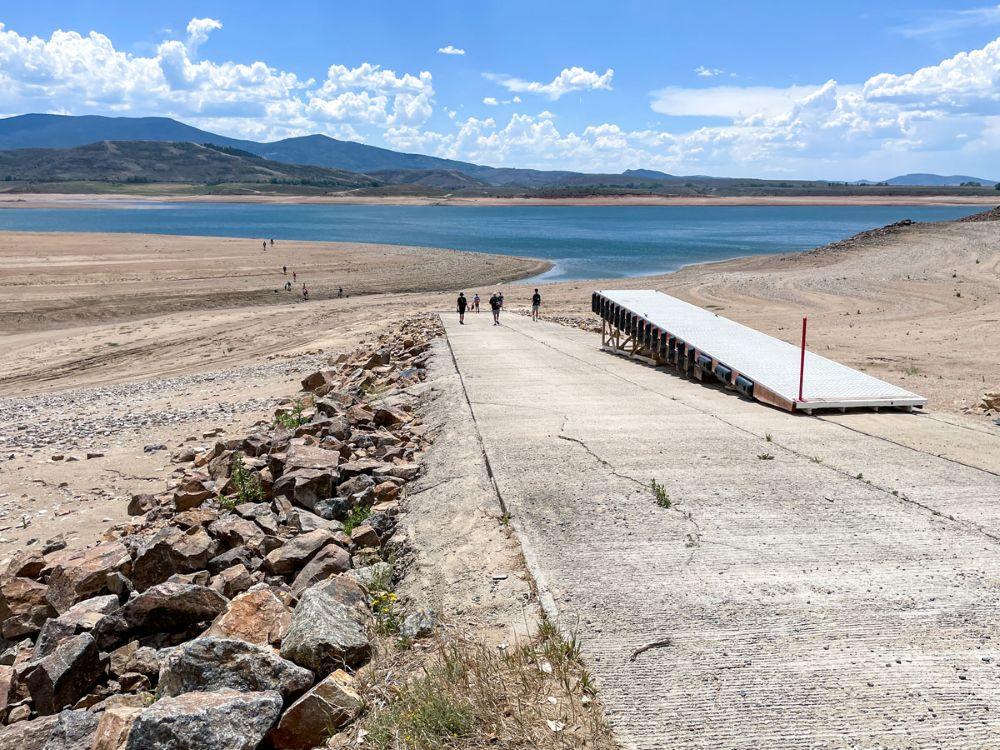
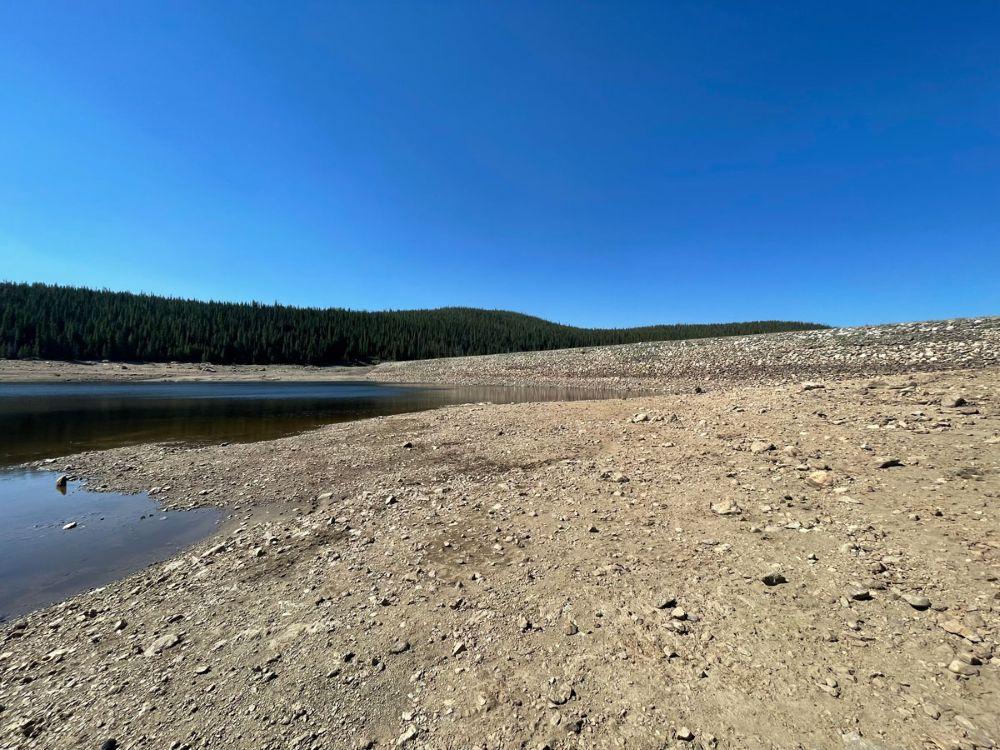
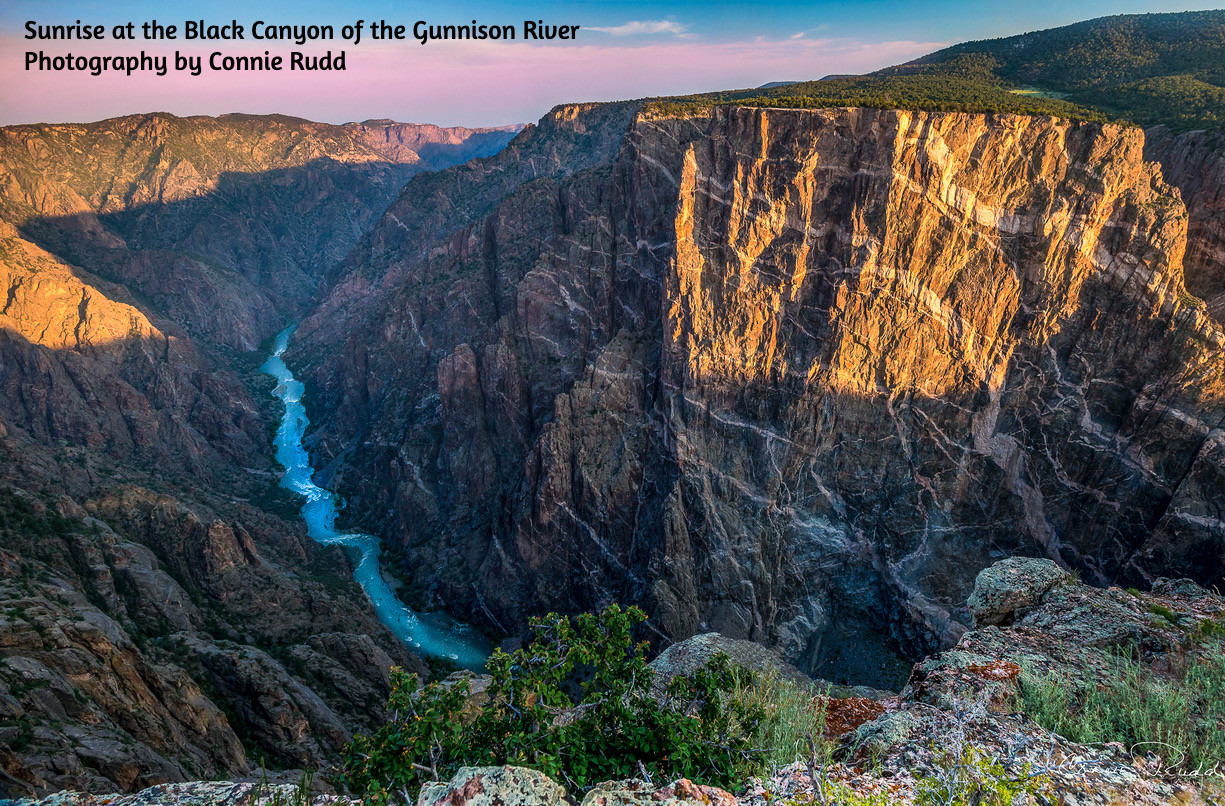
This past week, the U.S. Bureau of Reclamation posted an attention-grabbing statistic. By dropping to less than 25% of its capacity, Blue Mesa Reservoir has lost its status as the state’s largest body of water. Lake Granby, itself just 62% full, now holds the title.
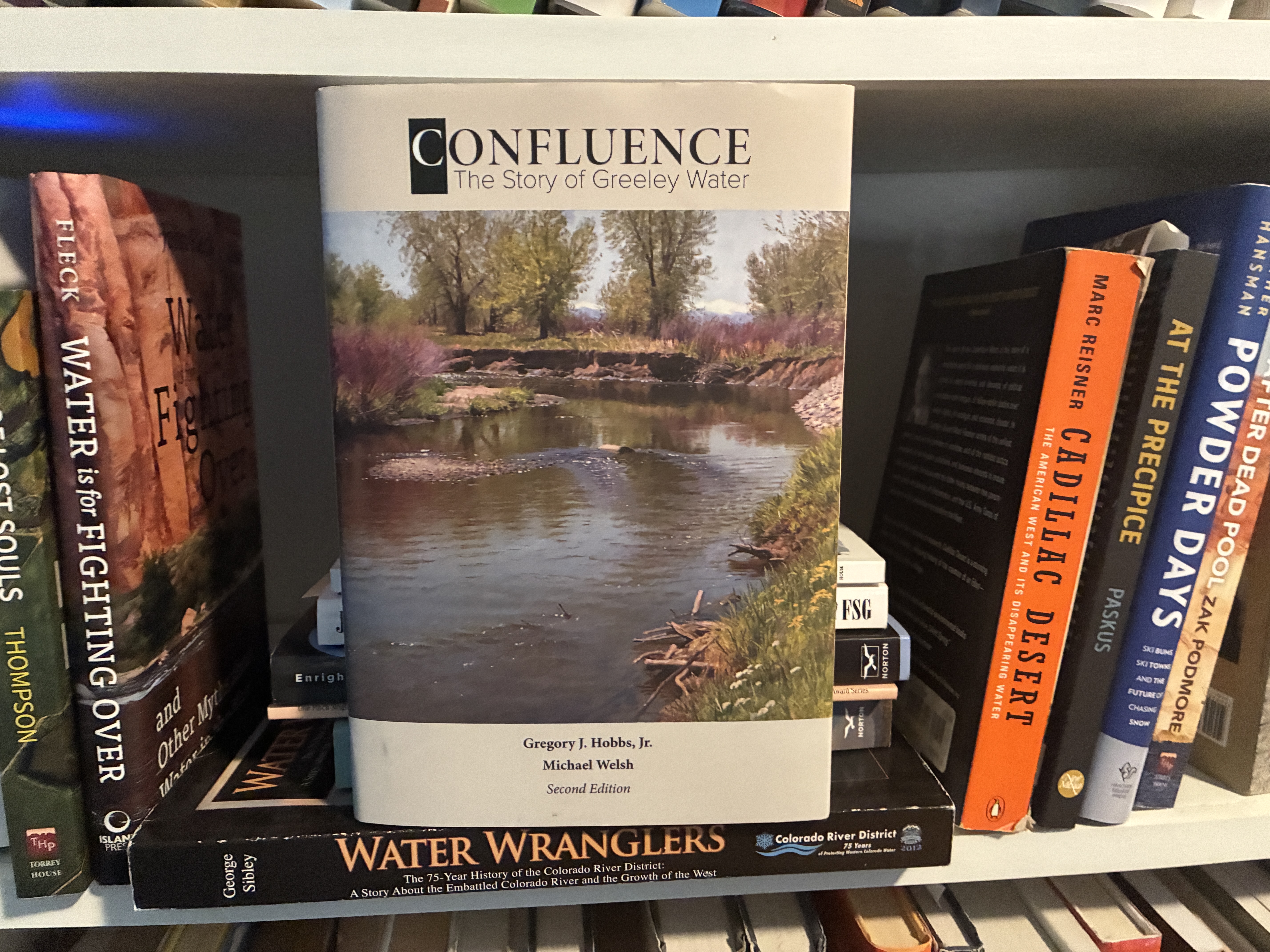
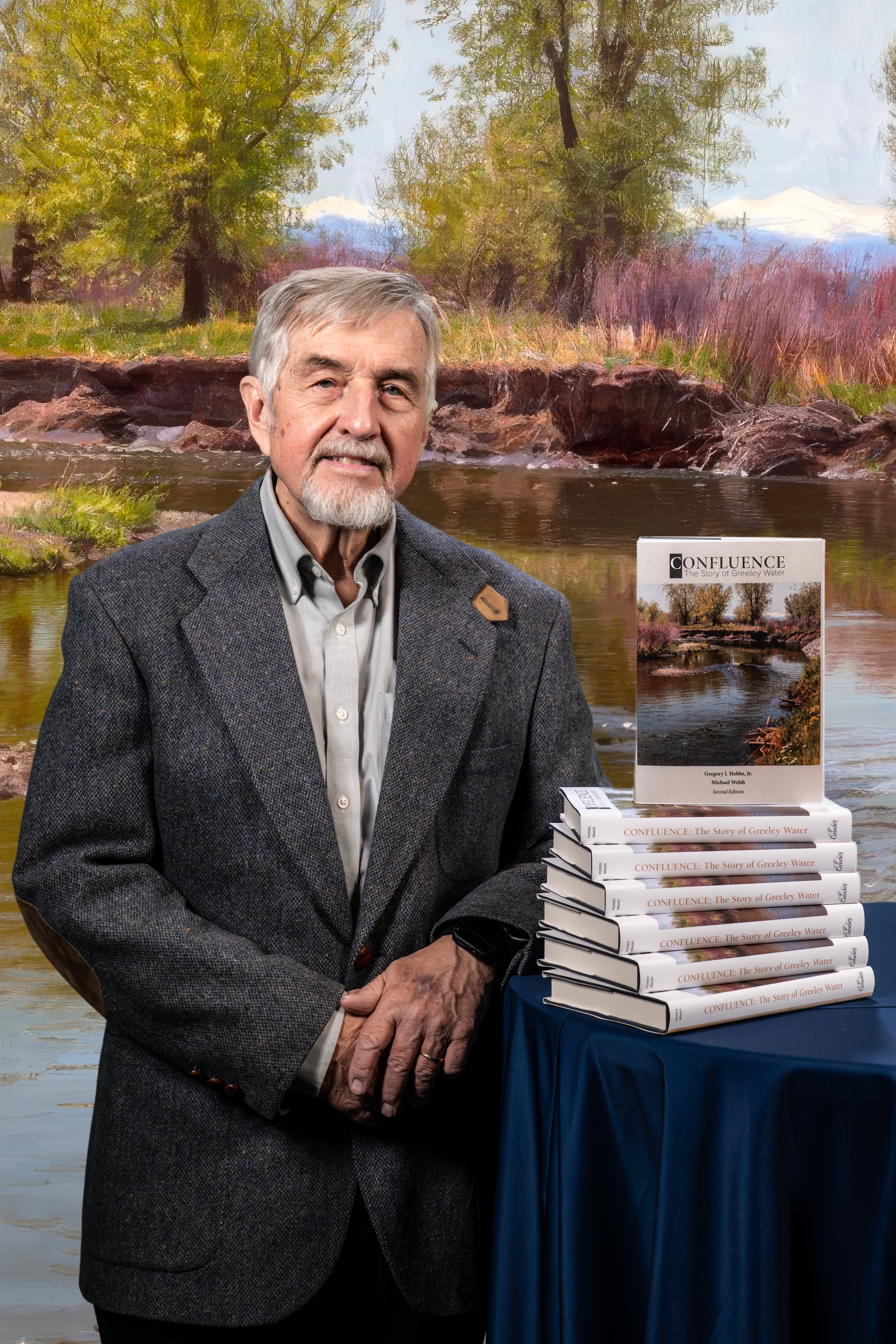
Recent best seller set in Iola and the West Fork of the Gunnison River. Click the image to read about it.
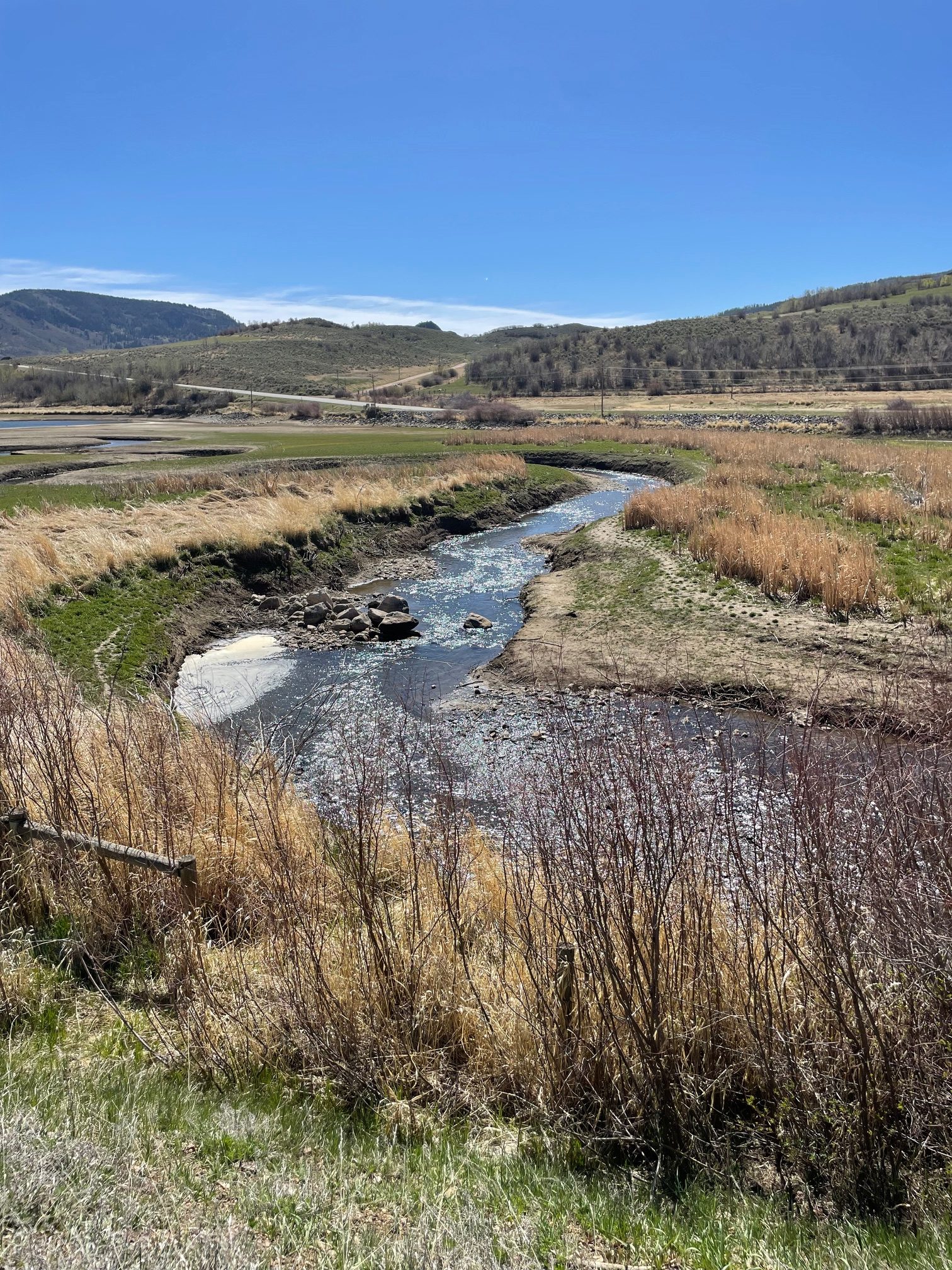
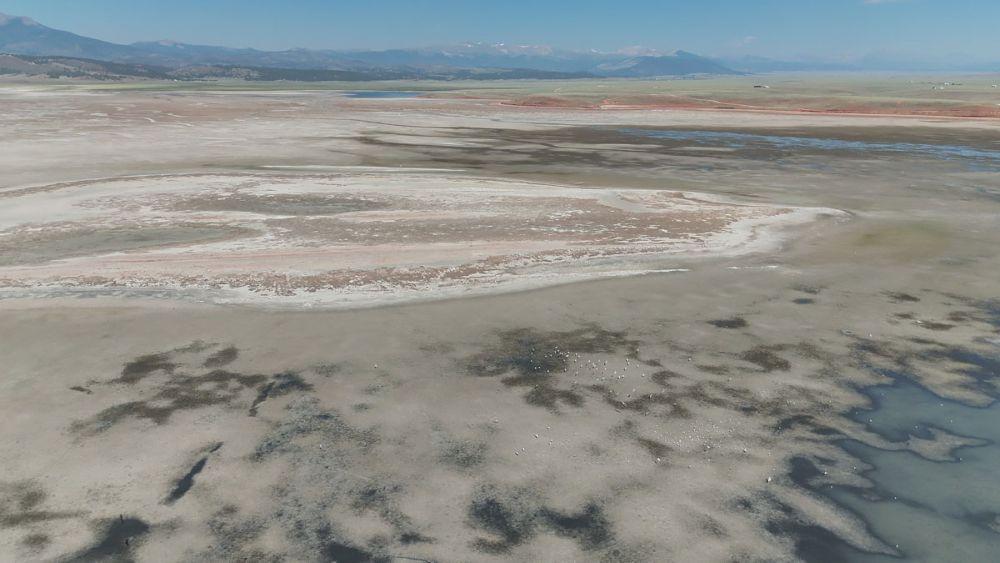
The ruins of Iola, a community flooded in the creation of Blue Mesa, are now visible. Parts of the Gunnison River snake through the lakebed in imitation of its historic path before the reservoir was dammed in the 1960s.
In a different year, the water storage unit that includes Blue Mesa might have helped replenish Lake Powell, the second-largest reservoir in the U.S., which now sits worryingly close to power pool. Power pool is the threshold when water levels drop too low to produce hydroelectric power…There’s no chance of Blue Mesa contributing much to Lake Powell this year, said Steve Pope, manager of the Uncompahgre Valley Water Users Association…The Uncompahgre Valley Water Users Association relies on water stored in the Blue Mesa, which is diverted downstream through the Gunnison Tunnel to irrigate tens of thousands of acres of farmland. The communities of Montrose, Delta and Olathe also rely on raw water from the tunnel for municipal use. The association typically has a secondary water supply from the Uncompahgre River, but Pope said that source is “nonexistent” this year. In anticipation of shortages, the association already limited users to 50% of their allocations this spring. Pope said he hoped no further restrictions would be necessary before Labor Day. Large row crop producers have already fallowed 30%-60% of their land in the valley, he said…
The Bureau of Reclamation has taken steps to avoid that scenario, said Caleb Foy, senior water resources engineer at the Colorado River Water Conservation District. Water managers were already anticipating a historically dry year this spring, when the window for the mountains to accumulate snowpack passed leaving the lowest amount ever recorded. Snowpack melts in spring to produce runoff, which feeds the Colorado River Basin. If the Bureau of Reclamation and water rights holders along the Gunnison River had not put restrictions in place, Blue Mesa might have been on a trajectory to drain past power pool, Foy said. The reservoir’s generators have an 86.4-megawatt capacity, enough to generate power for about 3,400 homes.
Click the link to read the article on The Denver Post website (Elise Schmelzer). Here’s an excerpt:
August 15, 2026
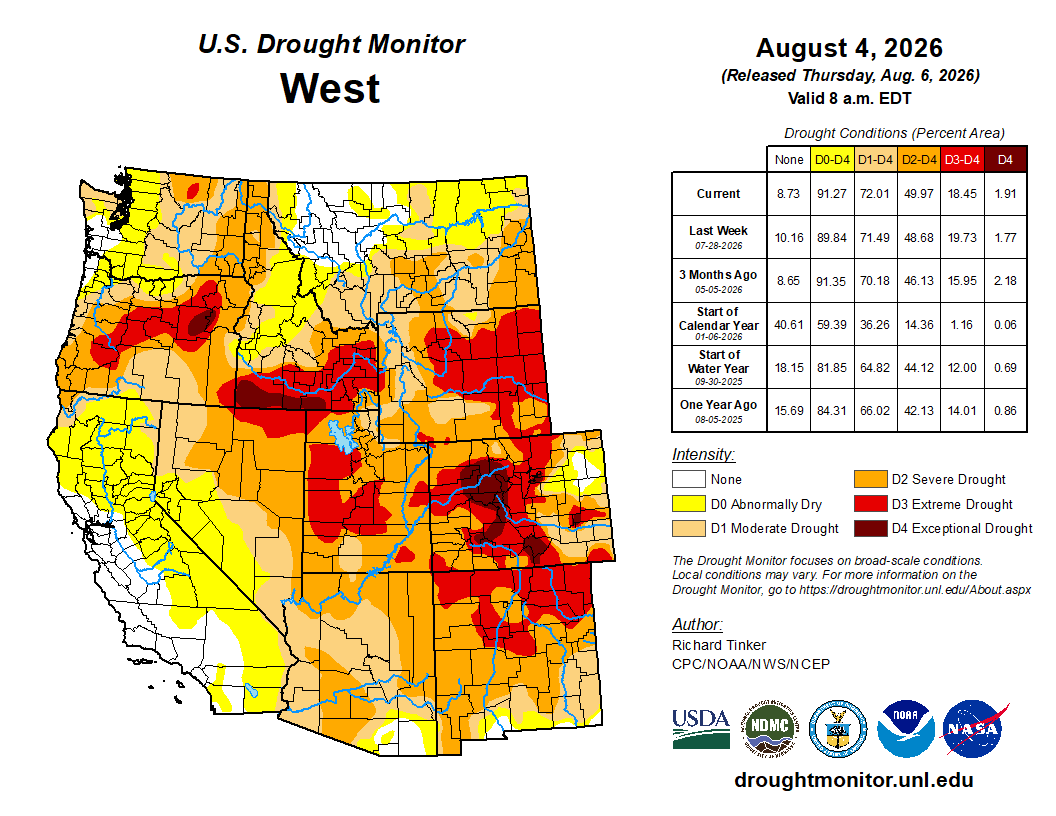
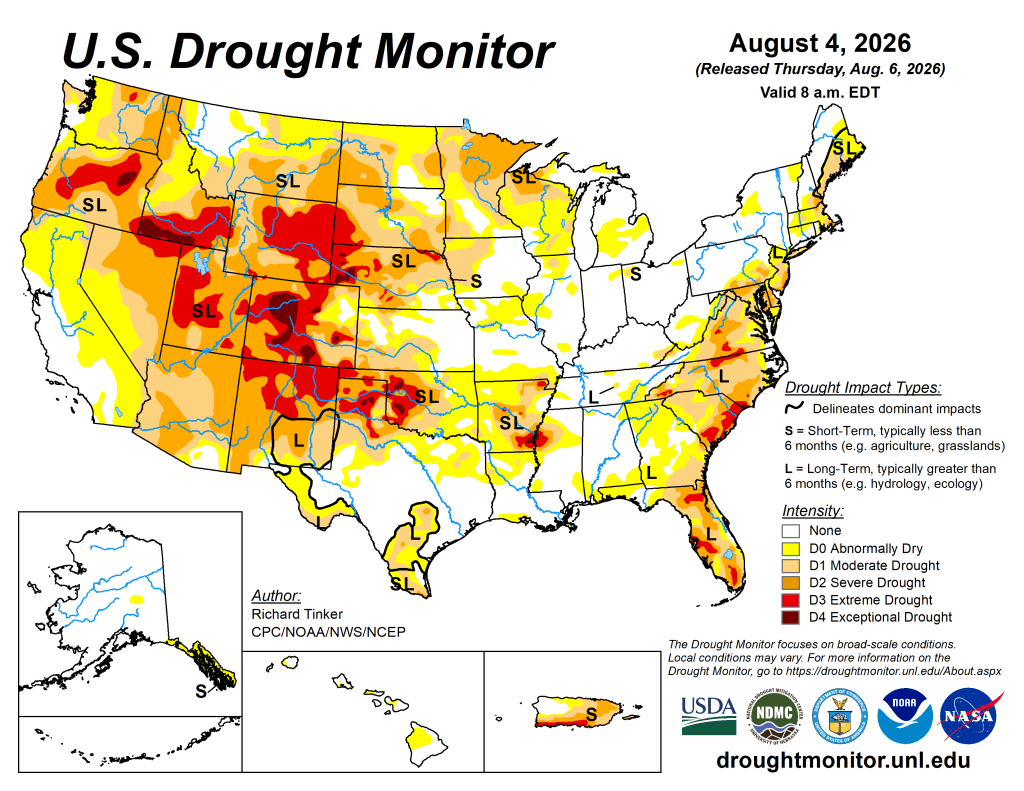
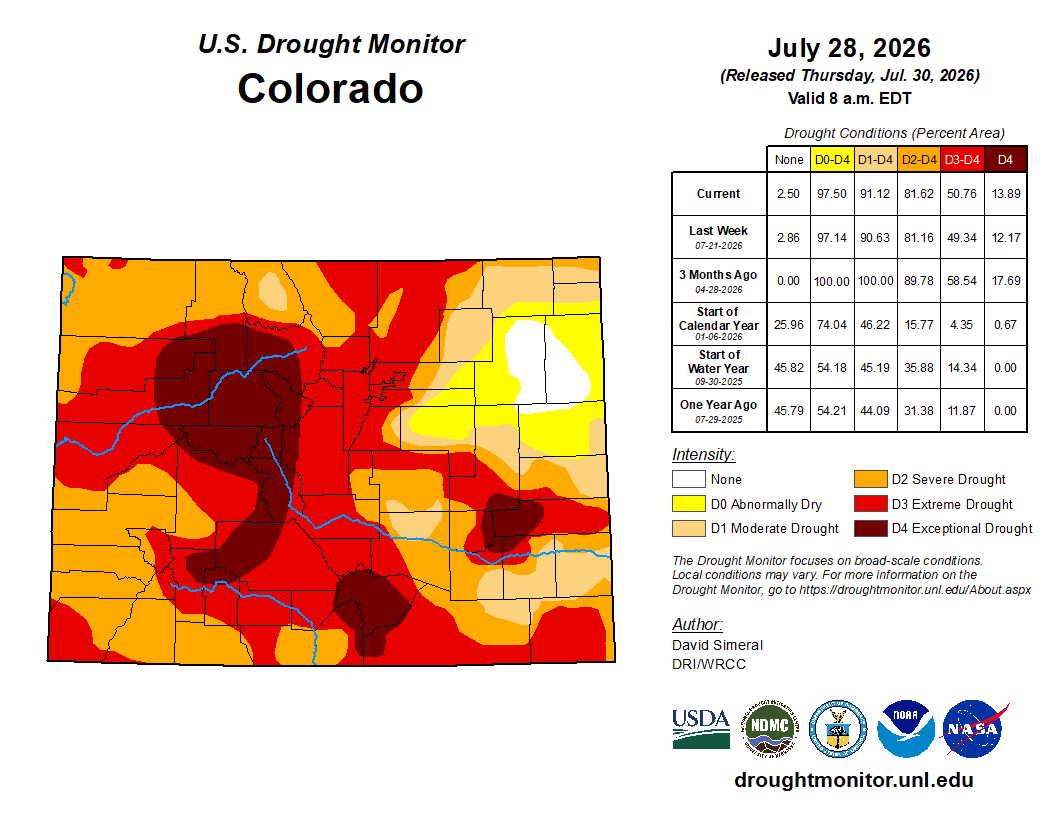
In some Front Range towns, residents still can water without inhibition despite searing drought. Nearly the entire state is in some level of drought, according to U.S. Drought Monitor data released Thursday, but the aridity is especially intense over the highly populated urban corridor and the mountains that are the source of much of Colorado’s water. The winter’s record-low snowpack translated into this summer’s anemic streamflows, moisture-sucking soil and drained reservoirs. Federal authorities describe the drought frying the Front Range with sobering words: severe, extreme, exceptional.
Despite widespread severe drought, 13 of the 25 largest cities and towns in Colorado have not implemented additional mandatory water use restrictions. The 13 communities — including the cities of Fort Collins, Pueblo and Boulder — are home to more than 1.5 million people, which is about a quarter of the state’s population. Water managers in many of the communities without additional drought restrictions have asked customers to voluntarily cut back water use, to varying degrees of success. Individual water providers set drought restrictions depending on their own portfolio of water sources and reservoirs. Communities that draw from multiple water sources, own powerful water rights and maintain large reservoir systems are best poised to ride out drought…Those differences can be confusing to customers who see headlines about extreme drought, shrinking reservoirs, other cities’ mandatory restrictions and the imperiled Colorado River system, said Kim Hutton, Boulder’s water resources manager. Denver Water and Aurora Water — along with many towns across the Western Slope — have implemented mandatory drought rules to curb water use. Pueblo, meanwhile, has neither mandatory nor voluntary restrictions in place. Boulder is under a drought watch and city leaders have asked customers to voluntarily conserve water and irrigate outdoors only twice a week. Hutton doesn’t expect to implement mandatory restrictions this year based on the amount of water they have stored…Fort Collins draws its water from the Colorado River via the Colorado Big Thompson Project, the Cache la Poudre River and the Michigan River, which is part of the North Platte River basin…Colorado Springs Utilities leaders have not implemented additional drought restrictions this year, though their customers are limited to three days a week of outdoor watering every year, regardless of drought status. The state’s second-largest city draws 70% of its water from the Colorado River, 25% from the Arkansas River and 5% from the South Platte River. The utility issued a water supply watch warning customers about drought impacts, but will not implement further restrictions until it has less than 1.5 years’ worth of water in its reservoirs, water conservation supervisor Julia Gallucci said. The city currently has 2.7 years’ worth of water in storage…
The lack of watering restrictions in some Front Range communities irked Andy Mueller, general manager of the Colorado River District, a taxpayer-funded agency that works to protect Western Slope water. Western Slope water users are working hard to conserve, he said, and farmers are fallowing fields because there is not enough to meet all the needs. It’s difficult to know that some of that conserved water ends up on the other side of the Continental Divide watering lawns in towns without any mandatory restrictions, he said.
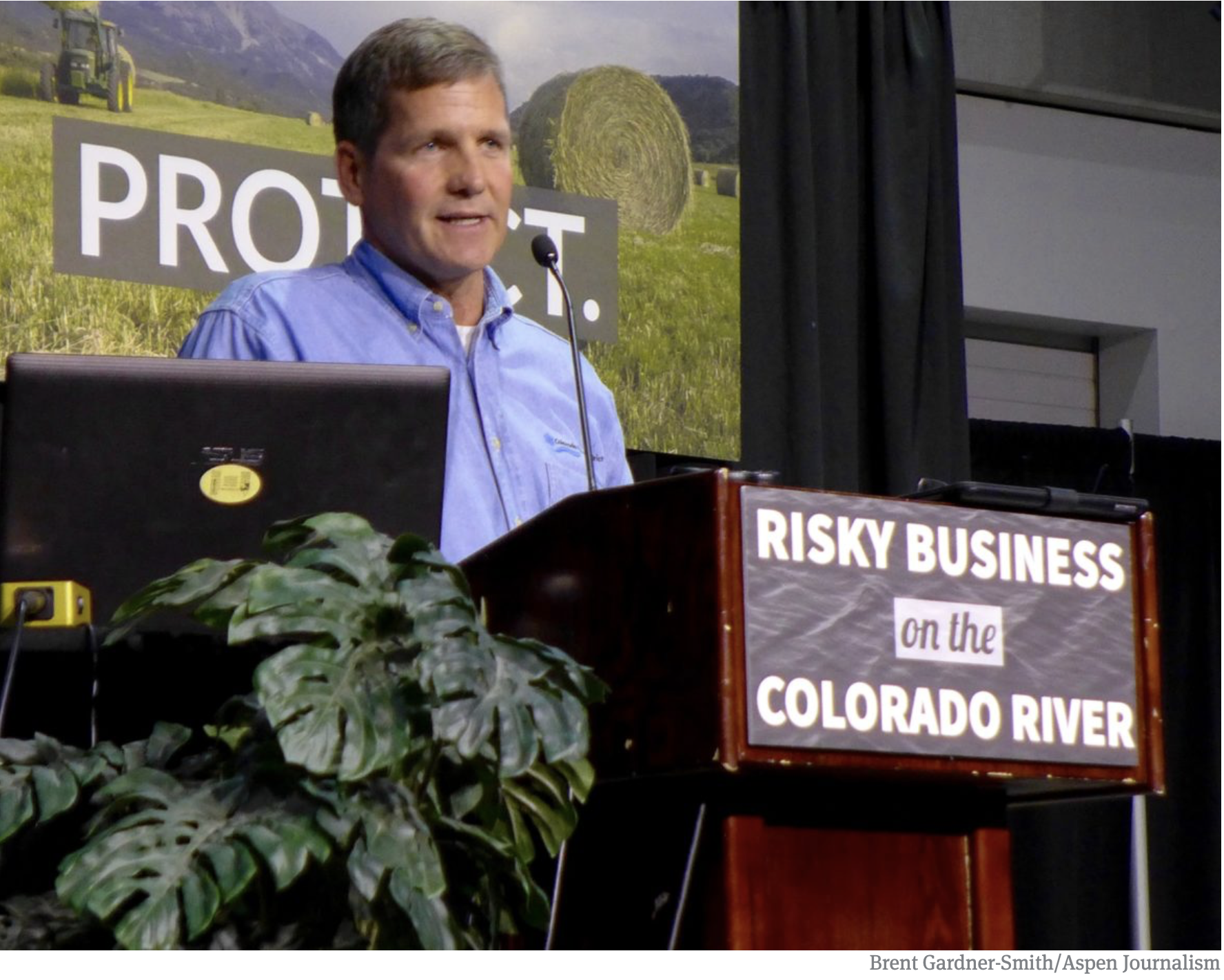
Andy Mueller, the general manager of the Colorado River District, speaking at the district’s annual seminar on the Colorado RIver, on Sept. 14, 2018 in Grand Junction. Muller expressed concerns about how the state of Colorado might deal with falling water levels in Lake Powell and Lake Mead. Photo credit: Brent Gardner-Smith/Aspen Journalism
Lake Powell’s drastically low water levels are evident in the discoloration of ancient cliffs that were submerged for decades, often referred to as “the bathtub ring” in March 2026 | Page Buono (American Rivers)
Click the link too read the article on the Colorado Politics website (Marianne Goodland). Here’s an excerpt:
August 17, 2026
In the past 10 days, both Lake Mead on the Arizona-Nevada border and Lake Powell roughly 300 miles northeast on the Utah-Arizona line have recorded their lowest water levels since the reservoirs were first filled. Lake Mead, the nation’s largest reservoir and which supplies water to Nevada, Arizona and California, measured 1,040.4 feet above sea level on Aug. 7. The level has continued to drop since then. On Monday, the reservoir measured 1,039.83 feet above sea level, nearly 190 feet below full and down about 2 feet over the past 30 days. A year ago, Lake Mead stood at roughly 1,054 feet.
Rarely seen back of the Hoover Dam prior to first fill
Hoover Dam, which created Lake Mead, was completed in 1935. The reservoir was last at full in 1983. If the reservoir loses another 4.76 feet, Hoover Dam begins to lose its ability to generate significant hydropower. At 895 feet, it reaches “dead pool” — a complete shutdown of Hoover’s hydropower system.
Lake Powell, the nation’s second largest reservoir and the water bank for Colorado, New Mexico, Utah and Wyoming, reached its lowest point in history on Sunday at 3,519.8 feet above sea level. A year ago, it stood at 3,551.33 feet above sea level.
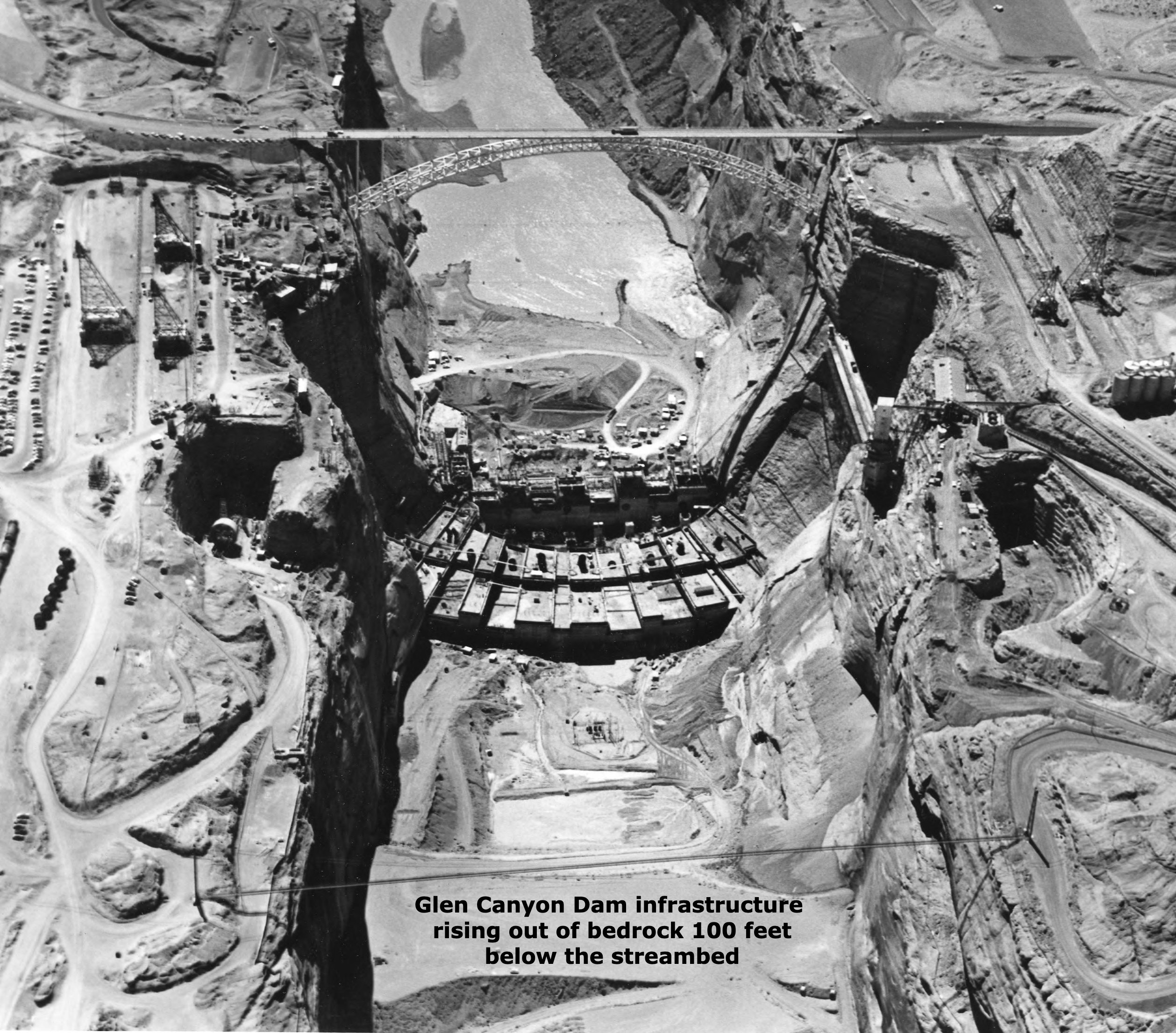
Glen Canyon Dam construction. Credit: Sibley’s Rivers
Glen Canyon Dam, which created the reservoir, was constructed in 1966. The last time Lake Powell was close to full was in 1999. At 3,490 feet, Glen Canyon Dam also begins to lose its ability to generate hydropower. At 3,370 feet, the elevation known as dead pool, hydropower production would stop entirely.
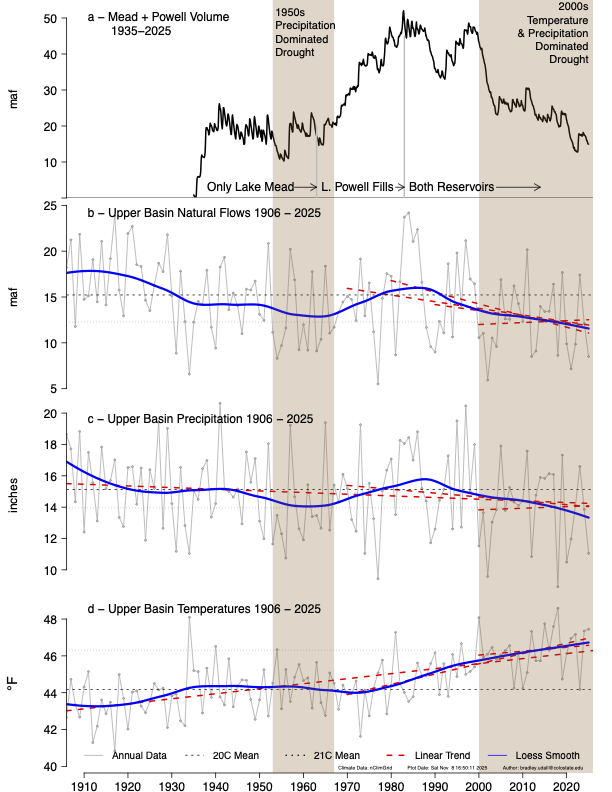
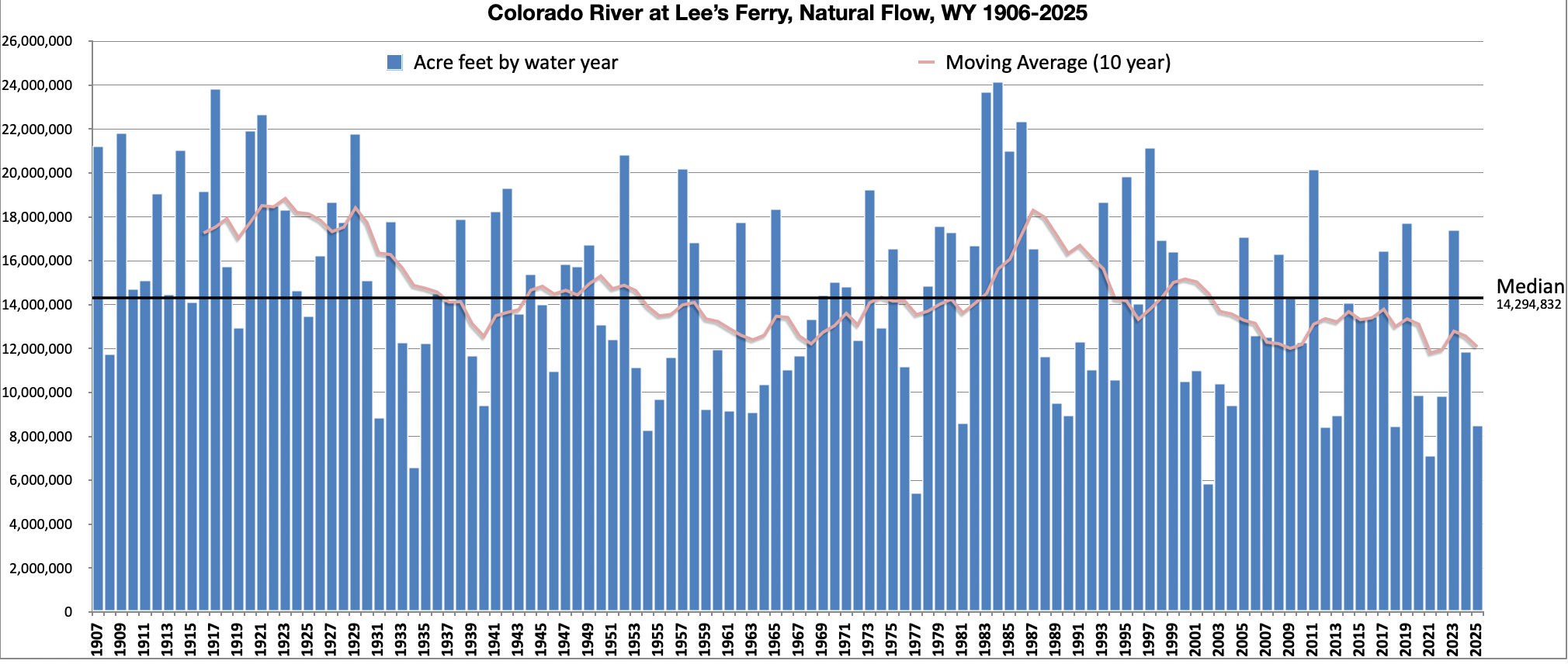
Udall/Overpeck 4-panel Figure Colorado River temperature/precipitation/natural flows with trend. Lake Mead and Lake Powell storage. Updated through Water Year 2025. Note the tiny points on the annual data so that you can flyspeck the individual years. Credit: Brad Udall
Both reservoirs are fed by the Colorado River, which has been hit by what some called a thousand-year megadrought that has cut its supply from around 15 million acre-feet per year to 12 million…This shouldn’t come as a surprise to anyone, according to Eric Kuhn, retired general manager of the Colorado River District.
“This was inevitable,” he told Colorado Politics. “All of the science has been pointing to this for 25 years.”
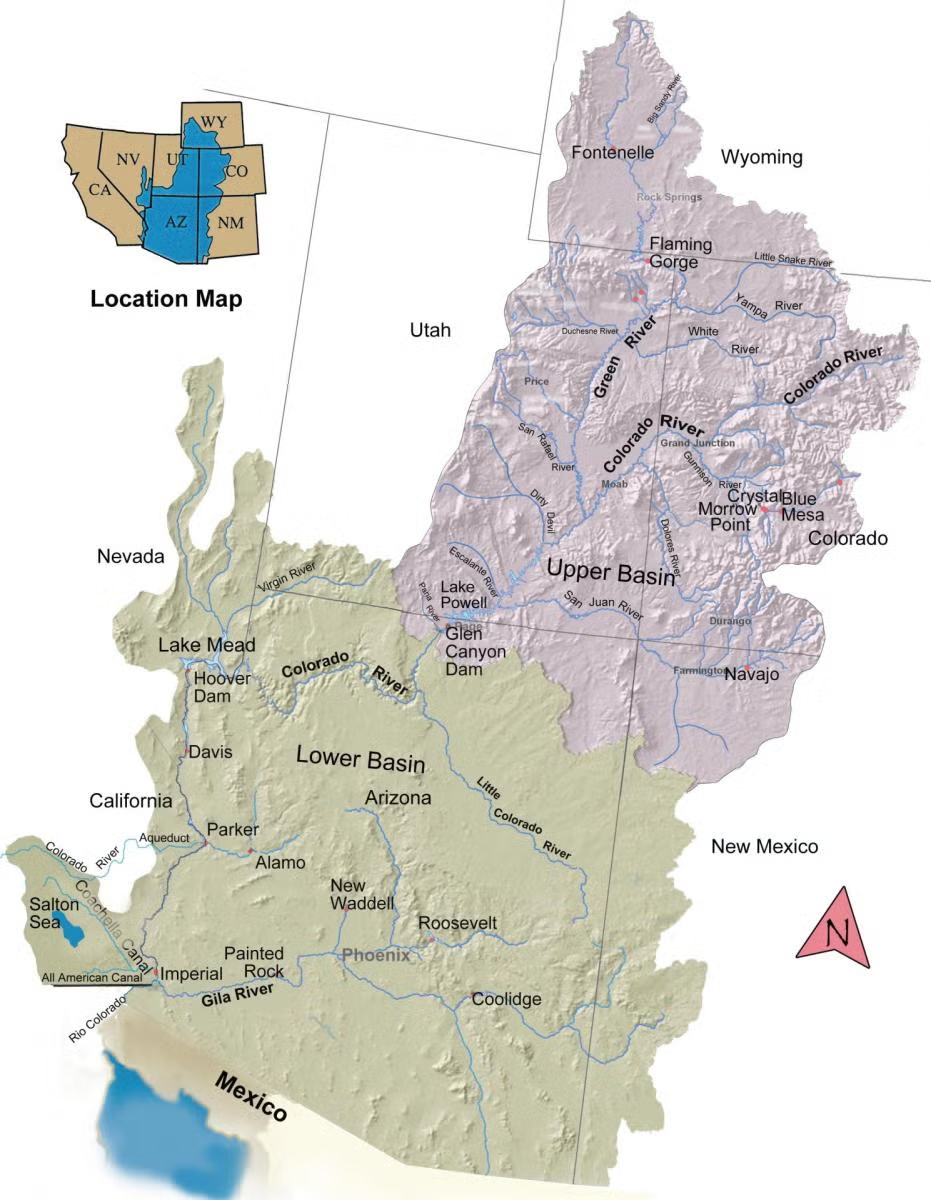
The Colorado River Basin spans seven U.S. states and is divided into Upper and Lower Basins. Lake Powell, upstream from the Grand Canyon, and Lake Mead, near Las Vegas, are the two principal reservoirs in the Colorado River water-supply system. (Bureau of Reclamation)
Climate change will almost certainly feature prominently in any multi-state litigation over the Colorado River. A court case over an almost-finished dam expansion may decide how.
Is climate change enough justification to stop the expansion of a reservoir that will take more water from the dwindling Colorado River?
That’s the central question in a lawsuit pitting the U.S. Army Corps of Engineers and Colorado’s largest water utility against a consortium of environmental nonprofits. The environmentalists say the Colorado River has no more water to give, while Denver Water, the utility whose Gross Reservoir would nearly triple in capacity, argues it is ensuring its customers can withstand droughts. The Corps contends it is not required to consider climate change or the downstream effects of its expansion of a dam to grow the reservoir.
The case in the 10th U.S. Circuit Court of Appeals has the potential to ripple through Western water management as states, tribes, cities and the federal government struggle to find a compromise on how to steeply cut water use. Some see history repeating itself, with the Gross Dam expansion emblematic of the kind of thinking that helped put the West into the very water crisis the project is meant to buffer the region against.
“Does it make sense for major water projects like this to continue to move forward?” asked Sarah Matsumoto, an associate professor of clinical law at the University of Colorado, Boulder, and director of the Getches-Green Natural Resources, Energy, and Environmental Law Clinic. “I just don’t think it does anymore, without at minimum considering impacts of climate and impacts of overappropriation on the river.”
The Corps and Denver Water appealed that decision, arguing that construction of the dam expansion is nearly complete, and topping off the reservoir behind it is in the public’s best interest. There are no other alternatives to consider, the utility asserts. The National Environmental Policy Act (NEPA), which requires evaluating the impacts of projects that need federal approval, does not require the assessment of climate change, they contend.
“We believe that considering potential climate impacts to a project goes beyond the scope of any guidelines, practicability, or NEPA reasonableness analysis,” said U.S. Department of Justice attorney Kyle Glynn, representing the Army Corps, during oral arguments for the case before the 10th Circuit Court of Appeals.
The expansion of Denver Water’s Gross Reservoir would hold an additional 77,000 acre feet of water diverted from the declining Colorado River, enough water for roughly 150,000 homes. Denver Water would get that water incrementally from an unused 1945 water right of 18,000 annual acre feet to ensure it can supply the growing metropolis of Denver and protect its water supplies during droughts.
The utility plans to only use its water right during wet years when it can stockpile water from excess supply. Of the 77,000 acre feet in diversions, 5,000 would be sequestered in an “environmental pool” that would enhance streamflows on South Boulder Creek and serve as additional storage for the cities of Boulder and Lafayette.
But environmentalists are not convinced there will be enough surplus water in the future for the utility to fill the reservoir. If the state is required to cut back its water use to address system-wide shortages on the Colorado River, reductions the seven states that depend on the river are currently negotiating, what happens to the over $800 million project, they wonder.
Those are the concerns driving the environmental groups, which sued over what they called an inadequate NEPA process and a failure to properly examine alternatives to the project. Natural resource professors watching the case share their concerns. The court’s decision, both say, could have far-reaching consequences for Southwestern states and nearly 40 million people who rely on the Colorado River, and could determine how climate change is considered in any future litigation.
Denver Water’s position is in direct contradiction with what Colorado is arguing in the current negotiations about how much water from the river states must give up, said Gary Wockner, founder of Save the Colorado, the environmental group that’s led the push against the Gross Reservoir expansion.
Colorado has maintained that it and other states close to the river’s headwaters should not have to make mandatory cuts because climate change is already limiting their supply by reducing river and stream flows. Should the negotiations over cuts to allocations from the river devolve so completely that states in the upper and lower halves of the Colorado River Basin sue one another, some water law experts believe climate change would figure prominently in the litigation.
“If the court supports Denver Water and says that Denver Water did not have to account for climate change to prove that they could operate the project, it sets a very difficult and perhaps powerful precedent, potentially undermining the state of Colorado’s position in the entire Colorado River negotiations,” Wockner said.
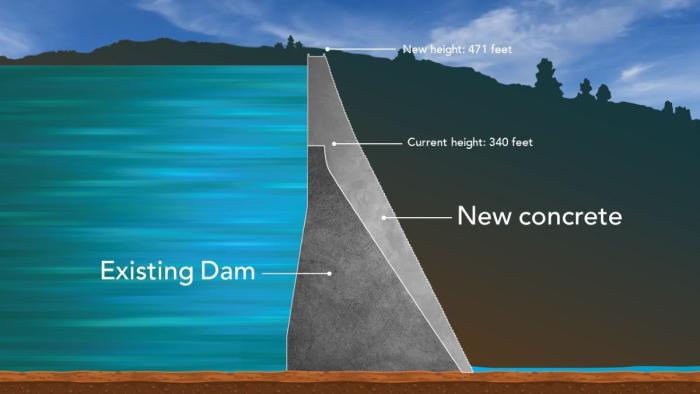
Roller-compacted concrete will be placed on top of the existing dam to raise it to a new height of 471 feet. A total of 118 new steps will make up the new dam. Image credit: Denver Water.
Can a Dam’s Progress Block Climate Considerations?
On the last day of July, attorneys for the environmental groups, Denver Water and U.S. Army Corps of Engineers gathered before three justices on the 10th Circuit Court of Appeals in a courtroom in Santa Fe, New Mexico. Their oral arguments came nearly two years after senior federal judge Christine Arguello ruled in favor of the environmentalists, saying that “the cracked foundation of the Colorado River’s management system all but demands skepticism over any proposal that will affect the hydrology of the Colorado River basin.”
Arguello’s decision didn’t stop construction to expand the dam, but forced the parties to meet and agree on remedies. Those discussions failed, however, leading Arguello to issue an injunction to stop construction in April 2025. That was lifted due to safety concerns about the dam being left incomplete, but an injunction remained preventing the clearing of the forest below to make room for the additional water, or filling the added space behind the dam.
The Gross Reservoir expansion solves a problem Denver Water has been trying to address for 23 years, said Jessica Brody, general counsel for the utility, in the 10th Circuit last month.
Denver Water has a water storage imbalance between its two collection systems with 90% of its reservoir storage located in the utility’s South System compared to 10% in its North System. This storage imbalance creates vulnerability if there is a drought, mechanical issue or emergency that affects the South System. The storage imbalance is one of the reasons Denver Water is expanding Gross Reservoir. Image credit: Denver Water.
Denver Water’s storage and delivery network is divided into north and south systems, which are unconnected and imbalanced. The south system provides 80 percent of the utility’s water supply, and if it were to go down, the north system, which includes Gross Reservoir, could run out of water in just one year. That leaves the utility’s system vulnerable in times of severe drought, wildfires or other emergencies.
Despite construction being nearly done, Brody said, Denver Water has a dam it cannot fill because of the lower court’s opinion.
That decision was an “abuse” of the court’s power, she said, as the water rights at stake are under the jurisdiction of the state, not federal agencies. Plaintiffs never sought a preliminary injunction to stop construction, although they did when later mediation failed. Jurisdiction over the cutting of trees to make room for the expanded reservoir lies with the U.S. Forest Service and the Federal Energy Regulatory Commission, not the Corps, she said.
The arguments from Denver Water and the Corps seemed to resonate with the three justices presiding over the case, largely due to the fact the dam is nearly complete.
“Poor pun: It’s water over the dam, because it’s built,” said Judge Timothy Tymkovich. “So costs, and I think climate change, are off the table now.”
William Eubanks, the attorney representing the environmental groups, disagreed. The dam expansion is part of Denver Water’s Moffat Collection System project, which requires work in addition to the Gross Reservoir project, such as felling the trees.
And there is still the question of where the water will come from.
A central point for the lawsuit, he said, is that under the Clean Water Act, water infrastructure developers have to show a project can be built and fulfill the expected need—in this case, a reservoir with more water. That wasn’t done here, Eubanks said.
“With the Moffat Collection System project, Denver Water and the Army Corps have recklessly gambled with over $800 million of ratepayer money,” Eubanks said before the court. Neither the Corps nor the utility forecasted whether there would be enough surplus water in the Colorado River for Denver Water to fill its reservoir, he argued. “In effect, they’re building a giant bathtub, even though there’s likely no water to ever fill it.”
CU Boulder professor Matsumoto is one of 11 natural resource law experts who submitted an amicus brief to the court asking it to affirm the lower court’s decision.
This case, they wrote, is a “classic example of why we need NEPA”—illustrating the consequences of an agency permitting and approving a project without a full evaluation of other alternatives and whether the project was even feasible. The foundational U.S. environmental law was designed to push agencies to “fully appreciate the consequences of their actions before they move forward with those actions,” they wrote.
The Corps violated NEPA by limiting the number of alternatives it considered for the project and only examining impacts up to 50 miles downstream, not along the full course of the river, the brief noted.
“It just doesn’t make any sense for the amount of water that they’re getting,” said Mark Squillace, a natural resources law professor at the University of Colorado in Boulder, and another one of the professors part of the amicus brief. “It’s insane.”
Udall/Overpeck 4-panel Figure Colorado River temperature/precipitation/natural flows with trend. Lake Mead and Lake Powell storage. Updated through Water Year 2025. Note the tiny points on the annual data so that you can flyspeck the individual years. Credit: Brad Udall
A Complicating Compact
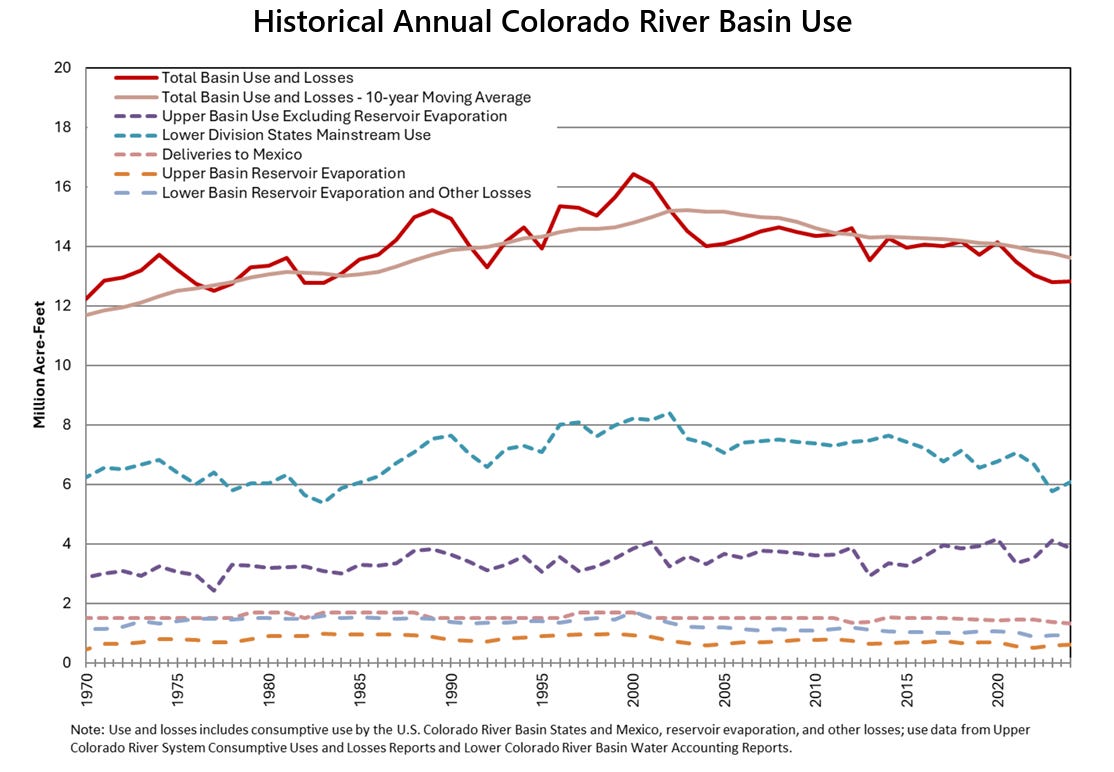
Since 1922, the Colorado River has been governed by its eponymous compact, which is now widely acknowledged to have overallocated the river by millions of acre feet of water. Under the compact, both the Upper Colorado River Basin, made up of Colorado, New Mexico, Utah and Wyoming, and the Lower Basin states of Arizona, California and Nevada, are entitled to 7.5 million acre feet of water, with another 1.5 million acre feet going to Mexico. But the river has averaged closer to 11 million acre feet since 2020—more than 6 million acre feet less than the total that has been allocated, according to the most recent federal data.
Though both basins get an equal share of the river, Article III(d) of the compact specifies that the Upper Basin “will not cause the flow of the river” to be depleted below an average of 7.5 million acre feet per year over any 10-year period downstream.
Failing to meet that requirement could trigger the Lower Basin to demand more water from the Upper Basin in what is known as a “compact call.” That unprecedented action could force severe water usage curtailments in the Upper Basin, and how that would affect users like Denver Water is unclear. The system is dangerously close to the hydrological conditions that could trigger a compact call.
It’s a known risk for this project, the professors say, but one that was ignored during permitting.
Gross Reservoir is far from the only new diversion proposed in the Upper Basin, which has never used its full allocation from the river, but sees that water as key to the region’s continued economic growth and prosperity. Over 1 million acre feet of diversions have been proposed across 30 projects in the Upper Basin. Many of those may not be developed, but they have become a sticking point in negotiations over the river’s future.
“Repeating the Same Mistakes”
As the lawyers argued in Santa Fe, news of a short-term federal proposalfor managing the Colorado River rippled across the basin. In the absence of a new consensus among the states over how to allocate the water, the federal government stepped in to manage the crisis.
Its track record on the Colorado River is deeply checkered.
The compact has served as the bedrock for a web of dams, reservoirs, canals and ditches built largely with federal funding and engineering prowess to distribute water across arid Western lands. The magnitude of this diffuse system and its overreliance on diverting and impounding water, experts say, is at least partially responsible for the severity of the West’s water crisis.
Building the Gross Reservoir Dam in the 1950s. Photo credit: Denver Water.
Some believed not everyone has learned the lesson. “We’re just repeating the same mistakes,” Squillace said. “A lot of it just results from a lack of imagination about a better way to do things.”
As water supplies shift, water utilities across the West are squeezing every last drop out of their systems through a range of modifications and adjustments to their infrastructure.
After the first of the West’s deep 21st-century droughts in 2002, Denver Water, which serves 1.5 million people across Colorado’s Front Range, decided it needed to act. The utility convinced the Army Corps of Engineers, which completed the original Gross Reservoir in the 1950s, that raising the dam to triple the amount of water it could impound would be the best course of action to combat drought.
Since then, Denver Water has also invested in water efficiency, which allowed it to better endure droughts from 2002 to 2026. Despite a growing population, water use is below the benchmarks from the 1970s, said Jeff Martin, Denver Water’s program manager for the reservoir expansion.
“We’ve really capitalized on most of our customer savings at this point,” he said. “Now, we need to shore up the rest of our need with the expanded reservoir.”
But a drier future is precisely what should preclude Denver Water and the Corps from seeing this project through, said Wockner with Save the Colorado.
“It’s nonsensical to be diverting more water out of rivers anywhere in the Southwest United States,” he said. “Because in many ways the climate change bullseye in the United States is on the Southwest and Colorado River Basin.”
The Colorado River, Wockner said, has no more water to give. But Martin sees room for more improvement in how the river is managed.
“I would be the first to say something needs to change there on how we use the river for all stakeholders, including some type of cuts throughout the system,” said Martin. “I’m not that decision maker though.”
Graphic credit: RogerWendell.com
The state, he said, controls Denver Water’s rights to the river. The utility has the right to use the water that may one day fill Gross Reservoir, he said, and has been planning to do so for decades.
Despite arguments that the water isn’t available, Martin has no doubt Denver Water will be able to one day fill the reservoir—if the courts allow it.
What Comes Next
The justices have given no indication of when a ruling on the Gross Reservoir Expansion Project will land.
If Denver Water loses its current appeal, the utility claims it will be unable to ensure a reliable water supply during times of drought, and the decision may deter developers from pursuing other ambitious projects to solve the West’s water problems, from new dams to expensive desalination plants.
In the Santa Fe courtroom, Teagen Blakey sat on a wooden bench watching the lawyers argue over a project that has loomed over more years of her life than it hasn’t.
President of The Environmental Group, a nonprofit from Colorado’s Front Range and one of the lawsuit’s plaintiffs, Blakey grew up in the area around Gross Reservoir. She remembers sitting in community meetings as a teenager when the project was being permitted.
Despite the project’s impacts on Boulder County, the water won’t serve residents there, she pointed out. But the dam and reservoir expansions’ impacts will fall on the local population. At the site where Denver Water will clear the forest is a hike featuring a waterfall that would be submerged.
“It’s something you can’t quantify as a value,” she said.
With such a high cost to something so special, Blakey said, there must be certainty about the benefit it will provide.
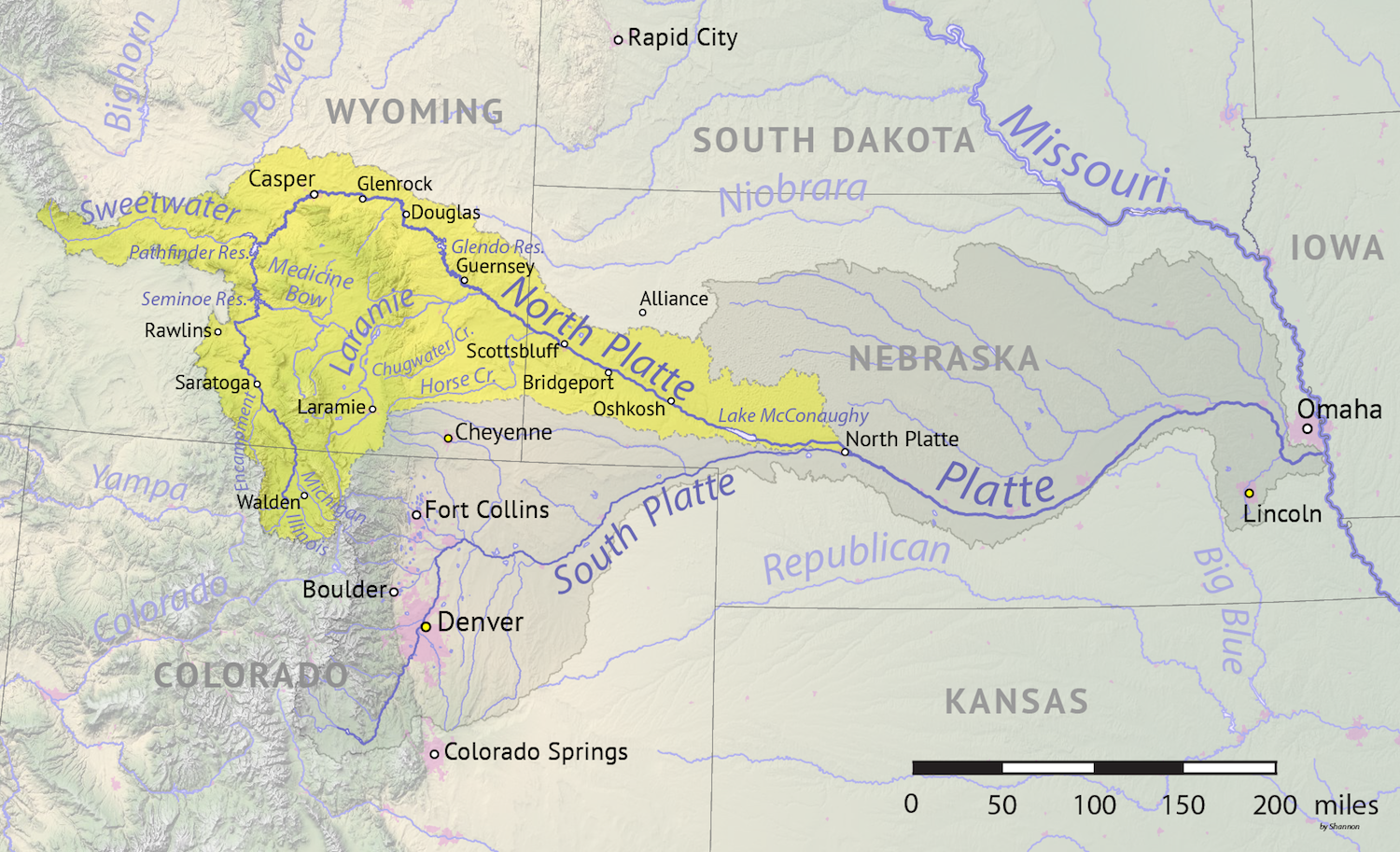
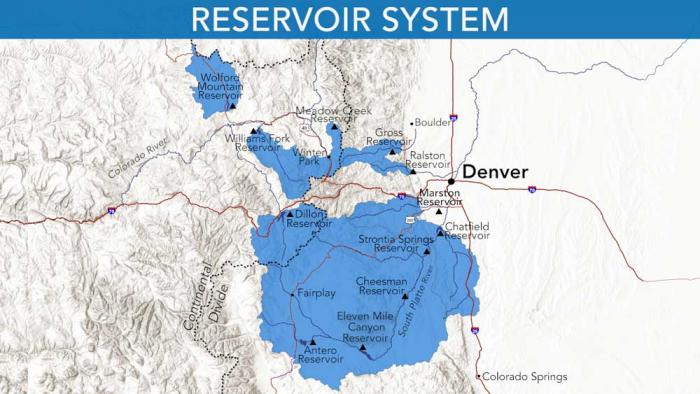
South Platte River Basin via Wikipedia
Map of the Colorado River drainage basin, created using USGS data. By Shannon1 Creative Commons Attribution-Share Alike 4.0
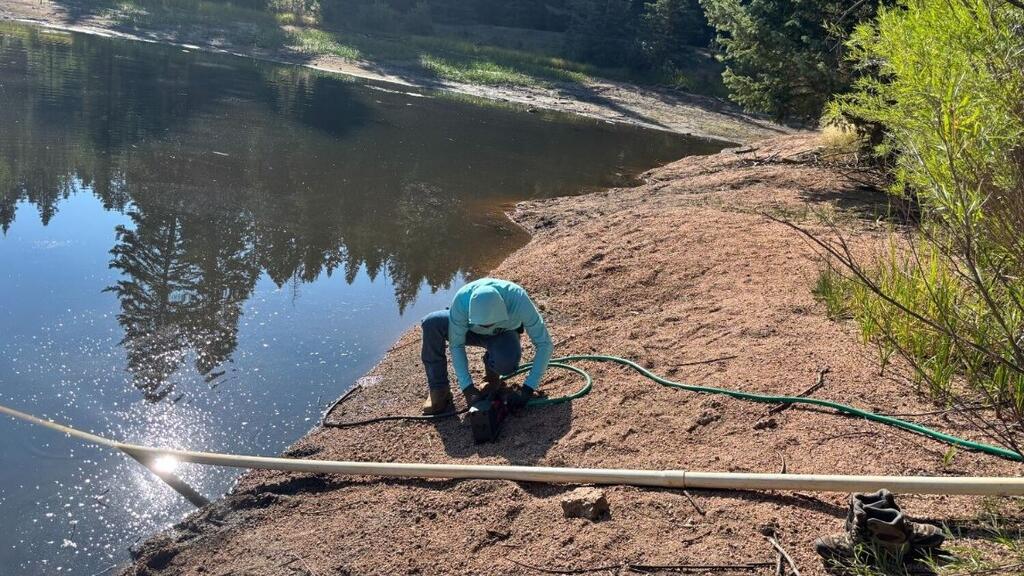
Park Resource Technician James Dilisio drains Gere Pond at Mueller State Park. The effort ensures Colorado Parks and Wildlife remains compliant with Colorado water laws as historic drought conditions continue to impact life throughout the Centennial State. CPW Photo/Brian Kerrigan
Visitors to Mueller State Park will see significantly lower water levels at two ponds as Colorado Parks and Wildlife releases water from Geer and Dragonfly ponds in response to continued drought conditions throughout the state and requirements under Colorado water law.
Most of the water has already been released from Geer Pond, a backcountry fishing location. Visitors hiking to the pond should expect to find primarily a dry pond bed with only a small amount of water remaining.
At Dragonfly Pond, located along the park’s main road and popular for children’s fishing and educational programs, park staff will release approximately three feet of water in the weeks ahead. The lower water level is expected to significantly reduce fishing opportunities at that pond for the remainder of the season.
“Visitors are definitely going to notice the change, especially at Dragonfly Pond,” said Brian Kerrigan, Mueller State Park manager. “But after the irrigation season ends, we’re hopeful a good winter will allow these ponds to refill and be available again in the spring.”
Colorado is experiencing extreme drought following low mountain snowpack, low streamflows and hot summer temperatures. Those conditions have left less water available to water-right holders across the state.
All of Mueller State Park’s ponds have water rights, but those rights are junior in priority to more senior water rights. When senior water-right holders call for water, CPW must comply with Colorado water law and allow water that otherwise would be stored in the ponds to continue downstream.
As Dragonfly water levels are reduced, water temperatures are expected to increase and create conditions unsuitable for trout. Dragonfly primarily supports stocked rainbow trout, while Geer primarily supports cutthroat trout. A fish salvage is not planned, as relatively few fish were stocked in the affected ponds this season.
Anglers still have opportunities elsewhere at Mueller State Park. Rock Pond and Brook Pond, both located in the park’s backcountry, remain available for fishing. Rock Pond is stocked with brook trout, while Brook Pond is stocked with cutthroat trout.
The impacts are expected to be temporary. Once the irrigation season ends, the park can begin retaining water in the ponds again. How quickly they recover will depend on winter precipitation and runoff.
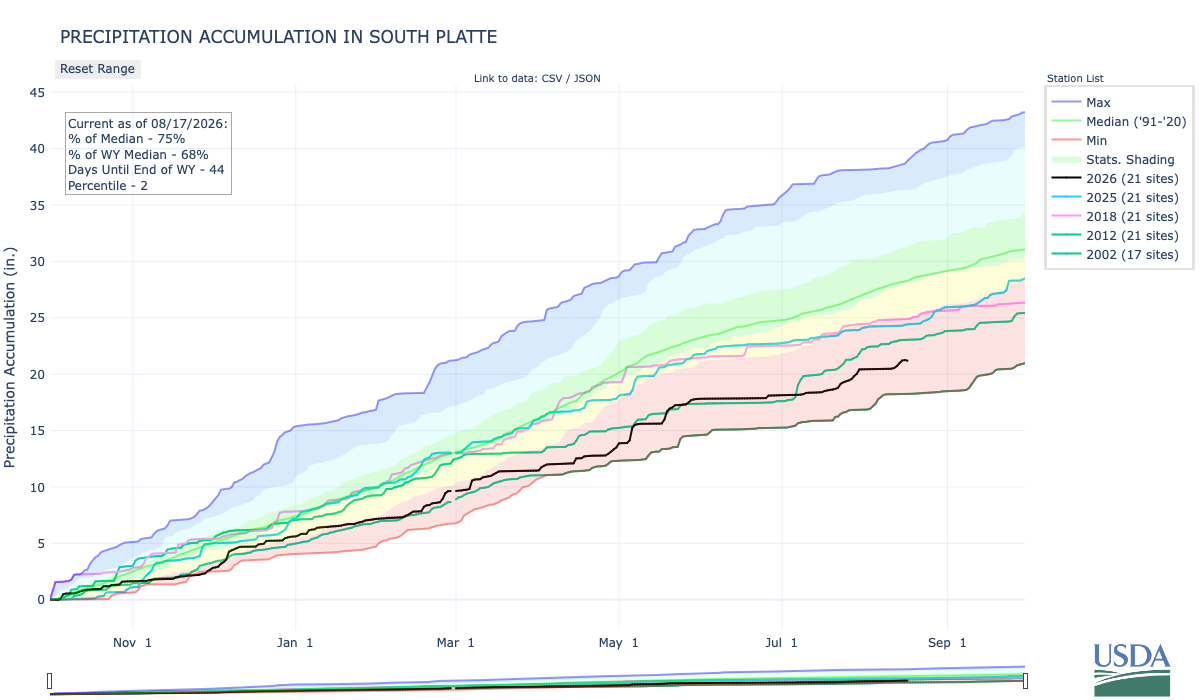
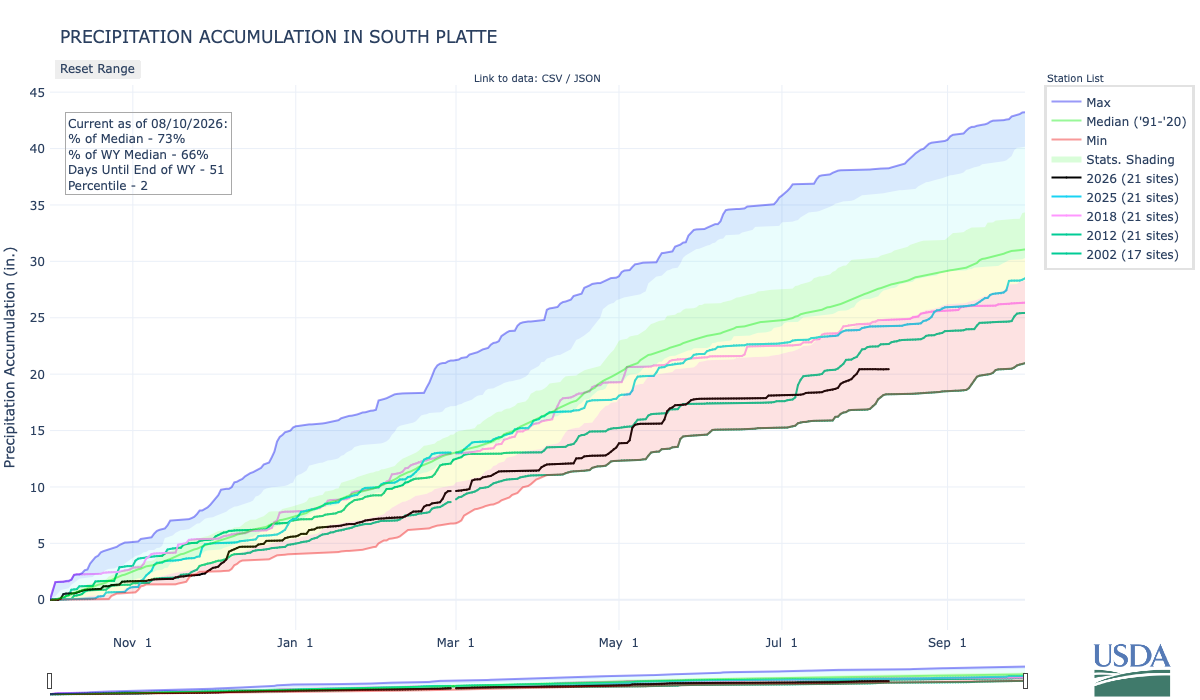
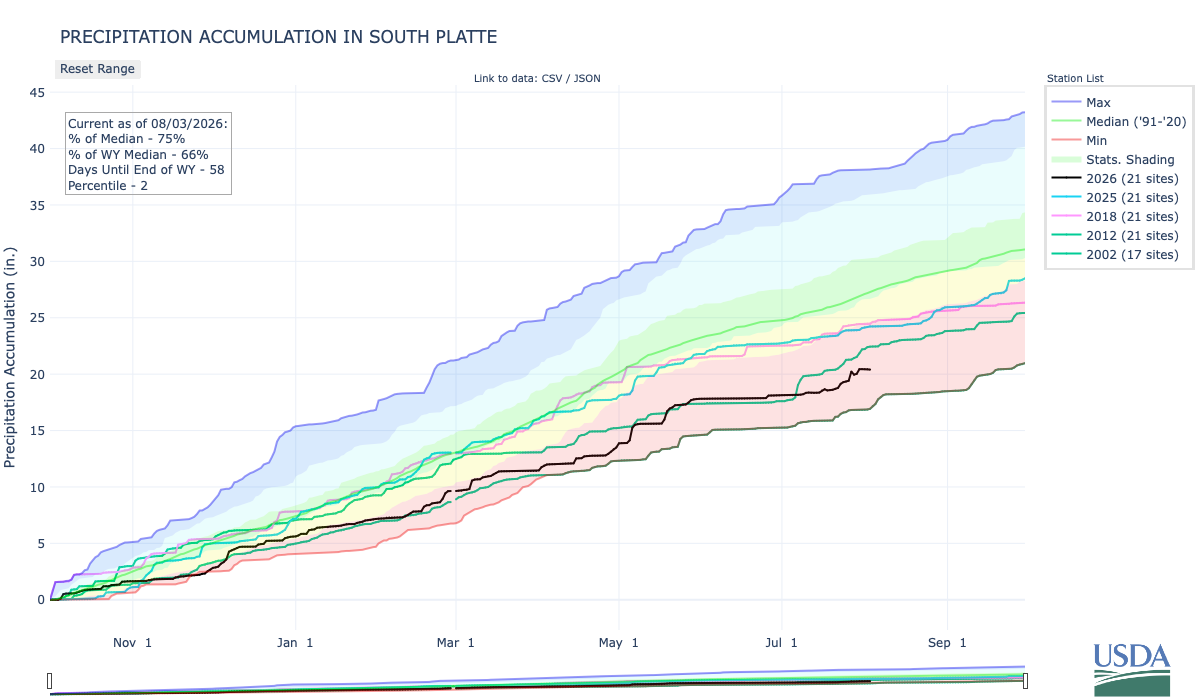
Below is the Precipitation Accumulation in South Platte graph from the NRCS for August 10, 2026. This morning precipitation is at 75% of the median (up 2% one week), and 68% of the water year median (up 2% one week). There are 44 days left in the water year.
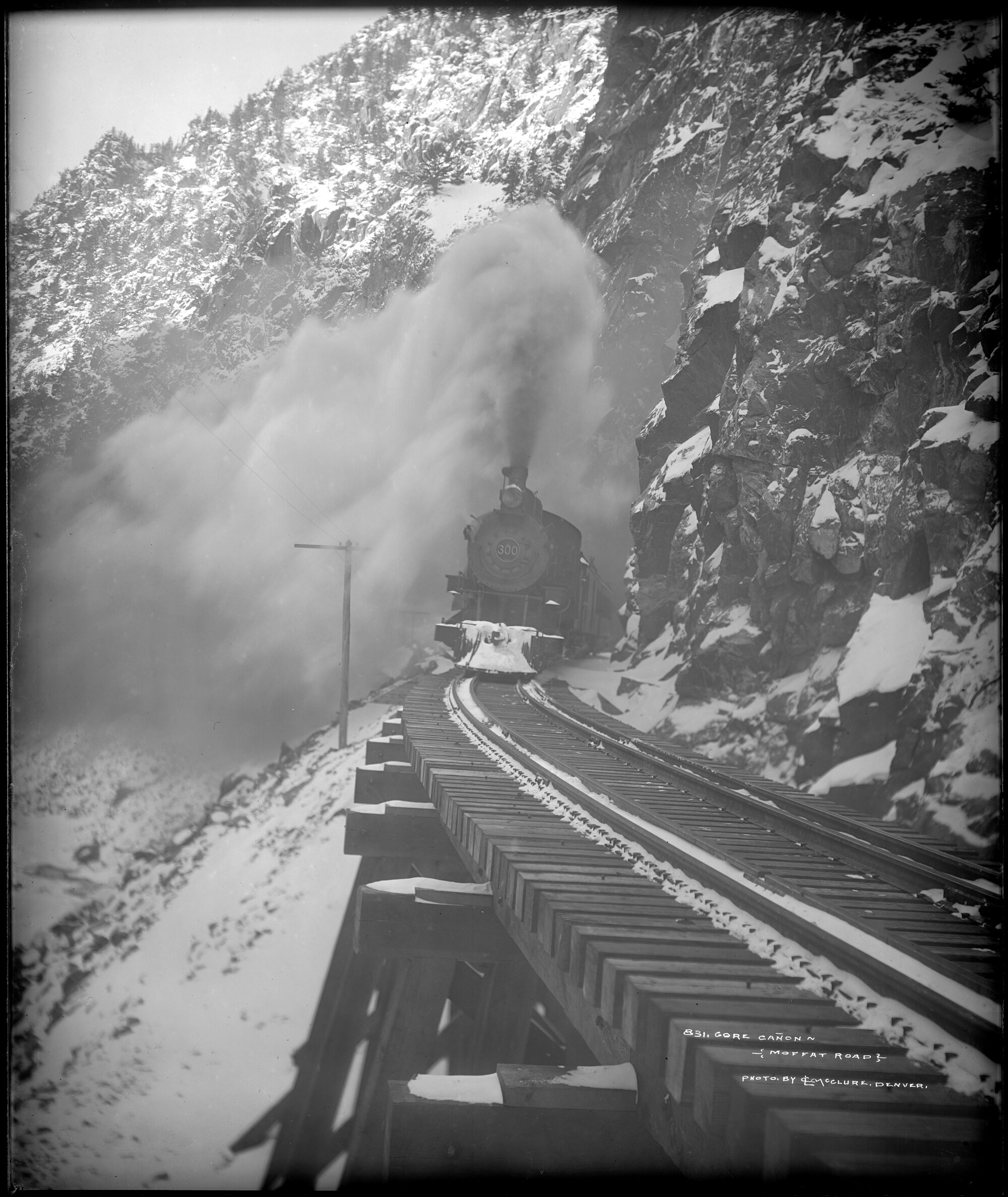
There is a chance for thunderstorms Wednesday, a slight chance for thunderstorms Thursday, and chance for thunderstorms Friday, with showers likely Saturday, and showers and thunderstorms likely Sunday, in the central mountains. Showers are likely Wednesday, there is a slight chance for thunderstorms Thursday, a chance for thunderstorms Friday, with showers likely Saturday, and showers/thunderstorms likely Sunday, in the northern mountains. There is a chance for thunderstorms Tuesday and Wednesday, with a chance for showers and thunderstorms Saturday, and showers are likely Sunday, down here, about 160 miles from Steamboat Springs where the arrival of the Denver, Northwestern & Pacific Railway, in 1909, was transformative. From ChatGPT:
Before the railroad, Steamboat Springs and the Yampa Valley were quite isolated. Moving people, livestock, supplies, and agricultural products across the mountains was difficult and expensive. The Denver, Northwestern & Pacific Railway, associated with railroad entrepreneur David Moffat, was being pushed westward from Denver across the Continental Divide. The line finally reached Steamboat Springs in December 1908, with regular rail service beginning in 1909. The railroad dramatically changed the local economy. Ranchers could ship cattle and other products to distant markets, while the railroad made the Yampa Valley’s coal and timber resources much more commercially valuable. Manufactured goods and building materials could also be brought into town more easily. It also reduced Steamboat’s isolation. A journey that previously required difficult travel over mountain roads could increasingly be made by train, strengthening Steamboat’s connections with Denver and the rest of Colorado.
Denver, Northwestern & Pacific Railway (later called Denver & Salt Lake) engine number 300 pulling hard and starting across wooden trestle in Gore Canyon, Colorado; Moffat Road; standard gauge track in steep narrow canyon. Creator McClure, Louis Charles, 1867-1957. Date 1907-1913. Via Denver Public Library Digital Collections
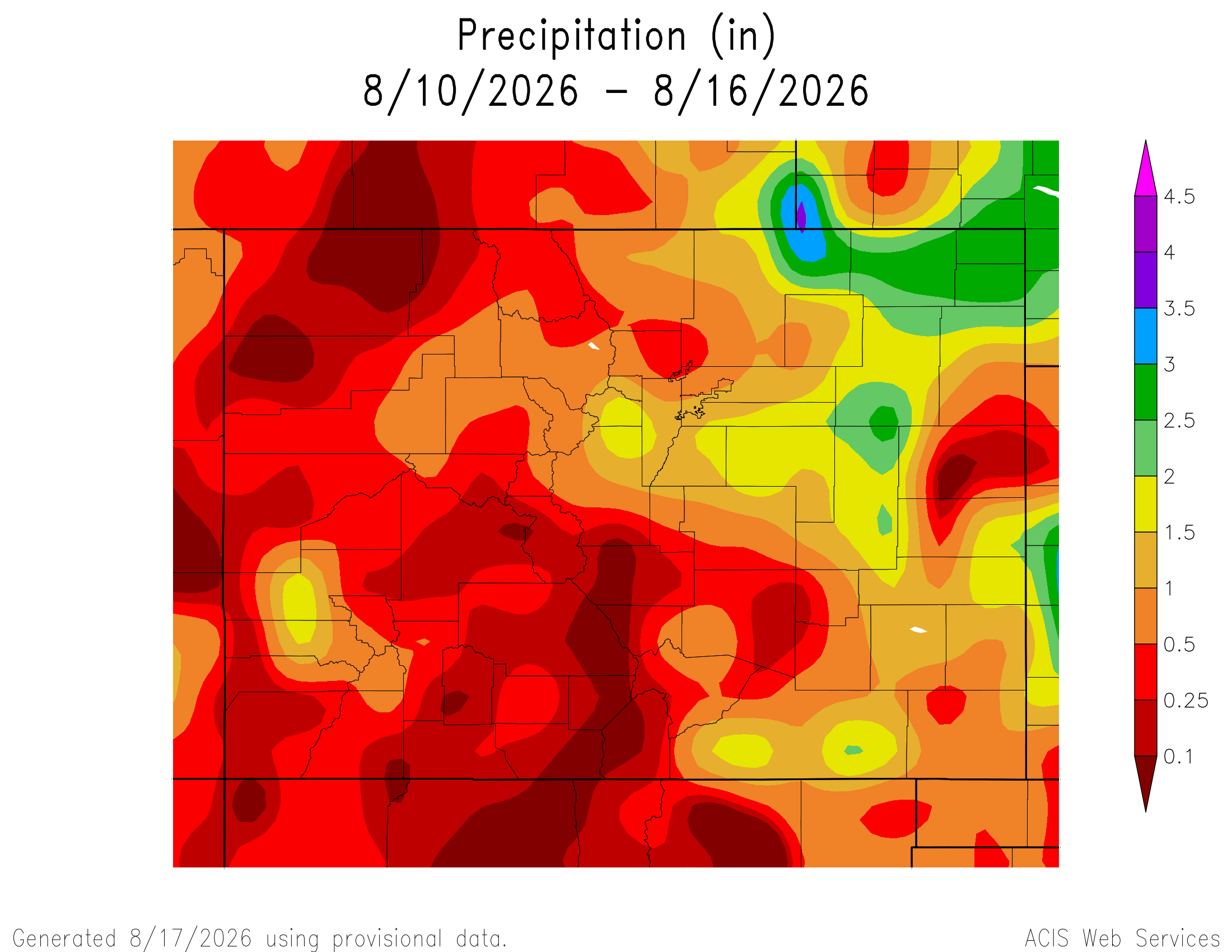
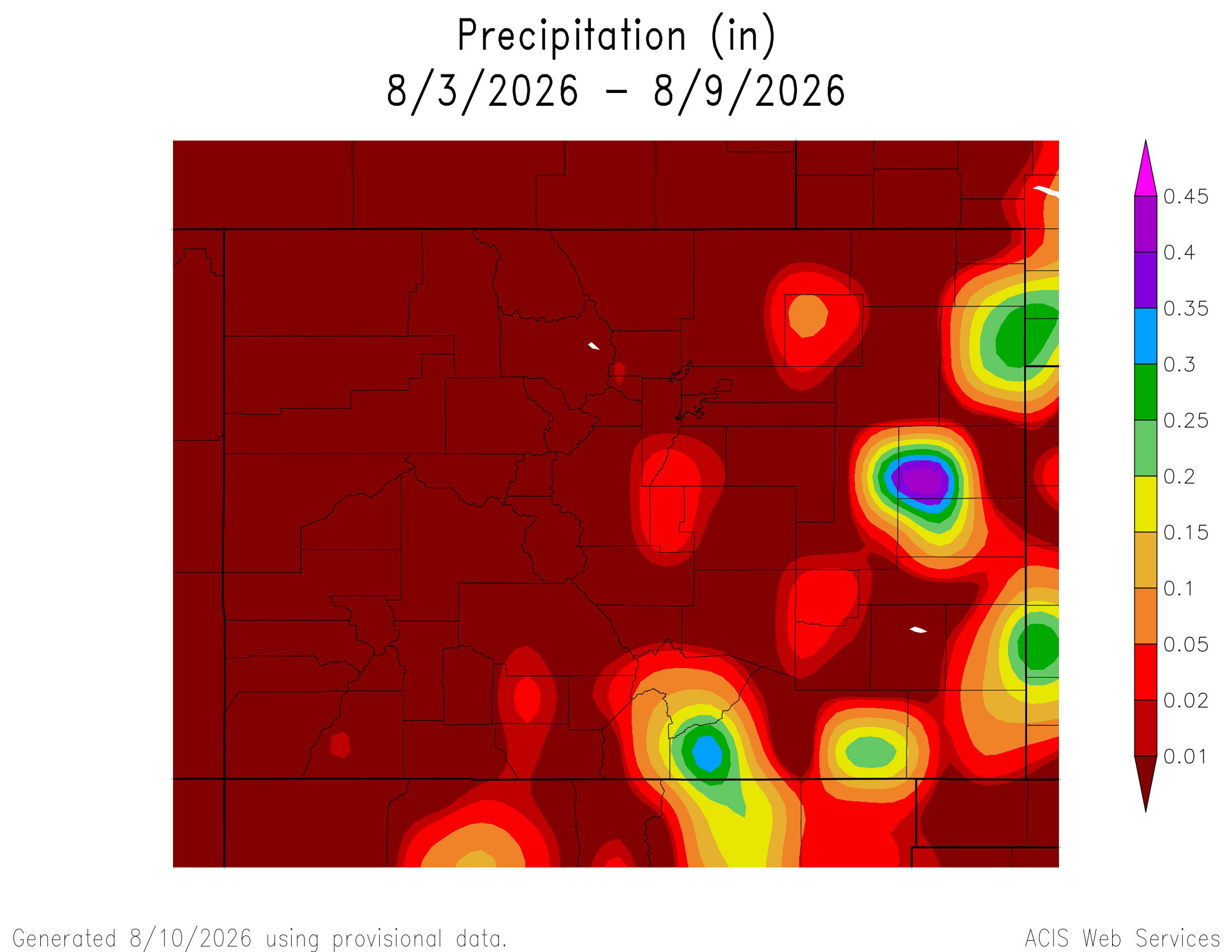
Here’s a look at the 7-Day Colorado precipitation map through August 16, 2026 from the High Plains Regional Climate Center. Precipitation in the South Platte Basin along the Continental Divide of the Americas ranged from 0.00” to 2.00”.
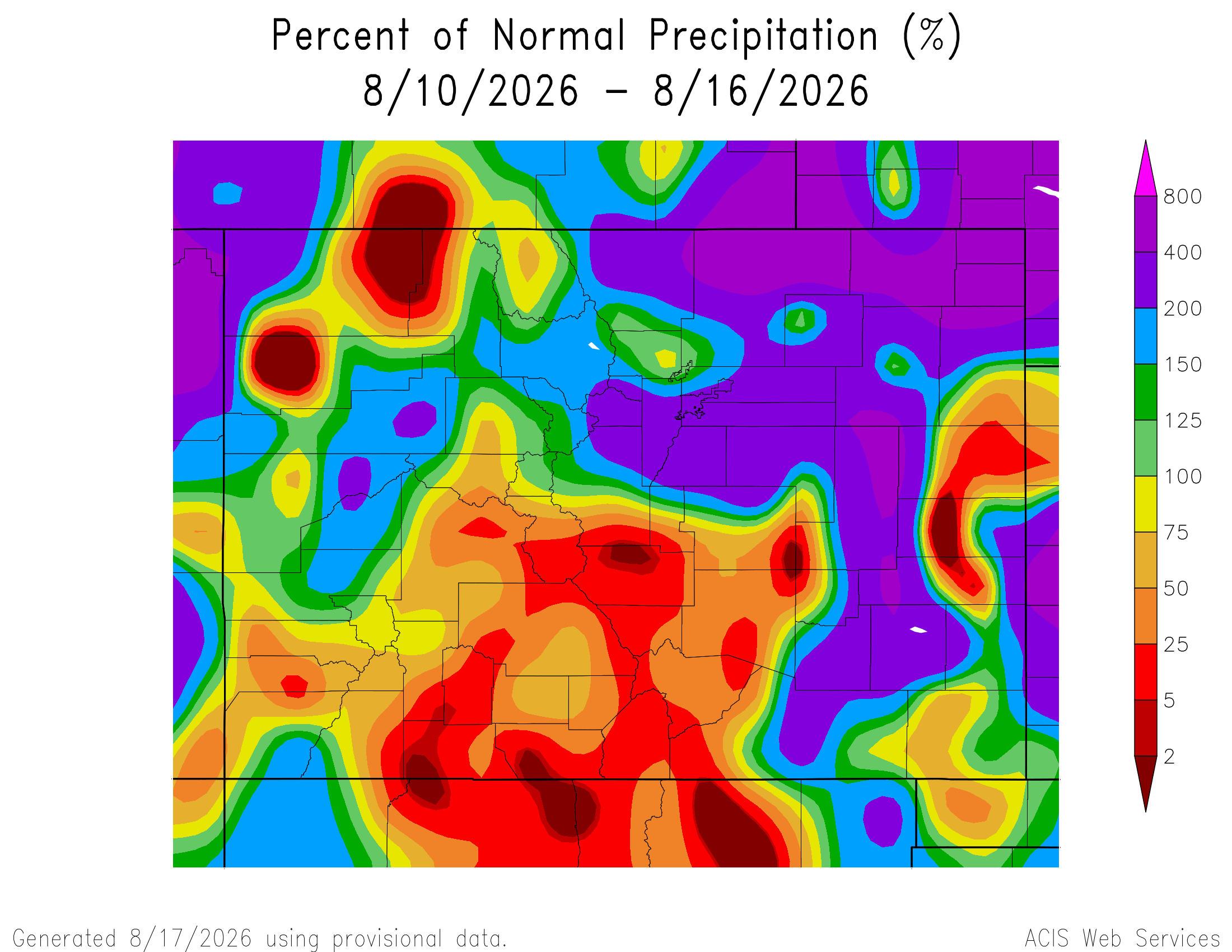
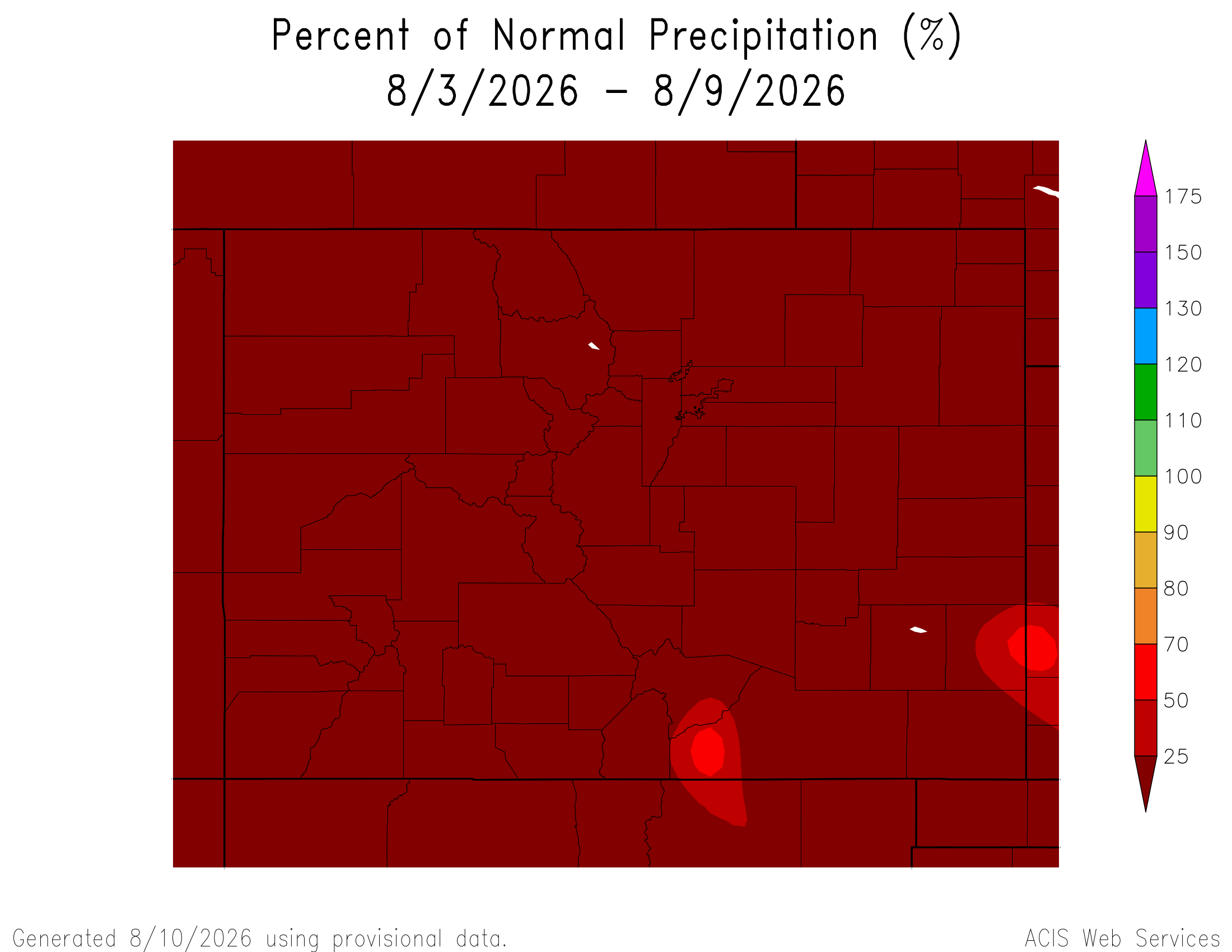
Here’s the 7-Day percent of normal precipitation map through August 16, 2026 from the High Plains Regional Climate Center. Precipitation in the South Platte River Basin along the Continental Divide of the Americas was 0% to 800% of normal.
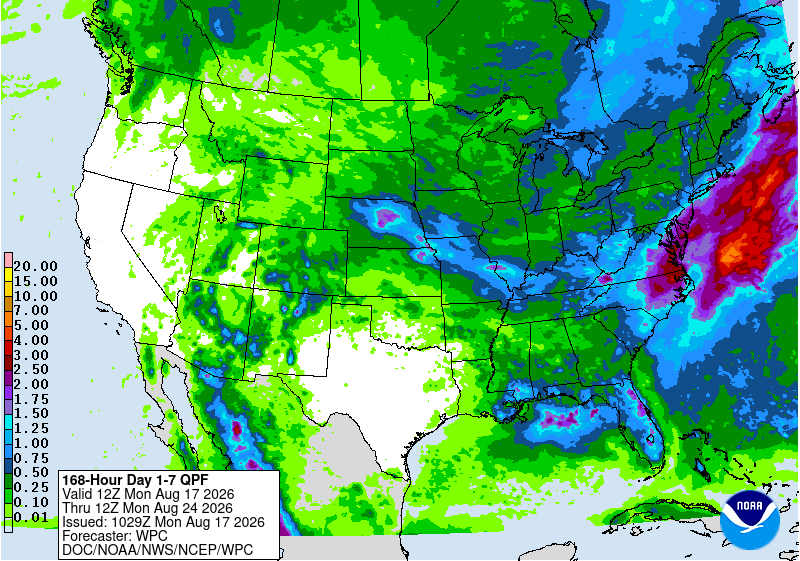
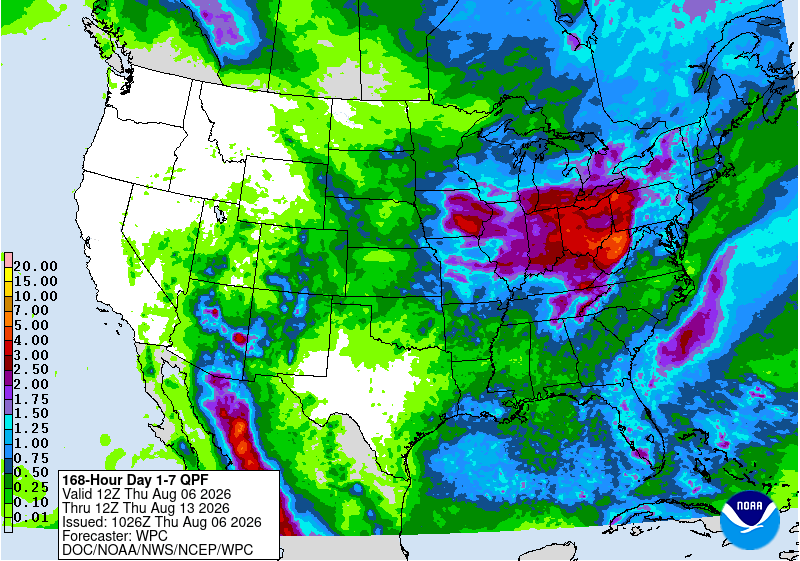
Below is the 7-day Quantitative Precipitation Forecast for the week of August 17, 2026. Precipitation is anticipated for the mountains of the South Platte River Basin and may total up to 0.75″.
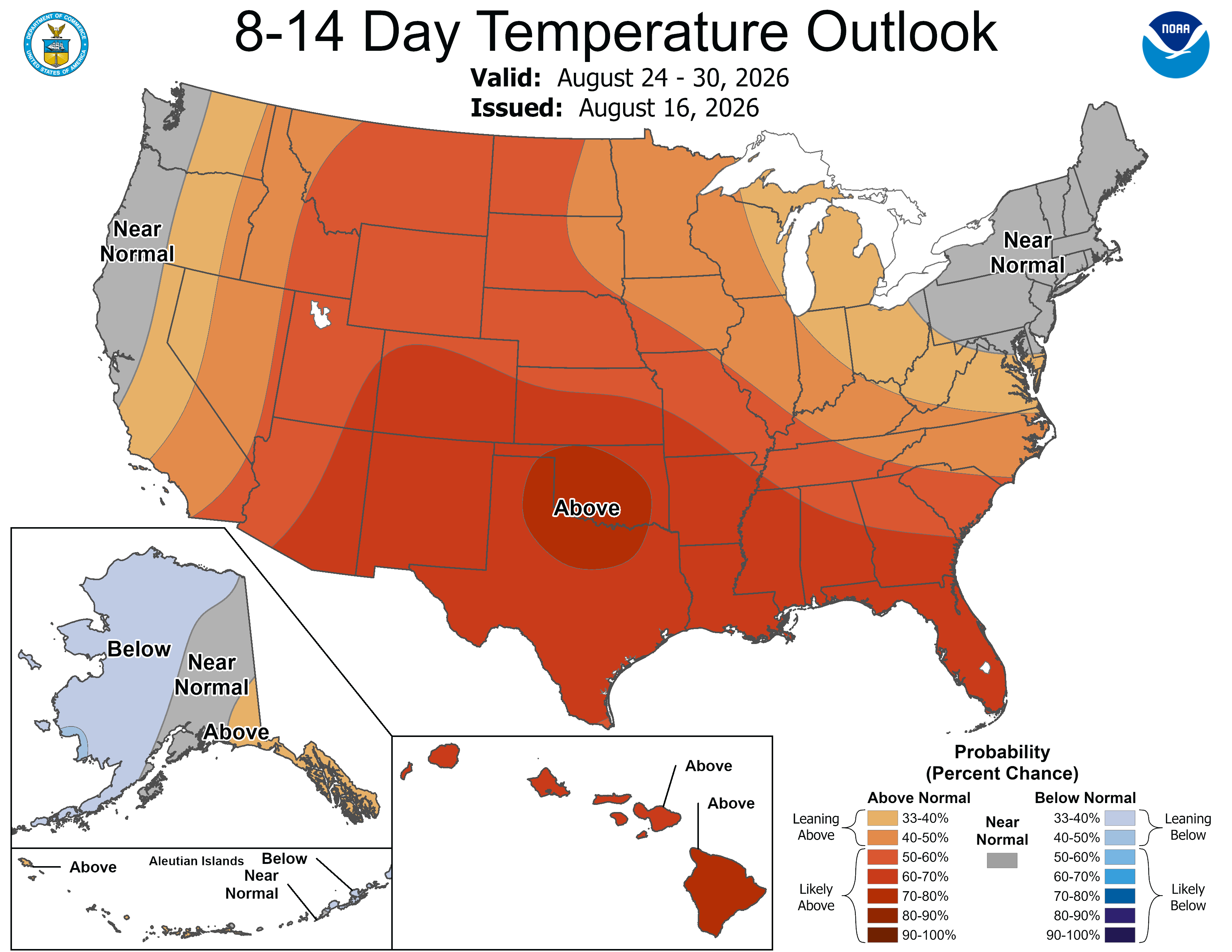
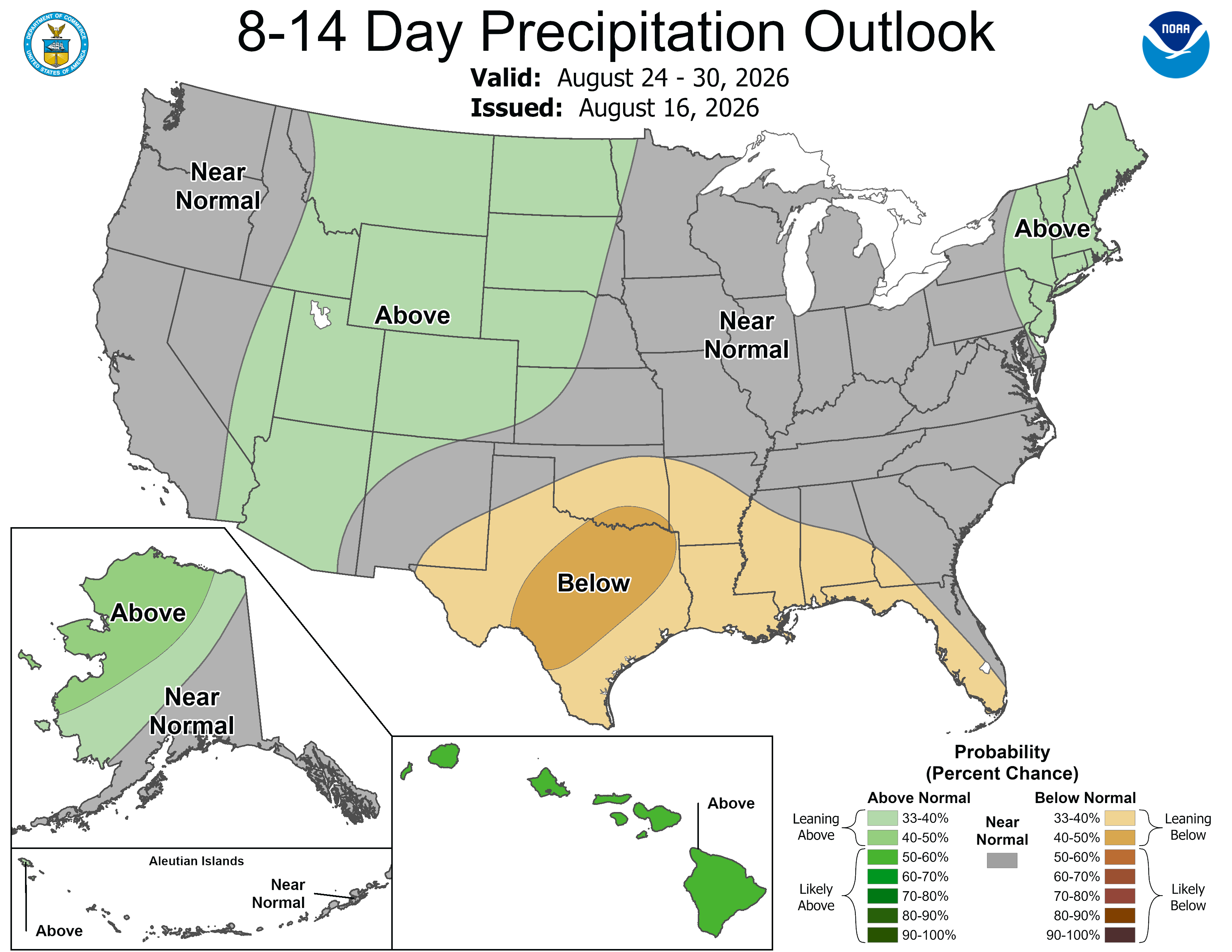
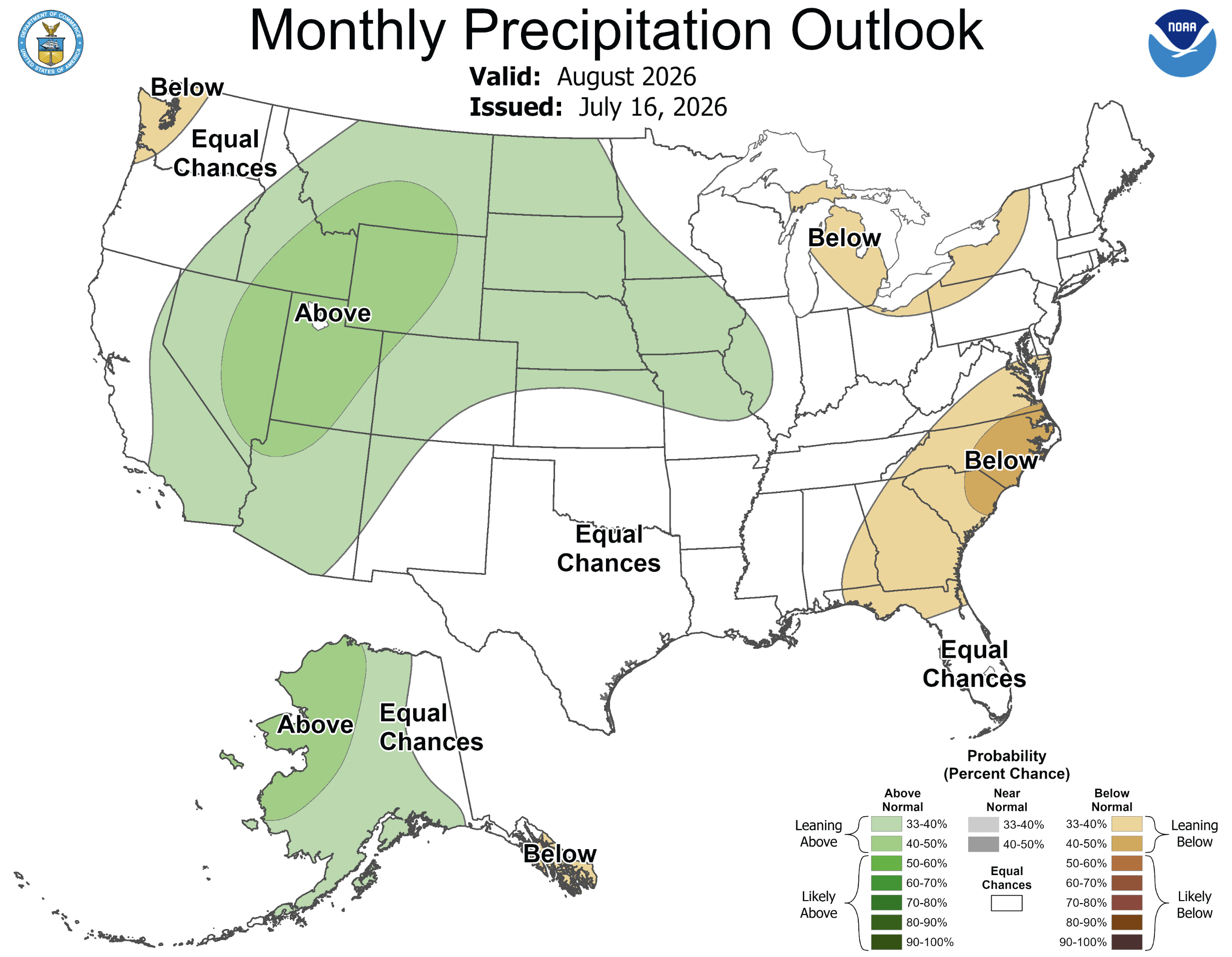
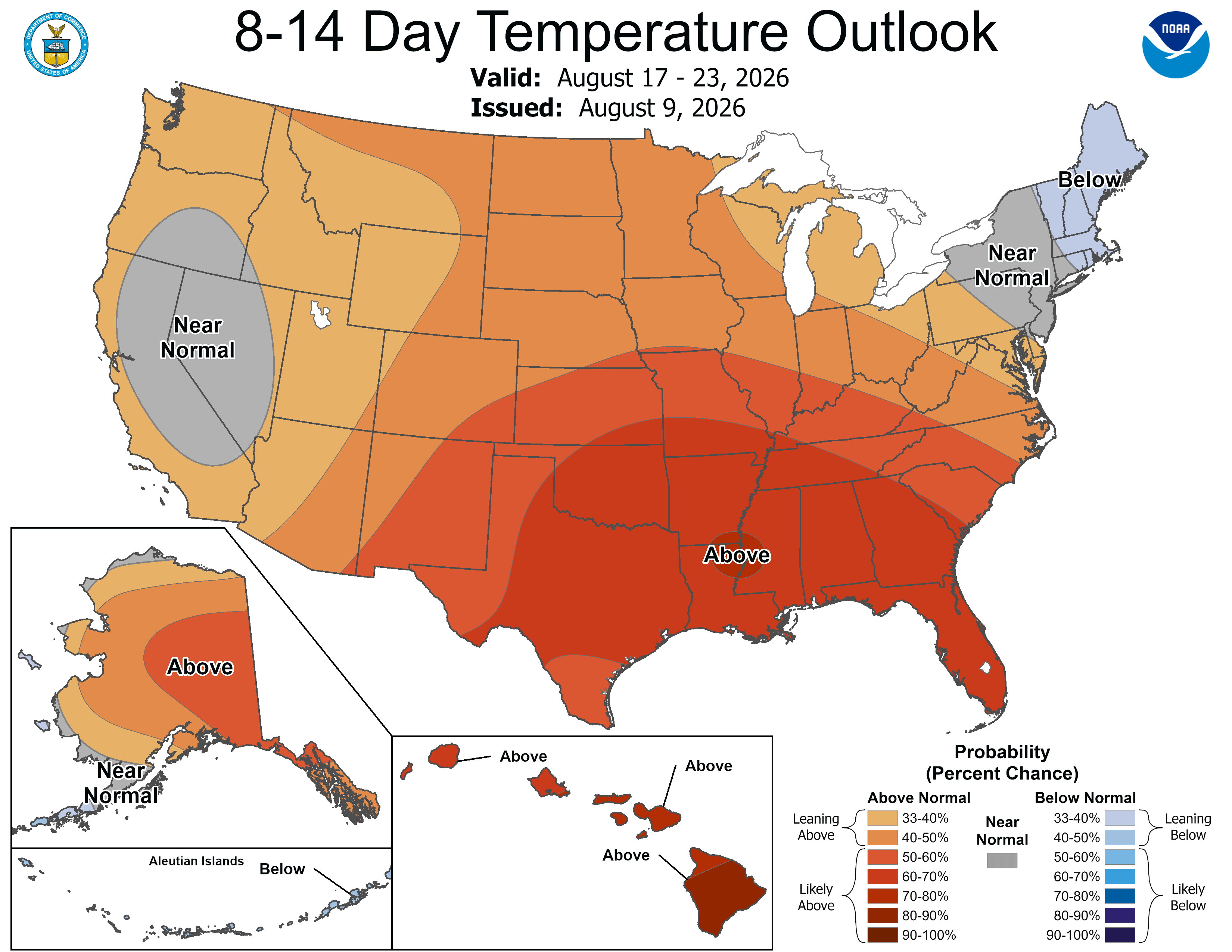
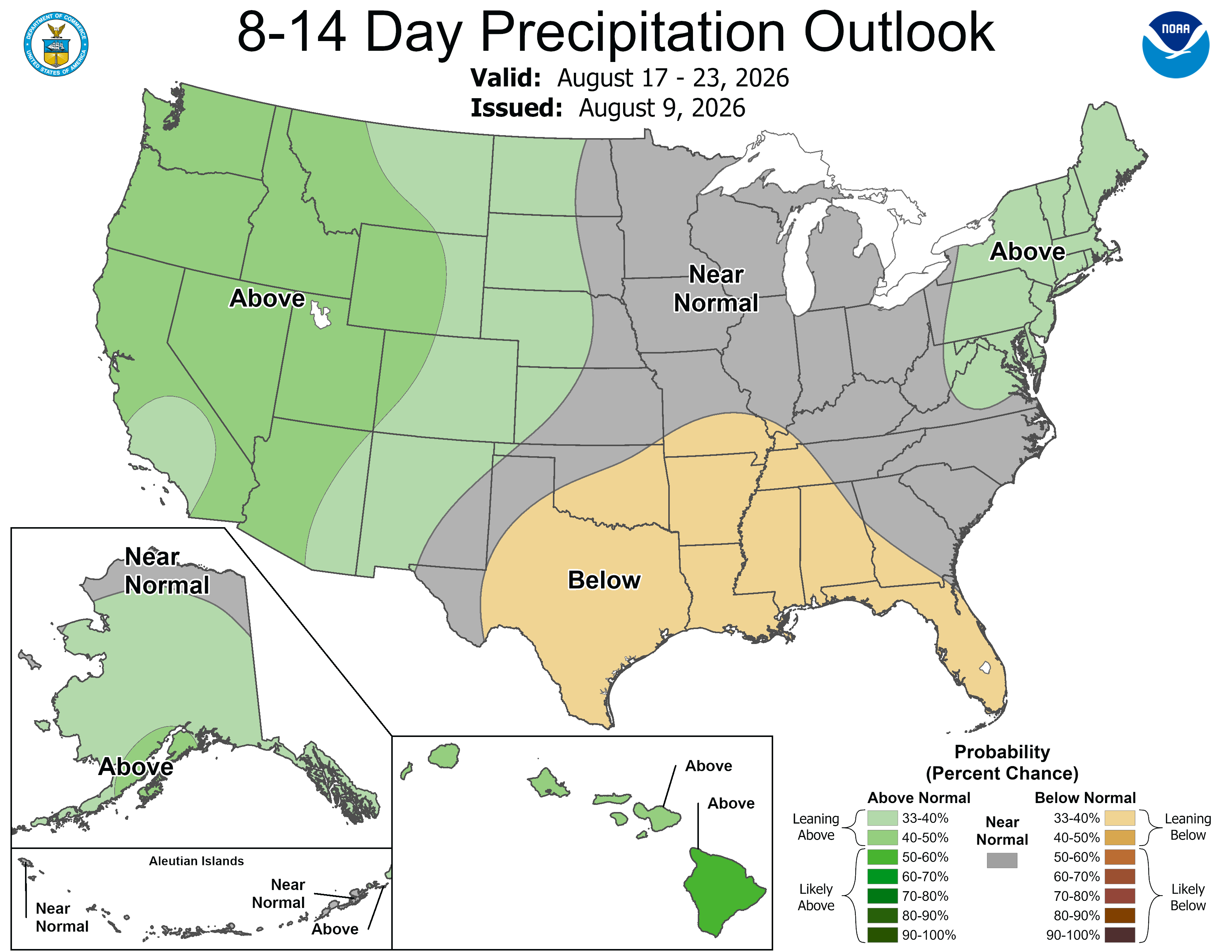
Below are the 8-14 day outlooks from the Climate Prediction Center, issued August 16, 2026, for temperature and precipitation, for the week starting August 24, 2026. The CPC expects above normal temperatures and above normal precipitation for the mountains of the South Platte River Basin.
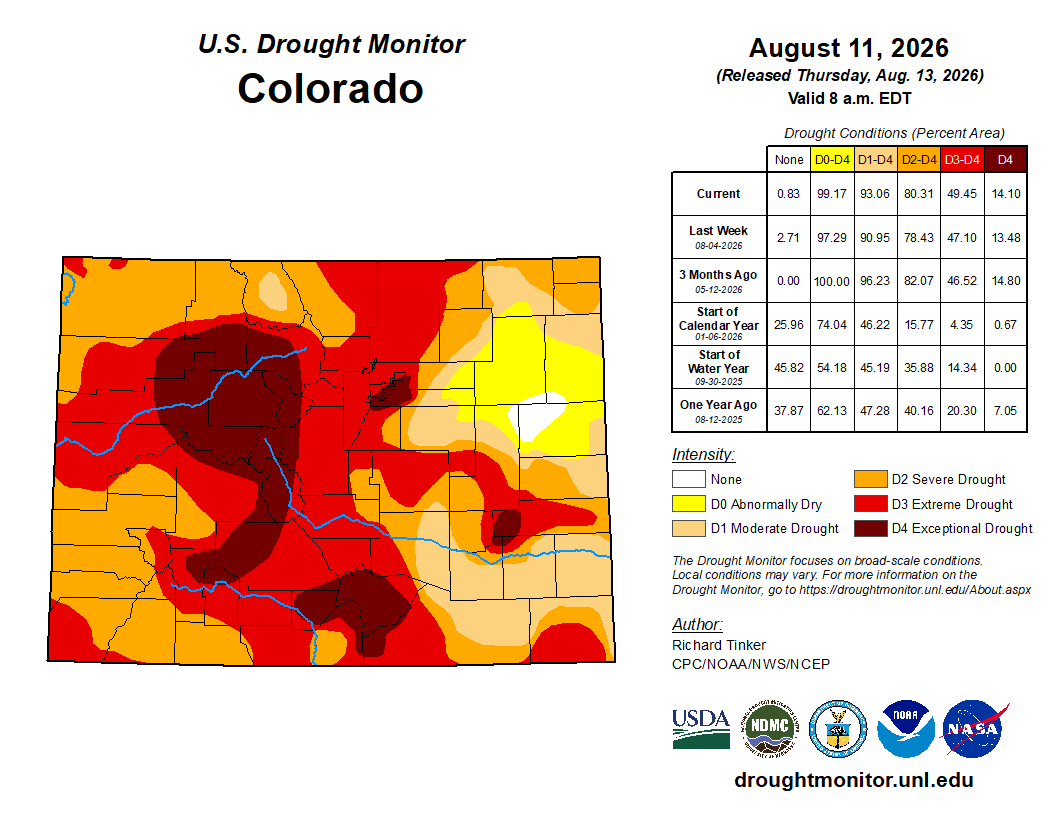
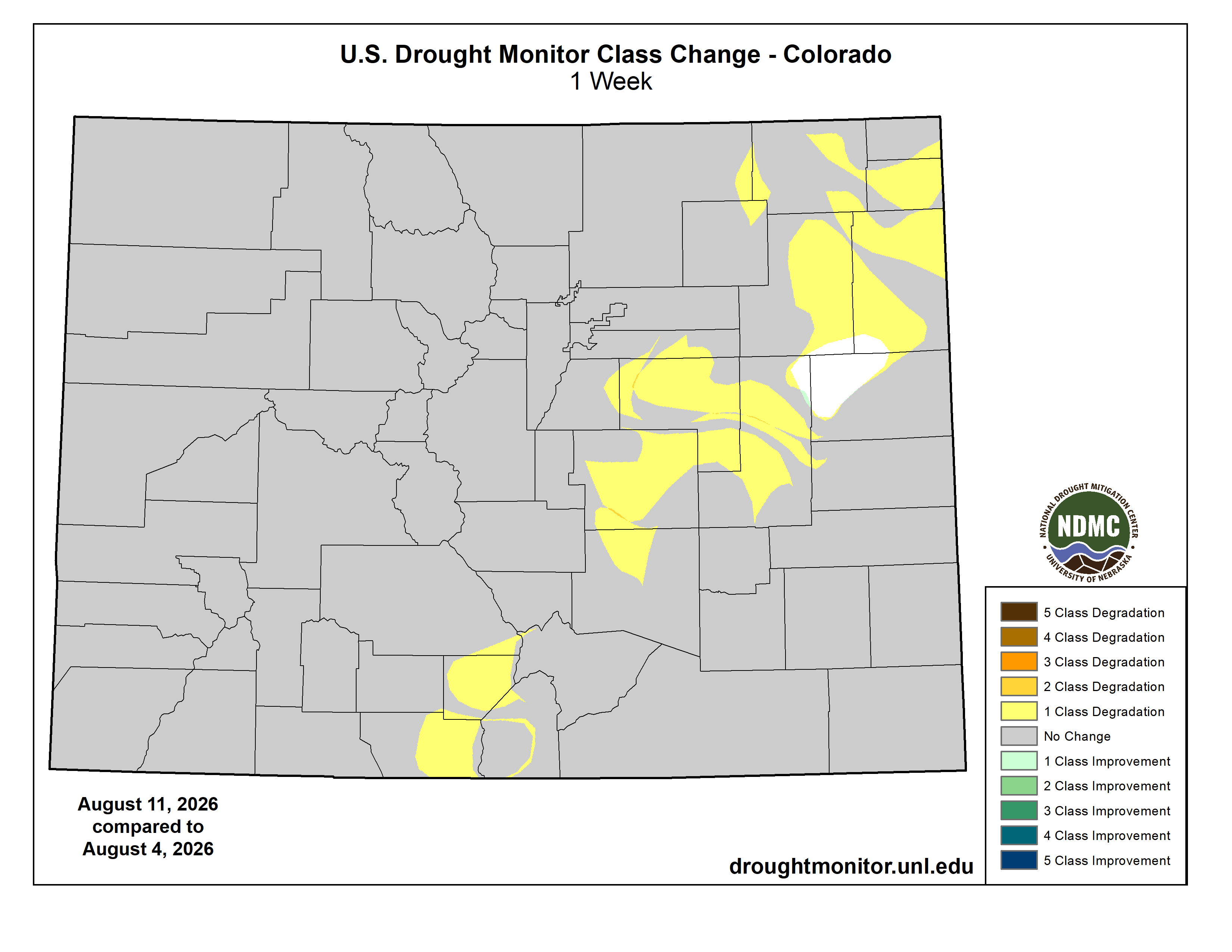
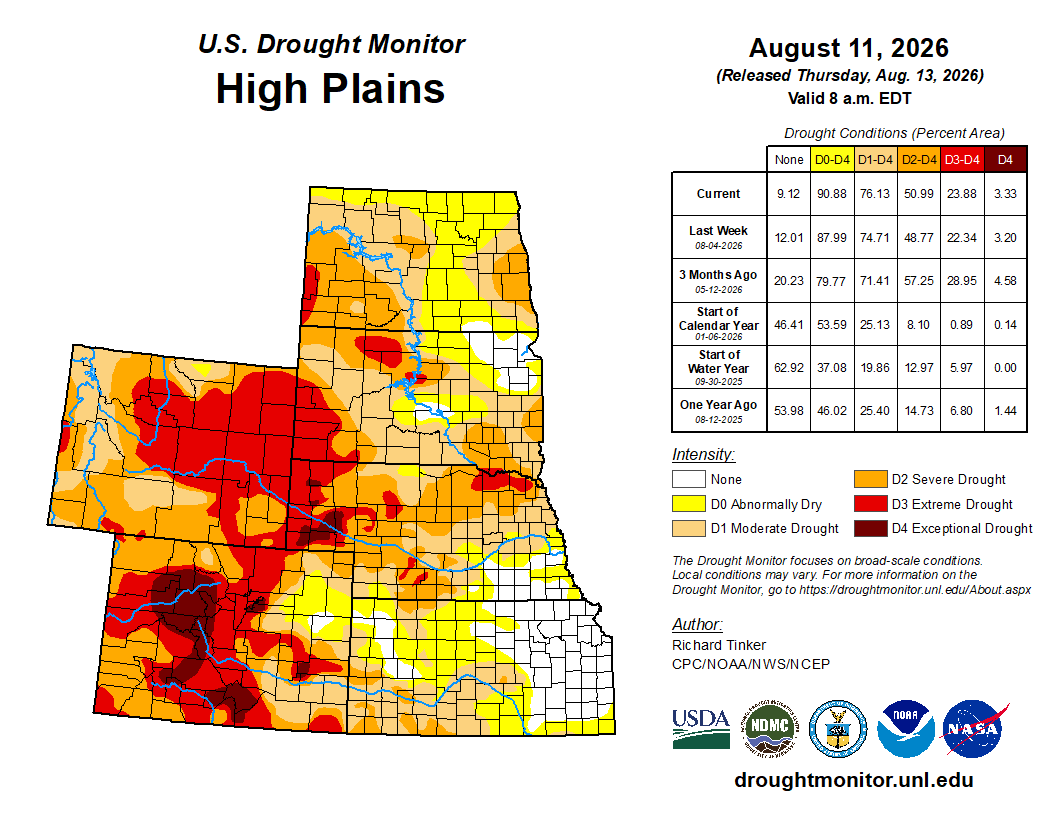
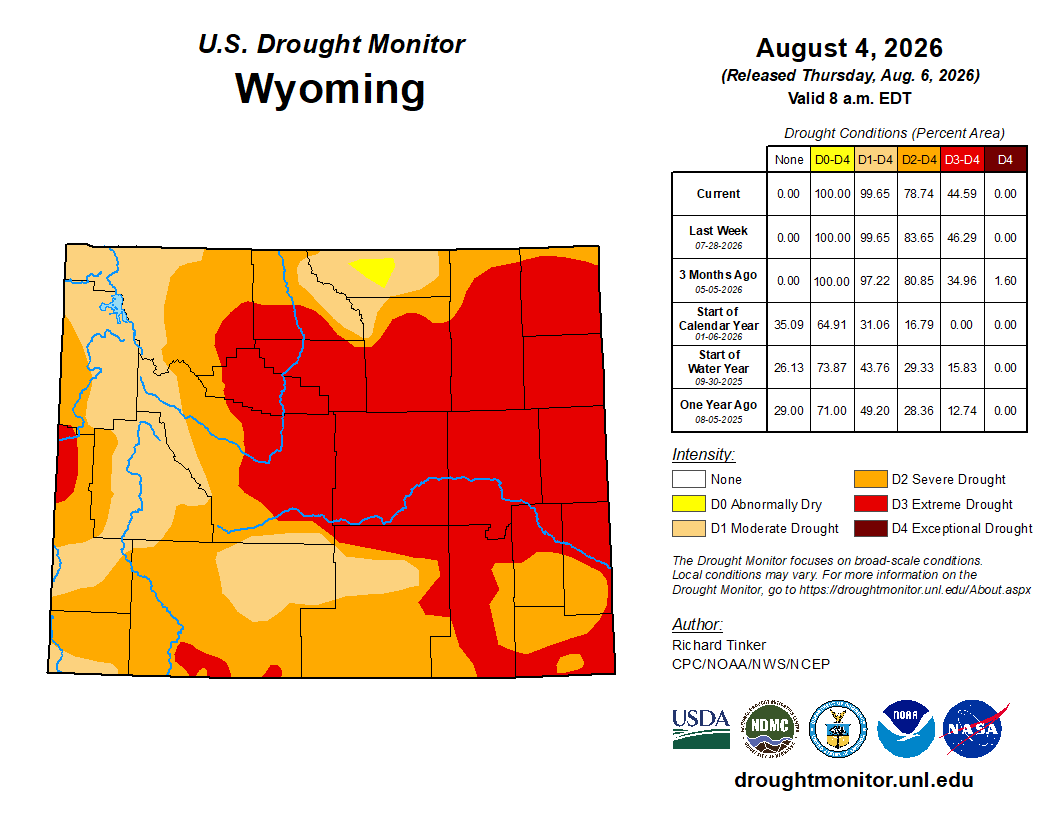
Below is the Colorado Drought Monitor map from August 11, 2026. There were one class degradations in Douglas, Arapahoe, Elbert, Morgan, Weld, Logan, and Sedgwick counties. Drought and abnormal dryness covers 99.17% of Colorado. The South Platte Basin is experiencing Abnormally Dry, Moderate, Severe, Extreme, and Exceptional drought conditions.
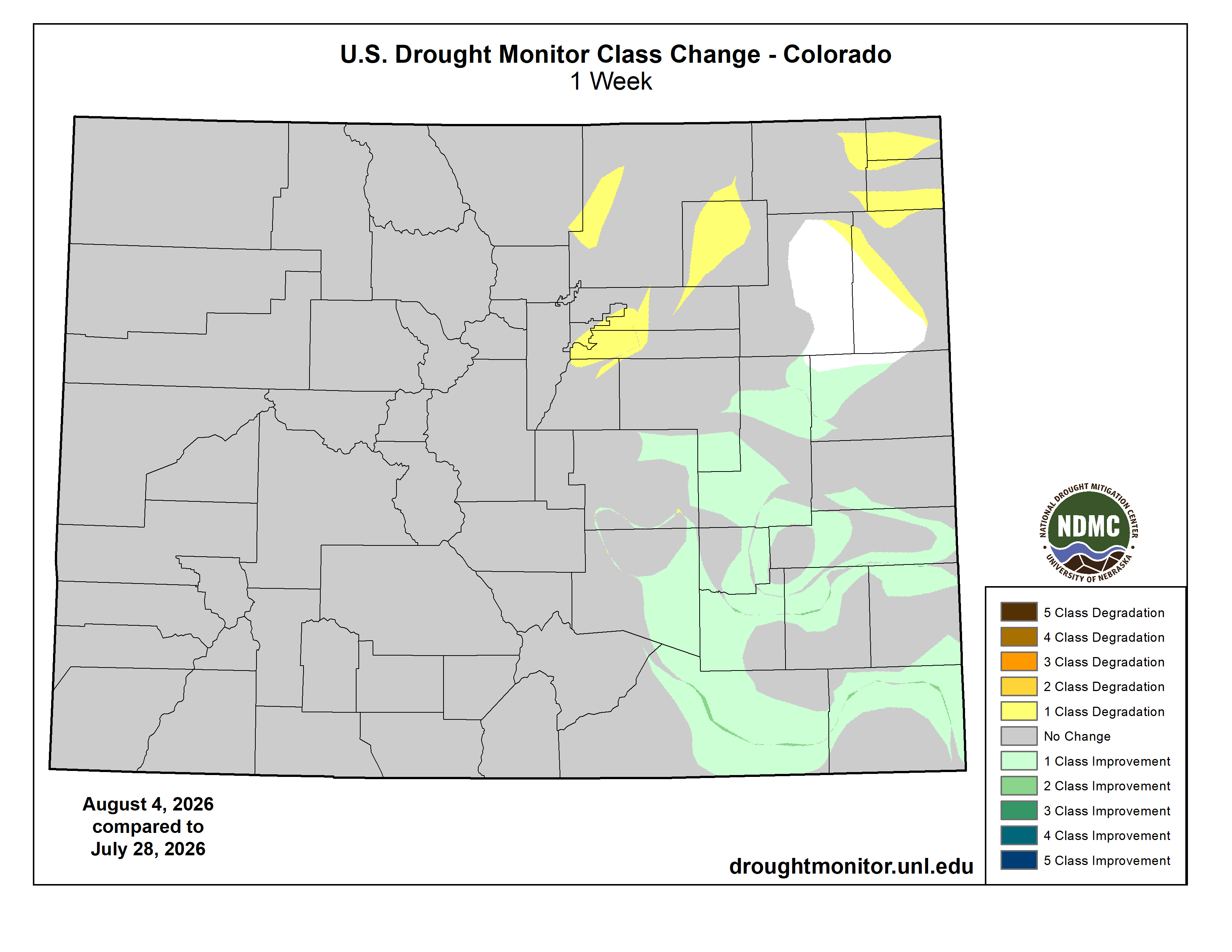
Below is the Colorado Drought Monitor one week change map ending August 11, 2026.
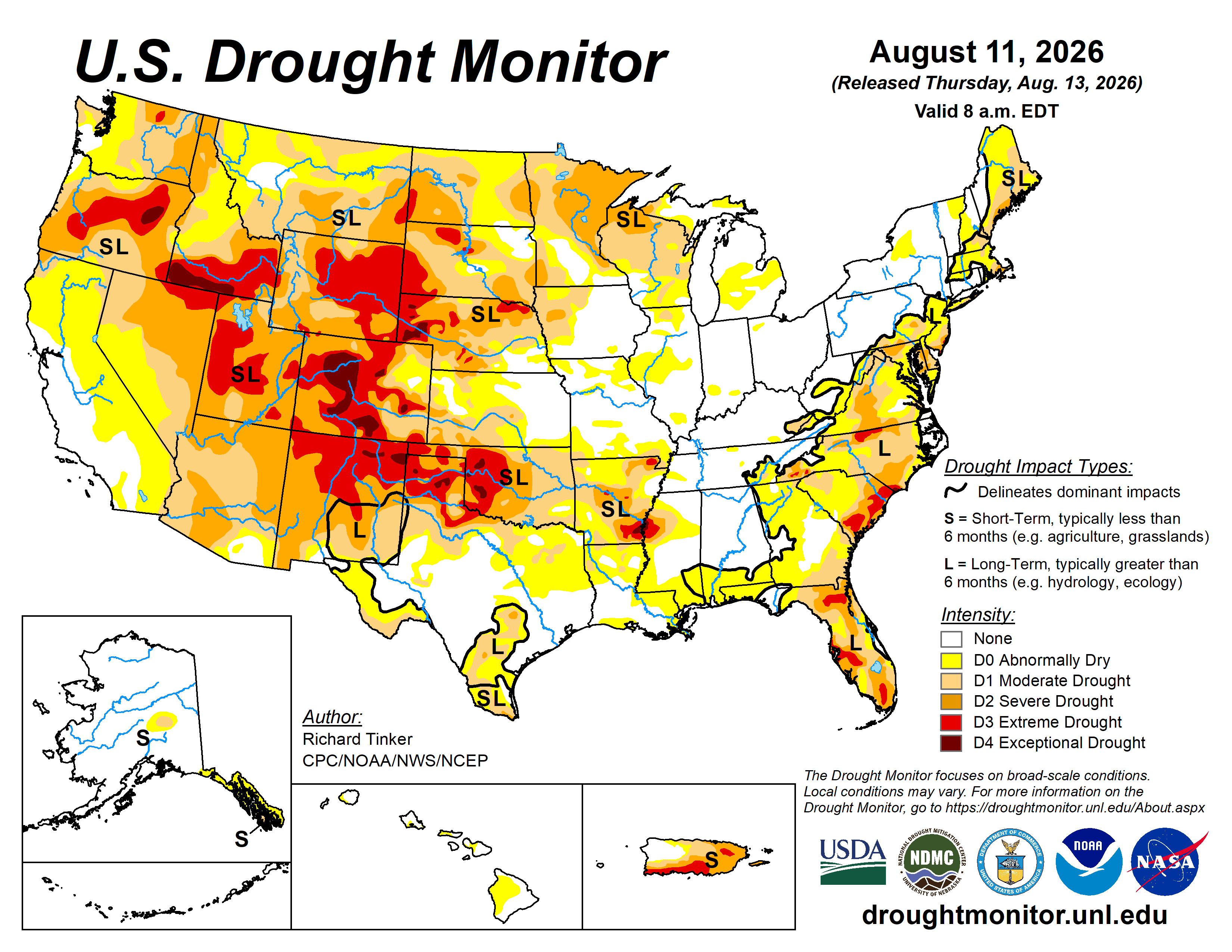
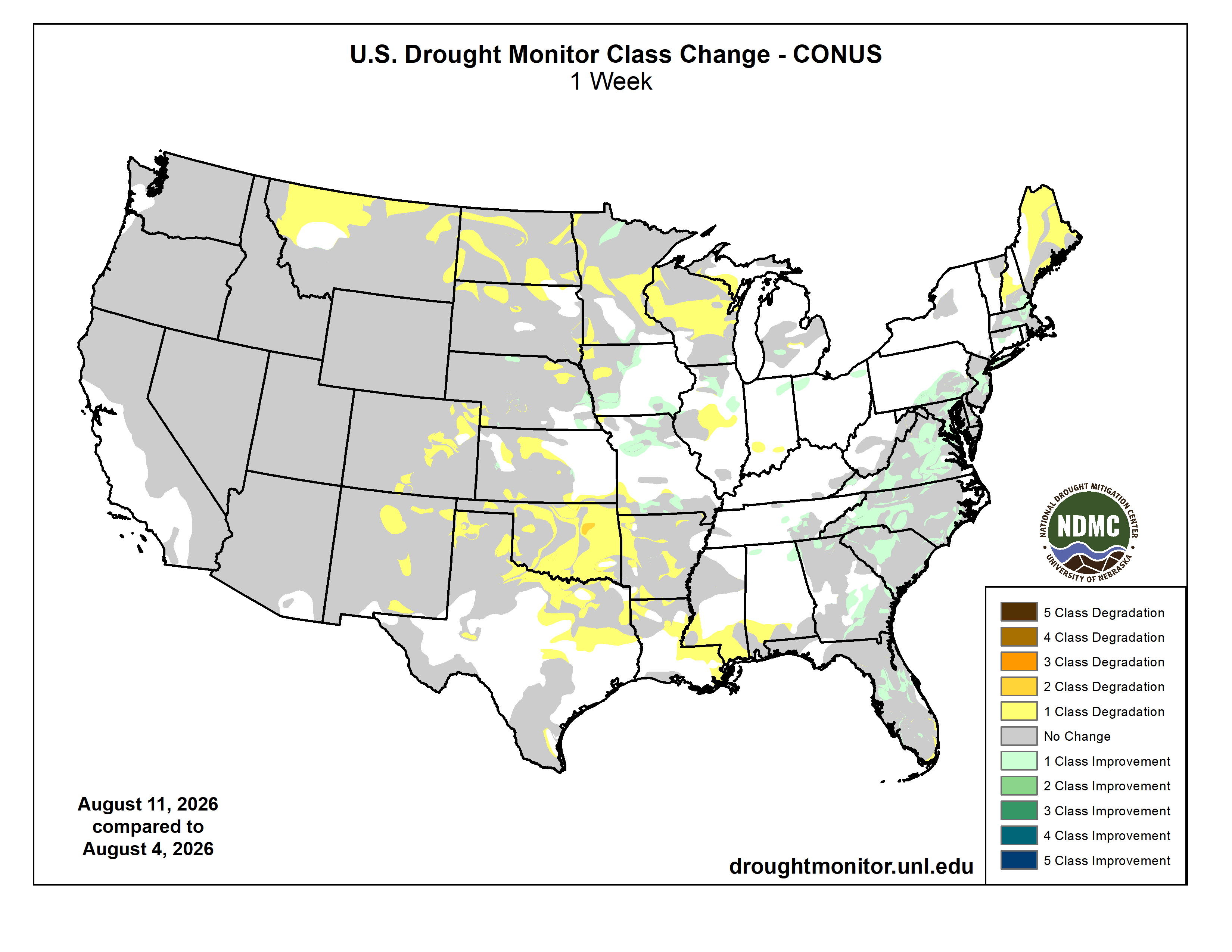
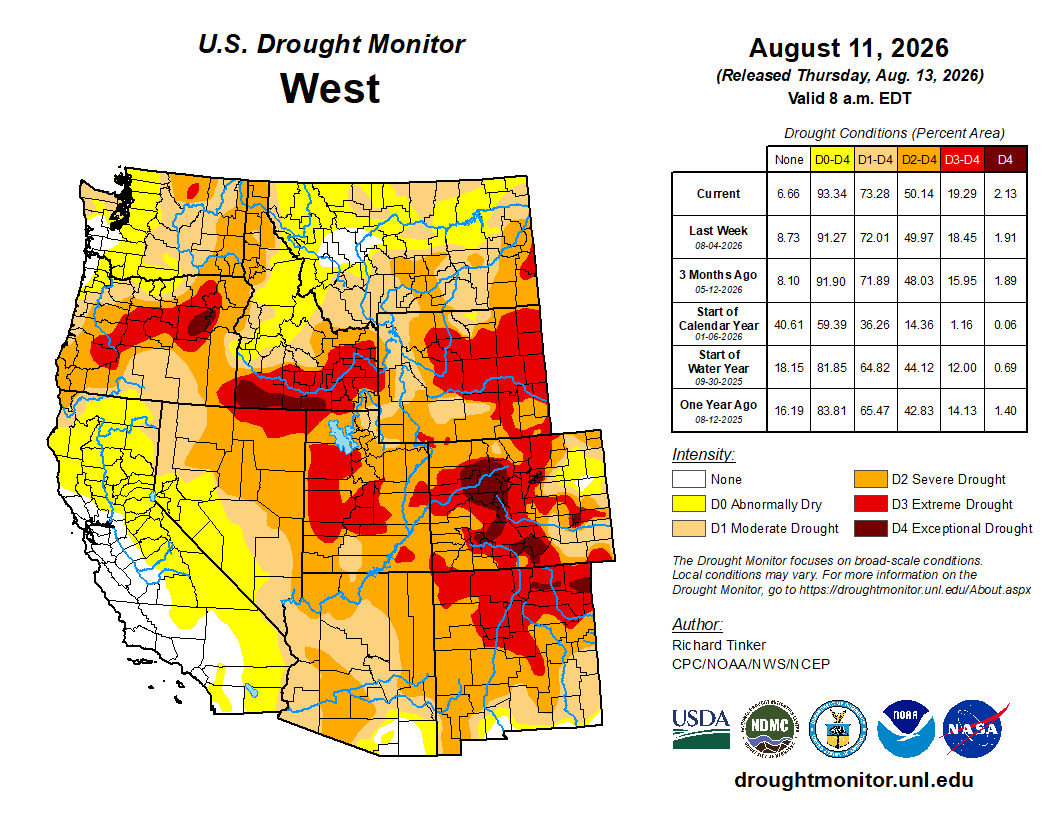
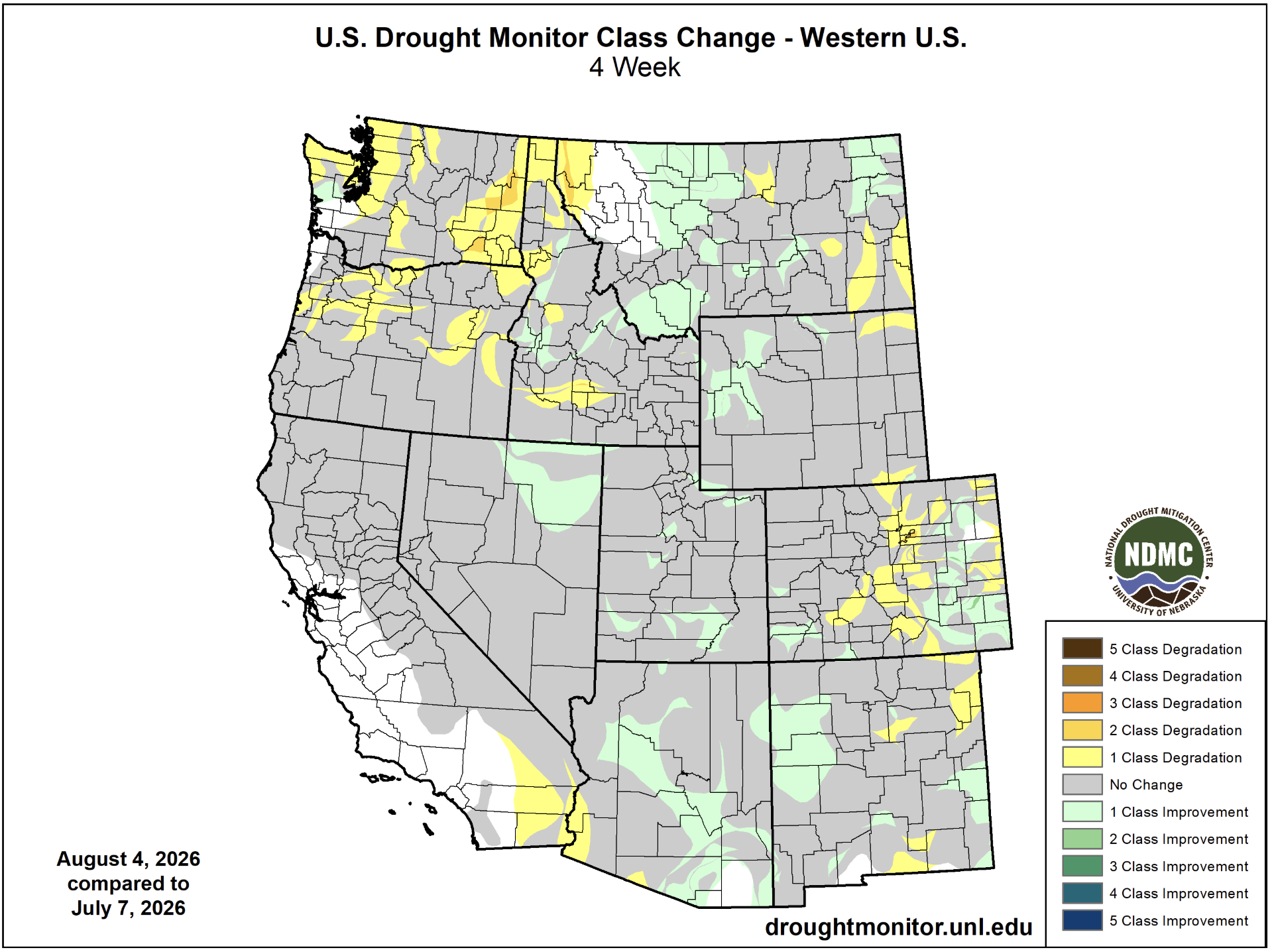
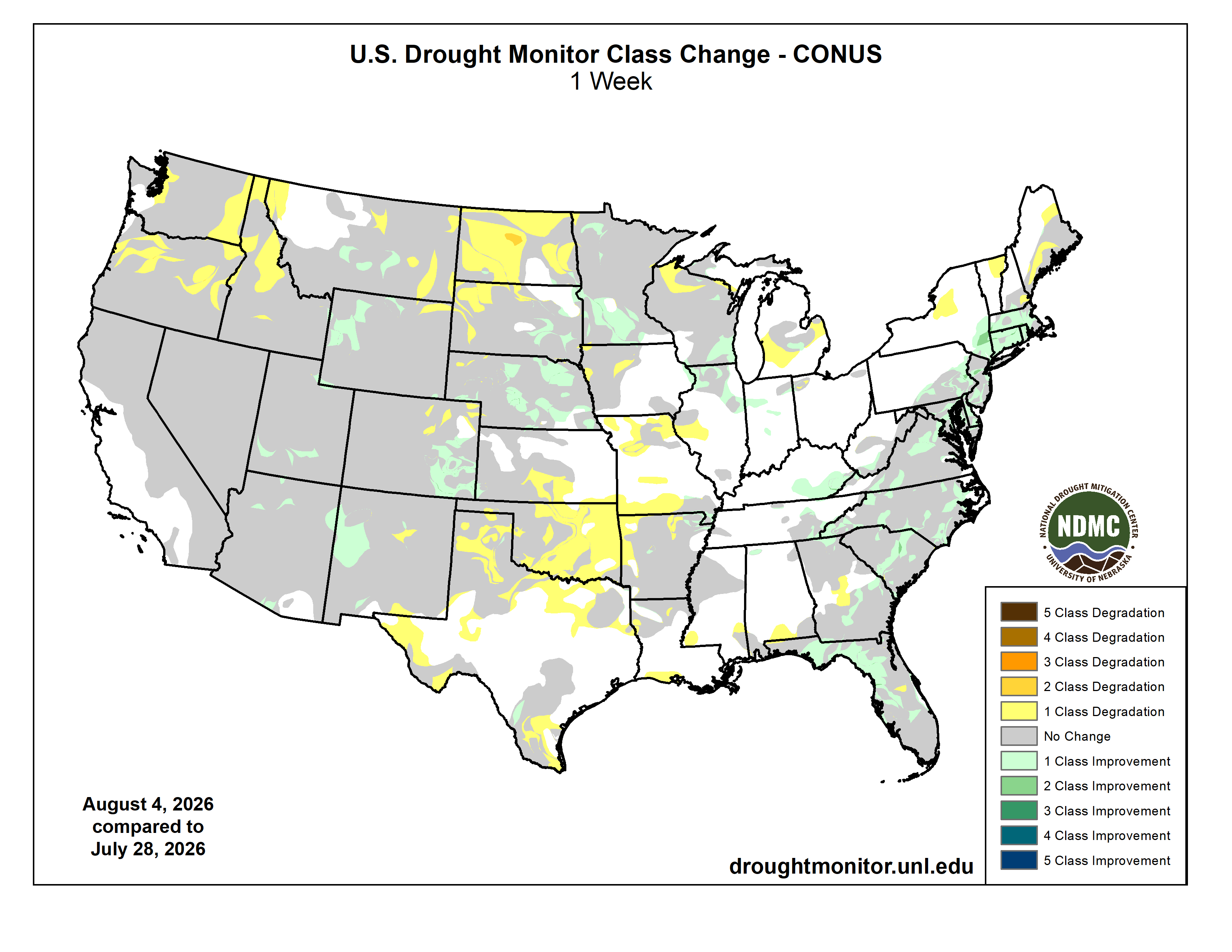
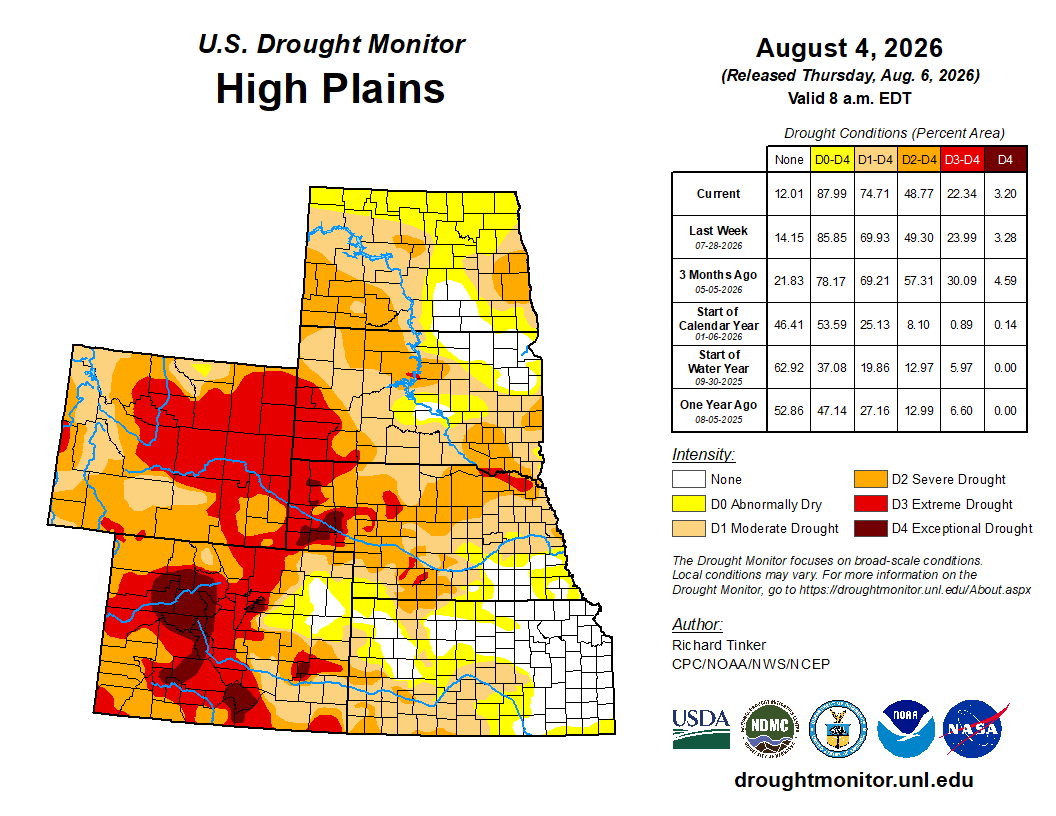
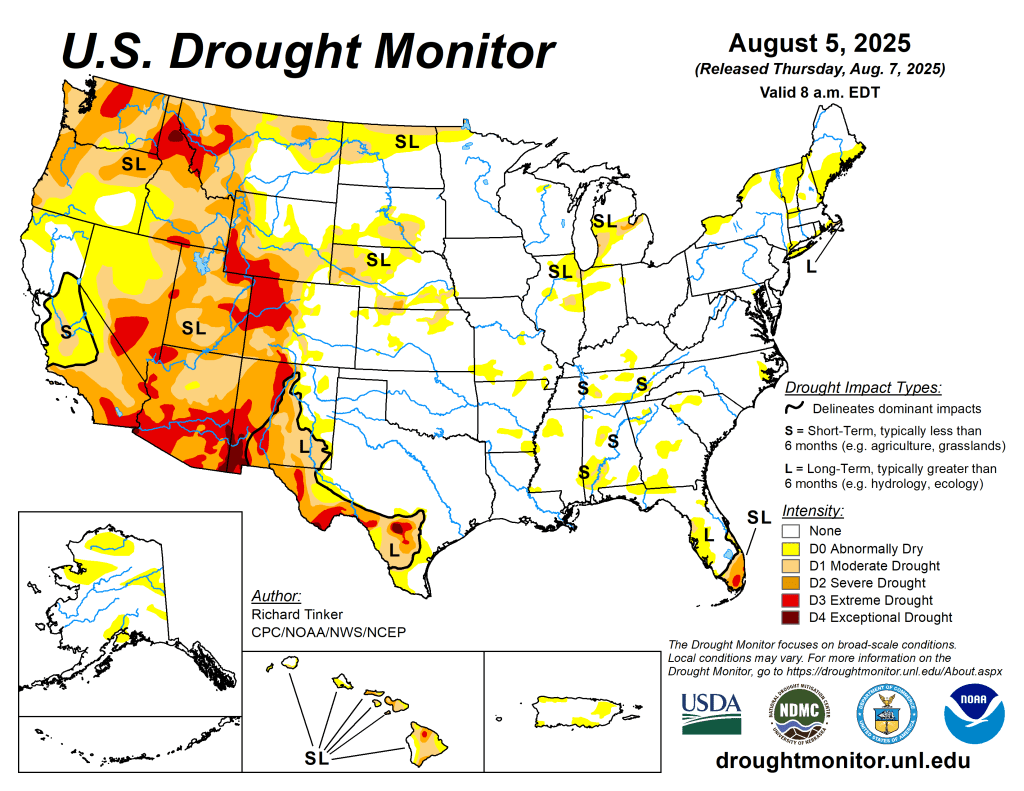
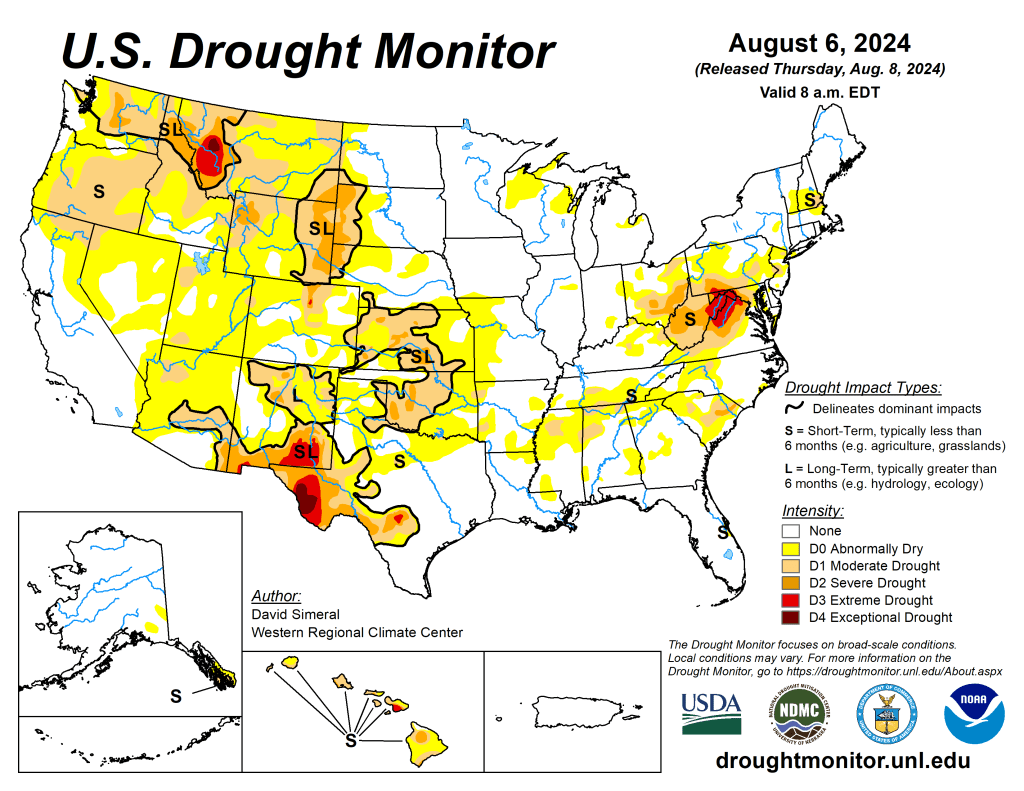
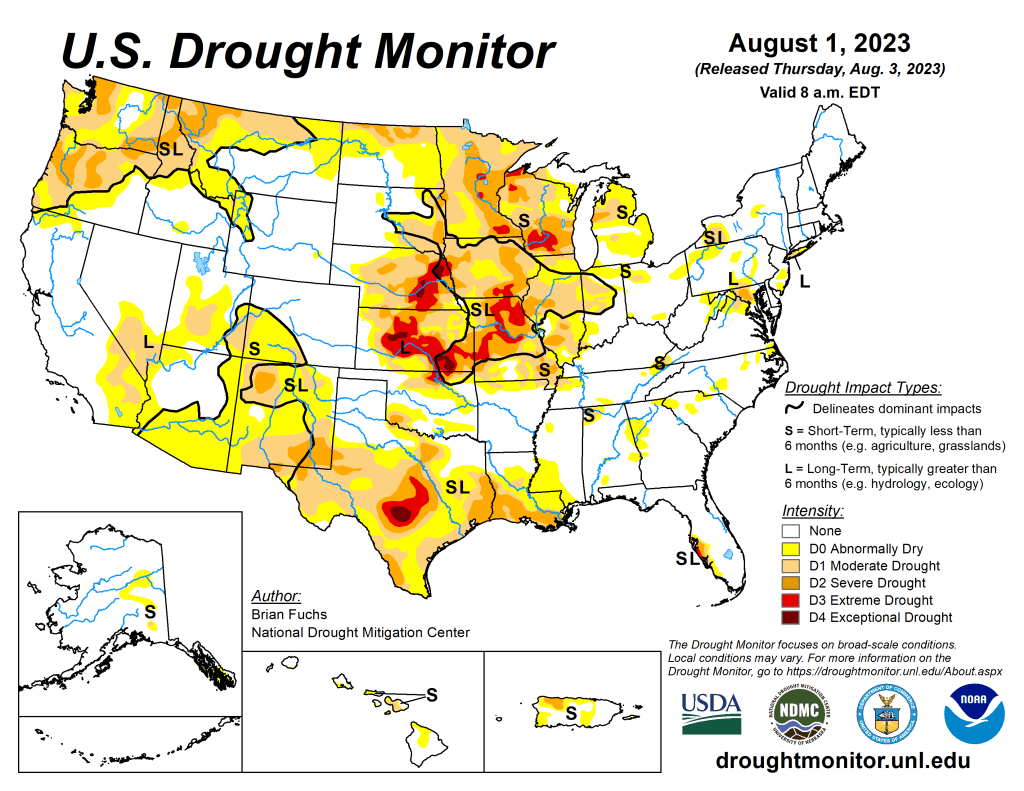
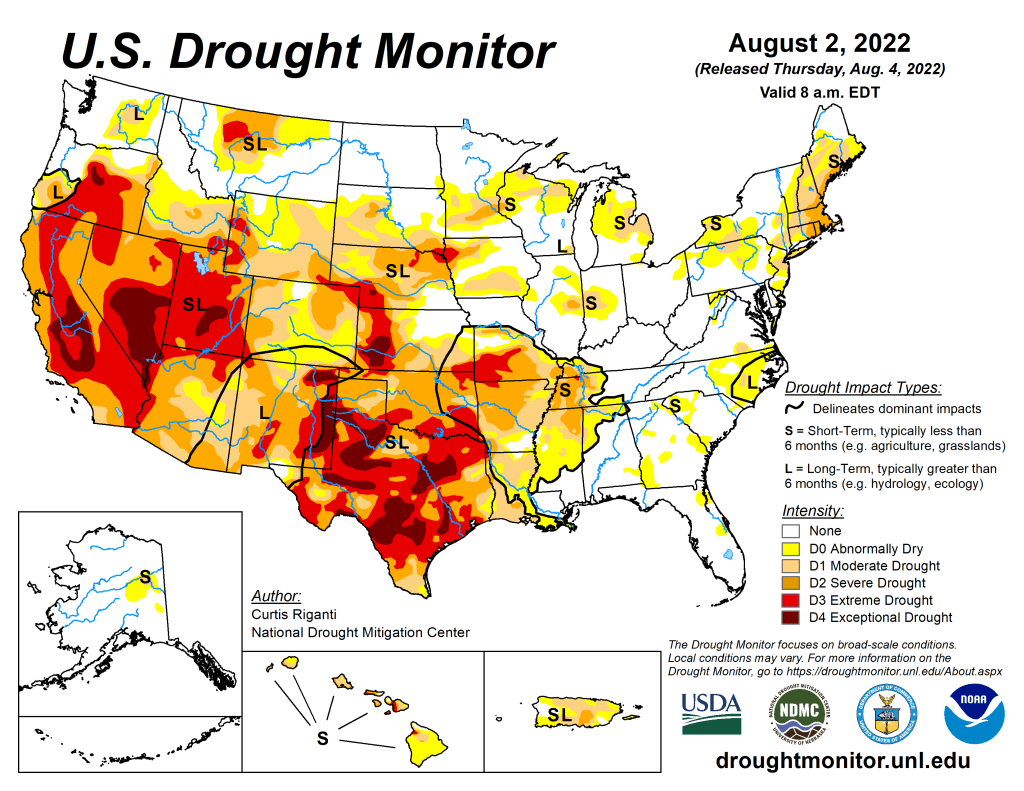
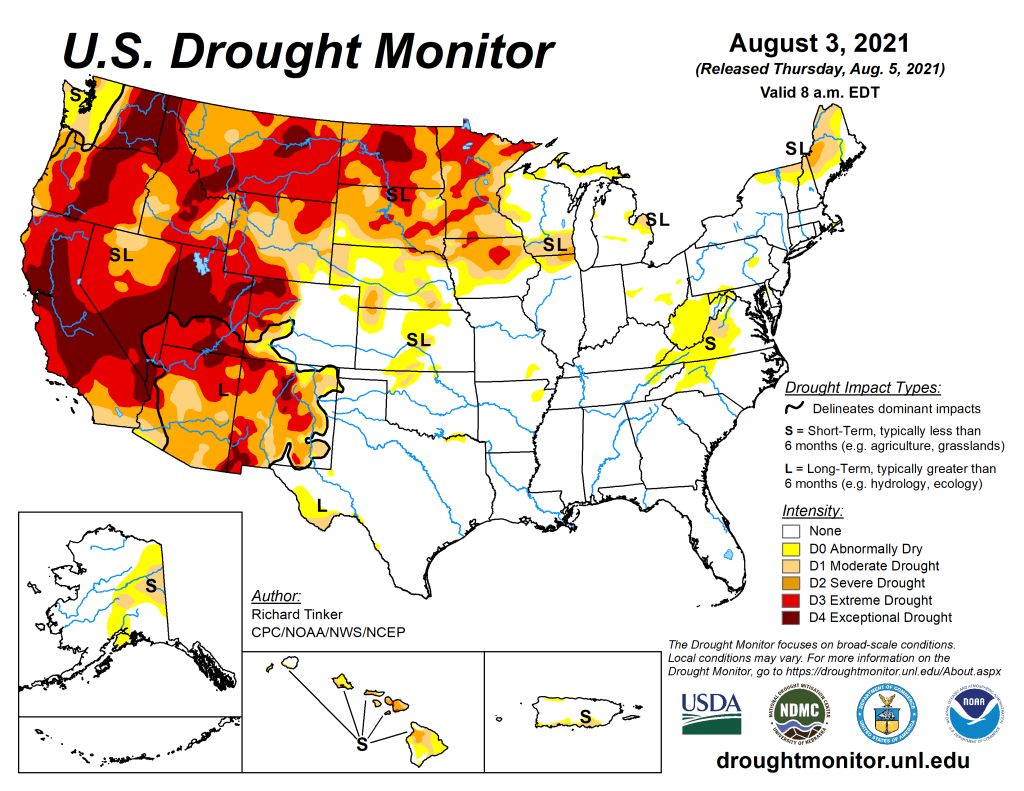
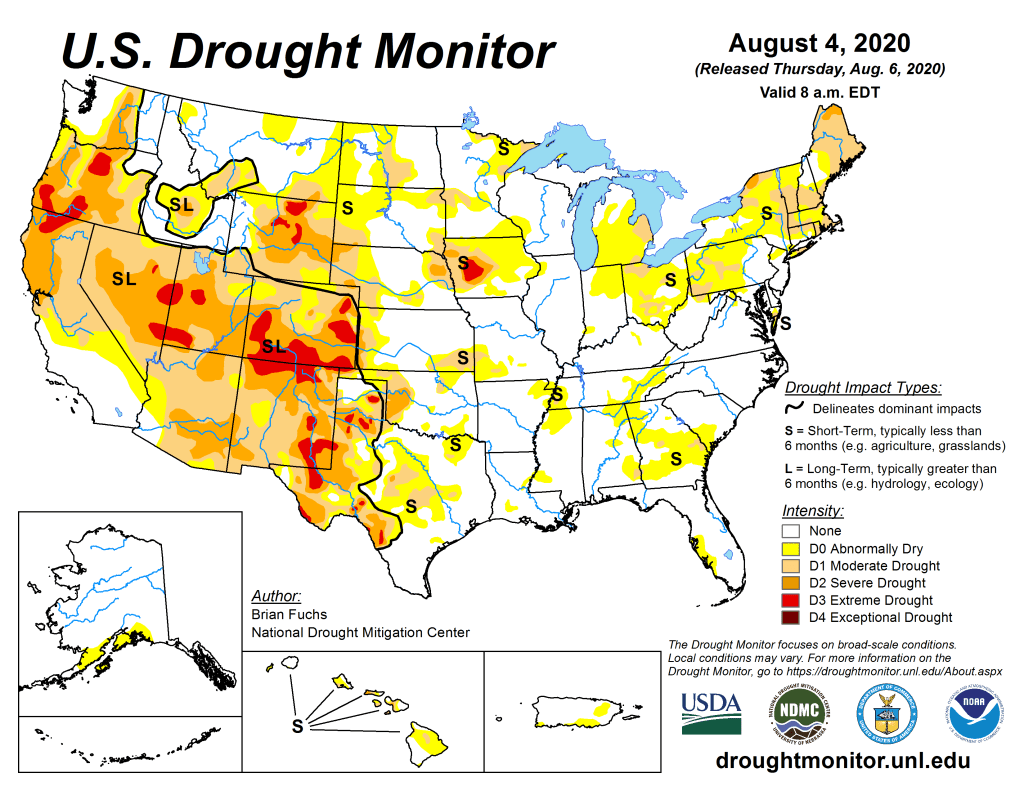
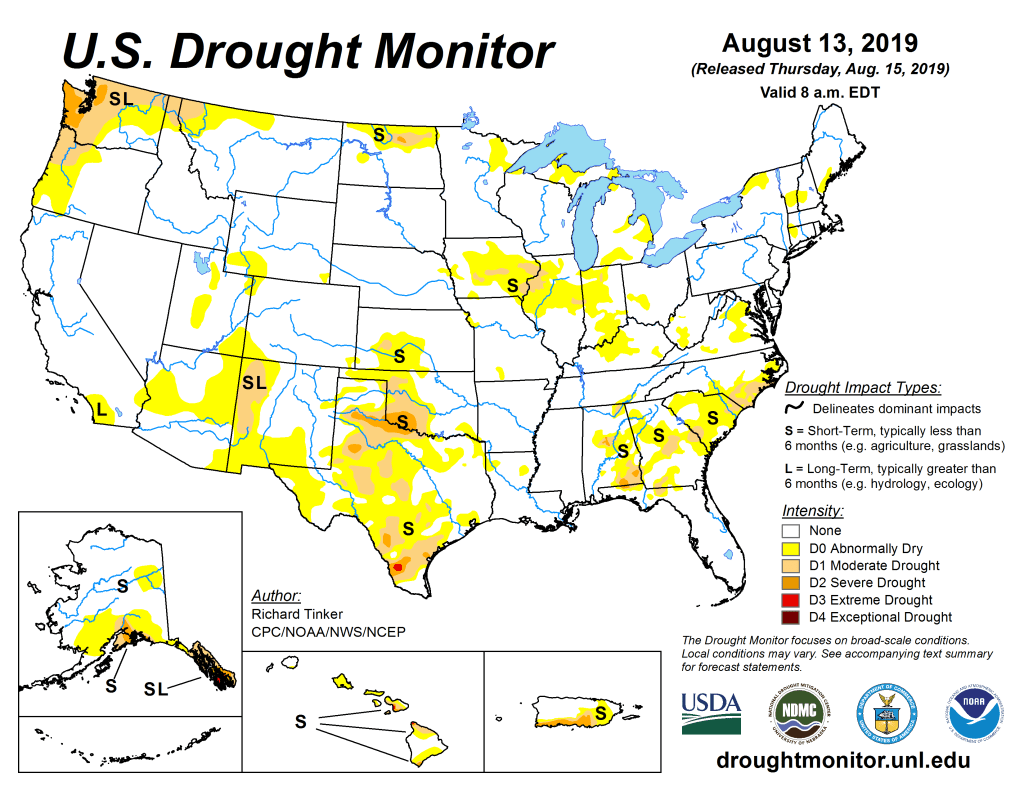
Here’s the US Drought Monitor Map from last week along with the one week U.S. change map.
Finally, Western Water Assessment released their latest Intermountain West Briefing recently. From the briefing:
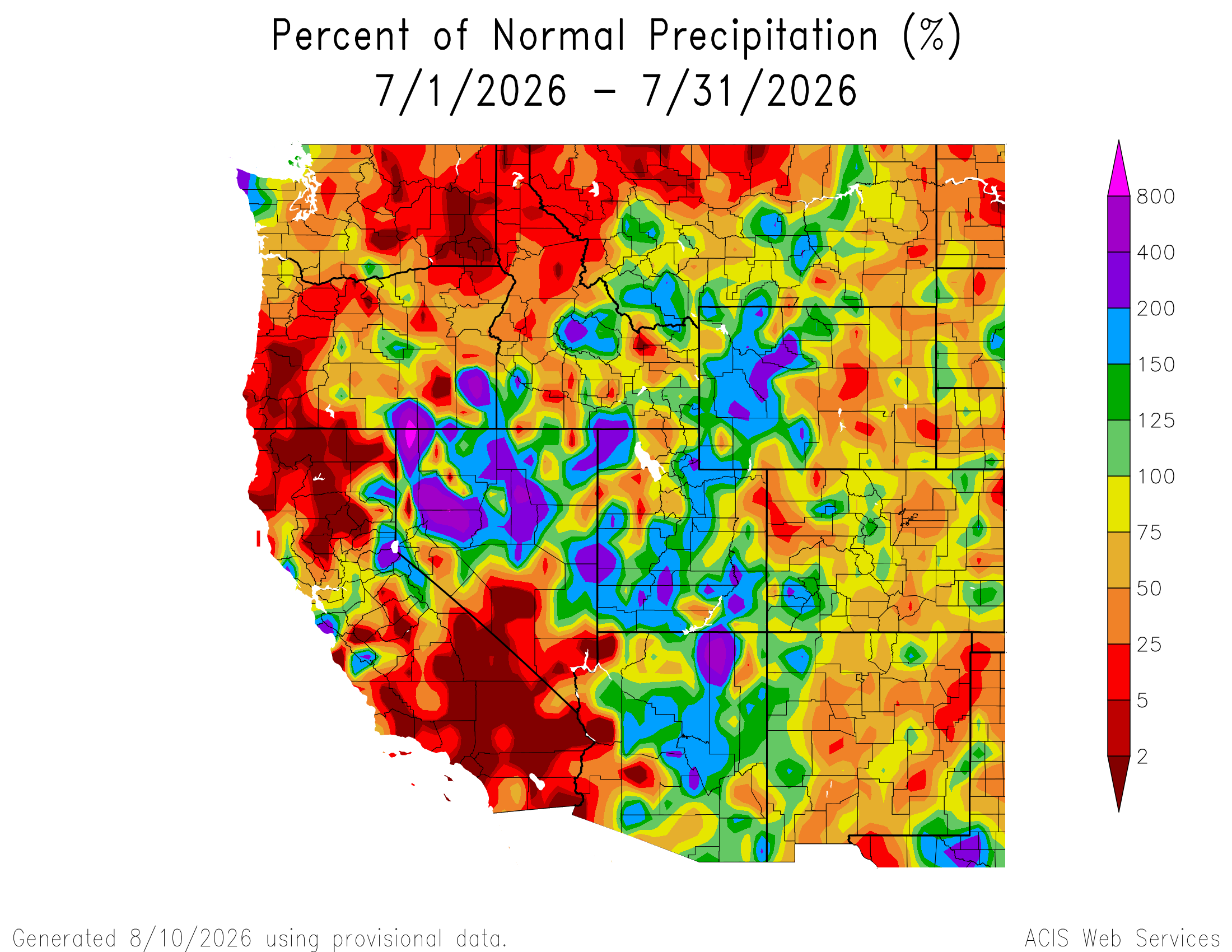
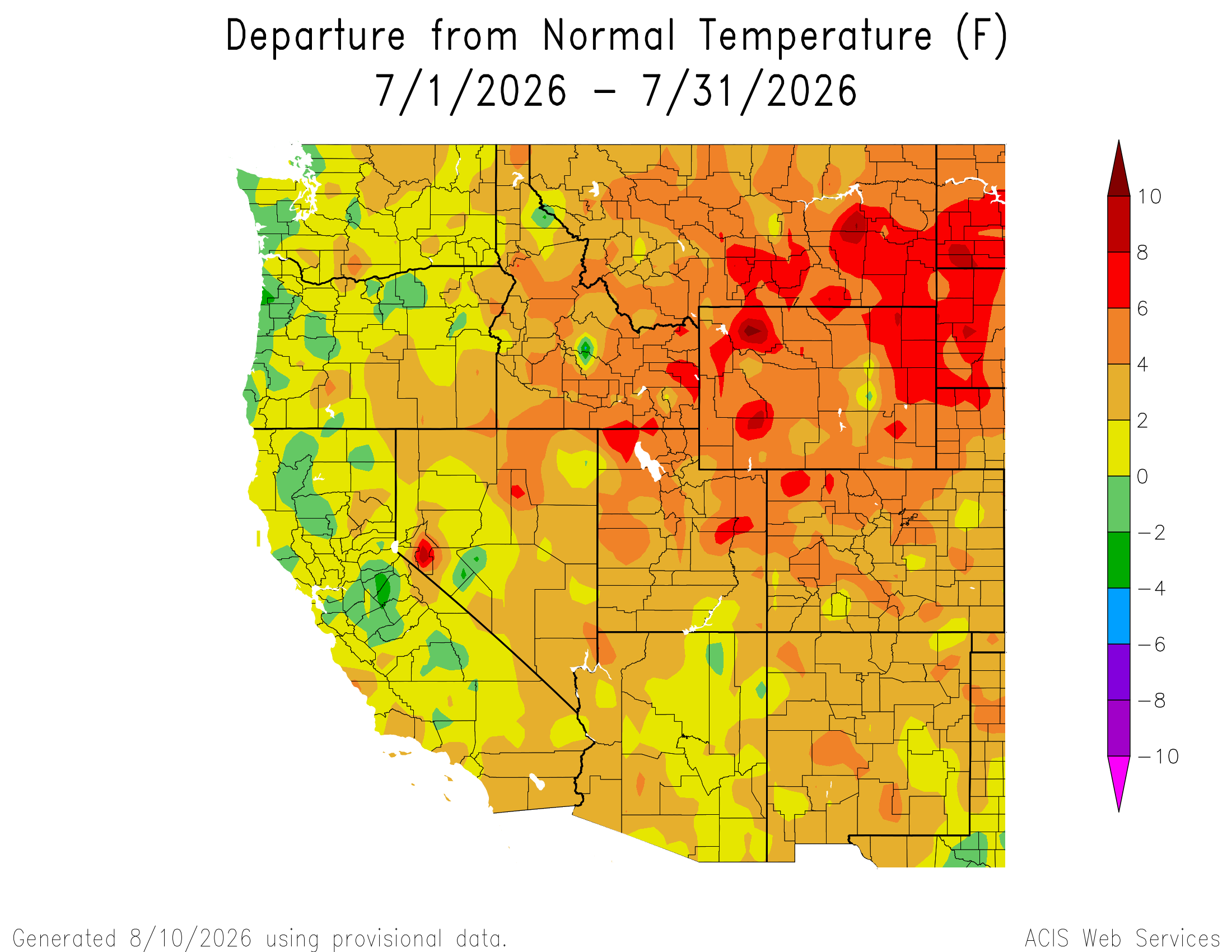
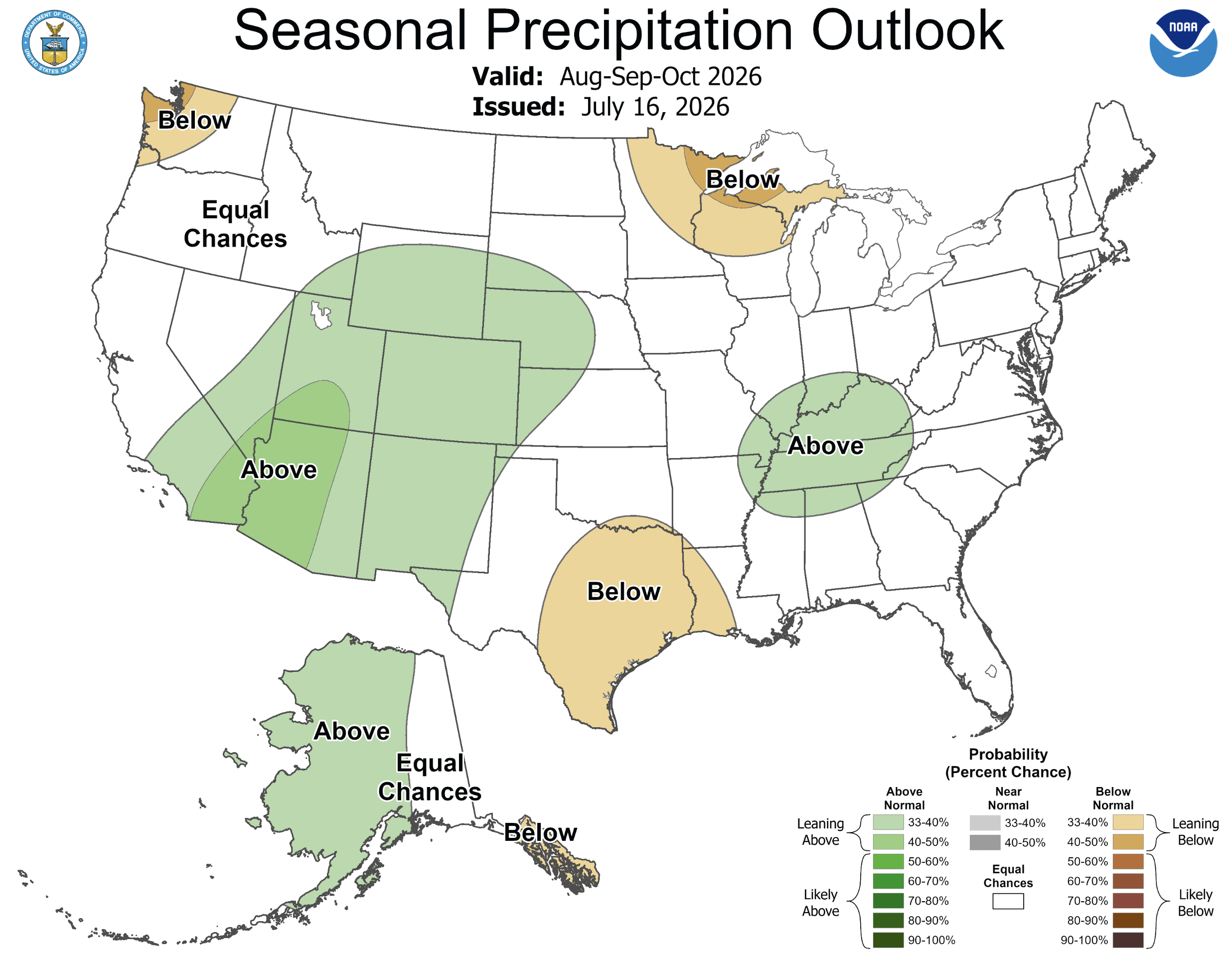
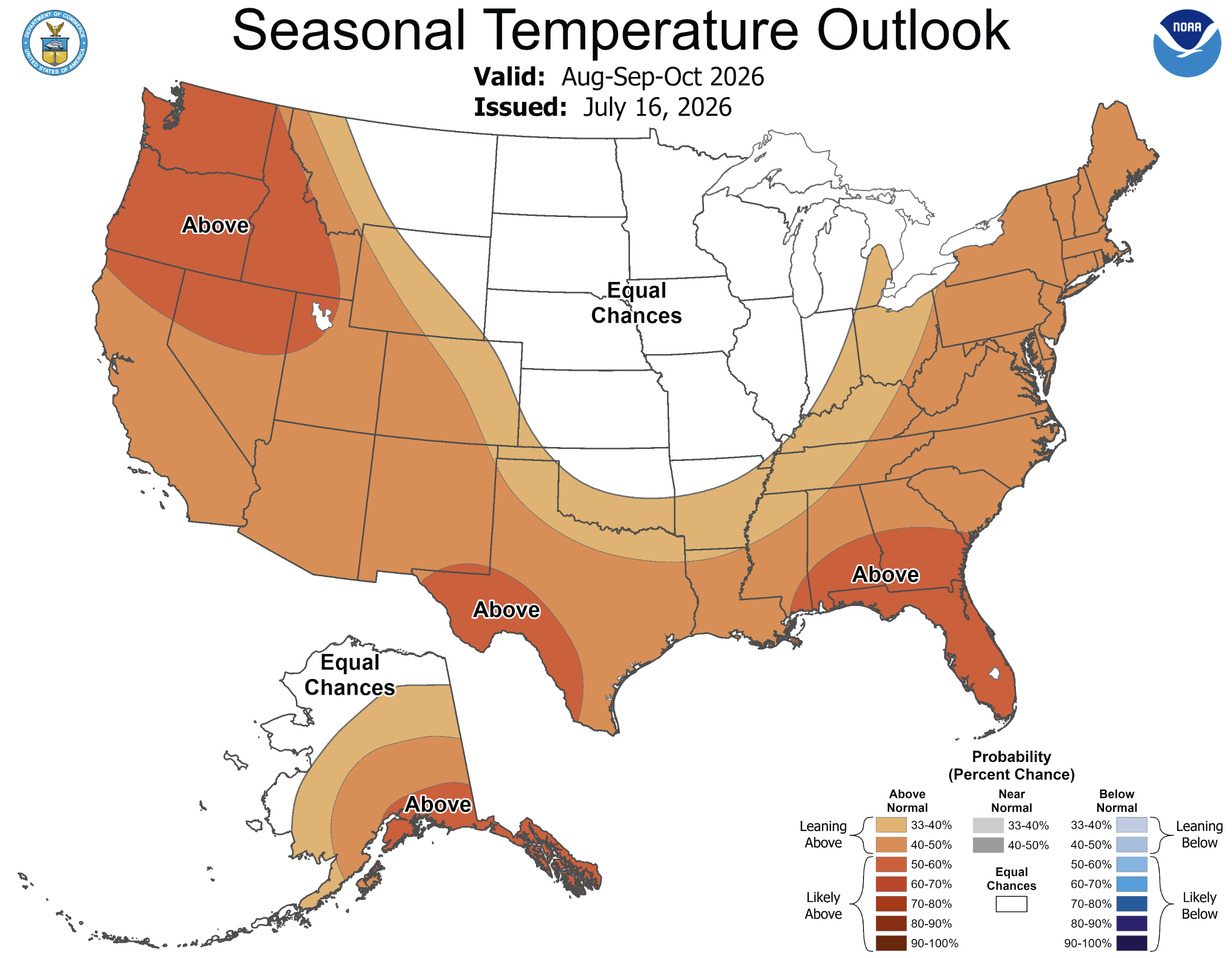
July precipitation was above average across much of Utah, western Colorado and western Wyoming, while below average precipitation fell in eastern Wyoming and much of Colorado. Regional temperatures were above to much above average across the region, and all-time daily maximum temperatures were set across all three states. Drought conditions prevail with 97% of the region covered by drought, and extreme or exceptional drought covered 35-45% of Colorado, Utah and Wyoming. Seasonal NOAA forecasts suggest active monsoonal precipitation and an increased probability of above average precipitation for the next three months. Monsoonal thunderstorms were responsible for six fatalities in Utah during July; a family of five drowned in a flash flood near Bicknell, UT and a hiker was killed by lightning in the Wasatch Mountains near Salt Lake City.Heavy rainfall also caused severe flooding and damage to 200 homes due to debris flows from the Cottonwood Fire burn scar near Beaver, Utah.
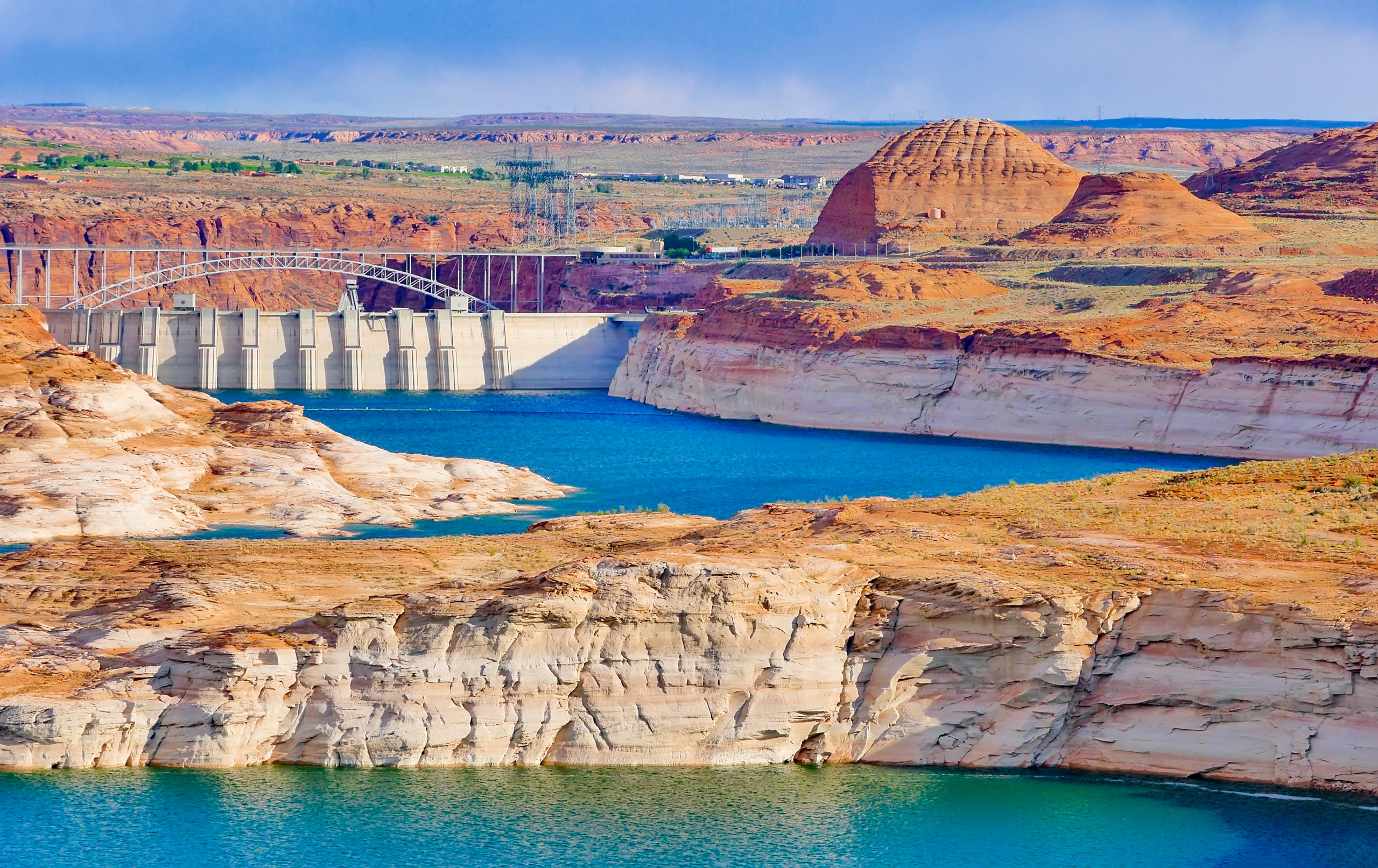
Glen Canyon Dam truly is a monumental structure, a 726-foot tall, 5-million-cubic-yard concrete plug that attempts to control and harness the tempestuous waters of the mighty Colorado River. It and the reservoir behind it serve as a water savings account that helps the Upper Basin states comply with the Colorado River Compact during dry years; they capture millions of tons of silt each year that would otherwise flow downstream and fill up Lake Mead; they provide a surface on which boaters can play; and the dam’s hydroelectric turbines are among the West’s largest power plants.
Now climate change-induced aridification and overconsumption has muddled the dam’s ability to serve its intended purposes aside from silt capture. Its savings are depleted, many of the boat ramps are unusable, and hydropower production has declined along with reservoir water levels.
The Bureau of Reclamation is now struggling to keep the dam viable, sort of, by trying to keep Lake Powell’s surface level from falling below 3,500 feet. This avoids reliance on the lower river outlet works, which are not designed for sustained use. But it also allows the dam to continue producing electricity.
Keeping the turbines turning is one of the main reasons the feds give for not even considering the proposal to reengineer the dam — either by fixing the river outlet works or boring a bypass tunnel through the canyon walls — to allow water releases at low reservoir levels. While it would give a lot more flexibility to dam operators and give “life” to currently “dead” storage, it would also zero out the hydropower production upon which, according to the Bureau of Reclamation and media reports, some 5 million people rely. Maximizing hydropower production is also the Bureau’s justification for ending cool mix releases aimed at mitigating smallmouth bass infestations downstream. This imperils both stocked and native endangered fish in the Colorado River.
This raises the question: What is the deal with hydropower and Glen Canyon Dam? And is it really that important to the Western power grid?
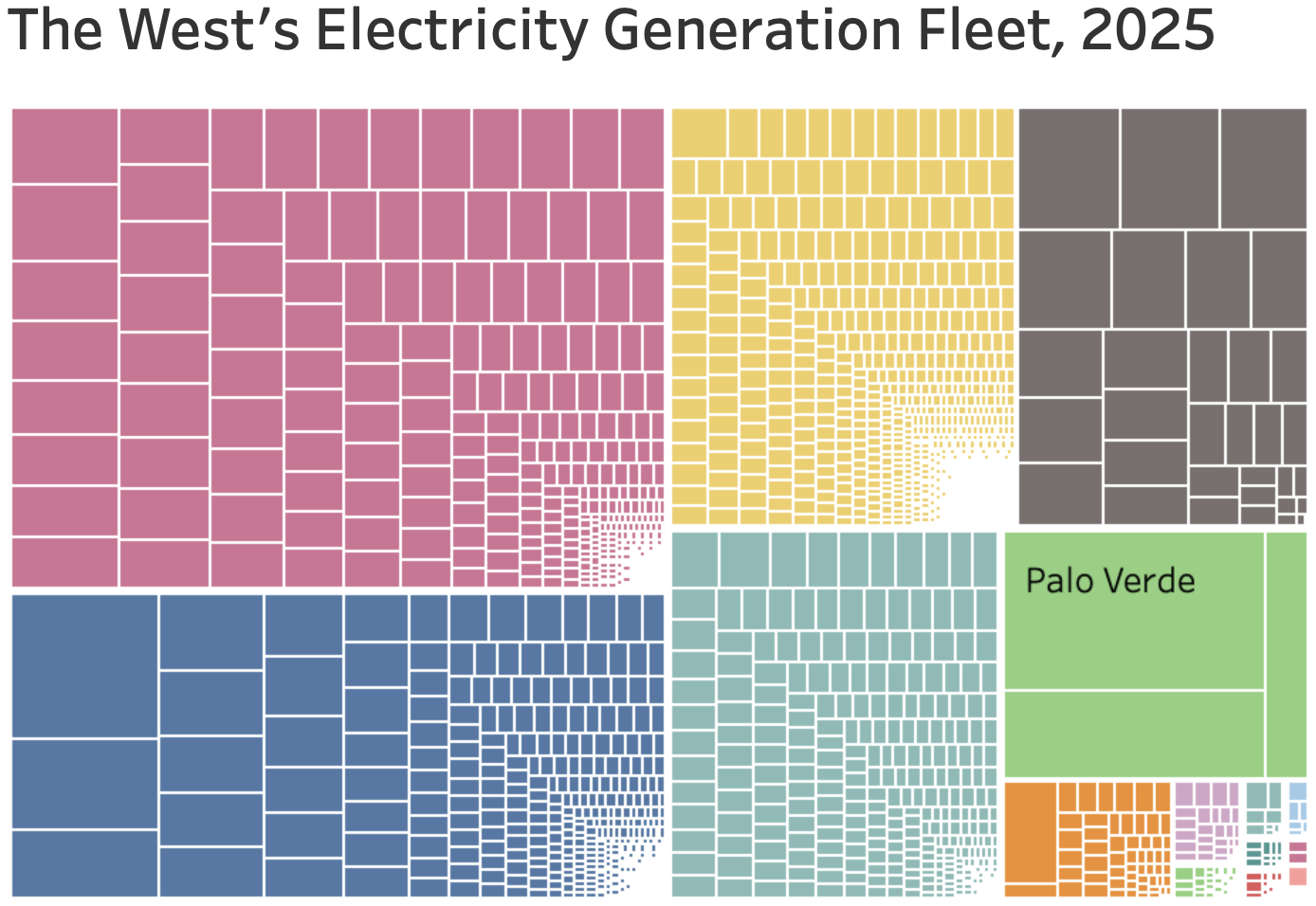
A visual look at Glen Canyon and Hoover Dam’s 2025 energy output compared to other generators in the Southwest (CA, NV, UT, CO, AZ, NM). Click here for an interactive look. Source: Land Desk dataviz using EIA data.
Eight generators sit at the toe of the dam, fueled by water channeled from the reservoir through the dam’s eight penstocks. Each generator has a nameplate capacity, or maximum rated output, of 165,000 kW, or 165 MW, for a total generating capacity of 1,320 MW, on a par with a large coal power plant (the Four Corners plant has a 1,540-MW capacity). In other words Glen Canyon Dam is a big power plant.
But capacity is really just potential, and what really counts is how completely and in what manner the power plant lives up to its potential. In that respect, Glen Canyon Dam has been a bit of a slacker lately.
That 1,320 MW of capacity is only true when the reservoir is at full pool, or 3,700 feet, when the water pressure needed to turn the turbines is at its highest level. As Lake Powell’s water levels drop, so does the hydroelectric “head,” or the vertical distance that the water falls, along with the water pressure. When the reservoir is full, or the level is at 3,700 feet, it takes about 1.9 acre-feet of water to generate 1 megawatt-hour of energy. At 3,500 feet, it takes 2.9 acre-feet to generate the same amount of electricity. As a result, at the reservoir’s current level (approx. 3,520 feet), the dam’s power plant has a capacity of just about 730 MW.
As the reservoir’s surface level drops, so too does water pressure, which in turn diminishes the turbine’s power capacity. The reservoir’s pool elevation sat just above 3,520 feet on August 13, 2026. Source: Bureau of Reclamation.
Naturally, a power plant’s output is also going to be determined by how much fuel you feed it, which in this case is water run through the penstocks, or releases from the dam. Back in the 1980s, when the reservoir was full (and then some), Glen Canyon Dam’s annual output was nearly 9 million megawatt-hours, or enough to power about 869,000 average American households for one year. But in 2025, it only produced 2.75 million megawatt-hours, or enough to power 269,370 homes. This year’s output will be considerably lower, since both reservoir levels (and thus, generating capacity) and dam releases have dropped significantly.
Glen Canyon Dam’s electricity production varies according to reservoir levels and releases through the penstocks/turbines. Source: Western Area Power Administration.
It throws the claims that some 5 million people rely on the power plant into dubious light, but it is still a lot of energy: Last year, Glen Canyon Dam had the 15th largest output among the Southwest’s hundreds of utility-scale power plants. But its output is dwarfed by Palo Verde nuclear plant’s 31.2 million megawatt-hours annually. Even Four Corners coal plant, which shuttered two of its units a decade ago, still puts out more than 8 million megawatt-hours per year, three times that of Glen Canyon. (Hoover Dam has a higher nameplate capacity than Glen Canyon, but its 2025 output was about the same as Glen Canyon’s).
Glen Canyon Dam is the largest generator in the Colorado River Storage Project, which is a part of the federal Western Area Power Administration’s Salt Lake City Area/Integrated Projects. WAPA markets the power from these projects at relatively low rates to about 140 municipalities, cooperatives, tribal nations, irrigation districts, and utilities across the West. Last year’s power sale revenues from WAPA’s SLCA projects totaled almost $179 million, money that goes into the Basin Fund, and then is used to operate the dams and other infrastructure, to purchase replacement power, to pay off debt, and to fund endangered species programs.
A hydropower dam’s value goes beyond its ability to produce a steady stream of energy and revenue. The power grid must stay in balance at all times, meaning that supply — or generation — must always be equal to demand. Throw off the balance and you risk a cascading failure that can lead to wide scale outages. Hydropower is super flexible, meaning a turbine’s output can be ramped up or down quickly by simply changing the amount of water entering the penstock. As more and more solar and wind, or variable renewable resources, are added to the grid, balancing the ups and downs becomes more challenging, making flexible tools like hydropower more critical.
In theory, Glen Canyon Dam’s operators could hold back water throughout the middle of the day, when electricity demand is lower and solar output is highest, and then open up the penstocks full blast in the late afternoon and evening, when solar drops off and the air-conditioners come on, driving up electricity demand, or load. Similarly, they could fire up the turbines, so to speak, if another power plant on the grid malfunctioned.
For the first 30 years of its existence, Glen Canyon Dam’s operators were fairly free to operate the power plant as a sort of grid-balancing peaker plant. On one July day in 1989, for example, the operators choked off flows to the turbines in the early morning hours when power demand was low, so that about 3,471 cubic feet of water per second was running through the dam at 5 a.m., a virtual trickle for the Colorado. As the day heated up and power demand climbed (there was barely any solar on the grid back then), they cranked up the amount of water flowing through the turbines and into the river to a monstrous 29,000 cfs—the maximum possible flow through the turbines—to inject a bunch of juice into the grid.
This was good for the grid, and good for revenues from power sales, since energy costs more during peak demand. It wasn’t so good for the river downstream or the folks who were using it, however. Imagine being a rafter on the Grand Canyon and watching the mighty Colorado shrink to less than 4,000 cfs, before growing more than eight times that in just 12 hours. That could wreak some serious havoc on one’s trip and, I imagine, a fish’s mojo.
Dam operators at the time wanted to further optimize this grid-balancing ability by installing turbines in the river outlet works so they could release more water and generate more power (and create even greater flow fluctuations downstream). The proposal was not only shot down, but also set off a string of events that ultimately led to the 1992 Grand Canyon Protection Act and the dam’s adaptive management program, which mandate minimum and maximum release rates and limit release fluctuation rates to protect Colorado River recreation and ecosystems downstream of the dam. The dam still serves as a grid-balancing tool, with releases and power generation peaking in the afternoon and reaching their low point in the early morning hours. But its effectiveness has been eroded by both the restrictions and by reduced capacity resulting from lower water levels.
Glen Canyon Dam is less and less critical to the Southwestern power grid with each passing year, and its importance is likely to continue to decline as aridification continues to rob it of its ability to produce power, and as more battery storage comes online to take up its grid-balancing role.
If and when Glen Canyon Dam loses its ability to produce power, it won’t result in millions of people sitting around in the dark with non-functioning air-conditioners. Nor will it bring back shuttered coal plants. The coal-fired Navajo Generating Station just up the road from Glen Canyon Dam put out more than 17 million MWh annually; it shut down in 2019 without crashing the grid or even causing noticeable strain. Same goes for the San Juan and Cholla coal plants.
Back in 2013 the San Onofre nuclear plant near San Diego shut down with little warning due to safety concerns. In the immediate aftermath, natural gas generation spiked as grid operators scrambled to replace the lost generation. But over time, as solar and wind and battery storage capacity was added to the state’s grid, the surge in gas generation subsided. Something similar — although at a much smaller scale — is likely to happen when Glen Canyon goes offline.
Which makes one wonder: Is it really worth it for the feds to expend so much energy and resources, to imperil downstream recreation and endangered fish, and cause so much Lower Basin gnashing of teeth and wringing of hands and possibly filing of lawsuits, to preserve a dam that just isn’t doing what it was intended to? [ed. emphasis mine]
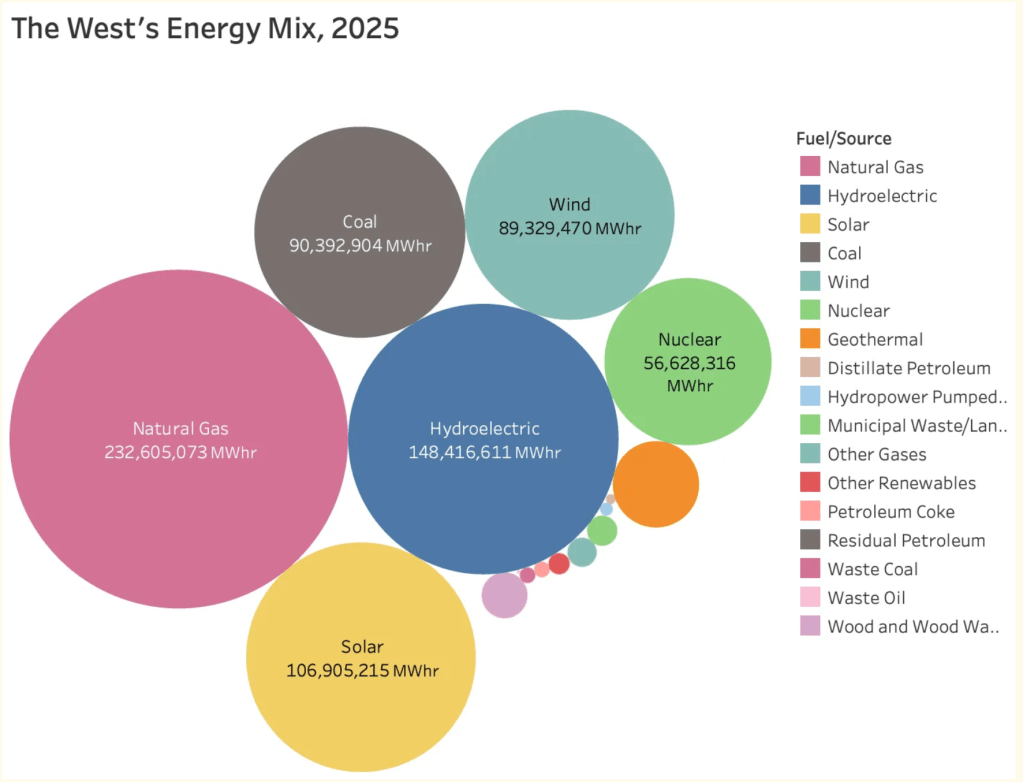
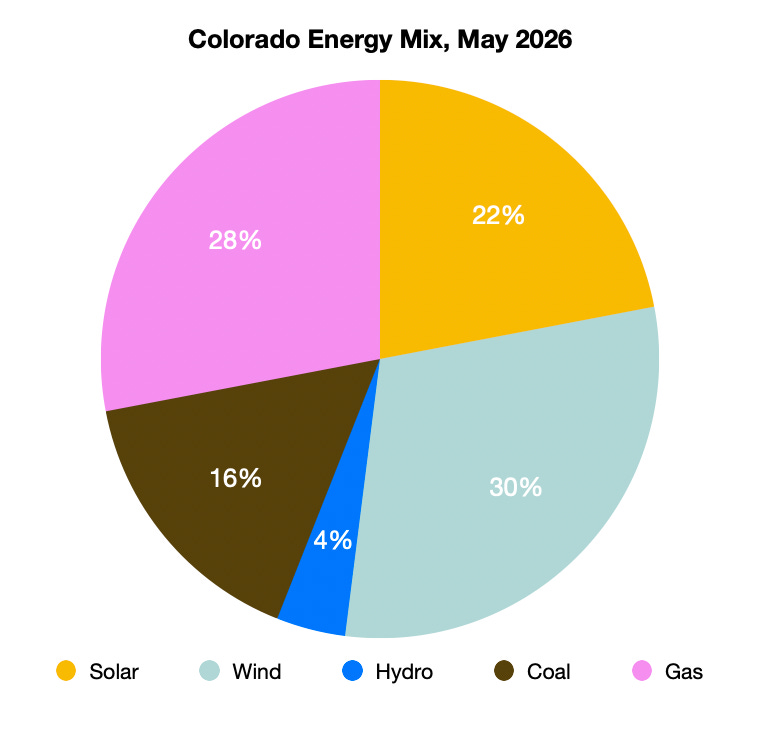
As long as we’re talking energy generation, I figured I’d give a little bit of a wider — and not quite as positive — view of the West’s energy generation and the transition. You may remember that last week I delivered the good news about solar taking over the grid — for the month of May. When you look at the same stats over the entire year of 2025, it doesn’t look quite so rosy, since natural gas generation clearly dominates the grid, at least for now.
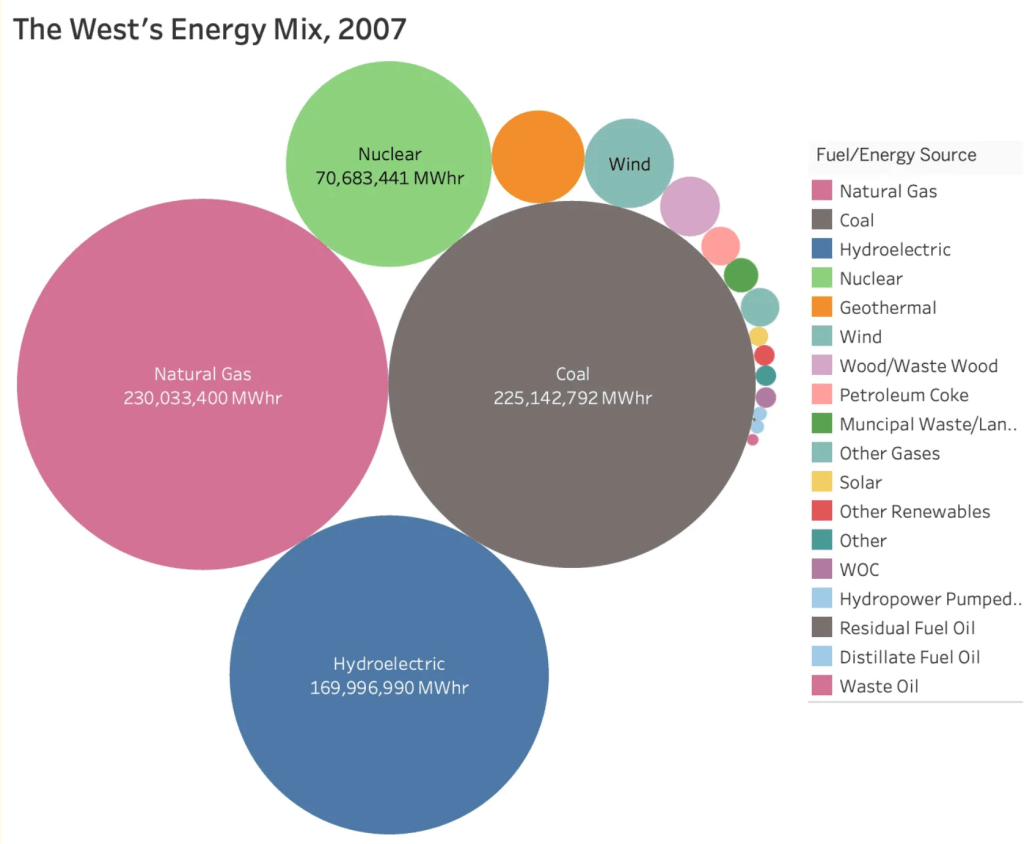
In search of some salvation, I went back to 2007 to make a comparison. Back then coal was king of the Western grid (with natural gas as queen), and solar was basically non-existent.
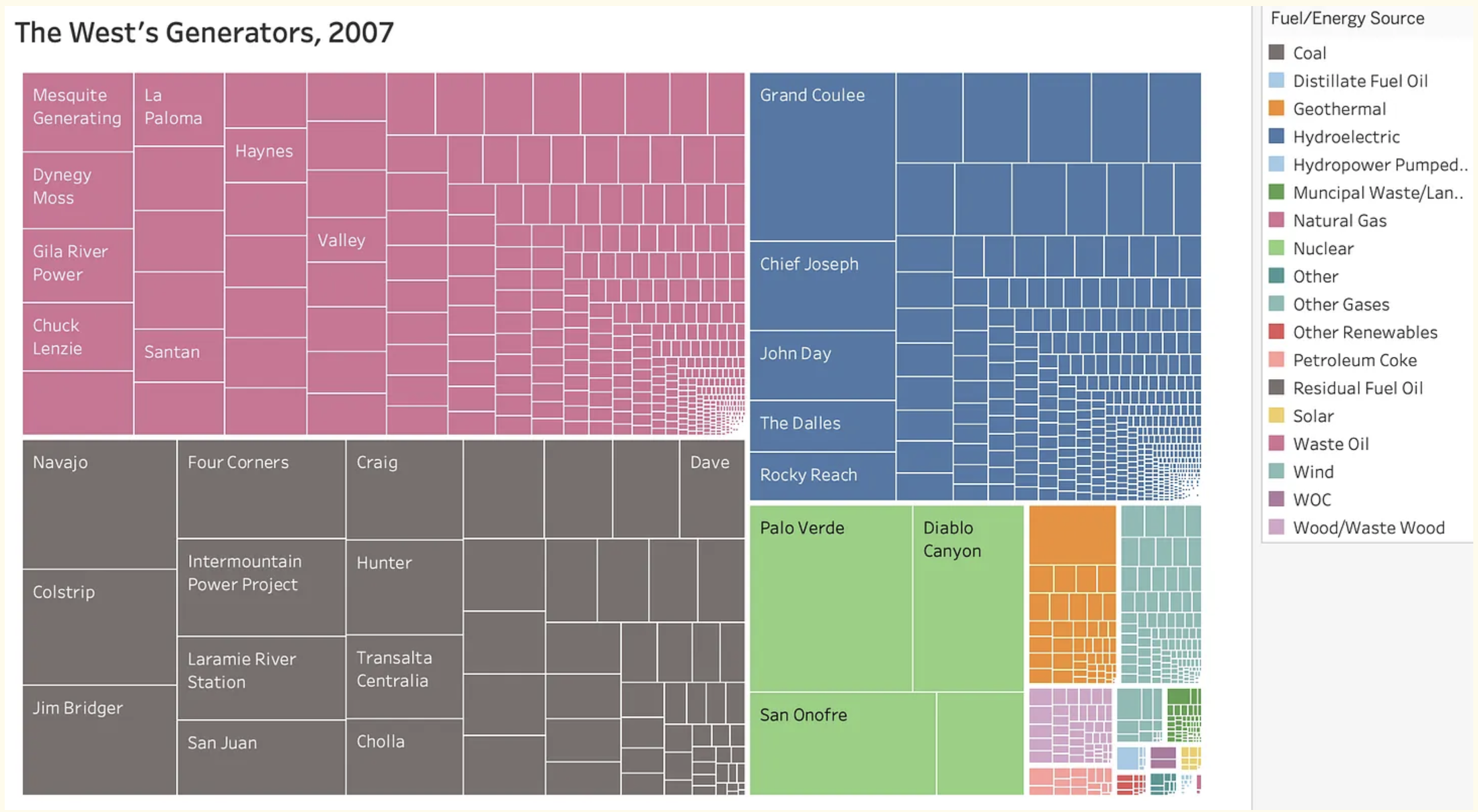
These graphics are available as interactive visualizations with a lot more information on every generator at Tableau. Unfortunately, I still don’t know how to embed them into Substack so that you can view them in situ. For a better view, click on the image or link in each caption.
In 2025, natural gas generation dominated the Western grid, with hydropower and solar rounding out the top three. Coal and wind are in a virtual tie for fourth place. Source: Land Desk dataviz made with EIA data.
This viz shows all of the generators of each kind on the Western grid sized in proportion to 2025 output. You can see that nuclear power plants are big, but few in number; solar plants are generally smaller and spread out. Source: Land Desk dataviz made with EIA data.
Looking at 2007, one can see the massive decline in coal-fired generation over the last couple of decades and the big buildup of solar. Most of the lost coal generation was replaced by solar and wind, not natural gas. Source: Land Desk dataviz using EIA data.
A look at the coal generators shows just how many huge coal plants have retired since 2007: e.g. Navajo, San Juan, Cholla, Centralia. Also note in the nuclear section that San Onofre is also gone. Source: Land Desk dataviz using EIA data.
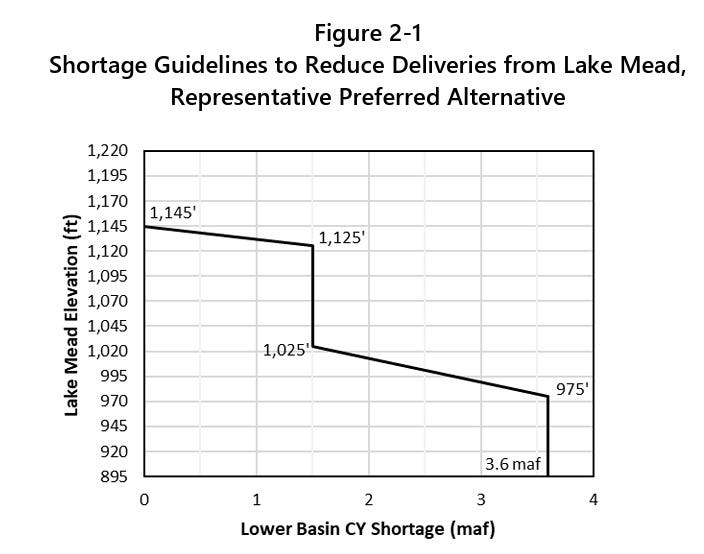
Tensions about water management are high on the Colorado River, even as water levels in reservoirs like Lake Mead drop to record lows and the west faces severe drought conditions…On July 31, the federal Bureau of Reclamation released a final environmental impact statement which outlines a potential framework for management of the river between 2027 and 2036. This framework would include mandatory water use cuts of up to a combined 3 million acre-feet per year for the lower basin states of California, Nevada and Arizona while seeking 200,000 acre feet in voluntary reductions from the upper basin states of Colorado, New Mexico, Utah and Wyoming. The impact statement and the associated National Environmental Policy Act (NEPA) decision-making process still leave an opportunity for the states on the Colorado River to reach their own agreement about future water use…
Colorado is introducing a new near-term water contribution program designed to take advantage of federal funding to encourage voluntary, compensated reductions in Colorado River water use. At a webinar on Aug. 6, Amy Ostdiek, section chief for the Colorado Water Conservation Board (CWCB) interstate, federal and water information section, explained that this program is one of several parallel activities that the state is undertaking alongside the ongoing NEPA process. She explained that the Bureau of Reclamation has announced that $100 million in funding will be available to support the upper basin states in establishing water contribution programs that will provide “water that but for these actions would not be there” to the Colorado River. She noted that funding would likely support about two years of a program, based on previous project costs, and that, to participate and claim the funds, Colorado would need to act now to begin establishing a program. Ostdiek stated that establishing such a program would honor commitments the state has made in negotiations to making voluntary water use reductions and would show that “Colorado is committed to being part of the solution.”
Map of the San Juan River, a tributary of the Colorado River, in Arizona, Colorado, New Mexico and Utah, USA. Made using USGS National Map data. By Shannon1 – Own work, CC BY-SA 4.0, https://commons.wikimedia.org/w/index.php?curid=47456307
After years of analysis and stalled negotiations, the federal government last month finally laid out its proposal for managing the Colorado River’s biggest reservoirs for the next decade. The Bureau of Reclamation still needs to release its final decision and an operating plan for the next two years. But its final environmental impact statement provides a framework for how it intends to manage parts of the Colorado River system under its control…
It still might not be enough in a drying West
The Colorado River Basin has been mired in drought for more than two decades, and research shows that area will likely only get warmer and drier. The question that really matters is how the new plan operates in a dry world, said Jack Schmidt, senior research scientist at Utah State University’s Center for Colorado River Studies. The document gives Reclamation flexibility to respond to an uncertain, but likely drier, river basin. It doesn’t solve all issues, though. If drought conditions don’t improve, Reclamation said in its analysis that “even large and unprecedented reductions may be needed and may not be enough to stabilize storage” at Lake Powell and Lake Mead.
“The scary thing about all of this is that none of this solves the problem if the world keeps getting drier,” Schmidt said. “That should be taken as an enormous warning for the desperate need to reduce the impact of a warming planet and the drying of the Colorado River Basin.”
[…]
Reclamation’s framework sets a goal of 200,000 acre-feet of voluntary water conservation in Utah and other Upper Basin states — Colorado, New Mexico and Wyoming. Gene Shawcroft, Utah’s Colorado River negotiator, said it will likely take Utah and its upstream neighbors three to five years to conserve that amount.
The largest reservoir in Colorado, Blue Mesa, is holding just over 240,000 acre-feet — “roughly about a third of the volume that we would typically expect to see in the reservoir in this time of year,” says Caleb Foy, senior water resources engineer at the Colorado River District. April-through-July inflow, 151,000 acre-feet, is the lowest unregulated inflow on record. This time of year, Blue Mesa is operated to maintain a minimum flow at the Whitewater gauge, far downstream, just above where the Gunnison joins the Colorado. A 2012 federal record of decision sets base-flow targets there — as low as 750 cubic feet per second, though June and July normally call for “upwards of just over 1,000 CFS at 1,050 CFS,” Foy says. Those flows exist to protect biology and recreation in the lower Gunnison, and endangered fish in the 18-mile reach of the Colorado below the confluence. This summer the Bureau of Reclamation, in consultation with the US Fish and Wildlife Service, other Gunnison Basin water users and the State of Colorado, “decided and agreed to lower the whitewater target down to 500 CFS.” It “isn’t certainly done lightly” Foy says: the cut preserves “nearly 500 acre-feet of storage per day” buying time against a Bureau forecast that Blue Mesa could drop below minimum power pool as early as October. Below that elevation the dam’s 86.4-megawatt plant (enough energy to supply at least 34,000 homes at full pool) — stops generating, and Foy says electrical output is already falling. Unlike Glen Canyon Dam, he is “not aware of any concerns” about operating below power pool.
The Farm Collaborative is headquartered at Cozy Point Ranch, an open space property owned by the city of Aspen. The nonprofit serves as not only a regenerative farm but a camp, school and resource center for the local community and farmers. The Farm Collaborative/Courtesy Photo
Click the link to read the article on The Aspen Times website (Lis Longwell). Here’s an excerpt:
August 12, 2026
Three years ago, beavers returned to an Aspen-area testing ground for regenerative agriculture. What’s happened since has been nothing short of transformative, according to Eden Vardy, who started The Farm Collaborative in 2008 with the ambitious goal of finding solutions to climate change.
When beavers returned to The Farm Collaborative in 2023, it was a sign that the regenerative agricultural practices were having the intended effects. The Farm Collaborative/Courtesy Photo
“Everything has transformed, there’s been just so much new growth in the riparian area. We’re starting to see predatory birds explore; I’ve seen a handful of golden eagles and bald eagles and a lot more coyotes and foxes coming into the area. But the most significant is the growth of the water table…This year, when we were anticipating our smallest year of water ever — which it still is, we are now starting to go dry — we had easily two months of more water than we thought we would this year as a result of really the storage systems that the beavers developed for us,” Vardy said…
Beavers’ role as a keystone species and ecosystem engineers has been increasingly recognized by scientists, environmentalists and water providers as an effective means of increasing drought resiliency. A project at Rocky Mountain National Park mimicking beavers has received notoriety for its early success in restoring wetland benefits to a drying landscape. Colorado Parks and Wildlife, during a time when Vardy served on its commission, responded to beavers’ growing popularity with a strategy to guide future species’ conservation and management. In July, the state agency also released beavers in two state wildlife areas near Rifle amid some man-made beaver structures to restore riparian ecosystems…
The Farm Collaborative’s learning center in Aspen was designed as a living classroom to connect individuals with food systems and explore regenerative agriculture practices. The Farm Collaborative/Courtesy Photo
Today, The Farm Collaborative — through youth and community programming as well as farmer support efforts — is focused on helping individuals explore and understand regenerative agriculture. The practice includes efforts to improve soil health, restore biodiversity and enhance water management…
“We are in a dust bowl again right now, just like we were during the Great Depression,” Vardy said. “Our tactics in agriculture, while productive, can have an adverse impact on the land in a way that prohibits our capacity to grow food, and regeneration is just utilizing the land differently, incorporating different techniques — instead of tilling, you can crimp from a grain operation, adding animals to the landscape for fertilization and soil building, cover cropping, crop rotations.”
Regeneration is not, however, simply an altruistic endeavor, he said.
“A beaver doesn’t show up in a water system because it’s altruistic and it wants to see more trout, more insects or more biodiversity; the beaver shows up because it wants to eat willow and it wants to raise its family in a healthy and comfortable way,” he said. “The byproduct of that work is that all these cascading biological effects take place.”
In the same way, regenerative agriculture is about making farms productive in the long term in a way that “restores the cascading effects for biology around the farm,” he added.
American beaver, he was happily sitting back and munching on something. and munching, and munching. By Steve from washington, dc, usa – American Beaver, CC BY-SA 2.0, https://commons.wikimedia.org/w/index.php?curid=3963858
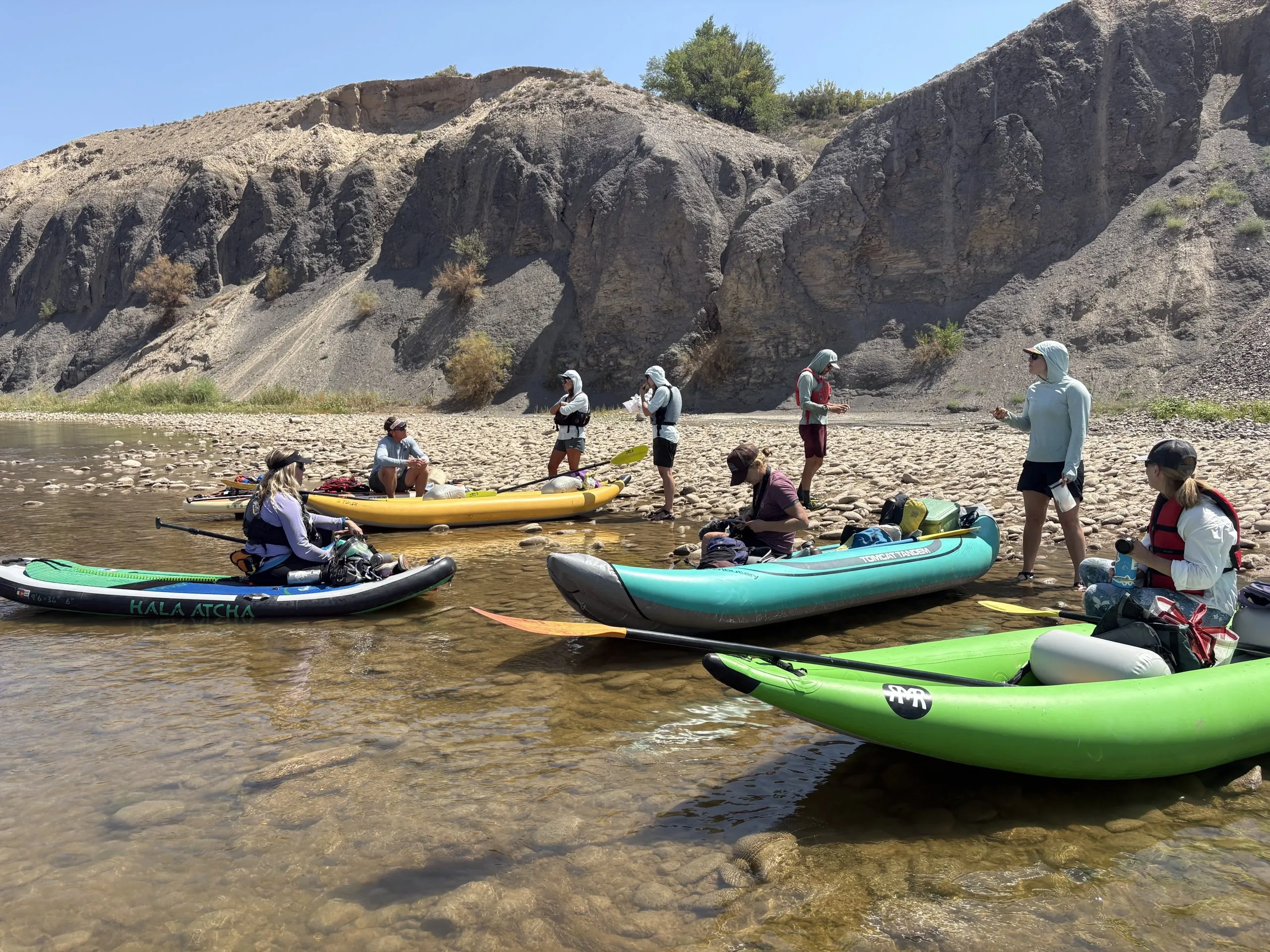
A group of paddlers take a lunch break on the 15-mile reach of the Colorado River this week. Boaters had to occasionally drag their duckies and paddle boards through the shallows because of extremely low flows. CREDIT: HEATHER SACKETT/ASPEN JOURNALISM
On a hot and sunny morning in August, a group of nine paddlers pushed their duckies and stand-up paddle boards into the Colorado River at Harky’s boat launch in Palisade.
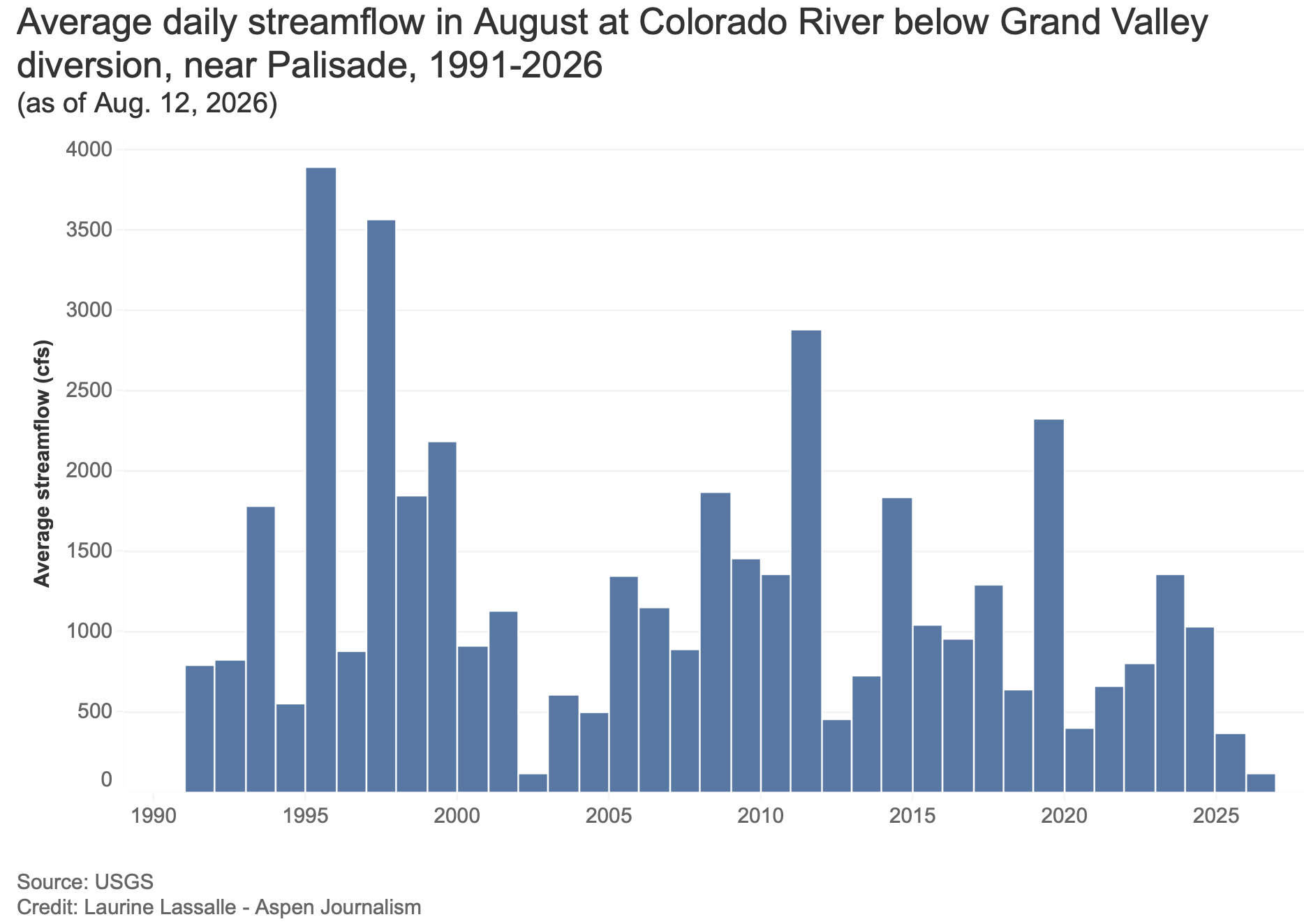
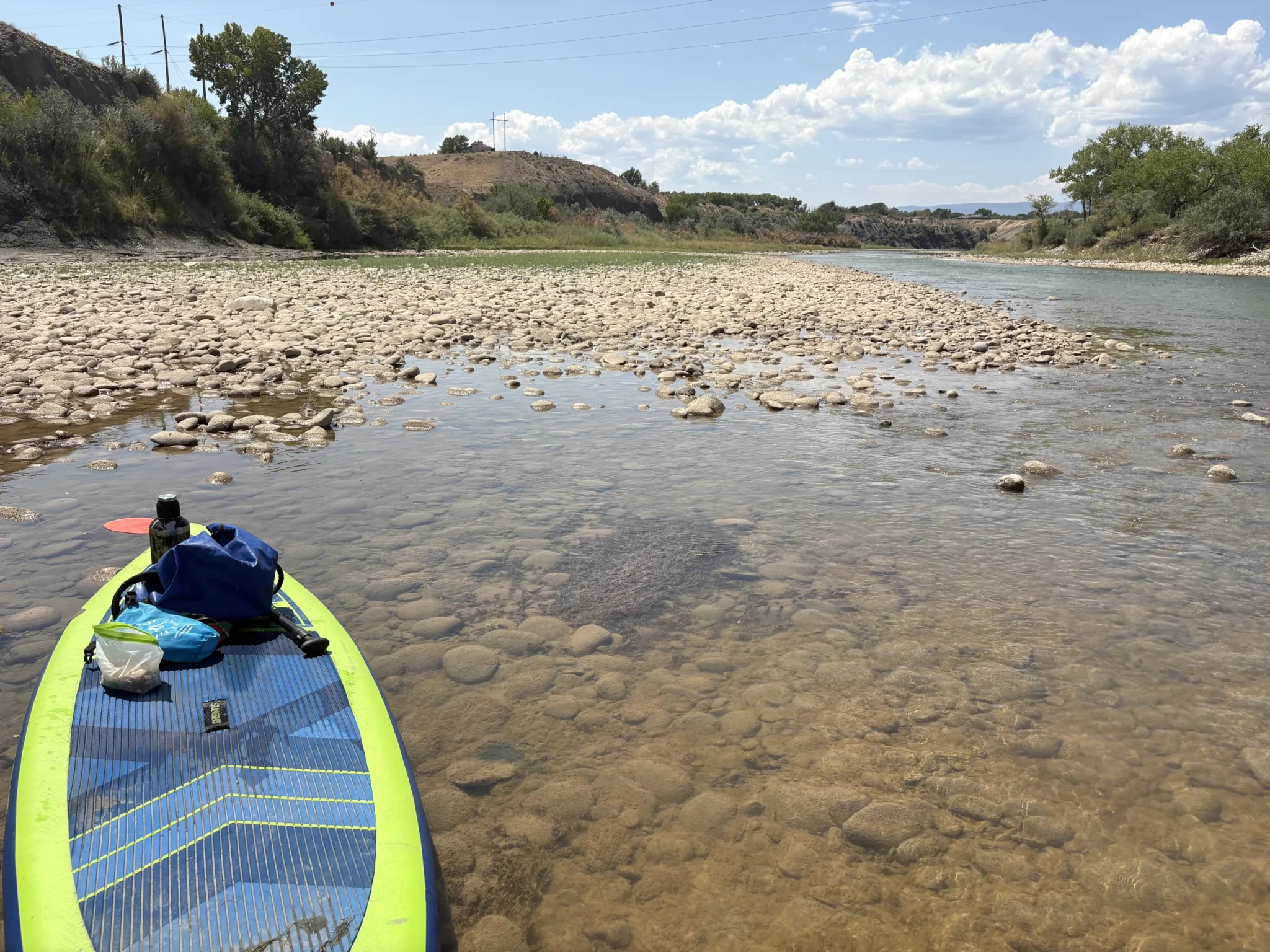
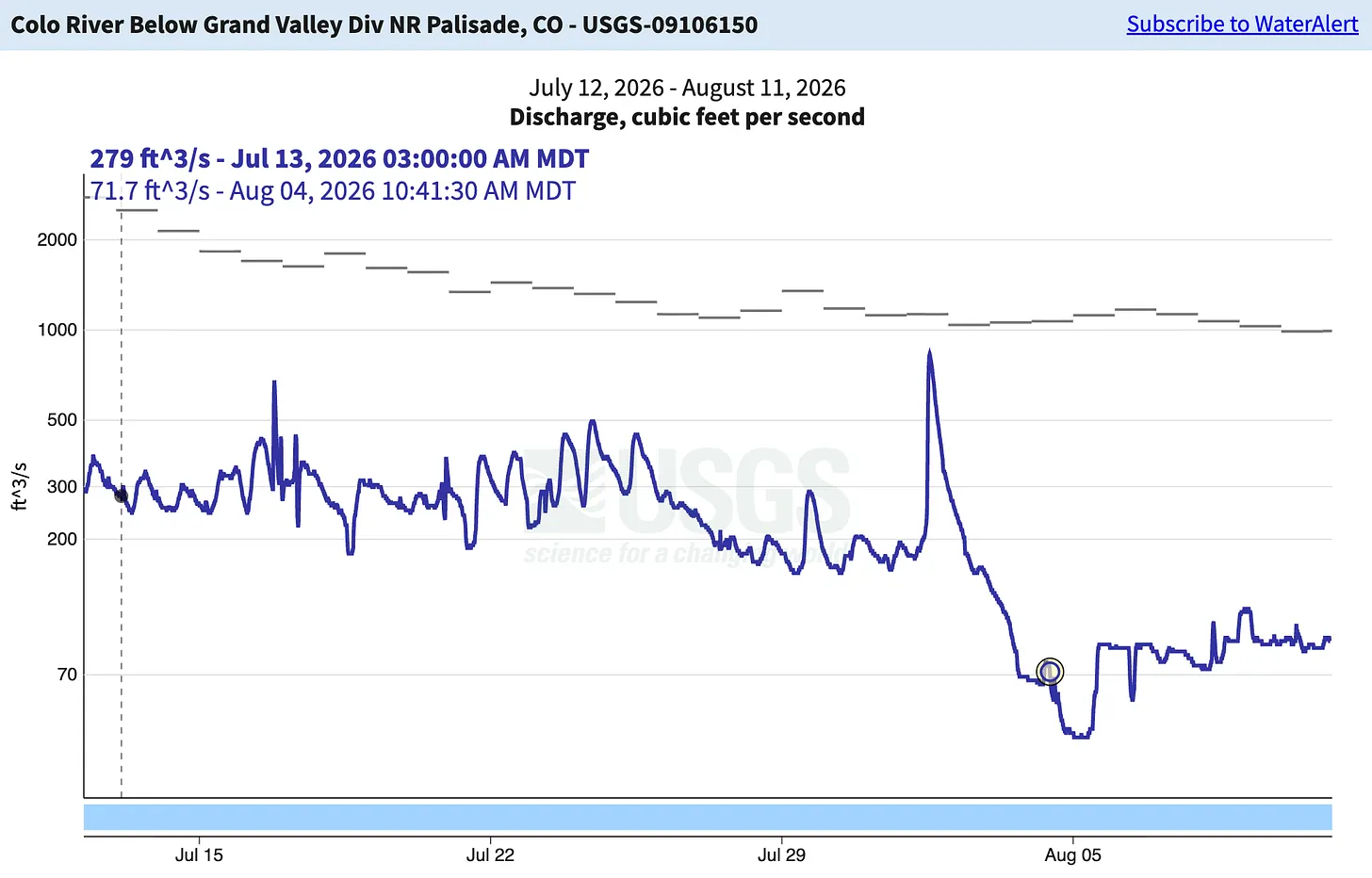
The goal of the float was to experience and document the river at one of the lowest levels it has ever seen. With flows hovering around 93 cfs, a bathtub ring showed on the rocks along the riverbank and rusty hunks of old farm equipment emerged from the streambed. Bright green algae grew between the rocks, and herons and ospreys hunted in the shallows.
In many places, paddlers got hung up on rocks and were forced to drag their watercrafts through the ankle-deep water. It took about four hours to float the roughly six-and-a-half miles from Palisade to Corn Lake, a trip that normally takes two to three hours with higher flows.
The trip was organized by Joel Sholtes, a water resources engineering instructor at Colorado Mesa University and a coordinator for the Grand Valley River Corridor Initiative.
“I knew that the river would kind of be on life support and maybe even dry up so I wanted to get out on the river with the people that were involved in managing its flow and experience the 15-mile reach at such a historically low level,” Sholtes said. “It just felt important to be on it and see it both from a habitat standpoint and from a user experience standpoint.”
Boaters got hung up on rocks in the 15-mile reach of the Colorado River during extremely low flows this week. The stretch of river between Palisade and the confluence of the Gunnison River is chronically dry. CREDIT: HEATHER SACKETT/ASPEN JOURNALISM
The Colorado River and its water users are now experiencing the consequences of the lowest winter snowpack on record, exceptionally hot temperatures and resulting low streamflows. The impacts are being felt across Colorado as farmers and ranchers have their irrigation water cut, cities and towns impose severe water restrictions on their customers and flows dwindle in stretches of river that are critical habitat for the ecosystem.
The stretch of the Colorado River between the large agricultural diversions in Palisade and the downstream confluence with the Gunnison River is known as the 15-mile reach. This chronically depleted section is also home to endangered fish. Water managers work each year to keep enough flows for fish by coordinating carefully timed releases from upstream reservoirs.
This map shows the 15-mile reach of the Colorado River near Grand Junction, home to four species of endangered fish. Map credit: CWCB
Grand Valley’s 15 mile-reach
This year’s historic drought makes keeping enough water in this reach more challenging than usual. The recovery program has pools of water dedicated to the fish in Lake Granby and Ruedi Reservoir that it releases specifically to boost flows in the 15-mile reach, but because of the dry conditions, less of that water is available. According to the Colorado Division of Water Resources, the average August flows in the 15-mile reach have been about 119 cfs this year, far below the 810 cfs target set by the Upper Colorado River Endangered Fish Recovery Program.
The program’s Instream Flow Coordinator David Graf told water managers on a conference call Wednesday that the program is trying to keep 75 cfs in the river through the end of August. Graf said the program was responsible for about 70% of the water in the river during Tuesday’s float; without it, flows could have dipped to around just 25 cfs.
“We are so far below the recommended flows anywhere in the Colorado River basin right now,” Graf said. “Keeping water in there is valuable; it takes a village.”
Irrigators reduce diversions
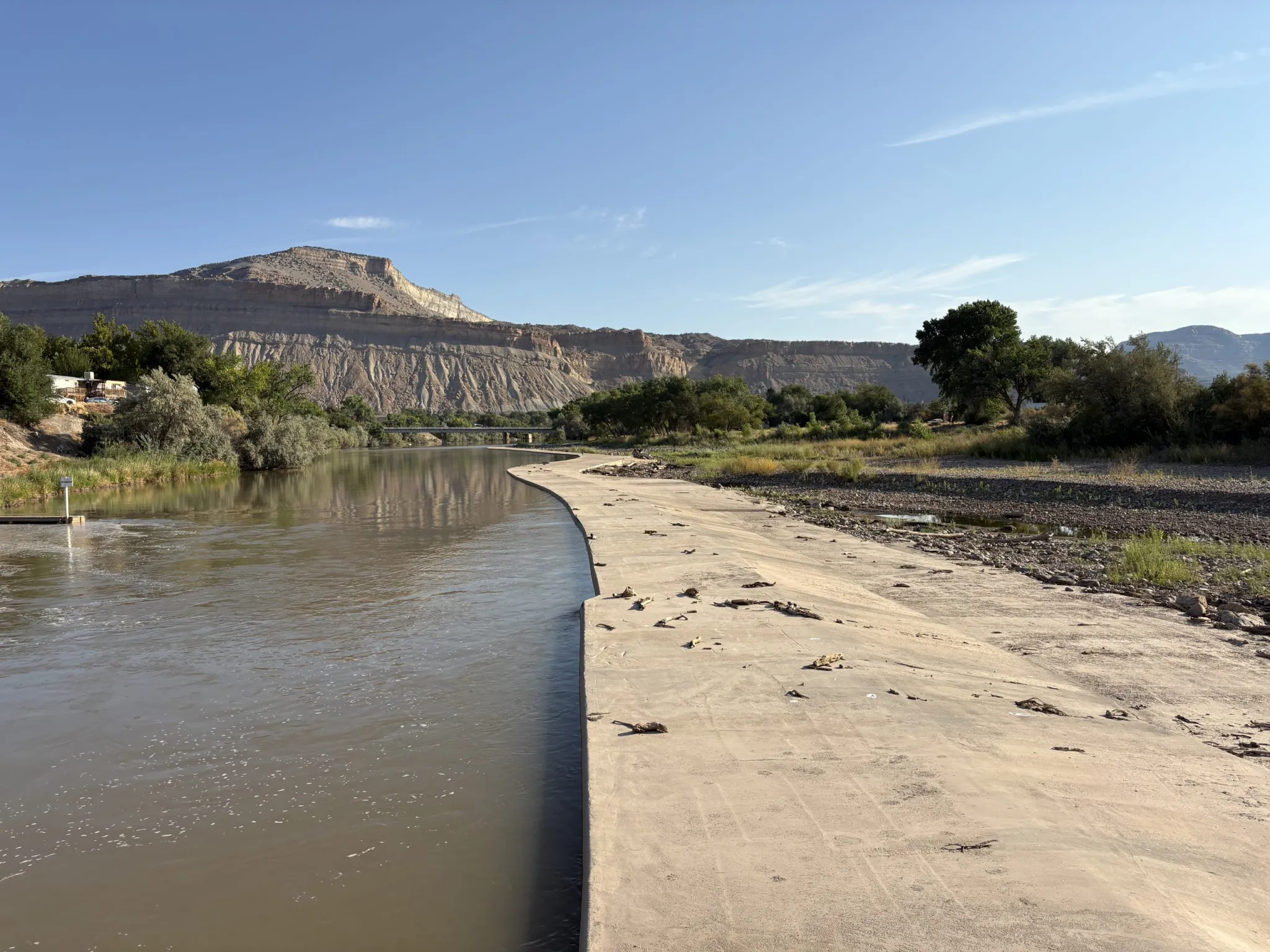
Nearly all of the river’s flows are being diverted to the Grand Valley’s agricultural producers. Colorado River water transforms the valley’s desert into a ribbon of verdant peach orchards, vineyards, corn and alfalfa fields. The valley’s irrigation districts can collectively draw 1,950 cfs from the river, but this year, they have reduced that down to 1,450 cfs in an effort to save some water for later in the season.
“We collectively set the target flow lower for the sole purpose of extending to gain and accrue some storage,” said Jackie Fisher, manager of Orchard Mesa Irrigation District. “We had none at the beginning of the year and it became super critical to talk with our partners and say, what can we live on now because we knew we needed it two or three months later.”
The Grand Valley Irrigation Company canal on the left is the last big agricultural diversion on the Colorado River in the Grand Valley. It marks the beginning of the 15-mile reach. CREDIT: HEATHER SACKETT/ASPEN JOURNALISM
Late summer is a crucial time for irrigators because the high flows of spring runoff have come and gone, but hot temperatures drive up the amount of water needed by crops. Irrigators often depend on releasing water stored in upstream reservoirs during this time to supplement low river flows. This year, spring runoff peaked weeks early and a pool of water in Green Mountain Reservoir known as the Historic Users Pool did not fill, which created far-reaching impacts.
HUP water is released mainly to satisfy farmers and ranchers in the Grand Valley, which hold the senior, commanding water rights on the river. The HUP also protects other water users, known as HUP beneficiaries, because without the releases from Green Mountain to supplement the Grand Valley, these other users could have to cut back.
Entities that own or lease stored water, like the Colorado River Water Conservation District, the Colorado Water Trust, Grand County and Northern Water, among others, have pitched in this year to contribute extra acre-feet to Grand Valley irrigators. But even with collaboration and water sharing, Grand Valley Water Users Association General Manager Tina Bergonzini said they cannot guarantee water deliveries to their farmers after September 1. Irrigation season typically goes through Oct. 31.
Low flows in the 15-mile reach of the Colorado River revealed a bathtub ring on the rocks lining the riverbank. Water managers strive to keep water in this section for endangered fish. CREDIT: HEATHER SACKETT/ASPEN JOURNALISM
“It probably sounds a little melodramatic to say, but it’s not: It’s literally the first time in 111 years that we’ve run out of water in the Grand Valley Water Users Association,” Bergonzini said. “I’ve done my best and my staff has done their best to make sure that our producers and our residents that are under our system are aware that we could get to the point that we have unreliable delivery.”
GVWUA irrigators have been on restriction all season and the association has been taking just 500 of its 730 cfs water right. Bergonzini said many of her producers have switched to less thirsty crops this year like triticale and Sudangrass, instead of corn and alfalfa, and have made adjustments to the way they irrigate to adapt to less water.
Heading into the fall with unreliable water is a scary scenario for some, Bergonzini said. It’s the time of year when some farmers plant winter crops and have a need for lots of water.
“We’ve tried to make sure everybody is prepared and that’s really all we can do,” she said.
Flows in the 15-mile reach were extremely low this week due to agricultural diversions and a historic drought. The reach is home to endangered fish. CREDIT: HEATHER SACKETT/ASPEN JOURNALISM
As water managers grapple with how to stretch this year’s meager flows as far as possible, Sholtes said from a recreation and quality of life standpoint, the Colorado River still provides so much value to the community – even when it’s barely flowing.
“I think it’s important to know that even in drought conditions, the river is accessible and enjoyable,” he said. “It’s my interest as a citizen in the Grand Valley, and as a scientist, to have a river that works for everyone, and to have growth and use that is compatible with the river ecosystem.”
Bicycling the Colorado National Monument, Grand Valley in the distance via Colorado.com
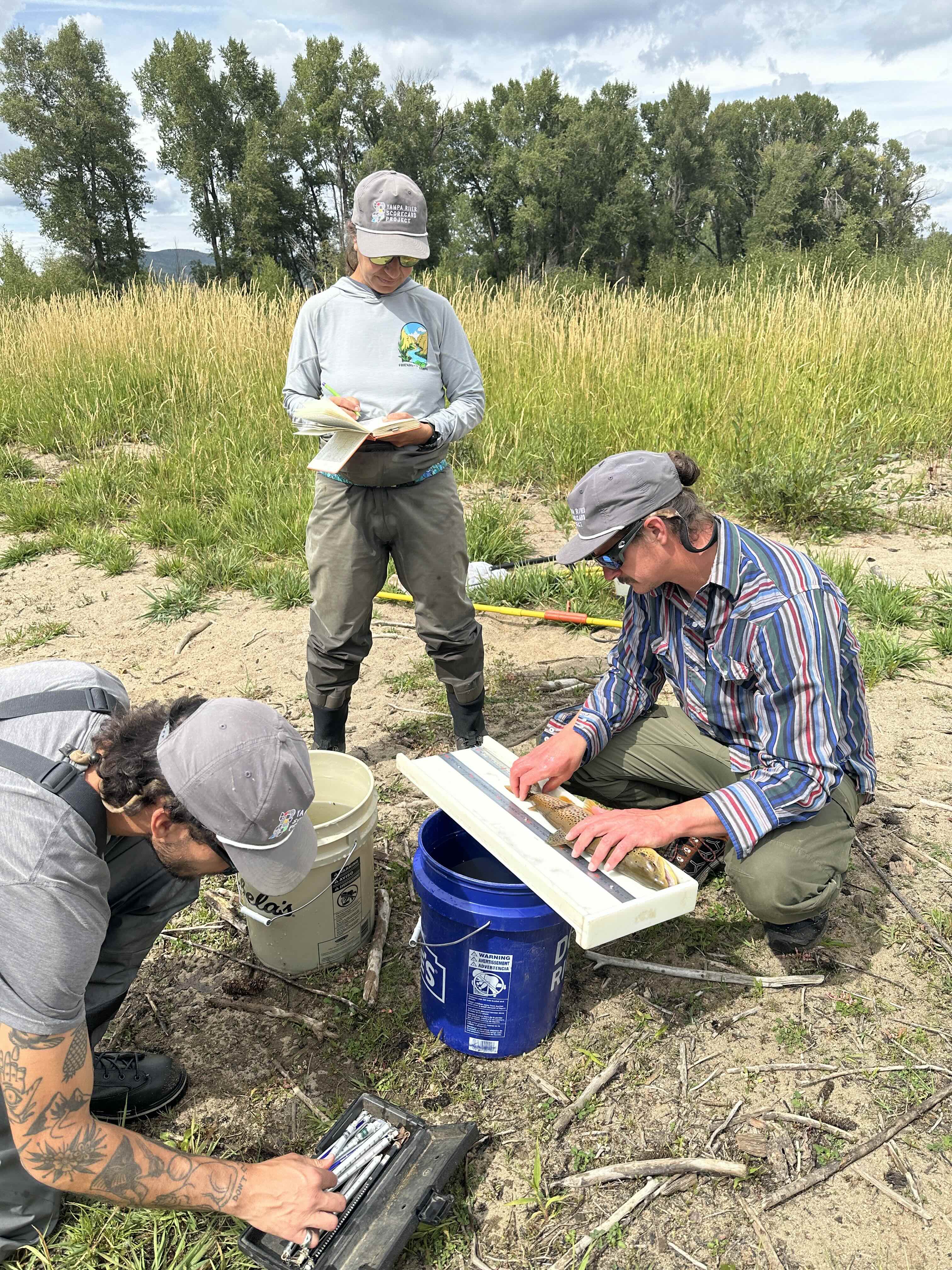
Kim Lennberg from Alba Watershed Consulting, Luke Kimmes from Colorado Mountain College, and John Kemper from Utah State University, collect data on the Elk River in 2025. Photo credit: Friends of the Yampa
Here’s the release from Friends of the Yampa:
July 29, 2026
Results for the 2025 Yampa River Scorecard Project focusing on the Elk River Segment are now available. This segment stretches for about 32 miles from the confluence with the South Fork Elk River to the confluence with the Yampa River. The main stem of the Elk flows through a mixture of private property and the Medicine Bow-Routt National Forest, past Glen Eden and Clark, and through a variety of large working ranches and small private developments. It also passes through the Christina State Wildlife Area, a Colorado Parks & Wildlife fishing easement, before reaching the main stem of the Yampa River east of Milner.
A complex combination of parameters is measured and considered when determining the score for any of the project segments. These parameters include flow and sediment regimes, water quality, habitat and riverscape connectivity, riparian conditions, river form, micro and macro habitat considerations, and the biotic community.
The overall score for the Ecological Health and Function of this segment was a “B.” This represents an overall healthy river. Findings show that this segment should continue to be protected as an example of a well-functioning system that supports both a healthy and productive human community and a relatively natural ecosystem.
Key findings:
Channel morphology largely intact
Limited invasive plant species present
Water quality generally excellent
Some periodic exceedances of temperature thresholds downstream
Bank armoring is the main detrimental factor that negatively influences organisms’ ability to move between aquatic habitat and riparian habitats
Native fish data is sparse and there is widespread and unregulated stocking of non-native fish species
The overall score of “B” refers to the Ecological Health and Function of the Elk River. Other attributes scored included People and Community Benefits and River Uses and Management. Photo credit: Friends of the Yampa
Why Do a River Health Assessment?
The Yampa River Scorecard Project is the implementation of a goal set forth in the Yampa White Green Basin Roundtable “Integrated Water Management Plan.” It is an ongoing river health assessment that will eventually provide data on the health of the Yampa River in its entirety. The goals for this project are to:
1) Provide a source of ongoing data collection related to river health that can document change over time.
2) Improve public understanding of river processes, river use, and river ecosystem services through an engaging public interface that communicates our findings at yampascorecard.org.
3) Provide information related to river health that may be used voluntarily by landowners/land managers to inform river and land-management decisions.
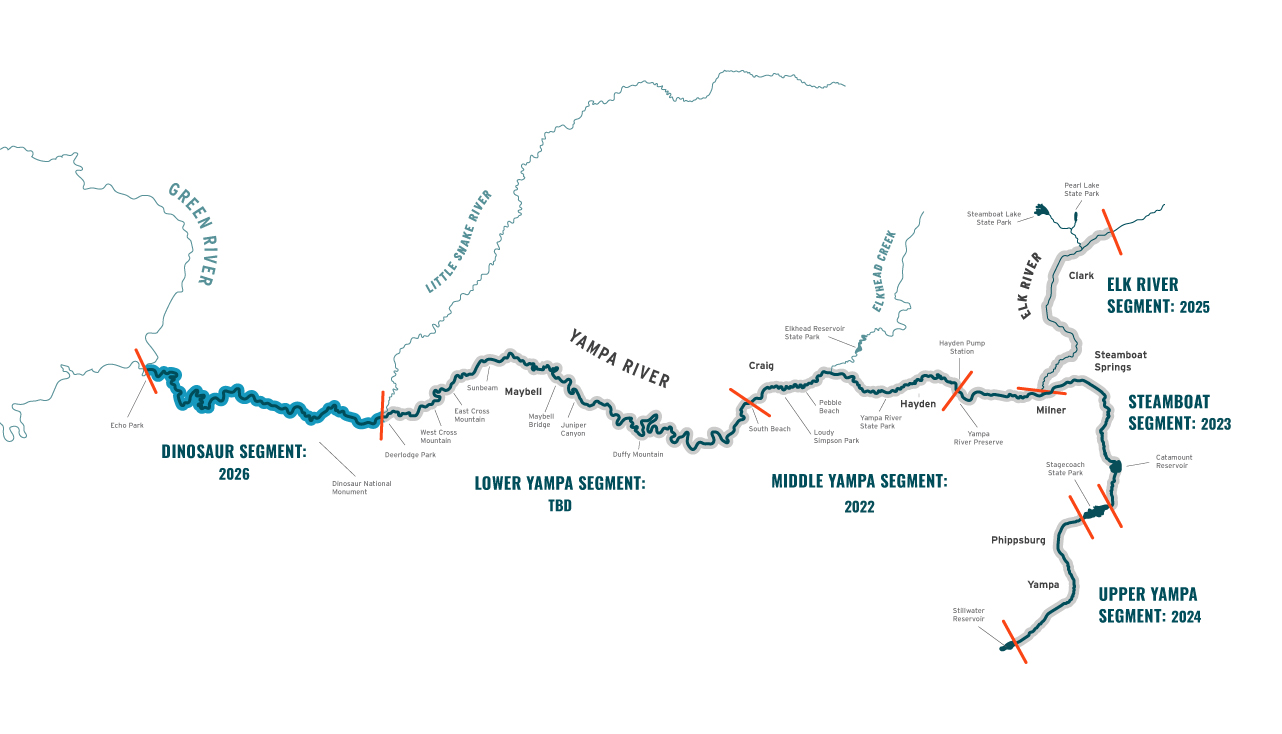
To accomplish these goals, Friends of the Yampa and Scorecard partners have divided the river into six segments. One segment is assessed each year so that after six years, the health of the entire river will be assessed.
The Yampa Basin is divided into 6 focal segments. The year listed is when the majority of the data is collected, and most reports will come out early the following year. Credit: Friends of the Yampa.
As summer temperatures soar across the United States and Europe, cities are being forced to confront the difficult reality that they’re getting dangerously hot.
One way to help cool buildings is to install green roofs – living rooftops covered by plants that can transform heat-absorbing rooftops into cooling solutions.
Chicago offers zoning incentives to encourage developers to build green roofs, like this one on City Hall. Patrick L. Pyszka, City of Chicago
Green roofs have long been promoted as a method to help cities stay cool. Often cities offer developers incentives to install them. But just building a green roof isn’t enough.
My research with colleagues shows that what happens after a green roof is built is as important as the decision to install a green roof in the first place. We found that many green roofs fall into neglect and don’t survive beyond a few years, likely due to the cost of maintenance. When buildings’ operational budgets are cut, landscape elements – including green roofs – are often altered or maintenance is scaled back to save money.
Unlike a traditional roof made of asphalt, metal or tiles, a green roof is made up of layers, including insulation, water proofing and drainage, that allow plants to grow atop the building.
Depending on their design, these roofs can support everything from low-growing sedums to shrubs and trees. Rockefeller Center’s rooftop terrace gardens in New York City were designed in the 1930s to hold trees, grass, shrubs and seating areas to double as parklike respites far above the traffic. The roof of the California Academy of Sciences in San Francisco is fully covered by 2.5 acres of wildflowers, succulents and other native coastal flowers.
The California Academy of Sciences in San Francisco features a green roof with hatches that open to an atrium below. Anna Fox via Flickr, CC BY
Plants absorb sunlight that would otherwise heat up the building below. They also cool the surrounding air through a process called evapotranspiration, in which they release water vapor. Additionally, they can reduce the amount of energy needed for heating and cooling buildings by acting as insulation. Green roofs also capture rainfall and prevent it from reaching storm drains, reducing flood risks and improving water quality in the community.
Because of these benefits, organizations like the European Commission and the U.S. Environmental Protection Agency have promoted green roofs in recent years as a way to reduce urban heat islands, make cities more resilient to extreme weather and improve biodiversity by supporting birds, butterflies and other insects.
The public Transbay Joint Powers Authority built an extensive park and walking path covering the roof of a four-block-long bus terminal in San Francisco. It’s known as Salesforce Park because the company Salesforce, headquartered next door, bought the naming rights. When it opened in 2019, developers estimated it would save $6,500 annually in energy costs. Fullmetal2887 via Wikimedia Commons, CC BY
These programs recognize the public benefits that green roofs can give, but they tend to focus on getting the roofs built rather than on keeping them functioning long term.
Without maintenance, all the work and money invested by builders and the communities can quickly be lost.
What happens to green roofs in the long term?
Most green roof conversations focus on their design: How deep should the soil be? What plants should be used? How much can they cool a building? Less attention is given to what happens to the roof five, 10, or 20 years down the road.
To better understand the long-term fate of green roofs, we studied 46 green roofs across the southeastern United States. Rather than asking how well a newly installed roof performed, we asked whether it was still functioning and being kept up years after construction. The results surprised us.
Nearly half of the roofs were no longer functioning as intended. Nine had been abandoned, with vegetation loss and no maintenance. Twelve roofs had been removed completely. https://www.youtube.com/embed/x037anb3vEY?wmode=transparent&start=0 Even a small, do-it-yourself green roof requires many layers to protect the structure from roots and provide drainage.
Even more interesting was what predicted a green roof’s success, or lack of it.
It didn’t matter whether the green roof had received LEED certification, formally recognizing it as sustainable design, or whether it was owned by a private corporation or a nonprofit. What mattered was whether building ownership had changed.
Every time buildings changed hands, green roofs either ended up abandoned or removed altogether, possibly due to a loss of knowledge about the roof. There is also the issue of cost; people who buy buildings with green roofs may have different budgets or priorities and do not necessarily want to spend the time or money to pay for them.
Larger-scale implication
Green infrastructure requires ongoing monitoring and care.
Plants need to be watered, fertilized and sometimes replaced. Irrigation systems need repairs. Invasive species need to be managed. Drainage layers need inspecting to prevent disastrous leaks that damage the building below. Maintenance on green roofs can cost anywhere from a few cents to over $3 a square foot per year and can be time-consuming depending on whether a roof needs to be weeded and watered by hand.
Without that care, many of the benefits used to justify the original investment can disappear.
The University of Tennessee-Knoxville’s Agriculture and Natural Resources Building has a lush, living roof where students and staff can enjoy nature. Mike McKinney/University of Tennessee
Imagine planting thousands of street trees, then never watering them again. That would be a poor investment. Yet people often assume green roofs will continue working indefinitely after installation without stopping to consider the work involved in keeping them alive.
Our research suggests that this assumption deserves a closer look.
Walter Reed Community Center in Arlington, Va., outside Washington, D.C., features a green roof that helps insulate the building. Arlington County, Va., CC BY-SA
But for green roofs to keep delivering environmental benefits decades after installation, communities may need to think beyond incentives for construction.
Long-term maintenance plans, clear ownership responsibilities and funding for stewardship may prove as important as the installation. Climate adaptation isn’t just about building new infrastructure, but also about making sure that infrastructure can continue to thrive years into the future.
Denver Water is throwing its weight behind and spreading the word about a proposed ballot initiative that would ask voters to redirect a portion of state sales tax revenue on sleeping bags, hiking boots and skis to help fight wildfires, reduce risk of additional blazes, and restore mountain watersheds already damaged by fire.
It’s a rare move for the state’s largest water provider, which serves 1.5 million customers in the metro area, and has been hard hit by major blazes, with thousands of acres of land scorched and reservoirs filled with debris. Tens of millions of dollars have been spent restoring land in the South Platte River Basin, where major events, such as the Hayman Fire in 2002, devastated key mountain lands and the streams that feed its collection system.
“For us it is a major infrastructure need,” said Alan Salazar, Denver Water’s general manager.
Proposition 308 is not yet on the ballot. Signatures were submitted to the Colorado Secretary of State’s office July 27. The office has until Sept. 2 to review the signatures.
For the past 20 years, as deep droughts have periodically gripped the state, wildfires have emerged as a major threat to the mountain watersheds that deliver fresh water across the state, from Durango, to Aurora, Denver and Fort Collins.
Denver Water operates a special fire mitigation project each year in partnership with other state and federal agencies, known as Forests to Faucets. But even with this collaborative approach, there isn’t enough money or labor to do all the work on the ground, Salazar said.
Proposition 308 would provide about $175 million annually that would go toward water and land conservation, according to Aaron Citron, The Nature Conservancy’s Natural Resources Policy Adviser in Colorado. The Nature Conservancy is one of the backers of 308, alongside Conservation Colorado, the Trust for Public Land and Western Resource Advocates.
The money would be taken from state coffers in years when there is a budget surplus. Though the proposal is not a new tax, it could reduce the size of refunds taxpayers normally receive in years when there is a surplus.
“Four of the largest wildfires have ignited in the last six years, burning 1.5 million acres. That has brought these issues more into the public consciousness … We know we have to act now if we want to protect resources and wildlife,” Citron said.
The money would be controlled mostly by GOCO and the state Natural Resources department
If approved, Proposition 308 would give about half of the sales tax revenue generated, $83 million, to Great Outdoors Colorado and another $83 million to the Colorado Department of Natural Resources, to expand land and water conservation programs these agencies already operate. Another $4.3 million would go to promoting outdoor recreation and the remaining $4.3 million would be spent to increase families’ access to the outdoors.
The ballot measure would exempt taxes collected on some sporting goods from the Taxpayer’s Bill of Rights, or TABOR, in a process known as de-Brucing, which is named after Douglas Bruce, the architect of the 1990 TABOR amendment.
Aurora Water staff has recommended that the city also endorse the measure but no formal action has been taken by city council, according to spokeswoman Shonnie Cline.
Budget hawks, such as Jon Caldara, president of Denver’s Independence Institute, said the citizen initiative is likely a reflection of voter frustration with state lawmakers, who he says haven’t done enough to fund the state’s basic need for water infrastructure, public safety and roads.
“Whether it is water or transportation infrastructure, we’re seeing that people are getting tired of the legislature not budgeting for basic needs. We shouldn’t be surprised people are taking their funding back,” Caldara said.
Unlike Denver and Aurora, Northern Water has not endorsed Proposition 308, General Manager Brad Wind said. Its board will likely receive a briefing on the topic in September.
Northern, too, has been hard-hit by wildfires. It has spent upwards of $100 million to restore and better protect its sprawling watershed west of Rocky Mountain National Park, which was scorched by the East Troublesome and Cameron Peak fires in 2020. Still, Wind said, that cash has allowed them to do only the bare minimum.
“We’re just touching the higher risk areas,” Wind said, “The cost is immense. I can’t imagine any utility has the money to make the investments needed.”
How voters will respond to Proposition 308 in November isn’t clear. Salazar said he isn’t aware of any organized opposition yet, but several other initiatives are also headed for the ballot, making a long list of things for voters to consider.
“It appears to be a crowded ballot,” Salazar said. “We want to make sure that when people get to this they are not exhausted.”
July precipitation was above average across much of Utah, western Colorado and western Wyoming, while below average precipitation fell in eastern Wyoming and much of Colorado. Regional temperatures were above to much above average across the region, and all-time daily maximum temperatures were set across all three states. Drought conditions prevail with 97% of the region covered by drought, and extreme or exceptional drought covered 35-45% of Colorado, Utah and Wyoming. Seasonal NOAA forecasts suggest active monsoonal precipitation and an increased probability of above average precipitation for the next three months. Monsoonal thunderstorms were responsible for six fatalities in Utah during July; a family of five drowned in a flash flood near Bicknell, UT and a hiker was killed by lightning in the Wasatch Mountains near Salt Lake City.Heavy rainfall also caused severe flooding and damage to 200 homes due to debris flows from the Cottonwood Fire burn scar near Beaver, Utah.
July temperatures were above average (+2-4ºF) for the entire region with much above average temperatures (+4-8ºF) across much of Wyoming, northern Colorado and northeastern Utah. All-time record high temperatures were set at many locations during July, including Provo (105ºF) and Salt Lake City (109ºF) in Utah, and Brighton (105ºF) and Burlington (113ºF) in Colorado. During a July 12-13 heatwave in Wyoming, 17 sites set all-time record high temperatures, including Worland (111ºF), Sheridan (109ºF), Thermopolis (109ºF), Cody (106ºF), Riverton (106ºF), Lander (102ºF), Moran (94ºF) and Yellowstone Lake (88ºF). All-time record high temperatures were also recorded in Laramie (94ºF) and Rock Springs (98°F) during July.
At the end of July, streamflow was below average for most regional rivers, especially in Colorado and Utah. On July 29, record low daily streamflow was recorded at 29 sites in Colorado, ten sites in Utah and four in Wyoming, including the Arkansas, Dolores, Eagle, Roaring Fork, South Platte, Uncompahgre and Yampa Rivers. Streamflow on the western slope of Colorado and along the Arkansas and South Platte Rivers was generally flowing at levels in the lowest 10% of all observations.
In late July, regional drought coverage remained at 97%. Drought covered the entire region except for a portion of northeastern Colorado where a small area of drought was removed during July. Coverage of exceptional drought conditions in the Colorado River Headwaters expanded in July.
El Niño conditions are present in the eastern Pacific Ocean with ocean temperatures running 1.5ºC above average. Current forecasts of peak Pacific Ocean temperatures of 2.5-3ºC above average indicate the formation of a very strong El Niño during the 2027 water year, an event that could be the strongest on record. There is a 100% probability of El Niño conditions continuing at least through December to February. NOAA seasonal forecasts indicate an increased probability of above average precipitation for the region during August to October, suggesting an active monsoon for the remainder of the season. Notably, the temperature forecast for August indicates equal chances of above or below average regional temperatures, but there is an increased probability for above average temperatures over the August to October period.
Significant weather event: Monsoonal thunderstorms lead to six fatalities in Utah. On July 17, an isolated thunderstorm near Bicknell, Utah caused flash flooding in a narrow canyon and swept a family of five to their deaths. The family from Provo, UT left for hiking and canyoneering in a slot canyon near Sunglow Campground around noon on 7/17. Sadly, bodies of all five family members were found deceased by the following morning. No precipitation from the storm was recorded at nearby weather stations in Loa, Torrey and Capitol Reef National Park.
On July 18, a 59-year-old man was killed by lightning while hiking in the Wasatch Mountains. The man and his brother were hiking along the exposed ridgeline of American Fork Twin Peaks near Snowbird Ski Area when the localized thunderstorm struck. The storm was very small, producing no rain at nearby sites and three lightning strikes were recorded in the vicinity during that hour.
The Cottonwood Fire burned 97,000 acres during June and July in the Tushar Mountains east of Beaver, Utah. On 7/20, nearly 1.6” of rain fell near Eagle Pointe Ski Area in upper portions of the Beaver River watershed. The ensuing debris flow flood severely damaged five miles of SR 153 which connects Beaver to Eagle Pointe ski area, damaged 80-200 homes and contaminated drinking water for Beaver and four rural communities. Residents from the Grove neighborhood in Beaver were evacuated and suffered the greatest residential home damage.
FLASH FLOOD: Pretty impressive flash flooding in Bicknell, UT yesterday 7/17/26. I’m hearing word from locals that there may have been a family swept away by this flood. I’ll bring updates as they come in, but that is just so sad to hear. pic.twitter.com/sJosstObeL
This press release text is by the American Meteorological Society. The graphics and captions are by Climate.us.
####
According to the 36th annual State of the Climate report, greenhouse gas concentrations, global sea level, and ocean heat content all reached record highs in 2025.
The three dominant greenhouse gases in Earth’s atmosphere—carbon dioxide (left), methane (center), and nitrous oxide (right)—all reached new highs in 2025. Climate.us image, adapted from Figure 2.61 in the BAMS State of the Climate in 2025. Background photo from Adobe Stock.
The international annual review of the world’s climate, published by the American Meteorological Society (AMS), is based on contributions from 625 scientists in 60 countries. It provides the most comprehensive update on Earth’s climate indicators, notable weather events, and other data collected by environmental monitoring stations and instruments located on land, water, and ice, as well as in space. The report is published as a supplement to the Bulletin of the American Meteorological Society (BAMS).
“The State of the Climate is a comprehensive, collaborative international effort to assess annual metrics for the atmosphere, oceans, and cryosphere,” says AMS President Alan Sealls. “It’s peer-reviewed data that paints a global picture of where we are, compared to benchmarks, and how fast things are changing. Consider it analogous to your annual health assessment from your physician. The State of the Climate connects to the health of all ecosystems. It presents critical measurements and trends which inform agencies, communities, businesses, and individuals for long-term planning.”
Notable findings from the international report include:
Earth’s greenhouse gas concentrations were the highest on record.Carbon dioxide (CO2), methane, and nitrous oxide—Earth’s major atmospheric greenhouse gases—once again reached record-high concentrations in 2025. The globally averaged CO2 level reached 425.6±0.1 parts per million, a 53% increase from the preindustrial level of ~278 ppm. Fossil fuel emissions in 2025 were also a record high in 2025, estimated to be 10.3±0.5 petagrams of carbon per year, more than three times the 3.0±0.2 petagrams of carbon per year in the 1960s.
Atmospheric carbon dioxide (CO2) in parts per million (ppm) for the past 800,000 years based on ice-core data (light purple line) compared to 2025 concentrations (bright magenta dot). The peaks and valleys in the line show ice ages (low CO2) and warmer interglacials (higher CO2). Throughout that time, CO2 was never higher than 300 ppm (light purple dot, between 300,000 and 400,000 years ago). The increase over the last 60 years is 100 times faster than previous natural increases. In fact, on the geologic time scale, the increase from the end of the last ice age to the present value of 425.6 ppm (dashed magenta line) looks virtually instantaneous. Graph by Climate.us based on data from Lüthi, et al., 2008, via NOAA NCEI Paleoclimatology Program.
Record and near-record temperatures were notable across the globe. The global mean temperature across land and ocean was among the three highest years on record, with records dating back as far as the mid-1800s. Near-neutral and La Niña-like conditions occurred in the eastern Pacific Ocean throughout the year, making 2025 the warmest year on record in which no El Niño conditions were present. Europe reported its warmest year on record, and Russia, China, the Republic of Korea, and Argentina each reported their second warmest. All five major global temperature datasets used for analysis in the report agree that the last 11 years (2015–25) were the 11 warmest on record.
Despite cool ENSO and weak La Niña conditions, sea surface temperatures were at near-record-high levels. Cool ENSO (El Niño-Southern Oscillation) conditions were sandwiched between weak La Niña conditions during 2025. Despite the cooler conditions in the equatorial Pacific Ocean throughout much of 2025, the mean annual global sea surface temperature was the third highest in the 172-year record, and 0.38°C above the 1991–2020 average. Approximately 87% of the ocean surface experienced at least one marine heatwave in 2025. Only 26% of the ocean surface experienced at least one marine cold spell.
Ocean heat and global sea level were the highest on record. Over the past half-century, the oceans have stored almost 90% of the excess energy trapped in Earth’s system by greenhouse gases and other factors. The global ocean heat content, measured from the ocean’s surface to a depth of 2000 m, continued to increase, and reached new record highs in 2025.
Global map of ocean heat content in the upper 2,000 meters (1.2 miles) of the ocean in 2025 compared to the 1993-2022 average. More places are warmer than average (orange) than cooler (blue). Adapted from Figure 3.5a in State of the Climate 2025 from the American Meteorological Society.
Global mean sea level was a record high for the 14th consecutive year, reaching about 111.2 mm above the average for 1993, when satellite altimetry measurements began. Warming oceans have contributed an average of 1.6±0.3 millimeters per year to rising sea levels since 2005, while melt from ice sheets and glaciers has contributed an average of 2.0±0.4 mm during that same period.
Between 1993 and 2025 mean sea level has risen across most of the world ocean (blue colors). In some ocean basins, sea level has risen 6-8 inches (15-20 centimeters). Rates of local sea level (dots) on the coast can be larger than the global average due to geological processes like ground settling or smaller than the global average due to processes like the centuries-long rebound of land masses from the loss of ice-age glaciers. Map by Climate.us based on data from University of Hawaii.
The Arctic saw near-record warmth. The Arctic had its second-warmest year in the 126-year record. Surface air temperatures in the Arctic are increasing at roughly three times the global average rate. Precipitation is also increasing across the region. In response to the precipitation and temperature increases, tundra plants have been increasing; 2025 marked the third highest value in the record with respect to greenness, a measure of the increase in plants and productivity.
Sea ice concentration in September 2025, the month with the smallest ice extent of the year. Extent is the total area of ocean that’s at least 15 percent ice covered. The gold line is the median extent for 1981-2010: half of years had smaller extents, half had larger. Map by Climate.us, based on data from the National Snow and Ice Data Center.
In Arctic waters, maximum sea ice extent in 2025 was the lowest in the 47-year record, while minimum extent was the 11th lowest. The thickness of the sea ice, which is related to its age, has also been decreasing over time. Ice older than four years old is nearly absent, with only 95,000 square kilometers of older ice in September 2025 as compared to 1.5 million square kilometers in the 1980s.
Routine observations of Arctic sea ice thickness only began a little over a decade ago. Experts use the age of the ice pack—which has been observed since the 1980s—as a proxy for ice thickness. In March 1985 (left), the winter maximum ice pack was dominated by ice at least 4 years old (white). In 2025 (right), only a small strip of very old ice remained tucked up against the islands of the Canadian Arctic. More than half of the winter ice pack was less than a year old (dark blue). Historically, the Beaufort Gyre served as a nursery for young, growing ice, but conditions have grown too warm for ice to persist there. Climate.us image, based on data from the National Snow and Ice Data Center.
Antarctica saw record warmth and continued low sea ice. Antarctica observed its warmest year since the start of the record in 1979. Surface melt on the continent was above average on most ice shelves, and melt on the Antarctic Peninsula approached record levels in early January. Surrounding the continent, sea ice remained below average in 2025, following a nearly decade-long trend. Annual daily maxima and minima of sea ice extent were the third and fourth lowest on record, respectively.
Glaciers around the world continued to melt. Land-based glaciers continued to lose ice for the 38th consecutive year, losing the equivalent of more than 1 meter of water on average for the fourth straight year. About 41% of the loss experienced by glaciers since 1976 has occurred in the last decade.
Yearly net gain or loss of ice mass in the World Glacier Monitoring Service “reference glacier” network since 1970 (gray bars, amount on left-hand vertical axis) combined with the running total ice loss through 2025 (red line, values on right-hand vertical axis.) Climate.us graph adapted from Figure 2.18 in State of the Climate in 2025.
Tropical cyclone activity was above average. A total of 97 named tropical cyclones were observed during the Northern and Southern Hemispheres’ storm seasons, above the 1991–2020 average of 87. Five storms reached Category 5 intensity. Three of these storms occurred in the North Atlantic, tying for the second most on record for that basin. Hurricane Melissa became one of the strongest Atlantic hurricanes on record, with a maximum intensity of 190 miles per hour and a minimum central pressure of 892 hPa on October 28. Melissa made landfall in Jamaica as a Category 5 storm, causing devastation on the western part of the island. The storm caused 95 fatalities and resulted in at least $12.2 billion (U.S. dollars) in damage.
There were 12 named storms in the Australian basin during the 2024/25 season, which was the most in a season since 2005/06. In February, Tropical Cyclone Zelia reached Category 5 intensity at sea and made landfall as a Category 4 storm in Western Australia. Flood heights at the town of Marble Bar due to heavy rainbands were nearly 2 meters above previous records.
The State of the Climate report is a peer-reviewed series published annually as a special supplement to the Bulletin of the American Meteorological Society. The journal makes the full report openly available online.
50% of the Lower 48 is short/very short, a 2% increase from last week.
Every state in the West and Plains is over 50%, with Colorado (92%) and Wyoming (87%) at the highest levels of short/very short in the US. #drought@USDApic.twitter.com/SwWbERtLIW
No, Lake Powell’s not that close to actual dead pool — or the level at which water can no longer be released downstream. At least not yet. But it is now within 20 feet of de facto deadpool, or 3,500 feet, which is the surface elevation the feds have said they will “defend” to keep Glen Canyon Dam viable. Besides, in this case I’m using “deadpool” somewhat metaphorically to describe the current state of water on the Colorado River and the rest of the West, which is about as dire as “deadpool” sounds.
It’s normal for streamflows to drop in August as the last remnants of high-country snow disappear in the dog-days sun. But since most of the snow was gone by late June, and the monsoon has thus far dropped in only for brief, violent, and occasional visits, almost every creek and river in the West is flowing far below median levels for this time of year. The water is also unusually warm, which is bad for fish. The Animas River in Durango, for example has climbed up into the 70° F territory every day for the last several weeks.
In the Upper Colorado River Basin, irrigation ditches with junior water rights are getting shut down right and left, weeks earlier than normal and just ahead of the big harvesting season. It’s already been a tough summer for most farmers; if reliable rains don’t arrive soon it could get much worse.
Paonia Reservoir in western Colorado has become a run-of-the-river operation, leaving downstream irrigation ditches in the North Fork Valley virtually dry — though those with senior rights continue to flow, for now.
One of the scariest dry-time indicators of the summer so far was the Colorado River near Palisade, Colorado, which fell to 43 cubic feet per second in early August. To put that in context, McElmo Creek, which is basically a desert arroyo fed by irrigation runoff, has been running around 30 cfs for the last few weeks.
It’s important to note, however, that it’s not only drought, but also diversions, that are depleting the Colorado River. The river below Glenwood Springs, which is upstream of Palisade, has been running around 1,700 cfs. And major ditches — Cameco, Orchard Mesa, and Grand Valley canals — that pull water from the Colorado just upstream from the Palisade gage are together carrying some 2,000 cfs, meaning they are taking nearly all of the river’s water. Runoff from those ditches eventually runs back into the Colorado, bringing its flows back up somewhat before the river crosses the state line into Utah.
The Government Highline canal is pulling over 1,200 cfs from the Colorado River upstream of Palisade, and two other canals are drawing more than 500 cfs each, leaving the river almost dry for a segment in the Grand Valley. Source: Colorado Division of Water Resources.
The good news is that rains have started up again in southern Arizona (the National Weather Service’s Tucson office has issued a flash flood watch for tomorrow), and forecasters are predicting thunderstorms will be returning to the rest of the region soon. Hopefully they’ll bring nice, gentle, soaking moisture, and not just lightning and torrential flooding.
But let’s get back to our Lake Powell August update and some numbers:
3,520.8 feet: Surface elevation of Lake Powell on Aug. 10, 2026. This is still about 9 inches higher than the previous all-time low of 3,519.9 in April of 2023. But that was April and there was already a bunch of snow in the high-country that would soon boost reservoir levels. The reservoir has been declining at a rate of about 2 inches per day, but that’s likely to speed up unless there is significant upstream precipitation in the coming weeks. So it’s not far-fetched to think it will drop to 3,500 feet as soon as this October.
2,505 cubic feet per second: Lake Powell’s inflow on Aug. 10, 2026.
-387 cfs: Lake Powell’s unregulated inflow on Aug. 8, 2026. Yes, that is a negative number, which may seem impossible. But unregulated inflow is an estimate of what the inflows would be without supplemental releases from upstream dams. Which means that valuable water is being released from upstream dams to slow Lake Powell’s decline.
7,710 cfs: Total average daily release from Glen Canyon Dam on Aug. 10, 2026.
281,267 acre-feet: Total inflows in July 2026.
83,824 acre-feet: Total unregulated inflows in July 2026 (meaning nearly 200,000 acre-feet was released from upstream dams to supplement the flows).
24,164 acre-feet: Estimated evaporation from Lake Powell in July 2026.
482,092 acre-feet: Total releases from Glen Canyon Dam in July 2026.
-224,989 acre-feet: Lake Powell’s water deficit in July 2026 (inflows – evaporation – releases = deficit)
-422,432 acre-feet: Lake Powell’s water deficit using unregulated inflow (or what it would be without supplemental water from upstream reservoirs).
3.72 million acre-feet: Total Lake Powell inflows so far this water year. At this pace, the 2026 water year’s total inflows will be around 4.2 MAF.
159 acre-feet: Total cool mix releases from Glen Canyon Dam in July 2026. This is where cooler water is released through the river outlet tubes — bypassing the hydropower turbines — to stifle smallmouth bass reproduction downstream of the dam. These releases have become necessary because during low reservoir levels, the warm-water loving bass are more likely to get sucked through the dam into the river, where they compete with and prey on native fish and stocked trout. But the Associated Press reports that the Bureau of Reclamation will not be doing any cool water mixing this year, since it would further reduce already diminished hydropower production from the dam (I’ll dig deep into the hydropower issue in this Friday’s Land Desk dispatch).
It’s not just Lake Powell that’s being drained, of course. During July, Flaming Gorge Reservoir ran an 87,000-acre-feet deficit; Blue Mesa Reservoir ran a 55,000 acre-feet deficit (and it received supplemental inflows from Taylor Park Reservoir); and Navajo Reservoir ran a 77,000-acre-feet deficit. Meanwhile, downstream, Lake Mead’s surface level fell to 1,040.2 feet, which is an all-time low. Deadpool watch, indeed.
The Western wildfire view this morning as seen through the Watch Duty app. It’s a great tool, by the way, and even better if you fork out $25/year to become a member (which gives you weather radar and flight tracker powers). Source: Watch Duty
🔥 Wildfire Lookout 🔥
The wildfire situation in the West is just insane right now. It seems that every time one big blaze starts to die down and reaches containment, another one pops up and grows even larger. Under the Trump administration’s full-suppression regime — which seeks to extinguish every fire, even those in wilderness that don’t threaten homes or lives — it all becomes a giant and deadly game of whack-a-mole.
In Utah, for instance, the Cottonwood Fire reached 95% containment after burning through more than 97,000 acres; the Babylon Fire in Bears Ears National Monument then grew to 107,000 acres before being contained; and now the Widemouth 2 Fire has exploded to 121,226 acres, and has taken the lives of two firefighters aboard a helicopter that crashed this past weekend.
The Northwest is especially scary, with over 2 million acres burned so far this year. Current fires include the Big Grass Fire straddling the southern Oregon-Idaho border that had burned through more than 541,000 acres as of Monday morning; the Rowe Creek Complex northeast of Bend, Oregon, at 368,000 acres; the Grasshopper Fire, on the east slopes of Mt. Hood; and the Little Giant and Sinlahekin Fires in Washington, at 111,000 and 143,000 acres, respectively.
A small sampling of other active fires in the West:
The Bug Fire and Fred Mtn. Fire are burning along the California-Nevada border just north of Reno, and are forcing evacuations.
The Gold Mountain Fire in the San Juan Mountains north of Ouray, Colorado, is at 90% containment after burning nearly 40,000 acres. But to the east of it, the Elk Fire jumped in size to over 7,000 acres, and is forcing evacuations in Hinsdale County.
The Frijoles Fire in northern New Mexico east of Pojoaque blew up to 4,158 acres over the weekend, and is at 0% containment. It is burning in the Pecos Wilderness Area.
📸 Parting Shot 🎞️
Mexican Hat rock in southeastern Utah with Raplee Ridge in the background. Jonathan P. Thompson photo.
Rainfall was highly variable across the Nation this past week. Totals exceeding 2 inches were widespread from northern and eastern Indiana through much of Ohio and into West Virginia and western Pennsylvania. Localized areas across central and eastern Indiana, central and southeastern Ohio, and western West Virginia recorded 5 to 7 inches. Interior sections of central and northern Missouri also saw widespread totals topping 2 inches, with a few isolated patches receiving 4 to 5 inches. Other areas with more scattered totals over 2 inches include the Upper Midwest, east-central Great Plains, the southern Great Lakes region, the central and southern Appalachians and adjacent foothills, the Carolinas, central and northern Georgia, and the Florida Peninsula. More moderate amounts, with isolated spots recording 2 to 3 inches, were dotted across the remainder of the Eastern Seaboard, Gulf Coast, Lower Mississippi Valley, and the Desert Southwest where a decent monsoonal circulation remained in place. Meanwhile, little or no precipitation fell on most locations in the seasonably-dry Far West, the Great Basin, the Intermountain West, much of the central and northern Rockies, most of the Plains, the Upper Mississippi Valley, the Great Lakes region, most of the Tennessee and Lower Ohio Valleys, portions of southern New England, the Virginia Tidewater, and adjacent locations. Farther north, a few tenths of an inch of precipitation were observed in central Alaska and the upper half of Southeast Alaska while little or no precipitation fell farther south there. The areas of Hawaii experiencing abnormal dryness (D0) recorded isolated amounts approaching an inch last week, but most of these areas received a few tenths of an inch at best.
Temperatures averaged at least slightly above normal along the West Coast and from the Great Basin and Southwest through the southern Plains and most of the Lower Mississippi Valley. Most areas from the eastern Great Lakes, Ohio Valley, and Mid-Atlantic regions northeastward to the Atlantic Ocean and Canadian Border also experienced a warmer than normal week. Numerous locations from near the Great Basin through Oklahoma and western Texas average 6 to 10 deg. F above normal, as did much of New England. Meanwhile, subnormal temperatures dominated the northern Plains. Other sites across the Lower-48 recorded near-normal temperatures for the week…
Moderate to heavy rainfall doused portions of eastern Kansas and adjacent Nebraska, leading to some limited relief, but totals were considerably lower elsewhere. Over 0.5 inch with isolated heavy amounts were observed in southern North Dakota, western and southern South Dakota, numerous patches across Nebraska, south-central and west-central Kansas, and the higher elevations of Colorado. Other locations measured a few tenths of an inch, if any. Improvements were restricted to small sections of north-central and southeastern Nebraska while dryness and drought persisted or intensified elsewhere. Areas from south-central through northeastern Colorado, southernmost and northwestern through north-central Kansas, northeastern Nebraska, and the northern half of the Dakotas saw the most widespread deteriorations. Over the past 30 days, most locations outside the highest elevations of Wyoming and Colorado have recorded well below normal precipitation, with less than 25 percent of normal amounts recorded over central and southwestern Kansas and much of North Dakota. There are a few stripes in the Great Plains with near or above-normal 30-day totals, but these conditions cover much smaller areas than those experiencing dryness and drought. Currently, large sections of Colorado and Wyoming are enduring severe to exceptional drought (D2 through D4), with the worst conditions affecting significant portions of Colorado and a few patches in western Nebraska. In the Great Plains, severe (D2) or extreme (D3) drought also extends across much of Nebraska and some adjacent locales, the central and western Dakotas, and a few patches in southeastern South Dakota and southwestern Kansas. The dryness is impacting especially surface moisture stores, including areas of reduced streamflows and degraded crops. Not all crop damage may be the result of dryness and drought, but it is the most significant contributing factor. In Colorado, 64 percent of pastures and rangelands are in poor or very poor condition (5-year average 23 percent), along with 70 percent of those in Nebraska (5-year average 30 percent), and 75 percent in Wyoming (5-year average 38 percent). Several crops in Colorado have a significant proportion in poor or very poor condition, including 46 percent of corn (5-year average 15 percent) and 57 percent of sorghum (5-year average 8 percent). In North Dakota, 53 percent of sorghum and 40 percent of corn are in similar condition (5-year averages of 13 and 15 percent, respectively). Significantly above-normal temperatures have also prevailed during the last 30 days, with temperatures averaging generally 6 to 9 deg F. above normal in the western Dakotas, the adjacent High Plains, central and western Colorado, and western Wyoming, with the largest departures observed in the latter region…
Colorado Drought Monitor one week change map ending August 11, 2026.
Moderate to locally heavy precipitation (0.5 to 3 inches) fell on much of Arizona and New Mexico primarily due to monsoonal convection. Farther north, a few tenths of an inch with isolated higher amounts of over an inch were recorded across Utah, much of the Great Basin, and some adjacent areas. The rest of the West Region was dry, with only isolated locations reporting as much as 0.2 inch. These conditions brought little change to dryness and drought across the West Region, with changes restricted to several areas of deterioration across the plains of Montana and part of the adjacent northern Rockies, similar to conditions farther east across the northern tier of the central Lower-48. Dryness and drought continue to cover a large proportion of the West Region, sparing only parts of central and western California, coastal areas near the Oregon/Washington border, and west-central Montana. Extreme to exceptional drought (D3-D4) is common across a large swath in interior Oregon, southern Idaho, the adjacent Great Basin, and a large section of Utah. Conditions have been exacerbated by 30-day temperatures averaging 4 to 8 deg F. above normal across Utah, southeastern Idaho, much of southern Montana, and -scattered locations across the Southwest. In Utah, 33 percent of winter wheat is in poor or very poor condition, compared to a 5-year average near zero. In addition, one-half to three-quarters of rangelands in Arizona, New Mexico, and Utah are in poor or very poor condition, which is well above average for this time of year. In addition, multiple years of persistently below-normal precipitation has left some large reservoirs in the West with extremely low water stores. The contents of Lake Mead have dropped to an all-time low since daily reports are available, back to 1937. By August 10, the amount of stored water dropped below 7 million acre-feet (capacity is over 28 million acre-feet)…
Dryness and drought have been expanding and worsening over much of the South Region for the past few weeks. Rapidly deteriorating conditions have been observed across Oklahoma, the Texas Panhandle, and adjacent areas of Arkansas, but almost all states saw declining conditions this past week. Tennessee was an exception, where more widespread heavier rainfall prompted some improvement in central and eastern parts of the state, with persisting or deteriorating conditions limited to northern and western parts of the state. Farther west, deterioration was introduced through most of Oklahoma (especially the eastern half of the state), the Red River Valley, Much of the Texas Panhandle and northeastern Texas, western Arkansas, northern and eastern Louisiana, and scattered patches across the remainder of the Region from the Lower Mississippi Valley westward. Oklahoma has seen very little precipitation over the last 30 days, with most locations reporting less than 25 percent of the normal. Temperatures averaging 3 to 7 deg F above normal mid-summer values significantly exacerbated the drying conditions across much of Oklahoma and northern Texas, including the Panhandle. Temperatures averaged near or up to 3 deg F above normal elsewhere. Much more abundant rainfall prior to the past 30 days is keeping longer-responding impacts from ramping up too quickly, but some crops and streamflows are being deleteriously affected. Almost half of Texas oats and over one-third of Oklahoma soybeans are in poor or very poor condition. Across Oklahoma, 44 percent of pastures and rangelands are in poor or very poor condition, as are 33 percent of those in Arkansas.
Looking Ahead
During August 13-17, 2026, moderate to heavy rain (over an inch) is forecast across the central and northern High Plains, the northern Rockies, the Colorado Rockies, scattered locations over the central and western Four Corners region and Great Basin, much of the northern and central Great Plains, the southern and central Great Lakes region, the northern Ohio Valley, and several patches across southern New England, the lower Northeast, southern Georgia, and both the southern and northern reaches of Florida. The highest totals (3 inches or more) are expected across part of east-central Montana, the northeastern quarter of Colorado, and much of a band from central Iowa into western Indiana. In contrast, light precipitation at best is anticipated across northern New England, interior sections of the Middle and Southern Atlantic States, northern portions of the Great Lakes and Minnesota, Lower Mississippi Valley, central and southern Plains, most of the Pacific Coast States, and lower elevations across the Great Basin and the central to southern Rockies. Meanwhile, areas from the south-central Great Plains across the Southeast are expected to record daily highs averaging 5 to 11 deg. F above normal, with the largest anomalies expected from Arkansas through central Tennessee. Farther north and west, daily highs should average 3 to 6 deg. F below normal over much of California and the Great Basin, the Northern Intermountain West, and northern reaches of the Rockies and Plains. Other locations should average closer to normal.
The 6- to 10-day outlook (August 18-23, 2026) at least marginally favors above-normal precipitation across the northern half of the Eastern Seaboard westward through the Great Lakes region, the northern halves of the Mississippi Valley and Plains, and from the Rockies to the West Coast. The best odds for wetter than normal weather (over 50 percent) cover the interior Pacific Northwest. Surplus precipitation is also favored throughout Alaska and Hawaii, with odds topping 40 percent in south-central Alaska and through the Hawaiian Island Chain. Subnormal totals are somewhat favored from the southern Great Plains through the Gulf Coast region and Florida. Meanwhile, warmer than typical mid-August conditions should dominate all 50 states, excepting only southwestern Alaska and the Aleutians, most of the central West Coast States and adjacent Great Basin, and the northern tier of the Lower-48 from the northern Plains through most of New England. The likelihood of unusual warmth top 70 percent from the southern Great Plains eastward through the Southeast and South Atlantic Coast, as well as southeastern Maui and the Big Island of Hawaii, and part of east-central Alaska. Chances exceed 80 percent from the central Lower Mississippi Valley into the interior central Gulf Coast States. Odds marginally favoring subnormal temperatures are restricted to the Aleutians and northern Maine.
US Drought Monitor one week change map ending August 11, 2026.
Way back in 2003, Sandra Postel and I published a book entitled “Rivers for Life: Managing Water for People and Nature.” In the book we put forth a concept of “sustainability boundaries” as illustrated below.
The concept is based on the idea that each hydrologic basin supplies a renewable volume of water that fluctuates from year to year. Human appropriation (H) of this water can increase over time but must stay within the limits of natural replenishment and also leave a sufficient volume of water in situ to support freshwater ecosystem health (E) for the long term. Credit: Sustainable Waters
Over the two decades since publishing the book I have been advising water managers and governments in their efforts to apply this sustainability concept. I’ve also worked with my university students to document places around the world where some form of this concept has been applied, carefully evaluate what has worked, and assess why some applications have struggled.
This concept can be applied at various spatial scales and by various administrative agencies. For example, if you’re trying to manage water scarcity across the entire Colorado River Basin in the American Southwest, the framework would need to include the entire watershed that replenishes the river and its tributaries, and the important actors would include both the US and Mexican federal governments as well as the individual states embedded within the basin. If the area of concern is the New Mexico portion of the Rio Grande, the state’s agencies would work with cities and irrigation districts to apply the concept.
Based on what I’ve learned from real-world experiments and our global research, I’ll outline a simple 3-step framework for operationalizing this concept and successfully managing water scarcity.
Step One: Setting the Cap
The first step is to gain a sound understanding of how much renewable water supply is available on average within the basin of interest. This determination is used to set an enforceable limit, or cap, on how much water can to be allocated for human consumption (H in the diagram above). Physical scientists will play an essential role in advising administrative authorities on where to set the cap.
Importantly, the cap needs to be modified regularly. My recommendation is to adjust the cap at 5-year intervals, based on the prior five years of annual replenishment. If the previous five years have yielded above average replenishment, the cap level might be raised for the next five years. If on the other hand the recent 5 years have been drier than average, the cap will need to be adjusted downward. By adjusting every five years, water users can reap the benefits of good years yet avoid depleting rivers, reservoirs, and aquifers during bad years. A five year interval also provides water managers and water users with a reasonable planning horizon and much-needed certainty.
Step Two: Allocating the Water
Water sharing is one of humanity’s most challenging endeavors. It is immensely difficult to allocate water in a manner that is fair, inclusive, and equitable, but quantitative, clear, and enforceable allocation is absolutely essential in sustainable water management.
My recommendation is to allocate on a percentage basis. For example, the US and Mexican federal governments could work with each of their respective states within the Colorado River Basin and negotiate percentage allocations to each state. These allocations would limit each state to their respective percentages of the overall basin cap (see H in diagram above). In the Colorado River Basin, some of the states have received allocations on a percentage basin, but the cap set in 1922 in this basin was grossly overestimated, leading to dangerous overconsumption that has depleted rivers, reservoirs, and aquifers. A downward adjustment and reallocation among states is desperately needed.
Step Three: Learning to Live Within One’s Allocation
Once a cap is set and water users receive their allocations, the users need to figure out how to live within their respective limits. This is the most fascinating and exciting aspect of water management. Human beings are remarkably resilient and innovative when they embrace a challenge and design ways to live within limits imposed upon them. One of the great benefits of Steps One and Two is that they clearly signal what is available to water users, and what is not. In my experience, the capping and allocating of water supplies provides an immensely beneficial stimulus for change and adaptation. This is how a thousand flowers bloom, meaning there are many ways that individuals, communities, companies, and geopolitical entities can adjust to new limits. They can implement water conservation measures in cities and on farms, recycle urban wastewater, capture stormwater runoff, desalinate salty water, shift to less thirsty crops, or adopt myriad other strategies.
As just one example, cities dependent upon the Colorado River have embraced the reality that their water supplies have been substantially reduced in recent decades due to climate change and long-term aridification. Faced with this challenge to their water security, they have been able to reduce their total water use by 18% even while their populations have increased by 24%!
Back to Retirement
On New Year’s Eve of last year I mentioned in my last blog that I was retiring from my professional water work. I decided to publish this one additional post because I simply can’t stand to watch the massive failures in managing the ongoing water crises in the Colorado River and Rio Grande without saying something. What I’ve said here is a distillation of what I’ve learned over four decades of work on water scarcity. I offer it with the hope that those involved in management of these stressed basins might give it some consideration. The paper cited below summarizes nearly 50 case studies where this framework has been implemented in some form.
Every three days, Kathleen Sullivan Kelley hauls water from the town of Meeker to fill a 500-gallon tank at her ranch in Rio Blanco County. Kelley’s horses used to drink from ponds on the property, but there’s no longer any surface water, and she and her husband, Reed, sold the last of the 200 cows they once raised. Kelley, 71, is concerned that the ranch could eventually be cut off from the city water source due to worsening drought.
A year ago, the Lee Fire tore through the Kelleys’ property, sparing their concrete house but destroying miles of trees, as well as all their fencing, plus several buildings and old granaries from a former homesteading community on the ranch. After being forced to evacuate, the Kelleys returned home 60 days later to falling ash and more than 75 years worth of destroyed infrastructure, she said.
“Our (weather) conditions have changed so much during my lifetime,” Kelley said. “Now three-quarters of the year is fire season. We’re watching for fire all the time. That’s our life now. We’re constantly thinking about fire mitigation.”
In July, Kelley joined six other ranchers in filing a brief with the U.S. Supreme Court in support of a lawsuit brought by the city of Boulder and Boulder County against three Suncor Energy entities and Exxon Mobil. Boulder is seeking monetary damages for costs incurred responding to wildfires, repairing transportation infrastructure, restoring watersheds and other harm related to climate change.
The county is not seeking to regulate emissions or fossil fuel production. It only wants the fossil fuel companies to help pay for harms the county contends were caused, in part, by the activities of Suncor and Exxon. The defendants say states lack the authority to regulate pollution, including greenhouse gas emissions, originating beyond its borders.
The ranchers’ brief was a response, in part, to a brief filed by several Colorado counties in support of the fossil fuel companies.
Case moves to U.S. Supreme Court
EarthRights International is representing Boulder and Boulder County in the lawsuit. In February, the U.S. Supreme Court granted the defendants’ petition to review an earlier Colorado Supreme Court decision allowing Boulder’s case to move forward. The Supreme Court will decide “whether federal law precludes state law claims seeking relief for injuries allegedly caused by the effects of interstate and international greenhouse-gas emissions on the global climate,” and, whether a U.S. Supreme Court review is even appropriate at this stage of the case.
“Proposed federal efforts attempt to shield fossil fuel companies from accountability, leaving local communities and taxpayers to shoulder the financial burden alone. That is a dangerous precedent. Our community should not bear the rising costs of climate impacts caused by decades of deception from the fossil fuel industry.” – Aaron Brockett, Boulder mayor
“More extreme weather, increased wildfire risk and growing strain on critical infrastructure have become an all too familiar reality in Boulder,” said Boulder Mayor Aaron Brockett in a statement provided to Colorado Newsline. “At the same time, proposed federal efforts attempt to shield fossil fuel companies from accountability, leaving local communities and taxpayers to shoulder the financial burden alone. That is a dangerous precedent. Our community should not bear the rising costs of climate impacts caused by decades of deception from the fossil fuel industry. This lawsuit is about accountability, protecting our community and ensuring the companies that knowingly contributed to the climate crisis share responsibility for the costs our communities now face.”
Representatives from Suncor and Exxon did not respond to requests for comment.
The ranchers
Rio Blanco County cattle rancher Deirdre Macnab learned about the case after reading a June 17 article in The Herald Times, a weekly newspaper serving Rio Blanco County. Macnab was disappointed to learn that Rio Blanco County commissioners had spent $7,500 of taxpayer money toward legal fees to file a brief in support of Suncor and Exxon Mobil. Participants in The Associated Governments of Northwest Colorado brief also include Mesa, Delta, Archuleta, Grand, Montezuma, Garfield and Montrose counties. Macnab decided to reach out to other ranchers who have been affected by a changing climate about support for Boulder’s cause.
The burning of fossil fuels has contributed to reduced snowpack, earlier melt-off, increased temperatures, and increasing heat domes, all affecting the agricultural community, Macnab said. Ranchers are not interested in imposing new regulations on the oil and gas industry. The group only wants fossil fuel companies to pay a share of costs that have occurred from harms caused by wildfires, floods and other extreme weather events. Suncor and Exxon both reported record profits last year.
“That’s the impetus of these ranchers getting behind this,” Macnab said. “It’s the responsibility of fossil fuel companies to support these impacted communities. We’re very concerned about the future.”
Dierdre Macnab and her border collie pose for a photo at her ranch in Rio Blanco County in June 2021. (Photo courtesy of Dierdre Macnab)
One of the ranchers is Kathryn Bedell, who, like Macnab, engages in regenerative agriculture, which emphasizes sustainable grazing practices and soil rebuilding. Bedell is on the board of the American Grass-fed Association and executive director of the Southwest Grass-fed Livestock Alliance. She promotes grass-fed agriculture instead of fattening cattle on grain in feedlots. The changing climate is affecting her ability to ranch.
In the spring and early summer, she grazed her cattle on what would normally be her hay pastures, because the water sources on her early summer pasture were dry. She expects she will need to sell her entire herd this fall, because she can’t afford to pay for hay for six to seven months, she said.
Another brief participant, Jay Fletcher, 78, grew up on the ranch he owns near Steamboat Springs. He supports Boulder’s lawsuit because of the changes he’s seen over his lifetime. Daily temperatures of 90 degrees Fahrenheit never used to happen, he said. Snow left his meadows early this year, on March 2 – that’s a first, he said. The unpredictable weather patterns have made ranching difficult, he said.
Other ranchers supporting Boulder’s lawsuit include Andy Breiter of Boulder County; Mike Callicrate, who ranches and farms in Kansas and operates a retail meat business in Colorado Springs; and Caleb Valdez in Montezuma County. Richman Law and Policy, headquartered in New York state, provided pro bono legal services for the group.
Mike Callicrate at Callicrate Cattle Co. in St. Francis, Kansas, where his cow-calf pairs graze on a pasture. (Photo courtesy of Callicrate Cattle Co.)
Macnab acknowledges some ranchers disagree with their approach, but she said a “significant number” of them agree. The seven ranchers are not seeking financial compensation for their personal losses, but they don’t want counties to be solely on the hook for harms they say are caused at least in part by fossil fuel companies, she said. Suncor is a Canadian company with several subsidiaries, including a refinery in Commerce City.
The federal government denied Colorado’s appeal for FEMA disaster relief, after the Elk and Lee fires burned more than 137,000 acres in Rio Blanco County last year, costing an estimated $27.5 million in damages.
Jay Fletcher poses in front of his cows at his ranch near Steamboat Springs. (Photo Courtesy of Jay Fletcher)
Colorado counties that support Suncor, Exxon
Oil and gas companies operate in the counties that support the AGNC brief in favor of Suncor and Exxon — and generate significant revenue for those communities, said Mesa County Commissioner Cody Davis. He said if Boulder succeeds in its case against Suncor and Exxon, the companies will move operations out of Colorado.
“It’s essentially regulating industry so they won’t be able to operate,” Davis said.
Mesa County contributed $15,000 toward the $75,000 total cost of filing the brief supporting Suncor, Davis said.
In an email to Colorado Newsline, Rio Blanco County commissioners cited high-paying jobs, and “severance tax distributions, federal mineral lease revenues and royalties, and property taxes on energy infrastructure” that help fund roads, schools, emergency services and other essential public functions, as reasons for their participation in the AGNC brief.
Colorado attorney general weighs in
A multistate coalition of attorneys general, including Colorado Attorney General Phil Weiser, filed their own brief with the Supreme Court stating that if it finds it does not have the authority to hear the case, the lawsuit should return to Colorado’s courts.
“At this stage of the case, it would be an overreach and improper for the Supreme Court to prevent Colorado courts from considering the merits of this litigation,” Weiser said in a statement.
Macnab said she recognizes the critical role that fossil fuel development has played in society. “But now the science is clear, and the technology available and we can begin a more rapid transition to a more sustainable future,” she said. “It’s important that people understand we have to protect our food production, and food producers, and local agriculture. Not only people’s livelihoods are at stake, but also food production.”
Colorado Newsline is part of States Newsroom, a nonprofit news network supported by grants and a coalition of donors as a 501c(3) public charity. Colorado Newsline maintains editorial independence. Contact Editor Quentin Young for questions: info@coloradonewsline.com.
The DRI Cloud Seeding Research Program uses ground-based generators, which are designed and built by DRI and can be operated remotely. Most cloud seeding operations, including those run by DRI, use a compound called silver iodide (AgI) to aid in the formation of ice crystals. Silver iodide exists naturally in the environment at low concentrations, and is not known to be harmful to humans or wildlife. When storm systems move through one of our cloud seeding project areas, a solution containing a small amount of silver iodide is burned from ground-based generators or released from aircraft. Upon reaching the cloud, the silver iodide acts as an ice forming nuclei to aid in the production of snowflakes. Credit: Desert Research Institute
Click the link to read the article on the KJZZ website (Alex Hager). Here’s an excerpt:
August 7, 2026
The Central Arizona Project runs a 336-mile-long canal system that carries water from the Colorado River across the desert and into the Phoenix and Tucson areas. Since 2007, it has been part of a collaborative effort to run cloud seeding equipment in the Rocky Mountains. The program brings together water users that benefit from faraway snowmelt — like CAP, water agencies in Las Vegas and Los Angeles and major farming districts in Southern California — and agencies that manage water near the snowy mountains themselves. Now, the future of CAP’s participation in that collaboration is in question. At a meeting of the CAP board of directors on Thursday, the cloud seeding program got caught in the middle of bigger water politics.
“I know we’ve been funding this for almost 20 years, and now everybody’s trying to cut us off,” said Barbara Seago, a CAP board member representing Maricopa County. “So my take is, why would we keep funding anything that benefits Colorado if they’re willing to cut us off?”
[…]
In recent years, water agencies in Arizona, California and Nevada have sent about $1.5 million per year to upstream cloud seeding work. Those agencies say it is a small part of the solution to the complicated, politically fraught issue of supply-demand imbalance along the Colorado River, but it is still worthwhile. Technical experts on CAP’s staff explained the program to the board as a way to benefit the Colorado River system overall, even if it is difficult to draw a straight line between dollars spent on cloud seeding and water that physically flows into Arizona’s reservoirs and canals.
“If we have more water on the ground in the watershed,” said Nolie Templeton, CAP’s Colorado River policy and analysis manager, “Then I think everybody in the watershed is going to benefit because more of that water will make it into our rivers and streams.”
Central Arizona Project map via Mountain Town News
Denver Water’s 1.5 million customers are using less water than usual, but it’s still not enough to meet the utility’s goal of reducing water consumption by 20% amid this year’s drought.
“We’d need to be at 10,300 acre-feet of savings. Instead, we are at 1,300 acre-feet of savings, so behind where we want to be,” said utility spokesperson Todd Hartman.
That means the utility, which serves residents in Denver and many surrounding communities, has achieved barely a tenth of its target.
In Aurora, water officials said locals have made progress toward that utility’s 20% goal, but did not provide exact statistics.
While the utilities aren’t hitting their goals, they’re not ringing alarms yet. Both utilities have implemented Stage I water restrictions, and neither plans to move to the more severe restrictions of Stage II.
But that could change depending on how water levels look for the rest of the year — and Aurora Mayor Mike Coffman said it could be soon. In a Facebook post, Coffman wrote that the city is “now teetering on having to move to Stage II drought restrictions that, if enacted, will reduce all outdoor irrigation from two waterings a week down to one, killing off most lawns completely. According to [Kirby] Shedlowski, however, Stage II restrictions are not yet on the table. She said Aurora Water staff would have to recommend that shift to the Aurora City Council, which hasn’t happened yet.
From Tishana ‘Tish’ Cano at the Greeley Water & Sewer Department:
“Here is a land where life is written in water.” Thomas Hornsby Ferril, named Colorado’s poet laureate in 1979, could not have composed a better description of the agricultural community founded at the confluence of the Cache la Poudre and South Platte Rivers. In April 1870, a group of far-seeking settlers after a long four-day train ride from New York City and other points back East. Their goal was to create a new way of life on the dry and desolate plains of northern Colorado. Water was the key – and in 1874, a conflict with upstream irrigators of the agricultural community of Fort Collins created a flashpoint in Colorado water law and the American West. Both sides met “half-way” near present-day Windsor and launched an iconic, heated debate over western water rights. With guns used in the Civil War at the ready, the parley led to the birth of western water law – the Doctrine of Prior Appropriation.
Authors Gregory J. Hobbs, Jr. and Michael Welsh describe the triumphs and challenges of Greeley’s water history, from its 1884 artesian well in City Park to its 1907 mountain water system. The book chronicles the Colorado-Big Thompson Project of the 1930s and the Milton Seaman Dam and Reservoir construction in the 1940s. Hobbs and Welsh describe the foresight and tenacity of creative men – David Boyd, Henry C. Watson, Delph Carpenter, W.D. Farr, Harold Evans, and others – who shouldered the work and pointed the way to identify, acquire, and deliver affordable water to Greeley for more than a century. “Plan for others as they have planned for you” guides and unites the actions of our story of Greeley Water.
From the Rocky Mountain American Water Works Association:
Public works agencies rarely have time to reflect on their accomplishments and lessons learned, as they pursue on a daily basis their operations, maintenance, and plans for future growth. Yet that retrospective is what the City of Greeley Water Utilities Department, with its century and one-half of service to the community, decided to engage with the research and publication of Confluence: The Story of Greeley Water (2020).
Harold Evans, chairman of the Greeley Water and Sewer Board for the past two decades, believed that those whom the utility served would benefit from a comprehensive analysis of the origins and development of an organization that began before Colorado statehood, and one that has grown over time by addressing the cycles of abundance and scarcity of water that define the Headwaters State.
Joining the team of researchers and writers in 2015 were Gregory J. Hobbs, Junior, a retired associate justice of the Colorado State Supreme Court, often considered the most knowledgeable member of the high court in matters of water law and policy, and Michael Welsh, a professor of history at the University of Northern Colorado, whose decades of teaching and scholarship included studies of the U.S. Army Corps of Engineers in the Southwest and on the West Coast.
This team explored the range of issues and tasks of a municipal water system that began in the summer of 1870 with a single irrigation ditch on the Cache la Poudre River that conveyed water to the fledgling Union Colony (later to become the town of Greeley). As the population increased and the economy evolved, the Greeley water utility added a community artesian well (1884); a mountain water treatment facility above Fort Collins at Bellvue (1907); and a storage facility on the North Fork of the
Poudre River known as Milton Seaman Reservoir (1945); the latter two remaining operational over a century later. Residents of the Colony, and their policies and regulations, also played an important role in the development of statewide and interstate water law. One example would be the enshrining in Colorado’s 1876 constitution of the “prior-appropriation doctrine.” In addition, a Greeley native, Delph Carpenter, who had been employed as a youth inspecting the community’s ditch system to guard against violation of its rules, became an authority on the collaborative features of western water law. Carpenter would be tasked by the U.S. Commerce Secretary, Herbert Clark Hoover, with a key role in the drafting of the Colorado River Compact.
That agreement would permit a group of Greeley and Colorado water professionals a decade later to approach the U.S. Bureau of Reclamation to confront the severity of the Great Depression and the Dust Bowl by means of the Colorado-Big Thompson Project; a multipurpose facility that secured the future for farmers and ranchers of the South Platte River basin, and later the urban growth of the Front Range.
The Greeley Water & Sewer Board, originating in 1958 from the idea that local decisions in water belong with the people, and guided by those who understood and appreciated what water meant to Greeley, established the nonpartisan principles that inform the acquisition and development of water facilities. From the leadership of water pioneer W.D. Farr to today, with Harold Evans, who has a background in Civil Engineering, the Board has possessed expertise and foresight that contributes to Greeley’s good fortune with its most precious resource.
What began with that first ditch has now become a network of multiple reservoirs in four river basins, and prize-winning water pollution-control facilities. The City of Greeley also has taken the lead in water efficiency & quality, working with state and federal partners to replace aging lead pipes, and to institute an advanced metering system and residential and commercial “water budgets” that keep utility customers informed of their use patterns and the value of conservation in times of drought. Once the first volume on the story of Greeley water appeared, the water utility continued to provide domestic water and wastewater treatment to its network of communities. The City also pursued regional cooperation with the municipalities of Fort Collins, Loveland, Windsor, and Evans. Greeley maintained its partnership with the Northern Water district, in particular its Chimney Hollow Reservoir, which will store additional supplies for a dozen water organizations that own water rights in the CBT system that are not reliably accessible in times of need.
From that recognition in 2020 that the story of Greeley water had not ended came a new edition in the summer of 2026, written to incorporate the purchase of water rights to the vast underground aquifer in far northern Colorado known as the Terry Ranch Project. Other dimensions of the utility’s operations addressed in the second edition of Confluence are the expansion of the “non-potable” water system for use in public and private spaces; the application of sophisticated information technology; and the advanced-planning functions of the “Integrated Water Resources Program,” which identifies scenarios and options for a wide variety of challenges and opportunities in water-resource management decades into the future.
It is our hope that this new look at an old story helps residents and businesses of Greeley and surrounding communities realize how important their water supplies are to their security and prosperity. In 1941, in the midst of a world at war, and as the decade of the Dust Bowl neared an end, Greeley’s leaders embraced a simple but compelling idea: “To plan for others as others have planned for you.” Wise words for their time, and wise words for ours now.
The Seminoe Reservoir backs up at the Seminoe Dam, with the North Platte River flowing freely below to the downstream Kortes Dam above the Miracle Mile. (Ryan Dorgan/WyoFile)
Click the link to read the article on the WyoFile website (Dustin Bleizeffer):
August 6, 2026
Driven by historically low snowpack and above average temperatures this summer, Seminoe Reservoir has slipped into “near-worst case” water quality modeling scenarios that federal officials are relying on to greenlight a controversial pumped-water storage hydroelectric project there.
The Carbon County reservoir, which stores water in the North Platte River system, measured just 29.4% capacity Wednesday [August 6, 2026], with a surface water elevation of 6,303 feet above sea level, according to the U.S. Bureau of Reclamation. That’s 12 feet below a “near-worst case” scenario of 6,315-feet elevation for the reservoir based on modeling of past years that opponents of the storage project have criticized as incomplete and shortsighted in consideration of changing climate in the region.
If the facility were in operation today, Seminoe’s current water level would trip a regulatory trigger enforced by the Wyoming Department of Environmental Quality, requiring developer rPlus Hydro to temporarily curtail operations, according to state and federal documents.
“Not a single shovel has hit dirt yet, and we’re already living in the near worst-case scenario,” Trout Unlimited’s Wyoming Government Relations Director Patrick Harrington told WyoFile. “What happens if next year looks like this year and we don’t refill Seminoe? What happens when the system experiences conditions that are drier than those that underpin the environmental analysis?”
This map depicts a proposed pumped water storage energy project at Seminoe Reservoir. (rPlus Hydro)
Utah-based rPlus Hydro, along with its subsidiary Black Canyon Hydro, expects to receive final approval from the Federal Energy Regulatory Commission this year to construct its Seminoe pumped-water storage project. The company wants to carve a new reservoir on a hill above the Seminoe dam, pump water from Seminoe uphill during the day and release the water through hydroelectric-generating turbines in the evening — an electrical “battery” to provide power when it’s most needed, it says.
The commission in June issued its final environmental impact statement for the project, sparking criticism that it ignored input from local leaders and failed to incorporate more protective measures for fisheries and wildlife, including for the Seminoe-Ferris bighorn sheep herd.
Miracle Mile worries
Among local concerns regarding the $4 billion, five-year construction project is the Miracle Mile stretch of the North Platte River below the Seminoe and Kortes dams. It’s a world-class trout fishery that attracts millions in tourism dollars annually. It’s also designated as an “Outstanding Resource Water.” That decades-old designation, according to the Wyoming Department of Environmental Quality, requires that it suffer “no further degradation from human activity” — a legally enforceable sideboard that the state, as well as natural resource advocates, hope will protect the popular fishing destination.
An angler releases a trout caught on the Miracle Mile portion of the North Platte River below Seminoe Reservoir. (Dustin Bleizeffer/WyoFile)
A cold-water species, trout get stressed when water temperatures range between 70 and 75 degrees Fahrenheit. Prolonged temps beyond that can result in a fish kill, according to the Wyoming Game and Fish Department.
Typically, “tailwater” portions of rivers immediately downstream of dams like the Miracle Mile get the benefit of the coldest water in the reservoir, because dam outlets are far below the surface where temperatures tend to be warmer. But rPlus Hydro’s facility would churn the reservoir’s water temperature strata, especially when water levels are low, according to state and federal analysis.
The North Platte River system has suffered low-water conditions this year, beginning in February with various “priority administration” calls that limit irrigation for some users. Though no towns or industrial water users along the main stem have gone without, many of them have dipped into a state-owned backup water supply held in reserve at Pathfinder Reservoir, according to Wyoming State Engineer Brandon Gebhart.
“The entire state is under some classification of drought,” Gebhart told the Wyoming Legislature’s Select Water Committee Thursday. “Over 83% of the state is in severe or extreme drought.”
Gebhart added that many reservoirs in the North Platte drainage system — excluding those on the main stem of the river — are at “dead pool,” meaning water levels are lower than the dam’s outlet, preventing downstream release.
Regulatory analysis, stipulations, so far
Under “moderate” drought conditions, the facility’s daily churn “has the potential to exceed the 1.1 °C [about 2 degrees Fahrenheit] criterion” for the Miracle Mile if Seminoe shrinks below 6,326-feet elevation in July and 6,315-feet elevation in August, according to DEQ. That’s likely to happen about once a decade, the agency concluded in its “adaptive management plan,” which prescribes how rPlus Hydro must comply with the Outstanding Resource Water designation for the Miracle Mile, among other water quality regulations.
But Trout Unlimited and other natural resource advocate organizations note that the analysis is based on a slice of past hydrological data for the Seminoe-Kortes-Miracle Mile waters — from 2013 through 2016. The former was the lowest water-year dataset used to help determine reservoir water level and water temperature parameters, though data was available from other years when water was lower, according to Trout Unlimited and the Lander-based advocacy group Wyoming Outdoor Council.
“Why would the model not include the historic range of natural variability to set realistic triggers for the [water quality adaptive management plan] when at least 25 years of historical data was available, including two highlighted years of lower water availability?” the Outdoor Council said in comments to the FERC.
Surface water at Seminoe Reservoir, seen in August 2013, 2020, 2022 and 2026. (European Space Agency)
Trout Unlimited’s Harrington said his group believes the modeling method is sound, but the concern is that the data is too limited. “We’re not saying that the water-quality model itself is bad. We’re just saying if you feed it incomplete information you’re going to get incomplete answers.”
The state’s certificate for the project calls for continuous water modeling going forward, which should help rectify what critics believe is an incomplete dataset, Harrington noted. After all, the state intends to “adapt” its regulatory parameters, and that includes future hydrological conditions. Though it requires rPlus Hydro to begin real-time water quality monitoring “at least two years before project construction,” the DEQ told WyoFile, the agency doesn’t expect that effort to begin until 2028.
Reached for comment, rPlus Hydro didn’t say whether it has begun collecting hydrological data.
“We know that there are low-water years from time to time on the North Platte, and this happens to be one of them,” a company representative told WyoFile via email. “rPlus continues to be committed to the proactive precautions that were built into the Adaptive Management Plan agreed to with the State of Wyoming.”
Local groups, including the Wyoming Outdoor Council, have also criticized state and federal analysis for not going far enough to consider climate-change forecasts for the region.
While the FERC acknowledges that “localized droughts are projected to increase by 2040 and … decreasing snowpack will affect both surface water availability and groundwater resources, increasing pressure on water resources,” it concludes in supporting documents that site-specific climate-change projections are “beyond the scope of the study.”
Typically, the commission can license hydroelectric facilities for up to 50 years, while rPlus Hydro asserts it can reliably operate for beyond 75 years. That raises the stakes to ensure that permitting and regulatory parameters today account for what could be a drastically different environmental future for the region, Harrington said.
“Whether this drought is persistent, or they come every decade, this is the future we should be preparing for,” Harrington said. “The reality of low-water years is here. It seems like we can count on less and warmer water in the North Platte.”
Congressional plea
In a July Senate Committee on Energy and Natural Resources hearing, U.S. Sen. John Barrasso listed concerns he’s heard from constituents regarding the Seminoe project, including its potential impact on what he described as “one of the most legendary trout fisheries in Wyoming and in the World.” The Republican lawmaker implored FERC Chairwoman Laura V. Swett to “commit to taking a renewed look at the state’s comments and consider their incorporation into your final decision.”
“I know these types of projects have a great impact on communities,” Swett responded. “They’re very emotional for both sides, and I am fully committed to making a measured decision based on the record and working with your staff to arrive at the right choice for the American people.”
Reached by WyoFile for further comment, the FERC replied, “We don’t comment on pending matters.”
Barrasso’s office, however, ensured that it is in communication with the agency regarding the matter.
“FERC followed up with our office after the hearing,” Barrasso’s office told WyoFile via email. “We reiterated Senator Barrasso’s comments on how important it is that FERC take into account the state’s comments regarding wildlife habitat and how important the Miracle Mile is to the people of Wyoming. Senator Barrasso will continue to engage FERC as they make their final decision.”
Map of the North Platte River drainage basin, a tributary of the Platte River, in the central US. Made using USGS National Map and NASA SRTM data. By Shannon1 – Own work, CC BY-SA 4.0, https://commons.wikimedia.org/w/index.php?curid=79266632
More than 300 Mountain whitefish were found dead by Colorado Parks and Wildlife on the lower stretch of the Elk River nearly two weeks ago. The fish kill prompted an immediate response by CPW, which implemented a voluntary fishing closure that remains in place.
“While difficult to see, this type of event was expected given the extreme drought conditions this year,” said CPW Northwest Region Senior Aquatic Biologist Ben Felt. “Mountain whitefish are especially vulnerable to high temperatures and low dissolved oxygen levels. Implementing this closure allows CPW to continue protecting this important native species by reducing angler pressure in this area.”
[…]
The shutdown spanned from the Christina State Wildlife Area, about 9 miles north of Steamboat Springs, downstream to its connections with the Yampa River. The fish kill was discovered July 19, and CPW said the cause was extreme drought conditions. During its investigation, CPW measured river temperatures as high as 82 degrees…CPW said temperatures had likely exceeded 80 degrees in the days leading to the fish kill. The Mountain whitefish is one of two native sport fish in Colorado. The other is the cutthroat trout. The fish is endemic to the White and Yampa River watersheds. However, in recent years, due to consistent high temperatures, low dissolved oxygen levels and non-native predatory fish, the whitefish has struggled to survive in the Yampa River. A prior drought in 2002 significantly impacted the Mountain whitefish population. A mandatory fishing closure is in place for the Yampa River for the 0.6 miles between Stagecoach Dam and Stagecoach State Park. Two voluntary closures are also in place on the Yampa River. The first is from the northern boundary of Sarvis Creek State Wildlife Area — about 1.7 miles downstream of Stagecoach Reservoir — extending 3.3 miles through the Bureau of Land Management portion of the river. The second is from the upstream boundary of Chuck Lewis State Wildlife Area to the western edge of Steamboat’s city limit. There is also a low water warning at Yampa River State Park.
this 16 inch long Mountain whitefish (Prosopium williamsoni) was caught and released in the McKenzie River near the town of Blue River, Oregon on September 1, 2007. By Woostermike at English Wikipedia – Transferred from en.wikipedia to Commons by OhanaUnited., Public Domain, https://commons.wikimedia.org/w/index.php?curid=5099696
On July 13th, the Colorado River District, in partnership with the Colorado Water Trust and the Yampa River Fund, began releasing water from Elkhead Reservoir to mitigate the impacts of extreme drought and critically low streamflows in the Yampa River Valley. Beginning with a release of 10 cubic feet per second, the releases are part of the Yampa River Reservoir Release Program, a 2,000-acre-foot pool first established in 2021 with funding from the Colorado River District’s Community Funding Partnership. The program is designed to reduce drought-related pressure on agricultural producers while supporting river health and aquatic habitat.
“While we’re experiencing exceptionally difficult drought conditions, the story of 2026 is neighbors and water users working together. No single reservoir, organization or water user can solve this alone,” said Hunter Causey, Chief Engineer for the Colorado River District. “By coordinating releases, operations and water use across the basin, we can stretch a limited supply further and provide meaningful benefits for agricultural producers, local communities and the river.”
Below-average snowfall and persistent summer drought have reduced streamflows and increased water temperatures throughout the Yampa River Basin. Releases through the Yampa River Reservoir Release Program are intended to support agricultural water users, help delay or prevent a call on the river during periods of critically low flow, and benefit designated critical habitat for four endangered fish species. Releases are expected to increase in the coming weeks and continue through July.
“The Colorado Water Trust is an environmental nonprofit, and our work is keeping water in rivers,” said Blake Mamich, Programs Director for the Colorado Water Trust. “In a drought this deep, that same mission means showing up for agriculture. Coordinating closely with the River District and the Division of Water Resources, we can time these releases so a single pool of water helps irrigators extend a tough season and keeps water in Yampa for habitat and fish.”
“This is a difficult year for producers throughout the Yampa Valley, and we wanted to be part of a practical solution that helps the broader community,” said Yampa Basin rancher Matt Boeddeker of Lily Park Land & Cattle. “Water users across Colorado are making hard choices and working together to stretch limited supplies, and like them, we hope to help our neighbors complete critical irrigation and reduce the immediate impacts of drought.”
The Yampa River is primarily supplied by snowmelt from the Flat Tops and Gore Range and flows through agricultural areas of northwest Colorado before joining the Green River in Dinosaur National Monument. During dry years, coordinated releases from Stagecoach and Elkhead reservoirs supplement streamflows for agricultural water users, river habitat and endangered fish. The Colorado River District and its partners will continue to monitor streamflow, water temperature, irrigation demand, and habitat needs, and will adjust releases as conditions warrant.
The Moffat County Planning and Zoning Commission voted Wednesday to begin studying how data centers relate to the county’s existing zoning rules, stressing that no data center has been proposed and no decision was made about whether such facilities should be allowed. The commission approved Resolution PC2026-01, initiating a public review of the county’s zoning resolution. It also directs planning staff and commission members to research possible regulations for data centers. The action did not approve or reject a project, change the county’s zoning code, impose a moratorium or commit the county to allowing data centers. Instead, it opened what county Planning Director Candace Miller described as a process to understand the industry and prepare the county in case an application is submitted…Miller said the Planning Department has received no application, speculative proposal or other specific data center plan. She said she brought the issue forward after observing discussions in communities across the country and determining that Moffat County’s zoning resolution does not specifically identify or regulate data centers. The county’s lack of a clear classification leaves unanswered questions about whether different types of data centers would be permitted, conditional or prohibited uses and which zoning districts could be appropriate.
Below is the Precipitation Accumulation in South Platte graph from the NRCS for August 10, 2026. This morning precipitation is at 73% of the median (down 2% one week), and 66% of the water year median (no change one week). There are 51 days left in the water year.
Weather.gov is returning an error this morning. The weather app on my iMac shows chances for precipitation from today through Sunday in the northern and central mountains. It shows chances for precipitation Wednesday through Sunday, down here about 330 miles from Telluride where Butch Cassidy and three other men robbed a Telluride, Colorado bank on June 24, 1889. From the Library of Congress:
This robbery is the first major crime attributed to Cassidy, who would go on to become a notorious bank and train robber, become the leader of the “Wild Bunch” gang, and inspire legends for years to come. Read more about it!…June 24, 1889, Butch Cassidy (Robert LeRoy Parker) and three others rob a bank in Telluride, Colorado. It is the first major robbery attributed to Cassidy…September 17, 1896, Cassidy and the “Wild Bunch” rob a bank in Montpelier, Idaho. In the succeeding years, the outlaws commit several other robberies throughout the Southwestern United States…June 1900, Cassidy considers an amnesty agreement with the governor of Utah, but ultimately does not turn himself in. Soon after, the “Wild Bunch” disbands, but reports of Cassidy continue to surface in the U.S. and South America throughout the early twentieth century.
View northeast Telluride, San Miguel County, Colorado, with San Juans in background and dirt mining roads and streets forming gridlines in town. Creator: Byers & St. Claire Date: 1895-1903. Credit: Denver Public Library Digital Collections
Here’s a look at the 7-Day Colorado precipitation map through August 9, 2026 from the High Plains Regional Climate Center. Precipitation in the South Platte Basin along the Continental Divide of the Americas ranged from 0.00” to 0.05”.
Here’s the 7-Day percent of normal precipitation map through August 9, 2026 from the High Plains Regional Climate Center. Precipitation in the South Platte River Basin along the Continental Divide of the Americas was 0% of normal.
Below is the 7-day Quantitative Precipitation Forecast for the week of August 3, 2026. Precipitation is anticipated for the mountains of the South Platte River Basin and may total up to 4.00″. Viva North American Monsoon!
Below are the 8-14 day outlooks from the Climate Prediction Center, issued August 9, 2026, for temperature and precipitation, for the week starting August 17, 2026. The CPC expects above normal temperatures and above normal precipitation for the mountains of the South Platte River Basin.
Below is the Colorado Drought Monitor map from August 4, 2026. There were one class degradations in Douglas, Arapahoe, Adams, Denver, Morgan, Weld, and Larimer counties. Drought and abnormal dryness covers 97.29% of Colorado. The South Platte Basin is experiencing Abnormally Dry, Moderate, Severe, Extreme, and Exceptional drought conditions.
Below is the Colorado Drought Monitor one week change map ending August 4, 2026.
Here’s the US Drought Monitor Map from last week along with the one week U.S. change map.
It’s safe to say that the Trump administration has been waging a war on solar and wind energy, both to spite its political adversaries and to bolster the fossil fuel industries…The data show, however, that Trump’s war on clean energy isn’t going much better than the fight he picked with Iran. For one thing, courts keep slapping down many of his initiatives because, well, they’re illegal. More than that, though, solar and wind generation are making big gains on many state’s electrical grids and, in some cases, are outpacing both coal and natural gas generation, even in fossil fuel strongholds.
Golfers play while a wildfire rages, 2017. Source: Beacon Rock Golf Course/Facebook.
Please remember, as I first heard friend of Coyote Gulch Laurna Kaatz say, “Climate Change is water change.” Right now there may or may not be elections this fall, and the results may or may not be heeded, but if elections do occur, please vote for candidates that are serious about the Climate Crisis.
As I write, vast regions of Europe are on fire as heatwave after heatwave pummels the continent. The UK has just experienced its driest July ever. Not a drop of rain has fallen in London for over a month. The situation is so bad that even the otherwise reliably climate-denying Telegraph has published articles that say climate change is real and humans are to blame. Previously, sea level rise inundating small island nations and crop failures in sub-Saharan Africa would barely merit a shrug from this right wing publication. Perhaps seeing Bordeaux’s vineyards go up in smoke was for them the moment when climate change got real. Pray mercy for Merlot, and think of the Chablis – something must be done!
Namely, the rapid phase out fossil fuels, while also making herculean efforts to adapt societies to the hotter and more dangerous world we are entering. This adaptation needs to go well beyond sea walls and AC. I am becoming increasingly concerned that what we regard as tipping points may actually be fracture points; the point at which key institutions and systems break from intense and cumulative stress. It’s this failure of social systems that concerns me just as much as Earth system collapse. They have the potential to amplify initial climate shocks via negative social tipping points. At systemic levels this has the potential to lead to what we call derailment risks – efforts to stop future heating are degraded because of lack of institutional capacity given increasing social, political, and economic disruption. Derailment risks are one of the reasons I am so baffled as to how proponents of solar geoengineering can blithely claim that future societies will be able to continue to operate planetary-scale cooling operations for centuries – but more on that in the future.
I am more than baffled at what some sections of the climate science community have been doing in the midst of this crisis. Over the past few years we have seen the quite astonishing spectacle of this community tying itself up in knots trying to decide what constitutes a worst case scenario when it comes to future heating…
You often hear: another world is possible. Well I am here telling you that another world is inevitable. We either decide to stop burning fossil fuels or the Earth system will stop us. We are well beyond incremental, so-called policy relevant pathways. Think wartime mobilisation, and the command of entire economies. None of the climate scenarios capture this. They are all constrained by what politicians would find palatable, which ultimately is whatever maintains economic growth. This means it is still very much business as usual when it comes to our reckless meddling with the Earth’s climate.
Exxon’s private prediction of the future growth of carbon dioxide levels (left axis) and global temperature relative to 1982 (right axis). Elsewhere in its report, Exxon noted that the most widely accepted science at the time indicated that doubling carbon dioxide levels would cause a global warming of 3°C. Illustration: 1982 Exxon internal briefing document
This article originally appeared on Inside Climate News, a nonprofit, non-partisan news organization that covers climate, energy and the environment. Sign up for their newsletter here.
Water users in the American Southwest confronted on Friday the strong possibility that cities and farms in the region must reduce Colorado River use by hundreds of billions of gallons after the Trump administration released a new management plan for the coming decade.
The document, published by the federal Bureau of Reclamation, outlines a 10-year management approach that could adjust to changing hydrological conditions that affect the river’s flow, with operations updatable every two years. The agency proposed cuts in water allotments originally suggested by Arizona, California and Nevada, which make up the river’s Lower Basin. Colorado, New Mexico, Utah and Wyoming, the region’s Upper Basin, could make voluntary conservation measures.
Interim guidelines and drought contingency plans agreed upon by the basin states in 2007 and 2019 are set to expire in 2027 and negotiations for a new agreement due this year have stalled, with the states missing repeated deadlines to come to a consensus.
But the Bureau of Reclamation operates much of the river’s infrastructure, including the Hoover and Glen Canyon dams, which form Lake Mead and Lake Powell, the nation’s two largest reservoirs. A federal record of decision finalizing operations on the river for the next two years will follow the final environmental impact statement Reclamation released Friday.
“This plan strikes a balance between flexibility and predictability for the Colorado River system that is vital to the 40 million people who rely on it given unprecedented hydrologic conditions and the potential for considerable impacts on water users,” said Andrea Travnicek, Interior’s assistant secretary for water and science, in a statement accompanying the plan’s release. “It also allows a new flexibility to respond to changing conditions and potential consensus.”
The agency is considering releases from Lake Powell, the reservoir near the border of Utah and Arizona that delineates the upper and lower basins, ranging from 5 million to 12 million acre feet to the downstream states (one acre foot can supply about two to four households for a year). The Lower Basin, including Mexico, could take steep cuts in their water allocations, potentially losing 1.5 million acre feet in both 2027 and 2028.
Under such a scenario, Arizona would lose 760,000 acre feet of its allotment from the river, California 440,000 acre feet and Nevada 50,000, following a proposal submitted by the Lower Basin.
But beyond 2028, Lower Basin cuts could reach up to 3 million acre feet.
The Arizona Department of Water Resources called that figure “unacceptable” in a statement published online. “Such reductions would devastate Arizona’s water users and its economy,” the agency said.
Reclamation appears to be seeking voluntary Upper Basin reductions of up to 200,000 acre feet, and discussed moving water from federally managed dams in the basin downstream, as hydrology allowed.
“The proposal responds to a fundamental reality: the Colorado River no longer reliably produces enough water to support all the uses and expectations built around it,” said JB Hamby, California’s Colorado River Commissioner, in a statement. “That challenge is shared across the Basin, and addressing it requires specific, measurable reductions in water use by every state.”
A spokesperson for the Colorado Department of Natural Resources said the state is “analyzing” the document.
Upper Basin governors said in a statement that they were “encouraged that new operating guidelines will better reflect existing water supply, which must underpin any practicable plan going forward.”
The Colorado River is perhaps the most climate-stressed waterway in the U.S. It provides water to between 35 and 40 million people across seven Western states, 30 tribes and two Mexican states as it wends its way through the Southwest, home to some of the country’s most arid and drought-stricken landscapes. Millions of Westerners also rely on the electricity the Hoover and Glen Canyon dams generate.
The 1922 compact between the river’s users assumed roughly 17.5 million acre feet of water was available to the two basins and Mexico, but the historical average of its natural flow has only been roughly 14.7 million acre feet. That number plummeted to an average of 11.2 million acre feet between 2020 and 2024, according to provisional data from Reclamation.
In that same time period, the agency calculated average use and evaporative loss across the basin at just over 13 million acre feet.
“The operational ranges that Reclamation put forward, they’re the right things that we need to be doing in order to fix the supply and demand imbalance,” said John Berggren, regional policy manager at Western Resource Advocates. “But it is just a range, and what they actually do over the next two years or within any given year, that will matter if they’re actually gonna be able to bring the system back into balance.”
Berggren hopes the short-term certainty this plan provides can unstick negotiations between the states.
“I hope [the basin commissioners] don’t just keep doing what they’ve been doing for the last two or three years, ’cause that clearly hasn’t worked,” he said. “I hope they try and take this opportunity to change things up. Let’s try something new and hopefully get to a seven-state agreement.”
Reclamation’s final environmental impact statement was initially supposed to codify the management plan the basin states have yet to agree on. Though deadlines for those negotiations have come and gone, Reclamation is still holding the door open for a deal, which is widely regarded as the most productive path to a durable long-term operating agreement for the river.
“Let’s try something new and hopefully get to a seven-state agreement.”
Negotiations are stalled over whether cuts should be mandatory across the entire basin. After overdrawing from the river for decades, the Lower Basin now uses less water than it is apportioned, according to federal accounting; it wants to see future cuts shared across the seven states. The Upper Basin, which has never used the full amount of water it is legally entitled to, has fiercely contested demands for it to make mandatory cuts, offering voluntary conservation measures instead. The states that make up that basin contend that variable environmental conditions, such as this year’s record-low snowpack, already limit how much water they use.
Even with some idea of federal management options in place, the absence of a seven-state agreement further increases the prospect of states dependent on the Colorado River suing one another in cases that would be adjudicated by the Supreme Court.
Still, proposing to manage the river in a way that is adaptive to hydrological conditions is “the kind of agreement that we are going to need to really think about long-term how do we live in this basin with much less water moving forward,” said Celene Hawkins, Colorado River program director at The Nature Conservancy.
Hawkins hopes this spurs a seven state agreement “so that, ultimately, we can do really good work for communities and for the river itself.”
Denver Water relies on a network of reservoirs to collect and store water. The large collection area provides flexibility for collecting water as some areas receive different amounts of precipitation throughout the year. Image credit: Denver Water.
Denver Water’s reservoir storage system, holding water supplies carefully built up over many years, is getting hit hard this summer as hot, dry weather drags on and customers use water.
As of July 31, 2026:
Dillon Reservoir in Summit County, Denver Water’s largest reservoir, was down 20 feet and expected to drop another 8 to 10 feet by Labor Day.
Williams Fork Reservoir near Kremmling was about one-third full; by the end of summer the dam’s hydro turbines won’t be able to produce hydropower.
And Antero Reservoir near Fairplay, considered an emergency drought storage reservoir, was dry after the water was moved out of it in May and June.
Overall as of July 31, Denver Water’s reservoirs stood at 75% of capacity, more than 20 percentage points down from the 96% they’re normally full at the end of July.
And reservoir levels will continue to drop as customers use water.
By April 1, 2027, right before the start of next year’s runoff, Denver Water’s reservoirs are expected to be merely 60% to 62% of capacity — the lowest they’ve been on April 1 since the 2002-2003 drought.
“Denver Water’s robust reservoir system serves as our water ‘savings account,’” said Nathan Elder, Denver Water’s manager of water supply.
“This year we are making significant withdrawals from our savings — and we don’t know how long the hot and dry weather conditions will last, or what this winter’s snowpack will look like. We need customers to do their part and reduce water use inside and outside, so that we won’t need to implement even more drastic restrictions.”
In order to stretch existing water supplies, Denver Water’s mandatory drought restrictions this summer limit outdoor watering to two assigned days per week. The utility’s regular summer watering rules also remain in effect, including no watering allowed during the day between 10 a.m. and 6 p.m. (Check assigned days and watering rules here.)
See how far Dillon has dropped:
Reservoirs play a critical role during droughts, as the stored water that was saved in the past is used to get through dry years.
In July, Denver Water customers used an average of 282 million gallons of water every day. In the winter, when there is no outdoor watering, Denver Water customers typically use about 110 million gallons per day.
Here’s a closer look at some of Denver Water’s key reservoirs:
Antero Reservoir
In May and June, Denver Water moved all the water out of the relatively shallow Antero Reservoir in Park County to avoid losing it to evaporation.
Antero’s water was sent down the South Platte River to Cheesman Reservoir, and, due to demand, almost all of that water has been used. Antero Reservoir is considered an emergency water storage reservoir that is used during drought years.
Antero Reservoir in Park County on June 30 without water. Denver Water used the water in the reservoir to meet customer demand due to record low snowpack and runoff. Photo credit: Denver Water.
This is the second time Denver Water has had to use all the water in Antero due to drought. The last time the reservoir was emptied to stretch water supplies in a drought was in 2002.
It is expected to take several years of average or above-average snowpack to refill Antero Reservoir.
Cheesman Reservoir
Cheesman Reservoir, located near Deckers along the South Platte River, opened in 1905.
As of July 31, Cheesman Reservoir was at 71% of capacity. The reservoir would have been even lower without the additional water moved from Antero.
Cheesman Reservoir on July 23, 2026, when it was at 74% of capacity. The reservoir is a critical storage site along the South Platte River near the small town of Deckers. Photo credit: Denver Water.
Cheesman’s water level as of July 31 was 26.5 feet down from full and the reservoir is expected to drop to 54% to 61% of capacity by April 1, 2027. During the drought of 2002-2003, Cheesman dropped all the way down to 29%, less than one-third of its capacity.
Dillon Reservoir
Dillon is Denver Water’s largest reservoir. Located in Summit County, it opened in 1963.
As of July 31, Dillon Reservoir was at 75% of capacity and down 22.5 feet. The reservoir is expected to drop another 8-10 feet by Labor Day.
At the end of July, Denver Water was pulling about 163 million gallons of water a day from the reservoir to meet the water demands of its customers in Denver and surrounding suburbs.
By next spring, Elder expects Dillon will be down to 50% to 60% of capacity. During the drought of 2002-2003, Dillon was down to 48% of capacity.
Dillon Reservoir in Summit County on July 20 looking west at the Tenmile Range in the background and Dillon Marina on the right. The reservoir is down 21 feet and was at 77% of capacity on July 24. Photo credit: Denver Water.
As for the record low? Dillon bottomed out at 35% of capacity in 1978 during a drought.
Gross Reservoir
Gross Reservoir is a critical water storage site in Boulder County. The dam is currently under construction and water levels have been lowered in the reservoir to allow that construction work to move forward safely.
As of July 31, Gross Reservoir was at 53% of capacity.
Gross Dam in Boulder County on June 2, 2026. The dam is under construction as part of the Gross Reservoir Expansion Project. The project is designed to nearly triple the capacity of Gross Reservoir to store more water to get through times of drought. Photo credit: Denver Water.
The Gross Reservoir Expansion Project is designed to nearly triple the size of Gross Reservoir, which will allow Denver Water to store more water to help get through times of drought. The project hit a major milestone in June 2026 when workers placed the last of the roller-compacted concrete steps that make up the higher dam.
Williams Fork Reservoir
The Williams Fork Reservoir, near Kremmling in Grand County, as of July 31 was 36% of capacity and down 52 feet.
The reservoir’s boat ramp was closed this summer due to low water levels caused by drought. Kayaking and other hand-paddled watercraft are still allowed.
Watch a video of conditions at Williams Fork this summer:
By the end of summer, the water level in Williams Fork is expected to be so low that the dam’s hydropower plant will no longer be able to generate power. The reservoir is expected to drop to 6% to 15% of capacity by April 1, 2027.
A group of visitors walks down the boat ramp at Williams Fork Reservoir on July 20. The ramp was closed this summer due to low water levels caused by drought. Photo credit: Denver Water.
Denver Water does not use Williams Fork to store water for the metro area. Instead, the reservoir’s water is used to exchange, or offset, water that is stored in Dillon Reservoir in order to meet downstream water rights obligations on the Colorado River.
Meadow Creek Reservoir
Denver Water’s smaller reservoirs are also affected by the drought, such as the Meadow Creek Reservoir near Granby in Grand County, a popular dispersed camping and fishing site.
Denver Water took advantage of this year’s low water conditions and further lowered the reservoir to just 6% of capacity in order to conduct an inspection and construction project on the dam.
Meadow Creek Reservoir in Grand County is being lowered this year for a construction project on the dam. Photo credit: Denver Water.
Water released from Meadow Creek was used for irrigation in Grand County, and 350 acre-feet of water was moved to storage in Gross Reservoir.
While Meadow Creek is not a primary storage site, its fate this summer demonstrates some of the challenges and complexity that comes with managing a water system while juggling the impacts of drought, maintenance requirements and the need to deliver to 1.5 million people in Denver and surrounding suburbs.
Looking ahead
While having Denver Water’s overall reservoir system at 75% of capacity as of July 31 may not sound too bad, Elder says customers need to act now to conserve as much water as possible.
And while there has been talk of a strong El Nino, summer monsoon rains and big winter storms on the horizon, Elder notes that “hoping for more rain and snow” is not an actual strategy for managing through a historic drought.
Also, 90% of the water Denver Water collects comes from mountain snow, meaning that even a strong monsoon this summer won’t do much to stem the fall in reservoir levels.
The bottom line is that no one really knows what next year’s water supply outlook will be until next winter — and more critically, until next spring’s runoff season, when the snow starts to melt and water flows into the reservoirs.
Right now, Elder’s team has calculated Denver Water’s water supply outlook through April 1, 2027, right before the next spring runoff begins.
And the team is forecasting that by then, Denver Water — and its customers — will be facing reservoir levels of just 60% to 62% of capacity, the lowest since the 2002-2003 drought.
“We have a strong reservoir system, but we are going through a lot of water this summer and reservoir levels are dropping,” Elder said.
“Every drop counts, and every action customers can take to conserve water inside and outside will help stretch our water supply. This is the time to Use Only What You Need.”
Denver Water’s decade long Use Only What You Need campaign found humor in conservation. Photo credit: Denver Water.
A map being shown around El Paso County by suburban water agencies traces the path of the Loop, a complex $134 million pipeline and pumping project that would allow northern and eastern communities in the county to reuse aquifer water returning to Fountain Creek, and pipe along water rights they have bought up on the southern side of the county. (Provided by Woodmoor Water and Sanitation District)
On Monday evening [August 3, 2026], the Monument town council voted unanimously to begin exiting the multidistrict authority. The Loop is left with just two water district members of the original four after the decision…Proposed in 2022, the Loop would divert water flowing down Fountain Creek, pumping it northward and east around Colorado Springs to districts along the way. Billed as a way to break the reliance of communities on the nonreplenishing groundwater of the Denver Basin, the Loop was first estimated to cost between $160 and $190 million to construct…Town staff recommended the action after hearing that Donala Water & Sanitation District, one of the remaining partners, would also be voting to remove itself from the agreement soon…Cherokee Metro District pulled out of the project in 2024. Interim General Manager Kevin Brown previously told The Gazette the district had to divert resources to remove forever chemicals in its supply before a compliance deadline. Instead of the Loop, Cherokee was going to focus its efforts on securing access to water rights in the Upper Black Squirrel Creek Basin.
Water stored in Colorado’s Denver Basin aquifers, which extend from Greeley to Colorado Springs, and from Golden to the Eastern Plains near Limon, does not naturally recharge from rain and snow and is therefore carefully regulated. Courtesy U.S. Geological Survey.
The Rio Grande County Board of Commissioners is the latest government body to place a moratorium on data centers. The commissioners also adopted a resolution prohibiting any large-scale, or hyperscale data centers in the county.
During Wednesday’s regular meeting, the commissioners unanimously approved the year-long data center moratorium to allow the county’s departments to address land use codes. The moratorium is broad as existing language relating to data centers didn’t exist in the county’s codes before. The separate resolution prohibiting large-scale and hyperscale data centers was approved unanimously.
Commissioners said they are using Colorado Municipal League definitions for large-scale and hyperscale.
This decision comes two weeks after a public hearing and work session that allowed county department heads and commissioners to hear the concerns from the public.
Rio Grande County Administrator Skip Schoen said there has been “considerable concern” in the county about data centers as “a category.”
More than 30 people spoke at the public hearing with more members of the public writing in their comments.
The public concern in Rio Grande County echoes widespread concern about data center construction in the rest of the San Luis Valley and much of the country.
Alamosa County has yet to signal an intent to place a moratorium on data centers as it is currently going through a process with a company called Strata Inc. that intends to build a small-scale, closed loop-cooled data center in the county.
The city of Alamosa will take up a resolution to place a temporary moratorium on “Utility Scale Battery Energy Storage Systems and Large Load Data Centers” during Wednesday night’s regular meeting.
Lake Powell and Wahweap Marina back in August 2021, when the surface level was at about 3,549 feet. It’s now at 3,522 feet, just above the all-time low reached in April 2022. Jonathan P. Thompson photo.
The feds stepped in after the seven Colorado River states failed to agree on a new plan to replace the 2007 Interim Guidelines and the 2019 Drought Contingency Plans, both of which expire at the end of September. The states will continue to negotiate, and a seven-state consensus deal would take precedence over the federal plan.
Udall/Overpeck 4-panel Figure Colorado River temperature/precipitation/natural flows with trend. Lake Mead and Lake Powell storage. Updated through Water Year 2025. Note the tiny points on the annual data so that you can flyspeck the individual years. Credit: Brad Udall
Those plans were aimed at bringing overall demand back into balance with supply, which is not easy given that a warmer and drier climate is continually diminishing the already over-allocated river. While the document appears to have been completely scrubbed of any references to “climate change” or “global warming,” it does obliquely acknowledge that the cause of the current woes is a heating planet with passages like this one: “Imbalance between water supply and demand will be exacerbated by increasingly likely low-runoff conditions: The Basin is experiencing increased aridity due to climate variability, and long-term drought and low-runoff conditions are expected in the future.”
The natural flow flow at Lees Ferry, which is a calculation of what the Colorado River’s flow would be without any upstream dams, diversions, or human consumption. Land Desk graph using Bureau of Reclamation data.
While the supply-demand balance is the central objective, a secondary one is to “protect critical elevations” at Lake Powell, which is to say they will take significant measures to keep the surface level from dropping below 3,500 feet, which provides a 10-foot buffer above minimum power pool. This not only preserves hydropower output, but it also avoids relying on the river outlet works for sustained releases. Meanwhile, the feds didn’t even consider proposals to drain Lake Powell or to build bypass tunnels around Glen Canyon Dam to allow for low-level water releases. [ed. Note that the USBR EIS is constrained by the “Law of the River”, the suite of agreements and legislation that details what the agency can do to operate the river.]
I should be posting articles here about the huge news Friday. But it wasn’t huge, it was boring and predictable. So is all the coverage. So are most of the people, the same people who get quoted over and over and over. Nothing but conventional wisdom, no ideas. Not a quotable… pic.twitter.com/A00bYHYhJH
Sorry, Ed. I’d like to help, but there’s not a whole lot of interesting things to say about this!
The release was met with much pomp and circumstance, along with a lot of hand-wringing and teeth-gnashing, though it didn’t contain any major surprises or changes from the draft EIS released earlier this year. The big takeaway, or at least the most talked-about one, is that the Upper Basin states will not be subjected to mandatory water use cuts, though they are being asked to cut about 200,000 acre-feet annually on a voluntary basis. The Lower Basin states, meanwhile, will be required to cut their consumption, perhaps by as much as 3.6 million acre-feet per year, depending on reservoir levels. That’s nearly half of those states’ Colorado River Compact allotment.
The cuts would be distributed based on water right priority, which would hit Arizona the hardest. That’s not because Arizona’s rights are junior to everyone else’s, but because their biggest straw — the Central Arizona Project — has junior rights, which the state accepted in exchange for federal funds to help build the thing and to help power its energy-sucking pumps.
Lower Basin leaders are, generally, livid. Arizona Gov. Katie Hobbs said the feds’ plan “still contains unacceptable options that include the federal government forcing Arizona to take the majority of draconian water cutbacks.” Nevada Gov. Joe Lombardo said the plan “seeks to impose unrealistic reductions on Nevada and our water users … {that} could have devastating economic and environmental impacts … .”
The response from the Upper Basin has been a more measured and mixed, but is predominantly one of relief at being spared mandatory cuts. But any celebration is tempered by the fact that nature is forcing its own cuts in the Upper Basin; irrigation canals are shutting down all over the place, long before the growing season is over, and some irrigators have received only a fraction of their usual allotment this year. Plus, the plan leaves open the possibility of draining Upper Basin reservoirs such as Flaming Gorge, Blue Mesa, and Navajo to buoy levels at Lake Powell. That will affect recreation and leave less water for irrigators and other users in the Upper Basin.
Meanwhile, advocacy groups are generally unhappy about the plan’s short-term approach, its focus on saving dams rather than the river, its willful ignorance of climate science, and its failure to force cuts on all river users. Even more dismaying is the fact that it doesn’t even cap Upper Basin consumption at current levels, implicitly allowing new diversions and water projects that would throw supply and demand further out of balance. “The Colorado River needs consequential and systemic change that confronts the ecological, political, and legal chaos caused by climate change and Glen Canyon Dam, but Reclamation’s plan is just ‘lather, rinse, repeat’ of past failed policies,” said Gary Wockner, of Save The Colorado, in a written statement.
This sentiment reveals a sort of paradox on the Colorado River: All of the water that flows to the Lower Basin and the industrial-scale alfalfa farms in the Imperial Valley also runs through the Grand Canyon, keeping that ecosystem healthier. Meanwhile, any water that the Upper Basin consumes or that is held back in Lake Powell to protect the dam’s integrity is water that doesn’t flow through the canyon.
There’s no indication that the Trump administration is punishing the Lower Basin states, however. It’s far simpler logistically to distribute and enforce mandatory consumption cuts in the Lower Basin because there are fewer diversion points, each of which is far larger than in the Upper Basin. Also, the 1928 Boulder Canyon Project Act made the Interior Secretary the “water master” on the Lower Colorado River, giving the feds greater authority to order shortages.
One question that remains unanswered is how reduced releases from Glen Canyon Dam would play out in the context of the Colorado River Compact, which dictates that the Upper Basin “not cause the flow of the river at Lee Ferry to be depleted below an aggregate of 75 million acre-feet” for any 10-year period. There’s a high likelihood that the 10-year aggregate flow will drop below 75 maf in the next year, giving Arizona possible grounds to sue and putting the interpretation of the clause into the hands of the Supreme Court.
Here are a few more details from the final EIS:
Glen Canyon Dam annual releases, which will be determined on Oct. 1, will range from 6 maf to 12 maf. This could drop as low as 5 maf if necessary to defend the “de facto deadpool” Lake Powell surface level of 3,500 feet. That would reduce flows in the Grand Canyon to below 7,000 cubic feet per second, and cause Lake Mead to drop further.
The maximum shortages/cuts for the Lower Basin would be 3.6 maf distributed as such:
Arizona: 1.96 maf
California: .9 maf
Nevada .21 maf
Estimated shortage impacts by water user type under various shortage conditions:
Acreage range of Indian Trust lands in the Lower Basin that would be fallowed under various shortage conditions:
AZ: 6,535 to 67,375 CA: 0 NV: 0
An alarming quote about how junior water rights holders are going to face shortages no matter what: Under the preferred alternative, “… for all Arizona, California, and Nevada junior entitlements (AZ CAP NIA-A and NIA-B; AZ CAP Indian, M&I, and 4(I); CA P4; and NV P8 priority groups) there are no potential futures in which >80% of normal domestic water delivery occurs.”
Lower Basin Tribal water users with present perfected rights would receive at least 80% of normal water deliveries in at least 90% of years across 2027-2039.
Glen Canyon Institute Executive Director Eric Balken observing the Cathedral. Photo credit: Glen Canyon Institute
During 75% of years under preferred alternative, Lake Powell’s level would be below 3,550 feet during at least 90% of months, meaning Cathedral in the Desert would be visible and accessible.
The EIS’s authors summed up the challenges with all of this — and the perils that may lie ahead — in one paragraph, writing:
Last winter’s meager snowpack near Silverton, Colorado, on March 14, 2026. Researchers analyzed Western snowpack data from the next day, March 15, to assess the influence of climate change on the historic snow drought and to project how future warming could affect the likelihood of similar events. Photo: Mitch Tobin/The Water Desk.
The American West’s historic snow drought in 2026 depressed skiers, heightened wildfire risks and constrained already scarce water supplies.
Was this extreme event just a stroke of bad luck in a region where snowfall naturally varies from year to year?
Or did the record-low snowpack bear the fingerprints of climate change?
A new study in the Proceedings of the National Academy of Sciences concludes that global warming more than quadrupled the odds of the West’s snow drought when compared to the preindustrial climate, before human greenhouse gas emissions began heating the planet.
In the Upper Colorado River Basin, where snowmelt supplies most of the water in a river that serves tens of millions of people and irrigates millions of acres of farmland, climate change’s estimated influence was even greater. Researchers concluded the snow drought was about 14 times more likely, although that estimate is more uncertain because the event was so exceptionally rare, even in today’s warmer world.
Looking ahead, scientists project that snow deficits as extreme as the West’s 2026 drought could become the norm by the end of the century if emissions continue to climb.
In the 2020s, a Westwide snow drought as bad as last season’s has about a 1-in-10 chance of occurring each year, so it’s still not the new normal. But the odds rise dramatically under the “moderately high” emissions scenario used in the study: the annual probability more than triples to about 1-in-3 by the 2050s and soars to nearly 9-in-10 in the 2090s.
Hydrologist Adrienne Marshall. Source: Colorado School of Mines.
I spoke with the study’s lead author, Adrienne Marshall, a hydrologist and assistant professor at the Colorado School of Mines. Excerpts from our July 23 conversation are below, edited lightly for clarity and brevity.
“Where we are is serious,” Marshall said. But she emphasized that a West where profound snow droughts are routine is not a fait accompli, because future greenhouse gas emissions are not set in stone.
“These are not predictions of what will happen in the future,” Marshall said. “I think this type of work is most useful if it is motivational and not discouraging.”
How would you summarize the most important findings of the study?
I think our most important findings here are that we were able to look at the extent to which this last year’s unusually low snow conditions were attributable to human-caused climate change.
We found that across the Western U.S., the low snow conditions we saw were about four and a half times more likely because of climate change that we’ve experienced to date. That is equivalent to a water volume that’s about the size of Lake Mead. If we think about a rare event in a world without human-caused climate change and a rare event in the world we’re living in, the amount of snow we’re missing is about the size of Lake Mead.
In the Upper Colorado River Basin, the snow drought was more extreme, so we find a higher “risk ratio,” meaning an increased probability due to human-caused climate change.
Did these findings surprise you?
The thing that surprised me was the magnitude. I wasn’t surprised to see that these events seemed to be attributable to human-caused climate change. I was a little bit surprised to see numbers that were quite as big as they were.
The study says that climate change made the snow drought about 4.4 times more likely. Could you explain that further? What exactly does that mean?
To dig into what that “more likely” means, people might have heard before of things like a 100-year rainfall event or a 100-year flood event, where we can say we would expect an event like this one to have maybe a 1% chance of happening each year. That would be a 100-year event.
So we took that approach with unusually low snow conditions. We used some models that were run for the 1850 to 1900 period, so that’s our period without human-caused climate change. And we saw that, in that period, the snow conditions we had this year would’ve been about a 1-in-30-year event. Then when we use those same models for about a 20-year period encompassing the world we’re living in now, we see it’s about a 1-in-7 event. And then we divide those two numbers, so 30 divided by about seven, to get that approximately four and a half times more likely value.
Skiers at Purgatory Resort in southwest Colorado on February 8, 2026. Photo: Mitch Tobin/The Water Desk.
Why is climate change making snow droughts like this much more likely?
In the most basic sense, there are two things that can cause snow drought. One is warm temperatures, and then the other one is just not getting any precipitation at all. So when we have warm temperatures, we get precip that falls as rain rather than snow.
When we think about the impacts of climate change, we have a lot of certainty about increasing temperatures. We have very good evidence that temperatures have increased, and models agree really well that they expect temperatures to continue to increase. That also aligns with our basic physical understanding of the Earth system.
Precipitation is a lot more uncertain, so it’s harder to see clear trends in winter precipitation so far, and models tend to disagree more about how we think precipitation will change—at least in the Western U.S. So when we think about the impacts on snow, those warming temperatures giving us less snow are kind of a really clear climate signal while the uncertainty in the precipitation can muddy the waters, relatively speaking.
With this snow drought, it sounds like it was really primarily driven by temperature.
We haven’t quantified what was the contribution of temperature versus precip. But if we look at what was happening across the West this year, temperatures were really unusually high over much of the winter, with sort of an extraordinary heat wave in March. Precipitation was low, but not extraordinary across most of the Southwest. And then as we look up into the Pacific Northwest and British Columbia, we tend to see precipitation that was a little bit above average up there. Temperature: kind of extraordinary. Precipitation: more within a range of variability that we’re used to seeing.
Source: National Integrated Drought Information System.
The date you used was March 15. We often hear about people using April 1 as the key milestone for snow water equivalent (a measure of the snowpack’s water content). Why did you use March 15?
We used March 15, in large part, because this year it looks like that was approximately peak snow water equivalent—when we sum up how much snow was sitting there across the West. We thought that was a useful indicator of how much snow does a water manager have to work with, even if it was earlier than usual. I think doing the same analysis with April 1 would be interesting, too. The statistics get a little bit more challenging for more rare events. Because of that March heat wave, I think that we would see that April 1 snow would likely have been even more extreme, which could make the statistics a little bit more challenging—increase uncertainty, essentially.
The study also looks specifically at the Upper Colorado River Basin. Could you explain what the findings were for that portion of the West?
In the Upper Colorado River Basin, this event was especially extreme. Snow was really particularly low. Our best estimate here is that, in the world we’re living in now, the snow conditions this year were about a 1-in-140-year event in the Upper Colorado River Basin, so quite rare. In the world without anthropogenic (human-caused) climate change, we think that it would’ve been maybe a 1-in-2,300-year event. Once we start estimating events quite that rare, we get big uncertainty ranges. Then when we divide those two, we see that in the Upper Colorado River Basin, we think that this event was about 14 times more likely because of human-caused climate change. But there our uncertainty is really large.
The Gold Mountain Fire burns near Ridgway, Colorado, on July 1, 2026. Photo: Mitch Tobin/The Water Desk.
The study also looks ahead to the future and the climate continuing to warm. What should we expect going forward?
These results were quite sobering. We look at what we would expect to happen in a moderately high greenhouse gas emissions scenario. What we see is for the Western U.S., we estimate that an event this bad had about a 10% chance of occurring each year in the 2020s. By the time we get to the 2050s, that slightly more than triples. So every year we would have about a 30% chance of having snow at least this low. And then by the 2090s, that becomes 87% of years, so we would expect that most of the time the snow would be at least this low Western U.S.-wide. In the Upper Colorado River Basin, we also see increases, but because this event was so extreme, we never see it becoming the norm in the 21st century.
The really important caveat here is that these are not predictions of what will happen in the future. These are our estimates of what we would expect in a particular greenhouse gas emissions scenario. And there are other greenhouse gas emission scenarios that are better. We could emit fewer greenhouse gases than this and do better than what these projections suggest.
It seems like pretty clear evidence for the benefit of reducing emissions for the snowpack.
The analysis I’d like to do is to look at the other scenarios and say, “OK, how much better would it be?” We don’t quite have the data to make exactly that apples-to-apples comparison at the moment, but there’s ways to pursue that . . . Based on our understanding of this system, I would strongly expect that if we look at a lower-emissions scenario, we would not see those probabilities climb quite so high.
We often hear the question, “Is this the new norm or is this the new normal?” These data suggest that it’s not right now. Western U.S.-wide, it could be by end of century. So I do look at that and think, “Let’s try to avoid that.” [ed. emphasis mine]
Low water at Blue Mesa Reservoir, along Colorado’s Gunnison River, on July 1, 2026. Photo: Mitch Tobin/The Water Desk.
What do you hope the public and decision-makers take away from this study and the projections?
There’s three big takeaways I have in mind. One is that I hope it’s clarifying in terms of where we’re at right now in terms of the impacts of climate change. It’s relatively new that we can look at a specific snow year and say, “Here’s how much this was caused by anthropogenic climate change.”
The second impact is I hope it’s useful for adaptation so that individuals and utilities and water managers can look at this snow year and think seriously about what we might like to do to adapt to more snow years like this.
And then the third thing is to help motivate us to see if we can push emissions trajectories downwards and do what we can to avoid having more snow years like this to the extent possible.
To learn more about the opposite of snow droughts—known as snow deluges—see my 2024 Q&Awith Marshall about her research on California’s epic snowpack during the 2022-2023 winter.
This story was produced and distributed by The Water Desk at the University of Colorado Boulder’s Center for Environmental Journalism.
Upper Colorado River basins. (The border of Wyoming and Colorado is mislabeled.) (U.S. BOR)
Aurora Water doesn’t much care which two days in a week you water your lawn, amid this historic drought.
But if your irrigation system starts up on a third day in the same week, the water world equivalent of a Flock camera is watching. The “smart” meters on every Aurora property automatically sense a spike in water use, and alert Aurora Water to confirm the violation and send out a warning or fine.
With updates at 15-minute intervals, the meters also detect irrigation watering during hot daytime hours when that’s against the rules.
The water surveillance, which Aurora Water officials acknowledge many of their customers might not realize exists, is one key to Colorado’s third-largest city so far achieving its water-saving goals in a year with record-low snowpack and abysmal streamflows into mountain reservoirs. Aurora says its 400,000 residents are using 27% less lawn water than in 2025, and managed a 9% cut from combined indoor and outdoor use.
Maintaining or even improving those savings is crucial as Aurora Water’s reservoir system sits at 49% full at a time when it should be above 80%.
Denver Water, meanwhile, has seen only about a 5% cut of water use compared with its previous five-year average among 1.5 million city and suburban customers. When Denver Water enacted twice-a-week watering restrictions in the spring, it set a target of a 20% cut from five-year average use.
Denver’s customers are doing better when using Aurora’s comparison with 2025 only, Denver officials said.
“Versus 2025, total water use is currently down about 7% and outdoor use is down about 16%,” said Travis Thompson, Denver Water communications manager.
The state’s largest water agency says it is encouraged by other statistics showing customers are using 21% less lawn water than they would have expected in the run of 95- to 100-degree days the Front Range experienced in July. In a summer that sits in the top 1% hottest and driest on record, the agency says, that’s a laudable savings mark.
One difference: Aurora Water spent millions of dollars in capital getting smart meters on every customer tap, while Denver Water chose to spend more of its capital speeding up replacement of aging, dangerous lead water delivery lines. Denver’s enforcement of drought restrictions to date has relied on thousands of neighbor complaints about properties watering more than twice a week, during restricted daytime hours or other violations.
“We have a far bigger tool than they have for being able to detect when people are using water irrigation water when they’re not supposed to,” said Shonnie Cline, Aurora Water’s deputy director of water internal and external relations.
Watchdog groups such as the American Civil Liberties Union in the past have raised questions about privacy invasions from smart home devices, including electric and water meters monitored by utilities. Especially by combining information from multiple meters, hackers or other bad actors could watch patterns and learn when people are home or away, are cooking, taking showers or other personal habits.
Cline said a better analogy than a controversial Flock camera is to see a smart water meter as a personal fitness tracker. “It gives you data and you are able to identify patterns that can improve your overall health if you make changes,” Cline said.
Aurora points out the smart meters for every customer work both ways, as a protection from leaks and potential property damage. Customers are able to log on and track their own use at the same time the city sees it, and could recognize a home leak while away on vacation, for example. During droughts, the meters will be one key to helping maintain reservoir storage for the benefit of the whole community, Cline said.
“There is a definite footprint that goes along with the data that indicates irrigation is taking place,” Cline said. “We have that pretty locked in where we can see when somebody’s irrigating, and so that’s why it’s interesting, because even when we send a warning, people are like, ‘But I didn’t!’ And then we’ll show them the data, and they’re like, ‘OK, I can’t argue with you, right?’ “
Denver Water, while enjoying higher water storage rates at its mountain reservoirs that have seen better snowpack, is not satisfied with customer savings rates and is now shifting somewhat from “education” to “enforcement” mode.
Denver had sent out nearly 3,600 warning letters but only five fines by the beginning of August. Fines will ramp up now that customers know what the rules are and Denver Water knows more about where the problem customers are, officials said.
Aurora Water, by contrast, has issued 234 fines after sending out more than 2,500 warning letters, including 10 of the highest $2,000 fines to businesses and large irrigation consumers. Only three customers were issued a second fine at the $250 residential level, Aurora Water said, and none had been issued a third fine. Aurora’s fines total more than $70,000.
Now that Denver Water has weeks of data on actual water use during drought restrictions, the agency can focus its communications on suburban areas with bigger lawns that haven’t cut back, said Greg Fisher, the utility’s manager of demand planning. Some of those suburban customers have no idea it’s Denver Water that collects their mountain runoff and delivers it to their local water utilities.
With only 5,000 advanced meters installed for 250,000 taps, Fisher said, word of mouth enforcement confirmed by onsite visits from Denver Water employees will continue to be the standard for warnings and fines.
“We continue to rely on, and I think it’s a pretty inventive idea, of letting our customers report water waste violations,” he said. “Even with the water people out on the street, we can’t be everywhere. So giving our customers the ability to report has been pretty powerful and I think effective for us.”
Denver Water officials do not anticipate asking their board this season to approve the next drought stage that would take lawn watering down to one day a week and add other restrictions. Denver Water would have to change its rate structure again to charge more for lawn watering that does occur to make up for loss of revenue from restrictions.
Plus, the utility thinks it’s a longer-term challenge to convince customers to change habits and stay “on board” with drought restrictions in the middle of what could be a multiyear crisis, Fisher said.
“We have a long game,” Fisher said. “This thing’s going to last a minimum of 12 more months, in my opinion, save for some sort of record-breaking snowfall this winter. So we’re in it for the long haul. I think we need to continue to up the message as we see conditions change. But at the same time, we really need to support our customers and have them stick with us for that extended period.”
People are capable of change, Denver Water officials said. The last drought this severe for Front Range customers was 2002.
“Our customers are using 100 million gallons less per day this year than they did in 2002, which is just stunning,” Fisher said. “And that translates to being actually 14% higher in our reservoir storage now than we were in 2002, because of our customers’ efficiency efforts over the last quarter century. We’re feeling really good about that. And that’s with significantly more population … 200 to 250,000 more people.”
Every so often it just seems like a good idea to drop out of the wrangling over the future of water in the arid west and – just go down to the river itself. A good friend abetted this by taking me along on a float down the lower Gorge of the Gunnison River. My friend was fishing; I was just along for the ride, and reflecting on my 60th anniversary of first moving to the Gunnison River valleys and the Colorado River Basin in 1966.
The Gunnison Gorge is a Bureau of Land Management Wilderness Area just downstream from the Black Canyon of the Gunnison River National Park. In 1966 I was – typically for a posturban American – unaware of where in the world I was, and didn’t know that the Gunnison River is one of the larger tributaries of the Colorado River, meeting the river in Grand Junction, Colorado, with a median contribution there of around 1.5 million acre-feet of water, with around another million acre-feet consumed by users in the Gunnison Basin, mostly for agriculture. This year, the river carries a fraction of that, less than a fourth of what passed for ‘normal’ through the 20thcentury.
Like most upper Colorado River tributaries, the Gunnison River alternates for most of its course between settled green mountain floodplain valleys, and canyons through which highways or railways might connect the valleys but otherwise humankind remains a visitor. The Gunnison’s Black Canyon is one of the steepest, deepest and narrowest canyons in the world, through which no highways or railways pass, and only a handful of adventurers float and swim through just to prove they can.
But the terrain levels out a little in the 14 miles of the Gunnison Gorge, creating long stretches of relatively broad slow-flowing stream, interrupted by rapids where side streams plunge in or rock falls have happened, creating a haven for fish and a gold-medal mecca for fishermen. Much of the Gorge is as narrow as the upstream canyon; dark rock walls on both sides rise steeply several hundred feet through most of it, with sand bars here and there for overnight camps and lunch stops. And everywhere in and along the river there are random rocks, ranging in size from a medicine ball to a small house; looking up the walls, one sees that more are awaiting some signal nudge to break off and fall, making one wonder what kind of mini-tsunami effect would happen if a raft were going by when a big one fell….
This is all what we call beautiful (recording it on our phones), but there is something else in these Gunnison canyons that goes beyond the pastoral scenic. You can get some of it in Connie Rudd’s sunrise image of the Black Canyon above. (Connie Rudd was superintendent of the Black Canyon National Park for a number of years.) The rock in the Black Canyon is not really black, but much of it is shadowed most of the time – not black so much as noir. The image shows the feature known as ‘The Painted Wall,’ due to its multicolored nature, but none of that is painted on; the river has exposed a cross-section of metamorphic rock that has been roiled, rolled, twisted, tilted, split and overturned, always under great pressure from earth layered on above and great heat from earth’s core hell. Rock that has had a hard life, not a comforting thought looking up at the walls from river level.
How did such a canyon system come to be? Gunnison Country geologist Tom Prather suggested that the Gunnison River, snowmelt from the already old Southern Rockies, had set its course looking as water does for the easiest routes through several hundred feet of fused volcanic ash from San Juan volcanoes to the south – on top of fused volcanic mud from the West Elk volcano to the north. And with its course already set in that stone, the forming river encountered the southern edge of a big blorp of metamorphic rock that was – well, just there. So rather than continuing to develop the open wide-V valley that most rivers are known for, the Gunnison River was captured by the hard rock with nothing to do but to cut an ever-deeper canyon that stayed steep and narrow with great hardrock walls in the Gunnison River’s Black Canyon and Gorge.
I am personally fascinated, in Rudd’s image, by how it shows the relative thickness of life as a layer contrasted with the geological layers. Look at the scrubby pinion-juniper and oak on the top of the Painted Wall. To call that layer of life on that mass of rock ‘skin-deep’ is almost an exaggeration. Our fossil-fueled efforts have expanded the layer of life to the seven miles or so above earth’s surface where we regularly fly, and the mile or so beneath the surface where we go to mine things we think we need, with nothing but microbial/incipient life above or below that. So life on earth occupies a layer 1/1,000th the diameter of the planet. If we remove fossil energy from the equation, the layer of earth and atmosphere occupied by life is probably measurable in thousands of feet rather than miles, less in total than a rounding error in the scale of the planet.
We’ve all heard the saying, ‘beauty is only skin-deep.’ But life is only skin-deep on the planet – ‘beauty’ is a term that works well in evaluations within that thin skin (as Connie Rudd’s image of the Painted Wall at sunrise is beautiful in its execution). But to be down in it, floating past rocks the size of small autos that came off those walls towering above – what’s there is some unarticulated and dynamic mystery beyond beauty. Maybe ‘awesome’ worked descriptively before that became a standard response to questions like ‘want to go for a beer?’ Maybe ‘Magnificent.’ ‘Stupendous.’ Or maybe just ‘brutal,’ if you’re floating along beneath it all; we don’t really get into its mystery until we’ve put it in terms in which we can feel something of the pain or ecstacy of what’s happened there.
Down in places like the Gorge that are beyond mere beauty and other ‘surface’ evaluations, I find my mind being stretched to the elastic limit over a concept like ‘nature.’ Or ‘god.’ The majority of us seem to be beyond a thoroughly churched ‘god’ (or panel of gods) as the creative force in the planet and its layer of life, but many of us seem to have just transferred to ‘nature’ that belief in some creative/destructive force larger than ourselves.
But it is not possible – for me, at any rate – to look up at these crumbling walls of tortured rock, some with trees struggling to grow in cracks in the rock until the roots split off the rock and tree and rock go in the river below with a wave that would smash a passing raft and its vacartioning passengers against the far wall – I can’t look at all of this and think of a loving ‘mother nature,’ a wisdom font of the sort we seem to want ‘nature’ to be, ultimately in charge of everything – that’s as hard as it is/was to look at ‘creation’ and imagine a ‘father god.’
Can we have creation without a designated creator – ‘god(s)’ or ‘nature’? All the ‘natural’ evidence I see points that way. In nature, life just happens, unfolds, evolves as it will or can: things just keep happening in what we call ‘nature,’ and when something happens, everything it happens to responds in some way – engages with it, absorbs or incorporates it, attacks it, tries to ignore it, sometimes succumbs to it, sometimes evicts it, and the whole incredible mishmash of life changing to adapt to things happening goes on. Sometimes what happens is something not happening, like a winter’s worth of snow not arriving, but it’s the same process: everything that this happens to responds in some way (some by also not happening)…. Life happens, and the living respond, and what happened (or didn’t) becomes part of life, in which things keep happening, on and on….
And to the extent to which old things happen in new places, to new groupings of living things with new responses and new outcomes, the process is creative, creation – sometimes creative destruction, but creation is not judgmental; creation just happens – as any mendicant poet or painter knows, trying to ‘look strange-eyed at the mindless world’ for the ‘dry sticks to turn to gold’ (thank you, Grendel).
That seems like the ‘nature of nature’ to me, and the nature of creation – and it has nothing to do with some set way that things are supposed to be. There’s no Garden of Eden/prelapsarian wilderness which we have destroyed or been ejected from; we still have all the indifferent wildness we can handle with the undomesticated Trumps, corporations and other weeds that grow out of the cracks of civilization’s pavement. American predatory capitalism is happening to the whole planet now, and everything on the planet, including its enshrouding atmosphere, is beginning to respond to that, seldom with appreciation.
Or so it seemed anyway, floating down the Gorge, in a protected wilderness park with nothing much to do but go with the flow and think about the life happening around me. One thing a water nerd like myself would of course think about, in thinking about the life happening around us, was the flow of the river that floated our raft. I knew the river was flowing at 300-350 cubic feet per second (cfs) through the Black Canyon and the Gorge; that flow was decreed as a year-round water right back in 2009 with priority to 1933 – along with an annual ‘spring flood’ flow for a short period usually in May, the volume depending on the depth of the mountain snowpack. Despite wilderness status for the Gorge and the ’natural’ appearance of everything there, the quantity of water flowing through is tightly controlled via releases from three dams upstream.
Aspinall Unit dams
A week or two after our float, the Bureau of Reclamation began cutting the flow to 200 cfs in response to the ‘creative destruction’ of the winter of 2026 that was happening. This reduction is happening mostly to protect the viability of the reservoirs from whence the water issues, but the river’s response to it will be to make some of the rapids in the Gorge more interesting (less water, more rock), and it may shut down the fishing (and some of the fish) as the remaining water warms to the point of endangering aquatic life.
We do have to face the fact that many, maybe most of our vaunted achievements as a civilization have not made life in the long run – even the medium run – better for ourselves and a lot of the rest of the planet’s life in a very basic way. And it seems to me we would probably do better at it if we could get away from the idea that some ‘god as a parent’ or ‘mother nature’ is going to show us The Way. The Way is still evolving, happening day by day, happening by happening. It’s truly dieu et la nature parmi nous, ‘god and nature among us’; someday maybe we’ll evolve enough to see that realizing either god or nature (making them real) is up to us, if we can come to collaborative execution as effective as our imagination. And we may do better there if we stopped looking and listening for god or nature as an already written book, and did more stopping, looking and listening for our own likely impacts before bulling ahead the way we usually do in the name of god or nature. Like it or not, we are probably writing the book, with a lot of the Old Testament chaos of false starts and backslides.
A line from a movie whose name I’ve forgotten came to my mind down in the Gunnison Gorge, a movie that ends (as I recall) in a lifeboat with the boat captain encouraging his rowers, ‘Pull for the horizon, boys; it’s better than nothing.’ A message of hope, as I remember, which should never be confused with optimism.
Okay – next post I’ll get back to the larger river and its challenges. Meanwhile, I hope all of you get some time to just irresponsibly drift this summer, like me in the Gunnison Gorge, and think about how life happens, and maybe some better responses we might all try to learn, better together.
ANOTHER SHAMELESS ADVERTISEMENT FOR MY POETRY BOOK
I am not optimistic
that things will get better
but still I hope
they will
hope
damned hope
hope damned
hope
the daisy game
is my game
petals to
the mettle
I can’t
not hope
An address by email to george@gard-sibley.org will get payment information and a book winging – okay, plodding its way to you.
Valley cities have spent years preparing for Colorado River shortages and say they are prepared to keep water flowing even under major federal cutbacks. Photo credit: Ted Wood/The Water Desk
Click the link to read the article on the KJZZ website (Alex Hager):
August 4, 2026
Colorado River shortages are no surprise. Climate change and drought have been steadily cutting into water supplies for about 26 years. Various plans to rein in demand have emerged throughout that time, and new cutbacks have been in the works for more than a year. The amount of water that each Valley city gets from the Colorado River varies significantly from city to city, but the majority receive at least some. Some cities are more prepared than others to weather today’s drier conditions, but most have at least some plan to deal with new Colorado River reductions. The Interior Department set the table for new cuts on Friday [July 31, 2026], laying out the framework of a plan that would allow the federal government to cut the Colorado River supply for Arizona, California and Nevada by up to 40%…A second announcement, which may come in the next few days, will deliver specifics about the size of cuts to the Phoenix area in 2027 and 2028.
Regardless of their scale, city leaders say they will be able to keep taps running.Like any good investor, most utility managers have focused on diversifying their portfolios. Essentially, the more different sources of water that flow to a city, the more it can tolerate cuts to one of those sources. In the Valley, that primarily means getting water from underground aquifers and the Salt River. Underground stores of water, pulled up by a system of wells, are carefully managed under state law and can give cities a backup in times of shortage on the surface. In some cases, water agencies have been taking excess water from the Colorado River for years and adding it to the underground stash, with the idea that it could be retrieved in times like these…In July, the Arizona Water Banking Authority announced that it will use its stored waterto make utilities whole in the event of cutbacks to their supplies from the Colorado River…Older, larger cities also tend to have more money for the kind of expensive engineering that can help diversify a water portfolio. For example, Phoenix is building a massive, high-tech water treatment plant that can safely recycle sewage back into purified drinking water. Major cities around the West are betting big on the technology to help withstand drought and climate change in the long term. Phoenix aims to send water from the $350 million facility into city pipes in early 2029. Cities that use water from the Salt River system are contributing to a multibillion-dollar expansion of Bartlett Dam, which holds back Bartlett Lake. In recent years, after particularly snowy winters, the river has provided more water than the reservoir can hold. A larger dam, cities say, would help them capture, store and use more water from the Salt River system in the future. For cities that lack diverse water portfolios and the kind of money needed for massive engineering projects, there’s a way for them to benefit from the cities that do. In April, as Colorado River cuts were becoming imminent, the city of Phoenix announced a new water transfer program called the “Secure Water Arizona Program”, or SWAP. Details are still emerging about how it would work, but it promises to connect cities that have water to cities that need water…Other water transfers, both in Arizona and across state lines, may be a big part of the long-term plan for cities and towns in the Valley. For example, farms may find it lucrative to sell some of their supplies to fast-growing cities in the metro that are willing to pay top dollar. Native American tribes, which often hold large, powerful legal rights to access the Colorado River, may also be willing to sell. A $5 billion settlement deal is currently in the works to give three Arizona tribes more access to their Colorado River water. If it passes, they could also gain the ability to lease their water to cities far from their reservations. Desalination, a high-tech process that can turn salty ocean water into pure, drinkable fresh water, has long been a tempting proposition for water-short cities. High costs and major logistical challenges mean that Arizona is unlikely to build its own desalination plant anytime soon, but a transfer program could allow it to benefit from an already-operational desalination facility. The Central Arizona Project and a handful of other water agencies around the region are exploring a deal to exchange water rights with a desalination facility in Carlsbad, California.
Moderate to heavy rain fell on almost all areas of dryness and drought along the Eastern Seaboard, improving conditions across large swaths of the region. Numerous locations experienced inundating rains and flooding, but drought conditions in some areas have been securely entrenched, limiting the amount of improvement introduced due to continuing impacts such as reduced water supplies, low groundwater, and similar hydrologic concerns.
Heavy to excessive rains also fell on some areas of dryness and drought farther west, from the central and northeastern Great Plains eastward through much of the Great Lakes Region and Lower Ohio Valley, prompting a few swaths of improvement there. But while heavy rains broadly affected the Eastern Seaboard and the Midwest, there were a few regions that missed the heavier amounts, leaving conditions essentially unchanged or even allowing for some deterioration. Temperatures averaging 6 to locally 12 deg F above normal in parts of the Upper Mississippi Valley and Great Plains, along with unusually low relative humidity across much of the Dakotas and Nebraska, accelerated surface moisture loss.
To the south, heavy rain was not as widespread across the Lower Mississippi Valley, the southern half of the Great Plains, and most of the High Plains. Still, moderate rains were not uncommon here, and there were isolated heavy amounts topping 2 inches. Thus, a variable pattern featuring areas of both deterioration and improvement was observed, with many locations essentially unchanged. Precipitation was markedly deficient from southern Kansas southward through much of Texas, resulting in broad areas of deterioration. Most of these areas were also warmer than normal, although humidity was not lacking. Much of the Texas Panhandle averaged 6 to 9 deg F above normal for the week. Other parts of this region were not as extreme, but most sites still averaged somewhat warmer than normal
From the Rockies westward, precipitation was sparse. Moderate amounts, with isolated totals over 2 inches, fell in association with the Southwest monsoon across portions of New Mexico and Arizona. Over the remainder of the West, scattered areas recorded several tenths of an inch to slightly over an inch across the Rockies and far Pacific Northwest, but most places recorded light precipitation at best. Very little rain fell across the Intermountain West, Great Basin, the interior Pacific Northwest, and California, although this is a dry time of year for many of those areas. Temperatures were above normal outside the Pacific Northwest
Dryness and heat intensified through most of Puerto Rico, with some areas recording one of the driest Julys on record. Hawaii and Alaska saw some new areas of abnormal dryness develop, along with moderate drought in extreme southeast Alaska…
Conditions varied significantly across the High Plains Region last week. Heavy rains of 2 to 5 inches with isolated higher amounts fell on northeastern South Dakota, a large part of northern and eastern Nebraska, and northeastern Kansas. Moderate to heavy amounts were observed elsewhere across the eastern and central sections of the Dakotas and Nebraska, southern and north-central and east-central Kansas, southeastern and the higher elevations farther west in Colorado, and patches of central and northern Wyoming and the western Dakotas. In the some of the drier parts of the region across North Dakota, central and western South Dakota, and western Nebraska, unusually hot weather accompanied the relatively low rainfall amounts. For the last 30 days, these locations generally averaged 4 to 8 deg F above normal, with a few spots in the western Dakotas and adjacent parts of Wyoming and Nebraska reporting 30-day average temperatures 8 to 10 deg F above normal. This included a few spells of extreme heat with high temperatures over 100 deg F. At the same time, relative humidity has been unusually low. Many areas across eastern Wyoming, western South Dakota, and adjacent Nebraska reported 4-week relative humidity averaging among the driest 10 percent of historic observations for the time period, and a few isolated spots were as dry as the lower 2 percent of historical observations. Less remarkable but still consistently below-normal relative humidity has prevailed over most of the region from the central Dakotas and Nebraska westward, along with most of Colorado. The dichotomy of conditions between eastern and western reaches of the Region is reflected in the changes introduced in the Drought Monitor this week. Most of North Dakota, the western half of South Dakota, and parts of northeastern Wyoming, western Nebraska, and northeastern Colorado saw conditions deteriorate, as did southern Kansas adjacent to Oklahoma. Meanwhile, eastern South Dakota, central through eastern Nebraska, southeastern Colorado, and western Wyoming notched sizeable areas of improvement. A new patch the worst drought classification (D4) was brought into northwestern Nebraska and another introduced in part of the Denver Metro Area. Existing areas of D4 remained intact in the Nebraska Panhandle, east-central Colorado, south-central and interior western Colorado. A majority of Wyoming and Colorado remain entrenched in D3, as do western reaches of Nebraska and South Dakota along with a few scattered locales farther south and east. In contrast, dryness has been entirely removed from sizeable parts of southeastern Nebraska, eastern Kansas, and the east-central Dakotas…
Colorado Drought Monitor one week change map ending August 4, 2026.
Areas of moderate to locally heavy rain, at least partially driven by a mature monsoon circulation, were observed across much of southern and eastern New Mexico, southeastern Arizona, the higher elevations of central Arizona, and a few scattered patches stretching from southern Utah northward through southeastern Idaho, southern Montana, and eastern Montana. A few swatches received similar amounts in western Washington. Other locations recorded little or no precipitation, although this is not uncommon during summer across much of California and the Far West. Conditions across southeastern Idaho and southern Montana have been exacerbated by temperatures averaging 6 to 10 deg F above normal during the past 30 days, including a few days of intense heat. Near- or below-normal temperatures during this period were restricted to the Pacific Northwest, central and northern California, and western Nevada. Relative humidity has been seasonably low during this period. The dry and hot conditions are not too out of character for July across California, Nevada, and southern Oregon, with drought designations unchanged from last week. Farther north, the lack of winter snowpack despite ample winter precipitation is starting to take its toll, with increasing moisture shortages leading to degradations across eastern Washington, northwestern and eastern Oregon, much of the Idaho Panhandle, and parts of eastern Montana. Meanwhile, locally heavy precipitation over the past few weeks, enhanced by rain from a mature monsoonal circulation, prompted localized areas of improvement in west-central New Mexico, parts of southeastern Arizona and some higher elevations farther north in the state, and a few places scattered across Utah…
Moderate to heavy rain was fairly widespread across central and eastern Tennessee and the eastern half of Mississippi, although amounts exceeding 2 inches were mostly limited to north-central and southeastern Tennessee. Light rain (several tenths of an inch) with scattered higher totals were observed farther west across Arkansas and, to a lesser extent, Louisiana. Farther west, there were a few swaths of moderate to heavy rain in parts of northwestern Texas, eastern Oklahoma, and central to southwestern Texas, but most of these two states reported no measurable rain to a few tenths at best. Recently, very hot weather has baked the northern portion of this region from the Red River Valley and the Texas Panhandle northward. Temperatures averaged 1-3 deg F above normal in northeastern Texas, 3 to 6 deg F above normal across most of Oklahoma, and 5 to 9 deg F above normal in the Texas Panhandle. Portions of Deep South Texas were also warmer than their typical mid-summer temperatures. The dryness and heat have accelerated deterioration across Oklahoma and northern Texas, where many locations are seeing dying grass, depleted stream-fed and farm ponds, and increased fire danger. The past 30 days brought less than half of normal rain to most locations from the Texas Panhandle and the Red River Valley northward, with the driest areas (less than one-quarter of normal) covering the central and eastern Texas Panhandle, western and northern Oklahoma, and some regions near the Red River. Subnormal humidity at the same time also aggravated the situation in the Texas Panhandle and western Oklahoma. As a result, drought degradation was widespread across most of Oklahoma and northern Texas, indicative of rapid surface moisture loss. Other areas of significant deterioration included western Texas, Deep South Texas, and western Arkansas. Abnormal dryness was also brought in to a few spots across Louisiana and Mississippi while more intensely dry conditions over portions of Arkansas and adjacent Mississippi were essentially unchanged. The past 30 days also brought less than half of normal rain to numerous locations across western and southern Texas, Arkansas, northern and eastern Louisiana, and central through southern Mississippi. Improvement was limited to portions of the wetter areas across eastern Tennessee…
Looking Ahead
During August 5-10, 2026, a decided lack of heavy rainfall is forecast across the Contiguous States. A few areas are expecting 1.5 to locally 3.0 inches of rain, but they are not extensive and include central Missouri, a few scattered patches along the Appalachians from western North Carolina to Upstate New York, isolated spots in southwestern Wisconsin and southwestern Michigan, and portions of central and west-central Florida. Totals of 1 to 2 inches are also possible in southeastern Arizona as well as some higher elevations in the state. Amounts exceeding an inch are also forecast across a large swath of Missouri and some adjacent areas, the southern Great Lakes and adjacent Mississippi Valley, most of western Pennsylvania, several areas in the Appalachians from northern Georgia through West Virginia, east-central Pennsylvania, portions of Upstate New York and adjacent Vermont, and the southern half of the Florida Peninsula. Scattered small patches across the central and eastern Gulf Coast, southeast and central Arizona, and northern New England may also record 1 to 1.5 inches. Other areas from the Mississippi Valley eastward are expecting light to moderate rain, with only a few tenths of an inch at best in much of the Lower Mississippi and Tennessee Valleys, southeastern Virginia, and adjacent North Carolina. Farther west, monsoonal moisture is expected to trigger light to locally moderate rains over parts of Arizona and New Mexico. Elsewhere from the central Great Plains westward, little or no precipitation is anticipated. Most of the country can expect near to above-normal temperatures during this period, especially over the Great Plains westward, where locations outside the Pacific Northwest and immediate West Coast are expected to record temperatures 5 to 11 deg. F above normal, with the greatest departures covering southern Kansas, the Texas and Oklahoma Panhandles, most of Colorado, and some adjacent areas. Temperatures east of the Mississippi River are expected to be closer to normal, although a few areas are expected to record somewhat warmer than normal conditions. Temperatures should average 4 to 6 deg F above normal across the Tennessee and adjacent Lower Mississippi Valley, across parts of the Mid-Atlantic Region, and northern New England.
The 6- to 10-day outlook (August 11-15, 2026) at least marginally favors above-normal precipitation from the Southwest, Great Basin, and Intermountain West eastward into the Great Plains. The best chances for significantly above-normal precipitation (over 50 percent) cover areas expected to be under the influence of the Southwest monsoon, from Arizona through most of Utah, eastern Nevada, and the southeastern California deserts. Odds lean toward above-normal precipitation in most of the eastern half of the country as well, excepting only the northwestern Great Lakes and adjacent Mississippi Valley, the southeastern Great Plains, the Gulf Coast and adjacent locales, and the lower Eastern Seaboard south of the Carolinas and central Georgia. Across the Contiguous States, enhanced chances for subnormal rainfall are limited to the Florida Peninsula. In Alaska, near normal precipitation is expected in central parts of the state and across most of Southeast Alaska, with subnormal amounts nominally favored in far southeastern areas that where moderate drought newly emerged this week. Above-normal precipitation is expected over most of Hawaii outside Kauai, with the best chances (over 40 percent) covering most of the Big Island. Meanwhile, warmer than typical mid-August conditions are favored across most of the Contiguous States, and throughout Alaska and Hawaii. Odds favor anomalous warmth from the Middle and South Atlantic Regions westward through the central and southern Great Plains, then from the entirety of the Rockies to the Pacific Coast. Chances for significantly above-normal temperatures are highest (near 80 percent) across the Big Island and southeastern Maui in Hawaii. The likelihood of above-normal temperatures exceeds 60 percent in a swath across central Alaska, in portions of the Lower Mississippi Valley and southern Great Plains, and the South Atlantic Region from most of Florida through eastern South Carolina.
US Drought Monitor one week change map ending August 4, 2026.
Just for grins here’s a slideshow of early August US Drought Monitor maps for the past few years.
The attackers did not try to infiltrate the computers that utility offices use. Instead, they tried to seize control of small computers in equipment like pumps and valves that deliver drinking water to millions of people.
The utilities countered the attacks by shutting down the control computers and sending personnel out into the field to operate equipment manually. Utility officials have said that water remained safe to drink.
How can someone from far away seize control of a water system and possibly shut off the flow or taint the water?
Controlling the water machinery
There are about 152,000 public drinking water systems in the United States, according to the federal government. A municipality gets its water from lakes, reservoirs, rivers or underground aquifers.
Pumps move water through pipes to a treatment plant that filters and disinfects it. More pumps push the treated water into storage tanks, then through distribution pipes to homes and businesses. The entire system can span many square miles.
Small computers control numerous pumps and other equipment involved in moving and treating drinking water, from source to consumer. Taloma et al, CC BY
The hackers accessed small computers called programmable logic controllers at the water systems that operate all sorts of industrial equipment. The programmable logic controllers read sensors that measure conditions such as water pressure, water chemistry, tank levels and equipment status, and automatically operate pumps, valves and alarms. A household thermostat is a useful comparison: It reads the temperature and tells the heating or cooling system what to do.
The programmable logic controllers also transmit operational data to a utility’s central computer system. Workers use dashboards to monitor the information and send commands back to the controllers. The two-way communications can travel through wired networks, over radio or cellular links, or through internet connections.
Many utilities operate with small staffs, so remote connections allow an employee to monitor a distant pump or tank, receive an alarm after hours or let a vendor diagnose equipment without traveling to every site.
Controllers that use the internet may access it directly, or go through protective firewalls, secure gateways or virtual private networks. Direct access is more vulnerable because there are fewer defensive barriers. A hacker can find a controller by scanning the internet and finding its Internet Protocol, or IP, address, then try a weak or stolen password or exploit a known security flaw.
To reach a controller through a secure gateway or encrypted service, a hacker would have to steal remote-access credentials, or break into the gateway or private network, or get control of an operator’s workstation. The hacker could then use that foothold to reach the controller.
Attempted access can also be part of an intruder’s longer-term strategy to collect information, test defenses or establish entry for a later date. https://www.youtube.com/embed/tqi0eRN_244?wmode=transparent&start=0 A cybersecurity consultant explains how hackers gain access to the small computers that control industrial and utility equipment like those used in drinking water systems.
How an attack works
Attacks on industrial control systems often follow a familiar sequence. Infiltration often begins with a quiet search for access. Attackers scan internet addresses for controllers, dashboards and outside companies that provide remote access services, looking for targets that are linked directly to the internet.
Next, the attacker looks for a default or stolen password to log in, an unpatched vulnerability or a misconfigured remote-access service. Sophisticated malware is not always necessary: In 2023, U.S. officials reported that Iranian-linked hackers targeted internet-connected Unitronics programmable logic controllers used by water utilities. Some utilities were still using the manufacturer’s default password, according to the Cybersecurity and Infrastructure Security Agency.
Finally, the attacker exploits the access they have gained. This could mean changing a password, issuing commands or attempting to alter the controller’s software. Researchers at the National Institute of Standards and Technology note that an intruder could replace legitimate control instructions with malicious commands. An attacker could also sneak into an office computer through phishing, then access the controller network.
Industrial equipment in service for decades is extremely vulnerable because it may not support modern security features, and utilities may delay updates because they want to avoid interrupting operations.
Reports thus far indicate that hackers accessed the Minnesota water systems through controllers that communicate over the internet directly. A July 30 FBI and Environmental Protection Agency advisory stated that attackers remotely accessed Rockwell Automation MicroLogix programmable logic controllers that were connected directly to the internet, and changed their IP addresses and passwords.
Defensive moves that utilities can take
The most immediate step that utilities can take to protect themselves is to remove controllers and human dashboards from direct connection to the internet. Following the Minnesota attacks, the Cybersecurity and Infrastructure Security Agency urged water utilities to place this equipment behind properly configured firewalls and other safeguards.
When remote access is necessary, utilities should route communications through a secure gateway or VPN, require multiple levels of authentication, and limit how much access each user has. Utilities should change default passwords, disable unused remote-access services and install vendor-approved updates to connected equipment.
In their guidance on internet-exposed dashboards, the cybersecurity agency also recommends separating operational networks from email and other business systems. This measure makes it harder for attackers to move between the two systems.
Finally, utilities should back up controller programs, log remote-access activity and practice restoring systems and operating manually.
A matter of resources
Rural water utilities with limited resources are a significant vulnerability in the United States’ critical infrastructure.
A group of volunteer cybersecurity experts is providing guidance to water utilities, but their reach is limited. Smaller utilities may need government funding or shared cybersecurity services to be able to defend themselves.
A citizen-initiated lawsuit under the Clean Air Act forced a cleanup at ExxonMobil’s Baytown, Texas, refinery and chemical complex. AP Photo/Ashley Landis
Reducing rampant pollution across the United States was so important that when Congress passed many environmental protection laws, including the Clean Air Act, Clean Water Act and Safe Drinking Water Act, it didn’t want to leave enforcement only to the executive branch.
Congress specifically wrote into those laws ways for citizens to enforce them through the courts when the government does not act to address the problem. Called “citizen suit provisions,” those parts of the laws allow regular people and advocacy groups to sue companies they believe are violating the law. Citizens can also sue federal agencies that fail to enforce the laws.
Now, in a legal filing, the Trump administration is saying citizens should not be allowed to enforce environmental laws. Rather, despite what the laws say, the U.S. Department of Justice has claimed in a case involving Elon Musk’s xAI that people should be required to leave enforcement to the executive branch – even if the executive decides to take no action.
The Clairton Coke Works in Clairton, Penn., was forced to clean up its emissions and more effectively monitor pollution in a settlement of a citizen suit under the Clean Air Act. Rebecca Droke/AFP via Getty Images
A history of success
For more than 50 years, citizen suits have been an effective part of cleaning up the environment in the U.S. The process is fairly straightforward: A person or group must send a formal notification to the person, company or agency they suspect of violating the law – with a copy to the U.S. Environmental Protection Agency. If after 60 days the problem is not rectified, the people can sue.
Citizen suits often ask the courts to order a stop to the polluting activity, payments for reducing or cleaning up the harm done, and civil penalties paid to the government. But if the government has already begun an enforcement action or is actively prosecuting the violator, a citizen suit cannot proceed.
The success of these cases depends on the ability of the plaintiff to prove a violation of the law. Violations of the Clean Water Act are somewhat easier to prove than violations of other statutes because the simple act of discharging a pollutant without a permit is a violation of the law. As a result, more citizen suit provisions have been brought under the Clean Water Act than under any other environmental statute.
In my area of research, plastic pollution, citizen suits have been used to hold plastic pellet manufacturers responsible for pollution. For example, the citizen suit provision of the Clean Water Act allowed Diane Wilson, a shrimper from Texas’ Gulf Coast, to sue Formosa Plastics in 2017 for persistent discharges of plastic pellets into Lavaca Bay, where some shrimp were caught, and which is connected to the Gulf of Mexico. In 2019, Formosa ended up settling for $50 million to pay for mitigation and remediation projects in the bay, cleaning up plastic and other pollution. Formosa also agreed to pay court costs and attorneys fees.
In another example, the environmental advocacy groups PennEnvironment and Three Rivers Waterkeeper in 2023 sued Styropek USA, which manufactured expandable polystyrene used for packaging and shipping, over pellet discharges into a western Pennsylvania creek. The pellets attracted and collected other toxic chemicals and were harming local aquatic plants and fish. In 2025, Styropek settled for $2.5 million. As part of the settlement agreement, Styropek agreed to install filters in the facility’s wastewater and stormwater systems to capture plastic pellets before they reached Raccoon Creek or the Ohio River. Styropek also had to eliminate the unauthorized discharge of plastic pellets from all of the facility’s stormwater drains.
Citizen suit provisions are not included in every law. But they have arisen in other contexts. For instance, a 2025 Texas state law seeks to restrict abortion rights and allows any citizen to sue doctors or other medical providers who perform or assist with abortions.
Residents of Southaven, Miss., have publicly objected to the operation of gas-fired turbines to power a data center in their community. AP Photo/Adrian Sainz
NAACP v. xAI
In April 2026, using the citizen suit provision of the Clean Air Act, the NAACP, a nationwide civil rights organization, sued xAI, an artificial intelligence company founded by Elon Musk, in federal court.
The NAACP alleged that xAI and a subsidiary company built and operated 27 natural gas-fired turbines in Southaven, Mississippi, without the required Clean Air Act permits. The turbines generated electricity to power xAI’s nearby Colossus 2 data center. The NAACP alleged that the gas plant released harmful pollutants, such as nitrogen oxides and formaldehyde, which can increase rates of asthma, respiratory diseases, heart problems and certain cancers.
Had xAI applied for a permit to operate the turbines under the Clean Air Act, the EPA would have required xAI to use the best available technology to reduce those emissions. But xAI never applied to the EPA for a permit.
Artificial intelligence company xAI operates a data center powered by gas-fired turbines in Tennessee as well as one in Mississippi that’s the subject of an antipollution lawsuit. Brandon Dill for The Washington Post via Getty Images
A request from the federal government
In June 2026, the U.S. Department of Justice asked the judge to dismiss the case, claiming, among other arguments, that citizen suits cannot proceed when the federal government does not oppose the polluting behavior.
According to the Justice Department, the NAACP’s lawsuit threatens “artificial intelligence innovation” and national security. The government’s filing goes on to argue that citizen lawsuits were not intended to allow everyday citizens to enforce laws in ways that go against what the federal government deems is in the public interest.
Instead, the Justice Department claimed, citizen suits should be allowed by the court only when the government fails to enforce the statute, and not when the government has decided that executive branch policy means enforcement action is contrary to the public interest.
In the late 1990s, Robert F. Kennedy Jr. used citizen suit provisions to force environmental cleanups of industrial pollution in the Hudson River. AP Photo/Rick Bowmer
Conflict between the government and the public
This is the first time the Justice Department has taken this position in court. But defendants and judges have questioned the constitutionality of citizen suits in the past.
Regardless of how the court rules in the NAACP case against xAI, I believe the filing from the Trump administration is another step in a broader effort to consolidate government power in the executive branch.
Colorado could impose new fees on data centers and renewable energy companies, tax sod grass, or fund a special trust to raise the $20 billion it needs over the next 30 years to ensure it has enough water, as climate change saps streams and shrinks snowpack.
That’s according to a new report issued by a special task force created by Colorado lawmakers last year. Most of the measures the report examined would require action by lawmakers and potentially voters.
Until now, the state has relied largely on severance taxes collected on oil and gas, mining and coal production to help fund water projects, including shoring up old pipelines and dams, funding water-saving initiatives and buying new supplies.
But those severance tax revenues vary dramatically from year to year and are often diverted by lawmakers to help cope with budget shortfalls. That is a problem that needs to be solved, according to state Sen. Dylan Roberts, a Democrat from Frisco who co-sponsored the legislation creating the task force.
“This report makes clear that Colorado needs a long-term strategy for funding water infrastructure that doesn’t depend almost exclusively on the ups and downs of severance tax revenue,” Roberts said.
Task force members were charged with finding permanent, stable sources of funding that can’t be tapped for other purposes by lawmakers.
“If we could just maintain the funding we have, that would be a start,” said Jim Yahn, a water policy veteran and Logan County commissioner appointed to the task force by Gov. Jared Polis.
The report, produced by the Colorado Water Center at Colorado State University, said the state would likely need several mechanisms to generate the revenue needed, and it cited the success of a 2019 sports betting initiative approved by voters that has generated millions of dollars in tax revenues annually for water projects.
Still, it said, “The gap between the identified need and available funding is a current challenge visible in oversubscribed grant and loan programs, aging infrastructure, and the growing difficulty local governments face in accessing capital for large projects.”
The report cites programs by New Mexico and Wyoming that protect severance tax revenues by placing them in special trust funds that cannot be tapped for other purposes.
Karen Schlatter, director of the Colorado Water Center who led work on the report, said she is hopeful the findings will provide lawmakers with a set of options they can use in combination to stabilize water funding in the future.
Roberts said it was likely that lawmakers would work on new legislation next year to begin to address long-term funding solutions.
That’s something Yahn, who is the past manager of North Sterling and Prewitt reservoirs in northeastern Colorado, would like to see as well.
“A long time ago the state did something right by creating the revolving loan fund,” Yahn said, referring to a loan pool run by the Colorado Water Conservation Board that water districts can borrow from and whose loan interest payments help finance subsequent loans for other water districts.
“We got loans for our spillways and diversion structures and now we are paying it back in a steady stream that other people can use. But when you sweep it out, we don’t have it,” he said, referring to cash diversions by lawmakers. “The next step would be finding some legislators that would be willing to keep the money where it is. If we could get the ball rolling on that, that would be the next step I would like to see.”
At a meeting of water managers last month, the head of Colorado’s Division of Water Resources compared the state to Mordor — the barren, ash-covered domain of the villain in J.R.R. Tolkien’s “The Lord of the Rings” trilogy. He then flipped through a series of graphs showing streamflow gauges across the state. Each one was at or near record lows.
“The monsoons will help — they will help reduce demand — but they won’t bring storage back up,” state engineer Jason Ullmann told his fellow water officials. “I think we’re all holding our breath to get through this year.”
It’s too early to say that this summer’s drought is the worst on record, Ullmann said in a later interview. Heavy rains from the monsoon that arrived in July could alleviate the worst of the suffering — if those come. So far, rain has done little to lift the weight of drought. As it has for months, nearly the entire state is enduring some level of dryness, according to data released Thursday by the U.S. Drought Monitor. It considers half of the state to be in extreme or exceptional drought — the two most severe categories used by the agency. The latest Colorado map barely changed from the one released the week prior…
Colorado Drought Monitor map July 28, 2026.
Beyond the Front Range urban corridor, where many cities and utilities have imposed watering restrictions, the drought has caused millions of dollars in losses to Colorado’s farmers. It’s sapped reservoir storage and hamstrung river recreation — including rafting on many popular stretches of river. It has also spurred new collaborations between water users trying to survive.
Lake Powell and Glen Canyon Dam. Photo credit: Western Resource Advocates
Click the link to read the article on the Colorado Politics website (Marianne Goodland). Here’s an excerpt:
July 31, 2026
Calling it a balanced approach that offers flexibility and predictability, the plan released by the U.S. Department of the Interior cuts the allocation of Arizona, California and Nevada, while sparing Colorado, Utah, New Mexico and Wyoming for now…Under the plan, the Lower Basin states could face collective cuts up to 3 million acre-feet through 2036, “subject to hydrology,” according to a news release by the Department of the Interior. That’s enough water to serve more than 25 million people a year. The plan would also allow annual releases between 5 and 12 million acre-feet from Lake Powell, the basin’s second-largest reservoir. Under the 10-year federal framework, water management decisions will be made every two years…
Assistant Secretary for Water and Science Andrea Travnicek said in a statement Friday that the plan, known as a final environmental impact statement, “strikes a balance between flexibility and predictability for the Colorado River system that is vital to the 40 million people who rely on it, given unprecedented hydrologic conditions and the potential for considerable impacts on water users.”
Between 2020 and 2024, the average consumptive use in the Colorado River Basin was 13.1 million acre-feet. That is broken down by:
Upper Basin: 3.8 million acre-feet (29%)
Lower Basin: 6.5 million acre-feet (49%)
Mexico use: 1.4 million acre-feet (11%)
Evaporation: 1.4 million acre-feet (11%)
At the time the 1922 compact was signed, the seven states had a combined population of about six million — roughly the size of Colorado’s population today…
She said last month that she “has no idea what that process would look like, constantly negotiating every two years.”
“The basin is experiencing increased aridity due to climate variability, and long-term drought and low-runoff conditions are expected in the future,” wrote the Bureau of Reclamation in the summary. “These conditions will exacerbate the now widely recognized imbalance between water supply and demand in the basin. Robust and flexible guidelines are needed to manage the Colorado River system and its resources under a broad range of potential future hydrologic conditions.”
[…]
The two reservoirs are currently governed by guidelines established in 2007 that are set to expire this year, and many agree the plan has failed to protect the Colorado River system…The final proposal does not provide specifics for how water will be distributed across the basin, with the Bureau of Reclamation describing it as a “framework” that identifies key triggers and ranges for developing future operating guidelines at Lake Powell and Lake Mead. It sets up a plan to negotiate 2-year operating plans for the reservoirs through 2036…The final statement provides a range of alternatives, including the Bureau of Reclamation’s “preferred” option. Each alternative sets guidelines for how it will reduce or increase annual consumptive water use allocations from Lake Mead to the Lower Basin states; store and deliver water saved through conservation efforts; manage and deliver surplus water; manage activities and make cuts above Lake Powell; and more.
Map of the Colorado River drainage basin, created using USGS data. By Shannon1 Creative Commons Attribution-Share Alike 4.0
Click the link to read the article on the Pagosa Springs Sun website (Josh Pike and Randi Pierce). Here’s an excerpt:
July 29, 2026
Beginning July 22, area jurisdictions began rescinding Stage 2 fire restrictions, with Stage 1 restrictions remaining in effect in much of the area…On July 22, it was announced that improved fire weather conditions and near containment on the Ferris Fire had prompted Bureau of Land Management (BLM) officials to ease fire restrictions and reopen public lands within the Tres Rios Field Office. Effective July 22, Stage 2 fire restrictions were lifted on BLM-administered public lands managed by the Tres Rios Field Office, including Canyons of the Ancients National Monument…On Thursday, July 23, the Archuleta County Sheriff’s Office (ACSO) announced it had, in collaboration with the Pagosa Fire Protection District, rescinded Stage 2 fire restrictions effective immediately…The following day, Friday, July 24, the Town of Pagosa Springs announced it had rescinded Stage 2 fire restrictions effective that day…On Wednesday, July 29, the San Juan National Forest announced it would be rescinding Stage 2 fire restrictions effective 12:01 a.m. Thursday, July 30, on all National Forest System lands…
Colorado Drought Monitor map July 28, 2026.
According to the Community Collaborative Rain, Hail and Snow Network (CoCoRaHS), areas in Archuleta County received from .91 inches to 3.15 inches of rain between July 15 and July 29. Despite the recent rains, the Pagosa Area Water and Sanitation District (PAWSD) remains in stage two drought restrictions, and the area remains in severe drought. According to the U.S. Drought Monitor, 100 percent of Archuleta County remained in severe drought as of July 21, with 1.90 percent of the county — the northeast corner — falling under extreme drought. The week prior, 36.15 percent of the county fell under extreme drought…
According to the U.S. Geological Survey water monitoring gauge at the San Juan River in Pagosa Springs and the Colorado Basin River Forecast Center, although the San Juan has remained at a very low but generally steady level, it did appear to hit record low levels several times over the last week. According to the River Forecast Center, on July 24, the river hit about 19 cubic feet per second (cfs), below the 2002 low of 21. The following day, it hit about 17 cfs, below the 2002 low of 19 cfs. On July 28 at 11:15 a.m., the river was recorded running at 15 cubic feet per second (cfs), 0.5 cfs above the previous record low set in 2002.
Map of the San Juan River, a tributary of the Colorado River, in Arizona, Colorado, New Mexico and Utah, USA. Made using USGS National Map data. By Shannon1 – Own work, CC BY-SA 4.0, https://commons.wikimedia.org/w/index.php?curid=47456307