Denver Water is seeking approvals from the U.S. Army Corps of Engineers, the U.S. Fish and Wildlife Service, and the state of Colorado to expand Gross Reservoir, which is southwest of Boulder. The 77,000 acre-foot expansion would help forestall shortages in Denver Water’s water system and offer flood and drought protection, according to Denver Water.
On Wednesday a collection of six environmental advocacy groups – Save the Colorado, the Environmental Group, Wildearth Guardians, Living Rivers, Waterkeeper Alliance Inc. and the Sierra Club – filed a lawsuit in Colorado’s federal district court against the proposed Gross Reservoir Expansion Project, alternately called the Moffat Firming Project…
The legal process surrounding Gross Reservoir has deep significance to Grand County. The county serves as the source for much of the water Denver Water relies upon, which is transported out of the county through the Moffat Tunnel near Winter Park Resort. The county is also party to a collaborative water management group called Learning By Doing. The group looks to improve river habitat in Grand County by conducting environmental water projects and through other means.
The lawsuit filed by the environmental groups does not name Denver Water and instead is directed at the US Army Corps of Engineers, the Department of the Interior and the US Fish and Wildlife Service. The 57-page complaint lays out 32 separate specific claims related to alleged violations of the National Environmental Policy Act, the Clean Water Act and the Endangered Species Act.
The alleged violations claimed by the environmental groups cover a wide range of technical issues related to the formal processes by which large construction projects, such as the Gross Reservoir Expansions, are approved by federal agencies. Many of the claims made by the environmental groups revolve around allegations that the Corps of Engineers, Interior Dept. and US Fish and Wildlife failed to exercise independent judgment related to claims made by Denver Water about the project.
“Denver Water’s proposal to build the largest dam in Colorado history will hurt the 40 million people in six states and two countries who depend on the Colorado River – a critical but disappearing, resource – for their water supply,” said Daniel E. Estrin, general counsel and advocacy director at Waterkeeper Alliance. “Waterkeeper Alliance stands united with our many Colorado River Basin Waterkeepers who are fighting to protect their waterways and their communities from this senseless and destructive water grab.”
For their part officials from Denver Water said the court filing did not surprise them.
“We expected it,” Jim Lochhead, CEO of Denver Water, said. “This is a really critical project for Denver Water. In the last 15 years we have come close to running out of water a couple of time at the north end of the system.”
Lochhead noted that those two incidents came in 2002 and 2013.
While Denver Water is not directly named in the lawsuit Lochhead said the organization will be entering the lawsuit to “provide our own perspective on the adequacy of the approvals.”
“We are confident the federal agencies follow regulations and federal law,” Lochhead said. “I think a court will uphold the findings by those agencies.”
When asked whether he believed Denver Water and the environmental groups who oppose the Gross Reservoir Expansion Project could reach some form of compromise agreement Lochhead answered, saying, “I think their position is pretty clear.”
A suit filed against three U.S. government agencies seeks to stop the expansion of Denver Water’s Gross Reservoir in Boulder County…
Gross Reservoir provides water to 1.4 million Front Range customers. The expansion would divert more water from Colorado River headwater tributaries during wet years. In a nutshell, the project seeks to raise the height of the existing dam by 131 feet; storage capacity would increase by 77,000 acre feet.
The environmental groups who sued say the U.S. government permitting process inadequately evaluated the impact of the large project on streamflows. There are also concerns about how construction would affect wildlife.
“We went above and beyond mitigation of environmental impacts under the permits,” Denver Water CEO Jim Lochhead said. “We sat down with Grand County, Eagle County… and a host of agencies across Western Colorado, and developed a series of environmental enhancements to the streams of Western Colorado.”
Trout Unlimited is one such group that has supported the Gross Reservoir expansion, citing successful stream augmentation programs along the Fraser River…
Revving up the legal gears could pose a setback for Denver Water, which has spent years securing the necessary permits. Now that it has those in place, environmental groups are seeking to stop construction.
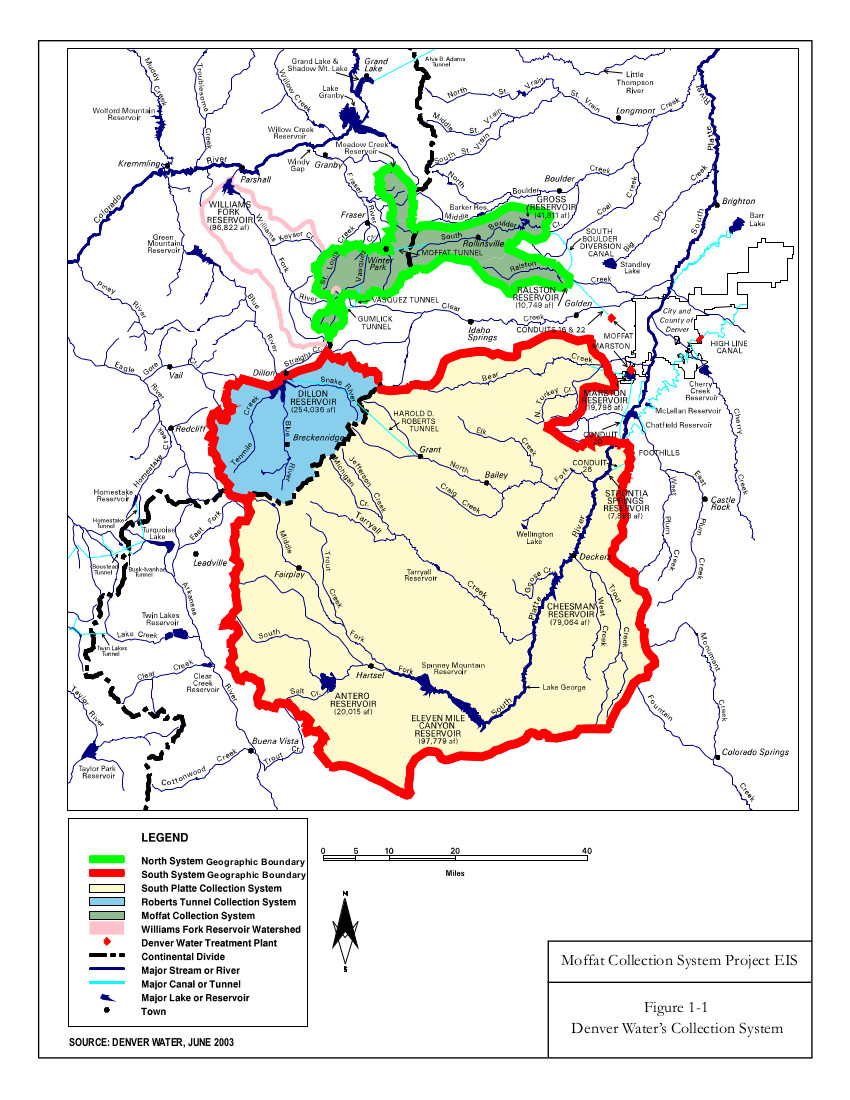
Denver Water’s collection system via the USACE EIS
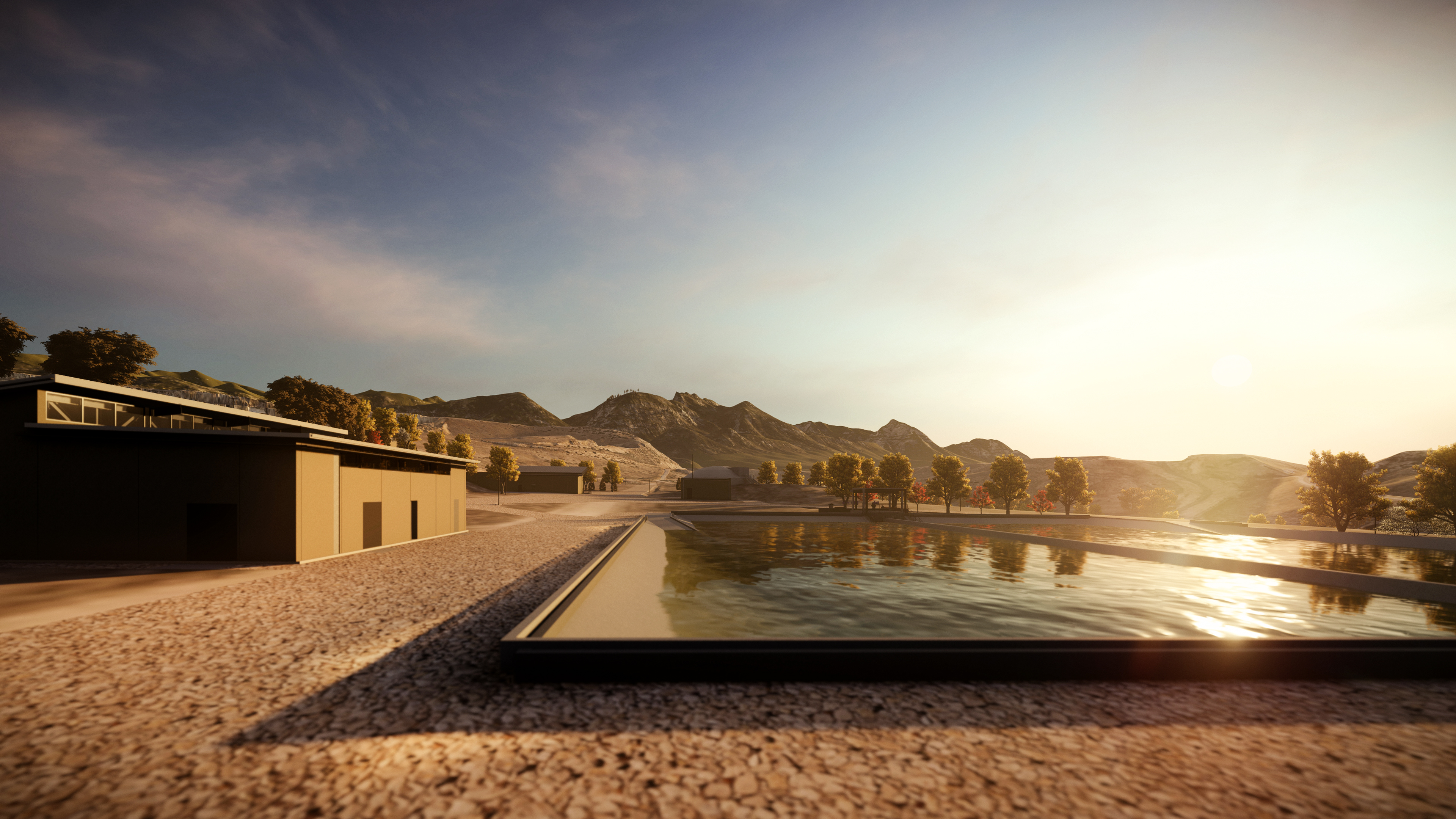
Northwater Treatment Plant — Denver Water is upgrading and modernizing the northern portion of its water system that was built in the 1930s. The utility is building a new water treatment plant, as seen in this rendering, installing a new pipeline, and redeveloping its Moffat Treatment Plant site. Photo credit: Denver Water
Here’s the release from Denver Water (Travis Thompson):
At its meeting today, the Denver Board of Water Commissioners adopted rate changes to fund essential upgrades and new projects to keep Denver Water’s system running smoothly. The new rates take effect Feb. 1, 2019, and monthly bills for most Denver residents will increase by 55 cents if they use water the same as they did in 2018.
“While the cost to maintain and upgrade the water system continues to increase, rapid development inside the city of Denver has brought in more fees from new taps sold, helping to minimize the 2019 rate increase for Denver customers,” said Jim Lochhead, Denver Water CEO/Manager. “The surrounding suburbs, however, had less development than in the past, reducing the amount collected from new tap fees, which means we’ll need to collect more revenue from suburban water rates in 2019.”
Suburban customers who receive water from one of Denver Water’s 65 distributors will see an additional monthly increase added to their volumetric charges. The Denver City Charter requires that suburban customers pay the full cost of service, plus an additional amount. Learn more about how this works: “Why Denver water costs more in the ‘burbs.”
If you live outside Denver and receive water from a distributor under contract with Denver Water, you can expect to see an annual increase between $23 and $41, which is between $1.90 and 3.40 a month (based on an annual use of 102,000 gallons of water).
Pat Fitzgerald, general manager of four Denver Water distributors including the Platte Canyon Water and Sanitation District and chairman of the suburban districts’ Technical Advisory Committee, which reviews Denver Water’s rates annually, provided this statement:
“The advisory committee supports the rate increase. The cost-of-service study used to determine the difference between inside city and outside city customers is fair and reasonable, and the committee had no objections to the results. The expenses are going up, but they’re all projects that are necessary to provide a reliable and safe source of water.”
The major multiyear projects that water rates fund include building a new, state-of-the-art water treatment plant, installing a new 8.5-mile water pipeline to replace a pipeline that was built in the 1930s, expanding Gross Reservoir to provide a more reliable future water supply, constructing a new water quality lab to ensure the highest water quality standards, investing more than $100 million to repair and replace water pipes, and more. There are 158 major projects identified in Denver Water’s five-year, $1.3 billion capital plan.
A customer’s bill is comprised of a fixed charge, which helps ensure Denver Water has more stable revenue to continue the necessary water system upgrades to ensure reliable water service, and a volume rate. The fixed monthly charge — which is tied to meter size — in 2019 is increasing by 55 cents for most residential customers both inside the city and out.
Denver Water’s rate structure includes a three-tiered charge for water use (called the volume rate). To keep water affordable, indoor water use — like for bathing, cooking and flushing toilets — is charged at the lowest rate. Essential indoor water use is determined by averaging the customer’s monthly water use on bills dated from January through March each year. This is called average winter consumption. Water use above the average winter consumption — typically for outdoor watering — is charged at a higher price.
Volume rates for Denver residents will remain the same, but will increase on suburban bills.
Denver Water operates and maintains more than 3,000 miles of pipe — enough to stretch from Los Angeles to New York — as well as 20 dams, 22 pump stations, 30 underground storage tanks, four treatment plants and more. The water provider’s collection system covers more than 4,000 square miles, and it operates facilities in 12 counties in Colorado.
Denver Water does not make a profit or receive tax dollars, and reinvests ratepayers’ money to maintain and upgrade the water system. The utility is funded by water rates, bond sales, cash reserves, hydropower sales and fees for new service (called System Development Charges).
Customers will see more information about 2019 rates in their bills and on Denver Water’s website over the next few months.
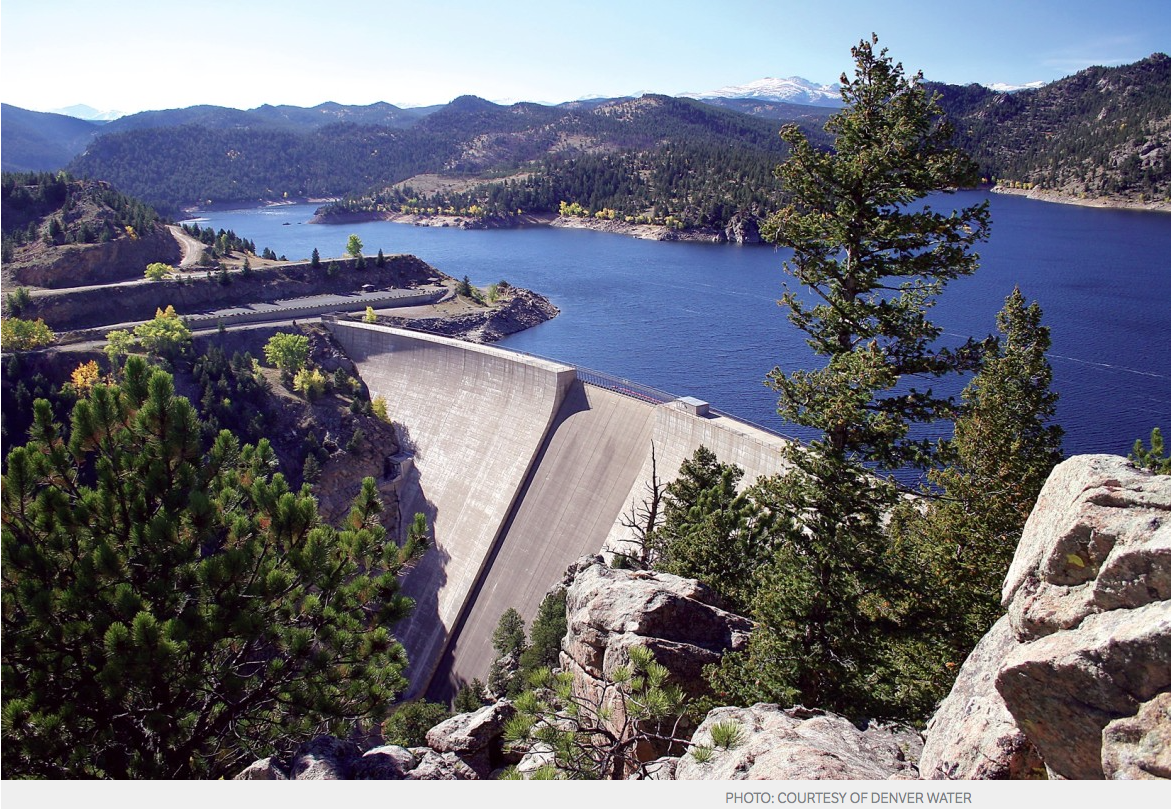
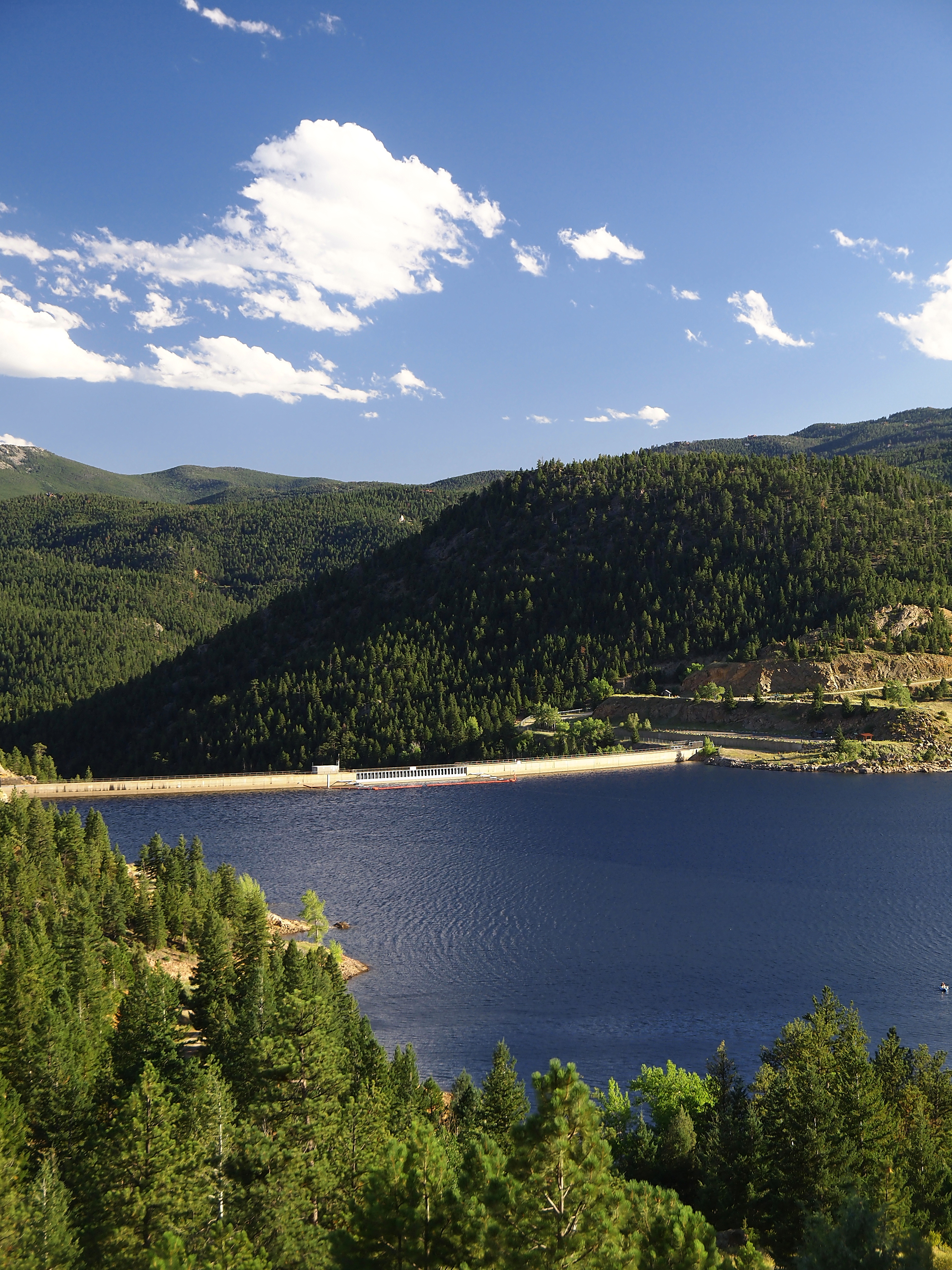
Gross Reservoir — The Gross Reservoir Expansion Project will raise the height of the existing dam by 131 feet, which will allow the capacity of the reservoir, pictured, to increase by 77,000 acre-feet. The additional water storage will help prevent future shortfalls during droughts and helps offset an imbalance in Denver Water’s collection system. With this project, Denver Water will provide water to current and future customers while providing environmental benefits to Colorado’s rivers and streams. Photo credit: Denver Water
There already are six projects being pursued in the South Platte Basin to extend the water supply. These are not included in the recent South Platte Storage Survey, but have been considered and under way for some time:
Northern Integrated Supply Project (NISP) map July 27, 2016 via Northern Water.
• The NISP/Glade project — The Northern Integrated Supply Project is a proposed water storage and distribution project that will supply 15 Northern Front Range water partners with 40,000 acre-feet of new, reliable water supplies.
Map from Northern Water via the Fort Collins Coloradan.
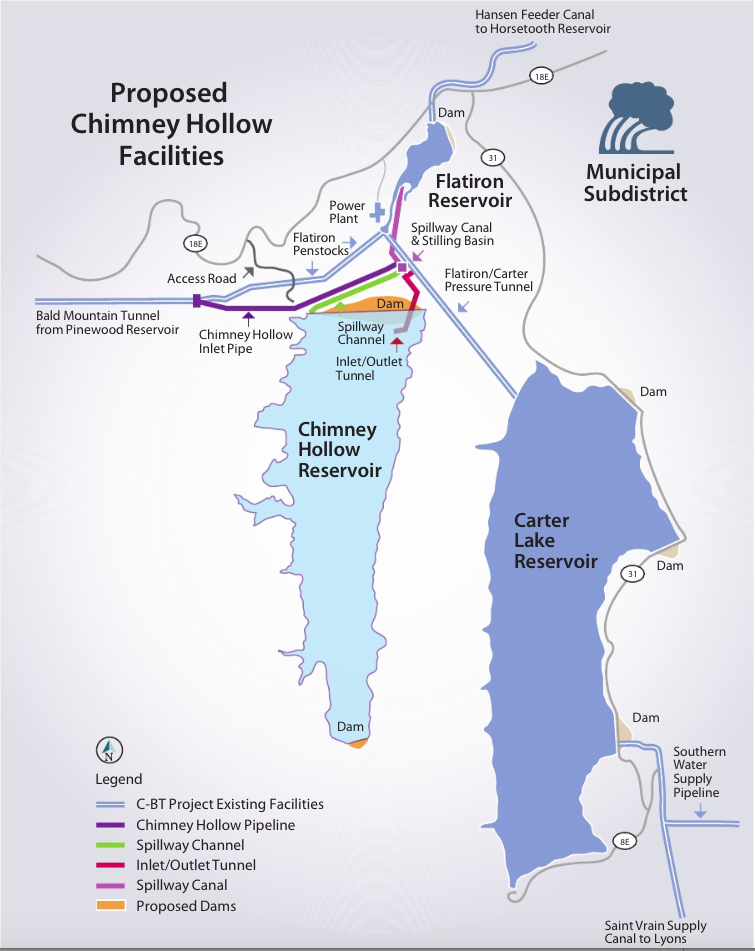
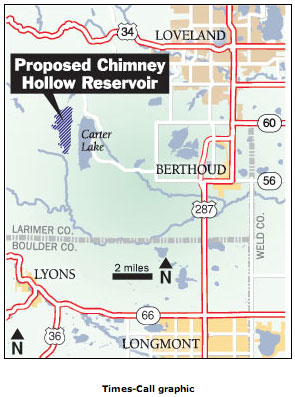
• Chimney Hollow Reservoir — A 360-foot high dam that will hold 90,000 acre feet to help supply the thirsty Thompson Valley urban area. The water will come from the Windy Gap Project, a diversion dam and pumping station completed in 1985 to provide extra irrigation and municipal water out of the Colorado River. The water originally was stored in Grand Lake, but when that is full, the water cannot be stored. Chimney Hollow, also known as the Windy Gap Firming Project, solves that problem.
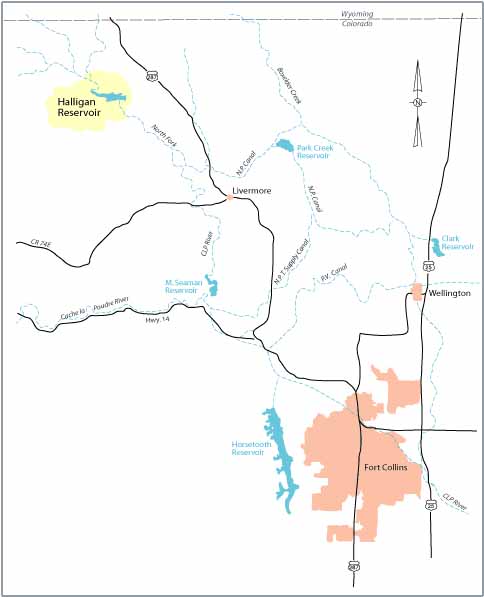
Reservoirs NW of Fort Collins
• Halligan reservoir enlargements — Halligan Reservoir near Fort Collins is about 100 years old. Its capacity is about 6,400 acre feet of water and the City of Fort Collins wants to add 8,125 acre feet to the reservoir by raising its dam about 25 feet.
• Milton Seaman Reservoir enlargement — Greeley originally had wanted to expand Seaman Reservoir in conjunction with Halligan, but because of diverging goals Greeley withdrew from the joint project. The expansion of Seamon now is targeted for design in 2028 and construction by 2030.
Gross Dam enlargement concept graphic via Denver Water
• Gross Reservoir enlargement — Gross Reservoir is one of 11 reservoirs supplying water to the City of Denver and surrounding urban areas. It is on the city’s Moffat System, which diverts water from the Western Slope to the metro area. Denver Water has proposed raising the dam height by 131 feet, which will allow the capacity of the reservoir to increase by 77,000 acre feet.
Proposed reallocation pool — Graphic/USACE
• Chatfield Reallocation Plan — The U.S. Army Corps of Engineers has determined that Chatfield Reservoir, built primarily for flood control after the 1965 South Platte River flood, can accommodate an additional 20,600 acre feet of water storage for water supply without compromising its flood control function. This additional storage space will be used by municipal and agricultural water providers to help meet the diverse needs of the state. No actual construction is required, but the legal, environmental, and engineering concerns of allowing the reservoir to hold more water all have to be satisfied.
Gross Dam enlargement concept graphic via Denver Water
FromThe Boulder Daily Camera (Lurline Underbrink Curran):
I would like to share why I support Denver Water’s Gross Reservoir Expansion project.
While located in Boulder County, the project obtains the water from Grand County — a county that is currently the most impacted county in the state of Colorado for transbasin diversions. You must wonder why the county and its citizens, stakeholders in the Colorado River Basin, along with Trout Unlimited support this project.
The reason is the Colorado River Cooperative Agreement, which is an historic agreement with statewide environmental benefits which were fought for and gained through sometimes difficult and long negotiations. It has been hailed as a new paradigm and one that will serve as an example of what can be gained when dealing with a finite resource like water. The signatories to this agreement represent the entire Colorado River Basin, and I had the honor of acting as Grand County’s lead negotiator in this agreement. I worked for Grand County for 33 years, retiring as county manager in 2015. I have lived in Grand County over 60 years and have deep roots and interest in the well-being of our waterways.
The environmental benefits gained by Grand County, which include additional flows, river ecosystem improvements, use of Denver Water’s system, participation in an adaptive management process called Learning by Doing, money for river improvements, just to name a few, are necessary to protect and enhance the Fraser and Colorado rivers. Without these benefits, these rivers will continue to degrade, with no hope of recovery or improvement.
Those who oppose the project offer no solutions to the already stressed aquatic environment of the Fraser and Colorado rivers. Through the Learning By Doing format and a public private partnership, partners have already implemented a river project on the Fraser as an example of what can be done. This project immediately produced improvements that were astounding. Colorado Parks and Wildlife can verify this claim. This essential work will not continue without the CRCA.
The impacts that are associated with the construction of the Gross Reservoir Enlargement are substantial and one sympathizes with those who will experience them, but the reality is they will end. Mitigation for the construction impacts can be applied. However, without the CRCA, the impacts to the Fraser and Colorado rivers will continue with no hope of improvement.
The environmental enhancements and mitigation that are part of the CRCA cannot be replicated without the reservoir expansion project, and the loss of these enhancements and mitigation will doom the Fraser and Colorado rivers in Grand County to environmental catastrophe.
Citing the success of Denver Water’s conservation efforts since it first issued its “purpose and need” statement for the project, and the fact that no service shortfall has yet materialized for its 1.4 million customers in the metro area, Boulder County Attorney Ben Pearlman said that based on prior environmental reviews, “Boulder County does not believe Denver Water has shown that the project’s purpose and need have been met and the FERC must deny Denver Water’s application to amend its permit.”
[…]
“We don’t think they have undertaken the duty they have (under federal environmental law) to analyze this problem thoroughly,” [Conrad] Lattes said…
Denver Water officials on Friday answered back by reasserting the project’s merits.
“The Gross Reservoir Expansion project represents an enormous amount of work, input and collaboration to ensure it is done in the most responsible way possible,” Jim Lochhead, Denver Water CEO/manager said in a statement. “And Denver Water will continue to develop noise, transportation and tree removal plans with input from stakeholders to minimize the impacts to Boulder County and its residents.”
At least seven major new reservoirs and water diversion projects are being planned in Colorado, which had a population of 5.6 million in 2017. Many would continue the controversial practice of diverting water across the Rocky Mountains from the state’s Western Slope, where the majority of Colorado’s precipitation falls, to its more arid Front Range, where people are flocking to Denver, Boulder, Fort Collins, Longmont and increasingly sprawling suburbs.
The water projects have been inspired partly by the Colorado Water Plan, an effort by Governor John Hickenlooper to solve a projected water deficit of 560,000 acre-feet by 2050, or enough to serve more than 1 million households. The plan calls for 400,000 acre-feet of new water storage and an equal amount of water conservation.
The plan is only two years old. But critics say it has prioritized gray infrastructure – new dams, pipelines and pumps – over green projects like water conservation and sustainable land use…
The state water plan does not recommend any specific water development projects. But Hickenlooper has personally endorsed several of them. He also appointed all the voting members of the Colorado Water Conservation Board, the entity that oversees the Water Plan and awards grants for water projects.
Greg Johnson, chief of water supply planning at the Water Conservation Board, said the state’s plan emphasizes conservation just as much as new water supply projects. But he said the latter may be more more pressing in some cases.
“Some of the bigger projects that are in permitting right now are helping meet really critical supply needs that a lot of those faster-growing northern Front Range suburbs have, where they’ve got new developments going up all over the place,” Johnson said. “They have maybe a 10- or 15-year horizon to get some of those things done.”
One of the water developments endorsed by the governor won a $90 million loan in 2017 from the Water Conservation Board – the largest loan in the board’s history. Known as the Windy Gap Firming Project, it proposes a new reservoir called the Chimney Hollow Reservoir near Longmont to store Colorado River water diverted through an existing tunnel under the Continental Divide.
The loan covers nearly one-fourth of total costs for the project, which is proposed by the Northern Colorado Water Conservancy District.
As its name implies, the project is intended to “firm up” existing Colorado River water rights held by a dozen Front Range cities. The cities already draw on these water rights, but can’t fully tap them in some years because of storage limitations. The new 90,000 acre-foot reservoir will solve this problem and allow them to divert the river almost every year.
The project would result in diverting 30,000 acre-feet more water out of the Colorado River every year than is currently diverted…
Other major projects in the works include the Moffat Collection System, a plan by Denver Water to expand Gross Reservoir to hold 77,000 acre-feet of additional diversions from Colorado River headwaters streams; and the White River Storage Project, a proposal for a new reservoir of up to 90,000 acre-feet in the northwest corner of the state, near the town of Rangely…
Greg Silkensen, a spokesman for the Northern Colorado Water Conservancy District, said the Windy Gap project is vital to many fast-growing Front Range communities that have lower-priority water rights.
“The Colorado economy is just crazy. Everybody and their brother is moving here,” Silkensen said. “There is a great deal of environmental mitigation that will go forward if the project is built. There’s going to be a lot of benefit to the Upper Colorado River if it does go through.”
Those projects include stream habitat restoration in the Colorado River and water quality improvements in Grand Lake, part of the existing Western Slope diversion system.
Boulder County is an intervenor in this action and offers the following comments on the Supplemental Environmental Assessment (EA) issued by the FERC’s staff on February 6, 2018, related to the Gross Reservoir Hydroelectric Project (FERC Project No. 2035-099).
As detailed below, Boulder County continues to object to the FERC issuing Denver Water’s requested license amendment. The FERC staffhas failed to address significant issues related to the project; as a result, approval by the FERC is premature and would result in negative and unnecessary impacts on the residents and natural resources of Boulder County.
The EA analyzes only those potential environmental effects of oe·nver Water’s proposal to expand Gross Dam and Reservoir which were not addressed in the 2014 Final EIS prepared by the Army Corps ofEngineers (Corps). The FERC’s staffreviewed the EA, made a finding of no significant impact, and recommended approval by the Commission, as mitigated by environmental measures discussed in the EA.
This approach is flawed because ofthe resulting narrow scope ofthe EA, the lack ofspecificity related to adoption of mitigation measures for project impacts, and the FERC staffs wholesale and unquestioning adoption of the Army Corps of Engineer’s Final Environmental Impact Statement (FEIS), which FEIS was completed on April 25, 2014, and for which a Record of Decision was issued on July 6, 2017. The FERC should determine that both the FEIS and the EA fail to meet the standards ofthe National Environmental Policy Act (NEPA) and therefore reject staff’s unreasonable approach.
Gross Dam enlargement concept graphic via Denver Water
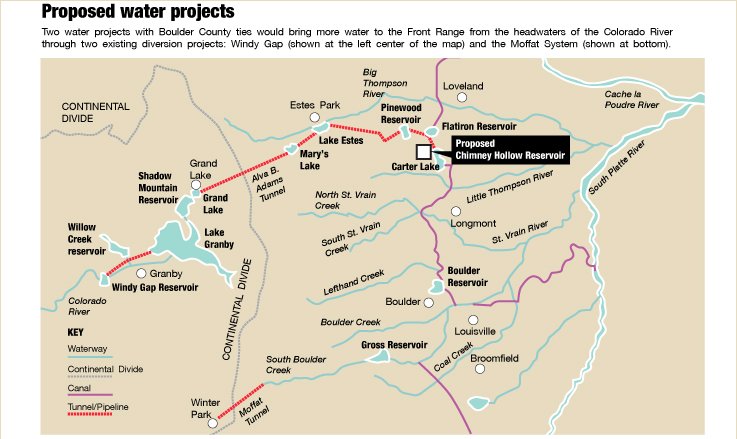
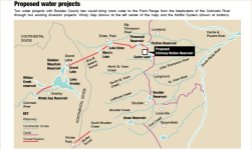
Moffat Collection System Project/Windy Gap Firming Project via the Boulder Daily Camera
Gross Reservoir has a surface area of 418 acres. Once the Gross Reservoir Expansion Project is completed an additional 424 acres will be added to the reservoirâs surface area.
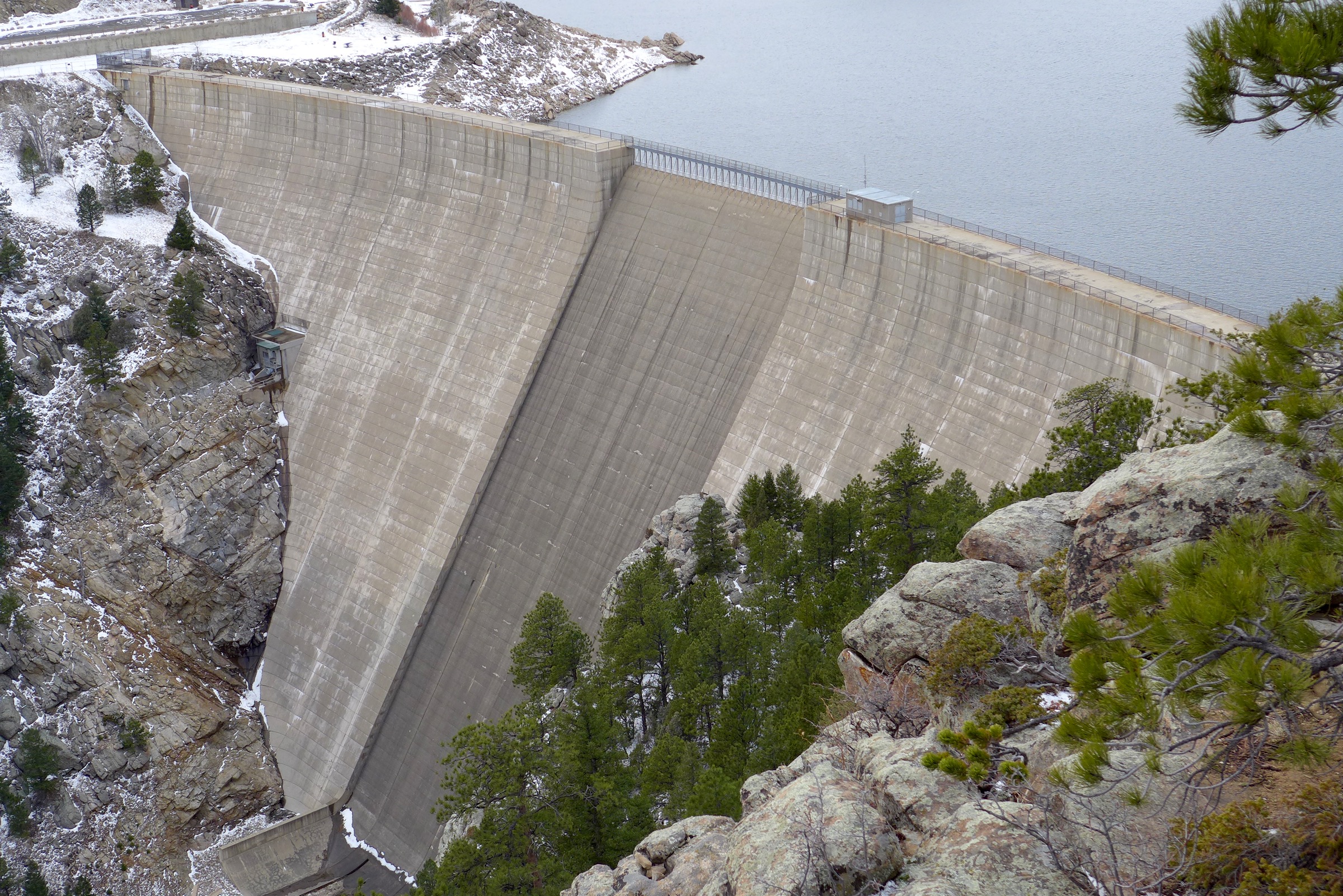
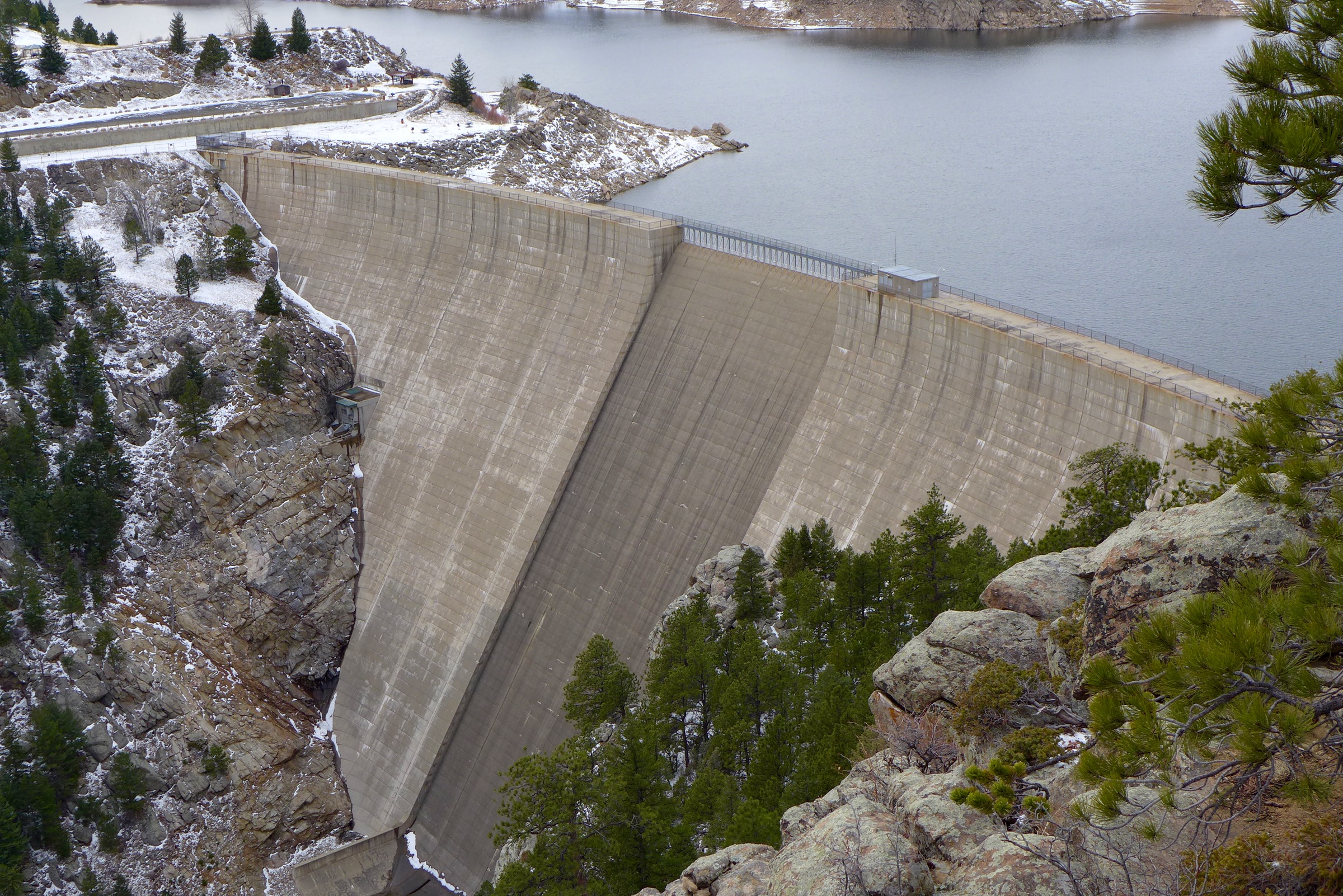
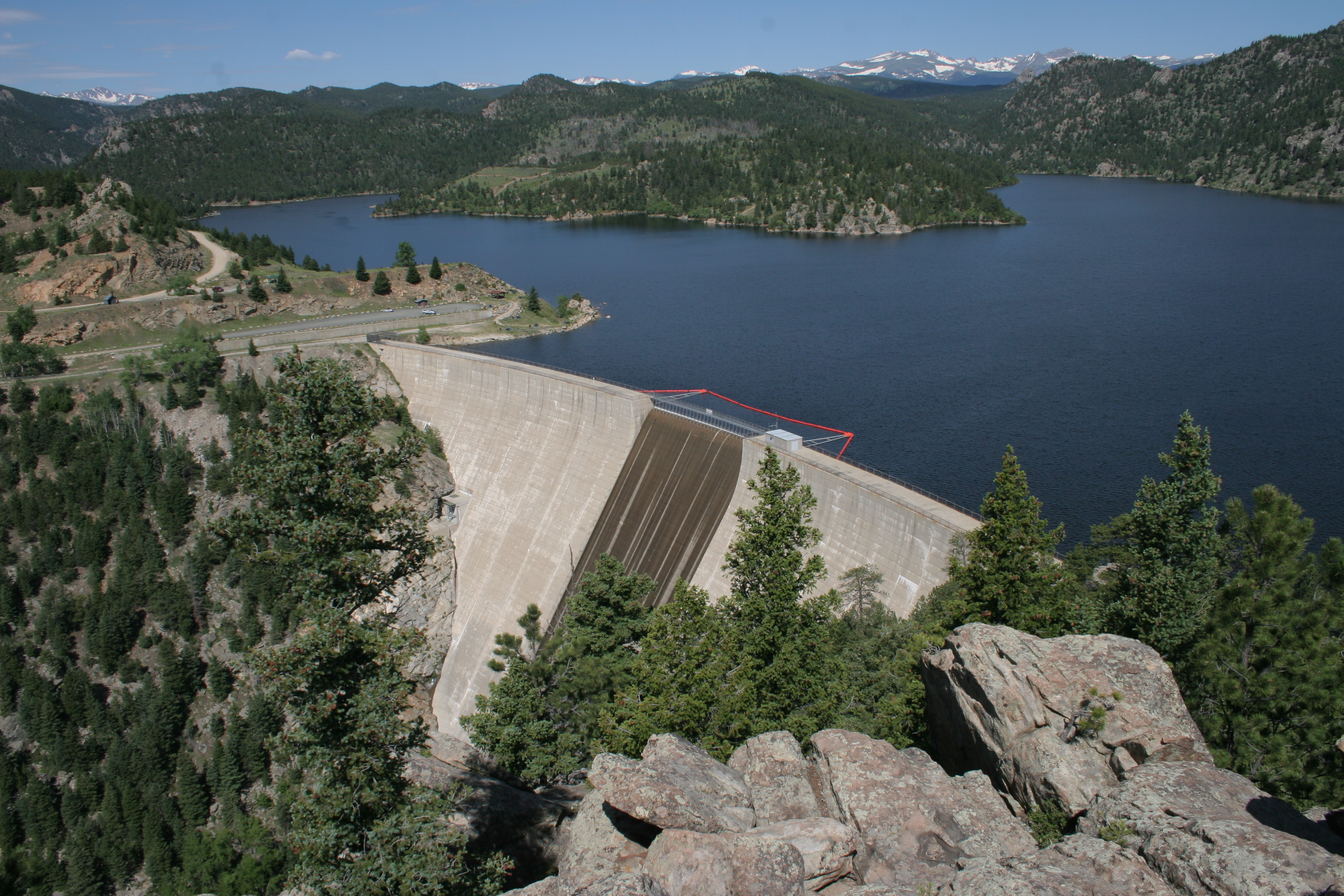
The dam that forms Gross Reservoir, located in the mountains west of Boulder. Photo: Brent Gardner-Smith/Aspen Journalism
Gross Reservoir in the mountains to the southwest of Boulder. Denver Water hopes to increase the height of the dam 131 feet, to a new height of 471 feet, to store three times as much water, which it says will help it meet increasing demands and to better weather severe droughts.
The Federal Energy Regulatory Commission, which is weighing a Denver Water request to raise the Gross Reservoir Dam, expand the reservoir and amend its hydroelectric license for the utility, issued a supplemental environmental assessment of the plans Feb. 6. At that time, the commission set a 30-day window for public comment on the document, set to expire March 8.
Save the Colorado and The Environmental Group of Coal Creek Canyon, through Boulder attorney Mike Chiropolos, and, separately, WildEarth Guardians, filed requests to extend that comment period by 60 days.
“Upon consideration, we find that a 30-day extension is warranted,” the commission’s secretary notified parties in a letter on Tuesday. Comments on that supplemental environmental assessment are now due to FERC by April 9…
Tim Guenthner and his wife, Beverly Kurtz, who live in the Lakeshore Park neighborhood on the north side of the reservoir, have studied issues around the proposed project for years.
Guenthner, with his background in engineering, has concerns about environmental, quality of life and safety considerations relating to Denver Water’s plans for development of an on-site quarry at Osprey Point, as well as the use of roller-compacted concrete to enlarge the dam. That’s a technique that he says has never been applied to a dam project at so great a scale. Previously, a dam raise of 117 feet at San Vicente Reservoir in San Diego County was the highest using this technique — not only in the United States, but the world…
The couple, who are part of The Environmental Group of Coal Creek Canyon, urge those interested in learning more about the $380 million Denver Water project to attend a meeting at 3:30 p.m. Sunday at the Coal Creek Canyon Improvement Association Community Center located at 31528 Coal Creek Canyon Road. The session will be used to plan social media campaigns and educate the public about the project’s current status and implications.
The Federal Energy Regulatory Commission is expected to rule early next year on what would be the biggest public works project in Boulder County history, exceeding the original construction of the Gross Reservoir Dam, which was completed in 1954.
The tree removal plan outlined in Denver Water’s FERC application states that all trees and their associated debris on about 430 acres along 12.5 miles of shoreline will have to be removed in the course of the expansion, which is envisioned as being completed by 2025.
Denver Water spokeswoman Stacy Chesney said the agency has estimated that “the density of the forest ranges from approximately 150 to 1,800 trees per acre. Based on these initial plans, we estimate up to 650,000 trees will need to be removed in the area surrounding Gross Reservoir.”
In a recent interview, Denver Water President Jim Lochhead vowed that every aspect of the project’s completion is being designed and executed with an eye toward mitigation of its impacts on the high country environment and those who depend on it for their recreation or call it home.
“We recognize that this is a major construction project and it has adverse impacts to the community,” said Lochhead, whose utility serves 1.4 million in Denver and many of its suburbs — but not Boulder County.
“We are trying to understand exactly what those impacts are, and see what the needs of the community are, and do everything we can to help address them.”
Referencing project manager Jeff Martin, Lochhead said, “Whether it’s traffic, hauling on the roads, whether it’s noise associated with the quarry, whether it’s the tree removal issues, it’s Jeff’s job to make sure it goes in a way that we’re doing the best that we can by the local community.”
Martin said: “We recognize the brutal aspects of the project. We don’t want to hide from those. That’s not our objective.”
Stressing that Denver Water intends to factor the concerns of reservoir neighbors into its planning of what’s officially known as the Moffat Collection System Project, Martin said, “We look forward to getting that feedback, seeing how we can make it into the most palatable project we can, and turn it into, maybe not reducing all the impacts, but for the greater good, reducing them as much as we can.”
[…]
A 48-page plan for the required tree removal prepared by Denver Water describes a mix of ponderosa pine, Douglas fir and Rocky Mountain juniper.
According to data the agency compiled in 2005, most of the trees at that time were 20 to 50 feet high, with a breast-high diameter ranging from 4 to 14 inches.
“Because of the topography, e.g., very steep slopes, rock outcrops, etc., several more complex tree removal (logging) systems will need to be used, and some temporary roads will need to be constructed to remove the trees,” the plan states.
It estimates that 50,000 tons of forest biomass are expected to be produced during the required clearing for the expansion of Gross Reservoir, which is to see its dam raised by 131 feet, expanding the reservoir’s capacity by 77,000 acre feet to a total storage capacity of 118,811 acre feet.
While noting that, “Traditionally, most of the slash would have been piled and burned in place,” the plan acknowledges that, “Today, burning large quantities of forest residue, in close proximity to residential areas, is problematic in the extreme.”
Allen Owen, Boulder District forester for the Colorado State Forest Service — a contracted forest resource management partner to Denver Water through the Forests to Faucets program — said he had been unaware of the number of trees Denver Water is planning to pull out of the Gross Reservoir area, or that it will involve the leveling of all growth on 430 acres of shoreline.
He doubts it would actually reach the 650,000 figure.
“That would mean 1,500 trees per acre over the entire 430-acre unit, and I know that’s not the case,” he said. “The stand densities vary all around the perimeter of the shoreline. There are areas that are nothing but solid rock, with no vegetation on it, to units that may have those number of trees. But there are not that many trees over the entire 430 acres. The number seems high.”
Owen expects state foresters will be involved in plotting how the trees’ removal proceeds.
“It’s something way beyond the ability of the Colorado State Forest Service,” he said. “I would consider that a big logging job, on very steep slopes, with very poor access. It is going to be very difficult, at best.”
Martin discussed three different potential scenarios, including removal by truck, burning and burial of felled lumber, or some combination of those strategies.
In cases where trees are located on small rock bluffs, Denver Water’s current removal plan notes, “the use of helicopter may be necessary.”
Denver Water believes new emerging technologies may pose options for removal that weren’t contemplated when its plan was authored.
“One of the things we’ve committed to is developing a process with public input … going out and getting some public input and some stakeholder input and that includes the U.S. Forest Service, the Colorado state forester and Boulder County, and developing some concepts … and then seeing what fits best for the community from there, and then moving forward with the plan,” Martin said…
Denver Water points to steps it is taking to mitigate the effects of construction wherever possible, and also emphasizes measures that it contends offers some in Boulder County a benefit. Lochhead and Martin touted the provision of a 5,000-square-foot environmental pool in the expanded reservoir, to be available for replenishing South Boulder Creek for the benefit of both Boulder and Lafayette at times when it is running dangerously low.
“That’s kind of a neat partnership there,” Lochhead said.
That does not mean that Boulder supports the Gross Reservoir expansion — but nor does it oppose it.
“Boulder has a neutral position on the overall expansion,” said Boulder’s source water administrator, Joanna Bloom.
“If the project somehow falls apart, then Boulder will continue to try to establish the streamflows on South Boulder Creek through other means,” Bloom said…
Boulder County’s stance on the expansion is more complicated.
The county filed extensive comments on both the draft and final environmental impact statements in the Army Corps of Engineers’ review process, and doesn’t agree that the EIS adequately addressed “the myriad of impacts” that would result for Boulder County and its citizens.
On March 23, the county filed an unopposed motion to intervene in the FERC approval process. One of the points the county addressed at length in that intervention relates to tree removal — and its arguments are based on the presumption of a far more modest, but still significant, removal of trees, at a total of 200,000.
“County roads (Flagstaff Road, Magnolia Road and others) are windy with low volume residential traffic and would be inappropriate for use by trucks hauling trees,” the county argued.
“In addition, it may not be possible to safely navigate SH 72 with trucks full of trees. These heavily laden trucks will cause damage to the roads and present safety concerns for road users.”
Moreover, the county contends Denver Water’s project must come through its land use review process, while the utility maintains that the county’s role is superseded by the FERC review process.
Until that conflict is resolved, the county is tempering its remarks, pro or con, on the Gross Reservoir project, so that it will not be seen as having prejudged any application Denver Water might make in the future through the county’s land review process.
Martin recalled that Denver Water worked extensively with Boulder County in 2012 exploring a potential intergovernmental agreement to facilitate the reservoir expansion.
While such a pact was ultimately rejected by Boulder County commissioners by a 3-0 vote, Martin said, “What we did receive was a lot of information from Boulder County and the public on how we need to shape the project in order to meet the needs of both the community and Boulder County.”
However, independent of the environmentalists’ planned federal lawsuit, there might be a need for another judge to sort out the critical question of whether Denver Water’s plans for tree removal and many other aspects of its reservoir expansion must pass through the county’s land use review process.
“I would say that it is likely that it will take litigation, because neither party is willing to give up its position,” said Conrad Lattes, assistant county attorney for Boulder County. “We need some neutral third party to decide this for us.”
However, on a warm and sunny day back before the chill of approaching winter descended on Colorado’s high country, Denver Water’s brass were flush with optimism.
Martin said that for Denver Water, it’s not just about getting the project done.
“We’re also looking at the social responsibility,” he said, “making sure that when it’s said and done, that we did it in the right way; that we could look back and say we did everything within reason and practicality to make this really the most environmentally, socially responsible project we can.”
Gross Dam enlargement concept graphic via Denver Water
The plan includes environmental enhancements and protections to ensure the Fraser River will be better off with the Moffat Project than without it.
Here’s a guest column from Kirk Klancke that’s running in the Boulder Daily Camera:
As a long-time resident of Grand County, I’ve been disappointed by recent articles in the Camera about the Moffat Firming Project permit and especially about the west slope implications of the project. Coverage has been misleading in highlighting potential negative environmental impacts while ignoring the stream habitat improvements and flow benefits in the permit that will actually improve the health of the Upper Colorado River system.
It’s important for readers to get the total picture in weighing the environmental impacts of the project.
Trout Unlimited is also a group “dedicated to protecting and restoring the Colorado River” — and we’ve spent more than a decade closely following the proposed Moffat project and working to protect the Upper Colorado. Then, a couple years ago, TU helped negotiate a settlement with Denver Water and local stakeholders in Grand County that included tough permit requirements that we believe will best protect the Upper Colorado and Fraser Rivers.
It’s true that the Moffat project will increase total diversions from the Colorado headwaters. But the project will also provide significant help to rivers and streams currently impacted by transmountain diversions, including streams diverted to meet Boulder’s water supply (through the Windy Gap project). Under terms of their permit, Denver Water must undertake mitigation and enhancement measures that will actually improve the health of streams.
For instance, as part of its commitments, Denver Water will manage diversions to help provide needed flushing flows on the Fraser and its tributaries, complete habitat and native trout restoration work in the Williams Fork basin, and contribute funds toward projects like the Fraser Flats restoration project that is already underway to improve stream and riparian habitat.
Most significantly, Denver Water will participate in an ongoing adaptive management program called “Learning by Doing” through which Denver, Grand County, Trout Unlimited and other local stakeholders are cooperating to apply mitigation and enhancement resources, monitor river and watershed conditions and make adjustments to achieve the best results over time. These efforts were launched even before Denver received their federal approvals.
While my efforts have focused on Grand County, I know that Denver Water has looked for partnerships on the east slope as well. For example, as part of the project, they will provide 5,000 acre-feet of storage in the enlarged reservoir for Boulder and Lafayette to use in providing in-stream flows at critical times, to keep downstream stretches of South Boulder Creek healthy and flowing.
Denver Water’s plans to enlarge Gross Reservoir certainly will have significant impacts on Boulder County, including disruption to lives and property around the reservoir area during construction — but these are mostly temporary impacts. It’s important to look at the project’s long-term benefits to our rivers and streams as well as to our water security.
For years I saw Denver Water as my community’s public enemy number one. But in recent times Denver Water has demonstrated a willingness to work as a partner to keep the Upper Colorado River healthy. This collaboration among stakeholders represents the best opportunity to protect and preserve the Upper Colorado River into the future.
The U.S. Army of Corps of Engineers officially threw its support behind the proposed expansion of Denver Water-owned Gross Reservoir, aka the Moffat Collection System Project, to triple capacity of the storage facility this past Friday. The review process has been nearly a decade and a half in the making as the Front Range tries to keep pace with population and expected water consumption growth by pulling more of the resource off the Colorado River in headwater communities along the Western Slope.
Just to reach the milestone and obtain buy-in from the region, Denver Water spent six years in negotiations with Summit, Grand and Eagle counties and 14 other stakeholders, as well as several other subsidiary entities. The result was the Colorado River Cooperative Agreement, which gave way to the impacted counties accepting the terms to allow the metro area’s municipal water agency to remove water to which it already owned the rights.
“While some may say 14 years is too long, I believe complicated issues deserve thorough study,” Jim Lochhead, Denver Water CEO and manager, said in a news release. “In accordance with other agreements we’ve implemented along the way, Denver Water will provide millions of dollars to improve watershed health in the critical Colorado and South Platte River Basins. The project enjoys broad, bipartisan support from lawmakers, major environmental groups, chambers of commerce and water interests on both sides of the Continental Divide.”
An environmental group that does not share in the reverie, however, is Save The Colorado, a nonprofit water advocacy organization against the project to divert 15,000 more acre-feet of water from the Colorado River…
Save The Colorado’s attorneys are presently reviewing the Army Corps’ record of decision in anticipation of a suit to be filed in federal district court in Denver as part of a larger coalition that may include Boulder homeowners who live around the reservoir’s perimeter. A requested injunction may be part of the legal strategy should Denver Water begin construction on the 131-foot heightening of the existing 340-foot dam wall if a few other smaller-scale permits are secured, but the aim is preventing it from ever coming to fruition.
“Our goal is stop the project, not slow it down,” said [Gary] Wockner…
Summit’s Board of County Commissioners believes the complex deal is a fair one, considering what the area’s water future may have looked like without it in place. Aside from other considerations to keep Denver Water’s appetite in check in the years to come, $11 million in cash — $2 million of which has already been paid — will ultimately be split evenly among the county government and its four major towns of Breckenridge, Dillon, Frisco and Silverthorne for future water and other environmental enhancement projects.
Various county entities, including Summit’s four ski resorts, also stand to receive access to a combined 1,700 acre-feet (approaching 570 millions of gallons) of water annually not previously available out of Denver Water-owned Dillon Reservoir. Grand County is to receive $6 million in payments upon the bypassing of possible legal barriers and final execution of all permits, on top of additional water and adaptive management assistance, while Eagle received some legal assurances of its own.
“This agreement provides for our economy, our environment, our way of life and are things we could have never gotten had we fought Denver Water in court,” said County Commissioner Thomas Davidson. “Denver Water already had these water rights, and that was something we from the Western Slope had to keep reminding ourselves of. Each side had to give up or give in on things they felt very passionately about not wanting to give up.”
With some exceptions, the compromise also better defines Denver Water’s service area to help prevent the expansion of those boundaries and the thirst for even more regional waters. The agency has committed to maintaining conservation activities and increasing reuse of water from the Blue River to reduce the need for more Western Slope water as part of these efforts. A guarantee to hold Dillon Reservoir at an accepted level for ideal aesthetic and recreational purposes from June 18 to Labor Day is a guarantee written into the agreement as well.
With the Army Corps’ endorsement as follow up to a prior certification granted by the Colorado Water Quality Control Division, Denver Water next needs a few remaining approvals from the Federal Energy Regulatory Commission, U.S. Forest Service and most likely a permit from Boulder’s Board of County Commissioners.
Denver Water is seeking approvals from the U.S. Army Corps of Engineers, the U.S. Fish and Wildlife Service, and the state of Colorado to expand Gross Reservoir, which is southwest of Boulder. The 77,000 acre-foot expansion would help forestall shortages in Denver Water’s water system and offer flood and drought protection, according to Denver Water.
Denver Water CEO Jim Lochhead said the project, which was approved late Friday, was important to add balance and resiliency to the agency’s system. The dam expansion still needs approval from the Federal Energy Regulatory Commission to increase its hydropower capacity.
“It’s been a long haul,” Denver Water Board President Paula Herzmark said of Friday’s decision. “We are just ecstatic, just elated that this permit is now in place and we can begin. To have the insurance that we’re going to have this additional source of supply as our community grows.”
[…]
Colorado Trout Unlimited was happy with the news. The group has been working with Denver Water to make the project environmentally friendly, Trout Unlimited counsel Mely Whiting said.
The project includes an environmental pool to divert water to streams that need it. It also led to the Learning By Doing Cooperative Effort that brings together groups to monitor stream conditions and quickly take action when needed. Denver Water is also giving about $25 million to Grand County and other counties for environmental advancements…
Lochhead countered that the extra water will be needed as current conservation efforts won’t be enough to cover the growing population and effects of climate change. He added that Denver Water has been working with environmental groups and local and federal governments since the start to not just mitigate damage, but rather improve rivers.
Lochhead acknowledged that the five years of construction will be hefty, especially the three years of intensive concrete placing. He said Denver Water worked with the local residents to mitigate impacts and said an onsite quarry will be built to reduce truck trips.
“With a warming climate and with growth and other issues in our system, we need to make sure that our system is resilient in the long term,” he said.
Denver Water finally has a key permit that it needed to begin raising Gross Dam, located in the foothills northwest of Denver. The purpose is to triple the amount of water that can be stored there, including greater volumes of water diverted from the Winter Park area.
But the city still needs several more federal permits and may get caught in a legal fight. Unlike some water battles of the past, however, this one will come from elsewhere along the Front Range…
Denver Water has been working on this plan since the great drought of 2002 caused city water officials to realize the vulnerabilities of their system. The agency provides water not only to Denver, but many suburbs — altogether about a quarter of all Colorado residents.
“While some may say 14 years is too long, I believe complicated issues deserve thorough study,” said Jim Lochhead, Denver Water chief executive.
Denver has diverted water from the Fraser River and its tributaries since 1936 through the pioneer bore of a railroad tunnel under the Continental Divide. The water is impounded at Gross Dam. The dam already stands 340 feet tall, and Denver wants to raise the dam another 131 feet, to accommodate increased diversions.
Grand County, whose water will be diverted, has not opposed the project…
These diversions were mostly engineered in the 1930s. “Denver had a vision; we had none,” summarized Lurline Curran, who is the now-retired county manager of Grand County, at a water conference about a decade ago.
This time, Grand County sat down with Denver and brokered a deal. Denver gets more water, but it also agrees to work with Trout Unlimited and other local groups to try to take the water in ways that are least impactful to fish and other components of the ecosystem.
The Gross Reservoir Expansion Project will add 77,000 total acre feet — 72,000 for Denver Water use and 5,000 for an environmental pool that provides additional water for South Boulder Creek during low-flow periods — nearly tripling reservoir capacity.
Here’s the release from Denver Water (Stacy Chesney):
Army Corps of Engineers issues record of decision and 404 Permit
Following 14 years of careful study, evaluation and deliberation, the Army Corps of Engineers has approved Denver Water’s request to raise Gross Dam in Boulder County. The additional water stored in Gross Reservoir will help prevent future shortfalls during droughts and helps offset an imbalance in Denver Water’s collection system.
The approval comes in the form of a record of decision and 404 Permit — two documents required by the federal government as part of the National Environmental Policy Act.
“Denver Water appreciates the Corps’ dedication and commitment to careful study of the anticipated impacts of this project,” said Denver Water CEO Jim Lochhead. “We will complete this project responsibly, as evidenced by our actions during the public process and the resulting robust environmental protections we’ve agreed to along the way. We’re proud to be doing the right thing.”
The existing dam was built in the early 1950s and was designed to be expanded in the future to increase water storage capacity. The Gross Reservoir Expansion Project approval completes this original vision.
“Issuance of this permit will unlock significant resources that will allow us to do good things for the river and the environment,” said Mely Whiting, counsel for Trout Unlimited.
In accordance with existing agreements, including the Colorado River Cooperative Agreement and Grand County’s Learning By Doing, and conditions in the 404 Permit, Denver Water will provide millions of dollars to improve watershed health in the critical Colorado and South Platte River Basins. Lochhead said these commitments are one reason that last year Colorado Department of Public Health and Environment found that the project will have a “net environmental benefit” on the state.
The project has earned key endorsements from Gov. Hickenlooper, state and federal lawmakers, major environmental groups, local mayors and city councils, chambers of commerce and economic development corporations, county elected officials and water interests on both sides of the divide.
“The next milestone we anticipate is approval by the Federal Energy Regulatory Commission of Denver Water’s hydropower license amendment application at some point next year,” said Jeff Martin, Gross Reservoir Expansion program manager. “In the meantime, Denver Water continues to make significant investments in setting a firm foundation for the project’s overall success by recently hiring Black and Veatch as the owner’s representative. We are also in the process of procuring a design engineer.”
Preconstruction activities, including dam design and geotechnical work, are expected to begin in 2018. The entire project is expected to be completed in 2025.
Here’s the release from the Arkansas River Basin Water Forum (Jean Van-Peldt):
Denver Water lawyer to share message of cooperation
Water agreements are always tricky, a matter of give and take.
Most importantly, they require cooperation.
That’s the message Patricia Wells, general counsel for Denver Water, will bring to the Arkansas River Basin Water Forum when she kicks off the second day of the forum on April 27 at Hotel Elegante, 2886 S. Circle Drive, Colorado Springs. The two-day forum will feature panels and tours to discuss water issues of concern to the Arkansas River basin, and El Paso County in particular.
“We’ll be talking about examples of how, when you’re dealing with the supply gap, you need to deal with others,” said Wells, who is also a member of the Colorado Water Conservation Board. “Multiple parties can accomplish more.”
Wells has represented Denver Water since 1991, coming on board just after the EPA veto of Two Forks. It changed how the state’s largest water provider dealt with the growth of its system, as well as the way it treated its neighbors. Wells came superbly prepared for the job, with her background as Denver City Attorney and as a staff attorney for the Environmental Defense Fund.
“The Two Forks veto came as a result of the environmental laws in the 1970s and ‘80s and was a paradigm shift,” Wells said. “Most large water organizations have gone through a metamorphosis in the last 30 years.”
In the case of Denver Water, that has meant two of the most far-reaching agreements in the history of Colorado Water, both occurring during Wells’ tenure at the legal helm. They were very different types of negotiations.
The first was the Colorado River Cooperative Agreement, which brought together 40 parties, primarily on the Western Slope, which had fought for decades over Denver’s appropriation of Colorado River water. Denver sought the support, or at least lack of opposition, from the communities in order to enlarge Gross Reservoir, a key supply for Denver Water located in Boulder County.
“We did all the right things,” Wells said. “But we’re still in the 13th year of permitting on Gross Reservoir. If we can’t get Gross Reservoir done then water projects can’t be done in Colorado.”
The second was the WISE (Water Infrastructure and Supply Efficiency), which looked at how Denver, Aurora and water providers in the South Metro Water Supply Authority could pool resources.
They were far different negotiations, but the common thread was the need to work together for common interests and to overcome operational hurdles.
“The state Water Plan talks about CRCA and WISE as how projects should be developed,” Wells said. “But I don’t think there’s a single way to do things.”
The Upper Arkansas River Voluntary Flow Management Program, which will be discussed in one of the workshops at the forum, is an example of multiple parties working together in the Arkansas River basin. That program has been in effect since 1991.
“These agreements take a lot of time to put together and a long time to get organized,” Wells said. “It’s about how you work with other people and why you work with other people.”
Registrations and information about this year’s forum are available at http://www.ARBWF.org.
Arkansas River Basin — Graphic via the Colorado Geological Survey
Denver Water, which serves 1.4 million people in the city and county of Denver and surrounding communities, is currently waiting for a permitting decision to be issued by the U.S. Army Corps of Engineers on its proposed expansion of Gross Reservoir, located in southwestern Boulder County.
The USFS has filed extensive past comments critical of the Gross Reservoir project, but now says all of its concerns about that project have been resolved.
Critics, however, point to a five-year, $4.5 million contract providing Denver Water funding for the original Forsythe project as well as numerous other Colorado forest management efforts — talks are now underway for a new five-year pact for Denver Water to help subsidize projects, including Forsythe II — and they challenge the level of transparency surrounding that wildlands management initiative.
Denver Water touts its relationship with the Forest Service on its website, billed since 2010 as the “From Forests to Faucets” program. That partnership called for Denver Water from 2010 to 2015 to match a $16.5 million investment from the Forest Service, for a total of $33 million, for forest treatment projects seen as critical to protecting water supplies and water quality.
A memorandum of understanding was signed by Denver Water in December for a similar new agreement between the two, setting up a new one-to-one matching effort totaling another $33 million, to cover 2017 to 2021.
The Colorado State Forest Service was also a partner to the previous pact, and will be to its successor, along with the Natural Resources Conservation Service.
Colorado saw a dramatic example of the healthy forests-healthy water link following the June 2002 Hayman fire, which filled Cheesman Reservoir — the oldest reservoir in the Denver Water system — with mud, ash and other debris.
Denver Water was forced to spend more than $27 million on water quality treatment, sediment and debris removal, reclamation techniques and infrastructure projects in the wake of the Hayman Fire and the 1996 Buffalo Creek Fire, according to Denver Water spokesman Travis Thompson.
But Magnolia-area resident David Bahr sees the Denver Water-USFS relationship as “absolutely” representing a conflict of interest, specifically as it applies to the controversial Forsythe projects in western Boulder County.
“How can it not be?” Bahr asked. “The fact that (USFA) employees and goods are being paid for by Denver Water means that if they weren’t doing this, those employees wouldn’t be getting paid. The Forest Service has to be aware of this, so it has to influence any decisions that they make.”
Vivian Long, president of the Magnolia Forest Group, has long been vocal in opposition to the original Forsythe project and its planned successor, Forsythe II, which calls for thinning and controlled burns on 2,855 acres of national forest land within the nearly 19,000-acre project area, to be carried out over 10 to 15 years.
“While they’re saying, ‘We’re taking money from Denver Water, but they have no input on what we do,’ I don’t know if that’s true or not,” Long said. “When we have asked about them taking money from Denver Water, they have tried to either downplay it, or deny, or just say they don’t know anything about it. So we’re left wondering, whose opinion is more important here: the public’s or Denver Water?”
Paperwork documenting the Denver Water-USFS relationship was obtained by Magnolia Forest Group member Teagen Blakey through Colorado Open Records Act requests…
Forsythe II critics point out that in March 2010, the Forest Service filed 142 pages of comments on the Gross Reservoir project with the Corps of Engineers highlighting many concerns, including the adequacy of Denver Water’s consideration for habitat and wildlife issues in the Arapaho and Roosevelt National Forests.
That same year, the Forest Service signed off on the five-year operating plan for Denver Water to pitch in $4,479,251 toward improving forest and watershed health on national forest lands in numerous Colorado watersheds designated as Denver Water “Zones of Concern,” including the St. Vrain Watershed, home to Gross Reservoir.
To date, $660,000 of that Denver Water money has gone toward Forsythe work, according to Arapaho & Roosevelt National Forests spokeswoman Tammy Williams.
On Oct. 17, the Forest Service and Denver Water agreed on a lengthy agreement settling any concerns over Gross Reservoir, which it states “resolves all issues raised by the Forest Service during the consultation process” relating to the Gross Reservoir expansion
Clark Chapman, vice president of the Magnolia Forest Group, is among those wondering why the Forest Service is seeming now to soft-pedal habitat concerns around both Forsythe II and Gross Reservoir…
Tammy Williams, the USFS spokeswoman, said there is no conflict of interest inherent in Denver Water’s pushing for Gross Reservoir and funding Forsythe forest work at the same time.
“Gross Reservoir was independently analyzed and considered separate and apart from the Forsythe II project,” she wrote in an email. “These projects are being proposed by different agencies, these are independent processes, with independent timelines and different decision makers.”
[…]
The western half of Gross Reservoir, as it is currently configured, is encompassed by the southeastern corner of the Forsythe II project area. But despite their proximity, the Forest Service maintains that its evaluation of Forsythe II is not influenced by its relationship with Denver Water.
For decades, the [Colorado River] has fed growing cities from Denver to Los Angeles. A lot of the produce in supermarkets across the country was grown with Colorado River water. But with climate change, and severe drought, the river is reaching a crisis point, and communities at each end of it are reacting very differently…
The problem is that Colorado’s population will nearly double by 2050. Future residents will need more water. Denver Water CEO Jim Lochhead says more storage is part of the solution. It’s also an insurance policy against future drought.
“From Denver Water’s perspective, if we can’t provide clean, reliable, sustainable water 100 years from now to our customers, we’re not doing our job,” Lochhead says.
Demand for Colorado River water is already stretched thin. So it may sound crazy that places like Colorado and Wyoming want to develop more water projects. Legally, that’s something they are entitled to do.
Wyoming is studying whether to store more water from a Colorado River tributary. “We feel we have some room to grow, but we understand that growth comes with risk,” says Pat Tyrrell, who oversees Wyoming’s water rights.
Risk because in 10 or 20 years there may not be enough water to fill up expanded reservoirs. A 16-year drought has dramatically decreased water supply even as demand keeps growing. And climate change could make this picture worse.
It makes Tyrrell’s job feel impossible.
“You understand the reality today of a low water supply,” he says. “You also know that you’re going to have permit applications coming in to develop more water. What do you do?”
Tyrrell says that as long as water is available, Wyoming will very likely keep finding new ways to store it. But a future with less water is coming.
In California, that future of cutbacks has already arrived. The water that started in Colorado flows more than 1,000 miles to greater Los Angeles.
So even in the sixth year of California’s drought, some lawns are still green.
“Slowly but surely, the entire supply on Colorado River has become less reliable,” says Jeffrey Kightlinger, who manages the Metropolitan Water District in Southern California. He notes that the water level in Lake Mead, the biggest reservoir on the river, has been plummeting.
An official shortage could be declared next winter. “And that’ll be a historic moment,” Kightlinger says.
It’s never happened before. Arizona and Nevada would be forced to cut back on how much water they draw from the river. California would be spared that fate, because it has senior water rights. So you wouldn’t expect to hear what Kightlinger says next.
“We are having voluntary discussions with Arizona and Nevada about what we would do proactively to help,” he says.
California could help by giving up water before it has to, between 5 percent and 8 percent of its supply. Kightlinger isn’t offering this out of the goodness of his heart; if Lake Mead drops too low, the federal government could step in and reallocate all the water, including California’s.
“We all realize if we model the future and we build in climate change, we could be in a world of hurt if we do nothing,” Kightlinger says.
This idea of cooperation is somewhat revolutionary after years of lawsuits and bad blood.
Recently, farmer Steve Benson was checking on one of his alfalfa fields near the Mexican border. “We know there’s a target on our back in the Imperial Valley for the amount of water we use,” he says.
This valley produces two-thirds of the country’s vegetables in the winter — with water from the Colorado River.
In fact, for decades, California used more than its legal share of the river and had to cut back in 2003. This area, the Imperial Irrigation District, took the painful step of transferring some of its water to cities like San Diego.
Bruce Kuhn voted on that water transfer as a board member of the district. “It was the single hardest decision I have ever made in my life,” he says.
Kuhn ended up casting the deciding vote to share water, which meant some farmers have had to fallow their land.
“It cost me some friends,” he says. “I mean, we still talk but it isn’t the same.”
Soon, Kuhn may have to make another painful decision about whether California should give up water to Arizona and Nevada. With an emergency shortage looming, Kuhn may have no choice.
Colorado’s economy depends on water: where it is, where the people who need it live and work, who has rights to it. Fights over those needs are a core part of the state’s history, and they tend to follow a pattern. So in some ways, the fight over the Fraser River in Colorado’s Grand County is familiar.
Denver Water holds unused water rights on the river, which starts in the shadow of Berthoud Pass and courses down the western side of the Continental Divide past Winter Park, Fraser and Tabernash to join the Colorado River outside of Granby.
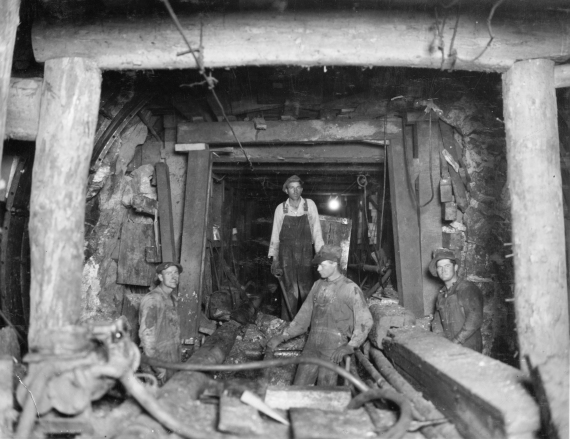
Workers pose for a photo in the Moffat Water Tunnel in this 1930 photo.
The agency, looking at the booming population and economy in Denver, now wants to exercise those rights. That means taking more water from the river, piping it under the Indian Peaks and sending it into Gross Reservoir near Boulder.
Some conservationists and environmental groups are crying foul, saying that the river has already been overtaxed (about 60 percent of its existing flow is already diverted to slake Denver’s growing thirst) and it’s time to let the river alone.
But the fight’s pattern is taking some unfamiliar twists and turns. Influential groups like Trout Unlimited and American Rivers, who’ve historically fought diversion projects, support this one. In exchange, Denver Water says it will will help protect and enhance what’s left of the Fraser River.
That compromise has fractured traditional lines in Colorado’s conservation and environmental advocacy community, and fostered new alliances. While these organizations more or less agree on their ultimate goal — to protect and restore the environment — the strategies they use are very different. The big question that divides them: When to compromise?
Denver Water Extends An Olive Branch
Decades ago, environmentalists were not at the top of list of Denver Water’s concerns when it would try to build dams and add capacity. In the 1980s, environmental groups pushed back on a huge proposed dam called Two Forks.
“[Denver Water] told us in so many words: ‘We’re the experts. You’re little environmentalists. Get out of the way,’ ” Dan Luecke, then head of Environmental Defense Fund’s Rocky Mountain office, told High Country News in 2000.
Then, in 1990, an EPA veto torpedoed the project at the last minute.
“That was really a turning point for our organization,” said Kevin Urie, a scientist who’s worked for Denver Water for nearly 30 years. “I think we realized with the veto of Two Forks that we needed to think about things differently.”
He believes that while Denver Water has long taken environmental impacts into consideration with its plans, it didn’t engage with local stakeholders — like conservation and environmental groups and Western Slope governments — until after the Two Forks project died.
There’s a demographic change underway as well: Many of the Denver metro area’s new residents also want to play in Western Slope rivers on the weekends. That has pushed Denver Water leadership to put a larger emphasis on environmental stewardship, Urie said.
But all those new residents still need water. Denver Water delivers water to about 1.4 million people across the metro, about double what it did some 60 years ago. Conservation efforts have kept overall demand relatively low in recent years. But with more people moving to Denver every day, Denver Water expects its demand to rise 37 percent by 2032 from 2002 levels.
The Fraser River is key to Denver Water’s plan to head off a shortfall in the relatively near future. The agency wants to divert half of the remaining flows from the Fraser and its tributaries through the Moffat Tunnel to Gross Reservoir near Boulder. (The proposed expansion of Gross has started its own fight, which CPR News’ Grace Hood chronicled last month.) It would be treated at the agency’s plant in Lakewood, and eventually delivered to customers across the metro.
The agency expects to have all of its necessary permits by 2018 and construction could begin in 2019 or 2020. But to get those permits, Denver Water has agreed to be part of a group that includes Grand County officials and environmentalists called “Learning by Doing.” These different players are often at odds when it comes to water issues.
Urie said Denver Water’s participation shows its desire to do right by the environment and local stakeholders. They’ve helped fund an ambitious project that will engineer the Fraser River’s flow on a nearly mile-long stretch between Fraser and Tabernash, squeezing it to make it narrower, deeper and colder — and thus healthier.
But is that what’s best for the river?
Urie thought about that question for a minute, and then chose his words carefully:
“Clearly the system would be better if we weren’t using the water resources for other uses. But that’s not the scenario we are dealing with,” Urie said.
Trout Unlimited Sees Opportunity
The Fraser River project’s biggest booster is Kirk Klancke, president of the Colorado River Headwaters Chapter of Trout Unlimited. For him personally, it’s a way to help a river that he’s lived near and played in for 45 years.
“I can’t talk about it without getting all emotional. My life’s been spent on this river,” he said.
He sees it as a chance to restore a part of the river popular with anglers called the Fraser Flats. Here, the brush-lined river levels out after tumbling through the pine forests of Berthoud Pass.
His playground is popular with others, too. Grand County is a short one- to two-hour drive from Denver. From fly fishing to alpine and nordic skiing to snowmobiling, it’s a tourist-based economy. And in Klancke’s eyes, all of that rests on the health of its water.
He’s watched the river dwindle and get warmer as more water has been pulled out of it. And that’s changed how his family has used it. When his children were young, they could stay in the river for only a minute or two.
“They’d come out and their lips would be purple and they’d be squealing,” Klancke said. “Now I throw my grandchildren in the river and they’re not in a hurry to get out. We spend up to an hour in a pool in the river.”
He’s watched this river that means so much to him get sicker and sicker; warm, shallow channels aren’t suitable for native fish and bugs. For years, he blamed the deteriorating environment on the Front Range and its water managers.
“I was a little radical because I urinated in diversion ditches. It’s about all I knew to do. I’ve matured quite a bit since then,” he said.
His turning point came when he got involved with Trout Unlimited.
“I loved their approach,” he said. “They were able to look at it in someone else’s shoes, which is what all mature people do. And then, move forward with opening up conversation.”
Such conversations are what led to the Fraser Flats project, Klancke said. When flows are low, like they were this fall, the river is shallow as it stretches across its native bed. The new channel will allow the river to recede and stay deeper — and cooler.
Essentially, that stretch of river will be turned into a creek. On its face, downsizing a river doesn’t sound like a big victory for environmentalists. But that’s not how Klancke looks at it. During peak flows in the spring, Klancke points out, the river will be nearly just as wild as it is now.
And moreover, Denver Water has to stay involved in the Learning by Doing group. So if environmental issues arise down the road, Klancke said the agency will be there to help solve them.
Is it a compromise? Yes, Klancke admits. But water managers own water rights in the upper Colorado Basin that they’ll use — with or without his blessing. The right to divert water for “beneficial uses” is enshrined in the Colorado Constitution.
“We have to face reality here,” Klancke said. “There is no more mighty Upper Colorado. There’s only keeping what’s left healthy.” [ed. emphasis mine]
WildEarth Guardians Stakes Out Moral High Ground
Like Klancke, Jen Pelz, wild river program director for WildEarth Guardians, has had her own evolution in thought toward environmental causes. Earlier in her career, she was a water lawyer in Denver who represented clients like the city of Pueblo that were taking water from Western Slope rivers.
But eventually she felt a pull toward environmental advocacy. Pelz credits that with childhood days spent on the banks of a tributary to the Rio Grande in New Mexico.
“It was kind of the place that I could go just be myself,” she said. “I developed a really strong connection to the river there.”
She was drawn to the confrontational, no-holds-barred approach used by WildEarth Guardians. The group is known for its headline-grabbing lawsuits. Most recently they sued the federal government over haze in Western Colorado and leases to coal mines.
The approach seems to be working, at least by WildEarth Guardian’s measure. The haze lawsuit ended in an agreement where a coal mine and coal-fired power plant in Nucla, south of Grand Junction, will shut down in the next six years. A power plant in Craig, Colorado will shut down one of its units too.
“We’re willing to not be liked by the general public, or by particular industries,” Pelz said. “And I think it takes that kind of moral integrity and just knowing where you stand on the issues, to really push the envelope.” [ed. emphasis mine]
Pelz is not interested in compromise on the Fraser River. She faults Trout Unlimited for starting negotiations at the wrong place. In her view, the baseline shouldn’t be where the river is now with about 60 percent of it being diverted. The conversation needs to start with the river at its natural flows, she said.
“The harm has already been done,” Pelz said.
If the Fraser River is going to be saved, she says, it’ll happen by letting more water back into the river — not by taking more out. As the climate warms, she says the river will need all the help it can get.
“Let’s start dealing with it now. Let’s have that hard conversation now, not 50 years from now when there’s no water left to have a conversation about,” she says.
Pelz says her organization, and another group called Save the Colorado, are considering litigation once final permits are approved. That could happen in 2018.
Such tactics doesn’t make Pelz a lot of friends. She said she’s been ostracized from her former clique of water lawyers. It’s hard for her to get meetings with government regulators.
WildEarth Guardians’ relationship with the greater environmental community is similarly strained. She said Denver Water is more willing to meet with environmentalists now because they’ve softened. And she’s upset with what Trout Unlimited has become in the eyes of regulators.
“Trout Unlimited has been deemed by Denver Water and the state of Colorado as being the environmental voice,” Pelz said. “They get invited to the table because they have this role in communities, which I don’t think is a bad thing, but they don’t necessarily represent all of the different interests in the environmental community.”
As a result, she said, groups like hers are being left out of the conversation.
“They don’t talk to us. They don’t ask us what we think. And I’ve called them. And I’ve had meetings with them. I’ve asked them what they think. And they’ve told me they don’t like our approach. And I understand that. But I think that it works both ways.”
Pelz said it can be hard to be out “towing the left line.” Everybody likes to be liked, she said. But she’s decided that over the long run, her methods are what will make a difference. To do anything else would be surrender.
“I don’t want to have to explain to my kids that I gave up the fight for this river that is the namesake of our state, the state they were born in, because I was willing to compromise,” she said. “We may not win, but damn we are going to try.”
American Rivers Finds Room To Maneuver
When Matt Rice, Colorado River basin director for American Rivers took the job a few years ago, he made the decision to put aside his dreams for what he really wanted. Instead, he focuses on what he thinks he can actually pull off.
“In a perfect world, I’d like to see all the wild rivers in this country and in this state flowing freely and filled with fish, doing what rivers should do,” Rice said. “It’s not realistic.”
But he acknowledges that groups like WildEarth Guardians can make his job easier at times. When Guardians files a lawsuit and makes a bunch of people mad, a group like his can step in and talk with state regulators and businesses. Guardians essentially provides cover for groups closer to the political center, he said.
“Their advocacy pushes everybody, not just conservation organizations, kind of further to the left. And I think that’s good,” Rice said.
But there’s a downside. Lawsuits and sharply worded press releases can sting, and are not easily forgotten. And Rice worries that aggressive tactics from far-left groups lead to skeptical parties like ranchers or Front Range water managers lumping all environmentalists together.
“That has the potential to undermine the progress we’re making,” he said.
Looking To The Future
A screenshot from the website for Colorado’s Water Plan.
With the publication of last year’s Colorado Water Plan, a first for the state, officials are trying to turn the page on Colorado’s long fight over water. The plan, which officials describe as a roadmap to sustainability, stresses collaboration between competing interests and conservation of the increasingly precious resource.
“Now is the time to rethink how we can be more efficient,” Gov. John Hickenlooper said at the water plan’s introduction in November 2015.
Diverting more water should be the last-possible solution, Hickenlooper said. That’s welcome news to environmentalists like Matt Rice of American Rivers.
Rice said they are supportive of the Fraser River diversion plan for the same reasons Trout Unlimited is, though they aren’t part of the Learning by Doing group. But he hopes the Fraser diversion, and another major project in the works called Windy Gap, are the last trans-mountain diversion projects.
There just isn’t enough water on the Western Slope, he said. And if another one comes up, Rice said they’ll fight it with everything they have.
“We’re kind of at the cliff right now in the Colorado River Basin,” he said.
Collaboration and compromise will certainly be part of environmentalism’s future in Colorado. But as groups like WildEarth Guardians continue to find success in the courts, the advocacy ecosystem has room for other strategies too.
Next year, the U.S. Army Corps of Engineers is expected to decide whether to issue a permit to triple the capacity of Gross Reservoir in the Rocky Mountain foothills, with additional shipments of about 18,000 acre feet of water a year from the Colorado River watershed. An acre foot is enough water to meet the annual needs of an average family of five.
That is one of the last regulatory barriers for utility Denver Water’s $380 million project, for which district officials say they hope to break ground in 2019 to help ensure local water supplies.
“We have an obligation to supply water,” said Jeff Martin, Denver Water’s manager of the project, as he stood recently atop a 340-foot concrete dam that is to be raised by 131 feet under the plan. “It’s not an option to not have water.”
[…]
The Corps of Engineers is expected to decide next year on a proposed new “Windy Gap” project in Colorado, which would divert up to another 30,000 acre feet a year to the Front Range, the heavily populated area where the Rocky Mountains rise up from the plains.
In addition, more than 200,000 acre feet would be diverted for proposed projects in Utah and Wyoming…
Water officials in California and other lower basin states say they aren’t overly concerned about more diversions upstream, because a 1922 compact requires the upper basin states to deliver them about 7.5 million acre feet a year, or one half the river flow set aside for human use north of the U.S.-Mexico border. Much of that water is stockpiled in Lake Powell on the Arizona-Utah border.
With the Colorado running much lower than when the compact was signed, water experts say there is less water to divert.
“So long as their development doesn’t impinge on their release to us, that is their business,” said Chuck Cullom, a program manager at the Central Arizona Project in Phoenix, which pulls from the river and stands to lose a fifth of its deliveries if a shortage is declared on the Colorado. “If it falls below that, then they would have to figure out how to manage their demand.”
Don Ostler, executive director of the Upper Colorado River Commission, which oversees use of the river in the upper basin states of Colorado, Utah, Wyoming and New Mexico, agreed that new diversions increase the risk of shortages.
“The more you develop, the more a severe drought can affect you,” said Mr. Ostler. “But we are able to live with a certain amount of shortage.”
In Denver, water officials don’t feel they have much choice but to seek more Colorado water.
In 2002, tons of sediment from a forest fire clogged one of Denver Water’s reservoirs during a drought. “We came close to running out of water in the northern end of our system,” said Jim Lochhead, chief executive officer of Denver Water, a utility that serves 1.4 million people.
That crisis helped prompt the district in 2003 to undertake the Gross Reservoir expansion, which would store more water from an existing tunnel that transfers Colorado River water from the west side of the Continental Divide.
Denver officials pledged to only take the water in wet years and release more into streams when it is dry—measures that drew praise from some conservationists…
Gov. John Hickenlooper in July gave the state’s approval, calling the dam’s expansion vital. “The state’s responsibility is to ensure we do the right thing for Colorado’s future,” the Democratic governor said at the time, “and this project is vital infrastructure for our economy and the environment.”
The dam that forms Gross Reservoir, located in the mountains west of Boulder. Photo: Brent Gardner-Smith/Aspen Journalism
It’s been almost a century since the Colorado River Compact was created, divvying up the resources of this mighty waterway between seven states and Mexico. That means almost 40 million people are dependent on the river in some way. Traditionally, the economic value of the river was based on what the water could be used for when extracted—things like agriculture, mining, and industry. Now, more people are pointing to the economic value of keeping water in the river itself.
The Fraser River in Grand County is a tributary of the Colorado River, which starts in Rocky Mountain National Park. It runs through the heart of the town of Fraser and neighboring Winter Park. These towns attract skiers in winter and fly fishers and outdoor enthusiasts the rest of the year.
“The recreation is all based around the river… it’s the absolute base of the recreational system,” says Dennis Saffell, a real estate broker in the mountain communities of Grand and Summit Counties. Saffell says there’s a direct connection to property values and proximity to the river…
Saffell says a loss of flow in the river would likely decrease the values for all properties in these mountain communities that are dependant on the river for a tourism economy.
That’s something that others in western slope communities are well aware of, including Jim Pokrandt with the Colorado River District, the principal water policy and planning agency for the Colorado River Basin within the state.
“We understand that water left in the river is important to the economy,” says Pokdradt, “and if we have dried up rivers then we’d have degradation to our western slope economy.”
Pokrandt says the fortunes of many western slope towns hinge on understanding that the strength of local economies is beginning to shift from taking water out of the river to leaving it in.
“Rafting, that’s a big deal, skiing that’s a big deal now, hunting, fishing… this is our economy here on the west slope,” says Pokrandt. “Yes, ag is still big, and yes there’s still some mining, but our new economy is based on water in the rivers in western Colorado.”
Historically, most Colorado water rights have involved uses that divert water from the streams, but back in the early 1970s lawmakers began to recognize the need to create rights allowing water to remain in the river, to help protect ecology. But that was just a first step. Now 43 years later, a lot of water is still being taken out of the Colorado River basin and diverted to the east. There are 13 major trans mountain diversions and many other smaller ones.
It’s a concern for advocates like Craig Mackey, co-director of the non-profit Protect the Flows.
“In the 21st century we have an economic reason to have the river itself, the recreation economy, the tourism economy and I think the hardest one to quantify is a quality of life economy,” says Mackey.
Protect the Flows advocates for conservation of the Colorado River Basin, pointing to the connection between a healthy river and healthy economies.
“People want to live here, they want to locate here, they want to grow businesses here, they want to raise their families here,” says Mackey. “And water and our snow in our mountains, which becomes the water in our rivers, is a huge driver in that quality of life economy that we’re so lucky to have here in the state of Colorado.”
Protect the Flows worked with Arizona State University in 2014 on the first study on the economic impact of the Colorado River. It found that the major waterway generates $1.4 trillion in economic benefits annually throughout the entire seven state river basin. In Colorado, the tourism and outdoor recreation economy tied to the river brings in more than $9 billion annually.
The Colorado Water Plan acknowledges the need to keep water in streams, but it also acknowledges the water needs of growing cities.
Realtor Dennis Seffell says even more needs to be done.
“Now it’s time to take a new fresh look as to why it’s important to keep rivers full of water,” Saffell says.
A prolonged drought in the south west, paired with over allocation, has left the Colorado River in a sorry state. Front Range communities, largely dependent on that western water, are having some success with conservation. But with an additional 2 million people expected to move to the Denver metro area over the next 25 years, demand will only increase.
Connecting the Drops is a collaboration between Rocky Mountain Community Radio stations and the Colorado Foundation for Water Education, with support from CoBank.
Owners of a typical single family home in Arvada will likely have to pay $1.41 more a month — or $16.90 additional a year — for water and sewer services fees in 2017.
The average single-family home is considered to be 3.2 people and a yard. And the average single family drinking water bill in Arvada runs about $481 annually and $291 annually for sewage.
Jim Sullivan, director of utilities for Arvada, said the average single-family account in Arvada uses 120,000 gallons of water each year for domestic and irrigation purposes and generates 60,000 gallons of sewage. Single-family accounts form the largest customer group in Arvada, using about 60 percent of the water.
Arvada City Council heard the proposed rate increases at the Sept. 26 workshop and will discuss the proposals during council meetings on Oct. 3 and Oct. 17, also the date of a public hearing. The rates have been raised every year over the past decade.
When taken separately, the proposed increases amount to 2 percent for water and 3 percent for wastewater. A 1.45 percent increase for water tap fees is also proposed. Stormwater and sewer tap fees are not projected to increase, city officials said.
The increases are needed because of rising vendor prices, new equipment and materials, and employee salary raises, Sullivan said.
Sullivan added that over the next 10 years, water operation costs will likely slowly increase as the city prepares to contribute payment for the Denver Water Gross Reservoir expansion project.
Sources of water
Arvada has two sources of water. The first is a 1965 contract with Denver Water. The second source is the city’s Clear Creek water right holdings.
But “these two sources will not be sufficient to meet the residents’ needs at buildout of the city,” Sullivan said. “The city has entered into an agreement with Denver Water to financially participate in the Gross Reservoir expansion in exchange for additional water supplies. This project should increase Arvada’s water supplies sufficiently to meet the city’s needs at buildout.”
Gross Reservoir, named for Denver Water former Chief Engineer Dwight D. Gross, was completed in 1954. It serves as a combination storage and regulating facility for water that flows under the Continental Divide through the Moffat Tunnel and supplies water to Denver Water’s North System.
The reservoir was originally designed with the intention of future expansion to provide necessary storage.
With demand expected to increase in coming years, expanding Gross Reservoir will increase sustainability to the water supply as part of Denver Water’s multi-pronged approach that includes conservation, reuse water and developing additional supply to meet customers’ future needs.
“We think we have enough money in the fund to avoid issuing debt for this project,” Sullivan told city council.
The proposed 2017 water fund budget is $29 million, with 75 percent going toward water system operations, 8 percent for debt services and 17 percent for capital improvements. The Gross Reservoir project is the majority of the capital improvements area.
The city’s current debt service is $2.2 million, paid mostly from tap fees, Sullivan said. He added that in 2020 the water bonds issued in January 2001 will be paid off.
The projected increase in the operations budget for water is $656,000 or 3 percent. However, the bond repayment in 2020 will reduce operating costs by $445,000 annually. Because of this, city staff is proposing to increase water rates by 2 percent rather than 3 percent in 2017, smoothing out future rate changes.
The proposed 2 percent rate increases the water fee part of the bill by $8.52 annually or 71 cents per month. The 3 percent increase for wastewater amounts to $8.40 annually or 70 cents per month.
It is expected that by 2023, the 20-year program to rehabilitate the sanitary sewer system in the city will end and the $2 million needed annually will drop to $500,000 for major repairs and maintenance.
The water tap fee increase of 1.45 percent applies to new construction and would increase by $275, bringing the total cost of a single family water tap to $19,275.
Denver Water is seeking approvals from the U.S. Army Corps of Engineers, the U.S. Fish and Wildlife Service, and the state of Colorado to expand Gross Reservoir, which is southwest of Boulder. The 77,000 acre-foot expansion would help forestall shortages in Denver Water’s water system and offer flood and drought protection, according to Denver Water.
Considering the Denver region is growing by an average of 4,500 new residents per month, a large sector of the population likely doesn’t remember the catastrophic 2002 drought. The most severe water shortage since the Dust Bowl, snowpack and soil moisture were at all-time lows, and we remained in a dry period until 2006. Luckily, with water restrictions in place, we never actually ran out of water—we just got really close.
“We realized that we had an immediate need to correct a vulnerability in our system,” Denver Water CEO Jim Lochhead says. That’s when Denver Water started planning the Gross Reservoir Expansion Project, and after more than a decade of negotiations, the project (which was recently endorsed by Gov. John Hickenlooper) is underway.
But will it be enough? The short answer is yes—as long as Denverites work on strengthening their water conservation practices. Lochhead was pleased to note that when a storm comes through the Mile High City, there is a noticeable drop in outdoor water use, because well-informed residents are turning off their sprinkler systems. Denver residents have managed to reduce water consumption by more than 20 percent in the last 15 years, even with a 15 percent increase in population, according to Lochhead.
The decrease is not enough to mitigate the risk of drought, however. As Colorado’s largest water utility, the Denver Water system is made up of two collection systems—the Northern and the South Platte—and they are incredibly imbalanced. About 80 percent of the water comes from the south system, leaving the north very vulnerable to low rainfall or wildfires. During the notable dry years of 2002 and 2013, clients in the north end were lucky their taps continued to flow.
“We were literally only one drought away from a major problem in our system,” Lochhead says, noting that as recently as 2013, the system was virtually out of water in the north-end.
In Colorado, rivers flow not only down mountain slopes but beneath them, across them, and through them.
Nearly four dozen canals, tunnels, and ditches in the state move water out of natural drainages and into neighboring basins. Some snake across high passes. Others pierce bedrock.
All manmade water courses, meant to supply farming, manufacturing, or household use, eventually become so familiar they become part of the landscape. But old infrastructure can come to life in different form. Recently, Gov. John Hickenlooper cast renewed attention on water supply and growth in the West with a decision in a long-running process to expand a Colorado River diversion.
That diversion is the Moffat tunnel which supplies water to Gross reservoir. From its western portal at the base of Winter Park’s ski slopes the 80-year-old conduit, blasted through layers of gneiss, granite, and schist, sends water from west-flowing Colorado River tributaries to Gross reservoir, east of the Continental Divide.
Denver Water, the public utility that owns Gross reservoir, wants to triple its capacity in order to secure water for one of the country’s fastest growing big cities. The $US 380 million project, under state and federal review since 2003, gained Gov. Hickenlooper’s endorsement on the last day of June, a week after it collected a key state water quality permit. The final piece will be a dredging permit from the U.S. Army Corps of Engineers.
The Gross reservoir expansion reflects a fundamental tension for the seven states and two countries that share the Colorado River: how many more diversions can the stressed basin tolerate? The watershed is drying but states in the upper basin still plan to pull more water out of the river. Whether they should — and how much — is a matter of constant debate.
“The challenge becomes reconciling the ability to develop water with the reality that you are assuming a ton of risk,” James Eklund, director of the Colorado Water Conservation Board, told Circle of Blue..
A Game of Risk
Some observers say that the risk threshold has already been crossed. A group of respected academics calling themselves the Colorado River Research Group argued in a 2014 paper that the basin must strive to use less water, not more. “Any conversation about the river that does not explicitly acknowledge this reality is not helpful in shaping sound public policy,” they wrote.
Eklund said he understands the sentiment behind the call for restraint. However, Colorado’s constitution is set up, he said, to protect the right to develop water.
“The state is not going to call balls and strikes and say whether a project is a good investment,” he said. “You take it at your peril. You assume the risk.”
The upper basin is starting to think about those risks. Like the lower basin, it is participating in the pilot conservation program. Most of its projects are located in Colorado and Wyoming. The goal is to prop up Lake Powell with the saved water.
Colorado transmountain diversions via the State Engineer’s office
Jim Lochhead, the CEO and manager of Denver Water, said Tuesday that building new dams in the Colorado River basin is not at the top of his to-do list. Nor, for that matter, is drying up farms to provide water for Colorado’s growing cities.
But he says Colorado still needs to have hard conversations about how to flexibly manage its water. In particular, he wants farmers to be able to share water with Denver and other cities without worrying that they may lose their water rights.
Speaking at the annual Western Water Symposium at Colorado State University, Lochhead credited the 2015 Colorado Water Plan as being a useful “compendium of the issues” but said it highlighted relatively easy solutions without fully addressing the harder challenges.
“I don’t think the solution is $20 billion of new water projects for Colorado, but that’s an easy thing to go look for,” said Lochhead, head of the state’s largest water utility that supplies 1.4 million people, and stores nearly 40 percent of its water in Summit County’s Dillon Reservoir.
A coordinated plan is needed, Lochhead said.
“We’re not there yet with the state water plan to develop any kind of coordinated principle vision for the future, much less how to get there,” he said.
Lochhead, who took the helm of Denver Water in 2010, described Colorado’s historical approach to water as a zero-sum game where there had to be a winner and a loser.
That zero-sum game lost its moorings in the second half of 20th century as a result of new federal and state laws, court decisions and political fights, Lochhead said.
He said that two decades have brought more collaboration between diverse interests, including those on both sides of the Continental Divide, and it is reflected in such projects as Wolford Mountain Reservoir near Kremmling.
Both Denver Water and the Colorado River Water Conservation District have an interest in Wolford Reservoir, with Denver Water on track to soon own 40 percent of the water in the reservoir. The water has many benefits, among them providing late-summer water to meet needs of four endangered fish species in the Colorado River near Grand Junction.
Another collaborative effort has been launched in the Winter Park area. There, Denver plans to increase diversions from the Fraser and Williams Fork rivers, but is doing so with the blessing of local authorities, thanks to a collaborative “learning by doing” effort in Grand County that seeks to reduce streamflow impacts from both new and existing diversions.
But Lochhead believes Colorado must still dramatically change its water allocation methods as it faces population growth. Demographers project that Colorado’s 5.4 million population will double within a few decades. If we seek to provide the water for the additional residents the way we provided for the first 5 million, he said, “we won’t like the outcome very well.”
Gore Canyon rafting via Blogspot.com
The river itself
A second challenge is the Colorado River itself, the fountain that supplies at least part of the water for 40 million people, from corn farms in northeastern Colorado to San Diego. And despite some good snow years, the two big reservoirs on the lower Colorado River, Lake Powell and Lake Mead, are both low enough to keep a ballroom full of water experts up at night.
It could get worse. And, according to projections of climate models, it likely will.
Laurna Kaatz, an in-house climate expert at Denver Water, recently told the Metro basin roundtable it’s still not clear if it will be hotter and drier, or hotter and wetter in Colorado in the future, but there is little doubt it will be hotter.
More major dams on the Colorado River are not the solution, Lochhead said. Evaporative losses would result in more loss than gain, he said, although he did allow for the possibility of relatively small dams.
Denver Water is, however, studying the potential for putting water into aquifers beneath the city, creating underground storage — storage that could, in theory, hold water from the Western Slope.
And Denver Water is looking to store up to an additional 15,000 acre-feet of Western Slope water in an expanded Gross Reservoir, southwest of Boulder. The $360 million project seeks to raise the elevation of the dam by 131 feet, which would increase the capacity of the reservoir by 77,000 acre-feet, bringing it up to 119,000 acre-feet.
Flexibility needed
Lochhead said that Colorado needs more flexible water management options that allow for greater sharing of the resource.
About 85 percent of water in Colorado is used by agriculture and ranchers and farmers tend to have the oldest and most senior water rights.
Water rights are private, said Lochhead, “but you can’t really do anything with that property right except what you are currently doing with it unless you go to water court. And by going to water court you put that entire water right at risk.”
In Colorado’s water courts, objections to changes in uses of water rights are often filed. The process can be lengthy and expensive for those seeking to make changes.
“You need a safe process where you don’t have to put your water right at risk, and you understand that you don’t have to spend years negotiating,” he said.
And Lochhead thinks Colorado also needs another conversation about conservation, where the emphasis is not about sacrifice but about innovation.
Denver Water intends to demonstrate what is possible as it redevelops its 35-acre headquarters campus along Interstate 25 near downtown Denver. There, planners think they can reduce demand for potable water by more than 50 percent.
In water reuse, said Lochhead, Colorado is “way behind the curve” as compared to some world cities, including Amsterdam and Sydney.
Editor’s note: Aspen Journalism and the Aspen Daily News are collaborating on the coverage of water and rivers. The Daily News published this story on Friday, July 29, 2016.
Denver Water’s collection system via the USACE EIS
FromThe Grand Junction Daily Sentinel (Dennis Webb):
A proposal to divert Colorado River water to Denver recently has won the endorsement of Gov. John Hickenlooper and the approval of the Colorado Department of Public Health and Environment.
But Denver Water’s Gross Reservoir expansion project may be just as notable for its general lack of opposition west of the Continental Divide. That’s thanks to a wide-ranging agreement, effective in 2013, in which Denver Water obtained concessions including a promise that numerous Western Slope parties to the agreement wouldn’t oppose the expansion project. In return, Denver Water made a number of commitments to the Western Slope.
Now Western Slope interests are working on a similar agreement with Northern Water and others on what’s called the Windy Gap Firming Project, which would store Colorado River water in a proposed Boulder County reservoir.
These approaches represent a far cry from how the Western Slope used to respond to transmountain diversion proposals.
“This is the new paradigm. It’s not the old school. In the old school it was like … we’ll see you in court,” said Jim Pokrandt of the Colorado River District, a party to the 2013 Denver Water deal.
For Denver Water, what’s called the Colorado River Cooperative Agreement provided greater certainty for its customers through means such as resolving longtime disputes regarding West Slope water. For the Western Slope, the deal meant dozens of obligations by Denver Water, such as millions of dollars in monetary payments to various entities, protections of Colorado River flows and water quality, a commitment to further water conservation and reuse efforts by Denver Water customers, and a provision aimed at helping assure maintenance of historic flows in the Colorado River even when the Shoshone Power Plant in Glenwood Canyon is not operating. That hydroelectric plant has a senior right helping control flows in the river.
Another key point in that deal is a promise that Denver Water and its customers won’t try to further develop Colorado River water without agreement from the river district and affected counties.
The cooperative agreement has 18 signatories but more than 40 partners, primarily West Slope governments, water conservation and irrigation districts, and utilities. Among them are the Ute Water Conservancy District and multiple irrigation districts in Mesa County.
Pokrandt said the 2013 deal is a win-win for both sides of the Continental Divide.
“That said, yes, more water would be moving east” if the Gross Reservoir project proceeds, he said.
The project, also sometimes called the Moffat Collection System Project, would nearly triple the capacity of the Boulder County reservoir. Denver Water is targeting water in the Fraser River, a tributary of the Colorado.
“Right now there are some periods of time when Gross Reservoir is full at its current size and their water rights are in priority but they can’t take any more water,” Pokrandt said.
The project has an estimated cost of $380 million, and Denver Water hopes to obtain the remaining major permits by the end of next year. CDPHE in June certified that the project complied with state water quality standards, and Hickenlooper endorsed it last week.
“The state’s responsibility is to ensure we do the right thing for Colorado’s future, and this project is vital infrastructure for our economy and the environment,” Hickenlooper said in a news release. “The partnerships and collaboration between Denver Water, the West Slope and conservation organizations associated with this project are just what the Colorado Water Plan is all about.”
That recently adopted plan in some respects took its lead from the Denver Water/Western Slope deal in seeking to address the state’s future water needs in a cooperative rather than confrontational manner statewide.
Pokrandt conceded that not everyone loves the Gross Reservoir proposal…
Trout Unlimited takes a more positive view of the Gross Reservoir project, pointing to its inclusion of a “Learning by Doing” program requiring monitoring of the health of the Fraser River and adjusting operations as needed. The Gross Reservoir proposal envisions drawing water from the Western Slope in wetter years and seasons, but providing the Colorado River watershed with extra water during low flow periods and investing in restoration projects.
“Moreover, Denver Water has entered into partnerships on the Front Range to ensure that the project alleviates chronic low-flow problems in South Boulder Creek. Both sides of the Divide benefit,” David Nickum, executive director of Colorado Trout Unlimited, said in a news release…
Denver Water Chief Executive Officer Jim Lochhead said in a news release, “The Denver metropolitan area is tied to the economic and environmental health of the rest of the state, and Denver Water is committed to undertake this project in a way that enhances Colorado’s values.”
Pokrandt said Western Slope water interests face the reality that under the state Constitution the right to appropriate water shall not be denied if the water can be put to beneficial use and a party can obtain the necessary financing and permitting.
“There’s not a legal stance to say no, so that’s why the river district was even formed in 1937, was to negotiate these things, because no is not an answer in the legal arena because of the Colorado Constitution,” he said.
When it comes to water rights, Pokrandt said, “in the Colorado Constitution, the Continental Divide doesn’t exist.”
This formal backing completes the state’s environmental reviews for the Moffat project, 13 years in the making, clearing the way for construction — if remaining federal permits are issued. Denver Water and opponents from Western Slope towns and nature groups reached a compromise aimed at enabling more population growth while off-setting environmental harm.
It is a key infrastructure project that will add reliability to public water supplies and protect the environment, Gov. John Hickenlooper wrote in a letter to Denver Water manager Jim Lochhead.
It “aligns with the key elements of Colorado’s Water Plan,” Hickenlooper wrote. “Denver Water and its partners further our shared vision for a secure and sustainable water future while assuring a net environmental benefit in a new era of cooperation.”
Denver would siphon 10,000 acre-feet a year, on average, more water out of Colorado River headwaters, conveying it eastward under the Continental Divide through a tunnel for more than 20 miles to an expanded Gross Reservoir southwest of Boulder. By raising that reservoir’s existing 340-foot dam to 471 feet, the project would increase today’s 41,811 acre-feet storage capacity by 77,000 acre-feet — more than doubling the surface area of the reservoir…
For more than a decade, Denver Water has been seeking permits, including federal approval for construction affecting wetlands and to generate hydro-electricity at the dam.
“During dry years, we won’t be diverting water. It is a relatively small amount of water. … It is a water supply that Colorado is entitled to develop,” Lochhead said in an interview.
The increased storage capacity “allows us to take water in wet times and carry it over through drought periods. It gives us operational flexibility on the Western Slope. … Having this additional storage enables that flexibility.”
Colorado leaders’ formal endorsement follows a recent Colorado Department of Public Health and Environment decision to issue a water quality permit for the project, certifying no water quality standards will be violated. Hickenlooper has directed state officials to work with federal water and energy regulators to expedite issuance of other permits. Denver Water officials said they expect to have all permits by the end of 2017, start construction 2019 and finish by 2024…
…Trout Unlimited and other conservation groups call the project a realistic compromise considering the rapid population growth along Colorado’s Front Range.
“If the state needs to develop more water, they need to do it in a less-damaging, more responsible way — as opposed to going to the pristine headwaters of the South Platte River, which is what the Two Forks project was going to do,” TU attorney Mely Whiting said.
“We’ve put things in place that will make Denver Water be a steward of the river,” Whiting said. The agreement hashed out between Denver Water and conservationists “does not specifically say they have to tweak the flows to help the environment. It does say they have to monitor, for water temperature and macroinvertebrates. And if there’s a problem, they are responsible for figuring out why and they need to do something about it. It does not say exactly what they have to do but they have to fix any problem.”
Gross Dam enlargement concept graphic via Denver Water
Gov. John Hickenlooper has officially endorsed a project to expand Boulder County’s Gross Reservoir, a move he hopes will improve Colorado’s water capacity for the next several decades.
The endorsement was considered a formality; Hickenlooper wrote to President Barack Obama four years ago, asking for the president’s help in speeding up the process for Gross and other water projects.
Colorado is predicted to face a gap of more than one million acre-feet of water by 2050, according to a 2010 estimate that many believe may be on the low end. One acre-foot of water is the amount of water it would take to cover the field at Mile High Stadium from endzone to endzone with one foot of water. That’s 325,851 gallons of water. The average family of four uses about half an acre–foot of water per year.
Hickenlooper couldn’t give his formal okay for the expansion of the reservoir, which is northwest of Eldorado Springs, until the state’s Department of Public Health and Environment had completed its review that certifies the project would comply with state water quality standards.
At 41,811 acre feet, Gross is among the state’s smallest reservoirs. It’s operated by Denver Water, supplied by water coming from the Fraser River on the west side of the Continental Divide through the Moffat Tunnel.
The expansion would allow the reservoir to collect another 18,000 acre-feet of water, enough to supply 72,000 more households per year. The estimated cost is about $380 million, which includes design, management, permitting, mitigation and construction.
The Gross expansion has been in the works for more than 13 years, with its first permits applied for in 2003. If all goes according to plan, the permitting process will be completed in 2017,with construction to begin in 2019 or 2020. The reservoir could be fully filled by 2025, according to Denver Water spokesman Travis Thompson.
In his letter to Denver Water, Hickenlooper called the Gross project key to serving more than 25 percent of the state’s population. It will “add reliability to our public water supply, and provide environmental benefits to both the East and West Slopes of Colorado,” he said.
Aye, there’s the rub: the Western Slope, whose residents fear that anything that will divert more water from the Western Slope to the Eastern Slope will cut into their water supplies. They also worry that more diversions of Colorado River water will make it more difficult to satisfy multi-state compacts with southwestern states that rely on water from the Colorado River, of which the Fraser is a tributary.
But Jim Lochhead, head of Denver Water, told The Colorado Independent that any further diversions will require buy-in from folks on the Western Slope.
It’s part of an arrangement between Denver Water and 17 Western Slope water providers that has been in development for the past six years, Lochhead said. “We’ve worked extensively with the West Slope to develop the Colorado River cooperative agreement,” which will make the environment and economy of Western Colorado better off, he said.
The agreement addresses impacts of Denver Water projects in Grand, Summit and other counties, all the way to the Colorado-Utah border.
Lochhead hopes the Gross Reservoir project will be a model for cooperation, with benefits for both sides of the Continental Divide.
And the cost? The budget for the agreement starts at $25 million and goes up from there. That first funding goes to Summit and Grand counties for enhancement projects, which includes improved water supply for Winter Park, Keystone and Breckenridge ski areas. Lochhead said the locals will figure out exactly how to spend the money, and that Denver Water isn’t dictating what those counties will do with it beyond setting some parameters for protection of watersheds, the area of land that drains to a particular body of water.
Denver Water has also committed to making improvements to the Shoshone Power Plant on the Colorado River near Glenwood Springs, and improvements to wastewater treatment plants all the way to the western state line to enhance area water quality.
“We have an extensive list of commitments to partner with the Western Slope, to do the right thing,” Lochhead said.
The Gross Reservoir expansion is critical to Denver Water’s future needs, as Lochhead sees it, because its improved capacity will allow the water utility to operate its system with more flexibility. That’s most important for Denver Water’s attention to environmental concerns, both on the Western Slope and for South Boulder Creek, which flows out of Gross Reservoir.
“The state’s responsibility is to ensure we do the right thing for Colorado’s future, and this project is vital infrastructure for our economy and the environment,” Hickenlooper said in a statement today. “The partnerships and collaboration between Denver Water, the West Slope and conservation organizations associated with this project are just what the Colorado Water Plan is all about.”
Added Lochhead in a statement Wednesday: “The Denver metropolitan area is tied to the economic and environmental health of the rest of the state, and Denver Water is committed to undertake this project in a way that enhances Colorado’s values.”
The dam that forms Gross Reservoir, located in the mountains west of Boulder. Photo: Brent Gardner-Smith/Aspen Journalism
The dam that forms Gross Reservoir, located in the mountains west of Boulder. Photo: Brent Gardner-Smith/Aspen Journalism
Here’s the release from Denver Water (Stacy Chesney/Travis Thompson):
Colorado Gov. John Hickenlooper has officially endorsed Denver Water’s proposed Gross Reservoir Expansion Project as a model for achieving a balanced approach to environmental protection and water supply development through an inclusive and collaborative public process.
The endorsement follows the Colorado Department of Public Health and Environment’s issuance of a Section 401 Water Quality Certification on June 23, 2016, which ensures compliance with state water quality standards. The certification confirms that Denver Water’s commitment to extensive mitigation and enhancement measures for the project will result in a net environmental benefit.
“The state’s responsibility is to ensure we do the right thing for Colorado’s future, and this project is vital infrastructure for our economy and the environment,” said Colorado Gov. John Hickenlooper. “The partnerships and collaboration between Denver Water, the West Slope and conservation organizations associated with this project are just what the Colorado Water Plan is all about.”
The Gross Reservoir Expansion Project — also known as the Moffat Collection System Project — will strengthen Denver Water’s system against drought and climate change by nearly tripling the capacity of Gross Reservoir, located in Boulder County.
“Colorado is a growing and dynamic state,” said Denver Water CEO Jim Lochhead. “Denver Water has the critical responsibility to sustain over 25 percent of the state’s population and the majority of our economy for decades to come.”
Since 2003, Denver Water has been involved in federal, state and local permitting processes to evaluate the proposed project and develop ways to not only mitigate identified impacts, but also to enhance the aquatic environment and the economy of Colorado. The 401 certification — one of the major regulatory requirements — recognizes and builds upon other existing Denver Water agreements such as the landmark Colorado River Cooperative Agreement, Learning by Doing cooperative effort and the Grand County Mitigation and Enhancement Coordination Plan.
“The Denver metropolitan area is tied to the economic and environmental health of the rest of the state, and Denver Water is committed to undertake this project in a way that enhances Colorado’s values,” said Lochhead.
Denver Water expects to secure all of the major permits for the project by the end of 2017. The estimated cost of the project is about $380 million, which includes design, management, permitting, mitigation and construction.
Visit http://grossreservoir.org to read more about the project and http://denverwaterblog.org for videos with voices from a few of the many project supporters including, Gov. Hickenlooper, Western Resource Advocates, Trout Unlimited, Colorado Water Conservation Board and Colorado Parks and Wildlife.
Click here to go to the website. Here’s an excerpt:
The Grand County Learning By Doing Cooperative Effort (LBD) is a unique partnership of East and West Slope water stakeholders in Colorado.
LBD emerged from the Colorado River Cooperative Agreement, a five-year negotiation that became effective in 2013 and will be fully implemented with the successful construction of the Moffat Collection System and Windy Gap Firming Project. The agreement establishes a long-term partnership between Denver Water and Colorado’s West Slope, including several water utilities, nonprofit organizations and government agencies.
A Governance Committee oversees the LBD activities, with one voting member from each of these organizations:
Colorado Parks and Wildlife
Colorado River District
Denver Water
Grand County
Middle Park Water Conservancy District
Northern Colorado Water Conservancy District
Trout Unlimited
A Technical Committee, made up of representatives from the Governance organizations, as well as government agencies, regional water utilities and other partners, advises on LBD efforts and activities.
LOVELAND – Mike King, the new director of planning for Denver Water, said at a recent meeting that beyond additional transmountain diversions through the Moffatt Tunnel into an expanded Gross Reservoir near Boulder, Denver Water doesn’t have other Western Slope projects on its radar.
King served as executive director of Colorado’s Department of Natural Resources from 2010 until January of this year, when he took the planning director job with Denver Water.
After speaking to a luncheon crowd of close to 200 at the Northern Water Conservancy District’s spring water users meeting in Loveland on April 13, King was asked from the audience “How much more water does Denver Water need from the Western Slope?”
“I think if we get Gross Reservoir approved, the answer is for the foreseeable future, you know, we need to do that first,” King said.
King is a native of Montrose, son of a water attorney, and has a journalism degree from CU Boulder, a law degree from the University of Denver, a master’s in public administration from CU Denver and 23 years of state government experience.
“And I can tell you that the reality is, whether it is from a permitting perspective or a regulatory perspective, the West Slope is going to be a very difficult place,” King continued. “If there is water available, it is going to be a last resort. And I so think that the answer is, that won’t be on our radar.”
Denver Water is seeking federal approval to raise the dam that forms Gross Reservoir, in the mountains west of Boulder, by 131 feet. That would store an additional 77,000 acre-feet of water and bring the reservoir capacity to 118,811 acre-feet. Ruedi Reservoir, by comparison, holds 102,373 acre-feet.
The $360 million project would provide 18,000 acre-feet of firm yield to Denver Water’s system and result in an additional 15,000 acre-feet of water being diverted from the West Slope each year. On average, Denver Water’s 1.3 million customers use about 125,000 acre-feet of West Slope water each year.
The water to fill an expanded Gross Reservoir would mainly come from tributaries of the Fraser and Williams Fork rivers, via the Moffat Tunnel, near Winter Park.
Beyond the Gross Reservoir project, King explained that any future Denver Water projects on the West Slope would need to fit within the confines of the Colorado River Cooperative Agreement, signed by Denver Water and 17 West Slope entities in 2013.
The CRCA, says that “if there is more water, it only comes after the West Slope says they agree with it and it makes sense,” King said. “That sets the bar so incredibly high and gives them the ultimate ability to say, ‘This is good for the West Slope.’
“And so I just don’t think Denver Water is going to be looking to the West Slope,” King continued. “I think anybody who manages natural resources, and water in particular, will never say ‘never’ to anything, but I think it is certainly not on our radar.”
Not on Denver Water’s radar, perhaps, but it is worth noting that Denver Water is the only major Front Range water provider to have signed the cooperative agreement with the West Slope.
When asked what he thought of King’s remarks about West Slope water, Eric Kuhn, the general manager of the Colorado River District said he thought the comments reflect “the concept that if Denver takes more water from the West Slope it could undermine the security/reliability of what they already take.”
Kuhn’s comment relates to the possibility that if Denver Water diverts too much water from the Western Slope, it could help trigger a compact call from the lower basin states, which could pinch Denver’s transmountain supply of water.
Editor’s note: Above is a recording of Mike King, the director of planning for Denver Water, speaking after lunch in front of about 200 people at Northern Water’s spring water users meeting, a public meeting held at The Ranch event center in Loveland on Wednesday, April 13, 2016. The recording, made by Aspen Journalism, begins shortly after King had begun his remarks. It is 26:34 in length. At 8:20, King discusses the development of the Colorado Water Plan. At 22:40, King answers a question about the governor’s endorsement of the Windy Gap project and another phrased as “How much more water does Denver Water need from the Western Slope?”)
A buoyant crowd
Earlier in the meeting engineers from Northern Water — which supplies water to cities and farms from Broomfield to Fort Collins — told the mix of water providers and water users from northeastern Colorado that they could expect an average spring runoff this year, both from the South Platte and the Colorado Rivers.
They were also told that Northern Water was making progress on its two biggest projects: the Windy Gap Firming Project, which includes construction of Chimney Hollow Reservoir near Berthoud; and NISP, the Northern Integrated Supply Project.
NISP includes two new reservoirs, Glade and Galeton, to be filled with East Slope water from the Cache La Poudre River, which runs through Fort Collins and into the South Platte River.
Just before lunch, John Stulp, the special policy advisor on water to Gov. John Hickenlooper, read a surprise letter from the governor endorsing the Windy Gap project, which would divert an additional 9,000 acre-feet of water each year, on average, from the upper Colorado River and send it through a tunnel toward Chimney Hollow.
Windy Gap is part of the Colorado-Big Thompson Project, which diverts on average 260,000 acre-feet a year from the Western Slope.
The Windy Gap project does include environmental mitigation measures for the sake of the Colorado River, and has approval from the required state agencies and Grand County, but it still needs a permit from the U.S. Army Corps of Engineers.
Looking east toward the Chimney Hollow Reservoir site, which is just this side of the red ridge. On the other side is Carter Lake Reservoir and beyond that, the Loveland area.A graphic from Northern Water showing the lay out of Windy Gap Firming Project.
A political risk
After lunch, King shared some insights from his old job as head of the state’s department of natural resources.
“I think it’s important that you understand what the development of the state water plan looked like from the governor’s perspective and the state’s perspective,” King told his audience.
As head of DNR, King had oversight over the Colorado Water Conservation Board, which was specifically tasked by the governor in late 2013 to produce the state’s first-ever water plan, and to do so in just two years.
King said that he, Stulp and the governor knew that a water plan in Colorado could be “the place where political careers went to die.”
“So the thing we had to make sure that came out of this, knowing that we weren’t going to solve the state’s water issues in two years, was that we had to do this in a manner that politically, this was viewed as a big win, and that future governors and future elected officials would say, ‘We need to do this again and we need to continue this discussion,’” King said.
“Not because the governor needed a political win,” King added, “but because to have the next stage of the water plan, to have the discussion in five years, you can’t have an albatross around this, and I think we were able to do that, and so we’re very proud of that.
“If we had a political mushroom cloud, no one would have ever touched the Colorado Water Plan again,” King continued. “That meant we aimed a little bit lower than maybe we would have liked, and I’ve gotten this at Denver Water, talking about lost opportunities in the Colorado Water Plan. Maybe we did aim just a little bit lower than we should have.”
King said the state was not able to “reconcile the inherent conflicts” in the various basin implementation plans, or BIPs, that were put together by regional basin roundtables as part of the water planning process.
And he acknowledged that the plan has been criticized for not including a specific list of water projects supported by the state, and for reading more like a statement of problems and values than a working plan.
“One of things that has been driven home to me time and time again in the two months that I’ve been at Denver Water is that planning is not something you do every five or six years,” King said. “Planning is a continuous process.”
King also said that there were some “tremendous successes” in the water plan, including the basin implantation plans, or BIPs, even though they sometimes conflicted.
“We got BIPs from every single basin,” King said. “The basins turned over their cards and said ‘This is what we need.’ So now we have a major step forward.”
Other plan elements
King said other successes in the Colorado Water Plan include the stated goal of conserving 400,000 acre-feet of water by 2050 and a nod to changing land use planning in Colorado.
King said tying land use to water availability “was something we never discussed in Colorado because it infringed on local control and it was just kind of a boogieman in the room.”
But he pointed out that “the vast majority of the basin implementation plans said, expressly, ‘We need to have this discussion’ and ‘We need to start tying land use to water availability,’” King said. “That’s a good thing. That’s a major step forward.”
When it comes to land use and Denver Water, King said driving down the per capita use remained a high priority and that if Denver proper grows, it is going to grow up through taller buildings, not by sprawling outward.
King also said Denver Water was working to manage, and plan for, the already apparent effects of climate change, especially as spring runoff is now coming earlier than it used to.
“We know that the flows are coming earlier, we know that the runoff is coming earlier,” King said, noting that reality is causing Denver Water to plan for different scenarios and ask questions about storage and late summer deliveries of water.
“For us, the most immediate thing is, is that we know it’s getting warmer,” King said. “In the last 20 years we’ve seen that, the way the [run offs] are coming earlier. We know we’ve had catastrophic events that are incredibly difficult for us to manage. And so we’re trying to work through that.”
Editor’s note: Aspen Journalism, the Aspen Daily News and Coyote Gulch are collaborating on coverage of rivers and water. The Daily News published this story on Wednesday, April 20, 2016.
Environmentalists are rallying support for a renewed fight against a long-standing proposal from Denver Water to nearly triple the capacity of Gross Reservoir by diverting from the Colorado River Basin…
Before a group of about 30 Monday night at Shine Restaurant and Gathering Place, the directors of two non-profits united in the fight against the expansion — Save the Colorado River and The Environmental Group — made presentations alleging impropriety on Denver Water’s part and soliciting donations to a legal fund.
“They’ve been working on their decision, and we assume, feel very strongly, that (Army Corps) will issue the permit,” said Chris Garre, President of The Environmental Group, which is based in Coal Creek Canyon. “As soon as that happens, the clock starts ticking.”
The Colorado River, the presenters said, is the most dammed and diverted on the planet. At the Colorado River Delta, there is no longer water, and there is concern that an expansion of Gross Reservoir would see some creeks and tributaries drained at the 80 percent level, with some “zero flow” dry days.
An expansion of Gross Reservoir, which is a roughly 25-minute drive west from Boulder on Flagstaff Road, would have a significant local impact. In fact, it would be the biggest construction project in Boulder County history, and would likely take about four or five years to complete.
The proposal seeks to increase the height of the dam by 131 feet, and would require the clearing of about 200,000 trees…
“Caring for the environment,” Garre added, “particularly those who live in the environment, in the forest, is crucial to your experience in Boulder County. This has never been addressed by Denver Water. It’s been ignored.”
While the universal downsides such major construction — noise and temporary aesthetic downgrade, among others — aren’t up for debate, Denver Water tells a very different story about the project.
The public agency that serves 1.3 million people in the Denver metro area gets about 80 percent of its water from the South Platte River System, and another 20 percent from Moffat, a smaller clump up north. Expanding Gross Reservoir and thereby Moffat, Denver Water says, will help balance the existing 80/20 split.
“This imbalance makes the system vulnerable to catastrophic events, such as the Buffalo Creek and Hayman fires, which caused massive sediment runoff into reservoirs on the south side of our system,” the agency published on its website.
During times of severe drought, the argument continues, “We run the risk of running out of water on the north end of our system,” which would primarily impact customers in northwest Denver, Arvada and Westminster.
Denver Water also maintains that as the Front Range continues to be one of the country’s fastest-growing areas, a shortfall in water supply is imminent unless addressed through projects like the one pitched for Gross Reservoir.
Here’s the release from Colorado Trout Unlimited (Randy Schofield):
TU praises river protections in Windy Gap project permit
Says 401 permit conditions put threatened river and fishery on road to
recovery
(Denver)-The Colorado Department of Public Health and Environment this week released its final 401 water quality certification for the proposed Windy Gap Firming Project (WGFP), which would divert additional water from the Upper Colorado River to northern Front Range communities. Trout Unlimited praised the 401 permit conditions for reaffirming the health of the Upper Colorado River and its world-class trout fishery.
“We firmly believe these permit conditions establish a strong health insurance policy for the Upper Colorado River,” said Mely Whiting, counsel for Trout Unlimited.
For years, Front Range water diversions have removed about 60 percent of the native flows of the Colorado headwaters, severely impacting fish and other aquatic life that depend on healthy flows to clean cobble and prevent the buildup of habitat-choking algae and sediment. The proposed Windy Gap expansion would further reduce native flows.
TU said the conditions included in the 401 permit for WGFP address critical fish habitat and water quality needs by:
* preventing stream temperature impacts during low flows in the summer.
* providing periodic “flushing flows” to cleanse the river during runoff.
* requiring ongoing monitoring and response if degraded conditions are detected.
The 401 permit conditions largely incorporate the protections included in earlier agreements involving the WGFP sponsor, the Municipal Subdistrict of the Northern Colorado Water Conservancy District (Subdistrict) and its project participants, and other stakeholders, including Grand County, Trout Unlimited, and the Upper Colorado River Alliance.
Under the 401 permit, the Subdistrict is required to monitor specifically for stream temperature, key nutrients, and aquatic life and submit results with an annual report that identifies any evidence of impairment (standards not met). If impairment is identified, the Subdistrict has to investigate to determine whether WGFP is causing or contributing to the impairment. If WGFP is found to play a role, then the Subdistrict is required to come up with a plan to solve the problem, consistent with state water quality laws.
“This long-term monitoring and flexibility of response is called ‘adaptive management’-and it’s a critical feature of the permit requirements,” said Whiting. “Adaptive management recognizes that stakeholders can’t foresee every problem, and it provides a process for ongoing monitoring and mitigation of river problems as they arise.”
TU noted that the permit builds on years of hard work, negotiations and collaboration. “We wouldn’t be at this point without the leadership of Grand County and their persistent efforts to improve the health of the Colorado River,” said Kirk Klancke, president of TU’s Colorado River Headwaters chapter. “And the Northern subdistrict also deserves credit for listening to our concerns and working with all stakeholders to find solutions.”
“This permit is another step toward fulfilling the Windy Gap Firming Project’s potential to be part of a balanced water supply strategy for Colorado’s Front Range,” said Drew Peternell, director of TU’s Colorado Water and Habitat Project. “Through a balanced portfolio-including responsible supply projects like WGFP, along with stronger conservation and reuse programs and ag-urban water-sharing-Colorado can meet its diverse water needs, from municipal needs to recreation, while keeping our rivers healthy.”
Under Section 401 of the federal Clean Water Act, the state of Colorado must provide the U.S. Army Corps of Engineers with a permit certifying that the project will comply with federal water quality standards. The remaining regulatory hurdle for the Windy Gap Firming Project is the final 404 wetlands permit by the Army Corps of Engineers, which the Corps could issue in 2016.
Issuance of all permits for the project will release resources, including money needed for the design and construction of the Windy Gap Reservoir Bypass to create a new river channel and reconnect the river and its fisheries upstream and downstream of the reservoir.
“It’s been a long and arduous process,” said Whiting of the WGFP permitting process, which has taken over 10 years. “It is time to roll up our sleeves and go to work for the river.”
During the next few years, two major installations will take shape in Denver that will seek to inform urban development of the future, including the use of water.
Along I-25, jut southwest of downtown, Denver Water has already started redeveloping its administrative campus. Most of the buildings there are more than 50 years old, but the water agency also sees it as an opportunity with the $195 million redevelopment to demonstrate the technology and concepts of the future.
Jim Lochhead — photo via Westword (Alan Prendergast)
With all that it has planned said Jim Lochhead, the chief executive of Denver Water, the agency thinks it can reduce the amount of water needed for the campus by 50 percent. The agency, he said, is embracing “total reuse.”
The other project to keep an eye on within Denver is at the Coliseum and Western Stock Show complex along I-70 north of downtown Denver. With state backing, the aging complex will be redeveloped by Denver in concert with Colorado State University using cutting-edge building technologies but also minimal water uses.
Denver and the West have entered a new era that recognizes limits. Lochhead, in a recent presentation at the Rocky Mountain Land Use Institute. During the 25 years of the conference there has been an “extraordinary remarkable transition in the paradigm of water,” he said.
In the first half of the 20th century, water developers, commonly called “water buffaloes,” encountered little opposition to their work. But after World War II, they “really ran into this new world that they didn’t understand,” said Lochhead.
The South Platte River typically all but vanishes as it passes through Denver’s industrial neighborhood north of downtown, downstream of the Burlington Ditch diversion, near the Cherokee power plant. Photo/Allen Best
The buffaloes understood water development in ways that were both monolithic and linear. Major cities and other agencies developed water, and they just ran over the opposition. Their development was linear, in that they just expected to do one more project after another. Their attitude, he said, was “if we run out of water, we’ll just get more.”
Lochhead identified a pivotal change in the 1950s, when a proposal to dam the Yampa River at Echo Park in northwest Colorado was fought by environmental groups and conservationists such as Wallace Stegner.
“They really didn’t see the first signs of the world shifting from under them as the Sierra Club was able to defeat construction of the dam in Echo Park,” he said. The water buffaloes didn’t see what was coming as Congress adopted the Wilderness Act and then a raft of environmental legislation. They didn’t see it when Jimmy Carter issued his “hit list” of federally funded reclamation projects in 1977, which effectively became the end of the era of dam building.
In Colorado, according to Lochhead, the pivot came in the early 1990s, when Two Forks Dam was defeated. It was a stern rebuke to the thinking of Colorado’s water developers, who believed if “just only they could get one more big water project.”
Denver, in the 21st century, has been part of the new wave of thinking. This has been evident most clearly in the plans to enlarge Gross Reservoir, southwest of Boulder. The increased water will come from stepped-up diversions from across the Continental Divide, in the Fraser and Williams Fork valleys, at the head of the Colorado River.
At first glance, this looks like business as usual. But this project has been different. Nobody questioned Denver’s right to the water under Colorado water law. But Denver at the outset admitted that there were other considerations, especially when the streams were already nearly tapped out. With the increased diversions, up to 80 percent of the flows of the Fraser River will be diverted.
West portal Moffat Water Tunnel
The plan worked out after lengthy negotiations between Denver Water representatives and those from Grand County and the Western Slope is complex. What is pertinent is that some of the major environmental groups, most notably Trout Unlimited, endorsed the settlement. And here’s a key principle:
When diversions occur will matter equally, or even more so, than how much is diverted.
Lochhead also pointed to the need for partnerships with irrigators downstream on the South Platte River. Denver has pledged to step up the reuse of the water it imports from the Western Slope, and it is entitled, by law, to use that water to extinction. Using the water to extinction, however, means less water for those downstream.
“We will have to have partnerships in how we deal with those impacts,” said Lochhead.
Also speaking on the same panel at the Rocky Mountain Land Use institute was Lawrence McDonnell, an adjunct professor of water law at the University of Colorado. The broad change in the West in the last quarter-century has been a small shift of water from agricultural produce to municipal uses, to accommodate rapid population growth. In the eight states, population grew 60 percent from 1990 to 2010, with most of that growth occurring on urban areas.
“Leadership has to come from cities,” he said, and it has. Growth has occurred “in ways that often resulted in far less per-capita water use.”
A major milestone in implementing the Colorado River Cooperative Agreement was reached last week when the water court signed a decree to secure and preserve environmental water flows in the Fraser, Williams Fork and Colorado rivers.
The decree protects releases of 2,000 acre-feet of water made available from Denver Water’s Moffat Collection System and Williams Fork Reservoir to preserve and improve the aquatic environment in the Fraser and Colorado rivers all the way through Grand County — a continuous stream reach of 73 miles — and beyond.
“This is truly a unique transbasin collaborative and milestone that provides the additional environmental flows on the Fraser River as contemplated by the CRCA,” said Grand County Board of County Commissioners Chairman Jane Tollett.
Once the Gross Reservoir Expansion Project is complete, Denver Water will be able to provide more water for county streams by delivering water to the Fraser River Basin at diversion points along its system, and by releasing water from Williams Fork Reservoir to the Colorado River.
The decree also provides for the delivery of 375 acre-feet to a number of Grand County water users for municipal and snowmaking purposes. If the water is not needed for those purposes, it can be added to the water being provided for environmental benefit.
The decree represents the most recent success in meeting the agreements outlined in the CRCA.
“In only a few short years since the CRCA went into effect, we’re already seeing that through collaboration, we can help improve the health of the Fraser and Colorado rivers,” said Jim Lochhead, Denver Water CEO/manager. “This decree is another step in ensuring that we are prepared to fully implement the CRCA conditions as they become effective.”
In 2014, Denver Water made a payment of $1.95 million to Grand County for two water supply projects. The Jim Creek Bypass and Pipeline, which Winter Park Water and Sanitation District is already designing, will help protect water quality at its water treatment plant in low-flow periods, and provide system flexibility. And, the Fraser River Pump Station, Pipeline and Discovery Park Pond project, pays for much-needed improvements that will help stabilize the business of Winter Park Resort and other businesses in the upper Fraser Valley.
“The CWCB is extremely pleased to be able to work with Grand County and Denver Water to implement this important agreement,” said James Eklund, director of the Colorado Water Conservation Board. “This is a great example of how effective the state’s Instream Flow Program can be in the context of multipurpose projects.”
The CRCA ushers in a new era of cooperation between Denver Water, West Slope entities and conservation groups to create a spirit of cooperation instead of litigation over water resources through “Learning By Doing,” a monitoring and adaptive management program with the goal of maintaining, and where possible, improving the health of Colorado River headwater streams in Grand County.
“Thanks to the Learning by Doing framework, we’re finding ways to maintain healthy flows for fish and wildlife in the Upper Colorado,” said Mely Whiting, counsel for Trout Unlimited. “We’re learning — by doing — that collaboration and cooperation can help ensure the health of our rivers while meeting other diverse needs, like municipal water. These flows will make a real difference for the river and for Grand County’s important recreation economy.”
Partner contact info:
Grand County: Ed Moyer, emoyer@co.grand.us, 970-725-3102
Denver Water: Travis Thompson, travis.thompson@denverwater.org, 303-628-6700
Colorado Water Conservation Board: Linda Bassi, Linda.bassi@state.co.us, 303-866-3441 ext. 3204
Trout Unlimited: Mely Whiting, MWhiting@tu.org, 720-375-3961
A state water judge has signed off on a deal between Denver Water and Grand County to leave 651 million gallons of water a year that otherwise would be diverted in headwaters of the Colorado River.
That water would be left each year for the purpose of improving stream health — habitat for fish and other wildlife — once Denver completes its Moffat Project to divert more water under the Continental Divide to the heavily populated Front Range.
Denver Water officials said the water, at least 2,000-acre feet, is enough to sustain 5,000 metro households each year.
State water judge James Boyd signed the decree last week.
The deal was done under the Colorado River Cooperative Agreement, finalized in 2013 between Denver and western slope communities, to try to balance growing urban demands with environmental needs.
Colorado’s Water Conservation Board would protect the water left in streams and use it to preserve natural conditions.
Denver Water manager Jim Lochhead said the deal shows Denver is prepared to fully implement the agreement.
Grand County authorities could not be reached for comment.
Under the agreement, Denver Water must conserve and recycle water and transfer up to 45,000 acre-feet a year in treated wastewater to suburbs on the condition that the suburbs agree not to pursue their own diversion projects and pay a surcharge. Western Slope communities, not including Grand County, would drop opposition to Denver’s Moffat Project.
Gross Reservoir in the mountains to the southwest of Boulder. Denver Water hopes to increase the height of the dam 131 feet, to a new height of 471 feet, to store three times as much water, which it says will help it meet increasing demands and to better weather severe droughts.
Gross Dam enlargement concept graphic via Denver Water
Gross Dam
Workers pose for a photo in the Moffat Water Tunnel in this 1930 photo.
West portal Moffat Water Tunnel
South Boulder Creek near the East Portal of the Moffat Tunnel via Jason Lee Davis
Moffat Collection System Project/Windy Gap Firming Project via the Boulder Daily Camera
Colorado unveiled a statewide water plan this past November to better prepare for an estimated doubling of its population by the year 2050, from about 5 million to an estimated 10.5 million. In the meantime, both intra- and interstate interests are presently at work attempting to gobble up every ounce of the Colorado River before it flows to the next.
Between four separate proposed diversion projects across Colorado, Utah and Wyoming — three states that make up the Upper Basin section of the Colorado River — about another 250,000 acre-feet of water would be pulled from these vital headwaters…
Specific to Colorado, those projects are the Moffat Collection System Project (A Denver Water enterprise that would remove 18,000 acre-feet), and the Windy Gap Firming Project (A Northern Water undertaking to obtain 30,000 acre-feet). And then Wyoming is in the initial stages of the Fontenelle Dam Re-engineering proposal, which would claim the largest amount of water at 123,000 acre-feet, and finally Utah’s Lake Powell Pipeline, which would require 86,000 acre-feet.
The idea is, basically, to stockpile water for each individual community before it can get downstream. The impediment standing in the way though — aside from their respective project approval processes, of course — is senior rights to the water source, as per the Colorado River Compact of 1922, from the states of the Lower Basin: California, Nevada and Arizona…
TAPPING OUT
All of these advancing claims on the Colorado River, on top of another plan suggested by Wyoming concerning 10 new Green River reservoirs over the next 10 years, several others in Colorado, as well as a small diversion project in New Mexico, are fast tapping the source out. The state’s water plan, produced through the Colorado Water Conservation Board (CWCB), was designed in part to help offset such concerns. But even this program is already running into its own set of troubles.
The director of the CWCB, James Eklund, recently scheduled a stakeholders meeting to discuss permitting of water diversions and additional storage but did not invite any of the counties and other entities associated with these headwaters. After learning of the meeting after the fact, the counties of Summit, Pitkin, Grand and Eagle (and joined by Gunnison and Park counties) sent a letter to Eklund stating that holding such meetings without this group was improper.
“We expressed our extreme disappointment,” said Summit County Commissioner Karn Stiegelmeier, “and this was not in the spirit of the letter of the Colorado Water Plan. “It was great frustration that right after this was passed, and we think we have good understand, and there have been so many hours and hours of meetings about how we should move forward and not leave local government out, and there was this meeting.”
[…]
A headwaters local government representative will now attend the next such meeting. The letter’s message was clear, said Stiegelmeier, who is also the vice chair of the Colorado Basin Roundtable.
“You may figure out how to comply with the EPA and all of the different federal agencies,” she said, “but if you’re not looking at local authorities and regulations, then you may be spinning your wheels and missing the boat. If you don’t include the local governments, you’re basically wasting time, and then it puts us on the defensive.”
DOWN THE RIVER
The water plan, which is not law but merely a consensus agreement, has now moved toward the next stages. No longer are the proposals to secure more water throughout the state, in particular for its most populous cities, a theory, but it’s transitioned to figuring out how to pay for all of it, with estimates coming it at $100 million a year.
Statewide tap fees and taxes are two funding sources currently be investigated by the CWCB. In the meantime, these other water diversion plans from within Colorado, in addition to those of neighboring states, move forward.
Decisions on the next steps for the two Colorado projects are due some time in 2016, while the Lake Powell Pipeline is on a federal fast-track plan and could be executed as early as the next two or so years. The Wyoming projects are still in the early phases of development.
The Colorado River Basin is divided into upper and lower portions. It provides water to the Colorado River, a water source that serves 40 million people over seven states in the southwestern United States. Colorado River Commission of Nevada
Moffat Collection System Project/Windy Gap Firming Project via the Boulder Daily Camera
James Eklund and Governor Hickenlooper roll out the Colorado Water Plan, Thursday, November 19, 2015 via The Colorado Independent
A screenshot from the website for Colorado’s Water Plan.
Drive around Grand County for a little while and you’ll notice our profusion of bumper stickers with slogans admonishing you to “Save the Fraser River”.
For many folks in the valley their bumper stickers are a sign of solidarity but for others such statements are more than mere words, they represents a visceral call to action. The issues and obstacles that confront the Fraser River are deeply rooted and solutions can be difficult to agree on, let alone implement. The Fraser River and its tributaries experience what is called an altered flow regime, meaning the natural stream flows of the river have been altered. According to Kirk Klancke, President of the Colorado River Headwaters Chapter of Trout Unlimited located in Grand County, currently around 60 percent of the native flows of the Fraser River are diverted out of the valley.
“One of the problems is the stream bed is native but the flows are not,” Klancke said. “Over half are diverted out of the Fraser valley. When you have diminished flows like that the stream loses its velocity. The river needs enough velocity to flush sediment out of the rocks on the bottom.That is where the macroinvertebrate life is.”
Macroinvertebrate life, or bugs, live within the voids in the rocks on the bottom of the river, Klancke said. As the river loses its velocity the flows are not able to flush the sediment out from the rocks and the amount of bug habitat is diminished, which has a corresponding effect on the amount of bug life on the river. The amount of bug life on the river has a direct correlation to the amount of fish within the river.
The reduced native stream flows also have a strong impact on the temperature levels within the streams and rivers. “When you have diminished flows the stream becomes wide and shallow and it heats up in ways it never did before,” said Klancke. “Seventy degrees is the limit trout can withstand. We are seeing temps in some places higher than that.”
In an effort to address both of these issues several western slope interests along with eastern slope diverters such as Denver Water have partnered together to form a group called Learning by Doing. Learning by Doing is a cooperative group that seeks to address the environmental impact concerns of Grand County organizations while still providing sustained diversion of water to the Front Range. The group has been developing project ideas and in the fall of 2016 they expect to begin a large rechanneling project on the Fraser River called the Fraser Flats Habitat Project.
Project organizers are planning to rechannel approximately half a mile of the Fraser River on the Fraser Flats, just outside of the Town of Fraser. The works is being done on a section of the river owned by Devil’s Thumb Ranch. So far around $100,000 have been raised to fund the project with roughly half of those funds coming from Denver Water and the other half coming from Devil’s Thumb Ranch. Trout Unlimited also has a $5,000 grant they will apply to the project, allowing for an additional 135 feet of rechanneling.
“The idea of rechanneling is to match the stream bed to the stream flows,” said Klancke. “We create a channel within a channel.”
In the simplest terms the rechanneling work is accomplished by physically digging a deeper channel within the center of the existing streambed where water can recede to at low flow times. The new channel provides a deeper and narrower pathway for the stream to follow, increasing the velocity of water while also decreasing temperatures. The work must be performed carefully so as not to damage the natural streambed either. The native streambed remains essential for allowing larger flows of water during spring runoff. Along with digging a new channel within the Fraser River workers will also move and adjust rocks to create a healthy ratio of riffles to pools within the river.
The collaborative project is the first from the Learning by Doing group and represents a very exciting step forward for people like Klancke who spoke highly of Denver Water and that organizations willingness to engage in the process and work to further the proposed actions. Denver Water CEO/Manager Jim Lochhead echoed his views.
“The most exciting aspect to this project is that all the parties to Learning by Doing are beginning work before it is technically required under the Colorado River Cooperative Agreement,” Lochhead stated. “This is due in large part to the partnerships and relationships that have developed over the past few years, and the value we place on the environmental resources in Grand County. We don’t want to lose momentum, and the fact that Devil’s Thumb Ranch, Trout Unlimited and others in the county have stepped up to move this effort forward is a great indication of our common commitment. We look forward to continuing to work with our partners to enhance the health of the aquatic environment in Grand County.”
Learning by Doing plans to put the rechanneling project out for bidding in mid Jan. and hope to have a contractor chosen by the end of Feb. Work on the project is expected to begin in the fall of 2016.
Eisenhower fishing “little boy falls” in 1955 in Maine.
Denver Water’s collection system via the USACE EIS
West portal Moffat Water Tunnel
Macro Invertebrates via Little Pend Oreille Wildlife Refuge Water Quality Research
Colorado River Basin in Colorado via the Colorado Geological Survey
Water advocates have repeatedly clamored for recognition that climate adaptation is about shifting hydrological cycles. In Paris, they are beginning to see results. But Paris is not where adaptation will take place. Fortifying modern society against the destructive potential of a new climate falls on the shoulders of public officials in countless cities, counties, and districts in countries rich and poor. In Denver and Dallas just as in Delhi and Dhaka.
Water managers have much to think about, and the considerations vary by region. Indian cities are still trying to provide 24-hours-a-day water service to their citizens, while American counterparts are encouraging residents to use less. Still, one issue more than any other is likely to dominate the water adaption discussion in the coming decades: storage. That is, how to smooth out climate irregularities into a reliable, steady water supply.
Storage is a “huge topic,” says Peter Gleick, president of the Pacific Institute, a research group. Huge, because the stakes are so high. There are billions of dollars in public and private investment and engineering contracts in play. California voters, for instance, approved $US 2.7 billion last year to spend on storage projects. There is potential conflict between old practices and new ideas. Dams and reservoirs are the tried-and-true storage method. A suite of alternatives is available but they have been tested in only a few parts of the world.
The questions are many: build new dams, increase the capacity of existing facilities, or change how they are managed? Emphasize small dams or large ones or none at all? Is underground storage an option? Where are the best locations? Must laws and policies be altered? How does conservation fit in? The questions are not only a matter of engineering. They also reflect deep and serious debates about social, environmental, economic, and political values.
Dams Set the Stage
In the beginning all storage was natural. Groundwater reserves were built up over millennia. Lakes formed and reformed. Domestic and economic life was molded on the seasonal cycles of rain, snow, and heat.
Soon enough, the demands of the modern era overwhelmed the natural order, in the United States in particular but also in other large economies. For settlements to grow into cities and pioneer farm plots into vast commercial enterprises, the need for regular and predictable water supplies was an urgent matter.
Manmade reservoirs were the answer. An era of dam building began in earnest in the United States in the 1930s. Fifty years later reservoir storage capacity had increased by a factor of 10. China, India, South Africa, and other countries followed. Worldwide, dams radically altered watershed ecology, drove millions from their homes, and became flashpoints for environmental and social justice movements.
Despite the drawbacks, reservoir storage helps in several ways. It provides a long-term buffer against extended drought. Dams in the Colorado River Basin, for example, hold four times the river’s average annual flow. Storage also protects communities against floods. The Portland, Oregon, waterfront would be washed away every few decades if not for the dozens of dams upstream on the Columbia River in British Columbia, Idaho, Montana, and Washington.
Storage is a critical issue today because natural systems are faltering. Groundwater reserves are being drained. Mountain snowpack is shrinking and melting sooner, leading to drier conditions later in the summer. A U.S. Geological Survey study published last month found that the peak spring river flows in the northern U.S. plains moved one to two weeks earlier over the last century.
“Climate change is going to destroy snowpack storage,” Gleick told Circle of Blue. A large body of scientific research supports the claim. Watersheds in the American West, southern Europe, the Middle East, and Central Asia that supply 2 billion people face declines in snow storage, according to a study published last month in the journal Environmental Research Letters. The snow season for several basins in the American West could shrink by two months by 2050, according to a 2014 University of Idaho study.
No single action will replace the storage that will be lost, according to Paul Fleming, manager of the climate and sustainability group at Seattle Public Utilities. That means communities must discuss the menu of options and agree on the order that works for them.
“It’s fair to say that any decision on storage needs to be rooted in the values of the location and of the people who reside there,” Fleming told Circle of Blue. Fleming was also a lead author for the adaptation chapter of the 2014 National Climate Assessment. “It’s important to think of storage not in isolation but as part of an overall strategy.”
Some regions need more storage than others — places that rely primarily on natural storage and are more exposed to the whims of weather.
“There are places where we’ve under-invested in surface storage,” Gleick said, mentioning sub-Saharan Africa as one such area. “These are places where there is a higher risk of drought and flood because they don’t have the protection that reservoirs provide.”
Dams need not be the behemoth structures that flourished in the last century and continue to be built today. Small dams can slow down rivers that are swollen from a heavy rain, hold back the water, and allow it to soak into the soil. The 2015 Stockholm Water Prize, considered the Nobel for water, went to Rajendra Singh for using such methods to restore groundwater tables in India. Singh’s organization has helped build or inspire the construction of more than 8,600 johads, or small earthen dams, in his home state of Rajasthan in the last two decades…
Using Old Dams In New Ways
Communities are also adapting by renovating old dams. Denver officials want to raise the height of Gross Reservoir, to boost storage capacity. Officials in Washington state plan to link two reservoirs in the Yakima River Basin by pipeline, to maximize storage.
Gleick points to Folsom Dam as another example of how an existing reservoir can be retrofitted to match a new climate reality. The dam, on the American River, east of Sacramento, was completed in 1956 and is operated by the federal Bureau of Reclamation. Like all dams that trap snowmelt to limit flood damage, Folsom is operated according to a set of formulas called rule curves. The curves tell managers when to transition from flood control mode, when reservoirs are emptied, to water storage mode. The shift happens in the spring, but decisions are often made with old data, Gleick said.
“We have to change those curves to reflect that the nature of storms is changing,” Gleick said.
Louis Moore, Bureau of Reclamation spokesman, told Circle of Blue that Folsom’s rule curves have been updated and that there are ongoing discussions about additional changes, to match new conditions. Paul Fleming said that Seattle is also changing how it manages its reservoirs.
Rule curves are an operational change. Reclamation is also altering Folsom’s physical structure. The agency is collaborating with the U.S. Army Corps of Engineers on a $US 900 million upgrade to the dam’s spillway. This will allow managers to dump water more quickly during a flood and thus store more water behind the dam.
Gross Dam enlargement concept graphic via Denver Water
Here’s a report from Hillary Rosner writing for Nova Next. Click through and read the whole thing. Here’s an excerpt:
“Be careful of rattlesnakes,” Brian Werner says as we walk near what will, a few years out, become the south end of Chimney Hollow Reservoir. I try to imagine what will happen to the snakes—and the bears and birds and burrowing animals—when these 1,600 acres become a lakebed. I’d been conducting an animated interview with Werner for more than an hour as we toured the region’s waterworks–reservoirs, pipelines, diversion ditches, pumps—but now, standing here, I’m speechless. Perhaps sensing my mood, Werner tries to be upbeat. He gestures to the west, where, as part of the reservoir land-acquisition deal, another 1,800 acres will be permanently protected. But it’s hard to stand beneath those ponderosas and not feel a kind of heartbreak.
Werner works for Northern Water, a public utility that delivers water to parts of eight northeastern Colorado counties and about 880,000 people. In conjunction with the U.S. Bureau of Reclamation, Northern Water administers the Colorado-Big Thompson Project, a sprawling collection of reservoirs and pipes built to send Colorado River water from the western part of the state across the Rockies (through a tunnel beneath Rocky Mountain National Park) the more populous—and growing—northeastern towns. Werner’s job title is public information officer, but after 34 years with the utility, he’s also its de facto historian, with an insider’s deep knowledge of the entire state’s water past and present, including the intricacies of water rights. (Western water law is an unfathomably complex beast predicated on a first-come-first-served system, which is why newer cities, late to the game, are struggling for rights to water that often flows right past them.)
Up and down Colorado’s Front Range—the string of cities perched along the Rocky Mountains’ eastern flanks—it’s a boom time. Fort Collins, the northernmost city, has doubled its population since the 1980s, with no sign of stopping. Farther to the east, in former rural communities like Frederick, Dacono, and Evans, pavement is spreading like weeds, subdivisions are sprouting in place of corn. The reservoir soon to drown the spectacular landscape under my feet that afternoon would deliver water to these bustling communities.
Nearby, another proposed reservoir would submerge a highway to store water from the Poudre River, which flows through downtown Fort Collins; this project will serve those same growing towns. “Some people think if we don’t build those projects, people just won’t come,” Werner says. “I wish that were the case. But it’s not gonna happen. People are going to keep moving here, because it’s a great place to live.”
Across much of the West, the story is similar. As cities and states grapple with urban growth alongside the impacts of global warming—crippling drought, a shifted timeline of snowmelt and stream flows, uncertainty about future water supplies—nothing is off the table when it comes to securing access to water. These days, the stories that make national news are more likely to be about old dams coming down than about new ones rising. That’s partly because dams coming down are still a rarity. But across the West, the local news is far more likely to be about smaller dams going up. The era of water mega-projects may be behind us, but engineers are still transforming landscapes to deliver water—an increasingly elusive and valuable commodity…
“The Reclamation era”—roughly the 1930s to the 1970s—“was big monster projects, massive dams that totally reshaped the watershed, rivers, and ecology,” says Reagan Waskom, director of the Colorado Water Institute at Colorado State University in Fort Collins. Today’s projects, Waskom says, are a series of “expansions and enlargements,” smaller-scale efforts meant to complement or shore up existing systems…
A subsidiary of Northern Water, called the Municipal Subdistrict, runs the Windy Gap project, which was built in the early 1980s to provide water for Boulder, Fort Collins, and four other Front Range cities. The system pulls water from the Colorado River and stores it in the Windy Gap reservoir on the west side of the Rockies then delivers it to Lake Granby, where it is pumped through the Big Thompson system to the eastern side. But in wet years, Lake Granby, the main reservoir for that Big Thompson system, is already full—leaving no room to store the Windy Gap water. That means in dry years, when the customers really need it, the water isn’t there.
Chimney Hollow is the solution, a way to stabilize the Windy Gap water supply. Water managers call it “firming.” Imagine that you are technically entitled to ten units of water out of a reservoir that stores 100 units. But in a dry year, the reservoir might only contain 30 units, and there are other customers besides you. In such a system, you couldn’t really depend on the reservoir for your water. That worst-case scenario is what water people call “firm yield.”
On the Windy Gap system, the firm yield is currently zero. “In the dry years, there’s no water available,” explains Werner, “and in the wet years, there’s nowhere to put it. You can’t rely on a project with zero firm yield.” Chimney Hollow, the utility contends, will give customers—the city of Erie, say— guaranteed annual delivery of their legally allotted water.
“Even with climate change, we know that there will be high flow years,” Waskom says. “When those come along, you’ve either got a place to store that water or you don’t.”[…]
There’s also the issue of whether there will continue to be enough water in the rivers to make these efforts worthwhile. “Whether you have a big reservoir or just a straw where you’re sucking water out of the river and sending it somewhere else, the question is, will the water be there?” says Jeff Lukas, a researcher with the Western Water Assessment, a think tank based at the University of Colorado. “Just because you’ve done the modeling and your scheme would’ve worked under the hydrology of last 50 years doesn’t mean it’ll work in the next 50 years.”[…]
The new world is nothing if not complex. It’s a world of tradeoffs, a world without easy answers. Still, standing on the hillside at Chimney Hollow, I’m sure of one thing: I wish there was some way to spare this spectacular place.
Chimney Hollow Reservoir site via the Bureau of Reclamation
Site of proposed Chimney Hollow Reservoir — Windy Gap Firming Project via the Longmont Times-Call
Windy Gap Reservoir
Windy Gap Reservoir
Moffat Collection System Project/Windy Gap Firming Project via the Boulder Daily Camera
From the Glenwood Springs Post Independent (Brent Gardner-Smith):
The Colorado Water Plan set to be released Nov. 19 will include a goal of developing 400,000 acre-feet of additional water storage in Colorado and a corresponding goal of reducing water use in the state by 400,000 acre-feet.
“The gap between supply and demand that we are forecasting is 560,000 acre feet by 2050, and if you add up 400,000 acre feet in conservation and 400,000 acre feet in storage, we zero out the gap,” said James Eklund, the director of the Colorado Water Conservation Board, which has been preparing the water plan for the last two years.
“And,” Eklund said, “while we are not saying which specific projects are going to have to come on line, we are saying that as an entire state we’ve got to work the problem of the gap from both the supply side and the demand side.”
Eklund said the goal of developing 400,000 acre-feet of additional water storage by 2050 was realistic.
As examples, Eklund cited, without officially endorsing, the proposed Moffat, Windy Gap and NISP projects, all of which are under review and include expanded reservoir storage.
Gross Reservoir, southwest of Boulder, is proposed to be enlarged to hold an additional 77,000 acre-feet of water as part of the expansion of the Moffat Collection System.
The proposed Chimney Hollow Reservoir, part of the Windy Gap Firming Project, would add 90,000 acre-feet of storage southwest of Loveland.
The proposed Glade and Galeton reservoirs, which are at the core of NISP, or the Northern Integrated Supply Project, would add 170,000 and 45,000 acre feet of new storage, respectively, near Fort Collins.
And the planned expansion of Chatfield Reservoir, south of Denver, of which the CWCB is an official sponsor, would add 20,600 acre-feet of storage.
In all, that’s 402,600 acre-feet of proposed additional storage on the Front Range.
“We think the projects on the books are going to get us most of the way there,” Eklund said. “So I don’t see the storage goal as pie-in-the-sky. And I don’t see it requiring some really big nasty project that somebody has been worrying about emerging.”
W. SLOPE NEEDS STORAGE
He also pointed to the growing potential to store water in underground aquifers near Denver as an additional opportunity. And, he noted, the Front Range “does not have a copyright on the idea of more storage.”
“The Western Slope needs more storage, too,” Eklund said. “They have gaps, municipal and industrial supply and demand gaps, just the like the folks on the Front Range. “
But the storage projects now in process may not be enough, or happen fast enough, for many Front Range water providers and planners, at least judging by the comment letters sent to the CWCB on the draft water plan by a Sept. 17 deadline.
Colorado Springs Utilities, in a Sept. 17 comment letter, told the CWCB it was “disappointed with the relative lack of discussion on storage” in the water plan.
“While we appreciate the plan’s focus on enlarging existing storage, we believe more attention should be paid to developing storage of all types, e.g., on-channel storage, off-channel storage, gravel pit storage, etc.,” wrote M. Patrick Wells, the managing engineer for water resource planning for CSU.
“The plan should include an affirmative statement that it is state policy to develop additional storage,” Wells said. “This cannot be stressed enough, and Colorado needs to do as much as it can to secure as much additional storage of all types within its borders as is possible.”
‘STRETCH GOAL’
The city of Westminster, which sits between Denver and Boulder, “believes that many of the components of the water plan will be successful only if there is the political will to create more water storage, including identifying new storage locations, expanding existing storage and encouraging regional storage solutions,” Westminster Mayor Herb Atchison wrote in a Sept. 17 letter.
And John Kaufman, the general manager of Centennial Water and Sanitation District, which serves customers south of Denver, told the CWCB “more storage, particularly on the East Slope of the Continental Divide, is needed. And creative ways to bring more West Slope water to the East Slope should be explored in a manner that also benefits West-Slope interests.”
Kaufman also said in his Sept. 17 letter that the water plan “will not achieve full success if conservation is viewed as the keystone of the plan.”
While there is abundant enthusiasm for additional storage among Front Range water providers, there is less support for, and even belief in, the CWCB’s goal of conserving an additional 400,000 acre-feet, which has been dubbed a “stretch goal” during the development of the water plan.
Aurora Water, for example, questioned the assumptions used by CWCB in reaching its 400,000 acre-foot goal.
Joe Stibrich, Aurora Water’s water resources policy manager told the CWCB in a Sept. 17 letter he understood CWCB added up 154,000 acre-feet of potential “passive conservation” savings, 166,000 acre-feet of “active conservation” savings, and 80,000 acre-feet of “aspirational stretch” savings to reach its goal.
Stibrich said “additional work is needed to validate the numbers” and that it would be more useful to “define potential saving in a range” such as 320,000 to 400,000 acre-feet.
And he said CWCB should make sure people know its “stretch goal” is just aspirational.
“By its very nature, a stretch goal is aspirational and is not achievable under current policies and with existing technology and programs,” Stibrich said.
CONSERVATION LIMITS?
And the Front Range Water Council, made up of the largest water providers in Colorado, told the CWCB that reaching the conservation goal couldn’t be expected to come before new storage.
“The plan should reject the notion that project approvals should be contingent of first meeting any sort of conservation goals or targets,” the letter from the council said. “Passive and active conservation savings occurs over time as a result of technological innovation, education, market penetration and other factors and as a result, does not naturally lend itself to being ‘sequenced’ ahead of other water supply options. “
Burt Knight, Greeley’s director of water and sewer, bluntly warned against relying on conservation.
“We cannot conserve our way out of the anticipated gap, and the conservation mandates proposed in this draft could have a domino effect on our environment, our economy, our public health and our quality of life,” Knight wrote.
Offering another perspective, Richard Van Gytenbeek, the outreach coordinator for Trout Unlimited’s Colorado Water Project, said the state should go beyond the 400,000 acre-foot goal in the plan and set a goal of saving 460,000 acre-feet.
“A stretch goal, by its very definition, should be aggressive and go beyond what we know we can do using the types of strategies already in place,” Van Gytenbeek told the CWCB in a Sept 17 letter. “Colorado needs to be aggressive and discover how far we truly can go in water efficiency.”
And in addition to the full-throated call for more storage in the comment letters to the CWCB, there are also words of caution about new dams and reservoirs.
“Reservoirs can provide beneficial stream flows downstream, but they can also do the opposite,” said Ken Neubecker, the assistant director for the Colorado River Program at American Rivers, in a Sept. 14 comment letter.
While Neubecker concedes that additional water storage “must be considered,” he told the CWCB ”we must also recognize that politically such storage will be difficult.”
“It is easy for politicians and roundtables to demand more storage,” Neubecker said, “until they identify the specific ‘backyard’ they want to fill, the source they wish to deplete and the existing uses they intend to deprive.”
Aspen Journalism is collaborating with the Glenwood Springs Post Independent and The Aspen Times on coverage of water and rivers in Colorado. More at http://www.aspenjournalism.org.
Gross Dam enlargement concept graphic via Denver Water
Site of proposed Chimney Hollow Reservoir — Windy Gap Firming Project via the Longmont Times-Call
Proposed reallocation pool — Graphic/USACE
Northern Integrated Supply Project via The Denver Post
From the Glenwood Springs Post Independent (Brent Gardner-Smith):
Letters sent to the Colorado Water Conservation Board in September about the draft Colorado Water Plan reveal a range of opinions about potential new transmountain diversions and the merits of using a “conceptual framework” to evaluate them.
Various Front Range water providers and interest groups told the CWCB that the conceptual framework should not be included in the water plan, should not be a regulatory requirement, and should not apply to transmountain diversion projects already in the planning and approval stage.
“Even with wording changes, the basin roundtables recommend that the CWCB not adopt the framework as it is a work in progress that may be modified as dialogue continues,” wrote the S. Platte and Metro basin roundtables, two of nine regional water-supply groups that meet under the auspices of the CWCB, in a combined Sept. 17 comment letter.
But a number of organizations based on the Western Slope or that focus on the Colorado River basin say the framework is a good step forward.
Officials at the Getches-Wilkinson Center for Natural Resources, Energy and the Environment at the University of Colorado Boulder, for example, gave an enthusiastic endorsement of the framework.
“This is a revolutionary document and a quantum leap forward in Colorado water history,” Lawerence MacDonnell and Anne Castle, both of the Getches-Wilkinson Center, wrote in a Sept. 17 letter to the CWCB. “The conceptual framework is a critically important part of the Colorado Water Plan and should be formally adopted in the plan and by the CWCB, not just monitored.”
The final water plan is expected to be approved by the CWCB board of directors at their meeting on Nov. 19 at the History Colorado Center in Denver.
The conceptual framework includes seven principles “to guide future negotiations between proponents of a new TMD and those communities who may be affected were it built.”
The concepts covered include a recognition that there may not be water to divert in dry years, that new diversions should not increase the likelihood of a compact call from California, that municipal conservation should also be pursued and that environmental needs must be addressed.
Brent Newman, a program manager in the water supply planning section of CWCB, said Friday that the framework is going to be included in the final water plan and will be called “Colorado’s Conceptual Framework.”
“Folks may not agree with every single principle, or even with discussing the concepts of a transmountain diversion out loud, but it represents a historic milestone in Colorado water policy that’s a long way from ‘Not One More Drop’ or ‘We’ll See You in Court,’” Newman said, citing the long-held positions of the Western Slope and the Front Range, respectively.
RANGE OF VIEWS
Comments on the second draft of the water plan were due Sept. 17 and water-focused organizations filed more than 50 substantive letters.
It’s not hard to pick up on the differing views in the letters about the framework, which was developed over the last two years by members of the Interbasin Compact Committee, which serves as an executive committee for the CWCB’s nine basin roundtables.
Those who don’t think new transmountain diversions are a good idea tend to support the framework. But those who see new diversions as necessary diminish the framework’s authority and reject its potential restrictions.
Castle and MacDonnell of the Getches-Wilkinson Center clearly support the framework, but they see big problems with taking more water from the upper Colorado River basin.
The pair told the CWCB that “development of significant new Colorado River supplies increases the risk of future curtailment to all existing, post-1922 Colorado River water users, reduces the production of renewable hydropower at Colorado River Storage Project reservoirs, and could ratchet up unwelcome and counterproductive political dynamics among the Colorado River basin states.”
But officials at Colorado Springs Utilities, while aware of potential issues with downstream water users in other states, see new TMDs as a likely necessity.
M. Patrick Wells, the managing engineer for water resource planning for CSU, told the CWCB in a Sept. 17 letter that the draft water plan “consistently overlooks the fact that one or more new TMDs will ultimately need to be constructed to address Colorado’s water supply gap.”
As such, Wells said the final water plan “should contain a definitive statement that a new TMD will be constructed, even if no formal concept has been proposed.”
Wells also said CSU has “a significant concern” that adhering to the framework will become a regulatory requirement of new water projects.
The utility “strongly requests” that language be added to the water plan to “make it abundantly clear that the conceptual framework is not a statement of state policy, and is not in any way to be interpreted or construed as a basis for any conditions or requirements in any water court case, state or federal permitting process, or contract negotiation.”
The members of the Front Range Water Council agree with Colorado Springs Utilities on this point.
In its Sept. 15 letter, the council pointed to recent remarks about the framework made by John McClow, a CWCB board member from the Gunnison River basin.
“As board member McClow stated in his remarks at the summer Colorado Water Congress convention, the framework has no regulatory force or effect. Rather, it is guidance, the implementation and use of which will depend on the positions taken by the parties who engage in good faith negotiations on the construction of future specific proposed projects.”
The council includes Denver Water, Aurora Water, Colorado Springs Utilities, Northern Water, the Southeastern Colorado Water Conservancy District, the Twin Lakes Reservoir and Canal Co., and the Board of Water Works of Pueblo.
MORE WATER EAST
A few organizations have told the CWCB that the framework should apply to both potential new transmountain diversions and the “firming” of existing transmountain water supplies.
Today, about 600,000 acre-feet of water a year is sent east under the Continental Divide and over 500,000 acre feet of that is diverted from headwaters in Grand, Summit, Eagle and Pitkin counties.
And another 120,000 to 140,000 acre-feet of water could be sent east after changes are made to existing transmountain diversion systems, according to the Colorado River basin roundtable.
Included in that 140,000 acre-feet figure is 20,000 acre-feet more from the Windy Gap project in Grand County, 18,000 acre-feet more from the Moffat Collection System above Winter Park, and 20,000 from the Eagle River MOU project, which potentially includes an expansion of Eagle Park Reservoir at the Climax Mine and a new dam and reservoir on lower Homestake Creek.
In addition to those, the water quality and quantity committee of the Northwest Colorado Council of Governments told the CWCB that there are other projects in the works that could send more water east, including “future Dillon Reservoir diversions, firming in the upper Roaring Fork and Fryingpan rivers, and Colorado Springs Utilities expanded diversions from the upper Blue River.”
In the language of the Colorado Water Plan, these projects already on the books are called IPPs, for “identified projects and processes.”
The Pitkin County commissioners, in a Sept. 15 letter, told the CWCB that the county “wholeheartedly endorses” the framework but “strongly believes” the framework’s core principles need to be “expanded in scope to apply equally to the various IPPs that involve trans-basin diversions.”
The Pitkin County Healthy Rivers and Streams Board, a tax-funded organization dedicated to leaving more water in the Roaring Fork River and its tributaries, feels the same way.
“The IPPs are the result of simple community canvassing to obtain information as to any potential plans or processes that are being contemplated around the state,” the board wrote in a Sept. 17 letter. “The IPPs have not been vetted and vary widely in size, impact and feasibility. “
SOME PLAIN LANGUAGE
Trout Unlimited, which has been paying close attention to the development of the water plan, said it supports the framework.
But it also gave the CWCB some plain-language criteria it thinks should be used to judge new TMDs.
“These transmountain diversions of water can cause severe economic and environmental damage to the areas of origin,” wrote Richard Van Gytenbeek, the Colorado River Basin outreach coordinator for Trout Unlimited, in a Sept. 17 letter to the CWCB.
As such, Gytenbeek told the CWCB it “should reject all new TMDs” unless the project proponent is already “employing high levels of conservation,” can show “that water is available for the project,” and “makes commitments that guarantee against environmental or economic harm to the basin of origin.”
The Colorado River District, which has board members from 15 Western Slope counties, said it supports the framework.
The river district’s general manager, Eric Kuhn, has been instrumental as a member of the IBCC in developing many of the framework’s key concepts.
“Admittedly, there are elements of the framework that we would prefer to edit but recognize there are others who would address those same edits in an opposite fashion,” the River District told the CWCB in a Sept. 17 memo.
However, the River District said the framework “represents a ‘way forward’ for constructive discussion about possible development of Colorado River basin water resources for out-of-basin use.”
Aspen Journalism is collaborating with the Post Independent and The Aspen Times and on coverage of statewide water issues. More at http://www.aspenjournalism.org…
SEVEN PRINCIPLES
1. East Slope water providers are not looking for firm yield from a new TMD and the project proponent would accept hydrologic risk for that project.
2. A new TMD would be used conjunctively with East Slope supplies, such as interruptible supply agreements, Denver Basin Aquifer resources, carry-over storage, terminal storage, drought restriction savings and other non-West Slope water sources.
3. In order to manage when a new TMD would be able to divert, triggers are needed. Triggers are operating parameters that determine when and how much water a potential new TMD could divert, based upon predetermined conditions within the Colorado River System.
4. A collaborative program that protects against involuntary curtailment is needed for existing uses and some reasonable increment of future development in the Colorado River System, but it will not cover a new TMD.
5. Future West Slope needs should be accommodated as part of a new TMD project.
6. Colorado will continue its commitment to improve conservation and reuse.
7: Environmental resiliency and recreational needs must be addressed both before and conjunctively with a new TMD.
Colorado transmountain diversions via the University of Colorado
Denver Water is hosting two Public Availability Sessions this week to encourage residents in the area of Gross Reservoir to come and meet with Denver Water staff to address questions about DW’s Gross Reservoir Expansion Project.
Location: Coal Creek Canyon Community Center
31528 CO-72, Golden, CO 80403
While not sponsored by Boulder County, the county has offered to spread the word about the meetings as a way for county residents to come have their questions and concerns addressed by Denver Water staff. As one Denver Water official has stated, “We’re very hopeful that this availability session format allows us to talk more directly with individuals about their concerns.”
Gross Dam enlargement concept graphic via Denver Water
Gross Dam
Workers pose for a photo in the Moffat Water Tunnel in this 1930 photo.
West portal Moffat Water Tunnel
The plan includes environmental enhancements and protections to ensure the Fraser River will be better off with the Moffat Project than without it.
Denver Water’s collection system via the USACE EIS
South Boulder Creek near the East Portal of the Moffat Tunnel via Jason Lee Davis
Moffat Collection System Project/Windy Gap Firming Project via the Boulder Daily Camera
During the meeting, officials from the Upper Colorado River Basin’s biggest water interests including Northern Water, Denver Water and the U.S. Bureau of Reclamation spoke about some of the basin’s biggest issues, including the state of runoff and snowpack in the region and the movement at Ritschard Dam on Wolford Mountain Reservoir.
Though snowpack seemed to falter during what proved to be a rather dry March, it’s been building steadily over the last three to four weeks, explained Don Meyer with the Colorado River District.
The variations in snowpack have pushed the basin into “uncharted territory,” he said.
“I think the message here is think 2010 in terms of snowpack,” Meyer said.
Though he added that snowpack is not analogous to runoff, Meyer said 2015 “will likely eclipse 2010 in terms of stream flow.”
Victor Lee with the U.S. Bureau of Reclamation echoed Meyer, adding that recent cold temperatures across the region have allowed snowpack to persist.
Though snowpack is currently below average, it could linger past the point at which the average snowpack tends to drop…
If the current snowpack does translate into high runoff in Grand County, there may not be anywhere to put it, Lee said.
Front Range reservoirs are full, and storage in Lake Granby is the highest it’s ever been for this time of year, according to Lee’s presentation…
Though it could be a good runoff year for Grand County, Meyer said that snow-water equivalent above Lake Powell is still well below average, making it a dry year for the Upper Colorado River Basin overall.
RITSCHARD DAM
Officials aren’t sure when the settling and movement at Ritschard Dam will stop, but it poses no threat to safety, said John Currier with the Colorado River District.
“We really are absolutely confident that we don’t have an imminent safety problem with this dam,” Currier said…
ENDANGERED FISH
The Bureau of Reclamation will increase flows from the Granby Dam to 1,500 CFS around May 29 and maintain those flows until around June 8, Lee said.
The releases will be part of an endangered fish recovery program and will be coordinated with releases from other basin reservoirs to enhance peak flows in the Grand Valley where the plan is focused.
Wolford Mountain Reservoir will also participate in the coordinated releases, Meyer said.
The program hopes to re-establish bonytail chub, Colorado pikeminnow, razorback sucker and humpback chub populations to a 15-mile stretch of the Colorado River above Grand Junction.
WINDY GAP FIRMING
After receiving its Record of Decision last year, the Windy Gap Firming Project’s next major hurdle is acquiring a Section 404 permit from the Army Corps of Engineers for the construction of Chimney Hollow Reservoir, said Don Carlson with Northern Water.
The permit regulates dredged or fill material into water as part of the Clean Water Act.
Northern Water hopes to acquire the permit this year, with construction possibly beginning in 2016 or 2017, Carlson said.
The project seeks to firm up the Windy Gap water right with a new Front Range reservoir. The project currently stores water in Lake Granby.
Because it’s a junior water right, yield for the project is little to nothing in dry years.
Northern Water also hopes to establish a free-flowing channel of the Colorado River beside the Windy Gap Reservoir as part of the Windy Gap Reservoir Bypass Project.
The new channel would allow for fish migration and improve aquatic habitat along the Colorado River.
That project still needs $6 million of its projected $10 million cost.
MOFFAT TUNNEL FLOWS
Moffat Tunnel flows are hovering around 15 CFS as Denver Water is getting high yield from its Boulder Creek water right, said Bob Steger with Denver Water.
The increased yield from that junior water right means flows through Moffat Tunnel will remain low through early summer, Steger said.
“The point is we’ll be taking a lot less water than we normally do,” he said.
Denver Water expects its flows through the tunnel to increase in late summer as its yield from Boulder Creek drops, Steger said.
Williams Fork Reservoir, which is used to fulfill Denver Water’s obligations on the Western Slope, is expected to fill in three to four weeks, Steger said.
Whatever else is in it, the biggest element of Colorado’s water plan will be cooperation.
“Water can either divide or unite us. In the end, it’s our choice,” Gov. John Hickenlooper told the Colorado Water Congress last week. “In this state, we work together, and we have to make sure it doesn’t divide us.”
When Hickenlooper called for a state water plan last year, it had a direct impact on most of the water professionals attending the summer workshop. Four months from the finishing line, the governor reiterated the importance of water to Colorado. The draft plan will be on the governor’s desk in December, whether or not Hickenlooper survives an election challenge from Republican Bob Beauprez. Beauprez addressed the Water Congress Friday.
Hickenlooper heaped praise on the work of basin roundtables, which have been meeting since 2005, and have spent the past year developing basin implementation plans.
“The roundtables, while not as glamorous and sexy as bare-knuckle water brawling in neighboring states and here in the past, have moved forward,” he said.
“It has not been just a small group of people in Denver directing how it will be used, but a broad group of people working together to write a plan.”
Hickenlooper highlighted the Arkansas Valley Conduit as an example of water projects that benefit the outlying areas of Colorado. Hickenlooper said he and Colorado Water Conservation Board Executive Director James Eklund talked with Mike Connor, deputy secretary of the Interior, earlier this year to ask him to move funds to provide more money for the conduit. Last week, the Bureau of Reclamation announced $2 million in funding for the conduit this year.
“That $2 million is a good first step for Southeastern Colorado, an area that has been in a drought for years,” he said.
Whether it’s putting in a new dam or pipeline, leasing water from farms or simply conserving water, municipal customers should be prepared to pay more for mitigation.
“With any project, we have to be prepared to look at the question: What are the underlying costs?” said Mark Pifher, permit manager for the Southern Delivery System being constructed by Colorado Springs Utilities.
Pifher led a panel of those who have worked on Colorado’s largest municipal water projects to explore the obvious and hidden add-on costs of water development. The event was part of the Colorado Water Congress summer convention.
In the case of SDS, an $840 million pipeline from Pueblo Dam to Colorado Springs, about $150 million in additional costs to meet permit requirements has been tacked on.
Aurora paid additional costs for its lease of High Line Canal water 10 years ago, with an additional $1.3 million on top of $10.8 million in direct payments to farmers and $1.4 million for a continued farming program now in its tenth year on the Rocky Ford Ditch.
In the Rocky Ford Ditch program, Aurora provides some of the water it purchased to allow farmers to stay in business.
“We’re thinking we’ll continue the program in the future,” said Tom Simpson, Aurora’s engineer in the Arkansas Valley. “One thing of concern is the availability of water in the Arkansas basin.”
New storage projects also come with a price tag for mitigation.
Travis Bray of Denver Water said the $360 million Gross Reservoir expansion project, designed to increase yield by 18,000 acre-feet, has cost an additional $30 million in mitigation so far, as it moves toward full permitting, projected to happen in 2015.
Jeff Drager of the Northern Colorado Water Conservancy District said its $300 million Windy Gap Project, designed to increase storage by 90,000 acre-feet, has cost $19 million in mitigation and 3,000 acre-feet of water.
Along with the money, agreements with affected communities cost time. Both projects are a decade behind schedule.
“I was a young guy when we started, and now my kids are out of college,” Drager said. “I’d just be happy to get this done by the end of my career.”
Even conservation has hidden costs, said Jason Mumm with MWH Global, a consultant on many municipal projects. He presented detailed analysis that showed how reduction of water use drives water rates up. As a result, customers may wind up paying the same amount of money or more after paying for appliances that reduce water use.
“Conservation is good, but we do need to understand that it comes with its own costs,” Mumm said.
More Colorado Water Plan coverage here. More conservation coverage here. More Windy Gap Firming Project coverage here and here. More Moffat Collection System Project coverage here and here. More Southern Delivery System coverage here and here.
Colorado transmountain diversions via the State Engineer’s office
West portal Moffat Water Tunnel
Colorado transmountain diversions via the University of Colorado
Denver Water’s collection system via the USACE EIS
Colorado-Big Thompson Project Map via Northern Water
Fryingpan-Arkansas Project via the Southeastern Colorado Water Conservancy District (Click to enlarge)
From the Glenwood Springs Post Independent (Lauren Glendenning):
Climate change might not be the end-all, be-all in the state’s water discussion, but Brad Udall knows it needs to at least be a part of it.
“The proper way to deal with climate change is to get out of the scientific battles and deal with it as a risk,” said Udall, who is the director and principal investigator of the University of Colorado-National Oceanic Atmospheric Administration Western Water Assessment.
While Colorado isn’t dealing with what Udall says is the biggest climate change impact, sea level rise, it is dealing with impacts of the overall water cycle. The West faces an unprecedented 14-year drought, resulting in low water levels at Lake Mead and Lake Powell, supply-demand gaps, power losses and threats to conservation.
As the atmosphere warms, it also holds more moisture, resulting in water cycle changes. Udall said the effects are already appearing as more rain and less snow, earlier runoff, higher water temperatures and more intense rain.
The higher water temperatures are something that water conservation folks throughout the Western Slope are concerned about. At a recent Colorado Basin Roundtable meeting, Holly Loff, executive director of the Eagle River Watershed Council, introduced to the group a recent assessment of the Upper Colorado River. The study shows that elevated water temperatures are occurring in the Upper Colorado that are above the known thermal tolerance of trout.
Loff said more transmountain diversions out of the basin to the Front Range would only further affect aquatic life, which goes beyond just fish and bugs.
“It impacts everything that uses the riparian area, which is every creature,” Loff said. “Temperature, that is huge. When you take the water out [of the streams for diversions], the water that’s left heats up more. Water temperatures rise, and it completely changes the fish that want to be in that water. Our fishermen are going to see that.”
Loff said she isn’t so quick to join in on the finger-pointing to the Front Range. The Front Range has cut back on wasteful bluegrass lawns, for example, and is doing a great job in terms of per-capita water use.
“They’re actually doing much better than we are” in per-capita water use, she said. “We are all going to have to make some changes.”[…]
[Martha Cochran] points out that agriculture efficiencies could help improve water supplies, but the use-it or lose-it concept hampers progress.
Use-it or lose-it means that a water user who fails to divert the maximum amount of water that their right allows loses some of their rights the next time they go to court to transfer those rights.
“Sprinkling systems for agriculture are more efficient and use less water, they’re easier to control, you can direct them better, they’re more specific about how and when,” Cochran said. “And that’s a good thing, but it’s not [a good thing] if it means you lose your water rights because you’re not using all the water you traditionally used.”[…]
As the state crafts the Colorado Water Plan, one development holds out hope that East and West Slope entities can work together. Just last year, the Colorado River Cooperative Agreement was signed between Denver Water and Western Slope water providers and municipalities. The agreement is a long-term partnership that aims to achieve better environmental health in the Colorado River Basin, as well as high-quality recreational use.
The agreement, which included 43 parties from Grand Junction to Denver, states that future water projects on the Colorado River will be accomplished through cooperation, not confrontation. It’s debatable whether that will happen, given the finger-pointing cropping up during the draft stages of the Colorado Water Plan process.
James Eklund, director of the Colorado Water Conservation Board and head of the development of the Colorado Water Plan, believes it can happen, but he admits it won’t be easy.
“The idea is to take that paradigm shift that occurred with the Cooperative Agreement and exploit that and replicate and scale that up to the entire state,” he said. “Doing that is going to require some work.”
But positions like Loff’s that are 100 percent against more transmountain diversion projects are widespread on this side of the Continental Divide, and it’s going to take more than some conversations and a few handshakes to find some middle ground.
“The biggest thing for us, and the entire basin, is that we want to make it perfectly clear that having another transmountain diversion over to the Front Range is really going to damage our recreation-based economy,” she said. “And that it’s going to have more impacts on the environment and on agriculture. They need to understand that we’re not saying we don’t want to share the water, it’s just that there isn’t any more water to share. We have obligations through the compact [to downstream states with legal rights], so more water leaving our basin — that water doesn’t ever come back.”[…]
So that will be part of the process in the coming months as each of the nine basins drafting implementation plans polish up their drafts before sending them off to the state. Two of the Front Range basins, Metro and South Platte, are combining theirs into one document, for a total of eight plans being rolled into the Colorado Water Plan.
It’s like a community development plan that lays out a vision and direction, but it will require execution, said Jim Pokrandt, communications and education director for the Colorado River District.
“Hopefully it will address how we can get down the path of efficiency and the land use discussion,” he said. “It’s a very painful discussion, but not as painful as the need to start digging a new transmountain diversion tomorrow.”
The nascent Colorado Water Plan has begun to materialize in the form of draft implementation plans for each of the state’s eight largest river basins. And Front Range interests are once again looking toward the Colorado River to cushion water demand in the face of rising populations and interstate water obligations on the other side of the divide…
Each roundtable released its draft plan last week, and the joint draft plan from the South Platte and Metro roundtables, which includes the Denver Metro Area, identifies new Colorado River water supplies as one of the “four legs of the stool” to address water needs in the South Platte River Basin.
The draft plan cites a growing population in the South Platte River Basin and obligations to send water to other states as major factors that justify additional trans-mountain diversion.
As of yet, the South Platte and Metro roundtables haven’t established just how much extra water it would need to divert from the Colorado River.
“There’s a lot of speculation out there from different folks, but I think the basin plan was very deliberate not to put a number to it because it really seemed to stall the conversation,” said Sean Cronin, the chair for the South Platte Roundtable. “It really felt like it was more prudent that we ought to be having a discussion about additional supplies, and we ought to be having a discussion about what those additional supplies would look like.”
The South Platte and Metro roundtables saw that the gap between water supplies and water demands on the West Slope left room for additional diversions, Cronin said. Additional diversions would also be limited to wet years, when more water is available.
“In the end, it really wasn’t a matter of how much water,” Cronin said. “It was simply a matter of do we want to pursue this idea for the greater good for Colorado.”
But the Colorado River Basin Roundtable’s draft plan doesn’t view its resources as expendable.
“We think that a new project should be the last thing that’s sought in that there still might not be enough resources or water to make that viable,” said Jim Pokrandt, chair of the Colorado River Basin Roundtable. “We base that on the fact that the we are already big donors of water to the Front Range.”[…]
But as Mark Koleber, chair of the Metro Roundtable, explained, Denver Water doesn’t supply all of the Denver-Metro area and outlying parts of the South Platte River Basin.
“The metro area is much larger than that outside of the Denver water system,” Kobeler said. “So what might be provided by the Moffat-Gross expansion wouldn’t necessarily go to areas outside of the Denver Water service area unless they have a contract for it.”
This means another entity could seek permitting for a transmountain diversion project from the Colorado River, which wouldn’t fall under the Colorado River Cooperative Agreement.
But Pokrandt said any additional diversions to the South Platte, in theory, would have to come from other basins like the Yampa or the Gunnison.
“Some new big transmountain diversion would probably have to go somewhere else,” Pokrandt said. “It would have to go somewhere else that’s not hard hit.”[…]
The draft basin implementation plan issued from the Colorado River Basin Roundtable has found that additional transmountain diversion would damage agriculture and degrade environmental conditions in the Colorado River basin.
“There’s already so much water taken out of the headwaters that we don’t think that there’s any more water to give without severe economic and environmental degradation,” Pokrandt said…
Each roundtable will submit its final plan to the Colorado Water Conservation Board in April 2015. The board will submit the final state water plan to the governor in December 2015.
Colorado transmountain diversions via the State Engineer’s office Click here to read the newsletter. Here’s an excerpt:
“CONCEPTUAL AGREEMENT” ON FUTURE TRANSMOUNTAIN DIVERSIONS RELEASED
Colorado’s Inter-basin Compact Committee has released a draft conceptual agreement on how additional Colorado River water could be sent East “under the right circumstances.” Central to the draft agreement, which is being circulated for comment, is that the East Slope recognizes that a new transmountain diversion may not be able to deliver water every year and must be used along with back-up non-West Slope sources of water.
The document is available here, and includes an annotated bibliography that summarizes many of the studies, pilot projects and white papers that have been developed over years of debate over how to meet Colorado’s future water needs. Feedback can be submitted via the Colorado’s Water Plan website, which contains draft chapters and information on the individual basin plans that were due at the end of July. The CO legislature’s Water Resources Review Committee is also holding hearings on the plan around the state. See the schedule here.
Colorado River Basin including out of basin demands — Graphic/USBR
Flood irrigation — photo via the CSU Water Center
Crop circles — irrigated agriculture
Grand Valley Irrigation Ditch
Upper Basin States vs. Lower Basin circa 1925 via CSU Water Resources Archives
Colorado River Basin in Colorado via the Colorado Geological Survey
Drought affected Lake Mead via the Mountain Town News
Glen Canyon Dam June 2013 — Photo / Brad Udall
From the Glenwood Springs Post Independent (Jim Pokrandt):
It’s almost time for football training camps, so here’s a gridiron analogy for Colorado River water policy watchers: Western Colorado is defending two end zones. One is the Colorado River. The other is agriculture. The West Slope team has to make a big defensive play. If water planning errs on the side of overdeveloping the Colorado River, the river loses, the West Slope economy loses and West Slope agriculture could be on the way out.
This is how the Colorado River Basin Roundtable is viewing its contribution to the Colorado Water Plan ordered up by Gov. John Hickenlooper. A draft plan will be submitted this December and a final plan in December 2015. The Roundtable is assessing local water supply needs and environmental concerns for inclusion into the plan and there is plenty of work to consider in the region. But the big play may very well be the keeping of powerful forces from scoring on our two goal lines.
Here’s why: Colorado’s population is slated to double by 2050. Most of it will be on the Front Range, but our region is growing too. Mother Nature is not making any new water. We still depend on the same hydrological cycle that goes back to Day 1. So where is the “new” water going to come from? Right now, there seems to be two top targets, the Colorado River and agriculture (where 85 percent of state water use lies in irrigated fields). Colorado needs a better plan.
The Colorado Basin Roundtable represents Mesa, Garfield, Summit, Eagle, Grand and Pitkin counties. This region already sends between 450,000 and 600,000 acre feet of water annually across the Continental Divide through transmountain diversions (TMDs) to support the Front Range and the Arkansas River Basin.
That water is 100 percent gone. There are no return flows, such as there are with West Slope water users. On top of that, this region could see another 140,000 acre feet go east. A number of Roundtable constituents have long-standing or prospective agreements with Front Range interests wrapped around smaller TMDs. Existing infrastructure can still take some more water. That’s the scorecard right now. We assert another big TMD threatens streamflows and thus the recreational and agricultural economies that define Western Colorado, not to mention the environment.
In the bigger picture, the Colorado River Compact of 1922 requires Colorado to bypass about 70 percent of the river system to the state line to comply with legal limits on depletions so six other states can have their legal share of the water. Failure to do so, by overdeveloping the river, threatens compact curtailments and chaos nobody wants to see. For one thing, that kind of bad water planning could result in a rush to buy or condemn West Slope agricultural water rights.
The Roundtable has heard these concerns loudly and clearly from its own members across the six counties as well as from citizens who have given voice to our section of the water plan, known as the Basin Implementation Plan (BIP). A draft of the BIP can be viewed and comments offered by going online to http://coloradobip.sgm‐inc.com/. It is under the “Resources” tab.
“There were numerous data issues raised that might be worth flagging,” said Elise Jones, Boulder County commissioner. “Everything from the use of median versus average in the statistics to whether or not the cost estimates are accurate. There were numerous other examples but that seemed to be a theme.”[…]
At the beginning of the meeting, Boulder County Commissioners’ staff voiced concerns about the project’s Final Environmental Impact Statement.
The 12,000-page Final Environmental Impact Statement is meant to reveal possible environmental impacts of the project.
“There wasn’t a robust discussion of the need and purpose of the project,” said Michelle Krezek, the commissioners’ staff deputy. “Specifically, there wasn’t any analysis of water conservation measures that could be taken or other smaller projects that could be undertaken instead of this large project. So it was hard to determine whether this was the right alternative.”
Other concerns included the absence of the Environmental Protection Agency from the process and the effect that expansion of the reservoir would have on Boulder County infrastructure.
Though most of the discussion focused on the project’s impacts in Boulder County, Grand County arose multiple times during the discussion, from both Grand and Boulder county residents. Boulder County commissioners said that they would take into account testimony about the effects of the project on the Western Slope.
“We would want to draw the Corps’ attention to those substantive comments even though they were outside Boulder County,” Jones said.
More than 20 people spoke during the hearing, but only one speaker, Denver Water Planning Director David Little, was in favor of the project, though he did not present an argument to counter previous assertions.
“The passion that the people in the audience have shown and some of the information that they’ve brought forward is important for you to consider in augmenting your comments to the corps,” said Little.
The Boulder County Commissioners will now submit their new comments to the Army Corps of Engineers.
More Moffat Collection System Project coverage here and here.
The Environmental Protection Agency has added its voice to those with critical comments on the U.S. Army Corps of Engineers’ analysis of the potential impact of a Gross Reservoir expansion.
“This letter and enclosed detailed comments reinforce the primary concern as stated in the EPA’s draft EIS letter that the Project would adversely impact water quality and aquatic resources in an already degraded system,” the EPA’s letter stated, referring to criticisms it initially raised when the analysis was in draft form.
The letter, from the EPA’s office of Ecosystems Protection and Remediation, asserts that the Army Corps’ analysis describes all mitigation measures “as conceptual, and does not include mitigation commitments for some Project impacts that are significant to regulatory requirements” of the Clean Water Act.
The official 45-day public comment period for the finalized environmental impact statement for what is formally known as the Moffat Collection System Project closed on June 9, and the EPA’s letter carries that date.
The project manager for the proposed expansion has said, however, that the Army Corps would continue to take “meaningful” and “substantive” comments on the analysis until the agency makes a decision on the project, likely by April 2015…
The EPA in its letter also states that it hopes its comments will stimulate further discussions with the Army Corps, the Colorado Department of Public Health and Environment, and Denver Water to ensure that its concerns are addressed prior to issuance of a project permit, so that the project is compliant with the Clean Water Act and “protective of waters of the U.S.”
U.S. Sen. Michael Bennet, D-Colo., had implored the Army Corps on June 5 to extend its public comment period. And, the same day, the Boulder County Commissioners unanimously approved a letter detailing their objections to the adequacy and accuracy of the Army Corps’ analysis of the project, also saying the 45-day window for public comment should be extended.
On Monday, the commissioners held three hours of public comment on the project, which will be distilled and used to contribute to a follow-up letter the commissioners will be sending to the Army Corps.
“We had a full room, and I would say it was very well attended, and that people came in with quite a bit of research, science and data,” said commissioners’ spokesperson Barbara Halpin.
More Moffat Collection System Project coverage here and here.