
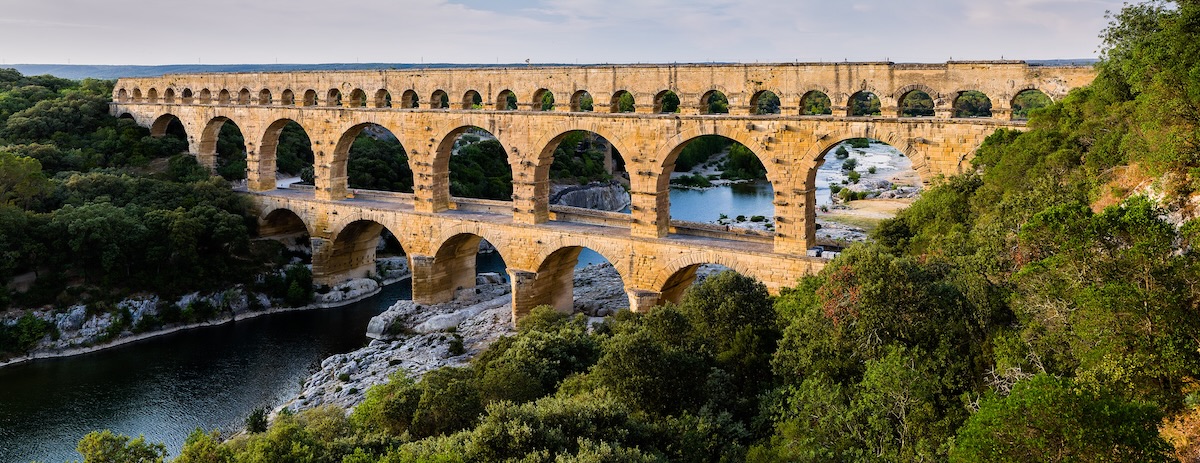
by Robert Marcos
Two years before his death during the eruption of Mt. Vesuvius, the Roman naturalist Pliny the Elder marveled at Rome’s aqueduct’s – which at their peak supported a million people in 200 cities across the Roman Empire.1
Pliny wrote, “If we take into account the abundant supply of water for public and private use, and then consider the distances traversed, the arches built, the mountains pierced, and the valleys leveled, we must admit that nothing more marvelous has ever existed in the whole world.” 2 At its height, the imperial capital of Rome was supplied by eleven major aqueducts which transported over 800 acre feet of fresh water into the capital every day. Because the system relied entirely on gravity rather than modern pumps, the water flowed continuously day and night. This imported water was primarily used in three ways –
- Public Fountains: Over 1,200 public basins and street fountains provided the primary source of clean drinking water for ordinary citizens.3
- Public Baths: Nearly 900 public bath complexes consumed the majority of the incoming water, operating as the social, cultural, and hygienic hubs of Roman daily life.4
- Private Luxury & Industry: The remaining water went to wealthy citizens who paid for private pipelines directly to their villas, as well as to industrial sites like mills and tanneries.5
To achieve a precise downward slope – sometimes as little as 1 foot of drop for every 4,000 feet of distance – ancient Roman engineers relied on three primary surveying tools. These tools allowed them to measure horizontal lines, vertical angles, and slopes across miles of uneven terrain. Roman aqueducts were constructed primarily from local volcanic stone (like tufa and travertine) and durable fired brick, bound together by a revolutionary pozzolanic concrete made from volcanic ash and lime, that allowed structures to be set underwater and grow stronger over time. Underground tunnels were carved directly into solid bedrock or lined with stone masonry, while internal channels were meticulously sealed with opus signinum—a waterproof hydraulic mortar mixed with crushed terracotta, to prevent leaks. Water was then carried over the famous stone-arched bridges, while heavy-duty terracotta tiles or thick lead pipes were used for localized distribution and pressurized siphons.
Although the ancient Assyrians are credited with the first “above ground” water conveyance, over the centuries the technology continued to be refined –
The Assyrians (c. 9th–7th Century BC): The Assyrians were the first to move beyond simple mud-brick irrigation canals to construct large-scale stone water networks. Under King Sennacherib, they built the Jerwan Aqueduct, the earliest known structures of its kind, using over two million blocks of ashlar masonry to carry freshwater across a valley to Nineveh. To prevent leaks, they lined the stone channels with a crude but effective waterproof layer of bitumen (tar).
The Babylonians (c. 7th–6th Century BC): As Babylon expanded, engineers mastered urban water management by integrating the Euphrates River directly into the city’s defenses and architecture through complex moats, dams, and subterranean brick channels. To combat flat terrain and deliver water to high elevations—most famously the legendary Hanging Gardens—they pioneered mechanical lifting technologies, including early iterations of the chain pump and mechanical lifts.
The Persians (c. 6th–5th Century BC): Confronted with arid desert landscapes, the Persians invented the qanat system, an engineering marvel of gently sloping underground tunnels driven horizontally into hillsides to tap into deep mountain aquifers. This breakthrough allowed water to flow entirely via gravity across miles of burning desert without evaporating. It required the development of precise vertical ventilation shafts used by miners to haul out debris and regulate airflow.
The Greeks (c. 6th–3th Century BC): Hydraulic Physics and Pressure SiphonsGreek engineers shifted the focus toward physics, geometry, and public sanitation, transitioning from open channels to enclosed, subterranean terracotta pipe networks. By sealing their systems, they mastered hydraulic pressure and invented the inverted siphon, allowing them to force water down into deep valleys and back up the other side to supply hilltop citadels. They also engineered massive feats of subterranean surveying, such as the Tunnel of Eupalinos, a half-mile aqueduct carved through a mountain from both sides simultaneously.