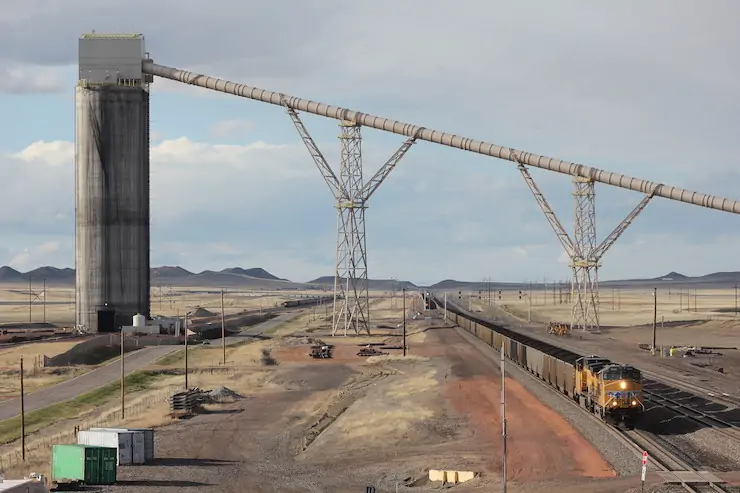
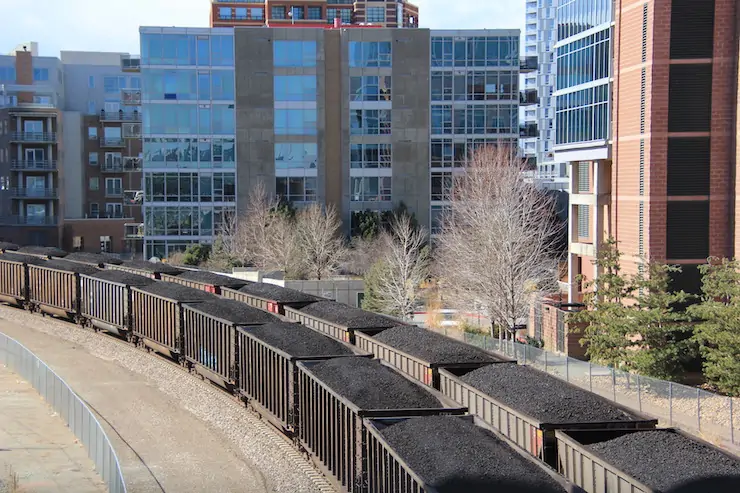
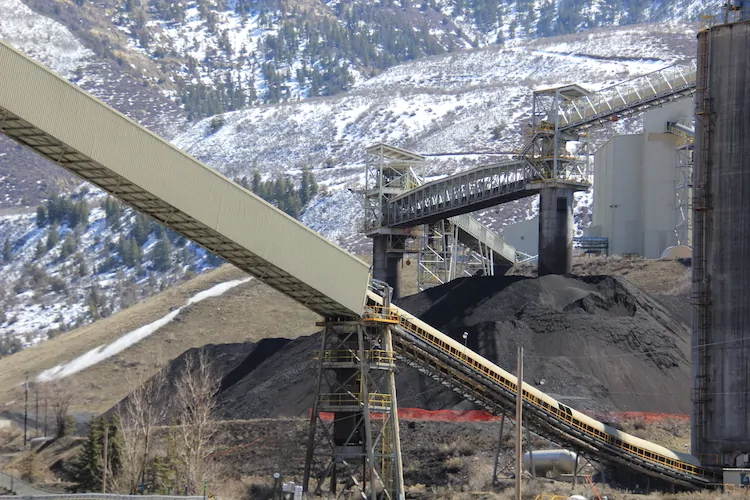
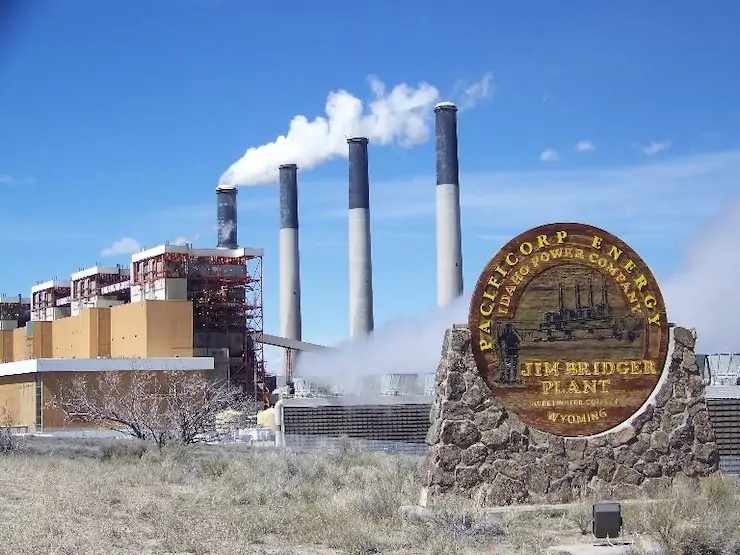
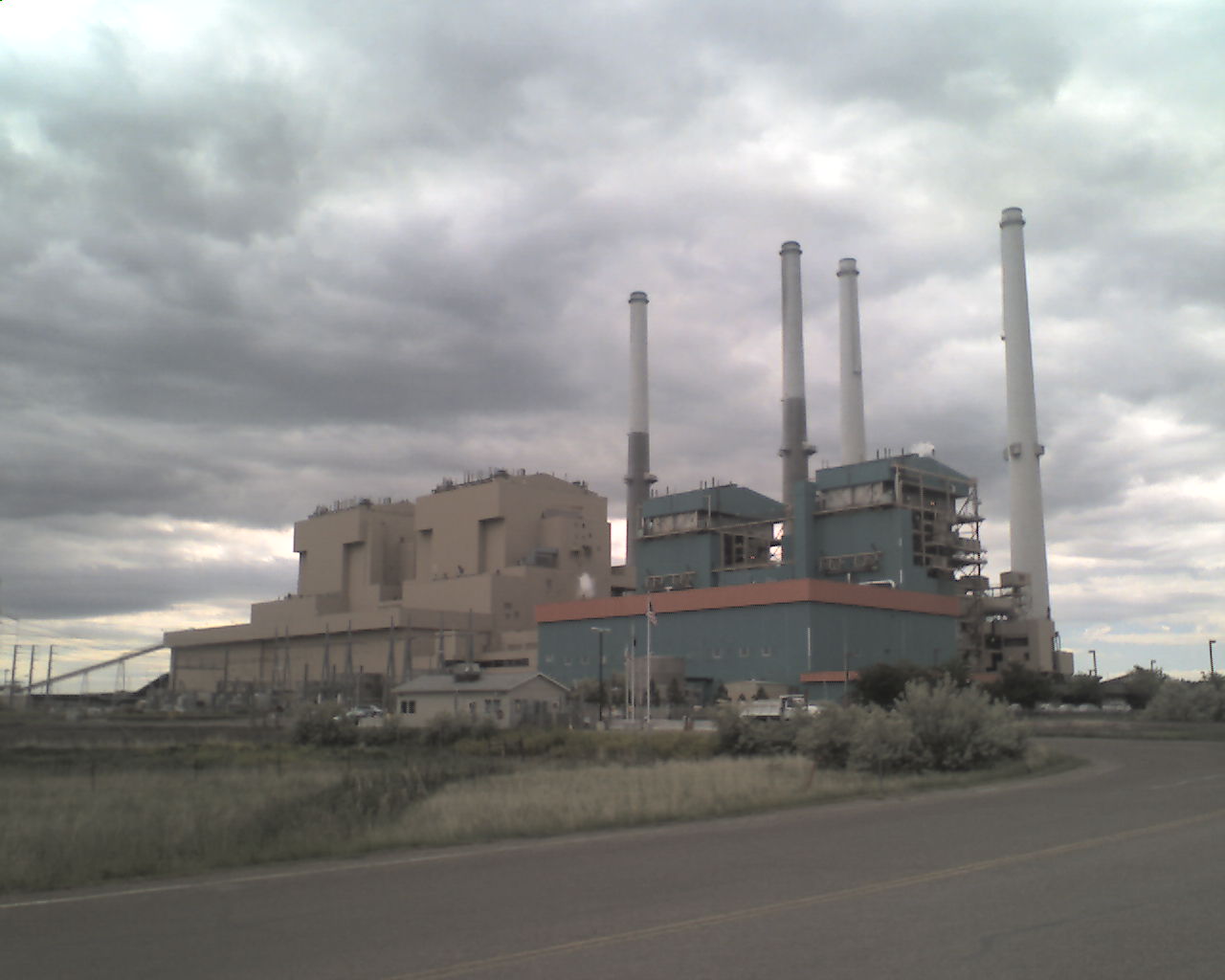
The coal mining industry reacted with outrage when the Bureau of Land Management recently announced plans to stop issuing new coal leases on the eastern plains of Wyoming and Montana.
From its headquarters in Washington, D.C., the National Mining Association predicted “a severe economic blow to mining states and communities,” while the industry’s political allies likened the move to declaring “war” on coal communities.
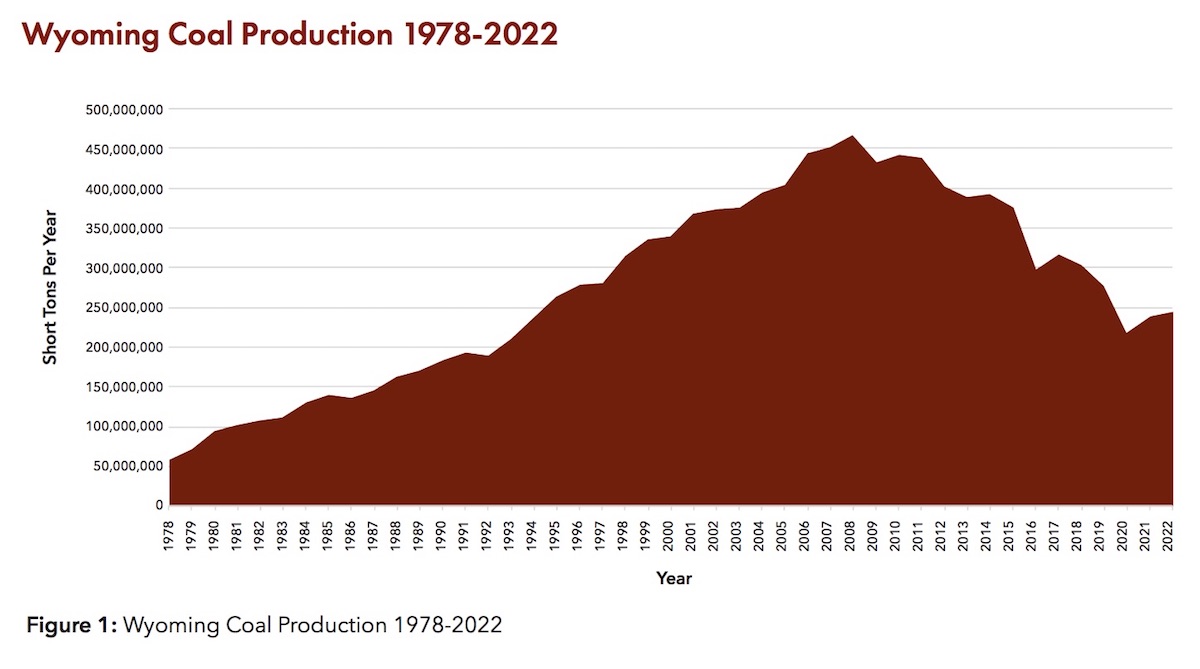
The truth is that coal has been steadily falling from its past dominance as energy king for nearly two decades. Domestic coal consumption dropped to 512 million tons in 2022, down 55 percent since its 2007 peak.
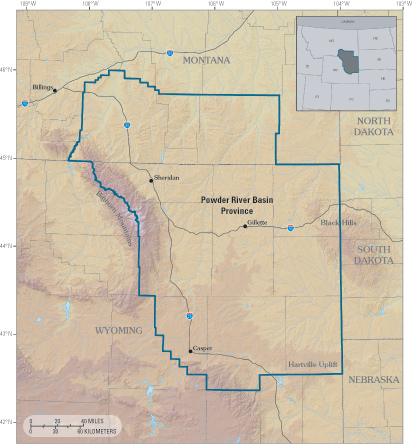
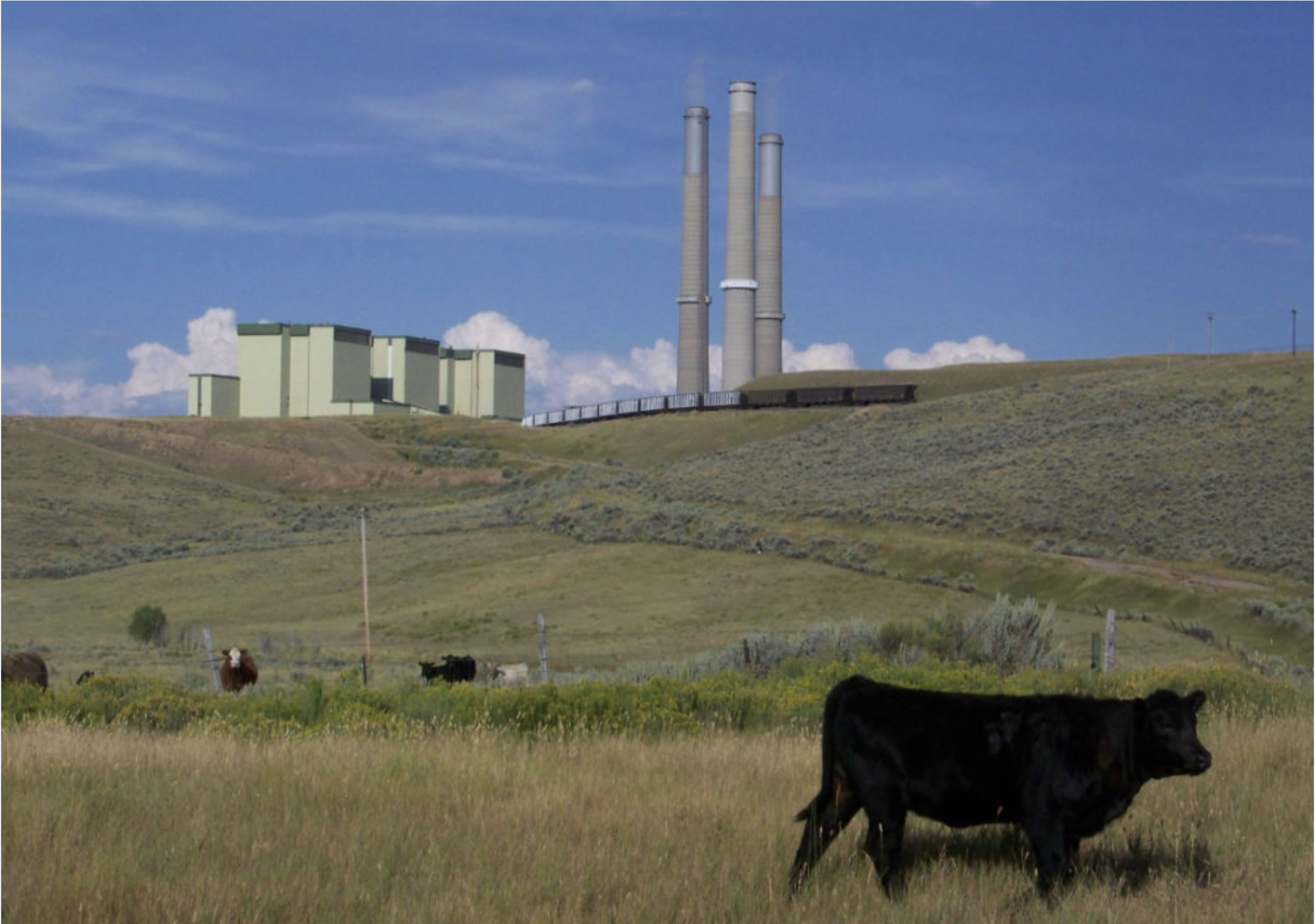
With the downward trajectory expected to continue, the Biden administration’s decision to end coal leasing in the Powder River Basin—the nation’s largest coal-producing region—reflects clear market trends. And far from killing coal, the administration’s plan allows mining to continue as the market transitions.
Billions of tons of previously leased federal coal remain available for mining from 270 tracts across the nation, which combined cover an area larger than Rocky Mountain National Park. One Montana mine has enough coal to keep operating until 2060. Taken together, economic effects related to ending new coal leasing in the Powder River Basin may not be felt until the 2040s and beyond.
Coal companies are well aware that U.S. energy markets have rapidly changed, a fact they soberly tell investors: “Over the last few years, customers have shifted to long-term supply agreements with shorter durations, driven by the reduced utilization of (coal) plants and plant retirements, fluidity of natural gas pricing and the increased use of renewable energy sources,” Wyoming’s largest coal producer, Peabody Energy, disclosed in its 2023 financial filing.
Even with declining markets, the Biden administration did not come to the decision on its own. Arguing that BLM’s past reviews of coal’s contributions to climate change were inadequate, a coalition of environmental groups sued the government and won. That forced the agency to revisit whether more coal leasing was warranted.
“For decades, mining has affected public health, our local land, air, and water, and the global climate,” said Lynne Huskinson, a retired coal miner. She’s a member of the Powder River Basin Resource Council, a Wyoming landowners’ group that was among the plaintiffs.
Now, she said, “we look forward to BLM working with state and local partners to ensure a just economic transition for the Powder River Basin as we move toward a clean energy future.”
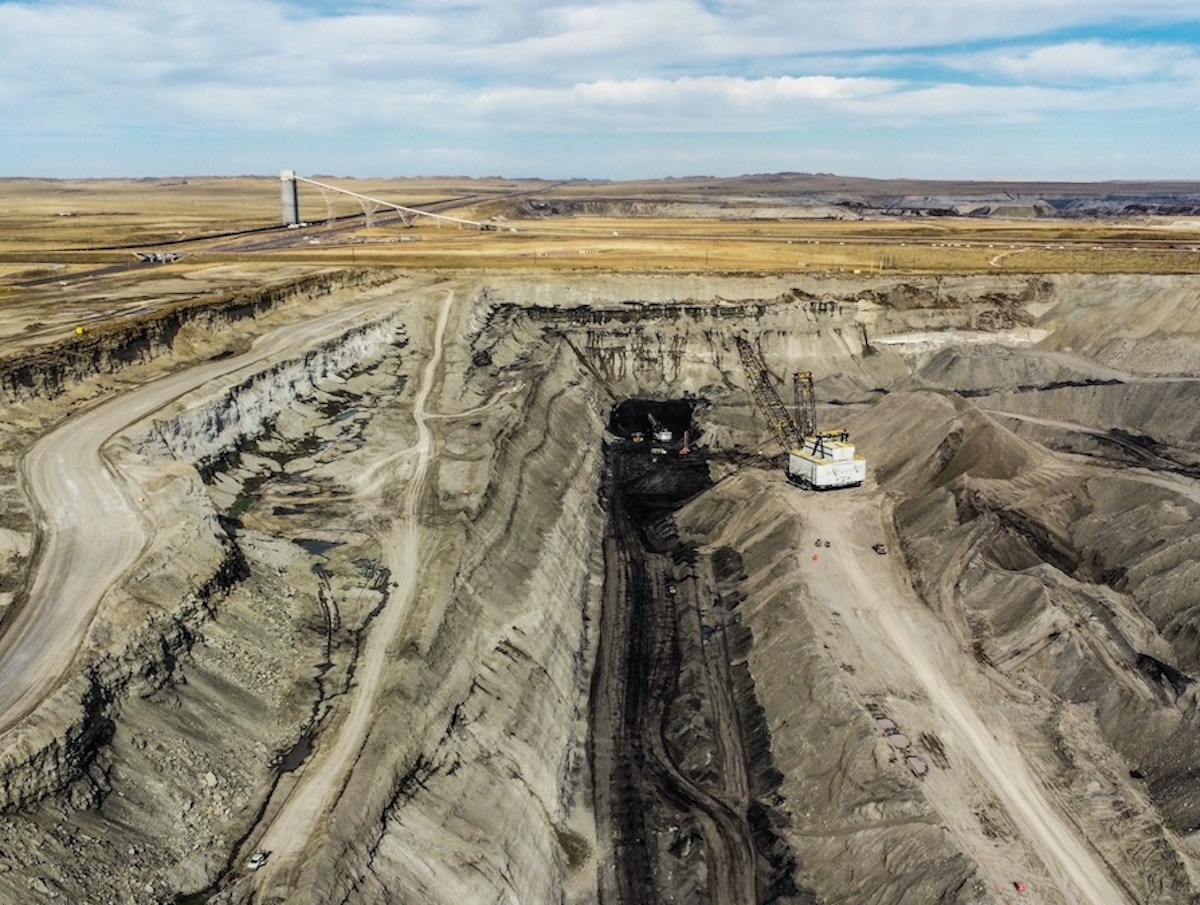
Huskinson lives in Gillette, Wyoming, where a dozen highly mechanized strip mines sprawl across the grasslands of the Powder River Basin. The Wyoming mines alone produce 40 percent of U.S. coal while employing less than 10 percent of the nation’s 44,000 coal workers.
The Basin’s mines have leased 8 billion tons of federal coal since the 1990s, a cheap and plentiful supply for the industry. The leasing process allows companies to nominate desired tracts, and then bid with little or no competition. Winning bidders often pay less than $1 a ton for coal, plus a nominal annual rent and a royalty after final sale.
There is little question that leasing helped launch and sustain the region’s energy boom. But in his 2022 decision, Judge Brian Morris of the Federal District Court of Montana cast his eye toward the future. Morris wrote that federal law required BLM to consider “long-term needs of future generations” that included “recreation, range, timber, minerals, watershed, wildlife and fish, and natural scenic, scientific, and historical values.”
The judge also gave the federal agency an out: “Coal mining represents a potentially allowable use of public lands, but BLM is not required to lease public lands.”
Morris’ words cleared the way for BLM to stop leasing, a decision that dovetails with a Colorado College poll that found most residents in eight Rocky Mountain states—including Wyoming and Montana—want Congress to prioritize conservation over energy development on public lands.
Peter Gartrell
The legal wrangling will likely continue, with the BLM reviewing protests from the coal industry and its political allies that lay the groundwork for more lawsuits. For now, though, it seems the Biden administration’s decision to keep coal in the ground not only follows the market and the law, but public opinion, too.
Peter Gartrell is a contributor to Writers on the Range, writersontherange.org, an independent nonprofit dedicated to spurring lively conversation about the West. He is a consultant in Washington, D.C., and covered coal leasing issues as a journalist and congressional staffer.
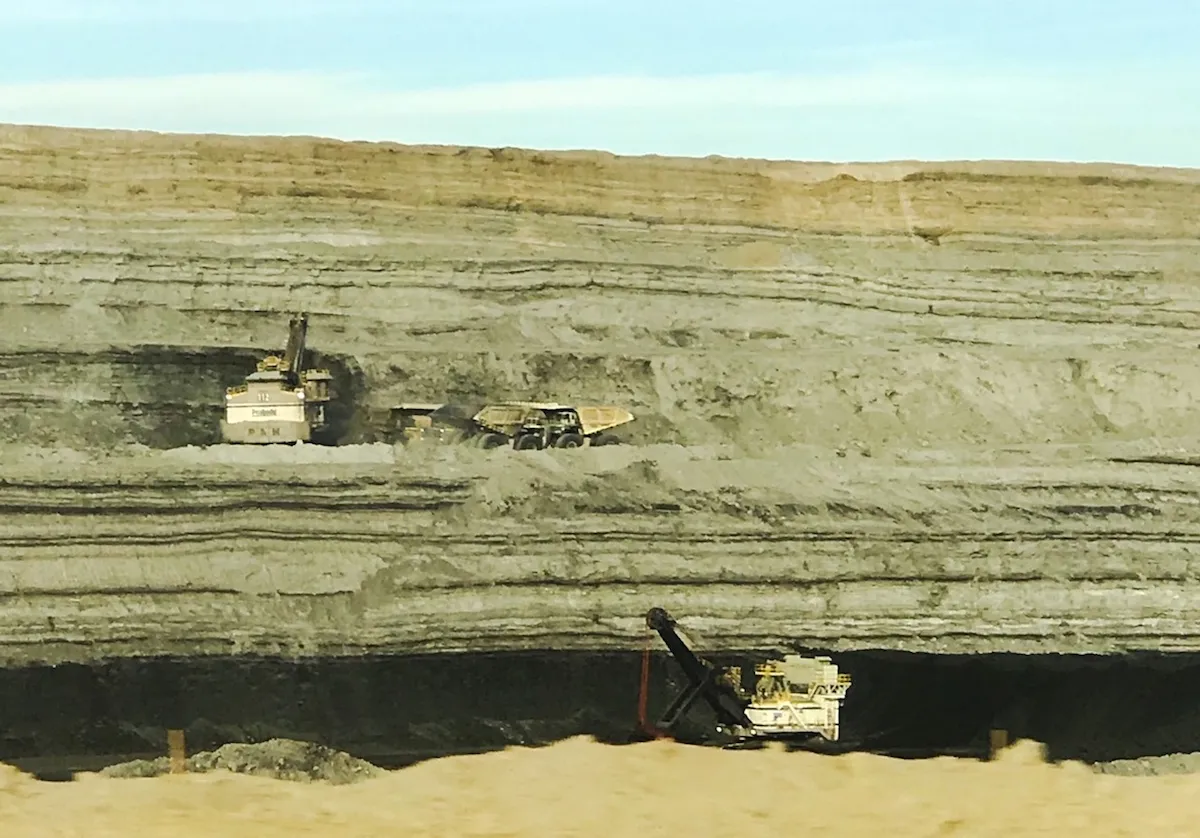
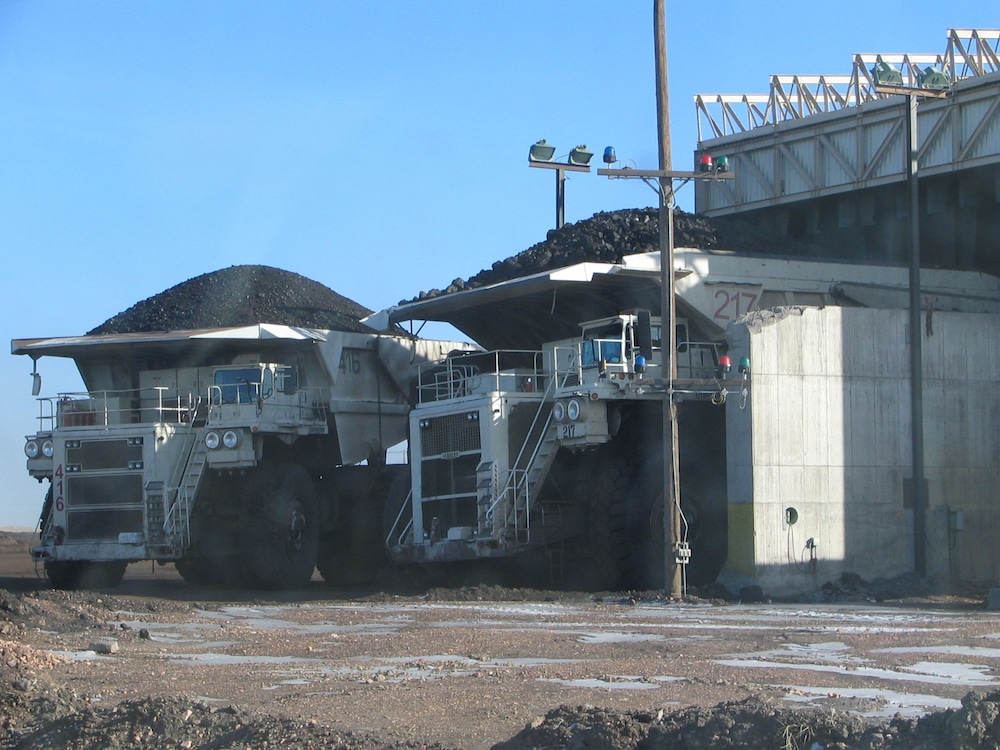
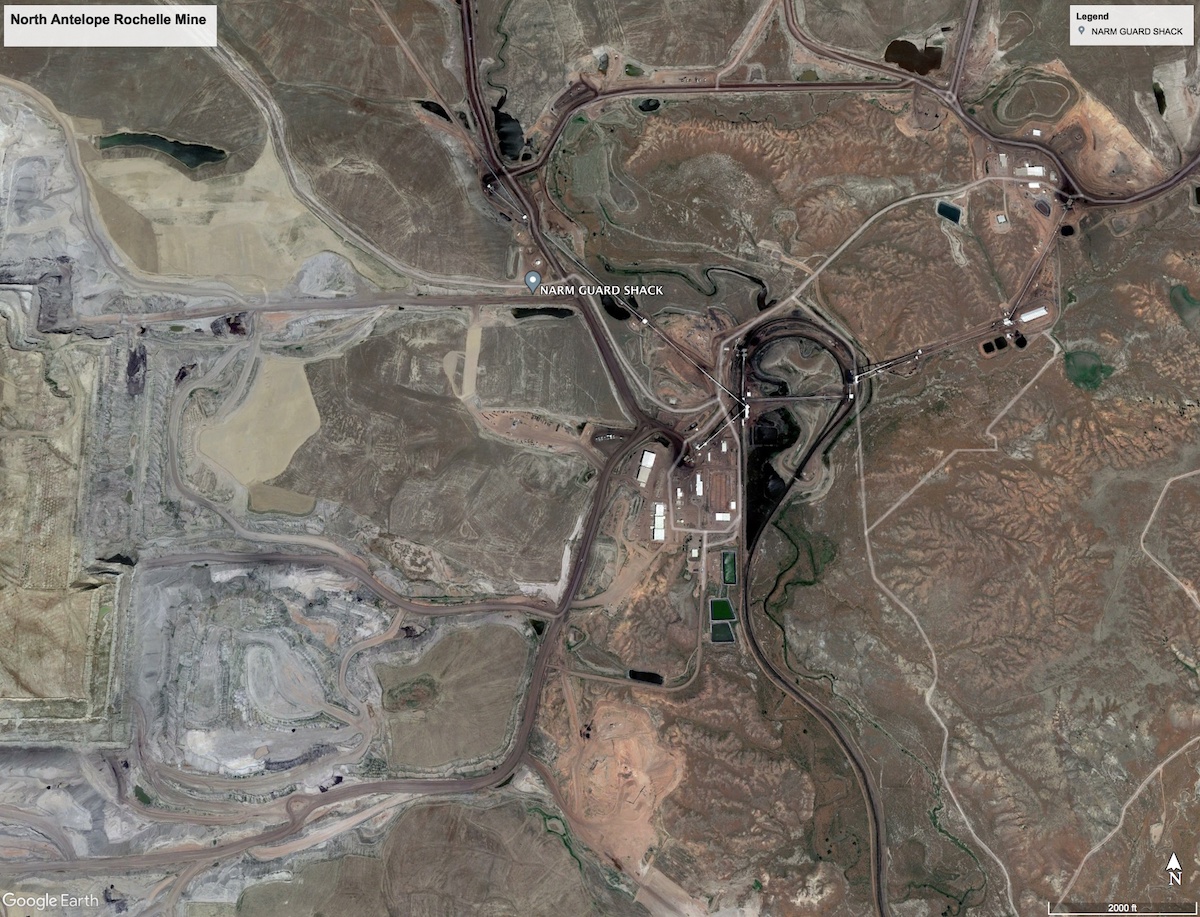
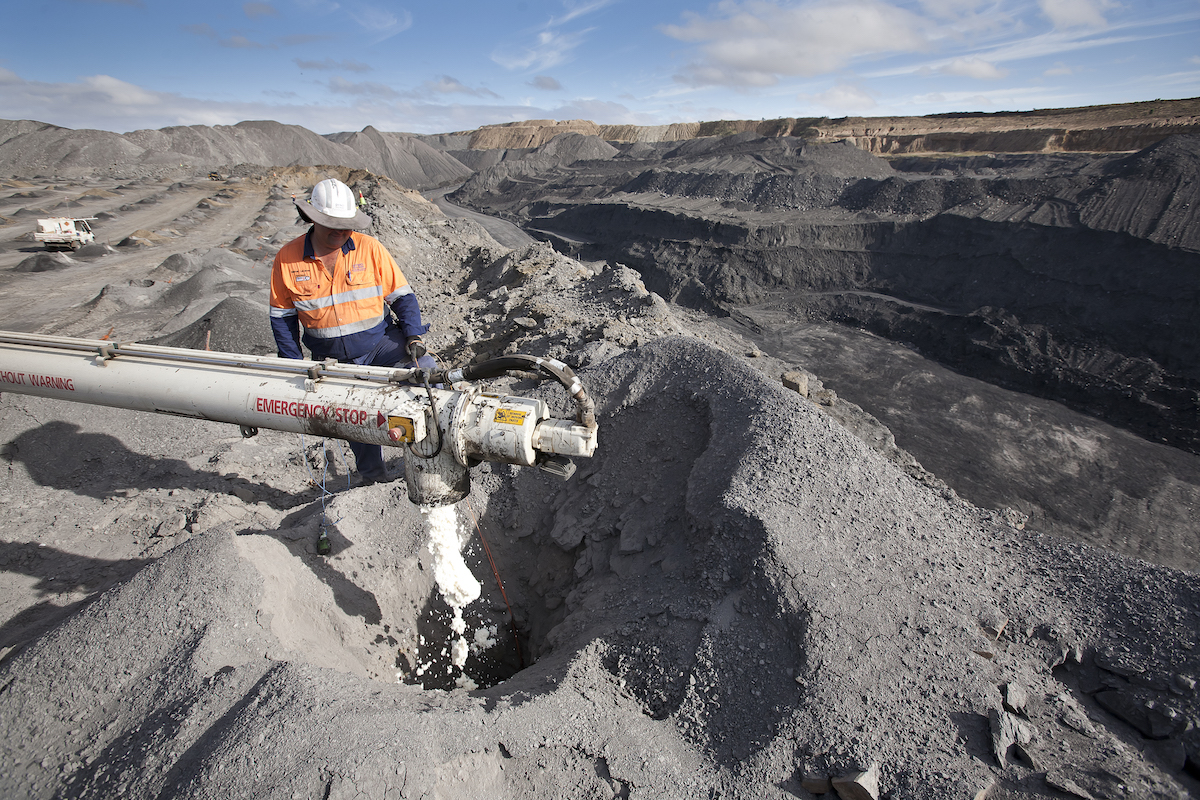
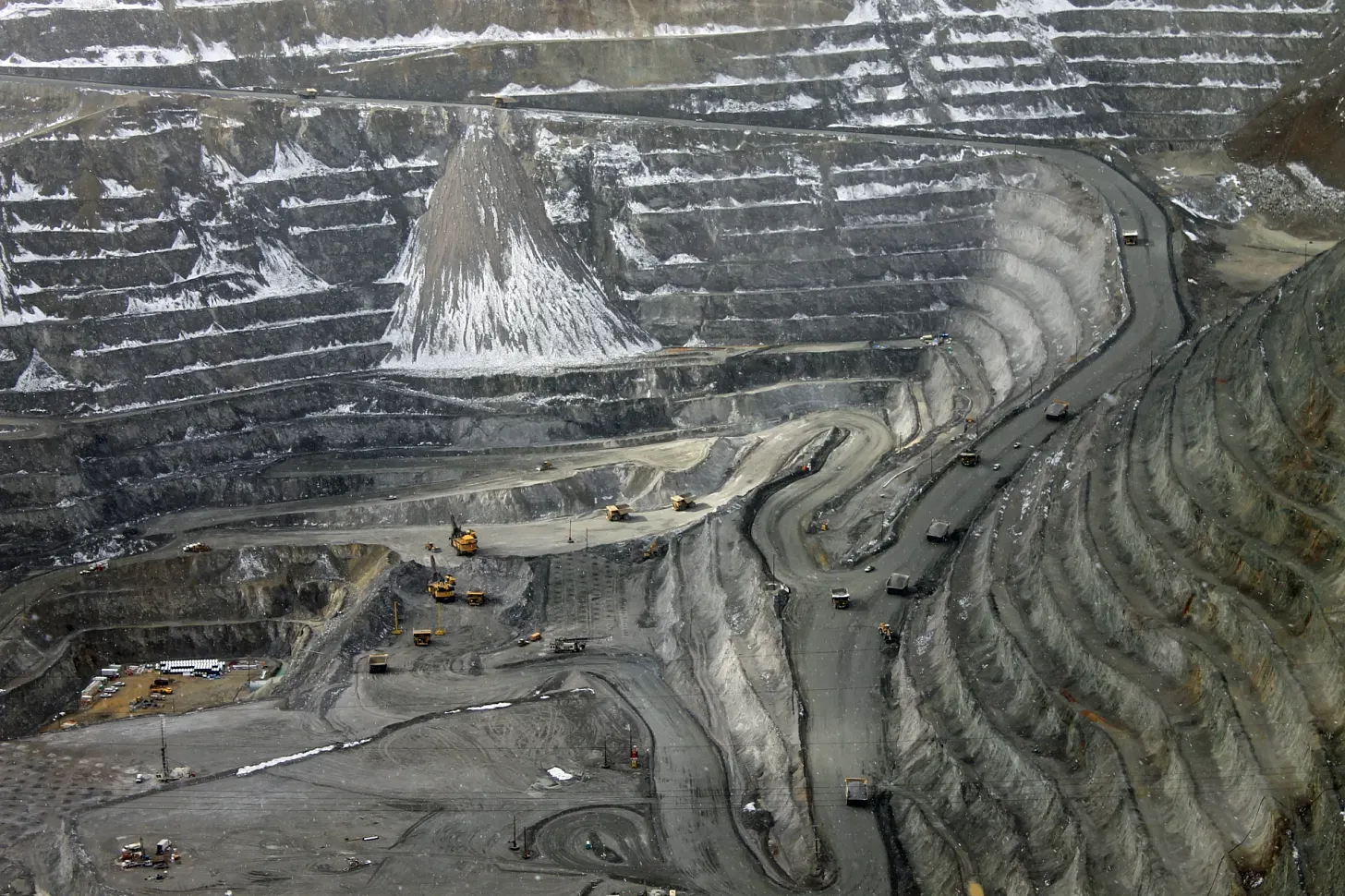
A truck-and-shovel crew removes overburden at the North Antelope Rochelle mine in Wyoming’s Powder River Basin in January 2020, as a coal shovel works below. (Alan Nash/WyoFile)
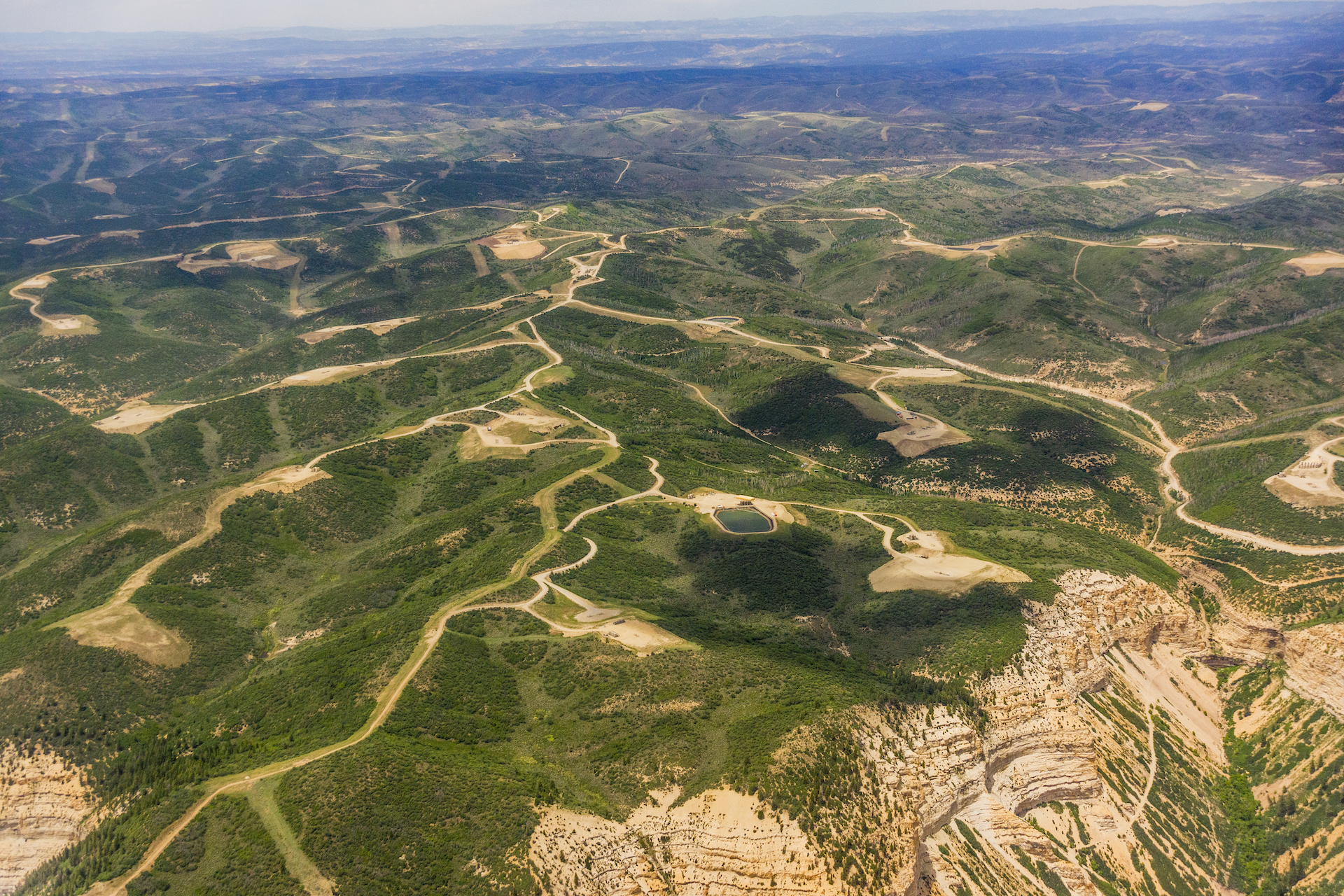
An aerial view of Assignation Ridge in the Thompson Divide area of Colorado. Project 2025 calls to restore mining claims and oil and gas leases in the Thompson Divide withdrawal area. (Courtesy of EcoFlight)
Written by former members of the Trump administration and other conservative leaders, Mandate for Leadership exhorts its readers to “go to work on Day One to deconstruct the Administrative state.” Among many other measures, it calls for radical reductions in the federal workforce and in federal environmental protections, and for advancing a “Trump-era Energy Dominance Agenda.”
The full text of Mandate for Leadership is below, preceded by an agency-by-agency overview of the proposals that could have the greatest impact on Western land, water and wildlife — as well as on Westerners themselves.
DEPARTMENT OF THE INTERIOR (p. 517)
The Project 2025 recommendations for the Department of the Interior were primarily authored by attorney William Perry Pendley, a vociferous opponent of protections for public lands and wildlife. As acting director of the Bureau of Land Management during the Trump administration, he transformed the agency into what one high-level employee described as a “a ghost ship,” in which “suspicion,” “fear” and “low morale” abounded.
Energy Policy
Pendley notes that the energy section was written “in its entirety” by Kathleen Sgamma of the Western Energy Alliance, an oil and gas industry group; Dan Kish of the Institute for Energy Research, a think tank long skeptical of human-caused climate change; and Katie Tubb of The Heritage Foundation. They recommend reviving the “Trump-era Energy Dominance Agenda” by:
reinstating a dozen industry-friendly orders issued by the Trump administration’s secretaries of the Interior (p. 522);
expanding oil and gas lease sales onshore and offshore (p. 522);
and weakening the National Environmental Policy Act, which requires environmental reviews of federally funded projects, by restoring Trump-era changes that set time limits for reviews, allowed agencies to skip some reviews altogether and eliminated any consideration of a project’s climate impacts (p. 533).
Land Conservation
The project aims to undo large landscape protections by:
The Cascade-Siskiyou National Monument was expanded via proclamation from President Obama in 2017, making the new monument approximately 112,000 acres. Bob Wick/Bureau of Land Management
Wildlife
Pendley expresses particular hostility toward the U.S. Fish and Wildlife Service, whose work he described as “the product of ‘species cartels’ afflicted with group-think, confirmation bias, and a common desire to preserve the prestige, power, and appropriations of the agency that pays or employs them.” He recommends:
delisting the grizzly bear in the Greater Yellowstone and Northern Continental Divide Ecosystems (p. 534);
ending the reintroduction of “experimental populations” outside a species’ historic range (p. 534);
abolishing the Biological Resources Division of the U.S. Geological Survey — which will be difficult to do, as it no longer exists as such and is now part of the National Park Service(p. 534);
The free-market advocate behind Project 2025’s section on the USDA has long railed against the subsidies and food stamp programs administered by the agency. As a fellow at The Heritage Foundation, Daren Bakst penned a lengthy report, Farms and Free Enterprise, that objects to many aspects of the farm bill, which funds annual food assistance and rural development programs. His vision, documented in the report, is present throughout Project 2025’s proposed agency overhaul.
Agency Organization
Project 2025 seeks to limit regulation in favor of market forces by:
reducing annual agency spending, including subsidy rates for crop insurance and additional programs that support farmers for lost crops (p. 296);
eliminating the Conservation Reserve Program, which pays farmers to enrich and protect parts of their land from agricultural production (p. 304);
removing climate change and equity from the agency’s mission (p. 290, 293);
and working with Congress to undo the federal labeling law, which requires consumer products to disclose where they were made and what they contain, as well as encouraging voluntary labeling (p. 307).
Forestry
The project will reduce forests on public lands by:
and rescinding the Biden administration’s Roadless Rule for the Tongass National Forest, which preserves 9.37 million acres of the world’s largest temperate rainforest and puts a cap on logging in the region (p. 531).
Logging within the Cougar Park timber sale in Kaibab National Forest in 2018. The timber project was part of an initiative intended to treat more than 2.4 million acres of ponderosa pine forest across northern Arizona. Dyan Bone/U.S. Forest Service
ENVIRONMENTAL PROTECTION AGENCY (p. 417)
Prior to serving as the EPA’s chief of staff during the Trump administration, Mandy Gunasekara was famous for handing Republican Sen. James Inhofe a snowball to disprove the existence of human-caused climate change. At the EPA, she played a key role in the United States’ withdrawal from the Paris Agreement and in the dismantling of the Obama-era Clean Power Plan. Gunasekara’s vision for the EPA is characterized by staff layoffs, office closures and the embrace of public comment over peer-reviewed science.
Agency Organization
The plan will diminish the agency’s scope of work by:
reducing full-time staff and cutting “low-value” programs (p. 422);
eliminating all research that is not explicitly authorized by Congress (p. 436);
restructuring scientific advisory boards and engaging the public in ongoing scrutiny of the agency’s science — potentially opening the door to a wave of pushback against the international consensus on climate change (p. 422, 436-438);
eliminating the use of catastrophic climate change scenarios in drafting regulation (p. 436);
relocating a restructured American Indian Office to the West (p. 440);
partially shifting personnel from headquarters to regional offices (p. 430);
and striking the regulations, including a program to reduce methane and VOC emissions, that enable the EPA to work with external groups to help enforce laws (p. 424).
Natural Resources
The project would jeopardize clean air and water by:
limiting California’s effort to reduce air pollution from vehicles by ensuring that its standards and those of other states avoid any reference to greenhouse gas emissions or climate change (p.426);
supporting the reform of the Endangered Species Act to ensure a full cost-benefit analysis during pesticide approval (p. 434-435);
repealing some regulations imposed by the Biden administration to limit hydrofluorocarbons, a particularly potent greenhouse gas (p. 425);
and undoing the expansion of the Good Neighbor Program, which requires states to reduce their nitrogen oxide emissions, beyond power plants to include industrial facilities like iron and steel mills (p. 424).
More than 350 prominent climate advocates on Tuesday endorsed Vice President Harris for president, a sign that environmental leaders believe hercampaign will energize like-mindedvoters in a way that President Biden could not. In a letter shared first with The Washington Post, big names in the environmental movement — including former U.S. climate envoy John F. Kerry, former secretary of state Hillary Clinton and Washington Gov. Jay Inslee (D)— wrote that Harris has long prioritized climate action and would continue to do so as president.
“We know that protecting our planet for ourselves and future generations requires the kind of bold leadership that Kamala Harris has demonstrated her whole life,” they wrote. “We are proud to support her and be in the fight against climate change with her.”
Inslee, whose ambitious climate proposals during his 2020 presidential campaign influenced Biden’s climate policies, said Harris could help mobilize young voters, a crucial Democratic constituency. Polls show that climate change is a top concern for young people, who are more likely than older generations to face raging wildfires, rising seas and stronger storms in their lifetimes.
“Her candidacy instantly lit an electric spark under young people across the country,” Inslee said. “That’s going to bode well for our fortunes.”
Kerry, who left the Biden administration in March, said in an interview that Harris was a “terrific ally” on climate policy. He noted that she was an early advocate of the United States reaching net-zero emissions by mid-century, and she delivered a forceful speech at the U.N. Climate Change Conference in Dubai last fall.
Three years ago, climate researchers shocked drought-weary Californians when they revealed that the American West was experiencing its driest 22-year period in 1,200 years, and that this severe megadrought was being intensified by global warming. Now, a UCLA climate scientist has reexamined the data and found that, even after two wet winters, the last 25 years are still likely the driest quarter-century since the year 800.
”The dryness still wins out over the wetness, big time,” said UCLA professor Park Williams.
The latest climate data show that the years since 2000 in western North America — from Montana to California to northern Mexico — have been slightly drier on average than a similar megadrought in the late 1500s…Williams shared his findings with the Los Angeles Times, providing an update to his widely cited 2022 study, which he coauthored with scientists at Columbia University’s Lamont-Doherty Earth Observatory. The new findings reveal that even the unusually wet conditions that drenched the West since the start of 2023 pale in comparison to the long stretch of mostly dry years over the previous 23 years. And that dryness hasn’t been driven by natural cycles alone. Williams and his colleagues have estimated that a significant portion of the drought’s severity — roughly 40% — is attributable to warming driven by the burning of fossil fuels and rising levels of greenhouse gases. The warming that has occurred in the region, an increase of more than 2.5 degrees Fahrenheit since recordkeeping began more than a century ago, has intensified the dry conditions, making the latest megadrought significantly more severe than it would be without climate change…Scientists and policy experts widely agree that adapting to aridification driven by climate change in the western U.S. will require major changes in how limited water supplies are managed for farms, cities and the environment.
“Regardless of what happens in the next few years, which will be dictated mostly by the randomness of weather, as the atmosphere continues to warm we should expect it to continue to degrade our water supply,” Williams said. “A warmer atmosphere is a thirstier atmosphere, and without a compensating increase in precipitation, which has not occurred, humans and ecosystems will be left with less water.”
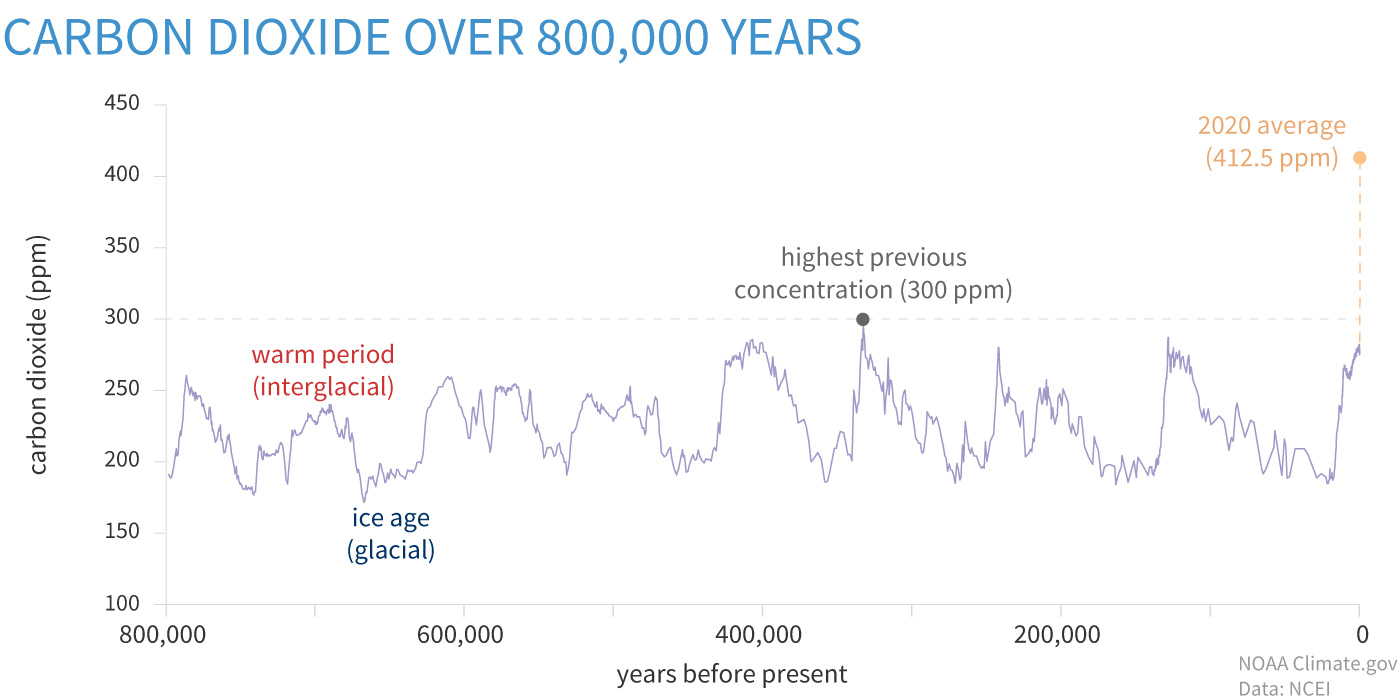
Atmospheric carbon dioxide concentrations (CO2) in parts per million (ppm) for the past 800,000 years. On the geologic time scale, the increase to today’s levels (orange dashed line) looks virtually instantaneous. Graph by NOAA Climate.gov based on data from Lüthi et al., 2008, via the NOAA NCEI Paleoclimatology Program.
Visitors walk past a sign reading ‘Stop: Extreme Heat Danger’ in Death Valley National Park during a heat wave on July 7, 2024. Etienne Laurent/AFP via Getty Images
A month into summer 2024, the vast majority of the U.S. population had already experienced at least one extreme heat wave, and millions of people were under heat alerts, with forecasts warning of more ahead.
Globally, the planet had its hottest day in at least eight decades of recordkeeping on July 21 – and then broke the record again on July 22, according to the European Union’s Copernicus Climate Change Service.
The extreme heat is part of a longer trend: Each of the past 13 months has been the hottest on record for that month globally, including the hottest June, the EU service reported in early July. It also found that the average temperature for the previous 12 months had been at least 1.5 C (2.7 F) warmer than the 1850-1900 pre-industrial average.
The 1.5 C warming threshold can be confusing, so let’s take a closer look at what that means. In the Paris climate agreement, countries worldwide agreed to work to keep global warming under 1.5 C, however that refers to the temperature change averaged over a 30-year period. A 30-year average is used to limit the influence of natural year-to-year fluctuations.
So far, the Earth has only crossed that threshold for a single year. However, it is still extremely concerning. We study weather patternsinvolving heat. The world appears to be on track to cross the 30-year average threshold of 1.5 C within 10 years.
Heat is becoming a global problem
Several countries have experienced record heat across the Americas, Africa, Europe and Asia in 2024. In Mexico and Central America, weeks of persistent heat starting in spring 2024 combined with prolonged drought led to severe water shortages and dozens of deaths.
Muslim pilgrims spent hours in extreme temperatures and humidity during the Hajj in June 2024 in Saudi Arabia. Over 1,000 people died in the heat. AP Photo/Rafiq Maqbool
Hospitals in Karachi, Pakistan, were overwhelmed amid weeks of high heat, frequent power outages, and water shortages in some areas. Neighboring India faced temperatures around 120 F (48.9 C) for several days in April and May that affected millions of people, many of them without air conditioning.
Although heat waves are a natural part of the climate, the severity and extent of the heat waves so far in 2024 are not “just summer.”
A scientific assessment of the fierce heat wave in the eastern U.S. in June 2024 estimates that heat so severe and long-lasting was two to four times more likely to occur today because of human-caused climate change than it would have been without it. This conclusion is consistent with the rapid increase over the past several decades in the number of U.S. heat waves and their occurrence outside the peak of summer.
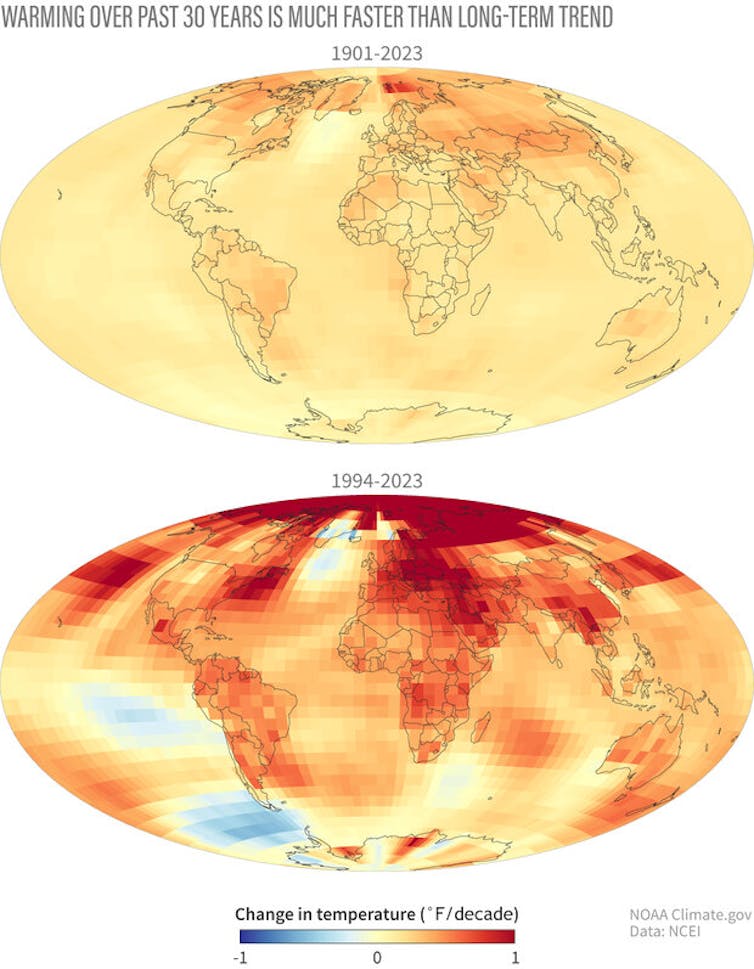
These record heat waves are happening in a climate that’s globally more than 2.2 F (1.2 C) warmer – when looking at the 30-year average – than it was before the industrial revolution, when humans began releasing large amounts of greenhouse gas emissions that warm the climate.
Global surface temperatures have risen faster per decade in the past 30 years than over the past 120. NOAA NCEI
While a temperature difference of a degree or two when you walk into a different room might not even be noticeable, even fractions of a degree make a large difference in the global climate.
At the peak of the last ice age, some 20,000 years ago, when the Northeast U.S. was under thousands of feet of ice, the globally averaged temperature was only about 11 F (6 C) cooler than now. So, it is not surprising that 2.2 F (1.2 C) of warming so far is already rapidly changing the climate.
If you thought this was hot
While this summer is likely be one of the hottest on record, it is important to realize that it may also be one of the coldest summers of the future.
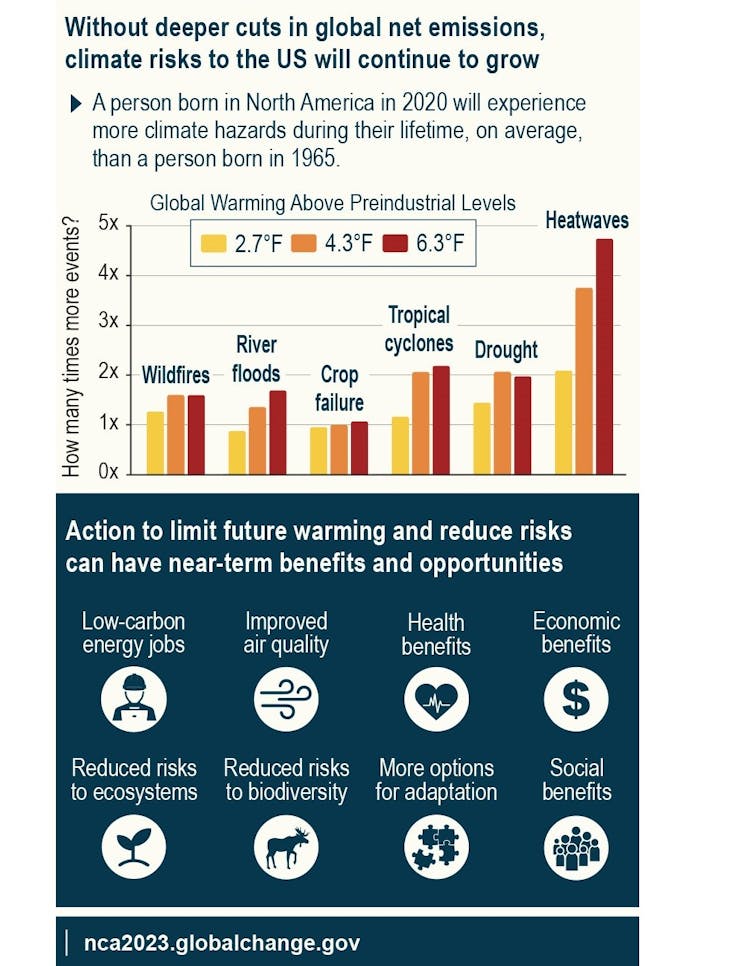
Actions to reduce warming can limit a wide range of hazards and create numerous near-term benefits and opportunities. National Climate Assessment 2023
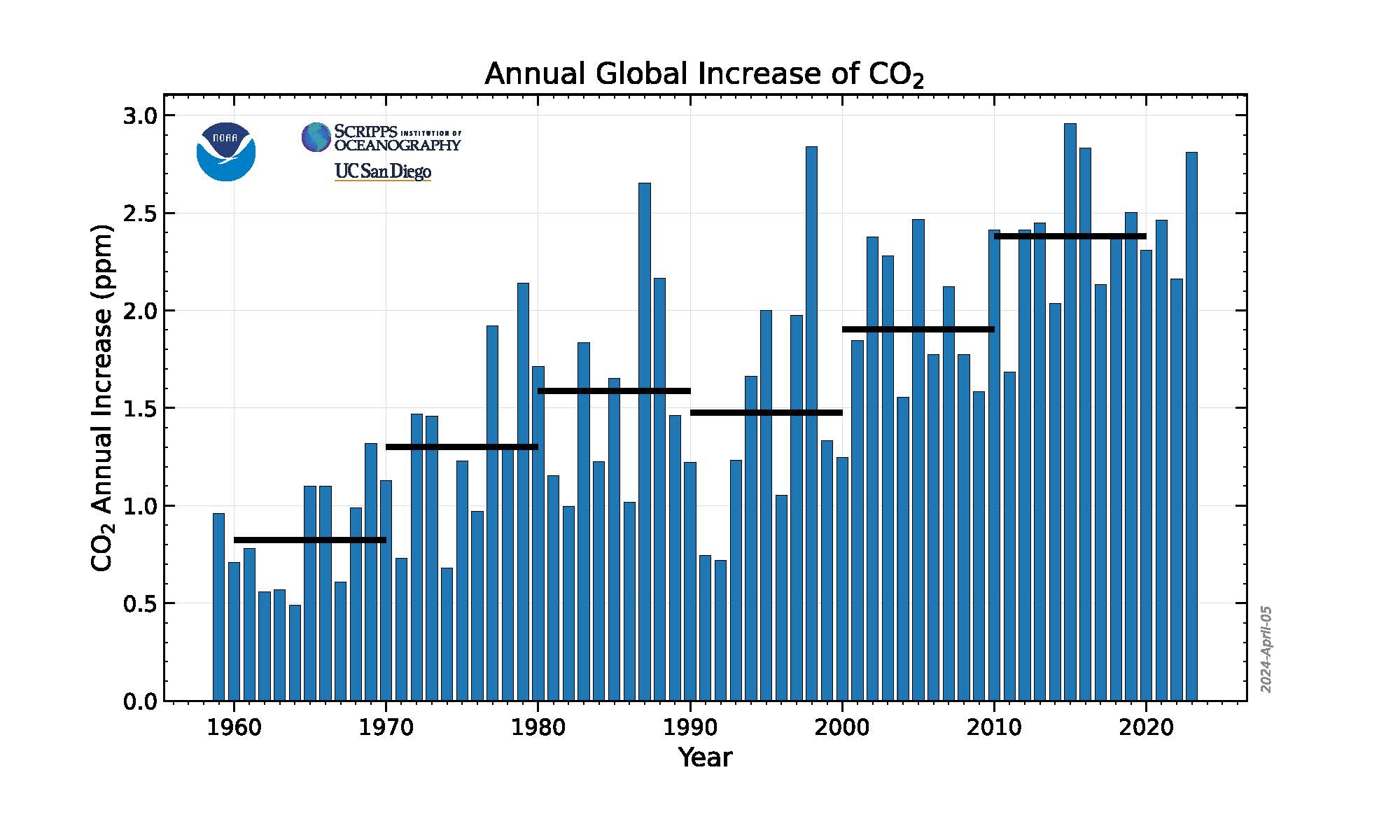
There is much that humanity can do to limit future warming if countries, companies and people everywhere act with urgency. Rapidly reducing fossil fuel emissions can help avoid a warmer future with even worse heat waves and droughts, while also providing other benefits, including improving public health, creating jobs and reducing risks to ecosystems.
It’s Friday, it’s hot, the world seems to be collapsing in multiple ways, so I thought I’d bring you a bit of good news for a change: Coal’s big breakdown is back. Okay, so it’s not great news for coal-company CEOs, or for the industry workers who will lose their jobs. But for the planet and all the folks who have had to live with coal mining and coal burning and all of its deleterious effects, it’s got to be a relief.
In his excellent book, Fire on the Plateau, the late, great scholar Charles Wilkinson coined the term “Big Buildup” to describe the flurry of postwar development of coal plants (and dams, uranium mining, oil and gas, etc.) on the Colorado Plateau. The Big Breakdown refers to the decline of the coal industry in the West, as big coal plants are mothballed and the mines shut down and, hopefully, reclaimed, and the air cleans itself up as a result.
The Breakdown began back in 2008, during the global financial crisis, when power consumption plummeted. The economy recovered. Coal did not — it had become more expensive than other energy alternatives and is dirtier, besides, so utilities rushed to rid themselves of the old smoke-spewing behemoths. But then, in the wake of the first wave of the COVID-19 pandemic, coal bounced back, sparking a bit of panic among clean air lovers everywhere. And lawmakers in Utah, Wyoming, and other fossil-fuel-fetishizing states rushed to pass laws to interfere in the free market and prop up the dying industry.
Alas, it isn’t working, as today’s chart — showing both electricity consumption and coal consumption — reveals. I’ve run this chart here before, but I wanted to update y’all because I really like it. Not only does it show how the grid is getting cleaner, but also provides a nice graphic look at U.S. energy history over the last 75 years.
Credit: Jonathan P. Thompson/The Land Desk
A. Coal was the king of the Industrial Age, of course, providing power to run mines and mills and factories and trains, while also heating homes. But by the 1950s the industry was struggling somewhat, as diesel locomotives supplanted the steam ones, natural gas gained ground for heating and cooking, and huge hydroelectric dams blocked rivers across the West to generate power. As of 1955, only 10% of the Western Grid’s power was generated from coal; nearly all the rest was from hydropower.
B. Congress established the Office of Coal Research in 1960 “to encourage and stimulate the production … of coal (and to) maximize the contribution of coal to the overall energy market.”
C. The Big Buildup began in the 1960s with the construction of Four Corners Power Plant on the Navajo Nation in northwestern New Mexico. The construction and operation of the plant and adjacent mine were rife with environmental injustice.
D. The Clean Air Act passed in 1970. You might think that would be the death knell for coal, pretty much the dirtiest fuel out there. But no, it did little to slow coal-burning and it actually boosted relatively low-sulfur coal from Western mines which emits less sulfur dioxide when burned.
E. In 1973 OPEC stopped sending oil and natural gas to the U.S. and its allies to retaliate for U.S. support of Israel in the Yom Kippur War. Further unrest in the Middle East continued to drive up oil and natural gas prices, motivating utilities to burn more coal to generate power.
F. President Jimmy Carter took office during these crises in 1977, the same year Atlantic Richfield Company opened its Black Thunder Mine in the Powder River Basin, which would go on to become the world’s largest coal mine. Carter was a walking contradiction, boosting solar and other clean energy and public lands protections on the one hand, and going all in on coal mining and burning on the other. He pushed domestic coal to displace oil or natural gas (much of which was imported) then used to generate power. Carter also hoped to make synthetic transportation fuels from coal and oil shale and he and Congress put billions toward synfuel subsidies.
G. In 1978 Congress passed the Industrial Fuels Power Act, which basically banned the construction of any new natural gas power plants (another reaction to the energy crises). Coal was the big winner of that one.
H. Carter was also a big pusher of conservation, in rhetoric and policy, and high energy prices bolstered his cause. Electricity consumption flattened and even dropped in the 1980s for the first time in three decades. Yet coal use shot up tremendously at the same time. Under Reagan, electricity use climbed again, but coal consumption dropped. Why? Because OPEC decided to flood the market with oil, lowering oil and gas prices to make them the cheapest fossil fuels for generating electricity.
I. Congress amends the Clean Air Act to tackle the acid rain problem, especially in the East and Midwest. Instead of hurting the coal industry, however, it again gave an even bigger boost to the Western mines. The Powder River Basin solidified its status as the nation’s coal bin.
J. Peak Coal occurred in 2007. There is virtually no chance U.S. mines will ever produce or plants burn as much coal as they did that year.
K. Electricity use plummeted during the 2008 Financial Crisis and coal use dropped with it. As the economy recovered, something strange happened: Electricity use stayed fairly flat, thanks to efficiency and other measures. Coal burning started to recover, but …
L. In 2009 natural gas prices crashed after the combination of horizontal drilling and multi-stage hydraulic fracturing opened up vast stores of methane previously believed to be unrecoverable. That glutted the market with gas, making it cost-competitive with coal. Meanwhile, Democrats and even some national environmental groups were pushing natural gas as a “bridge fuel” to get from dirty coal to renewables. At the same time, oodles of solar and wind generating capacity were being brought online, in part thanks to federal incentives. All of this combined to knock King Coal off its throne. It’s been in freefall (with a blip or two) ever since due mostly to fluctuations in natural gas prices.
M. The first wave of the pandemic and measures taken to slow its spread helped Americans reduce their electricity use considerably. Because coal was one of the most expensive sources of power on the grid, utilities ditched it first, so the dirty fuel took an even bigger blow. Coal plant retirement plans accelerated and it seemed as if coal could be in its final throes.
N. But then the economy recovered along with power use. At the same time, extreme heat drove up demand for more power, hydropower waned, and utilities needed to fill the gap between supply and demand. They turned first to natural gas, which caused prices of that fuel to increase, and then to coal. Thus the Big Breakdown’s dramatic pause in 2021.
But the Big Breakdown is back on. In 2023, coal use plummeted once again. And judging by the first quarter of 2024, there will be even less use this year, even as power demand creeps higher.
“Power Madness” in America, the Big Buildup of coal, and a Senate hearing from five decades ago — JONATHAN P. THOMPSON OCTOBER 1, 2020
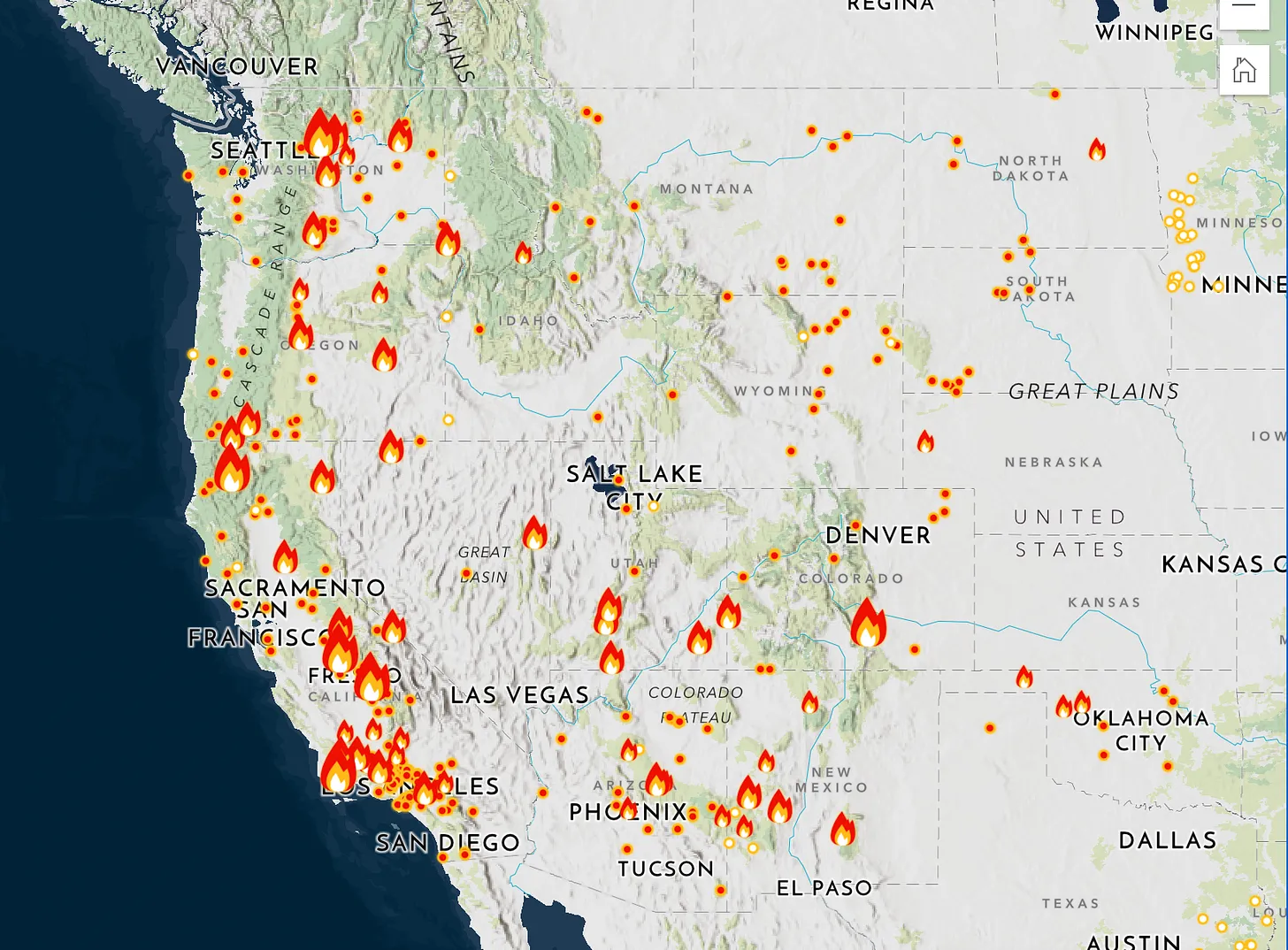
There’s a lot of big fires burning out there, with dozens of new starts daily across the West. The McDonald Fire in Alaska was first noticed on July 9; it’s now up to about 150,000 acres. The Cow Valley Fire in Malheur County, Oregon, has grown to 20,000 acres; it was ignited just yesterday. The Silver King Fire in Utah’s Tushar Mountains has charred through about 14,000 acres and forced the cancellation of a major gravel bike race there. There’s also the Babylon Fire south of Dark Canyon within the boundaries of Bears Ears National Monument. It’s grown to about 200 acres in a remote location that, frankly, could use a little bit of therapeutic burning (thanks to our favorite fire lookout readers for tipping us off to it.) Be careful out there, folks!
📸 Parting Shot 🎞️
A datura flower in southern Utah: shy by day; flirtatious and lascivious by night. Jonathan P. Thompson photo.
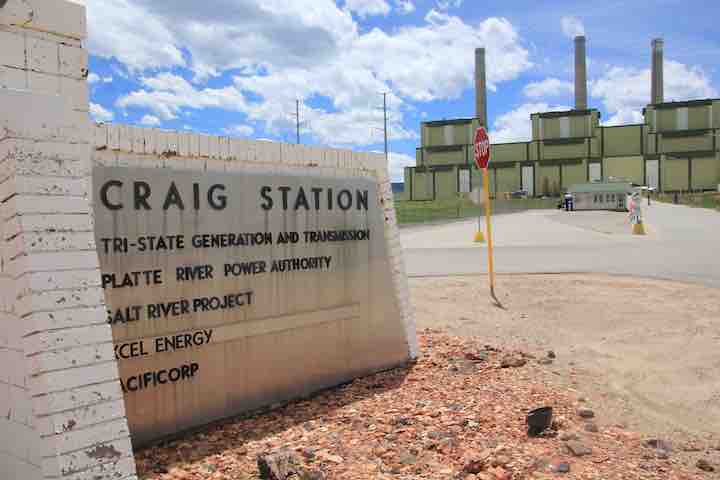
Craig station. Photo credit: Allen Best/Big Pivots
Click the link to read the article on the Big Pivots website (Allen Best):
July 9, 2024
Colorado legislators said coal communities should be helped in the energy transition. This agreement with Craig and Moffat County provides a picture of what that looks like in practice.
No other place in Colorado may be so dependent upon one company, one industry, as Craig and Moffat County.
Snow matters greatly to Aspen and Vail and the other ski towns who are linked at the hip, sometimes uncomfortably, with the big ski companies who sell the thrill of sliding downhill. But summer tourism, less dependent on uphill conveyance, has been coming on for decades. In Crested Butte, summer surpassed winter in the 1990s. Second-home development itself is a major economic sector, skiing just one of the amenities. Sales tax figures between a good snow year and a bad year vary relatively little.
In Craig, the mining and burning of coal has delivered the community a paycheck for nearly a half-century. The coal plant and the two primary coal mines that deliver fuel to the plant generate 43% of the total property taxes paid to Moffat County and various school, fire, and other districts this year. The 437 jobs in this smaller community that are being lost are, according to one analysis, the equivalent of 141,000 jobs in metropolitan Denver-Aurora.
Now, with the last coal-burning units to close down by 2028, a settlement agreement has been reached that some call a landmark. Tri-State Generation and Transmission Association, the operator and primary owner of the three coal-burning units at Craig Generation Station and Colowyo, one of the two coal mines that supply it, has agreed to pay the local community up to $73 million in payments beginning in 2026.
In addition, Tri-State has also agreed to give Moffat County augmentation water rights with a value estimated by Moffat County at $2 million to $3 million.
This agreement has been submitted to the Colorado Public Utilities Commission which can amend it, even reject it. If the past is precedent, the PUC commissioners are likely to approve it with little change.
Local officials involved in the negotiating say that it won’t make their community economically whole, but it will help them as they try to figure out how to rebuild their economy. One hope is that a revitalized rail service authorized by state legislators this year from Denver to Craig may interest manufacturers or create a stronger, safer connection to the Steamboat resort economy. Others have suggested that expanding tourism amenities can soften the departure of coal; others stoutly reject the idea of becoming “sheet changers.”
The Tri-State settlement agreement also applies to the broader electric resource plan being reviewed by the PUC. It has several major provisions:
Addition of 940 megawatts of renewable generation and 310 megawatts of battery storage to its generating capacity in its territory.
Retirement of Craig Unit 3, previously scheduled for 2030, by Jan. 1, 2028.
Solicitation of 290 megawatts of dispatchable combined-cycle gas plant, with first preference in Moffat County but somewhere in western Colorado or southwestern Wyoming if the bids for a Craig-area plant aren’t competitive.
Retirement of a coal-burning unit in eastern Arizona called Springerville 3 that was commissioned in 2006. That unit is to be closed by September 15, 2031, leaving Tri-State with ownership in just one coal-burning unit at the Laramie River Station in Wyoming.
Tri-State expects to achieve an 89% reduction in greenhouse gas emissions by 2030 as compared to 2005 levels.
Important in Tri-State’s pivot from coal in Colorado and Arizona is whether Tri-State gets federal aid. The Inflation Reduction Act of 2022 carved out $9.7 billion to assist electrical providers in rural America with stranded assets. Individual G&Ts can apply for up to 10% of the total amount in the New ERA program. That means that Tri-State may have applied for up to $970 million. Tri-State has not disclosed publicly how much it has applied for. The agreement, however, is not dependent upon whether Tri-State gets federal money. It will be needed, though, given the existing debt on the coal infrastructure.
Matt Gearhart, an attorney representing the Sierra Club in the proceeding, noted the importance of the New ERA funding in allowing utilities to think about retiring even relatively new coal-fired plants. Springerville came on line in 2006.
He also noted that the major natural gas plant in Craig is not a given. Whether that makes sense beyond providing local tax base and jobs is a discussion for a later day…
The settlement agreement can be found in the PUC files; it’s proceeding number 23A-0585E.
The three units of Craig Station were constructed from 1974 to 1984. Photo credit: Allen Best/Big Pivots
Coal is abundant in northwest Colorado. That’s why Public Service Co., now a subsidiary of Xcel Energy, in the 1960s built a coal plant near Hayden, 15 miles to the east of Craig and far distant from most of the utility’s consumers in metro Denver and elsewhere in the state.
Construction of the coal-burning units at Craig were started in 1974, a time when demand for electricity was soaring and utilities had learned how to build ever-bigger coal plants. Coal-plant construction was also induced by the expectation that oil shale in the nearby Piceance Basin would drive demand for greater amounts of electricity. That demand did not materialize, and in the late 1980s the utility, Colorado Ute, was forced into bankruptcy. Tri-State and other utilities picked up the pieces.
Tri-State owns the third unit outright but is a minority owner in the first two units. Other owners are Arizona-based Salt River Project (29%), the Oregon-based PacifiCorp (19.28%), Fort Collins-based Platte River Power Authority (18%), and Public Service Co., a.k.a. Xcel Energy (9.2%).
In 1979, during the construction years, I was in Craig briefly to work on local newspapers but returned rarely until 2015.
New EPA regulations governing pollutants had dampened the prospects of coal. WildEarth Guardians had launched an anti-coal campaign. Among its supporters was New Belgium, the brewery in Fort Collins.
I arrived on a September Sunday to conduct interviews. Later, out of curiosity, I wandered into a liquor store just before a Denver Broncos game. Beer was moving by the case, but none were Fat Tire or other New Belgium brews. They had become brews non grata in Craig, a place where coal was akin to religion.
In September 2015, Craig was feeling under siege as enforcement of federal regulations began drawing a smaller circle around emissions from the three coal-fired electrical generating units. Photo/Allen Best
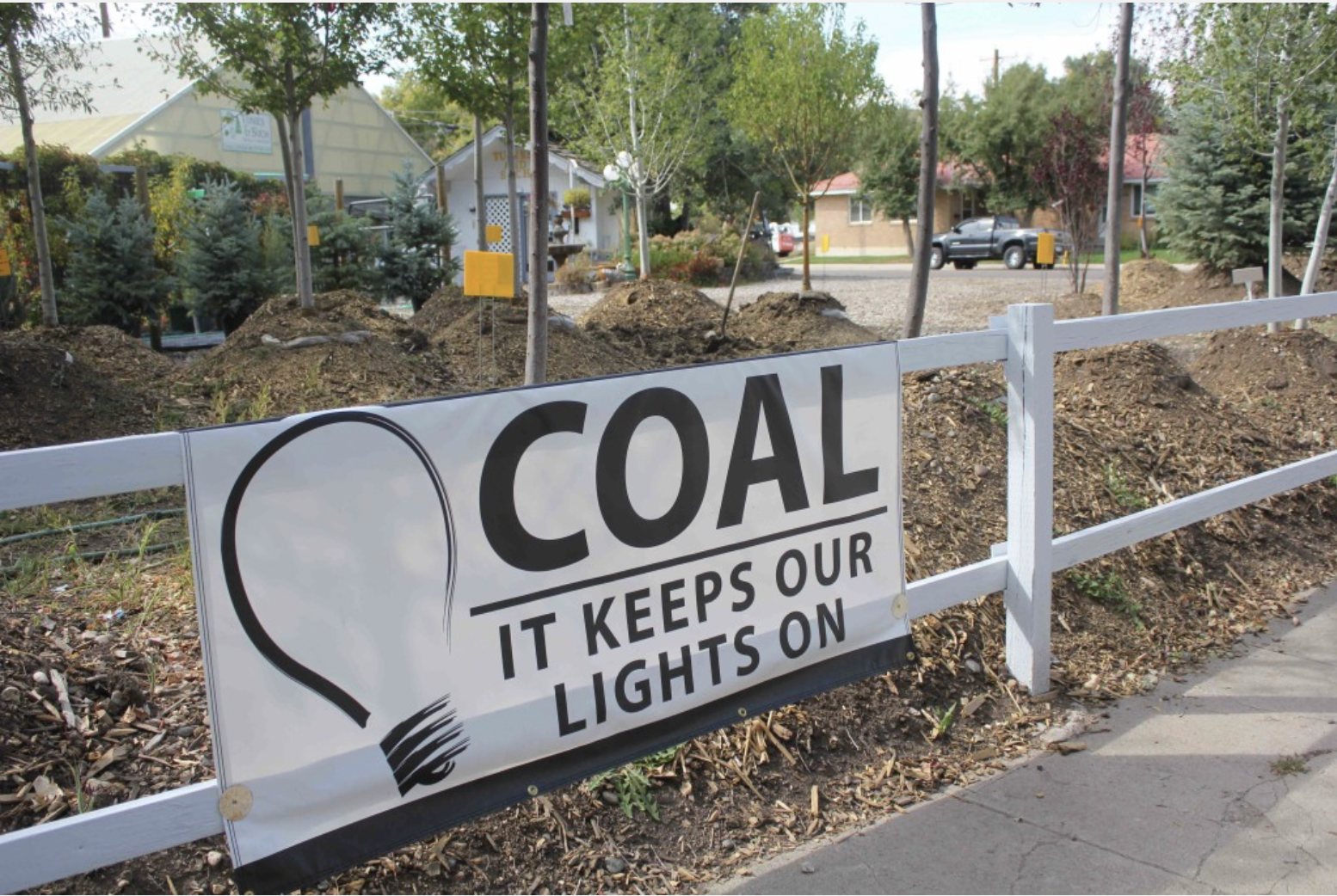
But while locals virtuously posted signs that said “Coal: It Keeps Our Lights On,” renewables were increasingly doing so, too, and with rapidly declining prices.
In April 2018, Tri-State brought on board a new chief executive, Duane Highley, with a clear mission to begin the pivot. In January 2020, in a ceremony at the Colorado Capitol, Highley announced that Tri-State planned to shut down the last of the coal units at Craig by 2030.
If the writing had been on the wall, there was still disbelief among many. That was evident in a March 2020 session at the high school in Craig. Anger was evident in remarks made to state representatives, but the more common thread was disbelief. What would replace the jobs, the tax base? And why was this necessary?
Among those listening that night and in a session the following day at Northwest Colorado Community College was Wade Buchanan. That week he had started as the first administrator of Colorado’s new Office of Just Transition. The department had been created by state legislators the previous spring. At that time, he had no staff and not much budget.
While adopting sweeping legislation to accelerate Colorado’s response to climate change, state legislators in 2019 had made it clear that coal-dependent communities were to be given a helping hand as Colorado made the necessary pivot from coal because of the climate and health impacts of burning coal.
The just transition law, HB19-13140, said this: “Colorado must ensure that the clean energy economy fulfills a moral commitment to assist the workers and communities that have powered Colorado for generations, as well as the disproportionately impacted communities who have borne the costs of coal power pollution for decades, and to thereby support a just and inclusive transition.”
What exactly that means in practice for Craig, though, was not spelled out. Other legislation more precisely laid out the expectations of Xcel Energy for its remaining coal communities. Legislators clearly thought that Xcel Energy, the state’s largest utility, and its customers needed to help out the Pueblo and Hayden communities, where coal plants will be retired, and at Brush, where the coal plant will be converted to burn natural gas.
Tri-State, if the state’s second largest electrical generator, has a different business model. It’s an electrical cooperative that was formed by its member cooperatives to deliver power. It has no overt profit motive.
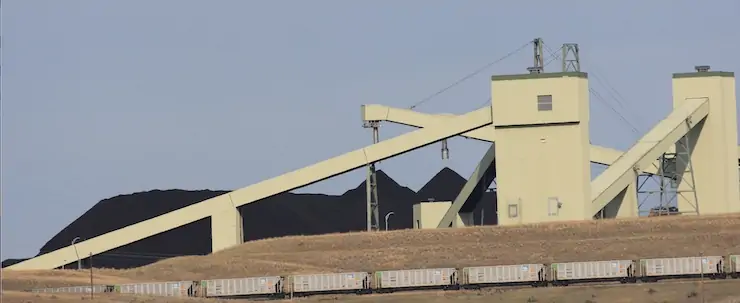
Coal for the Craig units comes principally from two coal mines in Moffat County. Photo credit: Allen Best/Big Pivots
Tri-State insisted, even days prior to the settlement agreement, that it was not required by state law to submit a community assistance plan or a workforce transition plan. It further pointed out that, unlike Xcel Energy, its member cooperatives “serve some of the most economically disadvantaged rural consumers in the West, many of whom reside outside of Colorado.” Indeed, Tri-State has members in four states, including Arizona, Wyoming and Nebraska.
However, even in 2022, Tri-State had agreed in a prior settlement to participate in planning that would provide community assistance.
Discussions about what that would look like became more vigorously discussed in monthly meetings facilitated by the Great Plains Institute that were held in Craig beginning in June 2023.
Tri-State’s first proposal was for community improvement projects, such as a new swimming pool.
Craig Mayor Craig Nichols says that after considering the offer, the local leaders quickly decided that wasn’t the best option.
“Once they closed the local plants and were gone, how would we continue to pay for those things?” says Nichols. “So we switched our No. 1 priority to the payments into a perpetual trust for the community.”
Joseph Pereira, the deputy director of the Office of Utility Consumer Advocate, the state agency charged with looking after the interests of consumers in utility matters, entered key arguments.
“This is an issue of fundamental fairness,” said Pereira in a May filing. “It would be fundamentally unfair to treat coal communities differently dependent upon what type of utility (investor owned or cooperative) generated energy. Moreover, it is difficult to conceive the intent of the legislature was to ensure a community like Pueblo, served by PSCo (Xcel), should be provided community assistance, but Craig is left to fend for itself.”
Buchanan, in his filing on behalf of the Office of Just Transition, painted a dark picture.
“Craig and Moffat County face a near-existential threat by the end of this decade. When a handful of entities that generate 43% of the property taxes in a community go out of business at the same time, it signals the potential for a broad, deep, and long-lasting – perhaps even permanent – decline in economic activity and opportunities from which no community can quickly or easily recover.”
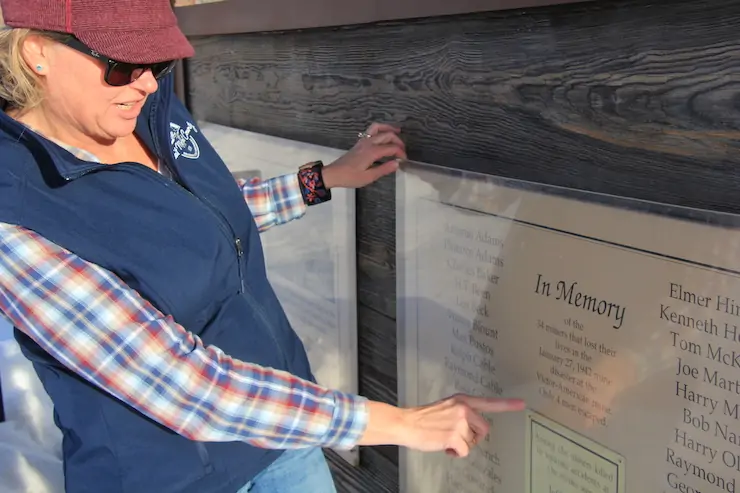
Jennifer Holloway, the executive director of the Craig & Moffat County Chamber of Commerce, points to a memorial at the one-time mining coal mining camp of Mt. Harris where her grandfather lost his life in 1942. Mt. Harris lies about 25 miles east of Craig. Mining no longer occurs there. Photo credit: Allen Best/Big Pivots
In his testimony, Buchanan compared Craig and Moffat County with other places in Colorado. The property tax hit is probably twice that of local jurisdictions where the Comanche and Pawnee coal plants are located in Pueblo and Morgan counties, and 2.9 times that of the coal plant at Hayden, in Routt County.
The job loss was also outsized compared to the other locations: 5.1 times the percentage loss in nearby Routt County, 16.8 times the expected percentage loss in Morgan County and 33.7 times the expected percentage loss in Pueblo County.
“Those three will also warrant sizable community and worker assistance commitments by Xcel Energy, the primary owner and operator of the coal plants,” Buchanan said in his testimony. “But none of the impacts in these counties will come close to those faced by Moffat County.”
Since it created the Office of Just Transition with a skimpy budget, legislators have allocated $35 million to the office and its efforts. Buchanan estimated that more than $17 million of that money will be awarded to Yampa Valley communities, mostly in Craig and Moffat County, in grants or to assist in what are called pre-closure strategies for potentially dislocated workers and their families. Somebody with the very unusual job description of “transition navigator” has been hired to help workers figure out their futures.
One grant of $40,000 went to Moffat County and Craig to develop infrastructure in the Yampa River to attract outdoor-based tourism.
Another $150,000 was given Moffat County to fund a socio-economic study to assess the impacts of a proposed pumped-storage hydro power project that could create 300 construction jobs and 30 high-paying permanent jobs — and also generate property tax.
Still another grant of $50,000 was given to help Moffat County retain independent legal counsel. In PUC proceedings, Denver and Boulder routinely enter filings in cases they deem important to their interests. Pueblo does, too. But this was something of foreign terrain for the northwest Colorado communities.
The settlement “is a big deal,” said Buchanan when I talked with him after the settlement agreement had been filed. He identified what he saw as several key elements.
One, he and his staff found their footing. “We realized that from the state’s perspective, that if we were going to do our job, we first and foremost had to be an effective partner with the affected communities. No coming and telling them what to do or how to do it or that we had the answers for the challenges they were facing,” he said.
The message was that “we are here to stand with you in this transition.“
That’s why the money was allocated for an outside attorney, to give the local communities an opportunity to have a voice.
The Office of Just Transition plans to make the same offer for Hayden and Routt County, he said.
Part of it was the stakeholder process facilitated by the Great Plains Institute.
A second key element was that Tri-State, despite its legal protestations of exemption from requirements, decided to step up. “The commitment they made in that settlement agreement is pretty significant.” It will “greatly empower the communities to have the resources to drive their own transition in the future.”
Third is that these communities have evolved in their thinking. The transition remains a huge challenge, and for the most part, “they don’t like the idea” of making this change. But they have “resolved to do what they can to take control of the transition they are a part of. That’s a very important thing.”
In summary, “we found our footing about how to do our work, Tri-State stepped up to the plate, and Craig and Moffat County found their voice in the process.”
Buchanan recommended that the PUC require Tri-State to provide $118 million in community assistance. How should the settlement of $73 million be seen? One individual involved in the case, talking only for background, said that it reflects the normal negotiating process. You ask for high and accept something less.
Nichols, the mayor of the city of 9,000 people, praised Tri-State for doing “more than they had to do. They had to do nothing. It really set the bar for future transitions.”
“This shows what the actual cost of decarbonization looks like,” he added.
Randy Looper, now a city council member, at the Elk Run Inn that he operated in 2020. Photo credit: Allen Best/Big Pivots
Randy Looper, a city council member and retired hotelier, said he doesn’t expect overnight transformation but he expects Craig can achieve a more diversified economy.
Looper especially likes the structure of the aid. Moffat County and Craig are to get $22 million in direct payments from 2026 to 2029. The money is to be used at their discretion.
From 2028 to 2038, Tri-State has agreed to provide up to $48 million more. But the agreement also specifies that this can be reduced if Tri-State reinvests in Craig and Moffat County. If Tri-State builds a natural gas plant that pays $2 million in property taxes, that can be deducted from the $7 million that Tri-State would ordinarily pay the city and county.
“They have incentive to build new things in Moffat County,” Looper said. “It’s a win-win for Craig and Moffat County.”
I met Looper maybe 10 years ago on a visit to Craig. He himself had left a job in banking in downtown Denver many years before, first to run a motel in Iowa until, becoming weary of the muggy summers, relocated to Craig. The older motel that they operated in Craig was wonderfully esoteric. His wife had advised wildlife themes for each room, and this went far beyond hanging photos or other art. Even toilet fixtures managed to have that unit’s theme. I stayed in the sheep, elk, and antelope rooms– and many more — but not the rattlesnake room. I wouldn’t have slept well.
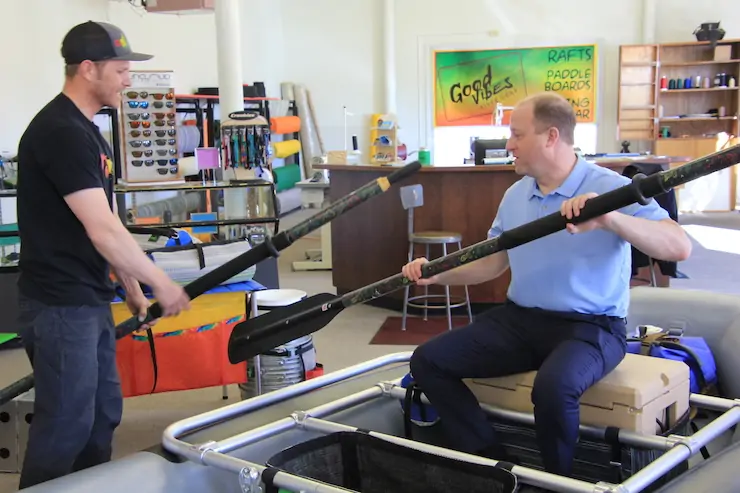
In March 2020 I was there for the mildly stormy meeting at the high school. Two days later, Gov. Jared Polis arrived in Craig and toured a boating store. It was just Polis and the two store owners – and me. That afternoon, he was at the Hayden Town Hall to hear testimony. Sometime that afternoon, word was sent out that Colorado had its first confirmed case of Covid-19.
That summer, instead of sinking real estate prices, Craig’s market actually gained. People were ready to leave behind the cities, whether in Colorado or Utah or wherever, for more rural living, if they could. Today, Craig hasn’t gained population, but neither has it lost any, said Looper. That has occurred even as the employment at the coal plant has dropped significantly, from about 300 to about 110.
Colorado Gov. Jared Polis stopped by a store in Craig devoted to boating gear prior to a meeting about coal closures in early March 2020. Photo credit: Allen Best/Big Pivots
The larger question is what exactly does this agreement represent and how may it influence other cases in Colorado? Xcel even now is readying an application for a just transition electric resource plan that will speak to how it can help Pueblo, Hayden, and Morgan County as the coal plants close or, in the case of the latter, get converted to natural gas. The application is due Aug. 1.
No doubt, this settlement agreement will in some way influence the other cases in Colorado. How could it not.? (And to be fair, some of Xcel’s agreements to Pueblo influenced this settlement).
“I don’t want to speculate about how this one will inform other commitments, but I’m pretty sure it will,” Buchanan told me.
A still larger question is how do we see this component of just transition in the broader conversation of this energy transition?
The coal communities thought they were doing good, meaningful work — and work that happened to pay well. Not like the high-tech jobs in Boulder or Denver, but good enough for a solid living. Craig is not a place of extremes in wealth. It’s solidly working class, middle class. Big pickups, sure, but not enormous houses.
Inevitably, when your job is digging and burning coal, your identity gets tied up in those duties. Then, to be told that what you’re doing is somehow wrong? That would be hard to reconcile.
True, even in the 1950s and 1960s, we had very strong, very firm evidence that putting carbon dioxide into the atmosphere was a very risky endeavor. A book I recently read, “Fire Weather: A True Story from a Hotter World,” makes that even more clear than I had previously understood. But as a society, we had not made that decision.
In the absence of other technologies, electricity generated by combustion of coal made our lives easier.
Now, at least in Colorado, and to a large degree in the United States and the world, we have concluded we must change directions. How, as the legislators put it, do we achieve a just transition, not leaving the coal communities behind?
Buchanan, in his filings and in our conversation, repeatedly emphasized the enormity of change for fossil fuel communities. “They served our economy well, and now they are being asked to do something that is extraordinarily difficult and potentially quite painful.”
What Colorado is trying to do is make this transition a little less painful. Pereira, at the Office of Utility Consumer Advocate, emphasized the social contract between energy communities and the broader society.
“If you create bogeymen out of communities, you’re undercutting the ultimate goal you are trying to achieve. We are not trying to decarbonize for the sake of climate. We are trying to decarbonize for social reasons, so we have a better place to live. If you are not including the social aspect of taking care of the communities, you are undercutting your overall goals.”
Downtown Craig has freshened up but has lost business to the chain retailers on the city’s edge. Photo credit: Allen Best/Big Pivots
This particular case was more difficult because there was no defined policy solution in regulations.
“The Legislature defined what it wanted for investor-owned utilities. This was unique because it required purely novel arguments. So there was new advocacy by our office, these novel arguments, to come to a position that worked for them.”
To get there required strong community advocacy, which Craig and Moffat County delivered.
The result was a very rare outcome over public policy. It was not a matter of somebody wins, somebody loses. “You know how rare that is in policy making?” he said.
How much of this applies to Pueblo? There, an advocacy group aligned with Xcel has made the case that Xcel should build a nuclear power plant to replace the lost jobs and revenue from Comanche Generating Station. That argument is hard to accept divorced from the reality of the current cost of nuclear technology. We’ll see where this lands.
As the mayor of Craig mentioned, there is a cost to the decarbonization. True, renewables are coming in cheaper, but there is a cost. Every utility manager recites “cost and reliability” morning, noon, and night. So what do we make of the cost here? Tri-State will spread its costs among its members, as will Xcel among its customers.
Among the parties to the settlement agreement was a member cooperative based in Holyoke called Highline Electric. Dennis Herman, the general manager, did not speak to the assistance to Craig and Moffat County, but he did testify in a press release that Tri-State’s plans will add significant renewable resources while demonstrating how to deliver reliable power to its members, even in extreme events.
Less than 20 years ago I traveled to Holyoke for a story about why the farmers there supported another Tri-State coal plant in Kansas. There, in the land of center pivots, they’ve made a big pivot in their thinking, as has Tri-State altogether and Colorado altogether.
Writing about weather in the climate crisis-era is like navigating an obstacle course littered with critics. One faction chides me if I write about insane rainstorms and flash flooding without attributing them to human-caused climate change; another blasts me for bringing up climate change too often, whether it’s to explain an especially active avalanche cycle or a long-term drought. Even the spate of “billion-dollar disasters” in recent years could be blamed on climate change, sure, but also on more development and humanity in the path of those disasters.
Quite often those critics are the voices in my own head. Part of this is due to my hankering to learn the history of a place, particularly southwestern Colorado. Every time there’s an “unprecedented” drought or flood, I can look back into my mental archives and find an example of an equally severe one. There was the huge snow year of 1932, when the Durango-to-Silverton train was blockaded for 90 days straight; the great floods of 1911, 1884, 1927, and 1970, which wreaked havoc along the region’s streams and rivers; the dismally dry and warm winter of 1878-79 that preceded the Lime Creek Burn; and the grainy 1918 photo of a water-wagon doing dust control on Silverton’s streets — in January.
Weather is and always has been wacky, with or without human-caused climate change. So I’m always careful before saying some meteorological event is “unprecedented.”
But this heat? Damn. It sure does look unprecedented — if the temperature alone isn’t shattering records, the duration of the heat waves are.
A better term than climate change is climate heating, because that’s exactly what’s happening: The planet is heating up as a result of Industrial (and Information) Age humans spewing oodles of greenhouse gases into the atmosphere. And while it may be difficult to find climate change’s figurative fingerprints on every incidence of severe weather, its coal-smudged paw-prints appear to be all over the longer and more severe spells of extreme heat we’ve been perspiring through in recent years. No, every record-breaking high temperature cannot be attributed unequivocally to climate change, but climate change does make these events far more likely to occur.
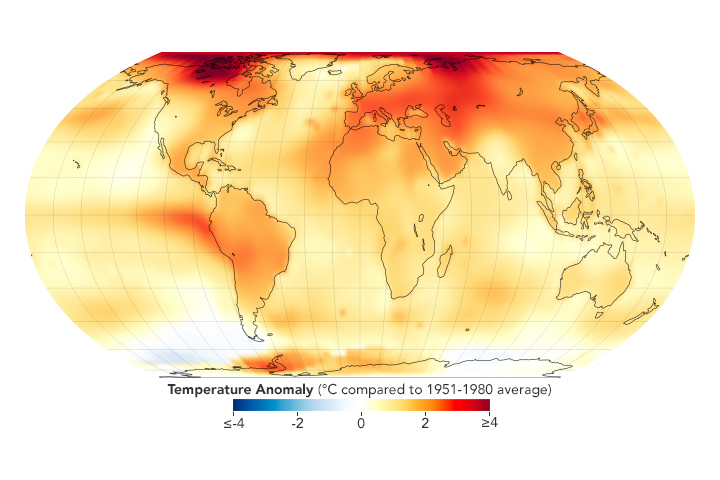
Last year was the warmest year on our planet since global record-keeping began in 1850, clocking in at 2.12 degrees Fahrenheit warmer than the 20th century average of 57° F. And guess what? This year will likely be even hotter: This June was the hottest June on record, globally, and the 13th consecutive monthly high temperature record. Eeek.
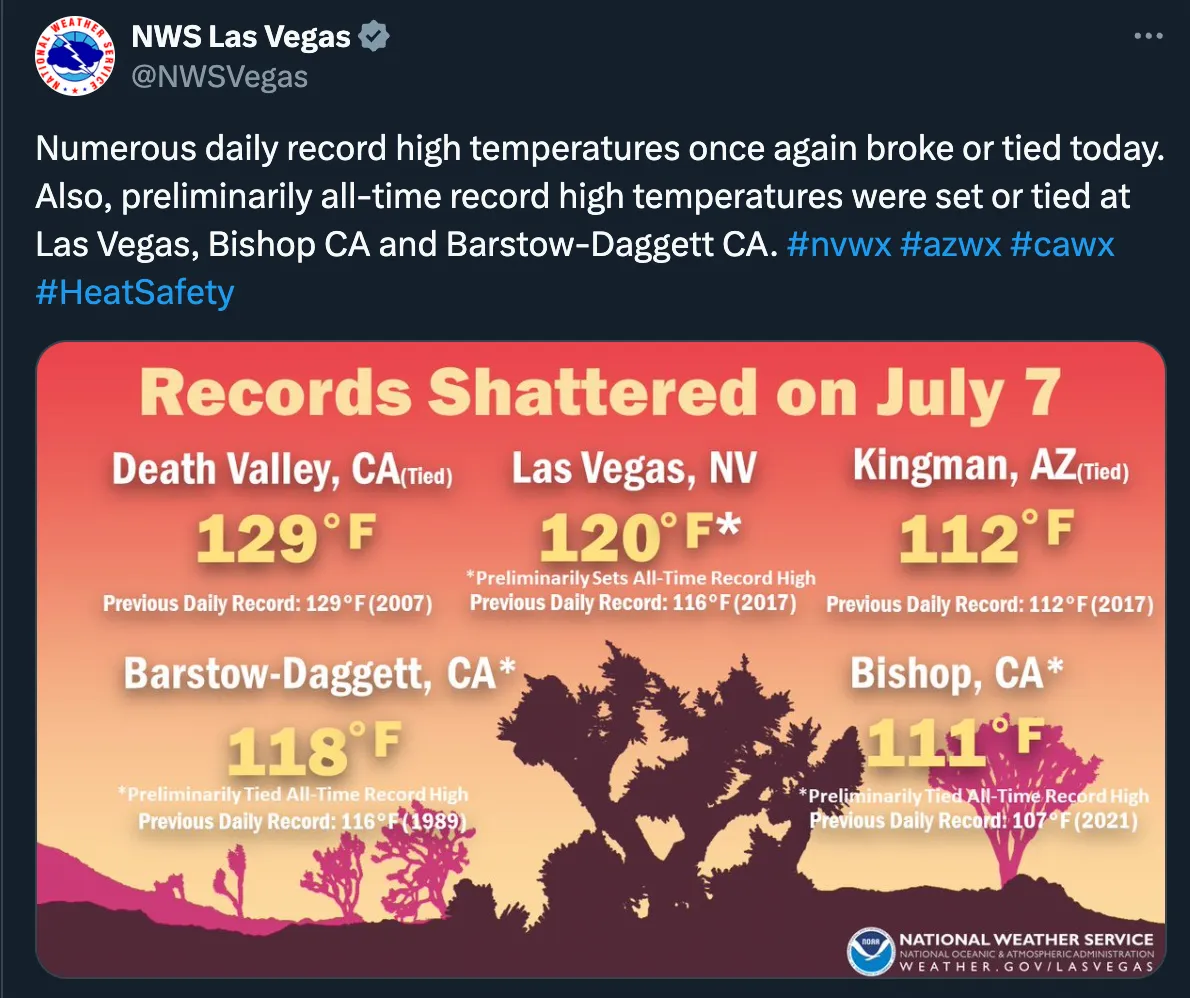
So, when the mercury in Las Vegas tops out at 120 degrees F and shatters the previous record of 117° F, as occurred last week, I think it’s not a stretch to attribute this specific weather wackiness to the warming climate (with a helping hand from the urban heat island effect, of course). And when this sort of heat stretches across a good portion of the West, follows record-setting, flash-flooding rainfall by a few weeks, and coincides with a hurricane ripping through the Carribean, well, it’s probably safe to assume that it’s all connected, via a warming climate. It is not safe, however, to go outside.
So, with that out of the way, here’s a rundown of some of the wackiness of late:
Phoenix just endured its hottest June on record, with an average monthly temperature of 97°F, or nearly six degrees above the 1990-2020 normal. So far this summer the daily high temperature has reached 110° F or warmer on 21 occasions, and 118° F on two days; the city has received just .02 inches of precipitation since April 2. Maricopa County officials have confirmed heat caused or contributed to 13 deaths so far this year, with another 162 fatalities under investigation. That’s significantly more than last year at this time.
Dozens of monthly maximum high temperature records were broken across the West in June and early July, especially along the West Coast, where the mercury was — and still is — reaching the triple digits day after day. Oregon officials suspect five deaths in the western part of the state in recent days are heat-related.
A new daily record was set in Death Valley, at 129 F. A motorcyclist touring through the national park died of heat exposure.
Sixteen locations in the West set monthly precipitation records in June, including:
Hovenweep National Monument, with 1.05 inches on June 28;
Arches National Park, 1.58” on June 28;
Panguitch, Utah, 1.50” on June 26;
Quemazon, New Mexico, 5.50” on June 21;
Arivaca, Arizona, 2.25” on June 24;
Ely, Nevada, 1.58” on June 26;
Mormon Mountain, Arizona, 2.30” on June 27.
Major wildfires are burning across the West. Before I get into the details, do spare a thought for the thousands of people fighting these fires. Not only do the flames and smoke threaten their health and lives, but so does the brutal heat. This is a sampling of some of the new starts (stats as of early a.m. July 9):
Silver King in Piute County, Utah, at 10,026 acres, 0% containment;
Deer Springs in Kane County, Utah, (north-northeast of Kanab) at 11,000 acres, 0% containment;
Fisher in Socorro County, New Mexico, at 2,500 acres, 1% containment;
Lake in Santa Barbara County, California, at 21,763 acres, 8% containment;
Shelly in Siskiyou County, California, at 4,203 acres, 0% containment (this one is likely to burn a “carbon offset” forest, where corporations pay the owner to not chop down trees so they can continue polluting). Whoops.;
Salt Creek Rd in Jackson County, Oregon, 1,700 acres, 2% containment;
North in Modoc County, California, 4,380 acres, 50% containment;
Thompson in Butte County, California, which is 100% contained after burning 3,789 acres. I include it here because it forced the shutdown of transmission lines, taking the Oroville Dam hydropower plant offline and depriving the California grid of valuable energy when it needs it to keep air-conditioners running. It’s yet another example of how extreme weather can strain the power grid.
It’s difficult to see how this is sustainable. Consider for a moment the misery the more than 9,000 unhoused people in Phoenix must be experiencing each and every day this summer. Many of them live on the streets and sidewalks, literally, where the concrete and asphalt can reach 160° F or more, hot enough to cause severe burns. Poorly insulated housing without cooling can be nearly as bad. Public cooling centers provide refuge, of course, but are there enough?
Sure, if you can afford it, you can hunker down in your home and crank up the air-conditioner and simply wait out the heat. But you could be waiting for quite some time these days; meanwhile, the growing fleet of air-conditioners will strain the grid, increasing the risk of a widespread power outage, which literally could be deadly in this heat.
There is a limit to this sort of thing, and it seems as if we must be getting close to the point where some places simply become uninhabitable. But if we’ve already reached that point, a lot of folks aren’t aware of it: Maricopa County remains one of the fastest growing metros in the U.S. And during the 12 months from June 2023 through May 2024, 48,000 building permits were issued in the metro area for new, private housing structures — numbers not seen since the great housing bubble of a couple decades ago.
Surely the housing bubble will burst, as it has in the past, before too long. But what about the air-conditioning bubble? Can it really last forever?
🏠 Random Real Estate Room 🤑
Speaking of people moving to hostile environments, the Amangiri resort near Lake Powell (and the polygamist settlement of Big Water) is now selling lots to those who can afford it. But don’t worry! While homeowners can avail themselves of the resort amenities, they are separated from those low-brow folks (who are forking out up to $6,500 per night to stay there) by a big slab of sandstone — saving them from having to rub elbows with the Kardashians next to the pool under 100°+ heat. And it will only cost you between $5 million and $12 million. For the lot, that is. Gross.
Follow Up
Remember my diatribe from a couple weeks ago about data centers’ excessive power use? Well, the pitfalls of all of that are playing out as I write this. Arizona Public Service, the state’s biggest utility, predicts its customers collectively will set new electricity-demand records this year. And it’s not because of all those new folks moving in or the new homes being built — efficiency gains have actually led to a 5% decrease in overall residential power consumption. It’s thanks to those data centers, of which there are 79 in the state (71 in Phoenix, seven in Tucson, and one in Nogales). It’s all fine and good until the grid crashes on a 118° F day.
This term, the court’s conservative supermajority handed down several rulings that chip away at the power of many federal agencies. But the environmental agency has been under particular fire, the result of a series of cases brought since 2022 by conservative activists who say that E.P.A. regulations have driven up costs for industries ranging from electric utilities to home building. Those arguments have resonated among justices skeptical of government regulation. On Friday [June 28, 2024], the court ended the use of what is known as the Chevron doctrine, a cornerstone of administrative law for 40 years that said that courts should defer to government agencies to interpret unclear laws. That decision threatens the authority of many federal agencies to regulate the environment and also health care, workplace safety, telecommunications, the financial sector and more…
But more remarkable have been several decisions by the court to intervene to stop environmental regulations before they were decided by lower courts or even before they were implemented by the executive branch. On Thursday, the court said the E.P.A. could not limit smokestack pollution that blows across state borders under a measure known as the “good neighbor rule.” In that case, the court took the surprising step of weighing in while litigation was still pending at the United States Court of Appeals for the District of Columbia Circuit.
Iron Fen. Photo credit from report “A Preliminary Evaluation of Seasonal Water Levels Necessary to Sustain Mount Emmons Fen: Grand Mesa, Uncompahgre and Gunnison National Forests,” David J. Cooper, Ph.D, December 2003.
The court also acted in an unusually preliminary fashion last year when it struck down a proposed E.P.A. rule known as Waters of the United States that was designed to protect millions of acres of wetlands from pollution, acting before the regulation had even been made final…Similarly, in a 2022 challenge to an E.P.A. climate proposal known as the Clean Power Plan, the court sharply limited the agency’s ability to regulate greenhouse gas emissions from power plants, even though that rule had not yet taken effect.
That kind of intervention has little in the way of precedent. Usually, the Supreme Court is the last venue to hear a case, after arguments have been made and opinions have been rendered by lower courts…Collectively, those decisions now endanger not only many existing environmental rules, but may prevent future administrations from writing new ones, experts say…
Comanche Generating Station. Photo credit: Allen Best/Big Pivots
Click the link to read the article on the Big Pivots website (Allen Best):
June 26, 2024
In one sense, Adam Frisch was an anomaly on the agenda of an energy conference held in Pueblo last Friday. He’s a Democrat, making a second run for Congress after narrowly losing in 2022 to Lauren Boebert in Colorado’s Republican-leaning 3rd Congressional District. The district’s largest city, Pueblo, once was reliably Democratic but has become a political toss-up.
Republican legislators, both current and former, were present at the conference, but I didn’t notice any Democratic legislators, even from Pueblo. Why that is, it’s hard to say.
Credit Frisch with knowing how to play to his crowd. He tipped his hat to natural gas several times even as he talked about how geothermal would use much the same skills sets and machinery.
He talked extensively about domestic energy mining and energy production. “There’s no green energy without mining, just none,” he said. He suggested that even now, burning wood may produce more energy than solar – although he did acknowledge Colorado has far more solar capacity than the national average. He took swipes at the “Colorado Capitol,” a reference to the Democrats who have run the show since the 2018 election and who have passed dozens of bills with the intent of pushing and pulling Colorado into a giant pivot that will dramatically reduce greenhouse gas emissions.
For the conference on the Pueblo campus of Colorado State University, Frisch dressed in a style that suggested allegiance to his party: blue jeans, blue shirt and blue sports jacket. But he has some tip-toeing to do in this Congressional district. He’s an Aspen resident, a member of the city council when that city’s municipal utility, Aspen Electric, succeeded in achieving 100% renewables. And Frisch by no means disavows climate change.
“Whether I’m in Durango or Boulder or up in Rangely, Colorado, I would say the same thing, that there is a climate crisis,” he said at the outset of his remarks in the conference’s opening session. “It’s hotter and drier. Everybody knows this. People are planting at different times, they’re harvesting at different times, they’re hunting at different times. But we need to figure out if we truly want to try to solve this problem.”
When running as an “outsider,” it’s useful to point to perceived hypocrisies among the elites. In Colorado, the prime candidate is Boulder.
“I need to poke fun a little bit at my former zip code, because in 2019 Boulder County, of the 3,147 counties in the country, (had) on a per-capita basis the most greenhouse gas emissions per person in the country.”
Congressional candidate Adam Frisch explains why generation will be important. Photo/Allen Best
True? Well, not really. It wasn’t Boulder County but one zip code within the county that spawned many stories in 2020. And it wasn’t total greenhouse gas emissions per capita, but only those provoked by buildings. For that matter, the University of Michigan researchers reported that were able to include only two-thirds of the nation’s counties in the study.
With those caveats in mind, they did find that the buildings in zip code 80510 produced 23,811 pounds of carbon dioxide per person. That zip code is in and around Allenspark, along the road between Boulder and Estes Park. It’s a place of knotty-pined cabins that burn a lot of propane gas as well as newer and some very large homes that likely use electricity.
The methodology of the researchers also examined the sources of electricity, and by that measure the heavy coal in the electrical mix bumped the figures higher. That area is served by a member cooperative of Tri-State Generation and Transmission or Xcel Energy, and in 2019 both were still very heavily invested in coal — including coal burned at Pueblo.
One other detail: that same study found that a zip code in San Francisco, the bastion of woke politics, actually had the nation’s lowest per-capita greenhouse gas emissions for buildings.
Details, details, details
That was par for the day. Just as important as who was at this energy summit and the information they shared was who was not there and what was not said.
The event was sponsored by Action Colorado, formerly known as Colorado 22, a reference to the counties of southwestern Colorado and the San Luis Valley that are included. Think of it as patterned after the much older Club 20.
The morning agenda had various speakers, but most notable was a defense of natural gas in buildings. The afternoon was almost entirely about the promise of nuclear energy.
Interspersed through the day were speakers from the International Brotherhood of Electrical Workers, or IBEW. They told about their lives and about their work. They spoke very well, very effectively. I spent eight years in Toastmasters trying to smooth my tongue of rusted iron into moments of silver. These guys were like professionals as they talked about growing up on ranches, about the dangers of working with electricity, about building better lives for themselves and their families.
The background question for the day’s conversation was what will happen when the last of Pueblo’s three coal-burning units becomes quiet. One of the three coal-burning units at Comanche Generating Station has closed, another will in 2025, and the third is to become silent no later than Jan. 1, 2031, as per the decision by the Colorado Public Utilities Commission.
(In my message to Big Pivots subscribers of June 13, I vaguely and imprecisely referred to 2030. To add some confusion, Gov. Jared Polis last week said 2029.)
What will replace the tax base and jobs in Pueblo and Pueblo County?
President Joe Biden visited the CW Wind factory in Pueblo, the world’s largest manufacture of towers for wind turbines, in November 2023. Photo/Allen Best
Pueblo is a river town, bisected by the Arkansas River. It’s a transportation hub for both highways and rail. It is above all a place that makes things. I am sure it has Ph.D.s among its 111,000 residents, but it has blue-collar DNA. Work gloves could be the city’s logo.
The steel mill was first and maybe even now remains foremost, hulks of rust rising above I-25 even as a new mill is now taking shape. The mill began producing rail in 1882, and that’s still the primary product, if the lengths have been extended to quarter-mile sections. It was called CF&I when I was young, and although I have no personal memories, Pueblo was still a rich ethnic stew in the mid-20th century, a cauldron of immigrants who labored under a film of coal smoke. You don’t have to go far to find people whose fathers and grandfathers and perhaps great-grandfathers had walked to the mill, lunch buckets in hand, from their houses in the Bessemer and other close-by neighborhoods.
That includes the former mayor, Nick Gradisar, and the fellow I had lunch with at the conference, Joseph Griego. Gradisar, a former board chair for Action Colorado, the organization sponsoring this conference, had a vison of pivoting Pueblo to a green-energy economy. He was handily defeated in the election last year.
Some of that pivot, however, had already started before he even became mayor.
On Saturday morning, after the conference, I awoke in our motel room on Pueblo’s north side soon after daybreak and set out to get photographs. I drove south on I-25, pausing during shift change at the gates of the steel mill, which is now owned by EVRAZ North America. Based in London, majority ownership was held by Russian oligarchs, cronies of Putin, most notably Roman Abramovich, who alone owned between a quarter and a third of the company. Evraz said in 2022 after the Russian invasion of Ukraine that it would sell its North American assets, but nothing has come of that. As best I can tell, Putin cronies still have a stake in Pueblo.
Continuing south out of the city, I turned off from I-25 at the Stem Beach turnoff, then headed northeast on Lime Creek Road, putting Greenhorn Mountain in the rearview mirror.
Greenhorn was originally Cuerno Verde, the name given by Spanish colonizers to two leaders, the father and son, of a band of Comanches. They were known for their distinctive headdress.
The younger Cuerno Verde was killed there in 1779 by the Spanish troops led by Juan Batiste de Anza and their Apache, Ute and Pueblo allies. And with the Comanche weakened, the Great Plains in Colorado with their plentiful bison became more available to some other immigrants, the Cheyenne and Arapahoe.
The alignments of what became Colorado were, in the 18th century, as convoluted as they are in the 21st century, but the conflicts for the time being now draw only figurative blood. By that measure, these disagreements about the energy transition are mild indeed even if one former legislator at the Pueblo conference described the politics he left behind at the Colorado Capitol as “toxic.”
The Lime Creek Road constitutes Pueblo’s industrial alley. First in this sequence is the former wind turbine factory formerly owned by the Danish company Vesta but purchased in 2021 by CS Wind, a South Korean company. The factory produces towers that are 90 meters tall and weigh 240 tons. President Joe Biden was there last November to give a pep talk about the clean energy agenda.
A little farther along is a turnoff to another set of gray industrial buildings rising up from the plains, the GCC cement plant and limestone quarry, one of two remaining cement plants in Colorado with the recent closure of a plant at Lyons.
The day before, a speaker at the conference – in the morning, non-nuclear session — representing a company called Carbon America, had spoken about the hopes to sequester carbon dioxide under cap rock in a geologic formation northeast of Pueblo. Two potential partners exist in the Pueblo area, this one and another near Florence. They manufacture cement from lime.
Carbon America sees carbon dioxide created in this process –none of it through combustion — as being one market for carbon sequestration along with the almost pure stream of carbon dioxide being emitted by corn ethanol plants. The company’s office is about a mile from my own in suburban Denver.
As I continued north, the three giant smokestacks of Comanche 3 rose higher. Before I got there, though, I first saw the low-rising rows of solar panels, a virtual sea of them amid the cacti.
The first solar farm, located directly east of the coal plant, was developed by Eric Blank, who has now become the chair of the Colorado Public Utilities Commission. Then, in 2021, completion of a far larger array of solar panels was completed. This project, Bighorn, was on land owned by Evraz around Comanche Station. It can generate 300 megawatts of direct current or 240 megawatts of alternating current. Through the artifice of credits, the solar production allows the steel mill to proclaim it has solar-made steel. (It also matters that the plant works with recycled steel, which requires less heat).
Still heading toward Comanche, I drove under transmission lines. whether generated by solar or for by coal units. However electricity is generated, it must be transmitted to metro Denver and wherever else. Will a nuclear plant transmit electricity at Comanche sometime in the 2030s?
The Pueblo area has Colorado’s two remaining limestone quarries and cement kilns, including this one along Lime Creek Road. Photo/Allen Best
The tone for the conference was set by the panel that followed Adam Frisch.
The panel consisted of representatives of three of Colorado’s four privately-owned utilities that sell methane, the primary constituent in natural gas, to consumers for building heat and water cooling.
Curbing methane emissions from Colorado’s buildings may be Colorado’s most difficult nut to crack. We don’t swap out buildings the way we do cars or cell phones.
Ken Fogle is a marketing vice president for Atmos Energy, one of Colorado’s two regulated gas-only utilities, meaning that they don’t also sell electricity. Black Hills Energy does sell both electricity and gas, but not necessarily in the same place. It was represented by Tom Henley, the senior public affairs director. And there was Michael Sapp, the state public affairs director for Xcel Energy, with sells both gas and electricity, and in largely the same areas.
The Monday prior to the conference, the Colorado PUC commissioners had issued their formal 141-page decision about Xcel’s proposed clean heat plan. The PUC commissioners rejected a lot of Xcel’s ideas.
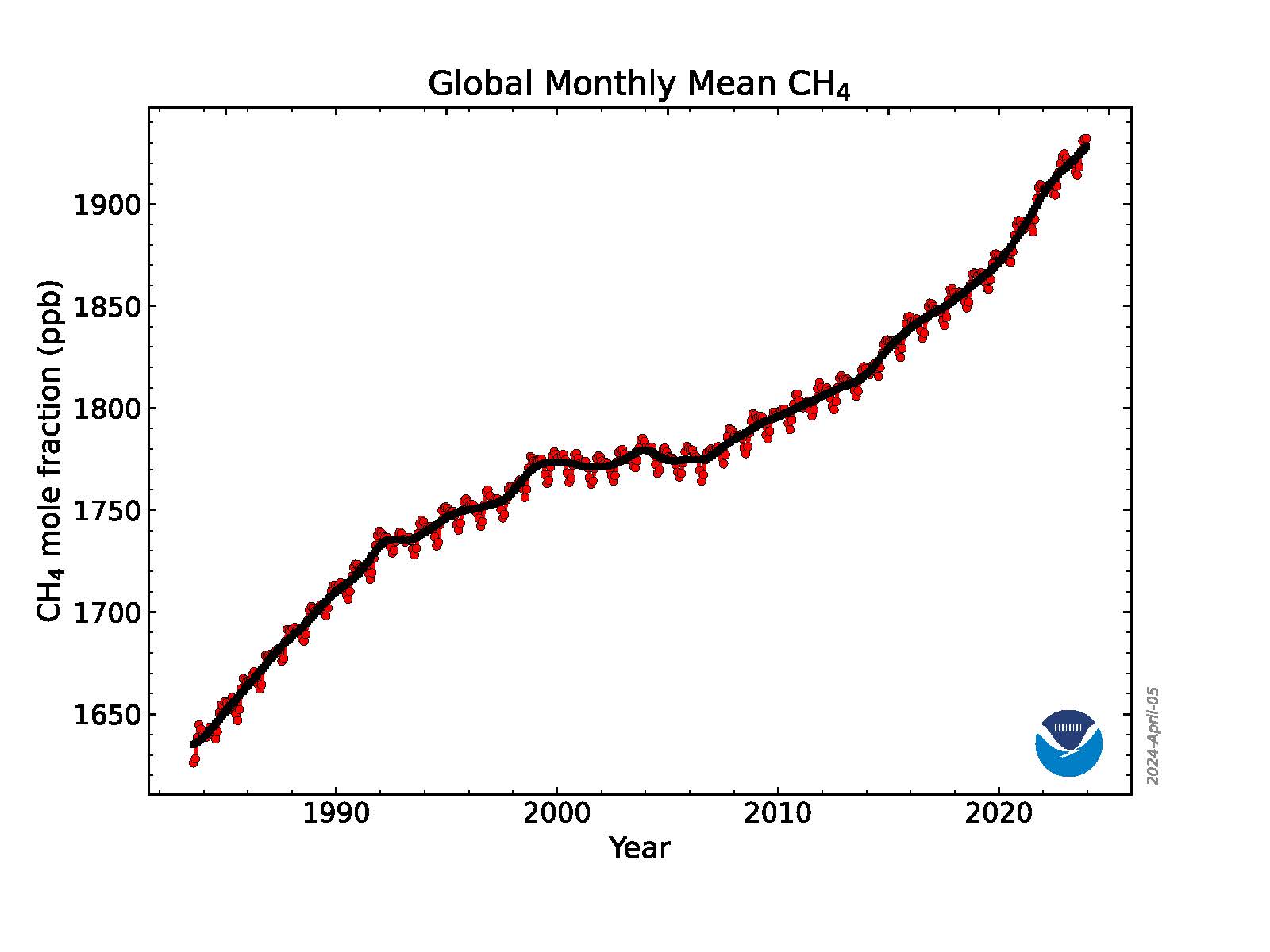
The plan was in response to legislation adopted in 2021 that said that the gas utilities needed to figure out how to start reducing emissions from the natural gas they delivered to their customers for heating of space and water. It’s one of maybe a half-dozen bills taking aim at methane, a powerful greenhouse gas that the Environmental Defense Fund says is responsible for about 30% of today’s global warming driven by human action.
“For those of you don’t know, natural gas has been kind of under the microscope, shall we say, for a number of years now down at the state capitol,” said Black Hills’ Henley.
The panelists in Pueblo said they thought the clean-heat legislation adopted in 2021 required too much, too soon. A major grievance is that the legislation required a 4% reduction in emissions by 2025 compared to a 2015 baseline – but ignoring the role of population growth. In effect, said several panelists, this means a 20% reduction.
Nobody argued whether climate change is real or the role of greenhouse gas emissions in causing climate change. That debate has, at least formally, passed. The argument is whether the reduction goals are realistic.
It’s a legitimate question. But this was not a panel created to further the dialogue. Instead, aided by softball questions, the remarks drifted toward preserving the status quo. These are companies who don’t want to change their business models in light of the evidence of climate change.
“How do we support legislators who favor an all-of-the-above energy mix,” they were asked.
“We’ve got to talk to people that are electing their officials to make sure they know what their officials are doing in Denver,” said Fogle, the Atmos representative. “I don’t think a lot of folks would agree with what’s happening in Denver when you go to these places like the Western Slope or Southeastern Colorado. I don’t think they’d agree with what’s happening in Denver. So you got to get the people involved and activate the base.”
Then another question. “Dems control the House, Senate and governor’s office, how do you navigate policies that are aimed at mandated, forced beneficial electrification, and what strategies do you try to deploy to work with that agenda?”
The key strategy that emerged in the remarks of panelists is to emphasize cost of adopting other technologies that will end the need for natural gas in buildings. Going electric is expensive, and natural gas is affordable. And there’s truth to that. Staying the course is the cheapest alternative. Cost can matter.
Ironically, along the way in this discussion about natural gas, there was a plug for nuclear. But when the agenda moved to nuclear that afternoon that cost almost entirely disappeared from the conversation.
That seems to be a pattern.
Former PUC commissioner Frances Koncilja explains the task force perspective as to what Pueblo needs after all the units in the Comanche Generating Station close. Photo/Allen Best
While some reading this might conclude otherwise, I am actually neutral about nuclear as a long-term solution. As I’ve written before, one of the leading climate change scientists, James Hansen, has embraced the need for nuclear. I know people in Boulder County – yes, in that place that many want to see as a hotbed of cross-breeding of privilege and wokeism — who believe it is necessary.
It would certainly solve a lot of problems. Even now, 20% of U.S. power comes from nuclear power plants.
Then there’s the matter of Colorado’s declared intention of not leaving behind coal communities in this transition. Frances Koncilja, a former PUC commissioner, in 2023 co-chaired a task force created by Xcel Energy that produced a report in January. The Pueblo Innovative Energy Solutions Advisory Committee Report heartily recommended a nuclear power plant to replace Comanche.
Pueblo County has done its part to reduce emissions, she said. Pueblo County will be responsible for a 36% reduction in greenhouse gas emissions by Xcel Energy and 20% statewide from the electric sector.
She emphasized the obligation of Colorado. “Just transition means that coal communities should not only be no worse off with the closure of coal facilities but also replace the coal generation with high-paying and highly-skilled jobs and lost tax base so that coal communities have an opportunity to prosper, grow and reimagine their local economies.”
Koncilja did not specifically cite the 2019 law, which in my read is a little more fuzzy than how she summarized it. Colorado does not owe Pueblo a one-for-one replacement.
The law says the “effects of coal plant closures on works and communities have the potential to be significant if not managed correctly.” It also mentions the state’s intention to “assist workers and communities impacted by changes in Colorado’s coal economy.” It also mentions a “moral commitment.”
The Pueblo Innovative Energy Solutions Advisory Committee she co-chaired recommended nuclear because of the 300 jobs with a salary range of $60,000 to $200,000 and annual tax payments of $95 million. In 2021, Xcel and its two co-owners of Comanche 3, one of the coal-burning units, collectively paid $31 million.
She also pointed to strong comparisons in wealth to other counties in Colorado, specifically Aspen/Pitkin County, Vail/Eagle County, Boulder County and Denver.
Exploitation of fossil fuels has left Pueblo far, far behind these other locations.
One unit of Comanche Generating Station has ceased operation and the other two will before 2031 gets underway. Photo/Allen Best
The afternoon was rich with speakers with a wealth of information about different types of nuclear technology that are in some stage of development. There were many details, but almost entirely absent were those most useful for relevancy in Pueblo and Colorado altogether. That begins with cost.
One speaker said his company’s technology will be able to deliver electricity for 3 cents a kilowatt-hour – making it competitive with renewables. But, of course, it has not been deployed yet.
When the representative from nuclear powerhouse Westinghouse concluded, she took several questions. The first was: What is the cause of the most significant pushback you get?” Cost, she replied.
Cost infamously rose to $35 billion, more than double original projections, on the two Vogtle units that have come on line recently in Georgia.
But what about the advanced nuclear designs? True enough, the Nuclear Regulatory Commission in early 2023 approved the design of small modular reactors. But NuScale, the company that had sought the approval for deployment at Idaho Falls, just a few months later cancelled the order. The problem? Escalating costs.
Can Bill Gates disprove us naysayers? He was in Wyoming on Monday to help break ceremonial ground for a nuclear plant near the site of a coal plant at Kemmerer. The company has a pending application with the U.S. Nuclear Regulatory Commission for the plant design. Gates and company hope for completion in 2030, a brisk pace.
Gates has put in $1 billion into TerraPower and the U.S. Department of Energy has $2 billion promised for the project. Gates, in an interview on Face the Nation on Sunday morning (see transcript), said he expects to invest several billion more. He estimated completion price at $10 billion. He also said he hopes to 100 projects using the same nuclear technology “to really make an impact.”
A sea of solar panels exists around Comanche Generation Station along with many transmission lines that export the power to Xcel Energy’s customers. Photo/Allen Best
In a seminar several weeks before, Duane Highley, chief executive of Tri-State Generation and Transmission, said he thought the price will not be bent down until about 2035 or beyond to a point where it can be justified for his members in places like the San Luis Valley and the corn-and-millet and wheat-and-ranch country of eastern Colorado.
To be fair, Highley said the cost of geothermal for electrical production is no better at this point. The comparison may not be the most useful. The technologies compete in two different cost arenas. Simply put, nuclear is a bigger gamble, the entry bid at a higher level.
But the larger point is that we have a whole host of technologies competing to be the final answer to 100% emissions-free energy — and nuclear is just one.
So why the bandwagon for nuclear? Will Colorado really throw cost considerations out the window and became the test lab for advanced nuclear technologies?
Highley, in his interview,(which you can read elsewhere in this issue), said he wished the federal government would bankroll the next-generation nuclear technology, such as for use on military bases. That would get us over this gigantic hump of price.
It would still leave us with puddles of radioactive waste hither and thither with that huge issue unresolved. Our past recklessness in places such as Rocky Flats, between Arvada and Boulder, leaves many uncomfortable.
And finally, there is this question: Why do nuclear advocates in Colorado think they can continue to make their case without addressing these hard questions.
The best I can figure is that nuclear has become a stand-in for coal and a political statement that borders on religion. Because Aspen, Boulder and Denver likes renewables, we need to be for nuclear. That’s why I found the talking points of the congressional candidate from Aspen so interesting. (And, to be honest, speaking to a Pueblo crowd and leading with the fact that you’re from Boulder likely would not be the wisest way to introduce yourself).
But what was Xcel Energy up to in creating this task force? What did it truly hope to accomplish? A mere distraction, a way to gain leverage against the Democratic majority at the Colorado Capitol?
I’m still scratching my head. I probably will be still until Xcel submits its proposal to the PUC in five weeks.
Attorney General Phil Weiser released the following statement regarding today’s U.S. Supreme Court decision overruling 40 years of regulatory law precedent:
“Under 40 years of precedent known as the Chevron doctrine, the Supreme Court has given reasonable deference to federal agencies to implement statutes passed by Congress, notably, when a statute is unclear. As the court has consistently acknowledged, it is impossible for Congress to legislate every detail needed to carry out and enforce complex laws.
“With today’s opinion in Loper Bright Enterprises v. Raimondo, the Supreme Court appoints itself as the super regulator. The court says that it knows better than highly trained experts when it comes to protections for the air we breathe, the water we drink, public lands, worker safety, food and drug safety, public safety, disaster relief, public benefits, or any other regulation that affects American lives. [ed. emphasis mine] The court’s decision in this case threatens to create regulatory uncertainty for businesses, government agencies, and everyday Americans. As a result, it promises not only confusion, but also higher costs and greater harms. Rather than clarifying the scope of the Chevron doctrine, the court chose to sow chaos and uncertainty.
“Today’s decision does not impact state regulations promulgated under Colorado state law. The Department of Law will continue to work with state agency partners to implement and enforce state regulations.”
The U.S. Supreme Court struck down a precedent Friday that had for decades limited judicial power to strike executive branch regulations, in a decision immediately criticized for potentially undermining decisions by scientists and agency experts.
The 6-3 and 6-2 decisions in two cases brought by fishing operators in New Jersey and Rhode Island challenged a National Oceanic and Atmospheric Administration rule and overturned the principle known as Chevron deference.
That precedent gave federal agencies broad discretion to use their judgment to resolve any ambiguity Congress left in a federal statute.
The court’s six conservatives reasoned that courts “routinely confront statutory ambiguities” that have nothing to do with the authority of regulatory agencies, Chief Justice John Roberts wrote in the majority opinion.
“Of course, when faced with a statutory ambiguity in such a case, the ambiguity is not a delegation to anybody, and a court is not somehow relieved of its obligation to independently interpret the statute,” Roberts wrote.
Under the 40-year-old precedent, courts gave up their interpretive role and deferred to agencies, Roberts wrote.
But they shouldn’t, he added. Judges should apply their own legal reasoning to reach a sound decision.
“Courts instead understand that such statutes, no matter how impenetrable, do — in fact, must — have a single, best meaning.”
1984 ruling overturned
The decision overturned Chevron v. Natural Resources Defense Council, a 1984 Supreme Court ruling that said courts must defer to federal agencies’ expertise when considering legal challenges to a rule. The 1984 ruling significantly raised the bar for overturning an agency rule.
The precedent strengthened the executive branch under presidential administrations of both parties, but experts worry its reversal will strip agencies of the power to enact regulatory safeguards across a broad spectrum of issues including clean air and public health.
In a dissenting opinion, the court’s three liberals — not including Justice Ketanji Brown Jackson in one of the cases, after she recused herself because she’d heard the case as an appeals court judge before joining the Supreme Court — said the majority erred by misunderstanding the roles of three branches of government.
Congress knows it cannot “write perfectly complete regulatory statutes,” Justice Elena Kagan wrote in a dissent. Interpretation of those statutes is a given, and Congress usually prefers a “responsible agency” instead of a court.
Agencies are more politically accountable and have greater technical expertise in a given issue than courts, she wrote.
“Put all that together and deference to the agency is the almost obvious choice,” Kagan wrote.
Kagan went on to criticize the decision as a power grab by the judiciary at the expense of agency experts.
“A rule of judicial humility gives way to a rule of judicial hubris,” she wrote. “In one fell swoop, the majority today gives itself exclusive power over every open issue — no matter how expertise-driven or policy-laden — involving the meaning of regulatory law.”
Liberals see a weakening of safeguards
Liberal groups and elected Democrats worried the reversal will strip agencies of the power to enact strong regulatory safeguards across a broad spectrum of issues, especially climate and environmental regulations.
“It weakens our government’s ability to protect us from the climate crisis, threats to worker safety, public health, clean air and water, safe medicines and food, a sound financial system, and more,” Manish Bapna, president of the environmental group NRDC Action Fund, wrote in a statement.
“Today’s reckless but unsurprising decision from this far-right court is a triumph for corporate polluters that seek to dismantle common-sense regulations protecting clean air, clean water and a livable climate future,” Wenonah Hauter, the executive director of the advocacy group Food & Water Watch, said in a statement.
Rachel Weintraub, the executive director of the Coalition for Sensible Safeguards, a group that advocates for strong federal regulations, said in an interview before the decision was released that Chevron deference has allowed a host of regulations affecting consumer safety, labor, environmental protections and other issues.
“The important role that government plays in ensuring the health and safety of our families and the fairness of our markets could be undermined here,” she said.
The ruling takes power away from the experts on a particular subject of a federal regulation — traffic engineers at the Department of Transportation, disease experts at the Food and Drug Administration or scientists at the Environmental Protection Agency, for example — and gives it to the federal judiciary, Weintraub said.
U.S. Rep. Raúl Grijalva, an Arizona Democrat who is the ranking member on the U.S. House Natural Resources Committee, called the ruling a gift to polluters and the fossil fuel industry.
“For 40 years, Congress has passed laws with the understanding that the interpretation of those laws is for the courts, but the implementation laid in the hands of the scientific and policy career experts at our federal agencies,” Grijalva said in a statement.
“But now, thanks to this extremist power-grab, our most fundamental protections will be at the whim of individual judges — many of whom are far-right ideologues — regardless of their lack of expertise or political agenda.”
Conservatives applaud rollback
Republicans in Congress and conservative activists praised the decision for weakening the administrative state, saying it would return power to the legislative branch.
“The Constitution vests Congress with the sole authority to make law,” Senate Republican Leader Mitch McConnell of Kentucky said in a statement. “After forty years of Chevron deference, the Supreme Court made it clear today that our system of government leaves no room for an unelected bureaucracy to co-opt this authority for itself.”
Rep. Bruce Westerman, an Arkansas Republican who chairs the House Natural Resources Committee, said Friday’s ruling should spur Congress to write more prescriptive laws.
“Congress has sidestepped our legal duties for far too long and today’s ruling puts us back in the driver’s seat when it comes to rulemaking and regulatory authority,” Westerman said in a written statement. “We’re no longer going to let federal agencies fill in the details when it comes to the policies we enact.”
Roman Martinez, an attorney who argued on behalf of the Rhode Island fishing operators, called the ruling a “win for individual liberty and the Constitution.”
“The Court has taken a major step to shut down unlawful power grabs by federal agencies and to preserve the separation of powers,” Martinez said in a statement distributed by the conservative public relations firm CRC Advisors. “Going forward, judges will be charged with interpreting the law faithfully, impartially, and independently, without deference to the government.”
No plans to reopen old cases
In the majority opinion, Roberts said the court did not plan to reopen cases that had been decided by Chevron “despite our change in interpretive methodology.”
Even prior to Friday’s decision, the court had used Chevron less often. During the oral argument, Roberts cited a study that the court had relied on the precedent sparingly over the past 14 years.
The court’s conservative majority has shown a willingness to move away from deference to agency decision-making, demanding more explicit congressional instruction.
In West Virginia v. EPA in 2022, for example, the court ruled that the EPA lacked the authority under the Clean Air Act to regulate greenhouse gas emissions.
Daniel Wolff, an administrative law attorney at the law firm Crowell & Moring, downplayed the effect the ruling would have on the administrative state.
Congress at times explicitly directs agencies to craft regulations, and those rules will still be subject to the same standard that they were written reasonably, Wolff said in an interview prior to the decision.
Rules with solid legal and statutory foundations would survive under either standard, he said.
“Rolling back Chevron is simply going to mean agencies don’t get the benefit of the doubt in the case of a tie,” Wolff said. “They have to come into the court and persuade the court that they have the better reading of the statute.”
Fishing operators
The cases decided Friday was brought by herring fishing operators from New Jersey and Rhode Island who challenged a NOAA rule requiring the operators to pay for the federal monitors who regularly join fishing boats to ensure compliance with federal regulations.
The fishing operators said the rule forced them to hand over up to 20% of their profits.
After a lower court relied on Chevron deference to rule in favor of NOAA, oral arguments at the Supreme Court in January focused almost entirely on Chevron.
Atmospheric carbon dioxide measured at NOAA’s Mauna Loa Atmospheric Baseline Observatory peaked in May 2024 at a monthly average of 426.9 parts per million, establishing another high mark in the 66-year record of observations on the Hawaiian volcano. Credit: NOAA
Click the link to read the article on the NOAA website (Theo Stein):
June 6, 2024
Carbon dioxide is accumulating in the atmosphere faster than ever — accelerating on a steep rise to levels far above any experienced during human existence, scientists from NOAA and the Scripps Institution of Oceanographyoffsite link at the University of California San Diego announced today.
This graph shows the full record of monthly mean carbon dioxide measured at Mauna Loa Observatory, Hawaii. The carbon dioxide data on Mauna Loa constitute the longest record of direct measurements of CO2 in the atmosphere. They were started by C. David Keeling of the Scripps Institution of Oceanography in March of 1958 at the NOAA Weather Station on Mauna Loa volcano. NOAA started its own CO2 measurements in May of 1974, and they have run in parallel with those made by Scripps since. (Image credit: NOAA Global Monitoring Laboratory)
CO2 measurements sending ominous signs
Scientists at Scripps, the organization that initiated CO2 monitoring at Mauna Loa in 1958 and maintains an independent record, calculated a May monthly average of 426.7 ppm for 2024, an increase of 2.92 ppm over May 2023’s measurement of 423.78 ppm. For Scripps, the two-year jump tied a previous record set in 2020.
From January through April, NOAA and Scripps scientists said CO2 concentrations increased more rapidly than they have in the first four months of any other year. The surge has come even as one highly regarded international reportoffsite link has found that fossil fuel emissions, the main driver of climate change, have plateaued in recent years.
“Over the past year, we’ve experienced the hottest year on record, the hottest ocean temperatures on record and a seemingly endless string of heat waves, droughts, floods, wildfires and storms,” said NOAA Administrator Rick Spinrad, Ph.D. “Now we are finding that atmospheric CO2 levels are increasing faster than ever. We must recognize that these are clear signals of the damage carbon dioxide pollution is doing to the climate system, and take rapid action to cut fossil fuel use as quickly as we can.”
Ralph Keeling, director of the Scripps CO2 program that manages the institution’s 56-year-old measurement series, noted that year-to-year increase recorded in March 2024 was the highest for both Scripps and NOAA in Keeling Curve history.
“Not only is CO2 now at the highest level in millions of years, it is also rising faster than ever,” said Keeling. “Each year achieves a higher maximum due to fossil-fuel burning, which releases pollution in the form of carbon dioxide into the atmosphere. Fossil fuel pollution just keeps building up, much like trash in a landfill.”
These graphs compare the rise of atmospheric carbon dioxide (CO2) in Mauna Loa and global records.The decadal average rate of increase of CO2 in the graphs on the right are depicted by the black, horizontal lines. (Image credit: NOAA Global Monitoring Laboratory)
Like a giant heat-trapping blanket
Like other greenhouse gases, CO2 acts like a blanket in the atmosphere, preventing heat radiating off of the planet’s surface from escaping into space. The warming atmosphere fuels extreme weather events, such as heat waves, drought and wildfires, as well as heavier precipitation and flooding. About half of the carbon dioxide humans release into the air stays in the atmosphere. The other half is absorbed at Earth’s surface, split roughly equally between land and ocean.
The record two-year growth rate observed from 2022 to 2024 is likely a result of sustained high fossil fuel emissions combined with El Nino conditions limiting the ability of global land ecosystems to absorb atmospheric CO2, said John Miller, a carbon cycle scientist with NOAA’s Global Monitoring Laboratory. The absorption of CO2 is changing the chemistry of the ocean, leading to ocean acidification and lower levels of dissolved oxygen, which interferes with the growth of some marine organisms.
A longstanding scientific partnership
For most of the past half century, continuous daily sampling by both NOAA and Scripps at Mauna Loa provided an ideal baseline for establishing long-term trends. In 2023, some of the measurements were obtained from a temporary sampling site atop the nearby Mauna Kea volcano, which was established after lava flows cut off access to the Mauna Loa Observatory in November 2022. With the access road still buried under lava, staff have been accessing the site once a week by helicopter to maintain the NOAA and Scripps in-situ CO2 analyzers that provide continuous CO2 measurements.
Scripps geoscientist Charles David Keeling initiated on-site measurements of CO2 at NOAA’s Mauna Loa weather station in 1958. Keeling was the first to recognize that CO2 levels in the Northern Hemisphere fell during the growing season, and rose as plants died in the fall. He documented these CO2 fluctuations in a record that came to be known as the Keeling Curveoffsite link. He was also the first to recognize that, in addition to the seasonal fluctuation, CO2 levels rose every year.
NOAA climate scientist Pieter Tans spearheaded the effort to begin NOAA’s own measurements in 1974, and the two research institutions have made complementary, independent observations ever since.
While the Mauna Loa Observatory is considered the benchmark climate monitoring station for the northern hemisphere, it does not capture the changes of CO2 across the globe. NOAA’s globally distributed sampling network provides this broader picture, which is very consistent with the Mauna Loa results.
The Mauna Loa data, together with measurements from sampling stations around the world, are incorporated into the Global Greenhouse Gas Reference Network, a foundational research dataset for international climate scientists and a benchmark for policymakers attempting to address the causes and impacts of climate change.
Trains load with Powder River Basin coal at the Black Thunder Mine in May 2011. Photo/Allen Best
Click the link to read the article on the Big Pivots website (Allen Best):
May 30, 2024
Wyoming politicos were furious, some enviros elated. But the Biden administration decision about Powder River coal leasing actually had no real consequence. Here’s why in a richer, deeper read.
Hisses and cheers, outrage and elation. These were predictable responses when the Biden administration announced that it plans no new leasing for coal in the Powder River Basin.
Wyoming’s congressional delegation had their usual talking points. Sen. John Barrasso called it part of President Joe Biden’s war on Wyoming.
“This will kill jobs and could cost Wyoming hundreds of millions of dollars used to pay for public schools, roads, and other essential services in our communities,” Barrasso said in a statement. “Cutting off access to our strongest resource surrenders America’s greatest economic advantages — to continue producing affordable, abundant, and reliable American energy.”
Other politicos from Wyoming echoed his words. This will cause the United States to become dependent on energy from other countries. It will create more pollution in other countries who don’t have access to Wyoming’s clean coal. And so forth.
My e-mail revealed some hurrahs from those in the environmental camp. “Wow,” said one individual. Organizations were supportive but more restrained. “A monumental decision,” said an individual from Earthjustice.
My take? It was a decision without consequence. Several people in Wyoming confirmed my reaction.
Provided to YouTube by CDBaby Wyoming Wind · Terry Yazzolino & Dan Thomasma Good Medicine ℗ 2007 Medicine Tree Music Released on: 2007-01-01
“This is a symbolically significant decision for the climate but in terms of practicality it means absolutely nothing,” Shannon Anderson, the staff attorney for the Powder River Basin Resource Council in Sheridan, Wyo., told me.
At current rates of extraction, coal companies that mine in the Powder River Basin have enough deposits to continue mining until 2041, she pointed out, citing research by the Bureau of Land Management. The BLM, the federal agency, is responsible for leasing coal from the subterranean land. It does so only in response to proposals from mining companies. In other words, the companies must ask to mine more coal. They haven’t done so lately.
None have done so since 2012. Two pending leases have stalled since 2015, awaiting action by the companies. The door was open for a long time without any coal companies walking in.
“It doesn’t make sense to make federal land available for coal leasing if the coal industry doesn’t want that land,” said Anderson.
In its announcement of the end of new coal leases in the Powder River Basin of Wyoming, the BLM noted that coal continues to be extracted from 12 surface mines in the field. They produced 220 million short-tons of coal in 2022, compared to 400 million tons in 2008, the peak year for coal extraction in both the Powder River Basin and the United States altogether.
Coal trains two-abreast wound their way through Denver’s LoDo district in March 2018. Demand from Colorado power plants for Powder River Basin coal has already slackened and will cease altogether before 2031. Photo credit: Allen Best/Big Pivots
Paramount is the decline in demand for coal. We’re burning less coal but that’s not because it is less available. Rather, it’s because we have cheaper alternatives and ones that produce fewer or no greenhouse gas emissions.
Colorado burns Powder River Basin coal, but not as much as it once did. Two coal-burning units went down in 2022, one in Pueblo and the second in Colorado Springs.
Two more at Pueblo will follow plus one near Colorado Springs (Nixon), and one north of Fort Collins (Rawhide). Near Brush, the Pawnee coal plant will be converted to natural gas no later than 2026.
All burn Powder River coal, and all will be closed by the end of 2030, perhaps earlier.
On X, the social media platform, I noticed the reaction of Larry Wolfe, who lives in Cheyenne and was for 30 years an attorney specializing in energy with legal heavyweight Holland and Hart.
“You are not watching the news, John (Barrasso), the coal industry is going out of business,” he had written the day after the announcement. “They don’t need new leases. They don’t have the demand for the coal they already own. Down 20% this year, with the companies forecasting 10% annual declines. Done in WY in 10 years or less.”
I called Wolfe to get a keener understanding of Wyoming coal and energy more broadly.
“If you are going to be realistic about this, you have to look at some of these coal companies,” he told me. “They’re not great companies anymore. They used to be — Peabody and Arch and a couple of others. They are not great companies anymore.”
Arch and Peabody were among the 60 coal companies who declared bankruptcy between 2012 and 2020. In addition to mines in the Powder River Basin, they also have mines in Colorado.
Colorado for a couple years had the coal equivalent of man bites dog. A company had reopened a mine west of Trinidad. Then it, too, closed. My research suggests limited coal mining in northwest Colorado beyond 2028, when the last power plant there closes.
West Elk, near Paonia, the state’s largest producer, which is owned by Arch Resources, may last longer. It has reserves of 10 to 12 years at current rates of extraction. It produces about one-tenth the volume of the company’s Black Thunder Mine in the Powder River Basin.
The West Elk Mine near Paonia in March 2022. Photo/Allen Best
On the campaign trail in 2016, Donald Trump promised to bring back “clean, beautiful coal.” He didn’t.
In November 2020, after the election, S&P Global Market Intelligence recalled Trump’s campaign vow. Instead, said S&P, a market analyst, coal jobs had declined 24% during his presidency. In leaving the White House he will likely leave the nation with the “lowest coal production and job figures in recent history.”
Coal undeniably benefited Wyoming. Wyoming accumulated $2 billion in just coal lease bonuses. The money was used to upgrade almost every school in the state, says Wolfe. That went away after about 2015-2016.
The hard-right component of the Republican Party of Wyoming professes to believe that the world around Wyoming has not changed except for the lunk-headed Democrats in Washington D.C. and maybe wayward states like Colorado.
Gov. Mark Gordon, also a Republican, has a more moderate view. He wants to see carbon capture and sequestration technology emerge as the answer that will allow Powder River coal to have a future. There are several coal plants near Gillette and, of course, Powder River coal for decades was delivered to power plants as far away as Georgia.
In his year as chair of the Western Governors Association, Gordon has made CCS (also called carbon capture storage and utilization, or CCSU) his key initiative, the way that Colorado Gov. Jared Polis the prior year had made geothermal his key initiative.
Wyoming also adopted a law that required its coal plants to test carbon capture.
In Colorado, the Polis administration sees a more limited role for carbon capture, such as for sequestering emissions from ethanol plants. Tri-State Generation and Transmission also proposes a new natural gas plant in concert with carbon capture technology.
The Colorado Land Board seems to think this can constitute a revenue stream in years ahead. It has already leased lands near Yuma, Pueblo, and in Weld County.
With his eye on Wyoming, Wolfe is skeptical the technology will pan out.
“Carbon capture doesn’t work very well. It’s not any kind of salvation. The trouble the carbon capture people have is they want to put this technology on old (coal) generation stations that have outlived their useful lives.”
Doing so will require spending perhaps a half-billion dollars per plant. And that will mean having to operate the coal plants for another 30 to 50 years to monetize the additional cost.
Wolfe calls it one of those “little naughty problems that lawyers bring up that people don’t want to talk about, but which are very real.”
Electric utilities “have been passing along research costs to consumers, and those costs have been tolerable. But they have to start making major investments about how to figure out everything,” says Wolfe. “The consumers will just go ballistic, because they won’t want to absorb the cost of what is likely to be a unproductive technology.”
Can carbon capture and sequestration technology be demonstrated to be economically feasible at the Jim Bridge Station in southwestern Wyoming? Photo/Allen Best
Jim Bridger, Wyoming’s largest coal plant, has a capacity of almost 2,442 megawatts — alone equal to the four coal plants on Colorado’s Eastern Slope. It has been identified as among the coal plants that may get retrofitted with carbon capture equipment.
WyoFile’s Dustin Bleizeffer, in an April 2, 2024, story, reported that two electric utilities were planning advanced engineering studies and analysis of potentially retrofitting Bridger’s four coal-burning units. Wyoming ratepayers, he reported, were already paying more than $3 million annually for the initial phases of study but will soon be paying $10 million to $20 million — “with no guarantee that a single coal plant might ultimately be retrofitted with the technology.”
In 2023, he reported, Rocky Mountain Power had estimated a cost of $1 billion per coal unit to install the technology. Another utility, Black Hills Energy, had reported the cost of retrofitting a power plant near Gillette called Wygen II at between $500 million and $668 million. The company in 2008 had estimated the cost at $182.5 million, or the equivalent of $268 in current dollars).
Where might the demand for coal-fired power come from? Cheyenne has been loading up on data centers. They can be seen while driving west from Cheyenne on Interstate 80. Microsoft has two and Meta just weeks ago was revealed to be the company behind a 945-acre data center development in Cheyenne. An 800,000-square-foot facility is planned.
Low electricity costs and Cheyenne’s coolish temperatures – spring comes about a month after it does in Denver just 100 miles to the south – help explain the draw. Resource adequacy could conceivably revive the coal market somewhat, although a safer bet would be on natural gas.
The same questions are starting to be asked in Colorado. The state’s energy office estimates that demand for electricity will increase 50% by 2040.
Wolfe predicts a cascading decline for Powder River coal. Multiple mines will close, leaving just a few that will be highly efficient, using autonomous mining machinery. Railroads – essential to delivery of Powder River coal – will lose interest in serving the much-diminished industry. “They will be wanting to repurpose the engines,” says Wolfe.
“This notion of a sort of glide path down, I wouldn’t count on that for a moment. If you have a couple of back-to-back winters that are really warm and the utilities are maintaining large stockpiles, the companies are going to get into desperate straits.”
BIG NEWS: On May 16, the Bureau of Land Management proposed ending new federal coal leasing in the Powder River Basin in Wyoming and Montana, which is by far the nation’s largest coal-producing region. The announcement comes on the heels of the finalization of a trio of more stringent rules for power plants. Together, the two moves could one day substantially diminish coal-fired electricity generation in the U.S., if not wipe it out altogether.
CONTEXT: Can we please stop accusing President Biden of “climate indifference” — and worse? I mean, seriously, folks: He may not have ended oil and gas drilling on public land, but he is standing up to the fossil fuel industry more potently than any president before him.
Granted, this is not a ban on coal mining. The gargantuan mines of the Powder River Basin will continue to churn out the carbon-intensive fuel for years. But when they deplete their current lease areas, which is expected to occur between 2035 and 2060, depending on the mine and region, they won’t be able to expand. That could potentially keep more than 48 billion tons of coal in the ground that otherwise would be mined and burned, thereby avoiding a heck of a lot of greenhouse gas emissions and other pollutant-spewing.
“This decision opens new doors to a future where our public lands are not sacrificed for fossil fuel profits and, instead, can prove a bulwark of ecological and community resilience in the face of a warming climate,” said Erik Schlenker-Goodrich, executive director of the Western Environmental Law Center, in a written statement.
The coal industry, as one might expect, is enraged, as are Wyoming and Montana leaders. Even Sen. Jon Tester, the Montana Democrat running for re-election against a full-blown climate change denier, is pushing back and considering ways to kill the plan. You can count on lawsuits challenging the plan, but keep in mind that the proposed leasing halt is the outcome of environmentalists challenging a Trump-era land-use plan.
Thing is, if the coal-burning industry continues to follow current trajectories, it may have perished on its own by the time this leasing ban kicks in. Yes, the Big Breakdown of coal has faltered somewhat in places: Rocky Mountain Power recently announced it was extending the life of some of its coal plants, for example. But it’s still underway as can be seen in the Powder River Basin, where first quarter 2024 coal production was more than 20% lower than a year earlier.
Coal-burning is going bye-bye, one way or another. Instead of trying to fend off the inevitable, local and state officials would be far better off seeking alternatives and ways to ensure that the transition is just and less painful.
Waste rock from the Sunday Mine Complex near Slick Rock, Colorado. Western Uranium & Vanadium hopes to start producing ore here in the next year or so. Jonathan P. Thompson photo.
On May 13, President Biden signed into law the Prohibiting Russian Uranium Imports Act, which does exactly what it says: bans imports of low-enriched uranium from Russia or Russian entities. And the domestic uranium mining industry is radiating with joy (see what I did there?) over the possibility it will boost efforts to reopen long-idled mines in the West.
Sen. John Barrasso, the Republican from Wyoming, first introduced the legislation back in 2022, shortly after Russia invaded Ukraine, as a way to cut off funding for Putin’s war machine. Sen. Ted Cruz put it on ice, purportedly to get his way with some other legislation, but finally removed his hold on it this spring. And, despite the MAGA GOP’s growing fondness for Putin, the bill finally made it through the House and Senate earlier this year before heading to Biden’s desk.
This is a big deal because U.S. utilities currently get almost all of their nuclear reactor fuel, i.e. uranium, from non-domestic suppliers. In 2022, about 12% of U.S. uranium purchases — or 4.9 million pounds of it — came directly from Russia. And another 25%, or some 10 million pounds, came from Kazakhstan, where the mines are mostly operated by Uranium One, a subsidiary of the Russian state-owned firm Rosatom. Uranium One also operates in Namibia and Tanzania. (Uranium One formerly owned mines and in-situ operations in Wyoming, too, but sold out of the U.S. in 2021).
In other words, the ban potentially creates a 15-million-pound gap between supply and demand that must be filled to keep reactors running. And domestic suppliers are scrambling to fill the void by reopening long-idled mines and constructing new ones in Utah, New Mexico, Arizona, Wyoming, and Colorado. Energy Fuels — which owns the White Mesa uranium mill in southeastern Utah, the Pinyon Plain near the Grand Canyon, and several other projects in Utah, New Mexico, and Wyoming — was giddy over the ban, tweeting: “We stand ready to help supply the #nuclear market with responsibly produced US #uranium.”
As the Land Desk has written before, much of the talk of a uranium mining renaissance is merely hype intended to mine investors’ bank accounts more than to extract actual ore. And most of the press releases about this or that upcoming firm’s latest exploratory drilling results are just a bunch of ballyhoo. Even if they do pan out, it wouldn’t be until years or even decades from now.
But the import ban, paired with sustained high uranium prices — around $90 per pound for the past six months — certainly will shoot some adrenalin into the figurative veins of established producers, which have been in a zombie state for the past several years. Energy Fuels, for instance, reports that it is producing uranium ore at its Pinyon Plain (Arizona) and La Sal and Pandora (Utah) mines, though it is stockpiling the rock for now rather than shipping it to its Utah mill for processing. The company is also preparing its Nichols Ranch (Wyoming) mine for production as well as its Whirlwind Mine, which lies along the Colorado-Utah state line on the eastern slopes of the La Sal Mountains outside of Gateway.
But even Energy Fuels’ outlook is tempered: They say they’ll start shipping ore, start producing at other mines, and ramp up permitting for other projects, if market conditions remain strong. And they may not. Miners in Canada and Australia may respond to the high prices and the Russia ban by substantially ramping up production and exports to the U.S., which would dampen prices and make it once again unfeasible for American mines to operate.
But in the short-term, it appears that uranium country is going to experience at least a mild mining resurgence. And it’s happening under some of the same mining laws that failed to mitigate the devastating impacts of past booms.
One of the ways I like to procrastinate — er, learn new things — is to cruise around the West via Zillow in search of the last affordable place to buy a home. Usually I don’t find much. But last week, the Los Angeles Times did my work for me by publishing a list of the only towns in the state where the median home sale price is $150,000 or less. LA Times staffer Terry Castleton writes:
Damn, I thought, these sound like some nice little secret gems! So I read on. These are some of the towns they came up with: Trona, Dorris, Macdoel, Tulelake, Boron, Yermo, Hinkley, Johannesburg.
Now, you might be thinking: Why is this jerk sharing this? Isn’t he worried the towns will be overrun and gentrified if the word gets out?
Well, no, I’m not too worried. First of all, it already appeared in a very big newspaper. Second of all, I’m not sure most of these towns are prime candidates for gentrification. I mean, consider Trona: a tiny little place sandwiched between an old coal plant/soda ash processing facility and a sprawling borax evaporation ponds.
Trona, California, from the sky. It’s still affordable and wonderful for folks who want to live in an industrial site. Source: Google Earth.
Here’s a sampling of homes on the market in Trona:
So, yeah, not bad prices, really. Especially considering that beyond the industrial facility is a bunch of desert expanse that I’m sure is beautiful.
Yermo, also on the list, looks similar, but it’s far less remote. And the LA Times story seems to have gone to its head, real estate-wise. The four homes on the market aren’t all that cheap (between $175k and $229k) — possibly due to its proximity to that desert gem of a city, Barstow. Ditto with Hinkley, famous for being the polluted place in Erin Brokovich. Yay.
I actually considered moving to Boron, another one on the list, after I graduated from college. The local high school was desperate for teachers and willing to hire folks without a teaching certificate. It was tempting, I must admit, especially for a desert rat like myself who could appreciate the sublimity of living on the edge of an open pit borax mine. Thing is, a lot of the land around there is an air force base, and the mountains are kind of far away, limiting exploration. I demurred.
Anyway, it’s worth checking out the other towns on the list if you’re seeking something affordable. They may be the only places left in all the Western U.S.
In a historic move, the U.S. Bureau of Land Management has proposed ending federal coal leasing in the Powder River Basin. The region, which extends from northeast Wyoming to southern Montana, is the nation’s largest coal supplier, and for 50 years a pillar of Wyoming’s economy.
The federal agency on Thursday issued its final supplemental environmental impact statement and proposed amendment to its Buffalo Field Office land use plan, selecting a “no future coal leasing alternative.” Mining companies can still develop their existing federal coal leases, which would allow for the region’s current rate of production to continue through 2041, according to the agency’s estimates.
The BLM was required by court order to rework its land use plan updates for the Buffalo, Wyoming and Miles City, Montana field offices after local conservation groups successfully argued it had not fully considered environmental, climate and human health impacts resulting from further coal leasing in the region. The agency’s action this week opens a 30-day “protest” period, and a final order is due later this year.
To submit a written protest, visit the BLM’s Filing a Plan Protest page for instructions. Protests must be submitted by June 17.
Though the Powder River Basin coal industry has been in decline since 2008, the BLM’s decision — even if it is defeated by legal challenges — sends a strong signal to the industry, as well as Wyoming and Montana leaders, that mining in the region will come to an end, said Shannon Anderson, attorney for the Sheridan-based landowner advocacy group Powder River Basin Resource Council.
“This recognizes the reality of where things are headed and provides us certainty,” Anderson told WyoFile. “It also provides the opportunity to responsibly close these mines to ensure reclamation gets done.”
Coal trucks prepare to dump their payload at Arch Resources’ Black Thunder coal mine in northeast Wyoming. (Dustin Bleizeffer/WyoFile)
Wyoming’s congressional delegates blasted the decision.
“This will kill jobs and could cost Wyoming hundreds of millions of dollars used to pay for public schools, roads, and other essential services in our communities,” Sen. John Barrasso, a Republican and vocal industry advocate, said in a statement. “Cutting off access to our strongest resources surrenders America’s greatest economic advantages — to continue producing affordable, abundant, and reliable American energy.”
Retired Powder River Basin coal miner Lynne Huskinson, also a member of the Powder River Basin Resource Council and Western Organization of Resource Councils that challenged the BLM, applauded the agency’s decision.
“As someone who lives near some of the largest coal mines in the nation, I’m thankful for the leadership from the BLM in finally addressing the long-standing negative impacts that federal coal leasing has had on the Powder River Basin,” Huskinson said in a statement. “For decades, mining has affected public health, our local land, air, and water, and the global climate. We look forward to BLM working with state and local partners to ensure a just economic transition for the Powder River Basin as we move toward a clean energy future.”
Wyoming coal production — primarily in the Powder River Basin — recently fell 20% with forecasts for lower-than-average demand for the rest of the year.
Despite declining demand, Wyoming Mining Association Executive Director Travis Deti believes cutting off coal leases will bring dire consequences. “In a time of deteriorating grid reliability and soaring electricity demand, make no mistake about it — the lights are going out,” Deti said in a prepared statement.
Gordon promises to sue
The BLM’s coal leasing decision is the latest in a series of federal rules aimed at drastically reducing greenhouse gas and other pollutants from fossil fuels, earning accolades from environmental groups and ire from states dependent on coal, oil and natural gas production.
The actions hit particularly hard in Wyoming where the BLM manages 18 million surface acres and about 43 million acres of subsurface minerals, including the vast majority of coal in the Powder River Basin.
The BLM in March announced its “final Methane Waste Rule” requiring oil and gas producers to curb greenhouse gas emissions from operations on federal and tribal lands — designations that describe 70% of Wyoming’s mineral acreage.
The agency is finalizing another rule to put conservation on par with the “multiple-use” doctrine guiding federal lands — another threat to Wyoming’s oil and gas industry, according to opponents.
The U.S. Environmental Protection Agency in April issued four “final” rules aimed at drastically cutting coal pollution, including a mandate that existing coal-fired power plants cut or capture 90% of their planet-warming carbon dioxide emissions by 2032 or convert to natural gas or close altogether.
The culmination of Biden administration actions, according to Gov. Mark Gordon, appears to be a deliberate attack on fossil fuel jobs and the economies of energy-producing states.
Gov. Mark Gordon spoke with Advance Casper members Feb. 13 2024 in Casper. (Dustin Bleizeffer/WyoFile)
“With this latest barrage in President Joe Biden’s ongoing attack on Wyoming’s coal country and all who depend upon it, he has demonstrated his lack of regard for the environment, for working people, and for reliable, dispatchable energy,” Gordon said in a statement. “This decision [to end coal leasing], compounded by the recent EPA rules, ensures President Biden’s legacy will be about blackouts and energy poverty for Wyoming’s citizens and beyond.”
Gordon promised to “fully utilize the opportunities available to kill or modify this Record of Decision before it is signed and final.”
Praise for federal environmental actions
Environmental groups say the bold federal actions to curb planet-warming greenhouse gas emissions are long overdue.
“The only way to address the climate crisis is to transition to a renewable energy economy, and America’s public lands are at the center of that transition,” Center for Western Priorities Deputy Director Aaron Weiss said in a statement. “We’re thankful to Interior Secretary Deb Haaland, BLM Director Tracy Stone-Manning, and all of the hard-working scientists and land managers who prepared these [Powder River Basin coal leasing] management plans.”
The main operations of the North Antelope Rochelle coal mine, as captured by satellite image. (Google Earth)
Conservation groups have also noted that the pollution reduction rules are accompanied by unprecedented spending via the Inflation Reduction and Infrastructure Investment and Jobs acts, injecting billions of dollars into communities throughout the nation, including funds that are specifically targeted to help energy communities transition away from fossil fuels.
Though coal has long powered the nation, markets are already adapting to cleaner forms of energy that will allow the nation to move beyond the greenhouse gas-emitting fuel, according to the Western Organization of Resource Councils’ Board Chair Paula Antoine.
“BLM’s announcement recognizes that coal’s era is ending,” Antoine said in a statement, “and it’s time to focus on supporting our communities through the transition away from coal, investing in workers, and moving to heal our lands, waters and climate as we enter a bright clean energy future.”
Official photograph of [former] United States Secretary of Energy Ernest Moniz. By Department of Energy – Office of the Secretary of the Department of Energy, Public Domain, https://commons.wikimedia.org/w/index.php?curid=26224045
With a pair of fossil-fuel friendly senators at his side, former U.S. Energy Secretary Ernest Moniz on Tuesday released a favorable report on U.S. natural gas and liquified natural gas (LNG), funded by the natural gas industry.
The report, “The Future of Natural Gas in a Low-Carbon World,” was written by the EFI Foundation, a nonprofit Moniz founded, and released at the U.S. Capitol. The report examined the role of natural gas in advancing energy security, energy equity and environmental sustainability in the United States, Europe and Asia.
The EFI report comes at a pivotal moment for the U.S natural gas and LNG export industry. The Biden Administration paused the approval of new LNG export capacity in January while the Energy Department considers the climate and financial impacts to U.S. gas consumers of additional LNG exports. The document seeks to broaden the discussion on U.S. LNG exports.
“The study, as you’ll be hearing, examines the role of natural gas in addressing what is sometimes referred to as the ‘energy trilemma’: energy security, energy equity and environmental sustainability,” said Moniz, president of the EFI Foundation and chair of the advisory committee that oversaw the report. “Unfortunately, too often, the discussion around those three priorities tends to devolve into stovepipes, as opposed to recognizing that progress on all of them requires treating it as one conversation.”
One of the report’s specific recommendations was to include an “energy security determination” in evaluating future permits for additional U.S. LNG export capacity.
Sen. Joe Manchin (D-W.V.), the largest recipient of oil and gas money in Congress, and Sen. Lisa Murkowski (R-Alaska), representing a state that derives a significant share of its revenue from oil and gas, joined Moniz as “keynote” speakers at the event.
Murkowski spoke of the need for an “all of the above” energy policy, which was the U.S. energy policy during the Obama administration when Moniz was Secretary of Energy.
Manchin called for lifting the pause on approvals for new LNG export capacity.
The report referred repeatedly to the “essential” role of natural gas.
The same day as the report’s release, Democrats in Congress released a report of their own, the culmination of a three-year investigation, concluding the oil and gas industry has misled Americans for decades about climate change.
“The fossil fuel industry engaged in an elaborate campaign of deception and doublespeak … as well as disinformation about the climate safety of natural gas and its role as a bridge fuel to a fossil-free future,” the Democrats’ report concluded.
Sen. Sheldon Whitehouse (D-R.I.), who released the report as chairman of the Senate Budget Committee, said the oil and gas industry seeks academic partnerships to legitimize its reports.
“Documents explicitly discuss leveraging ‘third party endorsements’ and partnerships with academic institutions to bolster Big Oil’s disinformation campaign,” Whitehouse said in a written statement to Inside Climate News.
Referring explicitly to the new Moniz report on natural gas, Whitehouse said “this report is yet another example of the industry deceiving the public about the compatibility of continued—or even expanded—production of natural gas with the scientific emission reduction targets we must achieve in order to meet the goals of the Paris Agreement and avoid the very worst effects of climate change.”
A spokeswoman for Democrats on the House Committee on Oversight and Accountability added that industry’s disinformation campaign “continues to this day, including, as [Moniz’s] recent report shows, their portrayal of natural gas as a green and climate friendly fuel even though they have failed to address methane emissions associated with natural gas. We know that Big Oil is intent on entrenching natural gas into both the U.S. and global energy economies for the foreseeable future by any means necessary.”
Some climate researchers echoed her conclusion that the new report may be a continuation of industry-funded misinformation.
“My concern is that Moniz is—and perhaps has been since his time in the administration—an advocate for polluters over people and the planet,” said Michael Mann, an earth and environmental science professor at the University of Pennsylvania and the director of the Penn Center for Science, Sustainability and the Media.
“It strains credulity to believe this is a coincidence,” Mann said of the report’s favorable view of natural gas, given its gas-industry funding. “Unfortunately, the old adage ‘follow the money’ seems quite relevant here.”
In addition to his role at EFI, Moniz is an emeritus professor at the Massachusetts Institute of Technology and a “special advisor” to MIT president Sally Kornbluth.
The EFI Foundation declined to respond publicly to criticisms of the report, and MIT did not respond to a request for comment.
The United States is the world’s largest exporter of LNG. Additional projects already approved by the Energy Department and not subject to the ongoing pause would triple existing U.S. export capacity.
The pause followed the pre-release of a study that is still undergoing peer review by Robert Howarth, a professor at Cornell University. Howarth’s study concluded the climate impact of LNG fuel is worse than burning coal.
Natural gas flares near a community in Colorado. Colorado health officials and some legislators agree that better monitoring is necessary. Photo credit the Environmental Defense Fund.
When burned, natural gas emits roughly half as much carbon dioxide as coal. However, methane, the primary component of natural gas, is a highly potent greenhouse gas, more than 80 times more effective at warming the planet than carbon dioxide over a 20-year period. If even a small amount of methane is leaked, vented, or otherwise emitted into the atmosphere before the gas is burned—as it commonly is—the climate impact of natural gas can be worse than that of other fossil fuels.
Whitehouse challenged the energy security claims in the Moniz report.
“There is no energy security for American families and businesses when the price of energy is determined by geopolitical events outside our control and by an industry that frequently engages in cartel-pricing,” he said. “True energy security will be achieved when we fully transition to renewable energy sources, the ‘fuels’ for which—wind, sunlight, flowing water, the earth’s heat—are free and not controlled by any one country or cartel.”
Nonetheless, the European Commission’s executive vice president for the European Green Deal, Maroš Šefčovič, whose responsibilities include leading the European Commission’s work on becoming climate-neutral by 2050, praised the Moniz report in a video address shown at the release event.
“Natural gas has a role to play as a transitional fuel, something reflected in the COP28 conclusions,” Šefčovič said, referring to the 2023 U.N. climate conference in Dubai. “It will help ensure our energy security and energy equity as our economies decarbonize.”
“So with Europe, having taken decisive action to reach net zero by 2050 including by accelerating the clean energy transition, we also recognize the importance of natural gas, notably in the medium term, and LNG in particular will continue to represent a significant source of gas for the EU,” Šefčovič added.
Funders or “sponsors” of the report, which was not peer-reviewed, included Chesapeake Energy, one of the largest independent gas producers in the U.S, and U.S. LNG export companies Venture Global LNG and Tellurian. The American Petroleum Institute and three other gas industry organizations or industry PR groups also provided funding.
Additional money came from the Cynthia and George Mitchell Foundation, named after the late George P. Mitchell, who is often referred to as the “father of fracking” for his role in developing the drilling technology known as hydraulic fracturing. The Institute of Energy Economics, a think tank in Japan, the world’s largest importer of LNG, also provided support.
The report states that the “EFI Foundation maintains editorial independence from its public and private sponsors.” However, more than half of the report’s “advisory committee” was comprised of individuals representing the report’s funders.
“EFI’s report reinforces more than a decade’s worth of independent and government-led research that has consistently shown the long-term role of natural gas in the global energy mix and its ability to accelerate global climate progress while strengthening global energy security,” API spokesperson Scott Lauermann said.
Joseph Romm, a researcher also at the Penn Center for Science, Sustainability and the Media, said the report’s “energy trilemma” framing that looks at energy security, equity and environmental sustainability downplays the importance of climate change.
“Climate is the overriding issue,” Romm said. “Not that the others aren’t important, but if you don’t do climate, the others don’t matter.”
Six years later, there is even less room for new fossil fuel developments, Romm said.
The EFI report states that carbon capture, utilization and storage (CCUS) is an effective option for reducing CO2 emissions across the natural gas supply chain, even though to date such technology has never been successfully deployed at a commercial level. As the report notes, “there is no natural gas-fired power plant with CCUS in operation worldwide as of July 2023.”
The Inflation Reduction Act and Bipartisan Infrastructure Law have provided tax incentives and billions of dollars for large-scale carbon sequestration projects.
“You shouldn’t go around telling people that, ‘Oh, you’re going to solve whatever your natural gas problem is with carbon capture, utilization and storage’ when there isn’t a single one in operation,” Romm said. “One has to distinguish between reality and wishful thinking.” [ed. emphasis mine]
The Moniz report also says that LNG shippers have started to offer their customers “carbon-neutral LNG cargo,” in which emissions from LNG production are offset through the purchasing of carbon credits.
Carbon offsets have come under increasing scrutiny in recent years as offset projects have failed to live up to their emission reduction claims. Even if the projects offset the emissions of LNG production, there would still be significant emissions when the fuel is burned.
The report acknowledges the climate impact of methane emissions associated with natural gas and says “methane emissions reductions are also critical.” The report also notes that “the carbon footprint of natural gas, while lower than some alternatives, must be dramatically reduced further” and “overcoming these challenges will ultimately determine whether natural gas is indeed a transitional fuel or an integral part of the long-term global energy mix.”
In releasing the report, Moniz said the gas industry “can do a lot more in terms of having the pause be a pause by taking care of some of the homework that needs to be done,” such as on methane emissions reductions.
However, the report focuses less on methane emissions and more on the carbon dioxide emissions reductions that can be achieved by switching from coal to gas.
Interested in methane and other greenhouse gas emissions near you? Check out http://climatetrace.org, which allows you to see emissions from oil and gas fields, large individual facilities, and more. You can also break it down by industry.
Whitehouse said the focus on carbon dioxide emissions over methane emissions is misleading, intentional and not new.
“Internal documents obtained in our recent investigation demonstrate that fossil fuel companies knew methane leaks made natural gas just as harmful to the climate as coal but sought to discredit the scientific evidence and paint natural gas as a clean fuel and a crucial part of the energy mix,” Whitehouse said.
One such document obtained through the Congressional investigation was an August 2016 email from Amory Lovins, the cofounder and, at the time, chief scientist for the Rocky Mountain Institute, a clean energy and sustainability research organization now known as RMI. The email was addressed to Rex Tillerson, then the chief executive of ExxonMobil.
Tillerson had just been appointed the chair of the National Petroleum Council, a federal advisory committee to the Secretary of Energy, a position then held by Moniz.
Lovins, who served as an environmental representative on the council, warned Tillerson of increasing methane emissions monitoring by “citizen activists.” He urged Tillerson, the country’s leading oil and gas executive, and his industry to “get ahead of that emerging movement” and “fix the leaks” before the “sloppy operators further damage the good firms’ reputation.”
Another record obtained through the Congressional investigation is a document from Chevron marked “classified,” which includes a presentation Lovins gave to the oil and gas company’s board of directors at a meeting in Pebble Beach, California, in 2018.
In the presentation, Lovins notes that the “#1 threat to gas” is “methane ‘slip,’” or emissions. Lovins added that “2.3% of US gas output is now lost” as emissions, making gas “little/no” better for the climate than burning coal. Lovins added that LNG is “worse” for the climate than coal.
LNG has higher greenhouse gas emissions than natural gas due to the energy it takes to liquify and then regasify natural gas, not counting the additional methane emissions that occur during the transport of LNG in ships.
“RMI experts routinely share their independent analysis and research with a variety of stakeholders, and in this case, we presented our understanding of the climate risks of methane to the oil and gas industry, in the hopes that the facts would lead to solutions,”Lovins said in an email. “The facts presented then and subsequent research from RMI and peers have confirmed that leaks of methane, the main ingredient in natural gas, even at small amounts, make it as bad as or worse than coal for the climate and not necessarily the cleaner alternative it was once thought to be.”
Peer-reviewed studies published since 2018 suggest the climate impact of natural gas is worse than previously thought. A study published last month in Nature found that 2.95 percent of U.S. gas output is emitted rather than the 2.3 percent figure Lovins used in 2018. For the Permian Basin of Texas and New Mexico, where much of the natural gas that is exported from the U.S. as LNG originates, emissions are far higher—9.6 percent—according to the Nature study.
Other factors, such as the use of a 20-year rather than 100-year timeframe for measuring the climate impact of methane, can result in an even smaller leak rate, making natural gas worse than coal. A study published last year in Environmental Research Letters by RMI researchers found a “methane leakage rate as low as 0.2 percent brings a gas system’s climate risk on par with coal.”
For Howarth, the Cornell professor, recent events elicit a sense of déjà vu. In 2011, Howarth published one of the first studies suggesting the climate impact of natural gas may be worse than coal.
The same year, Moniz, then the director of the MIT Energy Initiative, was co-chair of a non-peer-reviewed Energy Initiative report funded largely by industry, “The Future of Natural Gas,” a title nearly identical to the EFI report Moniz and colleagues published this week.
The 2011 report led by Moniz downplayed Howarth’s findings and called for federal policies that “encourage the development of a [global liquid natural gas] market.”
“It feels familiar,” Howarth said of the new “Future of Natural Gas” report. “Shale gas is clearly as bad or worse than coal, no matter what industry funded people want to spin.”
“And even if I were wrong,” Howarth added, “It’s just not the time to be promoting any fossil fuels.”
This graph shows the globally averaged monthly mean carbon dioxide abundance measured at the Global Monitoring Laboratory’s global network of air sampling sites since 1980. Data are still preliminary, pending recalibrations of reference gases and other quality control checks. Credit: NOAA GML
CHEYENNE, Wyo. – Governor Mark Gordon announced that Wyoming has filed two lawsuits challenging new rules from the Environmental Protection Agency (EPA) that target Wyoming’s coal and natural-gas fired power plants.
Today, Wyoming joined a coalition of 24 states challenging the Biden Administration’s recently released power plant regulations. The states argue that the new rule exceeds EPA’s authority and ignores the United States Supreme Court’s 2022 decision vacating Obama-era greenhouse gas limits for power plants. The suit asks the U.S. Court of Appeals for the District of Columbia Circuit to review and declare the regulations unlawful.
On May 8, Wyoming and 22 other states filed a lawsuit challenging another EPA rule that would require certain air emissions from coal-fired plants to be reduced drastically, with no corresponding health benefits and with great costs to Wyoming and its industries.
“The Biden Administration’s EPA seems determined to use unlawful rulemaking to continue its attacks on Wyoming’s core industries,” Governor Gordon said. “The only goal appears to be destroying Wyoming’s fossil fuel industry by further burdening our power plants, increasing costs to consumers, and threatening the stability of our nation’s electrical grid.”
This graph shows the globally averaged monthly mean carbon dioxide abundance measured at the Global Monitoring Laboratory’s global network of air sampling sites since 1980. Data are still preliminary, pending recalibrations of reference gases and other quality control checks. Credit: NOAA GML
Vermont lawmakers passed a bill this week that is designed to make big fossil fuel companies pay for damage from weather disasters fueled by climate change. The legislation is modeled after the Environmental Protection Agency’s superfund program, which requires the companies responsible for environmental contamination to either clean sites up themselves or reimburse the government for the costs of work to do so. Vermont’s bill, referred to as its Climate Superfund Act, would similarly mandate that big oil companies and others with high emissions pay for damage caused by global warming.
The amounts owed would be determined based on calculations of the degree to which climate change contributed to extreme weather in Vermont, and how much money those weather disasters cost the state. From there, companies’ shares of the total would depend on how many metric tons of carbon dioxide each released into the atmosphere from 1995 to 2024. The law passed with just three no votes in Vermont’s state Senate in early April, followed by approval in the state House on Monday. The Senate will deliver a final vote later this week before the bill heads to Republican Gov. Phil Scott’s desk. State Sen. Anne Watson, a co-sponsor of the bill, said she hopes that if the law goes into effect, it pushes big oil companies “to become purveyors of renewable energy sources and keep fossil fuels in the ground.”
Ceremonial shovels mark the location of the Innovation Center coal refinery field demonstration project north of Gillette on Sept. 2, 2022. It will be co-located with Atlas Carbon’s facility that produces activated carbon products. (Dustin Bleizeffer/WyoFile)
Biden administration’s suite of coal pollution rules a win for climate and health, advocates say, but a major blow to one of Wyoming’s bedrock economic drivers.
Gov. Mark Gordon has promised to sue over a new suite of federal rules that most observers agree will hasten the U.S. thermal coal industry’s trajectory toward extinction — an existential threat to many Wyoming communities and one of the state’s main economic drivers.
The U.S. Environmental Protection Agency on Thursday issued four “final” rules aimed at drastically cutting coal pollution, including a mandate that existing coal-fired power plants cut or capture 90% of their planet-warming carbon dioxide emissions by 2032 or convert to natural gas or close altogether. The agency’s other rules set timelines for significant cuts to smokestack emissions of mercury and other toxic metals, polluted wastewater from coal power plants and more stringent standards for coal ash disposal.
The “power plant” rules make good on President Joe Biden’s promise to address human-caused climate change, according to the EPA. The actions are also intended to help curtail illness and premature deaths from coal pollution while providing a clear regulatory framework for utilities to shift to renewable sources of energy.
The agency also noted that it consulted with coal-reliant utilities about their existing plans regarding coal facilities and crafted the implementation schedules to allow for planning that avoids electrical power supply issues.
Gov. Mark Gordon and U.S. Environmental Protection Agency Administrator Michael Regan held a joint press conference at the University of Wyoming on August 9, 2023. (Dustin Bleizeffer/WyoFile)
“By developing these standards in a clear, transparent, inclusive manner, EPA is cutting pollution while ensuring that power companies can make smart investments and continue to deliver reliable electricity for all Americans,” EPA Administrator Michael S. Regan said in a prepared statement.
Coal proponents in Wyoming are furious.
This graph shows the globally averaged monthly mean carbon dioxide abundance measured at the Global Monitoring Laboratory’s global network of air sampling sites since 1980. Data are still preliminary, pending recalibrations of reference gases and other quality control checks. Credit: NOAA GML
While the rules target coal-fueled power plants, they also put Wyoming coal mines on notice: Their already waning U.S. customer base has an expiration date.
“It is clear the only goal envisioned by these rules released by the Environmental Protection Agency today is the end of coal communities in Wyoming,” Gordon said in a prepared statement Thursday. “EPA has weaponized the fear of climate change into a crushing set of rules that will result in an unreliable electric grid, unaffordable electricity and thousands of lost jobs.”
The Wyoming Mining Association also discounted climate change as an excuse to attack the coal industry.
“Wyoming is once again the sacrificial lamb on the altar of the climate change cult,” the association’s Executive Director Travis Deti said.
The rules
The carbon dioxide emissions rule applies to coal-fired power plants as well as new natural gas-fired facilities, requiring them to prevent at least 90% of greenhouse gasses from entering the atmosphere.
“Existing coal-fired power plants are the largest source of [greenhouse gas] from the power sector,” the EPA stated in the rule. “New natural gas-fired combustion turbines are some of the largest new sources of [greenhouse gas] being built today, and these final standards will ensure that they are constructed to minimize their [greenhouse gas] emissions.”
The rule updating Mercury and Air Toxics Standards tightens emissions by about 70%, an especially significant reduction for plants that burn lignite — a lower-value coal than Wyoming’s subbituminous product — according to the agency.
Wyoming remains the nation’s largest coal producer, although production has plummeted by nearly half since 2008, with companies shipping some 237 million tons in 2023, according to the Wyoming State Geological Survey. More than 90% of coal mined in the state is sold to power plants in the U.S., which is why it’s often referred to as “thermal coal” — unlike “metallurgic coal” that is sold to steel manufacturers.
Wyoming coal production has decreased by nearly half since 2008. (University of Wyoming)
Coal mining contributed some $650 million in taxes, royalties and fees to the state in 2019 and employed more than 5,000 workers, according to the Wyoming Mining Association.
The vast majority of coal mining occurs in the Powder River Basin in the northeast corner of the state, while several communities host nearby coal-fired power plants: Gillette, Glenrock, Wheatland, Kemmerer and Rock Springs.
Although Wyoming has experienced declines in both coal production and coal-fired power, the industry still serves as a major economic backbone for the state — and a significant source of government revenue. The potential loss of coal-fired power facilities is an especially daunting prospect for nearby communities.
Those communities have wrestled with the knowledge of potential plant closures for a long time already, and the EPA’s new rules only serve to clarify that potential reality, said Robert Godby, associate professor at the University of Wyoming’s Economics Department.
“It really just kind of steepens the glide path to what we all knew was happening anyway,” he told WyoFile on Friday.
Explosive materials are loaded into a “blast hole” at a coal mine. (Dyno Nobel)
The new rules are likely to be challenged in court, not only by Wyoming, but also by other coal-reliant states, Godby said. Politics will also continue to play a role — particularly if a Republican wins the presidential election this year. He noted, however, that former President Donald Trump was not able to make good on a promise to turn around the coal industry’s decline.
Regardless, utilities are under increasing pressure to make long-term investment decisions in a quickly changing energy environment, and the EPA’s actions this week diminish the likelihood that they’ll find the regulatory certainty needed to invest in coal-fueled power.
“It makes it more likely they’re going to retire [coal plants] and announce firm dates,” Godby said. “That’s going to create more certainty for the communities that are affected.”
Meantime, Gordon, who has touted technologies to reduce carbon dioxide from coal power plants, has vowed to fight the rules.
“These rules are a travesty, and their effects are devastating,” Gordon said. “I have directed the Wyoming Attorney General to engage with and lead a coalition of states to challenge the power plant emissions rule, and we are prepared to apply our litigation strategy to the oncoming wave of federal regulatory actions that threaten Wyoming.”
The University of Wyoming’s School of Energy Resources, and its partners, are advancing multiple CO2 capture and sequestration demonstration projects at Basin Electric’s Dry Fork Station north of Gillette, seen here on Sept. 2, 2022. (Dustin Bleizeffer/WyoFile)
The U.S. Environmental Protection Agency on Thursday released a sweeping set of rules aimed at cutting air, water and land pollution from fossil fuel-fired power plants.
Environmental and clean energy groups celebrated the announcement as long overdue, particularly for coal-burning power plants, which have saddled hundreds of communities across the country with dirty air and hundreds of millions of tons of toxic coal ash waste. The ash has leached a host of toxins – including arsenic, mercury, lead, cadmium, radium and other pollutants – into ground and surface water.
“Today is the culmination of years of advocacy for common-sense safeguards that will have a direct impact on communities long forced to suffer in the shadow of the dirtiest power plants in the country,” said Ben Jealous, executive director of the Sierra Club, one of the nation’s oldest and largest environmental organizations. “It is also a major step forward in our movement’s fight to decarbonize the electric sector and help avoid the worst impacts of climate change.”
But some electric industry and pro-coal organizations blasted the rules as a threat to jobs and electric reliability at a time when power demands are surging. They also criticized the rule’s reliance on largely unproven carbon capture technologies.
America’s Power, a trade organization for the nation’s fleet of about 400 coal power plants across 42 states, called the number of new rules “unprecedented,” singling out the new emissions standards that will force existing coal plants to cut their carbon emissions by 90% by the 2032 if they intend to keep running past 2039. Michelle Bloodworth, the group’s president and CEO, called the rule “an extreme and unlawful overreach that endangers America’s supply of dependable and affordable electricity.”
The Pennsylvania Coal Alliance, a nonprofit organization representing Pennsylvania coal mining companies, called the new rule “a haphazard and dangerous threat to our grid’s electricity supply, national security and our economy,” in a news release.
‘This forces that’
Many experts expect the regulations to be litigated, particularly the carbon rule, since the last time the EPA tried to restrict carbon emissions from power plants, a group of states led by West Virginia mounted a successful legal challenge that went to the U.S. Supreme Court.
But Julie McNamara, deputy policy director with the Union of Concerned Scientists, said the agency took great pains to conform the rule to the legal constraints outlined by the court.
“This rule is specifically responsive to that Supreme Court decision,” she said. “Which doesn’t mean that it won’t go to the courts but this is so carefully hewn to that decision that it should be robust.”
The four rules EPA released Thursday mainly target coal-fired power plants.
“By developing these standards in a clear, transparent, inclusive manner, EPA is cutting pollution while ensuring that power companies can make smart investments and continue to deliver reliable electricity for all Americans,” EPA Administrator Michael S. Regan said.
In some ways, they attach a framework to a sea change in electric generation that is already well under way, McNamara said.
Coal accounted for just 16% of U.S. electric generation in 2023, according to the U.S. Energy Information Administration. In 1990, by comparison, it comprised more than 54% of power generation. However, some states are more reliant on coal power than others.
In 2021, the most coal-dependent states were West Virginia, Missouri, Wyoming and Kentucky, per a 2022 report by the EIA.
“This rulemaking adds structure to that transition,” McNamara said. “For those who have chosen not to assess the future use of their coal plants, this forces that.”
The same EIA report found that Ohio and Pennsylvania had the largest declines in coal-fired capacity over the past two decades. Both states shifted from coal to natural gas as their largest source of electricity over that period.
Heather O’Neill, president and CEO of the clean energy trade group Advanced Energy United, said the new regulations are a chance for utilities to embrace cheaper, cleaner and more reliable options for the electric grid.
“Instead of looking to build new gas plants or prolong the life of old coal plants, utilities should be taking advantage of the cheaper, cleaner, and more trusty tools in the toolbox,” she said.
The carbon rule
In 2009, the EPA concluded that greenhouse gas emissions “endanger our nation’s public health and welfare,” the agency wrote, adding that since that time, “the evidence of the harms posed by GHG emissions has only grown and Americans experience the destructive and worsening effects of climate change every day.”
The new carbon emissions regulation will apply to existing coal plants and new natural gas plants. Coal plants that plan to operate beyond 2039 will have to capture 90% of their carbon emissions by 2032. New gas plants are split into three categories based on their capacity factor, a measure of how much electricity is generated over a period of time relative to the maximum amount it could have produced.
The plants that run the most (more than 40% capacity factor) will have to capture 90% of their carbon emissions by 2032. Existing gas plants will be regulated under a forthcoming rule that “more comprehensively addresses GHG emissions from this portion of the fleet,” the agency said.
Michelle Solomon, a senior policy analyst for Energy Innovation, an energy and climate policy think tank, predicts that most coal plants will close rather than install the costly technology to capture carbon emissions.
“Climate goals aside, the public health impacts of the rules in securing the retirement of coal fired power plants is so important,” she said. Coal power in the U.S. has been increasingly pressured by cheaper gas and renewable generation and mounting environmental restrictions, but some grid operators have still been caught flat-footed by the pace of coal plant closures.
“I think the role of this rule, to provide that certainty about where we’re going, is so crucial to get the entities that have control over the rate of the transition to start to take action here,” she said. But the National Rural Electric Cooperative Association’s CEO, Jim Matheson, called the rules “unlawful, unrealistic and unachievable” noting that it relies on technology “that is not ready for prime time.”
And Todd Snitchler, president and CEO of the Electric Power Supply Association, a trade group for competitive power suppliers, called the rule “a painful example of aspirational policy outpacing physical and operational realities” because of its reliance on unproven carbon capture and hydrogen blending technologies to cut emissions.
A beefed up Mercury and Air Toxic Standards rule
The EPA called the revision to the Mercury and Air Toxic Standards “the most significant update since MATS was first issued in February 2012.” It predicted the rule would cut emissions of mercury and other air pollutants like nickel, arsenic, lead, soot, sulfur dioxide, nitrogen oxide and others. It cuts the mercury limit by 70% for power plants fired by lignite coal, which is the lowest grade of coal and one of the dirtiest to burn for power generation.
For all coal plants, the emissions limit for toxic metals is reduced by 67%. The EPA says the rule will result in major cuts in releases of mercury and other hazardous metals, fine particulate matter, nitrogen oxides and carbon dioxide. The agency projects “$300 million in health benefits,” including reducing risks of heart attacks, cancer and developmental delays in children and $130 million in climate benefits.
Stronger wastewater discharge limits for power plants
Coal fired power plants use huge volumes of water, and when the wastewater is returned to lakes, rivers and streams it can be laden with mercury, arsenic and other metals as well as bromide, chloride and other pollution and contaminate drinking water and harm aquatic life.
The new rule is projected to cut about 670 million pounds of pollutants discharged in wastewater from coal plants per year. Plants that will cease coal combustion over the next decade can abide by less stringent rules.
“Power plants for far too long have been able to get away with treating our waterways like an open sewer,” said Thomas Cmar, a senior attorney at Earthjustice, a nonprofit environmental law organization, during a briefing on the new rules earlier this week.
Closing a coal ash loophole
Coal ash, what’s left after coal has been burned for power generation, is one the nation’s largest waste streams. The 2015 EPA Coal Combustion Residuals rule were the first federal regulations for coal ash. But that rule left about half of the ash sitting at power plant sites and other locations – much of it in unlined disposal pits – unregulated because it did not apply to so-called “legacy impoundments” that were not being used to accept new ash.
“We’re going to see a long-awaited crackdown on coal ash pollution from America’s coal plants, and it’ll be a huge win for America’s health and water resources,” said Lisa Evans, a senior attorney with Earthjustice. “They are all likely leaking toxic chemicals like arsenic into groundwater and most contain levels of radioactivity that can be dangerous to human health.”
Groundwater monitoring data shows that the vast majority of ash ponds at coal plants are contaminating groundwater, said Abel Russ, a senior attorney with the Environmental Integrity Project. Butunder the old rule, Russ said, facilities could dodge cleanup requirements by blaming contamination on older ash dumps not covered by the regulation.
“This is a huge loophole,” Russ said. “You can’t restore groundwater quality if you’re only addressing half of the coal ash sources on site.”
However, several attorneys on the Earthjustice briefing said the new rules, which will require monitoring at clean up and hundreds of more ash sites, will only be as good as the enforcement.
“It’s meaningful only if these utilities obey the law. Unfortunately to date, many of them have not,” said Frank Holleman, a senior attorney with the Southern Environmental Law Center.
Utah News Dispatch is part of States Newsroom, a nonprofit news network supported by grants and a coalition of donors as a 501c(3) public charity. Utah News Dispatch maintains editorial independence. Contact Editor McKenzie Romero for questions: info@utahnewsdispatch.com. Follow Utah News Dispatch on Facebook and Twitter.
by Jonathan Thompson, High Country News April 25, 2024
Welcome to the Landline, a monthly newsletter from High Country News about land, water, wildlife, climate and conservation in the Western United States.Sign up to get it in your inbox.
On March 27, Interior Secretary Deb Haaland signed an order withdrawing nearly 222,000 acres of federal land in western Colorado’s Thompson Divide area from future mining claims and oil and gas leases. The protected area includes aspen forests, alpine ridges, piñon-juniper-dotted mesas and high-country meadows — diverse habitat that is home to an array of big game species and other wildlife. It stretches from Glenwood Springs to Crested Butte and over to Paonia, home of High Country News’ headquarters.
The move was a big deal for the eclectic ensemble of local ranchers, environmentalists and recreational users who had spent the last two decades fighting proposed mining and fossil fuel development in the area. It solidified a decade-old ban on new oil and gas leases while also driving a nail into the coffin of a thwarted bid to mine molybdenum on the “Red Lady,” a wildflower-strewn mountain outside Crested Butte.
The Thompson Divide protections cover just one-tenth of 1% of the land administered by the Bureau of Land Management. So a cynic might see this temporary withdrawal — it expires in 2044 — as little more than a mildly consequential attempt by President Joe Biden to further differentiate himself from his Republican rival and perhaps regain the support of voters disillusioned by his administration’s failure to end or significantly curtail fossil fuel development on public lands.
Zoom out a bit, though, and a much different picture reveals itself: The Thompson Divide withdrawal, like the Chaco region leasing ban, is merely one piece in a far larger policy puzzle. Taken alone, they’re not terribly significant. But the whole is far greater than the sum of the parts: It’s the most significant shift in public-land management since Congress passed the Federal Land Policy and Management Act of 1976, which mandated multiple use and sought to rid the BLM of its reputation as the “Bureau of Livestock and Mining,” in the process rocking the Western political landscape and sparking the Sagebrush Rebellion.
Marcelina Mountain in the Raggeds Wilderness is seen from Gunnison National Forest’s Horse Ranch Park trail, Colorado. A portion of the scene is part of a withdrawal of nearly 222,000 acres of federal lands in Colorado’s Thompson Divide area from future mining claims and oil and gas leases.
The administration has issued so many public-lands-related orders, rules and protections over the last several weeks that I’ve had a tough time keeping up. Tracking the environmentalists’ fluctuating responses — along with the growing outrage from Republican officials — has been downright exhausting, and at times exasperating. The recent acts include:
The BLM finalized its methane waste prevention rule on March 27, requiring operators on public lands to find and repair leaks and to reduce flaring and venting of the potent greenhouse gas. Each year, oil and gas facilities on federal land lose about 44.2 billion cubic feet of methane — i.e., natural gas — and other associated gases to venting and flaring alone. This equates to burning 2.7 million tons of coal, and it also robs American taxpayers of as much as $32 million per year in lost royalties. The rule will not only require drillers to capture or reuse methane when feasible, it will also charge royalties on wasted gas, bringing in tens of millions of dollars annually in additional revenue.
The administration blocked new oil and gas leases on 13 million acres — or just over half — of the National Petroleum Reserve-Alaska. The move is a bittersweet victory for environmentalists; it doesn’t affect the gargantuan Willow Project, which the Biden administration approved last year, or any other active leases in the reserve. Alaska Republicans slammed Biden nonetheless, calling his action an “illegal” blow and a “one-two punch” to the state’s economy.
The administration revoked a Trump-era approval for the proposed 211-mile Ambler industrial road through northwestern Alaska wilderness, saying it would violate environmental laws and harm wildlife and Indigenous subsistence hunters. The road would give mining companies access to a massive copper deposit buried beneath ecologically sensitive lands.
The Biden administration also blocked new mining claims and oil and gas leases on 4,200 acres of federal land near Placitas, New Mexico, for the next 50 years. The Pueblos of San Felipe and Santa Ana consider the land in question sacred.
The administration finalized rules raising royalty rates and reclamation bonding amounts for oil and gas drilling on federal land. Environmentalists welcomed the new rules, which mark one of the most significant changes to the Mineral Leasing Act since it became law in 1920. However, some argued that they did not go far enough to reduce hydrocarbon production — or reduce the resulting emissions — from public lands. And a ProPublica/Capital & Main investigation found that the new bonding amounts, which were based on flawed math, would not be nearly enough to cover the actual costs of cleaning up all the wells. Meanwhile, New Mexico’s oil and gas industry, which has enjoyed record-high profits in recent years, whined: “The new anti-oil and gas development policies will substantially handcuff production opportunities for small producers.”
The Biden administration just blocked new oil and gas leases on over half of Alaska’s National Petroleum Reserve.
Probably the most intense reactions — of both elation and anger — came in response to last week’s finalization of the public-lands rule, designed to put conservation on a par with oil and gas development, grazing and other extractive uses. The rule directs the agency to prioritize landscape health and creates a mechanism enabling outside entities to lease public land for restoration projects, much as a rancher or oil and gas company might lease BLM land. It also allows firms to lease land for mitigation work to offset impacts from development elsewhere on public lands, and it clarifies the process for designating areas of critical environmental concern, or ACECs, where land managers can add extra regulations to protect cultural or natural resources. And it directs the agency to incorporate Indigenous knowledge into decision-making, particularly when considering ACECs.
Environmentalists lauded the decision. In a written statement, Wilderness Society President Jamie Williams called it a “generation-defining shift in how we manage our shared resources.” It was met by an equally fervent but entirely opposite response from conservative lawmakers. Rep. Lauren Boebert, a Colorado Republican, denounced it as a “land grab” that would “end federal grazing” and block access to public lands — a misguided worry that was echoed by a variety of her GOP colleagues.
Both responses are likely to prove excessive. The rule doesn’t add any new restrictions or put any public land off-limits to development, nor does it give greens the power to expel a legitimate drilling, mining or grazing operation in order to do a restoration project. It simply provides new tools to help the BLM uphold the multiple-use charge that Congress mandated nearly 50 years ago, before the agency went astray during the Reagan and successive Bush administrations. And Boebert’s notion that it will hurt grazing is especially off-base: While Biden has occasionally stood up to the oil industry, he has done nothing to reform public-lands grazing policy, much to conservationists’ dismay.
Again, taken on its own, the new rule is hardly radical or revolutionary. But combined with the administration’s other actions — from significantly reducing the amount of land leased to oil and gas companies, to restricting energy development via resource management plans, to establishing new and restoring shrunken national monuments — it begins to amount to something important. At long last, a coherent — if imperfect — public-lands climate policy has begun to take shape.
This article first appeared on High Country News and is republished here under a Creative Commons license.
The public lands beat has been rather busy, to put it mildly, as the Biden administration rushes to finalize rules, orders, and protections as soon as possible to make them less vulnerable to being rolled back if Biden were to lose in November to, ummm, a more hostile candidate. Maybe Biden’s also working to more clearly distinguish himself on environmental issues from Trump in advance of the election — as if the stark contrast isn’t abundantly clear already.
So much has happened that I’ve fallen behind. So forget the pre-amble, let’s get to it:
In late March, the Bureau of Land Management finalized its methane waste prevention rule, which requires oil and gas operators on federal lands to find and repair leaks in their infrastructure and to phase out flaring and venting of methane — a.k.a. natural gas. The rules complement the EPA’s similar regulations finalized earlier this year.
Methane is a potent greenhouse gas, having about 86 times the warming potential of carbon dioxide over the near-term (methane in the atmosphere breaks down into carbon dioxide and water over the long-term). While methane — which occurs alongside oil in underground reservoirs — can be captured and marketed as natural gas, oil drillers tend to vent or flare it and other associated gases, since it isn’t as profitable as oil.
Flaring and venting of methane and other gases shot up after horizontal drilling-multistage hydraulic fracturing opened up vast new stores of oil. Source: Bureau of Land Management.
Between 2010 and 2020, after the “fracking”-enabled shale revolution got underway, oil and gas operations on federal and tribal land vented and flared an average of 44.2 billion cubic feet of methane annually. That’s as bad for the climate as burning around 9 million tons of coal. And since operators don’t pay royalties on gas they throw away, that cost American taxpayers some $166 million in lost revenue over a decade.
The rules look to rein that in by gradually decreasing the maximum amount of methane that can be flared or vented and charging royalties on the gases that are wasted. It is expected to slash greenhouse gas emissions and result in about $50 million annually in added royalty revenue.
A few days later, the administration finalized its ban on new oil and gas leases and mining claims on about 220,000 acres along Western Colorado’s Thompson Divide. The protections cover a stretch of high-country BLM and USFS land between Glenwood Springs, Crested Butte, and Somerset. It does not affect valid, existing leases or claims.
In the early 2000s an eclectic group of environmentalists, ranchers, and recreational users banded together to protect the Divide from the growing threat of oil and gas development. Their efforts goaded the feds to halt new development and cancel existing leases on much of the acreage, long before this spring’s move. Meanwhile, a similar uprising in the Crested Butte area blocked a proposed molybdenum mine on Mt. Emmons, or the Red Lady.
The administration’s withdrawal bolsters these efforts and blocks new development for the next 20 years. By then, one would hope, the administration’s demand-side efforts to reduce fossil fuel consumption — including encouraging clean energy development and pushing zero-emission cars — will have kicked in.
***
And Biden and Interior Secretary Deb Haaland raised royalty rates and reclamation bonding amounts for oil and gas drilling on federal land. This one was a long-time coming. The previous 12.5% royalty rate has remained unchanged since Congress passed the Mineral Leasing Act in 1920. And oil and gas drillers have been getting away with posting bonds for all of their wells in a state that don’t get anywhere near covering the cost of cleaning up a single well.
Environmentalists welcomed the reforms, but also criticized them for failing to address climate impacts of oil and gas development on public lands. Oh, and then there’s the thing about the faulty math: Mark Olalde and Nick Bowlin, for ProPublica and Capital & Main, found that even the new bonding amounts wouldn’t cover clean up. The problem? A BLM staffer miscalculated the cost to plug and reclaim a single well, and the inaccurate figure got incorporated into the analysis and final rule. Whoops.
***
The administration blocked new oil and gas leases on 13 million acres of the National Petroleum Reserve-Alaska. That’s a huge amount of land and especially remarkable given that it’s in a petroleum reserve and it’s likely to result in some 50% less greenhouse gas emissions than Trump’s plan for the same area. Still, it may not be enough for the climate hawks who remain livid over the administration’s approval of a scaled-back, but still gargantuan, Willow (a.k.a. “carbon bomb”) drilling project in the reserve. Meanwhile, Biden’s Willow approval is not enough to soothe the anger of Alaska’s congressional delegation — including Democrat Rep. Mary Peltola — who blasted Biden for ignoring Alaska’s love for fossil fuels and called it an “illegal” move that dealt a “one-two punch” to the state’s economy. You just can’t win for losing, can you?
***
Light and texture. Big Gypsum Valley, Colorado. Jonathan P. Thompson photo.
And last, but certainly not least: The Bureau of Land Management finalized its public lands rule, designed to put conservation on a par with oil and gas development, grazing, and other extractive uses.
The rule’s main provisions include:
It directs the agency to prioritize landscape health in all decision making, which is what it’s already supposed to do when assessing grazing allotments. It hasn’t done a very good job at that, so far.
It creates a mechanism for outside entities — states, tribes, or nonprofits — to lease public land for restoration projects — much as a rancher or oil and gas company might lease BLM land.
It allows firms to lease land for mitigation work to offset impacts from development elsewhere.
It clarifies the process for designating areas of critical environmental concern, or ACECs, where land managers can add extra regulations to protect cultural or natural resources.
And it directs the agency to incorporate Indigenous knowledge into decision-making, particularly when considering ACECs.
The rule is being hailed by conservationists as a “generation-defining shift” in public land management, and lambasted by Sagebrush Rebel-wannabes as a “misguided land grab meant to prevent oil and gas production … <and> … an attack on our ranchers and farmers that will end grazing on federal lands and will also prevent Coloradans from accessing their public lands.” (A gold star to whoever guesses which MAGA-loving congress member made the latter grossly misinformed quote!).
Honestly, I’m not sure either side’s hoohas are warranted. It’s hard to see how a couple new leasing categories will be generation defining, I kinda doubt the rules will affect oil and gas production, and I’m absolutely certain they won’t end grazing or otherwise block access to public lands.
The rule doesn’t add any new restrictions or put any land off-limits to development. It doesn’t give greens the power to kick a legitimate drilling, mining or grazing operation off public land to do a restoration or mitigation project. The mitigation leases could actually facilitate energy development. As for grazing, the Biden administration has indicated it considers ranching to be a type of land conservation, a theory that is manifested in the BLM’s policy of veering away from public lands grazing reform. Grazing is allowed in most ACECs. And the agency just set the 2024 grazing fee at $1.35 per animal unit month, the minimum Congress allows. I think the cows and their ranchers will be just fine under this new rule.
It seems to me that this rule’s provisions are fairly open to interpretation. That means the actual implementation — and how it plays out on the ground — will depend largely on BLM state, regional, and field-office managers. And those local-level bureaucrats can be swayed by the prevailing attitudes of the communities where they live and work, and by pressure from local or state officials.
In the end, the rule is essentially a reminder to the BLM that their job is not just to bend over for corporate and extractive interests, but to actually care for the land that belongs to all Americans. It is simply reinforcing the multiple-use charge Congress set forth when it passed the Federal Lands Policy and Management Act back in 1976. It’s not that big of a deal. But then again, FLPMA helped spark the Sagebrush Rebellion in the late 1970s. So who knows what this rule might inspire now…
📸 Parting Shot 🎞️
Eagles in a tree near Norwood, Colorado. Jonathan P. Thompson photo.
Corn in Baca County. Photo credit: Allen Best/Big Pivots
Click the link to read the article on the Big Pivots website (Allen Best):
Unanimous votes in the Colorado Legislature are rare, but they do happen. Consider HB24-1435, the funding for the Colorado Water Conservation Board projects.
The big duffle bag of funding for various projects was approved 13-0 by the Senate Water and Agriculture Resources Committee. It had bipartisan sponsors, including Rep. Marc Catlin, a former water district official from Montrose.
“Colorado has been a leader in water for a long, long time, and this is bill is an opportunity for us to stay in that leadership position,” said Catlin, a Republican and a co-sponsor.
“This is one of my favorite bills,” said Rep. Karen McCormick, a Democrat from Longmont and former veterinarian. She is also a co-sponsor.
This historical photo shows the penstocks of the Shoshone power plant above the Colorado River. A coalition led by the Colorado River District is seeking to purchase the water rights associated with the plant. Credit: Library of Congress photo
The bill has some very big-ticket items, including $20 million for the Shoshone power plant agreement between Western Slope interests and Public Service Co. of Colorado, better known by its parent company, Xcel Energy. Andy Mueller, the general manager of the Glenwood Springs-based Colorado River District, called the effort to keep the water in the river “incredibly important” to those who make a living in the Colorado River Basin.
This map shows the 15-mile reach of the Colorado River near Grand Junction, home to four species of endangered fish. Map credit: CWCB
Mueller also pointed out that keeping water in the river will benefit of four endangered species of fish that inhabit what is called the 15-mile stretch of the Colorado River near Grand Junction.
Another $2 million was appropriated for the turf-replacement program in cities, a program first funded in 2022. Another mid-range item is telemetry for Snotel sites, to keep track of snow depths, the better to predict runoff. It is to get $1.8 million.
Among the smallest items in the budget is a big one for Baca County, in Colorado’s southeast corner. The bill, if adopted, would provide the Colorado Water Conservation Board with $250,000 to be used to evaluate the remaining water in aquifers underlying southeastern Colorado. There, near the communities of Springfield and Walsh, some wells long ago exhausted the Ogallala aquifer and have gone deeper into lower aquifers, in a few cases exhausting those, too. Farmers in other areas continue to pump with only modest declines.
What exactly is the status of the underground water there? How many more decades can the agricultural economy dependent upon water from the aquifers continue? The area is well aside from the Arkansas River or other sources of snowmelt.
A study by the McLaughlin Group in 2002 delivered numbers that are sobering. Wes McKinley, a former state legislator from Walsh, at a meeting in February covered by the Plainsman Herald of Springfield, said the McLaughlin study numbers show that 84% of the water has been extracted. That study suggested 50-some years of water remaining. If correct, that leaves 34 years of water today.
Tim Hume, the area’s representation on the Colorado Groundwater Commission, has emphasized that he believes this new study will be needed to accurately determine how water should be managed.
How soon will this study proceed? asked Rep. Ty Winter, a Republican from Trinidad who represents southeastern Colorado. Tracy Kosloff, the deputy director of the Colorado Division of Water Resources, answered that the technical analysis should begin sometime after July. “I would think it is reasonable to finish it up by the end of 2025, but that is just an educated guess.”
She said the state would work with the Baca County community to come up with a common goal and direction “about how they want to manage their resources.”
Unlike the Republican River area of northeastern Colorado, where farmers also have been plunging wells into the Ogallala and other aquifers, this area of southeastern Colorado has no native river. In the Republican Basin, Colorado is trying to remove 25,000 acres from irrigation by the end of 2029 in order to leave more water to move into the Republican River. See story. A similar proposition is underway in the San Luis Valley, where farmers have also extensively tapped the underground aquifers that are tributary to the Rio Grande. See story.
San Luis Valley Groundwater
The closest to critical questioning of the bill came from Rep. Richard Holtorf, a Republican who represents many of the farming counties of northeastern Colorado. He questioned the $2 million allocated to the Office of the Attorney General.
He was told that $1 million of that constantly replenishing fund is allocated to the Colorado River, $110,000 for the Republican River, $459,000 for the Rio Grande, $35,000 for the Arkansas and $200,000 for the South Platte.
Then there’s the litigation with Nebraska about the proposed ditch that would begin in Colorado near Julesburg but deliver water to Nebraska’s Perkins County. Colorado hotly disputes that plan.
Lauren Ris, the director of the Colorado Water Conservation Board, said Colorado is “very confident in our legal strategy.”
Holtorf also noted that the severance tax provides 25% of the funding for the water operations. The severance tax comes from fossil fuel development. As Colorado moves to renewable energy, “what happens to this Colorado water if we kill the goose that lays the golden egg?”
Ris replied said future declines in the severance tax is a conversation underway among many agencies in Colorado state government.
The South Platte Hotel building that sits at the Two Forks site, where the North and South forks of the South Platte River come together. Photo: Brent Gardner-Smith/Aspen Journalism
Yet as I’ve traversed the American West over the last two years with my L.A. Times colleagues, exploring how the transition from fossil fuels to cleaner energy is reshaping sensitive ecosystems and rural communities, one lesson has risen above the rest: If we don’t embrace change now, while we still have a choice, far worse changes will eviscerate us later. That lesson crystallized for me over the last few months, as I wrote about a Montana coal town struggling to accept that its West Coast customer base no longer wants coal power — you can read my full story here — and as I struggled personally to figure out what kinds of stories I want to tell going forward, after a decade of reporting on challenges facing the energy transition…
Folks in Colstrip [Montana] and similar towns are justifiably worried that if big cities replace fossil fuels with renewable energy, their lives will change for the worse. They’re not totally opposed to wind and solar, but they’re skeptical those technologies will ever fully replace fossil fuels, in terms of the bountiful jobs, tax revenues and other economic benefits that coal, oil and gas have provided.
Power distribution lines in the Yampa River Valley October 2020. Photo credit: Allen Best/Big Pivots
Click the link to read the article on the Big Pivots website (Allen Best):
April 18, 2024
Bill moving through Colorado Capitol that would allow Xcel Energy and Tri-State G&T to keep water rights for 20 years after last coal plant closes
Colorado’s Yampa River Valley has five coal-burning units that will cease operations from 2025 to 2030. Two are at Hayden and three are at Craig. All require water for cooling.
What will become of that water once the coal plants close?
SB24-197, a bill that is rapidly moving through the Colorado Legislature, would allow Xcel Energy and Tri-State Power and Generation to hold onto their water rights, even if they are not using them, until 2050. That is a precedent-setting exception to Colorado’s famous use-it-or-lose-it provision in water law.
The utilities say they may very likely need the water once they figure out how they will replace the coal generation. Neither utility has announced specific plans, but in response to a question at the bill’s first hearing in a Senate committee last week, Xcel Energy’s Richard Belt identified pumped-storage hydro and hydrogen as leading candidates. The federal government has devoted considerable funding and support for development of both technologies, he said.
“Those are the two leaders,” said Belt. “There aren’t many on the horizon that would fill the niche in that decree.”
Both technologies would provide storage. Xcel and other utilities are on their way to having massive amounts of cheap renewable energy. Still to be solved is how to ensure reliability when winds quiet for long periods. And the sun, of course, always goes down.
Storage will be essential and perhaps some kind of baseload generation. Xcel’s current plans call for an increase in natural gas capacity to ensure reliability even if the natural gas plants are used only infrequently, say 1% or 2% of the time. Xcel Energy is also adding literally tons of four-hour lithium-ion battery storage.
Cabin Creek pumped hydro reservoir. Photo credit: EE Online
The company’s biggest storage device is still its oldest, the 324-megawatt Cabin Creek pumped storage unit. Water from the upper reservoir is released to generate electricity when it is needed most, then pumped back uphill when power is relatively plentiful.
A developer has secured rights from landowners at a site between Hayden and Craig. See story. Another pumped-storage hydro possibility has been identified in the area between Penrose and Colorado Springs.
Hydrogen has less of a track record, at least in Colorado. However, it is part of Colorado’s all-of-the-above approach. See story. Hydrogen can be created from natural gas, but to meet Colorado’s needs it must be created from water. It would then be stored. Like pumped-storage hydro, it would be created when renewables are producing excess electricity, and the hydrogen could then be tapped to create electricity when needed most. That electrical generation would also use water for cooling, Belt said.
The bill, said Belt, proposes to allow Xcel the time for the economic and feasibility details of these emerging technologies to be resolved “instead of forcing a near-term decision driven by the processes of current water law.”
Normally, utilities would be required to demonstrate purpose of water, which can take several years, or risk abandonment. Because they will not have to, some see this as allowing the utilities to speculate. The utilities insist that it’s too soon to know exactly what their future water needs will be. But in addition to owning land in the Yampa Valley and water, they have expensive transmission linked to the rest of Colorado.
State Sen. Cleave Simpson, a Republican from Alamosa — and a former lignite coal-mining engineer, made note of that infrastructure on the floor of the Senate on Monday morning when he spoke in favor.
The bill will allow the utilities to hold onto the water in Western Colorado “so the region can have a true just transition and so hopefully it can continue to be an energy producing
region using existing infrastructure.” Upon advice of the Colorado Attorney General’s Office, the bill was amended by the Senate to specify that the water must remain in the Yampa River Basin.
Coyote Gulch near the confluence of the Little Snake and Yampa Rivers July 2021.
Since Colorado adopted carbon reduction targets in 2019, there have been questions about what might happen to the water in the Yampa Valley. It’s not a huge amount of water, but it can matter in a basin that since 2018 has had several calls on the river after having none for the previous 150 years.
The issue was hashed out by the legislatively-created Drought Task Force in 2023. The task force called attention to the idea of allowing utilities to preserve their water rights until 2050, but the idea failed to get a full endorsement.
Sen. Dylan Roberts, a prime sponsor, explained at the Senate Agriculture and Natural Resources Committee meeting that additional work in recent months has produced legislation that has ended objections. Indeed, Western Resource Advocates supported the full bill, as did others.
Jackie Brown, who represented Tri-State on the task force, told the Senate committee members that the measures in SB24-197 “provide Tri-State certainty that our water resources remain intact and available for future dispatchable carbon-free generation as needed and is projected in our electric resource plan. While we continue our planning process, keeping this utility water in the Yampa River helps all water users, creating a win-win situation.”
The Glenwood Springs-based Colorado River District in 2021 conducted a study of what happens to water when released from the Elkhead Reservoir, which is located near Hayden. The study found that 14% of the water was picked up by irrigators, 10% was lost to transit – and the rest of it flowed downstream. That suggests what will become of this water while it is not used.
Downstream lie segments of the Yampa where endangered fish species live. Those stretches have become nearly non-existent during the hot and dry summers of recent years.
Routt County Commissioner Tim Corrigan said his county supports the bill. He said hebelieved that Moffat County did also. He emphasized that the solution will help the environment as well as other users. The energy transition in northwest Colorado, he said “will take place over a very long time.”
The bill also has provisions applicable across Colorado. It allows the owner of a decreed storage water right to loan water to the Colorado Water Conservation Board for a reach of river for which the board does not hold a decreed instream flow water right. It also requires the CWCB to establish an agricultural water protection program in each of the state’s water divisions.
Simpson, on the Senate floor, also explained that the bill would create what he called a much-needed program, crafting a pathway to loan water from water storage for a reservoir to benefit an instream flow program “without going through the whole CWCB process with getting an adjudicated flow.”
Yampa/White/Green/North Platte river basins via the Colorado Geological Survey
All this worry about warming when it’s just a natural cycle. The climate is always changing and today’s no different — right? Global Weirding is produced by KTTZ Texas Tech Public Media and distributed by PBS Digital Studios. New episodes every other Wednesday at 10 am central. Brought to you in part by: Bob and Linda Herscher, Freese and Nichols, Inc, and the Texas Tech Climate Science Center.
Click the link to read the article on the NOAA website (Theo Stein):
Levels of the three most important human-caused greenhouse gases – carbon dioxide (CO2), methane and nitrous oxide – continued their steady climb during 2023, according to NOAA scientists.
While the rise in the three heat-trapping gases recorded in the air samples collected by NOAA’s Global Monitoring Laboratory (GML) in 2023 was not quite as high as the record jumps observed in recent years, they were in line with the steep increases observed during the past decade.
“NOAA’s long-term air sampling program is essential for tracking causes of climate change and for supporting the U.S. efforts to establish an integrated national greenhouse gas measuring, monitoring and information system,” said GML Director Vanda Grubišić. “As these numbers show, we still have a lot of work to do to make meaningful progress in reducing the amount of greenhouse gases accumulating in the atmosphere.”
The global surface concentration of CO2, averaged across all 12 months of 2023, was 419.3 parts per million (ppm), an increase of 2.8 ppm during the year. This was the 12th consecutive year CO2 increased by more than 2 ppm, extending the highest sustained rate of CO2 increases during the 65-year monitoring record. Three consecutive years of CO2 growth of 2 ppm or more had not been seen in NOAA’s monitoring records prior to 2014. Atmospheric CO2 is now more than 50% higher than pre-industrial levels.
This graph shows the globally averaged monthly mean carbon dioxide abundance measured at the Global Monitoring Laboratory’s global network of air sampling sites since 1980. Data are still preliminary, pending recalibrations of reference gases and other quality control checks. Credit: NOAA GML
“The 2023 increase is the third-largest in the past decade, likely a result of an ongoing increase of fossil fuel CO2 emissions, coupled with increased fire emissions possibly as a result of the transition from La Nina to El Nino,” said Xin Lan, a CIRES scientist who leads GML’s effort to synthesize data from the NOAA Global Greenhouse Gas Reference Network for tracking global greenhouse gas trends.
Atmospheric methane, less abundant than CO2 but more potent at trapping heat in the atmosphere, rose to an average of 1922.6 parts per billion (ppb). The 2023 methane increase over 2022 was 10.9 ppb, lower than the record growth rates seen in 2020 (15.2 ppb), 2021(18 ppb) and 2022 (13.2 ppb), but still the 5th highest since renewed methane growth started in 2007. Methane levels in the atmosphere are now more than 160% higher than their pre-industrial level.
This graph shows globally-averaged, monthly mean atmospheric methane abundance determined from marine surface sites for the full NOAA time-series starting in 1983. Values for the last year are preliminary, pending recalibrations of standard gases and other quality control steps. Credit: NOAA GM
In 2023, levels of nitrous oxide, the third-most significant human-caused greenhouse gas, climbed by 1 ppb to 336.7 ppb. The two years of highest growth since 2000 occurred in 2020 (1.3 ppb) and 2021 (1.3 ppb). Increases in atmospheric nitrous oxide during recent decades are mainly from use of nitrogen fertilizer and manure from the expansion and intensification of agriculture. Nitrous oxide concentrations are 25% higher than the pre-industrial level of 270 ppb.
Taking the pulse of the planet one sample at a time NOAA’s Global Monitoring Laboratory collected more than 15,000 air samples from monitoring stations around the world in 2023 and analyzed them in its state-of-the-art laboratory in Boulder,
Colorado. Each spring, NOAA scientists release preliminary calculations of the global average levels of these three primary long-lived greenhouse gases observed during the previous year to track their abundance, determine emissions and sinks, and understand carbon cycle feedbacks.
Measurements are obtained from air samples collected from sites in NOAA’s Global Greenhouse Gas Reference Network, which includes about 53 cooperative sampling sites around the world, 20 tall tower sites, and routine aircraft operation sites from North America.
Carbon dioxide emissions remain the biggest problem
By far the most important contributor to climate change is CO2 , which is primarily emitted by burning of fossil fuels. Human-caused CO2 pollution increased from 10.9 billion tons per year in the 1960s – which is when the measurements at the Mauna Loa Observatory in Hawaii began – to about 36.8 billion tons per year in 2023. This sets a new record, according to the Global Carbon Project, which uses NOAA’s Global Greenhouse Gas Reference Network measurements to define the net impact of global carbon emissions and sinks.
This graph shows annual mean growth rates of carbon dioxide based on globally averaged marine surface data. Decadal averages of the growth rate are plotted as horizontal lines. Credit: NOAA GML
The amount of CO2 in the atmosphere today is comparable to where it was around 4.3 million years ago during the mid-Pliocene epoch, when sea level was about 75 feet higher than today, the average temperature was 7 degrees Fahrenheit higher than in pre-industrial times, and large forests occupied areas of the Arctic that are now tundra.
About half of the CO2 emissions from fossil fuels to date have been absorbed at the Earth’s surface, divided roughly equally between oceans and land ecosystems, including grasslands and forests. The CO2absorbed by the world’s oceans contributes to ocean acidification, which is causing a fundamental change in the chemistry of the ocean, with impacts to marine life and the people who depend on them. The oceans have also absorbed an estimated 90% of the excess heat trapped in the atmosphere by greenhouse gases.
Research continues to point to microbial sources for rising methane
NOAA’s measurements show that atmospheric methane increased rapidly during the 1980s, nearly stabilized in the late-1990s and early 2000s, then resumed a rapid rise in 2007.
A 2022 study by NOAA and NASA scientists and additional NOAA research in 2023 suggests that more than 85% of the increase from 2006 to 2021 was due to increased microbial emissions generated by livestock, agriculture, human and agricultural waste, wetlands and other aquatic sources. The rest of the increase was attributed to increased fossil fuel emissions.
“In addition to the record high methane growth in 2020-2022, we also observed sharp changes in the isotope composition of the methane that indicates an even more dominant role of microbial emission increase,” said Lan. The exact causes of the recent increase in methane are not yet fully known.
NOAA scientists are investigating the possibility that climate change is causing wetlands to give off increasing methane emissions in a feedback loop.
Downtown Durango on a Sunday morning. Photo credit: Allen Best/Big Pivots
Click the link to read the article on the Big Pivots website (Allen Best):
March 26, 2024
Directors say they see less risk going solo than staying tethered to their long-time wholesale provider
In putting together their annual meetings for members, Tri-State Generation and Transmission tries to put on a happy face of good health, team spirit, and forward movement. That’s what associations do, of course.
A happy face will be harder to muster when Tri-State holds its annual meeting next week at the Westminster Westin hotel. On May 1 it will lose its single largest member, United Power, which alone is responsible for more than 20% of the electricity supplied by Tri-State.
And on Monday morning [March 22, 2024], directors of another cooperative, Durango-based La Plata Electric Association, voted to serve notice of the coop’s plans to exit in two years. La Plata is the fifth largest of Tri-State’s 42 members, responsible for 5.7% of the total demand over a three-year period.
“We have kicked the tires,” said one of the directors, Rachel Landis, moments before the 9-to-3 vote. “We have been staying up late at night.”
“It’s a big day, a monumental day,” said Ted Compton, the chair of the board of directors, in a later interview with Big Pivots. “Nobody thinks that this decision will make our lives in this coop easy at all, but we have self-determination to make the choice that we want and our members want.”
La Plata has been studying its options for the last five years. At one point, in 2021, it chose a partial-requirements contract with Tri-State. The co-op even had an alternative supplier for 50% of the generation. But that approach went nowhere as the formula got balled up in the review by the Federal Energy Regulatory Commission, or FERC. Still, it left a sour taste still evident on the tongues of some directors.
Smaller tent needed
In 2026, when La Plata leaves, Tri-State will be left with 38 members. Also leaving in the interim will be Granby-based Mountain Parks Electric in Colorado and Nebraska’s Northwest Rural Public Power District.
For many years Tri-State had 44 members. The exodus began in 2016 when Kit Carson Electric of Taos, N.M., left Tri-State to pursue a different vision. Some wondered about the disaster ahead. Kit Carson had to pay $37 million to break its all-requirements contract to 2040. It hooked up with a new company, Denver-based Guzman Energy, which had no power generation of its own — although it now does.
Instead of a disaster, Kit Carson has triumphed. In June 2023 it made the final payment to Tri-State while also completing enough new solar to meet 100% of daytime needs in its service territory in northern New Mexico. It has also been building microgrids and pursuing hydrogen as a storage solution.
A retired Tri-State employee who lives in the Durango area urged the directors to stick with Tri-State. The utility can do renewables at scale, he said.
“Please do not try to get out of this contract with Tri-State,” said one woman, who said she was from rural La Plata County.
Another speculated that La Plata will have to pay $200 million or more to break its contract with Tri-State. Even if La Plata saves money, he added, “My kids will have grown up by the time we recoup $200 million.”
Compton, in his interview with Big Pivots, declined to give a figure. Tri-State, in a statement posted after the La Plata decision, said that the estimated value of La Plata’s contract termination payment to Tri-State is estimated at $209.7 million, with a final amount to be calculated prior to withdrawal.
Mark Pearson, a Durango resident, pointed to Kit Carson’s success. “It’s not like we’re the first one out of the gate,” he said. He cited a number of solar projects west and south of Durango. “There are an abundance of local energy sources that would be cheaper than our current contract with Tri-State.”
Directors supporting the exit emphasized their views that Tri-State has failed to be a viable partner. The contract to 2050 – agreed to in 2006 — does not meet La Plata’s needs now, they said.
“We need the ability to make decisions, be nimble, have flexibility, to have local generation,” said Tim Wheeler. “And the contract with Tri-State to 2050 does not present that at all. It represents something from 20 years ago.”
Decision to seek FERC regulation
Wheeler also cited the decision by Tri-State to seek regulation under FERC, which is far more complex, expensive and time consuming than regulation under the state PUC. To do so, Tri-State had to create a new class of members in 2019 who are not electrical cooperatives. For example, it added a greenhouse near Fort Lupton and a hunting guide from near Craig.
Joe Lewandowski, a director from Durango, urged La Plata members to take the long view of 5, 10 to 20 years when viewing costs. He also suggested that there was more risk to staying with Tri-State.
Asked about risk, Compton offered a couple of analogies.
“A lot of people simplistically see this as a decision to stay on a stable ship and get what need or jump off and swim on your own. That is not the way that La Plata has evaluated this. We currently do not see Tri-State as a stable ship. There are a lot of chinks in their armor, and it makes us nervous to be attached to that.”
La Plata, he added, feels more comfortable charting its own course. Tri-State, he said, got off course by seeking federal regulaton.
Tri-State went into the energy transition carrying heavy debt. It has pinned much hope on federal aid through the inflation Reduction Act to cover the cost of retiring stranded assets even as it builds lower cost renewables and natural gas.
But Wall Street analysts in the last couple of years have taken an increasingly dim view of Tri-State’s financials. For several years they have downgraded Tri-State’s credit-worthiness in a series of financial appraisals.
And Compton observed that Tri-State has encountered many problems at FERC.
In its statement, Tri-State made its case for why it should be seen as a viable wholesale provider going forward. In 2030, when 70% of its energy comes from renewables, Tri-State is forecast to achieve an 89% reduction in greenhouse gas emissions in Colorado from a 2005 baseline.
Tri-State has not raised its wholesale rates since 2017 – with an average 6.36% wholesale rate increase proposed to go into effect in 2024. That is being held up at FERC.
“Tri-State’s members have created tremendous momentum toward an energy transition that will provide long-term reliability and rate competitiveness, while reducing emissions and increasing flexibility to provide industry-leading optionality for members,” said Duane Highley, Tri-State’s CEO. La Plata’s “board has chosen not to be part of this future and go it alone on a different path, even as the region faces increasing reliability challenges.”
Why now for this decision?
Why a special meeting for the decision? And why just 10 days after Jessica Matlock, the general manager for the five previous years, left for a job at a larger organization in the Pacific Northwest?
Compton said the timing of the decision had nothing to do with Matlock’s departure.
But why not wait until April and the regularly scheduled board meeting? Because, he said, the board had decided the time was right to make the decision. It had all the information it needed.
He dismissed an observation made by the chief executive of another Colorado co-op that the timing allows La Plata to use its 2023 financials in its application to FERC. That will make La Plata exempt from any capital investments going forward such as new generation and transmission planned by Tri-State — and hence might lower the amount that La Plata will have to pay Tri-State to exit.
Compton repeatedly characterized that observation as speculative. “It was just one of one of many factors that we saw coming in the April 1 timeline,” he said.
La Plata has been a member of Tri-State since 1992 when it and other electrical cooperatives from Western Colorado joined in the wake of the bankruptcy by their former wholesale supplier, Colorado Ute.
Colorado Ute had over-extended itself to build three coal-burning units at Craig for an oil-shale industry that never arrived. Tri-State took over Colorado Ute’s members and its coal plants at Craig. Now, Tri-State is struggling in part because of the cost burden of those coal plants that will be closed between 2025 and 2030.
Craig Station in northwest Colorado is a coal-fired power plant operated by Tri-State Generation & Transmission. Photo credit: Allen Best
Click the link to read the article on the Grist website (Tristan Ahtone, Robert Lee, Amanda Tachine, An Garagiola, and Audrianna Goodwin):
February 7, 2024
This project was supported by the Pulitzer Center, the Data-Driven Reporting Project, and the Bay & Paul Foundation.
Alina Sierra needs $6,405. In 2022, the 19-year-old Tohono O’odham student was accepted to the University of Arizona, her dream school. She would be the first in her family to go to college.
Her godfather used to take her to the university’s campus when she was a child, and their excursions could include a stop at the turtle pond or lunch at the student union. Her grandfather also encouraged her, saying: “You’re going to be here one day.”
“Ever since then,” said Sierra. “I wanted to go.”
Then the financial reality set in. Unable to afford housing either on or off campus, she couch-surfed her first semester. Barely able to pay for meals, she turned to the campus food pantry for hygiene products. “One week I would get soap; another week, get shampoo,” she said. Without reliable access to the internet, and with health issues and a long bus commute, her grades began to slip. She was soon on academic probation.
“I always knew it would be expensive,” said Sierra. “I just didn’t know it would be this expensive.”
Alina Sierra poses for a photo while wearing a locket containing the ashes of her godfather. “He would tell me, like, ‘Further your education, education is power,’” she said. “Before he passed away, I promised him that I was going to go to college and graduate from U of A.” Bean Yazzie / Grist
She was also confused. The university, known as UArizona, or more colloquially as U of A by local residents and alumni, expressed a lot of support for Indigenous students. It wasn’t just that the Tohono O’odham flag hung in the bookstore or that the university had a land acknowledgment reminding the community that the Tucson campus was on O’odham and Yaqui homelands. The same year she was accepted, UArizona launched a program to cover tuition and mandatory fees for undergraduates from all 22 Indigenous nations in the state. President Robert C. Robbins described the new Arizona Native Scholars Grant as a step toward fulfilling the school’s land-grant mission.
Sierra was eligible for the grant, but it didn’t cover everything. After all the application forms and paperwork, she was still left with a balance of thousands of dollars. She had no choice but to take out a loan, which she kept a secret from her family, especially her mom. “That’s the number one thing she told me: ‘Don’t get a loan,’ but I kind of had to.”
Cacti grow behind a sign for the University of Arizona. Bean Yazzie / Grist
Established in 1885, almost 30 years before Arizona was a state, UArizona was one of 52 land-grant universities supported by the Morrill Act. Signed into law by President Abraham Lincoln, the act used land taken from Indigenous nations to fund a network of colleges across the fledgling United States.
By the early 20th century, grants issued under the Morrill Act had produced the modern equivalent of a half a billion dollars for land-grant institutions from the redistribution of nearly 11 million acres of Indigenous lands. While most land-grant universities ignore this colonial legacy, UArizona’s Native scholars program appeared to be an effort to exorcise it.
But the Morrill Act is only one piece of legislation that connects land expropriated from Indigenous communities to these universities.
In combination with other land-grant laws, UArizona still retains rights to nearly 689,000 acres of land — an area more than twice the size of Los Angeles. The university also has rights to another 705,000 subsurface acres, a term pertaining to oil, gas, minerals, and other resources underground. Known as trust lands, these expropriated Indigenous territories are held and managed by the state for the school’s continued benefit.
A parcel of land in Willcox, Arizona, granted to the University of Arizona. Eliseu Cavalcante / Grist
State trust lands just might be one of the best-kept public secrets in America: They exist in 21 Western and Midwestern states, totaling more than 500 million surface and subsurface acres. Those two categories, surface and subsurface, have to be kept separate because they don’t always overlap. What few have bothered to ask is just how many of those acres are funding higher education.
The parcels themselves are scattered and rural, typically uninhabited and seldom marked. Most appear undeveloped and blend in seamlessly with surrounding landscapes. That is, when they don’t have something like logging underway or a frack pad in sight.
In 2022, the year Sierra enrolled, UArizona’s state trust lands provided the institution $7.7 million — enough to have paid the full cost of attendance for more than half of every Native undergraduate at the Tucson campus that same year. But providing free attendance to anyone is an unlikely scenario, as the school works to rein in a budget shortfall of nearly $240 million.
UArizona’s reliance on state trust land for revenue not only contradicts its commitment to recognize past injustices regarding stolen Indigenous lands, but also threatens its climate commitments. The school has pledged to reach net-zero emissions by 2040.
The parcels are managed by the Arizona State Land Department, a separate government agency that has leased portions of them to agriculture, grazing, and commercial activities. But extractive industries make up a major portion of the trust land portfolio. Of the 705,000 subsurface acres that benefit UArizona, almost 645,000 are earmarked for oil and gas production. The lands were taken from at least 10 Indigenous nations, almost all of which were seized by executive order or congressional action in the wake of warfare.
Over the past year, Grist has examined publicly available data to locate trust lands associated with land-grant universities seeded by the Morrill Act. We found 14 universities that matched this criteria. In the process, we identified their original sources and analyzed their ongoing uses. In all, we located and mapped more than 8.36 million surface and subsurface acres taken from 123 Indigenous nations. This land currently produces income for those institutions.
“Universities continue to benefit from colonization,” said Sharon Stein, an assistant professor of higher education at the University of British Columbia and a climate researcher. “It’s not just a historical fact; the actual income of the institution is subsidized by this ongoing dispossession.”
Indigenous landgranted to universities
The amount of acreage under management for land-grant universities varies widely, from as little as 15,000 acres aboveground in North Dakota to more than 2.1 million belowground in Texas. Combined, Indigenous nations were paid approximately $4.7 million in today’s dollars for these lands, but in many cases, nothing was paid at all. In 2022 alone, these trust lands generated more than $2.2 billion for their schools. Between 2018 and 2022, the lands produced almost $6.7 billion. However, those figures are likely an undercount as multiple state agencies did not return requests to confirm amounts.
This work builds upon previous investigations that examined how land grabs capitalized and transformed the U.S. university system. The new data reveals how state trust lands continue to transfer wealth from Indigenous nations to land-grant universities more than a century after the original Morrill Act.
It also provides insight into the relationship between colonialism, higher education, and climate change in the Western United States.
Nearly 25 percent of land-grant university trust lands are designated for either fossil fuel production or the mining of minerals, like coal and iron-rich taconite. Grazing is permitted on about a third of the land, or approximately 2.8 million surface acres. Those parcels are often coupled with subsurface rights, which means oil and gas extraction can occur underneath cattle operations, themselves often a major source of methane emissions. Timber, agriculture, and infrastructure leases — for roads or pipelines, for instance — make up much of the remaining acreage.
By contrast, renewable energy production is permitted on roughly one-quarter of 1 percent of the land in our dataset. Conservation covers an even more meager 0.15 percent.
However, those land use statistics are likely undercounts due to the different ways states record activities. Many state agencies we contacted for this story had incomplete public information on how land was used.
“People generally are not eager to confront their own complicity in colonialism and climate change,” said Stein. “But we also have to recognize, for instance, myself as a white settler, that we are part of that system, that we are benefiting from that system, that we are actively reproducing that system every day.”
Students like Alina Sierra struggle to pay for education at a university built on her peoples’ lands and supported with their natural resources. But both current and future generations will have to live with the way trust lands are used to subsidize land-grant universities.
In December 2023, Sierra decided the cost to attend UArizona was too high and dropped out.
UArizona did not respond to a request for comment on this story.
Acreage now held in trust by states for land-grant universities is part of America’s sweeping history of real estate creation, a history rooted in Indigenous dispossession.
Trust lands in most states were clipped from the more than 1.8 billion acres that were once part of the United States’ public domain — territory claimed, colonized, and redistributed in a process that began in the 18th century and continues today.
The making of the public domain is the stuff of textbook lessons on U.S. expansion. After consolidating states’ western land claims in the aftermath of the American Revolution, federal officials obtained a series of massive territorial acquisitions from rival imperial powers. No doubt you’ve heard of a few of these deals: They ranged from the Louisiana Purchase of 1803 to the Alaska Purchase of 1867.
Backed by the doctrine of discovery, a legal principle with religious roots that justified the seizure of lands around the world by Europeans, U.S. claims to Indigenous territories were initially little more than projections of jurisdiction. They asserted an exclusive right to steal from Indigenous nations, divide the territory into new states, and carve it up into private property. Although Pope Francis repudiated the Catholic Church’s association with the doctrine in 2023, it remains a bedrock principle of U.S. law.
Native land loss 1776 to 1930. Credit: Alvin Chang/Ranjani Chakraborty
Starting in the 1780s, federal authorities began aggressively taking Native land before surveying and selling parcels to new owners. Treaties were the preferred instrument, accompanied by a range of executive orders and congressional acts. Behind their tidy legal language and token payments lay actual or threatened violence, or the use of debts or dire conditions, such as starvation, to coerce signatures from Indigenous peoples and compel relocation.
By the 1930s, tribal landholdings in the form of reservations covered less than 2 percent of the United States. Most were located in places with few natural resources and more sensitive to climate change than their original homelands. When reservations proved more valuable than expected, due to the discovery of oil, for instance, outcomes could be even worse, as viewers of Killers of the Flower Moon learned last year.
The public domain once covered three-fourths of what is today the United States. Federal authorities still retain about 30 percent of this reservoir of plundered land, most conspicuously as national parks, but also as military bases, national forests, grazing land, and more. The rest, nearly 1.3 billion acres, has been redistributed to new owners through myriad laws.
A waste pond on a land-grant parcel in Carlsbad, New Mexico. Eliseu Cavalcante / Grist
When it came to redistribution, grants of various stripes were more common than land sales. Individuals and corporate grantees — think homesteaders or railroads — were prominent recipients, but in terms of sheer acreage given, they trailed a third group: state governments.
Federal-to-state grants were immense. Cram them all together and they would comfortably cover all of Western Europe. Despite their size and ongoing financial significance, they have never attracted much attention outside of state offices and agencies responsible for managing them.
The Morrill Act, one of the best known examples of federal-to-state grants, followed a well-established path for funding state institutions. This involved handing Indigenous land to state legislatures so agencies could then manage those lands on behalf of specifically chosen beneficiaries.
Many other laws subsidized higher education by issuing grants to state or territorial governments in a similar way. The biggest of those bounties came through so-called “enabling acts” that authorized U.S. territories to graduate to statehood.
Every new state carved out of the public domain in the contiguous United States received land grants for public institutions through their enabling acts. These grants functioned like dowries for joining the Union and funded a variety of public works and state services ranging from penitentiaries to fish hatcheries. Their main function, however, was subsidizing education.
Since time immemorial, Indigenous peoples have lived with, and cared for, the lands they call home. But as settlers moved west, U.S. government and military officials forced those communities from their lands, sometimes through the signing of treaties, sometimes through military action. Once ceded, those lands became territories and then states. With statehood, those lands became part of America’s real estate system.
Lands inside newly formed states were overlaid with the Public Land Survey System — a rectangular survey system designed by early colonists to map newly acquired Indigenous lands. One 6-by-6 mile square on the grid is known as a township. Inside each township are 36 more 1-by-1 mile squares called sections.
In most states, sections 16 and 36 of every township were automatically set aside to fund K-12 schools, known as common schools at the time. From the remaining 34 sections, states could choose which lands would benefit other public institutions, like hospitals, penitentiaries, and universities.
In the years since statehood, some of these lands have been sold or swapped, but most Western states have held onto their trust lands. Spread across the Western U.S. land grid, trust lands are often unseen, landlocked, and anonymous on the landscape.
Primary and secondary schools, or K-12 schools, were the greatest beneficiaries by far, followed by institutions of higher education. What remains of them today are referred to as trust lands. “A perpetual, multigenerational land trust for the support of the Beneficiaries and future generations” is how the Arizona State Land Department describes them.
Higher education grants were earmarked for universities, teachers colleges, mining schools, scientific schools, and agricultural colleges, the latter being the means through which states that joined the Union after 1862 got their Morrill Act shares. States could separate or consolidate their benefits as they saw fit, which resulted in many grants becoming attached to Morrill Act colleges.
Originally, the land was intended to be sold to raise capital for trust funds. By the late 19th century, however, stricter requirements on sales and a more conscientious pursuit of long-term gains reduced sales in favor of short-term leasing.
The change in management strategy paid off. Many state land trusts have been operating for more than a century. In that time, they have generated rents from agriculture, grazing, and recreation. As soon as they were able, managers moved into natural resource extraction, permitting oil wells, logging, mining, and fracking.
Land use decisions are typically made by state land agencies or lawmakers. Of the six land-grant institutions that responded to requests for comment on this investigation, those that referenced their trust lands deferred to state agencies, making clear that they had no control over permitted activities.
Credit: Grist
State agencies likewise receive and distribute the income. As money comes in, it is either delivered directly to beneficiaries or, more commonly, diverted to permanent state trust funds, which invest the proceeds and make scheduled payouts to support select public services and institutions.
These trusts have a fiduciary obligation to generate profit for institutions, not minimize environmental damage. Although some of the permitted activities are renewable and low-impact, others are quietly stripping the land. All of them fill public coffers with proceeds derived from ill-gotten resources.
For a $10 fee last December, anyone in New Mexico could chop down a Christmas tree in a pine stand on a patch of state trust land just off Highway 120 near Black Lake, southeast of Taos. The rules: Pay your fee, bring your permit, choose a tree, and leave nothing behind but a stump less than 6 inches high.
“The holidays are a time we should be enjoying our loved ones, not worrying about the cost of providing a memorable experience for our kids,” said Commissioner of Public Lands Stephanie Garcia Richard, adding that “the nominal fee it costs for a permit will directly benefit New Mexico public schools, so it supports a good cause too.” The offer has been popular enough to keep the program running for several years.
The New Mexico State Land Office, sometimes described by state legislators as “the most powerful office you’ve never heard of,” has been a successful operation for a very long time. Since it started reporting revenue in 1900, it’s generated well over $42 billion in 2023 dollars.
All that money isn’t from Christmas trees.
For generations, oil and gas royalties have fueled the state’s trust land revenue, with a portion of the funds designated for New Mexico State University, or NMSU, a land-grant school founded in 1888 when New Mexico was still a territory.
New Mexico State University, as seen in an aerial view, is a land-grant school founded in 1888. Eliseu Cavalcante / Grist
The oil comes from drilling in the northwestern fringe of the Permian Basin, one of the oldest targets of large-scale oil production in the United States. Corporate descendants of Standard Oil, the infamous monopoly controlled by John D. Rockefeller, were operating in the Permian as early as the 1920s. Despite being a consistent source of oil, prospects for exploitation dimmed by the late 20th century, before surging again in the 21st. Today, it’s more profitable than ever.
In recent decades, more sophisticated exploration techniques have revealed more “recoverable” fossil fuel in the Permian than previously believed. A 2018 report by the United States Geological Survey pegged the volume at 46.3 billion barrels of oil and 281 trillion cubic feet of natural gas, which made the Permian the largest oil and gas deposit in the nation. Analysts, shocked at the sheer volume, and the money to be made, have taken to crowningthe Permian the “King of Shale Oil.” Critics concerned with the climate impact of the expanding operations call it a “carbon bomb.”
As oil and gas extraction spiked, so did New Mexico’s trust land receipts. In the last 20 years, oil and gas has generated between 91 and 97 percent of annual trust land revenue. It broke annual all-time highs in half of those years, topping $1 billion for the first time in 2019 and reaching $2.75 billion last year. Adjusted for inflation, more than 20 percent of New Mexico’s trust land income since 1900 has arrived in just the last five years.
“Every dollar earned by the Land Office,” Commissioner Richard said when revenues broke the billion-dollar barrier, “is a dollar taxpayers do not have to pay to support public institutions.”
Credit: Grist
Trust land as a cost-free source of subsidies for citizens is a common framing. In 2023, Richard declared that her office had saved every New Mexico taxpayer $1,500 that year. The press release did not mention oil or gas, or Apache bands in the state.
Virtually all of the trust land in New Mexico, including 186,000 surface acres and 253,000 subsurface acres now benefiting NMSU, was seized from various Apache bands during the so-called Apache Wars. Often reduced to the iconic photograph of Geronimo on one knee, rifle in hand, hostilities began in 1849, and they remain the longest-running military conflict in U.S. history, continuing until 1924.
In 2019, newly elected New Mexico Governor Michelle Lujan Grisham began aligning state policy with “scientific consensus around climate change.” According to the state’s climate action website, New Mexico is working to tackle climate change by transitioning to clean electricity, reducing greenhouse gas emissions, supporting an economic transition from coal to clean energy, and shoring up natural resource resilience.
“New Mexico is serious about climate change — and we have to be. We are already seeing drier weather and rising temperatures,” the governor wrote on the state’s website. “This administration is committed not only to preventing global warming, but also preparing for its effects today and into the future.”
No mention was made of increasingly profitable oil and gas extraction on trust lands or their production in the Permian. In 2023, just one 240-acre parcel of land benefiting NMSU was leased for five years for $6 million.
NMSU did not respond to a request for comment on this story.
More than half of the acreage uncovered in our investigation appears in oil-rich West Texas, the equivalent of more than 3 million football fields. It benefits Texas A&M.
Take the long drive west along I-10 between San Antonio and El Paso, in the southwest region of the Permian Basin, and you’ll pass straight through several of those densely packed parcels without ever knowing it — they’re hidden in plain sight on the arid landscape. These tracts, and others not far from the highway, were Mescalero Apache territory. Kiowas and Comanches relinquished more parcels farther north.
A flare glows on a land-grant parcel in Pyote, Texas, associated with Texas A&M. Eliseu Cavalcante / Grist
In the years after the Civil War, a “peace commission” pressured Comanche and Kiowa leaders for an agreement that would secure land for tribes in northern Texas and Oklahoma. Within two years, federal agents dramatically reduced the size of the resulting reservation with another treaty, triggering a decade of conflict.
The consequences were disastrous. Kiowas and Comanches lost their land to Texas and their populations collapsed. Between the 1850s and 1890s, Kiowas lost more than 60 percent of their people to disease and war, while Comanches lost nearly 90 percent.
If this general pattern of colonization and genocide was a common one, the trajectory that resulted in Texas A&M’s enormous state land trust was not.
Texas was never part of the U.S. public domain. Its brief stint as an independent nation enabled it to enter the Union as a state, skipping territorial status completely. As a result, like the original 13 states, it claimed rights to sell or otherwise distribute all the not-yet-privatized land within its borders.
Following the broader national model, but ratcheting up the scale, Texas would allocate over 2 million acres to subsidize higher education.
Texas A&M was established to take advantage of a Morrill Act allocation of 180,000 acres, and opened its doors in 1876. The same year, Texas allocated a million acres of trust lands, followed by another million in 1883, nearly all of it on land relinquished in treaties from the mid-1860s.
Today, the Permanent University Fund derived from that land is worth nearly $34 billion. That’s thanks to oil, of course, which has been flowing from the university’s trust lands since 1923. In 2022 alone, Texas trust lands produced $2.2 billion in revenue.
The Kiowa and Comanche were ultimately paid about 2 cents per acre for their land. The Mescalero Apache received nothing.
Texas A&M did not respond to a request for comment on this story.
For more than a century, logging has been the main driver of Washington State University’s trust land income, on land taken from 21 Indigenous nations, especially the Confederated Tribes and Bands of the Yakama Nation. About 86,000 acres, more than half of the surface trust lands allocated to Washington State University, or WSU, are located inside Yakama land cessions, which started in 1855. Between 2018 and 2022, trust lands produced nearly $78.5 million in revenue almost entirely from timber.
But it isn’t a straight line to the university’s bank account.
“The university does not receive the proceeds from timber sales directly,” said Phil Weiler, a spokesperson for WSU. “Lands held in trust for the university are managed by the Washington State Department of Natural Resources, not WSU.”
In 2022, WSU’s trust lands produced about $19.5 million in revenue, which was deposited into a fund managed by the State Investment Board. In other words, the state takes on the management responsibility of turning timber into investments, while WSU reaps the rewards by drawing income from the resulting trust funds.
“The Washington legislature decides how much of the investment earnings will be paid out to Washington State University each biennium,” said Weiler. “By law, those payouts can only be used to fund capital projects and debt service.”
This arrangement yielded nearly $97 million dollars for WSU from its two main trust funds between 2018 and 2022, and has generally been on the rise since the Great Recession. In recent decades, the money has gone to construction and maintenance of the institution’s infrastructure, like its Biomedical and Health Sciences building, and the PACCAR Clean Technology Building — a research center focused on innovating wood products and sustainable design.
That revenue may look small in comparison to WSU’s $1.2 billion dollar endowment, but it has added up over time. From statehood in 1889 to 2022, timber sales on trust lands provided Washington State University with roughly $1 billion in revenue when Grist adjusted for inflation. But those figures are likely higher: Between 1971 and 1983, the State of Washington did not produce detailed records on trust land revenue as a cost-cutting measure.
Meanwhile, WSU students have demanded that the university divest from fossil fuel companies held in the endowment. But even if the board of regents agreed, any changes would likely not apply to the school’s state-controlled trust fund, which currently contains shares in ExxonMobil, Shell, Chevron, and at least two dozen other corporations in the oil and gas sector.
“Washington State University (WSU) is aware that our campuses are located on the homelands of Native peoples and that the institution receives financial benefit from trust lands,” said Weiler.
In states with trust lands, a reasonably comfortable buffer exists between beneficiaries, legislators, land managers, and investment boards, but that hasn’t always been the case. In Minnesota’s early days, state leaders founded the University of Minnesota while also making policy that would benefit the school, binding the state’s history of genocide with the institution.
Those actions still impact Indigenous peoples in the state today while providing steady revenue streams to the University.
Henry Sibley began to amass his fortune around 1834 after only a few years in the fur trade in the territory of what would become Minnesota, rising to the role of regional manager of the American Fur Company at just 23. But even then, the industry was on the decline — wild game had been over-hunted and competition was fierce. Sibley responded by diversifying his activities. He moved into timber, making exclusive agreements with the Ojibwe to log along the Snake and Upper St. Croix rivers.
His years in “wild Indian country” were paying off: Sibley knew the land, waterways, and resources of the Great Lakes region, and he knew the people, even marrying Tahshinaohindaway, also known as Red Blanket Woman, in 1840 — a Mdewakanton Dakota woman from Black Dog Village in what is now southern Minneapolis.
Sibley was a major figure in a number of treaty negotiations, aiding the U.S. in its western expansion, opening what is now Minnesota to settlement by removing tribes. In 1848, he became the first congressional delegate for the Wisconsin Territory, which covered much of present-day Minnesota, and eventually, Minnesota’s first governor.
But he was also a founding regent of the University of Minnesota — using his personal, political, and industry knowledge of the region to choose federal, state, and private lands for the university. Sibley and other regents used the institution as a shel corporation to speculate and move money between companies they held shares in.
n 1851, Sibley helped introduce land-grant legislation for the purpose of a territorial university, and just three days after Congress passed the bill, Minnesota’s territorial leaders established the University of Minnesota. With an eye on statehood, leaders knew more land would be granted for higher education, but first the land had to be made available.
That same year, with the help of then-territorial governor and fellow university regent Alexander Ramsey, the Dakota signed the Treaty of Traverse De Sioux, a land cession that created almost half of the state of Minnesota, and, taken with other cessions, would later net the University nearly 187,000 acres of land — an area roughly the size of Tucson.
Among the many clauses in the treaty was payment: $1.4 million would be given to the Dakota, but only after expenses. Ramsey deducted $35,000 for a handling fee, about $1.4 million in today’s dollars. After agencies and politicians had taken their cuts, the Dakota were promised only $350,000, but ultimately, only a few thousand arrived after federal agents delayed and withheld payments or substituted them for supplies that were never delivered.
The betrayal led to the Dakota War of 1862. “The Sioux Indians of Minnesota must be exterminated or driven forever beyond the borders of the state,” said Governor Ramsey. Sibley joined in the slaughter, leading an army of volunteers dedicated to the genocide of the Dakota people. At the end of the conflict, Ramsey ordered the mass execution of more than 300 Dakota men in December of 1862 — a number later reduced by then-president Abraham Lincoln to 39, and still the largest mass execution in U.S. history.
That grisly punctuation mark at the end of the war meant a windfall for the University of Minnesota, with new lands being opened through the state’s enabling act and another federal grant that had just been passed: the Morrill Act. Within weeks of the mass execution, the university was reaping benefits thanks to the political, and military, power of Sibley and the board of regents.
Between 2018 and 2022, those lands produced more than $17 million in revenue, primarily through leases for the mining of iron and taconite, a low-grade iron ore used by the steel industry. But like other states that rely on investment funds and trusts to generate additional income, those royalties are only the first step in the institution’s financial investments.
Today, Sibley, Ramsey, and other regents are still honored. Their names adorn parks, counties, and streets, their homes memorialized for future generations. While there have been efforts to remove their names from schools and parks, Minnesota, its institutions, and many of its citizens continue to benefit from their actions.
Less than half of the universities featured in this story responded to requests for comment, and the National Association of State Trust Lands, the nonprofit consortium that represents trust land agencies and administrators, declined to comment. Those that did, however, highlighted the steps they were making to engage with Indigenous students and communities.
Still, investments in Indigenous communities are slow coming. Of the universities that responded to our requests, those that directly referenced how trust lands were used maintained they had no control over how they profited from the land.
And they’re correct, to some degree: States managing assets for land-grants have fiduciary, and legal, obligations to act in the institution’s best interests.
But that could give land-grant universities a right to ask why maximizing returns doesn’t factor in the value of righting past wrongs or the costs of climate change.
“We can know very well that these things are happening and that we’re part of the problem, but our desire for continuity and certainty and security override that knowledge,” said Sharon Stein of the University of British Columbia.
That knowledge, Stein added, is easily eclipsed by investments in colonialism that obscure university complicity and dismiss that change is possible.
Though it’s a complicated and arduous process changing laws and working with state agencies, universities regularly do it. In 2022, the 14 land-grant universities profiled in this story spent a combined $4.6 million on lobbying on issues ranging from agriculture to defense. All lobbied to influence the federal budget and appropriations.
But even if those high-level actions are taken, it’s not clear how it will make a difference to people like Alina Sierra in Tucson, who faces a rocky financial future after her departure from the University of Arizona.
In 2022, a national study on college affordability found that nearly 40 percent of Native students accrued more than $10,000 in college debt, with some accumulating more than $100,000 in loans. Sierra is still in debt to UArizona for more than $6,000.
“I think that being on O’odham land, they should give back, because it’s stolen land,” said Sierra. “They should put more into helping us.”
In January, Sierra enrolled as a full-time student at Tohono O’odham Community College in Sells, Arizona — a tribal university on her homelands. The full cost of attendance, from tuition to fees to books, is free.
The college receives no benefits from state trust lands.
CREDITS
This story was reported and written by Tristan Ahtone, Robert Lee, Amanda Tachine, An Garagiola, and Audrianna Goodwin. Data reporting was done by Maria Parazo Rose and Clayton Aldern, with additional data analysis and visualization by Marcelle Bonterre and Parker Ziegler. Margaret Pearce provided guidance and oversight.
Original photography for this project was done by Eliseu Cavalcante and Bean Yazzie. Parker Ziegler handled design and development. Teresa Chin supervised art direction. Marty Two Bulls Jr. and Mia Torres provided illustration. Megan Merrigan, Justin Ray, and Mignon Khargie handled promotion. Rachel Glickhouse coordinated partnerships.
This project was edited by Katherine Lanpher and Katherine Bagley. Jaime Buerger managed production. Angely Mercado did fact-checking, and Annie Fu fact-checked the project’s data.
Special thanks to Teresa Miguel-Stearns, Jon Parmenter, Susan Shain, and Tushar Khurana for their additional research contributions. We would also like to thank the many state officials who helped to ensure we acquired the most recent and accurate information for this story. This story was made possible in part by the Pulitzer Center, the Data-Driven Reporting Project, and the Bay & Paul Foundation.
The Misplaced Trust team acknowledges the Tohono O’odham, Pascua Yaqui, dxʷdəwʔabš, Suquamish, Muckleshoot, puyaləpabš, Tulalip, Muwekma Ohlone, Lisjan, Tongva, Kizh, Dakota, Bodwéwadmi, Quinnipiac, Monongahela, Shawnee, Lenape, Erie, Osage, Akimel O’odham, Piipaash, Očhéthi Šakówiŋ, Diné, Kanienʼkehá:ka, Muh-he-con-ne-ok, Pαnawάhpskewi, and Mvskoke peoples, on whose homelands this story was created.
The amount of acreage under management for land-grant universities varies widely, from as little as 15,000 acres aboveground in North Dakota to more than 2.1 million belowground in Texas. Combined, Indigenous nations were paid approximately $4.7 million in today’s dollars for these lands, but in many cases, nothing was paid at all. In 2022 alone, these trust lands generated more than $2.2 billion for their schools. Between 2018 and 2022, the lands produced almost $6.7 billion. However, those figures are likely an undercount as multiple state agencies did not return requests to confirm amounts.
The shiny new cold-weather air source heat pump installed during summer 2023 at Coyote Gulch Manor.
Click the link to read the article on the Grist website (Alison F. Takemura):
Installing a heat pump now is better for the climate, even if it’s run on U.S. electricity generated mostly by fossil fuels. Here’s why.
March 17, 2024
This story was originally published by Canary Media.
You might consider heat pumps to be a tantalizing climate solution (they are) and one you could adopt yourself (plenty have). But perhaps you’ve held off on getting one, wondering how much of a difference they really make if a dirty grid is supplying the electricity you’re using to power them — that is, a grid whose electricity is generated at least in part by fossil gas, coal, or oil.
That’s certainly the case for most U.S. households: While the grid mix is improving, it’s still far from clean. In 2023, renewable energy sources provided just 21 percent of U.S. electricity generation, with carbon-free nuclear energy coming in at 19 percent. The other 60 percent of power came from burning fossil fuels.
So do electric heat pumps really lower emissions if they run on dirty grid power?
The answer is an emphatic yes. Even on a carbon-heavy diet, heat pumps eliminate tons of emissions annually compared to other heating systems.
The latest study to hammer this point home was published in Joule last month by the National Renewable Energy Laboratory. The team modeled the entire U.S. housing stock and found that, over the appliance’s expected lifetime of 16 years, switching to a heat-pump heater/AC slashes emissions in every one of the contiguous 48 states.
In fact, heat pumps reduce carbon pollution even if the process of cleaning up the U.S. grid moves slower than experts expect. The NREL team used six different future scenarios for the grid, from aggressive decarbonization (95 percent carbon-free electricity by 2035) to sluggish (only 50 percent carbon-free electricity by 2035, in the event that renewables wind up costing more than their current trajectories forecast). They found that depending on the scenario and level of efficiency, heat pumps lower household annual energy emissions on average by 36 percent to 64 percent — or 2.5 to 4.4 metric tons of CO2 equivalent per year per housing unit.
That’s a staggering amount of emissions. For context, preventing 2.5 metric tons of CO2 emissions is equivalent to not burning 2,800 pounds of coal. Or not driving for half a year. Or switching to a vegan diet for 14 months. And at the high end of the study’s range, 4.4 metric tons of CO2 is almost equivalent to the emissions from a roundtrip flight from New York City to Tokyo (4.6 metric tons).
Eric Wilson, senior research engineer at NREL and lead author of the study, told me, “I often hear people saying, ‘Oh, you should wait to put in a heat pump because the grid is still dirty.’” But that’s faulty logic. “It’s better to switch now rather than later — and not lock in another 20 years of a gas furnace or boiler.”
Emissions savings tend to be higher in states with colder winters and heaters that run on fuel oil, such as Maine, according to the study. (Maine seems to be one step ahead of the researchers: Heat pumps have proven so popular there that the state already blew past its heat-pump adoption goal two years ahead of schedule.)
A dirty grid, then, doesn’t cancel out a heat pump’s climate benefits. But heat pumps can generate emissions in the same way standard ACs do: by leaking refrigerant, the chemicals that enable these appliances to move around heat. Though it’s being phased down, the HVAC standard refrigerant R-410A is 2,088 times more potent a greenhouse gas than CO2, so even small leaks have an outsize impact.
Added emissions from heat-pump refrigerant leaks barely make a dent, however, given the emissions heat pumps avoid, the NREL team found. Typical leakage rates of R-410A increase emissions on average by only 0.07 metric tons of CO2 equivalent per year, shaving the overall savings of 2.5 metric tons by just 3 percent, Wilson said.
A 2023 analysis from climate think tank RMI further backs up heat pumps’ climate bona fides. Across the 48 continental states, RMI found that replacing a gas furnace with an efficient heat pump saves emissions not only cumulatively across the appliance’s lifetime, but also in the very first year it’s installed. RMI estimated that emissions prevented in that first year were 13 percent to 72 percent relative to gas-furnace emissions, depending on the state. (Canary Media is an independent affiliate of RMI.)
Both the RMI and NREL studies focused on air-source heat pumps, which, in cold weather, pull heat from the outdoor air and can be three to four times as efficient as gas furnaces. But ground-source heat pumps can be more than five times as efficient compared to gas furnaces — and thus unlock even greater greenhouse-gas reductions, according to RMI.
How much could switching to a heat pump lower your home’s carbon emissions? For a high-level estimate, NREL put out an interactive dashboard. In the “states” tab, you can filter down to your state, building type and heating fuel. For instance, based on a scenario of moderate grid decarbonization in my state of Colorado, a single-family home that swaps out a gas furnace for a heat pump could slash emissions by a whopping 6 metric tons of CO2.
One final takeaway Wilson shared: If every American home with gas, oil, or inefficient electric-resistance heating were to swap it right now for heat-pump heating, the emissions of the entire U.S. economy would shrink by 5 percent to 9 percent. That’s how powerful a decarbonizing tool heat pumps are.
Senator Cheri Steinmetz (R-Lingle) chairs an official Senate Agriculture, State and Public Lands and Water Resources Committee hearing at the Wyoming Capitol in February 2024. (Mike Koshmrl/WyoFile)
Sen. Cheri Steinmetz was clear: The committee chairwoman did not want to hear prevailing viewpoints about carbon dioxide and climate change.
Those who accept what climate scientists have known for decades — that the planet is warming because of human-caused CO2emissions — need not speak up, the Lingle Republican said.
“If proponents of a different viewpoint wish to express that,” Steinmetz said, “they are free to have a hearing of their own.”
That left room for only alternative theories, those that deny or discount the world-changing effect carbon dioxide and other greenhouse gasses are having on human beings, other species and the climatic conditions of the planet.
Purported experts invited to testify, and other speakers, including each lawmaker who spoke, expressed either disbelief that climate change was happening, or a belief that it is inconsequential, even beneficial.
Speakers with the CO2 Coalition testify at a Senate Agriculture, State and Public Lands and Water Resources Committee hearing. The advocacy group is known for spreading disproven claims about climate change. (Ashton J. Hacke/WyoFile)
Flanking Steinmetz in the Wyoming Capitol extension building auditorium were four members of the Senate Agriculture, State and Public Lands and Water Resources Committee: Sens. Dan Laursen (R-Powell), John Kolb (R-Rock Springs), Tim French (R-Powell) and Bob Ide (R-Casper).
They nodded and smiled as they listened to presentations from speakers brought in from the CO2Coalition. The group touted its theory — discredited by the Intergovernmental Panel on Climate Change and other climate scientists — that loading more carbon dioxide into the atmosphere will not tip the planet’s climate into unlivable conditions.
William Happer, a physicist and co-founder of the CO2 Coalition, told lawmakers and attendees that those who believe climate science have been brainwashed.
“I don’t know how you deprogram people from a cult,” Happer said, “it’s really sort of a cult.”
Pamphlets distributed by an advocacy group, the CO2 Coalition, were distributed at a Wyoming Legislature hearing this week. On the front, the pamphlet declares: “CO2 should be celebrated, not captured.” (Ashton J. Hacke/WyoFile)
But the science is clear. In fact, human-caused climate change has pushed Wyoming’s annual mean temperature upward by 2.2 degrees Fahrenheit from 1920 to 2020, according to National Oceanic and Atmospheric Administration data. Wyoming’s highest elevations are warming even faster, already changing the seasonal pulse of water flows that the state’s economy is built around.
Climate change, which is already changing people’s lives in Wyoming, will have a dramatic effect on temperature regimes all across the state, according to University of Wyoming climate scientist Bryan Shuman. A place like Jackson, he said, will go from virtually never touching 90 degrees to getting that warm with regularity.
“On the track we’re on by 2050, [Jackson] will pretty easily start to have about two weeks of 90 degree weather,” said Shuman, one of the lead authors of the Greater Yellowstone Climate Assessment. “By 2100, depending on whether we mitigate carbon emissions or not, [Jackson] either ends up staying around that two-week level or it gets up to about two months of 90 degree weather.”
Deniers’ road trip
The CO2Coalition’s participation at the legislative hearing was part of a three-stop engagement in Wyoming. The Wyoming Republican Party teamed up with conservative group Turning Point USA to host speakers from the coalition for a series of events this week in Gillette, Cheyenne and at the University of Wyoming in Laramie.
Laramie resident Laurie Richmond attended the UW event and said she’s very concerned about Gov. Mark Gordon’s policy goal to capture and store more carbon than is emitted.
The governor, Richmond told WyoFile, won’t even give the CO2Coalition speakers “the time of day” — and she wasn’t happy about it.
Richmond worried about the economic burden of current state policies that attempt to force carbon capture retrofits at Wyoming coal-fired power plants. So far, Wyoming ratepayers are being forced to cover more than $3 million in costs for utilities to study the feasibility of adding carbon capture at five coal-burning units in the state — studies that were mandated by the Wyoming Legislature. If the utilities actually implement carbon capture at the coal plants, Black Hills Energy customers in Wyoming could be tapped for up to $1 billion, and Rocky Mountain Power’s Wyoming customers could pay more than $2 billion, according to preliminary filings with the state.
William Happer, co-founder and Chairman of the CO2 Coalition, in the red tie, arrives at the University of Wyoming in Laramie Feb. 14, 2024. (Dustin Bleizeffer)
“This is all about government grifting,” Richmond said. “Can we really afford $1,000 electrical bills every month? So Gov. Gordon’s got a problem coming.”
In the Capitol, Steinmetz said at the onset that the Senate Agriculture hearing wasn’t intended to be a personal attack on the governor. That didn’t stop speakers from taking shots at his policies.
“CO2 capture is unnecessarily costly and dangerous and therefore, it is not worth pursuing for the state of Wyoming — or anyone, for that matter,” Frits Byron Soepyan, a chemical engineer, told lawmakers.
“There are people that are going to say, ‘Climate is not changing.’ Or they’ll say, ‘It’s better to have more CO2.’ We can talk about all of that, but that doesn’t really matter,” Gordon said while speaking to business leaders in Casper on Tuesday.
More than 20 years of climate policy dictated from outside the state has moved markets toward lower-carbon energy sources, Gordon said. If Wyoming’s coal, oil and natural gas are going to remain viable, those industries must have technical solutions to reduce their carbon emissions, the governor has maintained.
Gov. Mark Gordon visits with City of Casper leaders during an Advance Casper event on Feb. 13, 2024. (Dustin Bleizeffer/WyoFile)
“The reason I say that it doesn’t really matter [where Wyomingites stand on climate change] is that what we are seeing is a regulatory environment that says, ‘We need to move away from fossil fuels because that’s the only way that we can save the planet, and we need to move to renewables because that’s the only way that we can save the climate,’” Gordon said.
“The most important thing is that Wyoming not stick its head in the sand,” he continued. “If [carbon capture] isn’t going to happen here, it’s going to happen — it is already happening in places like Texas and places like Louisiana. We really need to make sure that Wyoming is competitive, that it is a leader and that it is a place that people come to find the solutions.”
Gordon and his chief energy advisor, Randall Luthi, are working with Sen. Cale Case (R-Lander) and others on an idea that more equitably distributes both the cost of adding renewables and the cost of integrating fossil fuel carbon capture into the western electricity grid. All those capital costs — as well as long-term benefits — should be spread “system wide,” Luthi told WyoFile.
Wind turbines north of Medicine Bow, pictured Feb. 9, 2024. (Dustin Bleizeffer/WyoFile)
It will be a tough sell among Wyoming’s counterparts on the western grid, Gordon admitted. But it’s part of his signature “Decarbonizing the West” initiative as chairman of the Western Governors Association. Ultimately, Wyoming cannot impose such a system-wide “fee” on its own, Gordon told WyoFile. But the current electrical power regulatory regime doesn’t fairly distribute the cost of pursuing a net-zero electrical grid.
“We’re all in this together,” Gordon said. “Instead of being a victim, Wyoming can say, ‘If you’re really interested in doing something about CO2, we got the answer. We got the answer from the bottom to the top.’”
A state of climate denial
Steinmetz and other far-right lawmakers in the Legislature have tried to capitalize politically on Gordon’s carbon-capture advocacy. It’s fair to say their criticisms land with some residents of Wyoming, a state long financially dependent on revenue from carbon-producing industries and where fewer than half of residents believe humankind is driving climate change.
Approximately 38% of Wyoming residents believe “climate change is an extremely or very serious problem,” and 46% “have noticed significant effects from climate change over the past 10 years,” according to Colorado College’s annual Conservation in the West Poll, released earlier this month. Fifty-four percent “think that the low level of water in rivers is a serious problem,” according to the poll.
Still, Steinmetz’s and others’ efforts to make a spectacle of Gordon’s carbon policies haven’t gone over seamlessly. There was a fight, for example, over whether the Senate Agriculture Committee’s climate denier-led hearing should have been considered an official legislative event.
In late January Steinmetz spread word of the hearing on official Wyoming Legislature letterhead. She challenged the governor’s authority to pursue a carbon-negative policy: “The Legislature must have a true cost-benefit analysis in order to make an informed policy decision regarding the governor’s decarbonization plans for the state of Wyoming,” the Goshen County senator said in a press release.
CO2 Coalition Executive Director Gregory Whitestone spoke at the University of Wyoming on Feb. 14, 2024. (Dustin Bleizeffer/WyoFile)
The Legislature’s leadership didn’t appreciate it. Two days later the speaker of the House, Rep. Albert Sommers (R-Pinedale) and the Senate president, Sen. Ogden Driskill (R-Devils Tower) sent out another press release purportedly uncoupling the event from the Ag Committee.
The Legislative Service Office explained the decision in an email: “Under the Senate Rules a chairman can convene a meeting of their committee at any point during a legislative session to discuss items they deem to be relevant.”
House Majority Floor Leader, Rep. Chip Neiman (R-Hulett), thought that leaving the hearing sanctioned was “appropriate,” given how “deeply involved agriculture is in the whole issue of climate change.”
Parroting disproven claims
Shuman, the UW climate scientist, missed Turning Point USA’s event with the CO2 Coalition speakers due to a conflict, but afterward he looked into their resumes and a short report they produced about Wyoming and climate change.
“They are not climate scientists,” Shuman said.
The University of Wyoming professor took issue with some of the graphics the CO2 Coalition speakers presented. He was “shocked,” he said, by one graph purporting that annual average max temperatures have declined over the last 90 years in Wyoming, a “truly misleading” assertion.
“Basically, every single weather station across the state refutes that this is the trend,” Shuman said.
Sen. Cheri Steinmetz (R-Lingle) gives remarks at a press conference that followed a legislative hearing that promoted disproven claims about climate change. (Mike Koshmrl/WyoFile)
Nevertheless, the CO2 Coalition speakers had a receptive audience with the Senate Ag Committee. The next day, Steinmetz and other hardline Republican members of the Legislature gathered for a follow-up press conference.
“Our voters — the citizens of Wyoming — are rightly skeptical of this so-called crisis and permanent carbon capture and sequestration,” Steinmetz said.
Ten members of the Legislature, plus Secretary of State Chuck Gray, spoke after Steinmetz. Some doubted climate change was happening, while others challenged the need to act and take steps like sequestering carbon. Yet other legislators repeated the CO2 Coalition’s primary disproven message: that the primary gas accelerating the climate crisis is actually beneficial.
“We all know CO2is good,” said Sen. Dan Laursen (R-Powell), a hydrographer with the State Engineer’s Office. “Plants have to have it. The more there is there, the plants do better.”
Sen. Tim French (R-Powell) agreed.
Sen. Tim French (R-Powell) gives remarks at a press conference that followed a legislative hearing that promoted disproven claims about climate change. (Mike Koshmrl/WyoFile)
“As a farmer, I need a lot of CO2to grow my crops,” French said. “There’s a lot of hype out there from different individuals, but in my world, my business, I really need it.”
Climate scientists, however, came to consensus decades ago that the atmosphere needs less CO2 — at least if the goal is to inhabit a planet resembling the one we know today. In the middle of the 20th century the average annual temperature in Wyoming was about 40 degrees, Shuman said. Today, it’s approaching 43 degrees.
“While that doesn’t sound like a huge amount, it’s worth keeping in mind that the difference between the last ice age and today is only about 5 to 7 degrees,” Shuman said. “Even a few degrees makes a big difference.”
The Global Monitoring Division of NOAA/Earth System Research Laboratory has measured carbon dioxide and other greenhouse gases for several decades at a globally distributed network of air sampling sites. Credit: NOAA Global Monitoring Laboratory
Gov. Mark Gordon spoke with Advance Casper members Feb. 13 2024 in Casper. (Dustin Bleizeffer/WyoFile)
Click the link to read the article on the WyoFile website (Dustin Bleizeffer):
February 14, 2024
Governor Mark Gordon’s push for carbon capture at coal-fired power plants and for pumping planet-warming carbon dioxide underground to produce more oil isn’t a climate crusade, he told business leaders Tuesday in Casper. It’s an acknowledgment of where policies outside Wyoming have driven markets.
Wyoming, the nation’s top coal producer and among its top oil and natural gas producers, can help meet the goal — and the market reality — of reducing carbon emissions into the atmosphere, he said. But the state doesn’t have to abandon its fossil fuels to do it.
Instead, Gordon is on a mission to prove that integrating carbon capture with fossil fuel production and use is not only economically and technically viable, it’s necessary to fill in the energy-availability gaps that renewable energy introduces into the western electricity grid when the sun doesn’t shine and the wind doesn’t blow.
And if people are honest about the full cost and complete carbon life cycles of both renewables and fossil fuel energy, more states will get on board, he said.
Gov. Mark Gordon visits with Casper business leaders Feb. 13 2024 in Casper. (Dustin Bleizeffer/WyoFile)
“If we can extend the life of these coal plants [by retrofitting them to capture carbon] for a period of time, we can meet that gap,” Gordon told members of Advance Casper, the city’s business and economic development group.
Gordon has been aggressively sharing his energy vision of late. He spoke last fall at Harvard University, which drew a strong rebuke from Wyoming’s far right. He also appeared on “60 Minutes,” where the governor discussed making the state carbon-negative.
One challenge, Gordon explained to members of Advance Casper, is that states that are demanding low-carbon or carbon-free electricity are not fairly distributing those costs, which include the loss of viewsheds and wildlife habitat from wind and solar farms in Wyoming. At the same time, those states don’t want to help pay to capture carbon at Wyoming coal plants, despite their own carbon policies that push costs onto Wyoming ratepayers.
“We need to be able to have the grid pay for the desire to reduce carbon emissions — that’s consumers across” the West, Gordon said.
To that end, Gordon has been lobbying his counterparts in the Western Governors Association. Gordon was elected WGA president last summer, and he established “Decarbonizing the West” as his signature initiative during his one-year tenure.
A sticker at Nerd Gas Co. in Casper. (Dustin Bleizeffer/WyoFile)
The initiative spans an all-of-the-above energy strategy, from nuclear and geothermal power to smarter siting of wind and solar development. Bringing some of those western state leaders onboard with his ideas for adding carbon capture to fossil fuels is still a challenge, Gordon said.
Meantime, the Biden administration — although it’s onboard with Wyoming’s carbon capture research efforts — continues to present existential threats to the state’s struggling fossil fuel industries through restrictive rulemakings to cut carbon emissions, the governor maintains.
State of the state’s energy
In his State of the State address on Monday at the Capitol, Gordon said the Legislature’s task of crafting a state budget for the next two years is particularly challenging under the weight of federal policies that the Biden administration continues to pile on fossil fuels — an industry that has “anchored our economy for over a century,” Gordon said.
The weight of Wyoming’s fossil fuel economic anchor has varied greatly in recent years, and it’s the largest factor in setting the state’s budget — in boom times and in bust. Although revenue from Wyoming’s carbon-based energy industries rebounded after the economic shock of the pandemic, markets have begun to settle back into broader trends that point to a continued decline in Wyoming coal consumption and the potential for even more volatility for oil and natural gas.
Gov. Mark Gordon gives his State of the State address Feb. 12, 2024, at the Capitol in Cheyenne. (Ashton J. Hacke/WyoFile)
They also represent a federal policy agenda that is “misguided,” “warped” and “unwise” — and, borrowing from a phrase by Gulf War military leader Gen. Norman Schwarzkopf, they amount to “pure, unadulterated ‘bovine scatology,’” Gordon declared.
“Wyoming people know how these policies have left our nation more vulnerable to put our economy — our very way of life — at risk,” Gordon said.
Mauna Loa is WMO Global Atmosphere Watch benchmark station and monitors rising CO2 levels Week of 23 April 2023: 424.40 parts per million Weekly value one year ago: 420.19 ppm Weekly value 10 years ago: 399.32 ppm 📷 http://CO2.Earthhttps://co2.earth/daily-co2. Credit: World Meteorological Organization
A first of its kind U.N. study by conservation scientists finds nearly half of internationally protected migratory species are on their way to extinction.
Humans are driving migratory animals—sea turtles, chimpanzees, lions and penguins, among dozens of other species—towards extinction, according to the most comprehensive assessment of migratory species ever carried out.
The State of the World’s Migratory Species, a first of its kind report compiled by conservation scientists under the auspices of the U.N. Environment Programme’s World Conservation Monitoring Centre, found population decline, a precursor to extinction, in nearly half of the roughly 1,200 species listed under the Convention on Migratory Species (CMS), a 1979 treaty aimed at conserving species that move across international borders.
The report’s findings dovetail with those of another authoritative U.N. assessment, the 2019 Global Assessment Report on Biodiversity and Ecosystem Services, that found around 1 million of Earth’s 8 million species are at risk of extinction due to human activity. Since the 1970s, global biodiversity, the variation of life on Earth, has declined by a whopping 70 percent.
Scientists and economists use complicated models to try to predict how fast the world can transition away from fossil fuels. The Washington Post analyzed 1,200 modeled pathways for the world to shift to clean energy and found that only four of them showed the world hitting the 1.5C target without substantially overshooting or using speculative technology (like large-scale carbon capture) that doesn’t yet exist. At this point, many experts believe that the economy is too stuck on fossil fuels to transition fast enough for 1.5 degrees.
Does that mean we’ll pass catastrophic tipping points?
Arctic Ocean. Photo credit: The European Commission
That’s a more difficult question. Scientists don’t know exactly when certain tipping points — like the collapse of the Greenland ice sheet or the release of greenhouse gases from thawing permafrost — will occur. It’s very hard to predict and model these types of catastrophic changes.
And 1.5C isn’t a magic threshold; it’s not as though as soon as we pass that number, Antarctic ice sheets will collapse and ocean circulations will grind to a halt. But one thing is certain: For every tenth of a degree of warming, tipping points are more likely. Two degrees is worse than 1.9 degrees, which is worse than 1.8 degrees, and so on.
And at each tenth of a degree, the infrastructure and systems that the world has built — electric grids, homes, livelihoods — will become more strained. Our modern world simply was not designed for temperatures this high. At some level, the final temperature of the planet isn’t what matters most. It’s where countries can actually get carbon emissions to zero — and stop contributing to future warming altogether.
Click the link to read the article on The Washington Post website (Shannon Osaka). Here’s an excerpt:
It’s official: For the past 12 months, the Earth was 1.5 degrees Celsius higher than in preindustrial times, scientists said Thursday [February 8, 2024], crossing a critical barrier into temperatures never experienced by human civilizations. According to the European Union’s Copernicus Climate Change Service, the past 12 months clocked in at a scorching 1.52 degrees Celsius (2.74 degrees Fahrenheit) higher on average compared with between 1850 and 1900. At some level, that’s not surprising — the past 12 months have been scorching, as a warm El Niño cycle combined with the signal of human-caused warming generated heat waves and extreme weather events around the globe.
“This El Nino maximum is riding on top of a base climate that is continuously warming due to climate change,” Andrew Dessler, a climate scientist at Texas A&M University, said in an email. “The combination of them is what’s giving us such hot global temperatures.”
But does this mean that the world’s most famous climate goal is out of reach? Not … exactly. Here’s what you need to know:
In the 2016 Paris climate agreement, almost 200 nations agreed to keep the global average temperature from exceeding 2 degrees Celsius (3.6 degrees Fahrenheit) above preindustrial levels — and to “pursue efforts” to keep it below 1.5 degrees Celsius. The latter addition largely came from pressure from small-island states, who are at risk of disappearing under rising seas if temperatures get much higher. Scientists have shown that holding the temperature riseto 1.5C could mean the survival of coral reefs, the preservation of Arctic sea ice and less deadly heat waves…
Does this mean we have missed the 1.5C climate goal? No. There’s actually some disagreement about what exactly counts as breaching that threshold — but scientists and policymakers agree that it has to be a multiyear average, not a single 12-month period. Scientists estimate that without dramatic emissions reductions, that will happen sometime in the 2030s. But there could be other single years or 12-month periods that cross the line before then.
Can we still avoid passing 1.5C? Most scientists say passing 1.5C is inevitable. “The 1.5-degree limit is deader than a doornail,” Columbia University climate scientist James Hansen said in a call with reporters late last year.
A boom in Chinese solar power construction drove another record-breaking year of renewables growth in 2023, according to the International Energy Agency (IEA).
Carbon Brief analysis of figures in the IEA’s Renewables 2023 report show that the world is now on track to build enough solar, wind and other renewables over the next five years to power the equivalent of the US and Canada.
Rapid growth has also pushed the IEA to once again significantly upgrade its renewables forecast, adding an extra 728 gigawatts (GW) of capacity to a five-year estimate it made just a year ago. This is more than the electricity capacity of Germany and India combined.
The agency attributes this growth to plummeting costs of solar power and favourable policy regimes, particularly in China. New solar and onshore wind now provide cheaper electricity than new fossil fuel power plants almost everywhere, it says, as well as being cheaper than most existing fossil fuel assets.
Despite such accelerated expansion, the world is not currently on track to achieve the COP28target of tripling renewables capacity by 2030, according to the IEA.
However, it proposes various measures to further increase deployment, including more finance for developing countries.
‘Step change’
Last year was a “step change for renewable power growth” as the world built an extra 507GW of renewable capacity, primarily solar and wind power, according to the IEA.
This was a 49% increase on the previous year’s construction. It marked the 22nd year in a row that renewable capacity addition reached record levels.
Over the six-year period 2023-2028, an additional 3,684GW of renewables is expected to come online under the IEA’s “main” forecast. This is double the current total of renewable capacity installed globally.
In 2023, solar power both at utility-scale and on rooftops amounted to three-quarters of capacity additions, primarily due to growth in China. Over the next five years, 73% of the 3,174GW of new capacity will be solar, again driven largely by China. (See: China leads.)
By Carbon Brief’s calculations, this 2024-2028 period is on track to see an extra 4,963 terawatt-hours (TWh) of electricity generation from renewable sources.
This amounts to one-sixth of the world’s electricity output in 2022. As the chart below shows, this is equivalent to covering the entire electricity demand of the US and Canada with newly-built renewables.
Electricity generation in 2022 (dark blue) from key fuel sources and countries, terawatt-hours (TWh). Red bars indicate estimated electricity generation from the renewables built in 2019-2023 and set to be built in 2024-2028, according to the IEA’s “main case” forecast. Source: Carbon Brief analysis by Simon Evans of figures from the IEA Renewables 2023 and Renewables 2022 reports, the IEA world energy outlook 2023 and the Ember data explorer.
By 2028, the IEA forecasts that renewables will account for 42% of global electricity generation, with wind and solar power making up 25%. Despite showing no growth across this period, hydropower is still expected to be the largest single source of renewable power.
Taken together, the agency says renewables will overtake coal power as the largest source of power in “early 2025”. (A year ago, the agency said renewables would become the world’s largest electricity source within three years.)
One major driver of this growth is the plummeting cost of renewables, especially solar photovoltaics (PV). Spot prices for solar modules declined by almost 50% in 2023 compared to the previous year, according to the IEA.
Last year, 96% of newly installed utility-scale solar and onshore wind capacity generated cheaper electricity than new coal and gas plants, according to the IEA.
Moreover, three-quarters of new wind and solar power plants provided cheaper power than even existing fossil-fuel facilities.
The other key driver is the strong policy support that renewables enjoy in “more than 130 countries”, the IEA says. It notes that “policies remain key for attracting investment and enabling deployment”, with roughly 87% of the utility-scale renewable growth between 2023 and 2028 “expected to be stimulated by policy schemes”.
At the same time, the report highlights the impact of the “new macroeconomic environment” on the renewables sector, with inflation and high interest rates raising costs. Offshore wind has been hardest hit, with the IEA’s forecast for its growth outside China dropping by 15%.
The report also examines renewable heat consumption and the use of biofuels. Both are set to grow considerably in the coming years, but the IEA says neither are currently on track for the trajectories seen in its net-zero scenario, which aligns with the Paris Agreement.
Record revision
As a result of this growth, the IEA has again significantly raised its forecast for renewables capacity expansion, by a record amount.
It now sees an additional 728GW being built in the 2023-2027 period compared to its forecast from 2022 – a 33% increase. This is notable considering that, last year, the agency described a five-year 424GW adjustment as its “largest ever upward revision”.
The chart below shows the 120GW divergence between actual renewables growth in 2023 – some 507GW – and the forecast for that year of 387GW, made by the IEA in 2022.
Annual additions of renewable capacity (dark blue), with forecasts from 2022 (light blue) and 2023 (dark blue). The 2023 is based on the IEA’s “main case”. Unlike in previous IEA reports, solar power data for all countries has been converted to direct current (DC), increasing capacity for countries reporting in alternating current (AC). The 2022 forecast data has been converted to allow comparison. Source: Carbon Brief analysis of figures from the IEA Renewables 2023 and Renewables 2022, and historical data from the IEA.
The IEA has a long history of making relatively conservative predictions for renewable growth that are subsequently outstripped by reality, due to a combination of more favourable policy conditions and faster-than-expected cost reductions.
Forecasts from previous IEA renewables reports issued in 2020 and 2021 showed annual renewable growth rates remaining fairly stable at around 200GW and 300GW per year for the following five years, respectively.
However, these forecasts have not been included in the chart above as, for the first time, the agency has converted all of its solar power values to direct current, resulting in slightly different GW values. This means previous forecasts are not directly comparable, although the 2022 forecast figures have been converted for this purpose.
China leads
A key conclusion from the IEA’s new report is the global dominance of China in deploying solar and other renewables, which is set to increase in the coming years.
In the period 2005-2010, China built 39% of the world’s new renewable energy capacity. This increased to 47% in the 2017-2022 period and the IEA expects it to rise to 59% between 2023 and 2028. This can be seen in the chart below.
By 2028, the agency estimates that nearly half of China’s electricity will be generated by renewables. According to Ember, as of 2022 only around 30% of China’s electricity was from renewables.
During this period, the nation is set to deploy four times more renewables than the EU and five times more than the US.
Total renewable electricity capacity growth across six-year periods, including the forecasted growth under the IEA’s “main case” for 2023-2028. Growth in China is red and growth in the rest of the world is dark blue. Source: IEA Renewables 2023.
This growth is being driven by the nation’s success in solar power manufacture and installation, according to the IEA. In “almost all provinces”, generation costs for new utility-scale solar and onshore wind are now lower than for coal, which is generally used as the benchmark for electricity prices, the agency says.
The IEA attributes this progress to policy measures, including power market reforms, green certificate systems and province-level financial support to support rooftop solar installation. It also points to a “supply glut” that has helped solar module costs “plummet drastically”.
As China accounts for 90% of the upwards revision in the IEA’s forecast out to 2028, it notes that the nation’s solar achievements actually “hide slower progress in other countries”.
There have been a number of significant supportive policy changes in other countries and regions, however.
The US and the EU are expected to see renewable installation rates double across 2023-2028, compared to the previous six-year period – in both cases due primarily to solar expansion. The IEA attributes this to the US Inflation Reduction Act and supportive national policies – such as government renewable power auctions – across European nations.
The report also highlights the success of supportive policies in India and Brazil. It notes that while renewables are set to expand rapidly in sub-Saharan Africa – particularly South Africa – the region “still underperforms considering its resource potential and electrification needs”.
Tripling renewables
At COP28, nearly every government in the world agreed to a target of tripling global renewables capacity by 2030. This would bring the total to 11,000GW, which is in line with the IEA’s own net-zero scenario.
As it stands, the new report concludes that under the IEA’s “main case” forecast, shown in yellow in the chart below, renewable capacity would increase to 7,339GW in 2028.
Following that trajectory, capacity would reach around 9,000GW in 2030 – roughly an increase to 2.5 times current levels.
This forecast is based on existing policies and takes into account “country-specific challenges that hamper faster renewable energy expansion”, the IEA says.
By contrast, the IEA’s “accelerated case” involves governments “overcom[ing] these challenges and implement[ing] existing policies more quickly”.
In this scenario, shown in red below, renewables growth is around 21% higher. Capacity increases to 8,130GW in 2028, putting the world on track for the tripling by 2030 target.
Global renewables capacity growth under the “main case” (yellow) and “accelerated case” (red) forecasts laid out by the IEA. The light blue bar shows the 2022 baseline on which the “tripling renewables by 2030” target (dark blue) is based. Source: IEA Renewables 2023.
The IEA lists a handful of broad measures that governments could take to achieve an “accelerated” trajectory.
These include: improved policy responses to the “new macroeconomic environment” such as higher inflation; more investment in grid infrastructure; and dealing with “cumbersome administrative barriers and permitting procedures and social acceptance issues”.
The IEA notes that “the lack of affordable financing remains the most important challenge to renewable project development in most EMDEs [emerging markets and developing economies], especially in countries where renewable policy uncertainties also increase project risk premiums”.
It emphasises the need to boost financing for EMDEs to overcome this barrier. Last year, renewable growth was concentrated in just 10 nations and tripling renewables requires “a much faster deployment rate…in numerous other nations”, the IEA says.
A solar farm off CO 17 in Alamosa County. Photo credit: Owen Woods/Alamosa Citizen
The experts tell us an energy gap looms. Fossil fuels are phasing out, and solar and wind power can’t produce enough electricity to meet the demand in coming decades.
But that’s not the thinking of Amory Lovins, the 76-year-old co-founder of RMI, formerly the Rocky Mountain Institute in western Colorado.
A Harvard and Oxford dropout who’s been called the “Einstein of Energy Efficiency, Lovins said recently: “If we do the right things, we’ll look back and ask each other, ‘What was all the fuss about?’”
Lovins became famous in the 1970s after his research told him that building more polluting coal-fired power plants was a destructive mistake. His solution then was greater efficiency and reliance on renewables, and they, he insists, are still the answer.
“Though it’s invisible, efficiency will cut 50% of energy use and up to 80% if we do the right things,” he told me recently. “Most of the energy we use is wasted, which makes it much cheaper to save it, rather than buy it or burn it.”
According to a recent Princeton paper, he’s right: 84% of all energy consumed goes to waste during delivery or by leakage.
To prove it decades ago, he built a passive solar, super-insulated house at 7,100 feet of elevation in Old Snowmass, Colorado. It never had a heating system though winters regularly recorded 40 degrees below-zero temperatures.
When I arrived there recently at 8 a.m. it was 12 degrees F. Yet the house featured banana and papaya trees growing in natural light around a koi pond.
We became acquainted when he read my January 2023 Writers on the Range column entitled; “The energy gap nobody wants to tussle with.” I’d advocated building small modular nuclear reactors to bolster the grid when the wind doesn’t blow and the sun doesn’t shine.
The Crossing Trails Wind Farm between Kit Carson and Seibert, about 150 miles east of Denver, has an installed capacity of 104 megawatts, which goes to Tri-State Generation and Transmission. Photo/Allen Best
Lovins became famous in the 1970s after his research told him that building more polluting coal-fired power plants was a destructive mistake. His solution then was greater efficiency and reliance on renewables, and they, he insists, are still the answer.
“Though it’s invisible, efficiency will cut 50% of energy use and up to 80% if we do the right things,” he told me recently. “Most of the energy we use is wasted, which makes it much cheaper to save it, rather than buy it or burn it.”
According to a recent Princeton paper, he’s right: 84% of all energy consumed goes to waste during delivery or by leakage.
To prove it decades ago, he built a passive solar, super-insulated house at 7,100 feet of elevation in Old Snowmass, Colorado. It never had a heating system though winters regularly recorded 40 degrees below-zero temperatures.
When I arrived there recently at 8 a.m. it was 12 degrees F. Yet the house featured banana and papaya trees growing in natural light around a koi pond.
We became acquainted when he read my January 2023 Writers on the Range column entitled; “The energy gap nobody wants to tussle with.” I’d advocated building small modular nuclear reactors to bolster the grid when the wind doesn’t blow and the sun doesn’t shine.
Lovins called to set me straight, and after a second conversation and more research, I’m beginning to think he’s right.
Though Lovins has many solutions for the energy gap, he touts three major ways to find more energy in what we already do. Tops on the list is changing how we build and retrofit existing structures because buildings consume 75% of the electricity we buy.
Most energy jobs in the United States are already increasing efficiency, ranging from upgrading windows and other retrofits, far outpacing the shrinking fossil fuels industry. (energy.gov)
As one example, Lovins advocates “outsulation” for older structures, defined as adding exterior insulating panels to save heat. Courtesy of the European Union, my Irish in-laws recently had their house “wrapped” and saw their heating bills plummet.
His second way is demand-response, which Lovins calls flexiwatts. An example is cycling air conditioners off for 15-30 minutes at a time, a barely noticeable adjustment that cuts demand for peaker-power plants, those big emitters of greenhouse gases.
His third way is using renewables more effectively. Diversifying renewables by location and type within a region evens gaps from windless and cloudy weather.
Coyote Gulch’s shiny new Leaf May 13, 2023
As for electric cars being a drain on the grid, they will prove to be sources of electricity, he said, as the next generation batteries will be cheaper and likely have double the storage. Daytime solar stored in vehicles will be bi-directional, spooling out power during peak evening demand.
Lovins also cites LED lights dramatically cutting the cost of energy. In just a decade, they’ve become 30 times more efficient, 20 times brighter and 10 times cheaper.
Lovins is quick to admit that an energy gap remains, but he predicts a single-digit gap—6%—between what renewables produce and what’s needed. That, he said, can be made up by stored, green hydrogen or ammonia, manufactured from water and air with solar energy, and burned in existing gas plants.
As for nuclear power plants, Lovins said even the best-case scenarios for the next generation of nuclear generators are at least a decade away, and at least eight times more costly than renewables today.
“It’s better to use fast, cheap and certain rather than slow, costly and speculative,” he said.
Though cutting loose from fossil fuels is a massive undertaking, Lovins said America is on track. “We are on or ahead of schedule on renewables, with 85% of net new additions to the grid from renewables, and $1 billion invested in solar in the United States daily.”
For these reasons and more, Lovins sees our energy future as more of what we’re already doing—only smarter and faster. [ed. emphasis mine]
Let’s hope that he’s right. Dave Marston is the publisher of Writers on the Range, writersontherange.org, an independent nonprofit that exists to spur lively dialog about the West. He lives in Durango, Colorado.
Denver Water’s administration building is powered by solar panels. Photo credit: Denver Water.
When it comes to the country’s climate change culprits, the biggest offenders lurk in the transportation sector: Altogether, planes, trains and automobiles, etc., emit 28% of the nation’s greenhouse gases, plus other nasty pollutants that harm anyone who lives near highways and airports. Industrial sources — factories, cement plants, steel mills, etc. — spew nearly one-fourth of our climate-warming pollutants, while commercial and residential buildings are responsible for 13%, and agriculture contributes 10%.
Experts generally agree that the best way to reduce all these emissions is to electrify everything: Just replace petroleum-powered vehicles, natural gas-fired heaters and stoves and coal-fired cement kilns and steel furnaces with their electric analogs. After all, an electric vehicle’s tailpipe emits zero greenhouse gases or other pollutants. In fact, electric vehicles don’t even have tailpipes.
There is one nagging little detail, though: The energy producing all that electricity has to come from somewhere, generally from greenhouse gas-emitting fossil fuels. The electric power sector is the nation’s second-largest emitter of greenhouse gases, after transportation. Electrifying everything might do little more than redistribute emissions from buildings and cars to the power grid. Unless, that is, the power grid is decarbonized, a simple — but monumental — task: The electric power sector needs to quit fossil fuels, cold turkey. And that requires massive investments in new power sources and innovation to remake the grid for a carbon-free world.
SOURCES: Energy Information Administration, Environmental Protection Agency, Oregon Solar Dashboard, California Independent System Operator, Harvard Kennedy School Belfer Center, National Renewable Energy Laboratory. Illustrations by Hannah Agosta/High Country News
$3.5 million Funding the New Mexico Mortgage Finance Authority has allocated to help install rooftop solar on low-income households.
21,894 megawatt-hours Amount of electricity produced by utility-scale solar facilities in Oregon in 2015.
1.69 million megawatt-hours Amount produced in 2022.
500 megawatts Amount of battery storage on California’s grid in 2018.
8,000 megawatts Amount of battery storage on California’s grid today.
SOURCES: Energy Information Administration, Environmental Protection Agency, Oregon Solar Dashboard, California Independent System Operator, Harvard Kennedy School Belfer Center, National Renewable Energy Laboratory. Illustrations by Hannah Agosta/High Country News
103.5% Amount of California’s total demand met by solar power on May 8, 2022, a record.
16,044 megawatts Amount of solar generation on the California grid on Sept. 6, 2023, just after noon, the all-time record so far.
1,000 Feet of irrigation canal to be covered by solar panels at a Gila River Indian Community project in Arizona.
SOURCES: Energy Information Administration, Environmental Protection Agency, Oregon Solar Dashboard, California Independent System Operator, Harvard Kennedy School Belfer Center, National Renewable Energy Laboratory. Illustrations by Hannah Agosta/High Country News
1.05 billion tons Amount of coal burned for electricity generation in the U.S. in 2007.
469 million tons Amount burned in 2022.
7.1 trillion cubic feet Amount of natural gas burned for electricity generation in the U.S. in 2007.
12.4 trillion cubic feet Amount burned in 2022.
SOURCES: Energy Information Administration, Environmental Protection Agency, Oregon Solar Dashboard, California Independent System Operator, Harvard Kennedy School Belfer Center, National Renewable Energy Laboratory. Illustrations by Hannah Agosta/High Country News
371.5 million metric tons Carbon dioxide emissions from burning natural gas to generate electricity in 2007.
661 million metric tons Amount emitted in 2022.
2.33 billion 2007 total emissions (natural gas and coal).
1.5 billion 2022 total emissions.
SOURCES: Energy Information Administration, Environmental Protection Agency, Oregon Solar Dashboard, California Independent System Operator, Harvard Kennedy School Belfer Center, National Renewable Energy Laboratory. Illustrations by Hannah Agosta/High Country News
NASA announced that 2023 was the hottest year on record, according to an analysis of annual global average temperatures by the Goddard Institute for Space Studies. Scientists who maintain the temperature record, which begins in 1880, calculate a global temperature anomaly each year to determine how much temperatures have changed compared to temperatures from 1951–1980.
Every month from June through December 2023 came in as the hottest month on record. July ranked as the hottest month ever recorded.
But what caused 2023, especially the second half of it, to be so hot? Scientists asked themselves this same question. Here is a breakdown of primary factors that scientists considered to explain the record-breaking heat.
The long-term rise in greenhouse gases is the primary driver.
For more than 100 years, humans have been burning fossil fuels such as coal, gas, and oil to power everything from lightbulbs and cars to factories and cities. These actions, along with changes in land use, have led to a rise in greenhouse gases in the atmosphere. Greenhouse gases act like a blanket trapping heat around the planet. The more of them you add, the thicker that blanket becomes, further heating Earth.
Carbon Dioxide swirling around the Earth. Credit: NASA Earth Observatory
In May 2023, carbon dioxide concentrations in the atmosphere peaked at 424 parts per million at NOAA’s Mauna Loa Observatory, Hawaii. The annual peak has been steadily rising since measurements began in 1958. (Other global carbon measurement projects showed similarly high numbers.) Extending the record back even further with ice cores, carbon dioxide concentrations are the highest they have been in at least 800,000 years.
“We’re going to continue to have records be broken because the baseline temperature is moving up all the time,” said Gavin Schmidt, director of NASA’s Goddard Institute for Space Studies in New York City. “The cause of that warming trend over the last 50 to 60 years is dominated by our changes to greenhouse gases, particularly carbon dioxide and methane.”
The return of El Niño added to the heat.
On top of the long-term global warming trend are natural variations in the climate. One of the largest sources of such year-to-year variability is the El Niño Southern Oscillation (ENSO), which occurs in the tropical Pacific.
June 1 – 10, 2023. Credit: NASA Earth Observatory
ENSO transitions between three phases: El Niño, La Niña, and neutral, or average. During El Niño, trade winds weaken; that is, winds that normally blow from east to west in the tropical Pacific weaken. The sea surface around the equator in the central and eastern Pacific near South America also becomes warmer (and higher) than normal. El Niño often coincides with the warmest years in the global average.
During La Niña, the opposite happens: the trade winds strengthen and the sea surface temperatures in the eastern Pacific are cooler than normal. This can help offset some of the rising temperatures from long-term global warming.
From 2020–2022, the Pacific saw three years of La Niña conditions. Then El Niño returnedbeginning in May 2023. This El Niño has not yet been as strong as those in 2015–2016 or 1997–1998, both of which caused large global average temperature spikes. However, when you add this ocean warming to the long-term warming trend from greenhouse gases, the start of El Niño helped temperatures jump enough to create a new record for heat.
“For the most part, it’s us and El Niño,” said Josh Willis, a climate scientist at NASA’s Jet Propulsion Laboratory. “At the end of the day, humans are heating the planet, and El Niño is dancing on our heads.”
Globally, long-term ocean warming and hotter-than-normal sea surface temperatures played a part.
Looking more broadly, the tropical Pacific wasn’t the only part of the ocean that was hotter than normal this year. The global sea surface temperature set new records in 2023, with the North Atlantic and other parts of the ocean experiencing several marine heat waves.
August 21, 2023. Credit: NASA Earth Observatory
“Just like global temperatures, ocean temperatures are on the rise,” said Willis. “They have been rising for the last century or more, and they are not slowing down. If anything, they are speeding up.”
What’s behind the rise in ocean temperatures? Greenhouse gases warming the planet. Around 90 percent of the heat trapped by rising greenhouse gases is absorbed by the ocean. That means that as greenhouse gases continue to increase, so will ocean temperatures, which raises temperatures across the globe.
Aerosols are decreasing, so they are no longer slowing the rise in temperatures.
Another global trend that scientists are monitoring is a change in aerosols in the atmosphere. Aerosols are small particles in the air—such as smoke, dust, volcanic gases, sea spray, air pollution or soot—that can impact the climate. Airborne particles can either reflect sunlight, causing a slight cooling of the air, or absorb sunlight, causing a slight warming of it.
June 26, 2023. Credit: NASA Earth Observatory
As governments have passed regulations to reduce air pollution and improve air quality, the abundance of aerosols has been decreasing in most areas. Many of these human-produced particles are the type that cool the climate slightly, so with less of them in the air, the result is a slight warming effect. But this contribution is quite small in comparison to the much greater warming from rising greenhouse gases.
Scientists at NASA and around the world are investigating how a reduction in aerosols from new shipping regulations potentially change how much solar energy is reflected back into space. While these changes can be notable on regional scales, the global impact is likely small, Schmidt said.
Scientists found that the Hunga Tonga-Hunga Ha‘apai volcanic eruption did not substantially add to the record heat.
In January 2022, the eruption of the Hunga Tonga-Hunga Ha‘apai undersea volcano blasted an unprecedented amount of water vapor and fine particles, or aerosols, into the stratosphere. Water vapor, a greenhouse gas, can produce a warming effect on the atmosphere, so scientists investigated the impact of the eruption on the global temperature. Sulfate aerosols from eruptions, on the other hand, have sometimes led to some global cooling events.
Hunga Tonga-Hunga Ha‘apai volcanic eruption. Credit: NASA Earth Observatory
A recent study found that the volcanic sulfate aerosols reflected some sunlight away from Earth’s surface, leading to a slight cooling of less than 0.1 degrees in the southern hemisphere following the eruption. Essentially, the warming that occurred from the increase in water vapor in the stratosphere was offset by the cooling caused by volcanic sulfate aerosols leading to a slight cooling lower in the atmosphere. This means the eruption likely did not add to the record heat in 2023.
“We are very interested in the weather and extremes of any particular year because those are the things that impact us,” said Schmidt. “But the key difference between this decade and the ones before is that the temperatures keep rising because of our activities, principally the burning of fossil fuels.”
Perhaps you’ve seen the latest viral Facebook meme about the ungodly amount of mined material needed to manufacture an electric vehicle. If not, you’ve probably seen one like it, maybe bashing EVs, maybe solar panels or wind turbines or some other clean energy technology (often accompanied by a gory image of a purported lithium mine). The implication is always the same: That “green” technology you’re so fired up about isn’t green at all — in fact, it’s destroying the earth.
Normally I wouldn’t give these things a second thought. After all, they are memes, which by their very nature are simplistic and aimed at triggering the most primal emotional response, usually some flavor of fear.
But this particular one — an inventory of the many tons of ore that must be mined to produce the materials in a Tesla model Y battery — has been especially infectious, it seems, and has made its way onto many of my social media pals’ feeds. Some of my friends have used it to argue against purchasing an EV, others have rightly questioned its veracity, while still others have posted counter-memes debunking it.
Since the Land Desk covers lithium mining and other impacts of the clean energy transition, I figured I’d use this meme — circulated by someone named Jackie — as an opportunity to add some context. That’s because, regardless of whether the meme is accurate or not, it does bring up an important question: Are electric vehicles merely an instance of problem shifting, or transferring the equivalent environmental impacts from one technology to another?
The post in question, let’s call it Jackie’s Meme, claims that 250 tons of earth must be moved to obtain the lithium, nickel, manganese, and cobalt in a typical EV battery, and a Caterpillar 994A used for this purpose would burn about 264 gallons of diesel in 12 hours, offsetting the carbon emissions reductions you’d get from driving the car.
These are certainly eye-opening numbers, even if they are a bit off (I came up with a figure of 69 tons of material moved, not 250, but more on that later). But they are also irrelevant in isolation, since the only thing we can conclude is that manufacturing an EV requires mining, just like mining was required to produce the laptop I’m writing this on, the desk it’s sitting atop, and the data center responsible for delivering the information to you. In other words, building an EV has an impact on the environment, maybe even a big one.
Coyote Gulch’s shiny new Leaf May 13, 2023
But you don’t buy an EV because it’s good for the environment. You buy it because it’s less bad for the environment than a conventional vehicle (and for other reasons, such as performance, fuel savings, and so forth). Without including a comparison of how much material and mining is needed for a conventional vehicle vs. an electric one, the meme is useless, meant only to scare people away from doing anything.
And that may have been the intent. But another reason for the omission is that accurate apples to apples comparisons of the total amount of mined material needed for an average ICE vehicle vs. an average EV are hard to find. That said, we do know that EVs generally are heavier than their gas-powered counterparts due to the large, dense batteries (although they have far fewer moving parts). And we do know that EVs require far more of certain minerals, such as lithium, cobalt, nickel, and copper.
This IEA graphic is a good one for those particular minerals:
Source: International Energy Agency
Manufacturing an electric vehicle, then, requires about six times as much of the listed materials as a conventional car. I suspect this disparity might shrink somewhat if steel (iron), aluminum, and molybdenum were also included, but it wouldn’t change the basic fact: EVs are more mineral intensive than ICE cars.
And whether the mineral is steel or nickel, cobalt or platinum, extracting it requires moving, hauling, milling, and smelting huge amounts of rock to get a relatively minuscule amount of target mineral. That’s why the Bingham Copper Mine near Salt Lake City is 2.5 miles wide and nearly 4,000 feet deep. And the more rock and ore you mine, the larger the volume of waste, or tailings and waste rock and, generally speaking, the greater the environmental impact1. Here’s a great graphic showing the ratio of total material moved to ore mined to commodity produced:
From the Energy Transitions Commission. Hat-tip to Hannah Ritchie’s excellent Sustainability by the Numbers newsletter for pointing me to this resource.
Jackie apparently used this sort of math to get to the 250-tons figure. I think she’s off: using the IEA figures and the above graphic, I find that an EV would actually require moving about 69 tons of earth. But when you’re talking dozens of tons, it doesn’t really matter that much. Jackie’s point still stands: You’ve gotta mine a lot of stuff to make an EV.
So, go ahead, buy that gasoline guzzler and feel good about it. You’re doing the planet a favor!
Just kidding.
Sure, maybe when they come out the factory door, a new EV has a larger environmental footprint than its gasoline-powered counterpart. But once you start driving the things, the gasoline car’s impact grows at a much faster rate than the EV’s because of, well, gasoline.
Let’s say you live in New Mexico, and drive your car about 14,400 miles per year (the average for the state per registered vehicle), and you have an average car that gets about 22 miles per gallon. You’ll burn through 654 gallons of gasoline and your tailpipe will spew out about 6.4 tons of climate-warming carbon dioxide each year, along with a nasty cocktail of health-harming and smog-forming pollutants such as sulfur dioxide, carbon monoxide, nitrogen oxides, benzene, and particulates.
That’s on top of the impacts of drilling for the oil from which the gasoline is derived. Drilling and hydraulic fracturing a single well can use 10 million gallons or more of fresh water. The 1,300 gallons of crude oil needed to produce your car’s annual gasoline use will be accompanied by as much as 7,800 gallons of briney, contaminated wastewater that must be disposed of — often in deep injection wells that can trigger earthquakes. Planet-warming methane, along with harmful volatile organic compounds, can spew from oil wells, pipelines, and refineries. Pipelines rupture regularly, spilling wastewater, oil, or diesel — sometimes they even explode. And petroleum refineries are major pollution sources as well.
Electric vehicles don’t have tailpipes, so you’re not polluting the neighborhood by driving one around2. Yes, electric vehicles must be charged, and yes, some of that electricity is likely to be generated by burning fossil fuels, which requires extraction and creates pollution and other environmental impacts. But EVs generally are more efficient than gasoline powered cars, especially the gargantuan SUVs Americans are so enamored with, so even if you charge on a natural gas-generation-dominated grid you’re likely emitting less carbon per mile. Study after cradle-to-grave study has found that EVs have lower emissions over their lifecycle than their gasoline-powered counterparts, even when battery production3 and raw material mining is accounted for.
This is a Euro-centric graph from Carbon Brief, but it gets the point across. And believe me, an average “Euro car” is likely far more efficient than an average U.S. conventional car. Source: Carbon Brief.
EVs’ environmental advantages will continue to build as the electricity grid is further decarbonized and fossil fuel generation is displaced by solar, wind, geothermal, small hydropower, and nuclear. Large-scale battery recycling efforts are ramping up, which will reduce the amount of mining needed to build the things, and battery technology is advancing: They are becoming more energy dense and new lithium-, cobalt-, and nickel-free batteries are being developed. Researchers and startups are working to extract lithium from geothermal brine, allowing them to generate electricity and produce battery materials in one shot. And some hardrock mining operations are electrifying their haul trucks and other equipment and building solar arrays to power operations.
The upshot: If you need to purchase a new vehicle, and you’re trying to choose between an electric one or a gasoline-powered one, the EV probably would be a better choice for the environment over the long haul — regardless of the scare-memes.
Still, even that meme serves a purpose: It reminds us that we won’t get out of this mess by producing and consuming more stuff, no matter how “green” it may be. [ed. emphasis mine] Simply clogging up the roads with electric vehicles, blanketing the deserts with solar panels, building new dams, or filling our homes with “sustainable” goods won’t solve the problems created in the first place by overconsumption and waste. Economic and cultural systems must be overhauled or even overthrown. And the incessant hunger for more, more, more must be tempered at last.
Existing green growth policies are leading nowhere fast, so scientists say it’s worth exploring alternatives like degrowth to stay within planetary boundaries.
With Earth’s average annual temperature speeding toward 1.5 degrees Celsius faster than expected and global climate policy on a treadmill, an increasing number of researchers say it’s time to consider a “restorative pathway” to avoid the worst ecological and social outcomes of global warming.
In a study published today in Environmental Research Letters, an international team of scientists wrote that reaching global goals could require focusing on ways to drive rapid changes in the way people live, move, work and eat; on making sure that global wealth is distributed more equitably; and on restoring and protecting biodiversity and ecosystems like forests, oceans, fields and rivers that are critical to removing carbon dioxide from the atmosphere.
The restorative approach should be considered soon because the pace of climate impacts to ecosystems and communities is speeding up, the authors said. Climate extremes are outpacing decades of efforts to cap global warming with tools like carbon trading and offsets. Those are hallmarks of the green growth path mapped out by various United Nations-sponsored climate pacts like the Kyoto Protocol and the Paris Agreement, as well other ancillary agreements. They all aim to keep growing the global economy while reducing greenhouse gas emissions to net zero by 2050—partly based on assuming that large quantities of carbon dioxide will be directly removed from the air and stored by giant machines by then.
Many countries, like France, Sweden and the United States, have reduced emissions while continuing to grow their economies—called decoupling—over the last few decades, but research shows it’s not happening nearly fast enough to cap global warming.
Total global emissions, atmospheric greenhouse gas concentrations and the global average temperature all climbed to record highs during the past 30 years, amounting to about half the total greenhouse gas accumulations in the atmosphere since the start of the industrial age.
“It’s almost too late. We need to get cracking with this,” said Manfred Lenzen, a sustainability researcher at the University of Sydney and co-author of the new paper. “A lot of people think 1.5 is dead already, that we have to realistically aim for staying below 2C,” he said, adding that green growth—decoupling emissions from economic expansion—might have worked if the world had taken it seriously in 2000.
Starting then, it would have taken only a 2 percent annual reduction of greenhouse gas emissions to reach net zero by 2050; starting now means cutting global emissions by 7 percent a year, but the green growth approach is not cutting emissions by anywhere near the required rate, he said. And, particularly as outlined in the policy guiding reports from International Panel on Climate Change, it relies on deployment of unproven technologies.
A future of carbon removal? Credit: Inside Climate News
Carbon-removal technology, for example, is still decades away from deployment at a scale that would match the IPCC’s pathways to cap global warming at 1.5 degrees Celsius, as per the Paris Climate Agreement, said Lenzen.
Lenzen also co-authored a 2021 paper describing a “degrowth” alternative to the existing IPCC options, based on the idea of shrinking economies in rich countries in a controlled way by reducing production and consumption, in order to protect natural resources and reduce environmental damage while improving well-being.
Degrowth Research is Going Mainstream
A 2023 study in The Lancet Planetary Health journal showed that, even in countries with falling emissions and growing economies, emissions are not declining at rates compliant with the Paris Agreement. At the current rates, it would take those countries on average more than 220 years to reduce their emissions by 95 percent, the goal targeted for 2050.
The authors of that study wrote that those decoupling rates in high-income countries “cannot legitimately be considered green … To achieve Paris-compliant emission reductions, high-income countries will need to pursue post-growth demand-reduction strategies, reorienting the economy towards sufficiency, equity, and human wellbeing, while also accelerating technological change and efficiency improvements.”
Another 2023 paper in Nature described widespread scientific skepticism, especially in high-income countries, about the existing strain of tech-driven green growth, and also called for exploring “post-growth perspectives, including [growth-neutral] and degrowth strategies, to cultivate a more comprehensive discourse on sustainable development strategies.”
In any case, Lenzen added, “We’re not giving technology the chance to catch up with consumption, and that has been the dynamics over the past decade,” he said, describing a decades-long trend that is now leading researchers to look at alternative economics built on ecological sustainability and social justice.
The new paper doesn’t specifically use the term “degrowth,” but shares common themes, like focusing on human wellbeing and reduction of inequality. That “opens the possibility of talking about alternative sustainability scenarios without being too provocative about it,” said Lorenz Keyßer, a degrowth researcher at the University of Lausanne. That could make it more palatable to a wider audience, he added, including to the community of scientists who build the complex climate models that integrate human behavior with climate physics.
“Compared to their pathway, I think degrowth thinking is more explicit in terms of the proposed changes,” he said. “And it’s more openly ‘radical’ in the sense of being more pessimistic about green growth and decoupling, and in favor of a more transformative approach, which also includes ruptures and conflict.”
But research on degrowth, and similar related concepts like circular economies, or donut economics, is growing, and the European Parliament last year tasked its research service to study “beyond growth” alternatives, including a hard look to determine whether the European Union Green Deal is really sustainable.
Developing country leaders also recently spelled out steps that could have a huge cumulative impact and help protect vulnerable countries from climate impacts.
Speaking at COP28 in the context of global equity in climate financing, Barbados Prime Minister Mia Mottley said a global financial services tax of 0.1 percent could raise $420 billion, and a 5 percent tax on oil and gas profits would raise another $200 billion, while a 1 percent tax on the value of shipping would raise $70 billion.
And there would have to be some new global compact that “allows countries to recognize that they cannot only act in their own deliberate interest, but they have to also act in the interest of the preservation of global public goods,” Mottley said.
“We happen to be talking about climate,” she added. “But we could easily be talking about pandemics and big pharma. We could easily be talking about the digital divide and big tech.”
“Radical Incrementalism”
Oregon State University ecologist William Ripple, co-author of the new paper, said the findings show that their restorative pathway should be included in climate models along with the five “shared socioeconomic pathways,” or SSPs, that are used by the U.N.’s Intergovernmental Panel on Climate Change.
Current emissions trends, societal denial and lack of political will make their scenario a tough sell, but he said its merits can’t be honestly debated if it’s not included as an option for policy makers.
Their findings suggest a path of “radical incrementalism,” with small short-term steps to achieve big changes, like reducing the need to mine for metals or log forests to levels that don’t threaten biodiversity and ecosystem integrity, with per capita GDP stabilizing over time.
Oil and gas infrastructure is seen on the Roan Plateau in far western Colorado. (Courtesy of EcoFlight)
“Ending fossil fuel subsidies and public lands fossil fuel extraction projects would be great first steps for the U.S. and other developed countries, where applicable,” he said. “These actions would be low-hanging fruit and a good start in the process of radical incrementalism.”
Directly phasing out fossil fuel use is also critical, Ripple added. “An important step in this direction would be the adoption of a global coal elimination treaty since the coal industry has extremely harmful impacts on the climate and human health.”
For the paper, the team compiled a 500-year dataset for several key global climate indicators to measure humanity’s consumption of resources over the period.
“The results show a great acceleration of resource use and impacts since about 1850,” he said. “This illustrates that climate change is a symptom of the broader problem of ecological overshoot, the overexploitation of the Earth, which is driving several environmental crises.” The restorative pathway was designed to tackle this underlying issue, he added.
*As our current predicament makes clear, business-as-usual isn’t working and continued economic growth in wealthy countries isn’t sustainable,” Ripple said. “This motivated us to call for a shift toward post-growth economics where quality of life and societal wellbeing are the main priority.”
The key to curbing ecological overshoot means greatly reducing overconsumption and waste, especially by the wealthy, and implementing ecological economics that would focus on social justice rather than continued growth, he said.
One of the global measures they used dating back to 1820 shows the top 10 percent of the world’s wealthiest have consistently received at least 50 percent of all income, illustrating global economic inequality over the long term.
“The magnitude of this inequality,” he said, “provides further evidence that we need a dramatic change. We face multiple serious and interrelated social and environmental crises. We need economic policies that guide humanity toward more equitable resource use patterns.”
Under skies made hazy by wildfire smoke, flows in the Crystal River near Carbondale dipped to around 8 cfs in 2018. A new report on climate change in Colorado projects more frequent and intense wildfires and reduced streamflows in the future. CREDIT: HEATHER SACKETT/ASPEN JOURNALISM
Scientists predict with high confidence that Colorado’s future spring runoff will come earlier; soil moisture will be lower; heat waves, droughts and wildfires will be more frequent and intense; and a thirstier atmosphere will continue to rob rivers of their flows — changes that are all driven by higher temperatures caused by humans burning fossil fuels.
These findings are according to the third Climate Change in Colorado Assessment report, produced by scientists at the Colorado Climate Center at Colorado State University and released Monday. Commissioned by the Colorado Water Conservation Board, the report’s findings have implications for the state’s water managers. Borrowing a phrase from climate scientist Brad Udall, climate change is water change — which has become a common maxim for those water managers.
The report focuses on 2050 as a planning horizon and projects what conditions will be like at that time. According to the report, by 2050, the statewide annual temperatures are projected to warm by 2.5 to 5.5 degrees Fahrenheit compared with a late-20th-century baseline and 1 to 4 degrees compared with today. Colorado temperatures have already risen by 2.3 degrees since 1980. By 2050, the average year is likely to be as warm as the hottest years on record through 2022.
This warming, which scientists are very confident will come to pass, will drive the other water system changes that Colorado can expect to see. As temperatures rise and streamflows decline, water supply will decrease.
According to the report, by 2050 there will be an annual reduction of 5-30% in streamflow volume; a 5-30% reduction of April 1 snow-water equivalent (a measure of how much water is in the snowpack) and an 8-17% increase in evaporative demand (a measure of how “thirsty” the atmosphere is). A hotter, drier atmosphere can fuel dry soils and wildfire risk. Peak snowpack, which usually occurs in April, is also predicted to shift earlier by a few days to several weeks.
“Streamflows are primarily driven by snowpack that melts in the spring,” said Becky Bolinger, CSU research scientist, assistant state climatologist and lead author of the report. “When you are warming your temperatures, you are first changing the timing of when that snowpack will melt. And because we’re losing more to the atmosphere, that means we have less to run off in our rivers and be available for us later.”
Scientists are less certain about whether precipitation will increase or decrease in the future. Dry conditions have persisted across the state over the past two decades, with four of the five driest years occurring since 2000. Most climate models project an increase in winter precipitation, but they suggest the potential for large decreases in summer precipitation. But even if precipitation stays the same, streamflows will dwindle because of increased temperatures.
This graph shows the projected monthly streamflows for the Colorado River at Dotsero for 2050. A report on climate change in Colorado projects a 5-30% reduction in annual streamflow volume by 2050.
Planning for less water
CWCB officials hope water managers across the state will use the report to help plan for a future with less water. Many entities have already shifted to developing programs that support climate adaptation and resilience.
“I think we can say with confidence that it is more likely that we will have water shortages in the future,” said Emily Adid, CWCB senior climate adaptation specialist. “I think this report is evidence of that and can help local planners and people on the ground plan for those reductions in streamflow.”
Denver Water is one of those water providers that will use the report’s findings in its planning. The utility, which is the oldest and largest in the state, provides water to 1.5 million people and helped to fund the report. Denver Water has been preparing for a future with a less-reliable water supply through conservation and efficiency measures, reservoir expansion projects and wildfire mitigation.
“Projected future streamflows is a huge challenge for the water resources industry,” said Taylor Winchell, Denver Water’s senior planner and climate adaptation specialist. “The same amount of precipitation in the future means less steamflow because temperatures will continue to warm. … All this leads to this concept of uncertainty. We really need to plan for a variety of ways the future can happen essentially.”
Another finding of the report is that temperatures have warmed more in the fall than other seasons, with a 3.1 degrees Fahrenheit increase statewide since 1980, a trend that is expected to continue. Although it’s hard to pinpoint the exact cause of fall warming, Bolinger said it may have to do with the summer monsoons pattern, which can bring moisture with near-daily thunderstorms, but which have been weaker in recent years. That precipitation is critical, she said.
“First, you’re keeping the temperatures from getting too hot because you’re clouding over and getting storms,” Bolinger said. “And generally, with higher humidity, you’re going to have less evaporative loss from the soil. What we’ve been seeing in recent years is that we’re not getting that moisture in the late summer and into the fall.”
Less moisture and higher temperatures in the fall also leads to lower soil moisture and kicks off a vicious cycle of decreased water supplies. The dry soil gets locked in under the winter’s snowpack, and when spring melting begins, the water must first replenish the soils before feeding rivers and streams. This is what occurred in the upper Colorado River basin in 2021 when a near-normal snowpack translated to just 31% of normal runoff and the second-worst inflow ever into Lake Powell.
Some water-use sectors already experience shortages, especially those with junior water rights. Initiatives set up to support the environment and recreation are also at risk with shortages. And those shortages are likely to get worse in the future. In addition to grant programs, one of the ways CWCB aims to help these water users adapt is with a future avoided cost explorer (FACE) tool, which is outlined in the 2023 Water Plan. This modeling tool can help water managers figure out the costs of addressing — or failing to address — hazards such as wildfires, droughts and floods.
According to the report, extreme climate-driven events such as heat waves, droughts and wildfires are expected to be more frequent and intense.
“That gives you a little bit of perspective to say, ‘Well, what if I invest to mitigate this now, how can I lessen the potential impact in the future?,’” said Russ Sands, chief of CWCB’s water supply planning section. “I’m not trying to scare people; what we’re trying to do is motivate change and help them invest early.”
Despite the near-certainty of continued warming and resulting changes to the water system, Bolinger said there is a bright spot. Since the last time that a Climate Change in Colorado report was issued, in 2014, the world has begun to take action on reducing fossil fuel use and has shifted away from the worst-case scenario. Earlier projections were based on a “business as usual” assumption, with no climate mitigation.
“We do have things that have been put into place internationally like the Paris Accord,” Bolinger said. “We are more along the lines of a middle-case scenario. As long as we continue to take the actions that have been planned out, we are going to follow that middle scenario, which does show warming, but it’s not as bad.”
I was planning for this post to be tip-toeing into a conversation about the prior appropriation doctrine, a conversation which we badly need to have throughout the interior West, but which will likely be vigorously, even violently, opposed by those holding senior water rights in every western watershed.
But instead of that – I’ve been captured by the season, the dark season of long nights and short days that has made us – all the way back to our distant ancestors living in stick-and-mud wickiups (maybe especially them) – want to take a break from the daily round, and instead contemplate the larger problem of helping the sun return. So – a short break here, from worrying about the water we don’t have, or about 2026 and a new set of bandaids and splints for dragging into the future the Marley’s Chain that we call the Law of the River. No big bonfire either, or Saturnalia or Christmas or Kwanzaa just yet, although each in its good time. Instead, just a celebration, or at least acknowledgement, of our currently fading sun – and a revisit to the relationship between the sun and the water that the sun giveth and taketh away, the two things without which we would not be here.
A study by MIT researchers confirms that the planet harbors a “stabilizing feedback” mechanism that acts over hundreds of thousands of years to pull the climate back from the brink, keeping global temperatures within a steady, habitable range. Credits: Image: Christine Daniloff, MIT; NASA
Think, for starters, of the planet misnamed ‘Earth,’ held by the mysterious force of gravity in an uneven circle around the sun at about 66,000 miles per hour, too fast for gravity’s centripetal force to pull it into the sun, but not so fast that centrifugal force would let it leave the sun’s’pull on a straight line into the black night of space – a delicate kind of dynamic balance.
But – ‘Earth’: had we seen it first from above like we can now, from satellites on the upper edge of our atmosphere, we would have called the planet ‘Water,’ or maybe more romantically, ‘Oceania.’ Water covers 70 percent of the planet; we are a planet awash in water. Where the water came from, we can only hypothesize; but we have it – and we are also just the right distance from the sun we circle so that a lot of our water is in its liquid form. A few million miles closer to the sun and our water would be vapor in the atmosphere, as on Venus; a few million miles farther away, and the oceans and land would lie under deep layers of ice – the recent Pleistocene writ larger. But we are in the ‘sweet spot’ between those extremes, where the tilt of the planet is such that in our year’s passage around the sun, most of us are getting a taste of both the water-as-ice world and the water-as-vapor world, winter and summer; but thanks be, water-as-liquid continues to be where, or what, most of the water is.
Diagram credit: USGS
The majority of that water, of course – 97 percent of it – is too salty for land-based life on the 30 percent of the planet currently not underwater. We know that the presence of any water at all on that 30 percent of the planet depends on the sun turning water-as-liquid to water-as-vapor – in effect, ‘desalinating’ it – then wafting some of that cleansed water-as-vapor over the land on winds also generated by the sun, where the water-as-vapor cools as it rises over the land and condenses as precipitation – water-as-ice or water-as-liquid, but either way, what we call ‘freshwater,’ and need more than any other single resource (with the possible exception of the sun).
More than two-thirds of the freshwater that falls over the land gets ‘banked’ on the planet’s remaining glaciers and ice sheets, mostly useless to life. A majority of the remaining third (of just 3 percent of the total water, remember) soaks in as groundwater, some of it ‘tributary’ (eventually working its way underground into streams), and the rest non-tributary (going into ‘deep-storage’ in aquifers). The top layer of water that soaks into the ground is what most of our land-based plants depend on for life and living.
The diminished remainder – less than one percent of all the water on the planet – is surface water: the rivers, streams and lakes we see, use, play in and generally love to death. This is the water that most of the animal life on earth, including us mammals, depend on for life and living. We human mammals, however, have learned how to pump groundwater up to the surface for animal uses.
Sunset over the Yampa River Valley August 25, 2016.
But this is the point at which the sun ceases to be just a good friend. Its propensity for turning water-as-liquid into water-as-vapor does not stop at the edge of the ocean, and as soon as the sun and its agent winds deliver the precipitation to us – mostly water-as-ice in the Colorado River’s mountains – it goes to work converting it back to water-as-vapor.
Western Water Assessment/Nature Conservancy/USDA Snowtography guide cover January 2022.
The sun and wind don’t even wait till the water-as-ice turns to water-as-liquid; the wind goes to work as soon as the snow lands, the sun as soon as the clouds disperse; both sun and wind begin turning an unknown quantity of the water-as-ice directly into water-as-vapor, through the process of sublimation. Only snow that falls on the lee and shaded side of rocks, trees or ridges, or falls through a forest to the ground, is safe from the sun and wind. If it is intercepted on the branches of forest trees, it is sublimated from there too. Estimates of the amount of a snowpack lost to sublimation on exposed areas range as high as 30 percent. Researchers on a large Department of Energy project are making a very complex and instrument-intensive effort to determine more accurately how much is lost to sublimation, and studies are going on in the Western forests to see if there are management strategies that would better protect the snow from sublimation.
The snowpack that survives the winter melts in the spring and early summer, water-as-liquid that either soaks into the ground or runs off in streams, both processes in which its meets other sets of challenges from the sun. The sun that soaks into the ground is eagerly sought out by the roots of plants, and is carried up into their stems, leaves and flowers. There, around 5-10 percent goes into the growth of the plants, and most of the rest is transpired through leaves into the atmosphere as vapor, partly to create a favorable micro-environment around the plant, and – one irrationally suspects – patly because that’s what their lord and master sun wants them to do. (False fact alert.)
The water that runs off, either because the slope is too steep or rocky to soak in or because the ground is already saturated, encounters other challenges. Bouncing down the mountainsides in whitewater streams, dry air catches and vaporizes tiny droplets. Then once the water-as-liquid calms down in the valleys, it encounters lots of users, including us. Much of it is captured by plants, some ‘wild,’ some domesticated, with a large portion of that being transpired back to the atmosphere. Anywhere it is exposed to the sun, some of it is evaporated. In the Colorado River Basin, the water-as-liquid eventually encounters a dam and reservoir, where it becomes a sitting duck for the sun. The hotter the reservoir’s environment, the more is lost – although reservoirs in the upper reaches of the river are only partially exempted from evaporation; they lose water-as-liquid into thinner dry air. Again, we don’t have an accurate measure of evaporation from the sun and its sidekick winds, but estimates I’ve seen are around 800,000 acre-feet in ‘system losses’ (mostly evaporation) from the states above the canyons, and 1.2 million acre-feet system losses from the states below the canyons. Nearly a sixth of the river as it has been running the past 20 years – and those numbers get a little worse in dry years of low precipitation.
Low soil moisture can soak up snow runoff, leaving less for rivers and reservoirs. Image credit: Denver Water.
So the sun giveth and the sun taketh away. A 2022 summary study of Colorado River science cites findings that only 10 percent of the precipitation that falls over the Colorado River Basin actually shows up in the river. A goodly portion of the rest undoubtedly goes to groundwater – but a recent US Geological Survey study (too complex in its science for me to really comprehend) shows that roughly half of the river’s water below the snowpack zone (roughly 8,000 feet elevation and above) is groundwater making its way into the stream. Since about 85 percent of the river’s water originates above the 8,000 foot elevation, the sun clearly does quite a lot of its taking-away before the streams ever emerge in what could be called the human-use region.
There is, however, another co-conspirator with the sun, in determining the ratio of water-as-liquid to water-as-vapor, and that is the planet’s atmosphere – what is in the atmosphere. The atmosphere has a regulatory function for the ratios of water-as-ice to water-as-liquid, and water-as-liquid to water-as-vapor. Small changes in the amount of carbon and nitrogen gases in the atmosphere change those ratios significantly. At the height of the Pleistocene Epoch (most of the past two million years plus) the quantity of carbon gases in the atmosphere had dropped to less than 200 parts per million (ppm), decreasing the capacity of the atmosphere to hold solar heat, and the precipitation that fell as snow and piled up in glaciers in the mountains and ice sheets on the leveler land – ice masses with a weight sufficient to crack and depress the continental crust, leaving depressions that filled up with the Great Lakes when the ice melted.
Sometime in the last half-million years or so, however, something caused the carbon gases in the atmosphere to begin slowly increasing, and the balance of water on earth began to shift back from the cold dry epoch of water-as-ice toward water-as-liquid. Perhaps volcanic activity, perhaps fires in forests dried out for want of water, maybe some assistance from paleo-people burning forests and grasslands to keep forage optimal for the animals they hunted – some combination of factors and events bumped up the carbon gases in the atmosphere to 300 ppm plus or minus, and the planetary climate grew warmer and wetter, mellowing into the Holocene Epoch these past 10,000-15,000 years.
So comparatively mellow was the Holocene, with water-as-liquid replacing water-as-ice in comparative abundance, that all the forms of life that had survived the Pleistocene thrived – thrived so well that many species, plant and animal, experienced episodes of the ‘trauma of success’: outgrowing their resource base in episodes of swarming, and ultimately being brought back into balance through rough action by the rest of their environments, by ‘nature’ – a menu of measures that includes pandemic disease, famine, infighting, social breakdown, and all the other consequences of too many individuals competing for too little food, water, and ‘elbow room.’
We are certainly in that category of swarming species, but are a unique case, being not locked into instinctual behavior, but either blessed or cursed with the capacity to see what’s going on and take steps to adapt culturally, thus avoiding (or at least deferring) the depredations of famine, pandemic disease and war over food, water and land. But our adaptations get ever more complex and difficult to maintain, and usually have unforeseen consequences that have to be dealt with through even more complexity.
Our current success in staying ahead of the disasters that usually brings swarming species back into balance quickly, if brutally, has depended heavily on releasing carbon substances long sequestered in the ground, burning them – and consequently driving up the capacity of the atmosphere to hold the sun’s heat. The good news there is that we’ve probably precluded the usual interstadial return to the Pleistocene winter. But the bad news is that we have begun to significantly increase the conversion of water-as-liquid to water-as-vapor. We’ve all seen the summer virga, when falling precipitation over a desert is evaporated by rising heat before it can get to the ground – beautiful in the desert, but not something we want to see everywhere and all the time….
But time next year for all that. Wishing you all a meaningful and (if it’s not contradictory) joyful holiday season. See you again in 2024 – when we’ll again go down by the river and all its problems (for which a good primer would be to look at the Seven Principles of Kwanzaa).
Click the link to read the article on the Carbon Brief website (Multiple Authors):
Nearly every country in the world has agreed to “transition away from fossil fuels” – the main driver of climate change – at the COP28 climate summit in Dubai.
It is the first time such an agreement has been reached in 28 years of international climate negotiations.
The commitment is included in the first “global stocktake” of how countries can accelerate action to meet the goals of the landmark Paris Agreement.
However, many countries walked away from the talks frustrated at the lack of a clear call for a fossil-fuel “phase-out” this decade – and at a “litany of loopholes” in the text that might enable the production and consumption of coal, oil and gas to continue.
Despite an early breakthrough on launching a fund to pay for “loss and damage” from climate change, developing countries were left disappointed by a lack of new financial commitments for transitioning away from fossil fuels and adapting to climate impacts.
COP28 president and oil executive Dr Sultan Al Jaber hailed the “world-first” achievement of getting “fossil fuels” in a UN climate change agreement.
However, his presidency was overshadowed by allegations the UAE intended to use COP28 to make oil-and-gas deals.
Away from the negotiations, COP28 brought a wave of new international pledges – covering everything from oil-and-gas company emissions and tripling renewables, through to food systems and how the world can better integrate action on climate change and biodiversity loss.
Here, Carbon Brief provides in-depth analysis of all the key outcomes in Dubai – both inside and outside the COP.
It is yet another example of extremely vague and watered down texts full of loopholes that in no way is even close to being sufficient for staying within the 1,5° limit and ensure climate justice.
For the first time ever, COP28 ended with a deal to transition the world away from fossil fuels, Bloomberg reports. It says the United Arab Emirates (UAE) president Sultan Al Jaber arrived at a deal “strong enough for the US and EU on the need to dramatically curb fossil fuel use while keeping Saudi Arabia and other oil producers on board”. It notes that Al Jaber brought the gavel down on the so-called “global stocktake” text on Wednesday morning – a day later than when COP28 was scheduled to conclude – and was greeted by applause and cheers by delegates. The draft text of the global stocktake deal, which was published early this morning, “calls on parties to contribute to the following global efforts”, including “transitioning away from fossil fuels in energy systems in a just, orderly and equitable manner, accelerating action in this critical decade, so as to achieve net-zero by 2050”, Le Monde reports. It notes that the text does not include a request to “phase out” fossil fuels as many countries and civil society groups hoped for. According to the Press Association, the agreement “defied the expectations of many observers who thought that the host country being a major oil exporter would be too much of a conflict of interest”. The Guardian notes that “climate-justice advocates said the text fell far short of what was needed for a fair transition”. The New York Times lists some of the text’s other commitments, including calling on nations to triple the amount of renewable energy installed around the world by 2030 and to slash emissions of methane. The Guardianand BBC News have both been live-blogging the latest reaction to the final text before and after it was agreed.
Coverage from yesterday – published prior to the emergence of the new text – details how, as BusinessGreen describes it, the presidency and negotiating delegations had reportedly been up until 4am “attempting to broker a compromise on the global stocktake text”. The i newspaper says both the US and the UK had been branded “hypocrites” by climate campaigners for “criticising countries that do not agree to a ‘phase out’ of fossil fuels while continuing to develop oil and gas fields domestically”. The Financial Times frames the disputes that had been taking place as “the majority of countries present clash[ing] with Saudi Arabia”.
In wider COP28 news, the Independent has a piece about Tina Stege, climate envoy for the Marshall Islands, and her effort to secure a more ambitious outcome for her country. The Guardian has an explainer detailing the importance of “means of implementation” – climate finance and other support measures – for developing countries. New Scientist has a piece about how COP28 has “changed the conversation” around fossil fuels.
Directional drilling from one well site via the National Science Foundation
Small island states that arrived after the document was approved, don’t accept the outcome as a consensus decision.
December 13, 2023
Going into overtime under the cover of a dark winter night in Dubai, climate negotiators at COP28 cooked up a weak sauce of climate half-measures that fail to adequately address the existential risk of global warming to millions of people around the globe, according to leading climate experts at the conference.
The UAE Consensus, COP28 president Sultan al-Jaber said, represents a clear step in a just transition away from fossil fuels, but the tarnished image of the United Nations Framework Convention on Climate Change, and its process requiring consensus among nations, took another big hit because 39 small island states most affected by global warming were not in the room when al-Jaber signaled acceptance during the closing plenary.
As a result, there will be an asterisk next to COP28 in the future. To activists and many country delegates, the way the outcome came about further undermined al-Jaber’s leadership, which had been questioned since it was announced last year due to his apparent conflict of interest as head of the Abu Dhabi National Oil Company, one of the biggest fossil fuel producers in the world.
The conference started Nov. 30 with a growing coalition of countries calling for a fossil fuel phase out, and earlier drafts of the decision documents all included some iteration of that language, raising hopes that the UNFCCC would face the heart of the problem head-on.
But the finalized text calls only for accelerating efforts to “phase down” the use of unabated coal power, to “[transition] away from fossil fuels in energy systems, in a just, orderly and equitable manner,” and to accelerate action toward that transition “in this critical decade.”
Some of the speakers at the closing plenary, including Special Presidential Envoy for Climate John Kerry, said the mere mention of moving away from fossil fuels could be interpreted as a successful outcome for the climate summit. Al-Jaber tooted his own horn during the closing plenary by saying, “We have delivered a robust action plan to keep 1.5 in reach.”
That reference to the Paris accord’s goal of limiting warming to 1.5 degrees Celsius over pre-industrial levels elicited an immediate response from some climate scientists, including Rob Larter, a polar researcher with the British Antarctic Survey.
“When you see statements like this you know you’re being lied to,” Larter wrote in a social media post. “What’s been agreed certainly does not keep 1.5C in reach.”
Larter was one of the first scientists to highlight the abrupt and alarming decline of Antarctic sea ice this year. The vast expanses of ice at the poles function as one of the planet’s main cooling systems by reflecting a lot of incoming solar energy back into space. A permanent reduction of that surface would lead to additional heating of the atmosphere.
He faulted the statement for ignoring that carbon dioxide removal technologies will need to be scaled up massively to meet the 1.5 degree Celsius goal, and said there is still no convincing plan on how the transition away from fossil fuels will occur.
“We know it will not happen through national voluntary means alone. Collective, global agreements, on finance, carbon pricing, and technology exchange, are also needed, at a scale that vastly exceeds what is now on the table,” he said.
The new COP28 agreement also calls for “accelerating and substantially reducing non-carbon-dioxide emissions globally, including in particular methane emissions by 2030,” and for speeding the reduction of emissions from road transport, as well as “phasing out inefficient fossil fuel subsidies that do not address energy poverty or just transitions, as soon as possible.”
Kerry said the document should be seen as a significant achievement, given the challenge of trying to win consensus among 200 parties. “For the first time in the history of our regime, the decision supported by all nations of the world calls for transitioning away from fossil fuels in energy systems, so as to achieve net zero by 2050,” Kerry said.
“That is clear,” he said, even if it is not as strong as many would have liked.
Kerry said the applause that rang out in the plenary for the small island state representatives was “a clarion call to all of us about our obligation and responsibility over these next months to make sure we’re reaching as far as we can to implement as fast as we can.”
“We are a little confused about what just happened,” the delegate from Samoa said on behalf of AOSIS. “It seems that you gavelled the decisions, and the small island developing states were not in the room. We were working hard to coordinate the 39 small island developing states that are disproportionately affected by climate change, and so were delayed in coming here.”
The agreement falls far short of what would be needed to prevent some island states from being swamped by rising seas by the end of the century, AOSIS wrote, referring to it as a “draft decision,” which implies that the group doesn’t consider the document finalized.
“The course correction that is needed has not yet been secured,” the AOSIS statement continues. “We have made an incremental advancement over business as usual when what we really needed is an exponential step-change in our actions and support … We do not see any commitment or even an invitation for Parties to peak emissions by 2025.”
Mauna Loa is WMO Global Atmosphere Watch benchmark station and monitors rising CO2 levels Week of 23 April 2023: 424.40 parts per million Weekly value one year ago: 420.19 ppm Weekly value 10 years ago: 399.32 ppm 📷 http://CO2.Earthhttps://co2.earth/daily-co2. Credit: World Meteorological Organization
Although the decision frequently refers to science showing that fossil fuels must be phased out, the agreement doesn’t include a path toward the needed actions, the island states said.
“It is not enough for us to reference the science and then make agreements that ignore what the science is telling us we need to do,” the group wrote.
“I think AOSIS wanted to highlight that this decision could not be seen as being adopted in their name,” said Sébastien Duyck, a senior attorney with the Center for International Environmental Law. “The outcome is not enough to protect their sovereign rights, human rights of future generations.”
Statements from other countries during the closing plenary showed that the consensus touted by al-Jaber is fragile, and was reached mainly to avoid the appearance of a disappointing failure.
The German delegate said there were tears in the room, but that they were not all tears of joy, and spoke directly to island states: “Samoa, Marshall Islands, we see you, we feel you, we know this might not be enough.”
Some oil producing countries from the Arab League said the new agreement veered too far off the Paris Agreement by ignoring the principle of national self-determination, by mentioning a timeline, however vague, for the energy transition, and by shifting the conversation away from emissions to the source of emissions.
COP28 followed a now-familiar pattern: Heads of state, heads of governments and ministers flying in on private jets at the beginning of the talks—in the case of the United Kingdom, three high-level representatives all arriving on separate private jets—and making flashy announcements about scientifically unfounded non-binding deals. [ed. emphasis mine]
The ice sheets of Antarctica are one of the world’s most noted tipping elements. Melt water from the Nansen ice shelf fracture in Antarctica. Photo by Stuart Rankin (CC BY-NC 2.0)
Representatives for Indigenous communities and civil society environmental groups said the agreement doesn’t go nearly far enough to ensure the fossil fuel phase out science demands, or toward ensuring climate justice for developing countries.
Missing is language to ensure that rich nations go first and fast to end their fossil fuel addiction, and the groups pointed out that planned oil and gas developments in just a handful of rich, developed countries are enough to “bust the goal of 1.5 degrees.”
Native land loss 1776 to 1930. Credit: Alvin Chang/Ranjani Chakraborty
The outcome perpetuates a 500-year legacy of colonialism and will lead to more inequality in the future by continuing to encourage the commodification of nature, the Indigenous representatives said. And even though the final documents recognize the role of Indigenous people as the guardians of Mother Earth, “Our rights and knowledge continue to be sidelined in these discussions,” an Indigenous representative said.
The head of the Marshall Islands delegation, John Silk, called the outcome dishonest.
“I came from my home islands to work with you to solve the greatest challenge of our generations, to build a canoe together for my country …” he said. “We have built a canoe with a weak and leaky hull. Yet we have to put it into the water because we have no other option,” he said.
“I appreciate the effort that has gone into this outcome, but it has not been inclusive,” he said. “The fact that the decision was gavelled without a major group in the room … is unacceptable … This is a small step in the right direction in this process, a good signal. But in the context of the real world, where temperatures are rising and people are dying, it is not enough. And so as we sail this leaky canoe together, let’s agree to patch the holes so we can keep the canoe afloat for the sake of all of us, especially the most vulnerable.”
Oil and gas infrastructure is seen on the Roan Plateau in far western Colorado. (Courtesy of EcoFlight)