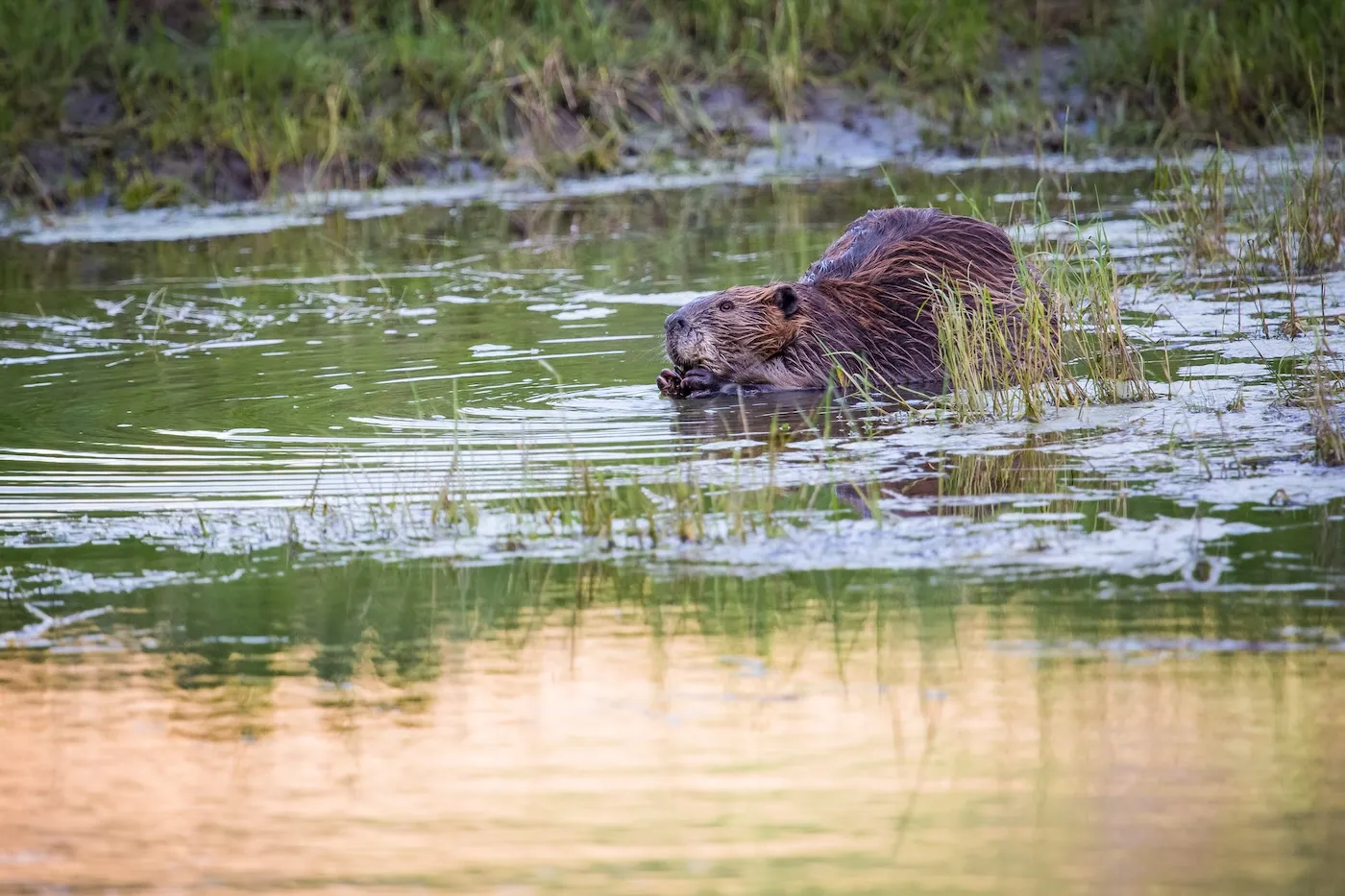
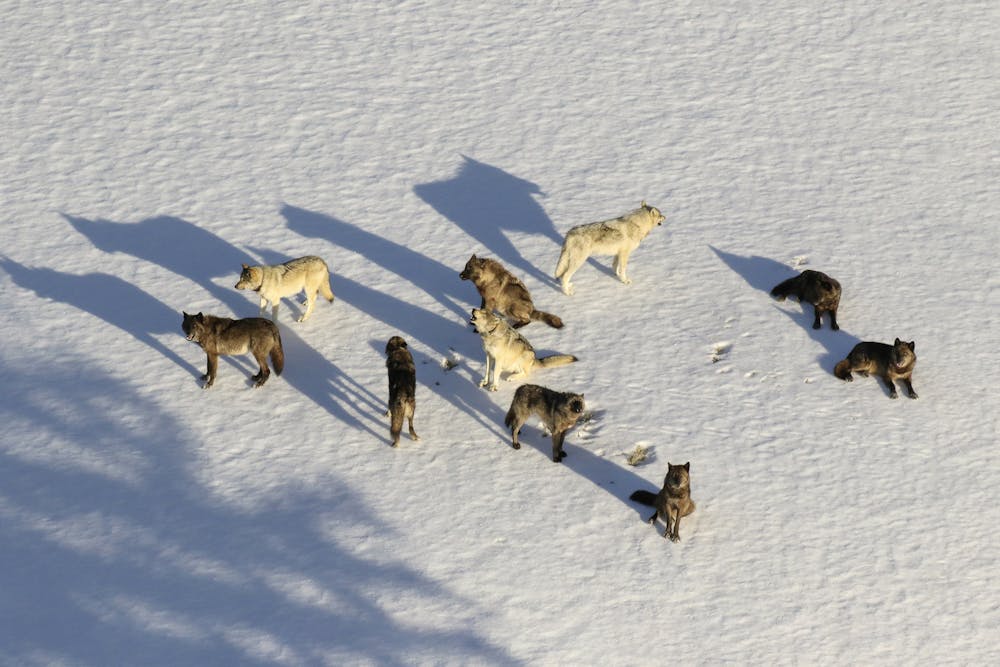
A beaver in the Lamar River. (Neal Herbert/National Park Service)
Click the link to read the article on the WyoFile website (Christine Peterson):
October 29, 2025
My rubber boots squelched as I grabbed another 5-gallon bucket full of mud from a Wyoming Game and Fish Department herpetology technician. We performed an awkward handoff before I dumped the mud on the ground in front of my sinking boots. The squelching continued as I used my boots to mash the fresh mud up against willow branches woven among 4-inch-wide posts rammed in a streambed.
Our little team, the herpetology technician, a Trout Unlimited project manager and another volunteer like me, were finishing up the first in a series of nearly a dozen fake beaver dams on a creek on the west side of the Snowy Range Mountains in southeast Wyoming. They’re technically called beaver dam analogues — since with their complex patterns of sticks and mud, they’re supposed to imitate real beaver dams. Although I’m not sure my noisy rubber boots really compare to the efficacy of the beaver tail.
The dams’ purpose, as the name implies, is to slow streamflow, lightly flooding banks and providing the water more time to seep into the ground.
If we’re lucky, a family of beavers will come along and make this analogue their home, even tearing out our handiwork to construct something they like better that’s more permanent and sturdier. Beavers are, after all, professional furry engineers, who perfected their craft over millennia.
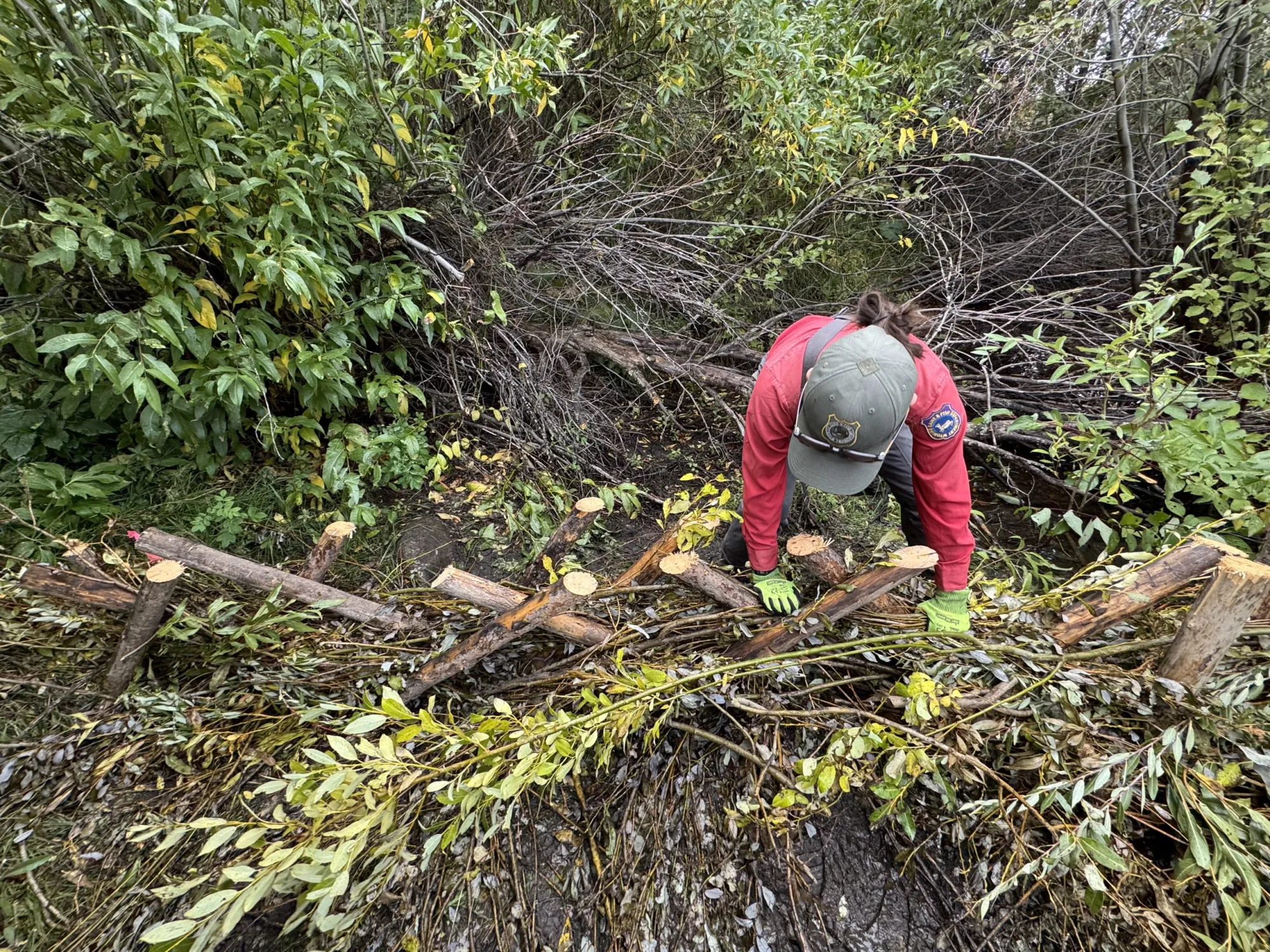
A Wyoming Game and Fish Department herpetology technician pushes willow branches through posts in the South Fork of Lake Creek in the Snowy Range. The willow branches help create a beaver dam analogue, meant to slow water flow and replenish the water table. (Christine Peterson)
Our fake beaver dams aren’t meant to last forever. They’ll be maintained annually for about five years (unless real beavers take over earlier), but the result when established in the right place can be remarkable, restoring and rejuvenating wetlands, replenishing the water table, keeping water higher up in systems longer in the year, and providing habitat for everything from insects, frogs and toads to elk and moose, and yes, even beavers.
Stream restoration experts like Steve Gale, the Wyoming Game and Fish Department’s aquatic habitat biologist, can and do extoll the benefits of beavers and beaver dams. And while the rest of us standing in the stream bed see their utility, we also agreed with Gale when he said: “Who doesn’t want to play in the water with mud and sticks?”
Bigger than just beavers
Before European settlers streamed onto this continent, bringing an insatiable demand for beaver pelts, the rodents lived in streams, creeks and rivers almost everywhere. They dammed any flowing water they could find and had a hand in shaping large swaths of the nation.
While beavers can be a nuisance, falling ancient cottonwoods in parched areas and flooding creeks and irrigation ditches, they’re also one of the best examples of ecosystem engineers, Gale said, and their services have been missed. Without beavers and beaver dams, rivers run faster and cut down into the soil, they wash away sediment and move water faster from headwater states like Wyoming to other states downstream.
So now watershed managers are turning to contraptions like the ones a team of nearly 20, including Game and Fish employees and volunteers from all over the state, helped build in mid-September.
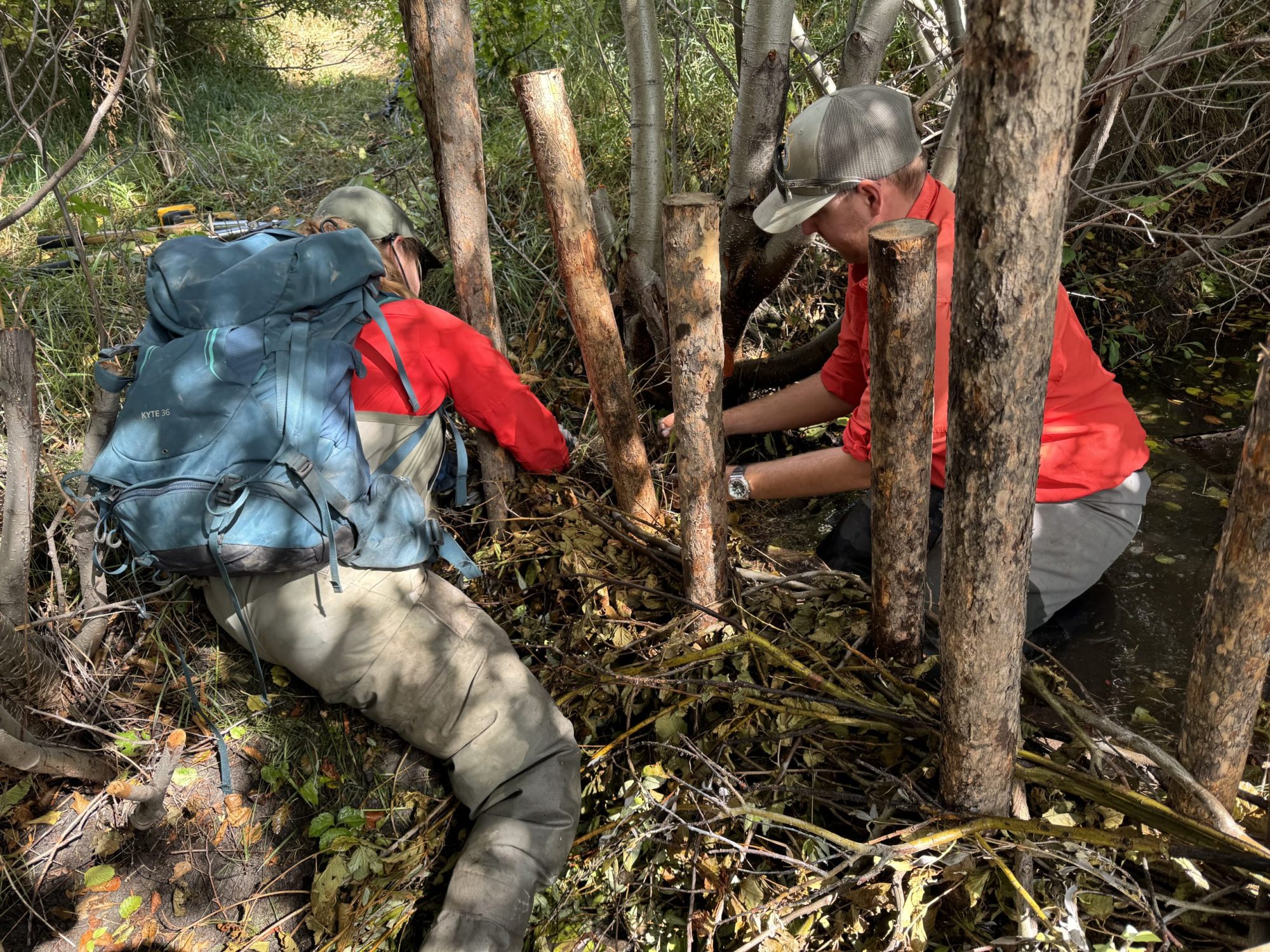
Two specialists with the Wyoming Game and Fish Department weave willow branches between posts in one of 11 beaver dam analogues built in mid-September. (Christine Peterson)
We stood on the banks of the South Fork of Lake Creek in the Pennock Wildlife Habitat Management Area and listened to Gale walk us through the process. In the last few decades, the South Fork of Lake Creek had cut deeper and deeper into the earth, ultimately sinking lower than the floodplain and as a result offering little water to surrounding vegetation. When runoff hit each spring, the water rushed down as plants sat parched on the banks.
“We lost riparian habitat and riparian width, which is important for calving areas,” he said. “We’re doing this work primarily for the deer, elk and moose.”
Beavers had been reintroduced here before, but even the industrious rodents had a hard time building dams and ponds deep enough to keep them alive and safe through winter.
We were here to help, hopefully. We would spend the bulk of the day pounding posts made from trees across the width of the creek over a quarter-mile-long stretch and then weaving bendy willow branches through the posts. After building a wall of willows, we would use buckets of mud and sod to fill in the cracks. With any luck, water would begin backing up almost immediately, eventually filling and slowly trickling over the tops.
Life or death
As beaver dam analogues become increasingly popular, biologists with state agencies and nonprofits are teaming up to place them in streams across the landscape.
Austin Quynn, the Trout Unlimited project manager helping direct our team, worked with groups of youth corps members over the last couple summers building, maintaining and repairing hundreds of analogues on a stream called Muddy Creek southwest of Rawlinsto help habitat for four native fish species: flannelmouth and bluehead suckers, roundtail chubs and Colorado River cutthroat. Last summer, beavers came from miles downstream and tore out dozens of analogues in one stretch. He sounded amused that his work was destroyed, because in its place, they’d built a massive dam that must have been what the beavers wanted and needed.
A finished beaver dam analogue stretches across a section of the South Fork of Lake Creek in the west side of the Snowy Range. Mud and woven willow branches help slow water, keeping the creek from becoming too incised and restoring wetlands. (Christine Peterson)
Some of the dams blew out from spring runoff, scouring the creek bed of sediment and leaving behind gravel that cutthroat trout could use for spawning.
Deep pools created by the analogues — and eventually beavers themselves — also offer fish refuge from the heat on mid-summer days.
On the east side of the Snowy Range, Wendy Estes-Zumpf, Game and Fish’s herpetological coordinator, and others built eight analogues in a creek which contains one of the last boreal toad populations in southeast Wyoming. It had been a stronghold for the creatures, but in the absence of beavers, the creek became incised, leaving little wetland habitat for toads to breed and survive.
A few seasons after Estes-Zumpf’s team erected the fake beaver dams, boreal toad populations have started to come back. She counted as few as four toads on past spring surveys and found almost 30 this spring including multiple age classes.
Beaver dam analogues aren’t a silver bullet for a drought-stricken West, Gale said, but for some species and some creeks, they could be the difference between life and death.
The snow season in Colorado’s high country is off to a slow start, but snowmaking at the ski resorts? That’s going gangbusters.
As October draws to a close, ski resorts are cranking out the snow due to a combination of the resorts’ annual race to opening day, this year’s unusually compressed window for the right meteorological conditions, and long-standing water supply agreements with Denver Water.
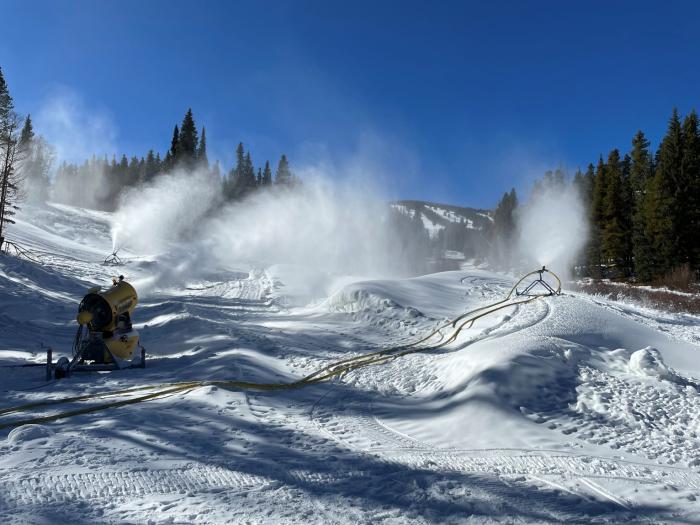
Snowmaking underway on the slopes at Breckenridge Ski Resort, one of six ski resorts in Denver Water’s watershed with agreements in place to use some of the utility’s water to make snow in the winter. Photo credit: Denver Water.
This year’s race to be the first ski resort to open ended over the weekend, when Keystone opened Saturday for three hours of afternoon skiing, followed by Arapahoe Basin, which opened for a full day of skiing on Sunday.
Denver Water collects water from across 4,000 square miles of mountain watershed, an area that’s also home to six major ski resorts: Arapahoe Basin, Breckenridge, Copper Mountain, Frisco Adventure Park, Keystone and Winter Park.
And stream gauges operated by Denver Water act as a proxy measure for snowmaking activity.
For example, the gauges monitoring streams affected by snowmaking at Winter Park and Keystone showed big overnight dips in recent days, as the resorts diverted water from the streams to their snowmaking equipment to get a head start on the ski season.
“The snow guns are blasting — and we can really see it reflected in those stream gauges,” said Nathan Elder, manager of water supply for Denver Water. “This appears to be one of the bigger starts to snow-making at the resorts as they gear up for opening day.”
The series of big drops in the amount of water flowing through the Moffat Tunnel last week indicates water being diverted to make snow at Winter Park Resort. Image credit: Colorado Water Conservation Board, Division of Water Resources.
It’s a reference to the impact of evaporative cooling in the dry Colorado air. In essence, the low humidity of the cold and dry air allows resorts to make snow even if the actual air temperature is above freezing.
“These ‘wet bulb’ conditions that are ideal for snowmaking have come later in the year than usual, so the resorts have had less time to make snow and are going strong now,” Elder said.
Water managers can see the activity in places like gauges on the Snake River, where overnight on Oct. 21, the stream that was flowing at 21 cubic feet of water per second plunged down to 6 cubic feet per second for several hours, then jumped back up to 32 cfs when the snowmaking at Keystone stopped the next day.
Importantly, the snowmaking machines couldn’t work their magic without the water the ski resorts are able to divert from high country streams. And the resorts can do that thanks to agreements with Denver Water that get the most use out of every drop of water.
Denver Water has very senior water rights in Grand and Summit counties, dating back to the 1920s and 1940s, before the ski resorts were open or made snow.
Agreements between Denver Water and the six ski resorts — Arapahoe Basin, Breckenridge, Cooper Mountain, Frisco Adventure Park, Keystone and Winter Park —allow the resorts to capture and use water for snowmaking, helping get the ski season off to an earlier start than they likely would be able to do otherwise.
The resorts use water that would otherwise get collected and stored in Denver Water reservoirs.
But it all evens out in the end. When the machine-made snow melts, it will flow downstream and wind up in the utility’s reservoirs on its way to customer taps next spring and summer.
Providing water for snowmaking is just one way Denver Water helps improve recreation in our collection system.
And those agreements are crucial this year, due to a late start to the snowfall season.
The average amount of snow measured at mountain tracking sites (called SNOTELs) as of Oct. 23 was 0 inches. There have only been seven other years, in the 46 years since SNOTELs began tracking data in 1979, when the average measurement was zero that late in October.
However, says Elder, do not despair.
A slow October roll-out does not automatically translate to a bad snow year overall.
“A slow start does not mean the peak snowpack in April will be low,” he said. “In some of those years the peak was well above average.”
And forecasts indicate that ‘wet-bulb’ temperatures are looking good for the remainder of this week, meaning more snowmaking will be underway.
So, if you haven’t already, get ready to break out those skis.
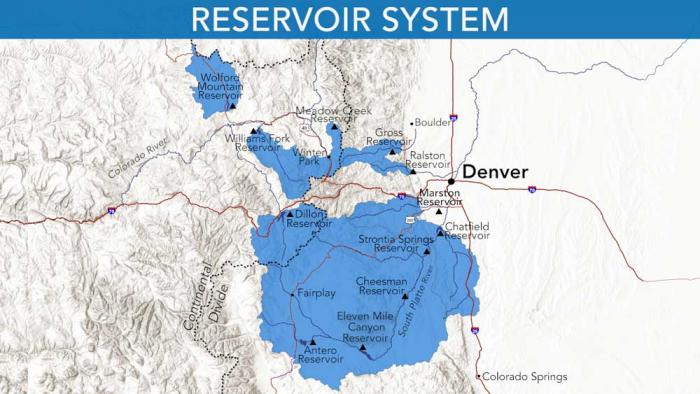
Denver Water relies on a network of reservoirs to collect and store water. The large collection area provides flexibility for collecting water as some areas receive different amounts of precipitation throughout the year. Image credit: Denver Water.
Drones have become integrated into everyday life over the past decade – in sectors as diverse as entertainment, health care and construction. They have also begun to transform the way people grow food.
In a new study published in the journal Science, we show that use of agricultural drones has spread extremely rapidly around the world. In ourresearch as social scientists studying agriculture and rural development, we set out to document where agricultural drones have taken off around the world, what they are doing, and why they have traveled so far so fast. We also explored what these changes mean for farmers, the environment, the public and governments.
From toys to farm tools
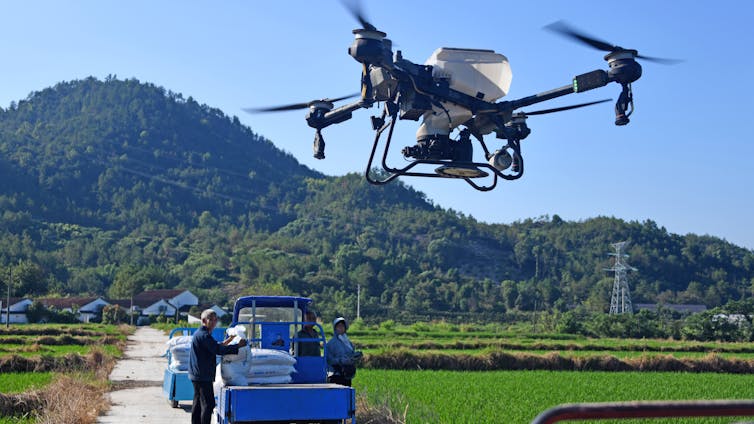
Just a few years ago, agricultural drones were expensive, small and difficult to use, limiting their appeal to farmers. In contrast, today’s models can be flown immediately after purchase and carry loads weighing up to 220 pounds (100 kg) – the weight of two sacks of fertilizer.
Their prices vary from country to country due to taxes, tariffs and shipping costs. In the U.S., a drone owner can expect to spend US$20,000 to $30,000 for the same equipment that a farmer in China could buy for less than $10,000. However, most farmers hire service providers, small businesses that supply drones and pilots for a fee, making them easy and relatively affordable to use. https://www.youtube.com/embed/1_XkHEUIi5Q?wmode=transparent&start=0 A promotional video for the DJI Agras T100 agricultural drone, which can carry a maximum load of 220 pounds (100 kg).
Agricultural drones are now akin to flying tractors – multifunctional machines that can perform numerous tasks using different hardware attachments. Common uses for drones on farms include spraying crops, spreading fertilizer, sowing seeds, transporting produce, dispensing fish feeds, painting greenhouses, monitoring livestock locations and well-being, mapping field topography and drainage, and measuring crop health. This versatility makes drones valuable for growing numerous crops, on farms of all sizes.
Technological leapfrogging
We estimated the number of agricultural drones operating in some of the world’s leading agricultural countries by scouring online news and trade publications in many different languages. This effort revealed where agricultural drones have already taken off around the world.
Historically, most agricultural technology – tractors, for example – has spread from high-income countries to middle- and then lower-income ones over the course of many decades. Drones partially reversed and dramatically accelerated this pattern, diffusing first from East Asia to Southeast Asia, then to Latin America, and finally to North America and Europe. Their use in higher-income regions is more limited but is accelerating rapidly in the U.S.
China leads the world in agricultural drone manufacturing and adoption. In 2016, a Chinese company introduced the first agriculture-specific quadcopter model. There are now more than 250,000 agricultural drones reported to be in use there. Other middle-income countries have also been enthusiastic adopters. For instance, drones were used on 30% of Thailand’s farmland in 2023, up from almost none in 2019, mainly by spraying pesticides and spreading fertilizers.
In the U.S., the number of agricultural drones registered with the Federal Aviation Administration leaped from about 1,000 in January 2024 to around 5,500 in mid-2025. Industry reports suggest those numbers substantially underreport U.S. drone use because some owners seek to avoid the complex registration process. Agricultural drones in the U.S. are used mainly for spraying crops such as corn and soy, especially in areas that are difficult to reach with tractors or crop-dusting aircraft.
Safer, but not risk-free
In countries such as China, Thailand and Vietnam, millions of smallholder farmers have upgraded from the dangerous and tiring job of applying agrochemicals by hand with backpack sprayers to using some of the most cutting-edge technology in the world, often using the same models that are popular in the U.S.
Drones save farmers time and money. They reduce the need for smallholders – people who farm less than 5 acres (2 hectares), which account for 85% of farms globally – to do dangerous and tiring manual spraying and spreading work on their own farms. They also remove the need to hire workers to do the same.
By eliminating some of the last remaining physically demanding work in farming, drones may also help make agriculture more attractive to rural youth, who are often disillusioned with the drudgery of traditional farming. In addition, drones create new skilled employment opportunities in rural areas for pilots, many of whom are young people.
On the downside, using drones could displace workers who currently earn a living from crop spraying. For instance, according to one estimate from China, drones can cover between 10 and 25 acres (4 to 10 hectares) of farmland per hour when spraying pesticides. That is equivalent to the effort of between 30 and 100 workers spraying manually. Governments may need to find ways to help displaced workers find new jobs.
In combination, these factors may increase the amount of food that can be produced on each acre of land, while reducing the amount of resources needed to do so. This outcome is a holy grail for agricultural scientists, who refer to it as “sustainable intensification.”
However, much of the evidence so far on yield gains from drone-assisted farming is anecdotal, or based on small studies or industry reports.
The drone revolution is reshaping farming faster than almost any technology before it. In just five years, millions of farmers around the world have embraced drones. Early signs point to big benefits: greater efficiency, safer working conditions and improved rural livelihoods. But the full picture isn’t clear yet.
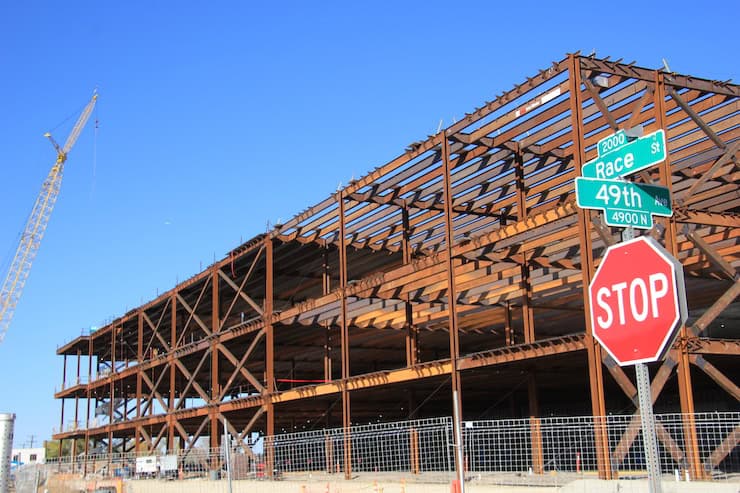
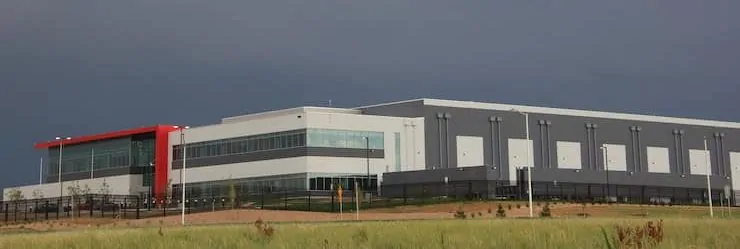
Data construction at 49th & Race, Denver. Photo credit: Allen Best
Click the link to read the article on the Big Pivots website (Allen Best):
October 23, 2025
Data centers in Colorado have been almost exclusively located along the Front Range, more narrowly yet between Colorado Springs and Boulder County.
In other words, they have arrived at exactly those places within the state that have prosperous economies, jurisdictions even struggling with the challenges imposed by growth.
Might data centers make their way to rural areas of Colorado?
Leaders of several electrical cooperatives offer mixed responses. Some report getting interest already, others not.
Tri-State Generation and Transmission Association, Colorado’s second largest electrical provider, hopes to prime the pump. It has filed a proposal with the Federal Energy Regulatory Commission for a tariff that it believes will interest developers. It’s called HILT, which stands for high-impact load tariff. It is designed for demands of 45 megawatts or more.
Meanwhile, several state legislators continue to hone bills they expect to introduce into the next legislative session. In the last legislative session, one bill proposed incentives for data center development in some locations. Others thought that the state needed guardrails to ensure that other customers — as well as land and especially water resources — are not imperiled. (Look for a deeper story on that in coming days in Big Pivots).
“Absolutely,” said Duane Highley, the chief executive of Tri-State, in an interview with Big Pivots on Oct. 7 when asked about potential for data centers in places like Craig or Fort Morgan. “Our members have actually had quite a bit of interest across our entire footprint. So definitely not just the urban areas.”
The Westminster-based cooperative provides wholesale power to 40 electrical cooperatives and public power districts in Colorado and three adjoining states.
“Some of our high-elevation members get a lot of interest because of the cool air and less need for cooling a data center,” he said. This, he added, is particularly true in Wyoming, where Tri-State has 10 member cooperatives. It supplies electricity to 16 cooperatives in Colorado.
Tri-State does not deliver electricity to Craig and Hayden, although it does operate three coal-burning units at Craig. It plans a gas-fired power plant there after the coal units get retired. The first unit is scheduled to retire later this year and the final two before the end of 2028.
At 6,200 feet in elevation, Craig is consistently cooler than the Front Range. It is often below zero during winter nights, sometimes far below.
“I guess Craig would be an excellent spot,” said Highley. He cited the existence of a “really big substation” as well as transmission.
“So if anybody wants to start a conversation around Craig, we will have the tariff in place to allow that to happen. ”
Highley reported that Tri-State has had four gigawatts of requests on its system from data centers. Tri-State has a generating capacity of 2.5 gigawatts from Wyoming to Arizona. Not all that demand will materialize, Highley hastened to add. “A lot of them are just shopping, but I have to think that some part of that is real.”
A spot check by Big Pivots of electrical cooperatives in Colorado reveals little of substance — yet.
“We really haven’t had any inquiries about data centers in the Mountain Parks service territory to date,” said Virginia Harman, the chief executive of Granby-based Mountain Parks Electric. “That doesn’t mean they won’t happen.”
In Buena Vista, Jon Beyer, the general manager of Sangre de Cristo Electric, has the same report. “We are not getting any inquiries anywhere in the Arkansas Valley. Land prices are pretty expensive, and electrical infrastructure is probably not robust enough for stuff of that size. Finding employees is a challenge as well,” he said.
“Coops along the Front Range — Poudre Valley, United Power, Mountain View, maybe even San Isabel, I would guess they have all received inquiries, folks kicking the tires.”
In western Colorado, Delta-Montrose Association has at least heard a little bit of interest via upstream electrical providers but “nothing to take to the bank,” said Kent Blackwell, the chief administrative officer. “The fact that we have even heard any out there is shocking to me, this far removed from urban centers.”
Different sizes
Data centers do come in different sizes and flavors. Micro data centers generally are those in places of 5,000 square feet or less. Small comes in at 20,000 square feet. Hyper-scale data centers are classified as those with over 100,000 square feet and consuming 100 megawatts.
QTS, Colorado’s most high-profile data center, seems not to have divulged its square footage but has a 67-acre campus in Aurora, near the intersection of I-70 and E-470, and a demand of 177 megawatts. However, it still ramping up, with a 10-year expansion.
The QTS hypescale data center in Aurora occupies a campus of 67 acres and is still ramping up. Photo credit: Allen Best/Big Pivots
Many data centers are even larger. Meta (Facebook) has a data center in Oregon that covers 4.6 million square feet. A data center in Inner Mongolia covers 10.7 million square feet.
These definitions and other information, by the way, come in part from Google AI reports (which makes those of us who are actual providers of diminished relevance — or at least uncompensated.) They could be wrong — as AI often is. Of course, newspapers were never wrong, were they?
Tri-State’s Highley said he has talked with developers covered by non-disclosure agreements. “I can’t share who they are, but I’ll just say I’m inspired by them,” he said. “They have a lot of money, and they do have the ability to execute. I also believe they’re shopping multiple locations at once, and so it’s a little bit of competition.”
Will this new HILT tariff from Tri-State — assuming it is approved by FERC — become a model for others? Highley said he got a call from a White House office in late September. The individual had lots of questions about Tri-State’s FERC filing. The individual had read Tri-State’s FERC filing in detail.
“Why do you care so much? Why are you calling me?” Highley asked. ” And he said, ‘Because I think this tariff that you filed could set a precedent for the industry nation-wide.”
Highley said he has not noticed another large-load tariff approved at FERC, although he has seen two that were rejected. “I don’t think we have it perfect, but we think we’re moving down a good path. We had input from developers and from our own co-op members to design this.”
Stranded assets?
Will this interfere with Tri-State’s plans to decarbonize? It expects to be at 50% carbon free electricity by year’s end and 70% by 2030. No, said Highley. Tri-State can meet new demand with solar, wind and battery storage. It also plans another natural gas plant near Craig, pending approval by the Colorado Public Utilities Commission.
Tri-State and its members would also allow data center developers to produce part of their own generation. That tariff is called bring-your-own-resource, or BYOR. A developer might have better access to supply chains, Highley said. “Again, some of these hyper-scalers have such a big checkbook they can buy their way to the front of the line. ”
HIghley said the Tri-State’s tariff will ensure that it has the capacity to back up the data center developer while getting properly compensated, so no other members subsidize the project.
A September presentation by Matt Fitzgibbon, Tri-State’s vice president of planning and analytics, tells a slightly nuanced story. A slide deck reported “limited potential” for stranded assets resulting in financial risk to Tri-State and its members while enabling “economic development across our members’ systems at an unprecedented level and pace.”
This gets at the heart of one concern about data centers, as illustrated in the Xcel filing with the Colorado Public Utilities Commission last year. How much of the prospective demand from data centers is real? And if it is not real, who will be left holding the bag if a utility spends gobs of money building new generating capacity? How much risk will be put on ratepayers, in the case of Xcel, or in the case of cooperatives, members?
In Durango, Chris Hansen, the chief executive of La Plata Electric since November, foresees data centers arriving in more rural parts of Colorado.
“We have had significant discussions with three different data center operators who are interested in southwest Colorado,” he reported. “We are making sure that we are open for business and communicating our opportunities in the near term, in the next 24 months, and those requiring more lead time of three, four or five years.”
Data centers, he said, “are most focused on low cost of power and availability of water for cooling. Those are very high on their list.”
And Colorado’s sales tax policy will not make it a higher cost for developers when they are buying hundreds of millions of dollars for chips. “That is something that is relevant for them as they make their decisions.”
Hansen said he believes that data center demand can be met in ways that are highly beneficial to existing customers and the electrical system more broadly.
Some rural places could be limited by lack of sufficient fiber connectivity to more urban areas. Hansen acknowledges that but points out that data centers can have different needs. As for southwest Colorado, it is well connected.
Delta-Montrose’s Blackwell sees his cooperative being in a good position to interest data center developers. It has fiber connectivity to Denver, Salt Lake City and Albuquerque. “A Facebook, an Amazon — the big data centers will want direct fiber connectivity.”
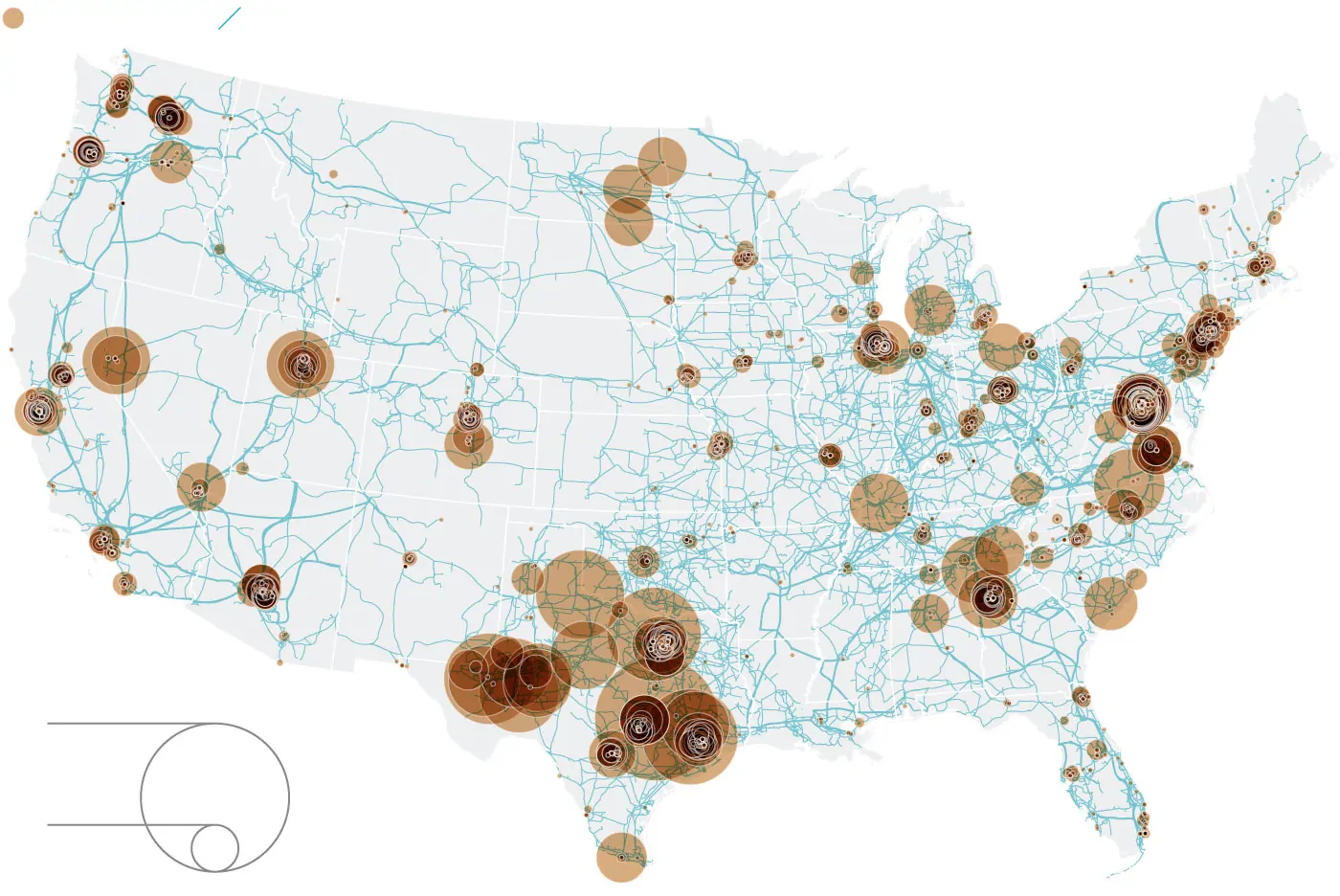
A map published last week by the Wall Street Journal using Department of Energy information showed data centers across the United States. Texas has, well, Texas-sized dots and maybe bigger. Virginia, with its data center alley, is well represented. But you see almost no dots of any size in the Rocky Mountain states beyond the urban areas with the exception of Cheyenne.
Hansen said he believes electrical cooperatives are positioned to meet demand that investor-owned utilities in urban areas cannot.
“Larger investor-owned utilities around the country are not in great position to meet demand. That is the trend I am seeing. Rural co-ops can move fast, as they don’t have to necessarily go through PUCs. Those things help make rural areas more attractive.”
Lots of shopping, little commitment
In Southwest Colorado, the data developers have been looking to get started at 50 to 100 megawatts. If things go well, they might want to grow to data centers of a gigawatt or more.
Data centers come in different flavors, said Hansen. Some data centers do have flexibility in their need for electricity, while others must respond immediately to needs of their consumers.
“Tech companies in the AI race need power, and lots of it. They aren’t waiting around for the archaic U.S. power grid to catch up,” reports Jennifer Hlller.
Data centers long took power for granted, a consultant told the Journal. “But that’s no longer possible given the city-sized amounts of electricity needed to train AI models. One data center can devour as much electricity as 1,000 Walmart stores, and an AI search can use 10 times the amount of energy as a Google search,” Hiller said.
Hence, they have taken to building their own power generating sources, often gas plants.
The downside to that, as Hansen pointed out, is that the data center developers could still need the reliability of the broader grid. “It’s a balancing act,” he said.
While Hansen in Durango has just started getting inquiries from data center developers, Mark Gabriel, chief executive of Brighton-based United Power, has been fielding inquires for two or three years.
The electrical cooperative covers 900-plus square miles from the foothills of the Rockies to the oil and gas territory of the Wattenberg Field. But it also serves land near DIA as well as along the fast-developing I-76 and I-25 corridors.
As such, United has been getting lots of “tire kickers.” Now, says Gabriel, United actually expects something to come of the talk. Two operators with large load demands have committed to the $650,000 up-front fees, two more are in active negotiations, and several others are talking with United.
“We anticipate at least one to come to fruition,” said Gabriel.
Click the link to read the article on the Big Pivots website (Allen Best):
October 23, 2025
It’s another one of those good news, bad news stories.
First, the bad news. The federal government withdrew its tax credits of up to $7,500 for purchase or lease of a new EV (and $4,000 for a used EV). Congress made that decision in early July, as part of the One Big Beautiful Act. The deadline was Oct. 1.
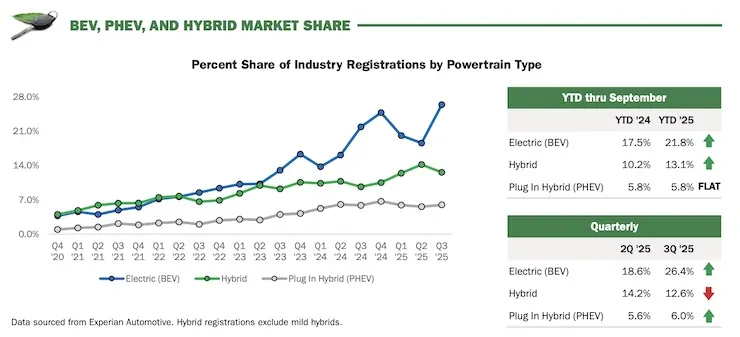
The good news is that the deadline spurred Coloradans to set a new record for purchases of EVs. From July through September, 32.4% of new vehicle sales in Colorado were EVs or plug-in hybrids. Colorado led the nation, slight ahead of California.
Colorado now has surpassed 210,000 EV registrations. To put that into perspective, then-Gov. John Hickenlooper in 2018 declared a goal of 940,000 registered EVs in Colorado by 2030.
The state has a long way to go. But it does have momentum.
This chart from the Colorado Automobile Dealers Association shows how the sales of EVs and plug-in hybrids has grown during the last five years in Colorado. Sales of EVs dropped in the first six months of this year but leaped to a record in response to the imminent federal deadline.
In a statement issued by his office, Gov. Jared Polis heralded the sales. “Coloradans and the free market are saying loud and clear that affordable, clean and efficient electric vehicles are here to stay,” he said. Those electric cars, he said, save money while improving air quality.
First road charge for Coyote Gulch’s Leaf in Granby May 19, 2023. Note the Colorado Energy Office’s logo below the connectors on the unused charger.
We hear less about range anxiety. We still don’t have high-speed charging stations to match the “filling stations” created in the 20th century. However, the state as of early October, had 1,487 high-speed charging ports at 458 locations around Colorado. They can be found from Cortez to Holyoke, and from Dinosaur to Lamar.
And the number of EVs is, in some places, reaching a tipping point.
Travis Madsen, transportation manager for the Southwest Energy Efficiency Project, reports a trip to New Mexico recently along Interstate 25. At Pueblo, he stopped to recharge. For the first time ever anywhere in his experience, he had to wait. All the ports were busy.
Madsen also had good news. From July through September, a record 167 new fast-charging ports were installed in Colorado.
Will this momentum continue?
Madsen doesn’t expect sales to remain above 30% during the next few quarters. He does hope that public awareness has grown about the value of EVs regardless of federal tax credits. EVs still generally cost more, but they require less maintenance and can be fueled far more cheaply, especially at home. Department of Energy data show that current EVs are 2.6 to 4.8 times more efficient at traveling a mile compared to a gasoline internal combustion engine, according to the Natural Resources Defense Council.
To help maintain momentum, the state on Nov. 3 will raise Vehicle Exchange Colorado rebates from the existing $6,000 to $9,000 for new EV purchases and leases. For used EV purchases and leases, the prices will rise from $4,000 to $6,000. The program aims to enable income-qualified Coloradans to access EVs. Maybe that will include writers.
The power of Artificial Intelligence (AI) to improve the accuracy, accessibility and reach of weather forecasts and early warnings has been recognized by the World Meteorological Organization, which will seek to ensure that all countries can benefit from its life-saving potential.
Key messages
AI can accelerate Early Warnings for All
Forecasts and warnings save millions of lives and billions of dollars
AI will compliment – not replace – traditional forecasting tools
WMO science for action supports the global economy
Credit: WMO / Melissa Debray
An Extraordinary World Meteorological Congress issued a call to the public, private and academic sectors to collaborate on the development of AI and machine learning (ML) technologies to protect communities and economies from hazards like extreme heat and rainfall. It also paved the way for AI/ML to be anchored in WMO’s global observation, data processing and forecasting backbone.
The resolutions were part of a wider package of measures approved by the Extraordinary Congress to accelerate progress towards WMO’s top overriding priority – to ensure universal coverage of early warning systems through the achievement of Early Warnings for All by the end of 2027.
“Early warnings are not an abstraction. They give farmers the power to protect their crops and livestock. Enable families to evacuate safely. And protect entire communities from devastation,” UN Secretary-General António Guterres told the Extraordinary Congress on 22 October in a ceremony which was one of the highlights of WMO’s 75th anniversary activities.
“We know that disaster-related mortality is at least six times lower in countries with good early-warning systems in place. And just 24 hours’ notice before a hazardous event can reduce damage by up to 30 per cent. Early-warning systems work. And they’re finally getting the attention – and investment – they deserve,” said the UN Secretary-General.
Mr. Guterres launched Early Warnings for All in 2022 with the goal of ensuring universal coverage by the end of 2027.
“The visit of the United Nations Secretary-General, the participation of presidents and ministers and the global attention they attracted is a reminder that what we do matters. Now we must build on this momentum. This is the moment to turn visibility into impact. To translate recognition into investment. To make sure that our transformation continues — that WMO remains not only relevant, but more essential than ever,” she said.
Global forecasting backbone
Congress approved a new set of technical regulations concerning early warning services, providing a clear reference and ensuring that the authoritative and trusted role of National Meteorological and Hydrological Services in issuing reliable and accurate warnings are supported and enshrined in national legislation
It issued a “call to all stakeholders” to collaborate on the development of AI/ML environmental monitoring and prediction technologies, tools and applications, noting the “unprecedented pace of progress” and the “transformative potential” to achieve Early Warnings for All.
The resolution builds on decisions by the WMO Executive Council in June 2025. It reaffirms WMO’s mission to facilitate international cooperation and standardization, building on decades of trust and data collection. AI must complement, not replace, existing well-honed scientific forecasting methods and infrastructure.
It emphasizes open data, open-source tools, and FAIR principles to foster transparency and global participation. It calls for ethical frameworks which establish principles for cooperation, intellectual property, and responsible AI use.
Congress also approved a resolution to integrate AI into the global forecasting infrastructure.
Acknowledging the significant disparity in forecasting capabilities among WMO Members, Congress stressed the need to support National Meteorological and Hydrological Services (NMHSs) globally, especially those in low- and middle-income countries, LDCs, and SIDS, to access and utilize new AI technology.
Due to rapidly evolving AI/ML technologies, Congress agreed to develop a new WIPPS strategy incorporating AI. The WMO Integrated Processing and Prediction System (WIPPS) is a worldwide network of operational centres that makes scientific and technological advances accessible and exploitable by Members, providing products related to weather, climate, water, and the environment.
While AI offers transformative potential for operational forecasting and warnings, the resolution recognizes that considerable challenges remain in AI systems’ capability to support forecasts of local high-impact weather systems and hydrological processes. These challenges must be addressed, tested, and demonstrated for operational use.
To ensure all Members benefit, the resolution requested WMO bodies enhance capacity development on AI use under WIPPS for low- and middle-income countries, LDCs, and SIDS. Furthermore, WIPPS pilot projects are essential to explore and deliver new prediction products, demonstrating AI’s potential to enhance developing countries’ capabilities.
An ongoing pilot project between the meteorological services of Norway and Malawi, which demonstrate an AI weather prediction and the concept of Forecasts-in-a-Box, was presented to Congress. It has showed improvements in forecasts – and is being closely watched as a model for other countries with resource constraints.
In other action, Extraordinary Congress:
Advanced the goals of the Global Greenhouse Gas Watch by integrating key components into existing programmes, including the expanded World Weather Watch and the Global Atmosphere Watch Programmes.
Approved WMO’s first Youth Action Plan, marking a structured approach to integrating youth perspectives into its work and empowering the next generation of leaders. This is a landmark step in nurturing young meteorologists, hydrologists and climate and ocean scientists, marking a new era of shared inter-generational responsibility and expertise in weather, water, and climate action.
Streamlined procedures on elections and appointment of the WMO Secretary-General.
Endorsed the WMO Secretary-General’s restructuring of WMO, responding to evolving global challenges, the need for a more integrated Earth system services and increasing financial constraints.
Requested the WMO Executive Council to set up a task force to develop recommendations for modification to the strategic and operating plans for 2026/2027 as a result of the ongoing liquidity challenges of WMO.
Executive Council
WMO’s Executive Council met on 24 October immediately following Extraordinary Congress. It confirmed a total budget of 138.7 million for the biennium 2026/2027. It agreed to the terms of reference and composition of the new task force which will identify proposals for realignment of WMO’s Strategic and Operating Plans during the 2026–2027 biennium, given the ongoing financial uncertainty. Science for Action
The Extraordinary Congress was held as WMO celebrates its 75th anniversary, with the theme of Science for Action.
WMO’s work underpins resilient development, food, transport, energy, security, health, water management and disaster risk reduction.
It is essential to the global economy and society and can leverage potential to unlock even more benefits for the global good.
Credit: WMO / Fabian Rubiolo
Science for Action
The Extraordinary Congress was held as WMO celebrates its 75th anniversary, with the theme of Science for Action.
WMO’s work underpins resilient development, food, transport, energy, security, health, water management and disaster risk reduction.
It is essential to the global economy and society and can leverage potential to unlock even more benefits for the global good.
Click the link to read the article on the InkStain website (John Fleck):
October 11, 2025
Total flow to date on the Rio Grande at Otowi is the lowest since 1964.
Otowi is the place where the river leaves the upper valleys and enters the canyons that lie at the head of the valley of Albuquerque, what we in New Mexico call the “Middle Rio Grande.”
The graph shows total flow to date this year, with previous drier years called out in red. You can see that the “drought of the ’50s,” (which really extended well into the 1960s) was the big impact decadal-scale event here, not the ’30s, Dust Bowl.
If you squint, you also can see the subtle impact of the San Juan-Chama Project, which beginning in the 1970s began importing Colorado River water. I’m measuring total flow with this calculation, not what is formally called the “Otowi Index Flow,” the official measure of native water used for Rio Grande Compact accounting. This is the number that matters the most to me – it’s the total amount of water we have to work with here in the Middle Rio Grande, the actual flow of water into the valley each year. You can see a subtle impact of that SJC water, raising up the floor in dry years. At least I think I can see that.
A Note on Method
I am not a computer programmer, or software engineer, or whatever you call that thing. But I’ve been writing computer code since I was a teenager in Upland, California, writing Fortran on punch cards that we would send to the guy who ran the school district mainframe to run in the middle of the night. (Southern California’s Mediterranean climate meant we did not have to trudge miles to school barefoot in the snow, but we did write code on punch cards.)
I’ve done it because it’s fun (I did a stint as a free software volunteer on the GNOME project 20-plus years ago), as a toolkit for analyzing data in my haphazard career as a “data journalist,” and in early days of newspaper Internet work, when we rolled our own web site code in Perl. I am a terrible coder, but with some help (site:stackexchange.com “cryptic error message”) I know enough to make my way around the data I have questions about. I was the guy at the newspaper who “borrowed” Lotus 1-2-3 from a friend to analyze city budgets, and persuaded the IT folks to put “R” on my desktop computer against their better judgment. But it’s laborious stuff because of the gap between my subject matter expertise and my coding skills. As a result, there were things I didn’t bother with.
Luis Villa, a friend from my GNOME days who went on to become a lawyer and big think person about “open” and the commons, posed a question on his blog last month about the gateway language model coding tools provide into open data. The provocative header to the section of the post was “Accessibility & Democratization”:
“Vibecoding” is a technique by which you tell a language model in plain language what you want your code to do. It writes it. You run it. It chokes, you paste in the error message and say “Fix this.” After a couple of iterations, it works. This is both dangerous and liberating. For me, it opens up vast areas of open data for analysis that I never would have bothered with because of the agony of pasting error messages into a search engine trying to find someone on Stackexchange who had the same problem, running their code, getting a new error message, turtles all the way down. I know the questions and the analytical structures I need, but turning those ideas into code was a pain in the ass!
In the case of the graph above, I had some old code I had written that downloaded USGS streamflow data, converted cubic feet per second (a rate) to acre feet over a specified time period (a volume), compared flow to date this year to flow to the same date in previous years, and made a graph.
This year has been super dry. I was curious about previous years that had been this dry. Updating the code to color those with lower flow than this year’s red was conceptually trivial, but would have been tedious and time consuming. Also, the old code’s visualization was ugly. Vibecoding the changes took an order of magnitude less time than writing all of that code by hand. I’m pretty sure it took longer to make the locator map in Datawrapper (which is fast!) than it did to update the code.
This would be a terrible idea, as Simon Willison argues, if my goal was to become a better programmer, or a software engineer writing production code. This is the same reason using language models to do your writing for you – if your goal is to come to understanding – is a terrible idea. The act of writing is an act of coming to understanding. For me, the knowledge work here is staring at the graph, incorporating what it is telling me into my knowledge framework, and doing the work of writing this blog post. I need to know enough to look at the code and the data it spits out to be confident that it’s sane. But I don’t care about the finicky syntax of R’s “mutate” and “ifelse.”
Three years after the Hermit’s Peak/Calf Canyon wildfire burned over 500 square miles in New Mexico — cementing the blaze as the state’s largest-ever — residents are feeling the ripple effects of flood damage and water insecurity.
Flash flooding is common following large burns, and the risks can last for a decade or more. Charred soils are unable to effectively absorb water, and trees are no longer around to soak up or slow rains, which run over burn scars “like water off a parking lot,” Reuters reports.
Last year alone, 105 fires put 6 million acres — primarily in the American West — at risk of flooding impacts.
In Mora, New Mexico, more than two dozen floods have ravaged homes since the Hermit’s Peak/Calf Canyon blaze. More lives have been lost to water than fire. Meanwhile, mold after flooding has led to the abandonment or demolition of homes. Runoff of toxic heavy metals and other contaminants have left residents’ wells polluted and unusable.
Rio Grande and Pecos River basins. Map credit: By Kmusser – Own work, Elevation data from SRTM, drainage basin from GTOPO [1], U.S. stream from the National Atlas [2], all other features from Vector Map., CC BY-SA 3.0, https://commons.wikimedia.org/w/index.php?curid=11218868
This shows how buffaloes were pushed west by white immigrants—just like Native Americans. No coincidence the last years on it coincide with the end of the US Wars on the Indigenous. Also no coincidence both were nearly driven to extinction—they killed them to starve Native people pic.twitter.com/bclCTwbsUR
Populations of salmon re-establish spawning habitat in a tributary in Southern Oregon in October 2025. To get here, the salmon had to swim past Keno and Link River dams and through Upper Klamath Lake, which was made possible after four hydroelectric dams were removed downstream on the Klamath River last year. Photo credit: Paul Robert/Wolf Wilson
Click the link to read the article on the Oregon Public Radio (es Burns and Cassandra Profita):
October 17, 2025
Just a year after four dams were removed, fall Chinook have migrated nearly 300 miles into the Upper Klamath Basin in Southern Oregon.
For the first time in more than 100 years, Chinook salmon have been spotted at the confluence of the Sprague and Williamson rivers in Chiloquin, the government seat of the Klamath Tribes in Southern Oregon.
“A hundred and fifteen years that they haven’t been here, and they still have that GPS unit inside of them,” said the visibly giddy Klamath Tribal Chair William Ray, Jr. “It’s truly an awesome feat if you think about the gauntlet they had to go through.”
Ray said salmon traditionally comprised about a third of the diet of the Indigenous people in the Upper Klamath Basin. That food source vanished with the building of Copco 1 Dam in northern California in 1918.
Scientists have been tracking the migration of this year’s run of fall Chinook as they’ve passed all of the old dam sites on the river.
Last week they reached a huge milestone: A Chinook was photographed entering Upper Klamath Lake. But it was unclear how that fish and the others waiting to scale the fish ladder would fare in the lake, which has been plagued by water quality issues, including toxic cyanobacteria blooms.
“This past summer the water in the lake was so toxic that you could not drink it or swim in it,” said Ray.
Ray says the Klamath Tribes fisheries staff started tracing the tag on one of the Chinook as it passed through the Link River Dam fish ladder in Klamath Falls on Oct. 8. Just a couple days later, the fish was detected passing into the Williamson River, having swum approximately 15 miles through the lake.
A guide to salmon returning to the Upper Klamath Basin created by the Oregon Department of Fish and Wildlife in October 2025. Courtesy of Oregon Department of Fish and Wildlife
“The run so far this year has been incredibly exciting, and we’re expanding our monitoring program on an almost daily basis to keep adapting,” said Mark Hereford, ODFW Klamath fisheries reintroduction project leader. “It is incredible to be a part of this historic return and see where these salmon go and what they do.”
ODFW Public Information Officer Adam Baylor said tagged fish were also detected Tuesday in the spring-fed waters of Pelican Bay, on the opposite side of the lake.
A radio-tagged Chinook salmon swims amongst Kokanee and Redband Trout in a spring-fed pool alongside the Upper Klamath Lake in October 2025. Paul Robert Wolf Wilson
“We figure that right now, there are possibly more than 100 salmon that have made it — that are above the Link River Dam,” said Ray.
ODFW and the tribes are encouraging people not to touch or catch the salmon. The rivers in the Upper Klamath Basin are closed to all salmon fishing.
“What’s next is to allow them to live their lives without any kind of interference,” Ray said. “We’re praying. We’re praying as loud as we can pray that the spawners will do their natural work and just keep coming back every year so the population can grow into a fishable population for us.”
In the meantime, Ray said the Tribes have a responsibility to continue habitat restoration work in the region to make sure the new visitors to the Upper Klamath Basin have healthy places to go.
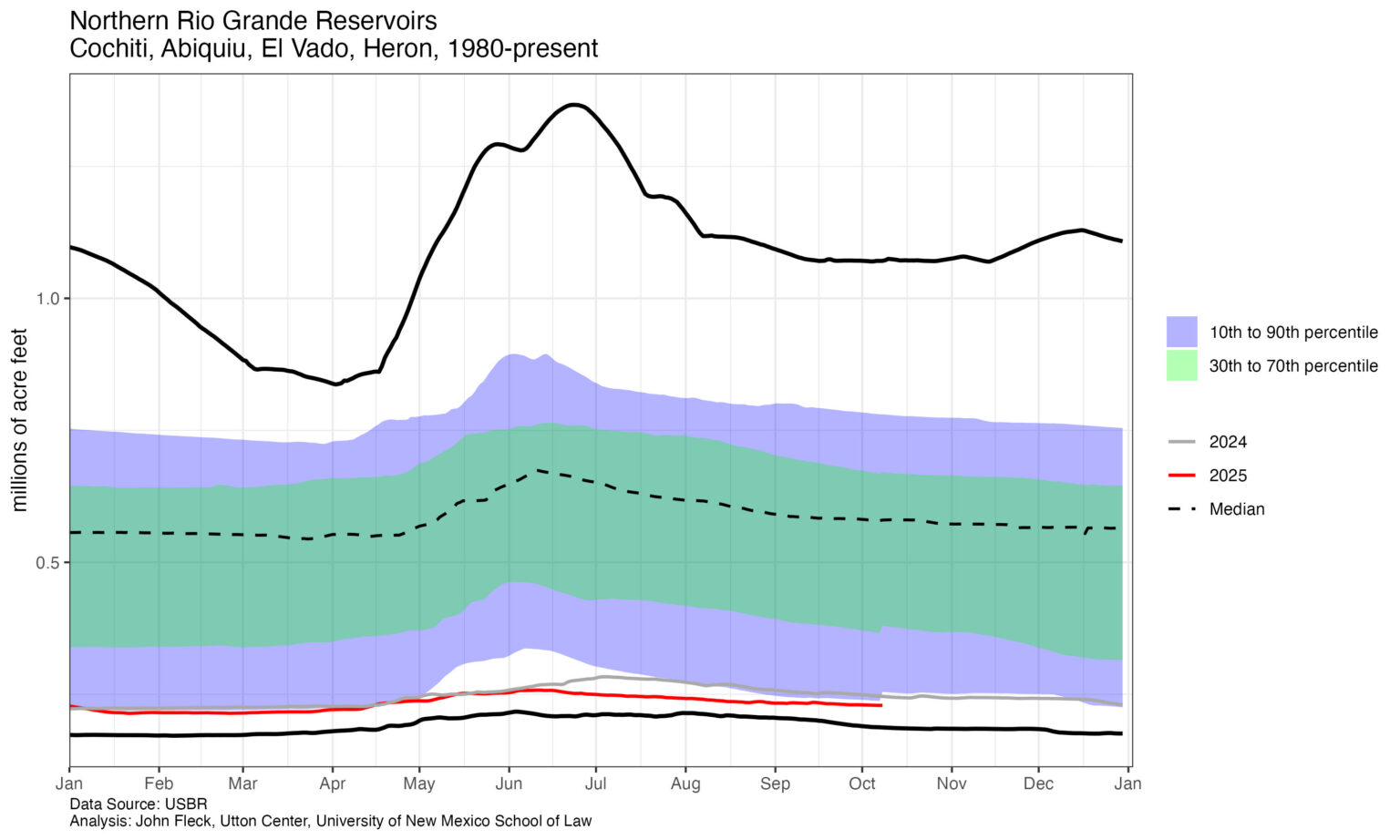
Exploring the data commons (I need to update the legend, the black lines are max and min)
Click the link to read the article on the InkStain website (John Fleck):
October 9, 2025
A bunch of odds and ends cluttering my brain, blog posts that are half written in my mind that are in the way:
Quoting Luis Villa on accessing the open data commons
Yes.
See graph above.
I always have had more questions (sometimes ill-posed, sometimes well-thought-through) than my coding abilities can execute. (See also domestic wells below.)
I pay for a subscription to Newspapers.com in order to have access to a large portion of my written work. I view what I have written over the course of my life – newspapers, books, blogs – as a mindful and intentional contribution to the information commons. But this aligns poorly with the formal economic and legal structures – “institutions” as we might define them for our water resources students, the rules that serve as the foundation for the more common-language definitions of “institutions” that might apply here, the organizations of publishing – newspapers and book publishers and Inkstain.
The newspaper paid me well (it wasn’t a lot of money, but I viewed it as a fair transaction) and owned what I produced. I pay now for the privilege of reading it. The books are more complicated. I choose to make Inkstain freely available.
Derrida and Adorno, two philosophers I have been poking at of late, are helping me think about the definitional challenges – not “the commons” in particular, but what we’re doing when we attach words/concepts to things, the cultural quicksand beneath our linguistic feet.
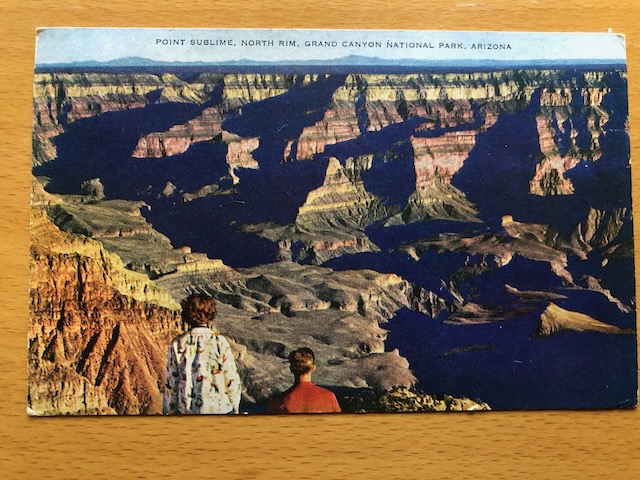
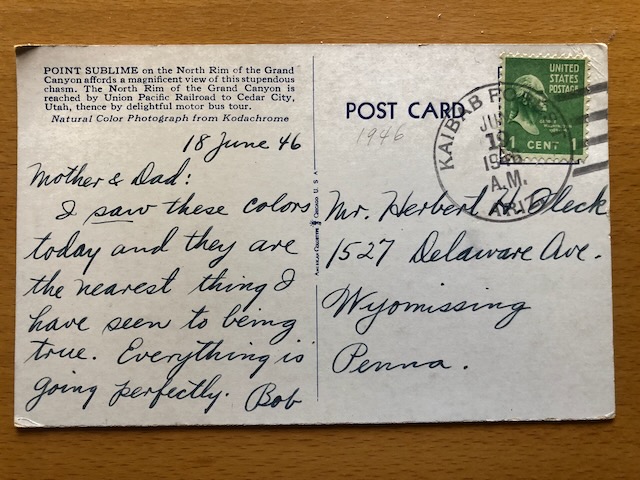
That Postcard
Point Sublime
“the nearest thing I have seen to being true”
Found this in a stack of old Dad stuff. It is my origin story, my father as a young artist in a moment of profound change. In laying the groundwork for his life, it laid the groundwork for mine.
Domestic Wells
OpenET-reported change in evapotranspiration, 2000-2004 compared to 2020-2024. Green is places water consumptive use from all sources has gone up. Brown is places it has gone down.
Density of domestic wells in greater Albuquerque. Dark green is >150 wells per square kilometer. Brown is no wells at all.
See Luis’s comment above about vibe coding and open data.
I am not sure what to do with this. I can’t unsee it.
I’m out on the epistemological thin ice here, but as a journalist I spent much of my life working in areas where that ice is thin, it’s where the interesting stuff happens.
Ostrom and the Colorado River
I’ve mostly been grabbing the handrail and trying not to fall off as my Wilburys friends, in what we see as a discourse vacuum, charge ahead with our critique of Colorado River governance:
In a 2011 paper, Elinor Ostrom laid out one of the final versions of her “design principles,” characteristics of successful institutional arrangements for collective action around natural resource systems. We spend a lot of time on this in the class I teach with Bob Berrens each fall for UNM graduate students. It was at the heart of my book Water is For Fighting Over, and it is at the heart of Ribbons of Green, the book Bob and I wrote that UNM Press will be publishing next year.
(Did I mention how much I love teaching?)
There are two design principles in particular that are at the heart of the current Colorado River challenges. Quoting from Ostrom 2011:
How are conflicts over harvesting and maintenance to be resolved?
How will the rules affecting the above be changed over time with changes in the performance of the resource system, the strategies of participants, and external opportunities and constraints?
There is an additional principle from Ostrom that shows up over and over in her work, that’s embedded in her explicit principles: a need for a shared understanding of the quantification of the resource.
I am thinking through how these ideas relate to the current Colorado River challenges. Those challenges suggest what I had thought was a functional system lacks these three things. I am thinking a lot about what I described in 2015 when I was writing Water is For Fighting Over, versus what I see happening in 2025. What has changed, or what did I miss?
In which I get my first ambulance ride
Burying the lead here (I always hated the artifice of the journalistic jargon-spelling “lede”), but I had occasion recently to spend a few days in the bubble of the medical-industrial complex. I’m fine, I think, but the identification of a “new” life-changing risk is in actuality the identification of a risk that has probably been there all along. It’s just that now I know about it.
Which means I can do some stuff to reduce that risk, including magical pharmacology (“If I crash,” I told my bike-riding buddy Sunday, “be sure to tell the EMT’s!”) and also saying more “nos” to the stresses of my life of public engagement. My contributions to the commons are not without personal cost, as well as the personal benefits I derive. (Sorry, J.)
It also means that I spend a lot of time thinking about this (new?) risk. This is subtext to all the rest of what I just wrote.
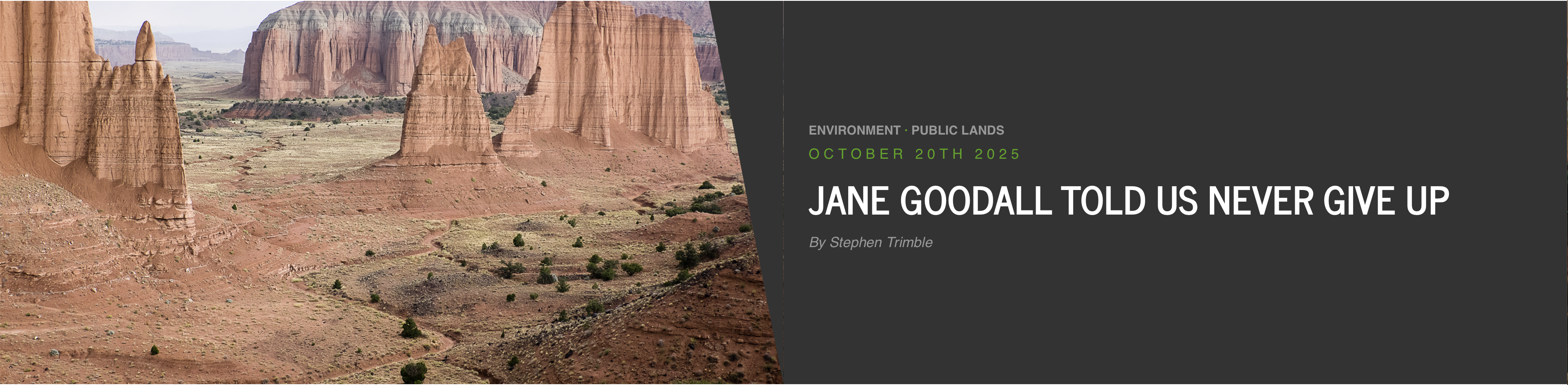
The Lee-Curtis proposal would bring OHV traffic into the wildness and quiet of Cathedral Valley in Capitol Reef National Park. Photo courtesy Stephen Trimble
In her “Last Words” interview that was broadcast after her death, Jane Goodall talked about her calm in the face of “the dark times we are living in now.” She devoted her life to battling for conservation but attributed this serenity to the time she spent in the forest with the chimps. All those weeks and months and years of quiet observation.
Such quiet is a rare gift. I haven’t been in Goodall’s Tanzanian rain forest, but recently shared Utah’s Capitol Reef National Park with a 25-year-old cousin visiting from urban America. Once in the canyons he kept pausing to say, “it’s so peaceful, so still.” He was astonished and renewed by that quiet.
This canyon country stillness is under attack. The assaults come in waves powered by motorized vehicles, engines revving.
First, the Trump administration proposes abandoning the 2023 Bureau of Land Management travel plan for Labyrinth Canyon. This 300,000-acre Utah wildland along the Green River just north of Canyonlands National Park is a gem—a fretwork of slickrock canyons along the river. Labyrinth preserves quiet for rafters, hikers, and bighorn sheep. No death-defying rapids here on this lazy, looping stretch easily paddled by families in canoes.
In a model compromise, the current Labyrinth plan maintains access to more than 800 miles of off-highway-vehicle (OHV) routes, closing only 317 miles to vehicles. In the surrounding Moab region, more than 4,000 miles of routes remain open. OHVs have plenty of room to roam.
But moderation is never enough for Utah politicians determined to motorize every inch of our public lands. They are pushing to reopen 141 miles of closed OHV routes at Labyrinth and hoping for even more. You can comment here before October 24.
In another backtrack on conservation in Utah, the administration has solicited bids for coal leasing on 48,000 acres of BLM land, much of it on and near the boundaries of national parks. The big views from Capitol Reef, Zion, and Bryce Canyon don’t stop at the park boundaries. Visitors, many from other countries, would be horrified by such industrialization of these world-class destinations. Rural Utah depends on these tourists to survive economically.
These are lands that even the conservative second Bush administration deemed unsuitable for mines. As Cory MacNulty, with the National Parks Conservation Association, said of the proposed leasing, “It’s absurd.”
Now the OHV battalions are threatening to overwhelm Capitol Reef National Park.
Utah Republican Senators Mike Lee and John Curtis introduced a bill on October 5 to open virtually every road in Capitol Reef to off-roaders. They claim that disabled Americans need this fundamental change to park policy, though even the park’s back roads are currently accessible by moderately high-clearance cars and trucks. There’s absolutely no need to permit noisy and destructive OHVs.
The senators’ second bill would potentially open other national parks to OHV use. Lee tried to pass nearly identical bills in 2021 and encountered a buzzsaw of resistance from national park advocates.
As retired Capitol Reef superintendent Sue Fritzke said, “OHVs would denigrate the very resources those sites have been set aside to protect, with increased dust and noise and impacts on wildlife, endangered species, and visitors.”
At each mile farther into remote corners of the park, off-highway vehicles become more problematic. Even though a majority of riders obey the rules, some will go off-road. They just will. Their vehicles are designed for this exact purpose. In Capitol Reef’s considerable backcountry—as in all underfunded national parks and monuments— staffing does not allow for constant patrolling to apprehend and ticket wrongdoers.
Capitol Reef is a place to slow down, not speed up. To revel in quiet, not reach for earplugs. To share the healing land with tenderness and restraint.
Lee disrespects national park values with these twin bills, and Curtis, who likes to tout his nature sensitivity on hikes with constituents, should know better. Their misguided proposals should be left to wither in committee and die. Those of us who love the restorative peace of national parks will just keep fighting such regressive bills.
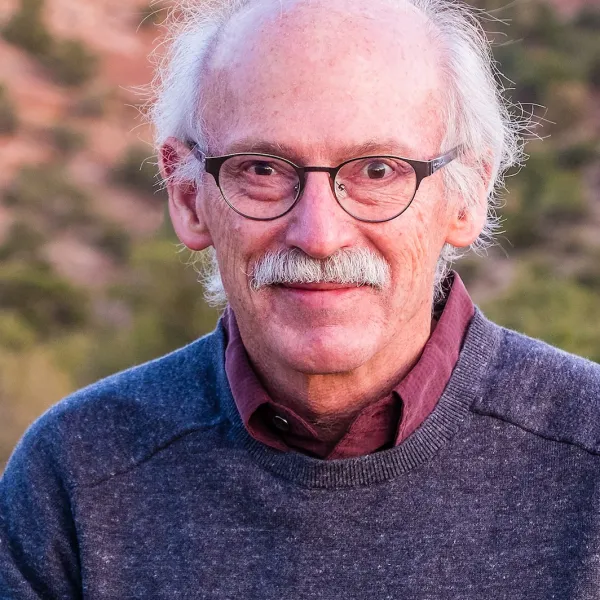
Stephen Trimble: Photo credit: Writers on the Range
In her last interview, Jane Goodall asked us to never give up: “Without hope, we fall into apathy and do nothing. If people don’t have hope, we’re doomed. Let’s fight to the very end.”
We will.
Stephen Trimble is a contributor to Writers on the Range, writersontherange.org, an independent nonprofit dedicated to spurring lively conversation about the West. He is a writer and photographer in Utah.
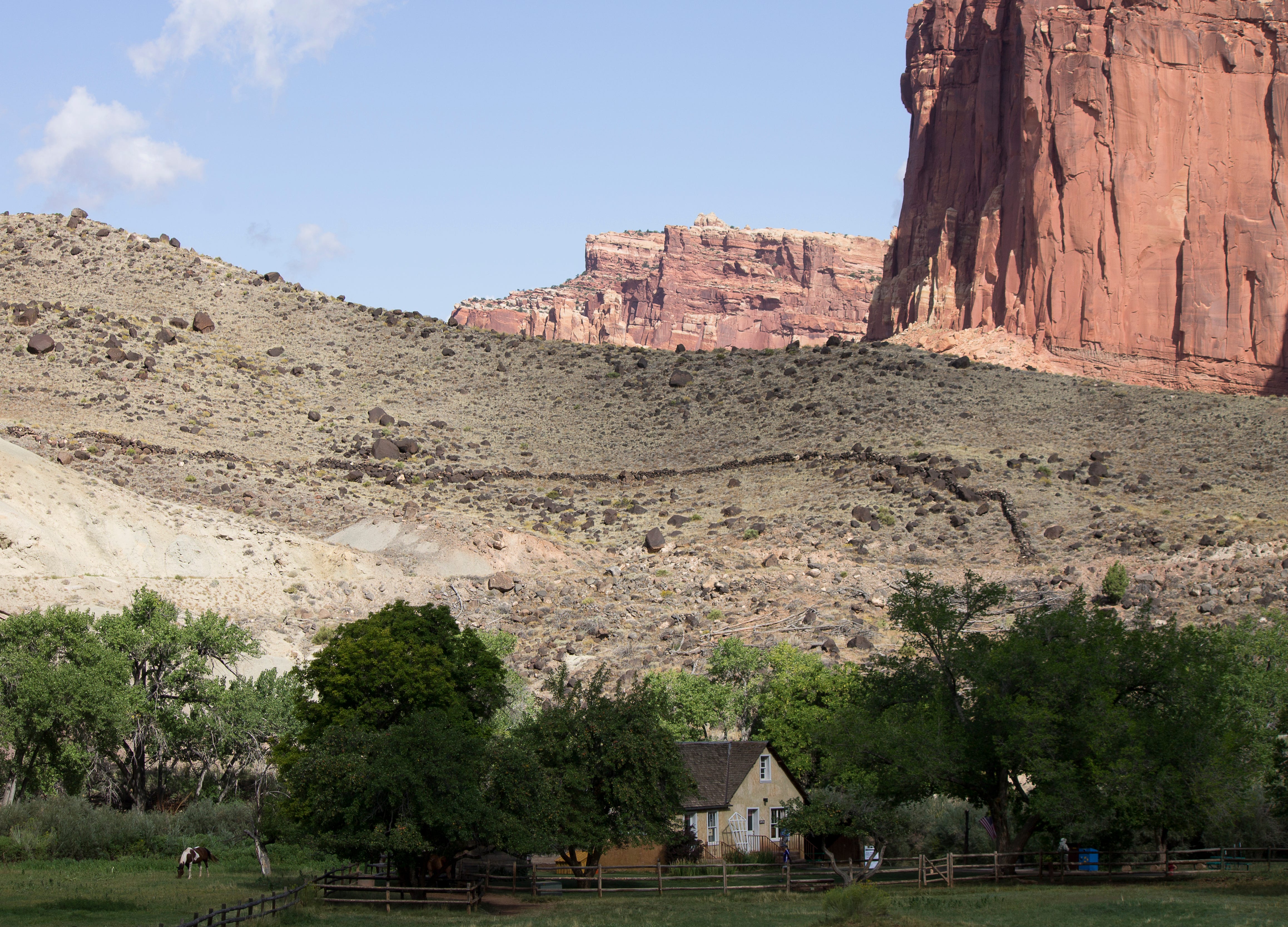
The Gifford Homestead in Capitol Reef National Park. Jonathan P. Thompson photo.
Klamath salmon are spawning in the Williamson River 4 the 1st time since the early 1900s. This pivotal moment is a testament to decades of activism, rigorous scientific research & advocacy from Klamath Basin Indigenous communities & allies. Photos by Paul Wilson/Klamath Tribes pic.twitter.com/P1gYxhUXaD
Here’s the link to the obituary in The New York Times (Gavin Edwards). Here’s an excerpt:
October 16, 2025
Ace Frehley, the original lead guitarist of the hard-rock band Kiss, who often performed in white-and-silver face makeup as the group sold millions of records during his two tenures with it, from 1973 to 1982 and then from 1996 to 2002, died on Thursday in Morristown, N.J. He was 74…A consummate showman, like all the members of Kiss, Mr. Frehley was known for playing guitars rigged with pyrotechnic effects and for his distinctive stage persona: He was known as “the Spaceman” or “Space Ace” because of the silver stars on his face. He designed the band’s logo, with its lightning-bolt letters…
Many rock fans initially dismissed Kiss as gimmicky charlatans. Its members weren’t photographed without their stage makeup until 1983. But the band’s energetic and theatrical live shows built a following of teenagers, known as the Kiss Army. The band placed eight singles in the Top 40 during Mr. Frehley’s tenure, and he played on seven of them, including “Love Gun,” “Christine Sixteen” and “I Was Made for Loving You.”
[…]
During Mr. Frehley’s time with Kiss, the band released 11 albums, both studio and live, that went gold or platinum in the United States. (Kiss ultimately sold more than 100 million albums.) With the passage of time and the enduring popularity of its party anthem “Rock and Roll All Nite,” the band saw its critical reputation improve. Kiss was inducted into the Rock & Roll Hall of Fame in 2014. The guitarist Tom Morello of Rage Against the Machine inducted the band, making the case for Kiss’s influence on everyone from Metallica to Lady Gaga. Mr. Frehley, he said, “blazed unforgettable, timeless licks across their greatest records.” Mr. Frehley himself bragged in a 2024 interview with the website Antihero that “out of the four founding members of Kiss, I definitely have been the most successful solo artist.” That was true largely because of his single “New York Groove,” a Top 20 hit with a stomping beat that is now played at Citi Field after every Mets victory. “New York Groove” was the most successful single from a typically excessive Kiss stunt: In 1978, the four members all released solo albums simultaneously.
Scientists secure jute netting over mulch on a newly planted section of the Ophir Pass fen in Colorado’s San Juan Mountains. Anna Marija Helt/High Country News
The resinous scentof Engelmann spruce wafted over a shallow, mossy pool surrounded by lush sedges near the 11,800-foot summit of Ophir Pass, in southwestern Colorado’s rugged San Juan Mountains. This type of wetland, known as a fen, forms when perennial water saturates the ground, limiting plant decomposition and allowing organic matter to accumulate as peat.
Just downhill, however, on that hot, sunny July day, another part of the fen was visible: a degraded area, bare soil exposed on a steep slope.
Peatlands — fens and bogs — are key climate regulators. (Bogs are maintained by precipitation, but fens, which, in North America, occur in the Northeast, Midwest and Mountain West, depend on groundwater.) Their peat retains plant carbon that would otherwise decompose and be released as carbon dioxide. Despite covering only about 4% of Earth’s land area, peatlands store a third of the world’s soil carbon — twice the amount trapped in forest biomass. “Fens are old-growth wetlands,” said Delia Malone, a recently retired field ecologist with the Colorado Natural Heritage Program. Some of Colorado’s fens are over 10,000 years old.
In relatively dry southern Colorado, they also provide a secondary round of water storage. The first round is Colorado’s snowpack, which, as it melts, feeds groundwater that fens’ spongy peat captures and later releases to dwindling waterways and drying landscapes after the snow is gone.
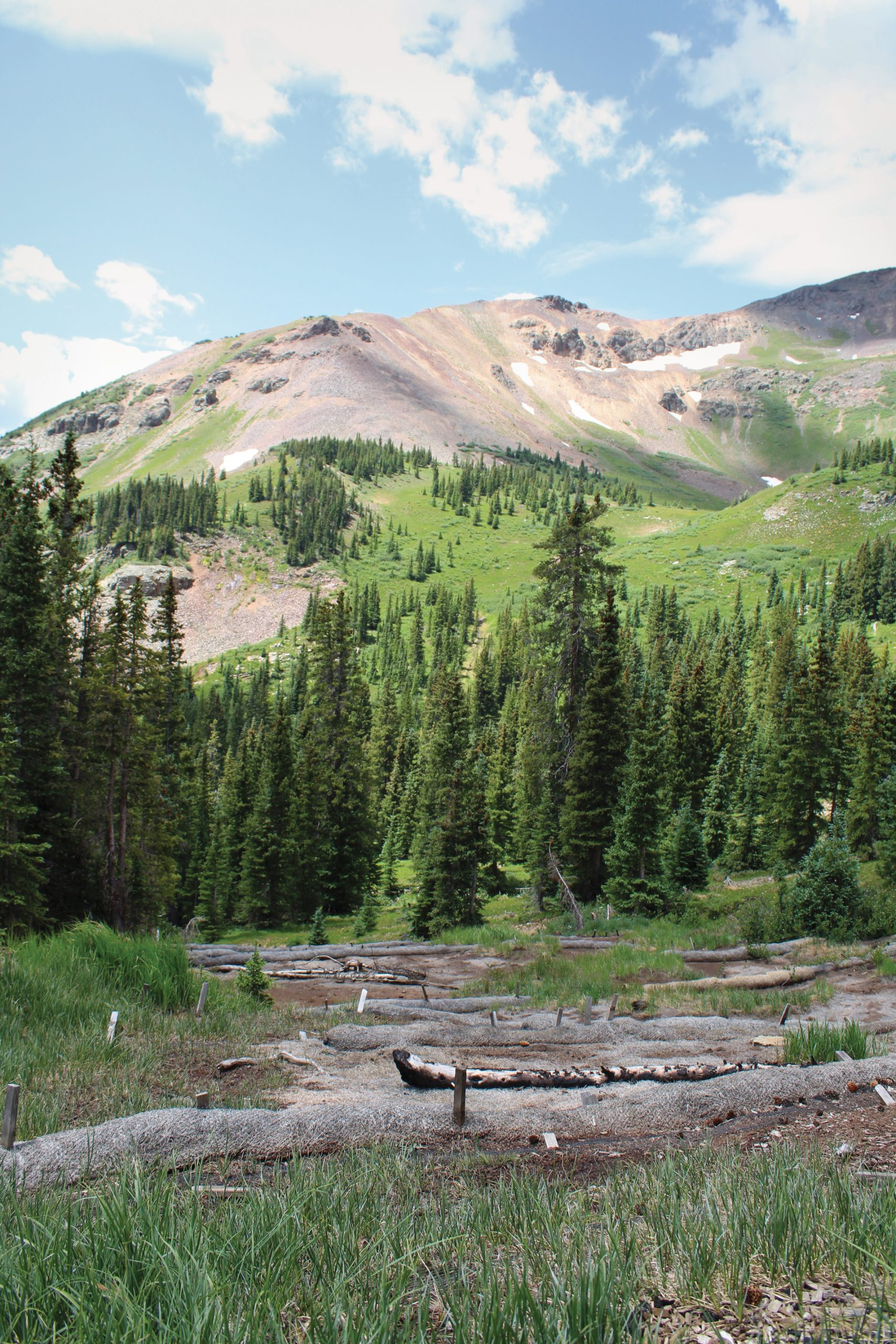
But the steep and degraded bare patch at Ophir Pass no longer functions. Where sedges, mosses, bog birch and other wetland species should be thriving, white PVC groundwater testing wells dot the ground, and heavy straw tubes called wattles reduce water and sediment runoff into the creek below.
“This is the steepest peatland we’ve ever tried to restore, as far as I know,” said wetland ecologist Rod Chimner, a professor at Michigan Tech. In the Rockies, fens lie at high elevations, which complicates restoration. Approximately 2,000 fens have been mapped so far in the San Juans, and about 200 need work. Chimner’s Ph.D. advisor, David Cooper, began restoring the area’s fens decades ago, and together they’ve literally written the book on mountain peatland restoration. Now, Chimner and staff from Mountain Studies Institute (MSI) — a local nonprofit research and education center — are restoring an ecosystem born from the last ice age but damaged by bulldozing in the 1970s.
Dams, road-building and other human activities harm Colorado’s fens, which can take 1,000 years to build just 8 inches of peat soil. The Ophir Pass fen is a rare iron fen, fed by groundwater rendered acidic by iron pyrite. The resulting chemistry supports unique plant communities — and leaves iron and other minerals incorporated in the peat or deposited in hardened layers. This fen was likely damaged by bog iron mining, which has degraded several iron fens in the San Juans.
Wattles on a steep degraded section of the fen. Anna Maria Helt/High Country News
Lenka Doskocil examines roots in peat that could be centuries old. Anna Maria Helt/High Country News
A restored pool flanked by sedges. Anna Maria Helt/High Country News
CLOUDS STARTED TO BUILD as workers used hand saws to extract plugs of sedge and soil from a healthy, already restored part of the fen. Like Goldilocks’ bed, the plugs have to be just right: Too large or too many, and digging them up disturbs the soil surface; too small, and they won’t survive transplantation. “As long as it has at least one rhizome, it will plant and spread,” said Lenka Doskocil, a research associate with MSI’s Water Program and Chimner’s graduate student. She split a plug, revealing rhizomes embedded in the rusty-brown peat, then nestled it into a bucket of plugs. Sometimes, workers plant nursery plugs or greenhouse starts from seeds collected in the area.
Chimner and Doskocil hauled the first bucket of plugs up to the bare patch, began digging small, regularly spaced holes, then gently inserted one sedge plug per opening. A stiff breeze provided relief as several other people joined in. “Take your time and do it right,” Chimner said encouragingly as he stepped back to observe. Otherwise, the plugs wouldn’t take.
Doskocil spotted an older plug protruding from the soil. But it wasn’t from rushed planting: Frost heave, a freeze-thaw cycle that thrusts soil upwards, had kicked it out of the ground, she said, tucking it back in. Frost heave complicates planting and breaks rhizomes, preventing nearby plants from colonizing bare soil. But Chimner’s past research has yielded a solution: Team members insulated the surface around each newly transplanted sedge with Excelsior, a shredded aspen mulch tough enough to withstand several winters. “We’re giving them little down jackets,” Chimner said.
A rhythm of extract-portage-dig-plant-mulch ensued as the iron-painted ridge of Lookout Peak towered to the north. A passenger yelled “thank you” from a truck descending the pass. Doskocil broke open a handful of peat, revealing roots that were hundreds of years old, if not older.
Planting the steepest quarter acre here has been difficult, and a 2021 fire didn’t help. “We’re kind of starting all over again” in that section, Chimner explained. They’re experimenting with direct seeding, which is common in wetland restoration, but challenging at the high-elevation site. “I’ve seeded here three times,” said Haley Perez, a community science program assistant with MSI.
Conservation biologist Anthony Culpepper, associate director of MSI’s Forest Program, gestured uphill toward what used to be a bare “Mars slope.” He listed the challenges: timing, winds that blow seeds away, variable winter and monsoonal precipitation, a short growing season, a sunbaked slope and animals that eat the seeds. Still, over many seasons and with multiple collaborators — several federal agencies, San Juan National Forest, Purgatory Village Land, the National Forest Foundation, San Juan Citizens Alliance and others — they’ve made great progress. That former Mars slope is now covered with mat-forming, soil-stabilizing wetland plants, including rare species.
The fen is wetter from strategic placement of wattles and check dams, wooden slats that slow surface water flow so that it soaks into the ground instead of running straight downhill. In turn, more groundwater has enabled transplantation and spread of thousands of plants. Much of the fen is now green, with mosses and other vegetation colonizing on their own. “This is the first time I’ve seen arnica at the site,” said Culpepper, who also noted the lack of invasives, a promising sign.
MSI takes an adaptive approach to restoration: Research guides planning and execution, and outcomes are carefully monitored to guide future work. That’s important in a region and state where rising temperatures and declining snowpack are predicted to lower water tables, which could disrupt new peat formation and even promote peat decomposition, potentially shifting some fens from carbon storage to carbon release. “How do we get our systems to a spot where they’re resilient enough to withstand the challenges that are going to continue to come?” asked Doskocil. MSI and its collaborators are working on it — at Ophir Pass; at Burrows Fen, a new project north of Silverton; and elsewhere throughout the San Juans.
Fat raindrops landed as the group debated whether to secure the mulch with a layer of jute netting. A wind gust decided it; they added the netting and then, just as the sun returned, trooped uphill to their vehicles to head home. Someone asked Chimner if he was satisfied with the day. “When I can look down and see all green, I’ll be satisfied,” he replied.
Wild for Good is a call to action and, we hope, an inspiration for you to join us in work that future generations will thank us for. We highlight 10 landscapes that Wilderness Workshop is invested in for the long haul. They are places where we explore nature with our friends and families, float boats in the summer, and backcountry ski in the winter. They provide critical wildlife habitat and connectivity corridors, and safeguard ecosystems that are necessary for climate resilience. And they may be lost to us forever if we don’t rally for their protection.
There are many, many more lands in our region that must also be protected and conserved so that we have a vibrant wildlands network to sustain our human and natural communities – ranging from roadless areas to working lands. These 10 priority landscapes are anchors in that network, places we’ve identified as deserving of and needing durable protections to support the ecological vitality of the whole region. By creating and sustaining thriving ecosystems in our neck of the woods, we in turn sustain and contribute to healthier natural systems across the state of Colorado and the West.
Please join us in this important work. Together, our community can keep our treasured public lands and waters…Wild for Good.
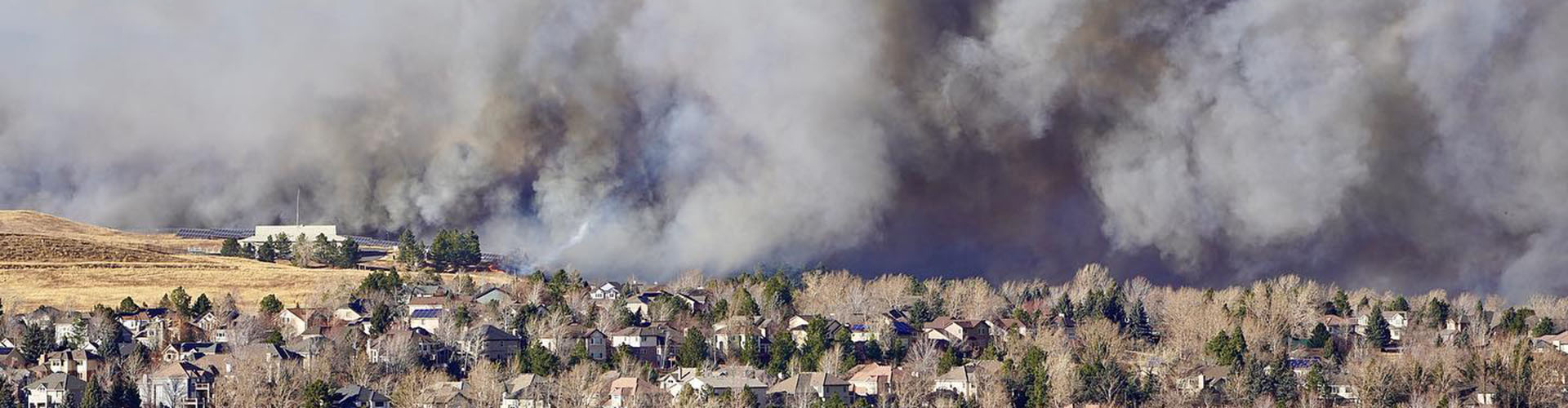
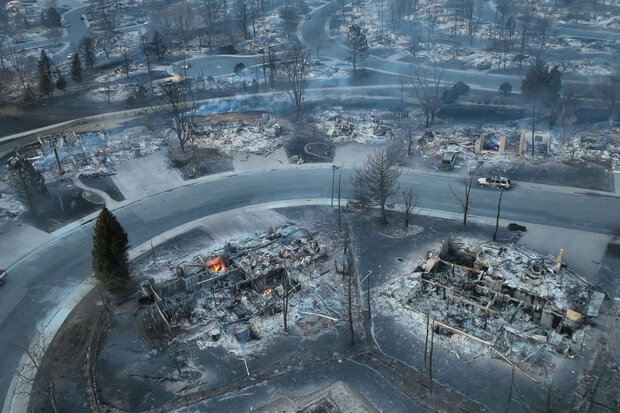
Marshall Fire December 30, 2021. Photo credit: Boulder County
Click the link to read the article on the Big Pivots website (Allen Best):
September 24, 2025
Xcel Energy, Qwest Corporation, and Teleport Communications America have reached agreements in principle to settle all claims asserted by subrogation insurers, the public entity plaintiffs, and individual plaintiffs.
Xcel Energy, through its subsidiary, Public Service Company of Colorado, expects to pay $640 million related to these settlements. Of that, $350 million is to come from insurance coverage and none from its customers.
The agreements in principle remain subject to final documentation and individual plaintiffs opting in to the agreement negotiated and recommended by their counsel.
Xcel Energy does not admit any fault, wrongdoing, or negligence in connection with this resolution.
“Despite our conviction that PSCo equipment did not cause the Marshall Fire or plaintiffs’ damages, we have always been open to a resolution that properly accounts for the strong defenses we have to these claims. In resolving all liability from the claims, this settlement reinforces our longstanding commitment to supporting the communities we serve,” said Bob Frenzel, chairman, president and CEO of Xcel Energy, in a statement released by Xcel.
“We recognize that the fire and its aftermath have been difficult and painful for many, and we hope that our and the telecom defendants’ contributions in today’s settlement can bring some closure for the community.”
The Marshall Fire left smoldering ruins in a Louisville, Colorado, neighborhood, at the end of December 2021. Photo courtesy WXChasing. Used with permission.
Xcel has developed a comprehensive strategy to reduce wildfire risk and improve grid resilience. See more about that plan here. The 2025-27 Wildfire Mitigation Plan includes investments in system resilience, improved situational awareness of high-risk fire scenarios, enhanced operations and maintenance practices to mitigate fire risk and increased engagement with state and local agencies.
This plan, which is informed by inputs from local communities and governments, includes specific improvements for Boulder County, including undergrounding certain power lines and modernizing energy delivery infrastructure.
The Marshall Fire started December 30, 2021, from an ignition on the Twelve Tribes property in Boulder County, when embers from an earlier debris burn reignited. The fire, fueled by high winds, spread quickly to the towns of Louisville and Superior. A second ignition occurred nearby approximately 80 minutes later.
The plaintiffs filed lawsuits seeking billions of dollars in damages against Xcel Energy and the telecom defendants in connection with the second ignition. Xcel Energy disputes that its equipment was involved in the second ignition.
SALT LAKE CITY — Researchers at Utah State University just completed a joint study with the Utah Division of Water Rights to better understand surface water movement and measurement near Great Salt Lake.
The critical study comes as efforts are underway by the Great Salt Lake Watershed Enhancement Trust, Office of the Great Salt Lake Commissioner and other agencies to increase flows to benefit the lake’s diverse objectives including lake level, habitat and salinity.
By speaking with local water managers, USU researchers were able to gather key information about how surface water moves throughout the Great Salt Lake ecosystem, inclusive of Great Salt Lake’s peripheral wetlands and its water body, as well as document existing measurement infrastructure, which was previously unavailable in one location.
“This information was not included in the first report because we realized we needed extra time to understand the important nuances of the whole lake ecosystem connectivity,” said Eileen Lukens, a Utah Water Research Laboratory researcher on the project.
Measurement of the water flowing to the Great Salt Lake commonly relies on four gages upstream of Great Salt Lake’s peripheral wetland complexes with little measurement below those points prior to 2024, according to USU researcher Eryn Turney. This unique study involved a three-season field campaign in which the USU team visited sites at the last measurable points of inflow to Great Salt Lake.
“We realized that there was a gap in our understanding of how water moves not only to Great Salt Lake’s ecosystem as a whole, but also between distinctive portions of the ecosystem like the wetlands and water body,” Turney said. “We wanted to understand the interconnection of these areas and how increased measurement could facilitate future water delivery.”
With this in mind, USU researchers were able to identify locations where additional measurement infrastructure is needed to aid in lake-oriented objectives as well as develop diagrams to identify potential pathways for water delivery to areas of Great Salt Lake’s ecosystem.
“This study is an important step forward in understanding how water moves through the Great Salt Lake ecosystem,” said Division of Water Rights Deputy State Engineer Blake Bingham. “By identifying where additional measurement is needed, we can make better-informed decisions that support management objectives of the lake and water distribution across the basin. Collaboration like this between state agencies and our research partners strengthens our ability to administer and distribute water rights with greater confidence and transparency.”
Lukens added that their work is a part of a larger whole made up of many lake stakeholders with projects underway that contribute to tracking and managing water.
“The United States Geological Survey, Division of Water Rights and other agencies made huge efforts this past year while our study was underway to address some of the measurement gaps around the lake.” Lukens said. “Although there are still more gaps to address, we are a lot closer to understanding inflow to Great Salt Lake now.”
Sunset from the western shore of Antelope Island State Park, Great Salt Lake, Utah, United States.. Sunset viewed from White Rock Bay, on the western shore of Antelope Island. Carrington Island is visible in the distance. By Ccmdav – Own work, Public Domain, https://commons.wikimedia.org/w/index.php?curid=2032320
Members of the House Committee on Natural Resources convene a hearing on public land funding at Jenny Lake Plaza in Grand Teton National Park on Sept. 5, 2025. Representatives pictured are Troy Downing, Doug LaMalfa, Harriet Hageman, Chairman Bruce Westerman and Teresa Leger Fernandez. (Angus M. Thuermer Jr./WyoFile)
Click the link to read the article on the WyoFile.com website (Angus M. Thuermer Jr.):
September 15, 2025
Four initiatives among federal agencies and in Congress would harm the Western landscape owned by all Americans, conservationists contend.
As Congress conducted a high-profile hearing in Grand Teton National Park 10 days ago to support parks funding, President Donald Trump’s administration and supporters were busy elsewhere eliminating public land protections across the West.
The Grand Teton hearing conducted by the House Committee on Natural Resources on Sept. 5 heard widespread support for resolving a backlog of maintenance at national parks, along with calls to restore DOGE staffing cuts.
But the committee meeting at the spectacular Jenny Lake Plaza came amidst a flurry of attacks against rules protecting wildlife, its habitat and preservation funds, conservationists said.
Those attacks include Agriculture Secretary Brooke Rollins’ move to rescind the Forest Service roadless rule that protects 59 million roadless acres considered vital to wildlife. Also, Interior Secretary Doug Burgum issued an order restricting use of the Land and Water Conservation Fund, which was created in 1964 to buy and preserve recreation lands.
Meantime, the U.S. House on Sept. 3 put on the chopping block a Bureau of Land Management plan in Montana that restricted coal leasing. If agreed to by the Senate, the bill would open the door to “legal and regulatory chaos” across the West, the Center for Western Priorities warned.
And on Thursday, the BLM opened comment on the plan to roll back its Public Lands Rule that gave conservation an equal footing with industrial uses of property owned by all Americans.
All that happened in 15 days — about one week on either side of the congressional Teton hearing. But while witnesses were supporting parks in the open air of the Teton Mountains, Trump allies were undercutting conservation with less visible methods, one public lands advocate said.
The rule changes, secretarial orders and legislation are complex and sometimes opaque, said Amy Lindholm, an Appalachian Mountain Club director and spokesperson for the Land and Water Conservation Fund Coalition.
“It’s not easy to understand what’s going on here,” she said, using Burgum’s order curtailing the LWCF as an example. “It flies under the radar [but] could be as serious as selling off pieces of federal public land.”
The MAGA messages
The administration and its supporters characterized the changes as necessary to help reduce the federal deficit, rectify allegedly unlawful policies and increase energy production, among other things.
“I am so baffled and mortified that for four years our government intentionally tried to impose energy poverty on the American people, all to please the vocal but minority climate lobby,” U.S. Rep Harriet Hageman said on the House floor when voting Sept. 3 for Joint House Resolution 104.
That bill states that the BLM’s Montana management plan restricting coal leasing in the Powder River Basin “shall have no force or effect.”
Designated roadless areas, like these timber stands on the Shoshone National Forest near South Pass, would be eliminated under rescission of the 2001 Roadless Rule that’s been announced by U.S. Department of Agriculture Secretary Brooke Rollins. (Mike Koshmrl/WyoFile/EcoFlight)
Hageman’s vote was one of three in the 211-208 tally that helped Republicans use the Congressional Review Act to move the bill through the House.
On another front, Agriculture Secretary Rollins’ roadless-rule rollback will allow loggers “to access our abundant timer [sic] resources,” U.S. Sen. Cynthia Lummis wrote to a constituent on Sept. 2. The roadless rule “has done nothing to advance our national interest or strengthen our communities,” Lummis wrote.
The rollback “will give state and local leaders, not distant federal agencies, the authority to manage forests responsibly, improve forest health, and implement real wildfire prevention strategies,” Lummis’ letter reads. “I will push back on any policies that endangers [sic] Wyoming families, communities or businesses.”
In ordering revisions to the Land and Water Conservation Fund, Interior Secretary Burgum wrote that changes will ensure funds “are managed efficiently and aligned with the goals of the Trump administration.” The account was used to buy and protect the 640-acre Kelly Parcel in Grand Teton National Park. While touting the revisions, Burgum said the Trump administration has “prioritized access to Federal lands and outdoor recreation.”
At the BLM, meanwhile, conservation should not be on equal footing with mining, drilling and grazing, according to a notice seeking public comment on the expurgation of the Public Lands Rule. Also known as the Conservation and Landscape Health Rule, the measure is “unnecessary and violates existing statutory requirements,” the notice reads.
Conservation doesn’t rise to a “principal or major use” of BLM land, the Western Energy Alliance said in a statement supporting rollback of the Public Lands Rule. Those principal uses are “mineral exploration and production, livestock grazing, rights‐of‐way, fish and wildlife development, recreation, and timber,” the statement said.
Greens see an assault
Conservationists and others are challenging those MAGA positions. Using the Congressional Review Act to undo the BLM’s Montana plan for the Powder River Basin coal — a move Hageman voted for — risks unleashing “legal and regulatory chaos across the West,” the Center for Western Priorities said.
“If courts interpret this action broadly, every management plan written since 1996 could be challenged in court — potentially invalidating oil and gas leases, grazing permits, and threatening public access to trails and campgrounds,” the Center’s Deputy Director Aaron Weiss said in a statement.
Without BLM resource management plans, operations would revert to “outdated frameworks … written before today’s recreation economy took off,” he said. “Outfitters, guides and businesses that depend on reliable access for rafting, off-roading, and other outdoor activities could face years of uncertainty, permit delays, and costly litigation.”
Road densities are especially high in Wyoming outside of wilderness areas and wilderness study areas, marked in blue in this map. Roads depicted are from the U.S. Geological Survey National Transportation Dataset. (Wyoming Wilderness Association)
On the roadless front, Lummis’ contention that roads can help prevent wildfires contradicts a 2007 study that found “current road systems increase risk of human-caused fire.” Authored by the Pacific Biodiversity Institute, the 40-page paper found that “[a]reas that are very close to roads have many times more wildfire occurrences than areas distant from roads.”
Roadless areas are critical to outfitter Meredith Taylor, who has worked successfully in them for decades, she told WyoFile. Industrializing them could endanger her family, community and business, she suggested.
“Unnecessary road development would ruin the value of these public lands for people and wildlife who appreciate them as they are,” Taylor said. The Jackson Hole Wildlife Foundation and others urged the public to comment before Sept. 19.
Conservation should be equal
Conservationists also decried the pending revocation of the BLM’s Public Lands Rule/Conservation and Landscape Health Rule. “The administration is saying that public lands should be managed primarily for the good of powerful drilling, mining and development interests,” Alison Flint, senior legal director at The Wilderness Society, said in a statement.
“They’re saying that public lands’ role in providing Americans the freedom to enjoy the outdoors, and conserve beloved places … is a second-class consideration,” Flint said. The rule “has solid grounding in a nearly 50-year-old directive from Congress,” she said.
Defenders of Wildlife said the existing rule “requires science-based decision-making and consideration of conservation.” The rule is “foolishly being yanked away in service of the ‘Drill, baby, drill’ agenda,” Vera Smith, national forests and public lands director at Defenders, said in a statement.
Addressing changes to the Land and Water Conservation Fund, which receives $900 million a year from oil and gas leasing, LWCF Coalition spokesperson Lindholm warned of dangers in Burgum’s order.
“There’s a provision encouraging states to use their state grant dollars [from the federal fund] to buy surplus federal land,” she said. “We don’t want states to use the funds to buy back federal land that’s already been protected, to pay for continued access to places they already have access to,” she said.
Given Burgum’s advocacy for developing federal land for housing, the changes create “a dangerous potential pathway for the selloff of federal lands,” she said.
The agency already has a process for the sale of property that works, Lindholm said. Burgum’s order will reexamine that process “with the intent of increasing the discretion of the secretary.”
Without Burgum’s stated selloff advocacy, “it’s not something we would have necessarily red-flagged,” she said.
Soul of Wyoming
Healthy landscapes and wildlife are the soul of northwestern Wyoming, state Rep. Liz Storer, a Democrat from Jackson, said. Her district covers Grand Teton and parts of Yellowstone national parks, the National Elk Refuge, parts of the Bridger-Teton National Forest and BLM property.
Those lands and the wildlife on them “define who we are,” she said at a Keep Parks Public rally in Jackson on Sept. 4.
Others at the forum chimed in. “These threats to public lands are very much alive,” Lauren Bogard, senior director of advocacy at the Center for Western Priorities, said after outlining DOGE cuts and threats to conservation.EcoTour Adventures founder and wildlife guide Taylor Phillips told the Teton congressional panel that scientists are scared. “In the next five to 10 years, the wildlife as we see it now will not exist unless drastic measures are taken,” Phillips testified of his talks with scientists.
It took decades, stacks of legal paperwork and countless phone calls, but, in the spring of 2025, a California Chuckchansi Native American woman and her daughter walked onto a 5-acre parcel of land, shaded by oaks and pines, for the first time.
This land near the foothills of the Sierra National Forest is part of an unusual category of land that has been largely left alone for more than a century. The parcel, like roughly 400 other parcels across the state totaling 16,000 acres in area, is held in trust by the federal government for the benefit of specific Indigenous people – such as a family member of the woman visiting the land with her daughter.
Largely inaccessible for more than a century, and therefore so far of little actual benefit to those it is meant for, this land provides an opportunity for Indigenous people to not only have recognized land rights but also to care for their land in traditional ways that could help reduce the threat of intensifying wildfires as part of a changing climate.
In collaboration with families who have long been connected to this land, our research team at the University of California, Davis is working to clarify ownership records, document ecological conditions and share information to help allottees access and use their allotments.
California’s unique historical situation
As European nations colonized the area that became the United States, they entered into treaties with Native nations. These treaties established tribal reservations and secured some Indigenous rights to resources and land.
Just after California became a state in 1850, the federal government negotiated 18 treaties with 134 tribes, reserving about 7.5 million acres, roughly 7.5% of the state, for tribes’ exclusive use.
Then, in 1887, Congress passed the Dawes Act, which allowed Native people across the U.S. to be assigned or apply for land individually. Though it called the seized land – their former tribal homelands – the “public domain,” the Dawes Act presented a significant opportunity for the landless Native people in California to secure land rights that would be recognized by the government.
Allotments are in a wide range of ecosystems, though more are in blue oak woodlands than any other single type of habitat. Images created by James Thorne, Ryan Boynton, Allan Hollander and Dave Waetjan.
Many of these allotments were remote – ecologically rich, yet hard to access. They were carved out of ancestral territories but often lacked access to infrastructure like roads, water or electricity. In some cases, allotments were separated from traditional village sites, ceremonial areas or vital water resources, cutting them off from broader ecosystems and community networks.
Federal officials often drew rough or incorrect maps and even lost track of which parcels had been allotted and to whom, especially as original allottees passed away. As a result, many allotments were claimed and occupied by others, coming into private hands without the full knowledge or consent of the Native families they were held in trust for.
There were once 2,522 public domain allotments in California totaling 336,409 acres. In 2025, approximately 400 of these allotments remain, encompassing just over 16,000 acres. They are some of the only remaining, legally recognized tracts of land where California Native American families can maintain ties to place, which make them uniquely significant for cultural survival, sovereignty and ecological stewardship.
The allotments today
Because of their remoteness, many of these lands remained relatively undisturbed by human activity and are home to diverse habitats, native plants and traditional gathering places. And because they are held in trust for Native people, they present an opportunity to exercise Indigenous practices of land and resource management, which have sustained people and ecosystems through millennia of climate shifts.
We and our UC Davis research team partner with allottee families; legal advocates including California Indian Legal Services, a Native-led legal nonprofit; and California Public Domain Allottee Association, an allottee-led nonprofit that supports allottees to access and care for their lands. Together, we are studying various aspects of the remaining allotments, including seeking to understand how vulnerable they are to wildfire and drought, and identifying options for managing the land to reduce those vulnerabilities.
Allotments have a range of fire risk, though many are in very-high-risk areas. Images created by James Thorne, Ryan Boynton, Allan Hollander and Dave Waetjan.
Many of these parcels are located in remote, less-developed foothills or steep terrain where they have remained relatively intact, retaining more native species and diverse habitats than surrounding lands. Many of these parcels have elements like oak woodlands, meadows, brooks and rivers that create cooler, wetter areas that help plants and animals endure wildfires or periods of extreme heat or drought.
Allotment lands also offer the potential for the return of stewardship methods that – before European colonization – sustained and improved these lands for generations. For example, Indigenous communities have long used fire to tend plants, reduce overgrowth, restore water tables and generally keep ecosystems healthy.
Guided by Indigenous knowledge and rooted in the specific cultures and ecologies of place, this practice, often called cultural burning, reduces dry materials that could fuel future wildfires, making landscapes more fire-resilient and lowering both ecological and economic damage when wildfires occur. At the same time, it brings back plants for food, medicine, fiber and basketry for California Native communities.
Challenges on allotments
The Chuckchansi family who reached their land for the first time in the spring of 2025 would like to move onto the land. However, the parcel is surrounded by private property, and they need to seek permission from neighboring landowners to even walk onto their own parcel.
In addition, a small number of employees at the Bureau of Indian Affairs are responsible for allotments, and they must also deal with issues on larger reservations and other tribal lands.
Further, because the lands are held in federal trust, allottees’ ability to engage in traditional management practices like cultural burning often face more stringent federal permitting processes than state or private landowners – including restrictions under the Clean Air Act and the National Environmental Policy Act.
To our knowledge, no fire management plans have been approved by the Bureau of Indian Affairs on California Native American public domain allotments. Nonetheless, many families are interested in following traditional practices to manage their land. These efforts were a key topic at the most recent California Public Domain Allottees Conference, which included about 100 participants, including many allottee families.
People gather at the second annual California Public Domain Allottees Conference in May 2025. Nina Fontana, CC BY-NC-ND
One option could be to shift some of the regulatory authority from the Bureau of Indian Affairs to the allottees themselves. Shifting authority to Indigenous peoples has improved forest health elsewhere, as found in a collaborative study between University of California Extension foresters and Hoopa Tribal Forestry. That research found that when the Hoopa Tribe gained control of forestry on their reservation along the Klamath River basin in northern California, tribal leaders moved toward more restorative forestry practices. They decreased allowable logging amounts, created buffers around streams and protected species that were culturally important, while still reducing the buildup of downed or dead wood that can fuel wildfires.
At a time when California faces record-breaking wildfires and intensifying climate extremes, allotments offer rare pockets of intact habitat with the potential to be managed with cultural knowledge and ecological care. They show that adapting to change is not just about infrastructure or technology, but also about relationships – between people and place, culture and ecology, past and future.
Every element that a wildfire needs in order to burn big, hot and fast converged in the northwestern corner of Colorado in early August.
Persistent daytime temperatures neared record highs. Winds gusted at 40 mph. Humidity levels hovered at about 2% — a percentage typically only seen in the Mojave Desert, said fire-behavior analyst Béla Harrington.
After six months of scant precipitation, the soil and vegetative fuels were bone dry, ready to explode with any extraneous spark.
The hot, thirsty air had sucked nearly every bit of remaining moisture out of the grasses, shrubs and trees.
With extremely low fuel moisture content levels in all types of vegetation, “The live fuels act like dead fuels,” Harrington said.
Between Aug. 6 and 9, the Lee and Elk fires near the town of Meeker scorched more than 100,000 acres.
By the time it was 95% contained on Aug. 31, the Lee Fire had become the state’s fourth largest fire in recorded history, with 138,844 acres burned.
“It’s the drought,” Harrington said from the Incident Command Center on Aug. 18 in Meeker, referring to why the Lee fire grew so big and so fast. At one point, the fire jumped across Highway 13 and came within less than 2 miles of the western edge of the town.
Had it not been for a change in wind direction that shifted the fire’s fury south toward Rifle — combined with the federal deployment of a massive amount of firefighting resources — the town may have faced a full evacuation.
On Aug. 11, the day before the larger region officially entered “exceptional drought” conditions, the Crosho fire started about 40 miles east of Meeker across the Flat Tops Wilderness, threatening the town of Yampa and ultimately burning more than 2,000 acres before it was declared fully contained Aug. 26.
Less than 30 miles to the south of the Crosho fire, lightning on Aug. 19 ignited the Derby fire on steep forested terrain, burning more than 5,700 acres near Dotsero.
Colorado’s only current area of D4 drought — the highest designation on the U.S. Drought Monitor’s 0-4 scale — encompasses the footprints of the four fires as well as nearly all of Garfield County, much of Rio Blanco County, and pieces of Moffatt, Routt, Eagle, Pitkin, Gunnison, Delta and Mesa counties.
The drought map of Colorado as of Aug. 28. Exceptional drought — the most extreme category — has fueled wildfires in the northwest region of the state.
Over much of the region, the soil is parched, the grass is yellow and wilted leaves are already changing colors.
From Meeker, Harrington pointed to red, orange and yellow serviceberry bushes on the hillside. “That doesn’t usually happen until October,” he said.
The monsoon season, which typically brings precipitation to the region starting in mid-July, didn’t show up until the end of August, said Colorado State climatologist Russ Schumacher. Before the season’s arrival this year, there were hot days, little cloud cover and very low humidity.
Mary Flynn, a fire prevention officer with the White River National Forest, said early color changes usually signal tree stress. Trees and shrubs in the region are going into winter dormancy early because of the drought, she said.
“With prolonged drought, trees are forced to conserve energy and resources. Lack of water will halt chlorophyll production and trigger leaf shedding to conserve water,” she said. “When a forest becomes severely impacted by drought, the small diameter plants, branches and grasses catch fire easily. Once the small diameter fuels are burning, fire spreads quickly to larger dry branches and plants. Once a fire is established, the resulting heat causes fire to spread even more quickly.”
In John Vaillant’s book “Fire Weather, he writes, “The drier the fuel and the hotter the air, the more explosive the fires, the more intensely they burn, the harder they are to extinguish and the more likely they are to produce their own weather in the form of wind and pyrocumulus clouds, which can generate fire whirls, tornadoes and more lightning, resulting in yet more fires that will perpetuate themselves for as long as fuel and weather conditions allow.”
On Aug. 9, the Lee fire created its own weather system, reaching above 30,000 feet with a pyrocumulus cloud.
The Lee fire’s smoke cloud was so big, it shaded the nearby Elk fire, Harrington said, cooling the smaller fire and giving firefighters an advantage. Burning along the White River just east of the Lee fire, the Elk fire was fully contained Aug. 16 at 14,518 acres.
A D4 drought is expected about once in 50 years, said Schumacher. “It’s reserved for the most extreme drought conditions,” he said.
But parts of Colorado have entered into exceptional drought at least five times since 2000.
“Based on tree-ring analysis, it has been determined that the American West is currently in the most severe drought of the past 1,200 years,” Vaillant writes in “Fire Weather.”
“Climate change is expected to continue to exacerbate impacts to forested ecosystems by increasing the frequency, size and severity of wildfires across the western United States,” according to a 2023 study by Tzeidle Wasserman and Stephanie Mueller and published in Fire Ecology.
And the trends are by no means isolated to the American West.
Canada set records in 2023 for its worst fire season and is currently experiencing its second-worst fire season in recorded history.
The European Union is experiencing its worst wildfire season on record.
National Interagency Fire Center public information officer Eric Coulter describes the fast moving progression of the Lee Fire in early August. CREDIT: KARI DEQUINE/ASPEN JOURNALISM
Good fire versus bad fire
Decades of excluding fire from the landscape inadvertently led to a mass buildup of fuel, said Angie Davlyn, executive director of the Roaring Fork Valley Wildfire Collaborative. Today, land managers are “doing great things to bring fire back in safe ways,” she said. However, Davlyn described this season’s drought conditions, when combined with the amount of “flammable stuff ready to ignite,” as “scary.”
Fire needs to be an essential part of the ecosystem, said Harrington. Some species of vegetation actually require heat in order to regenerate. Fire clears debris to make way for healthy new growth. “But you want low-intensity fire,” he said.
Schumacher said: “In the big picture, what we probably need is more fire on the landscape than less. But what we don’t want is really fast-growing, really intense fires. For one, they tend to be really hard to fight and raise the chance of approaching towns like Meeker or Rifle.”
Ecosystem recovery can also look different with higher-intensity fires, he said.
“When fires burn so hot and so intensely, they are not as healthy to the vegetation cycle regrowth,” he said. “When vegetation is scorched so completely, it takes a lot longer to come back,” and that creates conditions for invasive species such as fire-prone cheatgrass to infiltrate. “A really hot, intense, fast-moving fire can alter the ecosystem. That’s the difference.”
Fire severity — which is the extent of damage to vegetation and soil — is determined after a fire and plays a key role in recovery.
Drought can play a significant role in how fires affect ecosystems, according to a 2024 NASA analysis of 1,500 fires from 2014 to 2020 across the West. The research showed that “forests, grasslands and scrublands all struggle to recover from droughts that occur close in time with high-severity fires, which are becoming more common in the West,” writes Emily DeMarco, who is with NASA’s Earth Sciences Division. “That can lead to potentially lasting changes not only in the plant communities but also in local and regional water dynamics.”
Schumacher noted the increased fire risk after wetter years, when vegetation flourishes and grows dense.
“If it is dry, dry, dry all the time, the fuel never builds up, so you don’t have a lot of stuff to burn,” he said. “The amplification of extremes is a pretty common theme in what we can expect with a warmer climate.”
He also noted how wildfire burn scars increase the risk of flash flooding and mudslides, with vegetation killed and the topsoil layer turned hydrophobic, meaning it can’t absorb water. Schumacher pointed to the postfire mudslides that closed Interstate 70 in Glenwood Canyon the year after 2020’s Grizzly Creek fire, and deadly floods near Fort Collins two years after the Cameron Peak fire in 2020.
On July 8 in Ruidoso, New Mexico, destructive and deadly flash floods swept through the town that had been devastated by two wildfires in 2024.
The late-August rains prompted flash-flood warnings near the Lee fire with mudslides reported in Rio Blanco County. Although some area roads were impacted, no damage or injuries were reported.
Harrington said he had hope for renewed fertile pastures and healthy forage for deer and elk in at least some of the Lee fire’s footprint.
The Lee Fire smolders along Highway 13 south of Meeker on Aug. 18. The highway reopened on Aug. 16. CREDIT: KARI DEQUINE/ASPEN JOURNALISM
Bigger fires, longer seasons
A sign in Moffat County commemorates the 1988 “I Do” fire, which burned 15,000 acres and became, at that point, the state’s largest recorded fire.
The brutal fire season of 2002 brought many larger fires, including the Hayman fire, which became the largest ever in Colorado, at 137,760 acres. Then, in a single drought-fueled fire season in 2020, the Hayman was pushed to fourth place by the Cameron Peak fire (208,913 acres), the East Troublesome fire (193,812 acres) and the Pine Gulch fire (139,007 acres).
“Fire has always been a part of the landscape in the Western U.S.,” Schumacher said. “But these really big destructive fires are a relatively new phenomenon in western Colorado.”
Firefighter helicopter pilot and Basalt resident Steve Cohen said that in his 25-year career, he has seen firsthand fires steadily increasing in size. It wasn’t that long ago, he said, that “we’d never heard of a 100,000-acre fire.”
Cohen worked on the Lee, Elk and Crosho fires. Flying a six-seater A-Star helicopter, his duties include scoping out reports of smoke and transporting firefighters into and out of precarious terrain. Once he drops the crews, he takes the helicopter door off and sets up his neoprene bucket hanging at the end of a 100- to 150-foot cable, designed to scoop water from nearby ponds and lakes before dumping it on a fire.
Cohen also noted that many helicopter pilots are now required to work year-round contracts for what used to be a summer job. Thankfully grandfathered into his seasonal role, Cohen works as a ski patroller on Aspen Mountain in the winter.
A large aircraft drops retardant onto the edge of the Crosho Fire on Aug. 13 as it nears homes along County Road 8 near Dunkley Pass. CREDIT: KARI DEQUINE/ASPEN JOURNALISM
Firefighters save the day
While towns, surrounding neighborhoods and ranches were largely spared the wrath of the four northwestern Colorado fires, the Lee fire destroyed 30 structures, as well as an unknown number of cattle that could not be evacuated in time. According to the incident response team, seven of the structures were homes or cabins and 23 were “outbuildings.” Oil-and-gas infrastructure is still being evaluated for damage.
Eight structures were lost to the Elk fire, no structure was lost to the Crosho fire and one structure has been destroyed in the Derby fire, which was 6% contained as of Aug. 31.
The containment efforts by fire crews benefited significantly from the proximity of the fires to one another. When the Crosho and Derby fires ignited, abundant resources were already staged nearby, said Caleb Ashby, a Bureau of Land Management public affairs specialist with the National Interagency Fire Center (NIFC).
Crews worked on the Lee fire round the clock — bringing in a large amount of federal resources also protecting critical oil-and-gas infrastructure located near the fire’s northwestern boundary, said Eric Coulter, a NIFC public information officer.
At the Lee fire’s peak, there were nearly 1,300 inhabitants of the Incident Command Center staged at the Rio Blanco Fairgrounds in Meeker.
They utilized the most drones on any fire to date, Coulter said, including aircraft equipped with small “ping pong” balls filled with a chemical powder and then injected with glycol upon release, giving crews an aerial and overnight option to fight fire with fire in order to destroy fuel in the path of the fire and slow and control the burn.
At the Crosho fire, the federal response was immediate, and the air show was impressive. Not long after smoke was first reported, four red and yellow “Super Scooper” planes skimmed the surface of nearby Stagecoach Reservoir, filling their massive bellies before emptying them onto the fire.
Additional aircraft dropped countless loads of bright-pink retardant on the fire’s edges, while several different types of helicopters dumped water. Another plane flew high overhead, coordinating the whole show with military precision.
On Aug. 14, Colorado Gov. Jared Polis declared a disaster emergency and authorized the National Guard to help with the fire response, primarily utilized on the larger Lee and Elk Fires.
Rain fell on the Lee and Crosho fires on Aug. 15, helping turn the corner.
In communities near the four fires, handmade signs hung on fences and buildings expressing gratitude to the firefighters. Without the fast and massive local and federal responses — and lucky weather breaks — outcomes could have undoubtedly been worse.
Handmade signs of thanks cover the fence around the Rio Blanco County Fairgrounds — the temporary staging ground for the Lee and Elk fires’ incident command center. CREDIT: KARI DEQUINE/ASPEN JOURNALISM
Limited resources
The United States is currently at a Preparedness Level 4 (PL4), indicating that “national resources are heavily committed,” according to the NIFC.
A PL5 — the highest level — indicates “national resources are heavily committed, and additional measures are taken to support geographic areas. Active geographic areas must take emergency measures to sustain incident operations.”
At a PL5, it is possible that fire-response teams can’t get the resources that they request, Ashby said, although, ideally, resources are available but need to be moved around more strategically with a focus on protecting “values.”
“It is extremely impressive how fast we can move resources across the country to the folks who need them,” he said.
Still, “If we are at a PL5, resources are stretched extremely thin,” Ashby said. “Everyone is competing for the same resources.”
The values prioritized for protection include life, property, critical infrastructure and natural resources, Ashby said. With the critical fire weather conditions on display through most of August, the focus is on the initial attack.
“If we can keep a fire small before it grows into a large fire, that saves a lot of resources,” he said.
Collectively, the four fires surrounding the Flat Tops have cost the federal government about $65 million to fight, according to the most recent Incident Management Situation Reports.
The Lee fire alone has a price tag of $29.1 million as of Aug. 31. And that has not even been the state’s most expensive fire. The Turner Gulch fire, in Mesa County, has an estimated cost of $39.8 million to the federal government as of Aug. 28.
Ashby noted that these costs are just estimates at this time. Full costs include suppression repair, rehabilitation and local reimbursements, and they are not fully borne out until long after a fire has been extinguished.
On Aug. 6 and 7 the Lee Fire jumped across Highway 13, encroaching over the “Hogback” less than two miles from the edge of the town of Meeker. CREDIT: KARI DEQUINE/ASPEN JOURNALISM
The forecast
As fortuitous days of rain — heavy at times — fell on all four fires during the final week of August, it appeared that Mother Nature decided that the extremely drought-stricken corner of Colorado had had enough fire, for now.
The double-edged sword of precipitation also brought lightning and numerous new fire starts in the region, all of which were quickly contained.
Schumacher said he sees drought and fire comparisons to 2020, although he noted that the state’s second-biggest fire on record — East Troublesome — was ignited Oct. 14 of that year.
“2020 was exceptional in how long fire conditions persisted,” he said. “It remains to be seen if we have fires continue into the fall.”
At this time, the forecast is tilted toward a warmer-than-average fall, Schumacher said.
“The key question now is: Are we going to get relief here later in August and September, and see the end of fire season at that point? Or will we go back to a warm and dry fall and see things happening later in the season like 2020?”
Globally, 2025 is on track to become the second or third hottest year on record, behind 2024 and 2023.
Although there is only so much that humans can do in the face of bigger, hotter and faster fires, approximately 85% of wildfires nationwide are human-caused, according to the NIFC.
Davlyn said about half of Colorado’s annual average of 2,500 wildfires are caused by lightning.
Human-caused fires take resources away from lightning-caused fires, said Ashby. And although the late-August rains tempered the four fires and brought a collective sigh of relief from surrounding communities, “It’s not going to end this drought,” Davlyn said. “It’s not going to rehabilitate trees that have been in critical condition for months. It doesn’t work that instantaneously.”
Flynn echoed the need for continued vigilance. “This week’s moisture is providing much-needed relief on dry, stressed fuels in western Colorado,” she said. “But it may not be enough to significantly reduce fire danger moving into the fall.”
Oak Flat, Arizona features groves of Emory oak trees, canyons, and springs. This is sacred land for the San Carlos Apache tribe. Resolution Copper (Rio Tinto subsidiary) lobbied politicians to deliver this National Forest land to the company with the intent to build a destructive copper mine. By SinaguaWiki – Own work, CC BY-SA 4.0, https://commons.wikimedia.org/w/index.php?curid=98967960
Click the link to read the article on the AZCentral website (Debra Utacia Krol). Here’s an excerpt:
August 20, 2025
Key Points
Hours after the 9th U.S. Circuit Court of Appeals blocked a land swap for a copper mine at Oak Flat, President Donald Trump called the mine’s critics “Anti-American.”
Tribal leaders reacted quickly, reminding the president that they are the first Americans and are trying to protect their sacred lands.
Trump reportedly met with mining executives at the White House and, in his Truth Social post, argued that the United States needed to protect its copper reserves.
Arizona tribal leaders struck back after President Donald Trump called opponents of a planned copper mine at Oak Flat “anti-American,” suggesting they were allied with other copper-producing countries like China. Trump posted comments on Truth Social on Aug. 19, hours after the 9th U.S. Circuit Court of Appeals temporarily halted a land exchange that would allow Resolution Copper to build the mine on a site east of Phoenix held sacred by the Apache people and other Indigenous communities. “Those that fought (the mine) are Anti-American, and representing other Copper competitive Countries,” Trump wrote, while claiming that the 9th Circuit Court is “a Radical Left Court.” He did not include any evidence to support his claims…Currently, 10 of the judges on the 9th Circuit’s panel are Trump appointees; another three are Republican-appointed justices, while the remaining 16 judges in the circuit court are Democratic appointees, according to the legal news outlet Daily Journal. The president also said the U.S. needs copper now…
In a Facebook post on Aug. 20, San Carlos Apache Tribe Chairman Terry Rambler hit back: “As first Americans, the San Carlos Apache Tribe agrees on the importance of protecting America’s interests,” he said, but “the President’s comments mirror misinformation that has been repeated by foreign mining interests that want to extract American copper.” Rambler also pointed out that a Chinese company, Chinalco, is the largest shareholder of Rio Tinto and BHP, the two British-Australian firms that jointly own Resolution Copper. “Of course their interest is in mining this copper and shipping it to China.” With just three smelters in the U.S., and one of those currently non-functional, mines have been shipping crushed ore to China for processing for years.
The San Carlos Apache Tribe and a coalition of environmental groups have fought for years against the Resolution Copper mine, which would become one of the country’s largest at the cost of a site revered by the tribe.
Just hours before the deal was set to go through, a federal appeals court temporarily blocked a land transfer in Arizona on Monday that would ultimately lead to the destruction of a site sacred to Western Apache people.
The 9th U.S. Circuit Court of Appeals’ temporary restraining order is the latest in a long-running saga in which the U.S. Forest Service has planned to transfer the land to a mining company, Resolution Copper, while the San Carlos Apache Tribe and a coalition of environmental groups have fought to protect the sacred site of Oak Flat, or Chí’chil Biłdagoteel in Apache.
The company has worked for two decades to gain access to the 2,200 acres of land in Tonto National Forest that contains both the sacred site and one of the world’s largest untapped copper deposits. The restraining order halts the land transfer until the court can rule on two consolidated cases, which have argued in lower courts that approval of the land transfer and mine violates the National Environmental Policy Act and failed to adequately consult with the tribe.
“The Apache people will never stop fighting for Chí’chil Biłdagoteel,” said San Carlos Apache Tribe Chairman Terry Rambler in a statement. “We thank the court for stopping this horrific land exchange and allowing us to argue the merits of our pending lawsuit in court.”
A spokesperson for Resolution Copper said in a written statement that the order is “merely a temporary pause so that the court of appeals can consider plaintiffs’ eleventh hour motions,” and that the company is “confident the court will ultimately affirm the district court’s well-reasoned orders explaining in detail why the congressionally directed land exchange satisfies all applicable legal requirements.”
U.S. District Judge Dominic W. Lanza on Friday denied the tribe and environmental groups’ challenges, which had cleared the way for the land transfer to go through. In his order, he acknowledged the mine would destroy the sacred area and use a massive amount of the region’s scarce groundwater. But he noted that the transfer was signed into law in 2014 by President Barack Obama—mandated by Congress in a rider attached to a defense bill—and that the Supreme Court declined to hear another case challenging the mine.
A spokesperson from the U.S. Department of Agriculture, which oversees the Forest Service, declined to comment on the latest court order, but said the bill authorizing the land transfer aligns with the Trump administration’s efforts “to strengthen domestic mineral and energy production, advancing the nation’s economic and strategic goals.”
In April, the Trump administration signaled it would approve the project. A years-long religious freedom case brought by Apache Stronghold, an Apache religious group, was denied by the Supreme Court in May. Then, the U.S. Forest Service postedthe final environmental impact statement and draft record of decision for the Resolution Copper project, setting the stage for Oak Flat to be transferred to the mining company by Aug. 19.
Since then, the proposed mine has become one of the most high-profile environmental battles in the U.S. The 9th Circuit’s order requires the tribe and environmental groups to file their opening brief by Sept. 9, with answering briefs from the Forest Service and Resolution Copper due by Sept. 29.
“We’re thankful that the court has paused this ill-conceived land exchange that would destroy Oak Flat and all that makes it special, including the old Emory oak trees, endangered hedgehog cactus, and its significant cultural and recreational values,” said Sandy Bahr, director of the Sierra Club’s Grand Canyon Chapter, in a statement. The Sierra Club is one of the plaintiffs. “There is still a lot to do to save this special place, but we remain committed to doing everything we can to ensure Oak Flat is here for future generations.”
Trail building by the Civilian Conservation Corps on Notch Mountain, then a popular destination for its view of the Mount of the Holy Cross and the throngs of religious pilgrims who were drawn to the site in the early days of the Holy Cross National Forest, now part of the White River National Forest. CREDIT: U.S. FOREST SERVICE
Editor’s note: This story is the third of a three-part series examining the notion of public lands, both in the United States and in our region. Part one looked at the earliest expressions of the commons in territories that would become the United States. Parts two and three look at the history and legacy of what is now the White River National Forest.
The hunger for land was an insatiable draw to legions of the dispossessed who were on the march across America eager for land ownership. The Utes were simply in the way of an advance that could not or would not be stopped. The tragic story of these first inhabitants of the White River National Forest (WRNF) played out to a violent end amid a rush for land and resources in the Colorado Rockies that had 5,000 people per day pouring into the state by the 1870s.
Native inhabitants had been hunting and gathering here for more than 10,000 years. The Utes — the “People of the Shining Mountains,” according to the title of a book by Charles Marsh — ruled a vast and rugged empire of about 225,000 square miles that stretched from the Central Rockies west into Utah and Nevada, south into New Mexico and east onto the Great Plains where they hunted buffalo on horseback. The Utes were among the first Native Americans to acquire the horse from Spanish stock that, it was assumed, had been lost. Horses were key to Ute identity, and equestrian skills were a mark of manhood that provided rapid mobility and warrior status.
White River Ute warrior Gray Eagle and his young bride Honey Dew of the Mountains, on horseback on the western slope of the Wasatch Range in Utah, then roaming their vast territory west of the White River before the White River Agency was established. Circa 1871-1875. CREDIT: DENVER PUBLIC LIBRARY
Broken treaties and war
The advance of Europeans into Ute lands set up a tension that grew with every treaty violation and every trespass. As their domain was carved away, the U.S. government naively assumed the Utes could be transitioned from nomadic hunter-gatherers and cordoned off as sedentary farmers. Indian agents were hired to effect this transition, which, in the long run, proved futile and disastrous. There was no reasonable answer to “the Ute problem,” which was the terminology used by Frederick Pitkin, Colorado’s second governor from 1879-82, to refer to the cultural impasse.
The ensuing drama escalated at the White River Agency near today’s Meeker in 1879 when Indian agent Nathan Meeker, a naive and misguided minister, attempted to force the Utes’ compliance to “white man’s ways” by denying them their horses, rationing allotments and plowing over their racetrack to plant crops. Meeker and others believed that the Utes were in need of redemption for their spiritual welfare. The Utes, who found spiritual depth in the natural world around them, believed otherwise and clung to their sacred traditions.
The conflict boiled over in the late summer of 1879 when Meeker had a violent altercation with a Ute sub chief. The frightened Meeker sent for the U.S. Army, which advanced from Wyoming and was met by a strong Ute force. When the detachment of 190 troops crossed into Ute territory on Sept. 29, shots rang out, kicking off a grueling six-day battle of attrition that saw 17 U.S. soldiers killed and wounded 44, while the Utes saw 24 killed, in what became known as the Battle of Milk Creek. As the battle raged 17 miles away, Utes also attacked the White River Agency, killing Meeker, 10 men under his employ, and kidnapped women and children, including Meeker’s wife and daughter.
All captives were later released from a Ute camp on Grand Mesa. But the violent outbreak provided ample pretext for the whites to pursue a campaign of ethnic cleansing. In 1881, Pitkin issued an edict stating that the Utes would either be removed to reservations in Utah and southern Colorado or exterminated. Many were marched out of their homelands near the Uncompahgre River at gunpoint, while remaining bands roamed northwest Colorado until an 1887 military campaign known as the Colorow War.
With that Pitkin proclamation, 12 million acres of western Colorado opened for settlement. The White River Timberland Reserve was later created on these former Ute lands, placing them under federal administration. The Utes were compensated about $22 per capita in a settlement for all that they were forced to surrender. However, draws from those payments were taken from Ute hands to fund pensions paid to families of soldiers and agency staff killed during the violence surrounding the Meeker incidents. So ended the empire of the Utes.
Milk Creek Battlefield Park, 18 miles northeast of Meeker, Colorado. Battle of Milk Creek, Sept. 29 through Oct.5, 1879, between the Utes and the U.S. troops, which triggered the Meeker incident. The battle persisted with the Utes surrounding the wagon-circled troops until military reinforcements arrived. Most sources tally 17 whites killed and 44 wounded, along with 24 Utes killed and unknown numbers wounded, while 127 horses and 183 mules of the U.S. troopers died. By Jeffrey Beall – Own work, CC BY-SA 3.0, https://commons.wikimedia.org/w/index.php?curid=70937831
Exploitation, waste and destruction
“One of the most pressing problems facing Colorado in the 1880s and 1890s,” wrote Justine Irwin, author of the 1990 manuscript “White River National Forest: A Centennial History,” “was the prevalent exploitation of its natural resources by westward moving pioneers … [who] accepted the waste and destruction that followed as a small price to pay for their dream of prosperity.”
The prevailing attitude of the day regarded “wilderness” as a wasteland ripe for the biblical mandate in the Book of Genesis: “Increase, multiply, replenish the earth and subdue it.” These newcomers to western Colorado, wrote Irwin, viewed the land with “utilitarian spectacles,” through which “trees became lumber, prairies became farms, and canyons became the sites of hydroelectric dams.”
A dramatic example of the settlers’ creed was the extermination of the native elk herd as meat hunters ignored sustainable yields and fecklessly shot and killed all the native elk in the region, selling their harvest to railroad builders and mine workers. So-called “market hunting” flourished only as long as the herds lasted, and the 6,000 to 8,000 elk estimated to have been in the WRNF region in 1879 were soon extirpated. Hunters took only the hindquarters of the animals, leaving the rest as waste. The selling price for meat was 7 cents a pound for deer, 9 cents for elk, 10 cents for bighorn sheep and bear, and 50 cents for grouse.
Meanwhile, the General Land Office, a real estate branch of the Department of Interior, was busy selling off the commons at $1.25 per acre. The Homestead Act gave land away to qualifying settlers in 160-acre allotments for each adult member of a family. Large families could acquire considerable acreage of public lands. The Timber Culture Act of 1873, the General Mining Act of 1872 and the Railroad Act of 1862 gave away huge swaths of the public domain, all to encourage monetizing the commons and capitalizing on the riches of the continental empire of the United States.
“Ranchers, loggers and others invaded railroad lands taking what they wished and giving no thought to the long-range future of the region,” wrote Irwin, who describes a ruthless lawlessness that discouraged any interference in this land-based free-for-all. But there was change in the air as lawmakers recognized that there were limits to the nation’s natural resources. The giveaways continued, but national parks and designated forests were proposed and gradually established to preserve legacy Western landscapes for future generations in a first glimmer of conservation. The philosophy behind this growing movement was shared by Henry David Thoreau, George Catlin, John James Audubon, John Muir and an influential cadre of preservationists who began to win over advocates in Washington, D.C. The conservation ethic is summed up by author Rod Nash in his “Wilderness and the American Mind” (1967), in which he wrote, “Doesn’t the present owe the future a chance to know the past?”
Environmental concerns for preserving intact ecosystems to protect valuable and irreplaceable watersheds played a utilitarian role in conservation efforts on Western lands. Forestry management entered the lexicon of policymakers when, in 1875, Section 6 of the Colorado Constitution called for “Preservation of Forests: The General Assembly shall enact laws in order to prevent the destruction of, and to keep in good preservation, the forests upon the lands of the state.”
Citizen involvement through civic forestry associations amplified the call to protect national assets and save something for the future. In 1889, a timber reserve was called for on the Western Slope of Colorado to safeguard against wildfires, overgrazing and irresponsible timber harvests — all of which were decimating irreplaceable landscapes. A similar approach to nature aesthetics was winning hearts and minds for preserving the inspiring vistas that were beginning to sensitize America to the natural treasures of which it had taken possession.
In 1891, a groundswell of support led President Benjamin Harrison to enact the General Revision Act, a sweeping mandate to protect Western lands that led Harrison to issue a proclamation establishing the White River Plateau Timber Land Reserve, the first binding federal protection for a large expanse of central and northwest Colorado and the second of its scale and scope in the United States, after a forest reserve designated near Yellowstone National Park. Supporters called it a great victory, but detractors — of which there were many — impugned the initiative as a “taking” of what they considered the entitlement of free land.
The account of a boasting pioneer quoted in “White River National Forest: A Centennial History” and who had unconscionably plundered the public domain is a grim tale of misuse without supervision and reasonable limits of what was perceived as an infinite cornucopia: “In the summer of ’89, I killed about 700 deer and pulled the hides off, just for the hides. That fall, I got 43 bear near Lost Park. I shipped the hides to Chicago and they netted me clear $1.50 apiece. Everybody killed game for the hides and made money that way. I’ll tell you a fact: In ’89 I could ride up anywhere and there would be 40 to 50 bucks lying in one bunch. You could ride up to within a few feet of them. I killed 23 bucks in one day and jerked the hides off.”
Such carnage became repugnant to many and shameful to a growing number of nature lovers who advocated protective legislation such as the Forest Management Act of 1897 that granted the secretary of the interior power to regulate “occupancy and use” of federal lands. Implementation was another thing as new and often-inexperienced forest rangers came up against hardened libertarians who were armed and militant — namely, loggers and ranchers. Threats against rangers, who lacked policing power, were said to “make your eyes swell shut and your nose bleed,” according to “A Centennial History.”
“A ranger must be able to take care of himself and his horses under very trying conditions; build trails and cabins; ride all day and all night; pack, shoot and fight without losing his head. All this requires a very rigorous constitution,” read one early Forest Service job posting. A group of White River National Forest rangers are shown here at a 1921 meeting. CREDIT: U.S. FOREST SERVICE
Forest rangers bring law to the wilderness
According to Irwin’s manuscript, “the forest ranger had to become not only a conservationist, a lands manager, a grazing expert, a timber expert, a watershed manager, a wildlife protector and jack-of-all-trades, he also had to become an expert in public relations with a keen understanding of community and national politics.” Few could match up to these requirements without rigorous training and a deep commitment to the role.
In 1898, Charles W. Ramer of Fort Collins was appointed the first supervisor of the White River Plateau Timber Land Reserve, headquartered in Meeker. Jack Dunn, Harry Gibler and Solon Ackley were the first rangers hired to patrol the reserve, which was divided into nine districts. The rangers were assigned to observe that loggers and ranchers kept to their assigned boundaries, to ensure that game regulations were followed and to put out brush fires.
These early rangers faced tremendous personal risks from unruly forest users, as described in an account by ranger William Kreutzer, who faced repeated threats from his efforts to enforce regulations. One night in the early 1900s, wrote Irwin, “as he was returning to his camp from a day patrolling, three men sprang suddenly from the aspen thickets and attacked him. Almost instantly he was struck on the head with something that rendered him unconscious. When he recovered, many hours later, he was lying beside the road, his head ached, his nose was bruised.”
Early forest rangers faced personal risks from unruly forest users. One account by ranger William Kreutzer, shown here, described facing beatings and attempted shootings from his efforts to enforce regulations.
Another incident from Irwin’s manuscript revealed that Kreutzer boldly confiscated tools from a group of timber cutters felling trees inside the protected reserve. “One day he was riding a trail and a bullet whizzed by close to his head. He rolled from his saddle and sought shelter behind a large tree. Four more bullets struck near him. The boom that followed each shot told him they had come from a large rifle fired from a spot some distance away. He had only his six-shooter, but ascertaining as best he could the spot whence the shots came, he elevated the barrel of his gun and fired every cartridge. The shots of his assailant ceased. He decided that someone had just tried to scare him a bit.”
Trophy hunters flocked to hunt in the White River Reserve, the most prestigious of whom was President Theodore Roosevelt whose special train passed through Glenwood Springs in 1901. The Roosevelt party hunted the Danforth Hills near Meeker, killing 14 mountain lions. Although Roosevelt championed conservation of wild lands, he withdrew substantial acreage from the reserve on the advice of his chief forester, Gifford Pinchot, in order to appease complaints from forest users of “locking up the land.”
Meanwhile, posted notices advertised the following: “Men Wanted!! A ranger must be able to take care of himself and his horses under very trying conditions; build trails and cabins; ride all day and all night; pack, shoot and fight without losing his head. All this requires a very rigorous constitution. It means the hardest kind of physical work from beginning to end. It is not a job for those seeking health or light outdoor work. Invalids need not apply.”
Requirements were incredibly demanding, but men equal to the challenge answered the call and were hired only after completing a grueling exam that included saddling a horse, riding a required distance, packing a horse or mule with tools and camping gear, pacing the pack animal over a designated trail, taking bearings with survey tools and more. The annual salary for the few who were able to pass the test was $900 to $1,500, but starting at a lower figure.
The staunchest objectors to enforcement were cattlemen whose livelihood required substantial range. Among them was Roaring Fork Valley rancher Fred Light, who protested the charging of range fees for grazing his stock. Light’s story traces a reluctant yet gradual progression from vehement protests to acceptance of the principles of forest management.
Trophy hunters around the turn of the 20th century flocked to the newly created White River Reserve, the most prestigious of whom was President Theodore Roosevelt whose special train passed through Glenwood Springs in 1901. The Roosevelt party hunted the Danforth Hills near Meeker, killing 14 mountain lions. CREDIT: U.S. FOREST SERVICE
Light of the Roaring Fork
Fred Light (1856-1931) came to the Roaring Fork Valley in 1880. He prospected before locating a homestead on East Sopris Creek where he cut and sold hay in Aspen to feed the many teams required for mining and camp life. Eventually, Light proved up on his land, expanded his operation, and raised cattle and horses. In 1885, he was elected to the Colorado legislature and served two terms. He was a prominent, well-respected rancher who had political savvy — and clout.
“We want no forest reserves,” Light announced to cheers and applause at a meeting of the Stockmen’s Association in 1907. “If we must have reserves, we want no grazing tax; if we must have reserves and the tax, the cattlemen claim the privilege of saying who will be placed in charge of the reserves.”
Light gained notoriety when, that same year, he allowed his cattle to drift into the newly formed White River Forest Reserve where grazing was prohibited. Light, like many early ranchers, was resistant to government control over a resource that he and many ranchers took possession of as an entitlement by simply being there first and assuming a right of ownership.
Light was cited, which started a grazing-trespass case with the U.S. Department of Forestry and which eventually reached the Supreme Court. Light lost his case, but he had made a bold statement of rugged individualism that animated the spirit and the myth upon which much of the American West was settled. The decision against him, however, verified the government’s legitimacy in charging grazing fees and regulating uses on reserve land. Light accepted the decision and thereafter paid the appropriate fees. He also agreed to the rules and regulations, and he even came to endorse them as he witnessed how competing forest users were beginning to negatively impact the land.
Light’s story is compelling, but there was a far more sensational and dire event in his colorful life in the Roaring Fork Valley that describes a sad, personal anecdote. The Aspen-Democrat Times reported a dramatic event: An electrical storm, proclaimed “the worst in the history of this locality,” killed one person and wounded others in the Capitol Creek area.
According to the July 14, 1909, news story, “Early last evening an electrical storm set in which surpassed in severity any before experienced in this locality and brought disaster to the household of Hon. Fred Light of Capitol Creek, one of the most prominent and highly respected families of Pitkin County.” That evening, a bolt of lightning struck a potato cultivator outside the home, jumped to the gable on the home’s roof and ran down to the basement, where Light’s five children were packing meat. Light’s son Ray, 18, was killed with four others rendered unconscious.
Light’s conversion to the ways of the forest was a sign of progress, but, unfortunately, it did nothing to ameliorate an even more vitriolic conflict. A range war erupted in the early 1900s that pitted cattlemen and sheepherders against one another in a blood feud that resulted in thousands of sheep being slaughtered and a number of men being beaten and killed. The Western tradition of “first in time, first in right” gave cattlemen the wherewithal to declare the range existed for cattle only. Sheepherders were not forbidden by law or permit, but they took their lives in their hands if they violated the cattlemen’s self-imposed privilege.
Chapman Dam in the Fryingpan River basin, shown here in 1940, was a Great Depression-era Civilian Conservation Corps project. CREDIT: WWW.WATERARCHIVES.ORG
Range wars
While the Glenwood Post became amenable to regulations in the White River Reserve by acknowledging the advantages of range protection, increased pasturage and peaceable possession for cattlemen, the advent of sheepherders lit the fuse of a conflict that blew up repeatedly. Irwin describes the George Woolley Sheep Massacre in Routt County when, in 1911, several hundred sheep were “rimrocked” in a stampede that drove them off a cliff. In 1913, many sheep were killed by strychnine poisoning. Finally, a full-on range battle ensued in 1913 in the Battle of Yellowjacket Pass, between Craig and Meeker, when warring sheepherders and cattlemen fired upon one another, necessitating the calling out of the Colorado State Militia.
Changes in the cattle industry — such as growing domestic hay for winter feed and breeding more efficient strands of range cattle — increased weight gain and reduced the desperate need for vast grazing acreage. Forest rangers also played a part as peacemakers and mediators who headed off range feuds. They also took on rapidly expanding responsibilities to regulate timber cutting and supervise road-building, water diversions, irrigation, reforestation, erosion control, trail-building, sign-postage, wild game and fish management, and many other tasks. When elk were reintroduced to the forest in 1912 — Fryingpan Valley rancher Nelson Downey reportedly killed the last bull elk of the original herd in 1895 — rangers monitored the habitat and protected the imported elk from over-hunting.
As a more peaceful era settled on the reserve (renamed the White River Forest Reserve in 1902 by Roosevelt), a new use with rapidly growing popularity became evident as people came to the reserve, not to graze animals or cut timber, but to simply enjoy the sublime natural beauty that is in such profusion here. Enter recreation and a new identity for the public commons.
A U.S. Forest Service photo dated between 1910 and 1930 shows a man with a fishing pole near a tent at Snowmass Lake, with Snowmass Peak in the distance covered with snow. Recreation grew in popularity throughout the early 20th century, creating new priorities for the Forest Service. CREDIT: DENVER PUBLIC LIBRARY
For the love of nature
Pinchot, the chief forester, considered recreation to be only an “incidental use” until 1905, when hotels and sanitariums were introduced to the reserve for popular enjoyment and therapeutic healing. Gradually, roads and trails became part of the White River National Forest (Congress renamed it so in 1907) with the mandate to include all users. This brought commercial use into local cultural and economic equations and began a shift of management priorities.
An annual report on the forest in 1913 stated that natural resources would now be managed to reduce impacts from grazing and logging in order to “preserve the natural beauty of the location unmarred for the enjoyment of the public.” A potentially lucrative recreation economy spurred a tangential threat of privatizing public lands for commercial gain as stated in a letter to the U.S. Forest Service from the Denver Chamber of Commerce in 1913: “We deny that it is right or advisable for the federal government to retain title to and lease the public lands for any purpose whatsoever.”
The Forest Service was not alone in wariness of privatizing the commons for private development. In a major turnabout from only a decade before, Colorado stock growers shared the alarm: “We earnestly object to any action by Congress abolishing the national forests or transferring their control or administration from the national government, and we must respectfully urge our congressmen to oppose any measures materially changing the present method regulating grazing on the national forests.”
Even Light came to the forest’s defense as reflected in a report in the Glenwood Post in 1916: “Fred Light was even ready to kiss and forgive the forestry officials. … Mr. Light says he has learned to adapt himself to the forestry regulations and that the officials mean only good to the stockmen.”
Grazing and logging continued as fundamental to the forest economy, especially during World War I when resources were in great demand, and yet the clamor for private resorts and vacation cabins began exerting influence. Trappers Lake was a sought-after locale for a proposed lodge and several hundred cabins that threatened to commercialize a scenic focal point on this White River National Forest wilderness enclave. In 1919, Arthur Carhart, landscape architect for the U.S. Forest Service, made a survey of the area and later advocated for a new concept in public-lands management — wilderness — especially after a meeting with assistant forester Aldo Leopold, America’s first conservation biologist.
“How far shall the Forest Service carry or allow to be carried manmade improvement in scenic territories?” wrote Carhart. “The Forest Service is obliged to make the greatest return from the forests to the people of the nation that is possible.” Carhart acknowledged forest yields in economic terms, but then urged for a higher concept of land use. “There is a great wealth of recreational facilities and scenic values within the forests,” he opined. “There are portions of natural scenic beauty which are God-made and which of a right should be the property of all the people. There are a number of places with scenic values of such great worth that they are rightfully property of all people. They should be preserved for all time for the people of the nation and the world.”
With that statement, Carhart leaped beyond the utility of conversation via Pinchot into the notion of preservation along the aesthetic and spiritual lines of Muir and Leopold. Carhart concluded: “If Trappers Lake is in or anywhere near in the class of superlatives, it should not have any cabins or hotels intruding in the lake basin.” Trappers Lake was preserved, and Carhart’s memo became a strong endorsement of the Wilderness Act of 1964.
The mess tent at a Civilian Conservation Corps work project camp at Maroon Lake,1935. The CCC put the impoverished and the unemployed to work on federal lands to build roads, trails and facilities. CREDIT: ASPEN HISTORICAL SOCIETY
A Civilian Conservation Corps work project camp at Ashcroft, 1938. The workers at the camp were improving Castle Creek Road and building and repairing bridges. CREDIT: ASPEN HISTORICAL SOCIETY
The scenic WRNF and the CCC
There is a mountain in the distant West That, sun-defying, in its deep ravines Displays a cross of snow upon its side.
William Henry Jackson wrote that verse after photographing Mount of the Holy Cross (at 14,009 feet) during his wilderness sojourn in 1874 with the Ferdinand Hayden geologic survey team. Located in Eagle County, this dramatic peak became a religious icon in the 1920s when pilgrimages were made to nearby Notch Mountain for the spectacular view. Visitors came from around the world to see the sight, having either to hike there or to travel by horseback. President Herbert Hoover declared the peak a national monument in 1929. In 1950, that status was rescinded after the pilgrim era had tapered down to almost nothing.
Still, the religious influence of this remarkable mountain left an imprint in the American psyche that, for growing numbers, infused scenic lands with sacred status. A tide had turned when Western lands attained a divine countenance that glowed with ethereal majesty and touched the hearts, minds and imaginations of those who saw them. This love of the land became a national balm when, in 1929, the stock market crashed and America entered the Great Depression.
As many Americans suffered economic privation, the forests of the West became sanctuaries, places to escape the grit and grime of depressed cities and breathe fresh air. When Franklin D. Roosevelt was elected president in 1932, his socially progressive legislative agenda included the formation of a national service component called the Civilian Conservation Corps (CCC).
Federal dollars put the impoverished and the unemployed to work on federal lands to build roads, trails and facilities. CCC workers, each paid $30 per month, were mostly young men, from all walks and all corners of the nation, who spent weeks, months and sometimes years working in national forests, living in communal camps and recognizing the virtues of public lands.
During the 1930s, there were CCC camps in Woody Creek and at Norrie in the Upper Fryingpan. Gradually, forest access was opened to more users as land improvements mitigated erosion with the planting trees and shrubs, removing invasive or poisonous species, and making the forests prime recreation areas under the multiple-use mandate, which the Forest Service described as “inseparably interwoven into the social and economic future of forest communities.”
Maintaining the health of the range within the White River National Forest was a constant challenge made more practical by the Taylor Grazing Act of 1934, named for U.S. Rep. Edward Taylor, D-Colo., of Glenwood Springs. The act was designed specifically to prevent overgrazing and soil deterioration, and to provide for the orderly use and improvement of public lands, while also stabilizing the livestock industry dependent on the public range. Fundamentally, the act protected the health of the rangelands and the resources they provided.
Members of the 10th Mountain Division climb a slope during a winter training exercise where the troops skied from Leadville to Aspen. This image was likely captured near Mount Champion. After the war, many 10th Mountain veterans were among the legions of young skiers and mountaineers who established the Colorado ski industry that was soon to develop resorts on national forest land. CREDIT: 10TH MOUNTAIN DIVISION RESOURCE CENTER, DENVER PUBLIC LIBRARY
World War II and the 10th Mountain Division
America’s entering World War II with the Japanese attack on Pearl Harbor in 1941 raised demands for resources from the White River National Forest and reduced its workforce as all attention was focused on national defense. A different kind of attack, this one by the Engelmann spruce beetle, saw huge mortality rates throughout the forest, prompting foresters to implement the sustainable yield concept for renewable timber harvests, especially given the decimation from beetle-killed trees. This resulted in the passage, in 1944, of the Sustained Yield Forest Management Act, which found favor with the War Production Board and opened the forest to widespread logging. A deep cold snap in 1951 greatly reduced spruce beetle populations, restored forest health and obviated the need for insecticide applications that had been tested on Basalt Mountain.
The war brought a new user group to the forest when the 10th Mountain Division trained at Camp Hale, near Leadville. After the war, legions of young skiers and mountaineers were attracted to the state’s Rocky Mountains, where many established the Colorado ski industry that was soon to develop resorts on national forest land. Aspen became a focal point for Colorado’s identity with skiing, which brought Walter and Elizabeth Paepcke from Chicago to Aspen in 1945. Elizabeth Paepcke, who founded the Aspen Center for Environmental Studies (ACES), is described by Irwin as “an ardent conservationist trained by family friend, Gifford Pinchot,” and later by early wilderness advocate Enos Mills.
A Civilian Conservation Corps work project on Castle Creek Road,1937. Workers camped on public lands near Ashcroft improved Castle Creek Road and built and repaired bridges. CREDIT: ASPEN HISTORICAL SOCIETY
NEPA boosts environmental oversight
As recreation created mounting pressures for land development, the Forest Service recognized the need for greater environmental oversight, leading Congress in 1969 to pass the National Environmental Policy Act (NEPA). This groundbreaking legislation focused initially on the impacts of ski-area design and later became an overarching management tool for all public land uses.
Meanwhile, the White River National Forest became “the ski-area forest” as thousands of acres of public lands were permitted for ski runs and resort infrastructure. The town of Vail was incorporated in 1966, where by the end of the 1967-68 ski season, 1 million lift tickets were sold and revenues reached nearly $3 million. General forest visitation had also grown to 171,000 in 1947 from 96,000 in 1946. “For every two who pitched camp in our forests in 1948,” wrote a forester in 1950, “three or more did in 1949.” The recreation boom had begun.
By the mid-1950s, public demand for designated campgrounds created an ever-growing budget for facilities that could accommodate nature-seeking Americans. The role of the forests became focused on serving visitors in unprecedented numbers. The 1960 Multiple Use-Sustained Yield Act ushered in a new thrust for outdoor recreation as “multiple use” became the law of the land. Along with the explosion in tourism came ambitious water diversions as natural watersheds were impounded to fill dams and regulate flows for human benefit under the Bureau of Reclamation. Transmountain diversions and dams proliferated in the WRNF throughout the upper Fryingpan, Roaring Fork and Lincoln Gulch basins.
William Henry Jackson, who is credited with the image here, first photographed the cross of snow on the northeast face of the Mount of the Holy Cross in 1873, and the peak became one of the Rocky Mountains’ best known features. It was declared a national monument in 1929, but saw that status rescinded in 1950 as the number of religious pilgrims declined. The 14,009-foot peak has been protected by the Holy Cross WIlderness since 1980. CREDIT: DENVER PUBLIC LIBRARY
The wilderness idea
As human impacts threatened over-development of forest lands, a chorus of wilderness advocates called for a balance by establishing primitive and wilderness areas based on Carhart’s memo urging the preservation of Trappers Lake. The Wilderness Act of 1964 made possible the formation of the Maroon Bells-Snowmass Wilderness Area and many other mountain redoubts with roadless designations and pristine environments. Today, containing eight wilderness areas, the WRNF has 751,900 acres of statutory wilderness, the highest protected landscapes in the country, and 640,000 roadless acres.
The wilderness philosophy calls for preserving the nation’s legacy landscapes, where man is only a visitor. Although a mere 2% of the 48 contiguous states is protected with wilderness designation, these irreplaceable landscapes are sought after more and more frequently. They are fast becoming overcrowded, with many wilderness areas requiring permits merely to set foot in them. A deeper concept of nature has redefined recreation with access to quiet, peaceful settings where visitors may experience a spiritual balm and even a moral grounding for humanity. Lakota Sioux Luther Standing Bear said as much when he wrote at the turn of the 20th century: “The old Lakota was wise. He knew that a man’s heart away from nature becomes hard; he knew that lack of respect for growing, living things soon lead to a lack of respect for humans too.”
By the turn of the 21st century, the WRNF strained to manage for multiple uses of limited resources as competing users seek a balance among development, land conservation, wilderness preservation and environmental oversight. Management pressures are only growing, but under the current Trump administration’s Department of Government Efficiency (DOGE), many forest rangers and administrators have been dismissed, staffing is nearing a critical shortage, and the long-range management goals that have underpinned the health and resilience of the White River National Forest are under grave risks that are likely to impact the quality of our public lands.
A national forest mission statement describes what’s at stake: “The White River National Forest provides quality recreation experiences for visitors from around the world. Through strong environmental leadership we maintain a variety of ecosystems, producing benefits of local and national importance. Our success is due to active partnership with individuals, organizations and communities. Our strength is a diverse and highly skilled workforce.”
A current map of the White River National Forest, in green, which is Colorado’s largest, containing eight wilderness areas shaded dark green on this map.
The WRNF by the Numbers:
Total Acres of Land: 2.3 million
Wilderness Acres: 751,900
Roadless Acres: 640,000
Miles of System Trails: 2,500
Miles of System Road: 1,900
Miles of Streams: 4,000
Ski Resorts/Acres: 12 Resorts, 45,500 acres
Number of Campgrounds/ Picnic Areas: 85
Visitors per year: 9.2 million
This story, and Aspen Journalism’s ongoing coverage of challenges facing local public lands, is supported by a grant from the Fund for Investigative Journalism.
An undated historic photo shows the U.S. Forest Service ranger near the Mount of the Holy Cross. Before the turn of the 20th century, public lands lacked formal protection. “Nowhere has the strength and vitality of America been better reflected in the last 100 years than in the evolution of the National Forest System,” a forest official wrote in 1990. CREDIT: U.S. FOREST SERVICE
Editor’s note: This story is part two of a three-part series examining the notion of public lands, both in the United States and in our region. Part one looks at the earliest expressions of the commons in territories that would become the United States. Parts two and three look at the history and legacy of what is now the White River National Forest.
The evolution of the White River National Forest (WRNF) in just over a century mirrors the settlement of the American West — from an unregulated, free-for-all wilderness to strategically managed industrial tourism and sustainable, extractive industries. As the WRNF formed, it refined its management purview over user groups as they expanded from traditional timber and ranching to the ski areas, recreation sites and wilderness terrain that define the forest today.
Beginning with its original designation as a forest reserve in 1891, forest management was besieged by militant factions that argued against any management at all. This was an era when user groups included homestead farmers, fiercely independent ranchers and opportunistic loggers. Shrill denunciations and blatant noncompliance often occurred with these original land claimants who argued that public lands should be designated for those who came first and that its uses should be for what was best for them alone. Only as the forest adapted to changing times and needs did the multiuse mandate create opportunities and protections for all.
A prime example was Fred Light, a traditional rancher in the Roaring Fork Valley from the 1880s who at first resented the overlay of federal control over lands where he and other ranchers had grazed their cattle with no oversight and no fees. Light later came to appreciate the forest as it protected his interests from other users who threatened to overrun grazing lands, usurp water from the range or, in other ways, impinge on grazing entitlements. Light’s shift in temperament and his eventual willingness to follow forest regulations reflected a growing, if reluctant, acceptance that management principles are essential for all forest users to ensure equal access to the public commons.
Light’s transformation spread to other users as complexities arose around the need for sustainability. As a result, the forest mission grew into the broader interpretation of what is the best and highest use for all. This egalitarian approach required a deep and pragmatic exploration of values and resources that led to accommodating conflicting interests.
In the early days of the WRNF, however, forestry officials were immersed in countless disputes and occasional violent conflicts. Rangers were harassed, beaten and fired upon as they performed their duties according to the evolving directives of forest administrators. Juggling over the ensuing decades the utilitarian and esoteric aspects of this remarkably diverse topography of mountains, valleys, meadows, forests and rock-and-ice alpine splendor has required scientifically based and diplomatically advanced regulations to avoid the impacts of overgrazing, timber clear-cutting, mining, overcrowded recreation and other issues yet to surface.
Through it all, the WRNF remains public land — 2.3 million acres (3,593.75 square miles) of the most visited national forest in the United States, stewarded by rangers trained with the necessary skills of backwoodsmen, diplomats, defenders, peacemakers, resource managers and ecologists.
The story of the WRNF is therefore a weave of time and place, and of a people for whom the forest is both an economic lifeblood and a battleground for conservation and preservation. For many, the forest is a place of sacred, cherished, iconic and legacy landscapes in which any and all visitors may experience and celebrate the power and splendor of pristine nature.
The White River Plateau Timber Land Reserve, the second federal forest reserve to be created, came into existence in 1891 and has evolved into the White River National Forest we know today as the most visited national forest in the country. Its management purview reflects two centuries of tension between exploitation and preservation for the greater good. CREDIT: U.S. FOREST SERVICE
Snowmass Mountain is shown in a historic U.S. Forest Service photo. The architecture of the White River National Forest was determined by vast and nearly incomprehensible geologic forces that shaped the mountain landscapes we see today. CREDIT: U.S. FOREST SERVICE
Public lands with no protection
In a foreword to Justine Irwin’s unpublished manuscript “White River National Forest: A Centennial History,” Thomas Hoots, the WRNF supervisor in 1990, led off with a crucial observation: “Before the turn of the century, the public lands were without a protector.” The national commons was being plundered and exploited by whoever got there first. Such was the opportunism that was rampant during the fever of westward expansion marked by Manifest Destiny and a willful disregard to impose limits on human agency.
This land hunger was described the following way by Gifford Pinchot, chief of the U.S. Forest Service from 1898 to 1910 and one of America’s original wise use conservationists: “There is no hunger like land hunger, and no object for which men are more ready to use unfair and desperate means than the acquisition of land.”
Pinchot led a growing advocacy for conservation of national resources against great odds as they lobbied for protection of federal lands from the unbridled influences of capitalistic greed.
Richard A. Ballinger, secretary of the interior from 1909-11, clearly defined a prevailing view: “You chaps who are in favor of this conservation program are all wrong. In my opinion, the proper course to take with regard to [the public domain] is to divide it up among the big corporations and the people who know how to make money out of it.”
Thanks to those with clearer vision for a public lands legacy for America, the world and for future generations, Ballinger’s idea did not come to fruition. And yet such has been the message from the transactional Trump administration as the monetization of public lands offers yet again the potential for financial gain.
Thirty-five years ago, Hoots described a different ethic: “The nation’s leadership recognized this dilemma and so began the long climb towards public land and resource management as we know it today. Nowhere has the strength and vitality of America been better reflected in the last 100 years than in the evolution of the National Forest System.”
Gifford Pinchot portrait via the Forest History Society
The WRNF is an integral part of that system. It is also a stellar example of a forest that has withstood numerous threats and, despite many compromises toward achieving the multiple-use mandate, has retained the conservation principles that has made it one of the most successful stories of land management in the United States. “The strength of our nation,” concluded Hoots on the centennial of the WRNF, “demands nothing less of the stewards of these public resources.”
Federal forest management dates to 1876 when Congress created the office of special agent in the U.S. Department of Agriculture to assess the quality and conditions of forests in the United States. In 1881, the department expanded the office into the Division of Forestry. A decade later, Congress passed the Forest Reserve Act of 1891, authorizing the president to designate public lands in the West into what were then called “forest reserves.”
Enter what would become the White River National Forest, the preliminary boundaries of which were drawn on federal maps under the direction of administrators in Washington, D.C. These long-distance planners for a realm of national treasures gazed over mountainous regions whose value they could only speculate, but which they reasoned were valuable in ways other than extractive, fast-buck profits measured only in capital gains for the few.
Responsibility for these reserves fell under the Department of the Interior until 1905 when President Theodore Roosevelt transferred their care to the Department of Agriculture’s new division: the U.S. Forest Service. Pinchot led this agency as its first chief, charged with caring for the newly renamed public commons.
The WRNF was created as the White River Plateau Timber Land Reserve on Oct. 16, 1891, by President Benjamin Harrison. This reserve was the second oldest in the newly conceived forest system, after a reserve established east of Yellowstone National Park, which two decades earlier became the country’s first national park. The WRNF would become the largest forest in Colorado when, in 1945, it absorbed the Holy Cross National Forest, created as a reserve in 1905. This newly defined national forest was a priority because it was being exploited with unsustainable resource extraction. It soon earned a place of immeasurable importance in the mosaic of public lands designated across the rugged western United States.
A geologic map of Colorado, produced by the survey team led by Ferdinand Hayden in 1873-74, helped draw prospectors to the mountains. CREDIT: DENVER PUBLIC LIBRARY
Nature laid the foundation
The architecture of the WRNF was determined by vast and nearly incomprehensible geologic forces that shaped the mountain landscapes we see today. Precambrian granite is the bedrock that was heaved up, twisted, broken, eroded and later covered with beds of sandstone and, later still, covered with an inland seaway that stretched from Mexico to Canada.
That seaway propagated plant and marine life-forms that speak to a far-different climate and ecology than today and that would eventually, under enormous pressure, form into huge coal deposits. This Cretaceous Seaway then gave rise to new landscapes as several major uplifts shed the accumulated water into major river systems and began building the mountain peaks rising from the bedrock floor. The uplifting, some from magma upwelling, brought metals and minerals to the surface where they were dissolved in super-heated groundwater and conveyed in solution into bedrock faults and fissures where they precipitated out at concentration. This formed the veins that gold and silver miners would later extract through labyrinthine tunnels and shafts.
Glaciation sculpted the finishing touches on the landscape by paring mountains into ragged escarpments and precipitous arêtes, and gouging deep U-shaped valleys where glacial runoff cut deeper still in the V-shaped drainages that we see today. Nature’s work is never complete, and so the mountains and valleys continue to be formed by erosion and an almost immeasurable continued uplifting from energies emanating from Earth’s depths.
Then biology stepped in and established an overlay of life, the flora and fauna that we see today inhabiting the niches where they are genetically suited to proliferate and thrive. These are the desert scrublands, grassy meadows, mixed forests and lichen-covered alpine terrain comprising a half-dozen life zones and multiple ecosystems that give the WRNF the diversity that characterizes a healthy and vibrant ecology.
The forest is home to one of the largest mule deer herds and one of the largest elk herds in the nation, as well as bighorn sheep, mountain goats, black bears, mountain lions, snowshoe hare, marmot, porcupine, badger, marten, ground squirrels and chipmunks, hundreds of bird types, and thousands of plant species in a veritable Garden of Eden of biodiversity.
But the human stories are what capture our imaginations, as noted in Irwin’s WRNF Centennial History; the people of the forest have differed greatly in their relationship to it: “Some have loved her, some have abused her, some have hated her, but all have made her what she is today.”
A map shows the route of the 1776 Dominguez-Escalante expedition, led by two Spanish priests trying to find a way from Santa Fe to California. They reached Utah Lake before turning back, becoming the first Europeans to explore a vast portion of what would later become Colorado and Utah. CREDIT: WIKIMEDIA COMMONS
The first Europeans
The first Europeans to visit the region of the WRNF and enter the traditional homelands of the native Utes were Spanish Franciscan friars Fray Silvestre Velez de Escalante and Fray Francisco Atanasio Dominguez. The two explorers and their party left Santa Fe on an ambitious exploratory mission to find an overland route to the Roman Catholic mission in Monterey, in what later became California. They ventured into the Western wilderness in July 1776, the same year the American colonies declared independence from British rule.
After traversing what is now northern New Mexico and southwest Colorado, the party traveled north, eventually passing through the Paonia area and Muddy Creek. They met the Colorado River near Divide and Mamm creeks along the Grand Hogback, a diagonal sawtooth range near Silt and New Castle. With Ute guides, they crossed the White and Green rivers, making it as far as what is now known as Utah Lake along the Wasatch Front, where they encountered a thriving indigenous community. With winter approaching, the party turned back toward Santa Fe and faced starvation as they struggled to cross the Colorado River at a location now flooded by Lake Powell, but all made it back alive.
The Louisiana Purchase of 1803 opened the door to more exploration, this from the east where a few adventuresome parties reached Colorado’s Front Range. The towering Rockies were considered too severe an obstacle to pass through, except for freelancing traders and trappers who knew no bounds and no limits in their pursuit of trade and beaver pelts.
A French trapper, Antoine Robidoux, was perhaps the first Anglo to trap in the White River in 1825, harvesting beaver pelts from Trappers Lake on the north side of the Flat Tops. The Yampa Valley, to the north, became widely visited by mountain men such as Jim Bridger, Kit Carson and Jedediah Smith.
John Fremont, an Army officer and explorer, took part in an 1845 journey that crossed Tennessee Pass from the Arkansas River basin and then followed the White River into Utah. Credit: Wikimedia Commons
The seizing of Texas from Mexico in 1836 by Sam Houston stretched the promising Western U.S. boundaries, inviting more visitation as manifest destiny became a divine entitlement for Western settlement and provided a God-given mandate to force out native peoples and exploit the land and its many resources.
In 1845, John Fremont, guided by Carson, crossed Tennessee Pass from the Arkansas Valley and along the White River to Utah. With the announcement that gold had been discovered in California, streams of fortune-seekers flowed west through Colorado, many of whom recognized the grazing potential of verdant mountain valleys well-watered by rolling streams and rivers. After striking out on California gold, some returned to what would, in 1876, become Colorado to farm and raise cattle. The discovery of gold along Cherry Creek, near today’s Denver, made Colorado a hot new prospect in 1859, popularizing this mostly unmapped territory.
The next year, 1860, Capt. Richard Sopris, for whom Mount Sopris is named, prospected the Roaring Fork Valley with a party of 14. In journals, it was mentioned that they stopped to take in the soothing waters of Yampa Hot Springs at today’s Glenwood Springs. The Homestead Act was passed by Congress in 1862, encouraging more western migration and providing a relief valve for growing national tensions during the Civil War.
Official U.S. survey teams were sent west to report on resources and tribal relations. Foremost among them was John Wesley Powell, a Civil War veteran who had lost his right arm in the Battle of Shiloh, but it didn’t impede him from exploring the Green, Yampa, White and Colorado rivers. By the early 1870s, cattlemen began grazing their herds in Brown’s Park and the Meeker area in what would become northern Colorado.
As permanent settlements became established, some officials in the federal government became aware that Western lands had no protective management. They garnered congressional funding for a particularly seasoned survey team under the leadership of Ferdinand Vandeveer Hayden, who would later win acclaim for surveying Yellowstone. Hayden’s 1873-74 visits to the Gunnison Country, the Roaring Fork Valley and the White River produced maps that would later draw hordes of mining prospectors into Ute lands in the late 1870s.
The Hayden Survey produced detailed drawings of multiple mountainscapes across Colorado, including these depictions of Pikes Peak, the Sawatch Range and Elk Range. CREDIT: DENVER PUBLIC LIBRARY
Hayden and his “Rover Boys,” including renowned photographer and artist William Henry Jackson and geographer Henry Gannett, for whom the highest peak in Wyoming is named, summited, triangulated, mapped and named most of the major peaks that we know and climb today. The scientific acumen that this team provided was monumental in their understanding of geology, flora and fauna. Hayden correctly referred to the Elk Mountains as an example of an “eruptive range” and a “geologic jumble” for the upheavals he recognized. Described as “tall, slender, with soft brown hair and blue eyes,” Hayden, a consummate geologist, was given a nickname by the Utes that translated to “crazy man who runs around picking up rocks.”
A letter from Rover Boy J.T. Gardner to his daughter in New York state characterized what must have been a crowning moment in history to witness a pure wilderness: “We are in full tide of successful career camping almost every night at 11,000 or 12,000 feet and climbing peaks 14,000 feet and over, their tops overlooking crested ridges and grand rock-walled amphitheaters where old glaciers were born, I cannot tell you how I am enjoying this wonderful region. … What a sweet sight. … The terrible grandeur around me here where life is represented by the grim bears crawling along the edges of perpetual snow fields or the mountain sheep scaling the shattered crags.”
In a later letter, Gardner described the party’s discovery of Mount of the Holy Cross where a horizontal ridge and vertical couloir form a snow-filled cross. “We are undoubtedly the first who have ever reached this peak. I do not feel in the least over-fatigued and am very well and strong.” Enduring an early-winter storm, Gardner wrote: “On this climb I wore four heavy shirts and a thick buckskin coat. The snow blew so that I had to wear spectacles to protect the eyes.”
Hayden spent 20 days nursing a sick member of the party at the base of Mount Sopris while his party explored the Crystal River Valley, with Jackson photographing it all. Unfortunately for history, Jackson’s load-bearing mule stumbled and fell into the Crystal River, breaking the glass plate negatives. All photographic documentation from that portion of the survey was lost.
Nonetheless, Hayden’s Atlas of Colorado was published by the U.S. Department of the Interior in 1877, featuring six finely drawn resource maps identifying forests, pastures, croplands, and regions of coal, gold and silver. These geologic maps became a spur for treasure-seekers eager to flood into Ute lands. And there lay the age-old conflict between European trespass on the Western Slope of Colorado still controlled by the Utes under treaties, later broken, that were doomed at keeping the peace.
This story, and Aspen Journalism’s ongoing coverage of challenges facing local public lands, is supported by a grant from the Fund for Investigative Journalism.
This 1774 map shows the North American continent when it was still an unknown and unexplored wilderness inhabited by Native Americans. The vast interior would be acquired by the United States through the 1803 Louisiana Purchase and numerous land grabs that pushed against what then seemed like a limitless cornucopia. CREDIT: LIBRARY OF CONGRESS
“The house of America is founded upon our land,and if we keep that whole, then the storm can rage,but the house will stand forever.”— President Lyndon B. Johnson
Editor’s note: This story is part one of a three-part series examining the notion of public lands, both in the United States and in our region. Part one looks at the earliest expressions of the commons in territories that would become the United States. Parts two and three, which will run Sunday and Monday, look at the history and legacy of what is now the White River National Forest.
In April, U.S. Sen. John Hickenlooper, D-Colo., held a public gathering in Eagle to discuss the future of public lands under the Trump Administration. Will Roush, director of Carbondale-based Wilderness Workshop, stated a chief concern: Not only should public lands be protected — they must be maintained.
“Part of this work to make sure that we protect our public lands is just to keep our public land,” Roush said, as quoted in The Aspen Times on April 16. “If we can have a conversation about protecting public lands, then we’re not having a conversation about selling public lands.”
Roush’s reference was to the proposed sale of public lands that had been floated by Republican lawmakers as part of the budget reconciliation process. Hickenlooper said that any such large sales of public land would happen “over my dead body.” Since then, the sale of public lands advanced by Sen. Mike Lee, R-Utah, was removed from the Republicans’ “Big Beautiful Bill” due to pushback from bipartisan public lands advocates.
“Some things just shouldn’t be for sale,” Hickenlooper said, “and selling our public lands, which is one of the greatest assets we have as a country, is unthinkable. Selling broad tracks of BLM land or national forest, that’s unconscionable. So, yeah, I’ll do everything humanly possible to block that. And I’ve talked to enough Republican senators that I can’t imagine that’s ever going to happen — famous last words.”
A backpacker on the Four Pass Loop pauses before the snow-covered Maroon Bells in late autumn. “We need wilderness preserved — as much of it as is still left, and as many kinds — because it was the challenge against which our character as a people was formed,” Wallace Stegner wrote in a 1960 essay. CREDIT: PAUL ANDERSEN PHOTO
Exploiting veterans for cheap land
The idea of selling off lands held in public trust throughout the United States is grounds for national reflection on the significance of these very lands. Collectively referred to as the commons, these public lands are defined, according to an artificial intelligence search, as “the cultural and natural resources accessible to all members of a society, including natural materials such as air, water and a habitable Earth.”
Historically, the privatization of land across the continental United States has been, in large part, a protracted scandal of greed, corruption, exploitation and opportunism. The foundation of what President Lyndon B. Johnson called the “house of America” is established upon countless examples of feckless manipulation, starting in the aftermath of the Revolutionary War that opened the doors to America’s nascent continental empire.
Unable to pay Revolutionary War soldiers with cash in the fight against British domination, the necessarily frugal Continental Congress of this fledgling nation issued scrip, a cash substitute that could be redeemed with land grants on the expanding Western frontier. This complied with Thomas Jefferson’s vision of a landed citizenry — so-called philosopher farmers — who would furnish America with an independent, homespun, land-based community of engaged citizens able to guide the nation toward an enlightened future by “possessing a chosen country with room enough for our descendants to the thousandth and thousandth generation.”
But the plan went awry when cash-strapped veterans of the War of Independence traded their hard-earned scrip for pennies on the dollar to unscrupulous speculators who then cashed in the ill-gotten scrip to acquire millions of acres of Western land. These acts of greedy acquisition squandered the Jeffersonian promise of opening the country to those who had heroically served, often at great sacrifice. Land exploitation was condoned by those who would capitalize on the plight of veterans and the speculation of rising property values as the frontier moved west.
To retiring Gen. George Washington, this represented an irreparable moral failure to make good on a “debt of honor,” which he warned of in his Letter to the Governors at the successful culmination of the Revolutionary War in 1783: “In what part of the continent shall we find any man or body of men who would not blush to stand up and propose measures purposely calculated to rob the soldier of his stipend? And were it possible that such a flagrant instance of injustice could ever happen, would it not excite the general indignation and tend to bring down upon the authors of such measures the aggravated vengeance of Heaven?”
It may be hard to imagine a time in American history when land was so egregiously exploited — or that frontier land could be owned before it was even accurately measured. In “The Measuring of America,” Andro Linklater described the evolution of the earliest measuring instruments necessary for assessing land values: “Measuring out the wilderness made it possible for someone to buy and own it. This was a revolutionary concept. For centuries, the land had been lived in by the Delaware and passed through by the Miami and occupied by the Iroquois, but no one had ever owned it. No one had ever even thought of owning it. The idea of one person owning land did not yet exist on the west bank of the Ohio.”
Puritan colonist John Winthrop of the Massachusetts Bay Company reported in the 1600s, “As for the natives of New England, they enclose no land.” His reference to the enclosure echoed back to England in the 1100s when the public commons had been enclosed by the ruling aristocracy, banishing the people from their native landscapes. In America, where religious freedom had been a primary inspiration for colonial settlement in the new land, the acquisition of property soon predominated as a means for prosperity and personal gain.
Whereas Spanish and French New World settlements were owned strictly by the kings, the British colonies allowed individual ownership, which became a compelling reason for a dramatic swell in migration across the Atlantic. The resultant land hunger made a stark contrast to Native American concepts of the land as sacred common ground.
“What is this you call property?” asked a Massasoit chief in the 1620s of Plymouth colonists whom he had befriended. “It cannot be the earth, for the land is our mother, nourishing all her children, beasts, birds, fish and all men. The woods, the streams, everything on it belongs to everybody and is for the use of all of us. How can one man say it belongs only to him?”
A print published in 1866 by Currier & Ives in New York shows a native and three trappers seated around campfire, and three horses standing by a lake. Early white settlers, many driven across an ocean by a hunger to amass property, met with natives who in the words of one 17th century settler “enclose no land.” CREDIT: LIBRARY OF CONGRESS
Commoditizing the land
As land ownership evolved, the word “property” had to be redefined to include land. That is why the Virginia Constitution of 1776 — which was a prelude to the U.S. Constitution — stated “life, liberty and property” to be fundamental rights. The right to “the pursuit of happiness” came in a later iteration. It was land that defined a legitimate human pursuit.
Jefferson, America’s third president, assumed, according to Linklater, “the possession of land was the Newtonian principle that made democracy work. It guaranteed the independence of the individual and gave each one an interest in building a law-abiding community. All that was needed was education to teach them how best to use their freedom.”
James Madison, co-author of the Federalist Papers and the fourth president of the United States, differed with Jefferson’s land ethic. Madison regarded land ownership as restrictive and limiting to the need for a “commons” — the joint ownership and stewardship of the land. “Whenever there are uncultivated lands and unemployed poor,” wrote Madison, “it is clear that the laws of property violate natural right.” In an echo of the Native American view, Madison concluded, “The earth is given as a common stock for man to labor and live on.”
As the land became a transactional commodity, it was no longer valued solely for its production potential, but was valued for the raw land itself and what it might bring in speculative appreciation. “More than in any other economy of the time,” wrote Linklater, “American land was the prime producer of wealth … mostly from the increase in its value.”
Once a means of measuring the land was accomplished with a chain-link device called Gunter’s Chain, named for its inventor, land could be more accurately quantified, with metes and bounds better determined. This facilitated ownership assurances that could be defended by law. Gunter’s Chain preceded, by more than a century, the more widely used theodolite, a precise optical type of transit.
In the hands of savvy capitalists, measuring the land became a fever utilized by land corporations such as the Ohio Company, which used devalued currency that it had acquired to effect the most advantageous land purchases. “In the 1780s,” wrote Linklater, “most [state currencies] could be bought on the street for twenty cents on the dollar. When the states began to put their own public lands on sale, the holders of such notes could use them to pay for land at the currency’s full value.”
Speculation rewarded those who held the land as it escalated in price commensurate with demand from, as Linklater describes, “land-hungry, timber-yearning, field-dreaming squatters in Kentucky and Virginia” who sought land-owning opportunities. These opportunists saw the frontier as something more tangible than a romantic vision. “The adventure of taming the frontier was certainly there,” wrote Linklater, “but what drew people from eastern states and from around the world was the desire of this soil magically transformed from wilderness to property by the act of measurement and mapping. … The ease with which it made land available to anyone who went west in search of it had an almost incalculable influence on the development of the American psyche and the American economy.”
Gunter’s Chain was an early surveying tool of the late 1700s that became the first universally accepted measure for demarking western lands for acquisition and sale. Prior land measurements were vague, uncertain, non-conforming and readily challenged. CREDIT: LIBRARY OF CONGRESS
he wilderness made it possible for someone to buy and own it.
CREDIT: WIKIMEDIA COMMONS
In his seminal 1782 essay, “What Is an American?,” French immigrant farmer Jean de Crevecoeur issued a paean to the land and what it meant to America then. “I wish I could be acquainted with the feelings and thoughts which must agitate the heart and present themselves to the mind of an enlightened Englishman when he first lands on this continent. He must greatly rejoice that he lived at a time to see this fair country discovered and settled. He must necessarily feel a share of national pride when he views the chain of settlements which embellishes these extended shores.”
Equality and independence, wrote Crevecoeur, were the values the land gave to its new legal owners. “We are a people of cultivators, scattered over an immense territory, communicating with each other by means of good roads and navigable rivers, united by the silken bands of mild government, all respecting the laws without dreading their power, because they are equitable. … We are all animated with the spirit of an industry which is unfettered and unrestrained because each person works for himself.”
The American landscape became an asylum for the landless poor of Europe who had no opportunity to own land where they were born because of feudal controls that held the land for the aristocracy. “Can a wretch who wanders about, who works and starves, whose life is a continual scene of sore affliction or pinching penury — can that man call any other kingdom his country?” asked Crevecoeur. “A country that had no bread for him, whose fields procured him no harvest, who met with nothing but the frowns of the rich, the severity of the laws, with jails and punishments, who owned not a single foot of the extensive surface of this planet?”
Is it any wonder that land hunger was pervasive and drove hard men and women onto the rapidly expanding frontier of a continent that felt ripe for the plucking? America’s first president was exuberant in his depiction of just this manner of thought when he wrote his Letter to the Governors in 1783, as the Revolutionary War came to an end.
“The citizens of America,” Washington wrote, “placed in a most enviable condition, as the sole lords and proprietors of a vast tract of continent, comprehending all the various soils and climates of the world and abounding with all the necessaries and conveniences of life, are now, by the late satisfactory pacification, acknowledged to be possessed of absolute freedom and independency, are to be considered as the actors on a most conspicuous theatre which seems to be peculiarly designated by Providence for the display of human greatness and felicity.”
Manifest Destiny was a phrase coined by John O’Sullivan that stated: “The right of our manifest destiny to overspread and to possess the whole of the continent which Providence has given us for the development of the great experiment of liberty and federated self-government entrusted to us.” The associated image, “American Progress,” was painted by in 1872 by John Gast, a Prussian-born painter, printer, and lithographer who lived and worked during the 1870s in Brooklyn. CREDIT: LIBRARY OF CONGRESS
Manifest Destiny
Such effulgent prose prompted John O’Sullivan to declare, a century later, “Manifest Destiny” as the divine right of America to possess an entire continent as its just reward without moral scrutiny or remorse, but simply as a preordained right through the grace of God and the happenstance of history.
“Our Manifest Destiny is to overspread and to possess the whole of the continent which Providence has given us for the development of the great experiment of liberty and federated self-government entrusted to us,” O’Sullivan, a noted editor and diplomat, wrote in an 1845 essay about annexing vast areas of Western U.S. lands, including Texas.
This utilitarian affirmation of a right to possess paved the way to exploit all that the land could provide in a sometimes misbegotten destiny that would include the Dust Bowl of the 1930s. Manifest Destiny became a national entitlement of unlimited scope that remains an imperialistic rationale today.
Although individual and corporate land acquisitions of the 1700s ceded control of millions of acres from the public trust to private holdings, they were small potatoes compared with national acquisitions such as the Louisiana Purchase in 1803 as governments entered into the land market with astronomical acreages that amalgamated landscapes as mere abstractions.
“The sale of an empire,” wrote Linklater of Jefferson’s enormous real estate deal with the French, “was not an issue; it was simply a land deal.” The now-seemingly paltry sum of $15 million was deemed high at the time and raised eyebrows for profligacy. Yet, the French holdings of the purchase were acquired for 5 cents per acre — one of the most astounding real estate deals in history.
Captains Meriwether Lewis and William Clark led the famous Corps of Discovery on a survey of the Louisiana Purchase from 1804 to 1806, crossing the continental wilderness from St. Louis to the Pacific Ocean and revealing the enormity of President Thomas Jefferson’s astounding land deal with French potentate Napoleon Bonaparte. Credit: Library of Congress
In Steven Ambrose’s “Undaunted Courage” account of Meriwether Lewis and William Clark’s Corps of Discovery, the extent of the newly acquired Western lands and a constant sense of the unknown in their vast scale affected every member of the team and its captains. After reaching the Pacific coast at the mouth of the Columbia River, Lewis and Clark called for a vote that would decide a conundrum as to where the Corps would winter over. That vote was the first time in an official U.S. government capacity that a woman, a Native American and a Black African cast ballots with equal weight to their white counterparts. Sacajawea filled two roles, as both a woman and a Native American; and Clark’s slave, York, was the Black man. The captains granted them a say because their shared travails during the 18 months it took to reach the coast across the wilderness of the Louisiana Purchase had bonded them as equals.
And yet, what of the natives who had no vote and no say at other crossroads? They became collateral damage in the rapaciously acquisitive westward march across their former homelands. “Almost every Indian war from Fallen Timbers in 1794 to the final massacre at Wounded Knee in 1890 had its origin in the hunger for land,” wrote Linklater. Defeated, coerced and compromised, the natives often had no choice but to sign land-granting treaties that exploited their plight under rule by opportunistic whites. “The United States was making an offer that could not be refused,” wrote Linklater.
The treatment of the Cherokee was among the most brutal when settlement pressures divided their nation and later expelled its Eastern half, even though the tribe had settled to legitimately tend the land with white man’s ways, as had been stipulated. Removed by force to Oklahoma in the winter of 1838 by edict of President Andrew Jackson, the Trail of Tears claimed the lives of 4,000 of the dispossessed 16,000 from disease, starvation and bitter cold on this notorious death march.
His calloused treatment of the Cherokees in shameless pursuit of land reflected a deeper set of character flaws regarding Jackson’s presidency (1829-37), flaws that appear to crop up now and again in America’s top political figures, as a newspaper editorial of the day made clear:
“The language of Jackson has been that of a heartless despot, solely occupied with the preservation of his own authority. Ambition is his crime, and it will be his punishment too: intrigue is his native element, and intrigue will confound his tricks, and will deprive him of his power; he governs by means of corruption, and his immoral practices will redound to his shame and confusion. His conduct in the political arena has been that of a shameless and lawless gamester. He succeeded at the time, but the hour of retribution approaches, and he will be obliged to disgorge his winnings, to throw aside his false dice, and to end his days in some retirement, where he may curse his madness at his leisure; for repentance is a virtue with which his heart is likely to remain forever unacquainted.”
This treaty-breaking policy became a pattern that repeated itself again and again as Linklater describes: “Incursion by small groups of settlers, growing tension, Indian violence, American retaliation and the intervention of the U.S. Army.”
Such would be the fate of the Northern Utes in 1881, when this same progression fomented what was known as the Meeker Massacre and the expulsion of the Utes to two reservations after Colorado Gov. Frederick Pitkin’s decree that “The Utes must go!” Pitkin proclaimed that the “Ute problem” would be resolved either by moving them to reservations or eliminating them by extermination. Thus, 12 million acres of land, including Aspen and the Roaring Fork Valley, were opened to white settlement.
A late 19th century photo attributed to William Henry Jackson shows a view of the Yampah Hot Springs bathhouse buildings and hot springs pool in Glenwood Springs, Colorado, as well as a pedestrian bridge across the Colorado River, commercial buildings and residences. Jackson’s photography from the Rocky Mountain frontier introduced millions of Americans to the region. CREDIT: DENVER PUBLIC LIBRARY
Love of the land
As egregious as this historical progression sounds, all of us in western Colorado now call Ute lands our home. And so it has gone for generations of Americans whose acquisition of these once Native American lands has been a blessing overlaying a curse to those who were ruthlessly dispossessed. Many an author has described with rapture a sense of discovery, enchantment and enrichment from contact with these fought-over lands from which whole peoples were vanquished.
“When I strike the open plains, something happens,” wrote author Willa Cather (1873-1947), whose writings exude a deep appreciation for the Western landscapes of America. “I’m home. I breathe differently. That love of great spaces, of rolling open country like the sea, it’s the grand passion of my life.”
In 1850, long before Cather found her identity with the land, an Oregon Trail pioneer from Indiana, Margaret Frink, wrote a florid description of a junction of Midwestern wagon routes upon crossing Cottonwood Creek in Nebraska. Her praises as a witness to history are quoted in Rinker Buck’s “The Oregon Trail”:
“In the afternoon we came to the junction of the emigrant road from St. Joseph with our road. … Both roads were thickly crowded with emigrants. It was a grand spectacle to view the vast migration slowly winding its way westward over the broad plain. The country was so level we could see the long trains of white-topped wagons for many miles. It seemed to me that I had never seen so many human beings in all my life.”
Buck, who traveled the 2,150-mile Oregon Trail in four months by mule-drawn wagon in 2011, also quoted journalist George Law Curry, who crossed the trail in 1846 and was among 400,000 who had done so in the 15 years before the Civil War. Curry’s reflection was published in a St. Louis newspaper:
“Life on the plains far surpasses my expectation; there is a freedom and a nobleness about it that tend to bring forth the full manhood. A man upon the horizon-bound prairie feels his own strength and estimates his own weaknesses. He is alive to everything around him. For him there is a joy in the ‘lone elm’ grandeur on the mounds, beauty in the grassy and flower-besprinkled couch on which he rests, and a glory forever round him that stretches his spirit to its fullest tension.”
There were other reasons for the migration that made the West attractive, such as the growth of industrializing cities and the impending conflict over the spread of slavery, both repellant to those sensitive, bucolic souls seeking a peaceful little spread far from the madding crowd. The 1862 Homestead Act was the inducement where 160 acres could be claimed, worked and owned outright after living on it and improving it for five years. A small filing fee was required, as well as enough savings to get through until the land proved up.
“The idea behind the Homestead Act,” wrote Ian Frazer in “Great Plains,” “was that a nation of small, independent farmers would make the best foundation for democracy. It was an idea as old as the United States where politicians from the North wanted to fill the West with farmers to stop the spread of slavery.”
There was a political motive for offering free land, and an economic motive for those who sought it. Yet, the gift of land was not always fruitful for those who acquired it because of what all real estate brokers know about location, location, location. Bottomland near railroads was hard to get, so most homesteads were located on less-than-optimal plots. The homestead promise often failed to match up to the reality on the ground on what was a minimal portion of land, which rarely was enough to subsist on in pursuit of the evasive and intangible American dream.
Frazer wrote that the invention of barbed wire was necessary for any farm settlements to be possible and that the rates of success were marginalized by climate and aridity. Promotions by the U.S. Geological Survey and the serving railroads attempted to whitewash this harsh reality with “the meteorological theory that ‘rain follows the plow’ … that cultivation of the soil, human activity, steam from railroad engines — all the developments that accompany settlement — produced increased rainfall.” A so-called “rainline” was declared as an enticement by the Santa Fe Railroad to advance frontier settlements by 18 miles per year across the naturally arid West.
Cultivation was also thought to enhance dryland agriculture, but it proved yet another frontier fallacy as the sod was broken by the steel plow, resulting in destructive erosion. “Many thousands of homesteaders ended up owning farms on the Great Plains,” wrote Frazer. “But an even larger number went broke, lost their crops to grasshoppers, saw their fields dry up and blow away, went into debt, went crazy with loneliness, sold out, left, and never came back.”
Still, a deep-seated affection and affinity existed for the land as a romantic sense of place that was captured in verse by Katherine Lee Bates when she wrote “America the Beautiful” in 1895, five years after the closing of the American frontier. Her inspiration was a vision of Colorado’s Pikes Peak, for which the song was originally named:
O beautiful for spacious skies, For amber waves of grain, For purple mountain majesties Above the fruited plain! America! America! God shed his grace on thee And crown thy good with brotherhood From sea to shining sea!
Settlers in the Roaring Fork Valley, specifically Missouri Heights, raised similar paeans to the blessings of the land they acquired in the late 1800s and early 1900s as described by settler David Kapp in Anita McCune Witt’s “They Came From Missouri: The History of Missouri Heights, Colorado”:
I’ve got a hundred-sixty acres in the valley I’ve got a hundred-sixty acres of the best Got an old stove there That’ll cook three square And a bunk where I can lay me down to rest. I’ve got a hundred-sixty acres full of sunshine I’ve got a hundred-sixty million stars above Got an old paint hoss I’m the guy who’s boss On a hundred-sixty acres that I love.
Witt wrote: “They came by ship, by foot, by horse, and mule and oxen, by covered wagon and railroad box car, from all over the world, ultimately to settle on the high mesa above the Roaring Fork Valley.”
A mountain and pasture vista in eastern Oregon, near Unity, Oregon and the route of the Oregon Trail, illustrates the magnetic pull of the western frontier which enticed early emigrants. CREDIT: PAUL ANDERSEN PHOTO
The land forged the America character
The frontier experience was best described by Frederick Jackson Turner in his famous 1893 essay, “The Significance of the Frontier in American History.” In that vaunted text, Turner credits the varied landscapes of the American frontier with deeply influencing the American character.
“The existence of an area of free land, its continuous recession, and the advance of American settlement westward explain American development,” wrote Turner. “Behind institutions, behind constitutional forms and modifications lie the vital forces that call these organs into life and shape them to meet changing conditions. … The changes involved in crossing a continent, in winning a wilderness, and in developing at each area of this progress out of the primitive economic and political conditions of the frontier into the complexity of city life.”
Turner’s thesis underscores the critical importance of the land — the commons — as a formative influence to national characteristics of individualism, risk-taking, innovation and the constant refreshing of democratic institutions on the ever-advancing frontier as manifest in new communities far beyond the reach of established institutions. Against that demanding, sometimes fatal, character-building crucible, the American spirit was forged.
“American social development has been continually beginning over again on the frontier,” wrote Turner. “This perennial rebirth, this fluidity of American life, this expansion westward with its new opportunities, its continuous touch with the simplicity of primitive society, furnish the forces dominating the American character. The true point of view in the history of this nation is not the Atlantic Coast, it is the Great West.”
Turner described a de facto evolution across the landscape: First came the pioneer, who provisioned himself from the land with the rudiments of shelter, food and clothing, but never ownership. As the pioneers moved to new ground, they were replaced by emigrants who sought a longer tenure with land ownership, farming and establishing more permanence with their dwellings through the social institutions that platted towns and birthed cities. Finally came the developers, mercantile agents and entrepreneurs who converted the land to commercial purposes and ushered in urbanity.
The frontier landscapes also played a role in social diversity, as Turner posited: “In the crucible of the frontier the immigrants were Americanized, liberated and fused into a mixed race.” The frontier also influenced politics: “The legislation which most developed the powers of the national government, and played the largest part in its activity, was conditioned on the frontier.” The frontier also set a tone for a particular American personality: “The American intellect owes its striking characteristics to the frontier,” wrote Turner, “that coarseness and strength combined with acuteness and inquisitiveness, that practical, inventive turn of mind, quick to find expedients, that masterful grasp of material things, lacking in the artistic but powerful to effect great ends, that restless, nervous energy, that dominant individualism, working for good or for evil, and withal that buoyancy and exuberance which comes with freedom — these are the traits of the frontier.”
Wallace Stegner. Ed Marston/HCN file photo
Author Wallace Stegner recognized that the frontier had mostly been a wilderness bereft of human influence, which attributed the frontier with the power to “shape our history as a people.” Wilderness, the most protected landscape of U.S. public lands, was changed by those who pushed against it while they, too, were changed by coming in contact with it.
“While we were demonstrating ourselves the most efficient and ruthless environment-busters in history,” wrote Stegner, “and slashing and burning and cutting our way through a wilderness continent, the wilderness was working on us. It remains in us as surely as Indian names remain on the land.” Americans, he added, were “in subdued ways, subdued by what we conquered,” making us a nation of “civilized man who has renewed himself in the wild.”
Our wild lands — the untamed commons — continue to provide “spiritual refreshment,” wrote Stegner, “where the fun houses, the bulldozers, and the pavement of our civilization are shut out.” Stegner quoted author Sherwood Anderson, who suggested that men working in the outdoors “got a sense of bigness outside themselves that has now in some way been lost. Mystery whispered in the grass, played in the branches of trees overhead, was caught up and blown across the American line in clouds of dust at evening on the prairies.” Available here was a “deep, semi-religious influence” where men lost their “shrillness” and “learned the trick of quiet.”
Within his inspiring essay on wilderness, written in 1960 as a letter of comment to a federal lands manager, Stegner offered a manifesto for the conservation of a landscape that exists thanks to enlightened visionaries who recognized its lasting value for future generations, a landscape that can never be re-created:
“Something will have gone out of us as a people if we ever let the remaining wilderness be destroyed; if we permit the last virgin forests to be turned into comic books and plastic cigarette cases; if we drive the few remaining members of the wild species into zoos or to extinction; if we pollute the last clear air and dirty the last clean streams and push our paved roads through the last of the silence, so that never again will Americans be free in their own country from the noise, the exhausts, the stinks of human and automotive waste. And so that never again can we have the chance to see ourselves single, separate, vertical and individual in the world, part of the environment of trees and rocks and soil, brother to the other animals, part of the natural world and competent to belong in it.
“Without any remaining wilderness we are committed wholly, without chance for even momentary reflection and rest, to a headlong drive into our technological termite-life, the Brave New World of a completely man-controlled environment. We need wilderness preserved — as much of it as is still left, and as many kinds — because it was the challenge against which our character as a people was formed. The reminder and the reassurance that it is still there is good for our spiritual health even if we never once in 10 years set foot in it. It is good for us when we are young, because of the incomparable sanity it can bring briefly, as vacation and rest, into our insane lives. It is important to us when we are old simply because it is there — important, that is, simply as an idea.”
Roderick Nash, pictured here in the early 1980s in Crested Butte, is a wilderness historian and author of two seminal books on public lands: Wilderness and the American Mind; and The Rights of Nature. As a soundbite for conservation, Nash coined this rhetorical question: “Doesn’t the present owe the future a chance to know the past?” CREDIT: PAUL ANDERSEN PHOTO
Wilderness historian Roderick Nash detailed the evolution of wilderness ideology in his 1965 book “Wilderness and the American Mind,” quoting Aldo Leopold, America’s first conservation biologist: “Recreational development is a job not of building roads into lovely country,” Leopold observed in 1938, “but of building receptivity into the still unlovely human mind,” which lacked, in Leopold’s view, the wherewithal to “embrace, love, respect and admire the land.”
As a soundbite for conservation, Nash coined this rhetorical question: “Doesn’t the present owe the future a chance to know the past?”
Still, the utilitarian counterpoint has played a strong hand in land management and was made clear when vast acreages in Alaska were earmarked for wilderness during some of the most passionate conservation years in American history in the 1970s as the nation awoke to emergent wilderness values. “I believe,” said Robert Dilger of the Washington State Construction Trades Council, “that it is unwise to lock up for the future 146 million acres of land that has hardly been surveyed, let alone thoroughly analyzed for its resources.”
Dilger’s views echoed the “Wise Use” mindset that swept through many Western states in the 1980s and ‘90s, an idea that originated with Gifford Pinchot (1865-1946), the first chief of the U.S. Forest Service under President Theodore Roosevelt. “Pinchot’s devotion to the forest,” states a Facebook site honoring Pinchot, “went far beyond beauty and spiritual admiration. He saw protecting the national parks as a ‘social good’ and recognized that national forests had value not only because of their beauty but also because of the resources they provided to citizens.”
The outcome of innumerable debates, contentions and often-conflicting policies over public lands has resulted in a cumulative de facto division of enormous reaches of the commons across the continent. In a little over a century, the parceling of the great American landscape represents an intractable set of manipulations to control and own the commons by those who have often sought none other than personal gain.
Linklater wrote: “Since 1785 the landmass of the United States has grown to 2.3 billion acres, and of that total, 1.8 billion acres spread across 32 states have been at one time in the public domain. More than 1 billion acres have been transferred to individual ownership. In economic terms alone, it has represented the greatest orderly transfer of public resources to the private sector in history.”
Given the current trends in Washington, D.C., the proposed dispersal of public lands to which Hickenlooper speaks may surge again in historic proportions in acts that may make a strange mockery of a traditional and well-known Woody Guthrie song that has a crucial meaning to most Americans.
“This Land is Your Land”
This land is your land, this land is my land From California to the New York Island From the Redwood forest to the Gulf Stream waters This land was made for you and me.
As I went walking that ribbon of highway I saw above me that endless skyway I saw below me that golden valley This land was made for you and me.
I roamed and I rambled and I followed my footsteps To the sparkling sands of her diamond deserts While all around me a voice was sounding This land was made for you and me.
When the sun came shining, and I was strolling And the wheat fields waving and the dust clouds rolling A voice was chanting as the fog was lifting, This land was made for you and me.
This land is your land, this land is my land From California to the New York Island From the Redwood Forest to the Gulf Stream waters This land was made for you and me.
***
This story, and Aspen Journalism’s ongoing coverage of challenges facing local public lands, is supported by a grant from the Fund for Investigative Journalism.
Created by Imgur user Fejetlenfej , a geographer and GIS analyst with a ‘lifelong passion for beautiful maps.’ It highlights the massive expanse of river basins across the country – in particular, those which feed the Mississippi River, in pink.
High winds and extreme drought conditions in northwest Colorado have fueled the rapid growth of two wildfires this week near Meeker in Rio Blanco County, where firefighting crews say they’re prioritizing structure protection with “limited resources” on hand.
The Lee Fire, west of Meeker, nearly doubled in size Tuesday and has now burned 22,497 acres, predominantly on Bureau of Land Management land south of Colorado Highway 13. About 20 miles to the east, the Elk Fire is estimated at 8,304 acres in size. Both fires are believed to have been started by lightning strikes on Aug. 2.
Jeramy Dietz, operations section chief with the Rocky Mountain Incident Management Team responding to both fires, said in a video update Wednesday that crews are developing plans “based on our highest values at risk, with our limited resources that we have on hand.”
With the latest growth, the estimated area burned in Colorado by 11 major wildfires in 2025 now stands at 64,196 acres, according to federal data. That doesn’t include smaller fires suppressed by state and local first responders, but it already makes for the state’s worst fire year since 2020, when multiple historic blazes burned a record-setting 625,357 acres, according to National Interagency Fire Center data.
Other large Colorado fires this summer include the Turner Gulch Fire, which has burned over 24,000 acres east of Gateway, near the Colorado-Utah border, and is currently 49% contained; and the 4,232-acre South Rim Fire, which has forced the closure of parts of Black Canyon of the Gunnison National Park and is estimated at 52% containment.
Drought conditions classified as “severe” or “extreme” currently extend across the majority of Colorado’s western half, according to the U.S. Drought Monitor. A critical fire weather advisory for western Colorado and several neighboring states has been issued by the Rocky Mountain Area Coordination Center, a Denver-based branch of the NIFC, and will remain in place through at least mid-August.
“After a dry winter with minimal snowpack fuel moistures are well below normal, and much of the region is under severe to extreme drought,” the agency warns. “Extreme fire behavior marked by rapid spread, torching, and resistance to control is being driven by critically dry … fuels, and drought-stressed brush and trees. As heat intensifies and fuel moistures decline further, fire potential will remain elevated across the area.”
Colorado public health officials have issued health advisories for wildfire smoke in 17 counties across the state, including the Denver area and the northern Front Range. People “with heart disease, respiratory illnesses, the very young, and older adults” are advised to limit outdoor activities.
Due to climate change, much of Colorado has grown hotter and drier in recent decades, increasing wildfire risk. The three largest wildfires in Colorado history all occurred in 2020, and the state’s 20 biggest fires on record have all occurred in the past 20 years. Rising levels of greenhouse gases, mostly the result of fossil-fuel combustion, have caused much of the Western Slope to warm by an average of more than 4 degrees Fahrenheit above pre-industrial levels, and the region’s current “megadrought” is its worst dry spell in at least 1,200 years.
Click the link to read the release on the University of Colorado website (Daniel Katz, Ellie Browne, and Stephanie Maltarich):
June 9, 2025
Once in a while, scientific research resembles detective work. Researchers head into the field with a hypothesis and high hopes of finding specific results, but sometimes, there’s a twist in the story that requires a deeper dive into the data.
That was the case for CU Boulder researchers who led a field campaign in an agricultural region of Oklahoma. Using a high-tech instrument to measure how aerosol particles form and grow in the atmosphere, they stumbled upon something unexpected: the first-ever airborne measurements of Medium Chain Chlorinated Paraffins (MCCPs), a kind of toxic organic pollutant, in the Western Hemisphere. Their results published today inACS Environmental Au.
“It’s very exciting as a scientist to find something unexpected like this that we weren’t looking for,” said Daniel Katz, CU Boulder chemistry PhD student and lead author of the study. “We’re starting to learn more about this toxic, organic pollutant that we know is out there, and which we need to understand better.”
MCCPs are currently under consideration for regulation by the Stockholm Convention, a global treaty to protect human health from long-standing and widespread chemicals. While the toxic pollutants have been measured in Antarctica and Asia, researchers haven’t been sure how to document them in the Western Hemisphere’s atmosphere until now.
MCCPs are used in fluids for metal working and in the construction of PVC and textiles. They are often found in wastewater and as a result, can end up in biosolid fertilizer, also called sewage sludge, which is created when liquid is removed from wastewater in a treatment plant. In Oklahoma, researchers suspect the MCCPs they identified came from biosolid fertilizer in the fields near where they set up their instrument.
“When sewage sludges are spread across the fields, those toxic compounds could be released into the air,” Katz said. “We can’t show directly that that’s happening, but we think it’s a reasonable way that they could be winding up in the air. Sewage sludge fertilizers have been shown to release similar compounds.”
MCCPs little cousins, Short Chain Chlorinated Paraffins (SCCPs), are currently regulated by the Stockholm Convention, and since 2009, by the EPA here in the United States. Regulation came after studies found the toxic pollutants, which travel far and last a long time in the atmosphere, were harmful to human health. But researchers hypothesize that the regulation of SCCPs may have increased MCCPs in the environment.
“We always have these unintended consequences of regulation, where you regulate something, and then there’s still a need for the products that those were in,” said Ellie Browne, CU Boulder chemistry professor, CIRES Fellow, and co-author of the study. “So they get replaced by something.”
Using a nitrate chemical ionization mass spectrometer, which allows scientists to identify chemical compounds in the air, the team measured air at the agricultural site 24 hours a day for one month. As Katz cataloged the data, he documented the different isotopic patterns in the compounds. The compounds measured by the team had distinct patterns, and he noticed new patterns that he immediately identified as different from the known chemical compounds. With some additional research, he identified them as chlorinated paraffins found in MCCPs.
Katz says the makeup of MCCPs are similar to PFAS, long-lasting toxic chemicals that break down slowly over time. Known as “forever chemicals,” their presence in soils recently led the Oklahoma Senate to ban biosolid fertilizer.
Now that researchers know how to measure MCCPs, the next step might be to measure the pollutants at different times throughout the year to understand how levels change each season. Many unknowns surrounding MCCPs remain, and there’s much more to learn about their environmental impacts.
“We identified them, but we still don’t know exactly what they do when they are in the atmosphere, and they need to be investigated further,” Katz said. “I think it’s important that we continue to have governmental agencies that are capable of evaluating the science and regulating these chemicals as necessary for public health and safety.”
The United States’ national parks have an inherent contradiction. The federal law that created the National Park Service says the agency – and the parks – must “conserve the scenery and the natural and historic objects and the wildlife … unimpaired for the enjoyment of future generations.”
That means both protecting fragile wild places and making sure people can visit them. Much of the public focus on the parks is about recreation and enjoyment, but the parks are extremely important places for research and conservation efforts.
These places contain a wide range of sensitive and striking environments: volcanoes, glaciers, sand dunes, marshlands, ocean ecosystems, forests and deserts. And these areas face a broad variety of conservation challenges, including the effects of climate change, the perils of popularity driving crowds to some places, and the Trump administration’s reductions to park service staff and funding.
Gray wolves, long native to the Yellowstone area, were reintroduced to the national park in the mid-1990s and have helped the entire ecosystem flourish since. National Park Service via AP
Returning wolves to Yellowstone
One of the best known outcomes of conservation research in park service history is still playing out in the nation’s first national park, Yellowstone.
Gray wolves once roamed the forests and mountains, but government-sanctioned eradication efforts to protect livestock in the late 1800s and early 1900s hunted them to near extinction in the lower 48 states by the mid-20th century. In 1974, the federal government declared that gray wolves needed the protections of the Endangered Species Act.
The return of wolves has not only drawn visitors hoping to see these beautiful and powerful predators, but their return has also triggered what scholars call a “trophic cascade,” in which the wolves decrease elk numbers, which in turn has allowed willow and aspen trees to survive to maturity and restore dense groves of vegetation across the park.
Increased vegetation in turn led to beaver population increases as well as ecosystem changes brought by their water management and engineering skills. Songbirds also came back, now that they could find shade and shelter in trees near water and food sources.
Black bear protection in the Great Smoky Mountains
Great Smoky Mountains National Park is the most biologically diverse park in the country, with over 19,000 species documented and another 80,000 to 100,000 species believed to be present. However, the forests of the Appalachian Mountains were nearly completely clear-cut in the late 1800s and early 20th century, during the early era of the logging industry in the region.
Because their habitat was destroyed, and because they were hunted, black bears were nearly eradicated. By 1934, when Great Smoky Mountains National Park was designated, there were only an estimated 100 bears left in the region. Under the park’s protection, the population rebounded to an estimated 1,900 bears in and around the park in 2025.
Much like the gray wolves in Yellowstone, bears are essential to the health of this ecosystem by preying on other animals, scavenging carcasses and dispersing seeds.
When Everglades National Park was created in 1947, it was the first time a U.S. national park had been established to protect a natural resource for more than just its scenic value.
With their help, the parks – and the landscapes, resources and beauty they protect– can be preserved for the benefit of nature and humans, in the parks and far beyond their boundaries.
Click the link to read the article on the Big Pivots website (Allen Best):
August 5, 2025
Colorado governors of the past and possibly the future gathered in Lamar to pay their respects. His last wishes were that the wheat harvest go on.
When it became clear that John Stulp had little time left to live, he specified that the memorial service would come later, after the wheat had been harvested but before the next planting.
That service was held on Saturday, August 2, at the First Baptist Church in Lamar, in southeastern Colorado, not quite a month after his death. Several hundred people attended, many of us from out of town.
Fittingly, the family had positioned a few large vases fill with bundles of wheat next to the photos of Stulp. One photo was Yuma High School, and another was from a meeting with then-President Jimmy Carter. He got around in his life, but in his heart, he remained a farmer.
Tributes to his life were lavished at the church in Lamar, and from my experiences with him during the last 13 years or so, they were deserved. Responding to my first impressions on Facebook, one individual said this: “A great man.” Said another: “These sorts of people make civilization work.”
Former Colorado Gov. Bill Ritter was at the remembrance in Lamar, as was an individual who may possibly become Colorado’s next governor, Phil Weiser. Neither spoke, and as for Weiser, I saw no evidence he was campaigning. It appeared to me he was simply there to pay his respects after likely arising early in [Denver] to get to Lamar by mid-morning.
This was in addition to former U.S. senator, Ken Salazar, who was in the audience along with Kate Greenberg, the current Colorado commissioner of agriculture, and two of her predecessors, Don Brown and John Salazar. I also recognized various people from the Colorado Water Conservation Board, including at least two former directors of the Colorado Water Conservation Board, Becky Mitchell and James Eklund.
John Hickenlooper, still another former Colorado governor, was not there but had delivered a eulogy from the floor of the Senate shortly after John’s death on July 7. “John was a good man, a great man by any measure,” Hickenlooper had said.
What came out again and again was his love of place, his devotion to family and community, his generous heart. And while he was also a notably good listener, it was also said that John was a very good storyteller.
I knew Stulp a bit. In about 2012, I went to Beaver Creek for a water forum, and he was a speaker. I struck up a conversation with him, and he invited me to visit him on his farm south of Lamar the following weekend. Then I didn’t fully realize the irony of his position as the state’s “water czar” for Hickenlooper: his farm south of Lamar was entirely dryland.
When I visited him at that farm, we talked at length before he showed me around his home country. We stayed in touch after that, usually it being a matter of me seeking his perspective about water, energy, and other matters.
John leaned into the future. He saw the tiny details and the big pictures. Several times I consulted him to understand the role of eastern Colorado in our state’s energy transition. He had been a Prowers County commissioner from 1992 to 2003, and during the latter time he voted for approval of Colorado Green. The wind farm south of Lamar was, when it began operations in 2004, the largest in the country.
John Stulp purchased an electric pickup truck in 2022 and was happy to show it to visitors. Photo credit: Allen Best/Big Pivots
Of late, I was particularly interested in his experience as an early adopter. In his electric pickup he made the rounds between Lamar, a home in Lakewood that I believe he and his wife, Jane, had acquired during his 12 years in his position in Colorado state government, and Yuma, where he had begun life during an intense snowstorm in 1948 and where he still had farming property. Trips often also included Fort Collins, where two of his children lived.
Earlier this year, I was curious whether the growing network of fast-charging stations in eastern Colorado was meeting his traveling needs. By then, he was on oxygen, eight liters a minute, and when in the pickup he needed to draw on the battery. That gave him less margin for error, he said, and no, Colorado’s fast-charging infrastructure on the eastern plains fell short. He had been forced to return to an internal-combustion engine for trips to the Front Range.
As recently as late June, I had written to him after noticing a letter from him filed in a Colorado Public Utilities docket. It was, I wrote to him truthfully, the most compelling of all the comments I had seen filed in that case.
The main reflection I had after hearing the remarks in Lamar was a reinforcement of my previous opinion. For whatever reason, John put it together early in life. Many of us struggle to figure out our paths. He did not. He must have been a bright boy. By age 4, he was accompanying his aunt to a one-room schoolhouse. He grew up farming, growing corn, and raising cattle and hogs. He went to Colorado State University and became a veterinarian.
After stints as a veterinarian in Windsor and then Las Cruces, N.M., he and his wife, Jane, moved to the Lamar area, where she had grown up on a farm. They had five children, and he assumed new roles in agriculture organizations, his community, and state and national organizations. He was on the board of directors for the State Land Board, for the Colorado Wildlife Commission, and the board of governors of Colorado State University.
In the 1990s, then Colorado Gov. Roy Romer twice asked him to be the state ag commissioner, but he declined, citing the need to be with his family. Bill Ritter made the same request when he was elected in 2006, and this time he excitedly said yes. He served a four-year term.
Governor Hickenlooper, John Salazar and John Stulp at the 2012 Drought Conference
When John Hickenlooper was elected governor in 2010, he asked Stulp to be part of his team but in a different capacity. In his eulogy on the floor of the Senate, Hickenlooper explained what he was up to. Colorado had experienced particularly severe drought in 2011 and even more in 2012.
“I was convinced that we needed a blueprint, a plan of some sort, to address the projected growth and its future water supply, to make sure that we had the supply that could match our needs. I recruited John to serve as my top water policy advisor. We made it a cabinet-level position. He came to all our cabinet meetings. He was our water czar.”
Wheat harvest was a time of hard work but also joy at the Stulp farm south of Lamar. Photo credit: Allen Best/Bigg Pivots
Stulp’s background in agriculture — which uses 85% to 90% of water in Colorado — was key to his choice.
“John understood the agriculture community in Colorado better than almost anyone,” explained Hickenlooper. “Maybe that’s why, when I first approached him with the idea of a statewide water plan, he wasn’t immediately convinced. Actually, he was far from it. He was, I would say, more than skeptical.”
Hickenlooper explained that he understood how difficult it would be to get buy-in. “He didn’t think it was a smart idea for me politically as a new governor to take on an issue that had the potential to be so divisive,” explained Hickenlooper. “But he understood that we couldn’t let our rivers and farms be at risk of running dry. We needed him. Colorado needed him. And he set aside his reservations, rolled up his sleeves and went to work.”
Stulp’s work in achieving consensus was part of the state water plan completed in 2015 (and since updated twice). What has been the result of that plan? Has it actually been a success? That’s a much longer story.
In his eulogy, Hickenlooper also added a personal touch.
“I’m not sure there are gradations of ‘goodness,’ but I have traveled long distances with John Stulp, and I’ve stayed at his home in Prowers County where he and his remarkable wife, Jane, would cook up a barbecue and get me together with some of their neighbors.” “He even loaned my son, Teddy, a .410 shotgun so he could learn how to shoot,” said Hickenlooper.
“If I did believe in gradations of ‘goodness,’ John and Jane Stulp would be at the very top.”
Delivering a testament later, once again in response to my Facebook post, was Jackie Brown, who spent 39 yeas in public health, including 22 years in Prowers County. Stulp had recruited her to the position from nearby Baca County.
“John was the best example of a good man and a great leader,” she wrote. “He was honest, smart, caring, fair and had integrity. His family, community and his employees were his priority. Plus, he had a great sense of humor.”
The service was held in a church, and it turns out that Stulp was deeply religious. During covid, after his work in Colorado state government, he was confined to his home. He had, he told me, been admonished by one of his sons for venturing out to Walmart. Later, he lost a brother in Yuma to covid.
In this time of isolation, John agreed to take over the Baptist minister’s daily phone tree that sought to connect people during times of isolation. The pastor, Darren Stroh, said that Stulp had sent more than 200 messages. One of them contained these thoughts:
“If you were judged — choose understanding.
If you were rejected — choose acceptance.
If you were shamed — choose compassion.
Be the person you needed when you were hurting, not the person who hurt you.
Vow to be better than what broke you -— to heal instead of becoming bitter.
Act from your heart — not your pain.”
At the church on Saturday, his son Jensen told us about the father he knew, the father who relished wheat harvest, where he loved to offer rides in a combine to his grandchildren and others. Harvest on July 4th always produces extra energy amid questions of will it rain and will there be time to watch fireworks.
On this year’s July 4th, days before he died, the Stulp family gathered around John. With his strength ebbing, he delivered “one of the most meaningful and powerful speeches we’ve ever heard,” said John Stulp III. “It was a charge to the grandkids. First thing he said, finish harvest. Keep cutting the wheat. That was said multiple times.”
Then he continued about how he wanted them to comport themselves. Be flexible. The world is better when you are generous. We produce food, and the world is hungry. Care for others. Make sure they know you love them. Jesus wasn’t petty; neither should you be. Live in this moment and live it to the fullest, but plan for the future.
And with those words to his grandchildren remembered we were invited to the fellowship hall and a long table of tasty home-cooked food and an equally long table of desserts. In the middle of each table was a centerpiece consisting of a mementoes of John’s life and a small bundle of wheat.
Amidst the roar of rapids and the serenity of the Grand Canyon, “About Damn Time” by filmmaker Dana Romanoff, chronicles the journey of trailblazing boatwomen who, guided by legacy and determination, challenge a male-dominated world, protect sacred rivers, and pass the oars to the next generation. Dories—delicate, hand-crafted wooden boats—are known as the ballerinas of the river. They first danced on the Colorado River in the 1970s, introduced by environmentalist Martin Litton to immerse people in the Grand Canyon’s majesty and rally support against damming and destruction. Today, as the fight over Colorado River rights intensifies, river guides carry on this legacy, advocating for the protection of the Grand Canyon, the Colorado River, and its sacred places. Powerful, poetic, and action-packed, About Damn Time takes viewers on an exhilarating journey through churning rapids and serene starry nights. Along the way, it delves into the rich history and inspiring presence of boatwomen who are reshaping the river-running world for generations to come. A Stept Studios, Vault Rentals & Lockt Film presented by OARS Directed & Produced by Dana Romanoff Supported by American Rivers You might also like: A Guide to Fighting for Wild Rivers: • A Guide to Fighting for Wild Rivers | Pres… Martin’s Boat – A Film by Pete McBride: • Martin’s Boat – A Film By Pete McBride Dory Land: • Dory Land | Presented by OARS OARS has been providing whitewater rafting, hiking & multi-sport vacations since 1969 and we learned from decades of experience how to create magical nature-based experiences for you, your family, your friends or your business—the beauty of a pristine wilderness setting, combined with real-life adventure and thrills, captivating companionship and the chance to get away from it all. Find out more at our website: https://www.oars.com
Chuck Mangione, whose limpid fluegelhorn ruled the upper reaches of Billboard’s adult contemporary charts in the 1970s and ’80s with a culture-permeating lilt that helped create the genre known as “smooth jazz,” died on Tuesday at his home in Rochester, N.Y. He was 84. His death was confirmed by his family in a statement, which did not specify a cause. Mr. Mangione was a true pop star with an instantly recognizable signature silhouette: bewhiskered, his long hair crowned by a turned-down felt fedora. He was nominated 14 times for Grammy Awards and won twice: in 1976 for best instrumental composition, “Bellavia,” and in 1979 for best pop instrumental performance, for the title track from his score to the film “The Children of Sanchez.” Mangione hits could be grandiose, like “Land of Make Believe,” or lightly funky, like the aptly named “Feels So Good,” a Top 10 hit in 1978. Always melodic, his cotton-candy hooks could bore into listeners’ senses with a mood-elevating rush…
Mr. Mangione’s smooth jazz borrowed extensively from fusion — the infusion of electronic instruments into the jazz mainstream that Miles Davis had spearheaded in the late 1960s — dosing it with gossamer Flamenco-ish guitar and a disco backbeat, the perfect sonic pillow for his lyrical fluegelhorn. The result was a pop-jazz hybrid with enormous commercial appeal…“Feels So Good,” released in October 1977 as the title track off what quickly became a double-platinum album, made Mr. Mangione a superstar and cemented his style. It was infused with jazzlike licks but light on true jazz improvisation. Still, it brought the notion of jazz to a vast music-buying public that, for at least a decade, had been focused almost exclusively on rock ’n’ roll and its offshoots.
Mrs. Gulch’s landscape July 24, 2025. My son’s vegetable garden is shown in the right side background including the heirloom beans on the Cattle Fence Panel serving as a trellis.
Ozzy Osbourne, who achieved enormous success as a pioneer of two wildly popular entertainment genres, heavy metal music and reality television, died on Tuesday. He was 76. His family announced the death in a statement, which did not say where he died or specify a cause. He had been treated in recent years for a variant of Parkinson’s disease that he identified as Parkinsonism or Parkin 2, a condition exacerbated by his chronic drug abuse. Although Mr. Osbourne repeatedly announced his retirement over the years — he called a series of live dates in 1992 the “No More Tours” tour and a 2018 series “No More Tours II” — he gave his final concert this month, at a festival in his hometown, Birmingham, England, in his honor. Seated on a black throne, visibly moved by the enthusiasm of the crowd, he closed out his career by reuniting the original lineup of his heavy metal group Black Sabbath…As the lead singer of Black Sabbath, Mr. Osbourne was one of the inventors of heavy metal. As a solo artist, he became a remarkably durable star, with 13 platinum albums and the nickname “Prince of Darkness.” But he achieved even wider fame for his rock ’n’ roll excess, including an onstage incident in which he bit the head off a bat…
“All the stuff onstage, the craziness, it’s all just a role that I play, my work,” Mr. Osbourne insisted in an interview with The New York Times in 1992. “I am not the Antichrist. I am a family man.”
[…]
Born John Michael Osbourne in Birmingham on Dec. 3, 1948, he was the fourth of six children of John Thomas Osbourne, a toolmaker who worked the night shift at a power plant, and Lillian (Levy) Osbourne, who worked the day shift at an auto-parts factory. The Osbournes were crammed into a small working-class home; when Ozzy was young, it had no indoor plumbing. An indifferent student with undiagnosed dyslexia and attention deficit disorder, Ozzy dropped out of school at age 15 and had a series of short-lived jobs, including 18 months at a local slaughterhouse. After he was fired from that job (for fighting), he had a brief career as a burglar; when he was arrested, his father declined to pay the fine, and Ozzy spent three months in prison, which led him to abandon his criminal ambitions.
IN JULY 2020, Squeaks left Santa Ana Pueblo. Fitted with a GPS tracking collar by the pueblo’s Department of Natural Resources, the subadult male mountain lion made an extraordinary 558-mile journey to Mesa Verde National Park in southwestern Colorado. Squeaks crossed the rugged mesa and canyon country of northwestern New Mexico, skirted towns, swam Navajo Lake—twice—and struggled to navigate a maze of highways. Eventually, in late September, Squeaks made his way under US 550 near Cuba and continued north. The epic journey highlights a critical issue facing wildlife in New Mexico. Highways effectively work as deadly walls, impeding wildlife movement and decimating animal populations. In New Mexico, more than 1,200 wildlife-automobile collisions are reported across the state each year, although the number is considered a serious undercount. While firm wildlife-impact numbers are hard to come by, the New Mexico Department of Transportation (NMDOT) reported an average of 671 deer and 3,041 elk involved in crashes each year from 2002 to 2018…
Deer have been seen using the underpass on trail cameras. Photograph courtesy of NMDOT.
To address this, New Mexico is implementing a Wildlife Corridors Action Plan to guide NMDOT and the Department of Game & Fish to protect areas vital for wildlife movement and create fresh infrastructure that helps animals safely cross heavily trafficked highways…Over the past decade, the state has built 10 wildlife crossings, including one in Tijeras Canyon east of Albuquerque and at Ratón Pass near the Colorado border. Legislators also allocated an additional $50 million for construction of new passages in early 2025. The Wildlife Corridors Action Plan pinpointed 30 collision hot spots across the state with 11 in need of urgent action, including stretches near Silver City, Ruidoso, Glorieta Pass, and in the Sacramento Mountains. Santa Ana Pueblo is working with the state to construct wildlife passages along 19 miles of I-25 and nearly eight miles of US 550…
A bear using the underpass. Photograph courtesy of NMDOT.
The current top priority is a $45 million project on US 550, north of Cuba, to construct underpasses and overpasses with eight-foot-high fencing meant to both keep wildlife from highways and funnel them into the passages. That’s because different species have different needs when it comes to wildlife passages. Elk and pronghorn do not like underpasses, preferring a vegetated bridge over the highway. Deer, bear, mountain lions, coyotes, and bobcat are more comfortable with underpasses, provided they are at least 25 feet wide, 12 to 14 feet high, with a length less than 100 feet.
Earlier this week I was gazing with some amount of wonder at the Watch Duty fire map. Wildfires were cropping up in nearly every corner of the West, from the slopes of Navajo Mountain to the forests southwest of Window Rock; from the Gila Wilderness to two large blazes in southwestern Utah; from the Madre Fire north of Santa Barbara to the Gothic Fire in Nevada.
Oddly, however, Colorado seemed to be dodging fire season, despite ongoing drought conditions. That all changed a couple of days later, as blazes were sparked — mostly by lightning, it seems — along both rims of the Black Canyon of the Gunnison, on the Uncompahgre Plateau, and outside Buena Vista. Meanwhile, the Deer Creek Fire raced through 4,000 acres of forest and brush on the slopes of the La Sal Mountains just over the Utah border in just a matter of hours.
This isn’t surprising. Even in a not-so-dry year one would expect to see smoke in the air in July, especially when hotter than normal temperatures (Arches National Park recorded 106° F on July 10) combine with afternoon thunderstorms that bring a lot of lightning but not much rainfall.
But it does seem a little bit odd to be worrying about wildfires when, not far away, people and houses are literally being carried away by floodwaters. First came the horrible and heartbreaking tragedy in Texas’ Hill Country. Then, just a day or two later, more than three inches of rain fell over a couple of hours on the South Fork wildfire burn scar in southern New Mexico, sending mud-and-debris filled flash floods careening through the community of Ruidoso, killing three and damaging hundreds of houses and infrastructure.
Ruidoso can’t seem to catch a break from climate change-exacerbated disasters. In April 2022, the McBride Fire ripped through the area, killing two people and destroying more than 200 homes. Then, last June, the South Fork and Salt Firestogether burned nearly 25,000 acres and some 1,400 structures. Shortly thereafter heavy rains on the burn scar led to major flash flooding in the town.
This time there was even more rain in a shorter period of time, sending a massive wall of water down the Rio Ruidoso. In less than an hour, the river’s flow jumped from about 7 cubic feet of water per second, to 5,200 cfs (with the gage height leaping from 1.45 feet to 18.42 feet). That’s the highest flow by far since records began in 1958, and 700 cfs higher than last year’s post-fire flood. It turned the creek into a destruction machine.
Since record keeping began in 1954, the Rio Ruidoso did not even get close to 3,000 cfs until 2008. Since then it has exceeded that level four times, setting new records in both 2024 and 2025, which is likely because of increased runoff from the South Fork fire burn scar. Source: USGS.
But folks of a certain political bent think something else entirely is to blame: Deep-state “weather weapons” and cloudseeding. And they are serious enough about it that they are vandalizing weather radars and threatening to kill folks who work in the weather modification field. This WIREDarticle gives a good overview of the conspiracy theories at work.
It’s obviously a crock of cuckoo, for so many reasons. Deep state? Weather weapon? Targeting both red Texas and deep blue New Mexico? Yeah, no. Let’s say you do buy into all of that, then you might want to consider the questionable efficacy of said weather weapon.
Cloud-seeding graphic via Science Matters
Western water managers and ski areas have been trying to wring more snow from storms via cloudseeding for decades. Maybe, just maybe they’ve been able to increase precipitation from select storms by a as much as 10%, although that’s difficult to ascertain. And yet, they have not been able to end the megadrought that has seized the Southwest for two-and-a-half decades, they have not been able to concoct enough storms to fill Lakes Powell and Mead, and they have not delivered endless powder days to Rocky Mountain ski resorts.
Anyway, this is just an excuse to link to this old video on Project Skywater, which was the Bureau of Reclamation’s 1970s effort to use cloudseeding to increase snowpack in the Colorado River Basin to meet growing demands for water. It was a big, well-funded project. It didn’t yield much in the way of results. Nevertheless, it was the impetus for the San Juan Avalanche Project, which brought a herd of snow experts to Silverton to do a comprehensive study of avalanches and the potential impacts all of that new cloudseeding-yielded snow would bring.
Sorry for the poor production quality of the video, but it’s almost as old as I am, so what do you expect? Besides, it’s got a cool soundtrack.
🤯 Crazytown Chronicle 🤡
It’s funny, back in 1971, the Interior Department (via its Bureau of Rec) was putting out informative videos about attempted weather modification. Now they are spewing MAGA-cult propaganda that shouts Kim Jong Un. Oh how our public lands overseer has fallen! It refers to Trump as the “most iconic” president ever. Whatever the frack that means. Oh, also, expect an “iconic” fireworks show over Mt. Rushmore next year.
📈 Data Dump 📊
After pondering population growth and development in Kanab, Utah, in the last dispatch, I figured I’d take a look at where in the West folks are moving to in the post-COVID era. The answer: Arizona. Specifically Pinal County, which had the highest net in-migration rate1 from 2023 to 2024, and Maricopa County, which had the largest number of net in-migrants. San Juan County, Colorado, is also in the top 20 for migration rates, but that wasn’t exactly due to a massive population influx to the mountain town. It had a net in-migration of just 20 people, which is a lot in a county of 800 people.
Keep in mind this is not the population growth rate, which includes births and deaths, but just the migration rates (though the two closely correspond).
Many of these counties are the usual suspects, but there are some surprises. San Miguel (Telluride), Eagle (Vail), Hinsdale (Lake City), and Dolores (Rico) counties, all in Colorado, have some of the highest rates of out-migration in the West. These same counties had relatively high net in-migration between 2021 and 2023. The cause of the exodus is not clear, though it might have to do with high housing prices, which plague all of these places.
Pinal County’s appeal is probably related to it becoming an electric vehicle, battery, and other high-tech manufacturing hub in recent years, boosted by Biden-era incentives. Congress and Trump killed many of those incentives with their recent budget reconciliation bill, possibly jeopardizing at least some of the new firms and jobs. It will be interesting to see if the 2024 migration trends can continue. Neighboring Maricopa County continues to draw tens of thousands of new residents and air-conditioning-dependents each year, never mind that the mercury hit 118° F a couple of days ago.
L to R: Joe’s son and my children at the top of the Crack in the Wall trail to Coyote Gulch with Stevens Arch in the Background. Photo credit: Joe Ruffert
Joe Ruffert (Zach’s father) helping Coyote Gulch out of the mud along the Escalante River sometime in the early 1980s. We were on our way to meet Mrs. Gulch at Coyote Gulch. Photo credit: Mike Orr
Brian Wilson, who as the leader and chief songwriter of the Beach Boys became rock’s poet laureate of surf-and-sun innocence, but also an embodiment of damaged genius through his struggles with mental illness and drugs, has died. He was 82…On mid-1960s hits like “Surfin’ U.S.A.,”“California Girls” and “Fun, Fun, Fun,” the Beach Boys created a musical counterpart to the myth of Southern California as paradise — a soundtrack of cheerful harmonies and a boogie beat to accompany a lifestyle of youthful leisure. Cars, sex and rolling waves were the only cares. That vision, manifested in Mr. Wilson’s crystalline vocal arrangements, helped make the Beach Boys the defining American band of the era. During its clean-cut heyday of 1962 to 1966, the group landed 13 singles in the Billboard Top 10. Three of them went to No. 1: “I Get Around,”“Help Me, Rhonda” and “Good Vibrations.”…At the same time, the round-faced, soft-spoken Mr. Wilson — who didn’t surf — became one of pop’s most gifted and idiosyncratic studio auteurs, crafting complex and innovative productions that awed his peers.
“That ear,” Bob Dylan once remarked. “I mean, Jesus, he’s got to will that to the Smithsonian.”
Mr. Wilson’s masterpiece was the 1966 album “Pet Sounds,” a wistful song cycle that he directed in elaborate recording sessions, blending the sound of a rock band with classical instrumentation and oddities like the Electro-Theremin, whose otherworldly whistle Mr. Wilson would use again on “Good Vibrations.” “Pet Sounds” was a commercial disappointment upon its release, but the technical sophistication and melancholic depth of tracks like “God Only Knows” and “I Just Wasn’t Made for These Times”eventually led critics and fellow musicians to honor it as an epochal achievement. In both 2003 and 2020, Rolling Stone ranked “Pet Sounds” No. 2 on its list of the greatest albums of all time. (No. 1 was the Beatles’ “Sgt. Pepper’s Lonely Hearts Club Band” in 2003, Marvin Gaye’s “What’s Going On” in 2020.)
We travelled from Amsterdam to Paris via the train. What a great way to travel. The train was fast, smooth, and much quieter than an airplane. I have taken the train in the U.S. and Europe is way ahead.
From The New York Times (Ed Mackey): “Paris Saint-Germain thrashed Inter Milan 5-0 in Munich to win the Champions League for the first time. Former Inter player Achraf Hakimi opened the scoring for PSG, but it was the 19-year-old French forward Desire Doue who stole the show. He doubled PSG’s lead with a deflected effort before scoring a wonderful second goal after the half-time break. Khvicha Kvaratskhelia added a fourth and the 19-year-old substitute Senny Mayulu smashed home another to complete the rout.
Tomorrow it’s back to Barcelona and the flight (ugh!) back to Denver where Mrs. Gulch’s landscape is waiting.
Photos via my son May 31,2025. He said that the flowers are loving the rain in Denver.