

by Robert Marcos
A commonly cited metric claims that two households typically use an acre foot of water a year. But thanks to conservation in western cities an acre foot is often enough for 3-1/2 to 6 households. So why are government agencies, academics, and news agencies continuing to use an obsolete metric that makes residential water users look like they’re wasting water? 1
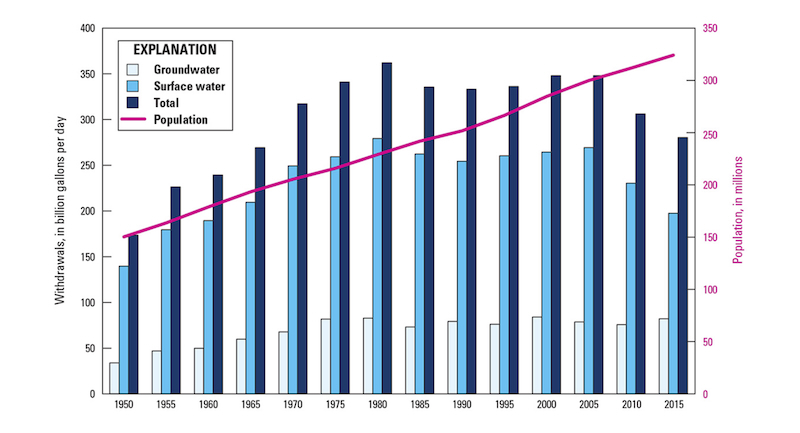
It’s bad enough that “40 million people” are reported to depend upon the Colorado River, while agriculture – which uses 80% of that water isn’t mentioned, while at the same time claiming that households are using twice as much water as they really are. The fact is that while the populations of cities have increased, per capita water use has fallen, dramatically.
Here are recent statistics of residential water use from 7 western cities –
SAN FRANCISCO, California A typical household in San Francisco consumes approximately 0.14 to 0.17 acre-feet of water per year. Because San Francisco households use so little water, one acre-foot of water can supply about six households for an entire year. Mathematically, this equals roughly 0.166 acre-feet per household annually. 2
DENVER, Colorado A typical household in Denver uses between 0.25 – 0.28 AF per year. Residents of Denver practice moderate outdoor summer watering balanced by high indoor winter efficiency. Single-family residential customers average about 50 gallons per person per day for indoor use, with overall annual use split roughly 50/50 between indoor and outdoor needs. 3
LAS VEGAS, Nevada A typical household in Las Vegas uses between 0.28 – 0.35 AF. While 60% of residential water in Southern Nevada is consumed outdoors for landscape irrigation, nearly 99% of indoor water is recycled. Water that flows down the drain or into the toilet is treated and pumped straight back into Lake Mead, which generates “return-flow credits” for the city.
TUCSON, Arizona Average annual residential water use is between 0.20 – 0.22 AF per year. The city of Tucson has dramatically reduced residential water usage during the past two decades. Tucson residential customers average about 74 to 76 gallons per person per day, ranking among the lowest per-capita residential consumers in the desert Southwest. The city of Tucson has been proactive in encouraging water conservation by offering a wide range of rebates and incentive programs to residential and commercial customers. 5
FLAGSTAFF, Arizona An average household in Flagstaff consumes about 0.25 acre-feet of water per year – or about one acre-foot for every four homes. Flagstaff residents use about 84 gallons of water per person daily, which is roughly half of the Arizona state average. 6
SAN DIEGO, California Average annual residential water use is between 0.22 – 0.24 AF per year. Multi-family housing density and strong baseline state efficiency standards. County-wide residential water use averages approximately 76 gallons per person per day, down from historical averages due to ongoing state and local efficiency standards. 7
PHOENIX, Arizona Average annual residential water use is between 0.29 – 0.45 AF per year. Large variations between newer low-water developments and older properties with pools and grass lawns. City residents average between 100 and 155 gallons per person per day total residential use, with the majority consumed outdoors via landscaping and pools. 8