Restoring the #ColoradoRiver Delta with a Diverse Environmental Team — Daughters for Earth #COriver #aridification

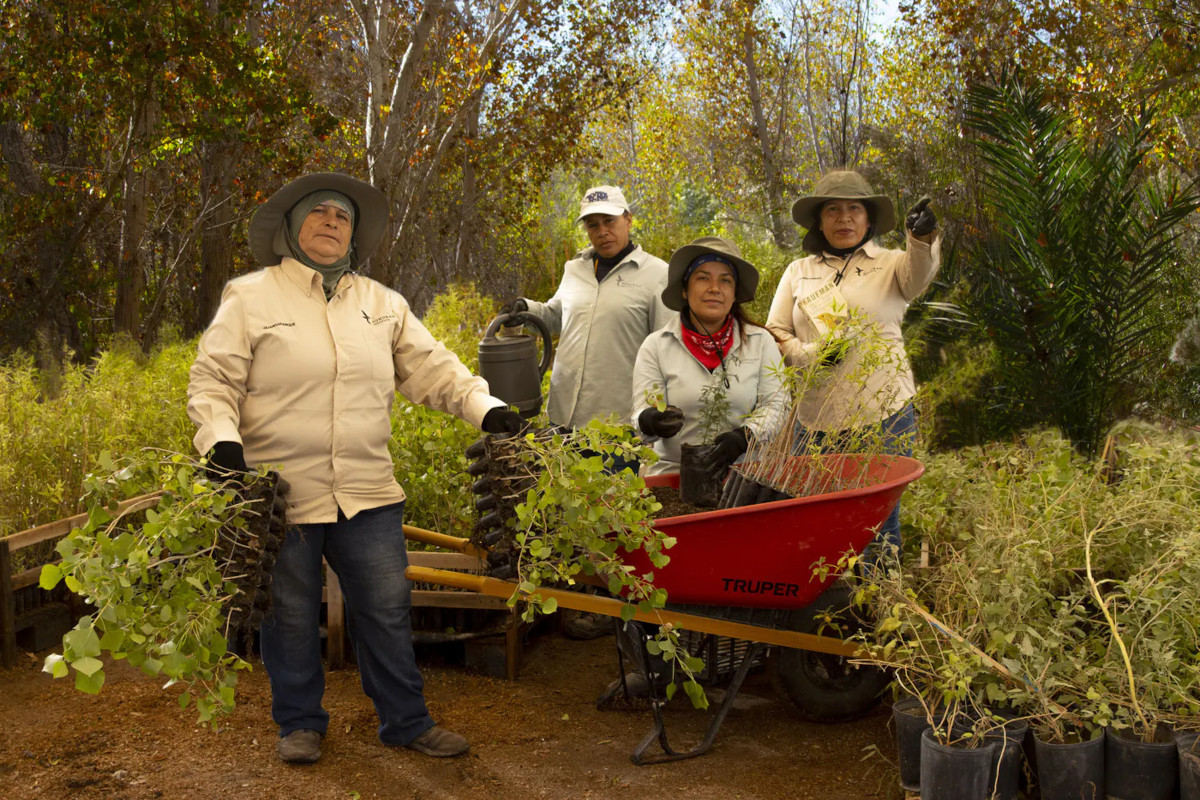
L to R: Alma Merendรณn, Rosa Gonzรกlez, Cristal Galindo, and Celedonia Alvarado leaders in native vegetation production restoration and monitoring activities at Laguna Grande site. Image credit Rabi Hernandez Sonoran Institute

Click the link to read the article on the Daughters for Earth website

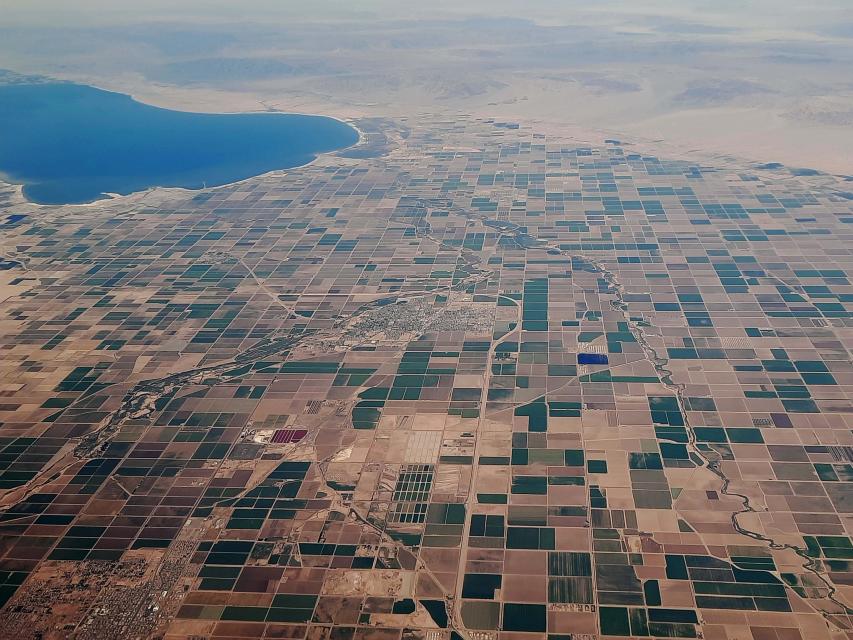
The Colorado River has not connected to the sea for a generation, and its Delta is dying out. This once lush region of 3,000 square miles teeming with plant, bird, and marine life lived only in the memory of older community members.

Most had abandoned hope that nature would ever return. No water means no life. However, the inverse is also true.

Funding for this project will help the Sonoran Institute (SI) revive, enhance, and maintain 751 acres of this area and reconnect the Colorado River to the sea. By reintroducing water, landscapes, wildlife, and communities thrive together.

A women-led restoration team

Led by Edith Santiago, who has 22 years of experience in the restoration of wetlands, this project comprises a diverse team of biologists, ecologists, hydrologists, community planners, environmental educators, and economists. Women hold over 50% of these positions.

Monitoring and growing native species

Support will allow this team to monitor the water and surrounding wildlife and conduct restoration activities that include irrigation, weeding, fire prevention, vigilance, and signage to prevent vandalism.

It will also help grow native species at the SI nursery near the Delta. Producing vegetation closer to restoration activities prevents plant damage and reduces transportation time.

As the restored area has increased and water presence has been permanent in the last two years, beaver (Castor canadensis) sightings are more common. Beavers feed on cottonwoods (Populus sp.) at Laguna Grande restoration site. Image credit: Guadalupe Fonseca, Sonoran Institute

Local outreach and education

Environmental education and outreach activities are essential to inspire the local community to help restore and conserve the Colorado River Delta. SI will achieve this through an online course about wildlife and vegetation, guided visits to restored areas, talks, presentations, and workshops. Building a training and multiple-use site will serve as a gathering and educational spot for the community.

SI has already engaged people through the visitor center at Laguna Grande, guided tours, and โ€œFamily Saturdays.โ€ Through these programs, nearly 26,000 people have reconnected with the river.

The importance of centering on community

The recovery and stewardship of the Delta ultimately depend on the commitment of people who live in the region. Having local community groups, leaders, and government agencies participate in the restoration work, operate plant nurseries, manage restoration sites, and welcome guests is a significant part of this project.

With a flowing river and a steady stream of visitors, the conservation site will become the heart of an economy based on working with nature, and a living, learning laboratory for the one million residents of Mexicali.

A group of Environmental Laboratory Technician (high school) students at Laguna Grande restoration site. Learning about native vegetation, wildlife and connecting with the Colorado river. Image credit: Rabi Hernandez, Sonoran Institute

Long-term goals to protect more land and reach more people

By 2024, the projectโ€™s main objective is to enhance and maintain 751 acres. The long-term plan is to restore and protect 30,000 acres of habitat. Another prime goal is to connect the river and sea for an average of 146 days a year.

Through education and social media, it aims to reach more than 400,000 people who will get to know the endangered beaver and many of the 380 bird species in the Delta. It will continue implementing virtual and in-person activities with students from kindergarten through college, families, national and international media, and donors.

Collaborating governments mean successful conservation

As a leader in restoration, SI and its partners have been working in this region for over 20 years. Their work extends along the main channel of the Colorado River, from the US and Mexico border to the upper estuary of the Gulf of California, and includes a key tributary, the Rio Hardy.

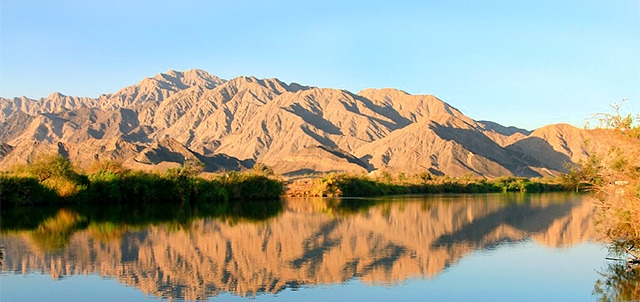
Rio Hardy, Baja California. Photo credit: Zona Turรญstica

SIโ€™s work has been crucial to adopting agreements between the United States and Mexico that have become a global example of collaboration. The Minute 319 and 323 accords between the two governments support the complete restoration of the Colorado River Delta.

By advancing agreements governing the river, restoration can succeed in the Delta as people connect with their natural resources. SIโ€™s team is optimistic that bringing the river back to life will make the local communities flourish harmoniously as one with nature.

SIโ€™s work has been crucial to adopting agreements between the United States and Mexico that have become a global example of collaboration. The Minute 319 and 323 accords between the two governments support the complete restoration of the Colorado River Delta.

By advancing agreements governing the river, restoration can succeed in the Delta as people connect with their natural resources. SIโ€™s team is optimistic that bringing the river back to life will make the local communities flourish harmoniously as one with nature.

It snowed โ€“ is the #ColoradoRiver saved? — @AmericanRivers #COriver #aridification

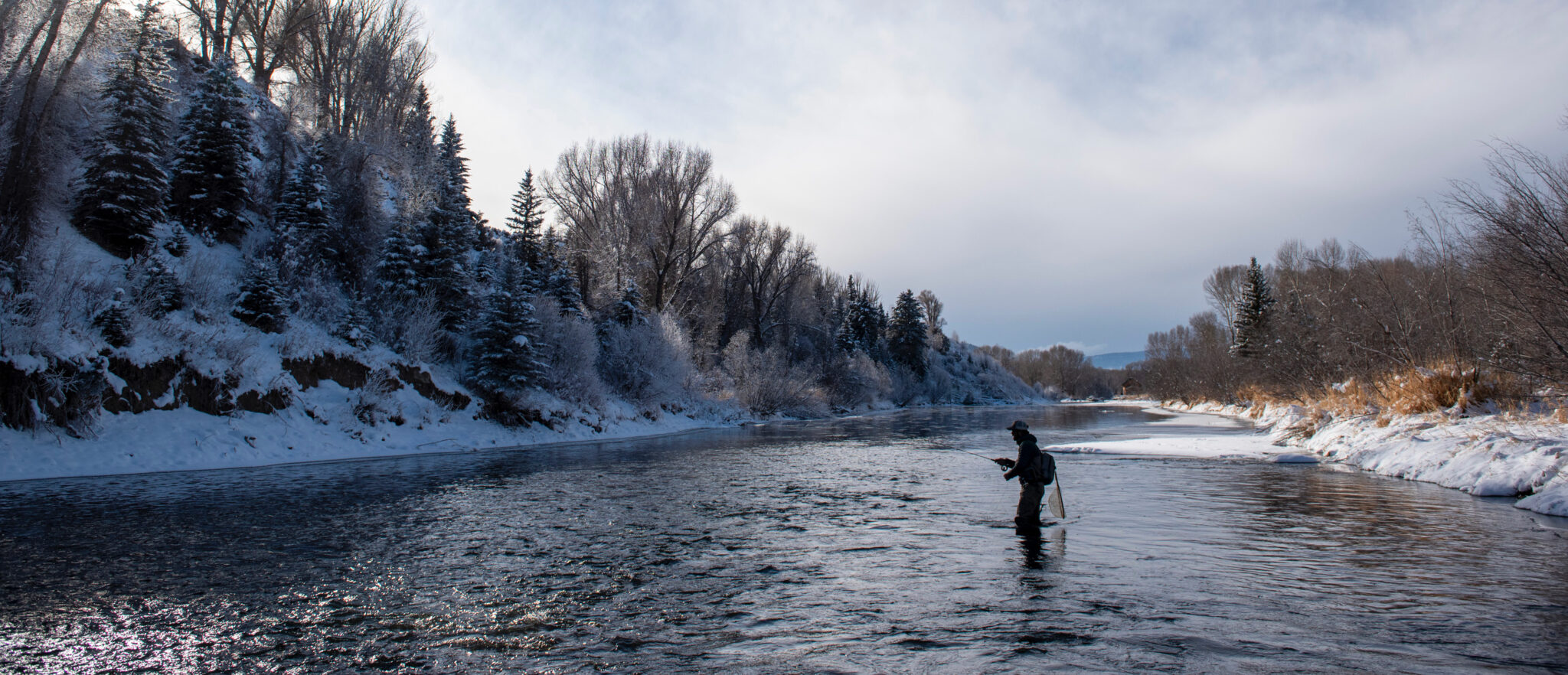
2015 DEC 14: Paul Bruchez feeds calves and fly fishes on his ranch the Reeder Creek Ranch outside of Kremlin, CO. Photo courtesy of Joshua Duplechian

Click the link to read the article on the American Rivers website (Sinjin Eberle):

With the substantial amount of snow that has fallen across the Colorado River basin over the past couple of months, I have been asked many questions about the state of the drought, and whether all this precipitation will reverse the severe declines in both Lake Powell and Lake Mead. Will all this snow โ€œsaveโ€ the Colorado River basin from further declines and cutbacks? Can we all just go back to normal now and not worry about conservation so much?

Spoiler alert โ€“ Not likely.

Certainly, all this snow will help quench the basinโ€™s immediate thirst.  It may also serve to have much of the basin delay confronting what has been shaping up to be a real emergency, with real consequences for everyone who relies on the Colorado River โ€“ but not for long. If we experience another low snowpack year which has been predicted, the situation from the top of the basin to Mexico will be pretty dire โ€“ and if this recent snow funnel turns off, it still could be. But for now, it appears that, while the current snow conditions will certainly not save the day, they might help side-step having to immediately endure worst-case scenarios beginning as early as this spring, which hopefully can provide the states and Federal government some space to come together and bring the rest of the Colorado River community along in support of workable solutions for the basin by the end of the summer.

Through my role with American Rivers, I am honored to be one of the two Environmental Representatives on the GLEN CANYON DAM ADAPTIVE MANAGEMENT PROGRAM (GCD-AMP) TECHNICAL WORK GROUP (TWG) which is intimately involved with much of the science conducted in the Grand Canyon and Lake Powell. As part of that role, how Glen Canyon Dam operates and is managed is of central consideration, and the impacts of decisions around how water flows through the dam are of critical importance to the ecological, recreational, and cultural values of the Grand Canyon and the overall natural heritage it provides.

Last week, at a meeting in Phoenix, we got detailed readouts around the hydrologic conditions in the Upper Basin of the Colorado River (Colorado, Wyoming, Utah, and New Mexico make up the Upper Basin) and so far, the data looks positive for this current water year.

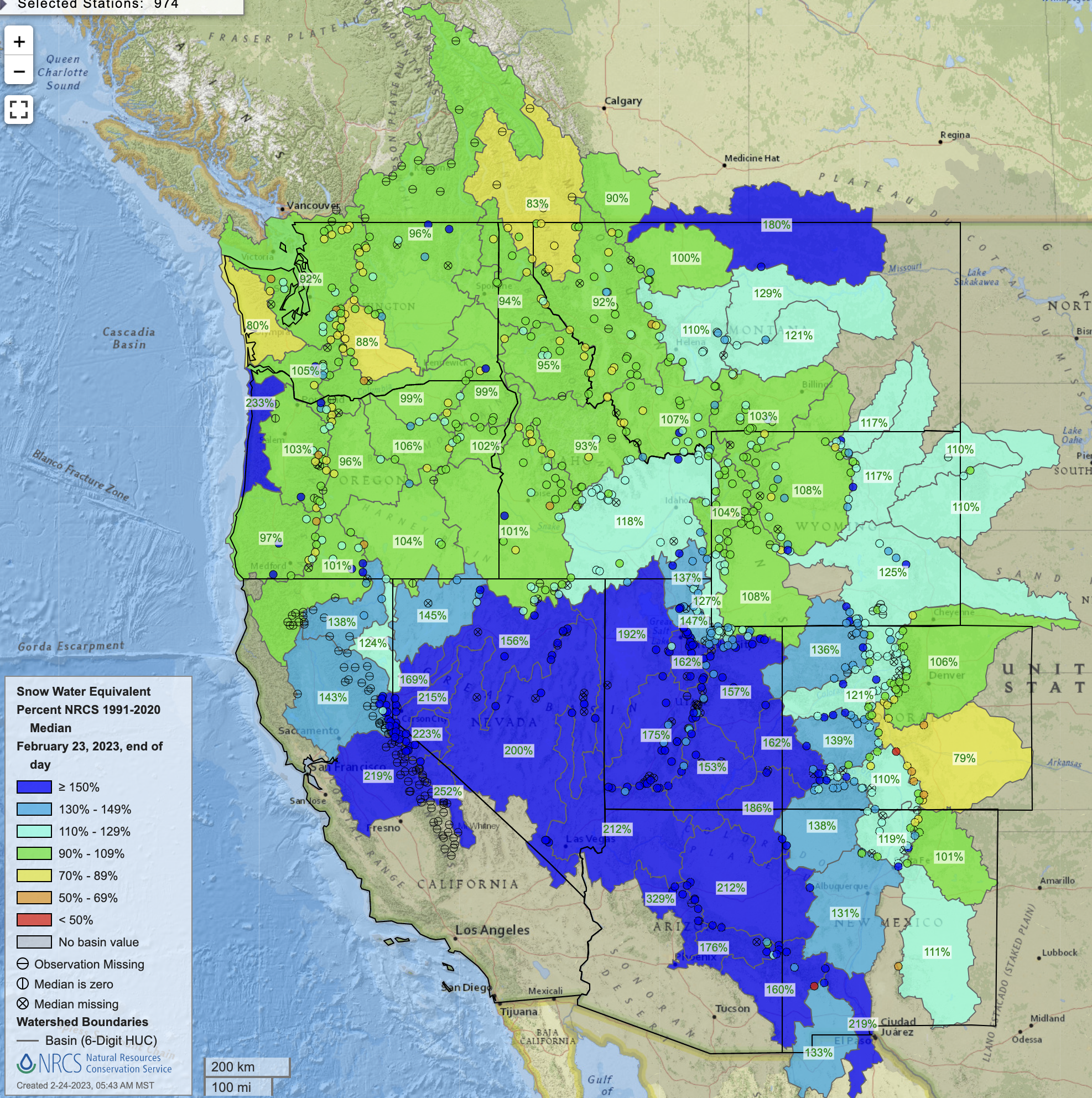
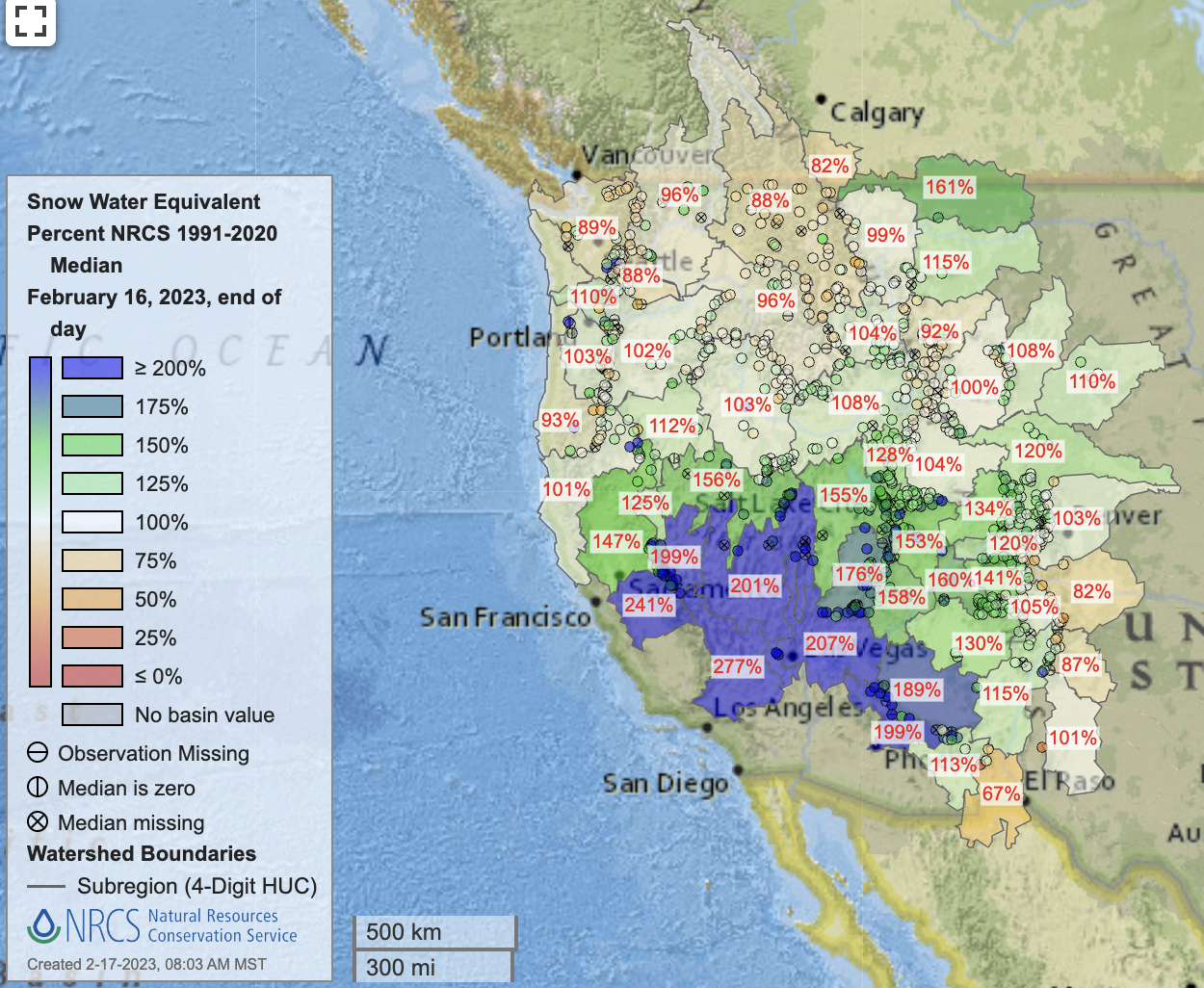
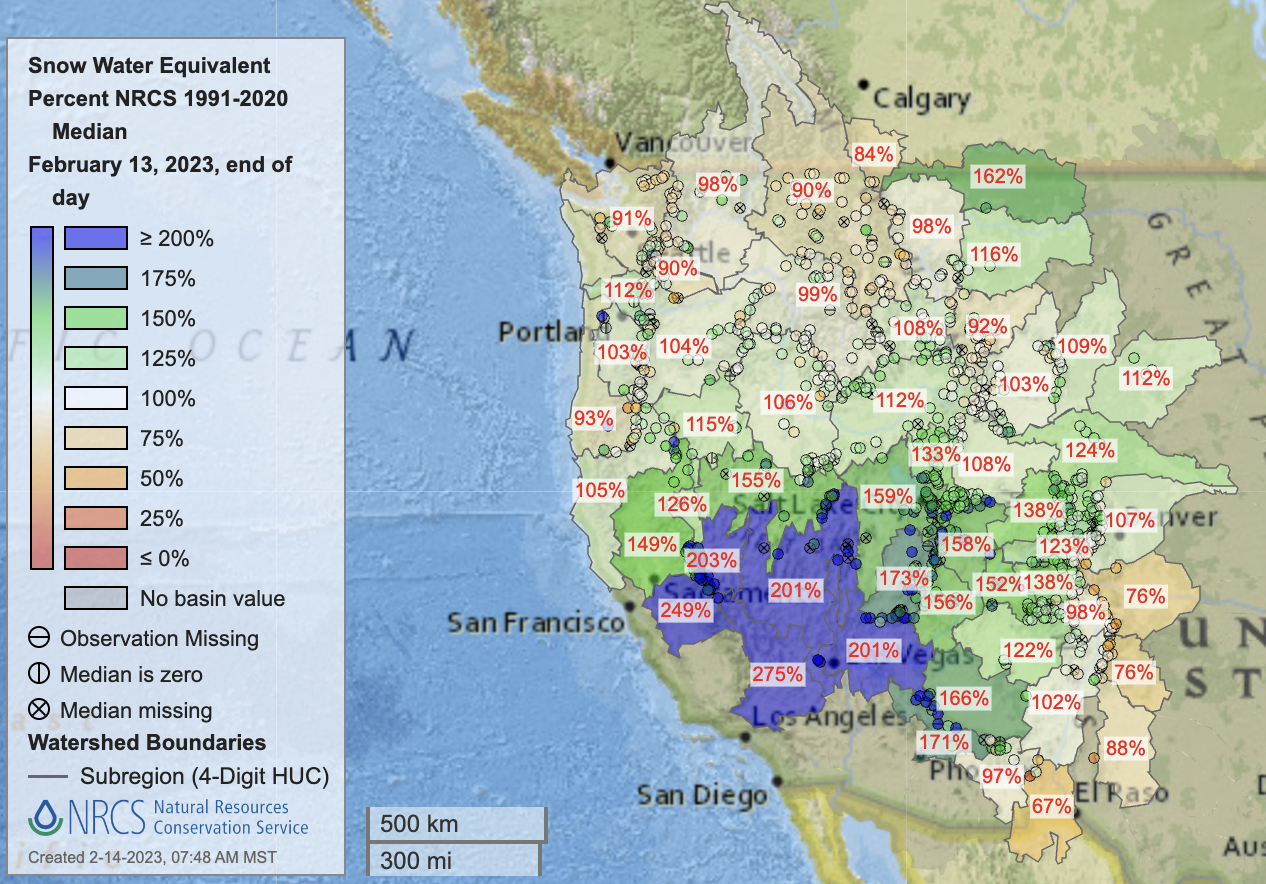
West snowpack basin-filled map February 23, 2023 via the NRCS.

All those purple and blue blobs are great news and something to cheer about. These numbers all play into how the Bureau of Reclamation (BOR), the Federal agency that oversees and manages the federal infrastructure for the Colorado River system, forecasts likely water supply scenarios in different areas of the basin. But for the time being, letโ€™s stick with Glen Canyon Dam and Lake Powell.

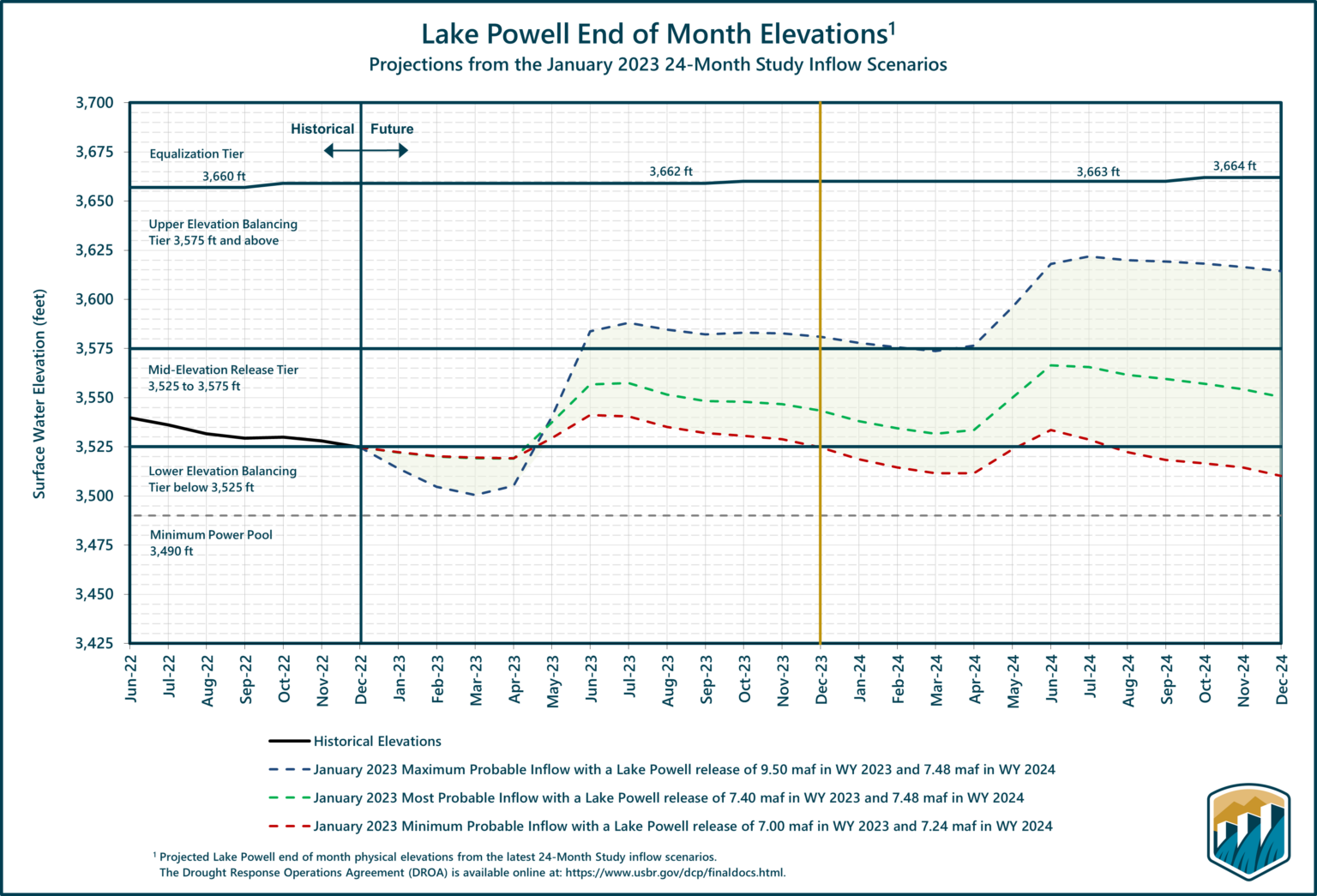
Most recent 24-month study projects that Lake Powell will stay above Minimum Power Pool according to current conditions. Graphic credit US Bureau of Reclamation

The chart above may look confusing but bear with me. The vertical axis is the elevation of the water stored behind Glen Canyon Dam in Lake Powell. The horizontal axis is time, looking ahead across the next two years. Modeling experts at BOR run dozens of simulations based on 30-year average hydrology, current snowpack conditions, soil moisture, projected meteorology, and water use estimates to identify potential probabilities around how much water may be coming through the system, including how much water may reasonably be expected to flow into Lake Powell in a given year. Then, understanding these โ€œinflowsโ€ projections in combination with other resource considerations, the BOR projects the volume and timing of water to be released out of Lake Powell, through the Grand Canyon, and into Lake Mead on an annual basis.

If you look carefully at the chart above, you will see three dotted lines undulating from left to right. Those three lines are the โ€œMinimum, Maximum, and Mostโ€ probable storage scenarios for Lake Powell based on different inflow and other inputs (Maximum being the top, a blue line which reflects where 90% of the scenarios will land at or below in storage elevation, meaning the maximum probable amount of water to be stored at Lake Powell for the relevant year; Minimum being the bottom, red line which reflects where 10% of the scenarios will land or fall below in storage elevation, meaning the minimum probable amount of water to be stored at Lake Powell for the relevant year; and, Most being the middle, green line, which reflects that 50% of the scenarios are likely to be at or below in Lake Powell storage elevations for the year.  Each of these projections is based on CURRENT conditions and is subject to change as we learn more about actual, as opposed to modeled, conditions in the basin.

As you can see, the line trends down from now until about mid-April 2023, then makes a sharp curve upwards. This represents spring runoff โ€“ it is current, frozen snow (very low runoff in the rivers) transitioning into spring (lots of snowpack melting and the rivers flowing vigorously.) Then as we get into summer and fall, things more or less flatten out as the snowpack depletes and levels in Lake Powell stabilize.

The most important line on the chart above (at least for this blog) is the bottom line (Minimum Probable,) and, in particular, the April 2024 timeframe, the lowest point on the chart. Below that lowest point is a grey dashed line marked โ€œMinimum Power Pool โ€“ 3,490ft.โ€ This represents the elevation where Lake Powell can no longer produce any hydropower electricity because the water has fallen too low to turn the turbines.

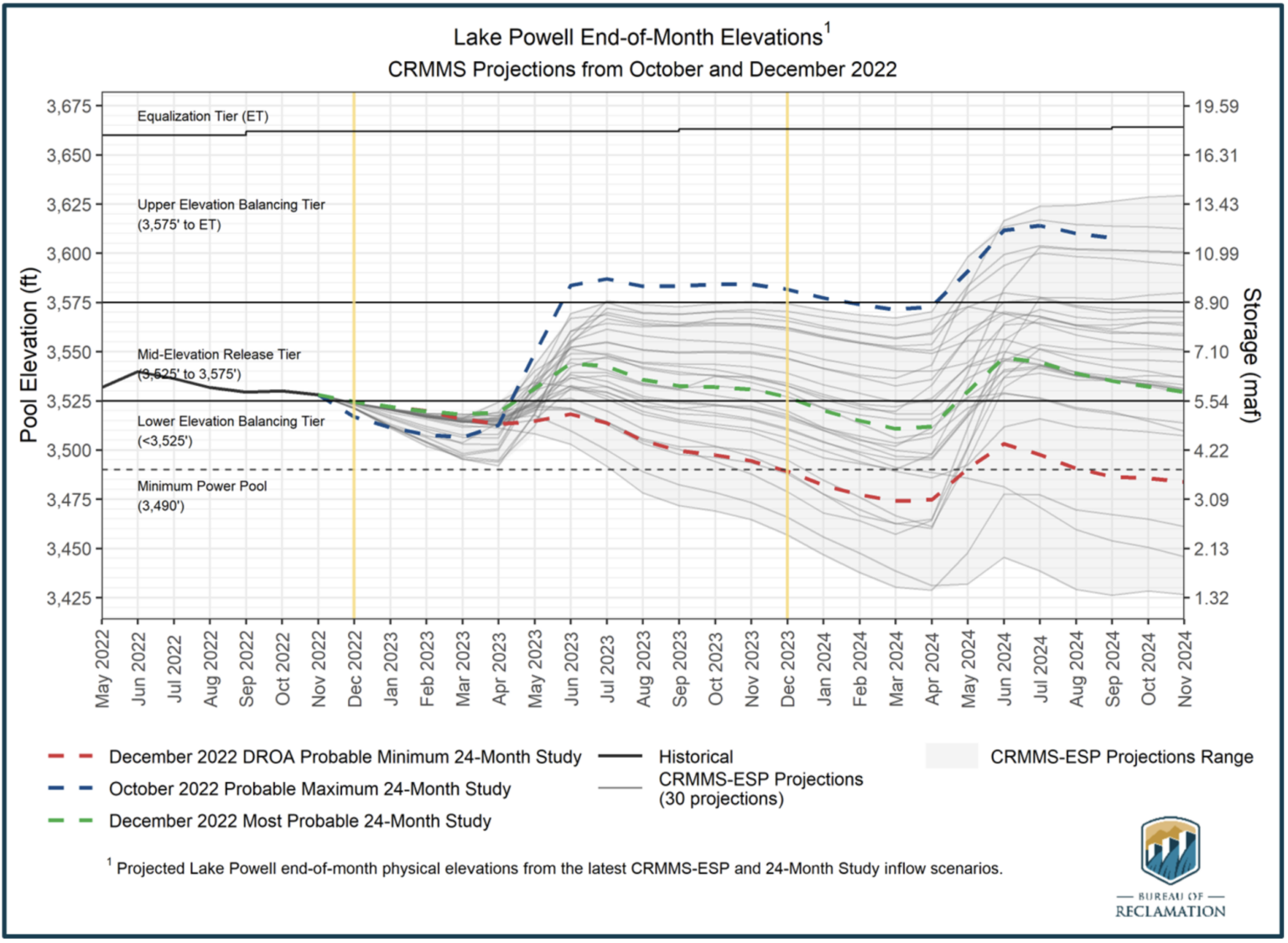
As recently as last December, there was a real probability that Lake Powell could fall below Minimum Power Pool (the elevation where hydropower could no longer be generated) as early as December 2023. Graphic credit US Bureau of Reclamation

Just a couple of months ago, it looked like Lake Powell may fall below that Minimum Power Pool elevation sometime around the April 2024 timeframe, and if this winterโ€™s snowpack was dismal, the threat to the minimum power pool could be much higher much sooner. Last fall, BOR Commissioner Touton instructed that the Basin must come up with an additional 2- and 4-million-acre feet of Colorado River water to avoid critical threats to infrastructure and the system between now and the time new long-term operating criteria can be finalized (est. 2026). This directive, along with several other factors, also inspired BOR to consider partially modifying the current operating criteria through a process called a Supplemental Environmental Impact Statement (SEIS).

A SEIS is, in essence, a comprehensive study around some options that could guide operations at the Glen Canyon Dam and other facilities to forestall threats to the health, safety, and continuing functionality of the system until more comprehensive management plans can be assessed and considered.  Short-term adjustments to system operations will likely consider, among other things, the release of less water (and potentially MUCH less water) from Lake Powell in the current and next years with the assumption that storage at Lake Powell could continue to decline. That study is in process, but we all need to continue to press the urgency of this situation and find every way possible to reduce the consumption of Colorado River water, from every user across the entire basin. Just because the snowpack looks good today, doesnโ€™t reduce the immediate need to find a way to live within the means that the river can provide starting now.

Now, some caveats to all this optimism. First, it could stop snowing, like it did last year, and this trend of piles of happy snow could go away. Second, the basin overall is in a serious water deficit across nearly all reservoirs in the Upper Basin.  BOR has had to release a lot of water over the past two years under emergency and drought contingency actions, including the implementation of a Drought Response Operations Agreement to try to keep Lake Powell from falling even farther and even faster. Lastly, runoff matters, and the combination of how soon spring arrives and how warm it gets, combined with how moist the soil is as that snow begins to melt will dictate how much water makes its journey down the river. With the solid monsoon seasons over the past two summers, the soil moisture is much better than it was a couple of years ago.  But dry soils absorb water as the snow melts, and if the soils are too dry, runoff water never makes it to the rivers in the first place. In fact, many believe that relying on the 30-year average hydrology conditions in the basin as part of the modeling foundation leads to potentially overly optimistic results in storage conditions. 

So, there is cause for optimism, and cause for skepticism, but at least at this point in early 2023, things are looking as good as they likely could to provide a little room to keep working toward collaborative solutions than in years past. Keep those snow dances coming!

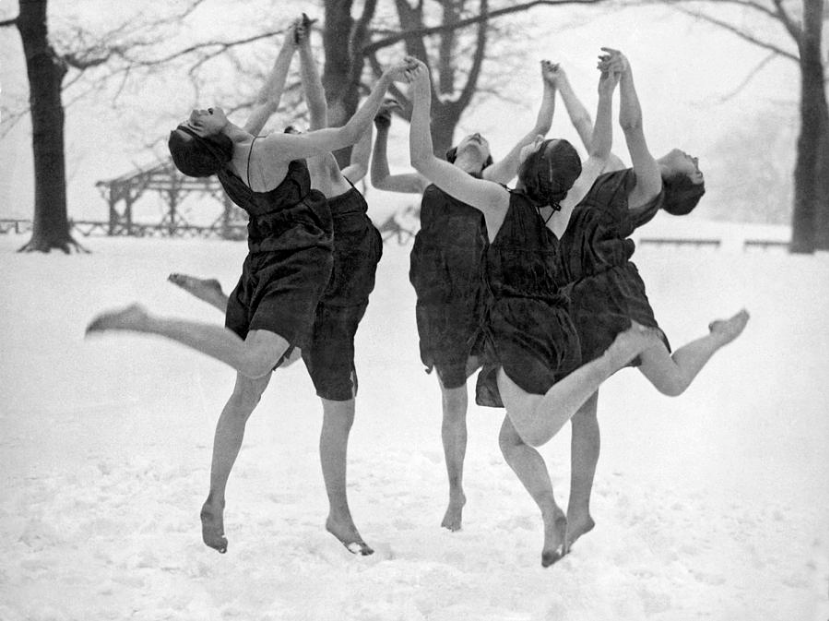
Barefoot Dance In The Snow New York, New York March 8, 1916. Girls of the Marion Morgan School of Dance in Los Angeles perform barefoot in the snow in Central Park. Underwood Archives by Underwood Archives

Romancing the River: Caliphobia and the #ColoradoRiver — Sibley’s Rivers #COriver #aridification

All American Canal Construction circa. 1938 via the Imperial Irrigation District. The All-American Canal in far southern California under construction, to carry water to the Imperial Valley – so called because it lies entirely with the United States, unlike an earlier canal that was mostly in Mexico.

โ€˜Caliphobiaโ€™ is a cultural germ that infects many Americans everywhere. โ€˜Caliphobiaโ€™ is fear and loathing of the State of California, the state that always seems to be ahead of everyone else in everything, bringing us everything from new entertainments and toys, to new laws on cultural frontiers the rest of us know we ought to be brave enough to embrace ourselves. Iโ€™m thinking of things like auto emission standards where the size of the California market brought the automobile industry to heel, with the nation eventually falling in line too. We hate them when theyโ€™re right.

Californians also occasionally take a big step backward in a deliberate way, and the nation eventually falls in step there too โ€“ remember โ€˜Proposition 13,โ€™ Californiaโ€™s 1978 property tax revolution to protect existing homeowners at the expense of community health, a battle which ultimately generated the national โ€˜Tea Partyโ€™ and the Trumpian โ€˜Iโ€™ve got mine Jackโ€™ culture. We hate them when theyโ€™re successfully wrong.

California always seems to be first with the worst as well as the best. For this they are generally disliked, even hated, in a subrational way that is often tinged with envy โ€“ Caliphobia. This leads to things like bumper stickers saying โ€˜Donโ€™t Californicate us!โ€™ and the perception of Californians as emigrants from the gridlock of their success, spreading through the West with fistfuls of money to drive up our housing prices.

Californiaโ€™s impact nationally has to do mostly with its size and population. Close to one of every eight Americans lives in California โ€“ approaching 40 million. One-eighth of our Congresspeople are part of the 53-person California delegation.

But where California โ€“ and Caliphobia โ€“ has had its largest and most ingrained impact may be in the Colorado River Region โ€“ the seven states through or between which the Colorado River meanders. California has close to twice as many people and Congressmen as the other six states combined.

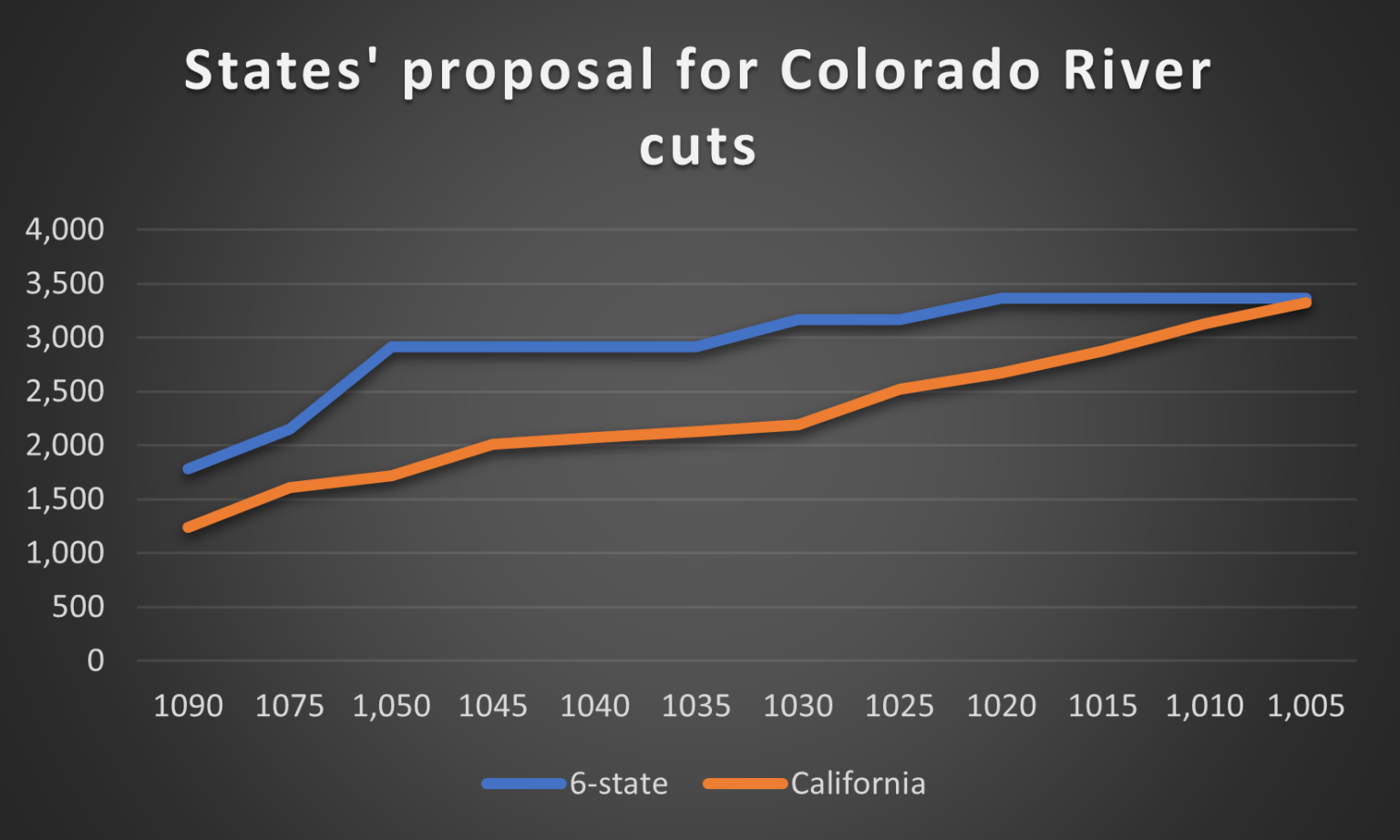
We see Caliphobia rearing its head today on the Colorado, as six of the seven Basin states have put forward a plan for major cuts in water use in the Basin โ€“ cuts the Interior Department says are essential if their system of storage and distribution structures are going to remain functional. But California refuses to sign onto that plan, in which they would take a big hit; instead, they have put forward their own plan in which they would take a moderate hit, but only after Arizona and Nevada have taken big hits, demanding that their large senior priority rights be honored. This is engendering media headlines like โ€˜California Isnโ€™t Playing Nice on the Colorado Riverโ€™ or โ€˜Unlike California, Vegas isnโ€™t gambling with its future by squandering water.โ€™

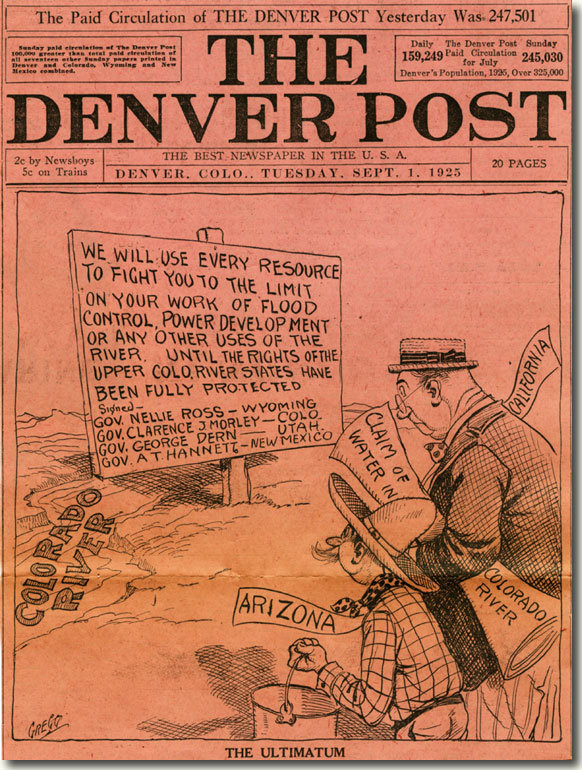
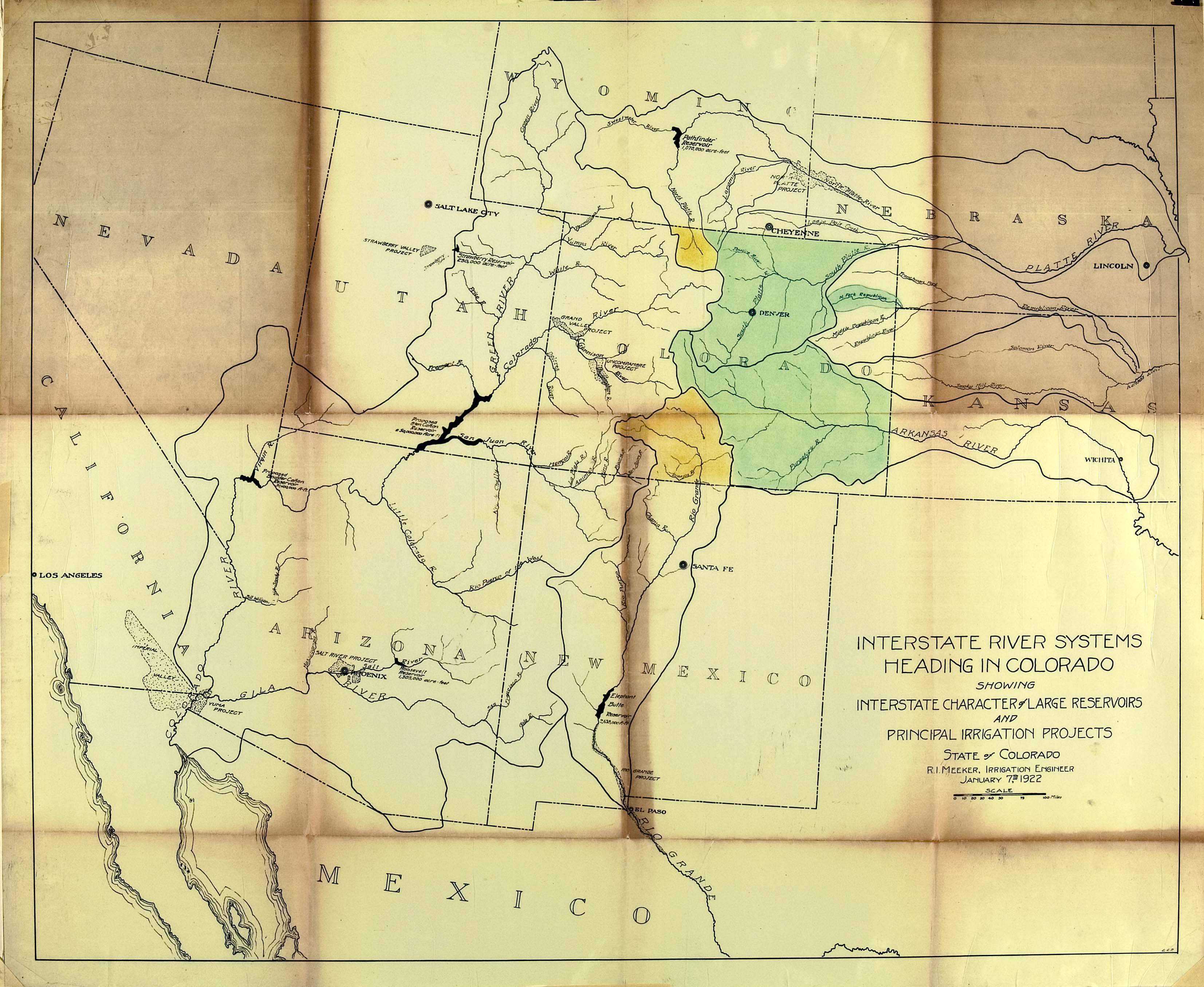
Upper Basin States vs. Lower Basin circa 1925 via CSU Water Resources Archives

Caliphobia is nothing new along the Colorado River, however. It goes back to the early 20th century. All seven states in the Region โ€“ Arizona, California, Colorado, Nevada, New Mexico, Utah, and Wyoming โ€“ had adopted the first come, first served appropriation doctrine for the distribution of the use of water. Appropriation law โ€“ free water for free land, permanently if you get there early โ€“ became a powerful growth engine that contributed to growth in all seven states in the early 20thcentury, but Californiaโ€™s population quintupled in that time.

This gaveย the six โ€˜slowerโ€™ states reason to fear that, in an unchecked seven-state horse race to appropriate use of the Colorado Riverโ€™s water, California had the pole position and a fast start, and might put most of the riverโ€™s water to use while they were still getting started. The fact that the developers of the Salton Sink, aka the Imperial Valley, down at the end of the river, had a 1901 appropriation filing for more than two million acre-feet of river water lent substance to their fear. Caliphobia spread along the river.

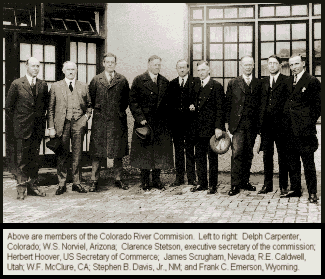
Herbert Hoover presides over the signing of the Colorado River Compact in November 1922. Members of the Colorado River Commission stood together at the signing of the Colorado River Compact on November 24, 1922. The signing took place at the Palace of the Governors in Santa Fe, New Mexico, with Secretary of Commerce Herbert Hoover presiding (seated). (Courtesy U.S. Department of Interior, Bureau of Reclamation)

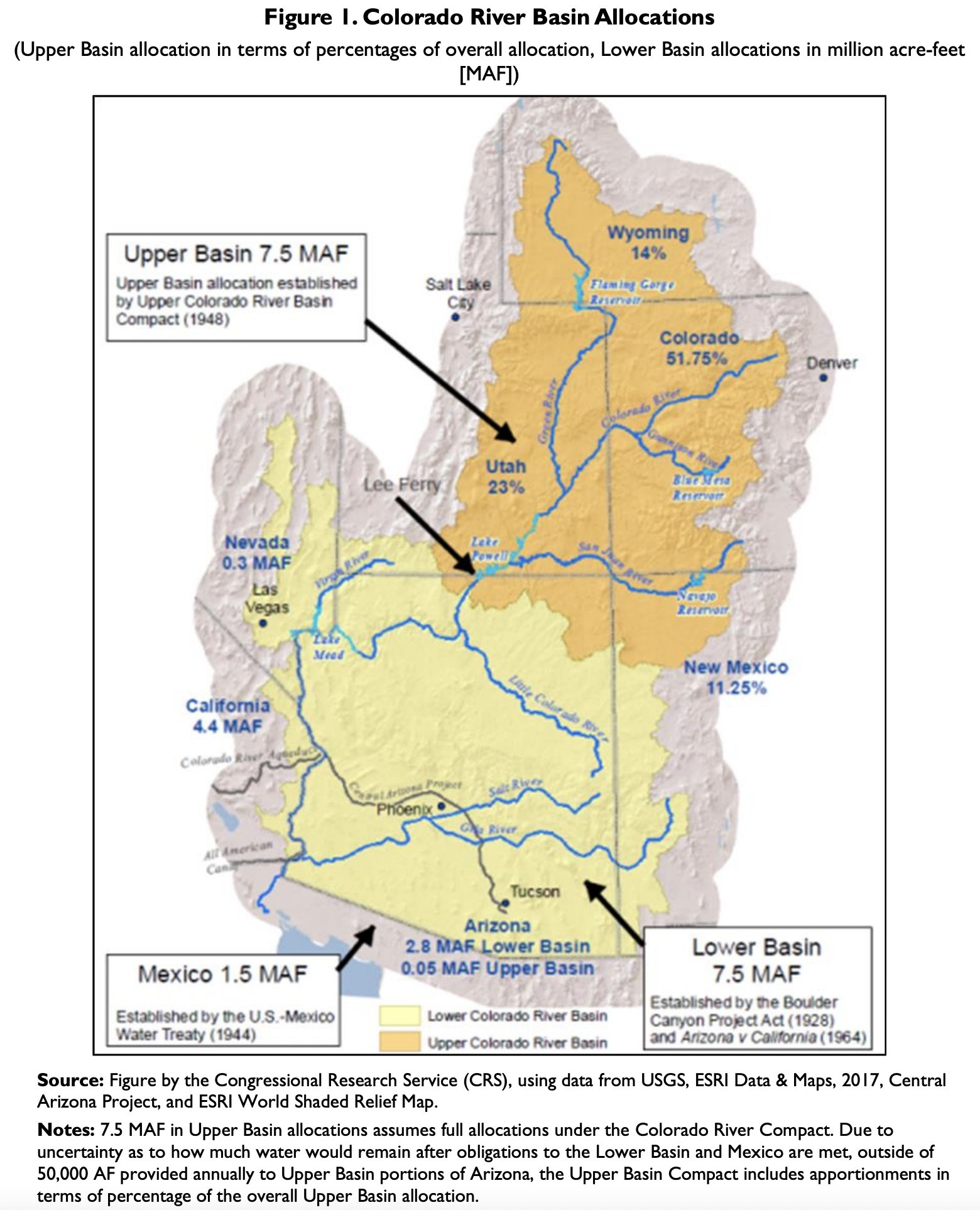
Their Caliphobia led to the convening, in 1922, of the Colorado River Compact commission, with the original intention to make an equitable seven-way division of the use of the river that would override the appropriation doctrine at the interstate level, assuring each state of a share of the river to develop in its own good time. But a seven-way split proved impossible to attain; they lacked necessary information about how much water was even in the river, and the only information they had about their own futures came from their own overheated imaginations. So in something close to desperation, with time running out, they came up with a big sloppy broad stroke: dividing the river in two, an Upper Basin with the four states above the unsettled canyon region (Colorado, New Mexico, Utah, and Wyoming), and a Lower Basin with the three states below the canyons (Arizona, California, and Nevada). Basically, each Basin would get the consumptive use of 7.5 million acre-feet (maf), to further divide among themselves as their futures unfolded.

It is hard to see the Compact as a real success โ€“ certainly not an achievement deserving the reverence most water mavens hold it in today. It gave the four Upper Basin states relief from having to compete for water with California, but it left Arizona and Nevada in the cage with California, and Arizona refused to ratify the Compact as a result. California officials said their state would not ratify the Compact until there was solid assurance that the storage dam would be built. All the Compact really achieved was a minimum show of agreement by six out of the seven states, which Congress found acceptable enough, and proceeded with the Boulder Canyon Project Act that finally passed in 1929.

The Act itself relieved the Lower Basin states of the stress of dividing up their 7.5 maf โ€“ difficult given Arizonaโ€™s bad case of Caliphobia โ€“ by doing the division for them: 4.4 maf for California, 2.8 maf for Arizona, and 300,000 af for Nevada. Why so little for Nevada? All the action in Nevada then was in the western part of the state, in the relatively well-watered mining and ranching area just east of the Sierra Nevada Mountains, four hundred miles from the Colorado River. The only town in southeastern Nevada was Las Vegas, a little flag-stop collection of ranchers and prospectors.

Caliphobia was enough of a presence in Congress so that, before the representatives would vote on the Boulder Canyon Project Act, California was required to pass a state law that the state would limit its use of Colorado River water to the 4.4 maf specified in the Act. California passed that law docilely enough in 1929; the Act contained not just the big dam to control the river, but the weir dam and All-American Canal for getting water to their Imperial Valley, so they had a lot to gain by complying.

But then, once the Act was passed and construction had begun, the seven largest California users got together in 1931 to divvy up their 4.4 maf โ€“ and an additional 962,000 acre-feet that they said the Upper Basin wouldnโ€™t be using for decades, so why shouldnโ€™t they use it in the meantime?

They were, in other words, going to use the Upper Basinโ€™s unused share of the river to grow on, in hopes that there would prove to still be excess undivided water in the Basin when the Upper Basin needed its water โ€“ or that the engineers would have figured out how to bring new water in from some other river with water to spare. Early Anthropocene thinking: something would come along to keep them from being limited to their 4.4 maf. The intrastate Seven-party Agreement became part of the โ€˜Law of the River,โ€™ along with the 1929 California Limitation Law.

The Metropolitan Water District, created to serve the Los Angeles-San Diego metropolitan area with Colorado River water, bet on the permanence of that surplus water in a big way: they built the 250-mile Colorado River Aqueduct to carry twice their share of the 4.4 legal allotment โ€“ a concrete conviction that they would not be limited.

The Bureau went along with this, given Californiaโ€™s assurance that it would only use โ€˜surplus waterโ€™ so long as it existed; it was consistent with the Bureauโ€™s optimistic outlook for the future of the riverโ€™s flow โ€“ even though in 1931, the riverโ€™s flow dropped to half of the allotted 15 maf, the beginning of a droughty decade. The myth of a surplus flow, above and beyond the Compact allotments, was born, and would persist on paper too โ€“ well, to the present: it has been the increasingly fictitious surplus that supposedly โ€˜paidโ€™ the 1.5 maf of evaporation and other system losses on the lower river.

The surplus was also supposed to take care of most of the Mexican allotment too, once that was negotiated in 1944. Anticipating an eventual allotment to Mexico, the Compact had said that โ€˜such waters shall be supplied first from the waters which are surplus over and above the aggregateโ€™ allotted to the states, and โ€˜if such surplus shall prove insufficient for this purpose, then, the burden of such deficiency shall be equally borneโ€™ by the two basins. More about that in a moment.

Caliphobia in the Upper Basin states increased as it became increasingly obvious after the 1930s drought that there was probably never going to be enough water in the river consistently for them to get a full 7.5 maf share. Yet the Compact committed them to โ€˜not cause the flow at Lee Ferry (the division point) to be depletedโ€™ below 75 maf in any 10-year period. So even though there was not enough for their full allotment, they had to let the Lower Basinโ€™s full allotment go downriver, or else โ€“ well, the Compact said nothing about what would or should happen if the flow at Lee Ferry fell below the Compact minimum, but that only enabled the Caliphobic imagination to run wild on what California would do to Upper Basin users in such an instance.

September 21, 1923, 9:00 a.m. — Colorado River at Lees Ferry. From right bank on line with Klohr’s house and gage house. Old “Dugway” or inclined gage shows to left of gage house. Gage height 11.05′, discharge 27,000 cfs. Lens 16, time =1/25, camera supported. Photo by G.C. Stevens of the USGS. Source: 1921-1937 Surface Water Records File, Colorado R. @ Lees Ferry, Laguna Niguel Federal Records Center, Accession No. 57-78-0006, Box 2 of 2 , Location No. MB053635.

That clause could have been interpreted as a mere caution to make sure the Upper Basin users themselves were not responsible for a seriously diminished flow of the erratic river past Lee Ferry. But it could also be interpreted as a delivery commitment even if the diminished flows were caused by something other than human uses, like a two decade drought โ€“ which would already have seriously impacted the Upper Basin. Would the Lower Basin โ€“ California โ€“ add insult to injury by placing a call on them to further diminish their own uses to meet the 7.5 maf โ€˜obligationโ€™? Letting the Lower Basin escape sharing any of the pain from the erratic river?

I find no evidence that California and Arizona ever officially threatenedthat, but the Caliphobic imagination believed it would happen, so the 1948 Upper Colorado River Compact in a sense codified it as a delivery obligation no matter what, and even included punishment in a โ€˜callโ€™ situation, for Upper Basin states who might have had gone above their percentage of the riverโ€™s highly variable flows.

Why did the Upper Basin not take advantage instead of the Compactโ€™s Article VI invitation, โ€˜should any claim or controversy arise between any two or more of the signatory States,โ€™ to work out a more equitable modification to the Compact? Caliphobia: fear that California was so big and powerful that it would just roll right over the four states. The six Davids were basically too timid to take on their Goliath.

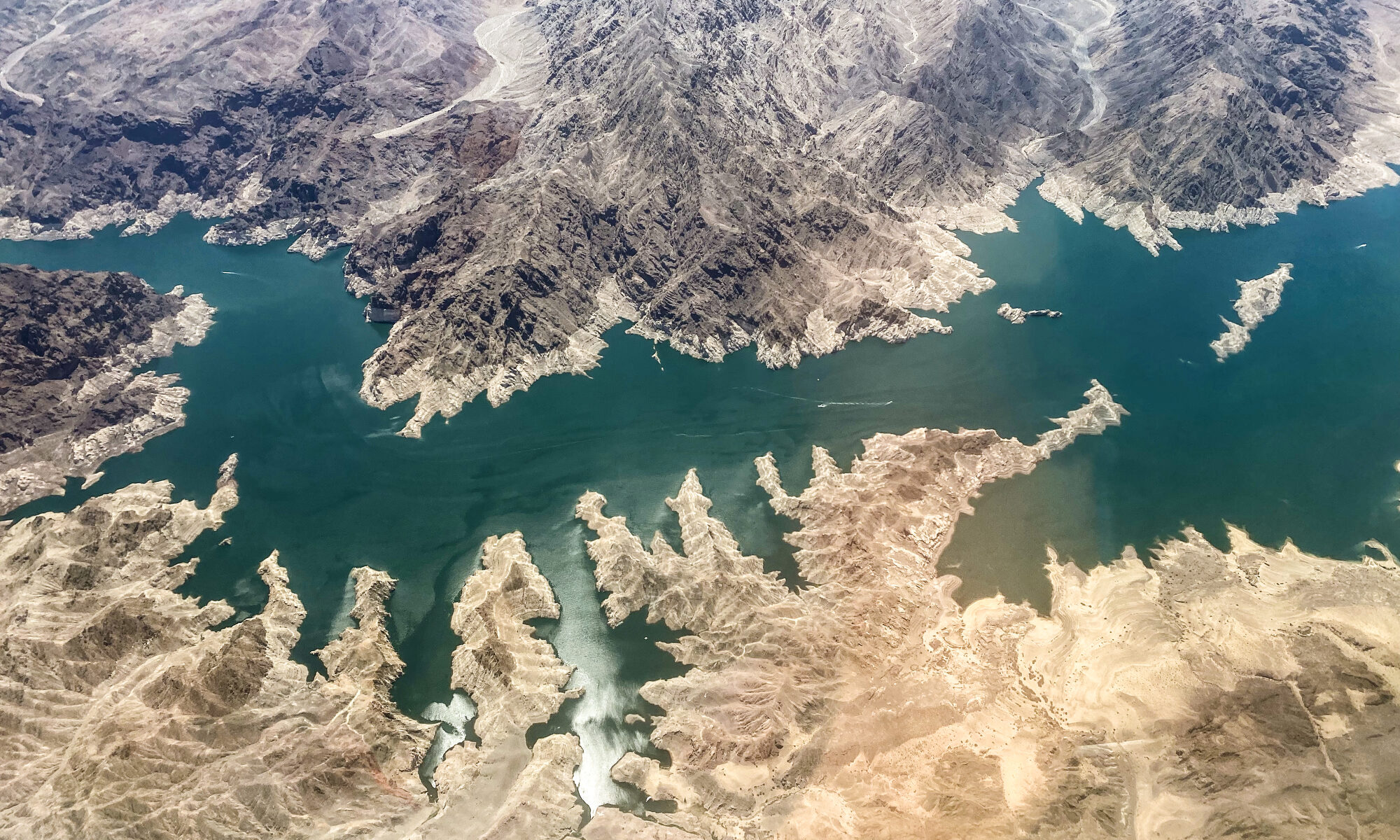
Lake Powell, a key reservoir on the Colorado River, has seen water levels drop precipitously as a result of two decades of drought. (Source: The Water Desk and Lighthawk Conservation Flying)

Another insult was added to the cumulative inequity to the Upper Basin in 1970 when, with Powell Reservoir filling behind Glen Canyon Dam, โ€˜Operating Criteria for Colorado System Reservoirsโ€™ were developed that set a desired minimum release from Powell for the Lower Basin, not the 7.5 maf Compact allotment, but 8.23 maf, the Compact allotment plus half of the Mexican obligation, to be shared among the four states. But was the Lower Basin subtracting their half of the Mexican obligation from their allotments? No, they were still relying on โ€˜surplusโ€™ flows, even though with ever increasing Upper Basin use, and the Central Arizona Project under construction, that surplus was steadily diminishing.

It wasnโ€™t until 2003 that the Interior Department โ€“ perhaps also a little fearful of California โ€“ cleared its throat and told California that it was time to give up the use of a no longer existing surplus. To everyoneโ€™s surprise, California agreed that, yes, it probably was time, and the terms of the โ€˜California Quantification Settlement Agreementโ€™ were worked out, and California is now back to 4.4 maf, sometimes even a little less.

Does this mean that the basic mythic story of the past century is no longer Goliath and the six Caliphobic Davids, but is more Gulliver getting tied down by the Caliphobic Lilliputians? How the current situation among the seven states shakes out will tell us more on that.

On the one hand, there are probably thousands of farmers on spreads of all sizes throughout the Basin quietly hoping that Californiaโ€™s stand for the primacy of appropriation law succeeds. The future of that body of law may hang in the balance. Too many people are asking questions like, how can we resolve anything with an appropriation law when everything is already appropriated? The farmers are probably happy to have one of the really big dogs making their case.

On the other hand, the six-state plan is not really an appropriation issue; it is primarily an effort to clean up an error left standing too long: the Lower Basin has no surplus left in the water bank to cover its system losses โ€“ or its Mexican obligation, for that matter. (Why has that not been mentioned yet?) The resulting โ€˜structural deficitโ€™ is why Mead Reservoir outflow is exceeding available inflow, and the logical thing to do is the โ€˜Nevada solutionโ€™ of simply parceling out that deficit in some equitable way among the three states, reducing their allotments accordingly. There is not really a priority issue involved in the six-state plan.

However it all shakes out in the next several months, we might hope that theย irrationalย aspects of Caliphobia might phase out, and no question about equity in the Basin be left unasked out of fear. There is not enough love for California anywhere, even on the national level, for it to get away with throwing its weight around.

As #ClimateChange and overuse shrink #LakePowell, the emergent landscape is coming back to life โ€“ and posing newย challenges — The Conversation

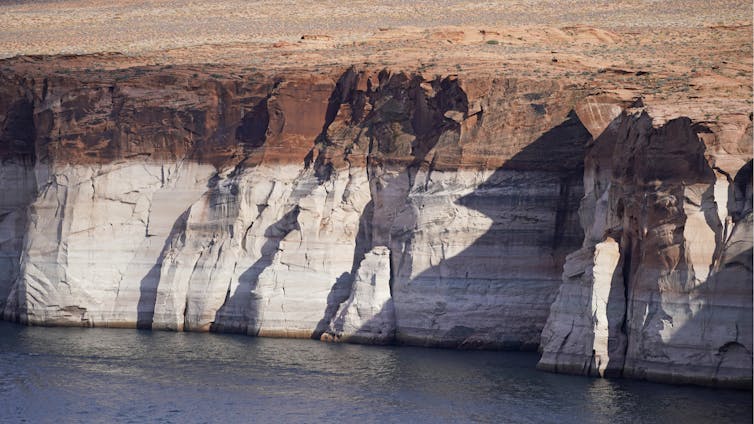
The white โ€˜bathtub ringโ€™ around Lake Powell, which is roughly 110 feet high, shows the former high water mark. AP Photo/Rick Bowmer

Daniel Craig McCool, University of Utah

As Western states haggle over reducing water use because of declining flows in the Colorado River Basin, a more hopeful drama is playing out in Glen Canyon.

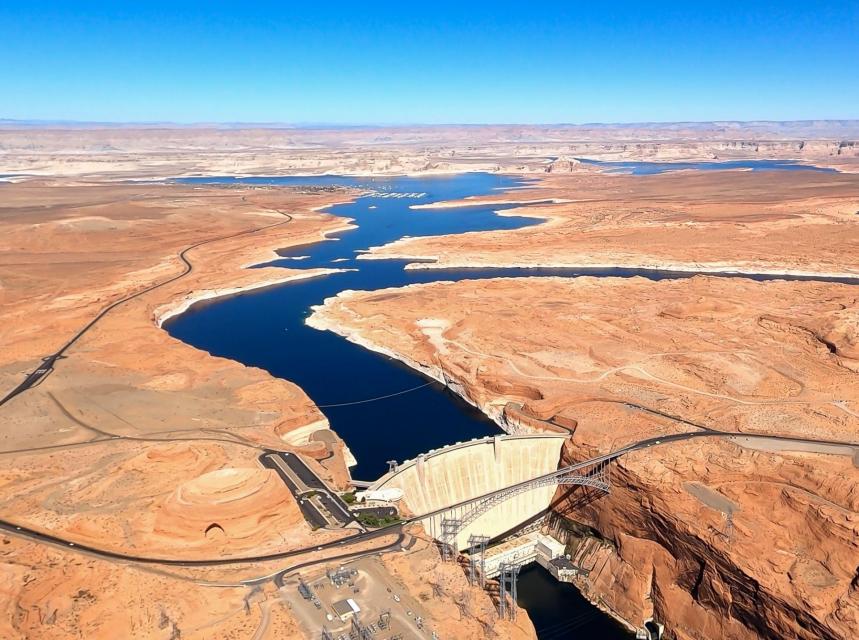
Lake Powell, the second-largest U.S. reservoir, extends from northern Arizona into southern Utah. A critical water source for seven Colorado River Basin states, it has shrunk dramatically over the past 40 years.

An ongoing 22-year megadrought has lowered the water level to just 22.6% of โ€œfull pool,โ€ and that trend is expected to continue. Federal officials assert that there are no plans to drain Lake Powell, but overuse and climate change are draining it anyway.

As the water drops, Glen Canyon โ€“ one of the most scenic areas in the U.S. West โ€“ is reappearing.

This landscape, which includes the Colorado Riverโ€™s main channel and about 100 side canyons, was flooded starting in the mid-1960s with the completion of Glen Canyon Dam in northern Arizona. The areaโ€™s stunning beauty and unique features have led observers to call it โ€œAmericaโ€™s lost national park.โ€

Lake Powellโ€™s decline offers an unprecedented opportunity to recover the unique landscape at Glen Canyon. But managing this emergent landscape also presents serious political and environmental challenges. In my view, government agencies should start planning for them now.

A tarnished jewel

Glen Canyon Dam, which towers 710 feet high, was designed to create a water โ€œbank accountโ€ for the Colorado River Basin. The U.S. Bureau of Reclamation touted Lake Powell as the โ€œJewel of the Coloradoโ€ and promised that it would be a motorboaterโ€™s paradise and an endless source of water and hydropower.

Lake Powell was so big that it took 17 years to fill to capacity. At full pool, it contained 27 million acre-feet of water โ€“ enough to cover 27 million acres of land to a depth of one foot โ€“ and Glen Canyon Damโ€™s turbines could generate 1,300 megawatts of power when the reservoir was high.

Soon the reservoir was drawing millions of boaters and water skiers every year. But starting in the late 1980s, its volume declined sharply as states drew more water from the Colorado River while climate change-induced drought reduced the riverโ€™s flow. Today the reservoirโ€™s average volume is less than 6 million acre-feet.

Nearly every boat ramp is closed, and many of them sit far from the retreating reservoir. Hydropower production may cease as early as 2024 if the lake falls to โ€œminimum power pool,โ€ the lowest point at which the turbines can draw water. And water supplies to 40 million people are gravely endangered under current management scenarios.

These water supply issues have created a serious crisis in the basin, but there is also an opportunity to recover an amazing landscape. Over 100,000 acres of formerly flooded land have emerged, including world-class scenery that rivals some of the crown jewels of the U.S. national park system. https://www.youtube.com/embed/y7jm08U38c0?wmode=transparent&start=0 As Lake Powell recedes, it is uncovering formerly flooded land and things that past visitors left behind.

Bargained away

Glen Canyon made a deep impression on explorer John Wesley Powell when he surveyed the Colorado River starting in 1867. When Powellโ€™s expedition floated through Glen Canyon in 1869, he wrote:

โ€œOn the walls, and back many miles into the country, numbers of monument-shaped buttes are observed. So we have a curious ensemble of wonderful features โ€“ carved walls, royal arches, glens, alcove gulches, mounds, and monuments โ€ฆ past these towering monuments, past these oak-set glens, past these fern-decked alcoves, past these mural curves, we glide hour after hour.โ€

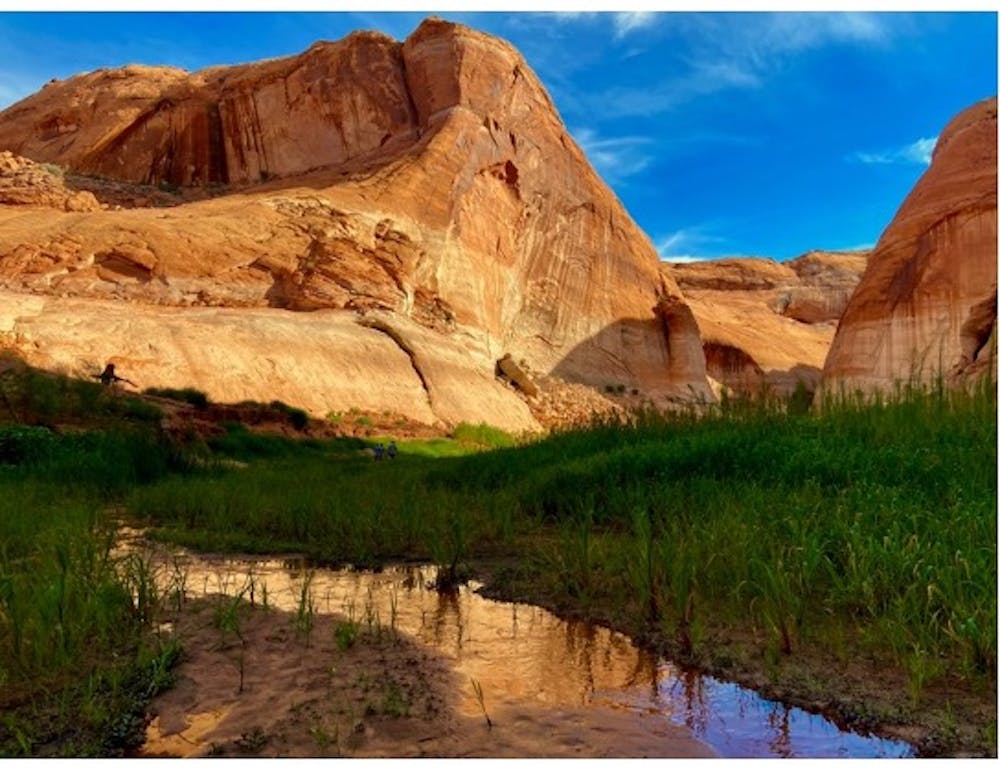
A red rock cliff towers above trees and a small pool of water.
This side canyon emerged in recent years as Lake Powell shrank. The white โ€˜bathtub ringโ€™ on the rock wall shows past water levels. Daniel Craig McCool, CC BY-ND

Glen Canyon remained relatively unknown until the late 1940s, when the Bureau of Reclamation proposed several large dams on the upper Colorado River for irrigation and hydropower. Environmentalists fiercely objected to one at Echo Park in Dinosaur National Monument on the Colorado-Utah border, alarmed by the prospect of building a dam in a national monument. Their campaign to block it succeeded โ€“ but in return they accepted a dam in Glen Canyon, a decision that former Sierra Club President David Brower later called his greatest regret.

New challenges

The first goal of managing the emergent landscape in Glen Canyon should be the inclusion of tribes in a co-management role. The Colorado River and its tributaries are managed through a complex maze of laws, court cases and regulations known as the โ€œLaw of the River.โ€ In an act of stupendous injustice, the Law of the River ignored the water rights of Native Americans until courts stepped in and required western water users to consider their rights.

Tribes received no water allocation in the 1922 Colorado River Compact and were ignored or trivialized in subsequent legislation. Even though modern concepts of water management emphasize including all major stakeholders, tribes were excluded from the policymaking process.

There are 30 tribes in the Colorado River Basin, at least 19 of which have an association with Glen Canyon. They have rights to a substantial portion of the riverโ€™s flow, and there are thousands of Indigenous cultural sites in the canyon.

Another management challenge is the massive amounts of sediment that have accumulated in the canyon. โ€œColoradoโ€ means โ€œcolored redโ€ in Spanish, a recognition of the silt-laden water. This silt used to build beaches in the Grand Canyon, just downstream, and created the Colorado River delta in Mexico.

But for the past 63 years, it has been accumulating in Lake Powell, where it now clogs some sections of the main channel and will eventually accumulate below the dam. Some of it is laced with toxic materials from mining decades ago. As more of the canyon is exposed, it may become necessary to create an active sediment management plan, including possible mechanical removal of some materials to protect public health.

The creation of Lake Powell also resulted in biological invasives, including nonnative fish and quagga mussels. Some of these problems will abate as the reservoir declines and a free-flowing river replaces stagnant still water.

On a more positive note, native plants are recolonizing side canyons as they become exposed, creating verdant canyon bottoms. Restoring natural ecosystems in the canyon will require innovative biological management strategies as the habitat changes back to a more natural landscape.

Finally, as the emergent landscape expands and side canyons recover their natural scenery, Glen Canyon will become a unique tourist magnet. As the main channel reverts to a flowing river, users will no longer need an expensive boat; anyone with a kayak, canoe or raft will be able to enjoy the beauty of the canyons.

Glen Canyon National Recreation Area, which includes over 1.25 million acres around Lake Powell, was created to cater to people in motorized boats on a flat-water surface. Its staff will need to develop new capabilities and an active visitor management plan to protect the canyon and prevent the kind of crowding that is overrunning other popular national parks.

Other landscapes are likely to emerge across the West as climate change reshapes the region and numerous reservoirs decline. With proper planning, Glen Canyon can provide a lesson in how to manage them.

Daniel Craig McCool, Professor Emeritus of Political Science, University of Utah

This article is republished from The Conversation under a Creative Commons license. Read the original article.

John Wesley Powell. By Painter: Edmund Clarence Messer (1842 - 1919) - Flickr, Public Domain, https://commons.wikimedia.org/w/index.php?curid=7299882

Falling #LakePowell #Water Levels Put #Wyoming Hydro Power at Risk — Public News Service

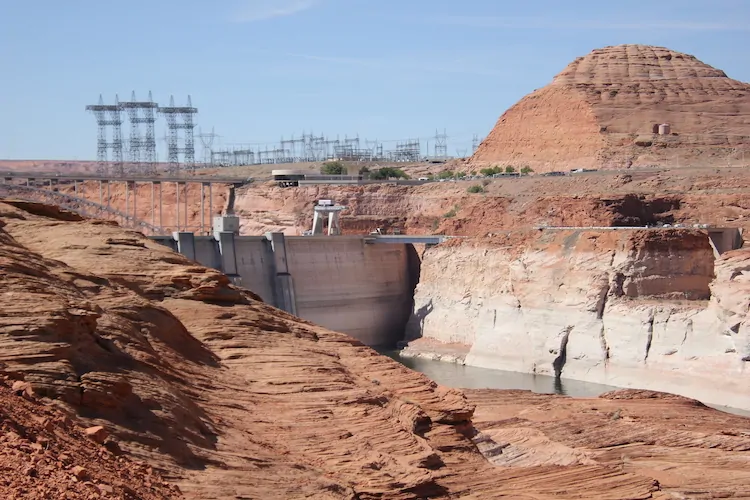
Glen Canyon Dam, January 2022. Jonathan P. Thompson photo.

Click the link to read the article on the Public News Service website (Eric Galatas):

Part of the deal Wyoming struck for sending its water down the Colorado River was that state residents would be able to tap electricity generated at Glen Canyon Dam. But that arrangement is becoming less tenable as water levels at Lake Powell required for hydro-power production continue to drop. 

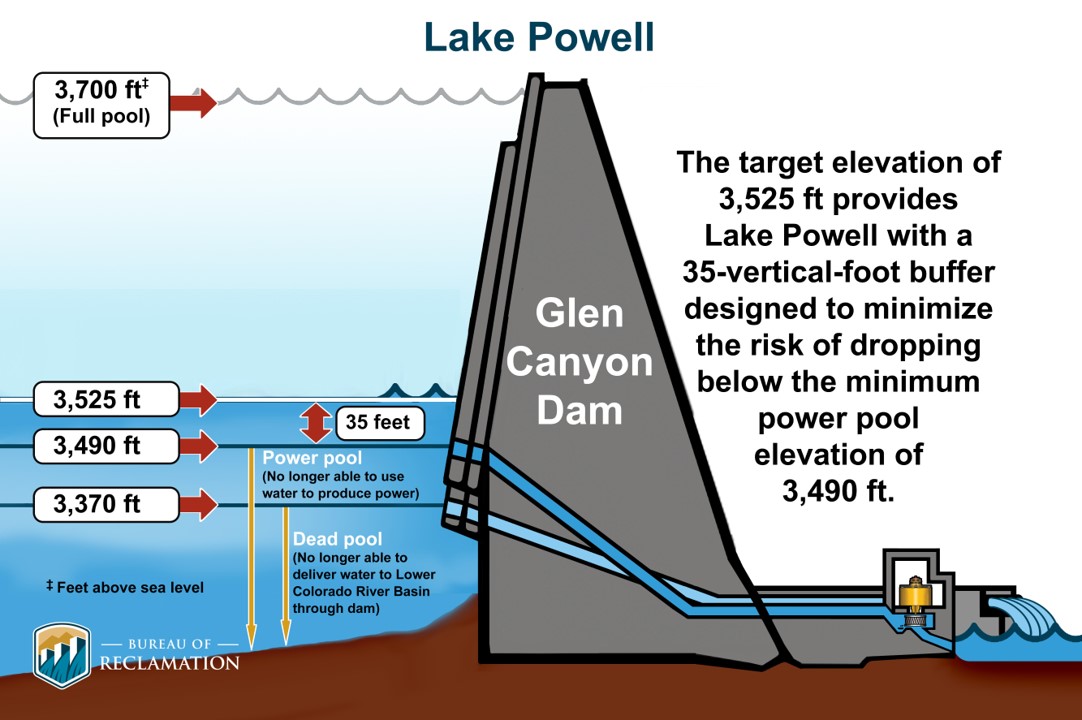
Sinjin Eberle, southwest communications director with the group American Rivers, explained in order to be able to generate electricity, Lake Powell can drop no lower than 3,490 feet.

“Figuring out how we’re going to manage this system in the face of a much smaller river is what everybody in the Colorado River Basin, whether you are in Wyoming or California, need to be concerned about,” Eberle said. 

Glen Canyon Dam currently generates energy for nearly 6-million households in Wyoming, Arizona, Colorado, Nebraska, Nevada, New Mexico and Utah. Lake Powell water levels dropped to their lowest point since 1967 last summer, reaching 3,533 feet, and some warn the lake could dip below levels necessary for power generation as early as this spring, and have proposed demolishing the dam to help restore the Colorado River’s health and long-term viability.

If Lake Powell drops below Dead Power to Dead Pool status at 3,370 feet, water would no longer be able to flow through the dam to lower basin states. This year’s higher-than-average snow pack may provide short-term relief, but Eberle said it could take years of above-average precipitation to reverse decades of drought across the region, and added the challenges facing Lake Powell and Glen Canyon Dam are multi-faceted.

“Water-supply issues from a lingering 23-year drought, with impacts from climate change continuing to exacerbate those drought conditions,” Eberle said. “And then (we have) some of the fastest growing areas of the country demanding more water.”

When the Colorado River Compact was first negotiated in 1922, there were just 475,000 people living in the seven-state basin. Then-Commerce Secretary Herbert Hoover projected that population could swell to two million people over time. But there are now at least 40-million people across the basin that depend on water from the river, Eberle said. 

“This framework that was built in 1922 has lasted 100 years, but is also trying to support a system that is many, many times larger than the wildest imaginations of the framers when they built this compact,” he said. 

Disclosure: American Rivers contributes to our fund for reporting on Environment, Public Lands/Wilderness, Salmon Recovery, Water. If you would like to help support news in the public interest, click here.

#ColoradoRiver states seek solution for shrinking #water supply The #Gunnison Country Times #COriver #aridification

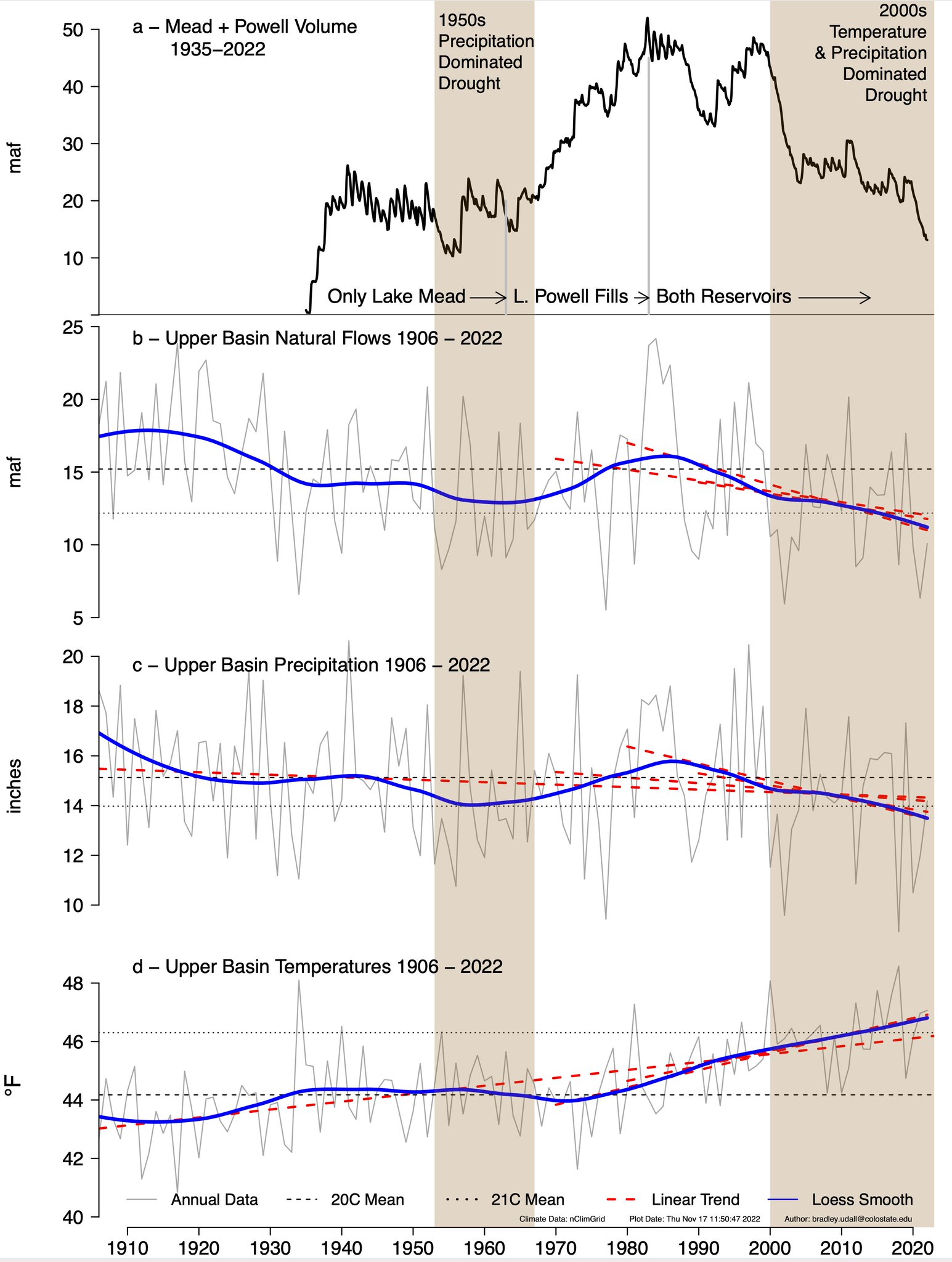
Updated Colorado River 4-Panel plot thru Water Year 2022 showing reservoirs, flows, temperatures and precipitation. All trends are in the wrong direction. Since original 2017 plot, conditions have deteriorated significantly. Brad Udall via Twitter: https://twitter.com/bradudall/status/1593316262041436160

Click the link to read the article on The Gunnison Country Times website (Bella Biondini). Here’s an excerpt:

โ€œWe can only save the Colorado River system if we act together,โ€ Upper Colorado River Commissioner Becky Mitchell said in a press release. โ€œThe CBMA (Consensus-Based Modeling Alternative) approach appropriately distributes the burden across the Basin and provides safeguards for the Tribes, water users, and environmental values in the Upper Basin.โ€ 

โ€˜Whoโ€™s using all the water?โ€™

Water use by basin has been historically uneven, but dry conditions along the Colorado River have continued to reduce the amount of water available for all users. While each basin is entitled to 7.5 million acre-feet per year under the 1922 compact, only the Lower receives that much. And its use has been steadily increasing.ย  At the same time, approximately 1.5 million acre-feet is lost to evaporation or in transit as it travels to large desert cities like Phoenix and Las Vegas. The Lower Basin gets to keep this bonus, and its total allocation is not charged with the losses.ย  Although Lower Basin users can pull more from large buckets of water upstream like Lake Powell in times of drought, those located at the headwaters of the Colorado River take their shortages directly from Mother Nature. Since 2019, use in the Upper Basin has declined by 22.5%, according to data from the Colorado Water Conservation Board.ย  The Upper Basin states have consistently argued that the source of the problem is overconsumption downstream, said John McClow, general counsel for the Upper Gunnison River Water Conservancy District. During the same time period that use in the Upper Basin declined, use in the Lower Basin increased by 7% โ€”ย ย equivalent to approximately 638,000 acre-feet or twice the current content of Blue Mesa Reservoir.ย 

โ€œWhoโ€™s using all the water? It isnโ€™t us,โ€ McClow said. โ€œBut we have no choice. We canโ€™t decide how much weโ€™re consuming. We can only consume what melts into the rivers.โ€

[…]

Reclamation has committed $125 million to a voluntary consumption reduction program in the Upper Basin through a partnership with the Upper Colorado River Commission. The Commission will select projects for implementation beginning in 2023 โ€” reimbursing selected water users per acre-foot of water saved for the greater system. Exactly how many users will participate is unknown.ย  Thereโ€™s agreement that the Upper and Lower Basin states must work collectively to address the risk in the Colorado River system, said Executive Director Chuck Cullom.

โ€œThereโ€™s also recognition that the Upper Basin activities are only effective if thereโ€™s companion action in the lower basin,โ€ Cullom said. 

Re-engineering #GlenCanyonDam — The Land Desk

Glen Canyon Dam during high flow experimental release about a decade ago. These occasional releases are just about the only time the river outlet works (where water is gushing out above) operate. Photo credit: Jonathan P. Thompson/The Land Desk

Click the link to read the article on The Land Desk website (Jonathan P. Thompson):

For the last two years or so, federal Bureau of Reclamation officials have been fretting publicly about what might happen to Glen Canyon Dam as water levels continue to drop.ย Currently the surface of Lake Powell is perilously close to the penstocks, or the water intakes that lead to the hydroelectricity turbines. Once those are rendered inoperable, the only way to get water through the dam is via the river outlet works, or ROW.

The back of Glen Canyon Dam circa 1964, not long after the reservoir had begun filling up. Here the water level is above dead pool, meaning water can be released via the river outlets, but it is below minimum power pool, so water cannot yet enter the penstocks to generate electricity. Bureau of Reclamation photo.

That could be a problem. First off, there are no turbines on the ROWs, so there would be no hydropower generation. And as Tanya Trujillo, the Interior Departmentโ€™s assistant secretary for water and science, noted last year, the dam was not built โ€œto operate solely through the outworks for an extended period of time.โ€ Bad things could happen, like cavitation of the ROWs, which could then threaten the very integrity of the dam. Something needs to be done.

Last week, the Bureau for the first time made public six alternatives the agency is considering:

  • Construct new, low- (3,245 feet) or mid-level (3,445 feet) power intakes through the dam that would utilize existing turbines, essentially lowering the โ€œminimum power poolโ€ level as much as 200 feet.
  • Connect the current ROWs โ€” at 3,374 feet โ€” to the current turbines or install new turbines so hydropower generation could continue until the lake reached โ€œdead pool,โ€ or falls below the ROWs (at which point no water can be released and the Grand Canyon will dry up).
  • Build a low-level bypass tunnel through the sandstone around the dam and install new turbines/power plant to allow for low-water releases with hydropower generation. (Simply reopening the original river diversion tunnels, built to allow for the construction of Glen Canyon Dam, was dismissed due to the fact that the openings are completely buried in silt. This bypass would be above the siltation level.)
  • Adjust Colorado River operations (e.g. release less water from Glen Canyon Dam, get people to stop using so much water, etc.)
  • Retrofit dam to allow it to generate hydropower through existing penstocks at slightly lower levels.
  • Invest in other power sources to offset hydropower losses.
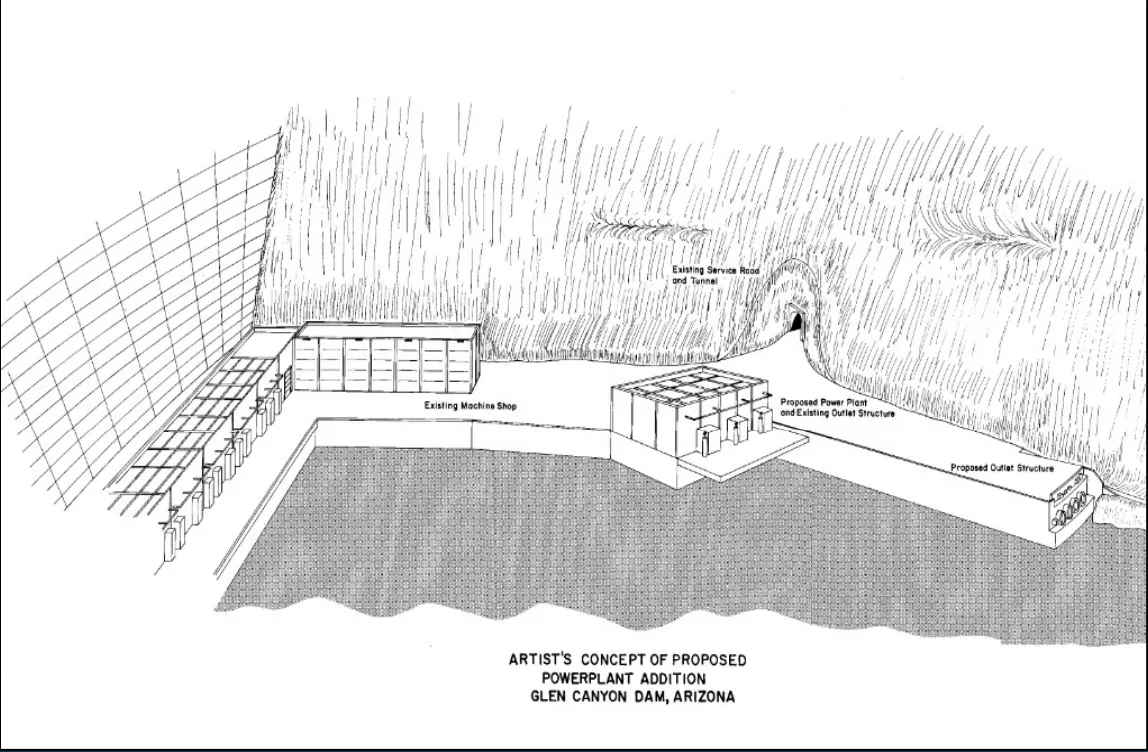
Proposed powerplant addition Glen Canyon Dam. Credit: The Land Desk

Any of the first three options would be a major and expensive undertaking. And any of them would also allow Glen Canyon Dam to be operated at much lower lake levels, which would have consequences for Lake Powell, too. Already the reservoir looks radically different than it does at โ€œnormalโ€ levels; try to imagine it 130 feet lower?

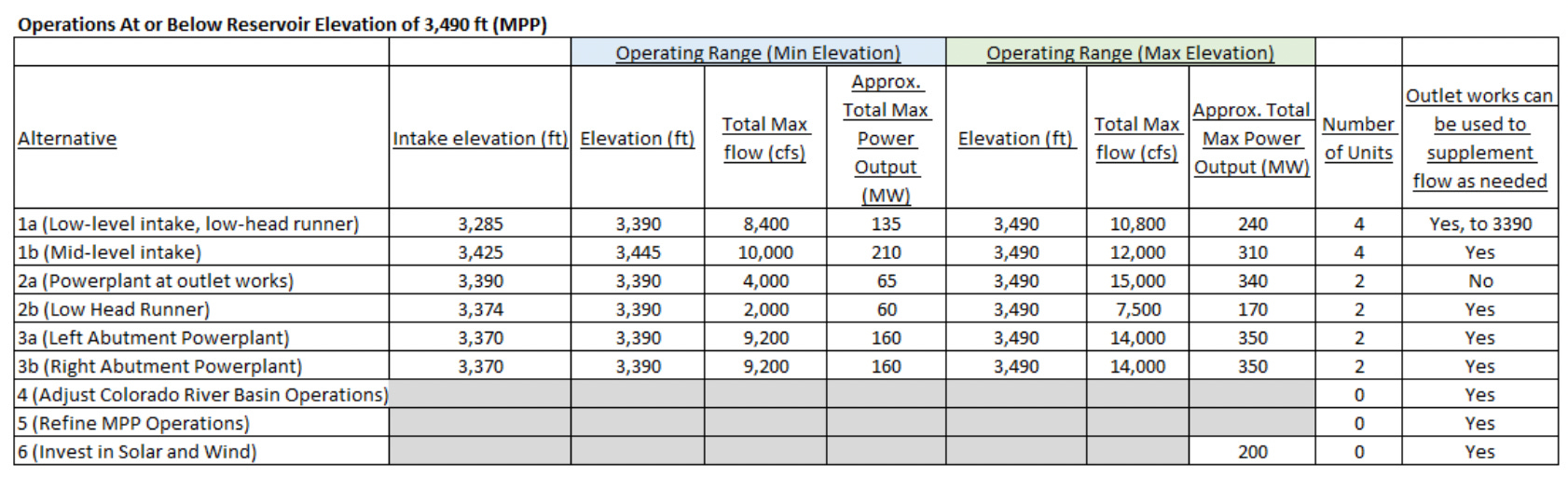
Currently, the surface of Lake Powell is sitting at 3,522 feet. Minimum power pool is 3,490. Dead pool is 3,370. The alternatives being considered would allow the minimum power pool level to drop to 3,390, according to the chart below (although, theoretically, a 3,285 foot intake would allow the level to drop another 100 feet before hitting dead pool).

Operations at or below reservoir elevation of 3,490′ (MPP). Credit: The Land Desk

That would not only reveal more hidden wonders, but would also cause the big slug of silt that is concentrated in the upper reaches of the reservoir to migrate further downstream. And it would wreak more havoc on recreation. Iโ€™ll leave you with a good Twitter thread from Zak Podmore mapping out Lake Powell at 3,285 feet.

Changes needed to save second-largest U.S. reservoir, experts say — The Washington Post #LakePowell #ColoradoRiver #COriver #aridification #snowpack

Updated Colorado River 4-Panel plot thru Water Year 2022 showing reservoirs, flows, temperatures and precipitation. All trends are in the wrong direction. Since original 2017 plot, conditions have deteriorated significantly. Brad Udall via Twitter: https://twitter.com/bradudall/status/1593316262041436160

Click the link to read the article on The Washington Post website (Anumita Kaur). Here’s an excerpt:

โ€œThereโ€™s too little supply and too much demand,โ€ said Brad Udall, a water and climate scientist at Colorado State University. โ€œUltimately, I think what weโ€™re going to see here is some major rewriting of Western water law.โ€

โ€œWeโ€™re seeing a collision right now between 19th century water law, 20th century infrastructure and 21st century population and climate change,โ€ Udall added. โ€œAnd how this works out is anybodyโ€™s guess.โ€

[…]

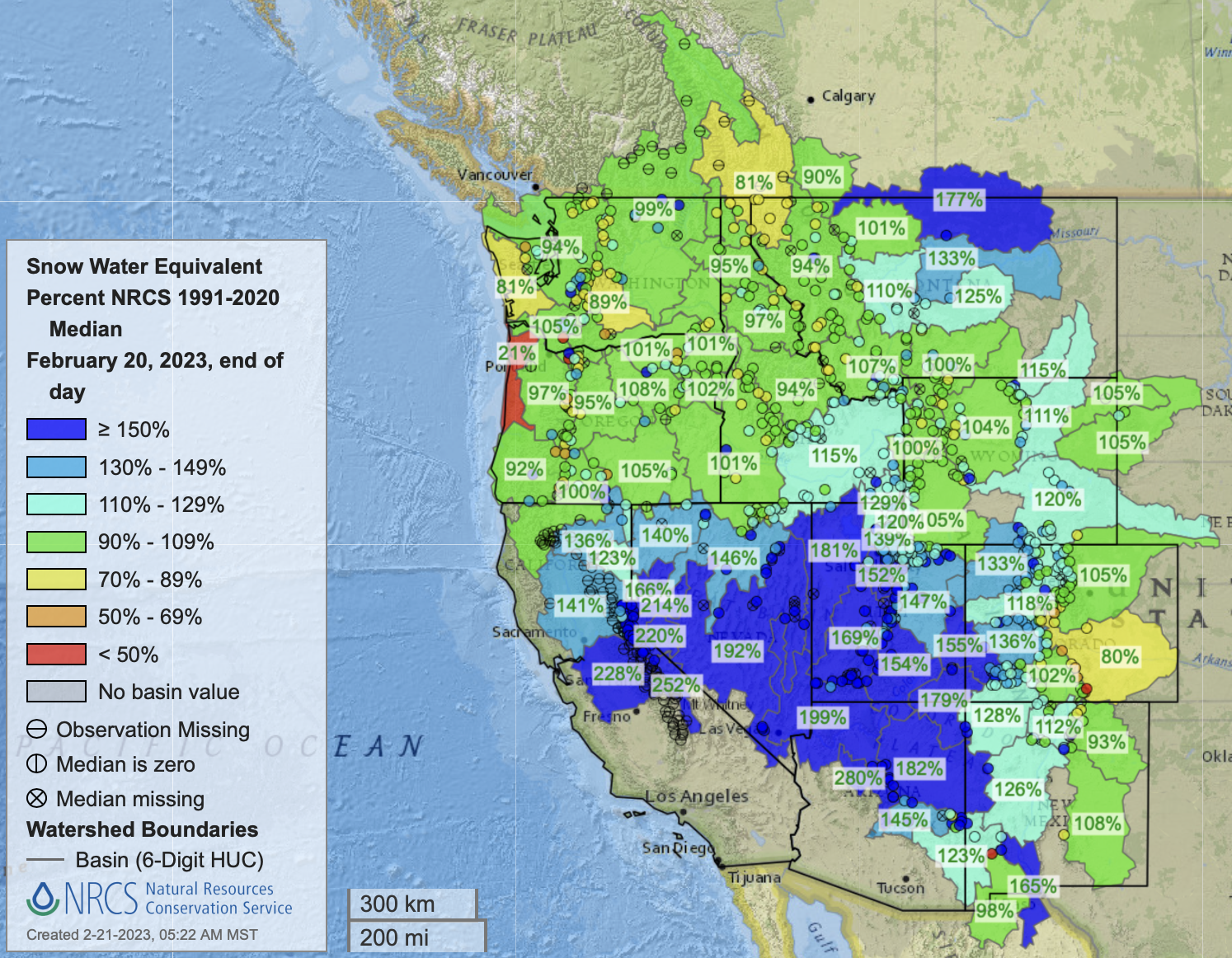
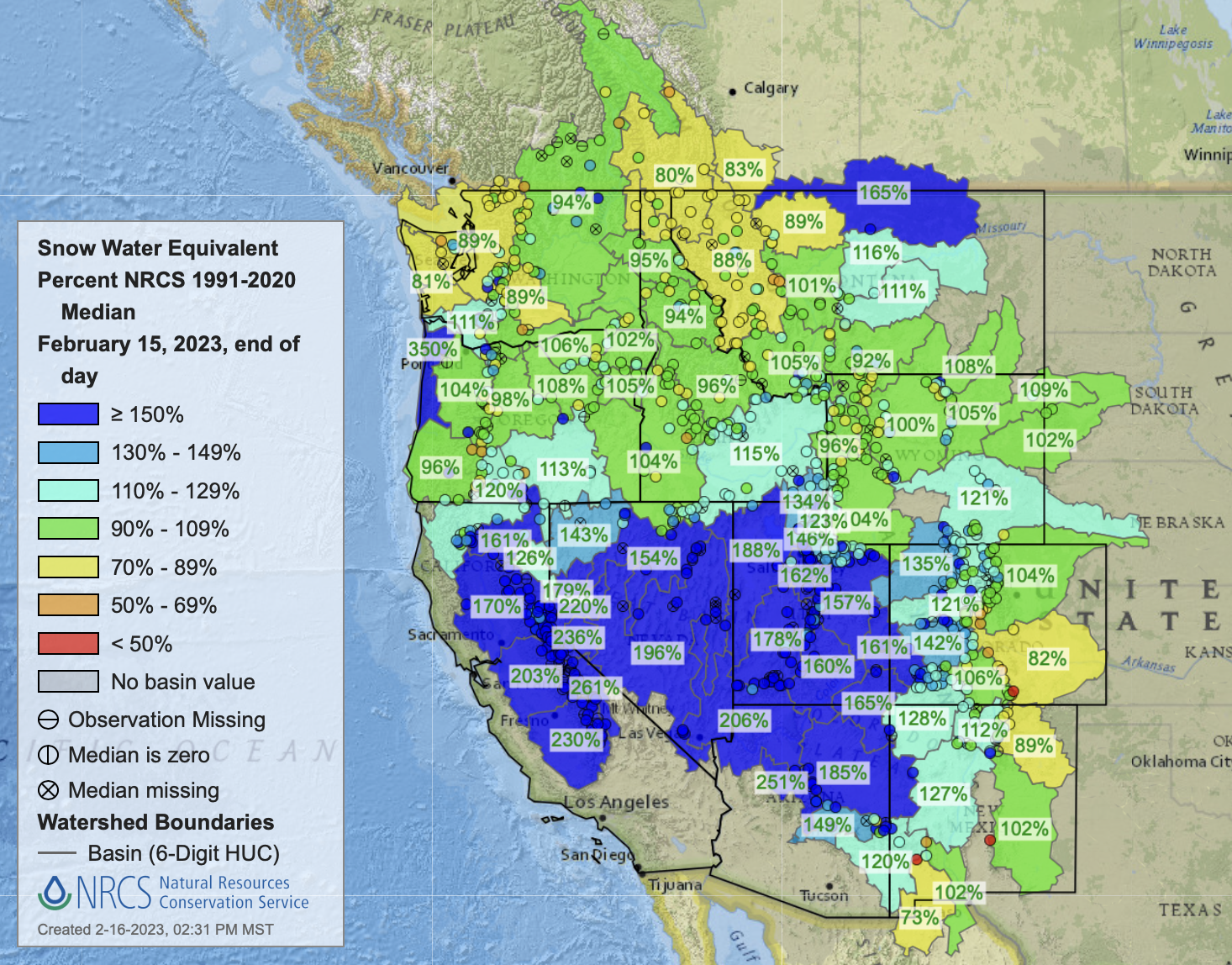
West snowpack basin-filled map February 20, 2023 via the NRCS.

The snow and rain seen in the west this year isnโ€™t enough to stabilize Lake Powell either, Andrechak said. โ€œNow, the reality is, theyโ€™re all going to get a cut. Everybody should give,โ€ he said.

โ€œThereโ€™s no time left. The crisis is here. They donโ€™t necessarily have to give it up forever. It might be temporary for several years until thereโ€™s improvements,โ€ he said. But even if water levels do improve in the future, states cannot expect to return to former water usage entirely.

โ€œClimate change is making sure that itโ€™ll never get back to those levels,โ€ Andrechak said.

At the heart of #ColoradoRiver crisis, the mighty โ€˜Law of the Riverโ€™ holds sway — The Los Angeles Times #COriver #aridification

Colorado River from Lee’s Ferry. Photo credit. Gonzo fan2007 – Own work, CC BY-SA 4.0, https://commons.wikimedia.org/w/index.php?curid=3631180

Click the link to read the article on The Los Angeles Times website (Hayley Smith and Ian James). Here’s an excerpt:

At the heart of the feud is the โ€œLaw of the River,โ€ a body of agreements, court decisions, contracts and decrees that govern the riverโ€™s use and date back to 1922, whenย the Colorado River Compactย first divided river flows among the states. [ed. note: George Sibley argues the “Prior Appropriation” is the base of the Law of the River.]ย 

But as California argues most strongly for strict adherence to this system of water apportionment, the other states say it makes little sense when the riverโ€™s largest reservoir, Lake Mead, continues to decline toward โ€œdead poolโ€ level, which would effectively cut off the Southwest from its water lifeline. The Law of the River, they say, is getting in the way of a solution.

โ€œWe can argue about whether interpretations of the Law of the River match the physical reality,โ€ said Tom Buschatzke, director of the Arizona Department of Water Resources. โ€œBut if you end up in a courtroom arguing these points and something isnโ€™t done, the Colorado River system is going to crash.โ€

[…]

Californiaโ€™s legal position is based on several factors, said James Salzman, a professor of environmental law at UCLA and UC Santa Barbara. First, the authors of the original Colorado Compact made the โ€œfateful decisionโ€ to divvy up water for the riverโ€™s lower-basin states of California, Arizona and Nevada in absolute quantities instead of percentages.ย That means upper-basin states are obligated to deliver 7.5 million acre-feet per year to the lower states, no matter what, which โ€œturned out to be a tragically bad design,โ€ Salzman said. Additionally, the massive Imperial Irrigation District in California established senior rights to the water before the Colorado River Compact โ€” meaning it holds high-priority rights to deliver theย single largest shareย of the riverโ€™s water to Imperial Valley farmlands.ย 

Arizona, by contrast, agreed to junior rights to the river in 1968 in exchange for building the Central Arizona Project, the system that transports river water through the state. 

In other words, according to the Law of the River, if thereโ€™s not enough water to go around, states like Arizona are supposed to be cut off before California.

The Salton Sea (pictured above ) straddles the Imperial and Coachella valleys and has long been a sticking point in Colorado River deals. But the federal government recently committed up to $250 million for restoration efforts at the sea. (Source: Water Education Foundation)

#ColoradoRiver District poll highlights voters’ #water concerns — The #GrandJunction Daily Sentinel #COriver #aridification

A lateral brings water from the Grand Valley Irrigation Company canal to this parcel of land, which is owned by private equity firm Water Asset Management, a company that has been accused of water speculation. A state work group has released its report on investment water speculation, but failed to come to a consensus and did not make recommendations to lawmakers. CREDIT: BETHANY BLITZ/ASPEN JOURNALISM

Click the link to read the article on the Grand Junction Daily Sentinel website (Dennis Webb). Here’s an excerpt:

About three-quarters or more of those polled identified as extreme or serious problems issues such as the levels of water in Colorado rivers, lower snowpack, availability of water for farming and ranching, wildfire conditions, and more frequent drought…Eight-four percent of respondents said they viewed out-of-state investment firms and hedge funds buying Colorado water rights, as has happened in Mesa County, as being very threatening to water availability on the Western Slope, and the same percentage consider out-of-state water interests like California to be very threatening. Seventy-eight percent said they consider foreign governments buying Colorado water rights to be very threatening, and 62% view water users from other parts of the state such as Denver and the Front Range as being very threatening…Four out of every five respondents said they would support a small tax increase dedicated to the river district to use easements to protect water, by employing land conservation agreements to pay willing agricultural producers to preserve their water right and keep that water in western Colorado…

Weigel said 53% of respondents in the eastern part of the district said water users from other parts of the state are very much a threat, even though it didnโ€™t rank among their top-five perceived threats.

โ€œLetโ€™s cut the crapโ€: #ColoradoRiver plan still isnโ€™t enough, experts say, and #California isnโ€™t on board — The #DenverPost #COriver #aridification

Updated Colorado River 4-Panel plot thru Water Year 2022 showing reservoirs, flows, temperatures and precipitation. All trends are in the wrong direction. Since original 2017 plot, conditions have deteriorated significantly. Brad Udall via Twitter: https://twitter.com/bradudall/status/1593316262041436160

Click the link to read the article on The Denver Post website (Conrad Swanson). Here’s an excerpt:

Evaporation and transfer loss is a meaningful starting point, Brad Udall, a water and climate scientist at Colorado State University, said. But the countryโ€™s two largest reservoirs, lakes Powell and Mead, are already at historic lows and waiting until they sink further to make cuts doesnโ€™t make sense.

โ€œLetโ€™s cut the crap,โ€ Udall said. โ€œWe donโ€™t have elevation to give away right now.โ€

All told, the six-state plan doesnโ€™t save the smallest amount of water required by the federal government. Evaporation, transfer loss and the tiered water cuts to the lower basin combine to save as much as 1.95 million acre-feet…At a minimum, the states must save 2 million acre-feet a year,ย federal officials announced last summer, but now water experts are wondering whether the basin must saveย three times that much, more than Colorado, New Mexico, Utah and Wyoming combined use in a single year…The existing proposal isnโ€™t enough to qualify as a long-term plan, but it might be enough for the basin to survive until it can agree on one, Udall said.

Federal officialsโ€™ reaction to the plan remains unclear. After the states published it Monday, a representative for U.S. Bureau of Reclamation Commissioner Camille Touton canceled a Tuesday morning interview with The Denver Post and directed questions to the U.S. Department of Interior, which offered no additional insight.

Two pumped #water storage projects move forward in #Colorado — @WaterEdCO

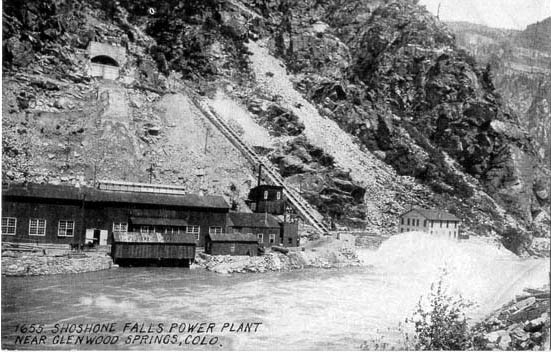
Shoshone Falls hydroelectric generation station via USGenWeb. Shoshone hydropower plant has the most senior, large-volume water right on the Colorado mainstem. The bonus for other users is that the water returns to the river after producing electricity.

Click the link to read the article on the Water Education Colorado website (Allen Best):

Two proposed pumped water storage projects that could expand Coloradoโ€™s ability to store renewable energy โ€“ one in Fremont County and another between Hayden and Craig in the Yampa River Valley โ€“ are moving forward.

Colorado will need green energy storage of some type if it is to attain its mid-century goals of 100% renewable energy. Solar and wind power are highly variable and cannot be turned off and on, like coal and natural gas plants are.

So the search is on for ways to build large-scale storage projects to hold the energy wind and solar generate. Lithium-ion batteries are part of the answer and are being rapidly added to supplement wind and solar. But they typically have a short life span, while pumped water storage hydropower projects can operate for decades.

Pumped storage hydro electric.

Pumped water storage has been refined in recent decades but the basic principles remain unchanged. Water is released from a higher reservoir to generate power when electricity is most in demand and expensive. When electricity is plentiful and less expensive, the water is pumped back up to the higher reservoir and stored until it is needed again.

This technology even today is responsible for 93% of energy storage in the United States, according to the U.S. Department of Energy. That includes Cabin Creek, Xcel Energyโ€™s 324-megawatt pumped storage unit near Georgetown. It was installed in 1967.

โ€œThese pumped-storage projects are anathema to the modern way of thinking,โ€ says Peter Gish, a principal in Ortus Climate Mitigation, the developer of the Fremont County pumped water storage project.

โ€œBut once built and operating, the maintenance costs are very, very low, and the system will last, if properly maintained, a century or longer. The capital investment up front is quite high, but when you run the financial models over 30, 50 or 60 years, this technology is, hands down, the cheapest technology on the market for [energy] storage.โ€

Ortus Climate Mitigation wants to build a 500-megawatt pumped water storage facility on the South Slope of Pikes Peak above the town of Penrose in Fremont County. This facility โ€“ essentially a giant battery for energy storage โ€“ would require two reservoirs.

Gish hopes to have a permit from the Federal Energy Regulatory Commission in 2026. Construction would take up to five years after the permit is approved.

In the Yampa Valley, another developer continues to plug away at a potential application for a site somewhere between Hayden and Craig. Still another idea is said to be in formulation in southwestern Colorado, but no details could be gleaned about that project.

Phantom Canyon, as Ortus calls its project in Fremont County, would require 17,000 acre-feet of water for the initial fill of the two reservoirs to be augmented by about 1,500 acre-feet annually due to losses from evaporation.

The company says it has accumulated water rights.

Gish, a co-founder of Ortus, says his company is โ€œkeenly awareโ€ of water scarcity issues in Colorado and looks into ways to reduce the evaporative loss and hence shave water needs. One option is to place solar panels over the reservoirs, producing energy while shading the water. On a vastly smaller scale, that has been done at the Walden municipal water treatment plant in north-central Colorado.

Unlike an unsuccessful attempt by Xcel in 2021 to build a pumped water storage project in Unaweep Canyon on federal land in Western Colorado, the Ortus project near Pikes Peak would involve only private land. The company has exclusive purchase options for 4,900 acres. It also has secured 12 easements for pipeline access from the lower reservoir to the Arkansas River.

Proximity to water sources matters, and so does the location relative to transmission. Penrose is about 30 miles from both Colorado Springs and Pueblo and major transmission lines.

The company last year laid out the preliminary plans with Fremont County planners and hosted a meeting in Canon City to which environmental groups and others were invited. By then, FERC had issued a preliminary permit which is the start of the permitting process. Gish, who has worked in renewable energy for 25 years, says no potential red flags were noted.

โ€œI have found that the local stakeholders are the first people you need to talk to about a project like this,โ€ Gish says, โ€œIf you are able to get local support, the rest of the pieces will tend to fall into place. If not, the rest of the process is a much more difficult proposition.โ€

In Western Colorado, Xcel faced local opposition but also the more daunting process of permitting for a project on federal land. In the Craig-Hayden area, Matthew Shapiro, a principal in green energy company Gridflex Energy, had been examining sites that are on private land. Work continues on geological assessments and other elements, but he says that a โ€œlot of other pieces need to come together before there is real progress.โ€

In addition to having water, that portion of the Yampa Valley also has the advantage of transmission lines erected to dispatch power from the five coal-burning units that are now scheduled to close between 2025 and 2030.

Shapiro hopes to also use Colorado-sourced water to generate electricity in a pumped-storage project on the North Platte River in Wyoming. Gridflex Energy filed for a license application with FERC last week for the project on Seminoe Reservoir.

โ€œVery few projects have made it that far since the turn of the millennium. Itโ€™s a pretty big deal,โ€ Shapiro said.

Long-time Colorado journalist Allen Best produces an e-journal called Big Pivots and is a frequent contributor to Fresh Water News.

Unaweep Canyon

As the #ColoradoRiver shrinks, federal officials consider overhauling #GlenCanyonDam — The Los Angeles Times #COriver #aridification

The back of Glen Canyon Dam circa 1964, not long after the reservoir had begun filling up. Here the water level is above dead pool, meaning water can be released via the river outlets, but it is below minimum power pool, so water cannot yet enter the penstocks to generate electricity. Bureau of Reclamation photo.

Click the link to read the article on The Los Angeles Times website (Ian James). Here’s an excerpt:

A preliminary analysis of potential modifications to the dam emerged during a virtual meeting held by the federal Bureau of Reclamation, which is also reviewing options for averting a collapse of the water supply along the river. These new discussions about retooling the dam reflect growing concerns among federal officials about how climate change is contributing to the Colorado Riverโ€™s reduced flows, and how declining reservoirs could force major changes in dam management for years to come…

Roerink and two other people who listened to the webinar told The Times that cost estimates for several alternatives ranged from $500 million to $3 billion. The agency will need congressional approval and will have to conduct an environmental review to analyze options. The Bureau of Reclamationโ€™sย presentation, given by regional power manager Nick Williams, included some additional alternatives that wouldnโ€™t require major structural modifications of the dam. Those options included adjusting operations to maximize power generation at low reservoir levels, studying ways of using the existing intakes at lower water levels, and making up for the loss of hydroelectric power by investing in solar or wind energy…

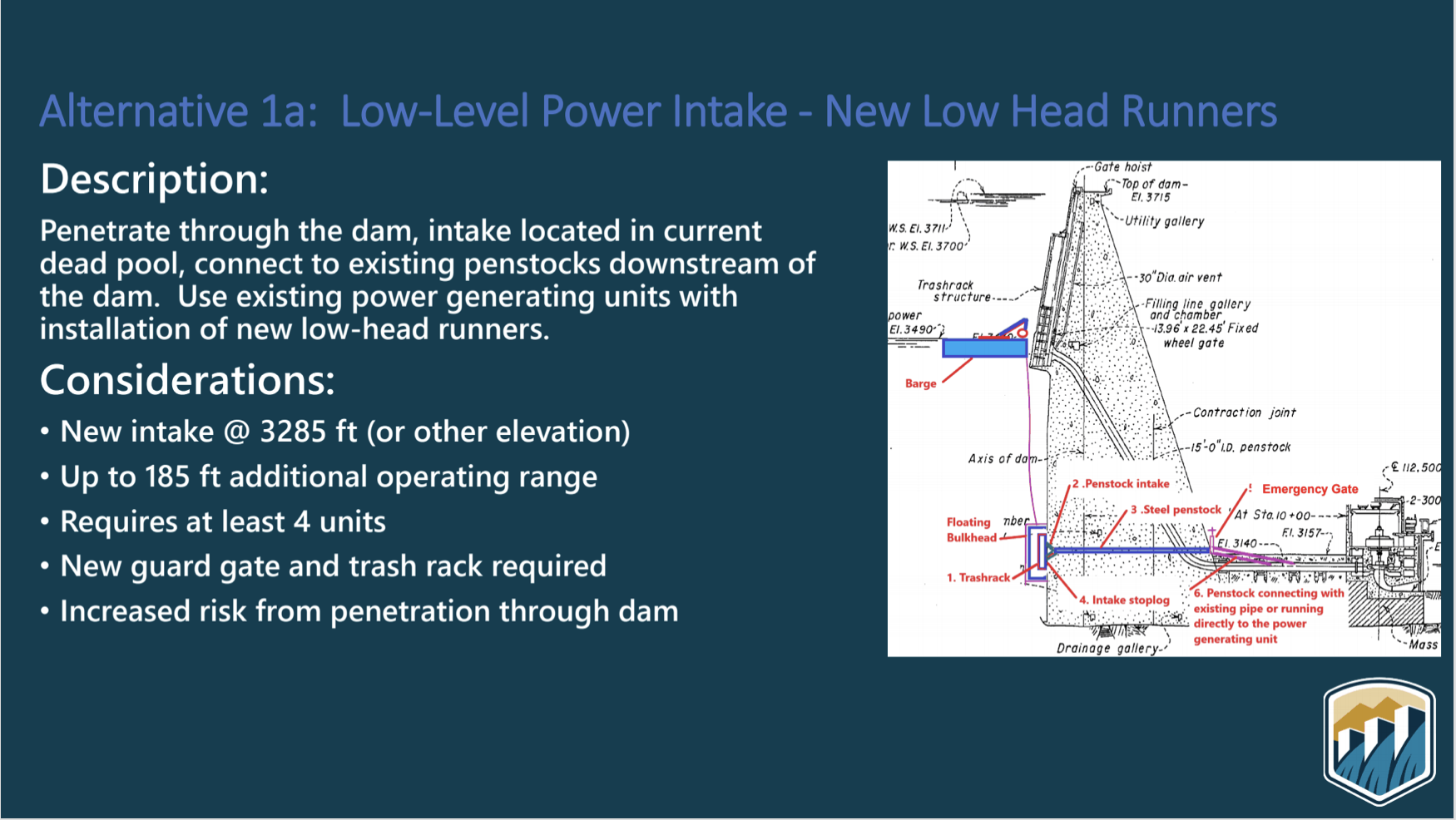
Low-Level Power Intake with New Low Head Runners (Alternative 1a. via USBR)

According to a slide presentation shown at the meeting, officials see potential hazards in some of the six alternatives. Piercing the damโ€™s concrete to create new low-level or mid-level intakes, for example, would entail โ€œincreased risk from penetration through dam,โ€ the presentation says. They also describe risks due to possible โ€œvortex formation,โ€ or the creation of whirlpools above horizontal intakes as the water level declines. Their formation could cause damage if air is pulled into the system. The presentation says one alternative would involve lowering the minimum power pool limit and possibly installing structures on the intakes to suppress whirlpools, but it said this still would not allow for the water level to go much lower.

A high desert thunderstorm lights up the sky behind Glen Canyon Dam — Photo USBR

Heavy snow comes to #PagosaSprings area — The Pagosa Springs Sun #SanJuanRiver #ColoradoRiver #COriver #aridification #snowpack

West snowpack basin-filled map February 18, 2023 via the NRCS

Click the link to read the article on the Pagosa Springs Sun website (Josh Pike). Here’s an excerpt:

Heavy snows have come again to Pagosa Country, with sites in Archuleta County receiving be- tween 6.1 and 13.1 inches of snow in the storms between Tuesday, Feb. 14, and 11 a.m. on Feb. 15, according to the Community Col- laborative Rain Hail and Snow Network website. Higher snowfall totals were concentrated in the northern and southern portions of the county, with the highest reported precipitation amount reported north of Pagosa Springs near Piedra Road.

A 6 a.m. Feb. 15 report from Wolf Creek Ski Area indicates that Wolf Creek had received 22 inches of snow in the previous 24 hours and 25 inches in the last week, bringing the midway snow depth to 101 inches and the year-to-date snow- fall total to 275 inches. According to the U.S. Department of Agriculture National Water and Climate Centerโ€™s snowpack report, the Wolf Creek summit, at 11,000 feet of elevation, had 26.3 inches of snow water equivalent as of 11 a.m. on Wednesday, Feb. 15. The Wolf Creek summit was at 121 percent of the Feb. 15 snow- pack median.

The San Miguel, Dolores, Animas and San Juan River basins were at 134 percent of the Feb. 15 median in terms of snowpack.

River Report

Stream flow for the San Juan River at approximately 11 a.m. on Feb. 15 was 66.3 cubic feet per second (cfs), according to the U.S. Geological Service National Water Dashboard. This reading is up slightly from last weekโ€™s reading of 55.9 cfs at 11 a.m. on Feb. 8. According to a Feb. 13 press release from Pagosa Area Water and Sanitation District (PAWSD) Manager Justin Ramsey, Lake For- est and Village Lake are full.

Pagosa Area Water & Sanitation District Vista Wastewater Treatment Plant upgrades could cost $15 million — The #PagosaSprings Sun #SanJuanRiver

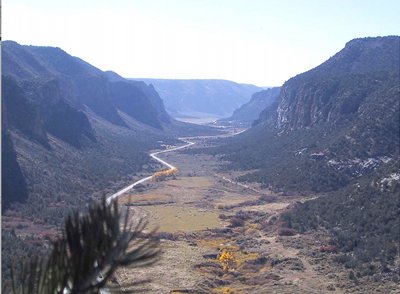
Piedra River valley from Chimney Rock National Monument. By Dicklyon – Own work, CC BY-SA 4.0, https://commons.wikimedia.org/w/index.php?curid=82546701

Click the link to read the article on the Pagosa Springs Sun website (Josh Pike). Here’s an excerpt:

At its Jan. 30 meeting, the Pagosa Area Water and Sanitation Dis- trict (PAWSD) Board of Directors discussed state-mandated modi- fications to the Vista Wastewater Treatment Plant that come with a potential cost of $15 million during a public hearing on a potential State Revolving Fund (SRF) loan for the project. The modifications are intended to improve nutrient removal and allow the plant to comply with new state nutrient standards. Nutrient removal involves the removal of nutrients such as phosphorus or nitrogen, which can be damaging to drinking water and aquatic environments in high quan- tities, from wastewater.

According to the Colorado De- partment of Public Health and Environment (CDPHE), such nutrients from the Vista plant could impact both nearby drinking water wells and the Piedra River, claims disputed by PAWSD.

The hearing opened with PAWSD District Manager Justin Ramsey ex- plaining, in response to a question from board member Gene Tautges, that PAWSD is currently pursuing a โ€œpolitical routeโ€ in its efforts to delay the modifications and that it had some initial communication with Colorado Sen. Cleave Simpson.

Deadpool Diaries: The chance of deadpool declines — John Fleck @jfleck #GreenRiver #ColoradoRiver #COriver #aridification

the Lower Basin โ€œstructural deficitโ€, reified. Photo credit: John Fleck

Click the link to read the article on the InkStain website (John Fleck):

First the bad news from the Colorado Basin River Forecast Centerโ€™s mid-February forecast โ€“ this yearโ€™s runoff into Flaming Gorge, which is at record low thanks to Drought Response Operations Agreement releases to prop up Lake Powell, is forecast to be below average this year, at 86 percent of average. At some point weโ€™ve gotta refill this hole.

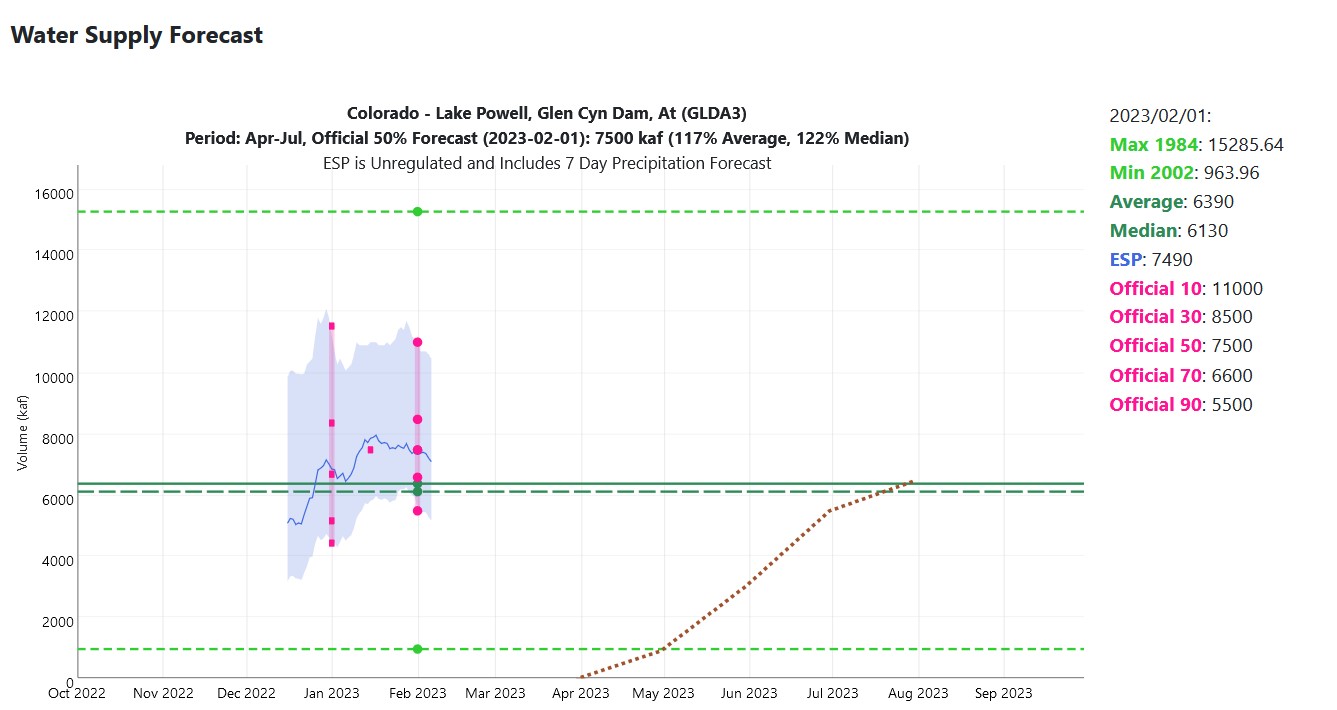
But the Lake Powell forecast continues to hover well above the โ€œaverageโ€ line, currently sitting at 117 percent.

Reclamationโ€™s latest 24-month study โ€œmost probableโ€ shows Powell bouncing back to above elevation 3,550. In the โ€œolden daysโ€ (like, last year?) 3,550 would have been awful, but in the midst of our current crisis management fire drill it looks pretty good.

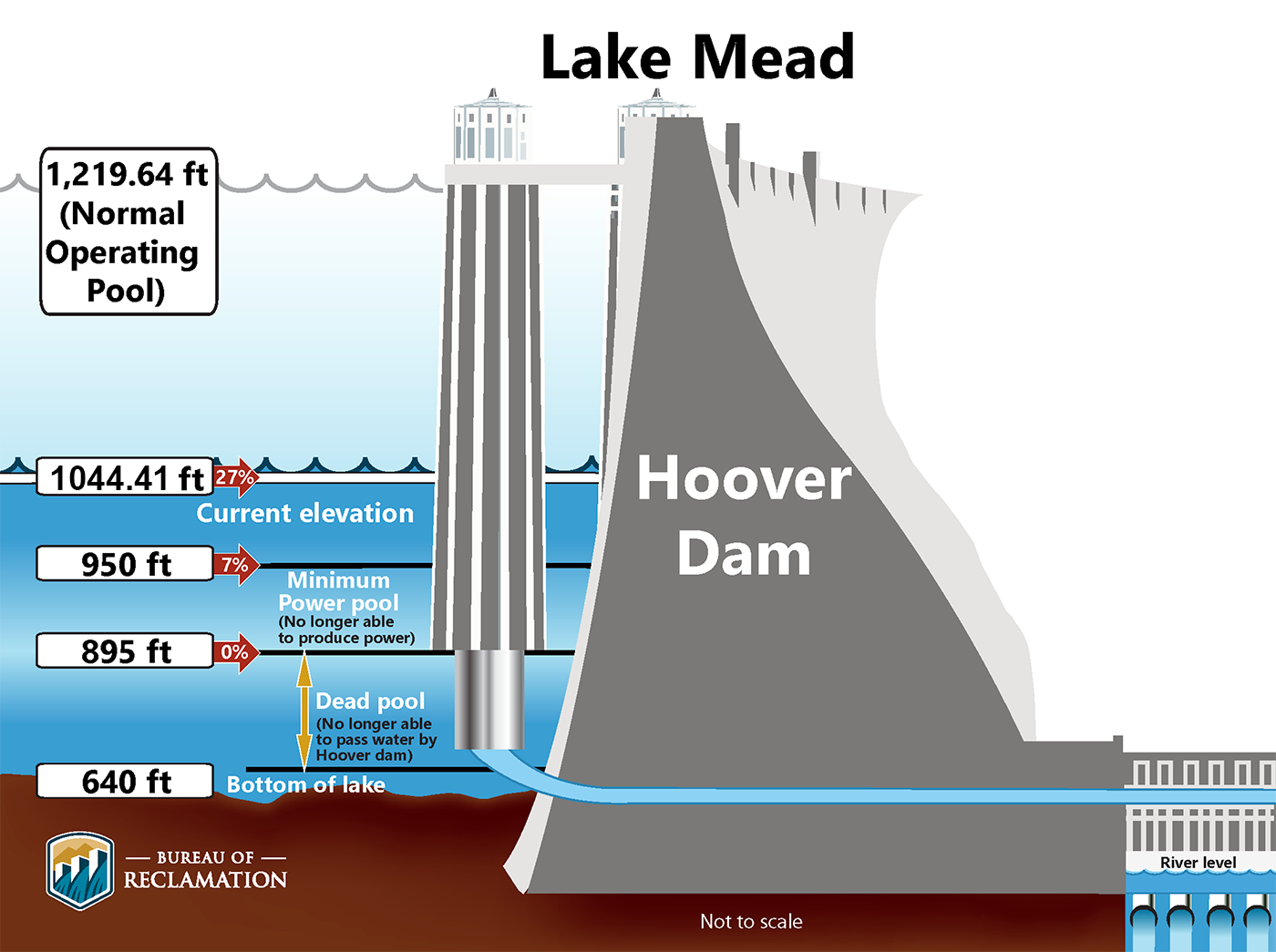
Mead stays awful in the current โ€œmost probableโ€, ending the water year at elevation1,034, another 10 feet below current levels, which should be enough for photojournalists to find some fresh wrecked pleasure boats, or possibly mob hits.

Under the โ€œmin probableโ€, Powell ends the water year at 3,544 and Mead ends at 1,021.

To help frame the current discussions, hereโ€™s the hypothetical Lower Basin cuts under the six-state and California SEIS proposals under elevations in the min probable forecast:

cuts, by state, at Mead elevation 1,020-1,0256-state proposalCalifornia proposal
California1,424,000750,000
Arizona1,252,0001,568,000
Nevada67,00082,000
total2,743,0002,400,000

Solid start to 2022-23 snow season in Colorado: Water planners optimistic for a strong finish, but cautious — @DenverWater #snowpack

Click the link to read the article on the Denver Water website (Jay Adams):

The winter of 2022-23 is off to a cold and snowy start across most of Colorado, which is good news for the stateโ€™s water supply.

So far, water watchers say weโ€™ve had the best start for the statewide snowpack season since 2017. 

However, while some parts of the state, like Steamboat Springs, are seeing the highest snowpack levels in over a decade, numbers in some parts of the state are lagging.

Snowpack is a measurement of the amount of water packed into the snow.

Colorado Snowpack basin-filled map February 17, 2023 via the NRCS.

โ€œColorado is a big state and itโ€™s not uncommon to see a wide range of snow totals across various regions,โ€ said Nathan Elder, Denver Waterโ€™s manager of water supply.

For example, the snowpack in the northwest corner of Colorado sat at 151% of normal as of Jan. 31, but the southeastern corner was just at 83% of normal.


Sign up for our free, weekly TAP email to stay on top of this season’s snowpack. (Scroll down to put your email in the light blue sign-up bar.)


The amount of snow that falls in the mountains is critical in Colorado because thatโ€™s where most of the stateโ€™s water comes from each year.

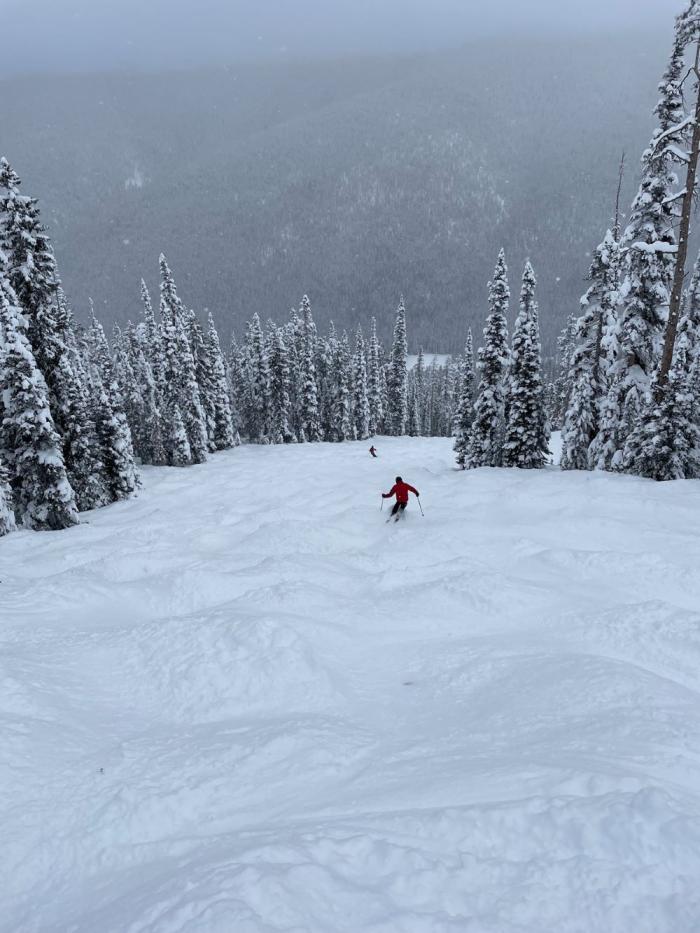
Skiers enjoy a powder day at Winter Park Ski Resort in December 2022. The resort saw 85 inches of snow in January and reported receiving 226 inches of snow so far this season as of Jan. 31. Photo credit: Denver Water.

Denver Water provides water to 1.5 million people in Denver and several surrounding suburbs, and 90% of the utilityโ€™s water supply comes from snow. The utility collects water from roughly 4,000 square miles of terrain in the mountains and foothills west of Denver in the Upper Colorado and Upper South Platte river basins.

Denver Water collects roughly half of its water from the Colorado River Basin and half from the South Platte.

Denver Water collects water from across 4,000 square miles of forest that spans the Upper Colorado and the South Platte river basins. Image credit: Denver Water.

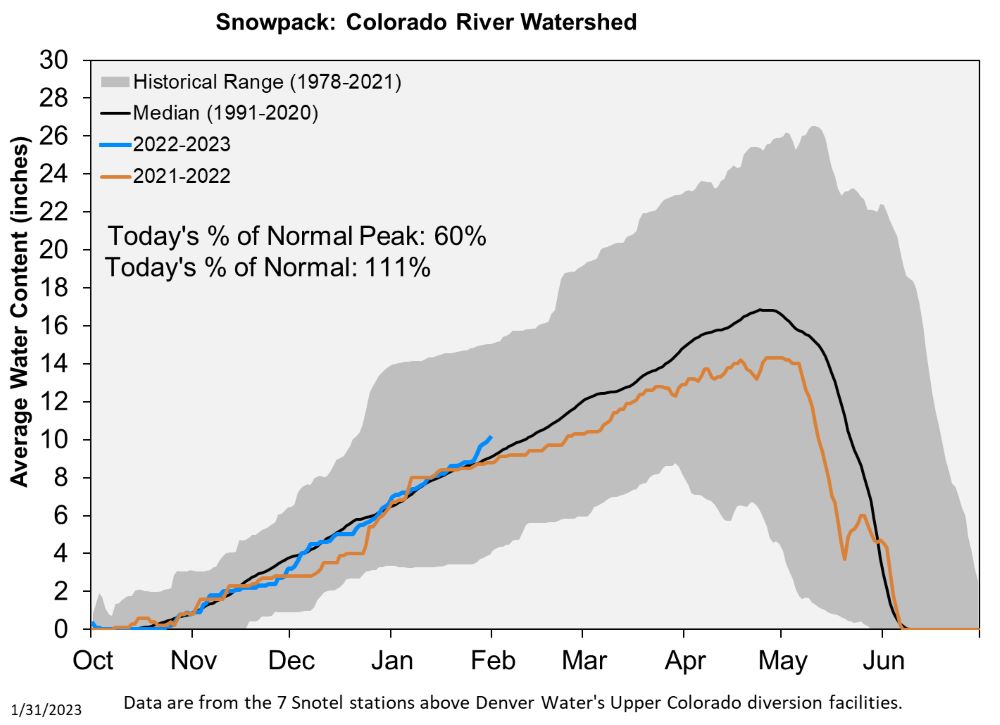
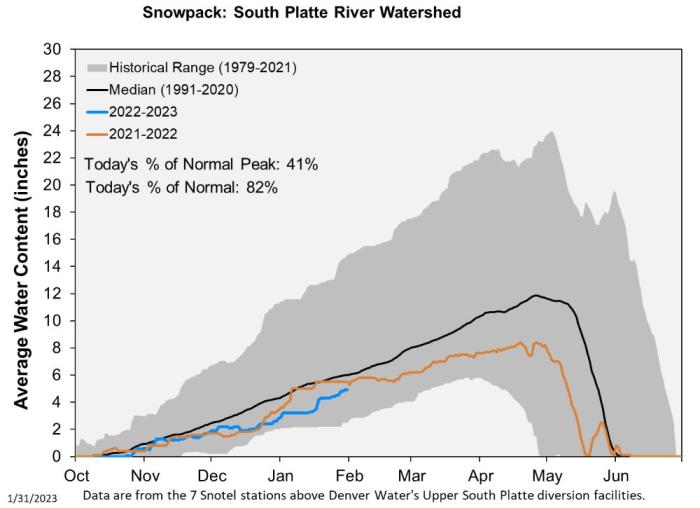
In the areas where Denver Water collects water, as of Jan. 31, the snowpack in the Upper Colorado River Basin stood at 111% of normal, while the Upper South Platte River Basin stood at 82% of normal.

Denver Water’s entire collection system. Image credit: Denver Water.
Seven SNOTEL stations in the area of the South Platte River Basin where Denver Water collects water are tracking below normal (the blue line) so far this season. Image credit: Denver Water.

โ€œThe difference in snowpack is why Denver Water has built a large collection system spread across several counties. That way if one area is having a down year, hopefully things are better in another area. And thatโ€™s what weโ€™re seeing so far this year,โ€ Elder said. 

Elder said this year the snowfall in the mountains has been steady since November 2022, compared with last winter, which will be remembered for having only a couple big storms that hit over the holiday season and ended up providing the bulk of the entire seasonโ€™s total snowfall.

โ€œAs a water planner, it would be nice to have a steady, predictable snowpack season, but weather doesnโ€™t work that way and each year plays out differently,โ€ Elder said. โ€œThatโ€™s why we constantly monitor the mountain snowpack and adjust our water planning accordingly.โ€


See how Denver Water monitors the snowpack from the air, on the ground and by using automated weather stations. 


Denver Waterโ€™s reservoir storage stood at 82% full heading into February, which is average for this time of year. Elder said heโ€™s cautiously optimistic the reservoirs will fill when the snow melts in the spring due to the snowpack so far.

Heโ€™s also encouraged by the fact that soil moisture for the state is the best itโ€™s been in eight years

โ€œWhen the soil moisture is in good shape, it means more water will flow into rivers and streams instead of being absorbed by dry ground,โ€ he said.

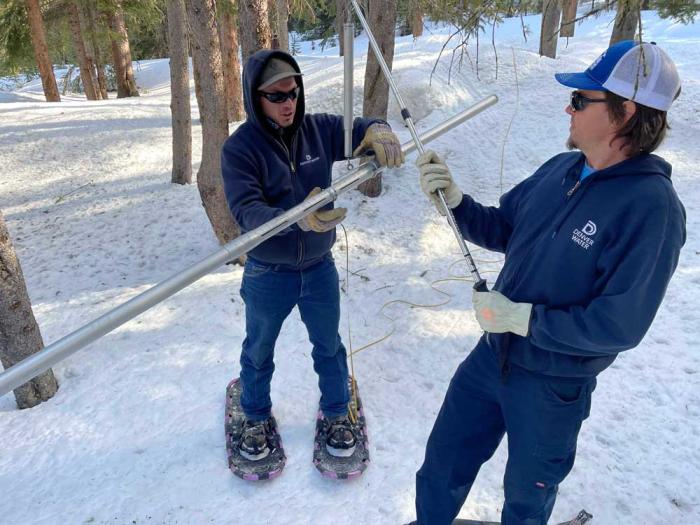
Denver Waterย monitors snowpackย throughout the winter season, using monthly measurements gathered by crews on the ground and daily reports from automated weather stations. The utility also gets information about the snowpack from planes surveying its collection system using high-tech equipment.ย 

Denver Waterโ€™s Rob Krueger (left) and Adam Clark work out of the utilityโ€™s Moffat Collection System office in Winter Park. Here they are weighing a snow sample to calculate how much water it contains. Photo credit: Denver Water.

This year, planes will fly over forests in Summit and Grand counties where Denver Water collects water โ€” and for the first time also will fly over the utilitiesโ€™ South Platte and South Boulder Creek watersheds.

โ€œWeโ€™ve got our snowiest months of the season coming up, and weโ€™re hoping the snow will keep falling,โ€ Elder said. โ€œSnowpack typically peaks around the third week of April, so thatโ€™s the key snowpack measurement weโ€™ll be watching.”

Elder said that even though water supply looks good now, the winter months are a great time to get your house into water-wise shape indoors by finding and fixing toilet leaks, installing low-flow aerators and replacing old showerheads with WaterSense-labeled fixtures.

Well, the West is Getting a Lot of Snow and Rain — Audubon #snowpack #ColoradoRiver #COriver #aridification

The Colorado River flows through Gore Canyon in Colorado. Photo: Mitch Tobin/The Water Desk

Click the link to read the article on the Audubon website (Jennifer Pitt):

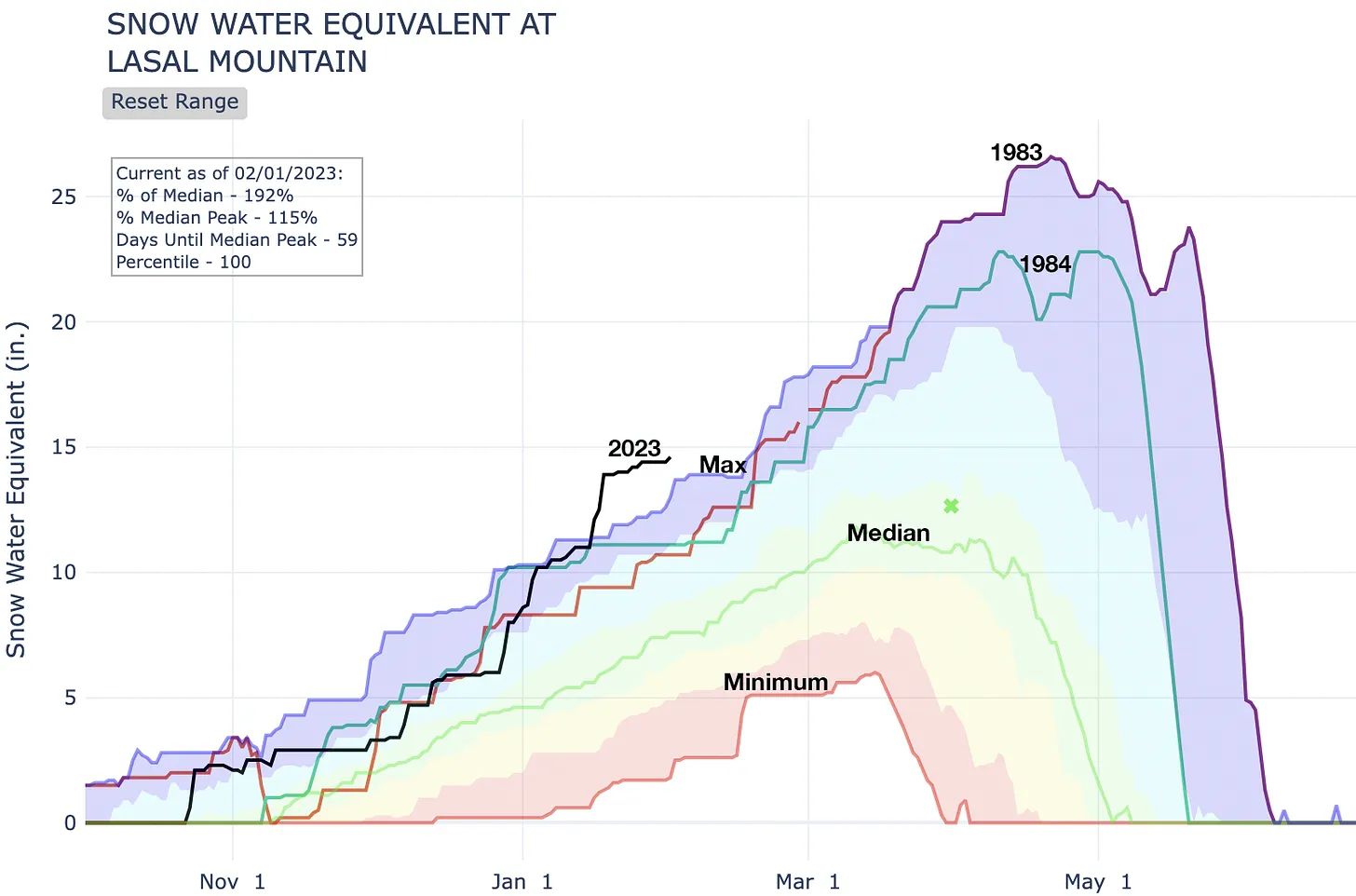
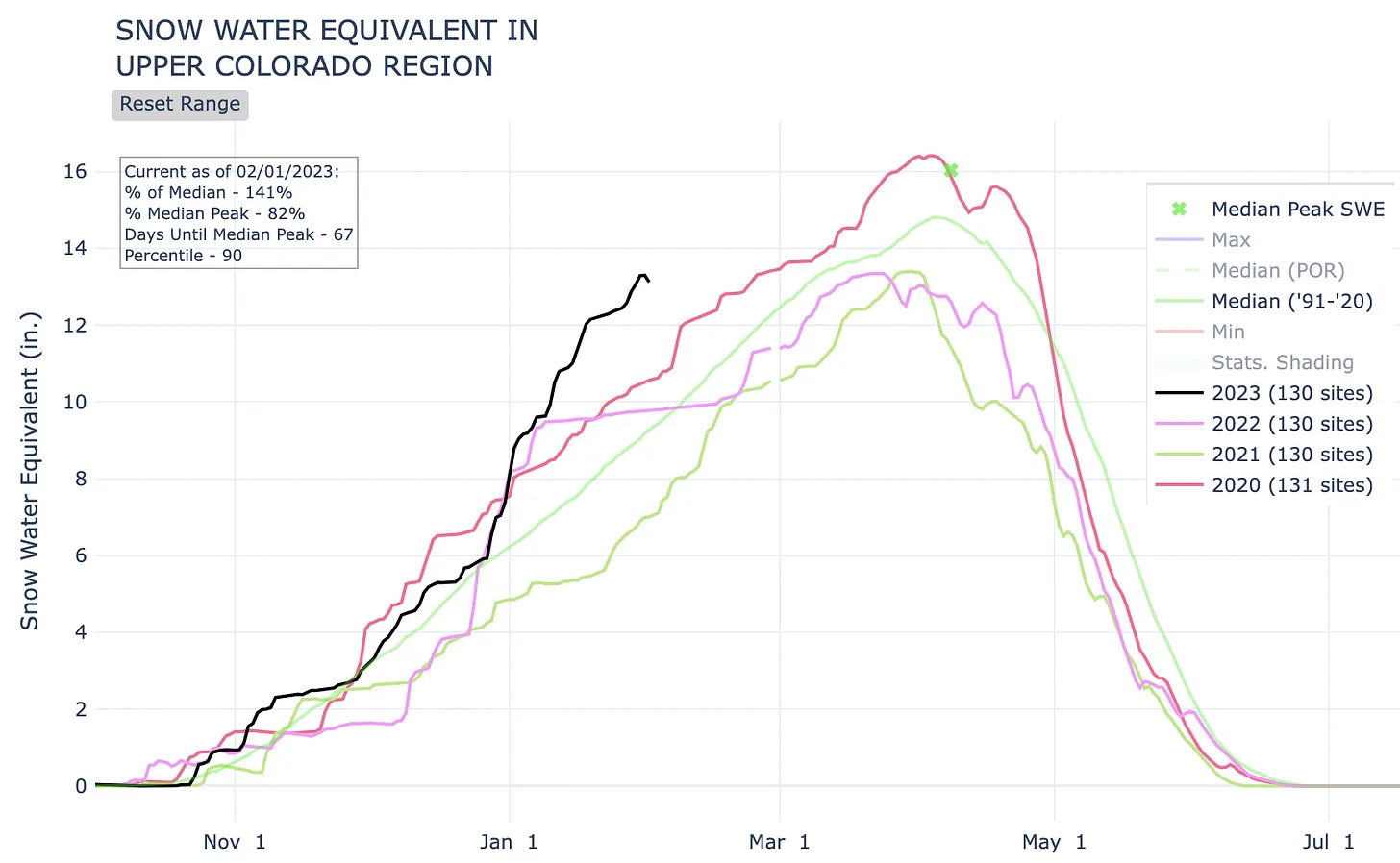
Itโ€™s early January, and while snow season in the Southern Rockies continues for another three months, we already see snowpack at 59% of the seasonal average. That is something to celebrate, as the Colorado River Basin has been in an extended drought going on 24 years, with consequences for people, birds and every other living thing that depend on rivers in this region. But the abundant start to the snow season does not mean Colorado River managers get a reprieve from their aggressive efforts to reduce water use and reform Colorado River operations.

In recent years we have seen โ€œabove averageโ€ early season snowpack turn into below average snowpack and far-below-average runoff. In 2021 for instance, 85% of average snowpack turned into runoff of 36%. A variety of factors created these dynamics, including fewer storms later in the snow season, warmer temperatures both increasing evaporation and evapotranspiration (evaporation from plants) and drying out soils which then soak up melting snow. Of course, we donโ€™t yet know this how this year will turn out for Colorado River water supply. Butย weย know it is too early to draw conclusions, other than โ€“ย gee, sure would be nice if it keeps snowing.

With Colorado River reservoirs two-thirds empty, federal and state water managers have sounded alarms, pointing to the risk of infrastructure failure and even the ability to deliver water and hydroelectric power to tens of millions of people. The available storage space in the reservoirs can hold more than three years of the Colorado Riverโ€™s average undepleted flow. So even a bomber snow season is not going to end the drought. Tom Buschatzke, who leads the Arizona Department of Water Resources acknowledged this in a recent interview with CNN:  “One good year doesn’t fix usโ€”even a couple of good years doesn’t fix usโ€ฆWe’ve got to rebuild that bank account.”

With climate warming projected to increase, thereโ€™s an urgent need to balance Colorado River water uses with supply, even to reduce uses below supply so that thereโ€™s less risk to the dams, to people and to nature. Best to keep the pedal to the floor on reforming Colorado River managementโ€”because while winter storms areย inherently good for water supplies, there is noย guarantee winters will be long, sustained, or consistent.

#California Rejected a #ColoradoRiver #Water Use Plan and Now Has Its Own. But the Issue is Far From Settled — LAist #COriver #aridification

Lake Mead and the Hoover Dam on the border between Nevada and Arizona on the morning of Friday, April 8, 2022. (Tim Lenard/The Nevada Independent)

Click the link to read the article on the LAist website (Erin Stone), publishedย Feb 1, 2023 2:44 PM:

This article was originally published by LAist on February 1, 2023

The seven states that draw from the Colorado River missed another deadline from the federal government to come up with an agreement to cut total water use by 2 to 4 million acre-feet.

Late Tuesday, California released its own plan after not signing on to a proposalagreed upon by six states to cut about 2 million acre-feet. Both plans agree we need to cut down a lot more on water use, but who shoulders the biggest cuts remains a question.

The Colorado River provides water to more than 40 million people and hundreds of thousands of acres of farmland in Wyoming, Colorado, New Mexico, Utah, Arizona, Nevada and California, plus two Mexican states (Baja California and Sonora).

California gets the most water from the river of any state, and the riverโ€™s main reservoirs โ€” Lake Powell and Lake Mead โ€” are two of our biggest water sources in the Southland (Lake Powell is also a major source of clean hydroelectric power). The river has long been overused โ€” and the climate crisis is pushing a reckoning with a century-old water rights law that many say is outdated in our hotter and drier reality.

Complicated Legal Rights

Last year, the federal government told the seven U.S. states that rely on the Colorado River to come up with a voluntary plan to cut total water use by 2 to 4 million acre-feet โ€” or face federal mandates. For context, California is legally entitled to 4.4 million acre-feet of water from the river every year.

The All-American Canal conveys water from the Colorado River to the Imperial Valley in Southern California. The Imperial Irrigation District is the largest user of Colorado River water. CREDIT: HEATHER SACKETT/ASPEN JOURNALISM

Most of the legal rights to that water are held by farmers in the arid Imperial Valley. The next biggest bucket goes to the Metropolitan Water District of Southern California, which serves 19 million people in cities across the Southland.

Lack of snowpack in the Sierra Nevadas and the crisis on the Colorado led to millions of people in Southland cities being put under outdoor watering restrictions. In Los Angeles, you can only water twice a week, though watering food gardens and trees by hand is allowed whenever needed. 

The crisis on the Colorado River could eventually bring more restrictions.

Two Proposals

After missing an initial deadline last August, on Tuesday six of the seven states releasedย a proposalย to cut water use by about 1.5 million acre-feet per year โ€” calling on California to shoulder the biggest cuts.

California didnโ€™t sign on, citing its senior water rights (the current rules say California is last to lose its water amid a shortage). In response, state officials released another plan that leaves the bulk of water cuts over the next few years to Arizona and Nevada (which have both faced unprecedented cuts to their usual shares over the last two years). California would curb its own water use 9% through 2026, when the current water shortage rules expire.

Both plans would lead to 2 to 3 million acre-feet of water cuts in 2024, but big disagreements remain on how to achieve those cuts.

That lack of consensus could spur federal mandates and lawsuits from the states, which could delay solutions. The current rules expire in 2026. By then, the states and federal government will need a more permanent plan for Colorado River water use. 

A final decision on the plan until then is expected by summer.

The Rockies are having a snowy winter, but not all of that #water will make it to the #ColoradoRiver — KUNC #COriver #aridification #snowpack

West snowpack basin-filled map February 15, 2023 via the NRCS.

Click the link to read the article on the KUNC website (Alex Hager). Here’s an excerpt:

New data show a snowy start to 2023 for the Colorado River basin. Inflows into Lake Powell, the nationโ€™s second largest reservoir, are currently projected to be 117% of average during spring runoff thanks to heavy winter precipitation in the Rocky Mountains… Snow in Colorado is an important factor in determining the amount of water that will flow into the Colorado River system each year. About two-thirds of annual flow starts as snow high in the mountains of Colorado. Across the state, snow totals are almost all above average, withย most zones showingย 120 to 140% of normal for this time of year. Northwest Wyoming and central Utah, which also contribute to the basinโ€™s water supply, posted January snowfall totals that nearly broke precipitation records. Many parts of Utah are showing snow totals above 170% of average, boosting the odds of above-average runoff in the spring, and fostering memorable seasons for theย areaโ€™s ski resorts

New data from the Colorado Basin River Forecast Center show heavy precipitation through much of the Colorado River Basin states โ€“ especially Utah, Wyoming and Arizona.

In the Colorado Riverโ€™s Upper Basin โ€“ which includes parts of Wyoming, Colorado, Utah, and New Mexico โ€“ the strongest precipitation fell in southwestern Colorado. The Gunnison, Dolores and San Juan rivers all saw January precipitation that ranged from 160 to 200% of average. Meanwhile, the lowest January precipitation totals were along the Eagle River in central Colorado, and the Green River above Fontenelle Reservoir in Wyoming. The Lower Colorado River Basin โ€“ which includes parts of Nevada, Arizona, and California โ€“ also saw strong precipitation. The Virgin, Little Colorado and Verde rivers all saw January precipitation above 200% of normal. Rain and snow in the Lower Basin is typically less important for the Colorado Riverโ€™s flow, but is helpful for plants, farms and ranches and wildfire mitigation…

When it comes to predicting the amount of water in the Colorado River each year, snow totals donโ€™t tell the full story. Scientistsย look to soil moistureย for a clearer picture of how much water will actually reach the places where humans divert and collect it. This year, soil moisture in the mountains is well below average. That could prevent some melting snow from ever reaching the Colorado River. That soil acts like a sponge, soaking up water before it has a chance to flow downhill to streams and lakes. Scientists have recorded years with 90% of average snowpack, only to see 50% of average runoff into reservoirs.

Does #Colorado need #water-use standards given the impacts of #aridification?: Agriculture uses the vast majority of water in Colorado, but its cities depend upon #ColoradoRiver diversions. That just might be a problem. Some solutions? @BigPivots #COriver

Leyden area lawn. Photo credit: Allen Best

Click the link to read the article on the Big Pivots website (Allen Best):

Let me give you a precise example of what weโ€™re talking about. An infill housing development took shape a couple of years ago near the Arvada High School in metropolitan Denver.

My midnight walksโ€”itโ€™s safer to walk thenโ€”often take me up that hill above the baseball diamond where grass was planted next to a row of mini-mansions. Rarely, if ever, will anybody set foot on that basketball court-sized plot of grass save to mow it.

Why was the turf planted? Likely because thatโ€™s the way it was always done. What I know with greater certainty is that roughly 75% of the water for this municipality comes from tributaries of the Colorado River. And I also know that these water rightsโ€”Arvada gets water from Denver Waterโ€”are junior to the 1922 Colorado River Compact. Water did not begin flowing through the Moffat Tunnel until 1936.

Huffing up the hill past this ornamental turf, I ask myself, โ€œDonโ€™t they know that adding turf in metro Denver or, for that matter, Grand Junction, during this time of rapid climate change is deeply problematic? Doesnโ€™t this qualify as either terribly ignorant or, just perhaps, arrogant?โ€

In Colorado, weโ€™ve resumed our conversation about how we use water and, more broadly, the type of development we want to see. Gov. Jared Polis made housing a central portion of his state-of-the-state address in early Januaryโ€”and he cycled around again and again to frame it within an ecosystem of impacts and goals, including water. He mentioned water 24 times in his address:

โ€œLet me be clear โ€“ housing policy is climate policy.

Housing policy is economic policy.

Housing policy is transportation policy.

Housing policy is water policy.โ€

On Jan. 26, in an address to the Colorado Water Congress, Polis made it a little more clear what he has in mind. He called for a โ€œcomprehensive approach to housing to preserve our water resources.โ€ He cited multiple benefits for revised land-use policies: reduced traffic, saved money for consumers and โ€“ most important, he added, it โ€œlimits demand on water resources.โ€

Polis said the Colorado Water Conservation Board will lead a study on integrating land use and water demand.

Front yard in Douglas Countyโ€™s Sterling Ranch are sparse on turf. Houses use well below the average volumes for Colorado. Photo/Allen Best

This 21-member Urban Landscape Conservation Task Force is to include representatives from 8 water utilities, 2 conservation districts, 2 environmental NGOs, with the balance to come from areas of expertise and interests such as stormwater, equity, and urban planning.

Looming over the three-day Water Congress conference was the future of the Colorado River. Attorney General Phil Weiser and Becky Mitchell, the director of the Colorado Water Conservation Board, both spoke from the same script. They said Colorado has kept within its limits as specified by the compact. The problems of the Colorado River are due very fundamentally to overuse by the lower-basin states, particularly California.

โ€œDenial is not just a river in Egypt,โ€ Weiser said.

Mitchell reported that Colorado and the three other upper-basin states in 2020 used altogether 3.5 million acre-feet compared to the 7.5 million acre-feet Colorado River Compact apportionment. The lower-basin states used on the order of 10 million acre-feet. The upper basin states live within what the climate delivers, she said, while the lower-basin states have lived beyond their means, steadily draining the federal reservoirs, both big and small. โ€œThey must do something, they must do it now,โ€ Mitchell said.

On Jan. 30, an agreement was announced among six of the seven states โ€“ California was the hold-out. It didnโ€™t impress many people.

โ€œLetโ€™s cut the crap,โ€ Brad Udall, who has emerged in the last decade as one of the most insightful observers of the Colorado River, told The Denver Post. โ€œWe donโ€™t have elevation to give away right now,โ€ a reference to elevations of the two big reservoirs, Mead and Powell.

Some homes in Erie have almost football field-sized back yards. Photo/Allen Best

Sounds simple enough. We wear the white hats. Yet Eric Kuhn, a former long-time manager of the Colorado River Water Conservation District, said itโ€™s not really that simple. Heโ€™s parsed the agreements at length in a book he co-authored called โ€œScience Be Dammed,โ€ a history of the Colorado River Compact, as well as various other papers and studies.

Kuhn said itโ€™s not a given that Colorado municipal water providersโ€”most of whom have water rights junior to the Colorado River Compactโ€”will always be able to access the Colorado River and its tributaries. And having no water is not an option.

โ€œCurtailment of those junior users is not acceptable at any time in the future,โ€ said Kuhn.

But the only logical place for growing towns and cities to expand their water portfolios is from water users with senior appropriations, namely agriculture.

Kuhn and Jennifer Gimbel, the director of the Colorado Water Conservation Board from 2008 to 2013, in November completed a report commissioned by the Common Sense Institute. Itโ€™s called โ€œAdapting Coloradoโ€™s Water Systems for a 21st Century Economy and Water Supply.โ€

When we spoke several days after the water conference, Gimbel reminded me that it was written for a business audience understanding that it needed to include the water community. โ€œIt was our opportunity to tell the business community โ€˜pay attention, because what happens with water is going to affect our economy one way or another.โ€™โ€

This is from Big Pivots 67, a reader-supported e-journal covering climate change and the resulting energy and water transitions in Colorado.

Useful to this understanding is the Common Sense Instituteโ€™s mission statement:

โ€œCommon Sense Institute is a non-partisan research organization dedicated to the protection and promotion of Coloradoโ€™s economy. CSI is at the forefront of important discussions concerning the future of free enterprise in Colorado and aims to have an impact on the issues that matter most to Coloradans.โ€

The report cites the need for demand-mitigation measures such as removing non-functional turf in new development. They cite the examples of Sterling Ranch, a tiny project in Douglas County where the developers, because they had little water, were forced to figure out how to minimize water use. They also cite Aurora, which last year adopted regulations that dramatically ratchet down water for new development.

They say this must become more common as Coloradoโ€™s population grows.

โ€œLacking statewide or regional standards, home developers are free to choose cities with less strict conservation standards,โ€ they wrote. โ€œRegional approaches are needed.โ€

They suggest regional conservancy and conservation districts might be a vehicle in lieu of statewide standards. They also cite WISE, the project in metro Denver and several of its suburban water providers, particularly those on the south side.

Lake Powell has been about a quarter-full. The snowpack looks strong now, but itโ€™s anybodyโ€™s guess whether there will be enough runoff come April and May to substantially augment the reservoir. May 2022 photo/Allen Best

The report, if broad-ranging and data-rich, also has a vagueness to it on this point. Gimbel says that lack of specificity was intentional. โ€œThe idea of demand-management measures in the report was left vague for a reason,โ€ she says. โ€œWe purposefully did not develop it more, to allow discussion already taking place to maybe morph into broad action.โ€

โ€œWe have to do more with less,โ€ said Kuhn. He cited projected population growth of 1.6 to 1.8 million new residents by 2050, most along the Front Range, but also the probability that the warming climate will make less water available, particularly from the Colorado River.

At several times during their Water Congress presentation, Gimbel and Kuhn acknowledged that state-wide standards would be an uphill struggle. In Colorado, towns, cities, and counties have traditionally called their own shots on land use and other development questions.

This is starting to shift, though. It is clear in Coloradoโ€™s agenda on reducing greenhouse gas emissions. But even here, thereโ€™s a balancing act. Legislatorsโ€”with the consent of Polisโ€”have told the investor-owned utilities they must meet carbon reduction goals. They have delivered the same mandate to Tri-State Generation and Transmission, which operates in ways that somewhat resemble those of Xcel.

But legislators left alone the municipal providers and the independent electrical cooperatives, instead choosing to persuade. It always helps, though, when the market is marching at a fast pace in the same direction.

In what I see as a direct parallel, the state recently has started to apply pressure to local jurisdictions to get ready for electrification in their building codes. Thereโ€™s some wiggle room for local jurisdictions, but itโ€™s not the free-for-all of yesteryear. Climate change forces a more urgent focus on issues we would have faced anyway but for other reasons.

Colorado has been having this water conversation for a while. In 2014, Ellen Roberts, then a state senator from Durango, and Don Coram, then a state representative from Montrose, introduced a conservation bill called โ€œLimit Use of Ag Water for Lawn Irrigation.โ€

Local governments didnโ€™t want the state stepping in. And there was pushback from the ag sector. โ€œIf itโ€™s water intensive, are you going to tell us that we canโ€™t grow that?โ€ one agriculture sector representative responded.

In the end, the bill became a study bill, the idea directed to an interim committee for further study. That, notes Roberts, is where bills commonly get sent to die. In this case, though, the conversation continuedโ€”and that was what she had intended all along.

โ€œMy concern was that if we waited for that to happen naturally, it might never happen or it would be so slow that it would have no meaningful impact,โ€ she says.

If the proposal was watered down, so to speak, even some legislators from the Western Slope who might not vote for it were โ€œappreciative that somebody was willing to walk the plank on the topic.โ€ In Durango itself, support ranged from those on the far left to those on the far right of the political spectrum.

The same issues that Roberts encountered are still very much alive.

Aurora, if lately a shining light for advocates of demand-management policies, harbors skepticism of mandates. โ€œAurora must retain control of what our city looks like,โ€ says Greg Baker, the cityโ€™s spokesman. Guidelines could be acceptableโ€”and smaller water municipalities could very well use help in delivering incentives.

This said, Aurora is open to discussion โ€œand it needs to be a proportional discussion,โ€ says Baker. โ€œWe donโ€™t want to tell agriculture how to use their water, but they account for 85% of water use in this state.โ€

On Jan. 31, in a legislative forum sponsored by Empower our Future, a Boulder County energy-focused organization, I asked State Sen. Fenberg, the Senate president, if the legislative broad brushes to advance the Polis land-use agenda could be described. He didnโ€™t deliver specifics, but he did a good job of describing the dynamics of what he called a โ€œthird-rail issue.โ€

โ€œIt will come down to what things should stay at the local level and I think the vast majority will remain at the local level.โ€ That said, he continued, the question remains of how we go about this in ways to advance Coloradoโ€™s other goals.

More issues have become statewide in nature. More state funding has been advanced for funding to expand housing. Water use is associated with housing, so the state has a connected interest, he suggested.

โ€œBecause of that, I think people have started asking more questions. If it is a state problem, shouldnโ€™t the state be more involved in either solving the problem or stopping the problem from getting worse?โ€

It will be, he concluded, a โ€œtough conversation.โ€ Laws governing water move slowly, and speakers at the Water Congress repeatedly said it is wise to move cautiously. Can the rapidly changing water story in the Colorado River Basin and the changing climate that is producing the crisis abide caution?

Support for #Conservation Remains High in the West Despite a Rise in Other Concerns, New Poll Finds — State of the Rockies Report

Click the link to read the release on the State of the Rockies website [Spanish version here] (Jacob Hay):

Thirteenth annual Conservation in the West Poll reveals voters not willing to go backwards on conservation progress to address gas prices, cost of living, or water shortages

COLORADO SPRINGSโ€”Colorado Collegeโ€™s 13th annual State of the Rockies Projectย Conservation in the West Pollย released today [February 16, 2023] shows strong support for conservation policies among Westerners even as concerns around gas prices, cost of living, drought and water shortages remain high.

The poll, which surveyed the views of voters in eight Mountain West states (Arizona, Colorado, Idaho, Montana, Nevada, New Mexico, Utah, and Wyoming), found support in theย 70 to 90 percentย range for conservation goals like protecting wildlife habitats and migration routes, ensuring healthier forests, preventing light pollution that blocks out the stars, and safeguarding drinking water.

From Bears Ears National Monument. Photo credit: Jonathan Thompson

82 percentย of Westerners support achieving a national goal of conserving 30 percent of land and inland waters in America, and 30 percent of ocean areas, by the year 2030. Support for that proposal is upย 9 percentย since 2020, while opposition to the goal dropped byย 5 percentย during that time. In order to further conservation progress,ย 84 percentย of Westerners support presidents continuing to use their ability to designate existing public lands as national monuments to maintain public access and protect the land and wildlife for future generations.

Voters express higher levels of concern than in the past over several issues that impact Western lifestyles. Asked what they consider to be extremely or very serious problems for their state, 65 percent of Westerners point to inadequate water supplies, 67 percent say drought, 69 percent say the low level of water in rivers, 78
percent 
name the rising cost of living, and 60 percent say the price of gasoline.

Those spiking concerns, however, are not dampening enthusiasm for conservation action across the West. Support remains high for a range of policies aimed at protecting land, water, air, and wildlife, including:

Highway 160 wildlife crossing 15 miles west of Pagosa Springs. Photo credit: Allen Best

85 percentย support constructing wildlife crossing structures across major highways that intersect with known migration routes.

The tallest dunes in North America are the centerpiece of a diverse landscape of grasslands, wetlands, forests, alpine lakes and tundra at Great Sand Dunes National Park in Colorado. Photo credit: The Department of Interior

84 percentย support creating new national parks, national monuments, and national wildlife refuges and Tribal protected areas to protect historic sites or areas of outdoor recreation.

Community solar garden in Arvada. Photo credit: Allen Best/Big Pivots

67 percentย support gradually transitioning to 100 percent of energy being produced from clean, renewable sources like solar and wind over the next ten to fifteen years.

Hey, World! I’m Tye, and I’ve been hiking for about 10 years. Come join me on this hiking journey throughout the state of New York. To learn more about me: https://youtu.be/GH2NqOEWJoc. Photo credit: Hiking While Black

76 percentย support directing funding to ensure adequate access to parks and natural areas for lower- income people and communities of color that disproportionately lack them.

Western San Juans with McPhee Reservoir in the foreground from the Anasazi Center Dolores

85 percentย support ensuring Native American Tribes have greater input into decisions made about areas on national public lands that contain sites sacred or culturally important to their Tribe.

โ€œThis year voters in the West have a lot on their minds, but they are not willing to trade one priority for another,โ€ said Katrina Miller-Stevens, Director of the State of the Rockies Project and an associate professor at Colorado College. โ€œHigh gas prices, increasing costs of living, and water shortage concerns are not enough to move Westerners to reconsider their consistent support for conservation policies or seek out short-sighted solutions that put land and water at risk. In fact, people in the West want to continue our progress to protect more outdoor spaces.โ€

Dories at rest on a glorious Grand Canyon eve. Photo by Brian Richter

Locally, a variety of proposed conservation efforts are even more popular with in-state voters than they were when surveyed last year. In Arizona, 62 percent of voters support legislation to make permanent the current ban on new uranium and other mining on public lands surrounding the Grand Canyon. 90 percent of Coloradans agree with protecting existing public lands surrounding the Dolores River Canyon to conserve important wildlife habitat, safeguard the areaโ€™s scenic beauty, and support outdoor recreation. 84 percent of Montanans support enacting the Blackfoot Clearwater Stewardship Act to ensure hunting and fishing access, protect stream flows into the Blackfoot River, and add eighty thousand acres of new protected public lands for recreation areas, along with timber harvest and habitat restoration. In New Mexico, 88 percent of voters want to designate existing public lands in the Caja del Rio plateau as a national conservation area to increase protections for grasslands and canyons along the Santa Fe river and other smaller rivers flowing into the Rio Grande. 83 percent of Nevadans want to designate existing public lands in southern Nevada as the Spirit Mountain National Monument to ensure outdoor recreation access and help preserve sacred Native American sites.

Voters call for bold action on water conservation in line with heightened concerns

The level of concern among Westerners around water issues remains high in this yearโ€™s poll even amidst a notable uptick in winter precipitation across the West.

Colorado River “Beginnings”. Photo: Brent Gardner-Smith/Aspen Journalism

The Colorado River is held in high regard by voters in the states that rely on it. 86 percent say the Colorado River is critical to their stateโ€™s economy and 81 percent view it as an attraction for tourism and recreation. At the same time, 81 percent of voters say the Colorado River is at risk and in need of urgent action.

Concerns about water availability in the West translate into support for a variety of water conservation efforts, including:

95 percent support investing in water infrastructure to reduce leaks and waste.
88 percent support increasing the use of recycled water for homes and businesses.

87 percent support requiring local governments to determine whether there is enough water available before approving new residential development projects.

80 percent support providing financial incentives to homeowners and businesses to replace lawns and grassy areas with water-saving landscaping.

62 percentย support prohibiting grass lawns for new developments and homes.

Rancher Bryan Bernal irrigates a field that depends on Colorado River water near Loma, Colo. Credit: William Woody

54 percentย support providing financial incentives to farmers to temporarily take land out of production during severe water shortages.

Despite concerns over higher gas prices and cost of living, voters want a cleaner and safer energy future on public lands

In the face of higher gas prices and increased costs of living, Westerners still support proposals to limit the volume and impacts of oil and gas drilling on public lands.

The Four Corners methane hotspot is yet another environmental climate and public health disaster served to our community by industry. But now that weโ€™ve identified the sources we can begin to hold those responsible accountable for cleaning up after themselves. The BLM methane rule and EPA methane rule are more clearly essential than ever. Photo credit: San Juan Citizens Alliance (2018)

91 percent support requiring oil and gas companies to use updated equipment and technology to prevent leaks of methane gas and other pollution into the air. 91 percent of voters support requiring oil and gas companies, rather than federal and state governments, to pay for all of the clean-up and land restoration costs after drilling is finished. 72 percent of voters support only allowing oil and gas companies the right to drill in areas of public land where there is a high likelihood to actually produce oil and gas.

Asked what should be the highest priority for meeting Americaโ€™s energy needs, 65 percent of Westerners say it should be reducing our need for more coal, oil and gas by expanding the use of clean, renewable energy. That is compared to 32 percent who favor drilling and digging for more oil and gas wherever we can find it.

Given a choice of public lands uses facing lawmakers, 68 percent of voters prefer ensuring we protect water sources, air quality, and wildlife habitat while providing opportunities to visit and recreate on national public lands. By contrast, only 26 percent of voters would rather ensure we produce more domestic energy by maximizing the amount of national public lands available for responsible oil and gas drilling and mining.

This is the thirteenth consecutive year Colorado College gauged the publicโ€™s sentiment on public lands and conservation issues. The 2023 Colorado College Conservation in the West Poll is a bipartisan survey conducted by Republican pollster Lori Weigel of New Bridge Strategy and Democratic pollster Dave Metz of Fairbank, Maslin, Maullin, Metz & Associates. The survey is funded by the William and Flora Hewlett Foundation.

The poll surveyed at least 400 registered voters in each of eight Western states (AZ, CO, ID, MT, NV, NM, UT, & WY) for a total 3,413-voter sample, which included an over-sample of Black and Native American voters. The survey was conducted between January 5-22, 2023 and the effective margin of error is +2.4% at the 95% confidence interval for the total sample; and at most +4.9% for each state. The full survey and individual state surveys are available on theย State of the Rockies website.

Colorado College is a nationally prominent four-year liberal arts college that was founded in Colorado Springs in 1874. The College operates on the innovative Block Plan, in which its 2,200 undergraduate students study one course at a time in intensive three and a half-week segments. For the past eighteen years, the college has sponsored the State of the Rockies Project, which seeks to enhance public understanding of and action to address socio-environmental challenges in the Rocky Mountain West through collaborative student-faculty research, education, and stakeholder engagement.

About Fairbank, Maslin, Maullin, Metz & Associates

Fairbank, Maslin, Maullin, Metz & Associates (FM3)โ€”a national Democratic opinion research firm with offices in Oakland, Los Angeles and Madison, Wisconsinโ€”has specialized in public policy oriented opinion research since 1981. The firm has assisted hundreds of political campaigns at every level of the ballotโ€”from President to City Councilโ€”with opinion research and strategic guidance. FM3 also provides research and strategic consulting to public agencies, businesses and public interest organizations nationwide.

About New Bridge Strategy

New Bridge Strategy is a Colorado-based, woman-owned and operated opinion research company specializing in public policy and campaign research. As a Republican polling firm that has led the research for hundreds of successful political and public affairs campaigns we have helped coalitions bridging the political spectrum in crafting winning ballot measure campaigns, public education campaigns, and legislative policy efforts. New Bridge Strategy helps clients bridge divides to create winning majorities.

About Hispanic Access Foundation

Hispanic Access Foundation connects Latinos and others with partners and opportunities to improve lives and create an equitable society.

U.S. Senator Hickenlooper rallies senators to help accelerate #ColoradoRiver compromise — The Hill #COriver #aridification

Governor Hickenlooper, John Salazar and John Stulp at the 2012 Drought Conference

Click the link to read the article on The Hill website (Sharon Udasin). Here’s an excerpt:

Keeping the Colorado River flowing will require concessions from seven sparring states โ€” but Congress may have the financial mobility to help get them there, according to Sen. John Hickenlooper (D-Colo.).

โ€œWe are working in a bipartisan fashion at this point,โ€ he told The Hill on Monday. โ€œThereโ€™s a recognition that a lot of peopleโ€™s livelihoods are at stake, and thereโ€™s a real urgency.โ€

Hickenlooper is at the helm of the new Colorado River Caucus โ€” a cohort of senators from both sides of the aisle who intend to help the states agree on consumption cutbacks.

Members of the group include representatives from all seven Colorado River states: California, Arizona, Nevada, New Mexico, Utah, Colorado and Wyoming.

Biden-Harris Administration Delivers $728 Million in Historic Investments to Address Western #Drought, Improve #Climate Resilience — Department of Interior

Map of the Upper Colorado River Basin showing major tributaries and sub-basins. Credit: https://www.mdpi.com/2073-4441/14/23/3813#

Click the link to read the article on the Department of Interior website:

Critical infrastructure investments under President Bidenโ€™s Bipartisan Infrastructure Law and Inflation Reduction Act to provide clean, reliable drinking water to communities and support water conservation in the Upper Colorado River Basin

As part of the Biden-Harris administrationโ€™s commitment to enhance the resilience of the West to drought and climate change, the Department of the Interior today [February 13, 2023] announced a $728 million investment to deliver clean, reliable drinking water to rural and Tribal communities, support water conservation in the Upper Colorado River Basin, and complete projects to improve water supply reliability. This historic funding from President Bidenโ€™s Bipartisan Infrastructure Law, the Inflation Reduction Act, and the Consolidated Appropriations Act of 2023 supplementsย unprecedented investmentsย to protect the stability and sustainability of the Colorado River System now and into the future.

Funded by the Bipartisan Infrastructure Law, seven authorized rural water projects under construction in Iowa, Minnesota, Montana, New Mexico, North Dakota and South Dakota will receive $278 million. These investments build on the allocation of $420 million for rural water construction activities in fiscal year 2022. The funding is helping projects complete construction of water treatment plants and intakes, supporting work related to pipeline connections, pump systems, and reservoir construction, and advancing other efforts to provide potable water to rural and Tribal communities.

The Bureau of Reclamation is also making available up to $125 million to support the relaunch of a System Conservation Pilot Program in the Upper Colorado River Basin. The renewed program โ€“ funded with an initial allocation through the Inflation Reduction Act โ€“ will help support water management and conservation efforts to improve water efficiency and ultimately protect the short-term sustainability of the Colorado River System.

This is in addition to the over $325 million in fiscal year 2023 funding that Reclamation has allocated for ongoing work on drought resilience projects across the country. Separately, this week the U.S. Department of Agriculture announced $25 million in WaterSMART funds to help Western farmers and ranchers conserve water through a partnership with Reclamation and USDAโ€™s Natural Resources Conservation Service.

โ€œThe Biden-Harris administration is committed to making communities more resilient to the impacts of climate change — this includes making the Colorado River Basin and the diverse communities that rely on it more resilient to the ongoing drought in the West,โ€ saidย Secretary Deb Haaland. โ€œWe are investing historic resources through the Presidentโ€™s Bipartisan Infrastructure Law and Inflation Reduction Act to provide clean, reliable drinking water to rural and Tribal communities, protect the stability and sustainability of the Colorado River System, and increase water efficiency across the West.โ€

โ€œThe Bureau of Reclamation is committed to ensuring the continued availability of water across the West, while at the same time enhancing the resiliency of our communities to a changing climate. As we move forward with these urgent priorities, we are doing so in close collaboration with Basin states, Tribes, water managers, farmers, irrigators, and other stakeholders,โ€ said Reclamation Commissioner Camille Calimlim Touton. โ€œThis historic funding underscores how proactive efforts from the Biden-Harris administration are helping increase water efficiency and conservation across the West.โ€

Overall, the Bipartisan Infrastructure Law provides Reclamation with $8.3 billion over five years for water infrastructure projects to advance drought resilience and expand access to clean water for families, farmers, and wildlife. The Inflation Reduction Act is investing an additional $4.6 billion to address the worsening drought crisis and plan for the hydrology of today and into the future. Combined, these laws represent the largest investments in climate resilience in the nationโ€™s history.

Historic Investments for Rural Water

Funding in fiscal year 2023 from the Bipartisan Infrastructure Law will enable significant advances of rural water systems and associated features:

  • $77.56 million for the Rocky Boys / North Central Montana Rural Water System in Montana for core pipeline construction on segments 7 and 8, continued construction progress of a water treatment plant, as well as construction for segments associated with Havre, Chester and Shelby Hub service areas.
  • $62.11 million for the Eastern New Mexico Rural Water System in New Mexico for the construction of approximately 26 miles of raw water transmission pipeline.
  • $60 million for the Lewis & Clark Rural Water System in Iowa, Minnesota and South Dakota to support a water treatment plant, construction associated with the Sible service area, and to reimburse states for related costs.
  • $26.33 million for the Garrison-Diversion Unit of the Pick-Sloan Missouri Basin Program in North Dakota for efforts associated with construction of water treatment plants, as well as efforts to support service on the Spirit Lake, Standing Rock and Fort Berthold Reservations.
  • $25 million for the recently authorized Musselshell-Judith Rural Water System in Montana for substantial completion of phases 3 and 4 of rural water construction activities.
  • $15 million for the Fort Peck Reservation โ€“ Dry Prairie Rural Water System in Montana to support substantial completion of the project.
  • $12 million for the Jicarilla Apache Rural Water System in New Mexico to support progress toward water treatment plant upgrades.

Detailed information on the fiscal year 2023 spend plan is available on Reclamationโ€™s website.

Upper Basin System Conservation Pilot Program

Up to $125 million in funding from the Inflation Reduction Act will enable Reclamation, in partnership with the Upper Colorado River Commission, to immediately move forward to implement the System Conservation Pilot Program. From 2015 to 2018, the Upper Basin System Conservation Pilot Program(link is external) successfully tested new approaches to conserve water on the Colorado River and proved these measures are an effective approach to temporarily increase water efficiency and mitigate the impacts of drought.

The program is cooperatively managed by Reclamation and the Upper Division States of Colorado, New Mexico, Utah and Wyoming acting through the Upper Colorado River Commission.

This program supplements additional investments from the Biden-Harris administration to help increase water conservation, improve water efficiency, and prevent the Systemโ€™s reservoirs from falling to critically low elevations that would threaten water deliveries and power production. Reclamation is currently reviewing applications for a similar program in the Lower Colorado River Basin and expects to make additional announcements in the coming months to support water conservation and address the ongoing drought.

More about the implementation of the 2023 System Conservation Pilot Program can be found on the Upper Colorado River Commission website(link is external).

Investments from the Consolidated Appropriations Act:

The Consolidated Appropriations Act of 2023 provides an additional $325 million in funding for work in five categories within the Water and Related Resources account, including:

  • Over $229 million for Water Conservation and Delivery;
  • $50 million for Rural Water;
  • $31 million for Environmental Restoration or Compliance;
  • $11 million for Fish Passage and Fish Screens; and
  • $4 million for Facilities Operation, Maintenance, and Rehabilitation.

This funding will go to construction and preconstruction activities where environmental compliance has been completed and the project will improve water supply reliability, improve water deliveries, enhance economic development, promote job growth, advance Tribal and non-Tribal water studies and activities or address critical backlog maintenance and rehabilitation activities.

More information on this funding can be found in Reclamationโ€™s Fiscal Year 2023 Distribution of Additional Funds for Ongoing Work list.

Poll: Why more than half of Utahns are less concerned about #drought — The Deseret News #snowpack

Click the link to read the article on The Deseret News website (Amy Joi O’Donoghue). Here’s an excerpt:

Poll probes attitudes on drought, weather in Utah

A new poll shows that while more than 8 in 10 Utah residents remain concerned over the drought impacting the state, the series of storms this winter leaving a bountiful mountain snowpack have more than half of them less concerned than last year…When it came to views people have regarding Utahโ€™s drought in general, 85% of survey participants said they were concerned, 14% said they were not concerned, while another 1% said they did not know…But with winter storms pounding the state, delivering snow levels well above average and in some areas like southern Utah nearly twice what is average, the poll shows some residentsโ€™ concern over drought is starting to wane. More than half of those polled, over 52%, said they are less concerned about drought than last year, 14% remain more concerned, 34% have about the same attitude and 1% donโ€™t know…

โ€œWhen people are seeing the above normal precipitation and snowpack, theyโ€™re talking about meteorological drought, which itโ€™s something that we welcome and we are seeing improvements, of course, in that area,โ€ Clayton said. โ€œThe one thatโ€™s going to take a much longer time to get out of is the hydrological drought, which is essentially our storage systems, our reservoirs โ€” all of our surface water storage.โ€

Six states release consensus framework for #ColoradoRiver cuts โ€”ย with #California absent — The #Nevada Independent

Lake Mead and the Hoover Dam on the border between Nevada and Arizona on the morning of Friday, April 8, 2022. (Tim Lenard/The Nevada Independent)

Click the link to read the article on Nevada’s only non-profit newsroom The Nevada Independent website (Daniel Rothberg):

Six of the seven U.S. states that rely on the Colorado River released a framework Monday that outlines a potential strategy for federal water regulators tasked with making unprecedented cuts on an overused watershed that serves about 40 million people across the Southwest. 

The states released the plan, outlined in a letter sent to the U.S. Department of Interior, one day before a federal deadline to negotiate a consensus-based framework for cutting back. Years of drought, amplified by climate change, have exposed structural imbalances in how the Colorado River is used, as there are often more legal rights to use water than there is water to go around. 

What happens next is an open question. The plan shows a unified front among six states about how some of the cuts should be divided, but it is also a reflection of the unresolved tensions that have characterized seven-state negotiations over short-term cuts, which began last summer. 

Notably, the plan failed to gain the support of California, seen as critical to making meaningful cutbacks, as the state with the largest apportionment of the river and priority legal entitlements to use water. And itโ€™s unclear how federal officials will regard a plan that leaves out a key state.

John Entsminger, who leads the Southern Nevada Water Authority, said in a statement Monday that while the goal remains a seven-state deal, the six-state plan was a โ€œpositive step forward.โ€ย 

Gov. Joe Lombardo also released a statement calling the six-state plan a โ€œmajor step forward.โ€

The plan builds upon a framework Nevada outlined this year. The consensus-based approach would require states to account for water lost to evaporation and leaky infrastructure, resulting in significant cuts to overall use. Together, annual water losses make up about half of the water federal officials are looking to cut as a short-term measure to stabilize the riverโ€™s major reservoirs โ€” Lake Mead and Lake Powell โ€” until a longer-term deal can be negotiated. 

California negotiators said any plan to make major cuts should adhere to a foundational tenet of Western water law โ€” that those who developed their water rights first have a priority to water in times of shortages. They have argued that any cuts should be dealt with under this system, a move that would require junior users, particularly in Arizona, to take potentially steeper cuts.

The proposal to cut back by dividing evaporation losses in proportion to water use, California has argued, would be an unfair way to shift the burden of cuts to some of the stateโ€™s oldest Colorado River users, including the Imperial Irrigation District, the largest single river user.  

โ€œWhen you have a junior right, thatโ€™s what you do,โ€ Tina Shields, an official with the farming district, recentlyย told theย Associated Press. โ€œYou try to share the problem with other users.โ€

In the coming weeks, federal water officials will review the plan and could incorporate parts of it in anย environmental review processย to evaluate the short-term cuts to annual water use. The federal government will likely announce a regulatory action later this year.

This graphic indicates Colorado River reservoir levels as of November 2022. (Arizona Department of Water Resources)

Calls grow for statewide #Colorado water #conservation standards; some cities skeptical — @WaterEdCO #ColoradoRiver #COriver #aridification

Castle Rock Water Conservation Specialist Rick Schultz, third from the right, inspects and tests a new landscape watering system in Castle Rock, one of many Douglas County communities reliant on the shrinking Denver Aquifer. In a Fresh Water News analysis of water conservation data, Castle Rock leads the state, having reduced its use 12% since 2013. Oct. 21, 2020. Credit: Jerd Smith, Fresh Water News

Click the link to read the article on the Water Education Colorado website (Allen Best):

With the Colorado River crisis deepening and the warming climate continuing to rob streams and rivers of their flows, talk in Colorado has resumed about how to limit growing water demand statewide for residential use.

A new report commissioned by the Common Sense Institute and written by Colorado water veterans Jennifer Gimbel and Eric Kuhn, cites the need for broader conservation measures such as removing non-functional turf in new development, among other things.

โ€œLacking statewide or regional standards, home developers are free to choose cities with less strict conservation standards,โ€ they wrote in the November 2022 report,ย โ€œAdapting Coloradoโ€™s Water Systems for a 21stย century Economy and Water Supply.โ€

โ€œRegional approaches are needed,โ€ they added in their broad-ranging report. They suggest regional conservancy and conservation districts might be a vehicle in lieu of statewide standards.

Gimbel, a senior scholar at CSUโ€™s Water Center and former director of the Colorado Water Conservation Board, and Kuhn, retired general manager of the Colorado River Water Conservation District, summarized their findings last Friday [January 27, 2023] in a presentation at the Colorado Water Congress Annual Convention. The water congress is a bi-partisan group representing dozens of water users across the state.

โ€œWe have to do more with less,โ€ said Kuhn. He cited projected statewide population growth of 1.6 to 1.8 million new residents by 2050, most along the Front Range, but also the probability that the warming climate will make less water available, particularly from the Colorado River.

Kuhn warned that deliveries of water from the Colorado River Basin to the Front Range are by no means guaranteed. Several Front Range water providers, including Pueblo, Denver and Northern Water have at least some water rights that are younger, or more junior than those farther downstream in places such as California, and could be vulnerable if mandatory cutbacks ever occurred. Within individual states in the West, older water rights are typically fulfilled before younger water rights during times of scarcity, though itโ€™s yet to be seen how mandatory cutbacks would materialize across the entire Colorado River Basin.

โ€œCurtailment of those junior users is not acceptable at any time in the future,โ€ said Kuhn.

Earlier during the conference, Colorado Gov. Jared Polis called for a โ€œcomprehensive approach to housing to preserve our water resources.โ€ He cited multiple benefits for revised land-use policies: reduced traffic, saved money for consumers and โ€“ most important, he added, it โ€œlimits demand on water resources.โ€

Polis said the Colorado Water Conservation Board will lead a task force on integrating land use and water demand. This 21-member Urban Landscape Conservation Task Force is to include representatives of 8 water utilities, 2 conservation districts, 2 environmental NGOs, with the balance to come from areas of expertise and interest such as stormwater, equity, and urban planning.

Local control, a basic precept of Coloradoโ€™s form of government, will also likely be an issue. Towns, cities and counties who are authorized to govern themselves in most cases, often resist state control in matters they believe should remain in local hands.

Aurora, if lately a shining light for turf removal and strict water conservation policies, harbors skepticism of any potential statewide mandates. โ€œAurora must retain control of what our city looks like,โ€ says Greg Baker, Aurora Waterโ€™s spokesman.

Aurora is open to discussion but โ€œit needs to be a proportional discussion,โ€ says Baker. โ€œWe donโ€™t want to tell agriculture how to use their water, but they account for 85% of water use in this state.โ€

In 2014, when Ellen Roberts, then a state senator from Durango, introduced a conservation bill, she found significant opposition.

Roberts said she introduced the bill, which did not pass, to get the conversation going in Colorado about stepped-up conservation programs. โ€œMy concern was that if we waited for that to happen naturally, it might never happen or it would be so slow it would have no meaningful impact,โ€ she says.

This latest report was designed for the business community, says Gimbel, but with the understanding that it needed to include the water community. โ€œIt was our opportunity to tell the business community โ€˜pay attention, because what happens with water is going to affect our economy one way or another.โ€™โ€

Allen Bestย grew up in eastern Colorado, where both sets of grandparents were farmers. Best writes about the energy transition in Colorado and beyond atย BigPivots.com.

Conservation Organizations Emphasize Need to Protect Environmental Priorities in #ColoradoRiver Basin — Audubon #COriver #aridification

Great Blue Heron. Photo: Patricia Kappmeyer/Audubon Photography Awards

Click the link to read the release on the Audubon website:

Several conservation organizations today [February 2, 2023] urge Colorado River Basin decision-makers to protect critical environmental priorities as they wrestle with Basin management decisions being made over the next several months. The groups warn that ignoring these priorities risks further damage to the Basinโ€™s environment and natural heritage, the foundation of the iconic Colorado River system.ย 

The U.S. Bureau of Reclamation is pursuing a supplemental Environmental Impact Statement (SEIS) process to evaluate the need to partially modify operating criteria for primary Colorado River reservoirs given extreme drought conditions and historically low reservoir levels at Lake Powell and Lake Mead.

While the groups are encouraged to see six of the Basin states put forward a โ€œconsensus based modeling alternativeโ€ for Reclamation to consider in the SEIS process, the groups seek to ensure that critical environmental concerns are considered in any operational actions that Reclamation models and evaluates.

As the Colorado River community considers operational changes, seven conservation organizations identify five (5) environmental priorities that are most directly linked to or implicated by the SEIS process, which is expected to be completed in the summer of 2023:

  • Investing federal funds in watershed health, long term resilience, and agricultural innovation in the Upper Basin tributaries with high fish and wildlife and recreational value;
  • Preserving the Endangered Fish Recovery Programs in the Upper Basin and the Lower Colorado River Multi-Species Conservation Program;
  • Safeguarding the integrity of the Grand Canyon ecosystem and recreational values;
  • Restoring wetlands at the Salton Sea to minimize toxic dust and benefit bird habitat along the Pacific Flyway;
  • Forestalling the loss and continuing restoration of the Colorado River Delta.

โ€œWe highlight these particular priorities because, for the Colorado River community, they are closely tied to the continued integrity of the Colorado River Basin and are potentially most affected by the current SEIS process,โ€ said Jennifer Pitt, Colorado River Program Director for National Audubon Society. โ€œIn the face of a hotter, drier climate, the Colorado Riverโ€”and all of the living things depending on itโ€”require that we stay focused on these priorities.โ€

โ€œWhatever options Reclamation ultimately considers as part of the SEIS process, these environmental priorities cannot be lost in the mix or sacrificed in the name of a crisis, or we risk making the entire situation worse,โ€ said Christy Plumer, chief conservation officer for Theodore Roosevelt Conservation Partnership.

โ€œThese and related priorities are essential to the continued sustainability of the Colorado River system.ย  Failing to consider them when making basin management decisions would undermine the ecological health of the Colorado River Basin, adding more potential for controversy in a Basin that needs to move forwardโ€”urgentlyโ€”with consensus efforts to reduce water demand and restore the health of the watershed,โ€ saidย Sara Porterfield, western water policy advisor for Trout Unlimited.ย 

โ€œOur groups have worked hard over the last decade to find environmental solutions that also benefit water users. We want to ensure those hard-won solutions and benefits arenโ€™t sacrificed because of interstate disputes over water allocations,โ€ said Taylor Hawes, director of the Colorado River Program at The Nature Conservancy. โ€œWe know the Basinโ€™s stakeholders are facing difficult decisions with dropping reservoir levels, drier soils, hotter temperatures, and that adjustments are needed now to deal with those issues in both the Upper and Lower Basins. Nevertheless, we donโ€™t want to lose sight of the risks to the extraordinary natural heritage of the Colorado River,โ€ Hawes added.

โ€œWe stand ready to work with Basin states, Tribes, water users, and the federal government to ensure that the SEIS process is sufficiently transparent, efficient, and comprehensive,โ€ said Kevin Moran, associate vice president of regional affairs for Environmental Defense Fund.

As #ClimateChange and overuse shrink #LakePowell, the emergent landscape is coming back to life โ€“ and posing newย challenges #ColoradoRiver #COriver #aridification

The white โ€˜bathtub ringโ€™ around Lake Powell, which is roughly 110 feet high, shows the former high water mark. AP Photo/Rick Bowmer

Daniel Craig McCool, University of Utah

As Western states haggle over reducing water use because of declining flows in the Colorado River Basin, a more hopeful drama is playing out in Glen Canyon.

Lake Powell, the second-largest U.S. reservoir, extends from northern Arizona into southern Utah. A critical water source for seven Colorado River Basin states, it has shrunk dramatically over the past 40 years.

An ongoing 22-year megadrought has lowered the water level to just 22.6% of โ€œfull pool,โ€ and that trend is expected to continue. Federal officials assert that there are no plans to drain Lake Powell, but overuse and climate change are draining it anyway.

As the water drops, Glen Canyon โ€“ one of the most scenic areas in the U.S. West โ€“ is reappearing.

This landscape, which includes the Colorado Riverโ€™s main channel and about 100 side canyons, was flooded starting in the mid-1960s with the completion of Glen Canyon Dam in northern Arizona. The areaโ€™s stunning beauty and unique features have led observers to call it โ€œAmericaโ€™s lost national park.โ€

Lake Powellโ€™s decline offers an unprecedented opportunity to recover the unique landscape at Glen Canyon. But managing this emergent landscape also presents serious political and environmental challenges. In my view, government agencies should start planning for them now.

A tarnished jewel

Glen Canyon Dam, which towers 710 feet high, was designed to create a water โ€œbank accountโ€ for the Colorado River Basin. The U.S. Bureau of Reclamation touted Lake Powell as the โ€œJewel of the Coloradoโ€ and promised that it would be a motorboaterโ€™s paradise and an endless source of water and hydropower.

Lake Powell was so big that it took 17 years to fill to capacity. At full pool, it contained 27 million acre-feet of water โ€“ enough to cover 27 million acres of land to a depth of one foot โ€“ and Glen Canyon Damโ€™s turbines could generate 1,300 megawatts of power when the reservoir was high.

Soon the reservoir was drawing millions of boaters and water skiers every year. But starting in the late 1980s, its volume declined sharply as states drew more water from the Colorado River while climate change-induced drought reduced the riverโ€™s flow. Today the reservoirโ€™s average volume is less than 6 million acre-feet.

Nearly every boat ramp is closed, and many of them sit far from the retreating reservoir. Hydropower production may cease as early as 2024 if the lake falls to โ€œminimum power pool,โ€ the lowest point at which the turbines can draw water. And water supplies to 40 million people are gravely endangered under current management scenarios.

These water supply issues have created a serious crisis in the basin, but there is also an opportunity to recover an amazing landscape. Over 100,000 acres of formerly flooded land have emerged, including world-class scenery that rivals some of the crown jewels of the U.S. national park system. https://www.youtube.com/embed/y7jm08U38c0?wmode=transparent&start=0 As Lake Powell recedes, it is uncovering formerly flooded land and things that past visitors left behind.

Bargained away

Glen Canyon made a deep impression on explorer John Wesley Powell when he surveyed the Colorado River starting in 1867. When Powellโ€™s expedition floated through Glen Canyon in 1869, he wrote:

โ€œOn the walls, and back many miles into the country, numbers of monument-shaped buttes are observed. So we have a curious ensemble of wonderful features โ€“ carved walls, royal arches, glens, alcove gulches, mounds, and monuments โ€ฆ past these towering monuments, past these oak-set glens, past these fern-decked alcoves, past these mural curves, we glide hour after hour.โ€

A red rock cliff towers above trees and a small pool of water.
This side canyon emerged in recent years as Lake Powell shrank. The white โ€˜bathtub ringโ€™ on the rock wall shows past water levels. Daniel Craig McCool, CC BY-ND

Glen Canyon remained relatively unknown until the late 1940s, when the Bureau of Reclamation proposed several large dams on the upper Colorado River for irrigation and hydropower. Environmentalists fiercely objected to one at Echo Park in Dinosaur National Monument on the Colorado-Utah border, alarmed by the prospect of building a dam in a national monument. Their campaign to block it succeeded โ€“ but in return they accepted a dam in Glen Canyon, a decision that former Sierra Club President David Brower later called his greatest regret.

New challenges

The first goal of managing the emergent landscape in Glen Canyon should be the inclusion of tribes in a co-management role. The Colorado River and its tributaries are managed through a complex maze of laws, court cases and regulations known as the โ€œLaw of the River.โ€ In an act of stupendous injustice, the Law of the River ignored the water rights of Native Americans until courts stepped in and required western water users to consider their rights.

Tribes received no water allocation in the 1922 Colorado River Compact and were ignored or trivialized in subsequent legislation. Even though modern concepts of water management emphasize including all major stakeholders, tribes were excluded from the policymaking process.

There are 30 tribes in the Colorado River Basin, at least 19 of which have an association with Glen Canyon. They have rights to a substantial portion of the riverโ€™s flow, and there are thousands of Indigenous cultural sites in the canyon.

Another management challenge is the massive amounts of sediment that have accumulated in the canyon. โ€œColoradoโ€ means โ€œcolored redโ€ in Spanish, a recognition of the silt-laden water. This silt used to build beaches in the Grand Canyon, just downstream, and created the Colorado River delta in Mexico.

But for the past 63 years, it has been accumulating in Lake Powell, where it now clogs some sections of the main channel and will eventually accumulate below the dam. Some of it is laced with toxic materials from mining decades ago. As more of the canyon is exposed, it may become necessary to create an active sediment management plan, including possible mechanical removal of some materials to protect public health.

The creation of Lake Powell also resulted in biological invasives, including nonnative fish and quagga mussels. Some of these problems will abate as the reservoir declines and a free-flowing river replaces stagnant still water.

On a more positive note, native plants are recolonizing side canyons as they become exposed, creating verdant canyon bottoms. Restoring natural ecosystems in the canyon will require innovative biological management strategies as the habitat changes back to a more natural landscape.

Finally, as the emergent landscape expands and side canyons recover their natural scenery, Glen Canyon will become a unique tourist magnet. As the main channel reverts to a flowing river, users will no longer need an expensive boat; anyone with a kayak, canoe or raft will be able to enjoy the beauty of the canyons.

Glen Canyon National Recreation Area, which includes over 1.25 million acres around Lake Powell, was created to cater to people in motorized boats on a flat-water surface. Its staff will need to develop new capabilities and an active visitor management plan to protect the canyon and prevent the kind of crowding that is overrunning other popular national parks.

Other landscapes are likely to emerge across the West as climate change reshapes the region and numerous reservoirs decline. With proper planning, Glen Canyon can provide a lesson in how to manage them.

Daniel Craig McCool, Professor Emeritus of Political Science, University of Utah

This article is republished from The Conversation under a Creative Commons license. Read the original article.

The riverโ€™s end: Amid #ColoradoRiver #water cuts, #Mexico seeks to restore its lost oasis — The Los Angeles Times #COriver #Aridification

Colorado River Dry Delta, terminus of the Colorado River in the Sonoran Desert of Baja California and Sonora, Mexico, ending about 5 miles north of the Sea of Cortez (Gulf of California). Date: 12 January 2009. Photographer: Pete McBride, U.S. Geological Survey

Click the link to read the article on The Los Angeles Times website (Ian James). Here’s an excerpt:

More than a century ago, the riverโ€™s delta spread across 1.9 million acres of wetlands and forests. The conservationist Aldo Leopold, who canoed through the delta in 1922, described it as โ€œa hundred green lagoonsโ€ and said he paddled through waters โ€œof a deep emerald hue.โ€ He described it as an oasis that teemed with fish, birds, beavers, deer and jaguars. In the years after his visit, the river was dammed and its waters were sent flowing in canals to farms and cities…

A Vermilion Flycatcher along the Laguna Grande Restauration Site in Baja California, Mexico. Photo: Claudio Contreras Koob

Restauremos El Colorado manages one of three habitat restoration areas in the delta, where native trees that were planted six years ago have grown into a forest that drapes the wetland in shade. Last spring, a stream of water was released from a canal and flowed into the wetland,ย restoring a stretch of riverย where previously there had been miles of desert sand. The water was released for a second straight year as part of an agreement between the Mexican and U.S. governments and with support from environmental groups…After the pulses of water, De la Parra and his colleagues have seen vegetation flourish along the river channel. Biologists have counted about 120 species of birds. And motion-activated wildlife cameras have captured images of beavers swimming and gnawing on tree trunks. De la Parra and others say the efforts in the delta have been a resounding success, showing that even small amounts of water can be used to revive ecosystems that were largely destroyed decades ago. De la Parra said he believes itโ€™s crucial that the restoration work continue. But although the conservation groups have water rights to maintain some wetlands, the riverโ€™s decline poses challenges for their efforts…

The riverโ€™s crisis also presents a pivotal moment for farms and cities to adapt, De la Parra said.

โ€œIโ€™m hoping that we can really understand that crisis is not something that we ought to waste,โ€ he said. โ€œWe need to use it to thrust ourselves into a different model.โ€

For cities, De la Parra said, that means initiatives such as recycling wastewater, capturing stormwater and probably investing in building a new desalination plant in Baja California.

For farmers, he said, there are opportunities to save water by installing efficient irrigation systems and moving away from thirsty crops like alfalfa to ones that use less water.

โ€œIt is a water revolution that needs to happen,โ€ De la Parra said.

Romancing the River: Deja Vuโ€ฆ. — George Sibley Sibley’s Rivers #ColoradoRiver #COriver #aridification

Colorado River Allocations: Credit: The Congressional Research Service

Click the link to read the article on the Sibley’s Rivers website (George Sibley):

Unless youโ€™ve been living in a media-free cave somewhere, you are probably aware that the Colorado River is again prominent in the news. Whatโ€™s not really noticed, but ought to be, is the extent to which we find ourselves today almost exactly where we were 101 years ago this winter, with six of the Colorado River states in tension with the seventh state over basically the same topic: the appropriateness of appropriation law as theonly legal means for allotting use of the riverโ€™s water.

โ€‹The line of conflict today is being drawn over the increasingly depleted state of the two big storage reservoirs on the Colorado Riverโ€™s mainstream, Mead and Powell Reservoirs. The Bureau of Reclamation,ย the ever-optimisticย manager of the riverโ€™s storage and distribution system, hasย finally acknowledgedย that its reservoirs are getting uncomfortably close to a โ€˜dead poolโ€™ situation whereby it would not only be unable to generateย electricย power, but would even be unable to get any water at all downstream from the big dams for much of the year. So they have issued two moderately panicky mandates that the states have to cut their uses dramatically in order to save the system: two to four million acre-feet (maf) of cuts from a river currently running only around 12 maf a yearย on averageย under natureโ€™s imposed burdens of aridification โ€“ cutting between a sixth and a third of current use.

Updated Colorado River 4-Panel plot thru Water Year 2022 showing reservoirs, flows, temperatures and precipitation. All trends are in the wrong direction. Since original 2017 plot, conditions have deteriorated significantly. Brad Udall via Twitter: https://twitter.com/bradudall/status/1593316262041436160

Part of the problem is probably a longer-than-usual dry spell in the natural order of fat and lean years. Another more permanent part of the problem is a warming climate that is depleting arid-land water supplies at a rate of around six percent for each additional degree Fahrenheit in average temperature. But a larger part of todayโ€™s problem is a century of increasingly bad management of the reservoirs, on the shaky infrastructure of a body of legislative acts, court decisions, environmental laws, and other interstate and intrastate agreements and contracts known as the Law of the River. 

โ€‹The Bureau has twice issued its mandate, first back in the summer of 2022 and again in December, saying that if the seven states cannot come up with a plan for such cuts, the Interior Department would do it for them. The states called its bluff the first time, but this second time โ€“ acknowledging the growing severity of the situation โ€“ six of the states came up with a plan for cutting usage by almost two million acre-feet. But a seventh state refused to sign on, and came up with its own plan. And itโ€™sย deja vuย all over again.

Arizona, Colorado, Nevada, New Mexico, Utah and Wyoming submitted the six-state plan, proposing just under two million acre-feet in cuts, mostly through finally reducing usage by Lower Basin states to account for evaporation and other system losses from Lower Basin reservoirs and delivery canals and the Lower Basinโ€™s share of the Mexico allotment. The Upper Basin would suffer no further cuts initially in the two million acre-foot reduction.

โ€‹California refused to participate in that plan, instead offering a nine percent reduction in use but wanting itsย massiveย senior water rightsย given priority,ย withย Arizonaย accepting theย junior status for all Central Arizona Projectย (CAP)ย water,ย agreed to the 1968 enabling legislationย in exchange for Californiaโ€™s support for the CAP.

In 1922, remember, those seven states had gathered to try to work out a perceived problem, the same six against California. All seven states allocated use of the waters of the river through the appropriation doctrine, which had evolved on local watersheds everywhere in the arid and semiarid lands of the West โ€“ the down-on-the-ground rules that enabled individuals to appropriate from the public commons both the land and essential irrigation water they needed in order to make a life and a living, with rights to use the water determined by priority of use: first come, first served โ€“  determinations often worked out vigorously in the early days at headgates, sometimes with deployment of shovels or shotguns. 

โ€‹This common law was evolved enough when territories became states, to enshrine it in state constitutions. But the ordering of prior appropriations became complicated as local watersheds had to fit their adjudicationsย for priority of useย with those of larger downstream confluences,ย withย whole river basinsย eventuallyย sorting out priorities that might result in senior users a hundred miles downstream placing calls on headwaters users who were seniors on their local stream but juniors on the larger river.

Southern Pacific passenger train crosses to Salton Sea, August 1906. Photo via USBR.

That situation was supercharged as free water and free land became a powerful engine for growth in the late 19th and early 20th centuries. All seven of the Colorado River states at least doubled their population in the first two decades of the 20th century โ€“ but Californiaโ€™s population quintupled in that same period. And all seven states also realized that the logic of the appropriations law meant that states sharing a river would have to acknowledge priority in each otherโ€™s appropriations โ€“ and one California development company, clear down by the delta, already had a 1901 decree for more than two million acre-feet of the riverโ€™s water for converting the barren Salton Sink into the Imperial Valleyโ€ฆ.

โ€‹Theย other sixย states feared that, with no law governing the distribution of water use other than the appropriation law, Californiaโ€™s uncontrolled growth might tie up most of the use of the river while they were still just getting started on their own uncontrolled growth. At best, it would be a seven-state horse race to appropriate as much water as possible as quickly as possible, in a competition that would hardly assure orderly and truly beneficial use. At worst, the slower states would simply be cut out of any significant water for development.

I think of it as โ€˜Caliphobiaโ€™: fear and loathing (and maybe a little envy) of California, the state that always seems to be ahead of everyone else in everything.ย Caliphobiaย occasionally still re-emerges today, and not just among western states. What the six states wanted was some kind of a mutual but enforceable agreement that would divide the use of the riverโ€™s water equitably among the seven states, independently of the appropriation laws; they seemed to wanted appropriation law to apply at the state level, but maybe not always at the interstate level.

Delph Carpenter’s original map showing a reservoir at Glen Canyon and one at Black Canyon via Greg Hobbs

โ€‹California had no fear of the other states, but they had a need of their own that prompted them to sit down with the other states to work out their problem. California needed the interstate river to be controlled by at least one large structure, capable of capturing and storing the riverโ€™s annual snowmelt flood and distributing the water more evenly through the rest of the year. The company developing the Salton Sink/Imperial Valley had been bankrupted by a rogue 1905 autumn flood that had managed to divert the entire river from the delta down into the Sink, turning part of it into the Salton Sea โ€“ the whole area was actually a segment of the Gulf of California that had been diked off by the debris moved by the river in grinding out the Grand Canyon; it had dried up leaving the Imperial Valley as much as 300 feet below sea (and river) level. An interesting irrigation challenge.

Upper Basin States vs. Lower Basin circa 1925 via CSU Water Resources Archives

โ€‹So California wanted a big dam that only the federal government had the resources and interstate authority to build โ€“ and the Interior Department and Bureau of Reclamation were chomping at the bit to take on that challenge. But westerners in Congress made it clear that there would be no funding for such a project until the other basin states were assured that they would each have an equitable share of the controlled riverโ€™s water to develop. The states themselves wanted to maintain as much control over the water as possible, so they sought permission under the U.S. Constitutionโ€™s compact clause to form a compact to divide the use of the river among themselves. Congress gave them a year to do that, and they assembled in Washington in January 1922, seven commissioners with Secretary of Commerce Herbert Hoover as chair, to create a Colorado River Compact.

โ€‹Their goal going into the compact meetings was to come up with a seven-way division of the consumptive use of the riverโ€™s water that would enable each state to grow to its full potential in its own good time. But that goal itself was basically impossible at that time. In the first place, they did not really know how much water the river had to divide; the guesstimates they had to work with varied between 13 and 17 million acre-feet per year.

And in the second place, and even worse: the only information about their own future needs they could bring to the table was their wild ambitious dreams; the sum of their estimates of each stateโ€™s irrigable land and the water needed to irrigate it added up to more than half again the Bureau of Reclamationโ€™s always optimistic estimates of the riverโ€™s flow. They had nothing but vague rosy ideas of their potential industrial growth.

โ€‹The Bureau had its own more objective estimates of how much water each state could probably use, fitted to its own optimistic estimates of the riverโ€™s volume, but the states were not interested in those numbers; they would only accept their own estimates of their own glorious futures (while criticizing everyone elseโ€™s).

โ€‹Such a seven-way split could only have been done in a context of setting limits anyway, and that was against the spirit of the times. This was the Early Anthropocene: having discovered the apparently unlimited power of mineable carbon, and designing formerly unimaginable machines and systems fueled by those carbon fuels, the state engineers and the engineers in organizations like Interiorโ€™s Bureau of Reclamation were ready to go nose-to-nose with nature, impatient to teach natural forces like the rampaging Colorado River to stand in and push rather than cut and run. Welcome to the Early Anthropocene, when the sky was the limit only because no one was yet thinking about outer space. While six of the basin states feared Californiaโ€™s fast start and uncontrolled growth in developing the riverโ€™s water, what they basically all wanted was to be California in their own good time, experiencing uncontrolled growth and the resulting uncontained wealth.

The Compactโ€™s Signers. Photo via InkStain

โ€‹After a frustrating week of working on that seven-way split, they were on the verge of abandoning the whole effort; but they all did want to get the federal government involved in developing the river (on their terms, of course), so they had to come up with something that would satisfy Congress that Caliphobia had been addressed. After a spring and summer of letter-writing and phone calls, they reconvened in Santa Fe in November, a month and a half from their deadline, in a do-or-die push to come up with a feasible compact.

Weโ€™ve looked in previous posts here at difficulties the Compact commission tried to address in that final eleven-day effort, and also at the difficulties their โ€˜alternate solutionโ€™ imposed on the river and its users for the century following: the division of a desert river into two basins, separating the source of water from the main flow of the water; the bad guess on the volume of flow, resulting in an unequal division; and perhaps worst of all, making the Upper Basin responsible for delivering a relatively even and constant flow to the Lower Basin regardless of what desert-river vagaries the upper states were experiencing. Most of that could have been avoided if they had been ableย psychologicallyย to submit to the limiting aspect of the seven-way split of the riverโ€™s use they thought they wanted, measured and administered by a balanced river commission of their own making. They were just not up to that; it was too early in the Anthropocene. Without going into specifics, it is hard to find anything in the subsequent agglomeration of legislative acts, court decisions, interstate and intrastate agreements, and other things bundled with the Compact as โ€˜The Law of the Riverโ€™ that did much to relieve those difficulties, until the environmental laws of the 1970s began to corral some of the random growth driven by appropriation law.

All of which may have something to with why, today, 101 years later, we find ourselves in roughly the same situation: the six states in a stalemate with California over alternatives to straight appropriation from the commons. But at this point โ€“ couldnโ€™t we start by finally doing the division of the river among the states (and Mexico) that couldnโ€™t be done in 1922? Arenโ€™t we what Hoover, in the 21st Santa Fe meeting, called โ€˜those men (and women now) who may come after us, possessed of a far greater fund of informationโ€™ and capable of making โ€˜a further division of the riverโ€™? 

โ€‹More specifically โ€“ after a century of developing the river for use, with the riverโ€™s use almost certainly over-appropriated โ€“ canโ€™t we acknowledge thatย theย seven-way division hasย actuallyย been accomplished? The seven states all have what they have and there isnโ€™t any more toย appropriate. All we need do at this point isย toย acknowledge that fact and put numbers on it โ€“ the actual numbers of what the states are all using and reusing today, no Compact fictions.ย There are those in each state who will say, but, but, but what aboutโ€ฆ. But โ€“ really.

I will not pretend that this would be a simple matter, and it would require a largeness of spirit we may still not be capable of bringing to it. Without even looking at any numbers, we can state with certainty that the four states (including Mexico) below the canyons are getting the use of approximately twice what the four states above the canyons get. This is not equal, but might it be equitable? The lower river agriculture is considerably more productive than upper river agriculture, and the lower river and out-of-basin diversions have the vast majority of the 40 million people needing some of the riverโ€™s water. And speaking only for myself, thatโ€™s fine with me; Iโ€™d rather see the water going to where the people are than see the people coming to where the water is.ย [ed. emphasis mine]

โ€‹What is not equitable, and would need to be changed (with a largeness of spirit), is a firm delivery for some users, with other equally worthy users bearing the brunt of both natural and cultural variability in flows. Once the numbers dividing our paltry 12 million acre-feet eight ways (including Mexico) are determined, they will need to be converted to percentages โ€“ the way theย four upperย states did in 1948, given their uncertainty about the available future flow. As the river loses water to rising temperature, the percentages could stay the same but the volume of water per state would drop accordingly.

All eight user-states would also have to take a share of the two million acre-feet of annual system losses, prorated by some no doubt complicated formula. And there would have to be a large-spirited agreement to leave some of the water from the occasional fat water years in the reservoirs, to build reserves for the probably abundant lean years as we move into our self-made future.

โ€‹The alternative to that kind of process at this point is probably a decade in the courts with those who want to stick with the appropriation laws as is, as the foundation Law of the River, versus those who realize it is time to move on to more equitable ways of allocating a scarce resource to millions who have no opportunity to appropriate the water they need. Heaven knows what might happen with the river in that decade. It is instead time to do some version of what the Colorado River Compact commissioners knew needed to be done, but could not bring themselves to do, so caught up were they in the romance of the Early Anthropocene. We are now, as the song goes, sadder but wiser. Or so we should hope.

โ€‹Expect some playing around with ideas for this in future posts. And Iโ€™d love to hear your thoughts on it: howย shouldย the river in the desert be distributed,ย respecting but beyond first come, first served?

Wetland on the west side of La Poudre Pass Colorado River Headwaters, July 2017. Photo credit: Greg Hobbs

Deadpool Diaries: Ignore this post about the latest #ColoradoRiver #runoff forecast — John Fleck @jfleck #COriver #aridification

CBRFC forecast: 1.4 million acre feet above median inflow to Lake Powell

Click the link to read the article on the InkStain website (John Fleck):

The Feb.1 numbers from the Colorado Basin River Forecast Center look good โ€“ Lake Powell inflow 1.4 million acre feet above the median.

Weโ€™ve got a lot of winter left, so definitely too early to make big plans to, for example, cut Colorado River water use deeply to avoid deadpool or, alternatively, decide that we donโ€™t need to cut Colorado River water use deeply to avoid deadpool.

This morningโ€™s @jfleck rabbit hole contained the numbers for the last decade and a bit from the CBRFC.

On average, the forecast is pretty much spot on. But the distribution is large. For the Polyannas in the audience, in 2019 actual flow into Lake Powell was 5 million acre feet above the Feb. 1 forecast. For the Cassandras, in 2012 it dropped by 3.1 million acre feet.

In eight of the last dozen years, actual flow was lower than the Feb. 1 forecast. In the other four, it was higher.

yearFeb. 1 forecastfinalchange
20119,00011,5002,500
20125,0501,910-3,140
20133,8502,560-1,290
20147,2506,920-330
20155,2006,7101,510
20166,4006,630230
20179,6008,170-1,430
20183,9002,600-1,300
20195,30010,4005,100
20205,7003,760-1,940
20213,3001,850-1,450
20225,0003,750-1,250
mean5,7965,563-233
median5,2505,195-1,270

The CBRFC folks will be explaining the current state of the basin at their monthly forecast webinar this morning (Feb. 7, 2023, 10 a.m. MT, registration stuff here.)

As always, a huge thanks to Inkstainโ€™s supporters, if you find this stuff useful you can help support the blog here.

#GrandLake designates Three Lakes Watershed Association as town representative for #water clarity issues — Sky-Hi News

Grand Lake via Cornell University

Click the link to read the article on the Sky-Hi News website (Kyle McCabe). Here’s an excerpt:

The Grand Lake Board of Trustees met for its regular meeting Jan. 23 and welcomed Kirsten Heckendorf, one of the directors of theย Three Lakes Watershed Association, to speak during its workshop session. Three Lakes is a nonprofit focused on improving the areas in and around Granby Reservoir, Shadow Mountain Reservoir and Grand Lake. Much of their work has been focused on improving water quality in Shadow Mountain Reservoir and Grand Lake. Heckendorf presented to the board about the associationโ€™s desire to be designated a representative of the town. She explained that the status would allow Three Lakes to participate in meetings it otherwise cannot…

Three Lakes and Grand Lake already have a working relationship, Heckendorf said. Mayor Steve Kudron said the town has been fortunate to have the association working through water issues with the town.ย Heckendorf said Three Lakes becoming a representative of the town would not greatly change how the association operates, and the designation would benefit the county as well as Three Lakes…The board asked Heckendorf a few questions about the request during the workshop and quickly approved the designation of Three Lakes as a town representative on water clarity issues later in the meeting.

U.S. Senator Bennet Addresses #Colorado Water Congress Amid Critical #ColoradoRiver Negotiations #COriver #aridification #CWCAC2023

Colorado River “Beginnings”. Photo: Brent Gardner-Smith/Aspen Journalism

Click the link to read the article on Senator Bennet’s website:

Bennet Celebrates Coloradans For Leading By Example on Water Conservation; Vows to Be A Voice for Upper Basin in Washington, D.C.

Video of the Speech is Available HERE

Denver โ€” Amid critical Colorado River negotiations, Colorado U.S. Senator Michael Bennet today addressed the Colorado Water Congress about the urgent work ahead to secure the future of the Colorado River Basin. Bennet called on the audience to define a new vision for the Colorado River, celebrated Coloradoโ€™s example on water conservation, and vowed to champion the interests of the Upper Basin in Washington, D.C. He also urged Coloradans to tell their stories to help the American people understand the urgency of addressing the Western water crisis. 

โ€œI strongly encourage the seven states to come to a joint proposal on the cuts that are needed. If the states canโ€™t find a way to work this out, we will be handing this decision to the Department of the Interior. No one wants that. Letโ€™s resolve this right here at home, in the West,โ€ said Bennet. โ€œWe have to live within what the river can provide, and thatโ€™s what weโ€™ve done โ€“ what we have always done โ€” in Colorado.โ€

In his remarks, Bennet highlighted examples of Colorado ranchers and farmers, local governments, and Tribes who have changed their practices to adapt to the worst drought conditions in 1,200 years. Using stories from across Colorado, Bennet demonstrated how Coloradans are leading, adapting, and innovating to meet these challenges, and urged others to follow their example.

As the Chair of the Senate Agriculture Subcommittee on Conservation, Climate, Forestry, and Natural Resources, Bennet plans to use this yearโ€™s Farm Bill to address the Western water crisis and make new investments in conservation, forests, and watersheds. Last year, Bennet secured $4 billion to address Western drought in the Inflation Reduction Act. In his remarks, Bennet called this funding a โ€œgood startโ€ and urged the federal government to do more to address the situation in the Colorado River Basin. 

โ€œ2023 may be the most important year for Western water since the Colorado River Compact came together a century ago. The choices we make this year will shape the Basin for the next 100 years,โ€ Bennet noted. โ€œWe have the opportunity to leadโ€ฆ and to tell this story, and to define the future of the Colorado River โ€“ not based on fear about the future, or bitterness over the past โ€“ but on creativity, collaboration, and a commitment to leaving the Basin in better shape than we found it.โ€

Senator Bennetโ€™s speech as delivered is available below. 

Thank you, good morning everybody. Thanks, Travis. 

I just got back late last night from D.C. Senator Hickenlooper and I went over to the Pentagon, actually, for lunch with the Secretary of Defense to [โ€ฆ] tell him that theyโ€™re not going to let them steal Space Command from Colorado. Thatโ€™s the conversation we had yesterday. By the way, if you ever have the opportunity to be Secretary of Defense, I would recommend itโ€”you get a very nice dining room there at the Pentagon. 

Travis, again, thank you for the introduction. We were last together four months ago in Steamboat. And I can tell you that itโ€™s been my experience that nobody has ever wanted me to come back within four months of when Iโ€™ve given a talk to them before, so I appreciate the invitation even more for that. 

And I just want to start by thanking everybody in this room for your leadership on Western water issues. As Travis said, money canโ€™t solve everything. It helps, but itโ€™s meaningless without the leadership of the people in this room. Iโ€™ve lost count the number of times over the years, Iโ€™ve turned to the people in this room โ€“ not just Christine, but often Christine โ€“ for guidance and expertise, and I canโ€™t thank you enough. Itโ€™s meant the world to me, particularly as Iโ€™ve served on the Agriculture Committee from the day that I got to the Senate. 

And I know that the people in this room, and the people that you come after, have forgotten more about water than Iโ€™ll ever know. 

But you donโ€™t have to be a water expert to know that weโ€™re in a five-alarm crisis in the West and the Rocky Mountain West. 

The West hasnโ€™t been this dry in 1,200 years.

Thatโ€™s when Vikings were marauding throughout Europe from one end to another โ€“ and even beyond that.  

And in 2023, these conditions have created profound challenges for Colorado and for the Rocky Mountain West.

Last summer, we saw parts of the Rio Grande Basin dry up for the first time in 40 years.

Nebraska is saying they might build a canal to divert precious water from the South Platte, threatening farmers on the High Plains of Colorado.

And weโ€™ve got a Colorado River in peril, governed by a century-old Compact that no longer reflects reality.

And here is the reality: As everybody in this room knows, the water allocated on paper has never matched the actual water in the River.

The Compact allocates 16.5 million acre-feet of water. I had the chance in the last couple weeks to spend ten days in the Middle East with [Senator] Mark Kelly from Arizona, and we had a lot of conversations about the Compact, and the way in which the estimates have been off from the very beginning โ€“ and we know the average flow is closer to 12.5 million.

And while the Upper Basin has acted responsibly, always, and taken less than its 7.5 million share, the Lower Basin has taken far more, year in and year out.

In 2022, the entire Upper Basin used only 3.5 million acre-feet — less than half of our legal allocation. 

We actually cut our use by a million acre-feet over the previous year.

And at the same time, the Lower Basin increased its use by 600,000 acre-feet, putting them well over their allocation, while we were trying to do the right thing. 

And, as you know, theyโ€™re doing that by draining Lake Powell and Lake Mead to their lowest levels since we filled those reservoirs 50 years ago.  

That is deeply unfair to our farmers and to our ranchers, to people like Harrison Topp, a peach farmer in the North Fork Valley whoโ€™s trying to keep his orchard alive with a lot less water.

Or the Ute Mountain Ute Tribe, which has had to dramatically cut back on farming because there is no water. 

I could go on. Every example is a reminder that we canโ€™t accept the status quo. We have to define a new vision for the River.

So as the seven states continue their negotiation, we have to reach a decision, because none of us wants the Department of Interior to impose one instead.

And that means everyone in the Basin has to make hard choices to live with what the River provides, which is what weโ€™ve always done โ€“ we have always done โ€” in Colorado. And frankly, what Tribes have done for centuries on this landscape.

I know the Upper Basin is prepared to make tough choices, and weโ€™ll have to see if the Lower Basin can do the same, is willing to do the same. 

Because even if we do everything humanly possible, it still wonโ€™t be enough without real changes from the Lower Basin that will make a material difference over the long term.

You know, Iโ€™m not overly optimistic about this; we shouldn’t be pollyannaish about this. Reaching an agreement wonโ€™t be easy, everybody knows that because we havenโ€™t reached an agreement yet. But everybody here in this room, and the people you represent, have a central role to play. 

In the months ahead, the entire Basin is gonna look to all of you for leadership and for examples of how to do more with less.

The example of Paul Bruchez, who I know is here today, I just saw him outside. 

Heโ€™s got ranches in Grand County, where heโ€™s experimenting with new crops that could use up to 30% less water. 

Or Lowell King in Fruita who abandoned conventional farming to try regenerative agriculture. Now, heโ€™s using less water, growing more crops, and setting an example for the entire West. 

We can all learn from them. 

We can point to the tough choices of leaders like Mayor Coffman in Aurora, where they just passed restrictions on new golf courses and developments with lawns that need too much water. 

There are stories like this all across our state, and itโ€™s our job to go and share them with the country.  

The people in this room may understand the Western water crisis, I know you do. But I can assure you, no one else does. 

Most Americans have no understanding about how important this River is. How it works. What it means to 40 million people in this Basin. And what the implications for its survival are โ€“ not just for the West, but for the entire United States of America.  

We have to tell them. We have to tell them. 

And itโ€™s not enough to keep talking to each other about it. We need everybody here to reach out and talk to national publications. Talk to members of the Senate and the House. Talk to the Administration. Go on the news at night. 

And our team stands ready to help. Weโ€™re prepared to do everything in our power to draw attention to this crisis back in Washington. 

I know my staff, Rosy, was here yesterday talking about the Farm Bill. And I think in the short term, we have an opportunity with the upcoming Farm Bill — not only to educate the public, but to make new investments in conservation, forests, and watersheds, on top of the ones Travis mentioned earlier. 

So if you have ideas, if youโ€™ve got concerns, or youโ€™ve got criticisms about how the Farm Bill works or how it could work better โ€“ we want to hear them.

But over the long term, we need the federal government to backstop whatever the states decide with the Bureau of Reclamation. 

I donโ€™t want the federal government to tell us what to do. Nobody in this room does. But if we can come to a consensus, the federal government is going to have to help backstop that consensus. 

The $4 billion that we secured in the Inflation Reduction Act is a good start, but itโ€™s only a down payment. 

And this year is a historic opportunity to build on that progress.

2023 may be the most important year for Western water since the Colorado River Compact came together a century ago.

The choices we make this year could shape the Basin for the next 100 years. 

I guarantee you if we donโ€™t make these choices, itโ€™ll shape the Basin for the next 100 years. 

We have the  opportunity to lead, I think, and to tell this story, and to define the future of the Colorado River โ€“ not based on fear about the future, or bitterness over the past โ€“ but on creativity, collaboration, and a commitment to leave the Basin in better shape than we found it. 

And I know Water Congress is up to that challenge, and I want you to know that Iโ€™m going to be with you in this fight every single step of the way.

Thank you for having me this morning.

How A Productive Burst Of Winter Moisture May (Or May Not) Impact #Drought In The Southwest — #Arizona Department of Natural Resources

Colorado River in Arizona. Photo credit: Arizona Department of Water Resources

Click the link to read the article on the Arizona Department of Water Resources website:

The Experts, Part 1

GOES-West Satellite view atmospheric river winter 2022 or 2023. Credit: ADWR

The news in recent weeks has included a deluge of headlines reflecting what millions of people across the country are wondering about (and hoping for):

Have the astonishing storms that have swept across the West since mid-December vanquished the drought at last?

The answer, of course, is complex. Yes and no. But, in fact, it is far more โ€œnoโ€ than โ€œyes.โ€ Drought is a long-term condition that doesnโ€™tโ€ฆ ahemโ€ฆ evaporate in a matter of a few very wet weeks.

For some well-informed perspective on the recent spate of โ€œatmospheric riversโ€ that have pounded the West Coast and contributed to record snowfall in places like Flagstaff, ADWR Water News turned to two of the Southwestโ€™s most reputable experts on weather conditions and forecasting.

Both Mark Oโ€™Malley, lead forecaster for the National Weather Service, and Arizona State Climatologist Erinanne Saffell provide expert analysis twice annually for the Arizona Drought Interagency Coordinating Group, which makes biannual recommendations to Arizonaโ€™s Governor about whether to declare a statewide drought emergency.

ADWR News asked Oโ€™Malley mostly for some perspective regarding the recent series of storms and about their potential long-term impact on moisture conditions in the Southwest, especially the Colorado River system. Our questions for Dr. Saffell, meanwhile, focused primarily on the effect of the storms in Arizona specifically.

Following is ADWR Water Newsโ€™ discussion of overall current moisture conditions in the Colorado River Basin with NWS Lead Meteorologist Oโ€™Malley.

Next week:ย Dr. Erinanne Saffell, Arizona State Climatologist, discusses the impact of the recent storms on Arizonaโ€™s drought conditions.

Mark Oโ€™Malley

ADWR Water News: While the recent storms appear to be helping to stabilize California drought conditions, what impacts, if any, are these “atmospheric rivers” having farther east? Are snowpack conditions in the Colorado Basin dramatically improved, too?

Oโ€™Malley: The series of storms that pummeled Californiahelped bring beneficial moisture inland across Arizona and the Colorado Basin. Snow water equivalent (SWE) ranges from 125-150 percent of normal for this part of the winter in the headwaters of the Colorado River to as much as 250 percent of normal in northern Arizona.

It must be noted, we’re still only heading into the middle of winter, and additional snowfall will be needed the next couple months to ensure heightened spring runoff.

ADWR Water News: Even if snowpack is above average, what factors may affect runoff? In the recent past, hot, dry and windy conditions, as well as the early advent of spring, have combined to drastically reduce runoff on the Colorado River watershed. Is that still a threat to runoff projections?

Oโ€™Malley: In the past several years, inconsistent snowfall over the entire winter, unusually warm spring months with rapid snow melt, and persistent dryness to deep soil moisture profiles have hampered spring runoff below what would otherwise be expected.

There are early indications (based on better summer and fall 2022 rainfall aiding soil moisture, and a more extensive snowpack) that runoff this season may not be as detrimentally affected as the past couple years. However, it’s still only mid-winter and it remains to be seen how additional precipitation and spring warming affect the runoff season.

Even if conditions remain favorable and above-average spring runoff occurs throughout the Colorado Basin, storage levels on the larger reservoirs are so low (that) this year’s runoff contribution will only be a small dent in the long-term deficit.

ADWR Water News: How do in-state moisture levels strike you at this point in the winter season? We’re guessing things are looking good, but don’t the same mitigating factors apply in Arizona as they do in the Colorado River watershed?

Oโ€™Malley: Overall precipitation and moisture in Arizona have been above normal so far this winter. Early season storm systems consisted mostly of rainfall. However, much colder storms since mid-December have resulted in more beneficial snowfall creating a favorable snowpack.

Even in the early season rain events, runoff into state reservoirs was better than the past couple years, so we’re optimistic that spring runoff totals will be very beneficial toย local central Arizona reservoirs.

Total precipitable water December 30, 2022 via ADWR

ADWR Water News: Last fall, you predicted that the โ€œLa Ninaโ€ condition would ebb in the early months of 2023 and that appears to be what’s happening. What do you foresee may be the result this spring of that turn to more of a โ€œneutralโ€ or โ€œEl Ninoโ€ condition?
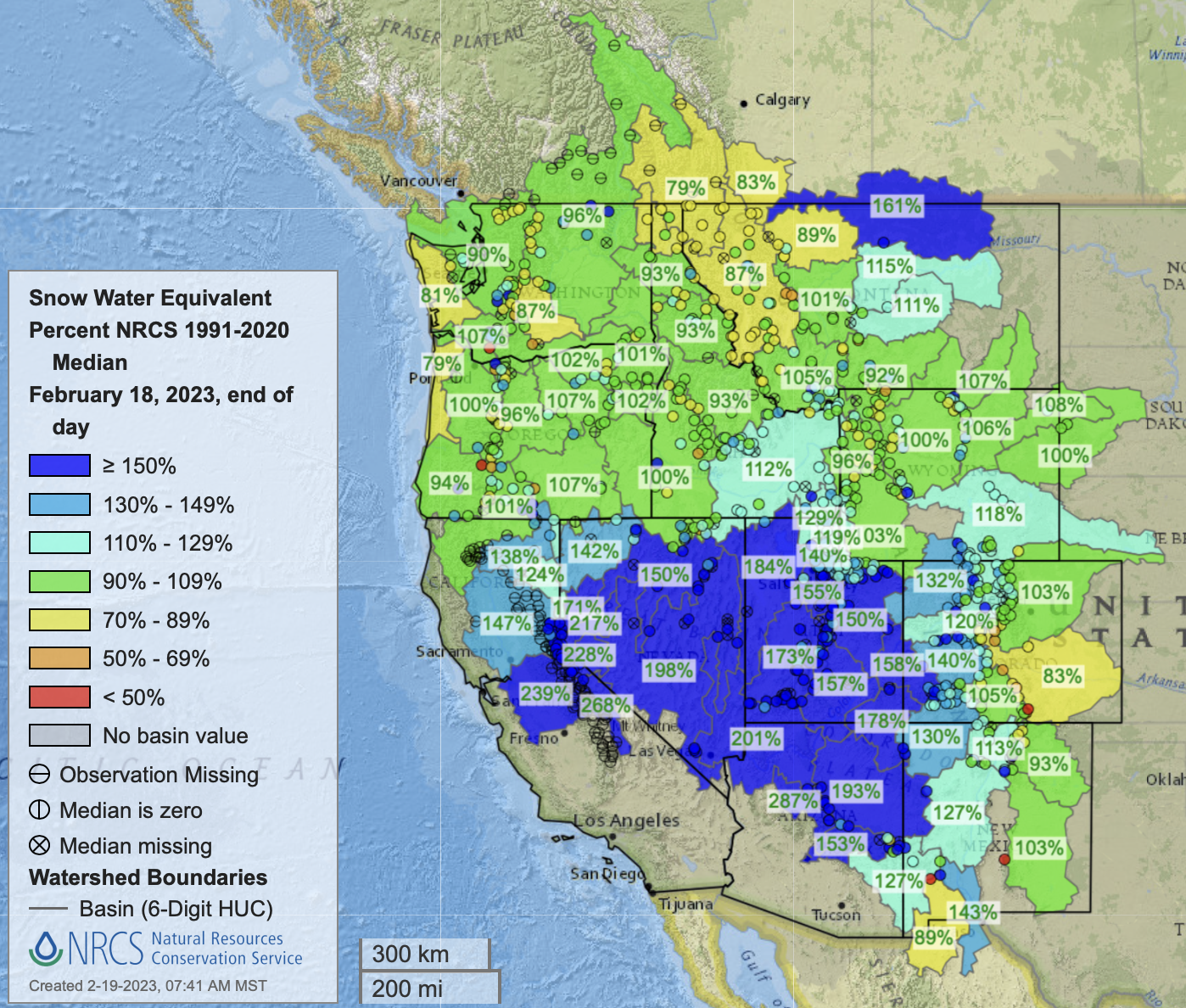
Oโ€™Malley: While La Nina conditions are still evident in the Pacific basin, there are strong indications that we will be entering a neutral state in the spring and summer. This winter has been a good example that not all La Nina years always produce drier than normal weather in the Southwest. While the majority of La Nina’s are dry for the Lower Colorado, there are a small handful (including this year) that result in normal to above normal precipitation.

The forecast for the spring suggests a small increase in odds that warmer than normal temperatures will occur, but no real tilt in odds regarding precipitation. Beyond the spring and summer, it’s a little too early to accurately predict the El Nino/La Nina state, however another La Nina next fall and winter is the least likely outcome.

ADWR Water News: Regarding current conditions in the Colorado River watershed, are these average-to-better-than-average conditions spread evenly? Or are some parts of the system still experiencing abnormally dry conditions? In the recent past, the southern slopes of the Rockies often were considerably drier than in the north.

Oโ€™Malley: Some of the headwater regions of Utah are still experiencing Severe and Extreme Drought conditions given the prolonged deficits. However, much of the Colorado headwaters have fallen out of drought depiction (as has the majority of Arizona). However, the Colorado headwaters snowpack is somewhat lower (as compared to normal) versus the rest of the basin โ€“ albeit, still a healthy 125-150 percent of normal. All told, this is much better than the past two winters, though the peak runoff doesn’t occur for a few more months.

โ€˜A living spiritโ€™: Native people push for changes to protect the #ColoradoRiver — The Los Angeles Times COriver #aridification

THE FORT MOJAVE TWINS ARE a pair of geoglyphs that represent large human figures that possibly date to 900 BCE. The twins are said to signify good and evil. The larger of the two has a massive head with attached limbs and is believed to represent good. It may also be representative of an ancient god. Photo credit: Atlas Obscura

Click the link to read the article on The Los Angeles Times website (Ian James). Here’s an excerpt:

On a bluff overlooking the Lower Colorado River Valley, the ground bears an image of two giant figures. Known as the Twins, these ancient figures are revered by members of the Fort Mojave Indian Tribe, who say they show their peopleโ€™s deep connection to the land and the river.

โ€œThis is a reminder of who we are,โ€ said Nora McDowell, an elder and former chairperson of the tribe. โ€œThis is our home. This is what the Creator gave us.โ€

In their beliefs, their place of origin lies to the northwest atย Avi Kwa Ame, also called Spirit Mountain. Their ancestors taught them that the Creator made the river and the plants and animals, and put the people here to protect it all…Centuries ago, the river swelled with seasonal floods, filling the valley. The people fished in the water and farmed on the silty floodplain, growing crops such as corn and squash. They saw the river and its water as the heart of life, something that belonged to no one. That began to change in the mid-1800s as white settlers moved west, appropriating land and water.

The American authorities wanted the tribeโ€˜s members to move farther south, but they resisted. The tribe saw the establishment of aย U.S. military outpostย at a river crossing, and eventually the Fort Mojave Indian Reservation wasย created along the river, encompassing lands in Nevada, Arizona and California.ย The fort later became a boarding school, where children wereย forced to assimilate and adopt English names.

Aspinall Unit operations update February 5, 2023 #GunnisonRiver #ColoradoRiver #COriver #aridification

The Pagosa Area #Water and Sanitation District Board of Directors approve increases in rates — The #PagosaSprings Sun

The springs for which Pagosa Springs was named, photographed in 1874. By Timothy H. O. Sullivan – U.S. National Archives and Records Administration, Public Domain, https://commons.wikimedia.org/w/index.php?curid=17428006

Click the link to read the article on the Pagosa Springs Sun website (Josh Pike). Here’s an excerpt:

According to PAWSD District Manager Justin Ramsey, the rate changes took effect immediately upon approval. According to the board packet for the meeting and as explained by PAWSD Director of Business Services Aaron Burns, the rate increases include a 6 percent increase in water rates and a 2.5 percent increase in wastewater rates.

With these changes, according to agenda documentation, the monthly service charge for water will rise from $29.66 to $31.44 per equivalent unit (EU). The volume charge per 1,000 gallons for between 2,001 and 8,000 gallons of usage will rise from $5.32 to $5.64, while the volume charge per 1,000 gallons for between 8,001 and 20,000 gallons of usage will increase from $10.65 to $11.29. The volume charge per 1,000 gallons for more than 20,001 gal- lons of usage will increase from $13.37 to $14.17. The water fill station charge per 1,000 gallons will increase from $11.49 to $12.18, while the water availability of service and waste- water availability of service fees remain the same at $14.30 and $12.50 respectively. According to the documenta- tion, the wastewater monthly service charge will rise from $32 to $32.80.

Prior to unanimously approving the rate changes, the board held a public hearing on the issue where it received no public comments concerning the altered rates.

The Cold War Legacy Lurking in U.S. Groundwater — ProPublica

Sign in the Lisbon Valley of southeastern Utah. Jonathan P. Thompson photo.

Click the link to read the article on the ProPublica website, by Mark Olalde, Mollie Simon and Alex Mierjeski, video by Gerardo del Valle, Liz Moughon and Mauricio Rodrรญguez Pons

ProPublica is a Pulitzer Prize-winning investigative newsroom. Sign up for The Big Story newsletter to receive stories like this one in your inbox.

In Americaโ€™s rush to build the nuclear arsenal that won the Cold War, safety was sacrificed for speed.

Uranium mills that helped fuel the weapons also dumped radioactive and toxic waste into rivers like the Cheyenne in South Dakota and the Animas in Colorado. Thousands of sheep turned blue and died after foraging on land tainted by processing sites in North Dakota. And cancer wards across the West swelled with sick uranium workers.

The U.S. government bankrolled the industry, and mining companies rushed to profit, building more than 50 mills and processing sites to refine uranium ore.

But the government didnโ€™t have a plan for the toxic byproducts of this nuclear assembly line. Some of the more than 250 million tons of toxic and radioactive detritus, known as tailings, scattered into nearby communities, some spilled into streams and some leaked into aquifers.

Congress finally created the agency that now oversees uranium mill waste cleanup in 1974 and enacted the law governing that process in 1978, but the industry would soon collapse due to falling uranium prices and rising safety concerns. Most mills closed by the mid-1980s.

When cleanup began, federal regulators first focused on the most immediate public health threat, radiation exposure. Agencies or companies completely covered waste at most mills to halt leaks of the carcinogenic gas radon and moved some waste by truck and train to impoundments specially designed to encapsulate it.

But the government has fallen down in addressing another lingering threat from the industryโ€™s byproducts: widespread water pollution.

Moab tailings site with Spanish Valley to the south

Regulators havenโ€™t made a full accounting of whether they properly addressed groundwater contamination. So, for the first time, ProPublica cataloged cleanup efforts at the countryโ€™s 48 uranium mills, seven related processing sites and numerous tailings piles.

At least 84% of the sites have polluted groundwater. And nearly 75% still have either no liner or only a partial liner between mill waste and the ground, leaving them susceptible to leaking pollution into groundwater. In the arid West, where most of the sites are located, climate change is drying up surface water, making underground reserves increasingly important.

ProPublicaโ€™s review of thousands of pages of government and corporate documents, accompanied by interviews with 100 people, also found that cleanup has been hampered by infighting among regulatory agencies and the frequency with which regulators grant exemptions to their own water quality standards.

The result: a long history of water pollution and sickness.

Reports by government agencies found high concentrations of cancer near a mill in Utah and elevated cancer risks from mill waste in New Mexico that can persist until cleanup is complete. Residents near those sites and others have seen so many cases of cancer and thyroid disease that they believe the mills and waste piles are to blame, although epidemiological studies to prove such a link have rarely been done.

โ€œThe government didnโ€™t pay attention up front and make sure it was done right. They just said, โ€˜Go get uranium,โ€™โ€ said Bill Dixon, who spent decades cleaning up uranium and nuclear sites with the state of Oregon and in the private sector.

Tom Hanrahan grew up near uranium mills in Colorado and New Mexico and watched three of his three brothers contract cancer. He believes his siblings were โ€œcasualtiesโ€ of the war effort.

โ€œSomebody knew that this was a ticking atomic bomb,โ€ Hanrahan said. โ€œBut, in military terms, this was the cost of fighting a war.โ€

A Flawed System

When a uranium mill shuts down, here is whatโ€™s supposed to happen: The company demolishes the buildings, decontaminates the surrounding soil and water, and encases the waste to stop it from leaking cancer-causing pollution. The company then asks the Nuclear Regulatory Commission, the lead agency monitoring Americaโ€™s radioactive infrastructure, to approve the handoff of the property and its associated liability to the Department of Energyโ€™s Office of Legacy Management for monitoring and maintenance.

ProPublicaโ€™s analysis found that half of the countryโ€™s former mills havenโ€™t made it through this process and even many that did have never fully addressed pollution concerns. This is despite the federal government spending billions of dollars on cleanup, in addition to the several hundred million dollars that have been spent by companies.

Often, companies or agencies tasked with cleanup are unable to meet water quality standards, so they request exemptions to bypass them. The NRC or state agencies almost always approve these requests, allowing contaminants like uranium and selenium to be left in the groundwater. When ingested in high quantities, those elements can cause cancer and damage the nervous system, respectively.

The DOE estimates that some sites have individually polluted more than a billion gallons of water.

Bill Dam, who spent decades regulating and researching uranium mill cleanup with the NRC, at the DOE and in the private sector, said water pollution wonโ€™t be controlled until all the waste and contaminated material is moved. โ€œThe federal governmentโ€™s taken a Band-Aid approach to groundwater contamination,โ€ he said.

The pollution has disproportionately harmed Indian Country.

Six of the mills were built on reservations, and another eight mills are within 5 miles of one, some polluting aquifers used by tribes. And the countryโ€™s last conventional uranium mill still in operation โ€” the White Mesa Mill in Utah โ€” sits adjacent to a Ute Mountain Ute community.

So many uranium mines, mills and waste piles pockmark the Navajo Nation that the Environmental Protection Agency created a comic book superhero, Gamma Goat, to warn Dinรฉ children away from the sites.

NRC staff acknowledged that the process of cleaning up Americaโ€™s uranium mills can be slow but said that the agency prioritizes thoroughness over speed, that each siteโ€™s groundwater conditions are complex and unique, and that cleanup exemptions are granted only after gathering input from regulators and the public.

โ€œThe NRCโ€™s actions provide reasonable assurance of adequate protection of public health and safety and the environment,โ€ David McIntyre, an NRC spokesperson, said in a statement to ProPublica.

โ€œCleanup Standards Might Suddenly Changeโ€

For all the governmentโ€™s success in demolishing mills and isolating waste aboveground, regulators failed to protect groundwater.

Between 1958 and 1962, a mill near Gunnison, Colorado, churned through 540,000 tons of ore. The process, one step in concentrating the ore into weapons-grade uranium, leaked uranium and manganese into groundwater, and in 1990, regulators found that residents had been drawing that contaminated water from 22 wells.

The DOE moved the waste and connected residents to clean water. But pollution lingered in the aquifer beneath the growing town where some residents still get their water from private wells. The DOE finally devised a plan in 2000, which the NRC later approved, settling on a strategy called โ€œnatural flushing,โ€ essentially waiting for groundwater to dilute the contamination until it reached safe levels.

In 2015, the agency acknowledged that the plan had failed. Sediments absorb and release uranium, so waiting for contamination to be diluted doesnโ€™t solve the problem, said Dam, the former NRC and DOE regulator.

In Wyoming, state regulators wrote to the NRC in 2006 to lambast the agencyโ€™s โ€œinadequateโ€ analysis of natural flushing compared to other cleanup options. โ€œUnfortunately, the citizens of Wyoming may likely have to deal with both the consequences and the indirect costs of the NRCโ€™s decisions for generations to come,โ€ the stateโ€™s letter said.

ProPublica identified mills in six states โ€” including eight former mill sites in Colorado โ€” where regulators greenlit the strategy as part of a cleanup plan.

When neither water treatment nor nature solves the problem, federal and state regulators can simply relax their water quality standards, allowing harmful levels of pollutants to be left in aquifers.

County officials made a small area near the Gunnison mill off-limits to new wells, and the DOE suggested changing water quality standards to allow uranium concentrations as much as 475 times what naturally occurred in the area. It wouldnโ€™t endanger human health, the agency said, because people wouldnโ€™t come into contact with the water.

ProPublica found that regulators granted groundwater cleanup exemptions at 18 of the 28 sites where cleanup has been deemed complete and liability has been handed over to the DOEโ€™s Office of Legacy Management. Across all former uranium mills, the NRC or state agencies granted at least 34 requests for water quality exemptions while denying as few as three.

โ€œTheyโ€™re cutting standards, so weโ€™re getting weak cleanup that future generations may not find acceptable,โ€ said Paul Robinson, who spent four decades researching the cleanup of the uranium industry with the Southwest Research and Information Center, an Albuquerque-based nonprofit. โ€œThese great mining companies of the world, they got away cheap.โ€

NRC staffers examine studies that are submitted by companiesโ€™ consultants and other agencies to show how cleanup plans will adequately address water contamination. Some companies change their approach in response to feedback from regulators, and the public can view parts of the process in open meetings. Still, the data and groundwater modeling that underpin these requests for water cleanup exemptions are often wrong.

One reason: When mining companies built the mills, they rarely sampled groundwater to determine how much contamination occurred naturally, leaving it open to debate how clean groundwater should be when the companies leave, according to Roberta Hoy, a former uranium program specialist with the Wyoming Department of Environmental Quality. She said federal regulators also havenโ€™t done enough to understand certain contaminants at uranium mills.

In one recent case, the NRC fined a mining company $14,500 for incomplete and inaccurate groundwater modeling data. Companies use such data to prove that pollution wonโ€™t spread in the future. Freeport-McMoRan, the corporation that owns the fined mining company, did not respond to a request for comment.

At a 2013 conference co-hosted by the NRC and a mining trade group, a presentation from two consultants compared groundwater modeling to a sorcerer peering at a crystal ball.

ProPublica identified at least seven sites where regulators granted cleanup exemptions based on incorrect groundwater modeling. At these sites, uranium, lead, nitrates, radium and other substances were found at levels higher than models had predicted and regulators had allowed.

McIntyre, the NRC spokesperson, said that groundwater models โ€œinherently include uncertainty,โ€ and the government typically requires sites to be monitored. โ€œThe NRC requires conservatism in the review process and groundwater monitoring to verify a modelโ€™s accuracy,โ€ he said.

Water quality standards impose specific limits on the allowable concentration of contaminants โ€” for example, the number of micrograms of uranium per liter of water. But ProPublica found that the NRC granted exemptions in at least five states that were so vague they didnโ€™t even include numbers and were instead labeled as โ€œnarrative.โ€ The agency justified this by saying the groundwater was not near towns or was naturally unfit for human consumption.

Lincoln Park/Cotter Mill superfund site via the Environmental Protection Agency

This system worries residents of Caรฑon City, Colorado. Emily Tracy, who serves on the City Council, has lived a few miles from the areaโ€™s now-demolished uranium mill since the late 1970s and remembers floods and winds carrying mill waste into neighborhoods from the 15.3-million-ton pile, which is now partially covered.

Uranium and other contaminants had for decades tainted private wells that some residents used for drinking water and agriculture, according to the Department of Health and Human Services. The company that operated the mill, Cotter Corp., finally connected residents to clean water by the early 1990s and completed cleanup work such as decontaminating soil after the EPA got involved. But the site remains without a final cleanup plan โ€” which the company that now owns the site is drafting โ€” and the state has eased water quality standards for molybdenum, a metal that uranium mining and milling releases into the environment.

โ€œWe have great concerns about what it might look like or whether cleanup standards might suddenly change before our eyes,โ€ Tracy said.

Jim Harrington, managing director of the siteโ€™s current owner, Colorado Legacy Land, said that a final cleanup strategy has not been selected and that any proposal would need to be approved by both the EPA and the state.

Layers of Regulation

It typically takes 35 years from the day a mill shuts down until the NRC approves or estimates it will approve cleanup as being complete, ProPublica found. Two former mills arenโ€™t expected to finish this process until 2047.

Chad Smith, a DOE spokesperson, said mills that were previously transferred to the government have polluted groundwater more than expected, so regulators are more cautious now.

The involvement of so many regulators can also slow cleanup.

Five sites were so contaminated that the EPA stepped in via its Superfund program, which aims to clean up the most polluted places in the country.

At the Homestake mill in New Mexico, where cleanup is jointly overseen by the NRC and the EPA, Larry Camper, a now-retired NRC division director, acknowledged in a 2011 meeting โ€œthat having multiple regulators for the site is not good governmentโ€ and had complicated the cleanup, according to meeting minutes.

Homestake Mining Company of California did not comment on Camperโ€™s view of the process.

Only one site where the EPA is involved in cleanup has been successfully handed off to the DOE, and even there, uranium may still persist above regulatory limits in groundwater and surface water, according to the agency. An EPA spokesperson said the agency has requested additional safety studies at that site.

โ€œA lot of people make money in the bureaucratic system just pontificating over these things,โ€ said William Turner, a geologist who at different times has worked for mining companies, for the U.S. Geological Survey and as the New Mexico Natural Resources Trustee.

If the waste is on tribal land, it adds another layer of government.

The federal government and the Navajo Nation have long argued over the source of some groundwater contamination at the former Navajo Mill built by Kerr-McGee Corp. in Shiprock, New Mexico, with the tribe pointing to the mill as the key source. Smith of the DOE said the department is guided by water monitoring results โ€œto minimize opportunities for disagreement.โ€

Tronox, which acquired parts of Kerr-McGee, did not respond to requests for comment.

May 2022 wildfire smoke obscured the throat of an ancient volcano called Shiprock. Photo credit: Allen Best/Big Pivots

All the while, 2.5 million tons of waste sit adjacent to the San Juan River in the town of 8,000 people. Monitoring wells situated between the unlined waste pile and the river have shown nitrate levels as high as 80 times the limit set by regulators to protect human health, uranium levels 30 times the limit and selenium levels 20 times the limit.

โ€œI canโ€™t seem to get the federal agencies to acknowledge the positions of the Navajo Nation,โ€ said Dariel Yazzie, who formerly managed the Navajo Nation Environmental Protection Agencyโ€™s Superfund Program.

At some sites, overlapping jurisdictions mean even less cleanup gets done.

Such was the case near Griffin, North Dakota, where six cows and 2,500 sheep died in 1973; their bodies emitted a blue glow in the morning light. The animals lay near kilns that once served as rudimentary uranium mills operated by Kerr-McGee. To isolate the element, piles of uranium-laden coal at the kilns were โ€œcovered with old tires, doused in diesel fuel, ignited, and left to smolder for a couple of months,โ€ according to the North Dakota Geological Survey.

The flock is believed to have been poisoned by land contaminated with high levels of molybdenum. The danger extended beyond livestock. In a 1989 draft environmental assessment, the DOE found that โ€œfatal cancer from exposure to residual radioactive materialsโ€ from the Griffin kilns and another site less than a mile from a town of 1,000 people called Belfield was eight times as high as it would have been if the sites had been decontaminated.

But after agreeing to work with the federal government, North Dakota did an about-face. State officials balked at a requirement to pay 10% of the cleanup cost โ€” the federal government would cover the rest โ€” and in 1995 asked that the sites no longer be regulated under the federal law. The DOE had already issued a report that said doing nothing โ€œwould not be consistentโ€ with the law, but the department approved the stateโ€™s request and walked away, saying it could only clean a site if the state paid its share.

โ€œNorth Dakota determined there was minimal risk to public health at that time and disturbing the grounds further would create a potential for increased public health risk,โ€ said David Stradinger, manager of the Radiation Control Program in the North Dakota Department of Environmental Quality. Contaminated equipment was removed, and the state is reevaluating one of the sites, he said.

โ€œA Problem for the Better Part of 50 Yearsโ€

While the process for cleaning up former mills is lengthy and laid out in regulations, regulators and corporations have made questionable and contradictory decisions in their handling of toxic waste and tainted water.

More than 40 million people rely on drinking water from the Colorado River, but the NRC and DOE allowed companies to leak contamination from mill waste directly into the river, arguing that the waterway quickly dilutes it.

Federal regulators relocated tailings at two former mills that processed uranium and vanadium, another heavy metal, on the banks of the Colorado River in Rifle, Colorado, because radiation levels there were deemed too high. Yet they left some waste at one former processing site in a shallow aquifer connected to the river and granted an exemption that allowed cleanup to end and uranium to continue leaking into the waterway.

The Bluewater disposal site was a uranium-ore-processing site addressed by Title II of the Uranium Mill Tailings Radiation Control Act (UMTRCA). The site transitioned to DOE in 1997 administered under the provisions of a general Nuclear Regulatory Commission (NRC) license.

For a former mill built by the Anaconda Copper Company in Bluewater, New Mexico, the NRC approved the companyโ€™s request to hand the site off to the DOE in 1997. About a decade later, the state raised concerns about uranium that had spread several miles in an aquifer that provides drinking water for more than 15,000 people.

The contamination hasnโ€™t reached the wells used by nearby communities, and Smith, the DOE spokesperson, said the department has no plans to treat the uranium in the aquifer. Itโ€™s too late for much more cleanup, since the DOEโ€™s Office of Legacy Managementโ€™s mission is to monitor and maintain decommissioned sites, not clean them. Flawed cleanup efforts caused problems at several former mills after they were handed off to the agency, according to a 2020 Government Accountability Office report.

โ€œUranium has been overplayed as a boom,โ€ said Travis Stills, an environmental attorney in Colorado who has sued over the cleanup of old uranium infrastructure. โ€œThe boom was a firecracker, and it left a problem for the better part of 50 years now.โ€

โ€œNo Way in Hell Weโ€™re Going to Leave This Stuff Hereโ€

Mining companies canโ€™t remove every atom of uranium from groundwater, experts said, but they can do a better job of decommissioning uranium mills. With the federal government yet to take control of half the countryโ€™s former mills, regulators still have time to compel some companies to do more cleanup.

Between 1958 and 1961, the Lakeview Mining Company generated 736,000 tons of tailings at a uranium mill in southern Oregon. Like at most sites, uranium and other pollution leaked into an aquifer.

โ€œThereโ€™s no way in hell weโ€™re going to leave this stuff here,โ€ Dixon, the nuclear cleanup specialist, remembered thinking. He represented the state of Oregon at the former mill, which was one of the first sites to relocate its waste to a specially engineered disposal cell.

A local advisory committee at the Lakeview site allowed residents and local politicians to offer input to federal regulators. By the end of the process, the government had paid to connect residents to a clean drinking water system and the waste was moved away from the town, where it was contained by a 2-foot-thick clay liner and covered with 3 feet of rocks, soil and vegetation. Local labor got priority for cleanup contracts, and a 170-acre solar farm now stands on the former mill site.

But relocation isnโ€™t required. At some sites, companies and regulators saw a big price tag and either moved residents away or merely left the waste where it was.

โ€œI recognize Lakeview is easy and itโ€™s a drop in the bucket compared to New Mexico,โ€ Dixon said, referring to the nationโ€™s largest waste piles. โ€œBut itโ€™s just so sad to see that this hasnโ€™t been taken care of.โ€

Methodology

To investigate the cleanup of Americaโ€™s uranium mills, ProPublica assembled a list of uranium processing and disposal sites from the Nuclear Regulatory Commissionโ€™s most recent โ€œStatus of the Decommissioning Programโ€ annual reportthe WISE Uranium Project and several federal agenciesโ€™ websites. Reporters reviewed fact sheets from the NRC and the Department of Energybefore studying the history of each mill contained in thousands of pages of documents that are archived mainly in the NRCโ€™s Agencywide Documents Access and Management System, known as ADAMS.

We solicited feedback on our findings from 10 experts who worked or work at the NRC, the Environmental Protection Agency, the Wyoming Department of Environmental Quality, the Southwest Research and Information Center, the University of New Mexico and elsewhere. Additionally, we interviewed dozens of current and former regulators, residents of communities adjacent to mills, representatives of tribes, academics, politicians and activists to better understand the positive and negative impacts of the uranium industry and the bureaucracy that oversees uranium mill cleanup.

We also traveled to observe mill sites in New Mexico, Utah and Colorado.

Map of Abandoned Uranium Mines on the Navajo Nation. Credit: EPA

#ColoradoRiver states fail to strike agreement; feds may step in — @WyoFile “…no one is calling on the Congress to fix this” — Kyle Roerink #GreenRiver #YampaRiver #LittleSnakeRiver #COriver #aridification

A high desert thunderstorm lights up the sky behind Glen Canyon Dam — Photo USBR

Click the link to read the article on the WyoFile website (Dustin Bleizeffer):

Hopes to forge a plan to reduce Colorado River Basin water use by 15% to 25% this year disintegrated this week with dueling proposals that pit California against Arizona and other basin states, including Wyoming.
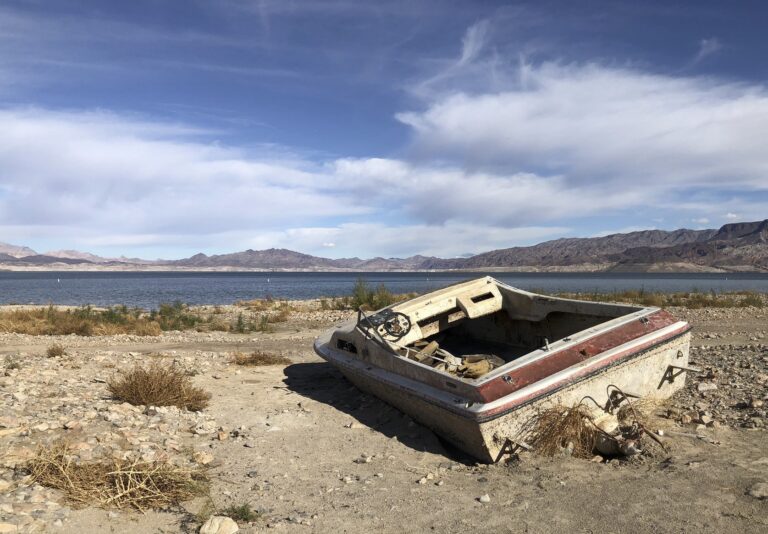
That leaves the U.S. Department of the Interior and Bureau of Reclamation, which issued the water-savings challenge in June 2022, to potentially impose their own plan to cut releases from Lake Powell and Lake Mead to maintain hydropower generation.
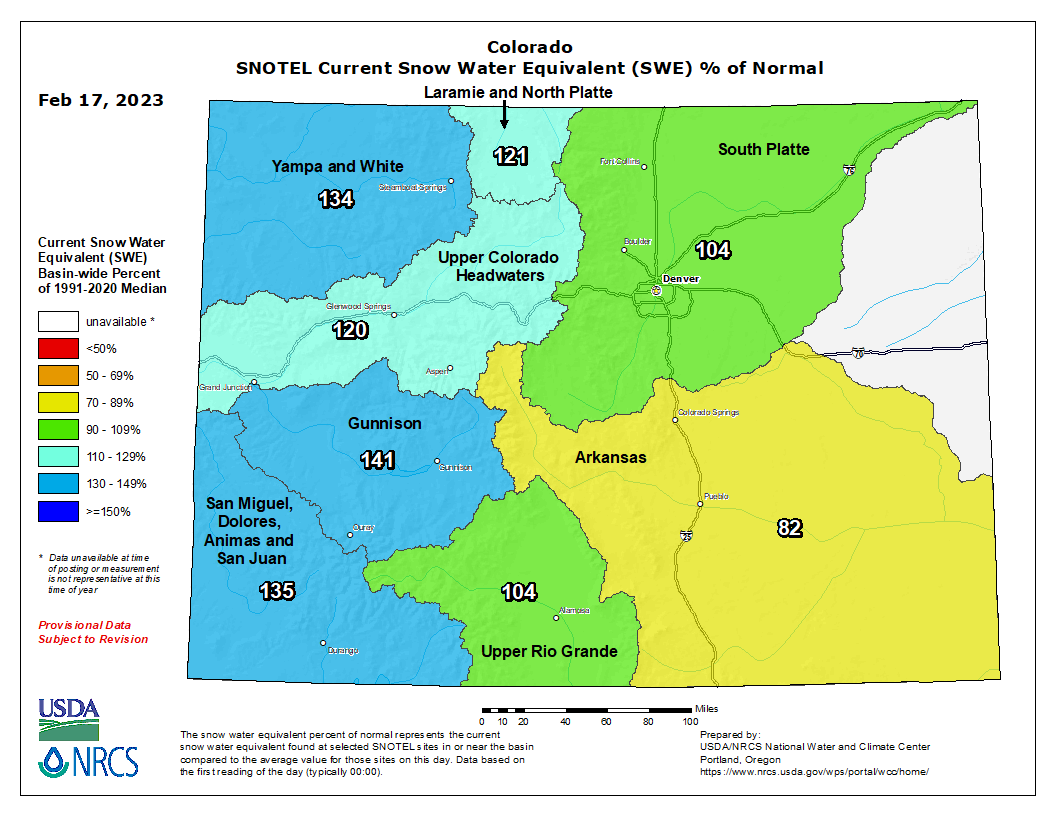
โ€œGiven the magnitude of water-use reductions that are being considered, talks between the Basin States have been very difficult at times,โ€ Wyoming State Engineer Brandon Gebhart said in an email to WyoFile.

Dueling proposals

Responding to a Jan. 31 deadline, Wyoming joined fellow Upper Colorado River Basin states โ€” as well as Nevada and Arizona in the Lower Basin โ€” in supporting a proposed โ€œconsensus-basedโ€ model for better accounting of actual water supplies, including water losses due to evaporation and seepage at Lake Mead. That framework, if implemented, should result in a water savings of 1.5 million acre-feet to 3.3 million acre-feet of water, according to a letter signed by water officials representing the six states.

A pump pulls water from the Green River at a Sweetwater County-managed recreation area Sept. 27, 2022. (Dustin Bleizeffer/WyoFile)

But those proposed water savings may not be fully realized this year. Plus, the six-state proposal leaves open the prospect for major water cuts this year to the Lower Basin states, particularly California โ€” the largest consumer of Colorado River water in the system. California countered this week with its own proposal for short-term water savings that would maintain the stateโ€™s bargaining power rooted in its senior water rights. That plan would shift the burden of water cuts to Arizona, which has water rights that are junior to Californiaโ€™s.

โ€œI think thatโ€™s why Arizona was quick to jump on the letter with the other six states,โ€ Great Basin Water Network Executive Director Kyle Roerink said.

Arizona prefers the consensus-building approach to sharing the pain of water-use reductions, Roerink said, over a strict adherence to the legal framework to restrict water use among those with the most junior water rights.

โ€œIn both letters, you have some serious shots across the bow as it relates to litigation and political posturing,โ€ Roerink said. โ€œAnd no one is calling on the Congress to fix this.โ€

Although the six-state proposal that Wyoming signed on to doesnโ€™t commit specific, voluntary water-use reductions, itโ€™s a necessary โ€œnext step toward a consensus solution,โ€ Gebhart said.

Buckboard Marina owner Tony Valdez stands next to a stake that indicates the extent of lowering water levels at Flaming Gorge Reservoir Sept. 26, 2022. (Dustin Bleizeffer/WyoFile)

โ€œAs we continue the process, we try to understand and respect the very difficult realities being faced by California and the other Basin States,โ€ he said. โ€œWe remain committed to working with the other Basin States and impacted water users to find consensus solutions.โ€

Despite varying legal positions and dire circumstances faced by each Colorado River stakeholder, some observers say Wyoming and the other Upper Basin states have offered up too little to help address the immediate problem that threatens some 40 million people who rely on the river.

โ€œThe Upper Basin is getting off scot-free,โ€ Roerink said. โ€œPlus, thereโ€™s no prohibitions put forth on potentially new development of Upper Basin water, like the West Fork of Battle Creek, for example.โ€

Wyomingโ€™s role

Regardless of what new actions the federal government may take in coming months, the Bureau of Reclamation will continue to rely on releasing extra volumes of water from Flaming Gorge Reservoir on the Wyoming-Utah border to help balance levels at downstream reservoirs, according to those close to the issue.

The bureau enacted extra releases totaling 625,000 acre-feet of water from the reservoir since 2021, and is expected to announce additional releases in April or May. Flaming Gorge was at 69% capacity in January, according to the bureau. If that continues into the summer, many boat ramps will be left high and dry threatening the local recreation economy.

Meantime, Wyoming and the Upper Colorado River Commission are encouraging voluntary water conservation, soliciting interest in a program that pays irrigators, municipalities and industrial facilities to leave water in streams that flow to the Colorado River.

This week, the UCRC extended the application deadline for the System Conservation Pilot Program to March 1. Wyoming officials expect to receive 15 to 20 proposals from individual water users in coming weeks, according to the state engineerโ€™s office.

For more information about the SCPP, visit the UCRCโ€™s website.

Green River Lakes and the Bridger Wilderness. Forest Service, USDA, Public domain, via Wikimedia Commons

#LakePowell: What is it good for? — @Land_Desk #ColoradoRiver #COriver #aridification #snowpack (February 2, 2023)

Click the link to read the article on The Land Desk website (Jonathan P. Thompson):

Absolutely nothing? 

Sometimes it seems that way, doesnโ€™t it?ย Unlike other dams, Glen Canyon does not provide any meaningful flood control (except for in the Grand Canyon). It doesnโ€™t regulate streamflow to stretch out the irrigation season (because there are virtually no fields to irrigate between Glen Canyon Dam and the upper end of Lake Mead). And it isnโ€™t so great at storing excess water since, well, there is no excess water. At best it serves as an overflow basin for when Lake Mead fills up. But with both Lake Powell and Lake Mead holding only about 25% of their total capacity, the upper reservoir has become redundant โ€” at least from a water storage standpoint.

Paddling Powell. Photo by Jonathan P. Thompson.

It is from this redundancy that the Fill Mead First philosophy has emerged. Wouldnโ€™t it make more sense, adherents of this school ask, to drain Lake Powell and put what water remains there into Lake Mead, so that youโ€™d have one half-full reservoir rather than two quarter-full ones? So that youโ€™d have billions of gallons of water evaporating off just one reservoir rather than two? 

Itโ€™s a great question. And it brings up another one: Why Lake Powell? As in, what purpose does Glen Canyon Dam still serve in a climate-changed, diminished Colorado River world? 

Let me start by saying that I believe the construction of Glen Canyon Dam was a crime against Nature. It inundated countless cultural sites, killed 186 miles of the mainstem of the Colorado River along with hundreds of additional miles of side canyons and tributaries, and deprived everyone born after 1963 of the opportunity to experience one of our nationโ€™s natural marvels. It radically altered the ecology of the Grand Canyon and further endangered already imperiled native fish.

Delph Carpenter’s original map showing a reservoir at Glen Canyon and one at Black Canyon via Greg Hobbs

For what was this sacrifice made? Primarily it was to enable the Upper Colorado River Basin states to comply with the Colorado River Compact

The Compact did two big things: First, it divided the assumed average annual flows of the river between the Upper Basin states (Colorado, Wyoming, Utah, and New Mexico) and the Lower Basin states (California, Arizona, Nevada). The Lower Basin got 8.5 million acre-feet per year; the Upper Basin got 7.5 million acre-feet per year. Mexico was added later, getting 1.5 million acre-feet. 

But there was something else: To ensure the Lower Basin would get its share, the Compact mandates that the Upper Basin โ€œnot cause the flow of the river at Lee Ferry to be depleted below an aggregate of 75 million acre-feetโ€ for any 10-year period. In other words, the Upper Basin couldnโ€™t merely take out its 7.5 MAF share each year and let whatever remained run down to their downstream compatriots. It had to deliver an annual average of 7.5 MAF. 

Thatโ€™s no problem during big water years, but during years when less than 15 MAF is in the river, the Upper Basin would have had to reduce its take accordingly, while the Lower folks would still get their share. During some dry years, the total flow of the river has been lower than 7.5 MAF, meaning the Upper Basin States would be left high and dry.

September 21, 1923, 9:00 a.m. — Colorado River at Lees Ferry. From right bank on line with Klohr’s house and gage house. Old “Dugway” or inclined gage shows to left of gage house. Gage height 11.05′, discharge 27,000 cfs. Lens 16, time =1/25, camera supported. Photo by G.C. Stevens of the USGS. Source: 1921-1937 Surface Water Records File, Colorado R. @ Lees Ferry, Laguna Niguel Federal Records Center, Accession No. 57-78-0006, Box 2 of 2 , Location No. MB053635.

Unless they had a savings account. Or, in this case, a dam and reservoir above Lee Ferry capable of storing enough water during wet years to be able to release the Lower Basinโ€™s 7.5 MAF during even the driest years, i.e. Glen Canyon Dam and Lake Powell. If not for Lake Powell, the Upper Basin States would have been in deep doo doo over the last couple of decades, because they would have had to substantially cut consumption or go to war with California for failing to deliver the required water to the Lower Basin. 

So you could say that the Colorado River Compactโ€™s downstream delivery mandate is the main reason we now are cursed or blessed with Lake Powell. Itโ€™s also perhaps the biggest hurdle for Fill Mead First folks to clear: You canโ€™t really get rid of Glen Canyon Dam without scrapping the Compact, for better or worse. 

The mandate and the reservoir have another consequence: It forces the Upper Basin States toย count evaporation losses against its consumptive use of the Riverย (because it has to deliver the 7.5 MAFย afterย evaporation occurs). Meanwhile, the Lower Basin States can simply take their allotted share out of the river, regardless of evaporation: Another inequity baked into the system.ย 

Glen Canyon Dam serves other purposes, too, such as:

  • Silt Control: Well, control may not be the right word, since no one has control over the clay and mud and sand (and other less savory sediments) that are carried down the Colorado and San Juan Rivers. But Lake Powell does a good job of catching the silt and keeping it from continuing downstream to clog up Lake Mead. Silt was piling up in Mead at a rate of up to 137,000 acre-feet per year before Glen Canyon. Now itโ€™s down to less than 10,000 acre-feet annually, thanks to that big silt-catcher upstream. 
  • Hydropower Production: Weโ€™ve written about this one a lot. The short version: If you did away with Glen Canyon Dam, youโ€™d be depriving the grid of enough electricity annually to power about a quarter of a million homes in the Southwest. It would also drain between $100 million and $200 million annually from dam electricity sales, which helps fund endangered fish recovery programs. That said, by putting that water in Lake Mead, youโ€™d offset some of that loss by increasing the generating capacity of Hoover Damโ€™s hydroelectric plant. 
  • Recreation: I will confess that when the Blue Ribbon Coalition announced itsย โ€œFill Lake Powell: The path to 3,588โ€ย initiative last year,ย I laughed. After all, the motorized recreation lobbying group was calling for massive consumption cuts by all of the Colorado Riverโ€™s users not to save the River or keep the system from collapsing, but to keep Lake Powell boatable. That just seemed like some slightly lopsided prioritizing. But then a friend and Lake Powell lover called me out on it, and I do have to admit that Iโ€™ve done some recreating on Powell, myself, and loved it.
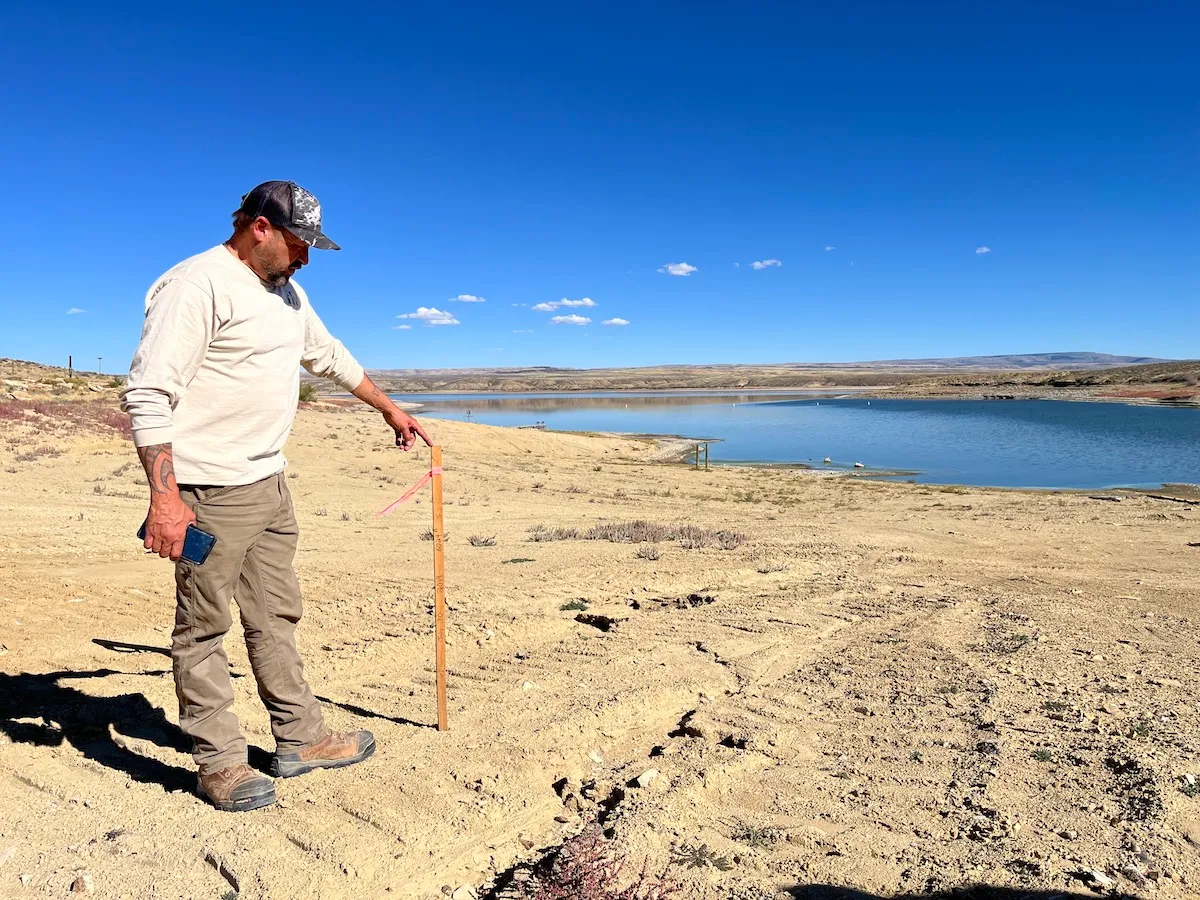
The first time I saw Lake Powell was in the mid-1970s when the reservoir was still filling up. My parentsโ€™ friends had rented a houseboat and we spent a week or so with them exploring side canyons, camping, swimming โ€” which for me was floating around in my life jacket โ€” in the warm waters, and hiking to out-of-the-way places that the reservoir and boat had made easily accessible. 

Thereโ€™s something surreal, even shocking about this vast body of water within an arid sea of stone. Itโ€™s easy to imagine someone heading off from their houseboat for a hike, getting lost, running out of water, and dying of thirst on a precipice hanging out over a 300-foot vertical drop to a trillion gallons of water. Itโ€™s otherworldly in that it seems horribly out of place on this world, which maybe is why it played the part of a post-apocalyptic planet in the opening scene ofย Planet of the Apes.

But the otherworldliness is part of the appeal, I suppose. Over the years I would return to Lake Powell with friends to camp out on the sandstone shores, sometimes getting there with boats, other times taking creaky old cars on sandy backroads to sections of shoreline that are now miles from the water. We spent a Summer Solstice or two on the reservoir and it was so damned hot and the days so long that early each morning Iโ€™d peel myself out of my sun-cooked and sweat-soaked sleeping bag and head straight for the tepid water.

It was usually a lot of fun: A luxurious change from the death march backpacking trips I tended to go on and a sort of novelty to be able to go on a big swim behind the Slickrock Curtain. Well, besides that time that some friends and I encountered a half-submerged cow carcass in the murky water near shore, its legs jutting skyward out of a horribly bloated body, Coors Light cans floating nearby like offerings to a bovine God. But hey.

Back in 2006 or 2007 my wife Wendy headed to Powell for a different sort of trip, setting out from Halls Crossing Marina in sea kayaks for a three-day tour. Thereโ€™s something eerie about being right down in the glassy, dark water like that. When out in the main channel I tried not to think about how those waters went down below me for hundreds of feet. I tried not to think about the story my cousins used to tell about how divers searching for one of the reservoirโ€™s many victims didnโ€™t find the body but did encounter 12-foot-long catfish in the depths. I tried not to think of what would happen if one of those monster houseboats crashed into me in my skinny little skiff. But all in all it was a marvelous trip and a great way to see that part of the world. Iโ€™ve been plotting a longer journey ever since, one in which maybe we hitch a ride with a motor boat up the Escalante or something.
My experiences notwithstanding, recreation at Lake Powell is not only big business, but has also become critical to the economies of the communities that have sprouted near its shores. A National Park Service study found nearly 3 million visitors to Glen Canyon National Recreation Area spent $332 million in and around the park in 2021 (down from $420 million in 2019 when reservoir levels were higher). 

Page, Arizona, was established to house the workers who constructed Glen Canyon Dam, and later became the parkโ€™s main gateway community, housing its employees, boats, and businesses that cater to park visitors. When the Navajo Generating Station coal plant shut down in 2019, a lot of folks worried that Page would collapse, economically. But itโ€™s stayed afloat โ€” pardon the pun โ€” thanks in part to Lake Powell tourism. 

If you drained Lake Powell would tourism to the area dry up, too? I doubt it. Plenty of folks โ€” myself included โ€” would flock to the place to see what the actual canyon looks like, even if it is half silted over. Others, Iโ€™m sure, would want to witness the carnage of climate change wrought collapse. Hell, Iโ€™d pay good money to be on a house boat as the reservoir drained just to see the place revealed in real time. 

I suspect Powell will be drained or drain itself in the next few decades, but I doubt it will happen in the next few years. The Bureau of Reclamation is clearly intent on keeping reservoir levels viable for as long as possible, even if it means bringing the hammer down on the states and forcing cuts in consumption. Combine those efforts with a few good snow years and, who knows, the reservoir might just rebound somewhat.

The Land Desk is a reader-supported publication, which means weโ€™ve got no advertisers, corporate sponsors or product placement deals. All weโ€™ve got is you. So, if youโ€™d like to support the Land Desk, sign up for a paid subscription.

West snowpack basin-filled map February 1, 2023 via the NRCS.

I donโ€™t want to jinx it, but maybe, just maybe, this is going to be one of those good spring runoff years of yore. The snow is piling up at above average rates, but it is still early: We may be two-thirds of the way through meteorological winter (Dec-Feb), but not even halfway through the big snow season, which can stretch into May. Thereโ€™s still time for the snow-deluge to turn to drought. 

Oh, and then there are the party poopers who are saying a good snow year is actually bad because it will cause people to let their guards down and ease up on efforts to conserve. 

But what the hell, Iโ€™m gonna celebrate. Because you know what? Thereโ€™s a s%$t-ton of snow out there, which is great for the ski areas and the rivers, sure, but best of all it means even lowlanders can go nordic skiing at the golf course, just like in the good olโ€™ days. Hereโ€™s some of the graphs that really stood out for me:

Wait, what?! Not only is the snowpack in Southeastern Utahโ€™s La Sal Mountains nearly double what it normally is this time of year, but itโ€™s 15% above the median peak level for the entire year. More remarkable, itโ€™s higher than ever for this date โ€” thereโ€™s even more liquid than in the monster years of 1983 and 1984 (when Glen Canyon Dam had a little spillover problem).
The Dolores River Basin has suffered from a string of drought years which has left irrigators a bit high and dry and the Dolores River downstream from McPhee Dam even drier. So, itโ€™s good to see things looking a bit better this year, albeit not quite as snowy as the La Sals (which also feed the lower Lower Dolores). If snowfall trends continue, it might mean McPhee will fill up enough that dam operators will release enough water to make a river downstream. Who knows, maybe there will be enough flow for a few days for boating? Cross your fingers.
And, finally, we have the Colorado River Basin above Lake Powell. Itโ€™s well above median levels, and far surpasses 2021. The question now is whether the black line for 2023 will keep climbing, or plateau like it did around this time last year. In any event, it should probably keep the reservoir from sinking below critical minimum power pool levels this summer.

Deadpool Diaries: The numbers in the statesโ€™ two proposals — John Fleck @jfleck #ColoradoRiver #COriver #aridification

Statesโ€™ proposal for Colorado River cuts. Lake Mead elevation along the x axis, millions of acre feet of cuts along the y axis. Credit: John Fleck

Click the link to read the article on the InkStain website (John Fleck):

Getting ready for an interview this morning with Mark Brodie at KJZZ (waving at my Phoenix friends!) I put together a table to make it easier to compare the six-state proposal submitted Monday to reduce Lower Colorado River Basin water use, and the California proposal submitted yesterday (Tues. 1/31/23).

Perhaps worth sharing here? โ€œElevationโ€ is Lake Mead elevation, the numbers are million acre feet of total cuts.

Two keys to note.

First, despite big disagreements about how to approach this, we have unanimity among all seven states that very deep cuts in Lower Basin water use are needed. At the lowest Lake Mead elevations, the numbers are similar.

The difference is in timing. Californiaโ€™s cuts donโ€™t kick in until later โ€“ essentially a gamble on good hydrology once again helping us avoid conflict by letting us use more water in the short term.
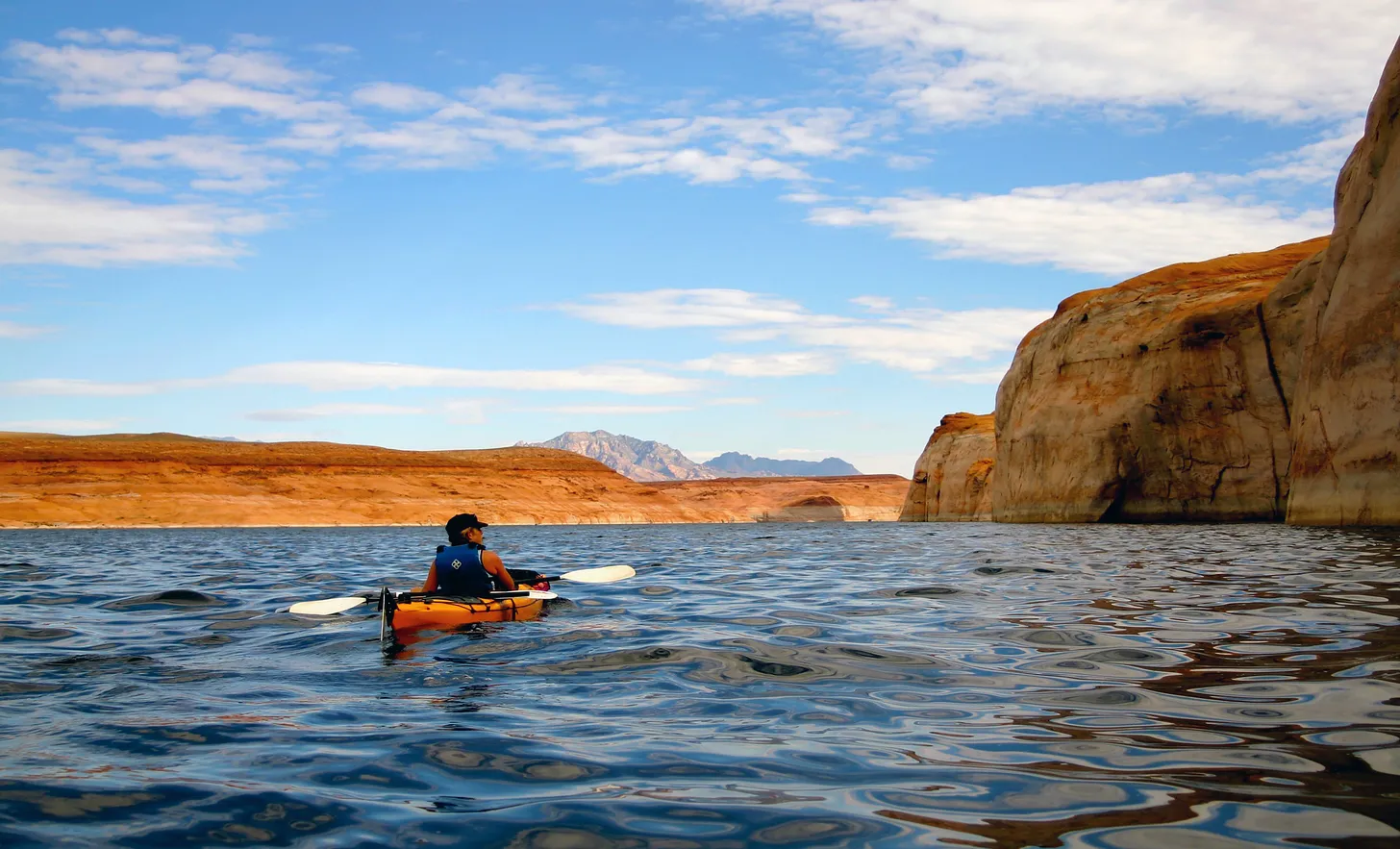
The six-state proposal says โ€œgo bigโ€ any time Mead drops below 1,050. The California proposal doesnโ€™t start โ€œgoing bigโ€ until 1,025.

The six-state proposal yanks the bandaid off now.

Under the current โ€œmost probable forecastโ€ for the coming year, weโ€™d end up in 2024 with:

  • Six state proposal: 3,168 million acre feet in cuts
  • California proposal: 2,188 million acre feet in cuts
TierElevation6-stateCalifornia
Tier 010901,7841,241
Tier 110752,1561,613
Tier 2a1,0502,9181,721
Tier 2b10452,9182,013
Tier 2c10402,9182,071
Tier 2d10352,9182,129
Tier 2e10303,1682,188
Tier 3a10253,1682,525
Tier 3b10203,3682,675
Tier 3c10153,3682,875
1,0103,3683,125
1,0053,3683,325

There are other differences too โ€“ huge disagreements on how to approach the allocation of the cuts! No time for that this morning, Iโ€™ve a book to write, but I hope to get back to that in the next few days, stay tuned.

Opinion: The 2023 session will determine #Colorado’s #water future — Abby Burk and Jessica Gelay #COleg #COWaterPlan

Colorado River February 2020. Photo: Abby Burk via Audubon Rockies.

โ€œWater is the conversation. It will be the centerpiece of our agenda this year,โ€ said newly elected Speaker of the House Julie McCluskie, setting the tone and elevating water issues for Coloradoโ€™s 2023 General Assembly.

Itโ€™s no secret Coloradoโ€™s rivers and streams are suffering and our stateโ€™s challenges are a good example of water crises gripping the American West. Parched rivers; stressed farms, livestock and fish; and more frequent floods and wildfires are all symptoms of the disruption wrought as climate change impacts our region and already strained water supply.

Abby Burk brings a lifetime love of rivers, particularly of the Colorado River and its tributaries. As the western rivers regional program manager for Audubon Rockies. Photo credit: Audubon Rockies

Coloradoโ€™s lawmakers and other leaders have a responsibility to ensure Coloradans have the tools we need to proactively respond to drought and its impacts โ€” on the legislatureโ€™s opening day, Senate President Steve Fenberg made it clear water will be among the high priority items the General Assembly takes on. And Speaker McCluskie concurred, saying: โ€œColorado has to be seen as a leader in this space.โ€ Gov. Jared Polisโ€™s proposed 2023 budget has already highlighted support for addressing our stateโ€™s water challenges. Last year the federal government injected a once-in-a- generation allocation of public funds to support water needs in the West. Now action is needed within the Colorado legislature to increase funding and capacity to establish both immediate and long-term drought security and to protect clean drinking water alongside river and watershed health.

Weโ€™re excited to see the Governorโ€™s budget request for a historic $25.2 million to advance implementation of the stateโ€™s water plan, providing capacity to meet increasing demands, to combat the effects of climate change, and to support the health of our rivers. Itโ€™s important to note: these state funds are vital for unlocking matching federal dollars, dollars that are expected to be leveraged for approximately $100 million worth of water project grants across the state โ€” a 4-to-1 return on investment. By engaging local communities, investing federal funds in needed infrastructure projects, and empowering millions of people to take action to conserve water, Colorado will make significant progress toward responding to long-term climate trends.

Flows in the Colorado River have decreased by more than 20% in just the past 20 years, which is why improving the struggling Colorado River system has been, and remains, the top priority for Water for Colorado. A healthy and vibrant river system serves as habitat for wildlife, increases resilience to floods and wildfires, enhances the quality and availability of water and forage for livestock, bolsters critical rural recreation economies and provides numerous ecological services that protect our sources of clean drinking water. With increasing threats of extreme weather events, healthy and functioning streams are critical to ensuring resilient communities, and a thriving state. This is why we are supporting efforts by the stateโ€™s Department of Natural Resources to pass legislation clarifying stream restoration projects can proceed without unnecessary red tape; and also why we support Governor Polisโ€™s budget request to increase Coloradoโ€™s ability to leverage federal funds and assist with the crisis we are facing on the Colorado River.

Water policy is no longer a niche issue. Water conversations are happening at every level of state leadership โ€” from the Governorโ€™s office, to the General Assembly, to the Attorney Generalโ€™s office โ€” and across issue areas this session, making national headlines week after week. For example, as Governor Polis and the General Assembly seek to address land-use patterns and the affordable housing crisis, they are inserting water use into the conversation as a vital element. Integrating land use, development planning and more flexible water management can be another area on which our state leads.

Jessica Gelay Colorado Government Affairs Manager. Photo credit: Western Resource Advocates

The focus on water needs to be wide-ranging, but it also must be consistent. The time is now for Colorado to implement innovative policies that keep rivers flowing and proactively respond to drought conditions. In doing so, we will be a leader, showing other states how to do more with less, supporting the health of our river systems, and securing our stateโ€™s long-term vitality in the face of a hotter, drier future.

As Speaker McCluskie told us, the work ahead on water may be โ€œthe most challenging work the state has ever done.โ€ While this is likely true, it may also be the most

rewarding โ€” we can tell our children and grandchildren they live in a more resilient state because of the work conducted this session.

In his 2023 State of the State, Governor Polis reminded us โ€œwater is life in Colorado and the (W)est, itโ€™s as simple as that.โ€ The consequences of inaction this session are too great to consider. Failing to protect our water resources is not an option. Luckily, Colorado has the opportunity to not only protect our water resources in the near-term, but lead the charge toward longer-term drought resilience and climate resilience. Itโ€™s incumbent upon our lawmakers to secure Coloradoโ€™s water future. We look forward to working together to do so.

Abby Burk is Western Rivers Regional Program Manager for Audubon Rockies. Jessica Gelay is the Colorado Government Affairs Manager for Western Resource Advocates. Audubon Rockies and Western Resource Advocates are both members of the Water for Colorado Coalition.

#Colorado joins five other #ColoradoRiver Basin states in #conservation plan — Sky-Hi News #COriver #aridification

Map credit: AGU

Click the link to read the article on the Sky-Hi News website (Kyle McCabe). Here’s an excerpt:

Six of the seven Colorado River Basin states agreed to a plan Monday, Jan. 30, to conserve water in the river and manage lakes Powell and Mead, a day before a federal deadline for the states to agree on voluntary water cuts passed. Politicians including Sen. Michael Bennet and Gove. Jared Polis applauded the six statesโ€™ collaboration…The six-state plan would not reach the 2 million acre-feet threshold, focusing many of its cuts on lower basin states, despite not having the approval of California, a lower basin state and the riverโ€™s largest consumer.

A news release from Bennetโ€™s office quoted him as saying the plan โ€œdid exactly what was neededโ€ and expressing his disappointment in California not agreeing to the plan. California insteadย submitted its own planย to the U.S. Bureau of Reclamation on Tuesday. Polis said in a news release that Colorado will also continue to follow the Upper Colorado River Commissionโ€™sย 5-Point Planย from July 2022, which was the upper basinโ€™s original response to the Bureau of Reclamationโ€™s calls for conservation in June 2022.

Will basin statesโ€™ plans save operations at Glen Canyon, Hoover dams?: Federal government will mull proposals to save ailing #ColoradoRiver — The Deseret News #COriver #aridification

Glen Canyon Dam November 2022. Photo credit: USBR

Click the link to read the article on The Deseret News website (Amy Joi O’Donoghue). Here’s an excerpt:

Politics and threatened litigation are replacing what is left of the water in the Colorado River as the seven basin states that rely on the Westโ€™s largest river try to reach an agreement to cut flows so power generation can continue at Glen Canyon and Hoover dams. The directive to find some sort of definitive plan for dam operations by reducing flows was issued by the U.S. Bureau of Reclamation, which is tasked with making decisions to prop up the river that has been decimated by drought and over diversion through the years. The proposals do not change any of the statesโ€™ water allocations, for now, or affect any existing water rights. The plans will ultimately become part of a more comprehensive effort being worked on by the federal agency.

The Compactโ€™s Signers. Photo via InkStain

It is more than a heavy lift for a river that was divided up under a compact forged more than 100 years ago in a remote location in New Mexico and subsequently shaped by regulations, court decisions and compacts that all coalesced into what is now known as the โ€œLaw of the River.โ€

[…]

โ€œInstead of bending over backwards to prop up Lake Powell, officials should be making plans to save Lake Mead and utilize Glen Canyon as a backup facility,โ€ said Eric Balken, executive director of Glen Canyon Institute. โ€œThereโ€™s just not enough water to save both reservoirs, and Mead is more vital to the basin.โ€

The institute has long advocated for the draining of Lake Powell, the nationโ€™s second largest reservoir behind Lake Mead.

On Monday, six of the states sharing the Colorado River โ€” California later detailed its own plan โ€” submitted what they described as a Consensus Based Modeling Alternative to the reclamation bureau. While not a formal agreement, they say it provides a step toward helping the federal agency as it crafts an environmental review going forward.

Among other things, the alternative details:

  • Additional combined reductions of 250,000 acre-feet to Arizona, California and Nevada at Lake Mead elevation 1,030 feet and below.
  • Additional combined reductions of 200,000 acre-feet to Arizona, California and Nevada at Lake Mead elevation 1,020 feet and below, as well as additional reductions necessary to protect Lake Mead elevation of 1,000 feet.

Those potential reductions are designed to keep Lake Meadโ€™s Hoover Dam in operation.

#California #Water Agencies Submit #ColoradoRiver Modeling Framework to Bureau of Reclamation — Colorado River Board of California #COriver #aridification

Graphic via Holly McClelland/High Country News.

Click the link to read the release on the Metropolitan Water District of Southern California website:

Proposal Outlines Constructive Approach to Achieve Necessary Water Use Reductions through 2026 to Protect Critical Infrastructure, Prioritize Public Health and Safety

California water agencies that rely on the Colorado River today proposed a modeling framework for the U.S. Bureau of Reclamation to evaluate as it considers actions to help stabilize reservoir elevations and protect critical infrastructure to ensure the Colorado River system can continue to support 40 million people, nearly 6 million acres of agriculture, and Tribes across seven states and portions of Mexico.

The modeling framework outlines a constructive approach to achieve additional water use reductions while protecting infrastructure, prioritizing public health and safety, and upholding the existing body of laws, compacts, decrees, and agreements that govern Colorado River operations (known collectively as the Law of the River). The approach builds on the California agenciesโ€™ commitments announced last fall to voluntarily conserve an additional 400,000 acre-feet of water each year through 2026 to protect storage in Lake Mead and help stabilize the Colorado River reservoir system.

Californiaโ€™s proposed framework seeks to protect Lake Mead elevation of 1,000 feet and Lake Powell elevation of 3,500 feet by modifying some parameters governing reservoir operations, maximizing the impact of existing plans and voluntary conservation actions, and increasing cutbacks if Lake Mead elevations decline. It also protects baseline water needs of communities across the West by prioritizing water supplies for human health and safety. The proposal was carefully developed to enable workable phased water use reductions and ensures protection of adequate water volumes in Lake Mead and Lake Powell.

The Salton Sea (pictured above ) straddles the Imperial and Coachella valleys and has long been a sticking point in Colorado River deals. But the federal government recently committed up to $250 million for restoration efforts at the sea. (Source: Water Education Foundation)

โ€œThe alternative provides a realistic and implementable framework to address reduced inflows and declining reservoir elevations by building on voluntary agreements and past collaborative efforts in order to minimize implementation delays. Californiaโ€™s alternative protects critical elevations and uses adaptive management to protect critical reservoir elevations through the interim period,โ€  — JB Hamby, chair of Colorado River Board of California and Californiaโ€™s Colorado River Commissioner, wrote in a transmittal letter to Reclamation.

The approach differs from a modeling proposal submitted to Reclamation on January 30 by the six other basin states. The six-state proposal would direct the majority of water use reductions needed in the Lower Basin to California water users through a new apportionment method based on โ€œsystem and evaporative losses.โ€ The proposal directly conflicts with the existing Law of the River and the current water rights system and mandates cutback without providing tools to manage reductions.

For the past several months, California water users have sought a timely, practical and implementable solution with other Lower Basin users that can be implemented over the next three years to protect critical elevations in Lake Mead while longer-term changes are negotiated to update 2007 Interim Guidelines that will expire at the end of 2026. Suggestions to fundamentally change the Law of River are appropriately addressed through this shared process to update the guidelines.

Californiaโ€™s water agencies remain committed to working with all Colorado River basin states to take urgent, fair, and achievable action now to avoid unacceptable risks to communities, farms and economies in California and the rest of the basin.

For decades, California has been a leader in managing its Colorado River water resources and collaborating in basin-wide efforts to more effectively operate and manage the reservoir system and to incentivize water conservation as demands have increased in the face of shrinking supplies due to climate change.

In 2003, California permanently reduced its use of Colorado River water from about 5.2 million acre-feet annually to its basic apportionment of 4.4 million acre-feet, a permanent annual reduction in water use of about 800,000 acre-feet. The reduction in use resulted from implementing a combination of agricultural and urban conservation activities. Since 2003, water users in California have taken significant actions to conserve Colorado River water, adding over 1.5 million acre-feet and 20 feet of elevation of conserved water to Lake Mead since 2007. California water users committed to further conservation to bolster storage in Lake Mead through the 2019 Drought Contingency Plan. California has invested billions of dollars in urban and agricultural conservation across Southern California, through programs that reach virtually every Colorado River water user in the state.

“Twenty years ago, California adopted the largest water conservation-and-transfer agreement in U.S. history that not only supports the bulk of our nationโ€™s food system but also sustains the environment. This multi-billion-dollar conservation-focused framework โ€“ the Quantification Settlement Agreement โ€“ is the blueprint for other states to follow. California has done its part and is willing to do more, but itโ€™s time for the other states to step up and create their own conservation programs that sustain the quality of life in their communities,โ€ said Jim Madaffer, vice chair of the Colorado River Board of California, representing the San Diego County Water Authority.

โ€œFor over 20 years, Metropolitan has met the challenge of reducing our use of Colorado River water, and we are committed to doing more now. But we must do it in a way that does not harm half of the people who rely on the river โ€“ the 19 million people of Southern California. We must do it in a way that does not devastate our $1.6 trillion economy, an economic engine for the entire United States. We must do it in a way that can be quickly implemented, adding water to lakes Mead and Powell without getting mired in lengthy legal battles. We must do it in a way that maintains and strengthens partnerships on the river, allowing us to work together to build longer term solutions. The proposal presented today by California does all of this by equitably sharing the risk among Basin states without adversely affecting any one agency or state. The plan presented yesterday, which shut out California, does not. California knows how to permanently reduce use of the river โ€“ we have done it over the past 20 years, through billions of dollars in investments and hard-earned partnerships. We can help the entire Southwest do it again as we move forward,โ€ said Adel Hagekhalil, general manager, Metropolitan Water District of Southern California.

โ€œThe Colorado River โ€“ Imperial Valleyโ€™s only source of water โ€“ supports far more than our rural disadvantaged community as it provides for a robust agricultural industry that feeds millions of people and provides food security for this nation. California, and particularly the Imperial Irrigation District, is working to be part of the solution, however we also believe in upholding the Law of the River and not shouldering the burden of supply limitations for states and agencies that have outgrown their water rights. California has spent the past two decades successfully working together to resolve intra-state supply and demand imbalances to sustain the Colorado River. Since the signing of the Quantification Settlement Agreement, the largest ag-to-urban water conservation and transfer agreement in U.S. history, IIDโ€™s water management programs have generated over 7.2 million acre-feet in support of the Colorado River system. Today, IID and its California partners have proposed a balanced and implementable plan that begins to address the monumental challenges we face with the ongoing Colorado River drought,โ€ said Henry Martinez, general manager, Imperial Irrigation District.

A water recharge basin in Southern California’s Coachella Valley. Source: California Department of Water Resources

โ€œHistorically, CVWD and our agricultural community have invested heavily in its irrigation delivery system to minimize water loss, including canal lining projects, a closed pipe irrigation distribution system and installing drip irrigation. We have prioritized the efficient use of Colorado River water over the long term. We also took action last year with other California agencies to voluntarily identify a collection of Colorado River water conservation and reduction actions to save 400,000 acre-feet annually through 2026. We support our California partners and are committed to reaching a 7-basin state consensus on a framework for additional water use reductions through 2026,โ€ said Jim Barrett, general manager, Coachella Valley Water District.

The farms of the Palo Verde Valley draw water from the Colorado River. Visual: Dicklyon / Wikimedia Commons

“One-hundred and forty-six years ago, the original developers of our Palo Verde Valley filed and were granted the very first water rights to Colorado River water. Secured by those rights, farmers and farm workers have invested multiple generations of farm loans and hard work to produce food and fiber for consumers. Surrounding our agriculture are small rural cities that depend exclusively upon Colorado River water for their domestic supply. Farmers and landowners in Palo Verde Irrigation District want to be part of a solution to the current mismatch of supply and demand on the River in a manner that honors existing Public Law, and Administrative Law,”  said Bart Fisher, president, Palo Verde Irrigation District Board of Trustees.

โ€œThe Colorado River has been the lifeblood of the Quechan people since time immemorial, and we have a deep and abiding responsibility to be good stewards of the River โ€“ for the Tribe and its members, for the species and ecosystems that it sustains, and for the benefit of our fellow tribes and non-Indian neighbors throughout the Basin. It is why we have always fought for and will continue to defend our water. The modeling proposal submitted by the State of California to the Bureau of Reclamation for inclusion as part of its development of the SEIS reflects a meaningful effort to address the hydrologic challenges facing the Basin while respecting the senior water rights of the Tribe and others and ensuring that the Colorado can continue to exist as a living river,โ€ said Quechan Tribal Council President Jordan Joaquin.

Updated Colorado River 4-Panel plot thru Water Year 2022 showing reservoirs, flows, temperatures and precipitation. All trends are in the wrong direction. Since original 2017 plot, conditions have deteriorated significantly. Brad Udall via Twitter: https://twitter.com/bradudall/status/1593316262041436160

6 #ColoradoRiver states submit a plan to cut #water use, but #California says ‘no deal’ — AZCentral.com #COriver #aridification

Colorado River “Beginnings”. Photo: Brent Gardner-Smith/Aspen Journalism

Click the link to read the article on the AZCentral.com website (Brandon Loomis). Click through for the photo gallery, here’s an excerpt:

Late last year, the federal government asked the seven states that share the Colorado Riverโ€™s water to submit a plan by the end of January to rapidly cut their use of water or face mandatory cuts. Six of them found a consensus proposal andsubmitted their idea on Tuesday. The seventh โ€” California โ€” is an ominous exclusion, given that it is the largest water user on the river and could thwart efforts to preserve the system if it presses its rights in court. Even so, water policy experts found it encouraging that six states could come together to present the U.S. Bureau of Reclamation with a state-driven option, one that fast-forwards through a plan devised 15 years ago…One of the proposalโ€™s authors, Southern Nevada Water Authority General Manager John Entsminger, said talks with California would continue.

โ€œWe absolutely intend to continue to work in good faith with California,โ€ he told The Arizona Republic. โ€œI donโ€™t see the fact that that six states submitted a letter as any sort of declaration of failure.โ€

[…]

Reclamation officials have said river users must cut between 2 million and 4 million acre-feet to stabilize the system. Officials from the six states โ€” Arizona, Colorado, Nevada, New Mexico, Utah and Wyoming โ€” believe their plan will save 3.3 million. Each acre-foot contains about 326,000 gallons and is enough to supply two or three households, though roughly 80% of the riverโ€™s water is applied on farms…

Entsminger said the “no action” alternative is too risky in an age when a warming and drying climate has drained most of the reservoirs’ capacity.

“You’re just rolling the dice on an extremely high-percentage chance that these reservoirs are going to continue to decline and you could go below minimum-power pool at Lake Powell and dead pool at Lake Mead,” he said.

As the #ColoradoRiver dries up, [6 states and #California] canโ€™t agree on saving #water — The Washington Post #COriver #aridification

Glen Canyon Dam, seen here in May 2022, was a major electrical generation but has produced less as volumes in Lake Powell have declined. Photo credit: Allen Best/Big Pivots

“This is what climate change + an out-dated law of the river looks like: ‘Thereโ€™s a problem of aridification. But on top of that, thereโ€™s a problem with the rulesโ€ฆThe rules governing the system are not sustainable.’ — Jonathan Overpack via Twitter

Click the link to read the article on The Washington Post website (Joshua Partlow). Here’s an excerpt:

The riverโ€™s biggest water user, California, didnโ€™t join six states in a proposal to cut some 2 million acre feet of usage

For theย second timeย in six months, states that depend on theย Colorado Riverย to sustain their farms and cities appear to have failed to reach an agreement on restricting water usage, setting up the prospect that the federal government will make unilateral cuts this year…

โ€œObviously, itโ€™s not going swimmingly,โ€ said Jeffrey Kightlinger, the former general manager of the Metropolitan Water District of Southern California, a water provider that is a major player in the talks. โ€œItโ€™s pretty tough right now.โ€

[…]

The proposal by the six states โ€” Arizona, Colorado, Nevada, New Mexico, Utah and Wyoming โ€” seeks to protect the major reservoirs in Lake Powell andย Lake Meadย from falling below critical levels, such as when the dams would no longer be able to generate electricity or at โ€œdead pool,โ€ when water would effectively be blocked from flowing out of these lakes. Before above-average snows in recent weeks, the Bureau of Reclamation was projecting thatย Lake Powellย could start to reach such thresholds by this summer.

One of the central tensions of these complicated negotiations is how to balance cuts between farming regions against those in cities, including major population centers. Agriculture uses some 80 percent of the riverโ€™s water and also tends to have the most senior rights, some dating back to the 19th century. The way this โ€œpriority systemโ€ works, residents of Phoenix would lose water before vegetable farmers in Yuma. Those who grow alfalfa in Southern Californiaโ€™s Imperial and Coachella valleys would keep their water before people in parts of Los Angeles.

Kightlinger, along with many other water experts and officials, says cuts of this magnitude and severity have to be shared, rather than doled out according to seniority.

โ€œThey canโ€™t follow the priority system. That would be a disaster. That would be: Weโ€™re basically going to put all the cuts on the major share of the economy. That just simply canโ€™t be reality,โ€ he said.

Map credit: AGU

Six states agree on a proposal for #ColoradoRiver cutbacks, #California has a counter — KUNC #COriver #aridification

Horseshoe Bend, Arizona. Photo credit: Getches-Wilkinson Center

Click the link to read the article on the KUNC website (Alex Hager). Here’s an excerpt:

Six of the seven states that use water from the Colorado River have agreed on a proposal to leave more water in Lake Mead, the nationโ€™s largest reservoir. California, which has the largest and oldest water rights in the region, was the lone holdout. The proposal was sent to the Bureau of Reclamation as the federal agencyย considers adjustingย the amount of water released from Lake Mead and Lake Powell each year…

โ€œI think the fact that six states are willing to issue this letter without California being on board shows the gravity of the situation for them,โ€ said Sarah Porter, director of the Kyl Center for Water Policy at Arizona State University. โ€œI’m sure they all would have preferred to have California be a cosigner of this, and it just shows how seriously they’re all taking this.โ€

The six-state proposal, branded as the โ€œConsensus-Based Modeling Alternativeโ€ would add about 1.5 million acre-feet to Lake Mead in each of the next two years. Thatโ€™s roughly the same amount of water that is lost each year due to evaporation and inefficient infrastructure. The plan attempts to correct an accounting problem. Each year, some water users in Nevada, Arizona and California are legally entitled to water in Lake Mead that does not physically exist, because it evaporates off of the reservoirโ€™s surface before it ever has a chance to flow downstream. The total amount of evaporated water varies each year depending on reservoir levels and weather. Accounting for that quantity of lost water could get the basinโ€™s users closer to the needed conservation to slow the decline of water levels at Lake Mead. Without changes, federal scientists say the reservoir will continue dropping towards โ€œminimum power pool,โ€ the level at whichย hydropower generationย within the Hoover Dam becomes impossible, and โ€œdeadpool,โ€ the level at which water is too low to flow through the dam at all…

California released details of its own proposal to Reclamation late Tuesday. The state suggested the adoption of aย water-saving planย it first outlined last October. Under that plan, the state would voluntarily cut back on its water use from the Colorado River use by 400,000 acre-feet โ€“ about 9% of its total annual use โ€“ each year until 2026. In a press release, the stateโ€™s Colorado River board wrote that its proposal would reduce water use while โ€œprotecting infrastructure, prioritizing public health and safety, and upholding the existing body of laws, compacts, decrees, and agreements that govern Colorado River operations.โ€ Californiaโ€™s proposal emphasizes the stateโ€™s desire to follow existing legal structures for river management, and says further steps could be taken if water levels at Lake Mead dip below 1,000 feet above sea level.

Colorado River Basin Plumbing. Credit: Lester Dorรฉ/Mary Moran via Dustin Mulvaney and Twitter

#ColoradoRiver States Submit a Consensus-Based Modeling Alternative to Bureau of Reclamation: Six states reach consensus on criteria for environmental review to help protect #LakePowell and #LakeMead #COriver #aridification

Click the link to read the article on the Arizona Department of Water Resources website:

January 30, 2023 โ€“ Today, states sharing the Colorado River submitted a letter to the Bureau of Reclamation (Reclamation) that outlines a Consensus-Based Modeling Alternative for Reclamation to evaluate and incorporate into its development of a Supplemental Environmental Impact Statement (SEIS) to revise current Operating Guidelines (โ€™07 Guidelines) for Glen Canyon Dam at Lake Powell and Hoover Dam at Lake Mead.

Revisions to the โ€™07 Guidelines are necessary to protect critical elevations and infrastructure within the two reservoirs to ensure the Colorado River system โ€“ which has been significantly impacted by more than two decades of prolonged drought exacerbated by clime change and depleted storage โ€“ can continue to serve more than 40 million people, approximately 5.5 million acres of irrigated farmland, Basin Tribes, environmental resources, and power production across seven states and portions of Mexico.

The states of Arizona, Colorado, Nevada, New Mexico, Utah and Wyoming jointly submitted the Consensus-Based Modeling Alternative, and the states remain committed to working cooperatively with their local water users, the federal government, other Basin States, Basin Tribes, non-governmental organizations and stakeholders throughout Reclamationโ€™s environmental review and in accordance with the National Environmental Policy Act (NEPA).

While the Consensus-Based Modeling Alternative is not a formal agreement between the Colorado River Basin States, it serves as an alternative framework for Reclamation to analyze in its SEIS process. It provides an approach to help protect Glen Canyon Dam and Hoover Dam infrastructure, water deliveries, and power production to mitigate the risk of either Lake Powell or Lake Mead reaching dead pool.

The Consensus-Based Modeling Alternative includes, but is not limited to, the following modeling criteria for Reclamation to consider and analyze:

  • Adjustments to the existing โ€˜07 Guidelines, including reduced releases from Lake Powell and Lake Mead to ensure the deliverability of water downstream and power production.
  • Adjustments to Lower Basin contributions required under Drought Contingency Plan.
  • Accounting for more than 1.5 million acre-feet of losses within the Lower Basin that arenecessary to protect infrastructure.
  • Additional combined reductions of 250,000 acre-feet to Arizona, California and Nevada at LakeMead elevation 1,030 feet and below.
  • Additional combined reductions of 200,000 acre-feet to Arizona, California and Nevada at LakeMead elevation 1,020 feet and below, as well as additional reductions necessary to protect LakeMead elevation 1,000 feet.
  • Actions outlined within the Upper Basin Stateโ€™s Drought Response Operations Agreement.
  • Additional voluntary conservation measures that take into account hydrologic shortage in theUpper Division States.

โ€œThis modeling proposal is a key step in the ongoing dialogue among the Seven Basin States as we continue to seek a collaborative solution to stabilize the Colorado River system,โ€ said Tom Buschatzke, Director of the Arizona Department of Water Resources.

โ€œThe CBMA includes the significant and necessary step of assessing evaporation and transit losses against Lower Basin uses. The Lower Basin actions operate in coordination with additional actions in the Upper Basin. We can only save the Colorado River system if we act together. The CBMA approach appropriately distributes the burden across the Basin and provides safeguards for the Tribes, water users, and environmental values in the Upper Basin,โ€ said Becky Mitchell, Colorado Commissioner, Upper Colorado River Commission and Director Colorado Water Conservation Board of the Colorado River Department of Natural Resources.

โ€œThe CBMA is a vital step forward as Reclamation considers new additional actions to operate the Colorado River system for the next few years. We recognize that the process to prepare a proposal in such a short timeframe was imperfect. We need to continue discussions among all 7 Basin States and to engage directly with tribal leaders and others as we prepare to move forward with the components of the CBMA across the Upper and Lower Basin. We have much more to do, but the CBMA is a tremendous step in the right direction.โ€ said Estevan Lopez, New Mexico Colorado River Commissioner.

โ€œThe challenge we continue to face is dry hydrology and depleted storage across the Colorado River Basin. The CBMA provides a path forward so that every state can contribute to finding a solution in close collaboration with our Tribes and water users,โ€ said Gene Shawcroft P.E, Utah Colorado River Commissioner.

โ€œThe concepts identified in the CBMA are a significant step toward building the consensus necessary to take incredibly challenging but vital actions to address the crisis on the River. We look forward to continuing to work with all the States to build on the CBMA concepts and move forward together,โ€ said Brandon Gebhart, Wyoming State Engineer.

A copy of the Consensus-Based Modeling Alternative is linked here.

Media Contacts:
Arizona Department of Water Resources:

Douglas MacEachern, dmaceachern@azwater.gov, 602-771-8507

Colorado Department of Natural Resources

Chris Arend, chris.arend@state.co.us, 303-264-8615

Southern Nevada Water Authority

Bronson Mack, bronson.mack@snwa.com, 702-822-8543

New Mexico State Engineerโ€™s Office

Maggie Fitzgerald, maggie.fitzgerald@ose.nm.gov, 505-231-7822

Colorado River Authority of Utah

Marty Carpenter, mcarpenter@northboundstrategy.com, 801-971-3601

Wyoming State Engineer’s Office

Brandon Gebhart, brandon.gebhart1@wyo.gov

Upper Colorado River Commission

Alyx Richards, arichards@ucrcommission.com, 801-531-1150