#Greeley Water survey, workshops to shape new #conservation program — The Greeley Tribune #PoudreRiver #SouthPlatteRiver

A chock full Milton-Seaman Reservoir spilling June 8, 2019. Photo credit: Chuck Seest

Click the link to read the article on The Greeley Tribune website (Chris Bolin). Here’s an excerpt:

January 23, 2024

The city of Greeley launched a multi-language survey to gather thoughts on designing a new water conservation program to fit everyoneโ€™s needs, according to a city news release. City officials will also host a pair of community workshops to engage with residents and bridge the gap between the city and its water users.

โ€œWe want our conservation programs to serve all water users in our growing and diverse community,โ€ Water Conservation Specialist Rita Jokerst said in the release. โ€œAnd weโ€™re excited to use this survey to hear from as many residents as possible.โ€

Residents can enter to win one of three $100 gift cards by filling out the survey atย greeleygov.com/LILACย or by attending one of the two come-and-go community workshops. The first will be hosted from 4-7 p.m.ย Jan. 23 at the Greeley Recreation Center, 651 10th Ave. The second will take place from 5:30-7:30 p.m.Feb. 21 at the LINC Library, 501 8th Ave. Greeley Water Efficiency Resource Coordinator Margarita Padillaย said she is excited about the survey and looks forward to engaging with the community…

For more information on the survey or workshop details, go toย greeleygov.com/LILAC.

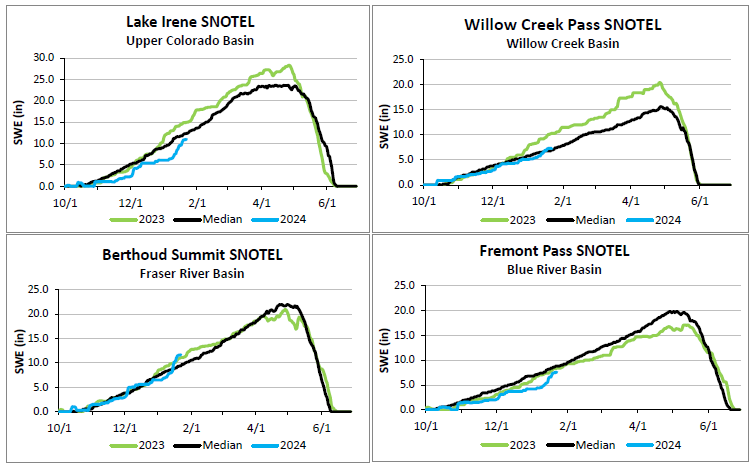
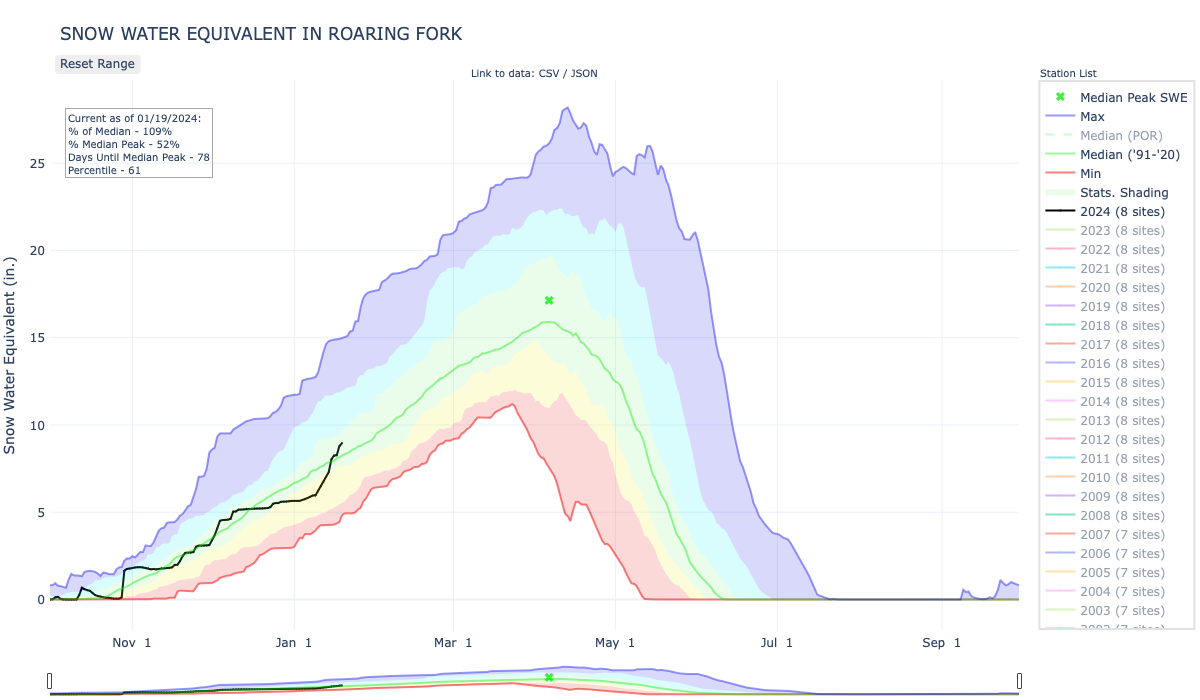
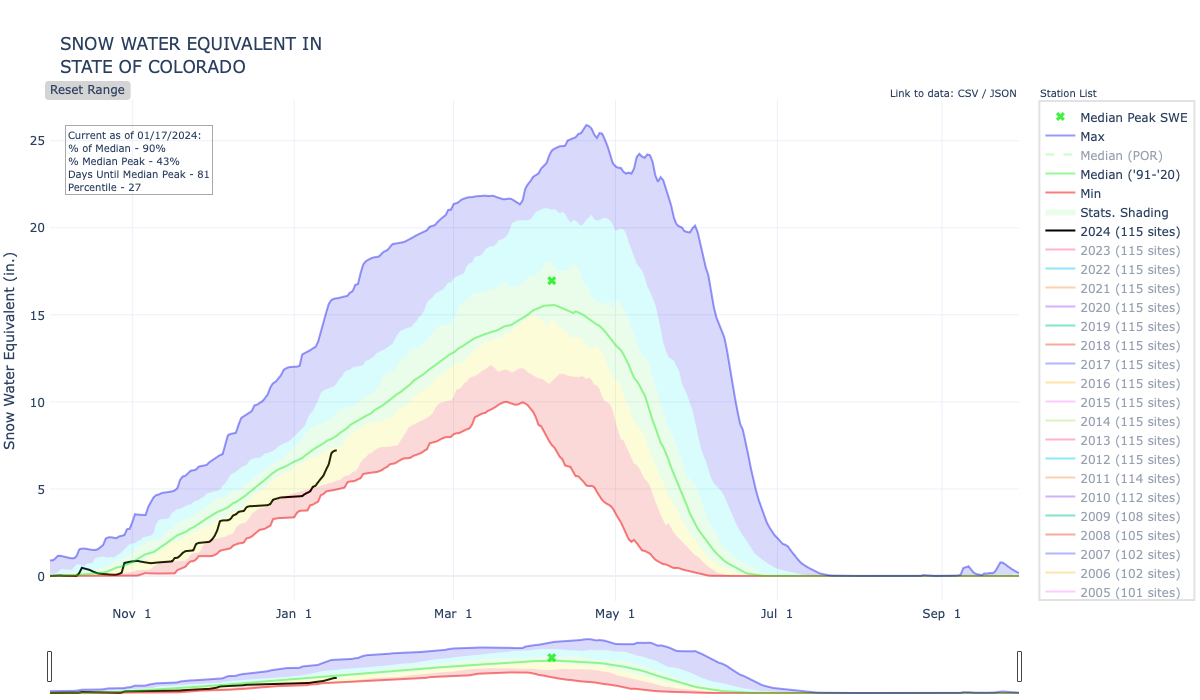
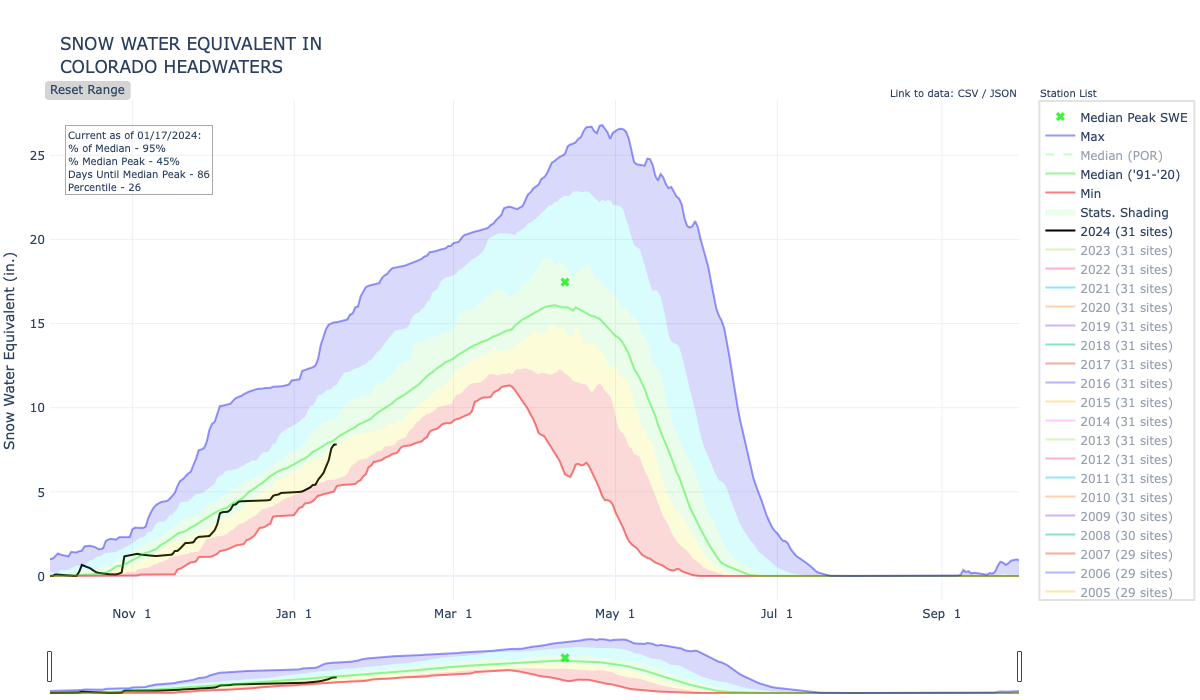
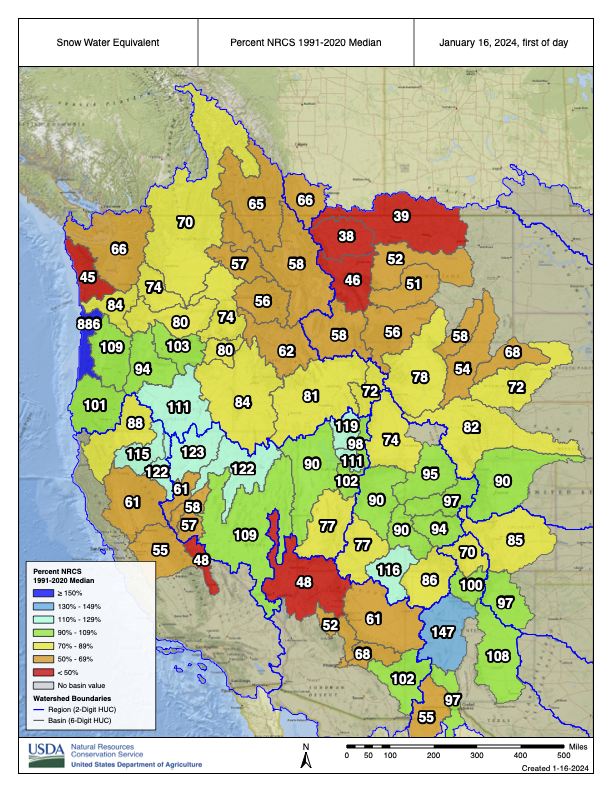
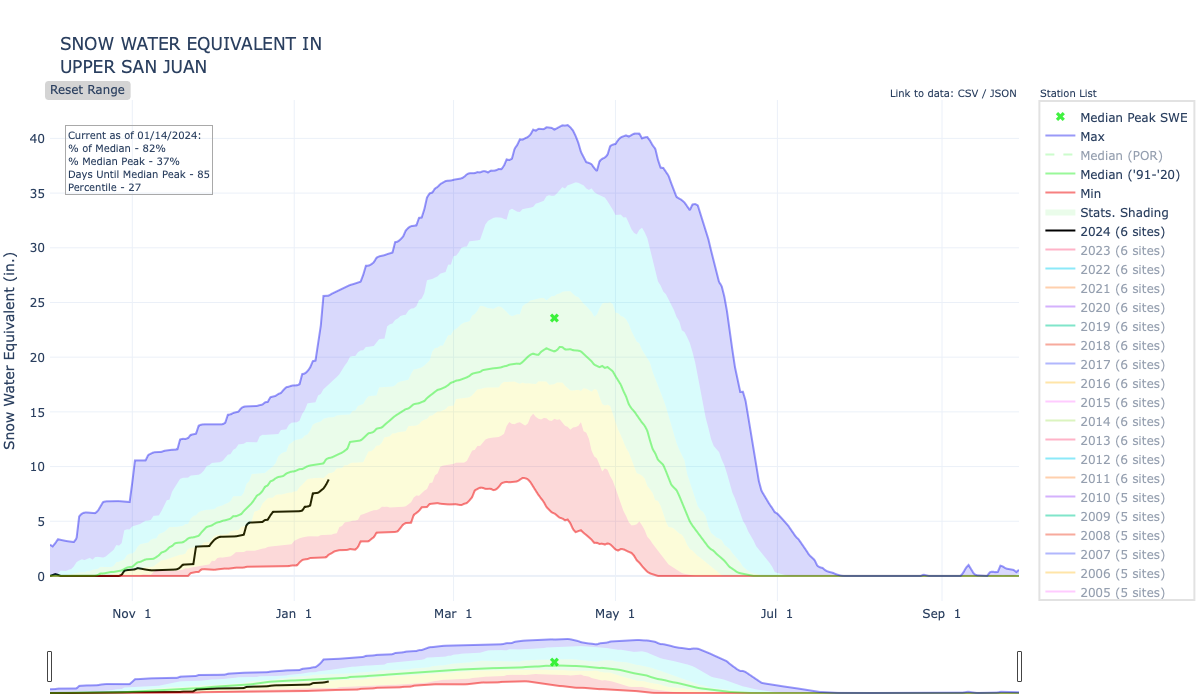
The active weather in recent weeks has greatly improved our #snowpack — @Northern_Water

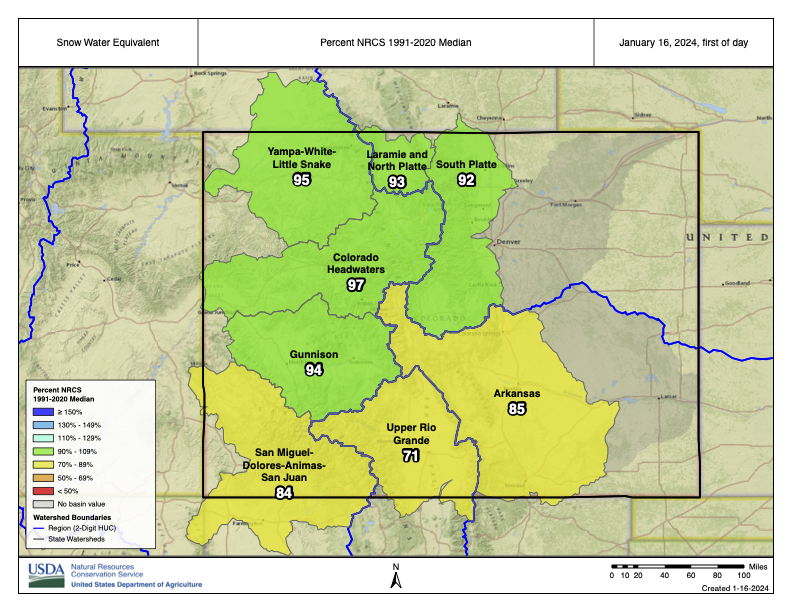
On average, both the West Slope and East Slope stations are at 100 percent of median snowpack for January 23, 2024 — @Northern_WaterA live snow report is available on our website. View the dashboard at http://northernwater.org/snowpacksummary.

Analysis: World will add enough renewables in five years to power US and Canada — Carbon Brief #ActOnClimate #KeepItInTheGround

Click the link to read the article on the Carbon Brief website (Josh Gabbatiss):

January 12, 2024

A boom in Chinese solar power construction drove another record-breaking year of renewables growth in 2023, according to the International Energy Agency (IEA).

Carbon Brief analysis of figures in the IEAโ€™s Renewables 2023 report show that the world is now on track to build enough solar, wind and other renewables over the next five years to power the equivalent of the US and Canada.

Rapid growth has also pushed the IEA to once again significantly upgrade its renewables forecast, adding an extra 728 gigawatts (GW) of capacity to a five-year estimate it made just a year ago. This is more than the electricity capacity of Germany and India combined.

The agency attributes this growth to plummeting costs of solar power and favourable policy regimes, particularly in China. New solar and onshore wind now provide cheaper electricity than new fossil fuel power plants almost everywhere, it says, as well as being cheaper than most existing fossil fuel assets.

Despite such accelerated expansion, the world is not currently on track to achieve the COP28target of tripling renewables capacity by 2030, according to the IEA.

However, it proposes various measures to further increase deployment, including more finance for developing countries.

โ€˜Step changeโ€™

Last year was a โ€œstep change for renewable power growthโ€ as the world built an extra 507GW of renewable capacity, primarily solar and wind power, according to the IEA.

This was a 49% increase on the previous yearโ€™s construction. It marked the 22nd year in a row that renewable capacity addition reached record levels.

Over the six-year period 2023-2028, an additional 3,684GW of renewables is expected to come online under the IEAโ€™s โ€œmainโ€ forecast. This is double the current total of renewable capacity installed globally.

In 2023, solar power both at utility-scale and on rooftops amounted to three-quarters of capacity additions, primarily due to growth in China. Over the next five years, 73% of the 3,174GW of new capacity will be solar, again driven largely by China. (See: China leads.)

By Carbon Briefโ€™s calculations, this 2024-2028 period is on track to see an extra 4,963 terawatt-hours (TWh) of electricity generation from renewable sources.

This amounts to one-sixth of the worldโ€™s electricity output in 2022. As the chart below shows, this is equivalent to covering the entire electricity demand of the US and Canada with newly-built renewables.

Electricity generation in 2022 (dark blue) from key fuel sources and countries, terawatt-hours (TWh). Red bars indicate estimated electricity generation from the renewables built in 2019-2023 and set to be built in 2024-2028, according to the IEAโ€™s โ€œmain caseโ€ forecast. Source: Carbon Brief analysis by Simon Evans of figures from the IEA Renewables 2023 and Renewables 2022 reports, the IEA world energy outlook 2023 and the Ember data explorer.

By 2028, the IEA forecasts that renewables will account for 42% of global electricity generation, with wind and solar power making up 25%. Despite showing no growth across this period, hydropower is still expected to be the largest single source of renewable power.

Taken together, the agency says renewables will overtake coal power as the largest source of power in โ€œearly 2025โ€. (A year ago, the agency said renewables would become the worldโ€™s largest electricity source within three years.)

One major driver of this growth is the plummeting cost of renewables, especially solar photovoltaics (PV). Spot prices for solar modules declined by almost 50% in 2023 compared to the previous year, according to the IEA.

Last year, 96% of newly installed utility-scale solar and onshore wind capacity generated cheaper electricity than new coal and gas plants, according to the IEA.

Moreover, three-quarters of new wind and solar power plants provided cheaper power than even existing fossil-fuel facilities.

The other key driver is the strong policy support that renewables enjoy in โ€œmore than 130 countriesโ€, the IEA says. It notes that โ€œpolicies remain key for attracting investment and enabling deploymentโ€, with roughly 87% of the utility-scale renewable growth between 2023 and 2028 โ€œexpected to be stimulated by policy schemesโ€.

At the same time, the report highlights the impact of the โ€œnew macroeconomic environmentโ€ on the renewables sector, with inflation and high interest rates raising costs. Offshore wind has been hardest hit, with the IEAโ€™s forecast for its growth outside China dropping by 15%.

The report also examines renewable heat consumption and the use of biofuels. Both are set to grow considerably in the coming years, but the IEA says neither are currently on track for the trajectories seen in its net-zero scenario, which aligns with the Paris Agreement.

Record revision

As a result of this growth, the IEA has again significantly raised its forecast for renewables capacity expansion, by a record amount.

It now sees an additional 728GW being built in the 2023-2027 period compared to its forecast from 2022 โ€“ a 33% increase. This is notable considering that, last year, the agency described a five-year 424GW adjustment as its โ€œlargest ever upward revisionโ€.

The chart below shows the 120GW divergence between actual renewables growth in 2023ย โ€“ some 507GWย โ€“ and the forecast for that year of 387GW, made by the IEA in 2022.

Annual additions of renewable capacity (dark blue), with forecasts from 2022 (light blue) and 2023 (dark blue). The 2023 is based on the IEAโ€™s โ€œmain caseโ€. Unlike in previous IEA reports, solar power data for all countries has been converted to direct current (DC), increasing capacity for countries reporting in alternating current (AC). The 2022 forecast data has been converted to allow comparison. Source: Carbon Brief analysis of figures from the IEA Renewables 2023 and Renewables 2022, and historical data from the IEA.

The IEA has a long history of making relatively conservative predictions for renewable growth that are subsequently outstripped by reality, due to a combination of more favourable policy conditions and faster-than-expected cost reductions.

Forecasts from previous IEA renewables reports issued in 2020 and 2021 showed annual renewable growth rates remaining fairly stable at around 200GW and 300GW per year for the following five years, respectively. 

However, these forecasts have not been included in the chart above as, for the first time, the agency has converted all of its solar power values to direct current, resulting in slightly different GW values. This means previous forecasts are not directly comparable, although the 2022 forecast figures have been converted for this purpose.

China leads

A key conclusion from the IEAโ€™s new report is the global dominance of China in deploying solar and other renewables, which is set to increase in the coming years.

In the period 2005-2010, China built 39% of the worldโ€™s new renewable energy capacity. This increased to 47% in the 2017-2022 period and the IEA expects it to rise to 59% between 2023 and 2028. This can be seen in the chart below.

By 2028, the agency estimates that nearly half of Chinaโ€™s electricity will be generated by renewables. According to Ember, as of 2022 only around 30% of Chinaโ€™s electricity was from renewables.

During this period, the nation is set to deploy four times more renewables than the EU and five times more than the US.

Total renewable electricity capacity growth across six-year periods, including the forecasted growth under the IEAโ€™s โ€œmain caseโ€ for 2023-2028. Growth in China is red and growth in the rest of the world is dark blue. Source: IEA Renewables 2023.

This growth is being driven by the nationโ€™s success in solar power manufacture and installation, according to the IEA. In โ€œalmost all provincesโ€, generation costs for new utility-scale solar and onshore wind are now lower than for coal, which is generally used as the benchmark for electricity prices, the agency says.

The IEA attributes this progress to policy measures, including power market reforms, green certificate systems and province-level financial support to support rooftop solar installation. It also points to a โ€œsupply glutโ€ that has helped solar module costs โ€œplummet drasticallyโ€.

As China accounts for 90% of the upwards revision in the IEAโ€™s forecast out to 2028, it notes that the nationโ€™s solar achievements actually โ€œhide slower progress in other countriesโ€.

There have been a number of significant supportive policy changes in other countries and regions, however. 

The US and the EU are expected to see renewable installation rates double across 2023-2028, compared to the previous six-year period โ€“ in both cases due primarily to solar expansion. The IEA attributes this to the US Inflation Reduction Act and supportive national policies โ€“ such as government renewable power auctions โ€“ across European nations.

The report also highlights the success of supportive policies in India and Brazil. It notes that while renewables are set to expand rapidly in sub-Saharan Africa โ€“ particularly South Africa โ€“ the region โ€œstill underperforms considering its resource potential and electrification needsโ€.

Tripling renewables

At COP28, nearly every government in the world agreed to a target of tripling global renewables capacity by 2030. This would bring the total to 11,000GW, which is in line with the IEAโ€™s own net-zero scenario.

As it stands, the new report concludes that under the IEAโ€™s โ€œmain caseโ€ forecast, shown in yellow in the chart below, renewable capacity would increase to 7,339GW in 2028. 

Following that trajectory, capacity would reach around 9,000GW in 2030 โ€“ roughly an increase to 2.5 times current levels.

This forecast is based on existing policies and takes into account โ€œcountry-specific challenges that hamper faster renewable energy expansionโ€, the IEA says.

By contrast, the IEAโ€™s โ€œaccelerated caseโ€ involves governments โ€œovercom[ing] these challenges and implement[ing] existing policies more quicklyโ€.

In this scenario, shown in red below, renewables growth is around 21% higher. Capacity increases to 8,130GW in 2028, putting the world on track for the tripling by 2030 target.

Global renewables capacity growth under the โ€œmain caseโ€ (yellow) and โ€œaccelerated caseโ€ (red) forecasts laid out by the IEA. The light blue bar shows the 2022 baseline on which the โ€œtripling renewables by 2030โ€ target (dark blue) is based. Source: IEA Renewables 2023.

The IEA lists a handful of broad measures that governments could take to achieve an โ€œacceleratedโ€ trajectory. 

These include: improved policy responses to the โ€œnew macroeconomic environmentโ€ such as higher inflation; more investment in grid infrastructure; and dealing with โ€œcumbersome administrative barriers and permitting procedures and social acceptance issuesโ€.

The IEA notes that โ€œthe lack of affordable financing remains the most important challenge to renewable project development in most EMDEs [emerging markets and developing economies], especially in countries where renewable policy uncertainties also increase project risk premiumsโ€.

It emphasises the need to boost financing for EMDEs to overcome this barrier. Last year, renewable growth was concentrated in just 10 nations and tripling renewables requires โ€œa much faster deployment rateโ€ฆin numerous other nationsโ€, the IEA says.

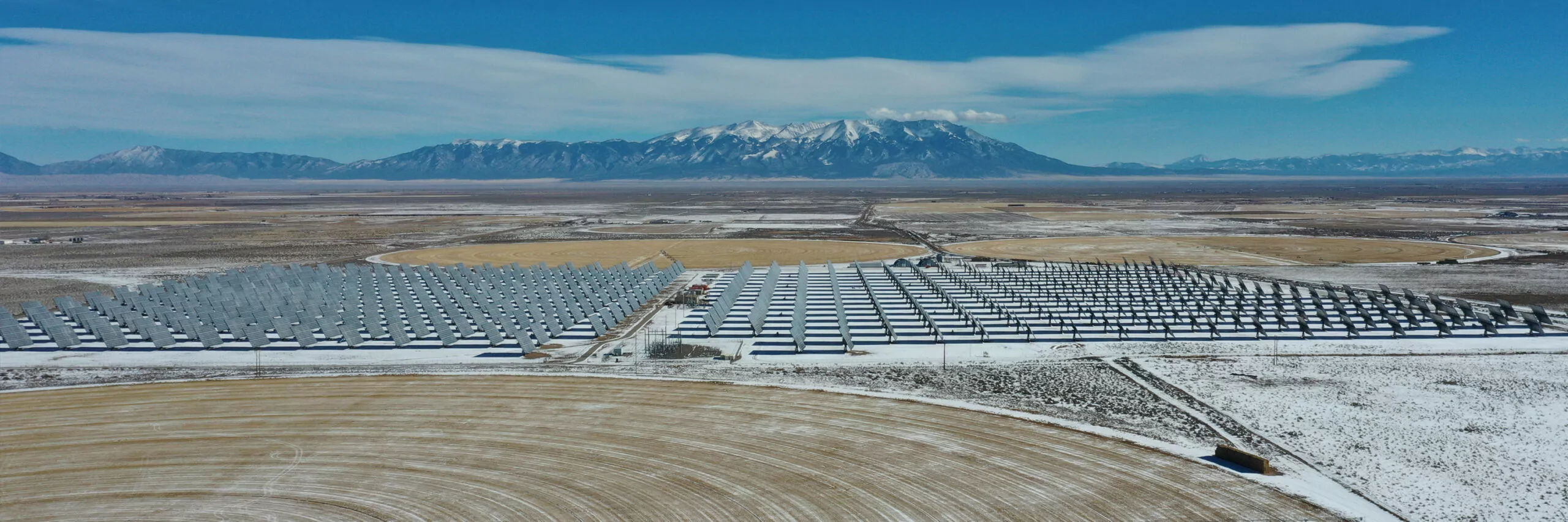
A solar farm off CO 17 in Alamosa County. Photo credit: Owen Woods/Alamosa Citizen

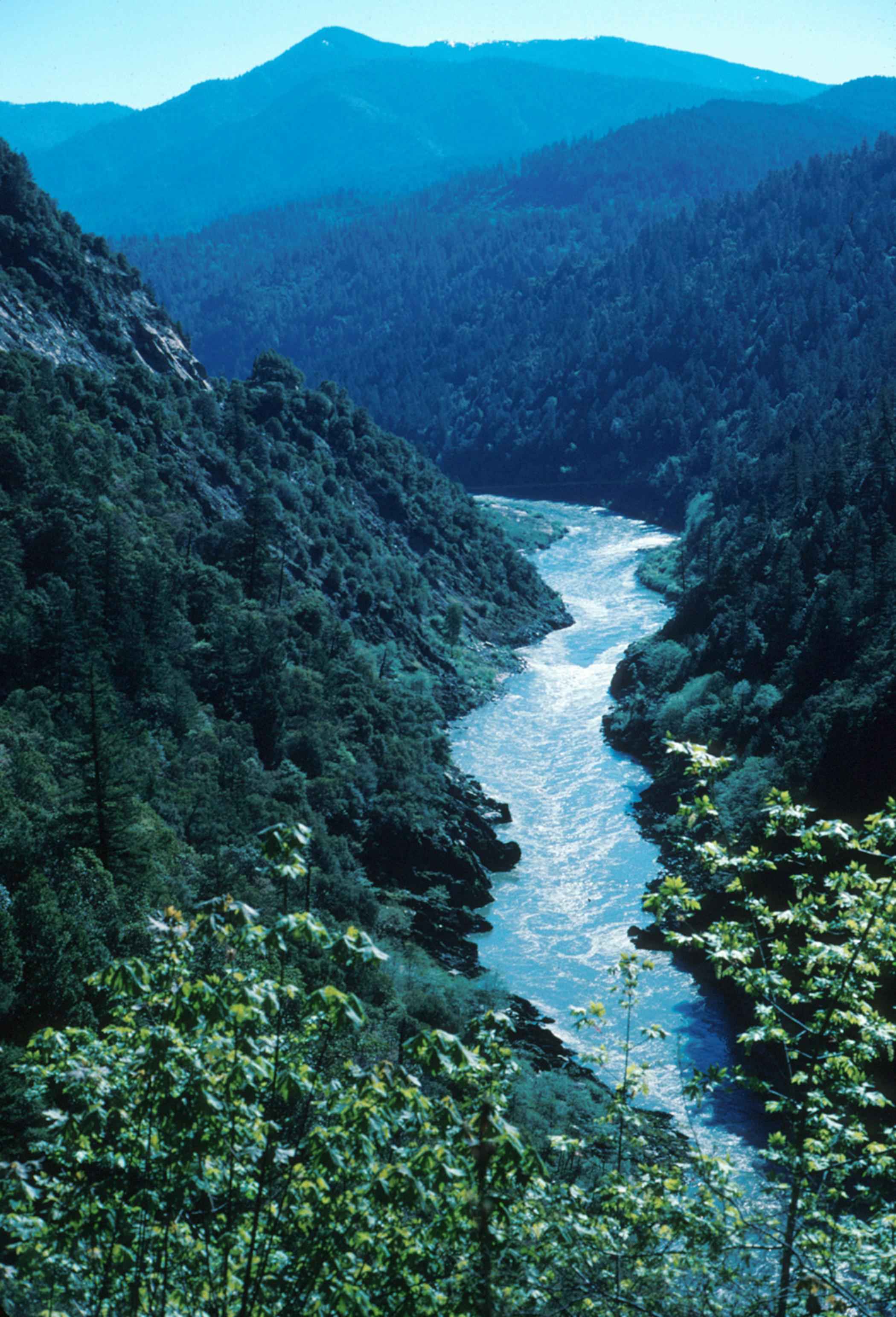
The World’s LARGEST Dam Removal: Klamath River PART 1 — Swiftwater Films #ActOnClimate #KlamathRiver

Dec 19, 2023

Embark on an exhilarating visual journey as we unveil the awe-inspiring transformation of the Klamath River over 5 months of meticulous deconstruction of Copco 2 dam. Immerse yourself in the grandeur of over 15,000 captivating images capturing the first and smallest of the four dams destined for removal by October 2024. Witness history in the making with the unveiling of the largest river restoration project ever undertaken! This mesmerizing time-lapse is just a glimpse into our ambitious 6-year independent feature film, “Undamming Klamath.” Join us as we bring this monumental river restoration story to life! This is an independent film and time-lapse project that needs your support. Tax-deductible donations through The Redford Center below:

https://www.paypal.com/donate/?hosted…

Produced by: Swiftwater Films Producer: Shane Anderson Timelapse Project Lead: Jesse Andrew Clark Timelapse Technicians: Olivia Vosburg and Jason Hartwick Project owner: Klamath River Renewal Corporation Owners rep: McMillen Deconstruction by: Kiewit Corporation Restoration Contractor: Resource Environmental Solutions Supported in part by: The Redford Center The Catena Foundation Resources Legacy Fund ยฉ SWIFTWATER FILMS LLC. UNDAMMINGKLAMATH.COM

ALL IMAGES PROPERTY OF SWIFTWATER FILMS LLC

#Coloradoโ€™s #snowpack gets boost from January snowstorms, but some regions remain in severe #drought: After dry start to winter, snowfall measured in feet raised levels closer to average — The #Denver Post

Click the link to read the article on The Denver Post website (Elise Schmelzer). Here’s an excerpt:

January 22, 2024

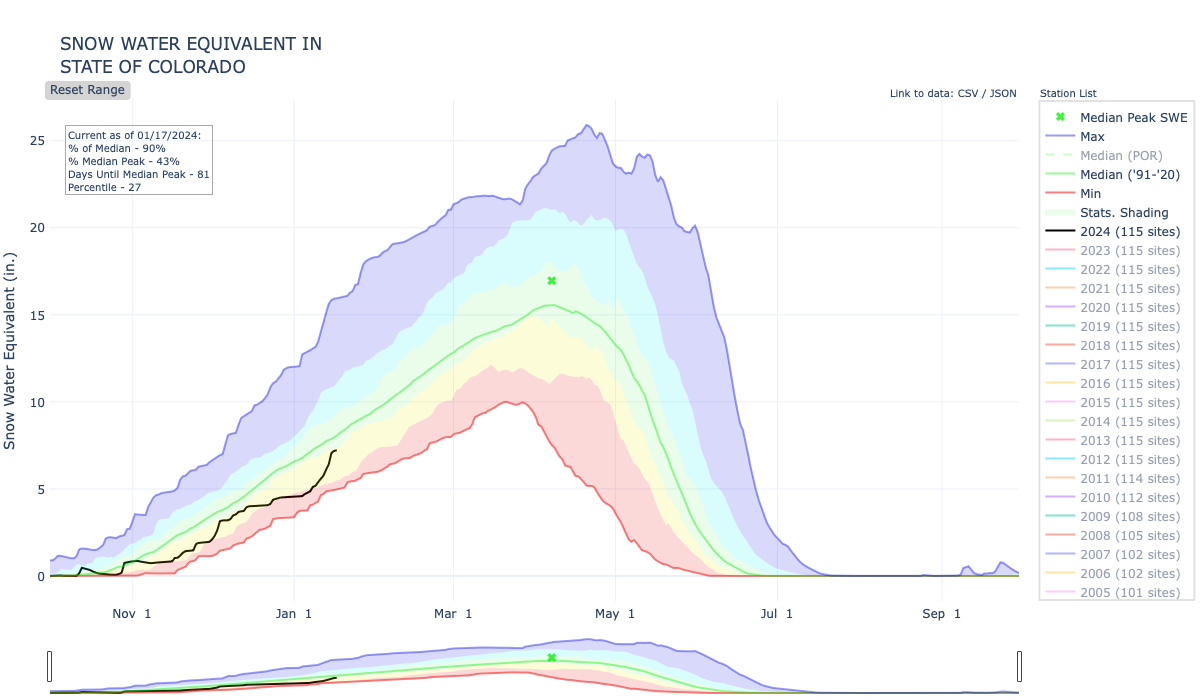
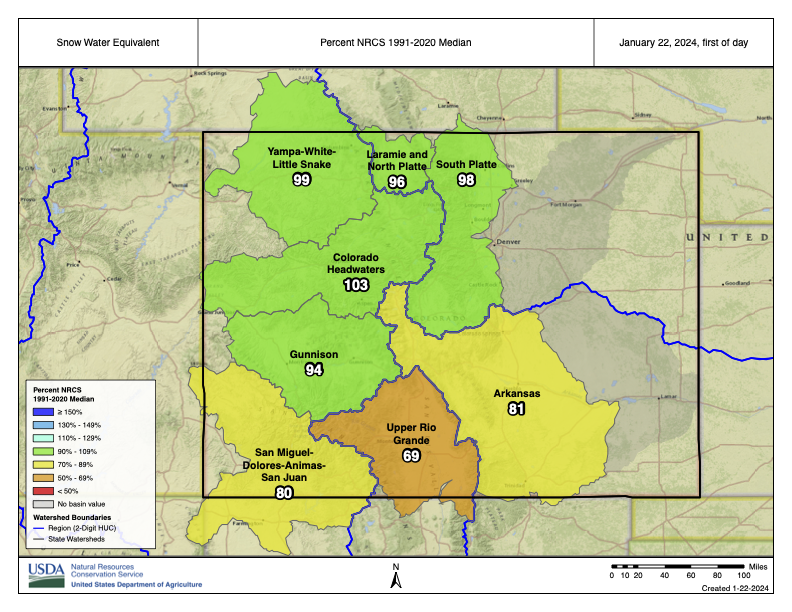
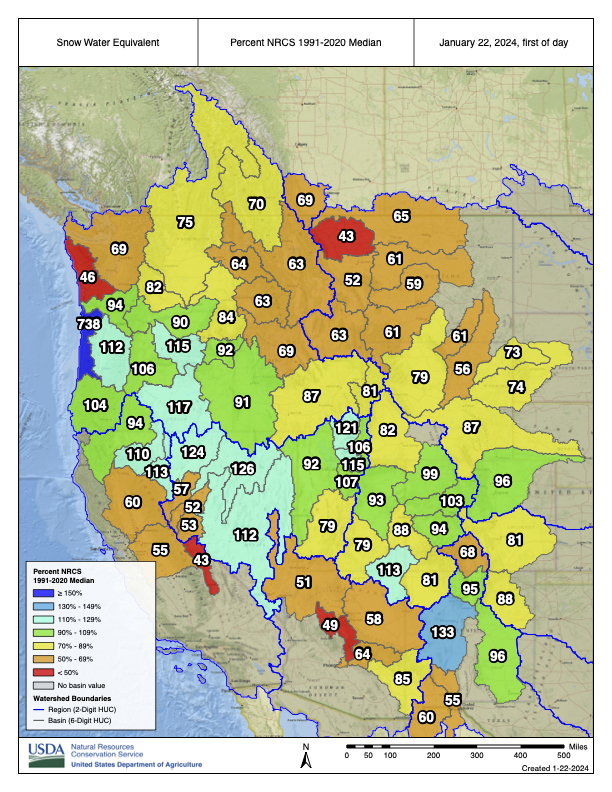
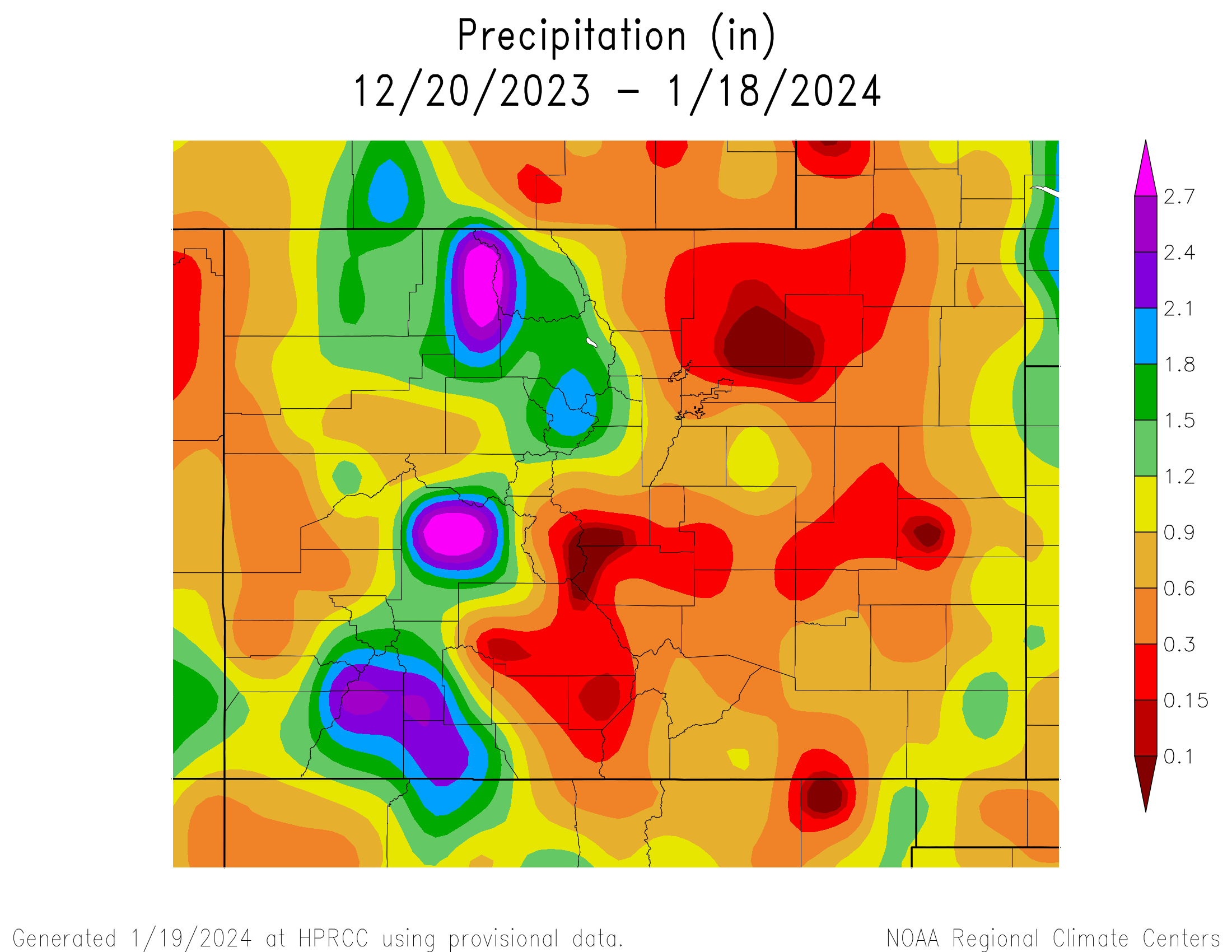
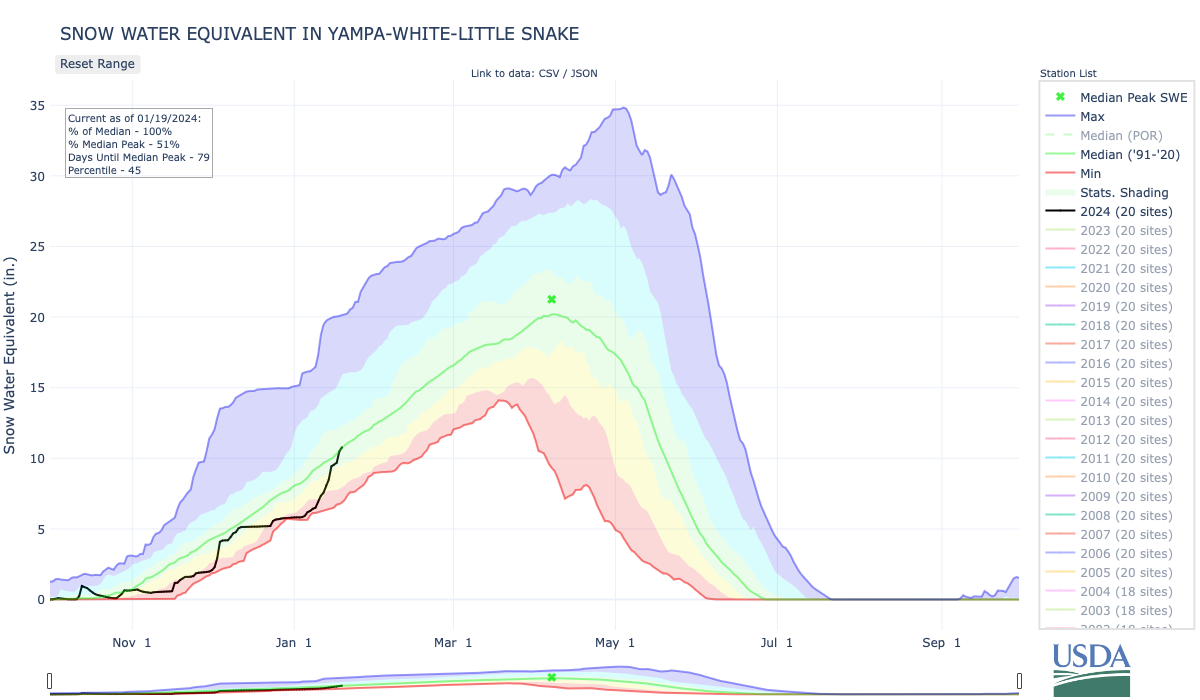
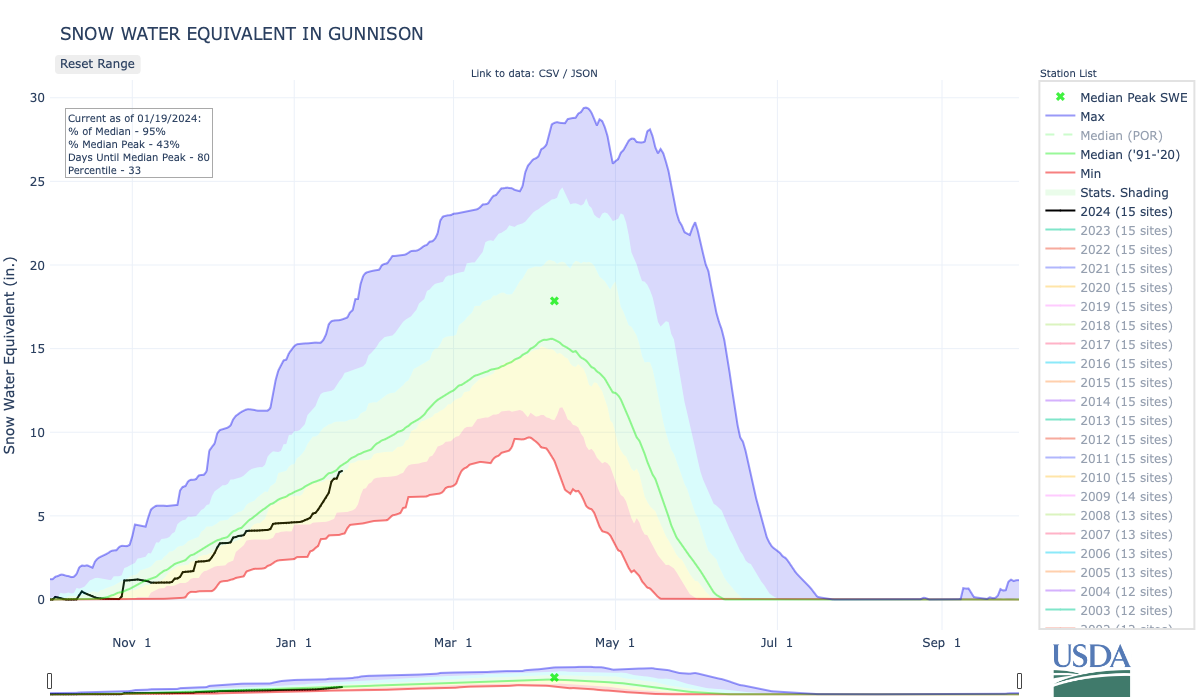
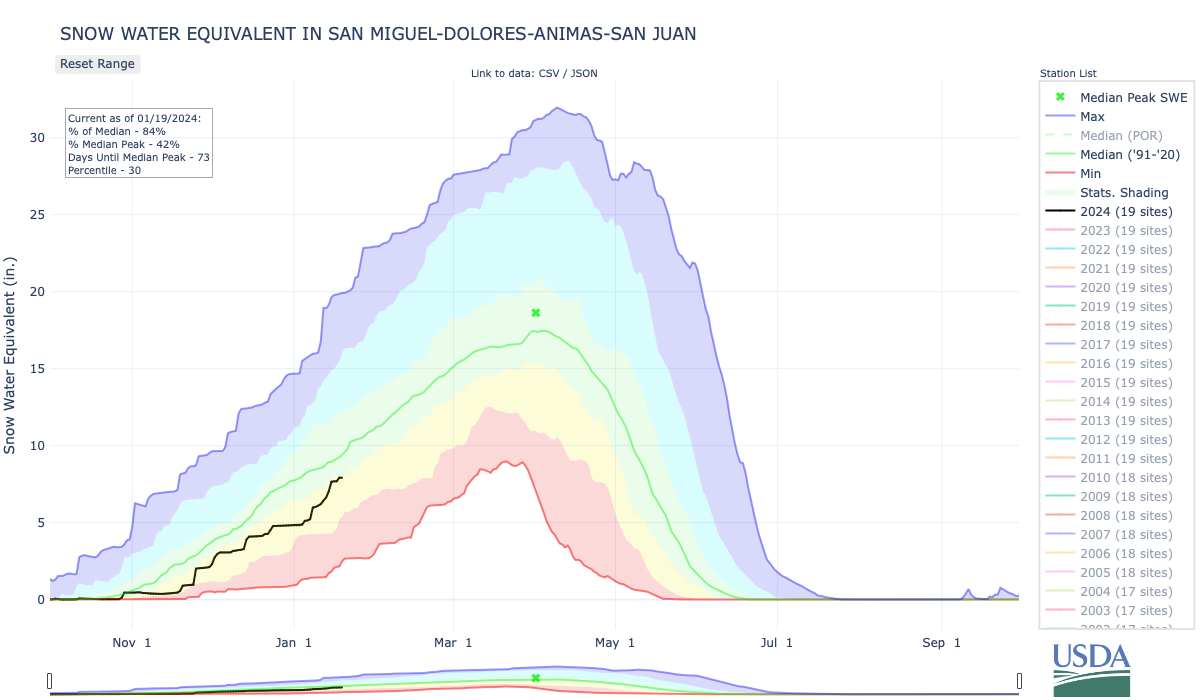
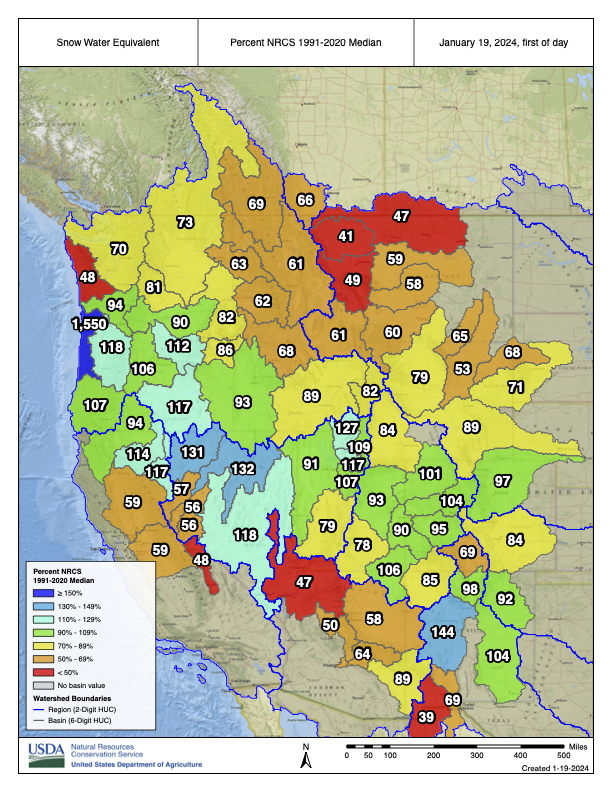
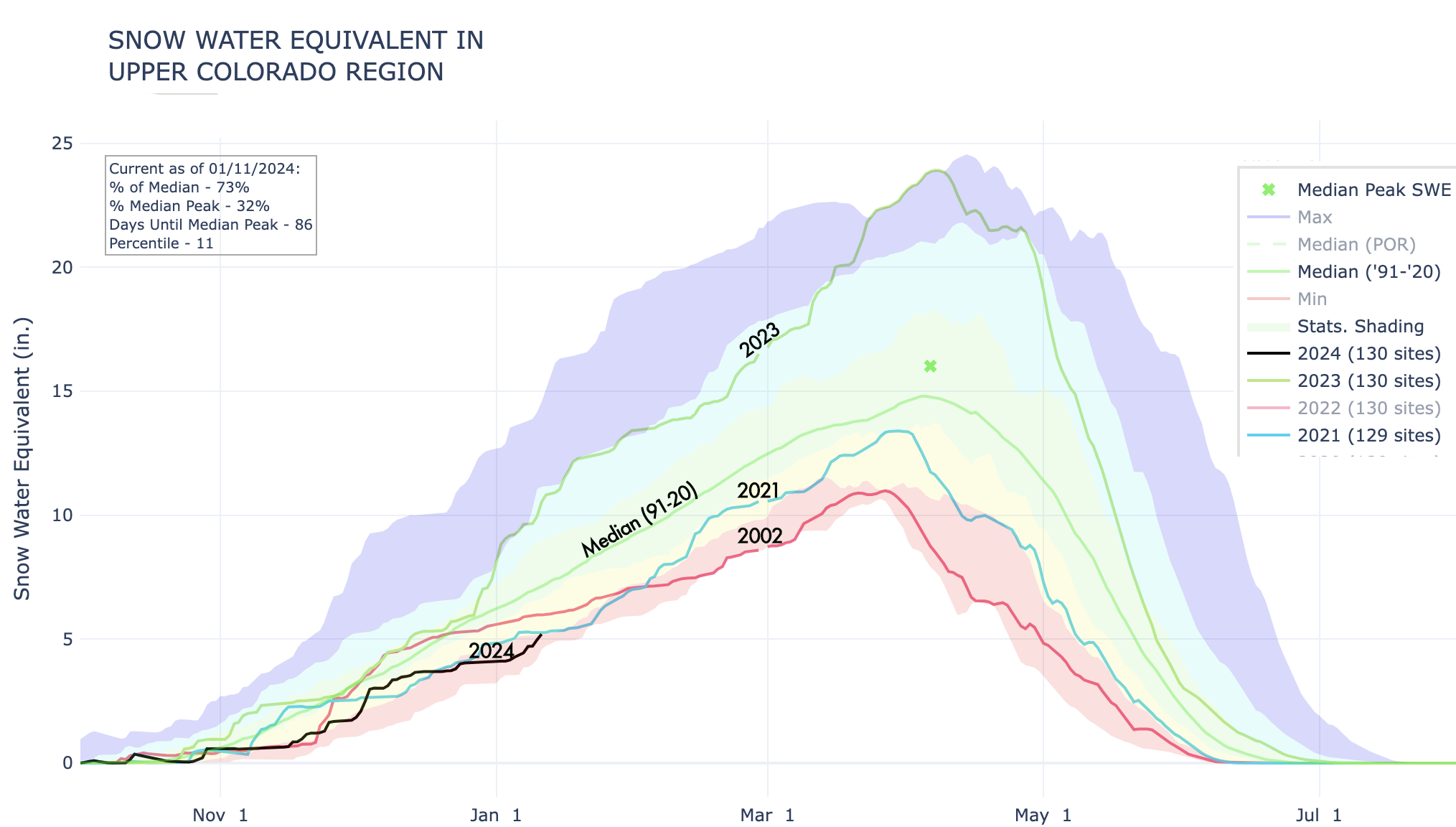
Statewide, the snowpack sat at 92% of the 30-year median on Monday,ย according to the National Water and Climate Center. Thatโ€™s a significant improvement from the beginning of January, when the snowpack was sitting at just below 70% of the median. The stormsย from Jan. 11 to Jan. 15ย dumped feet of snow on Coloradoโ€™s mountains, finallyย covering ski slopes that had been patchy with grassย and closing highways across the state.

โ€œThis was a hugely beneficial storm cycle over the last couple of weeks, both with respect to the water situation and outdoor recreation,โ€ saidย Russ Schumacher, the state climatologist and the director of the Colorado Climate Center. โ€œColorado looks a lot better than it did a couple of weeks ago.โ€

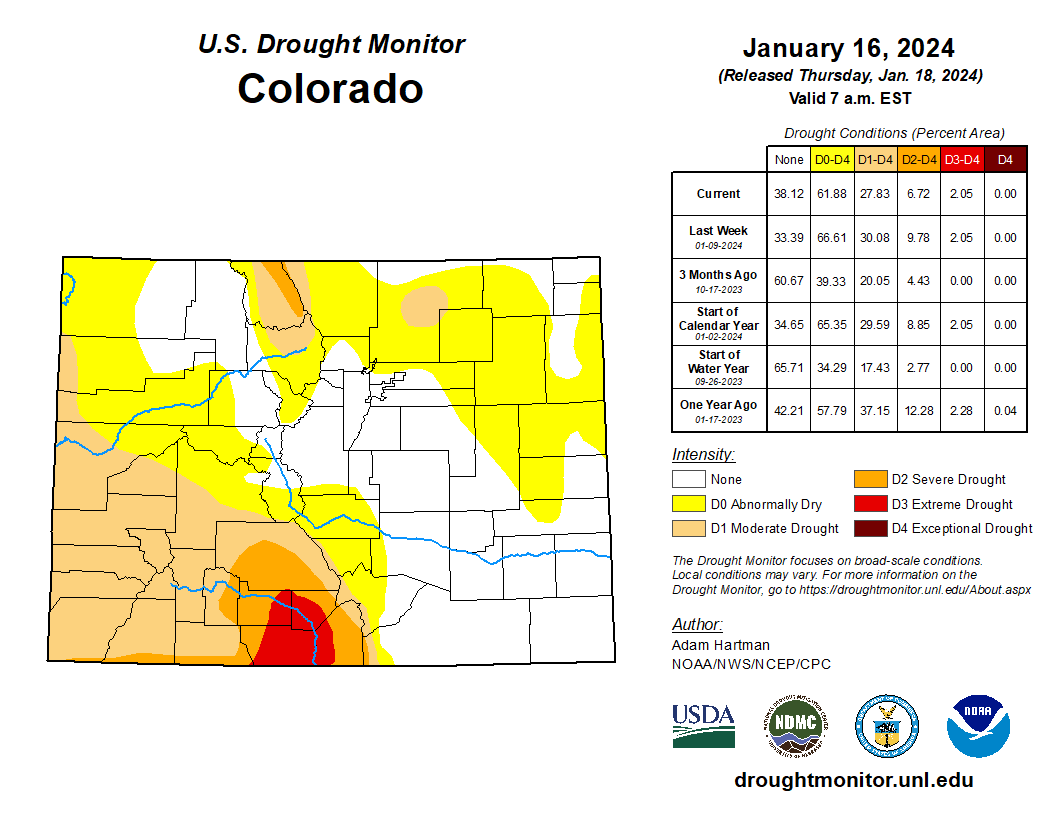
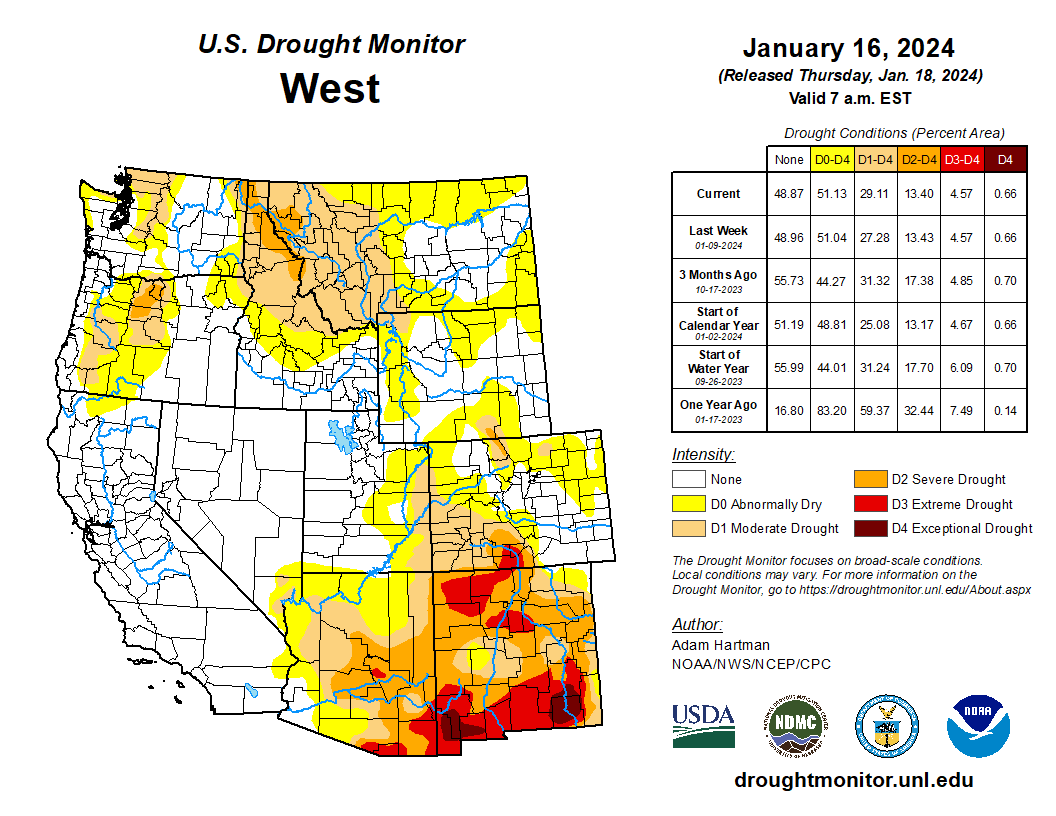
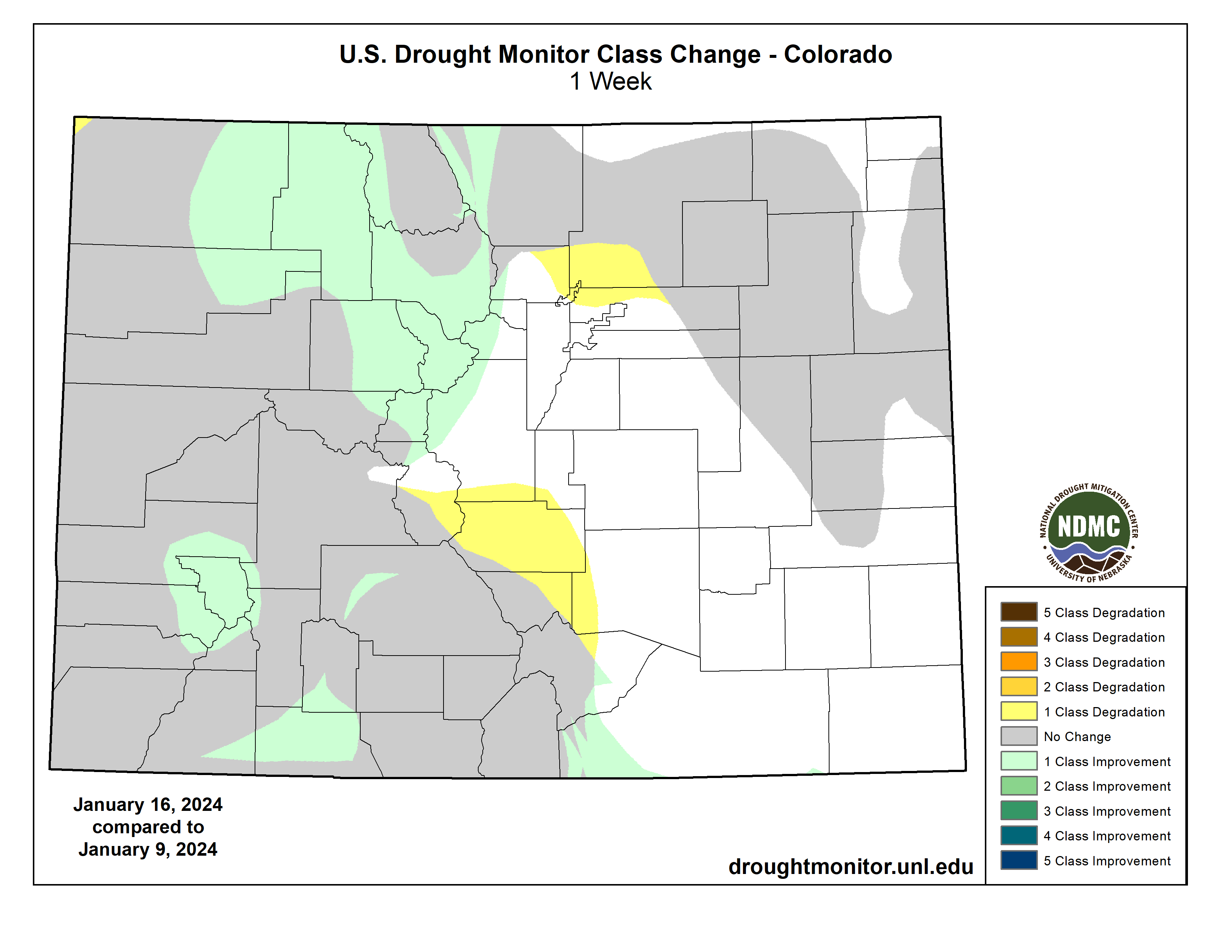
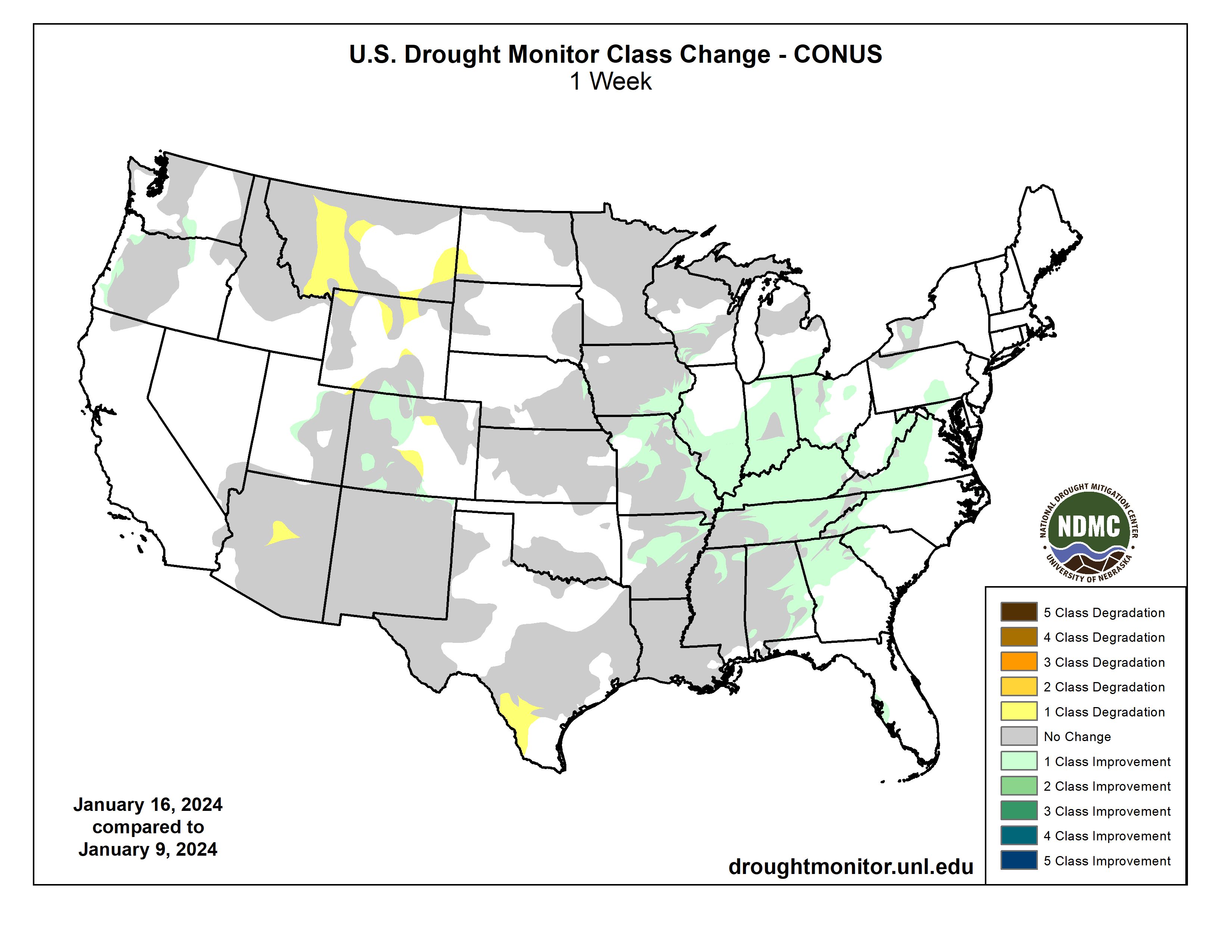
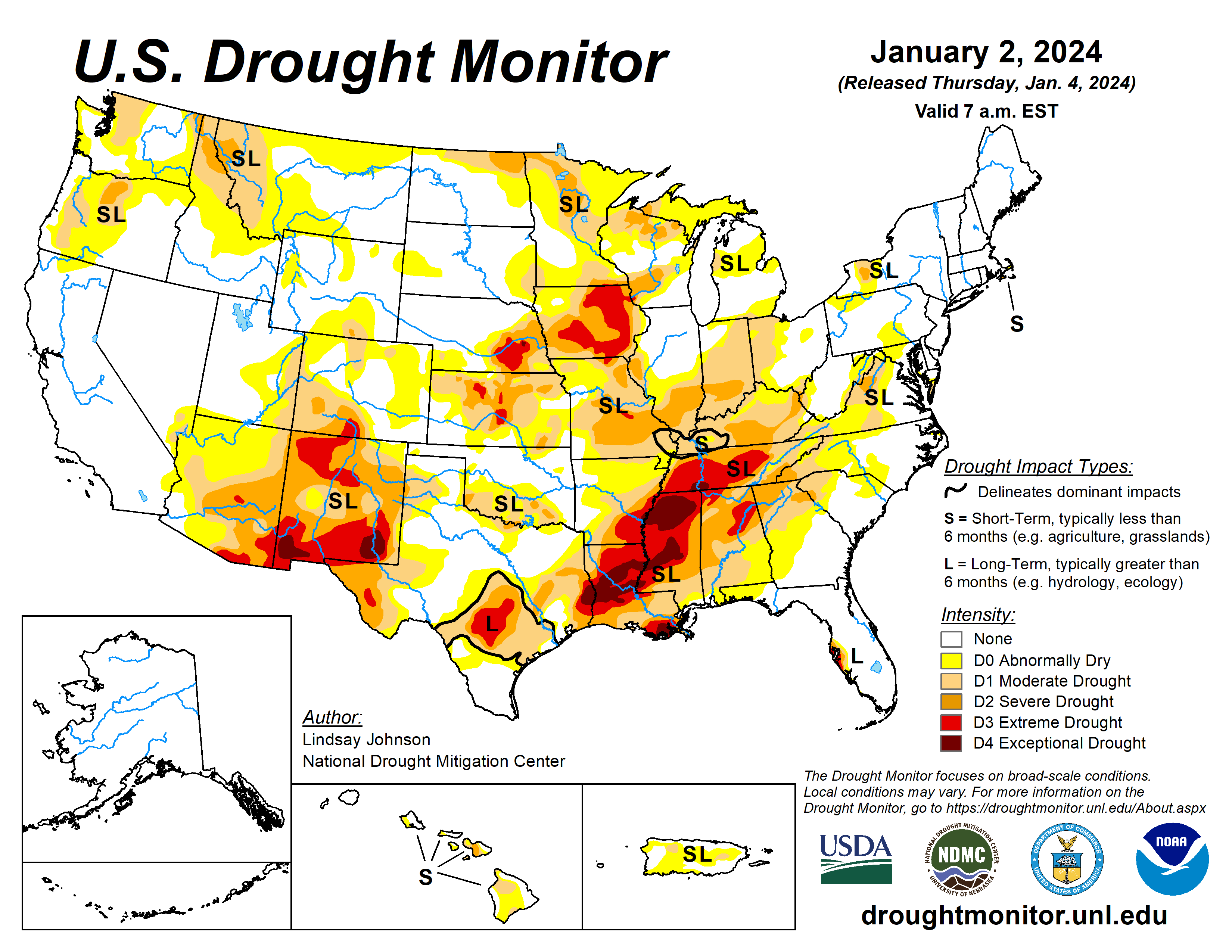
Colorado Drought Monitor map January 16, 2024.

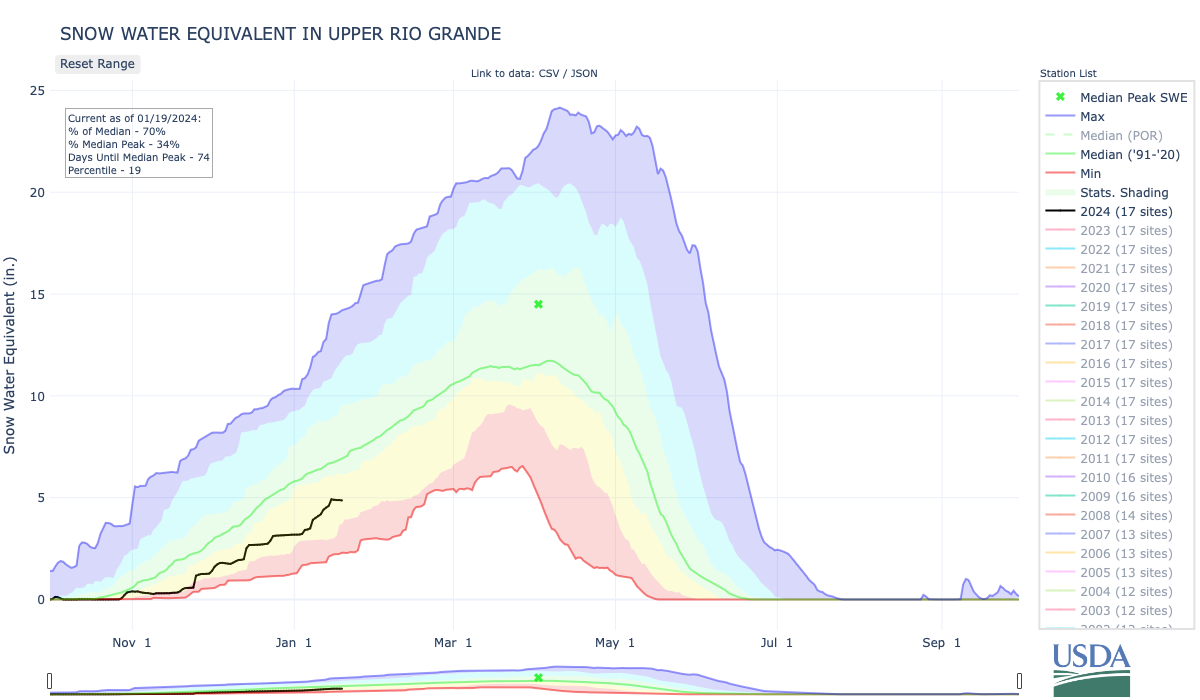
Sixty-two percent of the state was in drought last week, according to the most recent data released byย the U.S. Drought Monitor. Thatโ€™s a slight improvement from 67% before the storms…Not all areas of the state are faring the same. While the snowpack in the Yampa and South Platte river basins are sitting at 98% of median levels, the amount of snow in the Upper Rio Grande basin is at 69% and the snowpack in the San Juan basin is at 80% of median…A swath of land in southern Colorado โ€” including Conejos, Costilla, Rio Grande and Alamosa counties โ€” remained in severe or extreme drought, representing 9% of the state.

The snowpack in the Colorado River headwaters measured 99% of the median on Monday.

#SteamboatSprings officials honing in on new #YampaRiver policies — Steamboat Pilot and Today #aridification

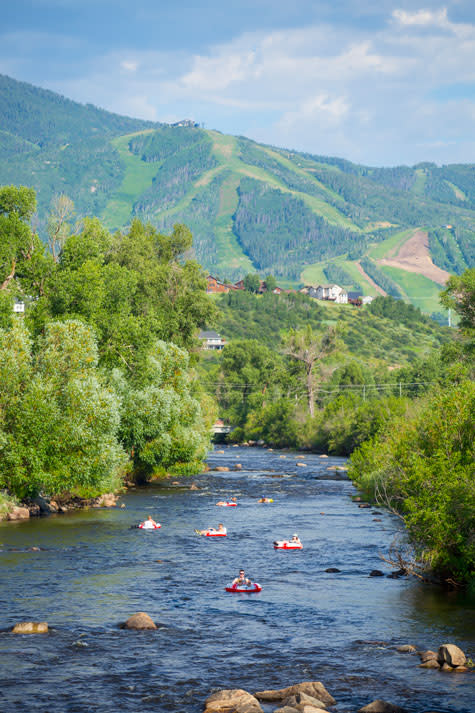
Tubing the Yampa River in Steamboat Springs. Tubing season typically begins in June and lasts through August. Conditions are reliant on the amount of snow-melt and rainfall Steamboat receives. If the water levels are too high or too low tubing will be halted. Photo credit: City of Steamboat Springs

Click the link to read the article on the Steamboat Pilot & Today website (Trevor Ballantyne). Here’s an excerpt:

January 22, 2024

A new forecasting tool to determine closing and opening procedures for the Yampa River is among a set of proposed regulations being discussed by city officials. The proposed policies are aimed at protecting โ€œthe biological integrity of the Yampa River while sustainably managing recreation,โ€ according to a report provided to council members last week. Late last year, Parks and Recreation commission members approved the use of the new tool, provided by the Carbondale-based firm Lotic Hydrological, which will set closure and reopening decisions for the Yampa River based on a framework of scientific criteria. Craig Robinson, Parks and Recreation Open Space and Trails Manager, said the current regulations for the criteria to determine river openings and closures โ€œare a little bit vague,โ€ in that they are based on a number of factors and involve consultation with Colorado Parks and Wildlife…

Outfitters and anglers licensed by the city to use the Yampa River agree the health of the riverโ€™s ecosystem is most important, but depending on their interests, they donโ€™t necessarily agree over the proposed policies. Backdoor Sports owner Pete Van De Carr noted the proposed system to close and reopen the river will likely result in less frequent but longer-term closures…

Brett Lee, the owner of Straightline Sports, provides angling tours for his customers on the Yampa River. Unlike Van De Carr, he said he welcomes the new opening and closing procedures being pitched by city staff because they will, hopefully, help mitigate the impact of tubing on the river…Adding to system for determining the opening and closing of the Yampa River, the city is also proposing new policies for licensed commercial outfitters that supply tubes and other guided services on the Yampa River. The proposed rules will require any tubes rented by outfitters or sold in the city must have a minimum 30-guage PVC thickness. If approved, they would also implement a three-year permit renewal process for outfitters and will specify that tube allocations for the outfitters are not considered as โ€œreal or personal property.โ€ Additionally, if any business owner with tube allocations sells their business โ€” and its tubing allocations โ€” the city must be notified, and the new entity must reapply to assume their allocation.

Yampa River Basin via Wikimedia.

Energy Guru Says Energy Gap Can be Bridged — Writers on the Range #ActOnClimate

Click the link to read the article on the Writers on the Range website (David Marston):

January 22, 2024

The experts tell us an energy gap looms. Fossil fuels are phasing out, and solar and wind power canโ€™t produce enough electricity to meet the demand in coming decades.

But thatโ€™s not the thinking of Amory Lovins, the 76-year-old co-founder of RMI, formerly the Rocky Mountain Institute in western Colorado.

A Harvard and Oxford dropout whoโ€™s been called the โ€œEinstein of Energy Efficiency, Lovins said recently: โ€œIf we do the right things, weโ€™ll look back and ask each other, โ€˜What was all the fuss about?โ€™โ€

Lovins became famous in the 1970s after his research told him that building more polluting coal-fired power plants was a destructive mistake. His solution then was greater efficiency and reliance on renewables, and they, he insists, are still the answer.

โ€œThough itโ€™s invisible, efficiency will cut 50% of energy use and up to 80% if we do the right things,โ€ he told me recently. โ€œMost of the energy we use is wasted, which makes it much cheaper to save it, rather than buy it or burn it.โ€

According to a recent Princeton paper, heโ€™s right: 84% of all energy consumed goes to waste during delivery or by leakage.

To prove it decades ago, he built a passive solar, super-insulated house at 7,100 feet of elevation in Old Snowmass, Colorado. It never had a heating system though winters regularly recorded 40 degrees below-zero temperatures.

When I arrived there recently at 8 a.m. it was 12 degrees F. Yet the house featured banana and papaya trees growing in natural light around a koi pond.

We became acquainted when he read my January 2023 Writers on the Range column entitled; โ€œThe energy gap nobody wants to tussle with.โ€ Iโ€™d advocated building small modular nuclear reactors to bolster the grid when the wind doesnโ€™t blow and the sun doesnโ€™t shine.

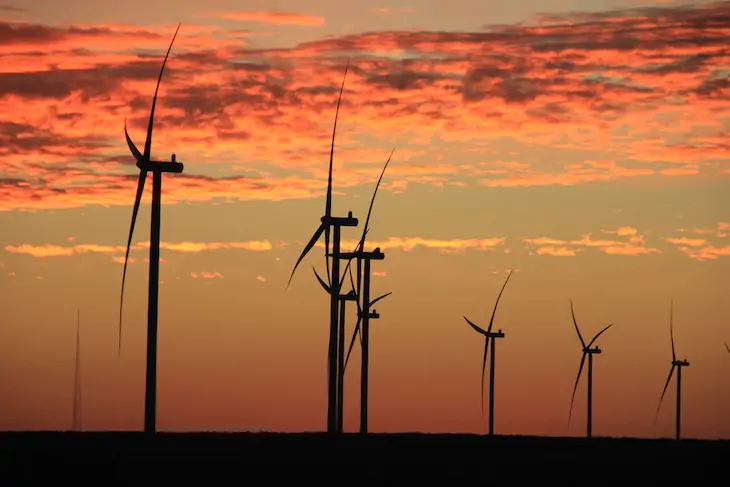
The Crossing Trails Wind Farm between Kit Carson and Seibert, about 150 miles east of Denver, has an installed capacity of 104 megawatts, which goes to Tri-State Generation and Transmission. Photo/Allen Best

Lovins became famous in the 1970s after his research told him that building more polluting coal-fired power plants was a destructive mistake. His solution then was greater efficiency and reliance on renewables, and they, he insists, are still the answer.

โ€œThough itโ€™s invisible, efficiency will cut 50% of energy use and up to 80% if we do the right things,โ€ he told me recently. โ€œMost of the energy we use is wasted, which makes it much cheaper to save it, rather than buy it or burn it.โ€

According to a recent Princeton paper, heโ€™s right: 84% of all energy consumed goes to waste during delivery or by leakage.

To prove it decades ago, he built a passive solar, super-insulated house at 7,100 feet of elevation in Old Snowmass, Colorado. It never had a heating system though winters regularly recorded 40 degrees below-zero temperatures.

When I arrived there recently at 8 a.m. it was 12 degrees F. Yet the house featured banana and papaya trees growing in natural light around a koi pond.

We became acquainted when he read my January 2023 Writers on the Range column entitled; โ€œThe energy gap nobody wants to tussle with.โ€ Iโ€™d advocated building small modular nuclear reactors to bolster the grid when the wind doesnโ€™t blow and the sun doesnโ€™t shine.

Lovins called to set me straight, and after a second conversation and more research, Iโ€™m beginning to think heโ€™s right.

Though Lovins has many solutions for the energy gap, he touts three major ways to find more energy in what we already do. Tops on the list is changing how we build and retrofit existing structures because buildings consume 75% of the electricity we buy.

Most energy jobs in the United States are already increasing efficiency, ranging from upgrading windows and other retrofits, far outpacing the shrinking fossil fuels industry. (energy.gov)

As one example, Lovins advocates โ€œoutsulationโ€ for older structures, defined as adding exterior insulating panels to save heat. Courtesy of the European Union, my Irish in-laws recently had their house โ€œwrappedโ€ and saw their heating bills plummet.

His second way is demand-response, which Lovins calls flexiwatts. An example is cycling air conditioners off for 15-30 minutes at a time, a barely noticeable adjustment that cuts demand for peaker-power plants, those big emitters of greenhouse gases. 

His third way is using renewables more effectively. Diversifying renewables by location and type within a region evens gaps from windless and cloudy weather.

Coyote Gulch’s shiny new Leaf May 13, 2023

As for electric cars being a drain on the grid, they will prove to be sources of electricity, he said, as the next generation batteries will be cheaper and likely have double the storage. Daytime solar stored in vehicles will be bi-directional, spooling out power during peak evening demand.

Lovins also cites LED lights dramatically cutting the cost of energy. In just a decade, theyโ€™ve become 30 times more efficient, 20 times brighter and 10 times cheaper.

Lovins is quick to admit that an energy gap remains, but he predicts a single-digit gapโ€”6%โ€”between what renewables produce and whatโ€™s needed. That, he said, can be made up by stored, green hydrogen or ammonia, manufactured from water and air with solar energy, and burned in existing gas plants.

As for nuclear power plants, Lovins said even the best-case scenarios for the next generation of nuclear generators are at least a decade away, and at least eight times more costly than renewables today.

โ€œItโ€™s better to use fast, cheap and certain rather than slow, costly and speculative,โ€ he said.

Though cutting loose from fossil fuels is a massive undertaking, Lovins said America is on track. โ€œWe are on or ahead of schedule on renewables, with 85% of net new additions to the grid from renewables, and $1 billion invested in solar in the United States daily.โ€

For these reasons and more, Lovins sees our energy future as more of what weโ€™re already doingโ€”only smarter and faster. [ed. emphasis mine]

Letโ€™s hope that heโ€™s right. Dave Marston is the publisher of Writers on the Range,ย writersontherange.org, an independent nonprofit that exists to spur lively dialog about the West. He lives in Durango, Colorado.

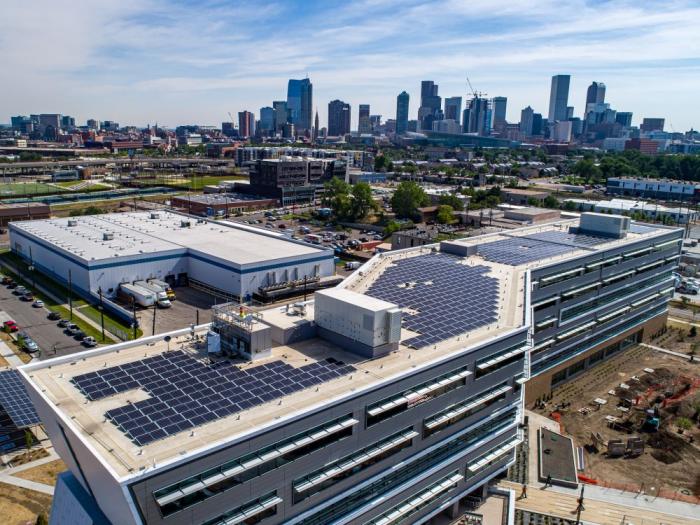
Denver Waterโ€™s administration building is powered by solar panels. Photo credit: Denver Water.

NOAA Climate Program Officeโ€™s COM Program Awards Nearly Five Hundred Thousand Dollars To Improve Precipitation Datasets

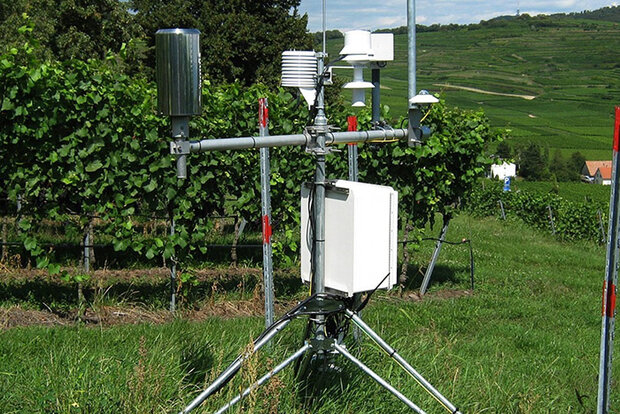
A land-based weather station that takes observations in recurring intervals. These observations are later used for data assimilation and forecasting. Credit: Pixabay

Click the link to read the release on the NOAA Website

January 4, 2024

CPOโ€™sย Climate Observations and Monitoringย (COM) program is announcing two new two-year projects in Fiscal Year 2023 (FY23) that aim to improve the research on precipitation datasets. The competitively selected projects total four hundred seventy-nine thousand dollars in grants1. These precipitation projects, chosen in response to theย Disaster Relief Supplemental Appropriations Act (DRSA)ย of 2022 and motivated byย NOAAโ€™s Precipitation Prediction Grand Challenge (PPGC)ย strategic objectives, will help improve NOAA monitoring and modeling capabilities. NOAA plays an important role in providing timely and accurate precipitation predictions to protect lives and property.

The Fifth National Climate Assessment, recently released by the U.S. Global Change Research Program, finds that climate change โ€œwill continue to cause profound changes in the water cycle, increasing the risk of flooding, drought, and degraded water supplies for both people and ecosystems. These impacts will disproportionately impact frontline communities.โ€ In 2023 (as of November 8), the U.S. has experienced 25 weather/climate disaster events with losses exceeding $1 billion, including two flooding events, 19 severe storm events, one tropical cyclone event, and one winter storm event. 

To reduce the severity of these impacts, NOAA scientists need to build new databases for precipitation information, and these projects will facilitate that work. 

The two new projects2ย funded by the COM Program in FY23 are:

  • Improving and Expanding Gridded Snowfall Analyses and Season-to-Subseasonal (S2S) Snowfall Forecastsย 
    • Snowfall is a critical resource within the hydrologic cycle of much of the continental United States (CONUS), especially in western states. Given this status, it is important to accurately quantify snowfall to maximize its benefits when it is abundant, and enable mitigation activities when it is lacking. This project will focus on the role of Snow-to-Liquid Ratio in analysis and forecasting by developing an improved methodology for a gridded snowfall product in the CONUS. This methodology will be then applied to create a novel gridded snowfall product for Alaska. The project will also produce a series of research-guided recommendations to produce S2S snowfall forecasts using output from the Unified Forecast System.
    • PI: Andrew Rosenow, University of Oklahomaย 
    • CoPI: Peter Veals, University of Utahย 
  • Developing Long-term High resolution precipitation dataset using deep learning with multi-source Earth System Data
    • The development of accurate, high-resolution gridded precipitation datasets over a long period of time is crucial for climate monitoring and forecasting. Although useful, current datasets exhibit great discrepancies and have different strengths and weaknesses. This project will develop an improved long-term high-resolution precipitation dataset over CONUS using machine learning techniques. It will integrate radar observations, gauge-based precipitation analysis data, climate reanalysis data, and satellite-based cloud data.
    • PI: Di Tian, Auburn University

1The funding will be distributed over the life of the projects and future-year funding is conditional on appropriations.

2At the time of publication, all awards may not have been accepted by recipient institutions 

Fremont County residents face exploratory uranium drilling โ€œright in the front yard of the communityโ€ — The #Denver Post #ArkansasRiver

Pictorial representation of the In situ uranium mining process. Graphic credit: (source: Heathgate Resources)

Click the link to read the article on The Denver Post website (Elise Schmelzer). Here’s an excerpt:

[Marijane] Sisson is among many residents of South T Bar Ranch alarmed by an Australian companyโ€™s plans to drill in the subdivision as a way to learn more about the uranium deposits beneath it. An appeal by a homeowner to stop the prospecting failed last week, allowingย Global Uranium and Enrichmentย to proceed. It could drill as many as 20 holes in the area this year. While original homeowners in the community owned some of the mineral rights and knew drilling was a possibility, the plans caught others by surprise, said Skip Blades, who owns three parcels in South T Bar Ranch. He appealed the companyโ€™s plans…

The drilling by Global Uranium and Enrichment, previously known as Okapi Resources, comes as prices for the radioactive elementย soar. Theyย reached a 16-year highย Monday as global supplies tighten and demand for nuclear power rises โ€” and as alternatives to oil and gas energy become more appealing. The market shift has spurred the opening of new uranium mines in the United Statesย for the first time in eight yearsย โ€” including three in the Mountain West.

The company plans to drill over a 60-day period between May and December. The goal is to extract samples of the rock and minerals for further study. Crews will work 24/7 to drill 5-inch-diameter holes 700 feet into the ground to collect the samples, according to the companyโ€™s application for aย Colorado Division of Reclamation, Mining and Safetypermit. Each hole will require a drill pad area of 6,400 square feet, cleared of grass and rocks, and will remain open for about six days. After the samples are extracted, the company will fill and cover the holes. More than 1,400 such holes have been drilled in the vicinity as different companies have come and gone…

Blades and Sisson worry the drilling could disrupt wildlife and contaminate their water supply. The drills will push through underground aquifers. Some of the drilling will occur near Tallahassee Creek, which feeds into the Arkansas River. Company representatives and staff from the Division of Reclamation, Mining and Safety said water contamination was unlikely. Company representatives also said they would comply with wildlife officialsโ€™ recommendations to mitigate harm to wildlife and would try to minimize disturbances to the neighborhood. In a written response to Bladesโ€™ formal complaint, a company representative said the drill areas would quickly revegetate. The company also said it would point lights toward the ground at night to minimize light pollution, adding that noise from the drill to be used โ€œis relatively muted when compared to other drills.โ€

SB-28 (#Groundwater Compact Compliance Fund) accounting: Almost entire $30M to retire wells is spent — @AlamosaCitizen #RioGrande

Photo credit: The Alamosa Citizen

Click the link to read the article on the Alamosa Citizen website:

January 21, 2024

Fund will retire approximately 11,296 acre-feet of water

When Colorado Senate Bill 28 was adopted during the 2022 legislative session, it created the Groundwater Compact Compliance Fund with $30 million earmarked for irrigators in the Upper Rio Grande Basin.

The state money derived from Coloradoโ€™s share of federal COVID dollars that came through the American Rescue Plan Act would serve to incentivize local farmers to permanently retire more groundwater wells. Doing so would further reduce groundwater pumping and translate to fewer irrigated acres in the Valley as a whole.ย 

Seven months after opening applications to the fund, the Rio Grande Water Conservation District has enough contracts to spend nearly the entirety of the $30 million. The contracts represent the full retirement of approximately 34 crop circles and partial restrictions on 28 circles, according to an accounting from the Rio Grande Water Conservation District. 

When itโ€™s all said and done, the $30 million will have paid for the retirement of approximately 11,296 acre-feet of water. An acre-foot represents around 326,000 gallons, or enough water to cover an acre of land.

Each application submitted to the Groundwater Compact Compliance Fund was reviewed by the Rio Grande Water Conservation District and Colorado Division of Water Resources. So far six applications representing $4,772,204 have been closed and the RGWCD now owns those water rights, according to deputy general manager Amber Pacheco.

The remaining applications have to be approved or rejected by March 31.

Republican River Basin. By Kansas Department of Agriculture – Kansas Department of Agriculture, Public Domain, https://commons.wikimedia.org/w/index.php?curid=7123610

The senate bill also directed $30 million to sustainability efforts on the Republican River Basin in the eastern plains. Like the Rio Grande Water Conservation District, the Republican River Water Conservation District has been successful in administering the program, Pacheco said.

โ€œWeโ€™ve been pretty successful,โ€ she said at the Jan. 16 board meeting of the Rio Grande Water Conservation District. โ€œItโ€™s pretty shocking that in six months that amount of money was obligated.โ€

A small amount of funding will likely remain after current applications are all reviewed, Pacheco said.

The RGWCD received a total of 27 applications. Hereโ€™s a breakdown of applications by subdistrict. The applications represent 11,296 acre-feet of past annual withdrawals that would be retired.

Applications total approximately $29,000,000

14 applications in Subdistrict 1* โ€“  $11,700,000
2 applications in Subdistrict 3* โ€“ $1,200,000
1 application in Subdistrict 4 โ€“ $500,000
4 applications in Subdistrict 5 โ€“ $5,100,000
2 applications in Subdistrict 6 โ€“ $1,300,000
4 applications in Subdistrict 7 (Trinchera Subdistrict) โ€“ $9,300,000

*SD1 and SD3 both offered some type of incentive on top of the SB28 program.

Rio Grande and Pecos River basins. Map credit: By Kmusser – Own work, Elevation data from SRTM, drainage basin from GTOPO [1], U.S. stream from the National Atlas [2], all other features from Vector Map., CC BY-SA 3.0, https://commons.wikimedia.org/w/index.php?curid=11218868

#Snowpack still below average peak levels — The Alamosa Citizen #RioGrande

Click the link to read the article on the Alamosa Citizen website (Chris Lopez):

January 20, 2024

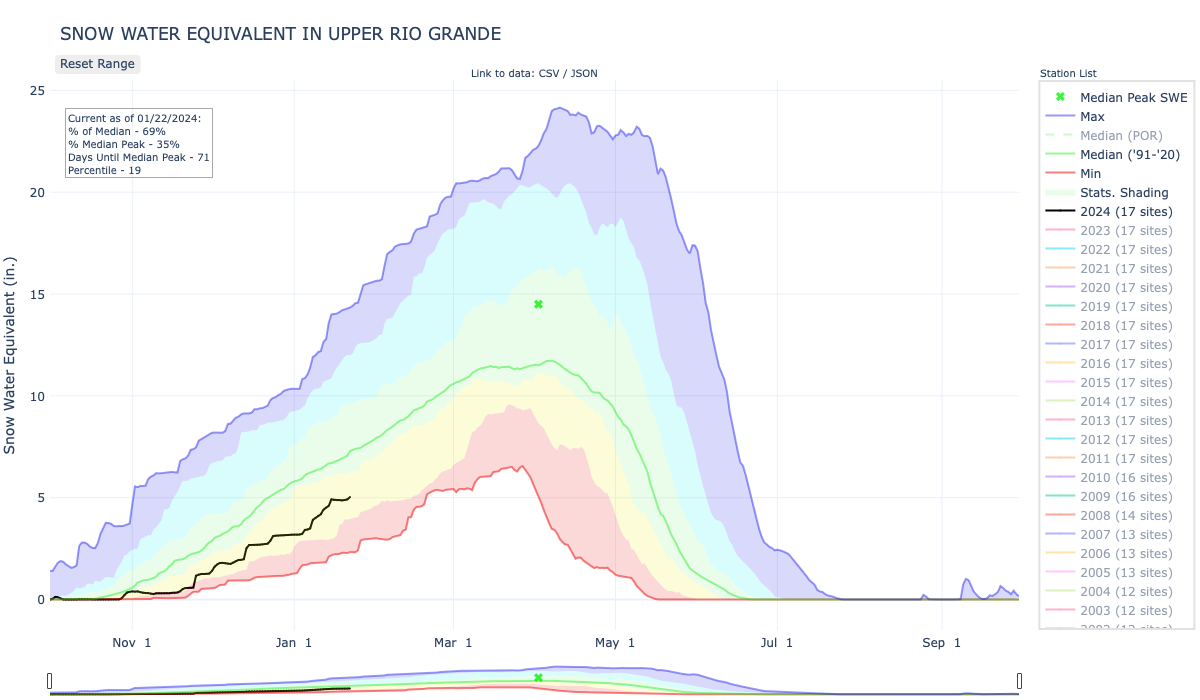
Current levels are at 71 percent of normal for the Rio Grande Basin

The Rio Grande Basin has about another 70 days to get itself up to average peak levels for snowpack that would deliver a normal spring runoff year for San Luis Valley irrigators in 2024. Water from melting snow in the surrounding mountain ranges also irrigates farm fields in New Mexico and Texas through the Rio Grande Compact. 

The snowpack levels and corresponding 2023 spring runoff was the focus of a presentation at the Rio Grande Water Conservation Districtโ€™s quarterly meeting held on Tuesday, Jan. 16. Craig Cotten, Division 3 engineer for the Colorado Division of Water Resources, walked water managers through a series of slides showing the conditions of rivers and creeks all critical to Valleyโ€™s agricultural economy as well as Coloradoโ€™s ability to deliver water to the New Mexico state line for Rio Grande Compact obligations.

Rio Grande and Conejos River

These charts represent the two river systems tied to the Rio Grande Compact and the effect on stream flows from snow runoff during the spring of 2023. The winter of 2022-23 translated into significantly above-average runoff for several months and then by the first of July a drop in streamflows to below average on the Rio Grande and right at average to below on the Conejos River. 

Itโ€™s the Rio Grande and Conejos that form theย Rio Grande Compactย between the states of Colorado, New Mexico and Texas. The annual spring runoff determines how much water Colorado delivers to the New Mexico state line to fulfill its compact obligation. From the 2023 runoff Colorado delivered 29 percent of the streamflow or 208,000 acre-feet of water from the Rio Grande, and 47 percent or around 200,000 acre-feet from the Conejos River.

Los Pinos River near Ortiz

Los Pinos is the main contributor to the San Antonio River, which is a main tributary to the Conejos. Los Pinos had significant above-average runoff that resulted in some flooding on the lower end of the San Antonio in the spring of 2023. With its tributaries, the Conejos River had 411,000 acre-feet or 137 percent of its long-term average in 2023. Again, 47 percent of that water had to be delivered to the New Mexico state line to meet Coloradoโ€™s Rio Grande Compact obligations.

Saguache Creek near Saguache

Saguache Creek forms from runoff coming off the San Juan Mountains. It had above-average spring streamflows like others, and ended up below-average when the normal summer rains did not materialize in 2023.

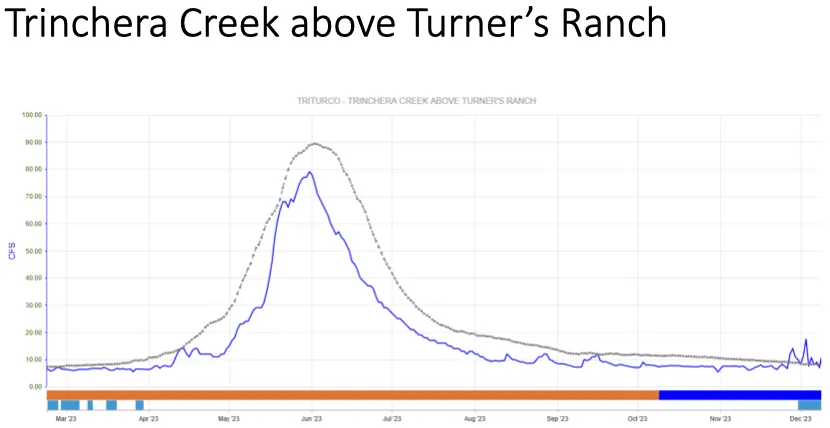
Trinchera Creek above Turnerโ€™s Ranch

Trinchera Creek presented the biggest challenges for irrigators in 2023 due to less snow on the Sangre de Cristos than on the San Juans. Trinchera Creek was significantly below average for most of the irrigation season.

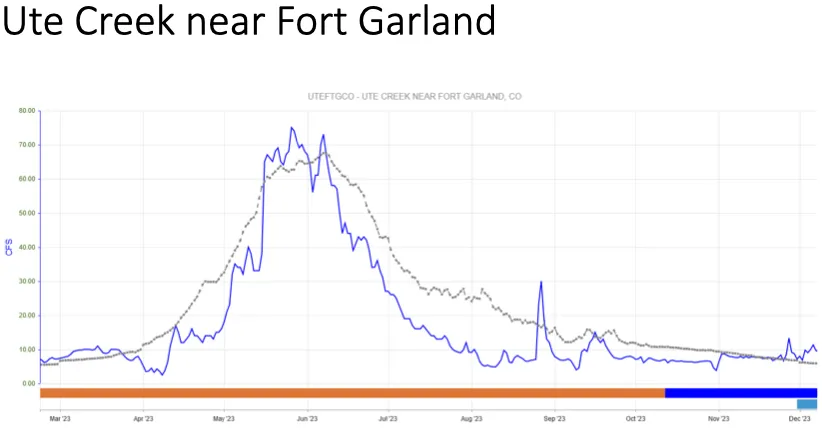
Ute Creek near Fort Garland

Ute Creek too forms from the Sangres. Unlike the Trinchera Creek, it got to average and a bit above for the peak of the 2023 spring runoff and then dropped to below-average streamflows for the year.

Alamosa Creek above Terrace Reservoir

The highlight of the heavy snow from 2022-23 and the corresponding spring runoff was the spilling of Terrace Reservoir for the first time in 40 years. โ€œThat was really neat to see,โ€ Cotten said.

Spring and summer 2024 forecasts

Looking to the 2024 spring runoff, current snowpack levels are at 71 percent of normal for the Rio Grande Basin and the lowest for any basin in Colorado by a significant amount. โ€œWe do still have some time to get up that average,โ€ Cotten said. โ€œIf we can get some good snowstorms coming our way, hopefully weโ€™ll be in decent shape for this year.โ€

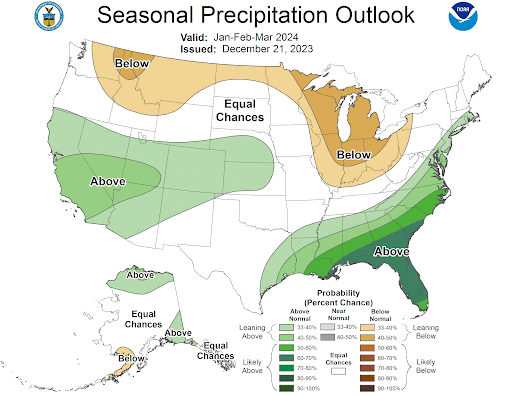
Precipitation outlook through March shows potential for more snow that would help build up the snowpack for spring water. The spring months show an equal chance for precipitation and then below-average forecasts for the summer months. The temperature forecasts for the summer do not predict the same type of record-setting heat as the summer of 2023.

Are We Headed for the First #ColoradoRiver Compact Tripwire? — Eric Kuhn and John Fleck (InkStain.net) #COriver #aridification #CRWUA2023

Colorado River “Beginnings”. Photo: Brent Gardner-Smith/Aspen Journalism

Click the link to read the article on the Inkstain website (John Fleck):

The Bureau of Reclamationโ€™s January 2024 โ€œMost Probableโ€ 24-month study forecasts that annual releases from Glen Canyon Dam for both Water Years 2025 and 2026 will be 7.48 million acre-feet per year (maf). If this happens, the ten-year total flow at Lee Ferry for the 2017-2026 period will drop to about 83.0 maf, only about 500,000 acre-feet above 82.5 million acre-feet, the first 1922 Compact hydrology โ€œtripwire.โ€

That line โ€“ 82.5 maf feet of Lee Ferry deliveries over a ten year period โ€“ has become a dividing line between two contending interpretations of the most important unresolved question in the century-old Colorado River Compact: How much water must the Upper Basin deliver to the Lower Basin? What happens if it doesnโ€™t?

September 21, 1923, 9:00 a.m. — Colorado River at Lees Ferry. From right bank on line with Klohr’s house and gage house. Old “Dugway” or inclined gage shows to left of gage house. Gage height 11.05′, discharge 27,000 cfs. Lens 16, time =1/25, camera supported. Photo by G.C. Stevens of the USGS. Source: 1921-1937 Surface Water Records File, Colorado R. @ Lees Ferry, Laguna Niguel Federal Records Center, Accession No. 57-78-0006, Box 2 of 2 , Location No. MB053635.

The consequences of triggering the tripwire, which might happen in 2027, are significant. In the worst case scenario, it could plunge the basin into Supreme Court litigation over the interpretation of the 1922 Compact, which could result in a forced curtailment of post-compact water uses in the Upper Basin. Or, alternately, if the Basin States are willing to settle their long-term disputed issues or implement basic changes to the Law of the River via the renegotiations of the post-2026 operating rules, it could be a โ€œnon-event.โ€  This is one of the fundamental issues facing the states as they meet to develop their basin-state alternative.

The 82.5 maf tripwire is based on the 1922 Compactโ€™s two flow-related requirements at Lee Ferry; Article III(d) requires the four Upper Division States to not cause the progressive ten-year flow at Lee Ferry to be depleted be depleted below 75 maf. Additionally, Article III(c) provides that if there is not sufficient surplus water to meet the annual water delivery requirements of the 1944 Mexican Treaty, normally 1.5 maf, then each basin must provide half of the deficiency (the required annual delivery minus the available surplus). The Upper Division States must deliver their share of the deficiency at Lee Ferry in addition to their obligations under Article III(d).

The Upper Division and Lower Division States have never agreed on the meaning and interpretation of Article III(c). There have been numerous papers on the disputed issues by both compact scholars and practitioners and Article III(c) has never been interpreted by the U.S. Supreme Court. Suffice it to say that the Lower Division States believe that the Upper Division States must deliver at Lee Ferry a total of 82.5 maf every ten years (75 maf + 10 x 750,000), but the Upper Division States believe that they currently have no obligation to Mexico, so the number is at most 75 million. There are of course, nuances. The Lower Division States have suggested that the Upper Division States might also need to cover transit losses between Lee Ferry and Mexico and the Upper Division States have most recently suggested that if climate change, not Upper Basin depletions, is causing the ten-year flow to fall below 75 million, then their article III(d) non-depletion obligation must be appropriately adjusted. Further, if pursuant to either the extraordinary drought provision or a treaty minute, the required annual delivery to Mexico is less than 1.5 maf, then, even with no surplus, the Upper Divisionโ€™s 50% share would be less than 750,000 acre-feet.

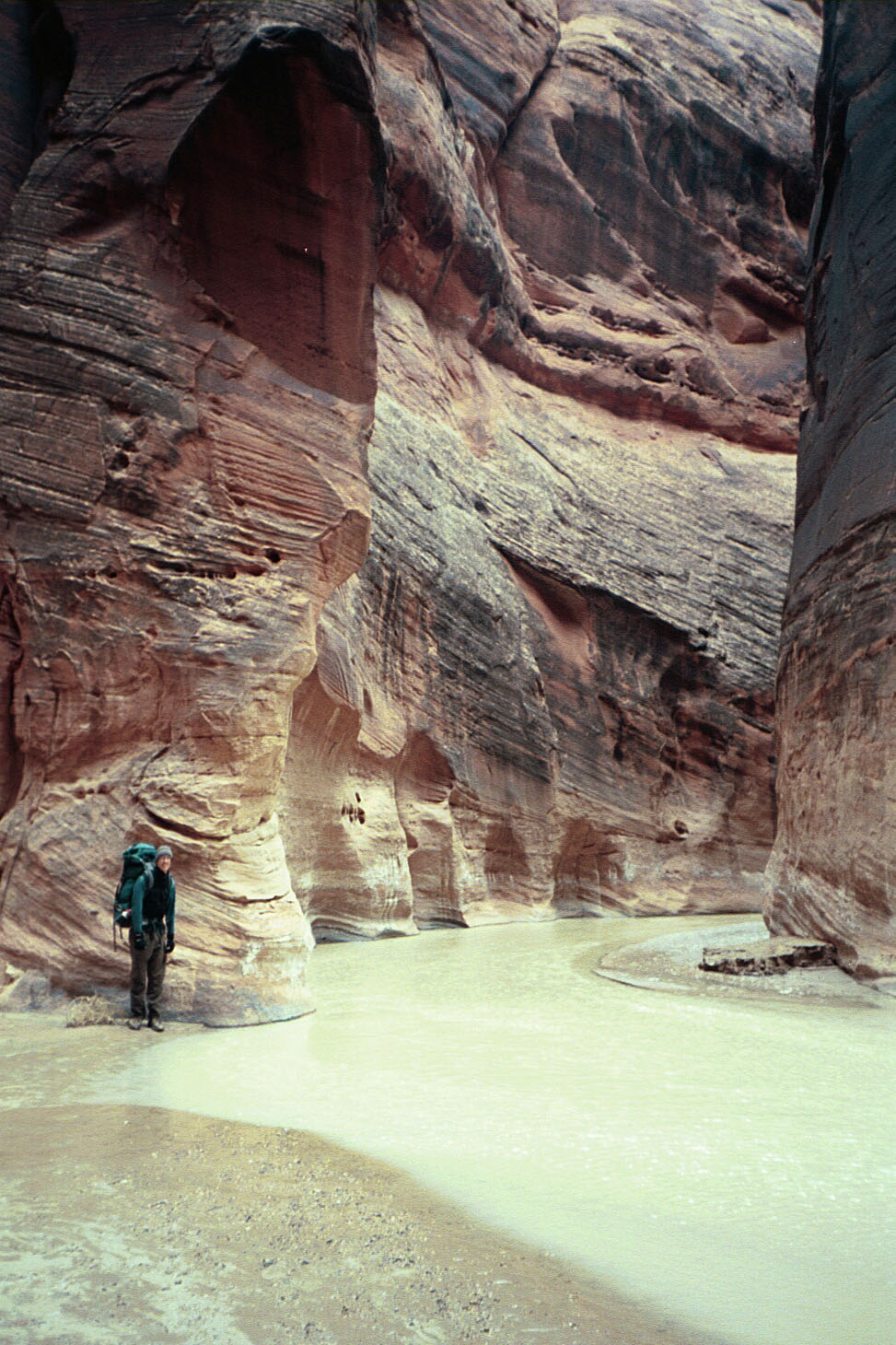
Paria River near Buckskin Gulch. By Seth G. Cowdery – Transferred from English Wikipedia. Original location was here., CC BY 2.0, https://commons.wikimedia.org/w/index.php?curid=835575

One should recognize that the annual releases from the Glen Canyon Dam and the annual flow at Lee Ferry (the compact point) are not the same.  Between the dam and Lee Ferry, the river gains flow from groundwater accretions (in part due to leakage around the dam) and from the Paria River. These gains can vary from about 30,000 acre-feet to over 300,000 acre-feet annually.  The ten-year Lee Ferry flow for 2014-2023 was approximately 86.1 maf.

That amount โ€“ 86.1 maf โ€“ might seem like a safe cushion. But because it is a ten-year moving total, we are about to drop out years with big releases (9 million acre feet) and replace them with years with just 7.48 maf. At the end of 2024, because both 2014 (the year that drops out) and 2024 (the year that is added in) are 7.48 maf years, the ten-year flow will stay about the same.  The way the ten-year flow calculation works is next year, 2015 will drop out and 2025 will be added in, and so on, but here is the problem; From 2015 through 2019, the 2007 Interim Guidelines dictated an annual release of 9 maf per year. With accretions, flows at Lee Ferry averaged about 9.18 maf per year (source: UCRC 74th Annual Report). Thus, if 2025 and 2026 are 7.48 maf years, the ten-year flow will lose about 1.5 maf/year making the total about 83 maf for the 2017-2026 period. Because the 2007 Interim Guidelines expire, we donโ€™t know what the annual release will be in 2027, but if itโ€™s less than about 8.5 maf, because 2017 was a 9 maf year, the ten-year Lee Ferry flow could drop below the tripwire โ€“ 82.5 maf (with two more 9 maf years, 2018 and 2019, in the pipeline).

We recognize that the 24-month studies donโ€™t predict the future. They are a planning and management tool. Itโ€™s plausible that by 2027, a series of wet years could result in a ten-year flow that is much higher than 82.5 maf, something that is, in our view, unlikely. But as we sit here in January 2024, the 24-month study is the only planning tool weโ€™ve got. It would behoove us to pay attention to what it is telling us.

If a future 24-month study projects that ten-year flows will fall below 82.5 maf, it will be a big deal for the basin. What provision of the Law of the River will control annual releases from Glen Canyon Dam โ€“ the post-2026 Operating Guidelines, the Lower Divisionโ€™s interpretation of the 1922 Compact (82.5 maf), or the Upper Divisionโ€™s interpretation of the 1922 Compact (75 maf or less)? ย If the Lower Division States agree to a ten-year flow target of less than 82.5 maf, are they effectively surrendering to the Upper Division States? If the Upper Division States agree to a flow target of 82.5 maf, are they effectively surrendering to the Lower Division States? If the Upper Basin states agree to either 82.5 maf or some smaller compromise delivery target and the hydrology remains bad, how will Wyoming, Colorado, New Mexico, and Utah โ€“ย our statesย โ€“ approach the required water use reductions? What if there is not enough water in storage in Lake Powell (and the other CRSP reservoirs) to release sufficient water to bring the ten-year flows to 82.5 maf? Will the Lower Division insist that that the UCRC implement a curtailment of post-compact uses in the Upper Basin. If the UCRC refuses to do so, will that plunge the Basin into litigation?

The structural deficit refers to the consumption by Lower Basin states of more water than enters Lake Mead each year. The deficit, which includes losses from evaporation, is estimated at 1.2 million acre-feet a year. (Image: Central Arizona Project circa 2019)

At the recent 2023 CRWUA meeting, representatives of the Lower Division States stepped up and made it clear they own the โ€œstructural deficit,โ€ and the conference was buzzing with talk of the innovative system approach the Lower Division has put on the table. This is great news, but as Coloradoโ€™s Royce Tipton concluded sixty years ago, the โ€œstructural deficitโ€ is not a single number. Itโ€™s a range that depends on the interpretation of the Lee Ferry obligations of the Upper Division States under the 1922 Compact. If the average annual flow requirement is 8.25 maf/year, (which Tipton referred to as โ€œfictionalโ€) he calculated the deficit to be about 1.2 maf/year. Today we believe itโ€™s about 1.4 -1.5 maf/year (Tiptonโ€™s assumptions about system losses were probably too low and perhaps his Lee Ferry to Lake Mead inflow assumptions too high). If, however, the average annual flow requirement is 7.5 maf/year, he calculated the deficit to be about 2 maf/year, today maybe 2.2 maf/year. This difference is huge, especially for the Central Arizona Project, the junior user on the Lower basin mainstem.

In the past decades, water managers in the Colorado River Basin have made accomplishments that even two decades ago were considered out of reach: The 2019 Drought Contingency Plans, the shortage sharing agreements with Mexico, the increased recognition of the rights of the Basinโ€™s Native American communities are just a few. The Lower Divisionโ€™s recent pronouncement that they own the structural deficit is another major step forward, but it has a fundamental flaw. Representatives of all seven Basin states continue to stubbornly insist that the Law of the River, and specifically, the 1922 Colorado River Compact, will serve as the โ€œfoundationโ€ of the post-2026 operating guidelines. The flaw is that is that we donโ€™t know if this foundation is based on a ten-year Lee Ferry flow of 82.5 maf, or 75 maf, or something different.

Put simply, the states agree that the Law of the River has to be the basis of what we do, but donโ€™t agree on what the Law of the River actually says. [ed. emphasis mine] Without an agreement on this fundamental issue, calling the 1922 Compact a foundation is nothing more than self-delusional wishful thinking. Now that the Lower Division States have agreed to own the structural deficit, is the next step for all seven states and the federal government to openly acknowledge that given the impacts of climate change on the river, the 1922 Compactโ€™s overallocation of water and its disputed Lee Ferry flow provisions are core problems for the basin, not the foundation? Finding a sustainable future, without litigation, will require accepting and acknowledging the basic problems we face, not avoiding them.

Map credit: AGU

Excellent water quality starts with water in the stream — #Colorado Water Trust #BoulderCreek #CrystalRiver

North Fork of the Gunnison River. Photo credit: Colorado Water Trust

Click the link to read the article on the Colorado Water Trust website (Sarah Klahn):

It is a bitterly cold December morning and I am tooling up Boulder Canyon to do some backcountry skiing above Nederland. As I slow down for a hairpin turn, the sun makes its way over the edge of the canyon and I notice some movement in the creek. Itโ€™s a little bird known as a Dipper, bobbing up and down on a rock in the creekโ€”and now diving into a pool below a fallen tree. These incredible birds live year-round near flowing streams in the Rocky Mountains and elsewhere in the west. They dive underwater for their foodโ€”aquatic insectsโ€”and actually have an extra eyelid so they can see while theyโ€™re underwater! Dipper populations on a stream mean it has excellent water quality and low silt loadโ€”both characteristics of Boulder Creek in Boulder Canyon above the City of Boulder.

Excellent water quality for Dippers and other species that live in or around aquatic ecosystem startsโ€”of courseโ€”with water in the stream. In Colorado, water use is controlled under the stateโ€™s โ€œprior appropriation systemโ€, which forms the legal framework for water distribution in the state. You may have heard the phrase โ€œfirst in time is first in rightโ€ which simply means the more โ€œseniorโ€ rights to use a quantity of water are associated with the earliest uses. In many parts of the state (for example the Cache La Poudre River near Fort Collins or the Rio Grande and its tributaries near Alamosa), many irrigation water rights pre-date statehood. And, while the act of putting water to use forms the basis of a water right, that right is only enforceable if confirmed by a district court or, since 1969, Coloradoโ€™s water courts.

The habitat of the American Dipper (Cinclus americana) is usually clear, rushing, boulder-strewn, mountain streams, within tall conifer forests. Photo via http://birdingisfun.com

In many, if not most streams in the state, the amount of water decreed far exceeds available water supplies. Such streams are โ€œover-appropriatedโ€, meaning that only in a very wet year will many of the more recent (โ€œjuniorโ€) water rights get to divert water.  In fact, Boulder Creek is over-appropriated at locations downstream of the City of Boulder. The Dippers are still safe in the canyon, where there are few actual diversions of water for consumptive use.

โ€œOver-appropriatedโ€ as a concept gets a bad rap. At the time of European settlement, those turning the prairie and mountain valleys into farms and cities were focused on building new homes in an unfamiliar place. Whether we agree with these decisions today, at the time, claiming every drop of available water was an obvious start to settling in a place as arid as Colorado. But Coloradoโ€™s prior appropriation system also has flexibility that allows volumes of water to be assigned to โ€œinstream flowโ€ usesโ€”providing a means to leave water in the stream to benefit aquatic ecosystems, including our friend the Dipper.

The Colorado Water Trust is on the forefront of creative and thoughtful efforts to use flexibility in state water law to put water back into streams. The Trust works to identify both streams in need of additional flows and water rights owners who want to re-imagine the use of their consumptive water rights to improve stream health in their own neighborhood. Broadly, these tools fall into two categories: leases or loans, which are used by the Trust and water right owners who want to maintain ownership of their water rights; and purchase of water rights from owners who are interested in selling to the Colorado Water Trust.

An image of the Crystal River Valley from an EcoFlight mission in August 2022. The view is downvalley, toward Mount Sopris. A group is exploring a federal designation of wild and scenic for the Crystal River in Gunnison and Pitkin counties. Courtesy of Ecoflight

On the Crystal River, a tributary of the Colorado River, the Water Trust and Cold Mountain Ranch, a water user diverting from a critical reach of the Crystal River, entered into an agreement that compensates the Ranch for coordinating diversions in a manner that enhances stream flows. The result is two-fold: the Ranch coordinates its diversions during certain types of water years to benefit the stream flow, but maintains ownership of its valuable, senior irrigation rights for use when water is more plentiful; and the stream benefits in years in which the river reach would otherwise be dry.

The Trust has also, from time to time, purchased portions of water rights, including an interest in the McKinley Ditch which diverts from the Little Cimarron River near Gunnison. Historically, three miles of the Little Cimarron River near Gunnison ran dry during late summer, due to upstream water diversions. Working with the Trustโ€™s frequent partner, the Colorado Water Conservation Board, the Trust obtained a change decree from the Division 4 Water Court. The change decree authorizes the Trustโ€™s water, which would otherwise be limited to irrigation uses, to be left in the stream for the benefit of the aquatic ecosystem.

Sarah Klahn, Board Member, Colorado Water Trust, Shareholder, Somach Simmons & Dunn. Credit: Colorado Water Trust

The Dippers in Boulder Canyon are in good shape, given the water quality and flow regime in Boulder Creek below Barker Dam; any resident Dippers in the Cimarron or Crystal watersheds in the vicinity of the Water Trustโ€™s projects are in better shape than they were before the Trustโ€™s projects were initiated. And for other streams in Colorado that may experience extreme low flows (or dry up completely) during certain types of water years, the Water Trust is actively looking for opportunities to partner with senior water right owners and use available tools provided by the prior appropriation system to enhance stream flows and enhance and protect aquatic ecosystems.

Sarah Klahn is a member of the Water Trust Board of Directors and a shareholder in Somach Simmons & Dunn. Sarah represents farmers and ranchers, as well as institutional clients, on water rights matters in four western states. 

Conservation of the North Rim area — Pete Kolbenschlag (Colorado Farm and Food Alliance) #GunnisonRiver #DoloresRiver #ColoradoRiver #COriver #aridification

Stateline run of Dolores River around the turn of the last century. Photo credit: Pete Kolbenschlag

From email from Pete Kolbenschlag (Colorado Farm & Food Alliance):

The North Rim of the Black Canyon, in the National Park, which is accessed from Fruitland Mesa near Crawford – a remote region of ranches at the base of the West Elk Mountains – showcases an especially dramatic feature. Even among many spectacular places in western Colorado it impresses, marking where the Southern Rockies transition into the mesas, deserts and canyons of the Colorado Plateau. This cherished national treasure is also a local North Fork favorite, found on the way to Blue Mesa and the city of Gunnison.

The Colorado Farm & Food Alliance is supportive of public lands conservation, for protecting the stunning landscapes near our home-base. Set into this amazing landscape are small towns like Crawford, Paonia and Hotchkiss, and scattered between and on the mesas all around are the farms, ranches, wineries and businesses that work hard to make it here. 

As we consider how we can adapt rural communities to be resilient and prosperous in a changing climate and dynamic future, we think that land conservation and watershed health are two of the most important, and effective, strategies we can pursue. That is one reason, as we look even further west, across the Uncompahgre Plateau, into the heart of Coloradoโ€™s red rock canyon country along the Dolores River, we see opportunity. 

Far less visited than Moab and Monticello, Utah which lie just on the other side of the La Sal Mountains and Paradox Basin, the looming Wingate cliffs along this tributary to the Colorado River, which it joins at Dewey Bridge just over the stateline, contain an unique, fascinating, often hardscrabble history.

Back in the North Fork Valley, the Black Canyon National Park is not the only nearby designated national park service or conservation area. Just downstream is the Gunnison Gorge National Conservation Area. And above it is the Curecanti National Recreation Area which includes not only Blue Mesa reservoir, Coloradoโ€™s largest water body, but seldom visited upper reaches of the Black Canyon itself, with sweeping vistas of the San Juan Mountains and the Uncompahgre Plateau. Protected public lands are critical components of the economy in this region.  

So lately as talk has percolated up from people who love the red rock Dolores River country, about securing protections to conserve what is unique and important about it, we pay attention. Sen. Bennet has long championed a bill to establish a national conservation area for part of the Dolores Canyon region. And more recently, a growing coalition of businesses, conservation groups and local elected officials are calling on President Biden to designate a national monument for a part of the region as well. 

We think this could be a great opportunity to ensure what is unique there remains intact and that local businesses benefit from growing visitation to the region. Given the rich history in the West End of Montrose County, like the Hanging Flume and the town of Uravan – a critical player in the Atomic Age – itโ€™s no wonder community leaders are wanting to protect the area. 

Towns like Naturita and Nucla, with their markets and cafes, can serve as hubs that support local farms and residents, as they always have, and play host to visitors and activities, provide guides and services, and be the jumping off and provisioning point for the more adventuresome. 

For places as rooted in tradition as are the rural communities of western Colorado, public land conservation and protecting the health of our lands and watersheds is a solid strategy to preserve what we care about most. And to welcome new opportunities. This is the strongest connection we see with our friends on the West End: protected public lands protect a rural way of life – and can help us better prepare for and better prosper in the future. 

As 2024 opens to new possibilities, we cannot think of a better conversation than how to secure a locally-rooted, sustainable, and prosperous future for the Dolores Canyon Country and the rural, western communities of our local and nearby watersheds. As President Biden looks for legacy projects to leave with future generations, now is the time for Coloradoโ€™s leaders like Senators Hickenlooper and Bennet, and Governor Polis to speak up and urge the president to act.ย 

Map of the Gunnison River drainage basin in Colorado, USA. Made using public domain USGS data. By Shannon1 – Own work, CC BY-SA 4.0, https://commons.wikimedia.org/w/index.php?curid=69257550
Dolores River watershed

Company with oil and gas interests seeking to keep rights alive for reservoir on #ThompsonCreek — @AspenJournalism #RoaringForkRiver #ColoradoRiver #COriver #aridification

A frozen Thompson Creek near its confluence with the Crystal River just south of Carbondale. A company with an interest in oil shale development in western Colorado is seeking to maintain conditional water rights for a proposed reservoir on Thompson Creek. CREDIT: HEATHER SACKETT/ASPEN JOURNALISM

Click the link to read the article on the Aspen Journalism website (Heather Sackett):

Puckett Land Co.โ€™s 23,893 acre-foot proposal dates to 1966, part of โ€œintegrated systemโ€ involving lands in Garfield and Rio Blanco counties

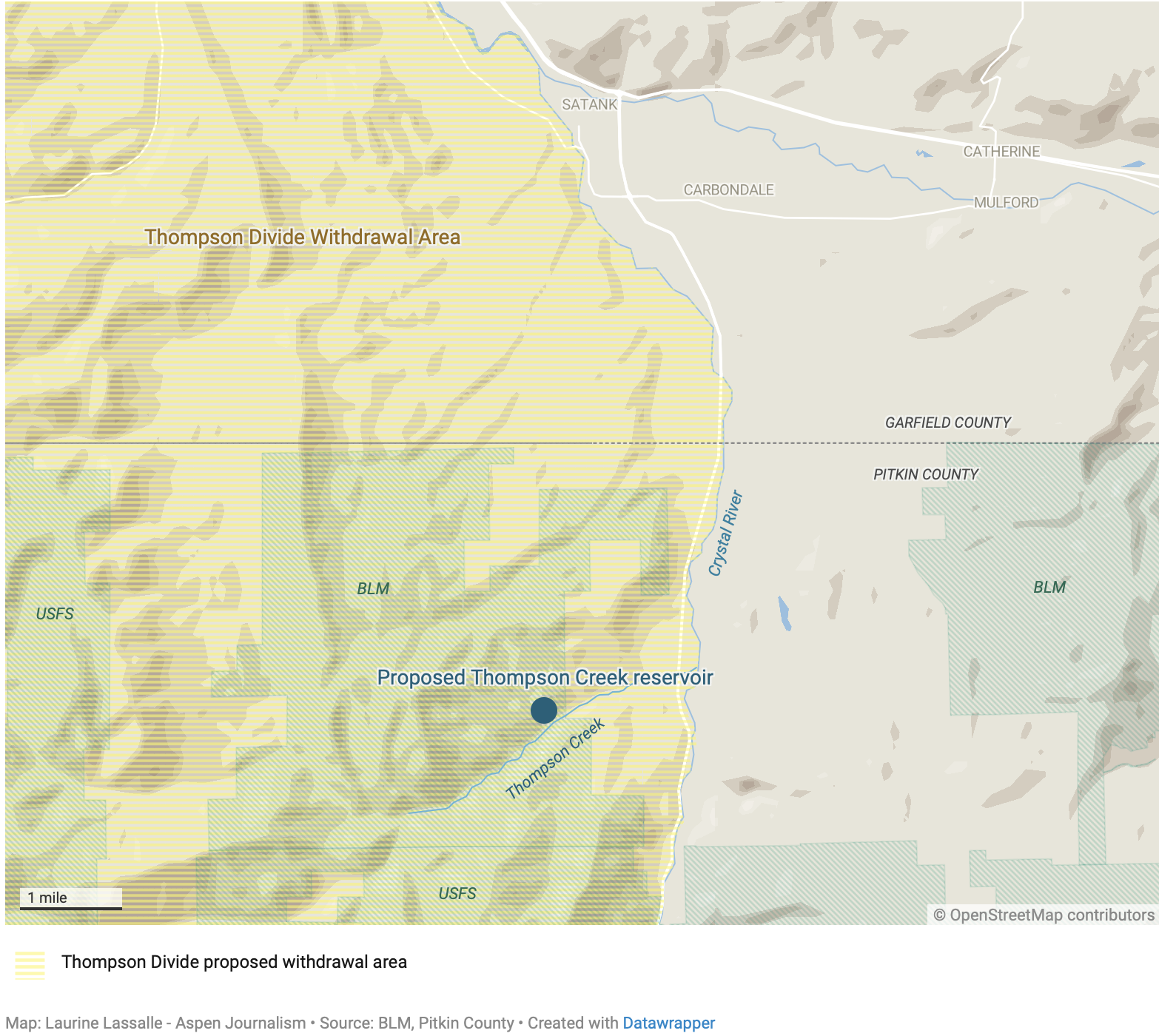
A company with an interest in oil shale development in western Colorado is seeking to maintain its water rights associated with a proposed reservoir on Thompson Creek that would be located within an area proposed for oil and gas lease withdrawal.

Puckett Land Co. is seeking to hold on to conditional water rights that date to 1966 for a 23,893-acre foot reservoir on Thompson Creek, a tributary of the Crystal River just south of Carbondale. It would be nearly one-fourth the size of Ruedi Reservoir, which, when full, holds just over 100,000 acre-feet. The reservoir site is located on Bureau of Land Management land in Pitkin County. 

According to water court documents filed in November, Puckett says the water is needed for the โ€œcommercial development of Puckettโ€™s oil, gas, coalbed methane and/or oil shale minerals.โ€ The water is decreed for industrial, domestic, recreational, irrigation, power, mining and all other purposes related to shale oil production, including the maintenance of a camp and community.

Puckett Land Co., based in Greenwood Village, Colorado, holds interests in 17,500 acres of land in Garfield and Rio Blanco counties, according to the application. The Thompson Creek water rights are described as being part of an integrated system that includes conditional rights for two small reservoirs, and a pump and pipeline on Starkey Gulch, a tributary of Parachute Creek. Those Parachute Creek basin reservoirs have not been constructed. 

Attorney for Puckett Land Co. Peter D. Nichols said that it would be inappropriate to respond to questions from Aspen Journalism while the application is pending in water court.

The proposed reservoir site is within the boundaries of an area that the U.S. Forest Service and BLM are proposing to withdraw from eligibility for new oil and gas leases. The proposed Thompson Divide withdrawal area is comprised of 224,713-acres in Garfield, Gunnison and Pitkin counties that generally straddles the ridge of mountains running from south of Glenwood Springs to the northern edge of the West Elk Wilderness, south of McClure Pass. 

Carbondale-based conservation group Wilderness Workshop supports the withdrawal, and executive director Will Roush said a reservoir on Thompson Creek is highly problematic for many reasons, including its many harmful effects on the ecosystem.

โ€œThe local community has been working for over a decade to protect Thompson Creek and the surrounding lands; damming the creek runs counter to these efforts and deeply held community values,โ€ Roush said in a statement. โ€œFurthermore, the intended use of this water would be to enable oil shale and other fossil fuel production. Given our water and climate crises, utilizing precious West Slope water to increase climate pollution is simply unacceptable.โ€

The proposed reservoir site is just upstream from Sunfire Ranch, which is near the confluence of Thompson Creek and the Crystal River. In 2020, Pitkin County spent $10 million to put a conservation easement on the property, meaning that most of the 1,240-acre property is protected from development. Pitkin County also has its own taxpayer-funded board, Healthy Rivers, that funds programs and grant requests that focus on improving water quality and quantity. 

Pitkin County Attorney John Ely said he is evaluating Puckettโ€™s application and deciding whether the county wants to weigh in. Interested parties have until Jan. 31 to file statements of opposition in water court. As of Friday, no such statements had been filed.

Proposed Thompson Creek reservoir

Conditional water rights

The reason Puckett has been able to hold on to water rights that are nearly 60 years old without putting them to beneficial use lies in a quirk of Colorado water law that at least one scholar says needs to be reformed. Conditional water rights allow a would-be water user to reserve their place in the priority system based on when they applied for the right โ€” not when they put water to use โ€” while they work toward developing the water. Under the cornerstone of water law known as prior appropriation, older waters rights get first use of the river. 

To maintain a conditional right, an applicant must every six years file whatโ€™s known as a diligence application with the water court, proving that they still have a need for the water, that they have taken substantial steps toward putting the water to use and that they โ€œcan and willโ€ eventually use the water. They must essentially prove they are not speculating and hoarding water rights they wonโ€™t soon use. 

But the bar for proving diligence is low. Judges are hesitant to abandon these conditional water rights, even if they have been languishing without being used for decades. Andrew Teegarden, a water fellow at the Getches-Wilkinson Center for Natural Resources, Energy and the Environment at the University of Colorado School of Law, argues this is partly because in Colorado water is treated as a property right. 

โ€œSome of the standards I think are a little lackadaisical merely because they donโ€™t require the holders to spell out and specify all of the diligence activities that an individual took,โ€ Teegarden said. โ€œMost of the diligence applications that youโ€™ll see are not filled with tons and tons of information; itโ€™s more general statements about things like maintenance and building infrastructure. โ€ฆ It seems like we could require a little bit more specificity out of some of these holders.โ€

In Puckettโ€™s diligence filing, the company says that in the past six years, it has spent nearly $100,000 on maintaining, repairing and upgrading its infrastructure and overall water system on its properties in the Colorado River basin; spent more than $80,000 on operational activities such as road maintenance and erosion control; spent more than $16,000 on professional services, including survey and title work; and has spent more than $80,000 on legal services to protect and develop its water rights. 

The application does not specifically mention work regarding the Thompson Creek reservoir site in its list of diligence activities and says that diligence on any part of the system constitutes diligence with respect to the entire system. It is not clear how the Thompson Creek reservoir would operate with other parts of the system.

Puckett also said in its application that current economic conditions are adverse to oil shale production, but that that should not be sufficient on its own to deny its diligence claim. 

Diligence filings are common and often fly under the radar. In 2017, the last time Puckett filed a diligence application for the Thompson Creek reservoir, no parties filed statements of opposition in the case. In the diligence filing prior to that, in 2010, only one party โ€” the owners of the Crystal River Ranch โ€” came forward as opposers. In that case, Puckett agreed to abandon conditional rights for a pipeline that would have diverted water from a point below the proposed dam.ย 

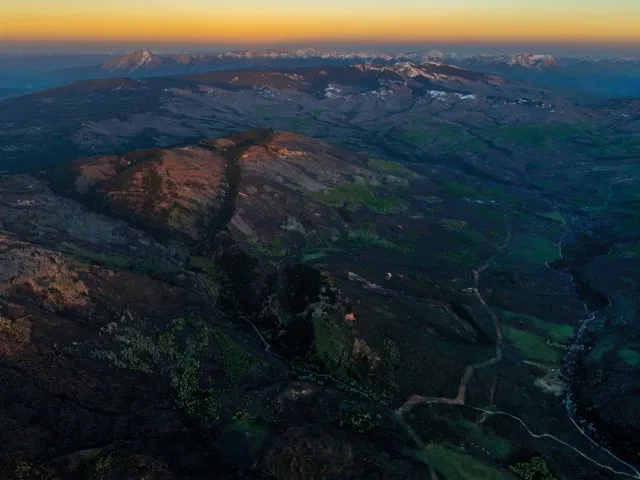
An aerial view of the Thompson Divide area, looking south along West Divide Creek, with the Bull Mountain pipeline running roughly parallel, to the left, of the creek bottom. Mount Sopris, at upper left, and Chair Mountain, upper right, frame the background. CREDIT: DAN BAYER / ECOFLIGHT

Oil shale and water use

In 2009, conservation group Western Resource Advocates produced a report called โ€œWater on the Rocksโ€ about oil shale water rights in western Colorado. According to the report, in anticipation of a boom, in the 1950s and โ€˜60s, companies with an interest in western Colorado oil shale amassed an enormous portfolio of water rights because extracting the oil from shale, a type of sedimentary rock, requires huge amounts of water. The report found that there were conditional water rights associated with oil shale development for 27 reservoirs with 736,770 acre-feet of water in the mainstem of the Colorado River basin. 

If these conditional water rights were to be developed, the impacts could be felt by other water users throughout the basin. When the holders of conditional rights with older priority dates finally begin diverting water they have not used in decades, they may force junior rights holders to stop using water, something Teegarden calls โ€œline-jumping.โ€ The sheer volume of water tied to oil shale development, if ever used, could upend the whole system.

โ€œAs soon as some of these conditional rights begin coming online, theyโ€™re going to curtail these users that have been receiving that water in some cases for decades,โ€ Teegarden said. โ€œWe have these users who have been making productive use of the stateโ€™s water for all this time and have been following all of the requirements of the law, but now they are the ones that might be punished for their use of the water.โ€

In a draft paper on the unintended consequences of conditional water rights in Colorado, Teegarden advocates for reforms to the anti-speculation and due-diligence standards. He says if users fail to put water to beneficial use within the typical 10-year abandonment period, the conditional water rights should be abandoned. With the help of the legislature, water courts could also implement a strict time limit for putting conditional rights to beneficial use and stop allowing them to exist indefinitely. For example, extensions through diligence filings could stop being granted after 50 years.

โ€œI think that we really need to be serious about looking into and reforming these conditional rights before the time comes where we see some of these impacts to other water users across the state,โ€ Teegarden said. โ€œBecause if we wait until that point, we wonโ€™t be able to guarantee a water-secure future, especially with the volumes of water that are associated with these conditional rights.โ€

Map of oil shale and tar sands in Colorado, Utah and Wyoming — via the BLM

Preliminary: #NewMexicoโ€™s #RioGrande Compact debt rose ~25,000 acre feet in 2023 — John Fleck (InkStain.net)

Elephant Butte Reservoir back in the day nearly full. Photo credit: USBR

Click the link to read the article on the InkStain website (John Fleck):

January 12, 2024

New Mexico once again fell short in 2023 of the requirement set out in the Rio Grande Compact to deliver water to Elephant Butte Reservoir for use in Southern New Mexico, Texas, and Mexico, delivering ~25,000 acre feet less than the Compact requires, according to preliminary estimates presented at Mondayโ€™s meeting of the Middle Rio Grande Conservancy District.

These numbers are preliminary. The final, official numbers will be sorted out at this springโ€™s meeting of the Rio Grande Compact Commission. But if they hold, that would put New Mexicoโ€™s cumulative Compact debt at ~125,000 acre feet.

Reallyย bad things donโ€™t start happening until New Mexicoโ€™s cumulative Compact debt rises above 200,00 acre feet, butย lessbad things are already happening now as a result of the debt. Under Article VI of theย Compact:

Translated, that means any runoff we could actually store in upstream reservoirs in 2024 we canโ€™t use, but rather have to hang onto to run down to Elephant Butte after the end of the irrigation season.

RUN-OF-THE RIVER AGAIN FOR MIDDLE VALLEY IRRIGATORS, AND FOR THE FISH

Thereโ€™s a complex interaction here between physical storage* and rules. But the bottom line is that once again this summer, water users in New Mexicoโ€™s Middle Rio Grande Valley, the stretch of the river between Cochiti Pueblo and Elephant Butte Dam, will be entirely dependent on natural runoff available after the farmers in the San Luis Valley of Colorado take their share of the river.

I would predict, as a result, that:

  1. People who irrigate in the Middle Valley should expect a high risk of significant stretches with no ditch water in the summer,
  2. Water available for instream flows for the endangered Rio Grande silvery minnow will once again be extremely tight, with a high likelihood of drying in the Isleta and San Acacia reaches this summer, and
  3. The Albuquerque Bernalillo County Water Utility Authority is likely to shut down river diversions for its drinking water plant at some point in the summer and switch over to groundwater pumping so I can keep taking showers.

* PHYSICAL STORAGE

El Vado Dam, built by the federal government and the Middle Rio Grande Conservancy District in the 1930s to store water during the spring runoff peak for irrigators to use in the late summer is under repair, a project taking way longer than expected. Itโ€™s likely that the necessary paperwork to store some water in Abiquiu Reservoir will be in place by runoff season, but the Compact Article VI debt means that water cannot be used for irrigation in 2024.

El Vado Dam and Reservoir. Photo credit: USBR

Navajo Dam operations update January 19, 2024 #SanJuanRiver #ColoradoRiver #COriver #aridification

Bluff UT – aerial with San Juan River and Comb Ridge. https://commons.wikimedia.org/w/index.php?curid=6995171

From email from Reclamation (Susan Novak Behery):

January 17, 2024

At 3:00 PM on January 29th (Monday), the release at Navajo Dam will be transferred to the 4×4 Auxiliaryย outlet, where the release will be reduced toย 250ย cfs. ย The minimum release will accommodate instream work for theย Turleyย Manzanares Ditch Company Diversion Dam Rehabilitation Project.ย ย The release will be transferred back to the power plant and increased back to its current level of 350 cfs at 8:00 AM the following morning, January 30th, 2024 (Tuesday). You may expect some silt and discoloration downstream in the river during this time due to the location of the intake of the 4×4.

This scheduled operation is subject to changes in river flows and weather conditions.  If you have any questions, please contact Susan Behery (sbehery@usbr.gov or 970-385-6560), or visit Reclamationโ€™s Navajo Dam website at https://www.usbr.gov/uc/water/crsp/cs/nvd.html

Article: Significantly wetter or drier future conditions for one to two thirds of the worldโ€™s population — Nature #ActOnClimate

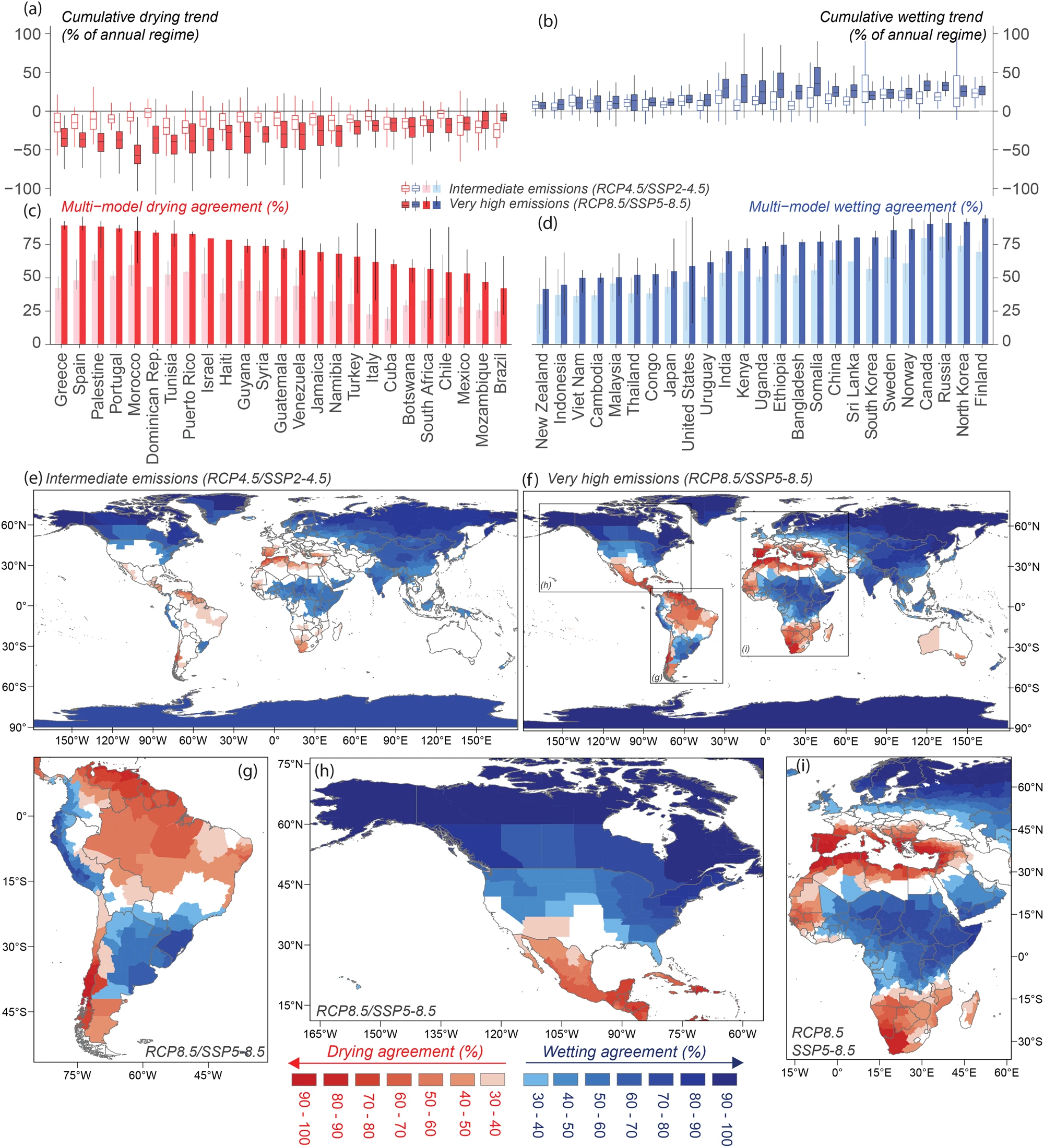
a, b Box-whiskers plots of cumulative change in precipitation regime over a 120-year period across GCMs for selected countries with higher agreement and affected populations. c, d Selected countries ranked by drying and wetting multi-model agreement (vertical lines denote intra-country variability showing the 10th and 90th spatial percentiles). e, f Spatial distribution of drying and wetting multi-model agreement for states. Rectangles on f very high emissions panel focusing on regions with strong intra-country variability are shown in detail on panels for g South America, h North America, i Africa, and Europe. White regions indicate no substantial agreement for drying and wetting. Refer to Figs. S1 and S2 and Supplementary Data for seasonal agreement across all countries and states globally.

Click the link to access the article on the Nature website (Ralph Trancoso,ย Jozef Syktus,ย Richard P. Allan,ย Jacky Croke,ย Ove Hoegh-Guldbergย &ย Robin Chadwick). Here’s the abstract:

Future projections of precipitation are uncertain, hampering effective climate adaptation strategies globally. Our understanding of changes across multiple climate model simulations under a warmer climate is limited by this lack of coherence across models. Here, we address this challenge introducing an approach that detects agreement in drier and wetter conditions by evaluating continuous 120-year time-series with trends, across 146 Global Climate Model (GCM) runs and two elevated greenhouse gas (GHG) emissions scenarios. We show the hotspots of future drier and wetter conditions, including regions already experiencing water scarcity or excess. These patterns are projected to impact a significant portion of the global population, with approximately 3 billion people (38% of the worldโ€™s current population) affected under an intermediate emissions scenario and 5 billion people (66% of the world population) under a high emissions scenario by the centuryโ€™s end (or 35-61% using projections of future population). We undertake a country- and state-level analysis quantifying the population exposed to significant changes in precipitation regimes, offering a robust framework for assessing multiple climate projections.

Forest Service withdraws key permit for controversial #Utah oil-train project opposed by Coloradans — #Colorado Newsline #ActOnClimate #KeepItInTheGround

A train of tanker cars travels the tracks along the Colorado River near Cameo on May 16, 2023. (Chase Woodruff/Colorado Newsline)

Click the link to read the article on the Colorado Newsline website (Chase Woodruff):

January 18, 2024

A controversial Utah oil-train proposal opposed by Colorado communities and environmentalists was dealt another blow this week when the U.S. Forest Service withdrew a key permit for the project.

In an announcement published Wednesday, Ashley National Forest Supervisor Susan Eickhoff blocked the issuance of a permit to the Uinta Basin Railway to construct 12 miles of railroad track through a protected area of the national forest in northeast Utah. The stretch of track in question is part of the proposed railwayโ€™s 88-mile connection between the oil fields of eastern Utahโ€™s Uinta Basin and the existing national rail network.

The project hasย drawn fierce opposition from Coloradans. A federal โ€œdownline analysisโ€ estimated that 90% of the resulting oil-train traffic โ€” as many as five fully loaded, two-mile-long trains of crude oil tankers per day โ€” would be routed through environmentally sensitive and densely populated areas in Colorado, en route to oil refineries on the Gulf Coast. The oil trains would more than quadrupleย the amount of hazardous materialsย being shipped by rail through many Colorado counties.

Coloradoโ€™s Eagle County and five environmental groups sued to overturn the Uinta Basin Railwayโ€™s approval, and in August 2023 a panel of federal judges ruled that the approval process contained โ€œnumerousโ€ and โ€œsignificantโ€ violations of the National Environmental Policy Act. The ruling vacated portions of the projectโ€™s environmental impact statement and ordered the federal Surface Transportation Board to redo its analysis of key environmental risks.

Because the Forest Serviceโ€™s decision in August 2022 to grant a right-of-way permit to the project was based on that flawed analysis, the agency has withdrawn its decision pending further proceedings at the STB.

This map, included in U.S. Forest Service documents evaluating the Uinta Basin Railway proposal, shows the 88-mile length of the route. Tunnels are shown in yellow.
CREDIT: COURTESY IMAGE

โ€œIf the deficiencies are addressed and resubmitted for consideration, the Forest Service may issue a new decision,โ€ Eickhoff wrote in a Jan. 17 letter.

โ€œThis is wonderful news for the roadless forest in Utahโ€™s Indian Canyon and the wildlife who call it home,โ€ said Ted Zukoski, senior attorney with the Center for Biological Diversity, one of the groups that sued to block the project. โ€œItโ€™s a victory for the Colorado River and nearby communities that would be threatened by oil train accidents and spills, and for residents of the Gulf Coast, where billions of gallons of oil would be refined. If the oil trainโ€™s backers attempt to revive this dangerous scheme, weโ€™ll be there to fight it again.โ€

In a press release, Democratic U.S. Sen. Michael Bennet of Colorado, who had urged multiple federal agencies to put a stop to the project, applauded the Forest Serviceโ€™s move.

โ€œA derailment along the headwaters of the Colorado River could have catastrophic effects for Coloradoโ€™s communities, water, and environment,โ€ Bennet said. โ€œIโ€™m glad the Forest Service has taken this important step to protect the Colorado River and the tens of millions of people who depend on it.โ€

Backers of the railway project include the Seven County Infrastructure Coalition, a group of Utah county governments in the oil-rich Uinta Basin. The coalitionโ€™s petition for a rehearing of the case by the U.S. Court of Appeals for the D.C. Circuit was denied in December, though the ruling could still be appealed to the U.S. Supreme Court.

โ€œWeโ€™re still looking at options,โ€ Greg Miles, a Duchesne County commissioner and co-chair of the coalition, said during a Jan. 11 public meeting. โ€œWe may be making a decision here within the next month.โ€

Dirt track to the right leads to a borehole site for a tunnel under the Ashley National Forest roadless area, part of the Uinta Basin Railway proposal which U.S. Forest Service officials approved in July 2022.
CREDIT: AMY HADDEN MARSH/ASPEN JOURNALISM

12 not-so-easy steps to decarbonize the grid: Electrifying will make a difference if that power comes from clean sources — Jonathan P. Thompson (@HighCountryNews) #ActOnClimate #KeepItInTheGround

Click the link to read the article on The High Country News website (Jonathan P. Thompson):

When it comes to the countryโ€™sย climate change culprits, the biggest offenders lurk in the transportation sector: Altogether, planes, trains and automobiles, etc., emit 28% of the nationโ€™s greenhouse gases, plus other nasty pollutants that harm anyone who lives near highways and airports. Industrial sources โ€” factories, cement plants, steel mills, etc. โ€” spew nearly one-fourth of our climate-warming pollutants, while commercial and residential buildings are responsible for 13%, and agriculture contributes 10%.

Experts generally agree that the best way to reduce all these emissions is to electrify everything: Just replace petroleum-powered vehicles, natural gas-fired heaters and stoves and coal-fired cement kilns and steel furnaces with their electric analogs. After all, an electric vehicleโ€™s tailpipe emits zero greenhouse gases or other pollutants. In fact, electric vehicles donโ€™t even have tailpipes.

There is one nagging little detail, though: The energy producing all that electricity has to come from somewhere, generally from greenhouse gas-emitting fossil fuels. The electric power sector is the nationโ€™s second-largest emitter of greenhouse gases, after transportation. Electrifying everything might do little more than redistribute emissions from buildings and cars to the power grid. Unless, that is, the power grid is decarbonized, a simple โ€” but monumental โ€” task: The electric power sector needs to quit fossil fuels, cold turkey. And that requires massive investments in new power sources and innovation to remake the grid for a carbon-free world.

SOURCES: Energy Information Administration, Environmental Protection Agency, Oregon Solar Dashboard, California Independent System Operator, Harvard Kennedy School Belfer Center, National Renewable Energy Laboratory. Illustrations by Hannah Agosta/High Country News

$3.5 million
Funding the New Mexico Mortgage Finance Authority has allocated to help install rooftop solar on low-income households. 

21,894 megawatt-hours
Amount of electricity produced by utility-scale solar facilities in Oregon in 2015. 

1.69 million megawatt-hours
Amount produced in 2022.

500 megawatts 
Amount of battery storage on Californiaโ€™s grid in 2018. 

8,000 megawatts
Amount of battery storage on Californiaโ€™s grid today.

SOURCES: Energy Information Administration, Environmental Protection Agency, Oregon Solar Dashboard, California Independent System Operator, Harvard Kennedy School Belfer Center, National Renewable Energy Laboratory. Illustrations by Hannah Agosta/High Country News

103.5%
Amount of Californiaโ€™s total demand met by solar power on May 8, 2022, a record. 

16,044 megawatts
Amount of solar generation on the California grid on Sept. 6, 2023, just after noon, the all-time record so far. 

1,000
Feet of irrigation canal to be covered by solar panels at a Gila River Indian Community project in Arizona.

SOURCES: Energy Information Administration, Environmental Protection Agency, Oregon Solar Dashboard, California Independent System Operator, Harvard Kennedy School Belfer Center, National Renewable Energy Laboratory. Illustrations by Hannah Agosta/High Country News

1.05 billion tons
Amount of coal burned for electricity generation in the U.S. in 2007.

469 million tons
Amount burned in 2022.

7.1 trillion cubic feet
Amount of natural gas burned for electricity generation in the U.S. in 2007.

12.4 trillion cubic feet
Amount burned in 2022.

SOURCES: Energy Information Administration, Environmental Protection Agency, Oregon Solar Dashboard, California Independent System Operator, Harvard Kennedy School Belfer Center, National Renewable Energy Laboratory. Illustrations by Hannah Agosta/High Country News

371.5 million metric tons
Carbon dioxide emissions from burning natural gas to generate electricity in 2007.

661 million metric tons
Amount emitted in 2022.

2.33 billion 
2007 total emissions (natural gas and coal).

1.5 billion
2022 total emissions.

SOURCES: Energy Information Administration, Environmental Protection Agency, Oregon Solar Dashboard, California Independent System Operator, Harvard Kennedy School Belfer Center, National Renewable Energy Laboratory. Illustrations by Hannah Agosta/High Country News

Illustrations by Hannah Agosta/High Country News

Jonathan Thompson is a contributing editor atย 
High Country News. He is the author ofย Sagebrush Empire: How a Remote Utah County Became the Battlefront of American Public Lands.ย 

Article: Cost and Energy Metrics for Municipal Water #Reuse — ACS Publications

Graphic credit: ACS Publications article “Cost and Energy Metrics for Municipal Water Reuse”

Click the link to access the article on the ACS Publications website (Daniel E. Giammar*, David M. Greene, Anushka Mishrra, Nalini Rao, Joshua B. Sperling, Michael Talmadge, Ariel Miara, Kurban A. Sitterley, Alana Wilson, Sertac Akar, Parthiv Kurup, Jennifer R. Stokes-Draut,ย andย Katie Coughlin). Here’s the abstract:

Municipal water reuse can contribute to a circular water economy in different contexts and with various treatment trains. This study synthesized information regarding the current technological and regulatory statuses of municipal reuse. It provides process-level information on cost and energy metrics for three potable reuse and one nonpotable reuse case studies using the new Water Techno-economic Assessment Pipe-Parity Platform (WaterTAP3). WaterTAP3 enabled comparisons of cost and energy metrics for different treatment trains and for different alternative water sources consistently with a common platform. A carbon-based treatment train has both a lower calculated levelized cost of water (LCOW) ($0.40/m3) and electricity intensity (0.30 kWh/m3) than a reverse osmosis (RO)-based treatment train ($0.54/m3ย and 0.84 kWh/m3). In comparing LCOW and energy intensity for water production from municipal reuse, brackish water, and seawater based on the largest facilities of each type in the United States, municipal reuse had a lower LCOW and electricity than seawater but higher values than for production from brackish water. For a small (2.0 million gallon per day) inland RO-based municipal reuse facility, WaterTAP3 evaluated different deep well injection and zero liquid discharge (ZLD) scenarios for management of RO concentrate. Adding ZLD to a facility that currently allows surface discharge of concentrate would approximately double the LCOW. For all four case studies, LCOW is most sensitive to changes in weighted average cost of capital, on-stream capacity, and plant life. Baseline assessments, pipe parity metrics, and scenario analyses can inform greater observability and understanding of reuse adoption and the potential for cost-effective and energy-efficient reuse.

Article: #ClimateChange and the global redistribution of biodiversity: substantial variation in empirical support for expected range shifts — Environmental Evidence #ActOnClimate

An American pika jumps between rocks, carrying flowers and grasses in Rocky Mountain National Park. Photo Credit: Dave Showalter

Click the link to access the article on the Environmental Evidence website (Madeleine A. Rubenstein,ย Sarah R. Weiskopf,ย Romain Bertrand,ย Shawn L. Carter,ย Lise Comte,ย Mitchell J. Eaton,ย Ciara G. Johnson,ย Jonathan Lenoir,ย Abigail J. Lynch,ย Brian W. Miller,ย Toni Lyn Morelli,ย Mari Angel Rodriguez,ย Adam Terandoย &ย Laura M. Thompson). Here’s the abstract:

Background

Among the most widely predicted climate change-related impacts to biodiversity are geographic range shifts, whereby species shift their spatial distribution to track their climate niches. A series of commonly articulated hypotheses have emerged in the scientific literature suggesting species are expected to shift their distributions to higher latitudes, greater elevations, and deeper depths in response to rising temperatures associated with climate change. Yet, many species are not demonstrating range shifts consistent with these expectations. Here, we evaluate the impact of anthropogenic climate change (specifically, changes in temperature and precipitation) on speciesโ€™ ranges, and assess whether expected range shifts are supported by the body of empirical evidence.

Methods

We conducted a Systematic Review, searching online databases and search engines in English. Studies were screened in a two-stage process (title/abstract review, followed by full-text review) to evaluate whether they met a list of eligibility criteria. Data coding, extraction, and study validity assessment was completed by a team of trained reviewers and each entry was validated by at least one secondary reviewer. We used logistic regression models to assess whether the direction of shift supported common range-shift expectations (i.e., shifts to higher latitudes and elevations, and deeper depths). We also estimated the magnitude of shifts for the subset of available range-shift data expressed in distance per time (i.e., km/decade). We accounted for methodological attributes at the study level as potential sources of variation. This allowed us to answer two questions: (1) are most species shifting in the direction we expect (i.e., each observation is assessed as support/fail to support our expectation); and (2) what is the average speed of range shifts?

Review findings

We found that less than half of all range-shift observations (46.60%) documented shifts towards higher latitudes, higher elevations, and greater marine depths, demonstrating significant variation in the empirical evidence for general range shift expectations. For the subset of studies looking at range shift rates, we found that species demonstrated significant average shifts towards higher latitudes (averageโ€‰=โ€‰11.8 km/dec) and higher elevations (averageโ€‰=โ€‰9 m/dec), although we failed to find significant evidence for shifts to greater marine depths. We found that methodological factors in individual range-shift studies had a significant impact on the reported direction and magnitude of shifts. Finally, we identified important variation across dimensions of range shifts (e.g., greater support for latitude and elevation shifts than depth), parameters (e.g., leading edge shifts faster than trailing edge for latitude), and taxonomic groups (e.g., faster latitudinal shifts for insects than plants).

Conclusions

Despite growing evidence that species are shifting their ranges in response to climate change, substantial variation exists in the extent to which definitively empirical observations confirm these expectations. Even though on average, rates of shift show significant movement to higher elevations and latitudes for many taxa, most species are not shifting in expected directions. Variation across dimensions and parameters of range shifts, as well as differences across taxonomic groups and variation driven by methodological factors, should be considered when assessing overall confidence in range-shift hypotheses. In order for managers to effectively plan for species redistribution, we need to better account for and predict which species will shift and by how much. The dataset produced for this analysis can be used for future research to explore additional hypotheses to better understand species range shifts.

The Significance of Chevron Deference: Two new #SCOTUS cases,ย Loper Bright Enterprises v. Raimondoandย Relentless Inc. v. Dept. of Commerce,ย may impact federal agenciesโ€™ ability to perform their duties — The Natural Resources Defense Council

The U.S. Supreme Court Building, current home of the Supreme Court, which opened in 1935. By Senate Democrats – 7W9A9324, CC BY 2.0, https://commons.wikimedia.org/w/index.php?curid=92666722

Click the link to read the article on the Natural Resources Defense Council website (David Doniger):

January 12, 2024

The U.S. Supreme Court is scheduled to hear arguments on January 17 in a pair of cases that could weaken the ability of federal agencies to confront the wide array of challenges the modern world throws at us, from protecting clean air and water to assuring the safety of food and medicines to preventing stock fraud and other financial scams, and more.

The cases Loper Bright Enterprises v. Raimondo and Relentless Inc. v. Department of Commerce challenge the authority of federal agencies to make their best judgments about the detailed rules and standards required to carry out laws that Congress has passed and tasked those agencies to administer.

The cases narrowly involve the management of the Atlantic herring fishery. The stakes, though, are much broader: whether the courts will continue to respect the decisions of the expert agencies, or whether judges will be set free to impose their own preferences on agency actions and decisions. [ed. emphasis mine]

The result could put hundreds of such decisions in the hands of unelected lower-court judges rather than agency professionals who have deep expertise in their appointed fields and who are accountable to the elected branches of governmentโ€”the president and Congress.

At issue is a legal doctrine calledย Chevronย deference. It came out of the 1984 case ofย Chevron USA v. Natural Resources Defense Council. In that case, the U.S. Supreme Court ruled that both agencies and courts must follow Congressโ€™s laws when they are clear and unambiguous. But when laws have more than one reasonable interpretation, courts must defer to the reasonable choices made by the expert agencies that Congress has tasked to administer those laws.

NRDC lost that case. In the four decades since, NRDC has both lost and won other cases that have been decided based on the Chevrondoctrine. But NRDC respects the legal framework that the doctrine provides and the important values it serves. 

Congress passes the laws the federal agencies administer. And Congress gives agencies the responsibility to administer those laws. 

Federal agencies are directly accountable to the U.S. president, the only public official elected nationally to serve the entire country. They are also accountable to Congress, which controls their funding and, through the Senate, decides whether to confirm each agencyโ€™s senior leadership nominees.

It is these publicly accountable federal agencies, not unelected judges, that have the responsibility, as well as the legal and technical expertise, to administer our laws in a way that ensures they achieve the purpose Congress intended.

Below are answers to key questions about this foundational legal doctrine and the important stakes these new cases have for the country.

Whatโ€™s the Chevron case all about?

Federal agencies have both the responsibility and the expertise to administer the laws passed by Congress, to ensure that those laws achieve their intended purpose. For well over a century, the Supreme Court has given great weight and respect to agency interpretations of the laws that Congress told them to carry out.ย 

Under long-standing precedent, when Congress has decided a specific policy issue, agencies and courts must carry out the legislatureโ€™s decisions. But when Congress has tasked an agency to flesh out Congressโ€™s policy choices and the agency has made a reasonable determination, then the courts are supposed to respect those determinations.

Forty years ago, the Supreme Court affirmed this doctrine in the Chevron case, saying that federal courts generally must defer to an agencyโ€™s reasonable interpretation on points where a statute leaves room for an agency to fill in details or has more than one reasonable interpretation. In such cases, unelected federal judges, lacking the same technical expertise, may not substitute their personal policy preferences for agency interpretations.

Why is the doctrine of Chevron deference so important?

It protects the essential role of federal agencies in writing the rules and standards required to administer laws passed by Congress to protect, for example, public health, worker safety, the integrity of financial markets, or the quality of our air, food, water, and medicine.

It allows federal agenciesโ€”which are accountable to elected officials and have developed decades of expertise in the tasks that Congress has assigned to themโ€”to do their duty on the publicโ€™s behalf, without having their reasonable policy choices second-guessed by unelected judges.ย 

It provides judges with clear guidelines for resolving legal disputes regarding the administration of laws intended to safeguard the public.

And it clarifies the roles of the three branches of federal government (legislative, executive, and judicial) so as to promote nationwide consistency in the administration of our laws and minimize the number of conflicting court decisions due to diverse policy inclinations from individual judges.

That entire legal frameworkโ€”and the protections, assurances, guidelines, and clarity it providesโ€”is now being challenged before the U.S. Supreme Court.

How is this doctrine being challenged?

In both Loper Bright Enterprises v. Raimondo and Relentless Inc. v. Department of Commerce, several herring boat owners have asked the Court to do away with or weaken the doctrine of Chevrondeference, and the essential public protections it provides. If the Court decides to overturn Chevron, it will have to set a new test for judges reviewing agency decisions. 

A ruling that weakens or reverses the Chevron deference doctrine could allow hundreds of unelected lower court judges to make decisions based on personal preferences, disregarding the expertise of the federal agencies that are accountable to the public through the elected branches of the president and Congress.

That could undermine safeguards the public has counted on for decades and the ability of federal agencies to administer the laws that Congress passes.ย 

How might this case put public safeguards and protections at risk?

In confronting the complex challenges of the modern world, Congress doesnโ€™t have the bandwidth, expertise, or foresight to address every detail, answer every question, or anticipate every new development that might arise in administering its laws. 

So, when Congress enacts a law to advance some national purposeโ€”protecting clean air, for exampleโ€”Congress makes the big decisions and then relies on federal agencies to administer the law. That means crafting the detailed and technical rules and standards needed to achieve the lawโ€™s intended purpose, and to adapt those rules to keep pace with unforeseen and evolving risks.

This ensures that policy decisions are enacted into law and administered by the two branches of governmentโ€”legislative and executiveโ€”that are accountable to the public, because they are composed of or responsible to elected officials. And it further ensures that laws are administered to achieve the purpose that Congress intended and are not thwarted by unelected judges inserting their personal policy choices.

How is that approach threatened by these cases?

This approach had been the foundation of sound governance in this country for many decades, but theย Chevronย deference doctrine affirmed it in 1984.

Reversing or weakening Chevron deference could upend that approach by opening the door to rulings in lower courts around the country that reflect the personal policy preferences of unelected judges who lack expertise in the relevant subject matter. That could unleash a torrent of litigation ai med at weakening or eliminating rules and standards weโ€™ve relied on for decades to ensure the efficient functioning of society and protect us all from needless risk.

What was NRDCโ€™s argument in the original Chevron USA v. Natural Resources Defense Council?

We argued that the Clean Air Act was unambiguous on the specific issue involved in that case. But the Supreme Court decided that Congress had given the U.S. Environmental Protection Agency (EPA) the authority to make a policy choice on that issue, and the Court later told the lower courts that in such situations, they should respect the agenciesโ€™ reasonable choices. 

The Courtโ€™s ruling upheld a deregulatory decision by the Reagan administration (a decision by Justice Neil Gorsuchโ€™s mother, Anne McGill Gorsuch, who was Reaganโ€™s first EPA administrator). The Courtโ€™s decision was widely hailed by conservative judges and legal scholarsโ€”including conservative justices such as Antonin Scaliaโ€”as the right way for courts to conduct themselves. Theย Chevronย doctrine has been followed for 40 years since in literally thousands of lower court decisions.

Now, however, an alliance of billionaire businessmen and conservative groups has turned against this useful doctrine. They want judges, not the agencies Congress has tasked to carry out its laws, to make these policy decisions. The small herring boats are out front in these cases, but siding with them in court are big business interests that want to avoid the safeguards our environmental, health, and financial laws demand of them. 

Arenโ€™t judges supposed to interpret our laws? Isnโ€™t that why we have an independent judiciary?

Yes. Itโ€™s the job of federal courts to ensure that federal agencies carry out the will of Congress, as expressed in the passage of laws.

That means federal courts must first determine whether Congress has already decided the policy question at issue in a case. If so, thatโ€™s the end of the story. The courtโ€™s job then is to compel the agency to do what Congress intended.

But, when Congress decides to task an agency with choosing the right approach, within a certain range, the courts have a duty to respect that congressional choice. In such cases, the judgeโ€™s job is to determine whether an agencyโ€™s choice falls within the bounds Congress has set. If so, the courtโ€™s duty is to uphold that reasonable agency decision. If not, the courtโ€™s duty is to overturn the agencyโ€™s actions and make the agency stay within those bounds.

Does theย Chevronย doctrine undermine judicial authority?

No. It gives courts clear guidelines for resolving legal disputes involving laws that agencies implement that are ambiguous or lend themselves to more than one reasonable interpretation.

Sometimes, for instance, a law will provide an agency with a range of options, or a range of parameters, and leave it up to the appropriate federal agency to determine the best way to carry out what Congress intended. Other times, a law will be imprecise as to the specific actions required to administer it, in the expectation that such determinations will be made by the agency that has the expertise to make those decisions.

It is in those instances, where the law leaves room for reasonable interpretation, that the Chevron deference doctrine provides courts with clear guidelines: Defer to the expertise of the appointed agency, which is accountable to the public, not the personal preferences or predilections of an unelected judge who lacks the appropriate expertise.

Does the Chevron doctrine place too much power in the hands of agency bureaucrats?

No. Federal agencies are accountable to the two elected branches of governmentโ€”the president and Congress. 

Congress controls the funding of federal agencies. Congress tasks these agencies to administer the laws passed by Congress. And Congress, through the Senate, decides whether to confirm a presidentโ€™s appointments to each agencyโ€™s senior leadership positions.

Why is agency expertise important?

Federal agencies are staffed by professionals with technical, legal, and scientific expertise in areas relevant to their field, whether that involves, for instance, defending federal ocean waters from the hazards of oil and gas drilling; protecting savings and investments by ensuring the integrity of capital markets; or safeguarding the public from dangerous chemicals in our air, water, or food.

Agency expertise therefore represents a significant public asset, accrued at substantial public investment. Taxpayers expect, and have a right, to benefit from the judgment and knowledge a staffer acquires over the course of a career devoted to, for example, food safety, water quality, or public health.

What else informs agency decisions and rulemakings?

Agency decisions and rulemakings are informed by a transparent process of public comments, hearings, and inquiry, all of which must be conducted in accordance with the U.S. Administrative Procedure Act. That ensures public input in agency decisions. It further ensures that agency actions are supported by the best available science, economic analysis, and other relevant information. 

Once rules or standards are put into place, the politically accountable branches can amend or even repeal them, as conditions warrant.

Finally, federal agencies are accountable to both the president, the only public official elected through a national vote to represent the entire country, and to Congress, through its powers of oversight, funding, and authority to amend or repeal laws and regulations.

Is this what some conservatives call the administrative state?

We rely on the federal government to help advance and defend the national interests, values, and aspirations that gather us as a nation. Providing responsible public oversightโ€”to ensure the efficient functioning of our society and to protect us all from needless riskโ€”is an essential part of its job.

To perform those duties effectively, the executive branch operates federal agencies staffed by professionals with expertise appropriate to their appointed fields.

Congress controls the funding for those agencies and passes the laws that the agencies administer, subject to judicial overview. The agencies are directly accountable to the president, who is directly accountable to the public. Where the system falls short, oversteps its bounds, or requires updates, the Constitution provides the legislative, judicial, and executive branches sufficient tools to make needed adjustments.

What some wrongly call the administrative state is actually our federal system of governance at work. The doctrine of Chevron deference provides a legal framework that helps to make our government more effective at serving the public.

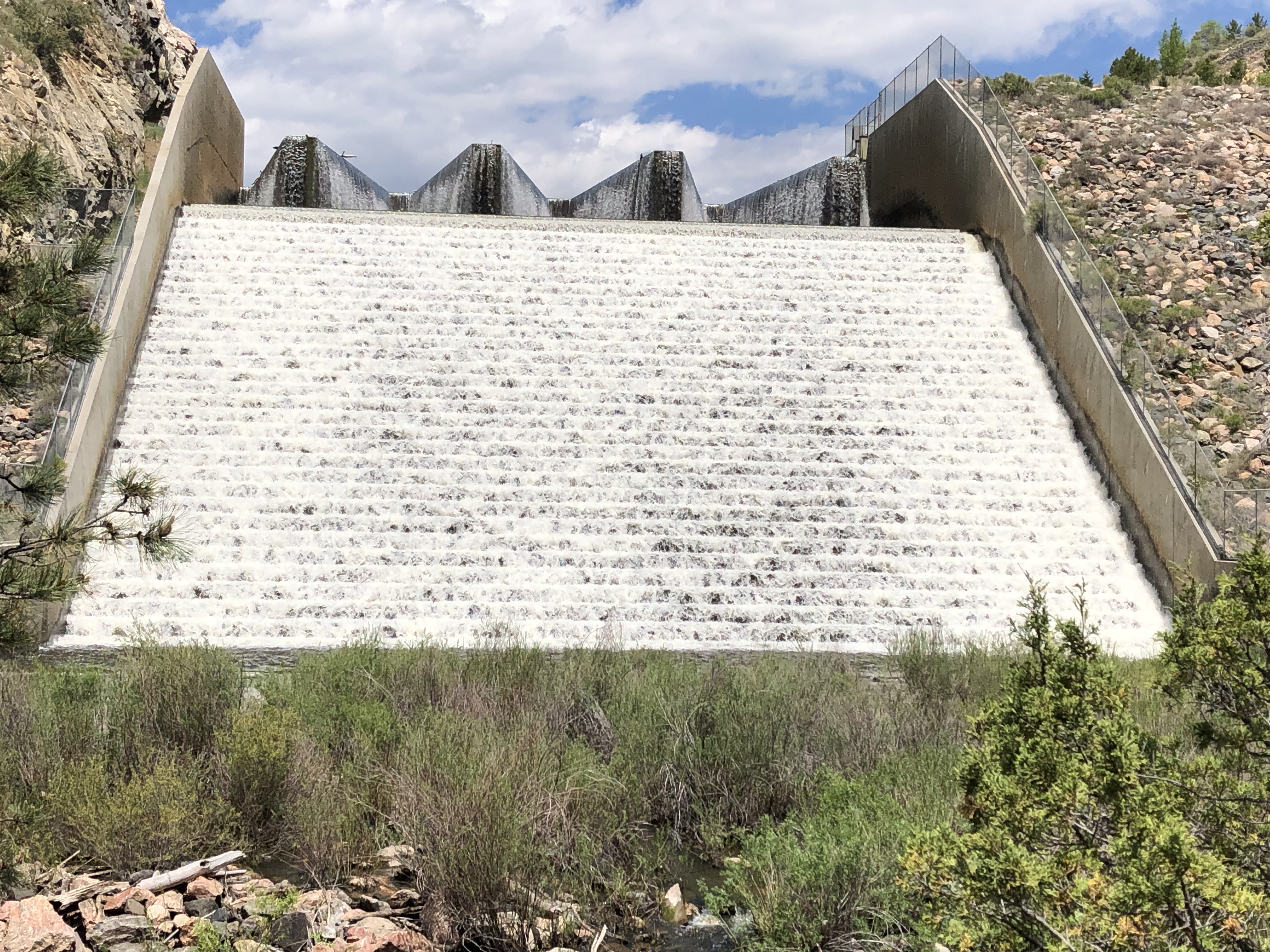
Weekend storm boosts #RoaringForkRiver Basin #snowpack to median — The #Aspen Daily News

Click the link to read the article on the Aspen Daily News website (Scott Condon). Here’s an excerpt:

January 16, 2024

For the Roaring Fork Basin overall, the snowpack soared from just 85% of average on Thursday morning to 102% on Monday morning, according to the NRCS. The Fryingpan Valley was the biggest gainer from the storms. The Chapman Tunnel Snotel site is at 107% of median. The Ivanhoe site is at 128%, Kiln is at 105% and Nast Lake is boasting a snowpack at 145% of median.โ€‚Meanwhile the Independence Pass Snotel site remains well below the rest of the basin. Independence was at only 67% of median as of Thursday morning. That improved to 80% by Monday morning with more snow falling. Nevertheless, thatโ€™s the lowest reading in the region. In the Crystal River drainage, McClure Pass was at 82% of median as of Monday morning. The North Lost Trail Snotel site outside of Marble was at 117%. The Schofield site, which typically has one of the highest snowpacks in the region, was at 90% Monday.

Map of the Roaring Fork River drainage basin in western Colorado, USA. Made using USGS data. By Shannon1 – Own work, CC BY-SA 4.0, https://commons.wikimedia.org/w/index.php?curid=69290878

Wet January helping #snowpack rebound — The #GrandJunction Daily Sentinel

Click the link to read the article on The Grand Junction Daily Sentinel website (Dennis Webb). Here’s an excerpt:

January 17, 2024

The National Weather Service in Boulder reported that from Friday through Monday, many areas in the central and northern mountains got 2 to 3 feet of snow, with some areas getting up to 4 feet, and wind gusts topping 100s mph in a few areas. Powderhorn Mountain Resort on Tuesday was reporting 8 inches over the past 48 hours. That was after it said it got more than 3 feet of snow over six days through last Thursday, including a whopping 24 inches in just 24 hours early last week. As of last week, all lifts and runs are now open at the resort. Vail Resorts is reporting seven-day snow totals at its Colorado ski areas ranging from 29 inches at Keystone Resort to 4 feet at Crested Butte Mountain Resort…Tom Renwick, a forecaster for the National Weather Service in Grand Junction, said the weekend storm produced about 50 inches of snow at Rabbit Ears Pass in the Steamboat Springs area and 51 inches at Green Mountain north of Vail, and much of the central mountain corridor got about 2 feet at higher elevations. In southwest Colorado, accumulations varied from about 4 to 8 inches in the foothills to a foot in higher elevations, he said. He said the Gunnison area had accumulations ranging from a foot to a foot and a half and Grand Mesa got around one foot in areas…

Snowpack in the Colorado River headwaters basin on Tuesday stood at 96% of normal for Jan. 16, with the Yampa/White/Little Snake river basins at 94% and the Gunnison River Basin also at 94%, according to the Natural Resources Conservation Service. The Upper Rio Grande River Basinโ€™s snowpack has increased to 71% of median from just 55% at the start of the month, the combined San Miguel/Dolores/Animas/San Juan basins stood at 84% of normal Tuesday and the Arkansas River Basin was at 85%.

Westwide SNOTEL basin-filled map January 19, 2024 via the NRCS.

#ColoradoRiver January 2024 Most Probable 24-Month Study — Reclamation #COriver #aridification #LakeMead #LakePowell

Map credit: AGU

Click the link to read the memo on the Reclamation Website (Noe Santos and Alex Pivarnik):

The operation of Lake Powell and Lake Mead in the January 2024 24-Month Study is pursuant to the December 2007 Record of Decision on Colorado River Interim Guidelines for Lower Basin Shortages and the Coordinated Operations of Lake Powell and Lake Mead (Interim Guidelines) and reflects the draft 2024 Annual Operating Plan (AOP). Pursuant to the Interim Guidelines, the August 2023 24-Month Study projections of the January 1, 2024, system storage and reservoir water surface elevations set the operational tier for the coordinated operation of Lake Powell and Lake Mead during 2024.

The August 2023 24-Month study projected the January 1, 2024, Lake Powell elevation to be less than 3,575 feet and at or above 3,525 feet and the Lake Mead elevation to be at or above 1,025 feet. Consistent with Section 6.C.1 of the Interim Guidelines the operational tier for Lake Powell in water year (WY) 2024 will be the Mid-Elevation Release Tier and the water year release volume from Lake Powell will be 7.48 million acre-feet (maf).

The 2022 Drought Response Operations Agreement (DROA) Plan1 for May 2022 through April 2023 was amended to suspend 2022 DROA Plan releases as of March 7, 2023. A total DROA release of approximately 463 thousand acre-feet (kaf) occurred under the 2022 DROA Plan. Reclamation will attempt to maximize DROA recovery in the Upper Initial Units in WY 2023 and through April 2024. Reclamation will provide monthly DROA accounting, including DROA releases and recovery, which can be found online at: https://www.usbr.gov/ColoradoRiverBasin/documents/dcp/DROA/DROSummarySheet.pdf.

In May of 2023, the DROA Parties agreed to the 2023 DROA Plan. The 2023 DROA Plan does not include any DROA releases, but rather provides for recovery of prior DROA releases from the units upstream of Powell.

Reclamation will continue to carefully monitor hydrologic and operational conditions and assess the need for additional responsive actions and/or changes to operations. Reclamation will continue to consult with the Basin States, Basin Tribes, Mexico, and other partners on Colorado River operations to consider and determine whether additional measures should be taken to further enhance the preservation of these benefits, as well as recovery protocols, including those of future protective measures for both Lakes Powell and Mead.

The August 2023 24-Month Study projected the January 1, 2024 Lake Mead elevation to be below 1,075 feet and above 1,050 feet. Consistent with Section 2.D.1 of the Interim Guidelines, a Shortage Condition consistent with Section 2.D.1.a will govern the operation of Lake Mead for calendar year (CY) 2024. In addition, Section III.B of Exhibit 1 to the Lower Basin Drought Contingency Plan (DCP) Agreement will also govern the operation of Lake Mead for CY 2024. Lower Basin projections for Lake Mead take into consideration updated water orders to reflect additional conservation efforts under the LC Conservation Program.

#Drought news January 18, 2024: The lack of seasonal snow cover has led to degradations across parts of the High Plains along the Front Range, due to topsoils being exposed and drying out

Click on a thumbnail graphic to view a gallery of drought data from the US Drought Monitor website.

Click the link to go to the US Drought Monitor website. Here’s an excerpt:

This Week’s Drought Summary

It was another stormy week across much of the eastern lower 48 states leading to widespread drought improvements from the Mississippi River Valley eastward to the Appalachians. A powerful storm system early in the week (January 9-10) brought heavy rainfall to parts of the eastern U.S., with most locations from Georgia to New England picking up more than 2 inches of precipitation, leading to flooding for several locations. In some locations across the Mid-Atlantic and interior Northeast, flooding was exacerbated by melting snow left over from a winter storm hitting the region the previous weekend (January 6-7). Behind the powerful storm system early this week, cold air plunged southward from Canada across the northern tier states, gradually spreading southward and eastward and overtaking most of the country east of the Rockies by the end of the week (January 16). Toward the end of the week, another storm system dropped wintry precipitation in a swath stretching from the Ozarks eastward to the Mid-Atlantic and Northeast. Across the western lower 48 states, precipitation was above average for the week, leading to targeted improvements to drought areas across the Intermountain West, where snowpack continues to build for several locations. Unfortunately, weekly precipitation and seasonal snowpack remain below normal this week across the Southwest and northern Rockies, leading to some degradation of drought conditions. No changes are warranted in Alaska this week, as the snowpack is in good shape statewide. Hawaii received more heavy rainfall this week, predominantly from a Kona Low early on, leading to improvement. Conversely, another warm and dry week in Puerto Rico warranted another round of degradation…

High Plains

Storminess in recent weeks and frigid temperatures this week warrant no changes across much of the Central and Northern Plains. However, there are mixed improvements (Colorado Plateau) and degradations (High Plains along the Front Range) warranted this week. Improvements to snowpack and short-term precipitation deficits this week warrant the improvements across the Colorado Plateau. Conversely, the lack of seasonal snow cover has led to degradations across parts of the High Plains along the Front Range, due to topsoils being exposed and drying out…

Colorado Drought Monitor one week change map ending January 16, 2024.

West

Some degradation of drought conditions is warranted where below average precipitation was observed this week. This is especially the case across western portions of Montana, where below average seasonal snow cover has left soils predominantly exposed, resulting in a slow decline in soil moisture over the past couple of months. On the other hand, targeted improvements are warranted across parts of the Pacific Northwest and eastern Great Basin, where 7-day precipitation totals and storminess in recent weeks have improved some of the long-term drought indicators. The active storm track in recent weeks has also led to gradual improvements to seasonal snowpack for several locations across the higher elevations of the Pacific Northwest, Great Basin, and portions of the Colorado Plateau…

South

Much of the precipitation this week fell across portions of the Ozarks and Tennessee Valley, associated with a couple of storm systems leading up to the start of the weekend (January 13), with many locations receiving in excess of 1 inch of rainfall. Toward the end of the week (January 15-16), a winter storm dropped several inches of snowfall across many of these same locations. Given the wetter than average conditions last week and another round of above average precipitation again this week, widespread improvement to drought conditions are warranted across portions of Arkansas and Tennessee. In parts of southern Texas, some degradation to the drought depiction is warranted, where short-term precipitation deficits are starting to mount. No changes are warranted elsewhere across the region due to above average precipitation last week and cold temperatures spreading across the region this week…

Looking Ahead

During the next five days (January 18-22), a fast moving storm system could bring some snowfall to portions of the Great Plains, Midwest, and Mid-Atlantic January 18-20. Surface high pressure behind this system is expected to gradually bring more southerly flow across much of the eastern U.S. as it moves eastward, leading to a moderation of the bitterly cold temperatures east of the Rockies, and some storminess across the south-central U.S., by January 22. A series of storms is also forecast to impact the West Coast over the next five days.

The Climate Prediction Centerโ€™s 6-10 day outlook (valid January 22-26), favors enhanced chances of above average temperatures across the entirety of the lower 48 states, with the highest chances (greater the 80%) centered over the Great Lakes. Enhanced chances of above average precipitation is also favored across much of the lower 48 states from coast to coast, with the highest chances (greater than 70%) across the south-central U.S. The exception is across the Northern Plains, where below average precipitation is favored.

US Drought Monitor one week change map ending January 16, 2024.

#GreatSaltLake Strategic Plan Released

Click the link to read the release on the State of Utah website (Kim Wells):

January 16, 2024

The Great Salt Lake Commissionerโ€™s Office has released the state of Utahโ€™s firstย strategic planย to get the Great Salt Lake to a healthy range and sustain it. In November 2022, the lake fell to a new record low level.ย  During the 2023 Legislative General Session,ย HB491ย  was passed, creating the Office of the Great Salt Lake Commissioner and required the preparation of a strategic plan applying โ€œa holistic approach that balances the diverse interests related to the health of the Great Salt Lakeโ€ฆ.โ€

โ€œThe plan represents an initial strategy to more effectively protect the lake while balancing the other ecological, economic and societal interests surrounding the lake,โ€ Commissioner Brian Steed said. โ€œRestoring the lake to a healthy range is not a one-year, one-policy, one-constituency solution. It will take a coordinated, data-driven approach so decision-makers can evaluate tradeoffs and balance competing interests.โ€

The lake is a dynamic system, and its management must also be dynamic. The plan will be revisited regularly and adjusted to reflect the latest data and meet new challenges and opportunities. The strategy includes short-, medium- and long-term actions. 

As outlined in HB491, the Great Salt Lake Strategic Plan helps ensure coordination of the work taking place among the manyย stakeholdersย who work on lake issues and calls for:ย 

  • Coordinating the efforts of a wide variety of agencies and stakeholders and ensuring robust public engagement on issues related to the lake
  • Utilizing the best available science and data when making decisions that impact the lake
  • Getting more water to the lake and ensuring a sustainable water supply while balancing competing needs, including human health and quality of life, a healthy ecosystem and economic developmentย 
  • Conserving water across different sectors (M&I, industrial and agricultural), including quantification of water savings and shepherding saved water to the lake
  • Protecting air and water quality

The release of the Great Salt Lake Strategic Plan is just the beginning. The hard work of implementing the plan builds off the work the state and others have already begun.  As the plan states on page 15, โ€œthe actions identified in the planโ€™s first year largely build upon initiatives, partnerships, and programs that have already begun to help the Great Salt Lake. The short-term actions are designed to provide a foundation and guidance for longer term strategies and actions.โ€ The plan also calls for additional detailed planning efforts to ensure enough water gets to the lake over the next 30 years and to maximize the investments that the Legislature has made for the benefit of the lake and everyone who relies upon it.

โ€œStriking the right balance for the Great Salt Lake is no small task, especially among the pressures of continued growth, sustained drought and higher temperatures that threaten to increase demand and shrink available water supplies even further,โ€ Steed said. โ€œIt will take all of us working together to protect and sustain the lake.โ€ย 

Learn more.


Aerial images of Great Salt Lake at record low elevation in 2021. Credit: Utah Department of Natural Resources

#Colorado pledges to play nice as #Nebraska plows ahead on $628M Perkins County Canal at the state line — Fresh Water News #SouthPlatteRiver

South Platte River at Goodrich, Colorado, Sunday, November 15, 2020. Photo credit: Allen Best

Click the link to read the article on the Fresh Water News website (Jerd Smith):

January 17, 2024

Nebraska is moving quickly to build a major canal that will take water from the drought-strapped South Platte River on Coloradoโ€™s northeastern plains, and deliver it to new storage reservoirs in western Nebraska.

But after a tumultuousย project announcement last year, with both states angrily declaring their thirst and concerns, the conflict has quieted, and talk of lawsuits, at least for now, has stopped. Water watchers liken this apparently calm work period with a similar period 100 years ago when early threats of legal battles gave way to an era of study and negotiation that preceded the signing by both states of the South Platte River Compact.

Governor Clarence J. Morley signing Colorado River compact and South Platte River compact bills, Delph Carpenter standing center. Unidentified photographer. Date 1925. Print from Denver Post. From the CSU Water Archives

โ€œIn my mind, itโ€™s โ€˜what is there to fight over,โ€™โ€ saidย Jim Yahn, a fourth-generation rancher, and former member of the Colorado Water Conservation Board who runs the North Sterling Irrigation Company. โ€œUnder theย 1923 South Platte River Compact, it is Coloradoโ€™s obligation to deliver. So now weโ€™re going to start suing and fighting over it? We agreed to do this. I donโ€™t think itโ€™s worth losing sleep over.โ€

With $628 million in cash from its state legislature, Nebraska has begun early design work and is holding public meetings outlining potential routes for the canal and reservoirs, according to Jesse Bradley, assistant director of the Nebraska Department of Natural Resources.ย At least one Colorado land purchase has been made.

Nebraska intends to complete design and start construction bidding in three years, and finish the project seven to nine years later, Bradley said.

โ€œWeโ€™re just trying to make sure we can protect the water we have under the compact,โ€ Bradley said. โ€œWe donโ€™t want to be any more intrusive than we need to be โ€ฆ and we believe there are opportunities for some win-wins,โ€ he said, including stabilizing levels in the popular Lake McConaughy and ensuring there will always be enough water in the river to protect one of the nationโ€™s most successful endangered species programs, the Platte River Recovery Implementation Program.

Engineering studies indicate the project could deliver 78,000 to 115,000 acre-feet of water annually, and perhaps just 30% of that in drought years, Bradley said. But that is still big water. If the top estimates hold, thatโ€™s enough water to irrigate more than 115,000 acres of corn, or supply water to more than 230,000 urban homes for one year.

At the state line, a difficult river

On the high prairie around Sterling and Julesberg, the solitude and silence mask a complicated water arena, withย cities such as Parker and Castle Rockย planning major projects themselves, and large- and small-scale cattle and corn producers watching every drop that flows.

Perkins County Canal Project Area. Credit: Nebraska Department of Natural Resources

โ€œThere is a lot going on up there,โ€ said Ron Redd, Parker Water and Sanitation Districtโ€™s general manager. โ€œI think that there is a fear that the way [Nebraska] has it laid out is going to be difficult. But the tone has changed because people understand it better. When we look at the numbers, we think itโ€™s not the end of the world.โ€

Colorado has a history of working with Nebraska on other water issues, including the successful negotiation of the South Platte River Compact and the settlement of a lawsuit involving the Republican River and Kansas.

Still, Colorado water regulators say they will carefully monitor the project and plan to meet regularly with Nebraskaโ€™s team.

โ€œThere are issues,โ€ said Kevin Rein, the former director of Coloradoโ€™s Division of Water Resources who retired in December. โ€œThe canalโ€™s location and the route it would follow is important. But more substantively, we want to ensure that the placement of the headgate [diversion structure] and the canal donโ€™t create a burden on Colorado and its water users.โ€

Water projects inside Colorado are subject to in-depth reviews in special water courts, but the Perkins Canal Project, as it is known, is governed by the federal compact, and wonโ€™t necessarily be subject to that process, officials said.

Colorado growers with junior water rights on the Lower South Platte, who are only allowed to divert during the winter, will likely be the most affected, according to Mike Brownell, a Logan County commissioner and dryland farmer. Under the compact, Nebraska too has a winter diversion right. The success of the deal will likely come down to how well both states and their diverters manage the water that is flowing, often in difficult icy conditions, officials said.

Local meetings in Sedgwick and Logan counties have been ongoing. Brownell said some people in those meetings estimate that vulnerable growers could lose half the water they are typically able to divert.

โ€œIf that would come to pass, it would be pretty catastrophic,โ€ Brownell said. โ€œWeโ€™re really not certain yet, but if we go from having thousands of irrigated acres, to having thousands of dryland acres, itโ€™s going to severely impact the property tax base in Logan and Sedgwick counties.โ€

Platte River Recovery Implementation Program target species (L to R), Piping plover, Least tern, Whooping crane, Pallid sturgeon

Also of concern is the health of the Platte River Recovery Implementation Program. Funded and overseen by Colorado, Wyoming, and Nebraska, and the federal government, the nearly 17-year-old program helps keep more water in the central Platte River and has dramatically boosted at-risk bird populations, including piping plovers and whooping cranes, and expanded their habitat. It has also allowed dozens of water projects in Colorado, Wyoming and Nebraska to comply with the federal Endangered Species Act and continue operating.

But that hard-won agreement took 10 years to negotiate. Don Ament, a Sterling-area rancher and former Colorado Commissioner of Agriculture who helped negotiate the deal, said heโ€™s worried that political strife over the canal and any additional strain on the riverโ€™s supplies, could endanger the recovery program.

Still, with few details on canal location and actual water diversions available yet, itโ€™s difficult to say what impact the Perkins Canal will have, according to Jason Farnsworth, executive director of the recovery program.

โ€œWe could see more water in the river, we could see less. We just donโ€™t know yet,โ€ he said.

Nebraskaโ€™s Bradley said he believes the recovery initiative will actually benefit from the canal, as his state seeks to gain control over its new winter water supply and deliver it to the main stem of the river, where it will benefit birds and fish.

โ€œThough the recovery program is not the primary objective of the canal, we think we are aligned with its goals because we are trying to maintain the flows we have today without seeing them erode,โ€ Bradley said.

The South Platte River Basin is shaded in yellow. Source: Tom Cech, One World One Water Center, Metropolitan State University of Denver.

The South Platte, like other Western rivers, is seeing flows shrink, thanks to climate change and growth farther west along Coloradoโ€™s Interstate 25 corridor.

Good water years, such as 2023 and 2013, still can dramatically boost flows on the Colorado/Nebraska state line. Water managers in Colorado believe careful management of the lower river and perhaps increased storage, could allow all the water users to coexist.

โ€œThere is a potential impact to (water) rights in the river, whether itโ€™s for storage or for the recovery program. So what do we do about that? We administer according to the compact,โ€ Rein said. โ€œIt sounds a little like weโ€™re giving up, but the water users are pretty smart. They know how to legally, and in good form, develop strategies to mitigate the impacts.

โ€œThe current perspective of Colorado,โ€ he added, โ€œis that we need to recognize that there is an interstate compact that has been approved by the United States and we place a high regard on the need to comply with that compact.โ€

More by Jerd SmithJerd Smith is editor of Fresh Water News. She can be reached at 720-398-6474, via email at jerd@wateredco.org or @jerd_smith.

Yes, Biden broke a promise. And it’s okay: Looking at the administration’s record on public lands and energy — Jonathan P. Thompson (@Land_Desk) #ActOnClimate #KeepItInTheGround

Pumpjacks in southeastern Utah. Jonathan P. Thompson photo

Click the link to read the article on The Land Desk website (Jonathan P. Thompson):

January 16, 2024

A few weeks ago, for myย monthlyย High Country Newsย column, I tried to unravel the puzzle posed by wildly divergent interpretations of President Bidenโ€™s record on climate, fossil fuels, and public lands. On the one hand, the Republican National Committee whined about how the administration is waging a war on energy, particularly fossil fuels. On the other, the college arm of the Democratic National Committee was accusing Biden of โ€œclimate indifference.โ€ย 

My conclusion was more or less this: Biden has been good โ€” maybe the best president โ€” when it comes to protecting certain public lands from fossil fuel energy development, even though he has made some questionable decisions. Thatโ€™s hardly climate indifference. And yet, during his watch, the U.S. oil industry has produced more crude and exported more natural gas than ever before, mostly on the strength of a drilling frenzy in the Permian Basin of Texas and New Mexico. If Bidenโ€™s waging a war on energy, his side is losing. 

In other words, neither side is correct (although I have to say the Republicans are wayoff. What donโ€™t they understand about record-high oil production levels and multi-billion dollar oil corporation profits?). And probably both sides should quit their kvetching.

Some readers seemed to appreciate my willingness to explore the liminal spaces; others not so much. Hereโ€™s an excerpt from one of the responses to the story: 

โ€ฆ I was pretty dismayed over his exclusion of Biden’s central campaign promise, which was ‘No more drilling on Federal land.’  โ€ฆ Why wasn’t this mentioned in Thompson’s piece? โ€ฆ In fact, I found it to be pretty disappointing that none of this was even brought up in his article, especially given how outraged and betrayed many young voters like myself feel re this. โ€ฆ If it was a Republican president who had broken a central campaign promise, my intuition is that it would have been pointed out in an article like the one Thompson wrote.

Iโ€™m pretty sure the letter writer, weโ€™ll call them Jay, isnโ€™t alone in their assessment of the Biden administrationโ€™s stance on federal land drilling โ€” or of my column. And I have to admit, I struggled a little bit with coming up with an honest response that didnโ€™t sound overly cynical. After all, telling someone who is outraged and feeling betrayed to just get over it is a bit harsh. But when it comes to the broken promise thing? Get over it. 

Wait! Donโ€™t stop reading yet. Bear with me as I explain. 

Yes, during the 2020 campaign, Biden did promise to end oil and gas drilling on public lands. I know that because the RNC listed all the instances of such pledges, holding them up โ€” ironically โ€” as evidence that Biden is waging that aforementioned war on energy. And no, he hasnโ€™t done that โ€” and probably wonโ€™t. Promise broken, outrage ensues. 

And I get it. Itโ€™s annoying and maddening to listen to politicians make promises they know they canโ€™t keep. But it also happens all of the time. During the 2020 campaign, Sen. Elizabeth Warren made a very similar promise, even including it in her energy plan. Would she have lived up to it? Highly unlikely. 

The President is not a dictator, thankfully, and canโ€™t simply make a massive change like ending all drilling on federal lands with a snap of the finger. Both Warren and Biden knew that. But that doesnโ€™t mean they were lying in order to secure more votes. Rather they were simply signaling their intent, setting a sort of Platonic-ideal goal to which theyโ€™d aspire and which they might achieve if there was no obstructionist Congress or courts or political gamesmanship to navigate. They are telling a certain type of voters that they will represent their interests, while telling another type (the fossil fuel-fetishizing RNC, for example) that they wonโ€™t. 

All of which is to say that judging a politician on promises kept or broken may not be that productive. Better to judge them on their policies and how they play out on the ground. And the Biden administration has made big strides in this direction, including: 

  • Halting all new oil and gas leasing on federal lands shortly after they took office, a move that had it remained in place would have eventually phased out new drilling. However, the courts shot down the moratorium, forcing the administration to hold new lease sales.
  • But those new sales donโ€™t look like the lease sales of old. For example, the BLM quietly pulled over 100 parcels from Wyoming auctions to protect sage grouse and big game habitat, and has angered industry by allegedly withholding some of the most productive parcels.
  • Restoring the original boundaries of Bears Ears and Grand Staircase-Escalante National Monuments, putting those lands off-limits to new oil and gas leases or mining claims. 
  • Banning โ€” for the next 20 years โ€” new oil and gas leasing within a 10-mile radius of New Mexicoโ€™s Chaco Culture National Historical Park and canceling Trump-era oil and gas leases in Alaskaโ€™s Arctic National Wildlife Refuge.
  • Proposing the withdrawal of nearly 4 million acres of federal land from new oil and gas leases in western Colorado and Wyomingโ€™s Red Desert.
  • Finalizing a plan to declare an additional 225,000 acres of the Thompson Divide in western Coloradoโ€™s high country off-limits to new oil and gas leasing and mining claims for the next 20 years.
  • Raising minimum bids for oil and gas leases and royalty rates on new drilling from 12.5% to 16.67% and increased reclamation bond amounts to help ensure that the oil companies โ€” not the taxpayers โ€” clean up the messes they make. 
  • Establishing the Baaj Nwaavjo Iโ€™tah Kukveniโ€”Ancestral Footprints of the Grand Canyon National Monument in northern Arizona, thereby protecting nearly 1 million acres from potential uranium mining.

  • Finalizing Environmental Protection Agency rules aimed at reducing methane emissions from oil and gas infrastructure, which are expected to prevent the release of 58 million tons of methane emissions โ€” the short-term climate-warming equivalent 4.9 billion tons of carbon dioxide* โ€” as well as 16 million tons of health-harming volatile organic compounds.
  • Implementing a new per-ton fee on methane emissions from oil and gas facilities, which should incentivize petroleum companies to cut not only that potent greenhouse gas, but also to reduce emissions of human-harming compounds that typically spew from wells.  
  • Proposing a Bureau of Land Management rule that would put conservation on a par with other public land uses, such as energy development and grazing.
  • Allocating billions of dollars to states and tribes to plug and reclaim abandoned and orphaned oil and gas wells that are prone to leakage and generally make a mess of things. This not only is good for the environment, but it is helping to create a new well-plugging industry in places where drilling has declined, thereby creating a land-healing economy. 

Not too shabby. And Iโ€™d say these actions do show that Biden has lived up to the intent behind his pledge, if not living up to the word of the promise. At least for the most part. 

Of course, all that good is offset at least somewhat by the administrationโ€™s approval of ConocoPhillipsโ€™ massive Willow oil and gas development in Alaska. Biden aimed for a sort of compromise, allowing for three drilling sites rather than the proposed five, nearly cutting the project in half. And yet the sheer magnitude of the development, which will include nearly 200 miles of roads and pipelines and various other infrastructure, is mind-numbing still. And putting some other Arctic lands off-limits to drilling doesnโ€™t exactly make up for the impacts this will wreak on the climate and the local environment and nearby communities. 

Meanwhile, the Bureau of Land Management under Biden issued 3,800 drilling permits for public lands, about 2,500 of which were in the Permian Basin, during fiscal year 2023. Thatโ€™s a lot, and seems to fly right in the face of Bidenโ€™s pledge to end federal land drilling. And, yes, it is more than Trump issued during his first two years in office, but far fewer than in Trumpโ€™s last two years. (Not that comparing anyone to Trump on these issues does anyone any good, since presidents donโ€™t control this sort of thing. The W. Bush administration issued nearly 7,000 permits during a single year, by the way).

At first glance it may look like Biden handed out an insane number of permits during his first year in office. In fact, most of the permits for fiscal year 2021 were issued by Trump in his final months in office. Apparently oil companies feared Biden would cut off the spout, so they went crazy with applications. Credit: Jonathan P. Thompson/The Land Desk

At times it can seem as if the Biden administration is erratically indecisive on these issues. But I would say that what appears to be fickleness is actually shrewd political pragmatism. Had Biden canceled Willow altogether, he would have drawn the ire of Sen. Lisa Murkowski, one of the few rational Republicans in Congress, and Rep. Mary Peltola, a Democrat and Native Alaskan who is an ardent supporter of Willow and Alaska energy development in general. And attempting to directly thwart Permian Basin drilling by shutting down permitting or leasing there would threaten the massive budget surpluses resulting from an oil and gas tax revenue bonanza, which in turn would surely cause problems for the Democrats who make up most of the stateโ€™s political leadership, from the governor to the congressional delegation to the state legislature. Biden would alienate his allies and then heโ€™d likely lose in court. [ed. emphasis mine]

It is disappointing that our leaders have to play these games, especially given whatโ€™s at stake. But is it a betrayal? Or climate indifference? I think not. As for the outrage, I would suggest aiming it not at Biden, but at the oil corporations pumping out crude โ€” and raking in profit โ€” at record high levels, all the while whining about even the most incremental efforts to slow them down and protect the planet. [ed. emphasis mine]

#Coloradoโ€™s lagging #snowpack spikes following back-to-back storms, now nears 30-year average — The Summit Daily

Click the link to read the article on the Summit Daily website (Robert Tann). Here’s an excerpt:

January 17, 2024

According to data from the U.S. Department of Agriculture, Coloradoโ€™s snowpack is at 90% of the 30-year-median as of Tuesday, Jan. 16. It marks a major turnaround from the beginning of the month,ย when statewide snowpack hovered between 60% and 70% of the median.ย 

โ€œItโ€™s been pretty significant, the jump that weโ€™ve received in the last roughly week or so,โ€ said James Heath, division engineer for the Colorado Division of Water Resources.

Before this past week, โ€œWe were tracking alongside some of our worst years for snowpack,โ€ such as 2002, 2012 and 2018, Heath said. But double-digit snowfall, which for some mountain areasย translated to multiple feet of snow,ย caused snowpack levels to surge.

Some regions are trending above the state average, such as the Colorado Headwaters River Basin, which includes central and northern mountain areas. As of Tuesday,ย the basin was at 96% of the average…Snowpack measures the amount of water held in the snow, which is referred to as the snow water equivalent. In an average season for the Colorado Headwaters, the snow water equivalent will peak at 17.5 inches, representing the amount of water predicted to melt and become runoff in the late spring and early summer.ย  Within the past week, the snowpack netted roughly 2 inches of water, rising from 5.4 inches on Jan. 9 to 7.7 inches on Jan. 16. Tracking the snow water equivalent can be a critical indicator for how full reservoirs will be come summer…

Longer-range forecasts show elevated precipitation in the weeks and months ahead.ย According to projections from the National Oceanic and Atmospheric Administration, Colorado has a 33% to 40% chance of more precipitation than is usual for the months of January, February and March.

#Colorado Town Appoints Legal Guardians to Implement the Rights of a Creek and a Watershed — Inside #Climate News #BoulderCreek #SouthPlatteRiver #RightOfNature

Nederland, Colorado. By Kkinder, CC BY-SA 3.0, https://commons.wikimedia.org/w/index.php?curid=1314472

Click the link to read the article on the Inside Climate News website (Katie Surma):

Systemic roadblocks in the U.S. legal system have thwarted efforts to advance the rights of nature movement. The Colorado advocates are testing a new approach.

A town in Colorado has appointed two legal guardians to act on behalf of natureโ€”in this case, a section of Boulder Creek and its watershed situated within the town of Nederland. 

Activists are hailing the move as the first time humans have been appointed to act as legal guardians for nature within the United States, where the so-called rights of nature movement has had a hard time advancing laws that recognized the rights of rivers, forests, animals and ecosystems. 

Earlier this month, the Board of Trustees in Nederland, 45 miles northwest of Denver, authorized the appointment of two guardians to represent Boulder Creek and the watershed for purposes of preparing annual reports about the ecosystemsโ€™ health and to make recommendations on improving water quality, wildlife habitats and wetlands protection. 

The board, the townโ€™s legislative body, approved Nederland residents Alan Apt, an author and former board member, and Rich Orman, a retired lawyer, as the ecosystemโ€™s first guardians.ย 

Legal guardians are regularly appointed by courts to make decisions for, and represent the interests of, children, incapacitated adults and bankrupt organizations.

Importantly, the Nederland board did not give Apt and Orman authority to sue on behalf of the watersheds or to be sued. That exception was aimed at averting pushback from opponents, according to Gary Wockner, the Colorado-based executive director and founder of Save the Worldโ€™s Rivers and a rights of nature advocate. 

In Florida and Ohio, where communities have passed rights of nature laws, the agriculture industry has successfully pushed for the enactment of state-level legislation preempting the local ordinances, rendering them void. 

Rights of nature laws generally provide higher levels of protection to ecosystems and species than conventional laws, worrying some industry groups who say the laws could be used to block development. 

Overcoming such preemption legislation requires a state level law or constitutional change. Even before voters in Orange County, Florida, overwhelmingly approved a ballot referendum in 2020 recognizing the legal rights of five waterways to exist, the conservative Florida legislature passed a law prohibiting localities from enacting such measures. 

With those lessons in mind, advocates, including Wockner, are using a different tactic in Colorado, where there currently is no rights of nature preemption law on the books.ย 

โ€œWe chose to take a soft approach aimed at winning peoplesโ€™ hearts and minds,โ€ Wockner said, adding that Nederlandโ€™s resolution is aimed in part at educating people about the shortcomings of existing environmental laws.

Those shortcomings, according to Wockner, include who has legal standing to go to court and enforce environmental protection laws. Typically, to meet standing requirements, plaintiffs must, among other things, show that they have been injured and that the court has the capacity to grant some sort of relief that would benefit them, which has generally required that they be human. 

Rights of nature advocates say that the system is based on the flawed premise that natureโ€”from individual species to whole ecosystemsโ€”is merely property that humans generally have the right to destroy. Typically, mainstream legal systems only consider the wellbeing of nature indirectly. For example, if land is illegally polluted, the owner of that land could ask a court to order a remedy for his economic, health or other damages. Generally, there is no way for the court to account for harm to the land in its own right.  

That human-centered approach is criticized by advocates who argue that legal systems should be based on the reality that humans are part of nature and that, similar to humans, the natural world inherently possesses certain rights. They also point out that mainstream legal systems have long recognized that corporations, nation states and other non-human entities have legal rights and the ability, through guardians or other designated representatives, to go to court and enforce those rights.ย 

Nature, too, advocates say, should have legal standing to assert its rights and request relief, such as for ecosystem restoration, even when there is no immediate human interest at stake. 

In 2021, Nederland town took a step in that direction when it issued a nonbinding declarationย recognizingย that, within town limits, Boulder Creek and its watershed were โ€œlivingโ€ entities possessing โ€œfundamental and inalienable rights,โ€ such as to exist, to be restored and to provide an adequate habitat to native wildlife such as black bears, bobcats, brown trout and giant pine trees.ย 

A previous attempt to advance the so-called rights of nature movement in Colorado was shut down in 2017. Attorney Jason Flores-Williams filed a lawsuit in federal court on behalf of the Colorado River Ecosystem and others, and against the state of Colorado, seeking judicial recognition of the ecosystemsโ€™ rights to exist, flourish, regenerate and naturally evolve. 

Coloradoโ€™s then attorney general moved to dismiss the complaint, asserting that the suit contained various procedural deficiencies and threatened to sanction Flores-Williams, who, in response, withdrew the lawsuit.ย 

Colorado Rivers. Credit: Geology.com

Since then, the town of Nederland and three other Colorado municipalities have enacted nonbinding resolutions recognizing the rights of theย Uncompahgre River,ย Grand Lake andย St. Vrain Creeks.ย 

โ€œWeโ€™re working within the confines of the Colorado and U.S. legal systems, and nibbling away at them,โ€ said Wockner, the Fort Collins-based advocate. โ€œItโ€™s absolutely a long game, but there are a lot of people who think this way.โ€

The Whanganui is a major river on the North Island of New Zealand. The Whanganui River is a major river in the North Island of New Zealand. It is the country’s third-longest river, and has special status owing to its importance to the region’s Mฤori people. In March 2017 it became the world’s second natural resource (after Te Urewera) to be given its own legal identity, with the rights, duties and liabilities of a legal person. The Whanganui Treaty settlement brought the longest-running litigation in New Zealand history to an end. Dana Zartner, CC BY-ND via The Conversation

At least six countriesโ€”Ecuador, Bolivia, Panama, Uganda, New Zealand and Spainโ€”as well as some Native American tribes, have some form of national law recognizing the rights of nature or legal personhood for ecosystems. Many more nations have some form of court recognition or local laws recognizing the rights of ecosystems or individual species. 

Some of those laws strictly recognize that nature possesses particular rights, like the rights to exist and regenerate, while other laws recognize the legal personhood of an ecosystem, which generally implies that the ecosystem also bears duties. 

The U.S. Supreme Court has in multiple cases recognized legal personhood for non-humans, most prominently in Citizens United v. Federal Elections Commission, where it recognized the legal personhood of corporations. 

Rights of nature laws also vary in who can go to court on natureโ€™s behalf. Some provide legal standing to any person, while others, like Nederlandโ€™s resolution, appoint specific guardians. In Colombia, where there is judicial recognition of the rights of the Atrato River, a court created a guardianship body, including members of riverine communities, to enforce the Atrato riverโ€™s rights.

The polar vortex is acting up — NOAA

Click the link to read the article on the NOAA website (Laura Ciasto and Amy Butler):

January 16, 2024

Across the United States, many are experiencing the first big blast of Arctic air of 2024. Coats and gloves are emerging from the closets, and heaters are working overtime, with temperatures dropping more thanย 25 degrees below normal in some parts of the country.ย But the question on our mindsโ€ฆthe ever-looming question everyone asks when the cold air spreads across the country โ€ฆ the question that motivated this blog: Is the stratospheric polar vortex playing a role in this cold snap? Read on to find out!

Like parts of the United States, some flowers arenโ€™t used to the cold and snow. Photo credit: Laura Ciasto.

Stratospheric shenanigans

If we had to characterize the behavior of the stratospheric polar vortex over the last week, weโ€™d say itโ€™s actingโ€ฆsquirrely. Living up to the celebrity status we bestowed upon it, the stratosphere seems to know everyone is watching and has decided to do something unexpected. 

For weeks now, weโ€™ve talked about the warming of the temperatures and weakening of the polar vortex winds that are 19 miles above us over the Arctic. So far, this disruption of the polar vortex has been minor, falling short of the wind reversal (west-to-east โ†’ east-to-west) that defines a major sudden stratospheric warming. Ourย postย last week explained that this major warming event has been elusive so far due to the lack of waves propagating from the troposphere below to the main level of the stratospheric polar vortex. Minor warmings themselves are not unexpected. Nor are they generally expected to be felt all the way down at the surface.
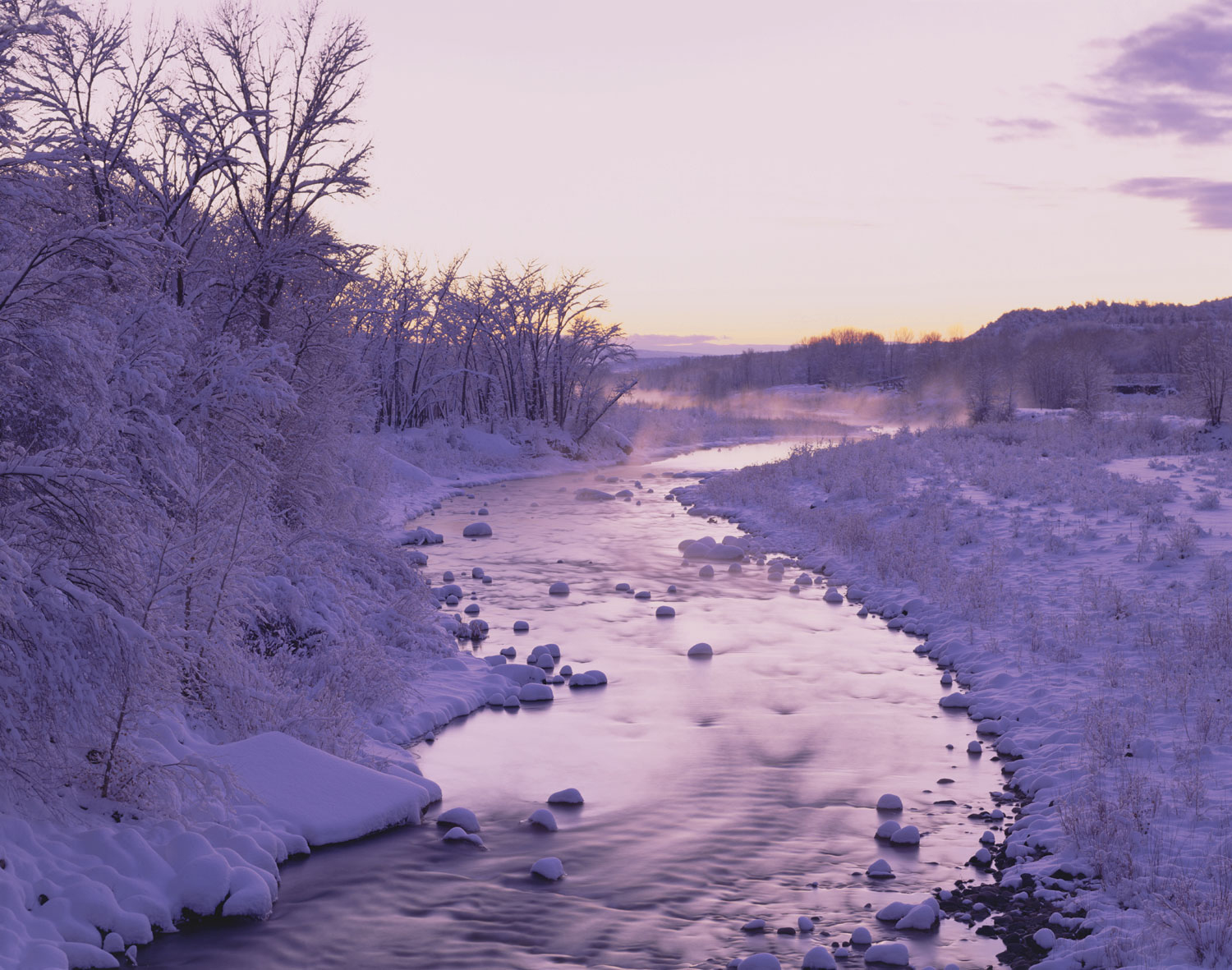
Atmospheric conditions over the last week. In the last several days (left panel), the vortex in the lower stratosphere has been pulled apart from below with two smaller lobes emerging, one of which has been hanging out well above eastern North America. Itโ€™s only in the last day or two (right panel) that this splitting of the vortex has extended up towards 10-hPa. NOAA Climate.gov image based on Global Forecast System data provided by Laura Ciasto.

But what makes the stratosphereโ€™s current behavior unexpected and somewhat rare is that the polar vortex seems to be more disrupted at the lower levels, closer to the stratosphere-troposphere boundary. For more than a week, high pressure has been sitting in the troposphere over Greenland [footnote #1]. Itโ€™s possible that the recent minor stratosphere warming reinforced this Greenland high pressure, which then drove a wedge into the stretched-out polar vortex in the lowest part of the stratosphere, splitting it into two lobes. 

This lower stratosphere disturbance has been affecting the winds above it and looks to become just strong enough to fully reverse the winds of the polar vortex in the mid-stratosphere. A major sudden stratospheric warming is forecast to likely occur tomorrow. Normally, thatโ€™s when the excitement about whether weโ€™ll see any surface impacts begins, as changes in the polar vortex communicate their way down to the lower stratosphere and sometimes the troposphere. But since the lower stratosphere has been perturbed for a while now, weโ€™ve already been on the lookout for changes in the troposphere.

Teasing the troposphere

Though we will have to wait and see how much this brief but major disruption of the polar vortex may influence weather patterns over the next few weeks, it appears as though the minor warming during the first week of January and the subsequent destruction of the polar vortex in the lower stratosphere were enough to at least help set the stage for the cold air outbreak over North America this past weekend. We havenโ€™t talked much about the surface impacts yet, but we tend to think of it in a probabilistic sense: a disrupted polar vortex increases the odds that the tropospheric jet stream will stay shifted farther south, which increases the risk for cold air outbreaks over the eastern United States and Europe. Most importantly, this โ€œloading of the diceโ€ for cold air can persist for up to 6 weeks after the vortex is disrupted, making these events relevant for weather timescales, but also for longer sub-seasonal forecasts (e.g., Week-2 to Monthly Outlooks).

Differences from average atmospheric thickness (standardized geopotential height anomalies) in the column of air over the Arctic from the troposphere to the stratosphere since mid November 2023. The lower stratosphere and upper troposphere have been most strongly connected for the last several days as denoted by the high thickness anomalies (orange areas, suggesting a weaker-than-average polar vortex). Based on the Global Forecast System (GFS) model, that connection may last for a few more days before weakening as indicated by the forecasted low tropospheric thickness anomalies (purple area) that do not extend into the stratosphere. NOAA Climate.gov image adapted from original by Laura Ciasto.

Itโ€™s important to note that while the polar vortex may have played a part in nudging the current jet stream south, and may help that pattern persist, there are many other factors that go into a cold air outbreak. Other climate processes like the ongoing El Niรฑo also impact the location of the jet stream throughout the winter. And the jet stream doesnโ€™t always need to be nudged by climate processes in the tropics or the stratosphere; it can nudge itself (what weโ€™d call internal variability).

Lasting impressions?

Based on the recent forecast models, the full breakdown of the polar vortex into a major sudden stratospheric warming is expected to be brief. After that, the forecast average suggests the vortex will cease its shenanigans and strengthen again back to its normal speed. While the polar vortex in the mid-stratosphere tends to recover quickly after these disturbances, any effects on the tropospheric jet stream and its weather patterns could potentially stick around for a while. This doesnโ€™t automatically mean more cold air outbreaks like weโ€™ve seen this week, but gives us a heads up that the risk of these events is slightly higher in the weeks to come.

Observed and forecasted (NOAA GEFSv12) wind speed in the polar vortex compared to the natural range of variability (faint shading). Based on the January 15, 2024 forecast, the stratospheric polar vortex winds will decrease to zero, just reaching the threshold of a major sudden stratospheric warming, in the next day or two. This major warming status will be brief and the winds are forecast to become westerly again, strengthening to their near normal state in the next week. The vortex may even become stronger than normal, based on the average of all individual forecasts, but that outcome is uncertain due to the large range of the individual forecasts. NOAA image by Laura Ciasto.

Footnotes

  1. Sometimes a high pressure center will set up over a region (like Greenland) and sit there for multiple days. When this happens, the weather patterns that normally move from west to east are โ€œblockedโ€ and have to move either north or south of the high pressure center. The persisting high pressure over Greenland is not uncommon in the winter and is sometimes called a Greenland block.

#Snowpack news January 16, 2024: Beautiful snowfall over the weekend

Westwide SNOTEL basin filled map January 16, 2024 via the NRCS.
Colorado snowpack basin filled map January 16, 2024 via the NRCS.

4 Western Slope takeaways from Jared Polisโ€™ State of the State speech: The governor talked about wolves, fire insurance and mountain rail, but water was not emphasized — The Summit Daily

Image from Grand County on June 6, 2020 provided courtesy of Jessica Freeman via Colorado Parks and Wildlife.

Click the link to read the article on The Summit Daily website (Elliott Wenzler). Here’s an excerpt:

January 12, 2024

Wolves

While talking about his goals for the environment, the governor mentioned the reintroduction of gray wolves in Colorado, which began in December, as a way the state is โ€œstrengthening native biodiversity and restoring balance to our ecosystems.โ€

โ€œWe also need to protect that progress by continuing to invest in nonlethal conflict minimization that works to help our farmers and ranchers thrive,โ€ he said…

Reducing fire insurance costs

Polis kicked off his speech talking about his top priority: housing. While he mostly focused on policies he hopes will help boost housing stock across the state, he also mentioned he would be supportive of legislation aimed at reducing the cost of fire insurance. 

โ€œEspecially in the face of increasing climate-related disasters like the Marshall Fire,โ€ he said. 

A bill on the topic is expected to be introduced this session. 

Mountain rail

Polis has also emphasized improved transit as a way to help make housing costs more affordable by allowing more density and making commutes easier. Part of that plan includes converting existing rail tracks from Winter Park to northwest Colorado into passenger rail. Itโ€™s a concept thatโ€™s been talked about for years and often thought of as an impossible โ€œmoon shot,โ€ as Polis put it.

โ€œIโ€™m here to tell you itโ€™s within reach,โ€ Polis said…

Water

In one of his only comments on the topic, Polis said the state โ€œremains committed to aggressively defending Coloradoโ€™s interests and rights in the Colorado River negotiations.โ€

[…]

Polis also said the state is on track to meet its goal of reaching 80% clean electricity by 2030 and will soon release new goals for greenhouse gas reduction. โ€œNow we need to cut red tape that is holding back local investments and unprecedented federal resources in renewable and clean energy,โ€ he said. Rep. Elizabeth Velasco, who represents Eagle, Garfield and Pitkin counties, said she was glad to hear the governorโ€™s emphasis on clean air. โ€œThose are things I see as very relevant towards our districts in rural communities in the Western Slope.โ€

#Drought #Climate Summary December 2023: Drought declines overall, with widely varying conditions across the U.S. — National Drought Mitigation Center

This photo depicting local river conditions in Mineral County, Nevada, shows some flows into braided channels, with surrounding hills and some tributaries dry. Photo submitted Dec. 28, 2023, via CMOR .

Click the link to read the article on the National Drought Mitigation Center website (Curtis Riganti):

Drought Overview

US Drought Monitor map January 2, 2024.
US Drought Monitor one week change map ending January 2, 2024.
US Drought Monitor 6 week change map ending January 9, 2024.

Changes to drought conditions varied widely across the U.S. during December. Improvements to ongoing drought conditions occurred in parts of the central Gulf Coast, central and southern Great Plains, Mid-Atlantic and western Carolinas, and Washington and Oregon. Degradations occurred across parts of the Ozarks, middle Mississippi and lower Ohio River valleys, northern Colorado, and southwest Montana and adjacent Idaho, among a few other areas. Outside of the contiguous U.S., some degradations to drought conditions occurred in Puerto Rico, while widespread improvements to ongoing drought occurred in Hawaii.

Nationwide, exceptional drought coverage dropped from 1.78 to 1.02%. Extreme or worse drought coverage dipped from 6.54 to 5.25%. Severe or worse drought coverage declined from 17.12 to 13.88%. Moderate or worse drought coverage decreased from 30.28 to 27.59%.

Drought Forecast

U.S. Monthly Drought Outlook for January 2024. Courtesy of NOAAโ€™s Climate Prediction Center.

According to the January drought outlook from the National Weather Service Climate Prediction Center, drought improvement is likely in parts of the Pacific Northwest, from the Four Corners area to the U.S.-Mexico border, and from eastern Texas northeastward through the southeastern part of the Appalachian Mountains.

Within the contiguous U.S., drought is forecast to persist in areas where drought was ongoing near the end of December. Degradation is forecast across much of Puerto Rico and on the island of St. John, while improvement is likely on Maui, Kahoolawe, far western Molokai, far western Oahu and parts of the Big Island of Hawaii.

Temperature

Departure from normal temperature from Dec. 1 to Dec. 31, 2023. Courtesy of High Plains Regional Climate Center.

Most of the contiguous U.S. saw warmer-than-normal temperatures during December, with a few exceptions in southern parts of the Southeast region. The northern Great Plains, Upper Midwest and Great Lakes regions all had much warmer-than-normal temperatures for December, especially in Minnesota, where most sites reported temperatures at least 12 degrees above normal for the month.

Elsewhere, temperatures in the West, southern Great Plains, and Northeast were primarily 3 to 9 degrees warmer than normal, with isolated warmer values. Southeast Alaska and the North Slope regions saw temperatures range from 2 to about 8 degrees above normal, while south-central and southwest Alaska were mostly 2 to 6 degrees below normal. Temperature observations in Hawaii were within a couple degrees of normal, with the exception of an observing site in the center of the Big Island. Temperature anomalies in Puerto Rico varied from 3 degrees warmer than normal to 1 to 2 degrees cooler than normal.

Precipitation

Departure from normal precipitation from Dec. 1 to Dec. 31, 2023. Courtesy of High Plains Regional Climate Center.
Percent of normal precipitation from Dec. 1 to Dec. 31, 2023. Courtesy of High Plains Regional Climate Center.

Drier-than-normal weather enveloped parts of central and western Montana, much of northern Wyoming, much of western Utah and portions of Nevada. Dry weather also occurred from northeast Texas to western Ohio, including portions of Mississippi and central Alabama.

Above-normal precipitation fell in southern Louisiana, the Florida Panhandle and along much of the Atlantic Coast. Wetter-than-normal weather also occurred in the Texas Panhandle, western Oklahoma, much of Kansas and Nebraska, and in eastern South Dakota and Minnesota.

Southeast Alaska received above-normal precipitation in December. In Hawaii, a mix of above- and below-normal rainfall occurred on Kauai and Oahu, while mostly below-normal precipitation occurred elsewhere. Well below-normal rainfall fell across northwest and parts of northeast Puerto Rico.

Regional Overviews

South Drought Monitor map January 9, 2024.

South

Warmer-than-normal temperatures were common across much of the South during December. Temperatures in Oklahoma, Texas, Arkansas, northern Mississippi and Tennessee ranged mostly from 2 to 6 degrees above normal. In a few locations in the northern reaches of Oklahoma and Arkansas, it was even warmer than that, with temperatures topping out from 6 to 8 degrees above normal.

Drier-than-normal weather enveloped parts of eastern Texas, central and northern Louisiana, southeast and northern Arkansas, much of Mississippi, and most of central and western Tennessee. A quarter or less of normal December precipitation fell near the Corpus Christi area, and less than half of normal precipitation fell at many places from northeast Texas through northern Louisiana, southern Arkansas, northern Mississippi, and central and western Tennessee.

Wetter-than-normal weather occurred in south-central and southeast Louisiana, the Texas and Oklahoma panhandles and northwest Oklahoma. Many locations in northwest Oklahoma and in the Oklahoma and Texas panhandles recorded at least double their normal December precipitation.

A mix of drought degradations and improvements occurred across the South in December. Widespread multiple-category improvements occurred in southern Louisiana and Mississippi where above-normal rain amounts fell, and conditions improved by multiple categories in a small area of eastern Tennessee. Scattered one- and two-category improvements occurred in central and western north Texas, the eastern Texas Panhandle and western Oklahoma, and parts of northeast Oklahoma.

Meanwhile, primarily one- or two-category degradations occurred in parts of northeast Texas, southern and northern Arkansas, northwest Mississippi, and central and western Tennessee.

Exceptional drought coverage decreased from 10.17 to 5.44%. Extreme or worse drought coverage declined from 21.85 to 18.56%. Severe or worse drought coverage dropped from 36.13 to 31.94%. Moderate or worse drought coverage dipped from 55.05 to 52.4%.

High Plains Drought Monitor map January 9, 2024.

High Plains

Warm temperatures covered almost the entire High Plains region during December. The northeast half of South Dakota and most of North Dakota saw temperatures of 9โ€“12 degrees above normal, reaching 12โ€“15 degrees above normal in eastern North Dakota. The rest of the High Plains saw temperatures from 3 to 9 degrees warmer than normal, with a few higher readings mixed in. Above-normal precipitation fell across much of south-central and eastern Colorado, Nebraska, Kansas and the eastern Dakotas. Precipitation in Wyoming was primarily below normal, while precipitation anomalies varied in western South Dakota and western Nebraska.

Primarily drought improvements occurred in eastern Colorado, parts of Kansas, eastern Nebraska and southeast North Dakota. Degradations were common in north-central Colorado, the Black Hills, central and northern Wyoming, and eastern South Dakota. Exceptional drought coverage dipped slightly, from 0.56 to 0.03%. Extreme or worse drought coverage declined a bit, going from 3.31 to 1.97%. Severe or worse drought coverage decreased from 12.62 to 8.8%. Moderate or worse drought coverage dropped from 24.38 to 22%.

West Drought Monitor map January 9, 2024.

West

Warmer-than-normal temperatures covered most of the West during December. Temperatures from 3 to 9 degrees above normal were common across most locations, with central and eastern Montana reaching 9 to 15 degrees above normal. Drier-than-normal locations for December across the region included most of western Utah, much of Nevada, parts of northwest Arizona, much of Montana and parts of Idaho. Parts of eastern Washington, southern Arizona and New Mexico saw wetter-than-normal weather for December.

Improvements to drought or abnormal dryness were widespread in western Washington and Oregon, eastern Washington and northeast Oregon, the Idaho Panhandle, southwest Arizona and New Mexico. Degradations occurred in southwest Montana and adjacent parts of Idaho, as well as parts of northern Arizona and central Utah. Exceptional drought coverage was unchanged, remaining at 0.66%. Extreme or worse drought coverage declined slightly, from 5.22 to 4.67%. Severe or worse drought coverage dropped from 16.29 to 13.17%. Moderate or worse drought coverage dipped from 27.59 to 25.08%.

A Terrible Dilemma Faces the Great Basin — Writers on the Range #ActOnClimate

Click the link to read the article on the Writers on the Range website (Stephen Trimble):

January 15, 2024

The long drive between Salt Lake City, Utah and Reno, Nevada on Interstate 80 feels endless, the landscape timeless. But these basins and ranges of the Great Basin Desert are changing dramatically.

Wildfire, climate change and aridification are transforming plant communities, while animals, including humans, try to figure out how to respond. Meanwhile, the dwindling Great Salt Lake risks becoming a toxic dust bowl.

Sagebrush now covers only half the territory it did before European settlers arrived with their livestock in the 1800s. Exotic annual grasses, including cheatgrass, have increased eightfold here since 1990, accelerating the fire cycle, outcompeting native plants and decreasing the available forage for grazers, wild and domestic.ย 

Cheatgrass is an annual invasive plant that crowds out native plants in sagebrush range. Near Elko, Nevada. Photo credit: The Sagebrush Initiative

I called this place โ€œthe sagebrush oceanโ€ when I first wrote about it in the 1980s. Now, scientists mourn the loss ofย 1.3 million acresย of healthy sagebrush each year, threatening animals that need sagebrush, like the Greater Sage Grouse and pygmy rabbit. Recent photographs of Nevada and Utah West Desert basins document a cheatgrass sea.

Researchers and federal lands staffers chant the management mantra for sagebrush ecosystems: โ€œidentify the core, protect the core, grow the core, mitigate impacts.โ€

But what is this dwindling core? Think intact ecosystems with abundant sagebrush and native understory, with minimal threats from invasive grasses, encroaching conifers or modification by people. Not much land fitting that description is left.

The core thatโ€™s left is rare and vulnerable. Although the Intermountain West is no longer the exclusive domain of the livestock industry, grazing continues to affect more acres than any other human use. Large expanses of sagebrush with grasses and wildflowers eaten down to nubs by cattle do not constitute โ€œrestoration.โ€

That is why land managers are hard put to save threatened animals that need sagebrush, like the greater sage grouse and pygmy rabbit.

But the dilemma is this: Saving sagebrush puts the aromatic shrublands at odds with piรฑon-juniper woodlandโ€”a landscape just as beloved, just as vital. Range ecologists believe that growing the sagebrush core means that half of the Great Basin woodlands need โ€œtreatmentโ€โ€”removing younger stands of trees while retaining old growth forest. Treatment means ripping the trees from the earth with a chain stretched between bulldozers or โ€œmasticatingโ€ trees to shreds.

A spree of โ€œtreatmentsโ€ approved at the end of the Trump administration in 2020 opened millions of acres of woodland in the Great Basin and Colorado Plateau to destruction. I happened upon one such project in the Kern Mountains of easternmost Nevada last summer, where a crew had been contracted to thin a dense woodland. The crew created a firebreak, but I felt Iโ€™d entered a war zone, with the scattered corpses of hundreds of trees littering newly cleared ground.

Before 1860, two-thirds of Great Basin landscapes in woodland habitat were treeless. Today, less than one-third is treeless, as trees decrease the acreage and vitality of sagebrush. But itโ€™s unclear if sagebrush animals will repopulate cleared habitat anytime soon.

No more than half of tree treatments result in the regrowth of native grasses. Meanwhile, flocks of Pinyon Jays that depend on the trees suffer steep declines.

Hereโ€™s the rub: both sagebrush and woodland landscapes harbor incredible biodiversity. Piรฑon or sagebrushโ€”which matters most? To sage grouse, pygmy rabbits and piรฑon mice? To backcountry recreationists, to cattlemen? To Indigenous Great Basin Washoe, Paiute and Shoshone peopleโ€”citizens of what ethnobotanist Gary Nabhan calls โ€œPiรฑon Nut Nation?โ€

Piรฑon pine (Juniperus_occidentalis). Photo credit: Wikimedia

When you live in a piรฑon-juniper woodland, you live with the trees, not under them. โ€œTreeโ€ usually means tall, vertical, but these trees often are round, comforting. I have enormous affection for the โ€œp-j,โ€ my home territory. Yet who doesnโ€™t love the smell of sagebrush after a rain and cherish its native wildlife?

As sweeping change comes to the Great Basin, federal managers need to address causes, not symptoms. Their challenge is huge: to confront invading cheatgrass and junipers and reverse the decline of sagebrush, nut harvests, native grass and birds. All this, while ensuring that mule deer and cows flourish.

If we want to heal the land and restore the balance between sagebrush and woodland, we need to treat these landscapes as we would with those we loveโ€”using every bit of wisdom from both western and Indigenous traditions for the benefit of our collective future. 

Stephen Trimble is a contributor to Writers on the Range, an independent nonprofit dedicated to spurring lively conversation about the West,ย writersontherange.org. A 35thย anniversary edition of his book,ย The Sagebrush Ocean: A Natural History of the Great Basin, will be published this year.

Map showing the Great Basin drainage basin as defined hydrologically. By Kmusser – Own work, Elevation data from SRTM, all other features from the National Atlas. Rand McNally, The New International Atlas, 1993 used as reference., CC BY-SA 3.0, https://commons.wikimedia.org/w/index.php?curid=12079426

Martin Luther King, Jr. Day 2024 #MLKDay2024

Martin Luther King, Jr. riding back in the day. Photo credit: Bicycle Lobby

The future of fire is female: Training event brings together women interested in wildland firefighting — USFS

The Women in Wildland Fire Crew led in line by Ashlynn Buschschulte, Apache-Sitgreaves National Forests, 2023. (USDA Forest Service photo by Julianne Nikirk)

Click the link to read the article on the USFS website (Julianne Nikirk):

January 5, 2024

Last summer, when a wildfire started near her hometown, McClane Moody saw groups of scruffy men running around in dirty yellow shirts, green pants and muddy boots. They were wildland firefighters working to control the blaze. Moody was intrigued. She wanted to help her community when it faced emergencies, too, but wasnโ€™t exactly sure how. It never occurred to her that women also serve as wildland firefighters.  

This would all change when she came across a wildland firefighter training program specifically for women in the rolling mountains of Alpine, Arizona where she, herself, got a taste of the physical and mental challenges that come with being a wildland firefighter. And learned that she could do it.

A Women in Wildland Fire cadet practices hoselays during Women in Wildfire Training, 2023. (USDA Forest Service photo by Julianne Nikirk)

โ€œI didnโ€™t even know this was a career field up until this past summer. I am definitely going to apply for a job in the field,โ€ Moody said after completing the week-long intensive program that introduces wildland firefighting to women. 

With under 15% of wildland fire employees identifying as women, the Women in Wildfire Training Program aims to overcome barriers to equity that are still very much present in the industry. For participants, the intentional inclusion of women signals a โ€œsafe spaceโ€ to learn and be among peers, encouraging people to explore a career in wildland fire management. In fact, many program participants, called cadets, would not have applied for the program if it was not geared specifically towards women.

โ€œRepresentation matters. When you see yourself represented, you feel more welcome inherently and know youโ€™ll learn how to overcome some of those obstacles together,โ€ said Aubrey Hoskins, a recent program cadet.

Women in Wildland Fire cadets construct fireline during a training exercise, Apache-Sitgreaves National Forests, 2023. (USDA Forest Service photo by Julianne Nikirk.)

The obstacles Hoskins refers to include hours of digging handline, pushing through exhaustion while managing stress and demonstrating personal responsibility โ€“ all skills needed for the job. The program forms women into firefighting crews to give them an โ€œauthentic experienceโ€ of working on a real wildfire incident. Even in this simulated emergency environment, by design, the mental and physical fortitude required is very real.

According to the training organizers, known as the cadre, this is all part of the โ€œtype two fun,โ€ a reference to the entry-level firefighter (type 2) qualifications the cadets are seeking. After successfully completing the program, these women leave with certifications that allow them to apply for wildland firefighter jobs. They also connect with an ever-expanding network of like-minded people and strong support structures.

โ€œIt was great to learn together and not have gender be a barrier,โ€ recalled Cheyenne Lopez, a program cadet. โ€œEveryone was super open to making connections and building relationships. I hope to see these people again someday.โ€

And she very well may. Many of the people that organize the training were once standing in the cadetsโ€™ boots. Over several years the program has hosted 65 students, half of whom gained employment in the Forest Service wildland fire program immediately upon completion. Now these same firefighters are sharpening their own leadership skills while giving back to the women following in their footsteps.

Ashlynn Buschschulte, a former cadet, now Squad Boss Trainee and member of the training cadre, shared her reflections.  

โ€œThe transition from cadet to cadre has been an opportunity to find a leader in myself and that capability of being able to make sure what Iโ€™m doing is safe and effective for my crew. I have a better sense of responsibility for my crew. Itโ€™s made me more confident in my choices and the way I think about fighting fire,โ€ she said.

Women in Wildland Fire cadets observe fire behavior on a prescribed burn, 2023. (USDA Forest Service photo by Julianne Nikirk)

While getting accepted into the program is competitive due to the limited number of cadet spots, the Apache-Sitgreaves National Forests, which hosts the training, is working to keep up with the growing applicant pool. Placing new recruits in wildland fire jobs across the country is critical to addressing the nationโ€™s wildfire crisis. And with the U.S. Forest Service employing more than 11,000 firefighters each year, the need is never-ending.

As Jasper Lanning, a training cadre member, explained, โ€œTo get people that are passionate and actually want to be involved in this line of work takes time to build those experiences and give them a taste of what theyโ€™re getting into.โ€

Women in Wildland Fire cadets practice medical evacuation procedures, 2023. (USDA Forest Service photo by Julianne Nikirk)

The hope is investments like this will pay off by building a more inclusive future in an industry dominated by men. For the women who seek the challenge of the Women in Wildfire program they come away ready to help their communities by doing one of the most difficult jobs โ€“ a calling that, regardless of gender, comes from deep inside.ย Colville National Forest,ย Employee Resources,ย Fire,ย Fire Prevention,ย Firefighters, employees,ย employment,ย women,ย women firefighters

Assessing the Global #Climate in 2023 — NOAA #ActOnClimate

Click the link to read the article on the NOAA website:

January 12, 2024

Earth had its warmest year on record; Upper-ocean heat content was record high while Antarctic sea ice was record low

Highlights:

  • NOAA ranks 2023 as the warmest year in its global temperature record, which dates back to 1850.
  • There is a one-in-three chance that 2024 will be warmer than 2023 and a 99% chance that 2024 will rank among the five warmest years on record.  
  • Upper ocean heat contentโ€”the amount of heat stored in the top 2000 meters of the oceanโ€”was record high in 2023.
  • Average annual Arctic sea ice extent was among the 10 lowest since 1979, and Antarctic sea ice extent was the lowest on record.
  • There were 78 named tropical storms across the globe in 2023, which was below average, and 20 in the North Atlantic, which was well above average.

Surface Temperature

In 2023, global surface temperature was 2.12ยฐF (1.18ยฐC) above the 20th-century average. This ranks as the highest global temperature in the period 1850โ€“2023, beating the next warmest year (2016) by a record-setting margin of 0.27ยฐF (0.15ยฐC). The 10 warmest years since 1850 have all occurred in the past decade. In 2023, global temperature exceeded the pre-industrial (1850โ€“1900) average by 2.43ยฐF (1.35ยฐC).
Temperatures were warmer than average over the vast majority of the Earthโ€™s surface in 2023. Areas of notable warmth include the Arctic, northern North America, central Asia, the North Atlantic and the eastern tropical Pacific. Temperatures were cooler than average over relatively smaller areas, such as eastern and western Antarctica, the Southern Ocean near western Antarctica and southern Greenland.
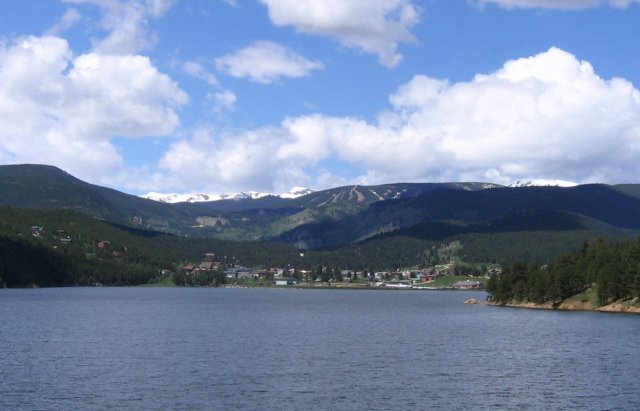
Looking ahead, there is a one-in-three chance that 2024 will be warmer than 2023 and a 99% chance that 2024 will rank among the top five warmest years.

Ocean Heat Content

Upper ocean heat contentโ€”the amount of heat stored in the top 2000 meters of the oceanโ€”was record high in 2023. Ocean heat content is a key climate indicator because the oceans store 90% of the excess heat in the Earth system. The indicator has been tracked globally since 1958, and there has been a steady upward trend since about 1970. The five highest values have all occurred in the last five years.

Snow Cover

Northern Hemisphere snow cover extent averaged 9.4 million square miles in 2023, which was slightly below average. Monthly extent ranged from 17.8 million square miles in January to just under 1.0 million square miles in August, both of which were below average. Snow cover extent records began in 1967.

Sea Ice Extent

Arctic sea ice extent averaged 4.05 million square miles in 2023, ranking among the 10 lowest years on record. The maximum extent in March was 5.64 million square miles, which ranked fifth lowest, while the minimum extent in September was 1.63 million square miles, which ranked sixth lowest. Sea ice extent records begin in 1979.

Antarctic sea ice extent averaged 3.79 million square miles in 2023, the lowest on record. The maximum extent in September was 6.55 million square miles, which was the lowest by a record margin. The minimum extent in February was 690,000 square miles, which set a record low for the second consecutive year.

Tropical Cyclones

Seventy-eight named storms occurred across the globe in 2023, which was below the 1991โ€“2020 average of 87.5. Forty-five of those reached tropical cyclone strength (โ‰ฅ74 mph), and 30 reached major tropical cyclone strength (โ‰ฅ111 mph). These also included seven storms that reached Category 5 (โ‰ฅ157 mph) on the Saffir-Simpson hurricane wind scale. The global accumulated cyclone energy (ACE) was about 8% above the 1991โ€“2020 average.

The North Atlantic had 20 named storms, which was much above the 1991โ€“2020 average of 14.4. Seven of those were hurricanes, including three major hurricanes. The ACE was about 18% above normal. Idalia was the only billion-dollar hurricane to impact the continental United States in 2023. Hurricane Lee was the strongest storm in the Atlantic in 2023 and the only Category 5 storm.

December 2023

Global surface temperature in December 2023 was 2.57ยฐF (1.43ยฐC) above the 20th-century averageโ€”the warmest December on record. For the ninth consecutive month, the global ocean surface was record warm. Regionally, North America and South America each had their warmest December on record.

Credit: NOAA

Northern Hemisphere snow cover extent in December ranked as the 11th-lowest December extent in the 58-year record. North America and Greenlandโ€™s combined extent was well below average, ranking as the third-smallest December on record. Eurasian snow cover extent for December was slightly above average.

Global average sea ice extent in December ranked as the second-lowest December extent in the 44-year record (after 2016). Arctic sea ice extent was 4.63 million square miles, the ninth-lowest December on record. Antarctic sea ice extent was 3.35 million square milesโ€”16% below average and the second lowest for December on record.

Three named tropical storms occurred across the globe in December, which is half of the long-term average. Jasper reached major tropical cyclone strength (โ‰ฅ111 mph). The global accumulated cyclone energy was less than 50% of the long-term average for December.

Where the world warmed the most in #Earthโ€™s hottest year [2023] — The Washington Post #ActOnClimate

In 2023, global surface temperature was 2.12ยฐF (1.18ยฐC) above the 20th-century average. This ranks as the highest global temperature in the period 1850โ€“2023, beating the next warmest year (2016) by a record-setting margin of 0.27ยฐF (0.15ยฐC). The 10 warmest years since 1850 have all occurred in the past decade. In 2023, global temperature exceeded the pre-industrial (1850โ€“1900) average by 2.43ยฐF (1.35ยฐC).

Click the link to read the article on The Washington Pose website (John Muyskens and Niko Kommenda). Here’s an excerpt:

Last year, more than 40 percent of the Earthโ€™s surface was at least 1.5 degrees Celsius (2.7 degrees Fahrenheit) warmer than in the late 1800s, a Washington Post analysis of temperature data released by the nonprofit Berkeley Earth found…Roughly one-fifth of the globe has already warmed by more than 2 degrees Celsius (3.6F) compared with the late 1800s, before humans started burning fossil fuels on a large scale. Around 5 percent of the planet has warmed more than 3 degrees Celsius (5.4F) โ€” a fast-warming area around the Arctic…Swaths of Canada and the northern U.S. saw temperatures at least 2 degrees Celsius above the preindustrial average, contributing to Canadaโ€™s worst ever recorded wildfire season…Brazil, Paraguay and Bolivia all experienced unusual temperature spikes in 2023 despite warming more slowly in recent decades, according to Berkeley Earth data…2023 saw record levels of heat in the oceans too.

Western Senators Say More Farm Bill Tools Are Needed to Cope With Long-Term #Drought — Progressive Farmer

US Drought Monitor map January 9, 2024.

Click the link to read the article on the Progressive Farmer website (Chis Clayton). Here’s an excerpt:

January 11, 2024

A bipartisan group of 16 U.S. senators representing ten western states on Thursday called on the leaders of the Senate Agriculture Committee to provide more resources to address long-term drought challenges in the region. The senators drafted the letter after conversations with Senate Ag committee staff have left them “concerned that drought provisions are at risk of not being included in the farm bill, a Senate staffer informed DTN…

Western farmers and ranchers need more resources to help conserve water, improve watershed scale planning, upgrade water infrastructure and protect the land from erosion. The farmers and ranchers in western states need a farm bill that provides support to conserve water, improve watershed scale planning, upgrade water infrastructure, protect land from erosion to help create more long-term resiliency to extreme drought conditions, the senators stated.

#Nebraska buys land in #Colorado to build a canal, but doubts remain about plans to divert water — KUNC #SouthPlatteRiver

Perkins County Canal Project Area. Credit: Nebraska Department of Natural Resources

Click the link to read the article on the KUNC website (Alex Hager). Here’s an excerpt:

January 11, 2024

Nebraska is moving forward with plans to build a canal that would redirect some South Platte River water out of Colorado. The state bought about 90 acres of land in Colorado as part of construction plans. The purchase marks an important step for the Perkins County canal project, since critics haveย questioned its feasibilityย from the start. The canal was first pitched in January 2022 by then-Governor Pete Ricketts as a way for Nebraska to protect its water supply against rapid development on Coloradoโ€™s Front Range. The plan would take advantage of a 1923 legal agreement about sharing the South Platte. The late-December land purchase is so far the only one Nebraska has made in conjunction with the canal project. The state spent about $90,000 on the parcel southeast of Julesburg. Jesse Bradley, the stateโ€™s deputy director of Natural Resources, said it could be used โ€œin conjunction with construction activitiesโ€ and may not contain the canal itself…

[Jim] Yahn detailed a few hurdles that could get in the way of the projectโ€™s completion. First, they might have trouble filling the canal with water in the first place. Some nearby Colorado reservoirs have legal priority over Nebraska water users, and because the bulk of the water would be moved during non-irrigation season, it could literally get frozen by wintertime temperatures on its way to Nebraska. Yahn, who formerly served as the Colorado Water Conservation Boardโ€™s director for the South Platte basin, also said Nebraska should be prepared to spend a lot of money in order to acquire land along the canalโ€™s path.

The South Platte River Basin is shaded in yellow. Source: Tom Cech, One World One Water Center, Metropolitan State University of Denver.

#Colorado #Climate Center: Expect a drier, warmer state: Report predicts higher temperatures and lower precipitation, especially in the Southwest and #SanLuisValley — @AlomosaCitizen #RioGrande #SanJuanRiver #ColoradoRiver #COriver #aridification

Click the link to read the article on the Alamosa Citizen website (Owen Woods):

January 13, 2024

Theย Colorado Climate Centerโ€™s reportย on the 2023 climate year and its outlook on the future of our climate and our snowpack, is full of data that shows a trend we all saw coming: the seasons are getting warmer, the melt-off is happening sooner, and most of all, the snowpack is decreasing year after year.ย 

Coloradoโ€™s average temperature, season after season, since 1980 has increased by an average of 2.3 degrees. The winter has seen a 1.0 degree increase; spring has increased by 1.7 degrees; summer at 2.5 degrees; and autumn has seen an increase in temperature by 3.1 degrees.

โ€œAnnually,โ€ the report says, โ€œthe greatest warming has been observed over the Southwest and San Luis Valley climate regions.โ€

The seven of the 10 hottest years on record have occurred since 2010. The rise in temperature means a reduced snowpack. Nothing is more of a key indicator for the health and wellness of Colorado than its snowpack. 

Snowpack serves as a seasonal reservoir that stores upwards of 15 million acre-feet, on average, across the state. Colorado is a โ€œheadwaters state,โ€ which means that four major rivers have their headwaters right here: the Colorado River, the Rio Grande, the Arkansas River and the Platte River. 

Precipitation from snow is more likely to end up as runoff than precipitation from rain. 

Credit: Climate Change in Colorado: A Report for the Water Conservation Board, Executive Summary

The 21st century record, which ranges from 2001 to 2022, showed an average of three percentto 23 percent lower snow water equivalent on April 1 than the 1951 to 2000 average. 

Snow water equivalent (SWE) is the amount of water you get if you melted the snow down and were able to measure what was left. These measurements are more accurate than snowfall or snow depth, because those measurements donโ€™t always account for a wide array of snow densities. 

โ€œThe largest decreases occurred in the southwestern portion of the state, specifically in the San Juan and Rio Grande basins.โ€

Credit: Climate Change in Colorado: A Report for the Water Conservation Board, Executive Summary

Projections show a negative five percent to negative thirty percent measure of snow water equivalent by the year 2050. April 1 to May 15 is historically when true mountain runoff starts to occur with a change in temperature, but projections show that by 2050 that date will shift earlier by a few days then to a few weeks. 

The 114 SNOTEL sites that give us this information are mostly situated between 8,500 feet and 11,000 feet elevation, and report data every hour. They are all monitored by the National Resource Conservation Service. 

Studies showed that snowpack has decreased in many of Coloradoโ€™s major river basins; however the percentage of decline when compared to other Mountain West regions was โ€œgenerally smallerโ€ due to Coloradoโ€™s higher elevations and colder winters.

โ€œThese studies also found that warming temperatures were an important cause of the observed SWE declines, while below-normal fall and spring precipitation in the past few decades has also played a role.โ€

Credit: Climate Change in Colorado: A Report for the Water Conservation Board, Executive Summary

Although larger snowpacks have become less common, big snowfall years like 2019 can and will occur. 

Severe droughts are projected to increase, as well. โ€œRegardless of changes in precipitation, it is likely that warmer temperatures will contribute to more frequent and severe droughts. Warmer temperatures will also decrease the benefit of wetter years.โ€

โ€œSouthwestern and South-central Colorado have experienced the largest magnitude

of warming.โ€ฏ The observed warming trend in Colorado is strongly linked to the overall human influence on climate and recent global warming.โ€

Over the next several decades, the report suggests, further and significant warming is expected in all parts of Colorado, in all seasons. 


KEY REPORT FINDINGS

Temperature

  • Statewide annual average temperatures warmed by 2.3ยฐF from 1980 to 2022.
  • Only one year in the 21st century has been cooler than the 1971-2000 average. 2012 remains the stateโ€™s warmest year in the 128-year record, at 48.3ยฐF (3.2ยฐF warmer than the 1971-2000 average).
  • The greatest amount of warming has occurred in the fall, with statewide temperatures increasing by 3.1ยฐF from 1980-2022.
  • Southwestern and South-central Colorado have experienced the largest magnitude of warming.
  • The observed warming trend in Colorado is strongly linked to the overall human influence on climate and recent global warming. The observed warming over the last 20 years is comparable to what was projected by earlier climate models run in the 2000s.
  • Further and significant warming is expected in all parts of Colorado, in all seasons, over the next several decades.
  • By 2050 (the 2035-2064 period average), Colorado statewide annual temperatures are projected to warm by +2.5ยฐF to +5.5ยฐF compared to a 1971-2000 baseline, and +1.0ยฐF to +4.0ยฐF compared to today, under a medium-low emissions scenario (RCP4.5).
  • By 2070 (the 2055-2084 period average), Colorado statewide annual temperatures are projected to warm by +3.0ยฐF to +6.5ยฐF compared to the late 20th century, and +1.5ยฐF to +5.0ยฐF compared to today, under RCP4.5.
  • By 2050, the average year is likely to be as warm as the very warmest years on record through 2022. By 2070, the average year is likely to be warmer than the very warmest years through 2022.
  • Summer and fall are projected to warm slightly more than winter and spring.

Precipitation

  • Colorado has observed persistent dry conditions in the 21st century. According to water year precipitation accumulations, October 1 โ€“ September 30, four of the five driest years in the 128-year record have occurred since 2000.
  • Drying trends have been observed across the majority of the state during the spring, summer, and fall seasons.
  • Northwest Colorado summer precipitation has decreased 20% since the 1951-2000 period.
  • Southwest Colorado spring precipitation has decreased 22% since the 1951-2000 period.
  • Precipitation is slightly more favorable over the northern mountains during a La Niรฑa winter. For most regions and the remaining seasons, wetter conditions are slightly enhanced during an El Niรฑo.
  • The direction of future change in annual statewide precipitation for Colorado is much less clear than for temperature. The climate model projections for 2050 range from -7% to +7% compared to the late 20th century average, under a medium-low (RCP4.5) emissions scenario.
  • The model projections for precipitation change by 2070 are very similar to those for 2050.
  • Most climate models project an increase in winter (Dec-Feb) statewide precipitation; the model consensus is weaker for the other seasons. The models do suggest enhanced potential for large decreases (-10% to -25%) in summer precipitation.

#LakePowell Is Still in Trouble. Hereโ€™s Whatโ€™s Good and Whatโ€™s Alarming About the Current Water Level: Low water puts a hydropower plant at risk and highlights volatility for an important form of clean energy — Inside #Climate News #ColoradoRiver #COriver #aridification

“New plot using the nClimGrid data, which is a better source than PRISM for long-term trends. Of course, the combined reservoir contents increase from last year, but the increase is less than 2011 and looks puny compared to the โ€˜holeโ€™ in the reservoirs. The blue Loess lines subtly change. Last year those lines ended pointing downwards. This year they end flat-ish. 2023 temps were still above the 20th century average, although close. Another interesting aspect is that the 20C Mean and 21C Mean lines on the individual plots really donโ€™t change much. Finally, the 2023 Natural Flows are almost exactly equal to 2019. (17.678 maf vs 17.672 maf). For all the hoopla about how this was record-setting year, the fact is that this year was significantly less than 2011 (20.159 maf) and no different than 2019” — Brad Udall

Click the link to read the article on the Inside Climate News website (Dan Gearino):

January 11, 2024

What do you call a situation that remains a crisis, but has ever so slightly improved?

Iโ€™m asking myself this as I look at the latest water level data for Lake Powell, the reservoir in Arizona and Utah that feeds the Glen Canyon hydropower plant and is a conduit for drinking water for parts of several states.

The level on Monday was 3,568 feet above sea level, according to the Bureau of Reclamation, the federal agency that manages the reservoir and the power plant.

On the same day last year, the water was at 3,525 feetโ€”a difference of 43 feet. That was close to the reservoirโ€™s lowest level since it was initially being filled in the 1960s.

Both the current level and last yearโ€™s are much lower than is optimal, following years of drought and overallocation of the reservoirโ€™s water. But officials have some breathing room thanks to last yearโ€™s wet winter, which led to an above average, and in some areas, record snowpack that helped replenish some of what had been lost.

โ€œWeโ€™ve kind of been digging ourselves out of a hole,โ€ said Bart Miller, the healthy rivers director at Western Resource Advocates, a conservation nonprofit based in Boulder, Colorado. โ€œThe one wet year that we had is only getting a part of the way there โ€ฆ We still have a lot of work to do to put our demands for water back into balance with what the river provides.โ€

Heโ€™s talking about the Colorado River, which passes through Lake Powell. The Colorado River Basin is a source of water and hydropower for about 40 million Americans.

But this brief reprieve may soon be done because of low precipitation in recent months. The Bureau of Reclamation has noted the lack of rain and snow and last month reduced its estimate for how much water would flow into the lake in 2024. To give a sense of the scale of the problem, snowpack in the Upper Colorado River Basin was at 65 percent of normal this week.

The lake and its 1,320-megawatt power plant get a lot of attention because of their importance to millions of water and electricity consumers, and because the water level has gotten perilously close to shutting off the flow to the power plant.

Lake Powell key elevations. Credit: Reclamation

If the level falls to 3,490 feetโ€”78 feet below this weekโ€™s readingโ€”water will be too low to spin the turbines that generate electricity.

If the level falls to 3,370 feetโ€”198 feet below this weekโ€™s readingโ€”it would reach โ€œdead poolโ€ status, when the water is too low to flow downstream from the dam. The results would be catastrophic for communities south of the dam, as David Dudley explained last year in Sierra magazine.

The Bureau of Reclamation does regular forecasts to have an idea of these risks. A report issued in August projects that there is essentially a zero percent chance that the power plant will be forced offline this year, but a 3 percent chance the water level will drop enough to force a shutoff in 2028.

Lake Powell is one several prominent examples of water resources that are at risk because of drought that climate change has exacerbated and the overallocation of the Colorado River. Downriver is another example, Lake Mead, whose low water levels have led to heightened concerns about the Hoover Dam power plant, as Rhiannon Saegert wrote for the Las Vegas Sun in August.

The Biden administration is working with states that rely on the Colorado River to find ways to conserve water and maintain adequate flow through Lake Powell and Lake Mead. The administration revised the operating guidelines for the lakes in April, including measures to better give notice to operators of irrigation systems and water utilities about water delivery reductions, and giving the Bureau of Reclamation more flexibility to conserve and store water.

โ€œFailure is not an option,โ€ said Tommy Beaudreau, who was then deputy secretary of the Interior, in an April statement.

Hydroelectric Dam

Letโ€™s take a few steps back. Hydropower plants have long been some of the most reliable sources of carbon-free electricity. The country gets 6 percent of its electricity from hydropower, which is more than any other utility-scale renewable source except for wind.

But drought and other extreme weather events are making hydropower increasingly volatile. The ups and downs show up in national figures; 2021 and 2022 were two of the three lowest years for hydropower generation since 2010, according to the Energy Information Administration. (This doesnโ€™t include 2023, for which full-year records are not yet available.)

The shifts look ever more drastic at the state level.

From October 2022 to September 2023, hydropower generation in Washington Stateโ€”the national leader in hydropowerโ€”was down 23 percent compared to the previous 12-month period.

In that same timeframe, California increased its hydropower generation by 72 percent.

Credit: Inside Climate News

The โ€œwhyโ€ comes down to local factors such as drought or recovery from drought. For grid operators, the takeaway is that hydropower isnโ€™t as steady as it used to be.

There also is a growing view among environmental and justice advocates that hydropower has harmful effects on plants and animals, and can lead to an increase in methane emissions. And, construction of reservoirs has often displaced Indigenous communities.

Some of those advocates, with support from farmers, are saying the Colorado River should be allowed to flow freely through the area where the Glen Canyon Dam now stands in order to improve the availability of water south of the dam, among other benefits. Ian James of the Los Angeles Times wrote about this in September.

While the idea doesnโ€™t have widespread support, itโ€™s not being dismissed in the way it might have been a decade ago, when the problems with the dam were less apparent.

Federal officials have resources to prepare for declining water levels on Lake Powell, but they are dealing with symptoms of larger problems: climate change and a demand for water that exceeds a shrinking supply.

For now, the news is better than it was last year at this time, but Miller isnโ€™t treating this like a victory.

โ€œWe havenโ€™t solved the problem,โ€ he said. โ€œWeโ€™re still in this place where we need to do a lot of work.โ€

Storm brings needed snowfall — The #PagosaSprings Sun #snowpack #SanJuanRiver #ColoradoRIver #COriver #aridification

Upper San Juan Basin SWE January 14, 2024 via the NRCS.

Click the link to read the article on the Pagosa Springs Sun website (Hailey Sams). Here’s an excerpt:

January 11, 2024

Sites in Archuleta County received more than a foot of snow from the weekendโ€™s storm. As of Thursday, Jan. 4, Archuleta County had received around 2 inches of snow and Wolf Creek Ski Area had received 3 inches. Saturday night and Sunday brought the biggest snowstorm of the season, accumulating between 7 and 14 inches in areas of Archuleta County, according to the Community Collaborative Rain, Hail and Snow Network (CoCoRaHS) website. Wolf Creek Ski Area reported 29 inches in a report on Jan. 8…

According to snoflo.org, the Wolf Creek summit, at an elevation of 11,000 feet, had a 48-inch snowpack (84 percent of normal), up from 56 percent of normal on Jan. 3. The website reports that it is low for this time of year. According to the Natural Resources Conservation Service, on Jan. 4, the Wolf Creek summit had 28 inches of snow and 7.8 inches of snow water equivalent. As of Jan. 9, the agency reports 51 inches of snow and a snow water equivalent of 9.6 inches.

Hot Takes on a warming world — Jonathan P. Thompson (@Land_Desk)

North of Dove Creek, Abajo Mountains in the distance. Photo credit: Jonathan P. Thompson/The Land Desk

Click the link to read the article on The Land Desk website (Jonathan P. Thompson):

January 12, 2024

According to the myriad press releases I receive from the industrial self-care complex, we are in the thick of January Blues season โ€” the downtime that follows the month of consumerism, er, the holidays. I donโ€™t know about that, but I do know that olโ€™ Mother Snow must be feeling a little blue about the news these days. 

Sure, it finally snowed a fair amount in the Four Corners region, blanketing high and even lowlands with white, slicking up the roads, and freshening up the slopes.

In Durango, enough snow accumulated to allow nordic skiing at the Hillcrest golf course, my favorite winter health indicator. And, because the new snow fell on a weak, faceted base layer, it elevated avalanche hazard in some areas, including at the Palisades Tahoe ski resort in eastern California.

Placer County Sheriffโ€™s Office on Instagram: โ€œOLYMPIC VALLEY, Calif. — At approximately 9:30 a.m. today at Palisades Tahoe, an avalanche occurred on the Palisades side of the ski resort, specifically above the GS bowl area of KT-22. Olympic Valley Fire Department responded to Palisades Tahoe for word of an avalanche in the ski area. OVFD contacted ski patrol, who confirmed an avalanche in the GS Bowl of KT 22. OVFD began recruiting allied agencies and pooling resources in support of Palisades Ski Patrol efforts: OVFD, PCSO, and Palisades Tahoe. Placer County Sheriffโ€™s Office assisted Olympic Valley Fire and Palisades Tahoe with the search and rescue operation. Tahoe Nordic Search and Rescue was activated along with allied agency partners and assets from the west side. PCSO is investigating the coronerโ€™s case. The avalanche caused one fatality and one injury. Our thoughts and prayers are with their family members at this difficult time. No further missing persons have been reported. More than 100 Palisades personnel participated in a beacon search, and two probe lines have been completed. The mountain is closed for the remainder of the day. The avalanche debris field is approximately 150 feet wide, 450 feet long and 10 feet deep. We will update with more information as it becomes available. A press conference will be scheduled at 2:30 p.m. at Basecamp at Palisades Tahoe. WHAT: Palisades Tahoe avalanche incident press conference WHO: Olympic Valley Fire Department Chief Brad Chisholm, Placer County Sheriffโ€™s Office Sgt. Dave Smith, Placer County Sheriffโ€™s Office Lt. Don Nevins, Placer County District 5 Supervisor Cindy Gustafson WHERE: Palisades Tahoe, Basecamp Conference Room, 1960 Olympic Vly Rd, Olympic Valley, CA 96146 WHEN: Wednesday, Jan. 10, 2:30 p.m. #palisadestahoe #olympicvalleyโ€ JANUARY 12, 2024

And yet, it will take a constant barrage of such storms to pull much of the West out of the snow drought. Even if that does happen (and itโ€™s still possible), the science is indicating that the winters we once knew are a thing of the past, and the snowpack โ€” and water supplies โ€” will keep getting thinner, on average, with each passing decade. So here are the hot takes on the hot world:

Itโ€™s now official: 2023 was the planetโ€™s hottest year on record (going back to 1850). Thatโ€™s according to the Copernicus Climate Change Service, which keeps tracks of this sort of thing. It was also the โ€œfirst time on record that every day within a year has exceeded 1ยฐC above the 1850-1900 pre-industrial level.โ€ Some days in November were even 2 ยฐC above the pre-industrial level. Yikes.

Earth was record warm in 2023.

The U.S. didnโ€™t experience its hottest year ever, but it was warmer than average(especially from July onward). The Western side of the country actually had it a bit better than Texas and the East; we were merely โ€œabove averageโ€ for the year. Balancing it out, much of the West also got above average precipitation. Unfortunately the Four Corners, after a bountiful winter, got robbed of the big monsoon come summer, bringing levels down to average and even below that in New Mexico, where the drought persists. December was especially warm and dry across most of the West and was even the hottest December ever in the Upper Midwest and Northern Rockies.

Overnight, minimum temperatures keep getting warmer, even more so than the maximum daytime highs. Source: NOAA

And a warm and dry December brings the January snowpack blues to the mountains that feed the Colorado River. The 130 SNOTEL stations in the Upper Colorado River Basin are recording a snowpack on a par with the dismally dry 2021 winter, which brought Lake Powell down to crisis levels. The snowpack is even thinner than it was on this date in 2002. Ack! Still, check out the trajectory for 2023: After an average beginning, winter really took off from January into about mid-April. So thereโ€™s still time for a recovery. Really.

Overnight, minimum temperatures keep getting warmer, even more so than the maximum daytime highs. Source: NOAA

That aligns with the findings of a new peer-reviewed study recently published in Nature, showing that human-caused warming has been shrinking mountain snowpacks globally since at least 1981. The findings are nuanced: The shrinkage isnโ€™t happening everywhere (colder areas are less vulnerable to the rising temperatures, so far), itโ€™s happening at different rates in different places, and it isnโ€™t always attributable to human-caused global warming. In fact, while the Rio Grande has โ€œsuffered large historical snowpack declines of over 10% per decade โ€ฆ there is little agreement that forced temperature and precipitation changes have caused those declines, reinforcing the notion that low-frequency variability can overwhelm forced signals in snow and hydroclimate, even on multidecadal timescales.โ€ The Colorado River Basinโ€™s snowpack has also shrunk at a rapid rate, and in that case the authors did find a link to anthropogenic global warming. And because of the nonlinear sensitivity of snow to warming, the future may be even less snowy. Iโ€™ll let the authors explain:

Under Shared Socioeconomic Pathway (SSP) 2โ€“4.5, a โ€˜middle-of-the-roadโ€™ emissions scenario, the most highly populated basins are expected to see strong declines in spring runoff as a result of nonlinear snow loss, even in the face of relatively modest warming projected in those regions. The western USA, for example, is poised to see particularly sharp spring runoff declines in the upper Mississippi (84โ€‰million people, 30.2% spring runoff decline), Colorado (14โ€‰million, 42.2%), Columbia (8.8โ€‰million, 32.7%) and San Joaquin (6.8โ€‰million, 40.9%) river basins.

And, yes, Coloradoโ€™s snows and streamflows will be a victim of this same phenomenon, according to the latest climate change report for the Colorado Water Conservation Board. The report finds:

  • Statewide annual average temperatures warmed by 2.3ยฐF from 1980-2022 โ€” with a strong link to human influence on climate โ€” with the greatest warming occurring in the south-central and southwestern parts of the state, and during the fall.
  • By 2050 statewide temperatures are projected to warm by 2.5ยฐF to 5.5ยฐF compared to the 1971 baseline, making the average year in the 2050s and beyond warmer than the hottest years on record now. 
  • Precipitation has decreased 22% in southwestern Colorado and 20% in northwestern Colorado since the 1951-2000 period, but the future trends are less clear than temperatures โ€” precipitation may even increase by as much as 7%, with the largest gains during winter, though more of it is likely to fall as rain. 
  • Snowpack has also decreased and future warming likely will lead to further reductions, even if precipitation increases, and the seasonal snowpack peak is projected to shift earlier by as much as several weeks by 2050, which could be accelerated by increased dust-on-snow events.
April 1st snowpack by major river basin. Credit: The Land Desk
  • A shrinking snowpack and earlier runoff will further diminish streamflows. 
  • Soil moisture has generally been on the decline in high-elevations since 1980 and future warming is expected to lead to future decreases in summer soil moisture, which can, in turn, exacerbate warming. 
  • Warming has driven greater evaporative demand โ€” or atmospheric thirst โ€” over the last four decades, this means crops will need more irrigation to thrive, increasing water consumption even as water supplies dwindle.
Potentail Evapotraspiration (PET) 1980-2022. Credit: The Land Desk

Well, if you didnโ€™t already have the January Blues (or didnโ€™t even know such a malady existed), you just might have them now. Iโ€™m sorry, but it will help to go up to the golf course and do some nordic skiing, I promise. And for more on the Colorado climate report read Heather Sackettโ€™s excellent piece for Aspen Journalism.

Five Factors to Explain the Record Heat in 2023 — NASA Earth Observatory

Earth was record warm in 2023. Credit: NASA Earth Observatory

Click the link to read the article on the NASA Earth Observatory website:

NASA announced that 2023 was the hottest year on record, according to an analysis of annual global average temperatures by the Goddard Institute for Space Studies. Scientists who maintain the temperature record, which begins in 1880, calculate a global temperature anomaly each year to determine how much temperatures have changed compared to temperatures from 1951โ€“1980.

Every month from June through December 2023 came in as the hottest month on record. July ranked as the hottest month ever recorded.

But what caused 2023, especially the second half of it, to be so hot? Scientists asked themselves this same question. Here is a breakdown of primary factors that scientists considered to explain the record-breaking heat.

The long-term rise in greenhouse gases is the primary driver.

For more than 100 years, humans have been burning fossil fuels such as coal, gas, and oil to power everything from lightbulbs and cars to factories and cities. These actions, along with changes in land use, have led to a rise in greenhouse gases in the atmosphere.ย Greenhouse gasesย act like a blanket trapping heat around the planet. The more of them you add, the thicker that blanket becomes, further heating Earth.

Carbon Dioxide swirling around the Earth. Credit: NASA Earth Observatory

In May 2023, carbon dioxide concentrations in the atmosphere peaked at 424 parts per million at NOAAโ€™s Mauna Loa Observatory, Hawaii. The annual peak has been steadily rising since measurements began in 1958. (Other global carbon measurement projects showed similarly high numbers.) Extending the record back even further with ice cores, carbon dioxide concentrations are the highest they have been in at least 800,000 years.

โ€œWeโ€™re going to continue to have records be broken because the baseline temperature is moving up all the time,โ€ said Gavin Schmidt, director of NASAโ€™s Goddard Institute for Space Studies in New York City. โ€œThe cause of that warming trend over the last 50 to 60 years is dominated by our changes to greenhouse gases, particularly carbon dioxide and methane.โ€

The return of El Niรฑo added to the heat.

On top of the long-term global warming trend are natural variations in the climate. One of the largest sources of such year-to-year variability is the El Niรฑo Southern Oscillation (ENSO), which occurs in the tropical Pacific.

June 1 – 10, 2023. Credit: NASA Earth Observatory
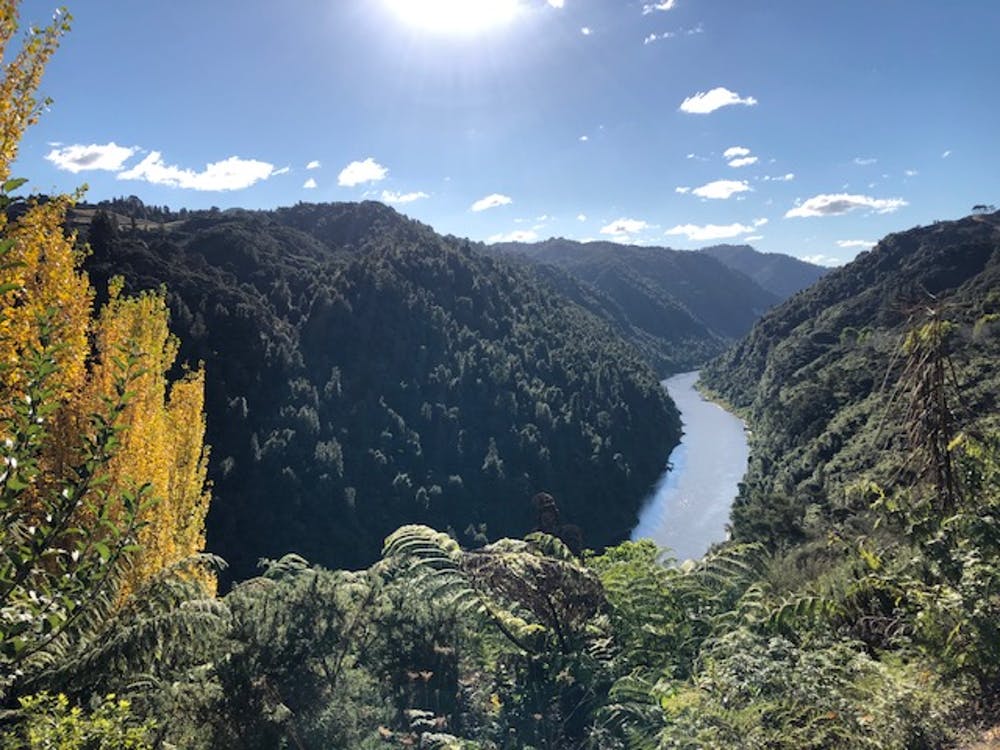
ENSO transitions between three phases: El Niรฑo, La Niรฑa, and neutral, or average. During El Niรฑo, trade winds weaken; that is, winds that normally blow from east to west in the tropical Pacific weaken. The sea surface around the equator in the central and eastern Pacific near South America also becomes warmer (and higher) than normal. El Niรฑo often coincides with the warmest years in the global average.

During La Niรฑa, the opposite happens: the trade winds strengthen and the sea surface temperatures in the eastern Pacific are cooler than normal. This can help offset some of the rising temperatures from long-term global warming.

From 2020โ€“2022, the Pacific saw three years of La Niรฑa conditions. Then El Niรฑo returnedbeginning in May 2023. This El Niรฑo has not yet been as strong as those in 2015โ€“2016 or 1997โ€“1998, both of which caused large global average temperature spikes. However, when you add this ocean warming to the long-term warming trend from greenhouse gases, the start of El Niรฑo helped temperatures jump enough to create a new record for heat.

โ€œFor the most part, itโ€™s us and El Niรฑo,โ€ said Josh Willis, a climate scientist at NASAโ€™s Jet Propulsion Laboratory. โ€œAt the end of the day, humans are heating the planet, and El Niรฑo is dancing on our heads.โ€

Globally, long-term ocean warming and hotter-than-normal sea surface temperatures played a part.

Looking more broadly, the tropical Pacific wasnโ€™t the only part of the ocean that was hotter than normal this year. The global sea surface temperatureย set new records in 2023, with the North Atlantic and other parts of the ocean experiencing several marine heat waves.

August 21, 2023. Credit: NASA Earth Observatory

โ€œJust like global temperatures, ocean temperatures are on the rise,โ€ said Willis. โ€œThey have been rising for the last century or more, and they are not slowing down. If anything, they are speeding up.โ€

Whatโ€™s behind the rise in ocean temperatures? Greenhouse gases warming the planet. Around 90 percent of the heat trapped by rising greenhouse gases is absorbed by the ocean. That means that as greenhouse gases continue to increase, so will ocean temperatures, which raises temperatures across the globe.

Aerosols are decreasing, so they are no longer slowing the rise in temperatures.

Another global trend that scientists are monitoring is a change in aerosols in the atmosphere.ย Aerosolsย are small particles in the airโ€”such as smoke, dust, volcanic gases, sea spray, air pollution or sootโ€”that canย impact the climate. Airborne particles can either reflect sunlight, causing a slight cooling of the air, or absorb sunlight, causing a slight warming of it.

June 26, 2023. Credit: NASA Earth Observatory

As governments have passed regulations to reduce air pollution and improve air quality, the abundance of aerosols has been decreasing in most areas. Many of these human-produced particles are the type that cool the climate slightly, so with less of them in the air, the result is a slight warming effect. But this contribution is quite small in comparison to the much greater warming from rising greenhouse gases.

Scientists at NASA and around the world are investigating how a reduction in aerosols from new shipping regulations potentially change how much solar energy is reflected back into space. While these changes can be notable on regional scales, the global impact is likely small, Schmidt said.

Scientists found that the Hunga Tonga-Hunga Haโ€˜apai volcanic eruption did not substantially add to the record heat.

In January 2022, the eruption of the Hunga Tonga-Hunga Haโ€˜apai undersea volcano blasted an unprecedented amount of water vapor and fine particles, or aerosols, into the stratosphere. Water vapor, a greenhouse gas, can produce a warming effect on the atmosphere, so scientists investigated the impact of the eruption on the global temperature.ย Sulfate aerosols from eruptions, on the other hand, have sometimes led to some global cooling events.

Hunga Tonga-Hunga Haโ€˜apai volcanic eruption. Credit: NASA Earth Observatory

recent study found that the volcanic sulfate aerosols reflected some sunlight away from Earthโ€™s surface, leading to a slight cooling of less than 0.1 degrees in the southern hemisphere following the eruption. Essentially, the warming that occurred from the increase in water vapor in the stratosphere was offset by the cooling caused by volcanic sulfate aerosols leading to a slight cooling lower in the atmosphere. This means the eruption likely did not add to the record heat in 2023.

โ€œWe are very interested in the weather and extremes of any particular year because those are the things that impact us,โ€ said Schmidt. โ€œBut the key difference between this decade and the ones before is that the temperatures keep rising because of our activities, principally the burning of fossil fuels.โ€

NASA Earth Observatory map (top) by Lauren Dauphin, based on data from the NASAย Goddard Institute for Space Studies.ย Carbon dioxide animationย by Helen-Nicole Kostis, NASAโ€™s Scientific Visualization Studio.ย Sea surface height anomaly mapย by Lauren Dauphin, using modified Copernicus Sentinel data (2023) processed by the European Space Agency and further processed by Josh Willis, Severin Fournier, and Kevin Marlis/NASA/JPL-Caltech.ย Sea surface temperature anomaly mapย by Lauren Dauphin, using data from the Multiscale Ultrahigh Resolution (MUR) project.ย Wildland fire smoke imageย by Lauren Dauphin, using Terra MODIS data from NASA EOSDISย LANCEย andย GIBS/Worldview.ย Eruption imageย courtesy of NOAA and theย National Environmental Satellite, Data, and Information Serviceย (NESDIS). Story by Angela Colbert (NASA JPL), with Sally Younger (NASA JPL).

References & Resources

Understanding Water Supply Forecast Error on the #ColoradoRiver — NOAA #COriver #aridification

The current water level of Lake Mead behind the Hoover Dam July 2023. Photo credit: Reclamation

Click the link to read the article on the NOAA website (Peter Goble, Russ Schumacher):

January 9, 2024

The Colorado River is perhaps the most critical resource to the southwestern United States, providing water to over 40 million people. In an average year, over half of this water comes from western Colorado, primarily in the form of snowmelt when high-elevation seasonal snowpack dissipates in the spring.

The Colorado River has been managed with a large series of reservoirs. Seasonal water supply forecasts made by agencies like the Colorado Basin River Forecast Center (CBRFC) and the National Resources Conservation Service (NRCS) using data from high-elevation Snowpack Telemetry (SNOTEL) stations offer water managers insight into how much water to expect each year. These forecasts allow for less uncertainty and better management of these important reservoirs. 

However, 2020 and 2021 were low water supply years, much lower than one would expect based on snowpack values alone. Researchers from the Colorado Climate Center questioned whether very low, if not record low, soil moisture levels at high elevation were causing a smaller fraction of snowmelt to runoff than in a normal year, and further,  whether these conditions are likely to occur more frequently in a warmer climate. โ€œOn the Sources of Water Supply Forecast Error in Western Coloradoโ€ is the result of a research project funded by NOAAโ€™s National Integrated Drought Information System (NIDIS) to explore this question.

The research team created hindcasts of Aprilโ€“August streamflows using SNOTEL snowpack and precipitation data from 1981โ€“2021, inputting modeled soil moisture and groundwater data to predict streamflow. In this case, โ€œhindcastโ€ refers to a prediction of streamflow in a previous subset of years using a statistical model that was trained based on a separate subset of years. In this way, the researchers mimicked an actual water supply forecasting environment without including the known answer into the model (See the AMS article for a more detailed explanation of the methods).

The researchers paid special attention to hindcasts using the data available on April 1. April 1 is near peak snowpack season, and these numbers have historically been used as a benchmark for how much water to expect in the coming spring. In 2021, for instance, adding soil moisture data from the Western Land Data Assimilation Systemโ€™s km resolution land surface model reduced April 1 streamflow hindcast in all four major basins, and lowered hindcast error across the board. 

Results indicate that a much larger fraction of the error in the hindcast is attributable to the weather that occurs after April 1 and 2021 was no exception. While antecedent soil moisture conditions were record-low in western Colorado, 2021 also had a much drier-than-normal spring for western Colorado with a record dry April. This was not well predicted or incorporated in operational streamflow forecasts. April 1 numbers do not tell the whole story, because what happens before the snowpack season, and what happens from April 1 through early June, also have a marked impact on the yearโ€™s water supply. 

The findings from this study are important because they establish a ceiling for how skillful we can expect water supply forecasts to be without significant, successful investments in sub-seasonal to seasonal forecasting over the Intermountain West. Soil moisture data can be implemented more effectively in the future and incrementally lower water supply forecast error for this crucial region. However, with time, larger-scale errors in sub-seasonal to seasonal prediction will need to be addressed to create a consistently accurate forecast of water supplies.